
Dear Freesurfer Experts,
I have run my participants' longitudinal sMRI data through the preprocessing longitudinal pipeline, ran the LME multivariate analysis, cluster-thresholded the data, and am now trying to visualize those results in Freeview (for some reason tksurfer is very, very slow to run on my computer). I am interested in the Fs volume (thickness*area) measure.
I noticed in the FsFast Tutorial https://surfer.nmr.mgh.harvard.edu/fswiki/FsFastTutorialV5.1/FsFastGroupLevel, that all the corrected results were able to be merged into one file using the vlrmerge command. In the beginning of the tutorial, it states that fMRI and structuraI group analyses run similarly. * I was therefore wondering if I can use the vlrmerge command (or some similar command) for my LME data, such that I can view the following information all in one file: both hemispheres, aparc and aseg. * Currently I can only view the aparc results for each of the hemispheres separately (and I haven't found a way to visualize the aseg data).
Thank you for taking the time to read this email.
Best,
Jennifer Legault Ph.D candidate, Neuroscience Brain, Language, and Computation Lab The Pennsylvania State University

You can put surface data back into the volume with mri_surf2vol (which will also merge left and right into one volume). What do you do with the aseg data?
On 04/01/2016 10:46 AM, Jennifer Legault wrote:
Dear Freesurfer Experts,
I have run my participants' longitudinal sMRI data through the preprocessing longitudinal pipeline, ran the LME multivariate analysis, cluster-thresholded the data, and am now trying to visualize those results in Freeview (for some reason tksurfer is very, very slow to run on my computer). I am interested in the Fs volume (thickness*area) measure.
I noticed in the FsFast Tutorial https://surfer.nmr.mgh.harvard.edu/fswiki/FsFastTutorialV5.1/FsFastGroupLevel, that all the corrected results were able to be merged into one file using the vlrmerge command. In the beginning of the tutorial, it states that fMRI and structuraI group analyses run similarly. / I was therefore wondering if I can use the vlrmerge command (or some similar command) for my LME data, such that I can view the following information all in one file: both hemispheres, aparc and aseg. / Currently I can only view the aparc results for each of the hemispheres separately (and I haven't found a way to visualize the aseg data).
Thank you for taking the time to read this email.
Best,
Jennifer Legault Ph.D candidate, Neuroscience Brain, Language, and Computation Lab The Pennsylvania State University
Freesurfer mailing list Freesurfer@nmr.mgh.harvard.edu https://mail.nmr.mgh.harvard.edu/mailman/listinfo/freesurfer

Hi Doug,
Thanks for your quick response! When running the LME mass univariate analysis, I am assuming this also includes subcortical structures, correct? From my understanding, subcortical areas are segmented as opposed to parcellated. The main thing I want to examine all the regions of the brain that might change over time (as a function of the training task I've given my participants), so I would look at both the aparc and the aseg data, right? Apologies if I've misunderstood your question. For the aseg data, I am currently having trouble with figuring out how to cluster threshold the data (do i use mri_surfcluster with an argument to call the aseg annotation or do I use mri_volcluster?) I would then want to visualize the cluster thresholded data for subcortical structures in freeview. Optimally, I would like to find some way to look at the whole brain in Freeview to see these regions that have changed as a function of my training task.
Best,
Jen
On Fri, Apr 1, 2016 at 11:23 AM, Douglas N Greve greve@nmr.mgh.harvard.edu wrote:
You can put surface data back into the volume with mri_surf2vol (which will also merge left and right into one volume). What do you do with the aseg data?
On 04/01/2016 10:46 AM, Jennifer Legault wrote:
Dear Freesurfer Experts,
I have run my participants' longitudinal sMRI data through the preprocessing longitudinal pipeline, ran the LME multivariate analysis, cluster-thresholded the data, and am now trying to visualize those results in Freeview (for some reason tksurfer is very, very slow to run on my computer). I am interested in the Fs volume (thickness*area) measure.
I noticed in the FsFast Tutorial <
https://surfer.nmr.mgh.harvard.edu/fswiki/FsFastTutorialV5.1/FsFastGroupLeve...
, that all the corrected results were able to be merged into one file using the vlrmerge command. In the beginning of the tutorial, it states that fMRI and structuraI group analyses run similarly. / I was therefore wondering if I can use the vlrmerge command (or some similar command) for my LME data, such that I can view the following information all in one file: both hemispheres, aparc and aseg. / Currently I can only view the aparc results for each of the hemispheres separately (and I haven't found a way to visualize the aseg data).
Thank you for taking the time to read this email.
Best,
Jennifer Legault Ph.D candidate, Neuroscience Brain, Language, and Computation Lab The Pennsylvania State University
Freesurfer mailing list Freesurfer@nmr.mgh.harvard.edu https://mail.nmr.mgh.harvard.edu/mailman/listinfo/freesurfer
-- Douglas N. Greve, Ph.D. MGH-NMR Center greve@nmr.mgh.harvard.edu Phone Number: 617-724-2358 Fax: 617-726-7422
Bugs: surfer.nmr.mgh.harvard.edu/fswiki/BugReporting FileDrop: https://gate.nmr.mgh.harvard.edu/filedrop2 www.nmr.mgh.harvard.edu/facility/filedrop/index.html Outgoing: ftp://surfer.nmr.mgh.harvard.edu/transfer/outgoing/flat/greve/
Freesurfer mailing list Freesurfer@nmr.mgh.harvard.edu https://mail.nmr.mgh.harvard.edu/mailman/listinfo/freesurfer
The information in this e-mail is intended only for the person to whom it is addressed. If you believe this e-mail was sent to you in error and the e-mail contains patient information, please contact the Partners Compliance HelpLine at http://www.partners.org/complianceline . If the e-mail was sent to you in error but does not contain patient information, please contact the sender and properly dispose of the e-mail.
On 04/01/2016 04:44 PM, Jennifer Legault wrote:
Hi Doug,
Thanks for your quick response! When running the LME mass univariate analysis, I am assuming this also includes subcortical structures, correct?
Which processing are you doing? It should be obvious if you are doing surface-based or ROI-based analysis.
From my understanding, subcortical areas are segmented as opposed to parcellated. The main thing I want to examine all the regions of the brain that might change over time (as a function of the training task I've given my participants), so I would look at both the aparc and the aseg data, right?
Yes, you can.
Apologies if I've misunderstood your question. For the aseg data, I am currently having trouble with figuring out how to cluster threshold the data (do i use mri_surfcluster with an argument to call the aseg annotation or do I use mri_volcluster?) I would then want to visualize the cluster thresholded data for subcortical structures in freeview.
If you are doing an ROI analysis then there is no clustering.
Optimally, I would like to find some way to look at the whole brain in Freeview to see these regions that have changed as a function of my training task.
If you have a value for each ROI (segmentation and/or parcellation), then you can read in aseg+aparc.mgz in fsaverage (apas = MRIread('aparc+aseg.mgz')), then find all the voxels that belong to a given ROI and assign them the value for the ROI, then write it out, then view the output as an overlay on orig.mgz
Best,
Jen
On Fri, Apr 1, 2016 at 11:23 AM, Douglas N Greve <greve@nmr.mgh.harvard.edu mailto:greve@nmr.mgh.harvard.edu> wrote:
You can put surface data back into the volume with mri_surf2vol (which
will also merge left and right into one volume). What do you do
with the
aseg data?

On 04/01/2016 10:46 AM, Jennifer Legault wrote:
> Dear Freesurfer Experts,
>
> I have run my participants' longitudinal sMRI data through the
> preprocessing longitudinal pipeline, ran the LME multivariate
> analysis, cluster-thresholded the data, and am now trying to
visualize
> those results in Freeview (for some reason tksurfer is very,
very slow
> to run on my computer).  I am interested in the Fs volume
> (thickness*area) measure.
>
> I noticed in the FsFast Tutorial
>
<https://surfer.nmr.mgh.harvard.edu/fswiki/FsFastTutorialV5.1/FsFastGroupLevel>,
> that all the corrected results were able to be merged into one file
> using the vlrmerge command.  In the beginning of the tutorial, it
> states that fMRI and structuraI group analyses run similarly. /
I was
> therefore wondering if I can use the vlrmerge command (or some similar
> command) for my LME data, such that I can view the following
> information all in one file: both hemispheres, aparc and aseg.
> / Currently I can only view the aparc results for each of the
> hemispheres separately (and I haven't found a way to visualize the
> aseg data).
>
> Thank you for taking the time to read this email.
>
> Best,
>
> Jennifer Legault
> Ph.D candidate, Neuroscience
> Brain, Language, and Computation Lab
> The Pennsylvania State University
>
>
> _______________________________________________
> Freesurfer mailing list
> Freesurfer@nmr.mgh.harvard.edu
<mailto:Freesurfer@nmr.mgh.harvard.edu>
> https://mail.nmr.mgh.harvard.edu/mailman/listinfo/freesurfer

--
Douglas N. Greve, Ph.D.
MGH-NMR Center
greve@nmr.mgh.harvard.edu <mailto:greve@nmr.mgh.harvard.edu>
Phone Number: 617-724-2358 <tel:617-724-2358>
Fax: 617-726-7422 <tel:617-726-7422>

Bugs: surfer.nmr.mgh.harvard.edu/fswiki/BugReporting
<http://surfer.nmr.mgh.harvard.edu/fswiki/BugReporting>
FileDrop: https://gate.nmr.mgh.harvard.edu/filedrop2
www.nmr.mgh.harvard.edu/facility/filedrop/index.html
<http://www.nmr.mgh.harvard.edu/facility/filedrop/index.html>
Outgoing:
ftp://surfer.nmr.mgh.harvard.edu/transfer/outgoing/flat/greve/

_______________________________________________
Freesurfer mailing list
Freesurfer@nmr.mgh.harvard.edu <mailto:Freesurfer@nmr.mgh.harvard.edu>
https://mail.nmr.mgh.harvard.edu/mailman/listinfo/freesurfer


The information in this e-mail is intended only for the person to
whom it is
addressed. If you believe this e-mail was sent to you in error and
the e-mail
contains patient information, please contact the Partners
Compliance HelpLine at
http://www.partners.org/complianceline . If the e-mail was sent to
you in error
but does not contain patient information, please contact the
sender and properly
dispose of the e-mail.
-- Jennifer Legault Ph.D candidate, Neuroscience Brain, Language, and Computation Lab The Pennsylvania State University
Freesurfer mailing list Freesurfer@nmr.mgh.harvard.edu https://mail.nmr.mgh.harvard.edu/mailman/listinfo/freesurfer
Hi Doug,
I'm currently running the LME mass-univariate analysis (I've previously conducted the LME univariate analyses with ROIs with little to no problems) and, thanks to your help, have run my data through this analysis and done the cluster-thresholding for the aparc data but not the aseg data (since I'm not sure how to cluster-threshold the segmented data--any advice you have would be greatly appreciated). Is there a way to view the significant voxels overlaid on the aseg+aparc.mgz in fsaverage for the whole brain?
Best,
Jen
On Fri, Apr 8, 2016 at 12:36 PM, Douglas N Greve greve@nmr.mgh.harvard.edu wrote:
On 04/01/2016 04:44 PM, Jennifer Legault wrote:
Hi Doug,
Thanks for your quick response! When running the LME mass univariate analysis, I am assuming this also includes subcortical structures, correct?
Which processing are you doing? It should be obvious if you are doing surface-based or ROI-based analysis.
From my understanding, subcortical areas are segmented as opposed to parcellated. The main thing I want to examine all the regions of the brain that might change over time (as a function of the training task I've given my participants), so I would look at both the aparc and the aseg data, right?
Yes, you can.
Apologies if I've misunderstood your question. For the aseg data, I am currently having trouble with figuring out how to cluster threshold the data (do i use mri_surfcluster with an argument to call the aseg annotation or do I use mri_volcluster?) I would then want to visualize the cluster thresholded data for subcortical structures in freeview.
If you are doing an ROI analysis then there is no clustering.
Optimally, I would like to find some way to look at the whole brain in Freeview to see these regions that have changed as a function of my training task.
If you have a value for each ROI (segmentation and/or parcellation), then you can read in aseg+aparc.mgz in fsaverage (apas = MRIread('aparc+aseg.mgz')), then find all the voxels that belong to a given ROI and assign them the value for the ROI, then write it out, then view the output as an overlay on orig.mgz
Best,
Jen
On Fri, Apr 1, 2016 at 11:23 AM, Douglas N Greve <greve@nmr.mgh.harvard.edu mailto:greve@nmr.mgh.harvard.edu> wrote:
You can put surface data back into the volume with mri_surf2vol (which
will also merge left and right into one volume). What do you do
with the
aseg data?

On 04/01/2016 10:46 AM, Jennifer Legault wrote:
> Dear Freesurfer Experts,
>
> I have run my participants' longitudinal sMRI data through the
> preprocessing longitudinal pipeline, ran the LME multivariate
> analysis, cluster-thresholded the data, and am now trying to
visualize
> those results in Freeview (for some reason tksurfer is very,
very slow
> to run on my computer).  I am interested in the Fs volume
> (thickness*area) measure.
>
> I noticed in the FsFast Tutorial
>
<https://surfer.nmr.mgh.harvard.edu/fswiki/FsFastTutorialV5.1/FsFastGroupLevel>,
> that all the corrected results were able to be merged into one file
> using the vlrmerge command.  In the beginning of the tutorial, it
> states that fMRI and structuraI group analyses run similarly. /
I was
> therefore wondering if I can use the vlrmerge command (or some similar
> command) for my LME data, such that I can view the following
> information all in one file: both hemispheres, aparc and aseg.
> / Currently I can only view the aparc results for each of the
> hemispheres separately (and I haven't found a way to visualize the
> aseg data).
>
> Thank you for taking the time to read this email.
>
> Best,
>
> Jennifer Legault
> Ph.D candidate, Neuroscience
> Brain, Language, and Computation Lab
> The Pennsylvania State University
>
>
> _______________________________________________
> Freesurfer mailing list
> Freesurfer@nmr.mgh.harvard.edu
<mailto:Freesurfer@nmr.mgh.harvard.edu>
> https://mail.nmr.mgh.harvard.edu/mailman/listinfo/freesurfer

--
Douglas N. Greve, Ph.D.
MGH-NMR Center
greve@nmr.mgh.harvard.edu <mailto:greve@nmr.mgh.harvard.edu>
Phone Number: 617-724-2358 <tel:617-724-2358>
Fax: 617-726-7422 <tel:617-726-7422>

Bugs: surfer.nmr.mgh.harvard.edu/fswiki/BugReporting
<http://surfer.nmr.mgh.harvard.edu/fswiki/BugReporting>
FileDrop: https://gate.nmr.mgh.harvard.edu/filedrop2
www.nmr.mgh.harvard.edu/facility/filedrop/index.html
<http://www.nmr.mgh.harvard.edu/facility/filedrop/index.html>
Outgoing:
ftp://surfer.nmr.mgh.harvard.edu/transfer/outgoing/flat/greve/

_______________________________________________
Freesurfer mailing list
Freesurfer@nmr.mgh.harvard.edu <mailto:Freesurfer@nmr.mgh.harvard.edu>
https://mail.nmr.mgh.harvard.edu/mailman/listinfo/freesurfer


The information in this e-mail is intended only for the person to
whom it is
addressed. If you believe this e-mail was sent to you in error and
the e-mail
contains patient information, please contact the Partners
Compliance HelpLine at
http://www.partners.org/complianceline . If the e-mail was sent to
you in error
but does not contain patient information, please contact the
sender and properly
dispose of the e-mail.
-- Jennifer Legault Ph.D candidate, Neuroscience Brain, Language, and Computation Lab The Pennsylvania State University
Freesurfer mailing list Freesurfer@nmr.mgh.harvard.edu https://mail.nmr.mgh.harvard.edu/mailman/listinfo/freesurfer
-- Douglas N. Greve, Ph.D. MGH-NMR Center greve@nmr.mgh.harvard.edu Phone Number: 617-724-2358 Fax: 617-726-7422
Bugs: surfer.nmr.mgh.harvard.edu/fswiki/BugReporting FileDrop: https://gate.nmr.mgh.harvard.edu/filedrop2 www.nmr.mgh.harvard.edu/facility/filedrop/index.html Outgoing: ftp://surfer.nmr.mgh.harvard.edu/transfer/outgoing/flat/greve/
Freesurfer mailing list Freesurfer@nmr.mgh.harvard.edu https://mail.nmr.mgh.harvard.edu/mailman/listinfo/freesurfer
This is what I don't understand: "done the cluster-thresholding for the aparc data"
The aparc data is an ROI and so you should not have (could not have) done clusterwise thresholding (?)
On 04/08/2016 12:57 PM, Jennifer Legault wrote:
Hi Doug,
I'm currently running the LME mass-univariate analysis (I've previously conducted the LME univariate analyses with ROIs with little to no problems) and, thanks to your help, have run my data through this analysis and done the cluster-thresholding for the aparc data but not the aseg data (since I'm not sure how to cluster-threshold the segmented data--any advice you have would be greatly appreciated). Is there a way to view the significant voxels overlaid on the aseg+aparc.mgz in fsaverage for the whole brain?
Best,
Jen
On Fri, Apr 8, 2016 at 12:36 PM, Douglas N Greve greve@nmr.mgh.harvard.edu wrote:
On 04/01/2016 04:44 PM, Jennifer Legault wrote:
Hi Doug,
Thanks for your quick response! When running the LME mass univariate analysis, I am assuming this also includes subcortical structures, correct?
Which processing are you doing? It should be obvious if you are doing surface-based or ROI-based analysis.
From my understanding, subcortical areas are segmented as opposed to parcellated. The main thing I want to examine all the regions of the brain that might change over time (as a function of the training task I've given my participants), so I would look at both the aparc and the aseg data, right?
Yes, you can.
Apologies if I've misunderstood your question. For the aseg data, I am currently having trouble with figuring out how to cluster threshold the data (do i use mri_surfcluster with an argument to call the aseg annotation or do I use mri_volcluster?) I would then want to visualize the cluster thresholded data for subcortical structures in freeview.
If you are doing an ROI analysis then there is no clustering.
Optimally, I would like to find some way to look at the whole brain in Freeview to see these regions that have changed as a function of my training task.
If you have a value for each ROI (segmentation and/or parcellation), then you can read in aseg+aparc.mgz in fsaverage (apas = MRIread('aparc+aseg.mgz')), then find all the voxels that belong to a given ROI and assign them the value for the ROI, then write it out, then view the output as an overlay on orig.mgz
Best,
Jen
On Fri, Apr 1, 2016 at 11:23 AM, Douglas N Greve <greve@nmr.mgh.harvard.edu mailto:greve@nmr.mgh.harvard.edu> wrote:
 You can put surface data back into the volume with mri_surf2vol (which
 will also merge left and right into one volume). What do you do
 with the
 aseg data?

 On 04/01/2016 10:46 AM, Jennifer Legault wrote:
 > Dear Freesurfer Experts,
 >
 > I have run my participants' longitudinal sMRI data through the
 > preprocessing longitudinal pipeline, ran the LME multivariate
 > analysis, cluster-thresholded the data, and am now trying to
 visualize
 > those results in Freeview (for some reason tksurfer is very,
 very slow
 > to run on my computer).  I am interested in the Fs volume
 > (thickness*area) measure.
 >
 > I noticed in the FsFast Tutorial
 >
 <https://surfer.nmr.mgh.harvard.edu/fswiki/FsFastTutorialV5.1/FsFastGroupLevel>,
 > that all the corrected results were able to be merged into one file
 > using the vlrmerge command.  In the beginning of the tutorial, it
 > states that fMRI and structuraI group analyses run similarly. /
 I was
 > therefore wondering if I can use the vlrmerge command (or some similar
 > command) for my LME data, such that I can view the following
 > information all in one file: both hemispheres, aparc and aseg.
 > / Currently I can only view the aparc results for each of the
 > hemispheres separately (and I haven't found a way to visualize the
 > aseg data).
 >
 > Thank you for taking the time to read this email.
 >
 > Best,
 >
 > Jennifer Legault
 > Ph.D candidate, Neuroscience
 > Brain, Language, and Computation Lab
 > The Pennsylvania State University
 >
 >
 > _______________________________________________
 > Freesurfer mailing list
 > Freesurfer@nmr.mgh.harvard.edu
 <mailto:Freesurfer@nmr.mgh.harvard.edu>
 > https://mail.nmr.mgh.harvard.edu/mailman/listinfo/freesurfer

 --
 Douglas N. Greve, Ph.D.
 MGH-NMR Center
 greve@nmr.mgh.harvard.edu <mailto:greve@nmr.mgh.harvard.edu>
 Phone Number: 617-724-2358 <tel:617-724-2358>
 Fax: 617-726-7422 <tel:617-726-7422>

 Bugs: surfer.nmr.mgh.harvard.edu/fswiki/BugReporting
 <http://surfer.nmr.mgh.harvard.edu/fswiki/BugReporting>
 FileDrop: https://gate.nmr.mgh.harvard.edu/filedrop2
 www.nmr.mgh.harvard.edu/facility/filedrop/index.html
 <http://www.nmr.mgh.harvard.edu/facility/filedrop/index.html>
 Outgoing:
 ftp://surfer.nmr.mgh.harvard.edu/transfer/outgoing/flat/greve/

 _______________________________________________
 Freesurfer mailing list
 Freesurfer@nmr.mgh.harvard.edu <mailto:Freesurfer@nmr.mgh.harvard.edu>
 https://mail.nmr.mgh.harvard.edu/mailman/listinfo/freesurfer


 The information in this e-mail is intended only for the person to
 whom it is
 addressed. If you believe this e-mail was sent to you in error and
 the e-mail
 contains patient information, please contact the Partners
 Compliance HelpLine at
 http://www.partners.org/complianceline . If the e-mail was sent to
 you in error
 but does not contain patient information, please contact the
 sender and properly
 dispose of the e-mail.
-- Jennifer Legault Ph.D candidate, Neuroscience Brain, Language, and Computation Lab The Pennsylvania State University
Freesurfer mailing list Freesurfer@nmr.mgh.harvard.edu https://mail.nmr.mgh.harvard.edu/mailman/listinfo/freesurfer
-- Douglas N. Greve, Ph.D. MGH-NMR Center greve@nmr.mgh.harvard.edu Phone Number: 617-724-2358 Fax: 617-726-7422
Bugs: surfer.nmr.mgh.harvard.edu/fswiki/BugReporting FileDrop: https://gate.nmr.mgh.harvard.edu/filedrop2 www.nmr.mgh.harvard.edu/facility/filedrop/index.html Outgoing: ftp://surfer.nmr.mgh.harvard.edu/transfer/outgoing/flat/greve/
Freesurfer mailing list Freesurfer@nmr.mgh.harvard.edu https://mail.nmr.mgh.harvard.edu/mailman/listinfo/freesurfer
Apologies for likely using the wrong term. I meant to say that I've done the cluster-thresholding for the surface data, using the mri_surfcluster command with annot -aparc as an argument.
On Fri, Apr 8, 2016 at 1:03 PM, Douglas N Greve greve@nmr.mgh.harvard.edu wrote:
This is what I don't understand: "done the cluster-thresholding for the aparc data"
The aparc data is an ROI and so you should not have (could not have) done clusterwise thresholding (?)
On 04/08/2016 12:57 PM, Jennifer Legault wrote:
Hi Doug,
I'm currently running the LME mass-univariate analysis (I've previously conducted the LME univariate analyses with ROIs with little to no problems) and, thanks to your help, have run my data through this analysis and done the cluster-thresholding for the aparc data but not the aseg data (since I'm not sure how to cluster-threshold the segmented data--any advice you have would be greatly appreciated). Is there a way to view the significant voxels overlaid on the aseg+aparc.mgz in fsaverage for the whole brain?
Best,
Jen
On Fri, Apr 8, 2016 at 12:36 PM, Douglas N Greve greve@nmr.mgh.harvard.edu wrote:
On 04/01/2016 04:44 PM, Jennifer Legault wrote:
Hi Doug,
Thanks for your quick response! When running the LME mass univariate analysis, I am assuming this also includes subcortical structures, correct?
Which processing are you doing? It should be obvious if you are doing surface-based or ROI-based analysis.
From my understanding, subcortical areas are segmented as opposed to parcellated. The main thing I want to examine all the regions of the brain that might change over time (as a function of the training task I've given my participants), so I would look at both the aparc and the aseg data, right?
Yes, you can.
Apologies if I've misunderstood your question. For the aseg data, I am currently having trouble with figuring out how to cluster threshold the data (do i use mri_surfcluster with an argument to call the aseg annotation or do I use mri_volcluster?) I would then want to visualize the cluster thresholded data for subcortical structures in freeview.
If you are doing an ROI analysis then there is no clustering.
Optimally, I would like to find some way to look at the whole brain in Freeview to see these regions that have changed as a function of my training task.
If you have a value for each ROI (segmentation and/or parcellation), then you can read in aseg+aparc.mgz in fsaverage (apas = MRIread('aparc+aseg.mgz')), then find all the voxels that belong to a given ROI and assign them the value for the ROI, then write it out, then view the output as an overlay on orig.mgz
Best,
Jen
On Fri, Apr 1, 2016 at 11:23 AM, Douglas N Greve <greve@nmr.mgh.harvard.edu mailto:greve@nmr.mgh.harvard.edu> wrote:
 You can put surface data back into the volume with mri_surf2vol (which
 will also merge left and right into one volume). What do you do
 with the
 aseg data?

 On 04/01/2016 10:46 AM, Jennifer Legault wrote:
 > Dear Freesurfer Experts,
 >
 > I have run my participants' longitudinal sMRI data through the
 > preprocessing longitudinal pipeline, ran the LME multivariate
 > analysis, cluster-thresholded the data, and am now trying to
 visualize
 > those results in Freeview (for some reason tksurfer is very,
 very slow
 > to run on my computer).  I am interested in the Fs volume
 > (thickness*area) measure.
 >
 > I noticed in the FsFast Tutorial
 >
 <https://surfer.nmr.mgh.harvard.edu/fswiki/FsFastTutorialV5.1/FsFastGroupLevel>,
 > that all the corrected results were able to be merged into one file
 > using the vlrmerge command.  In the beginning of the tutorial, it
 > states that fMRI and structuraI group analyses run similarly. /
 I was
 > therefore wondering if I can use the vlrmerge command (or some similar
 > command) for my LME data, such that I can view the following
 > information all in one file: both hemispheres, aparc and aseg.
 > / Currently I can only view the aparc results for each of the
 > hemispheres separately (and I haven't found a way to visualize the
 > aseg data).
 >
 > Thank you for taking the time to read this email.
 >
 > Best,
 >
 > Jennifer Legault
 > Ph.D candidate, Neuroscience
 > Brain, Language, and Computation Lab
 > The Pennsylvania State University
 >
 >
 > _______________________________________________
 > Freesurfer mailing list
 > Freesurfer@nmr.mgh.harvard.edu
 <mailto:Freesurfer@nmr.mgh.harvard.edu>
 > https://mail.nmr.mgh.harvard.edu/mailman/listinfo/freesurfer

 --
 Douglas N. Greve, Ph.D.
 MGH-NMR Center
 greve@nmr.mgh.harvard.edu <mailto:greve@nmr.mgh.harvard.edu>
 Phone Number: 617-724-2358 <tel:617-724-2358>
 Fax: 617-726-7422 <tel:617-726-7422>

 Bugs: surfer.nmr.mgh.harvard.edu/fswiki/BugReporting
 <http://surfer.nmr.mgh.harvard.edu/fswiki/BugReporting>
 FileDrop: https://gate.nmr.mgh.harvard.edu/filedrop2
 www.nmr.mgh.harvard.edu/facility/filedrop/index.html
 <http://www.nmr.mgh.harvard.edu/facility/filedrop/index.html>
 Outgoing:
 ftp://surfer.nmr.mgh.harvard.edu/transfer/outgoing/flat/greve/

 _______________________________________________
 Freesurfer mailing list
 Freesurfer@nmr.mgh.harvard.edu <mailto:Freesurfer@nmr.mgh.harvard.edu>
 https://mail.nmr.mgh.harvard.edu/mailman/listinfo/freesurfer


 The information in this e-mail is intended only for the person to
 whom it is
 addressed. If you believe this e-mail was sent to you in error and
 the e-mail
 contains patient information, please contact the Partners
 Compliance HelpLine at
 http://www.partners.org/complianceline . If the e-mail was sent to
 you in error
 but does not contain patient information, please contact the
 sender and properly
 dispose of the e-mail.
-- Jennifer Legault Ph.D candidate, Neuroscience Brain, Language, and Computation Lab The Pennsylvania State University
Freesurfer mailing list Freesurfer@nmr.mgh.harvard.edu https://mail.nmr.mgh.harvard.edu/mailman/listinfo/freesurfer
-- Douglas N. Greve, Ph.D. MGH-NMR Center greve@nmr.mgh.harvard.edu Phone Number: 617-724-2358 Fax: 617-726-7422
Bugs: surfer.nmr.mgh.harvard.edu/fswiki/BugReporting FileDrop: https://gate.nmr.mgh.harvard.edu/filedrop2 www.nmr.mgh.harvard.edu/facility/filedrop/index.html Outgoing: ftp://surfer.nmr.mgh.harvard.edu/transfer/outgoing/flat/greve/
Freesurfer mailing list Freesurfer@nmr.mgh.harvard.edu https://mail.nmr.mgh.harvard.edu/mailman/listinfo/freesurfer
-- Douglas N. Greve, Ph.D. MGH-NMR Center greve@nmr.mgh.harvard.edu Phone Number: 617-724-2358 Fax: 617-726-7422
Bugs: surfer.nmr.mgh.harvard.edu/fswiki/BugReporting FileDrop: https://gate.nmr.mgh.harvard.edu/filedrop2 www.nmr.mgh.harvard.edu/facility/filedrop/index.html Outgoing: ftp://surfer.nmr.mgh.harvard.edu/transfer/outgoing/flat/greve/
Freesurfer mailing list Freesurfer@nmr.mgh.harvard.edu https://mail.nmr.mgh.harvard.edu/mailman/listinfo/freesurfer
And now you want to do an ROI analysis or a map-based analysis of the subcortical structures? We don't do the latter as that is a VBM analysis.
On 04/08/2016 01:07 PM, Jennifer Legault wrote:
Apologies for likely using the wrong term. I meant to say that I've done the cluster-thresholding for the surface data, using the mri_surfcluster command with annot -aparc as an argument.
On Fri, Apr 8, 2016 at 1:03 PM, Douglas N Greve greve@nmr.mgh.harvard.edu wrote:
This is what I don't understand: "done the cluster-thresholding for the aparc data"
The aparc data is an ROI and so you should not have (could not have) done clusterwise thresholding (?)
On 04/08/2016 12:57 PM, Jennifer Legault wrote:
Hi Doug,
I'm currently running the LME mass-univariate analysis (I've previously conducted the LME univariate analyses with ROIs with little to no problems) and, thanks to your help, have run my data through this analysis and done the cluster-thresholding for the aparc data but not the aseg data (since I'm not sure how to cluster-threshold the segmented data--any advice you have would be greatly appreciated). Is there a way to view the significant voxels overlaid on the aseg+aparc.mgz in fsaverage for the whole brain?
Best,
Jen
On Fri, Apr 8, 2016 at 12:36 PM, Douglas N Greve greve@nmr.mgh.harvard.edu wrote:
On 04/01/2016 04:44 PM, Jennifer Legault wrote:
Hi Doug,
Thanks for your quick response! When running the LME mass univariate analysis, I am assuming this also includes subcortical structures, correct?
Which processing are you doing? It should be obvious if you are doing surface-based or ROI-based analysis.
From my understanding, subcortical areas are segmented as opposed to parcellated. The main thing I want to examine all the regions of the brain that might change over time (as a function of the training task I've given my participants), so I would look at both the aparc and the aseg data, right?
Yes, you can.
Apologies if I've misunderstood your question. For the aseg data, I am currently having trouble with figuring out how to cluster threshold the data (do i use mri_surfcluster with an argument to call the aseg annotation or do I use mri_volcluster?) I would then want to visualize the cluster thresholded data for subcortical structures in freeview.
If you are doing an ROI analysis then there is no clustering.
Optimally, I would like to find some way to look at the whole brain in Freeview to see these regions that have changed as a function of my training task.
If you have a value for each ROI (segmentation and/or parcellation), then you can read in aseg+aparc.mgz in fsaverage (apas = MRIread('aparc+aseg.mgz')), then find all the voxels that belong to a given ROI and assign them the value for the ROI, then write it out, then view the output as an overlay on orig.mgz
Best,
Jen
On Fri, Apr 1, 2016 at 11:23 AM, Douglas N Greve <greve@nmr.mgh.harvard.edu mailto:greve@nmr.mgh.harvard.edu> wrote:
  You can put surface data back into the volume with mri_surf2vol (which
  will also merge left and right into one volume). What do you do
  with the
  aseg data?

  On 04/01/2016 10:46 AM, Jennifer Legault wrote:
  > Dear Freesurfer Experts,
  >
  > I have run my participants' longitudinal sMRI data through the
  > preprocessing longitudinal pipeline, ran the LME multivariate
  > analysis, cluster-thresholded the data, and am now trying to
  visualize
  > those results in Freeview (for some reason tksurfer is very,
  very slow
  > to run on my computer).  I am interested in the Fs volume
  > (thickness*area) measure.
  >
  > I noticed in the FsFast Tutorial
  >
  <https://surfer.nmr.mgh.harvard.edu/fswiki/FsFastTutorialV5.1/FsFastGroupLevel>,
  > that all the corrected results were able to be merged into one file
  > using the vlrmerge command.  In the beginning of the tutorial, it
  > states that fMRI and structuraI group analyses run similarly. /
  I was
  > therefore wondering if I can use the vlrmerge command (or some similar
  > command) for my LME data, such that I can view the following
  > information all in one file: both hemispheres, aparc and aseg.
  > / Currently I can only view the aparc results for each of the
  > hemispheres separately (and I haven't found a way to visualize the
  > aseg data).
  >
  > Thank you for taking the time to read this email.
  >
  > Best,
  >
  > Jennifer Legault
  > Ph.D candidate, Neuroscience
  > Brain, Language, and Computation Lab
  > The Pennsylvania State University
  >
  >
  > _______________________________________________
  > Freesurfer mailing list
  > Freesurfer@nmr.mgh.harvard.edu
  <mailto:Freesurfer@nmr.mgh.harvard.edu>
  > https://mail.nmr.mgh.harvard.edu/mailman/listinfo/freesurfer

  --
  Douglas N. Greve, Ph.D.
  MGH-NMR Center
  greve@nmr.mgh.harvard.edu <mailto:greve@nmr.mgh.harvard.edu>
  Phone Number: 617-724-2358 <tel:617-724-2358>
  Fax: 617-726-7422 <tel:617-726-7422>

  Bugs: surfer.nmr.mgh.harvard.edu/fswiki/BugReporting
  <http://surfer.nmr.mgh.harvard.edu/fswiki/BugReporting>
  FileDrop: https://gate.nmr.mgh.harvard.edu/filedrop2
  www.nmr.mgh.harvard.edu/facility/filedrop/index.html
  <http://www.nmr.mgh.harvard.edu/facility/filedrop/index.html>
  Outgoing:
  ftp://surfer.nmr.mgh.harvard.edu/transfer/outgoing/flat/greve/

  _______________________________________________
  Freesurfer mailing list
  Freesurfer@nmr.mgh.harvard.edu <mailto:Freesurfer@nmr.mgh.harvard.edu>
  https://mail.nmr.mgh.harvard.edu/mailman/listinfo/freesurfer


  The information in this e-mail is intended only for the person to
  whom it is
  addressed. If you believe this e-mail was sent to you in error and
  the e-mail
  contains patient information, please contact the Partners
  Compliance HelpLine at
  http://www.partners.org/complianceline . If the e-mail was sent to
  you in error
  but does not contain patient information, please contact the
  sender and properly
  dispose of the e-mail.
-- Jennifer Legault Ph.D candidate, Neuroscience Brain, Language, and Computation Lab The Pennsylvania State University
Freesurfer mailing list Freesurfer@nmr.mgh.harvard.edu https://mail.nmr.mgh.harvard.edu/mailman/listinfo/freesurfer
-- Douglas N. Greve, Ph.D. MGH-NMR Center greve@nmr.mgh.harvard.edu Phone Number: 617-724-2358 Fax: 617-726-7422
Bugs: surfer.nmr.mgh.harvard.edu/fswiki/BugReporting FileDrop: https://gate.nmr.mgh.harvard.edu/filedrop2 www.nmr.mgh.harvard.edu/facility/filedrop/index.html Outgoing: ftp://surfer.nmr.mgh.harvard.edu/transfer/outgoing/flat/greve/
Freesurfer mailing list Freesurfer@nmr.mgh.harvard.edu https://mail.nmr.mgh.harvard.edu/mailman/listinfo/freesurfer
-- Douglas N. Greve, Ph.D. MGH-NMR Center greve@nmr.mgh.harvard.edu Phone Number: 617-724-2358 Fax: 617-726-7422
Bugs: surfer.nmr.mgh.harvard.edu/fswiki/BugReporting FileDrop: https://gate.nmr.mgh.harvard.edu/filedrop2 www.nmr.mgh.harvard.edu/facility/filedrop/index.html Outgoing: ftp://surfer.nmr.mgh.harvard.edu/transfer/outgoing/flat/greve/
Freesurfer mailing list Freesurfer@nmr.mgh.harvard.edu https://mail.nmr.mgh.harvard.edu/mailman/listinfo/freesurfer
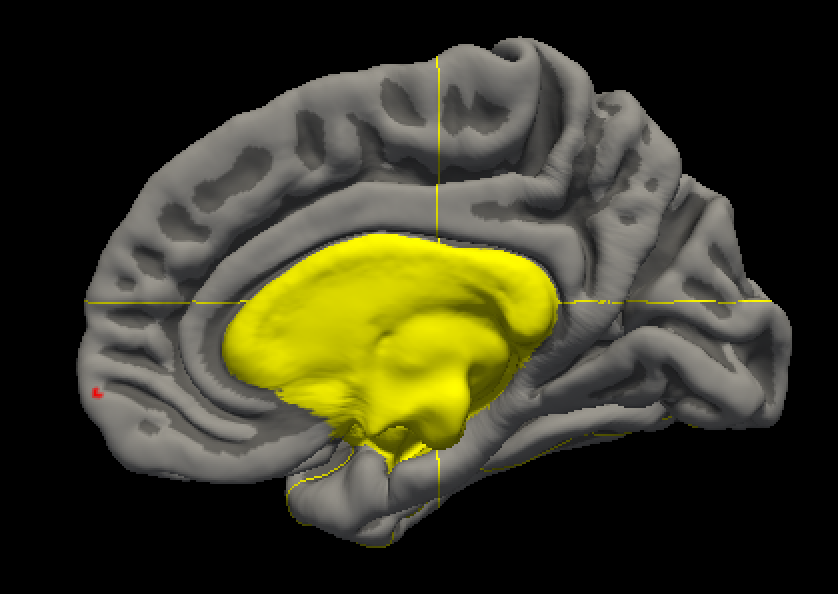
When I ran the LME mass-univariate analysis as instructed here https://surfer.nmr.mgh.harvard.edu/fswiki/LinearMixedEffectsModels#b.29Mass-univariate-1, doesn't that include subcortical structures? When I overlay the spval.mgh file from my mass-univariate analyses as an overlay in freeview, I can only see the surface based results; any subcortical structure is in all yellow (please see attached screenshot). I'm wondering how I can visualize the subcortical results for the LME mass-univariate results.
Thanks for your help,
Jen
On Fri, Apr 8, 2016 at 1:09 PM, Douglas N Greve greve@nmr.mgh.harvard.edu wrote:
And now you want to do an ROI analysis or a map-based analysis of the subcortical structures? We don't do the latter as that is a VBM analysis.
On 04/08/2016 01:07 PM, Jennifer Legault wrote:
Apologies for likely using the wrong term. I meant to say that I've done the cluster-thresholding for the surface data, using the mri_surfcluster command with annot -aparc as an argument.
On Fri, Apr 8, 2016 at 1:03 PM, Douglas N Greve greve@nmr.mgh.harvard.edu wrote:
This is what I don't understand: "done the cluster-thresholding for the
aparc data"
The aparc data is an ROI and so you should not have (could not have) done clusterwise thresholding (?)
On 04/08/2016 12:57 PM, Jennifer Legault wrote:
Hi Doug,
I'm currently running the LME mass-univariate analysis (I've previously conducted the LME univariate analyses with ROIs with little to no problems) and, thanks to your help, have run my data through this analysis and done the cluster-thresholding for the aparc data but not the aseg data (since I'm not sure how to cluster-threshold the segmented data--any advice you have would be greatly appreciated). Is there a way to view the significant voxels overlaid on the aseg+aparc.mgz in fsaverage for the whole brain?
Best,
Jen
On Fri, Apr 8, 2016 at 12:36 PM, Douglas N Greve greve@nmr.mgh.harvard.edu wrote:
On 04/01/2016 04:44 PM, Jennifer Legault wrote:
Hi Doug,
Thanks for your quick response! When running the LME mass univariate analysis, I am assuming this also includes subcortical structures, correct?
Which processing are you doing? It should be obvious if you are doing surface-based or ROI-based analysis.
From my understanding, subcortical areas are segmented as opposed
to
parcellated. The main thing I want to examine all the regions of the brain that might change over time (as a function of the training task I've given my participants), so I would look at both the aparc and
the
aseg data, right?
Yes, you can.
Apologies if I've misunderstood your question. For the aseg data, I am currently having trouble with figuring out how to cluster
threshold
the data (do i use mri_surfcluster with an argument to call the aseg annotation or do I use mri_volcluster?) I would then want to
visualize
the cluster thresholded data for subcortical structures in freeview.
If you are doing an ROI analysis then there is no clustering.
Optimally, I would like to find some way to look at the whole brain
in
Freeview to see these regions that have changed as a function of my training task.
If you have a value for each ROI (segmentation and/or parcellation), then you can read in aseg+aparc.mgz in fsaverage (apas = MRIread('aparc+aseg.mgz')), then find all the voxels that belong to a given ROI and assign them the value for the ROI, then write it out,
then
view the output as an overlay on orig.mgz
Best,
Jen
On Fri, Apr 1, 2016 at 11:23 AM, Douglas N Greve <greve@nmr.mgh.harvard.edu mailto:greve@nmr.mgh.harvard.edu>
wrote:
You can put surface data back into the volume withmri_surf2vol (which
  will also merge left and right into one volume). What do you do
  with the
  aseg data?

  On 04/01/2016 10:46 AM, Jennifer Legault wrote:
  > Dear Freesurfer Experts,
  >
  > I have run my participants' longitudinal sMRI data through
the
  > preprocessing longitudinal pipeline, ran the LME multivariate
  > analysis, cluster-thresholded the data, and am now trying to
  visualize
  > those results in Freeview (for some reason tksurfer is very,
  very slow
  > to run on my computer).  I am interested in the Fs volume
  > (thickness*area) measure.
  >
  > I noticed in the FsFast Tutorial
  >
  <
https://surfer.nmr.mgh.harvard.edu/fswiki/FsFastTutorialV5.1/FsFastGroupLeve...
,
> that all the corrected results were able to be merged intoone file
> using the vlrmerge command. In the beginning of thetutorial, it
> states that fMRI and structuraI group analyses runsimilarly. /
  I was
  > therefore wondering if I can use the vlrmerge command (or
some similar
  > command) for my LME data, such that I can view the following
  > information all in one file: both hemispheres, aparc and
aseg.
  > / Currently I can only view the aparc results for each of the
  > hemispheres separately (and I haven't found a way to
visualize the
  > aseg data).
  >
  > Thank you for taking the time to read this email.
  >
  > Best,
  >
  > Jennifer Legault
  > Ph.D candidate, Neuroscience
  > Brain, Language, and Computation Lab
  > The Pennsylvania State University
  >
  >
  > _______________________________________________
  > Freesurfer mailing list
  > Freesurfer@nmr.mgh.harvard.edu
  <mailto:Freesurfer@nmr.mgh.harvard.edu>
  > https://mail.nmr.mgh.harvard.edu/mailman/listinfo/freesurfer

  --
  Douglas N. Greve, Ph.D.
  MGH-NMR Center
  greve@nmr.mgh.harvard.edu <mailto:greve@nmr.mgh.harvard.edu>
  Phone Number: 617-724-2358 <tel:617-724-2358>
  Fax: 617-726-7422 <tel:617-726-7422>

  Bugs: surfer.nmr.mgh.harvard.edu/fswiki/BugReporting
  <http://surfer.nmr.mgh.harvard.edu/fswiki/BugReporting>
  FileDrop: https://gate.nmr.mgh.harvard.edu/filedrop2
  www.nmr.mgh.harvard.edu/facility/filedrop/index.html
  <http://www.nmr.mgh.harvard.edu/facility/filedrop/index.html>
  Outgoing:
  ftp://surfer.nmr.mgh.harvard.edu/transfer/outgoing/flat/greve/

  _______________________________________________
  Freesurfer mailing list
  Freesurfer@nmr.mgh.harvard.edu <mailto:
Freesurfer@nmr.mgh.harvard.edu>
  https://mail.nmr.mgh.harvard.edu/mailman/listinfo/freesurfer


  The information in this e-mail is intended only for the person
to
  whom it is
  addressed. If you believe this e-mail was sent to you in error
and
  the e-mail
  contains patient information, please contact the Partners
  Compliance HelpLine at
  http://www.partners.org/complianceline . If the e-mail was
sent to
  you in error
  but does not contain patient information, please contact the
  sender and properly
  dispose of the e-mail.
-- Jennifer Legault Ph.D candidate, Neuroscience Brain, Language, and Computation Lab The Pennsylvania State University
Freesurfer mailing list Freesurfer@nmr.mgh.harvard.edu https://mail.nmr.mgh.harvard.edu/mailman/listinfo/freesurfer
-- Douglas N. Greve, Ph.D. MGH-NMR Center greve@nmr.mgh.harvard.edu Phone Number: 617-724-2358 Fax: 617-726-7422
Bugs: surfer.nmr.mgh.harvard.edu/fswiki/BugReporting FileDrop: https://gate.nmr.mgh.harvard.edu/filedrop2 www.nmr.mgh.harvard.edu/facility/filedrop/index.html Outgoing:
ftp://surfer.nmr.mgh.harvard.edu/transfer/outgoing/flat/greve/
Freesurfer mailing list Freesurfer@nmr.mgh.harvard.edu https://mail.nmr.mgh.harvard.edu/mailman/listinfo/freesurfer
-- Douglas N. Greve, Ph.D. MGH-NMR Center greve@nmr.mgh.harvard.edu Phone Number: 617-724-2358 Fax: 617-726-7422
Bugs: surfer.nmr.mgh.harvard.edu/fswiki/BugReporting FileDrop: https://gate.nmr.mgh.harvard.edu/filedrop2 www.nmr.mgh.harvard.edu/facility/filedrop/index.html Outgoing:
ftp://surfer.nmr.mgh.harvard.edu/transfer/outgoing/flat/greve/
Freesurfer mailing list Freesurfer@nmr.mgh.harvard.edu https://mail.nmr.mgh.harvard.edu/mailman/listinfo/freesurfer
-- Douglas N. Greve, Ph.D. MGH-NMR Center greve@nmr.mgh.harvard.edu Phone Number: 617-724-2358 Fax: 617-726-7422
Bugs: surfer.nmr.mgh.harvard.edu/fswiki/BugReporting FileDrop: https://gate.nmr.mgh.harvard.edu/filedrop2 www.nmr.mgh.harvard.edu/facility/filedrop/index.html Outgoing: ftp://surfer.nmr.mgh.harvard.edu/transfer/outgoing/flat/greve/
Freesurfer mailing list Freesurfer@nmr.mgh.harvard.edu https://mail.nmr.mgh.harvard.edu/mailman/listinfo/freesurfer
freesurfer@nmr.mgh.harvard.edu
-
 Douglas N Greve
 -
 Jennifer Legault
 -
 Jennifer Legault