
Hi all,
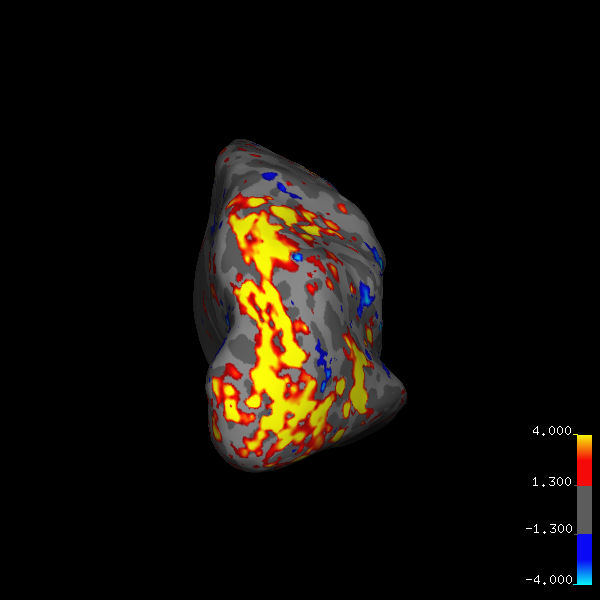
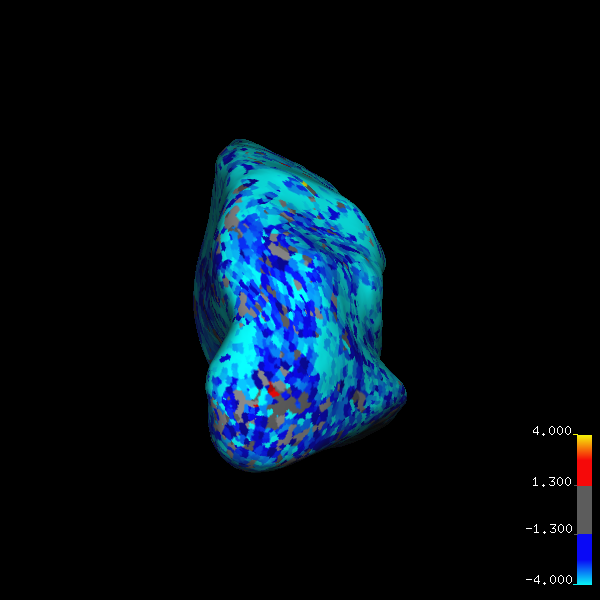
I'm still trying to figure out what's going on with the differences I'm getting between selxavg-sess and selxavg3-sess. I"m using freesurfer4.5. I was using selxavg3-sess (as suggested on the wiki) but I was getting weird activation maps when I compared any condition vs. baseline, where most of the brain was more activity for baseline (which was fixation) - see the attached picture for act-fix-gamma-selxavg3-rh.png. So I ran selxavg-sess which was what I used to run with an older version of freesurfer, and when I did this I got a more appropriate picture - see act-fix-gamma-rh.png
The experiment starts with fixation (baseline) so I tried running the analysis with and without skipping the first 2 TRs to account for the BOLD spike, but it makes no difference in the activation map.
These are essentially the commands I ran: mkanalysis-sess.new -analysis loc_loc -TR 2 -paradigm loc.dat -designtype blocked -funcstem fmc -runlistfile loc_runs.txt -inorm -nconditions 2 -timewindow 20 -gammafit 2.25 1.25
mkcontrast-sess -analysis loc_loc -contrast shape_vs_fix -a 2 -c 0
selxavg3-sess -s 101006SP_loc_loc -df loc_loc.dir -analysis loc_loc
Thoughts? Or should I just not use selxavg3-sess?
Katie
---------- Forwarded message ---------- From: Katie Bettencourt kcrum@bu.edu Date: Tue, Nov 2, 2010 at 2:31 PM Subject: Questions about event related processing and selxavg-sess and selxavg3-sess To: freesurfer maillist freesurfer@nmr.mgh.harvard.edu
Hi all,
I've been trying to analyses both an event related and block design experiments and have noticed a couple things that are confusing me and I would appreciate any help anyone could give me.
1. In trying do the event-related analysis, I'm am a bit confused by the FIR vs Gamma analysis and the use of the time window and tprestim in the FIR analysis. I have an experiment with 6 set size conditions and 1 fixation condition. each trial is 6s long with a TR of 1.5
I have run both of these commands:
mkanalysis-sess.new -analysis supIPS_loc -TR 1.5 -paradigm supIPS.dat -designtype event-related -funcstem fmc -motioncor -runlistfile supIPSruns.txt -inorm -nskip 2 -nconditions 6 -gammafit 2.25 1.25
mkanalysis-sess.new -analysis supIPS_loc -TR 1.5 -paradigm supIPS.dat -designtype event-related -funcstem fmc -motioncor -runlistfile supIPSruns.txt -inorm -nskip 2 -nconditions 6 -tprestim 2 -timewindow 20
The FIR gives me a time course window, which makes me think that perhaps that is the one I want to use, but it shows very little activation. This data has been previously analyzed in Brain Voyager, so I know it's not a case of the conditions not actually causing activation, but for some reason, the FIR analysis doesn't show any. I'm not sure if this is due to a bad time window/tprestim settings, or something else. However the gamma fit analysis shows a bunch of activity where I expect to see it, but no time course window. (attached are pngs of the differences for the act_vs_fixation comparison).
2. In addition, in both the event related (gamma) and a normal block design (different experiment) I get very different results (at least for certain comparisons) depending on whether I use selxavg-sess (with stxgrinder-sess for each contrast) or selxavg3-sess. The differences are shown in the attached pngs (act_vs_fix-gamma.png (which is the selxavg-sess and stxgrinder-sess analysis and act_vs_fix-gamma-selxavg3). In the block design, both selxavg3 and selxavg (+stxgrinder) give me very similar activation when comparing two non-null conditions (ie. shape_vs_noise) but very different (and similar to the differences in the attached pictures) activations when comparing against the null (ie shape_vs_fix or noise_vs_fix). What am I doing wrong here?
Thanks for your help!
Katie

I have no idea what is happening, but I can suggest a few checks. Have you looked at the motion correction plots? Have you looked at the raw data? Another thing to try is to turn off whitening when you make the analysis for selxavg3-sess.
doug
Katie Bettencourt wrote:
Hi all,
I'm still trying to figure out what's going on with the differences I'm getting between selxavg-sess and selxavg3-sess. I"m using freesurfer4.5. I was using selxavg3-sess (as suggested on the wiki) but I was getting weird activation maps when I compared any condition vs. baseline, where most of the brain was more activity for baseline (which was fixation) - see the attached picture for act-fix-gamma-selxavg3-rh.png. So I ran selxavg-sess which was what I used to run with an older version of freesurfer, and when I did this I got a more appropriate picture - see act-fix-gamma-rh.png
The experiment starts with fixation (baseline) so I tried running the analysis with and without skipping the first 2 TRs to account for the BOLD spike, but it makes no difference in the activation map.
These are essentially the commands I ran: mkanalysis-sess.new -analysis loc_loc -TR 2 -paradigm loc.dat -designtype blocked -funcstem fmc -runlistfile loc_runs.txt -inorm -nconditions 2 -timewindow 20 -gammafit 2.25 1.25
mkcontrast-sess -analysis loc_loc -contrast shape_vs_fix -a 2 -c 0
selxavg3-sess -s 101006SP_loc_loc -df loc_loc.dir -analysis loc_loc
Thoughts? Or should I just not use selxavg3-sess?
Katie
---------- Forwarded message ---------- From: *Katie Bettencourt* <kcrum@bu.edu mailto:kcrum@bu.edu> Date: Tue, Nov 2, 2010 at 2:31 PM Subject: Questions about event related processing and selxavg-sess and selxavg3-sess To: freesurfer maillist <freesurfer@nmr.mgh.harvard.edu mailto:freesurfer@nmr.mgh.harvard.edu>
Hi all,
I've been trying to analyses both an event related and block design experiments and have noticed a couple things that are confusing me and I would appreciate any help anyone could give me.
- In trying do the event-related analysis, I'm am a bit confused by
the FIR vs Gamma analysis and the use of the time window and tprestim in the FIR analysis. I have an experiment with 6 set size conditions and 1 fixation condition. each trial is 6s long with a TR of 1.5
I have run both of these commands:
mkanalysis-sess.new -analysis supIPS_loc -TR 1.5 -paradigm supIPS.dat -designtype event-related -funcstem fmc -motioncor -runlistfile supIPSruns.txt -inorm -nskip 2 -nconditions 6 -gammafit 2.25 1.25
mkanalysis-sess.new -analysis supIPS_loc -TR 1.5 -paradigm supIPS.dat -designtype event-related -funcstem fmc -motioncor -runlistfile supIPSruns.txt -inorm -nskip 2 -nconditions 6 -tprestim 2 -timewindow 20
The FIR gives me a time course window, which makes me think that perhaps that is the one I want to use, but it shows very little activation. This data has been previously analyzed in Brain Voyager, so I know it's not a case of the conditions not actually causing activation, but for some reason, the FIR analysis doesn't show any. I'm not sure if this is due to a bad time window/tprestim settings, or something else. However the gamma fit analysis shows a bunch of activity where I expect to see it, but no time course window. (attached are pngs of the differences for the act_vs_fixation comparison).
- In addition, in both the event related (gamma) and a normal block
design (different experiment) I get very different results (at least for certain comparisons) depending on whether I use selxavg-sess (with stxgrinder-sess for each contrast) or selxavg3-sess. The differences are shown in the attached pngs (act_vs_fix-gamma.png (which is the selxavg-sess and stxgrinder-sess analysis and act_vs_fix-gamma-selxavg3). In the block design, both selxavg3 and selxavg (+stxgrinder) give me very similar activation when comparing two non-null conditions (ie. shape_vs_noise) but very different (and similar to the differences in the attached pictures) activations when comparing against the null (ie shape_vs_fix or noise_vs_fix). What am I doing wrong here?
Thanks for your help!
Katie
Freesurfer mailing list Freesurfer@nmr.mgh.harvard.edu https://mail.nmr.mgh.harvard.edu/mailman/listinfo/freesurfer
freesurfer@nmr.mgh.harvard.edu
-
 Douglas N Greve
 -
 Katie Bettencourt