

Thanks for all your help guys, but I am still having trouble (!). This time I've tried a different dataset, again just a simple 2 group comaprison with no covariates.
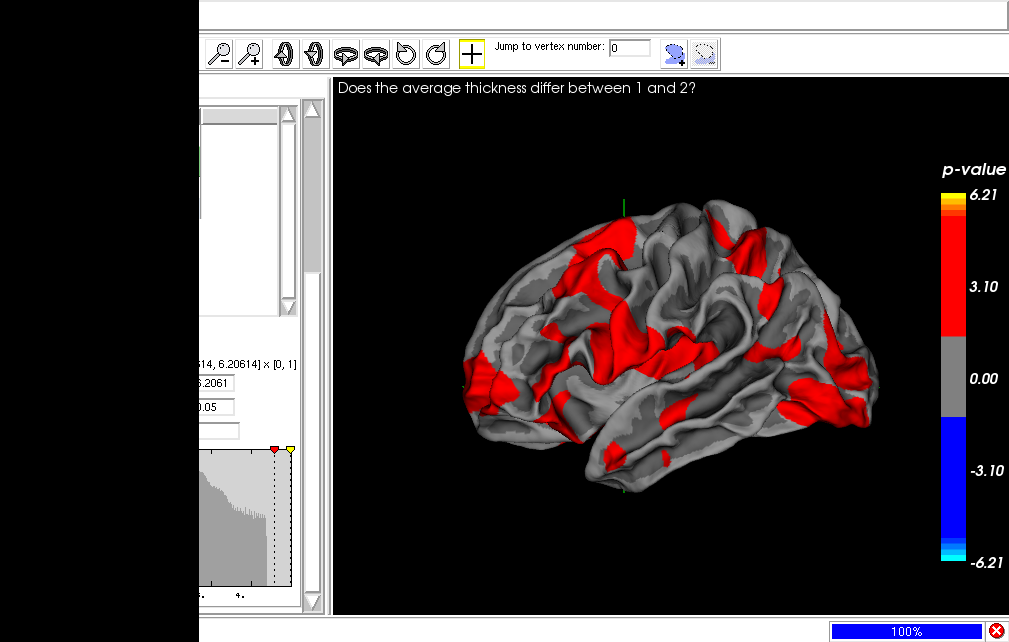
Running this in qdec, and visualizing with a low threshold (min=1.3), I see a whole bunch of clusters (see attached). However, when I run mri_surfcluster, I only get one whole brain cluster again (see below). This time I smoothed with 15 mm in qdec, although I get the same if I smooth with 10mm. I have kept the thresholds low on purpose, because I expect that something should come out?? I did not run simulations in this instance, to cut processing time.
mri_surfcluster --in qdec/MF_lh_15mm/contrasts.sig.mgh --no-adjust -- subject fsaverage/ --hemi l h --thmin 1.3 --minarea 15 --sum TestClusters
thsign = abs, id = 0 version $Id: mri_surfcluster.c,v 1.39 2007/07/31 00:34:19 greve Exp $ hemi = lh srcid = qdec/MF_lh_15mm/contrasts.sig.mgh paint srcsubjid = fsaverage/ srcsurf = white srcframe = 0 thsign = abs thmin = 1.3 thmax = -1 fdr = -1 minarea = 15 xfmfile = talairach.xfm nth = -1 sumfile = TestClusters subjectsdir = /data/kang/work/struct/alex/freesurfer/subjects_cann FixMNI = 1 ------------- XFM matrix (RAS2RAS) --------------- /data/kang/work/struct/alex/freesurfer/subjects_cann/fsaverage//mri/ transforms/t alairach.xfm 1.000 0.000 0.000 0.000; 0.000 1.000 0.000 0.000; 0.000 0.000 1.000 0.000; 0.000 0.000 0.000 1.000; ---------------------------------------------------- Reading source surface /data/kang/work/struct/alex/freesurfer/ subjects_cann/fsav erage//surf/lh.white reading group avg surface area 822 cm^2 from file Reading in average area /data/kang/work/struct/alex/freesurfer/ subjects_cann/fsa verage//surf/lh.white.avg.area.mgh Done reading source surface Computing metric properties Loading source values number of voxels in search space = 163842 Done loading source values (nvtxs = 163842) overall max = 1e+10 at vertex 26 overall min = 1.75775 at vertex 126983 surface nvertices 163842 surface area 65416.985991 surface area 65416.985976 NOT Adjusting threshold for 1-tailed test Searching for Clusters ... thmin=1.300000 (1.300000), thmax=-1.000000 (-1), thsignid=0, minarea=15.000000 Found 1 clusters Max cluster size 103339.460938 INFO: fixing MNI talairach coordinates
On 05/12/2007, at 4:19 AM, Doug Greve wrote:
There's really no such thing as an opt kernel size. The best size depends on the underlying signal and can be space variant.
doug
Alex Fornito wrote:
Yes, I selected 25 mm on qdec, based on the Lerch paper suggesting this was a generally 'optimal' kernel size. The 34.309.. was the residual output to y.fsgd.
Do you recommend a smaller kernel?
On 04/12/2007, at 5:41 PM, Pratap Kunwar wrote:
I think, one reason for getting only one big cluster is because your fwhm value is very high. By the way how did you get fwhm 34.309616??, was it produced by selecting fwhm 25 (max on Qdec)on Qdec?
Did you try fwhm 10 or 15?
Thanks for your help Pratap. I've actually been trying to follow the tutorial and was running simulations initially, but when I tried to re-trace my steps I ended omitted them because I forgot they were necessary for mri_surfcluster.
Either way, the results are the same- I still get one whole surface cluster as output even after running simulations. In this case, I re- ran it copying your commands, except I used perm because I have low numbers and no covariates. I also ran 1000 permutations, to get a quick initial result for testing. My commands and output are below.
I would appreciate further help on this, as I'm not sure where I'm going wrong!
also, I noticed that after your mri_glmfit command, you added --i divided into 5000 each. Sorry, but I'm not sure what you meant by that.
---> i had split simulation (10,000 iterations)into multiple runs csd1* (5000 iterations) and csd2* (5000 iterations) since mc-z relatively takes long time comparing to permutation. More on, https://surfer.nmr.mgh.harvard.edu/fswiki/ FsTutorial_2fGroupAnalysis?action=highlight&value=fsgd
mri_glmfit --y qdec/MF_group_rh/y.mgh --fsgd qdec/MF_group_rh/ qdec.fsgd doss --surf fsaverage rh --fwhm 34.309616 --C qdec/ MF_group_rh/contrasts/Diff-1-2-Intercept.mat --sim perm 1000 2 stats/ newperm_rh/newperm_rh --glmdir stats/newperm_rh/
gdfReadHeader: reading qdec/MF_group_rh/qdec.fsgd INFO: demeaning continous variables Continuous Variable Means (all subjects) Class Means of each Continuous Variable 1 group1 2 group2 INFO: gd2mtx_method is doss Reading source surface /data/kang/work/struct/alex/freesurfer/ subjects_cann/fsaverage/surf/rh.white reading group avg surface area 822 cm^2 from file Reading in average area /data/kang/work/struct/alex/freesurfer/ subjects_cann/fsaverage/surf/rh.white.avg.area.mgh simbase stats/newperm_rh/newperm_rh Number of vertices 163842 Number of faces 327680 Total area 65020.765625 AvgVtxArea 0.396850 AvgVtxDist 0.717994 StdVtxDist 0.193566 reading group avg surface area 822 cm^2 from file Reading in average area /data/kang/work/struct/alex/freesurfer/ subjects_cann/fsaverage/surf/rh.white.avg.area.mgh INFO: fwhm2niters: Fixing group surface area Surface smoothing by fwhm=34.309616, niters=866.000000
$Id: mri_glmfit.c,v 1.138.2.1 2007/09/12 15:38:19 nicks Exp $ cwd /data/kang/work/struct/alex/freesurfer/subjects_cann cmdline mri_glmfit --y qdec/MF_group_rh/y.mgh --fsgd qdec/ MF_group_rh/ qdec.fsgd doss --surf fsaverage rh --fwhm 34.309616 --C qdec/ MF_group_rh/contrasts/Diff-1-2-Intercept.mat --sim perm 1000 2 stats/ newperm_rh/newperm_rh --glmdir stats/newperm_rh/ sysname Linux hostname kang machine i686 user alex FixVertexAreaFlag = 1 UseMaskWithSmoothing 1 fwhm 34.309616 niters 866.000000 OneSampleGroupMean 0 y /data/kang/work/struct/alex/freesurfer/subjects_cann/qdec/ MF_group_rh/y.mgh logyflag 0 usedti 0 FSGD qdec/MF_group_rh/qdec.fsgd glmdir stats/newperm_rh/ DoFFx 0 Loading y from /data/kang/work/struct/alex/freesurfer/ subjects_cann/ qdec/MF_group_rh/y.mgh Matrix condition is 1 search space = 82167.6 Smoothing input by fwhm 34.309616 Smoothing done, nsteps = 866, tsec = 1236.17 ... done DOF = 28 thresh = 2, threshadj = 2 Starting simulation sim over 1000 trials 1/1000 t=0 ------------------------------------------------ Starting fit and test 10% 20% 30% 40% 50% 60% 70% 80% 90% 100% Diff-1-2-Intercept 0 nc=3 maxcsize=1910.81 sigmax=-3.00831 Fmax=13.551 2/1000 t=0.0572833 ------------------------------------------------ Starting fit and test 10% 20% 30% 40% 50% 60% 70% 80% 90% 100% Diff-1-2-Intercept 1 nc=0 maxcsize=0 sigmax=1.36036 Fmax=4.46612 3/1000 t=0.0994333 ------------------------------------------------
... and so on... then
mri_surfcluster --src qdec/MF_group_lh/contrasts.sig.mgh --csd stats/ newperm_lh/newperm_lh-Diff-1-2-Intercept.csd --sum stats/ newperm_lh/ newperm_lh --ocp stats/newperm_lh/newperm_lh.mgh
thsign = abs, id = 0 version $Id: mri_surfcluster.c,v 1.39 2007/07/31 00:34:19 greve Exp $ hemi = rh srcid = qdec/MF_group_lh/contrasts.sig.mgh paint srcsubjid = fsaverage srcsurf = white srcframe = 0 thsign = abs thmin = 2 thmax = -1 fdr = -1 minarea = 0 xfmfile = talairach.xfm nth = -1 sumfile = stats/newperm_lh/newperm_lh subjectsdir = /data/kang/work/struct/alex/freesurfer/ subjects_cann FixMNI = 1 ------------- XFM matrix (RAS2RAS) --------------- /data/kang/work/struct/alex/freesurfer/subjects_cann/fsaverage/mri/ transforms/talairach.xfm 1.000 0.000 0.000 0.000; 0.000 1.000 0.000 0.000; 0.000 0.000 1.000 0.000; 0.000 0.000 0.000 1.000;
Reading source surface /data/kang/work/struct/alex/freesurfer/ subjects_cann/fsaverage/surf/rh.white reading group avg surface area 822 cm^2 from file Reading in average area /data/kang/work/struct/alex/freesurfer/ subjects_cann/fsaverage/surf/rh.white.avg.area.mgh Done reading source surface Computing metric properties Loading source values number of voxels in search space = 163842 Done loading source values (nvtxs = 163842) overall max = 43.1907 at vertex 101931 overall min = 7.66111 at vertex 28089 surface nvertices 163842 surface area 65020.838384 surface area 65020.838382 NOT Adjusting threshold for 1-tailed test Searching for Clusters ... thmin=2.000000 (2.000000), thmax=-1.000000 (-1), thsignid=0, minarea=0.000000 Found 1 clusters Max cluster size 103836.125000 INFO: fixing MNI talairach coordinates Saving cluster pval stats/newperm_lh/newperm_lh.mgh
On 04/12/2007, at 11:30 AM, Pratap Kunwar wrote:
Alex,
You have to do simulations using mri_glmfit before youdo mri_surfcluster,
[more info in this link at https://surfer.nmr.mgh.harvard.edu/fswiki/ FsTutorial_2fGroupAnalysis?action=highlight&value=fsgd go down to [4.0 Using mri_glmfit to correct for multiple comparisons: ]
USAGE: ./mri_glmfit
--glmdir dir : save outputs to dir
--y inputfile **y.mgh --fsgd FSGDF <gd2mtx> : freesurfer descriptor file **qdec.fsgd --C contrast1.mat <--C contrast2.mat ...> --fwhm fwhm : smooth input by fwhm ** your smoothing value from " fwhm.dat" --surf subject hemi <surfname> : needed for some flags (uses white by default) **lh or rh --sim nulltype nsim thresh csdbasename : simulation perm, mc- full, mc-z **mc-z (i used) is faster than mc-full, minimum threshold value ( i.e. 1.3 for 0.05),
My command was more like this,
mri_glmfit --y y.mgh --fsgd qdec.fsgd doss --surf fsaverage rh -- fwhm < ??
--C contrast/contrastname.mat --sim mc-z 5000 1.3 f11/csd1 -- glmdir f11
mri_glmfit --y y.mgh --fsgd qdec.fsgd doss --surf fsaverage rh --fwhm 14.504073 --C contrast/contrastname.mat --sim mc-z 5000 1.3 f11/ csd2 --glmdir f11
--i divided into 5000 each
from above mri_glmfit, i got two files starting with csd1* .csd and csd2*.csd.
Next one is
mri_surfcluster, mri_surfcluster --src contrastname/sig.mgh --csd csd1* .csd --csd csd2* ..csd --sum <text summary file --sum <*.sum> --ocp <*.mgh>
the output file *.sum can be opened in text editor and *.mgh can be seen using tksurfer. Check the link above link for more details (i just followed that link when i did last month).
let me know if you get into more problems.
pratap
> On 11/28/2007 07:43 PM, Alex Fornito wrote: >> Hi, >> I have run qdec for a simple contrast comparing thickness >> across >> the >> cortical surface between a patient and control group. Not much >> survives vertex-wise FDR correction, and I would like to try >> cluster-based thresholding. I would like to make sure I >> understand the >> inputs to the command. Am I correct on the following? >> >> --in = the signifcance values (i.e., contrast_name.sig.mgh >> file) >> --thmin = the vertexwise threshold for determining clusters, >> where 2 >> corresponds to p=.01 >> --minarea = the cluster extent threshold - Am I correct in >> assuming >> this should not be smaller than the smoothing kernel? >> >> When I run the command below, I get the following output. >> Only one >> (whole hemi) cluster is identified. I'm not sure if its a >> problem in >> my command line, or with my data. Also, I seem to have the -- >> cwsig >> flag wrong, but can't figure out the error (appending .w >> or .label to >> the end of the output filename does not change the error). >> >> I greatly appreciate your help. >> >> >> mri_surfcluster --in qdec/MF_group_lh/contrasts.sig.mgh -- >> subject >> fsaverage --hemi lh --surf white --annot aparc --sign abs -- >> thmin 2 >> --minarea 25 --sum stats/qdec_run/cluster/summary.txt --o >> stats/qdec_run/cluster/cluster_output --cwsig >> stats/qdec_run/cluster/cwsig --olab >> stats/qdec_run/cluster/MF_group_lh_thk >> >> thsign = abs, id = 0 >> version $Id: mri_surfcluster.c,v 1.39 2007/07/31 00:34:19 greve >> Exp $ >> hemi = lh >> srcid = qdec/MF_group_lh/contrasts.sig.mgh paint >> srcsubjid = fsaverage >> srcsurf = white >> srcframe = 0 >> thsign = abs >> thmin = 2 >> thmax = -1 >> fdr = -1 >> minarea = 25 >> xfmfile = talairach.xfm >> nth = -1 >> outid = stats/qdec_run/cluster/cluster_output paint >> sumfile = stats/run2/cluster/summary.txt >> subjectsdir = /data/kang/work/struct/alex/freesurfer/ >> subjects_cann >> FixMNI = 1 >> ------------- XFM matrix (RAS2RAS) --------------- >> /data/kang/work/struct/alex/freesurfer/subjects_cann/fsaverage/ >> mri/transforms/talairach.xfm >> 1.000 0.000 0.000 0.000; >> 0.000 1.000 0.000 0.000; >> 0.000 0.000 1.000 0.000; >> 0.000 0.000 0.000 1.000; >> ---------------------------------------------------- >> Reading source surface >> /data/kang/work/struct/alex/freesurfer/subjects_cann/fsaverage/ >> surf/lh.white >> reading group avg surface area 822 cm^2 from file >> Reading in average area >> /data/kang/work/struct/alex/freesurfer/subjects_cann/fsaverage/ >> surf/lh.white.avg.area.mgh >> Done reading source surface >> Reading annotation >> /data/kang/work/struct/alex/freesurfer/subjects_cann/fsaverage/ >> label/lh.aparc.annot >> reading colortable from annotation file... >> colortable with 35 entries read (originally >> /space/amaebi/26/users/buckner_cortical_atlas/scripts/ >> colortable_final.txt) >> Computing metric properties >> Loading source values >> number of voxels in search space = 163842 >> Done loading source values (nvtxs = 163842) >> overall max = 43.1907 at vertex 101931 >> overall min = 7.66111 at vertex 28089 >> surface nvertices 163842 >> surface area 65416.985991 >> surface area 65416.985976 >> NOT Adjusting threshold for 1-tailed test >> Searching for Clusters ... >> thmin=2.000000 (2.000000), thmax=-1.000000 (-1), thsignid=0, >> minarea=25.000000 >> Found 1 clusters >> Max cluster size 103339.460938 >> INFO: fixing MNI talairach coordinates >> Saving thresholded output to stats/qdec_run/cluster/ >> cluster_output >> avg = 35.029, stdev = 4.669, min = 7.661, max = 43.191 >> Saving cluster pval stats/qdec_run/cluster/cwsig >> unknown file type for file (stats/qdec_run/cluster/cwsig) >> LabelWrite: saving to stats/qdec_run/cluster/ >> MF_group_lh_thk-0001.label >> >> >> >> Alex Fornito >> JN Peters Research Fellow >> Melbourne Neuropsychiatry Centre >> Department of Psychiatry >> The University of Melbourne >> >> Postal address: >> Melbourne Neuropsychiatry Centre >> National Neuroscience Facility >> Levels 2 & 3, 161 Barry St >> Carlton South Vic 3053 Australia >> >> Ph: +61 3 8344 1861 >> Fax: +61 3 9348 0469 >> >> fornitoa@unimelb.edu.au mailto:fornitoa@unimelb.edu.au >> >> >> >> >> --------------------------------------------------------------- >> ---- >> ----- >> >> _______________________________________________ >> Freesurfer mailing list >> Freesurfer@nmr.mgh.harvard.edu >> https://mail.nmr.mgh.harvard.edu/mailman/listinfo/freesurfer > >
Freesurfer mailing list Freesurfer@nmr.mgh.harvard.edu https://mail.nmr.mgh.harvard.edu/mailman/listinfo/freesurfer
Alex Fornito JN Peters Research Fellow Melbourne Neuropsychiatry Centre Department of Psychiatry The University of Melbourne
Postal address: Melbourne Neuropsychiatry Centre National Neuroscience Facility Levels 2 & 3, 161 Barry St Carlton South Vic 3053 Australia
Ph: +61 3 8344 1861 Fax: +61 3 9348 0469
fornitoa@unimelb.edu.au
Alex Fornito JN Peters Research Fellow Melbourne Neuropsychiatry Centre Department of Psychiatry The University of Melbourne
Postal address: Melbourne Neuropsychiatry Centre National Neuroscience Facility Levels 2 & 3, 161 Barry St Carlton South Vic 3053 Australia
Ph: +61 3 8344 1861 Fax: +61 3 9348 0469
fornitoa@unimelb.edu.au
-- Douglas N. Greve, Ph.D. MGH-NMR Center greve@nmr.mgh.harvard.edu Phone Number: 617-724-2358 Fax: 617-726-7422
In order to help us help you, please follow the steps in: surfer.nmr.mgh.harvard.edu/fswiki/BugReporting
Alex Fornito JN Peters Research Fellow Melbourne Neuropsychiatry Centre Department of Psychiatry The University of Melbourne
Postal address: Melbourne Neuropsychiatry Centre National Neuroscience Facility Levels 2 & 3, 161 Barry St Carlton South Vic 3053 Australia
Ph: +61 3 8344 1861 Fax: +61 3 9348 0469
fornitoa@unimelb.edu.au
I retract the last email - it seems like I was entering the wrong sig.mgh file as input. Sorry for the confusion!!!
On a separate issue, I would like to check that I have the following correct:
I have extracted a cluster image using mri_surfcluster withouth running simulations. Say, for e.g., I use thmin 2 and minarea 30. I load the resulting output.mgh file into tksurfer. I would then like to perform FDR correction on the resulting clusters. I'm guessing that pressing the FDR button in the Overlay config menu will do the trick, since (from what I understand) the output.mgh file I have loaded assigns a zero to all vertices not in a cluster. I figure that this will therefore result in an FDR correction that accounts only for the vertices within my clusters.
However, I'm uncertain how the 'only marked' checkbox fits in. If I tick it, I get an error calculating the FDR. I'm guessing this option is relevant if you combined a stat map with a label file.
Am I on the right track?
Thanks again, Alex
On 05/12/2007, at 9:52 AM, Alex Fornito wrote:
<Pic.png>
Thanks for all your help guys, but I am still having trouble (!). This time I've tried a different dataset, again just a simple 2 group comaprison with no covariates.
Running this in qdec, and visualizing with a low threshold (min=1.3), I see a whole bunch of clusters (see attached). However, when I run mri_surfcluster, I only get one whole brain cluster again (see below). This time I smoothed with 15 mm in qdec, although I get the same if I smooth with 10mm. I have kept the thresholds low on purpose, because I expect that something should come out?? I did not run simulations in this instance, to cut processing time.
mri_surfcluster --in qdec/MF_lh_15mm/contrasts.sig.mgh --no-adjust --subject fsaverage/ --hemi l h --thmin 1.3 --minarea 15 --sum TestClusters
thsign = abs, id = 0 version $Id: mri_surfcluster.c,v 1.39 2007/07/31 00:34:19 greve Exp $ hemi = lh srcid = qdec/MF_lh_15mm/contrasts.sig.mgh paint srcsubjid = fsaverage/ srcsurf = white srcframe = 0 thsign = abs thmin = 1.3 thmax = -1 fdr = -1 minarea = 15 xfmfile = talairach.xfm nth = -1 sumfile = TestClusters subjectsdir = /data/kang/work/struct/alex/freesurfer/subjects_cann FixMNI = 1 ------------- XFM matrix (RAS2RAS) --------------- /data/kang/work/struct/alex/freesurfer/subjects_cann/fsaverage//mri/ transforms/t alairach.xfm 1.000 0.000 0.000 0.000; 0.000 1.000 0.000 0.000; 0.000 0.000 1.000 0.000; 0.000 0.000 0.000 1.000;
Reading source surface /data/kang/work/struct/alex/freesurfer/ subjects_cann/fsav erage//surf/lh.white reading group avg surface area 822 cm^2 from file Reading in average area /data/kang/work/struct/alex/freesurfer/ subjects_cann/fsa verage//surf/lh.white.avg.area.mgh Done reading source surface Computing metric properties Loading source values number of voxels in search space = 163842 Done loading source values (nvtxs = 163842) overall max = 1e+10 at vertex 26 overall min = 1.75775 at vertex 126983 surface nvertices 163842 surface area 65416.985991 surface area 65416.985976 NOT Adjusting threshold for 1-tailed test Searching for Clusters ... thmin=1.300000 (1.300000), thmax=-1.000000 (-1), thsignid=0, minarea=15.000000 Found 1 clusters Max cluster size 103339.460938 INFO: fixing MNI talairach coordinates
On 05/12/2007, at 4:19 AM, Doug Greve wrote:
There's really no such thing as an opt kernel size. The best size depends on the underlying signal and can be space variant.
doug
Alex Fornito wrote:
Yes, I selected 25 mm on qdec, based on the Lerch paper suggesting this was a generally 'optimal' kernel size. The 34.309.. was the residual output to y.fsgd.
Do you recommend a smaller kernel?
On 04/12/2007, at 5:41 PM, Pratap Kunwar wrote:
I think, one reason for getting only one big cluster is because your fwhm value is very high. By the way how did you get fwhm 34.309616??, was it produced by selecting fwhm 25 (max on Qdec)on Qdec?
Did you try fwhm 10 or 15?
Thanks for your help Pratap. I've actually been trying to follow the tutorial and was running simulations initially, but when I tried to re-trace my steps I ended omitted them because I forgot they were necessary for mri_surfcluster.
Either way, the results are the same- I still get one whole surface cluster as output even after running simulations. In this case, I re- ran it copying your commands, except I used perm because I have low numbers and no covariates. I also ran 1000 permutations, to get a quick initial result for testing. My commands and output are below.
I would appreciate further help on this, as I'm not sure where I'm going wrong!
also, I noticed that after your mri_glmfit command, you added --i divided into 5000 each. Sorry, but I'm not sure what you meant by that.
---> i had split simulation (10,000 iterations)into multiple runs csd1* (5000 iterations) and csd2* (5000 iterations) since mc-z relatively takes long time comparing to permutation. More on, https://surfer.nmr.mgh.harvard.edu/fswiki/ FsTutorial_2fGroupAnalysis?action=highlight&value=fsgd
mri_glmfit --y qdec/MF_group_rh/y.mgh --fsgd qdec/MF_group_rh/ qdec.fsgd doss --surf fsaverage rh --fwhm 34.309616 --C qdec/ MF_group_rh/contrasts/Diff-1-2-Intercept.mat --sim perm 1000 2 stats/ newperm_rh/newperm_rh --glmdir stats/newperm_rh/
gdfReadHeader: reading qdec/MF_group_rh/qdec.fsgd INFO: demeaning continous variables Continuous Variable Means (all subjects) Class Means of each Continuous Variable 1 group1 2 group2 INFO: gd2mtx_method is doss Reading source surface /data/kang/work/struct/alex/freesurfer/ subjects_cann/fsaverage/surf/rh.white reading group avg surface area 822 cm^2 from file Reading in average area /data/kang/work/struct/alex/freesurfer/ subjects_cann/fsaverage/surf/rh.white.avg.area.mgh simbase stats/newperm_rh/newperm_rh Number of vertices 163842 Number of faces 327680 Total area 65020.765625 AvgVtxArea 0.396850 AvgVtxDist 0.717994 StdVtxDist 0.193566 reading group avg surface area 822 cm^2 from file Reading in average area /data/kang/work/struct/alex/freesurfer/ subjects_cann/fsaverage/surf/rh.white.avg.area.mgh INFO: fwhm2niters: Fixing group surface area Surface smoothing by fwhm=34.309616, niters=866.000000
$Id: mri_glmfit.c,v 1.138.2.1 2007/09/12 15:38:19 nicks Exp $ cwd /data/kang/work/struct/alex/freesurfer/subjects_cann cmdline mri_glmfit --y qdec/MF_group_rh/y.mgh --fsgd qdec/ MF_group_rh/ qdec.fsgd doss --surf fsaverage rh --fwhm 34.309616 --C qdec/ MF_group_rh/contrasts/Diff-1-2-Intercept.mat --sim perm 1000 2 stats/ newperm_rh/newperm_rh --glmdir stats/newperm_rh/ sysname Linux hostname kang machine i686 user alex FixVertexAreaFlag = 1 UseMaskWithSmoothing 1 fwhm 34.309616 niters 866.000000 OneSampleGroupMean 0 y /data/kang/work/struct/alex/freesurfer/subjects_cann/qdec/ MF_group_rh/y.mgh logyflag 0 usedti 0 FSGD qdec/MF_group_rh/qdec.fsgd glmdir stats/newperm_rh/ DoFFx 0 Loading y from /data/kang/work/struct/alex/freesurfer/ subjects_cann/ qdec/MF_group_rh/y.mgh Matrix condition is 1 search space = 82167.6 Smoothing input by fwhm 34.309616 Smoothing done, nsteps = 866, tsec = 1236.17 ... done DOF = 28 thresh = 2, threshadj = 2 Starting simulation sim over 1000 trials 1/1000 t=0 ------------------------------------------------ Starting fit and test 10% 20% 30% 40% 50% 60% 70% 80% 90% 100% Diff-1-2-Intercept 0 nc=3 maxcsize=1910.81 sigmax=-3.00831 Fmax=13.551 2/1000 t=0.0572833
Starting fit and test 10% 20% 30% 40% 50% 60% 70% 80% 90% 100% Diff-1-2-Intercept 1 nc=0 maxcsize=0 sigmax=1.36036 Fmax=4.46612 3/1000 t=0.0994333
... and so on... then
mri_surfcluster --src qdec/MF_group_lh/contrasts.sig.mgh --csd stats/ newperm_lh/newperm_lh-Diff-1-2-Intercept.csd --sum stats/ newperm_lh/ newperm_lh --ocp stats/newperm_lh/newperm_lh.mgh
thsign = abs, id = 0 version $Id: mri_surfcluster.c,v 1.39 2007/07/31 00:34:19 greve Exp $ hemi = rh srcid = qdec/MF_group_lh/contrasts.sig.mgh paint srcsubjid = fsaverage srcsurf = white srcframe = 0 thsign = abs thmin = 2 thmax = -1 fdr = -1 minarea = 0 xfmfile = talairach.xfm nth = -1 sumfile = stats/newperm_lh/newperm_lh subjectsdir = /data/kang/work/struct/alex/freesurfer/ subjects_cann FixMNI = 1 ------------- XFM matrix (RAS2RAS) --------------- /data/kang/work/struct/alex/freesurfer/subjects_cann/fsaverage/ mri/ transforms/talairach.xfm 1.000 0.000 0.000 0.000; 0.000 1.000 0.000 0.000; 0.000 0.000 1.000 0.000; 0.000 0.000 0.000 1.000;
Reading source surface /data/kang/work/struct/alex/freesurfer/ subjects_cann/fsaverage/surf/rh.white reading group avg surface area 822 cm^2 from file Reading in average area /data/kang/work/struct/alex/freesurfer/ subjects_cann/fsaverage/surf/rh.white.avg.area.mgh Done reading source surface Computing metric properties Loading source values number of voxels in search space = 163842 Done loading source values (nvtxs = 163842) overall max = 43.1907 at vertex 101931 overall min = 7.66111 at vertex 28089 surface nvertices 163842 surface area 65020.838384 surface area 65020.838382 NOT Adjusting threshold for 1-tailed test Searching for Clusters ... thmin=2.000000 (2.000000), thmax=-1.000000 (-1), thsignid=0, minarea=0.000000 Found 1 clusters Max cluster size 103836.125000 INFO: fixing MNI talairach coordinates Saving cluster pval stats/newperm_lh/newperm_lh.mgh
On 04/12/2007, at 11:30 AM, Pratap Kunwar wrote:
Alex,
You have to do simulations using mri_glmfit before youdo mri_surfcluster,
[more info in this link at https://surfer.nmr.mgh.harvard.edu/fswiki/ FsTutorial_2fGroupAnalysis?action=highlight&value=fsgd go down to [4.0 Using mri_glmfit to correct for multiple comparisons: ]
USAGE: ./mri_glmfit
--glmdir dir : save outputs to dir
--y inputfile **y.mgh --fsgd FSGDF <gd2mtx> : freesurfer descriptor file **qdec.fsgd --C contrast1.mat <--C contrast2.mat ...> --fwhm fwhm : smooth input by fwhm ** your smoothing value from " fwhm.dat" --surf subject hemi <surfname> : needed for some flags (uses white by default) **lh or rh --sim nulltype nsim thresh csdbasename : simulation perm, mc- full, mc-z **mc-z (i used) is faster than mc-full, minimum threshold value ( i.e. 1.3 for 0.05),
My command was more like this,
mri_glmfit --y y.mgh --fsgd qdec.fsgd doss --surf fsaverage rh -- fwhm < ?? > --C contrast/contrastname.mat --sim mc-z 5000 1.3 f11/csd1 -- > glmdir f11
mri_glmfit --y y.mgh --fsgd qdec.fsgd doss --surf fsaverage rh --fwhm 14.504073 --C contrast/contrastname.mat --sim mc-z 5000 1.3 f11/csd2 --glmdir f11
--i divided into 5000 each
from above mri_glmfit, i got two files starting with csd1* .csd and csd2*.csd.
Next one is
mri_surfcluster, mri_surfcluster --src contrastname/sig.mgh --csd csd1* .csd --csd csd2* ..csd --sum <text summary file --sum <*.sum> --ocp <*.mgh>
the output file *.sum can be opened in text editor and *.mgh can be seen using tksurfer. Check the link above link for more details (i just followed that link when i did last month).
let me know if you get into more problems.
pratap > >> On 11/28/2007 07:43 PM, Alex Fornito wrote: >>> Hi, >>> I have run qdec for a simple contrast comparing thickness >>> across >>> the >>> cortical surface between a patient and control group. Not much >>> survives vertex-wise FDR correction, and I would like to try >>> cluster-based thresholding. I would like to make sure I >>> understand the >>> inputs to the command. Am I correct on the following? >>> >>> --in = the signifcance values (i.e., contrast_name.sig.mgh >>> file) >>> --thmin = the vertexwise threshold for determining clusters, >>> where 2 >>> corresponds to p=.01 >>> --minarea = the cluster extent threshold - Am I correct in >>> assuming >>> this should not be smaller than the smoothing kernel? >>> >>> When I run the command below, I get the following output. >>> Only one >>> (whole hemi) cluster is identified. I'm not sure if its a >>> problem in >>> my command line, or with my data. Also, I seem to have the >>> --cwsig >>> flag wrong, but can't figure out the error (appending .w >>> or .label to >>> the end of the output filename does not change the error). >>> >>> I greatly appreciate your help. >>> >>> >>> mri_surfcluster --in qdec/MF_group_lh/contrasts.sig.mgh -- >>> subject >>> fsaverage --hemi lh --surf white --annot aparc --sign abs -- >>> thmin 2 >>> --minarea 25 --sum stats/qdec_run/cluster/summary.txt --o >>> stats/qdec_run/cluster/cluster_output --cwsig >>> stats/qdec_run/cluster/cwsig --olab >>> stats/qdec_run/cluster/MF_group_lh_thk >>> >>> thsign = abs, id = 0 >>> version $Id: mri_surfcluster.c,v 1.39 2007/07/31 00:34:19 >>> greve >>> Exp $ >>> hemi = lh >>> srcid = qdec/MF_group_lh/contrasts.sig.mgh paint >>> srcsubjid = fsaverage >>> srcsurf = white >>> srcframe = 0 >>> thsign = abs >>> thmin = 2 >>> thmax = -1 >>> fdr = -1 >>> minarea = 25 >>> xfmfile = talairach.xfm >>> nth = -1 >>> outid = stats/qdec_run/cluster/cluster_output paint >>> sumfile = stats/run2/cluster/summary.txt >>> subjectsdir = /data/kang/work/struct/alex/freesurfer/ >>> subjects_cann >>> FixMNI = 1 >>> ------------- XFM matrix (RAS2RAS) --------------- >>> /data/kang/work/struct/alex/freesurfer/subjects_cann/ >>> fsaverage/ >>> mri/transforms/talairach.xfm >>> 1.000 0.000 0.000 0.000; >>> 0.000 1.000 0.000 0.000; >>> 0.000 0.000 1.000 0.000; >>> 0.000 0.000 0.000 1.000; >>> ---------------------------------------------------- >>> Reading source surface >>> /data/kang/work/struct/alex/freesurfer/subjects_cann/ >>> fsaverage/ >>> surf/lh.white >>> reading group avg surface area 822 cm^2 from file >>> Reading in average area >>> /data/kang/work/struct/alex/freesurfer/subjects_cann/ >>> fsaverage/ >>> surf/lh.white.avg.area.mgh >>> Done reading source surface >>> Reading annotation >>> /data/kang/work/struct/alex/freesurfer/subjects_cann/ >>> fsaverage/ >>> label/lh.aparc.annot >>> reading colortable from annotation file... >>> colortable with 35 entries read (originally >>> /space/amaebi/26/users/buckner_cortical_atlas/scripts/ >>> colortable_final.txt) >>> Computing metric properties >>> Loading source values >>> number of voxels in search space = 163842 >>> Done loading source values (nvtxs = 163842) >>> overall max = 43.1907 at vertex 101931 >>> overall min = 7.66111 at vertex 28089 >>> surface nvertices 163842 >>> surface area 65416.985991 >>> surface area 65416.985976 >>> NOT Adjusting threshold for 1-tailed test >>> Searching for Clusters ... >>> thmin=2.000000 (2.000000), thmax=-1.000000 (-1), thsignid=0, >>> minarea=25.000000 >>> Found 1 clusters >>> Max cluster size 103339.460938 >>> INFO: fixing MNI talairach coordinates >>> Saving thresholded output to stats/qdec_run/cluster/ >>> cluster_output >>> avg = 35.029, stdev = 4.669, min = 7.661, max = 43.191 >>> Saving cluster pval stats/qdec_run/cluster/cwsig >>> unknown file type for file (stats/qdec_run/cluster/cwsig) >>> LabelWrite: saving to stats/qdec_run/cluster/ >>> MF_group_lh_thk-0001.label >>> >>> >>> >>> Alex Fornito >>> JN Peters Research Fellow >>> Melbourne Neuropsychiatry Centre >>> Department of Psychiatry >>> The University of Melbourne >>> >>> Postal address: >>> Melbourne Neuropsychiatry Centre >>> National Neuroscience Facility >>> Levels 2 & 3, 161 Barry St >>> Carlton South Vic 3053 Australia >>> >>> Ph: +61 3 8344 1861 >>> Fax: +61 3 9348 0469 >>> >>> fornitoa@unimelb.edu.au mailto:fornitoa@unimelb.edu.au >>> >>> >>> >>> >>> -------------------------------------------------------------- >>> ----- >>> ----- >>> >>> _______________________________________________ >>> Freesurfer mailing list >>> Freesurfer@nmr.mgh.harvard.edu >>> https://mail.nmr.mgh.harvard.edu/mailman/listinfo/freesurfer >> >> > > _______________________________________________ > Freesurfer mailing list > Freesurfer@nmr.mgh.harvard.edu > https://mail.nmr.mgh.harvard.edu/mailman/listinfo/freesurfer > > >
Alex Fornito JN Peters Research Fellow Melbourne Neuropsychiatry Centre Department of Psychiatry The University of Melbourne
Postal address: Melbourne Neuropsychiatry Centre National Neuroscience Facility Levels 2 & 3, 161 Barry St Carlton South Vic 3053 Australia
Ph: +61 3 8344 1861 Fax: +61 3 9348 0469
fornitoa@unimelb.edu.au
Alex Fornito JN Peters Research Fellow Melbourne Neuropsychiatry Centre Department of Psychiatry The University of Melbourne
Postal address: Melbourne Neuropsychiatry Centre National Neuroscience Facility Levels 2 & 3, 161 Barry St Carlton South Vic 3053 Australia
Ph: +61 3 8344 1861 Fax: +61 3 9348 0469
fornitoa@unimelb.edu.au
-- Douglas N. Greve, Ph.D. MGH-NMR Center greve@nmr.mgh.harvard.edu Phone Number: 617-724-2358 Fax: 617-726-7422
In order to help us help you, please follow the steps in: surfer.nmr.mgh.harvard.edu/fswiki/BugReporting
Alex Fornito JN Peters Research Fellow Melbourne Neuropsychiatry Centre Department of Psychiatry The University of Melbourne
Postal address: Melbourne Neuropsychiatry Centre National Neuroscience Facility Levels 2 & 3, 161 Barry St Carlton South Vic 3053 Australia
Ph: +61 3 8344 1861 Fax: +61 3 9348 0469
fornitoa@unimelb.edu.au
<Pic.png>_______________________________________________ Freesurfer mailing list Freesurfer@nmr.mgh.harvard.edu https://mail.nmr.mgh.harvard.edu/mailman/listinfo/freesurfer
Alex Fornito JN Peters Research Fellow Melbourne Neuropsychiatry Centre Department of Psychiatry The University of Melbourne
Postal address: Melbourne Neuropsychiatry Centre National Neuroscience Facility Levels 2 & 3, 161 Barry St Carlton South Vic 3053 Australia
Ph: +61 3 8344 1861 Fax: +61 3 9348 0469
fornitoa@unimelb.edu.au

That does not sound right, I think that the first clustering step will probably invalidate FDR. You can use FDR to set the voxel-wise threshold when you run mri_surfcluster, but I'm not sure you can do it afterwards.
Alex Fornito wrote:
I retract the last email - it seems like I was entering the wrong sig.mgh file as input. Sorry for the confusion!!!
On a separate issue, I would like to check that I have the following correct:
I have extracted a cluster image using mri_surfcluster withouth running simulations. Say, for e.g., I use thmin 2 and minarea 30. I load the resulting output.mgh file into tksurfer. I would then like to perform FDR correction on the resulting clusters. I'm guessing that pressing the FDR button in the Overlay config menu will do the trick, since (from what I understand) the output.mgh file I have loaded assigns a zero to all vertices not in a cluster. I figure that this will therefore result in an FDR correction that accounts only for the vertices within my clusters.
However, I'm uncertain how the 'only marked' checkbox fits in. If I tick it, I get an error calculating the FDR. I'm guessing this option is relevant if you combined a stat map with a label file.
Am I on the right track?
Thanks again, Alex
On 05/12/2007, at 9:52 AM, Alex Fornito wrote:
<Pic.png>
Thanks for all your help guys, but I am still having trouble (!). This time I've tried a different dataset, again just a simple 2 group comaprison with no covariates.
Running this in qdec, and visualizing with a low threshold (min=1.3), I see a whole bunch of clusters (see attached). However, when I run mri_surfcluster, I only get one whole brain cluster again (see below). This time I smoothed with 15 mm in qdec, although I get the same if I smooth with 10mm. I have kept the thresholds low on purpose, because I expect that something should come out?? I did not run simulations in this instance, to cut processing time.
mri_surfcluster --in qdec/MF_lh_15mm/contrasts.sig.mgh --no-adjust --subject fsaverage/ --hemi l h --thmin 1.3 --minarea 15 --sum TestClusters
thsign = abs, id = 0 version $Id: mri_surfcluster.c,v 1.39 2007/07/31 00:34:19 greve Exp $ hemi = lh srcid = qdec/MF_lh_15mm/contrasts.sig.mgh paint srcsubjid = fsaverage/ srcsurf = white srcframe = 0 thsign = abs thmin = 1.3 thmax = -1 fdr = -1 minarea = 15 xfmfile = talairach.xfm nth = -1 sumfile = TestClusters subjectsdir = /data/kang/work/struct/alex/freesurfer/subjects_cann FixMNI = 1 ------------- XFM matrix (RAS2RAS) --------------- /data/kang/work/struct/alex/freesurfer/subjects_cann/fsaverage//mri/transforms/t alairach.xfm 1.000 0.000 0.000 0.000; 0.000 1.000 0.000 0.000; 0.000 0.000 1.000 0.000; 0.000 0.000 0.000 1.000;
Reading source surface /data/kang/work/struct/alex/freesurfer/subjects_cann/fsav erage//surf/lh.white reading group avg surface area 822 cm^2 from file Reading in average area /data/kang/work/struct/alex/freesurfer/subjects_cann/fsa verage//surf/lh.white.avg.area.mgh Done reading source surface Computing metric properties Loading source values number of voxels in search space = 163842 Done loading source values (nvtxs = 163842) overall max = 1e+10 at vertex 26 overall min = 1.75775 at vertex 126983 surface nvertices 163842 surface area 65416.985991 surface area 65416.985976 NOT Adjusting threshold for 1-tailed test Searching for Clusters ... thmin=1.300000 (1.300000), thmax=-1.000000 (-1), thsignid=0, minarea=15.000000 Found 1 clusters Max cluster size 103339.460938 INFO: fixing MNI talairach coordinates
On 05/12/2007, at 4:19 AM, Doug Greve wrote:
There's really no such thing as an opt kernel size. The best size depends on the underlying signal and can be space variant.
doug
Alex Fornito wrote:
Yes, I selected 25 mm on qdec, based on the Lerch paper suggesting this was a generally 'optimal' kernel size. The 34.309.. was the residual output to y.fsgd.
Do you recommend a smaller kernel?
On 04/12/2007, at 5:41 PM, Pratap Kunwar wrote:
I think, one reason for getting only one big cluster is because your fwhm value is very high. By the way how did you get fwhm 34.309616??, was it produced by selecting fwhm 25 (max on Qdec)on Qdec?
Did you try fwhm 10 or 15?
Thanks for your help Pratap. I've actually been trying to follow the tutorial and was running simulations initially, but when I tried to re-trace my steps I ended omitted them because I forgot they were necessary for mri_surfcluster.
Either way, the results are the same- I still get one whole surface cluster as output even after running simulations. In this case, I re- ran it copying your commands, except I used perm because I have low numbers and no covariates. I also ran 1000 permutations, to get a quick initial result for testing. My commands and output are below.
I would appreciate further help on this, as I'm not sure where I'm going wrong!
also, I noticed that after your mri_glmfit command, you added --i divided into 5000 each. Sorry, but I'm not sure what you meant by that.
---> i had split simulation (10,000 iterations)into multiple runs csd1* (5000 iterations) and csd2* (5000 iterations) since mc-z relatively takes long time comparing to permutation. More on, https://surfer.nmr.mgh.harvard.edu/fswiki/FsTutorial_2fGroupAnalysis?action=... https://surfer.nmr.mgh.harvard.edu/fswiki/FsTutorial_2fGroupAnalysis?action=highlight&value=fsgd
mri_glmfit --y qdec/MF_group_rh/y.mgh --fsgd qdec/MF_group_rh/ qdec.fsgd doss --surf fsaverage rh --fwhm 34.309616 --C qdec/ MF_group_rh/contrasts/Diff-1-2-Intercept.mat --sim perm 1000 2 stats/ newperm_rh/newperm_rh --glmdir stats/newperm_rh/
gdfReadHeader: reading qdec/MF_group_rh/qdec.fsgd INFO: demeaning continous variables Continuous Variable Means (all subjects) Class Means of each Continuous Variable 1 group1 2 group2 INFO: gd2mtx_method is doss Reading source surface /data/kang/work/struct/alex/freesurfer/ subjects_cann/fsaverage/surf/rh.white reading group avg surface area 822 cm^2 from file Reading in average area /data/kang/work/struct/alex/freesurfer/ subjects_cann/fsaverage/surf/rh.white.avg.area.mgh simbase stats/newperm_rh/newperm_rh Number of vertices 163842 Number of faces 327680 Total area 65020.765625 AvgVtxArea 0.396850 AvgVtxDist 0.717994 StdVtxDist 0.193566 reading group avg surface area 822 cm^2 from file Reading in average area /data/kang/work/struct/alex/freesurfer/ subjects_cann/fsaverage/surf/rh.white.avg.area.mgh INFO: fwhm2niters: Fixing group surface area Surface smoothing by fwhm=34.309616, niters=866.000000
$Id: mri_glmfit.c,v 1.138.2.1 2007/09/12 15:38:19 nicks Exp $ cwd /data/kang/work/struct/alex/freesurfer/subjects_cann cmdline mri_glmfit --y qdec/MF_group_rh/y.mgh --fsgd qdec/MF_group_rh/ qdec.fsgd doss --surf fsaverage rh --fwhm 34.309616 --C qdec/ MF_group_rh/contrasts/Diff-1-2-Intercept.mat --sim perm 1000 2 stats/ newperm_rh/newperm_rh --glmdir stats/newperm_rh/ sysname Linux hostname kang machine i686 user alex FixVertexAreaFlag = 1 UseMaskWithSmoothing 1 fwhm 34.309616 niters 866.000000 OneSampleGroupMean 0 y /data/kang/work/struct/alex/freesurfer/subjects_cann/qdec/ MF_group_rh/y.mgh logyflag 0 usedti 0 FSGD qdec/MF_group_rh/qdec.fsgd glmdir stats/newperm_rh/ DoFFx 0 Loading y from /data/kang/work/struct/alex/freesurfer/subjects_cann/ qdec/MF_group_rh/y.mgh Matrix condition is 1 search space = 82167.6 Smoothing input by fwhm 34.309616 Smoothing done, nsteps = 866, tsec = 1236.17 ... done DOF = 28 thresh = 2, threshadj = 2 Starting simulation sim over 1000 trials 1/1000 t=0 ------------------------------------------------ Starting fit and test 10% 20% 30% 40% 50% 60% 70% 80% 90% 100% Diff-1-2-Intercept 0 nc=3 maxcsize=1910.81 sigmax=-3.00831 Fmax=13.551 2/1000 t=0.0572833 ------------------------------------------------ Starting fit and test 10% 20% 30% 40% 50% 60% 70% 80% 90% 100% Diff-1-2-Intercept 1 nc=0 maxcsize=0 sigmax=1.36036 Fmax=4.46612 3/1000 t=0.0994333 ------------------------------------------------
... and so on... then
mri_surfcluster --src qdec/MF_group_lh/contrasts.sig.mgh --csd stats/ newperm_lh/newperm_lh-Diff-1-2-Intercept.csd --sum stats/newperm_lh/ newperm_lh --ocp stats/newperm_lh/newperm_lh.mgh
thsign = abs, id = 0 version $Id: mri_surfcluster.c,v 1.39 2007/07/31 00:34:19 greve Exp $ hemi = rh srcid = qdec/MF_group_lh/contrasts.sig.mgh paint srcsubjid = fsaverage srcsurf = white srcframe = 0 thsign = abs thmin = 2 thmax = -1 fdr = -1 minarea = 0 xfmfile = talairach.xfm nth = -1 sumfile = stats/newperm_lh/newperm_lh subjectsdir = /data/kang/work/struct/alex/freesurfer/subjects_cann FixMNI = 1 ------------- XFM matrix (RAS2RAS) --------------- /data/kang/work/struct/alex/freesurfer/subjects_cann/fsaverage/mri/ transforms/talairach.xfm 1.000 0.000 0.000 0.000; 0.000 1.000 0.000 0.000; 0.000 0.000 1.000 0.000; 0.000 0.000 0.000 1.000;
Reading source surface /data/kang/work/struct/alex/freesurfer/ subjects_cann/fsaverage/surf/rh.white reading group avg surface area 822 cm^2 from file Reading in average area /data/kang/work/struct/alex/freesurfer/ subjects_cann/fsaverage/surf/rh.white.avg.area.mgh Done reading source surface Computing metric properties Loading source values number of voxels in search space = 163842 Done loading source values (nvtxs = 163842) overall max = 43.1907 at vertex 101931 overall min = 7.66111 at vertex 28089 surface nvertices 163842 surface area 65020.838384 surface area 65020.838382 NOT Adjusting threshold for 1-tailed test Searching for Clusters ... thmin=2.000000 (2.000000), thmax=-1.000000 (-1), thsignid=0, minarea=0.000000 Found 1 clusters Max cluster size 103836.125000 INFO: fixing MNI talairach coordinates Saving cluster pval stats/newperm_lh/newperm_lh.mgh
On 04/12/2007, at 11:30 AM, Pratap Kunwar wrote:
> Alex, > > You have to do simulations using mri_glmfit before youdo > mri_surfcluster, > > [more info in this link at > https://surfer.nmr.mgh.harvard.edu/fswiki/ > FsTutorial_2fGroupAnalysis?action=highlight&value=fsgd > go down to [4.0 Using mri_glmfit to correct for multiple > comparisons: ] > > USAGE: ./mri_glmfit > > --glmdir dir : save outputs to dir > > --y inputfile **y.mgh > --fsgd FSGDF <gd2mtx> : freesurfer descriptor file **qdec.fsgd > --C contrast1.mat <--C contrast2.mat ...> > --fwhm fwhm : smooth input by fwhm ** your smoothing value from " > fwhm.dat" > --surf subject hemi <surfname> : needed for some flags (uses > white by > default) **lh or rh > --sim nulltype nsim thresh csdbasename : simulation perm, mc- > full, mc-z > **mc-z (i used) is faster than mc-full, minimum threshold value > ( i.e. > 1.3 for 0.05), > > My command was more like this, > > mri_glmfit --y y.mgh --fsgd qdec.fsgd doss --surf fsaverage rh -- > fwhm < ?? > >> --C contrast/contrastname.mat --sim mc-z 5000 1.3 f11/csd1 -- >> glmdir f11 > > > > mri_glmfit --y y.mgh --fsgd qdec.fsgd doss --surf fsaverage rh > --fwhm > 14.504073 --C contrast/contrastname.mat --sim mc-z 5000 1.3 f11/csd2 > --glmdir f11 > > --i divided into 5000 each > > from above mri_glmfit, i got two files starting with csd1* .csd and > csd2*.csd. > > Next one is > > mri_surfcluster, > mri_surfcluster --src contrastname/sig.mgh --csd csd1* .csd --csd > csd2* > ..csd --sum <text summary file --sum <*.sum> --ocp <*.mgh> > > the output file *.sum can be opened in text editor and *.mgh can > be seen > using tksurfer. Check the link above link for more details (i just > followed that link when i did last month). > > let me know if you get into more problems. > > pratap > >> >>> On 11/28/2007 07:43 PM, Alex Fornito wrote: >>> >>>> Hi, >>>> I have run qdec for a simple contrast comparing thickness across >>>> the >>>> cortical surface between a patient and control group. Not much >>>> survives vertex-wise FDR correction, and I would like to try >>>> cluster-based thresholding. I would like to make sure I >>>> understand the >>>> inputs to the command. Am I correct on the following? >>>> >>>> --in = the signifcance values (i.e., contrast_name.sig.mgh file) >>>> --thmin = the vertexwise threshold for determining clusters, >>>> where 2 >>>> corresponds to p=.01 >>>> --minarea = the cluster extent threshold - Am I correct in >>>> assuming >>>> this should not be smaller than the smoothing kernel? >>>> >>>> When I run the command below, I get the following output. >>>> Only one >>>> (whole hemi) cluster is identified. I'm not sure if its a >>>> problem in >>>> my command line, or with my data. Also, I seem to have the >>>> --cwsig >>>> flag wrong, but can't figure out the error (appending .w >>>> or .label to >>>> the end of the output filename does not change the error). >>>> >>>> I greatly appreciate your help. >>>> >>>> >>>> mri_surfcluster --in qdec/MF_group_lh/contrasts.sig.mgh --subject >>>> fsaverage --hemi lh --surf white --annot aparc --sign abs >>>> --thmin 2 >>>> --minarea 25 --sum stats/qdec_run/cluster/summary.txt --o >>>> stats/qdec_run/cluster/cluster_output --cwsig >>>> stats/qdec_run/cluster/cwsig --olab >>>> stats/qdec_run/cluster/MF_group_lh_thk >>>> >>>> thsign = abs, id = 0 >>>> version $Id: mri_surfcluster.c,v 1.39 2007/07/31 00:34:19 greve >>>> Exp $ >>>> hemi = lh >>>> srcid = qdec/MF_group_lh/contrasts.sig.mgh paint >>>> srcsubjid = fsaverage >>>> srcsurf = white >>>> srcframe = 0 >>>> thsign = abs >>>> thmin = 2 >>>> thmax = -1 >>>> fdr = -1 >>>> minarea = 25 >>>> xfmfile = talairach.xfm >>>> nth = -1 >>>> outid = stats/qdec_run/cluster/cluster_output paint >>>> sumfile = stats/run2/cluster/summary.txt >>>> subjectsdir = /data/kang/work/struct/alex/freesurfer/ >>>> subjects_cann >>>> FixMNI = 1 >>>> ------------- XFM matrix (RAS2RAS) --------------- >>>> /data/kang/work/struct/alex/freesurfer/subjects_cann/fsaverage/ >>>> mri/transforms/talairach.xfm >>>> 1.000 0.000 0.000 0.000; >>>> 0.000 1.000 0.000 0.000; >>>> 0.000 0.000 1.000 0.000; >>>> 0.000 0.000 0.000 1.000; >>>> ---------------------------------------------------- >>>> Reading source surface >>>> /data/kang/work/struct/alex/freesurfer/subjects_cann/fsaverage/ >>>> surf/lh.white >>>> reading group avg surface area 822 cm^2 from file >>>> Reading in average area >>>> /data/kang/work/struct/alex/freesurfer/subjects_cann/fsaverage/ >>>> surf/lh.white.avg.area.mgh >>>> Done reading source surface >>>> Reading annotation >>>> /data/kang/work/struct/alex/freesurfer/subjects_cann/fsaverage/ >>>> label/lh.aparc.annot >>>> reading colortable from annotation file... >>>> colortable with 35 entries read (originally >>>> /space/amaebi/26/users/buckner_cortical_atlas/scripts/ >>>> colortable_final.txt) >>>> Computing metric properties >>>> Loading source values >>>> number of voxels in search space = 163842 >>>> Done loading source values (nvtxs = 163842) >>>> overall max = 43.1907 at vertex 101931 >>>> overall min = 7.66111 at vertex 28089 >>>> surface nvertices 163842 >>>> surface area 65416.985991 >>>> surface area 65416.985976 >>>> NOT Adjusting threshold for 1-tailed test >>>> Searching for Clusters ... >>>> thmin=2.000000 (2.000000), thmax=-1.000000 (-1), thsignid=0, >>>> minarea=25.000000 >>>> Found 1 clusters >>>> Max cluster size 103339.460938 >>>> INFO: fixing MNI talairach coordinates >>>> Saving thresholded output to >>>> stats/qdec_run/cluster/cluster_output >>>> avg = 35.029, stdev = 4.669, min = 7.661, max = 43.191 >>>> Saving cluster pval stats/qdec_run/cluster/cwsig >>>> unknown file type for file (stats/qdec_run/cluster/cwsig) >>>> LabelWrite: saving to stats/qdec_run/cluster/ >>>> MF_group_lh_thk-0001.label >>>> >>>> >>>> >>>> Alex Fornito >>>> JN Peters Research Fellow >>>> Melbourne Neuropsychiatry Centre >>>> Department of Psychiatry >>>> The University of Melbourne >>>> >>>> Postal address: >>>> Melbourne Neuropsychiatry Centre >>>> National Neuroscience Facility >>>> Levels 2 & 3, 161 Barry St >>>> Carlton South Vic 3053 Australia >>>> >>>> Ph: +61 3 8344 1861 >>>> Fax: +61 3 9348 0469 >>>> >>>> fornitoa@unimelb.edu.au mailto:fornitoa@unimelb.edu.au >>>> >>>> >>>> >>>> >>>> ------------------------------------------------------------------- >>>> ----- >>>> >>>> _______________________________________________ >>>> Freesurfer mailing list >>>> Freesurfer@nmr.mgh.harvard.edu >>>> mailto:Freesurfer@nmr.mgh.harvard.edu >>>> https://mail.nmr.mgh.harvard.edu/mailman/listinfo/freesurfer >>> >>> >>> >> >> _______________________________________________ >> Freesurfer mailing list >> Freesurfer@nmr.mgh.harvard.edu >> mailto:Freesurfer@nmr.mgh.harvard.edu >> https://mail.nmr.mgh.harvard.edu/mailman/listinfo/freesurfer >> >> >> >
Alex Fornito JN Peters Research Fellow Melbourne Neuropsychiatry Centre Department of Psychiatry The University of Melbourne
Postal address: Melbourne Neuropsychiatry Centre National Neuroscience Facility Levels 2 & 3, 161 Barry St Carlton South Vic 3053 Australia
Ph: +61 3 8344 1861 Fax: +61 3 9348 0469
fornitoa@unimelb.edu.au mailto:fornitoa@unimelb.edu.au
Alex Fornito JN Peters Research Fellow Melbourne Neuropsychiatry Centre Department of Psychiatry The University of Melbourne
Postal address: Melbourne Neuropsychiatry Centre National Neuroscience Facility Levels 2 & 3, 161 Barry St Carlton South Vic 3053 Australia
Ph: +61 3 8344 1861 Fax: +61 3 9348 0469
fornitoa@unimelb.edu.au mailto:fornitoa@unimelb.edu.au
-- Douglas N. Greve, Ph.D. MGH-NMR Center greve@nmr.mgh.harvard.edu Phone Number: 617-724-2358 Fax: 617-726-7422
In order to help us help you, please follow the steps in: surfer.nmr.mgh.harvard.edu/fswiki/BugReporting
Alex Fornito JN Peters Research Fellow Melbourne Neuropsychiatry Centre Department of Psychiatry The University of Melbourne
Postal address: Melbourne Neuropsychiatry Centre National Neuroscience Facility Levels 2 & 3, 161 Barry St Carlton South Vic 3053 Australia
Ph: +61 3 8344 1861 Fax: +61 3 9348 0469
fornitoa@unimelb.edu.au mailto:fornitoa@unimelb.edu.au
<Pic.png>_______________________________________________ Freesurfer mailing list Freesurfer@nmr.mgh.harvard.edu mailto:Freesurfer@nmr.mgh.harvard.edu https://mail.nmr.mgh.harvard.edu/mailman/listinfo/freesurfer
Alex Fornito JN Peters Research Fellow Melbourne Neuropsychiatry Centre Department of Psychiatry The University of Melbourne
Postal address: Melbourne Neuropsychiatry Centre National Neuroscience Facility Levels 2 & 3, 161 Barry St Carlton South Vic 3053 Australia
Ph: +61 3 8344 1861 Fax: +61 3 9348 0469
fornitoa@unimelb.edu.au mailto:fornitoa@unimelb.edu.au
Sorry, can I ask why the clustering step would invalidate FDR?
From my understanding, FDR allows you set a limit on the number of false
positive in a family of contrasts reaching significance at a nominal threshold. I would like to this nominal threshold using cluster stats (e.g., p<.05, cluster extent 30mm), and then use FDR to correct for comparisons at vertices exceeding this initial threshold, therefore avoiding running FDR on each vertex of the surface. Is this not possible?
That does not sound right, I think that the first clustering step will probably invalidate FDR. You can use FDR to set the voxel-wise threshold when you run mri_surfcluster, but I'm not sure you can do it afterwards.
Alex Fornito wrote:
I retract the last email - it seems like I was entering the wrong sig.mgh file as input. Sorry for the confusion!!!
On a separate issue, I would like to check that I have the following correct:
I have extracted a cluster image using mri_surfcluster withouth running simulations. Say, for e.g., I use thmin 2 and minarea 30. I load the resulting output.mgh file into tksurfer. I would then like to perform FDR correction on the resulting clusters. I'm guessing that pressing the FDR button in the Overlay config menu will do the trick, since (from what I understand) the output.mgh file I have loaded assigns a zero to all vertices not in a cluster. I figure that this will therefore result in an FDR correction that accounts only for the vertices within my clusters.
However, I'm uncertain how the 'only marked' checkbox fits in. If I tick it, I get an error calculating the FDR. I'm guessing this option is relevant if you combined a stat map with a label file.
Am I on the right track?
Thanks again, Alex
On 05/12/2007, at 9:52 AM, Alex Fornito wrote:
<Pic.png>
Thanks for all your help guys, but I am still having trouble (!). This time I've tried a different dataset, again just a simple 2 group comaprison with no covariates.
Running this in qdec, and visualizing with a low threshold (min=1.3), I see a whole bunch of clusters (see attached). However, when I run mri_surfcluster, I only get one whole brain cluster again (see below). This time I smoothed with 15 mm in qdec, although I get the same if I smooth with 10mm. I have kept the thresholds low on purpose, because I expect that something should come out?? I did not run simulations in this instance, to cut processing time.
mri_surfcluster --in qdec/MF_lh_15mm/contrasts.sig.mgh --no-adjust --subject fsaverage/ --hemi l h --thmin 1.3 --minarea 15 --sum TestClusters
thsign = abs, id = 0 version $Id: mri_surfcluster.c,v 1.39 2007/07/31 00:34:19 greve Exp $ hemi = lh srcid = qdec/MF_lh_15mm/contrasts.sig.mgh paint srcsubjid = fsaverage/ srcsurf = white srcframe = 0 thsign = abs thmin = 1.3 thmax = -1 fdr = -1 minarea = 15 xfmfile = talairach.xfm nth = -1 sumfile = TestClusters subjectsdir = /data/kang/work/struct/alex/freesurfer/subjects_cann FixMNI = 1 ------------- XFM matrix (RAS2RAS) --------------- /data/kang/work/struct/alex/freesurfer/subjects_cann/fsaverage//mri/transforms/t alairach.xfm 1.000 0.000 0.000 0.000; 0.000 1.000 0.000 0.000; 0.000 0.000 1.000 0.000; 0.000 0.000 0.000 1.000;
Reading source surface /data/kang/work/struct/alex/freesurfer/subjects_cann/fsav erage//surf/lh.white reading group avg surface area 822 cm^2 from file Reading in average area /data/kang/work/struct/alex/freesurfer/subjects_cann/fsa verage//surf/lh.white.avg.area.mgh Done reading source surface Computing metric properties Loading source values number of voxels in search space = 163842 Done loading source values (nvtxs = 163842) overall max = 1e+10 at vertex 26 overall min = 1.75775 at vertex 126983 surface nvertices 163842 surface area 65416.985991 surface area 65416.985976 NOT Adjusting threshold for 1-tailed test Searching for Clusters ... thmin=1.300000 (1.300000), thmax=-1.000000 (-1), thsignid=0, minarea=15.000000 Found 1 clusters Max cluster size 103339.460938 INFO: fixing MNI talairach coordinates
On 05/12/2007, at 4:19 AM, Doug Greve wrote:
There's really no such thing as an opt kernel size. The best size depends on the underlying signal and can be space variant.
doug
Alex Fornito wrote:
Yes, I selected 25 mm on qdec, based on the Lerch paper suggesting this was a generally 'optimal' kernel size. The 34.309.. was the residual output to y.fsgd.
Do you recommend a smaller kernel?
On 04/12/2007, at 5:41 PM, Pratap Kunwar wrote:
I think, one reason for getting only one big cluster is because your fwhm value is very high. By the way how did you get fwhm 34.309616??, was it produced by selecting fwhm 25 (max on Qdec)on Qdec?
Did you try fwhm 10 or 15?
> Thanks for your help Pratap. > I've actually been trying to follow the tutorial and was running > simulations initially, but when I tried to re-trace my steps I > ended > omitted them because I forgot they were necessary for > mri_surfcluster. > > Either way, the results are the same- I still get one whole surface > cluster as output even after running simulations. In this case, I > re- > ran it copying your commands, except I used perm because I have low > numbers and no covariates. I also ran 1000 permutations, to get a > quick initial result for testing. My commands and output are below. > > I would appreciate further help on this, as I'm not sure where I'm > going wrong! > > also, I noticed that after your mri_glmfit command, you added --i > divided into 5000 each. Sorry, but I'm not sure what you meant by > that.
---> i had split simulation (10,000 iterations)into multiple runs csd1* (5000 iterations) and csd2* (5000 iterations) since mc-z relatively takes long time comparing to permutation. More on, https://surfer.nmr.mgh.harvard.edu/fswiki/FsTutorial_2fGroupAnalysis?action=... https://surfer.nmr.mgh.harvard.edu/fswiki/FsTutorial_2fGroupAnalysis?action=highlight&value=fsgd
> mri_glmfit --y qdec/MF_group_rh/y.mgh --fsgd qdec/MF_group_rh/ > qdec.fsgd doss --surf fsaverage rh --fwhm 34.309616 --C qdec/ > MF_group_rh/contrasts/Diff-1-2-Intercept.mat --sim perm 1000 2 > stats/ > newperm_rh/newperm_rh --glmdir stats/newperm_rh/ > > gdfReadHeader: reading qdec/MF_group_rh/qdec.fsgd > INFO: demeaning continous variables > Continuous Variable Means (all subjects) > Class Means of each Continuous Variable > 1 group1 > 2 group2 > INFO: gd2mtx_method is doss > Reading source surface /data/kang/work/struct/alex/freesurfer/ > subjects_cann/fsaverage/surf/rh.white > reading group avg surface area 822 cm^2 from file > Reading in average area /data/kang/work/struct/alex/freesurfer/ > subjects_cann/fsaverage/surf/rh.white.avg.area.mgh > simbase stats/newperm_rh/newperm_rh > Number of vertices 163842 > Number of faces 327680 > Total area 65020.765625 > AvgVtxArea 0.396850 > AvgVtxDist 0.717994 > StdVtxDist 0.193566 > reading group avg surface area 822 cm^2 from file > Reading in average area /data/kang/work/struct/alex/freesurfer/ > subjects_cann/fsaverage/surf/rh.white.avg.area.mgh > INFO: fwhm2niters: Fixing group surface area > Surface smoothing by fwhm=34.309616, niters=866.000000 > > $Id: mri_glmfit.c,v 1.138.2.1 2007/09/12 15:38:19 nicks Exp $ > cwd /data/kang/work/struct/alex/freesurfer/subjects_cann > cmdline mri_glmfit --y qdec/MF_group_rh/y.mgh --fsgd > qdec/MF_group_rh/ > qdec.fsgd doss --surf fsaverage rh --fwhm 34.309616 --C qdec/ > MF_group_rh/contrasts/Diff-1-2-Intercept.mat --sim perm 1000 2 > stats/ > newperm_rh/newperm_rh --glmdir stats/newperm_rh/ > sysname Linux > hostname kang > machine i686 > user alex > FixVertexAreaFlag = 1 > UseMaskWithSmoothing 1 > fwhm 34.309616 > niters 866.000000 > OneSampleGroupMean 0 > y /data/kang/work/struct/alex/freesurfer/subjects_cann/qdec/ > MF_group_rh/y.mgh > logyflag 0 > usedti 0 > FSGD qdec/MF_group_rh/qdec.fsgd > glmdir stats/newperm_rh/ > DoFFx 0 > Loading y from > /data/kang/work/struct/alex/freesurfer/subjects_cann/ > qdec/MF_group_rh/y.mgh > Matrix condition is 1 > search space = 82167.6 > Smoothing input by fwhm 34.309616 > Smoothing done, nsteps = 866, tsec = 1236.17 > ... done > DOF = 28 > thresh = 2, threshadj = 2 > Starting simulation sim over 1000 trials > 1/1000 t=0 ------------------------------------------------ > Starting fit and test > 10% 20% 30% 40% 50% 60% 70% 80% 90% 100% > Diff-1-2-Intercept 0 nc=3 maxcsize=1910.81 sigmax=-3.00831 > Fmax=13.551 > 2/1000 t=0.0572833 ------------------------------------------------ > Starting fit and test > 10% 20% 30% 40% 50% 60% 70% 80% 90% 100% > Diff-1-2-Intercept 1 nc=0 maxcsize=0 sigmax=1.36036 Fmax=4.46612 > 3/1000 t=0.0994333 ------------------------------------------------ > > ... and so on... then > > mri_surfcluster --src qdec/MF_group_lh/contrasts.sig.mgh --csd > stats/ > newperm_lh/newperm_lh-Diff-1-2-Intercept.csd --sum > stats/newperm_lh/ > newperm_lh --ocp stats/newperm_lh/newperm_lh.mgh > > thsign = abs, id = 0 > version $Id: mri_surfcluster.c,v 1.39 2007/07/31 00:34:19 greve Exp > $ > hemi = rh > srcid = qdec/MF_group_lh/contrasts.sig.mgh paint > srcsubjid = fsaverage > srcsurf = white > srcframe = 0 > thsign = abs > thmin = 2 > thmax = -1 > fdr = -1 > minarea = 0 > xfmfile = talairach.xfm > nth = -1 > sumfile = stats/newperm_lh/newperm_lh > subjectsdir = > /data/kang/work/struct/alex/freesurfer/subjects_cann > FixMNI = 1 > ------------- XFM matrix (RAS2RAS) --------------- > /data/kang/work/struct/alex/freesurfer/subjects_cann/fsaverage/mri/ > transforms/talairach.xfm > 1.000 0.000 0.000 0.000; > 0.000 1.000 0.000 0.000; > 0.000 0.000 1.000 0.000; > 0.000 0.000 0.000 1.000; > ---------------------------------------------------- > Reading source surface /data/kang/work/struct/alex/freesurfer/ > subjects_cann/fsaverage/surf/rh.white > reading group avg surface area 822 cm^2 from file > Reading in average area /data/kang/work/struct/alex/freesurfer/ > subjects_cann/fsaverage/surf/rh.white.avg.area.mgh > Done reading source surface > Computing metric properties > Loading source values > number of voxels in search space = 163842 > Done loading source values (nvtxs = 163842) > overall max = 43.1907 at vertex 101931 > overall min = 7.66111 at vertex 28089 > surface nvertices 163842 > surface area 65020.838384 > surface area 65020.838382 > NOT Adjusting threshold for 1-tailed test > Searching for Clusters ... > thmin=2.000000 (2.000000), thmax=-1.000000 (-1), thsignid=0, > minarea=0.000000 > Found 1 clusters > Max cluster size 103836.125000 > INFO: fixing MNI talairach coordinates > Saving cluster pval stats/newperm_lh/newperm_lh.mgh > > > > > > > On 04/12/2007, at 11:30 AM, Pratap Kunwar wrote: > >> Alex, >> >> You have to do simulations using mri_glmfit before youdo >> mri_surfcluster, >> >> [more info in this link at >> https://surfer.nmr.mgh.harvard.edu/fswiki/ >> FsTutorial_2fGroupAnalysis?action=highlight&value=fsgd >> go down to [4.0 Using mri_glmfit to correct for multiple >> comparisons: ] >> >> USAGE: ./mri_glmfit >> >> --glmdir dir : save outputs to dir >> >> --y inputfile **y.mgh >> --fsgd FSGDF <gd2mtx> : freesurfer descriptor file **qdec.fsgd >> --C contrast1.mat <--C contrast2.mat ...> >> --fwhm fwhm : smooth input by fwhm ** your smoothing value from >> " >> fwhm.dat" >> --surf subject hemi <surfname> : needed for some flags (uses >> white by >> default) **lh or rh >> --sim nulltype nsim thresh csdbasename : simulation perm, mc- >> full, mc-z >> **mc-z (i used) is faster than mc-full, minimum threshold value >> ( i.e. >> 1.3 for 0.05), >> >> My command was more like this, >> >> mri_glmfit --y y.mgh --fsgd qdec.fsgd doss --surf fsaverage rh -- >> fwhm < ?? >> >>> --C contrast/contrastname.mat --sim mc-z 5000 1.3 f11/csd1 -- >>> glmdir f11 >> >> >> >> mri_glmfit --y y.mgh --fsgd qdec.fsgd doss --surf fsaverage rh >> --fwhm >> 14.504073 --C contrast/contrastname.mat --sim mc-z 5000 1.3 >> f11/csd2 >> --glmdir f11 >> >> --i divided into 5000 each >> >> from above mri_glmfit, i got two files starting with csd1* .csd >> and >> csd2*.csd. >> >> Next one is >> >> mri_surfcluster, >> mri_surfcluster --src contrastname/sig.mgh --csd csd1* .csd --csd >> csd2* >> ..csd --sum <text summary file --sum <*.sum> --ocp <*.mgh> >> >> the output file *.sum can be opened in text editor and *.mgh can >> be seen >> using tksurfer. Check the link above link for more details (i just >> followed that link when i did last month). >> >> let me know if you get into more problems. >> >> pratap >> >>> >>>> On 11/28/2007 07:43 PM, Alex Fornito wrote: >>>> >>>>> Hi, >>>>> I have run qdec for a simple contrast comparing thickness >>>>> across >>>>> the >>>>> cortical surface between a patient and control group. Not much >>>>> survives vertex-wise FDR correction, and I would like to try >>>>> cluster-based thresholding. I would like to make sure I >>>>> understand the >>>>> inputs to the command. Am I correct on the following? >>>>> >>>>> --in = the signifcance values (i.e., contrast_name.sig.mgh >>>>> file) >>>>> --thmin = the vertexwise threshold for determining clusters, >>>>> where 2 >>>>> corresponds to p=.01 >>>>> --minarea = the cluster extent threshold - Am I correct in >>>>> assuming >>>>> this should not be smaller than the smoothing kernel? >>>>> >>>>> When I run the command below, I get the following output. >>>>> Only one >>>>> (whole hemi) cluster is identified. I'm not sure if its a >>>>> problem in >>>>> my command line, or with my data. Also, I seem to have the >>>>> --cwsig >>>>> flag wrong, but can't figure out the error (appending .w >>>>> or .label to >>>>> the end of the output filename does not change the error). >>>>> >>>>> I greatly appreciate your help. >>>>> >>>>> >>>>> mri_surfcluster --in qdec/MF_group_lh/contrasts.sig.mgh >>>>> --subject >>>>> fsaverage --hemi lh --surf white --annot aparc --sign abs >>>>> --thmin 2 >>>>> --minarea 25 --sum stats/qdec_run/cluster/summary.txt --o >>>>> stats/qdec_run/cluster/cluster_output --cwsig >>>>> stats/qdec_run/cluster/cwsig --olab >>>>> stats/qdec_run/cluster/MF_group_lh_thk >>>>> >>>>> thsign = abs, id = 0 >>>>> version $Id: mri_surfcluster.c,v 1.39 2007/07/31 00:34:19 greve >>>>> Exp $ >>>>> hemi = lh >>>>> srcid = qdec/MF_group_lh/contrasts.sig.mgh paint >>>>> srcsubjid = fsaverage >>>>> srcsurf = white >>>>> srcframe = 0 >>>>> thsign = abs >>>>> thmin = 2 >>>>> thmax = -1 >>>>> fdr = -1 >>>>> minarea = 25 >>>>> xfmfile = talairach.xfm >>>>> nth = -1 >>>>> outid = stats/qdec_run/cluster/cluster_output paint >>>>> sumfile = stats/run2/cluster/summary.txt >>>>> subjectsdir = /data/kang/work/struct/alex/freesurfer/ >>>>> subjects_cann >>>>> FixMNI = 1 >>>>> ------------- XFM matrix (RAS2RAS) --------------- >>>>> /data/kang/work/struct/alex/freesurfer/subjects_cann/fsaverage/ >>>>> mri/transforms/talairach.xfm >>>>> 1.000 0.000 0.000 0.000; >>>>> 0.000 1.000 0.000 0.000; >>>>> 0.000 0.000 1.000 0.000; >>>>> 0.000 0.000 0.000 1.000; >>>>> ---------------------------------------------------- >>>>> Reading source surface >>>>> /data/kang/work/struct/alex/freesurfer/subjects_cann/fsaverage/ >>>>> surf/lh.white >>>>> reading group avg surface area 822 cm^2 from file >>>>> Reading in average area >>>>> /data/kang/work/struct/alex/freesurfer/subjects_cann/fsaverage/ >>>>> surf/lh.white.avg.area.mgh >>>>> Done reading source surface >>>>> Reading annotation >>>>> /data/kang/work/struct/alex/freesurfer/subjects_cann/fsaverage/ >>>>> label/lh.aparc.annot >>>>> reading colortable from annotation file... >>>>> colortable with 35 entries read (originally >>>>> /space/amaebi/26/users/buckner_cortical_atlas/scripts/ >>>>> colortable_final.txt) >>>>> Computing metric properties >>>>> Loading source values >>>>> number of voxels in search space = 163842 >>>>> Done loading source values (nvtxs = 163842) >>>>> overall max = 43.1907 at vertex 101931 >>>>> overall min = 7.66111 at vertex 28089 >>>>> surface nvertices 163842 >>>>> surface area 65416.985991 >>>>> surface area 65416.985976 >>>>> NOT Adjusting threshold for 1-tailed test >>>>> Searching for Clusters ... >>>>> thmin=2.000000 (2.000000), thmax=-1.000000 (-1), thsignid=0, >>>>> minarea=25.000000 >>>>> Found 1 clusters >>>>> Max cluster size 103339.460938 >>>>> INFO: fixing MNI talairach coordinates >>>>> Saving thresholded output to >>>>> stats/qdec_run/cluster/cluster_output >>>>> avg = 35.029, stdev = 4.669, min = 7.661, max = 43.191 >>>>> Saving cluster pval stats/qdec_run/cluster/cwsig >>>>> unknown file type for file (stats/qdec_run/cluster/cwsig) >>>>> LabelWrite: saving to stats/qdec_run/cluster/ >>>>> MF_group_lh_thk-0001.label >>>>> >>>>> >>>>> >>>>> Alex Fornito >>>>> JN Peters Research Fellow >>>>> Melbourne Neuropsychiatry Centre >>>>> Department of Psychiatry >>>>> The University of Melbourne >>>>> >>>>> Postal address: >>>>> Melbourne Neuropsychiatry Centre >>>>> National Neuroscience Facility >>>>> Levels 2 & 3, 161 Barry St >>>>> Carlton South Vic 3053 Australia >>>>> >>>>> Ph: +61 3 8344 1861 >>>>> Fax: +61 3 9348 0469 >>>>> >>>>> fornitoa@unimelb.edu.au mailto:fornitoa@unimelb.edu.au >>>>> >>>>> >>>>> >>>>> >>>>> ------------------------------------------------------------------- >>>>> ----- >>>>> >>>>> _______________________________________________ >>>>> Freesurfer mailing list >>>>> Freesurfer@nmr.mgh.harvard.edu >>>>> mailto:Freesurfer@nmr.mgh.harvard.edu >>>>> https://mail.nmr.mgh.harvard.edu/mailman/listinfo/freesurfer >>>> >>>> >>>> >>> >>> _______________________________________________ >>> Freesurfer mailing list >>> Freesurfer@nmr.mgh.harvard.edu >>> mailto:Freesurfer@nmr.mgh.harvard.edu >>> https://mail.nmr.mgh.harvard.edu/mailman/listinfo/freesurfer >>> >>> >>> >> > > Alex Fornito > JN Peters Research Fellow > Melbourne Neuropsychiatry Centre > Department of Psychiatry > The University of Melbourne > > Postal address: > Melbourne Neuropsychiatry Centre > National Neuroscience Facility > Levels 2 & 3, 161 Barry St > Carlton South Vic 3053 Australia > > Ph: +61 3 8344 1861 > Fax: +61 3 9348 0469 > > fornitoa@unimelb.edu.au mailto:fornitoa@unimelb.edu.au > > > > >
Alex Fornito JN Peters Research Fellow Melbourne Neuropsychiatry Centre Department of Psychiatry The University of Melbourne
Postal address: Melbourne Neuropsychiatry Centre National Neuroscience Facility Levels 2 & 3, 161 Barry St Carlton South Vic 3053 Australia
Ph: +61 3 8344 1861 Fax: +61 3 9348 0469
fornitoa@unimelb.edu.au mailto:fornitoa@unimelb.edu.au
-- Douglas N. Greve, Ph.D. MGH-NMR Center greve@nmr.mgh.harvard.edu Phone Number: 617-724-2358 Fax: 617-726-7422
In order to help us help you, please follow the steps in: surfer.nmr.mgh.harvard.edu/fswiki/BugReporting
Alex Fornito JN Peters Research Fellow Melbourne Neuropsychiatry Centre Department of Psychiatry The University of Melbourne
Postal address: Melbourne Neuropsychiatry Centre National Neuroscience Facility Levels 2 & 3, 161 Barry St Carlton South Vic 3053 Australia
Ph: +61 3 8344 1861 Fax: +61 3 9348 0469
fornitoa@unimelb.edu.au mailto:fornitoa@unimelb.edu.au
<Pic.png>_______________________________________________ Freesurfer mailing list Freesurfer@nmr.mgh.harvard.edu mailto:Freesurfer@nmr.mgh.harvard.edu https://mail.nmr.mgh.harvard.edu/mailman/listinfo/freesurfer
Alex Fornito JN Peters Research Fellow Melbourne Neuropsychiatry Centre Department of Psychiatry The University of Melbourne
Postal address: Melbourne Neuropsychiatry Centre National Neuroscience Facility Levels 2 & 3, 161 Barry St Carlton South Vic 3053 Australia
Ph: +61 3 8344 1861 Fax: +61 3 9348 0469
fornitoa@unimelb.edu.au mailto:fornitoa@unimelb.edu.au
-- Douglas N. Greve, Ph.D. MGH-NMR Center greve@nmr.mgh.harvard.edu Phone Number: 617-724-2358 Fax: 617-726-7422
In order to help us help you, please follow the steps in: surfer.nmr.mgh.harvard.edu/fswiki/BugReporting
FDR assumes that the collection of values has both positives and negatives. It assumes that the pvalues of the negatives are uniformly distributed between 0 and 1, and this model is used to estimate the total number of positives (both true and false). When you cluster, you are setting all voxels below a certain threshold to 0, thus invalidating the assumption about the distribution of the negatives.
doug
Alexander Fornito wrote:
Sorry, can I ask why the clustering step would invalidate FDR? From my understanding, FDR allows you set a limit on the number of false positive in a family of contrasts reaching significance at a nominal threshold. I would like to this nominal threshold using cluster stats (e.g., p<.05, cluster extent 30mm), and then use FDR to correct for comparisons at vertices exceeding this initial threshold, therefore avoiding running FDR on each vertex of the surface. Is this not possible?
That does not sound right, I think that the first clustering step will probably invalidate FDR. You can use FDR to set the voxel-wise threshold when you run mri_surfcluster, but I'm not sure you can do it afterwards.
Alex Fornito wrote:
I retract the last email - it seems like I was entering the wrong sig.mgh file as input. Sorry for the confusion!!!
On a separate issue, I would like to check that I have the following correct:
I have extracted a cluster image using mri_surfcluster withouth running simulations. Say, for e.g., I use thmin 2 and minarea 30. I load the resulting output.mgh file into tksurfer. I would then like to perform FDR correction on the resulting clusters. I'm guessing that pressing the FDR button in the Overlay config menu will do the trick, since (from what I understand) the output.mgh file I have loaded assigns a zero to all vertices not in a cluster. I figure that this will therefore result in an FDR correction that accounts only for the vertices within my clusters.
However, I'm uncertain how the 'only marked' checkbox fits in. If I tick it, I get an error calculating the FDR. I'm guessing this option is relevant if you combined a stat map with a label file.
Am I on the right track?
Thanks again, Alex
On 05/12/2007, at 9:52 AM, Alex Fornito wrote:
<Pic.png>
Thanks for all your help guys, but I am still having trouble (!). This time I've tried a different dataset, again just a simple 2 group comaprison with no covariates.
Running this in qdec, and visualizing with a low threshold (min=1.3), I see a whole bunch of clusters (see attached). However, when I run mri_surfcluster, I only get one whole brain cluster again (see below). This time I smoothed with 15 mm in qdec, although I get the same if I smooth with 10mm. I have kept the thresholds low on purpose, because I expect that something should come out?? I did not run simulations in this instance, to cut processing time.
mri_surfcluster --in qdec/MF_lh_15mm/contrasts.sig.mgh --no-adjust --subject fsaverage/ --hemi l h --thmin 1.3 --minarea 15 --sum TestClusters
thsign = abs, id = 0 version $Id: mri_surfcluster.c,v 1.39 2007/07/31 00:34:19 greve Exp $ hemi = lh srcid = qdec/MF_lh_15mm/contrasts.sig.mgh paint srcsubjid = fsaverage/ srcsurf = white srcframe = 0 thsign = abs thmin = 1.3 thmax = -1 fdr = -1 minarea = 15 xfmfile = talairach.xfm nth = -1 sumfile = TestClusters subjectsdir = /data/kang/work/struct/alex/freesurfer/subjects_cann FixMNI = 1 ------------- XFM matrix (RAS2RAS) --------------- /data/kang/work/struct/alex/freesurfer/subjects_cann/fsaverage//mri/transforms/t alairach.xfm 1.000 0.000 0.000 0.000; 0.000 1.000 0.000 0.000; 0.000 0.000 1.000 0.000; 0.000 0.000 0.000 1.000;
Reading source surface /data/kang/work/struct/alex/freesurfer/subjects_cann/fsav erage//surf/lh.white reading group avg surface area 822 cm^2 from file Reading in average area /data/kang/work/struct/alex/freesurfer/subjects_cann/fsa verage//surf/lh.white.avg.area.mgh Done reading source surface Computing metric properties Loading source values number of voxels in search space = 163842 Done loading source values (nvtxs = 163842) overall max = 1e+10 at vertex 26 overall min = 1.75775 at vertex 126983 surface nvertices 163842 surface area 65416.985991 surface area 65416.985976 NOT Adjusting threshold for 1-tailed test Searching for Clusters ... thmin=1.300000 (1.300000), thmax=-1.000000 (-1), thsignid=0, minarea=15.000000 Found 1 clusters Max cluster size 103339.460938 INFO: fixing MNI talairach coordinates
On 05/12/2007, at 4:19 AM, Doug Greve wrote:
There's really no such thing as an opt kernel size. The best size depends on the underlying signal and can be space variant.
doug
Alex Fornito wrote:
Yes, I selected 25 mm on qdec, based on the Lerch paper suggesting this was a generally 'optimal' kernel size. The 34.309.. was the residual output to y.fsgd.
Do you recommend a smaller kernel?
On 04/12/2007, at 5:41 PM, Pratap Kunwar wrote:
>I think, one reason for getting only one big cluster is because >your fwhm >value is very high. By the way how did you get fwhm 34.309616??, >was it >produced by selecting fwhm 25 (max on Qdec)on Qdec? > >Did you try fwhm 10 or 15? > > > >>Thanks for your help Pratap. >>I've actually been trying to follow the tutorial and was running >>simulations initially, but when I tried to re-trace my steps I >>ended >>omitted them because I forgot they were necessary for >>mri_surfcluster. >> >>Either way, the results are the same- I still get one whole surface >>cluster as output even after running simulations. In this case, I >>re- >>ran it copying your commands, except I used perm because I have low >>numbers and no covariates. I also ran 1000 permutations, to get a >>quick initial result for testing. My commands and output are below. >> >>I would appreciate further help on this, as I'm not sure where I'm >>going wrong! >> >>also, I noticed that after your mri_glmfit command, you added --i >>divided into 5000 each. Sorry, but I'm not sure what you meant by >>that. >> >> >---> i had split simulation (10,000 iterations)into multiple runs >csd1* >(5000 iterations) and csd2* (5000 iterations) since mc-z >relatively takes >long time comparing to permutation. >More on, >https://surfer.nmr.mgh.harvard.edu/fswiki/FsTutorial_2fGroupAnalysis?action=... >https://surfer.nmr.mgh.harvard.edu/fswiki/FsTutorial_2fGroupAnalysis?action=highlight&value=fsgd > > > >>mri_glmfit --y qdec/MF_group_rh/y.mgh --fsgd qdec/MF_group_rh/ >>qdec.fsgd doss --surf fsaverage rh --fwhm 34.309616 --C qdec/ >>MF_group_rh/contrasts/Diff-1-2-Intercept.mat --sim perm 1000 2 >>stats/ >>newperm_rh/newperm_rh --glmdir stats/newperm_rh/ >> >>gdfReadHeader: reading qdec/MF_group_rh/qdec.fsgd >>INFO: demeaning continous variables >>Continuous Variable Means (all subjects) >>Class Means of each Continuous Variable >>1 group1 >>2 group2 >>INFO: gd2mtx_method is doss >>Reading source surface /data/kang/work/struct/alex/freesurfer/ >>subjects_cann/fsaverage/surf/rh.white >>reading group avg surface area 822 cm^2 from file >>Reading in average area /data/kang/work/struct/alex/freesurfer/ >>subjects_cann/fsaverage/surf/rh.white.avg.area.mgh >>simbase stats/newperm_rh/newperm_rh >>Number of vertices 163842 >>Number of faces 327680 >>Total area 65020.765625 >>AvgVtxArea 0.396850 >>AvgVtxDist 0.717994 >>StdVtxDist 0.193566 >>reading group avg surface area 822 cm^2 from file >>Reading in average area /data/kang/work/struct/alex/freesurfer/ >>subjects_cann/fsaverage/surf/rh.white.avg.area.mgh >>INFO: fwhm2niters: Fixing group surface area >>Surface smoothing by fwhm=34.309616, niters=866.000000 >> >>$Id: mri_glmfit.c,v 1.138.2.1 2007/09/12 15:38:19 nicks Exp $ >>cwd /data/kang/work/struct/alex/freesurfer/subjects_cann >>cmdline mri_glmfit --y qdec/MF_group_rh/y.mgh --fsgd >>qdec/MF_group_rh/ >>qdec.fsgd doss --surf fsaverage rh --fwhm 34.309616 --C qdec/ >>MF_group_rh/contrasts/Diff-1-2-Intercept.mat --sim perm 1000 2 >>stats/ >>newperm_rh/newperm_rh --glmdir stats/newperm_rh/ >>sysname Linux >>hostname kang >>machine i686 >>user alex >>FixVertexAreaFlag = 1 >>UseMaskWithSmoothing 1 >>fwhm 34.309616 >>niters 866.000000 >>OneSampleGroupMean 0 >>y /data/kang/work/struct/alex/freesurfer/subjects_cann/qdec/ >>MF_group_rh/y.mgh >>logyflag 0 >>usedti 0 >>FSGD qdec/MF_group_rh/qdec.fsgd >>glmdir stats/newperm_rh/ >>DoFFx 0 >>Loading y from >>/data/kang/work/struct/alex/freesurfer/subjects_cann/ >>qdec/MF_group_rh/y.mgh >>Matrix condition is 1 >>search space = 82167.6 >>Smoothing input by fwhm 34.309616 >>Smoothing done, nsteps = 866, tsec = 1236.17 >> ... done >>DOF = 28 >>thresh = 2, threshadj = 2 >>Starting simulation sim over 1000 trials >>1/1000 t=0 ------------------------------------------------ >>Starting fit and test >>10% 20% 30% 40% 50% 60% 70% 80% 90% 100% >>Diff-1-2-Intercept 0 nc=3 maxcsize=1910.81 sigmax=-3.00831 >>Fmax=13.551 >>2/1000 t=0.0572833 ------------------------------------------------ >>Starting fit and test >>10% 20% 30% 40% 50% 60% 70% 80% 90% 100% >>Diff-1-2-Intercept 1 nc=0 maxcsize=0 sigmax=1.36036 Fmax=4.46612 >>3/1000 t=0.0994333 ------------------------------------------------ >> >>... and so on... then >> >>mri_surfcluster --src qdec/MF_group_lh/contrasts.sig.mgh --csd >>stats/ >>newperm_lh/newperm_lh-Diff-1-2-Intercept.csd --sum >>stats/newperm_lh/ >>newperm_lh --ocp stats/newperm_lh/newperm_lh.mgh >> >>thsign = abs, id = 0 >>version $Id: mri_surfcluster.c,v 1.39 2007/07/31 00:34:19 greve Exp >>$ >>hemi = rh >>srcid = qdec/MF_group_lh/contrasts.sig.mgh paint >>srcsubjid = fsaverage >>srcsurf = white >>srcframe = 0 >>thsign = abs >>thmin = 2 >>thmax = -1 >>fdr = -1 >>minarea = 0 >>xfmfile = talairach.xfm >>nth = -1 >>sumfile = stats/newperm_lh/newperm_lh >>subjectsdir = >>/data/kang/work/struct/alex/freesurfer/subjects_cann >>FixMNI = 1 >>------------- XFM matrix (RAS2RAS) --------------- >>/data/kang/work/struct/alex/freesurfer/subjects_cann/fsaverage/mri/ >>transforms/talairach.xfm >> 1.000 0.000 0.000 0.000; >> 0.000 1.000 0.000 0.000; >> 0.000 0.000 1.000 0.000; >> 0.000 0.000 0.000 1.000; >>---------------------------------------------------- >>Reading source surface /data/kang/work/struct/alex/freesurfer/ >>subjects_cann/fsaverage/surf/rh.white >>reading group avg surface area 822 cm^2 from file >>Reading in average area /data/kang/work/struct/alex/freesurfer/ >>subjects_cann/fsaverage/surf/rh.white.avg.area.mgh >>Done reading source surface >>Computing metric properties >>Loading source values >>number of voxels in search space = 163842 >>Done loading source values (nvtxs = 163842) >>overall max = 43.1907 at vertex 101931 >>overall min = 7.66111 at vertex 28089 >>surface nvertices 163842 >>surface area 65020.838384 >>surface area 65020.838382 >>NOT Adjusting threshold for 1-tailed test >>Searching for Clusters ... >>thmin=2.000000 (2.000000), thmax=-1.000000 (-1), thsignid=0, >>minarea=0.000000 >>Found 1 clusters >>Max cluster size 103836.125000 >>INFO: fixing MNI talairach coordinates >>Saving cluster pval stats/newperm_lh/newperm_lh.mgh >> >> >> >> >> >> >>On 04/12/2007, at 11:30 AM, Pratap Kunwar wrote: >> >> >> >>>Alex, >>> >>>You have to do simulations using mri_glmfit before youdo >>>mri_surfcluster, >>> >>>[more info in this link at >>>https://surfer.nmr.mgh.harvard.edu/fswiki/ >>>FsTutorial_2fGroupAnalysis?action=highlight&value=fsgd >>>go down to [4.0 Using mri_glmfit to correct for multiple >>>comparisons: ] >>> >>>USAGE: ./mri_glmfit >>> >>> --glmdir dir : save outputs to dir >>> >>> --y inputfile **y.mgh >>> --fsgd FSGDF <gd2mtx> : freesurfer descriptor file **qdec.fsgd >>> --C contrast1.mat <--C contrast2.mat ...> >>> --fwhm fwhm : smooth input by fwhm ** your smoothing value from >>>" >>>fwhm.dat" >>> --surf subject hemi <surfname> : needed for some flags (uses >>>white by >>>default) **lh or rh >>> --sim nulltype nsim thresh csdbasename : simulation perm, mc- >>>full, mc-z >>>**mc-z (i used) is faster than mc-full, minimum threshold value >>>( i.e. >>>1.3 for 0.05), >>> >>>My command was more like this, >>> >>>mri_glmfit --y y.mgh --fsgd qdec.fsgd doss --surf fsaverage rh -- >>>fwhm < ?? >>> >>> >>> >>>>--C contrast/contrastname.mat --sim mc-z 5000 1.3 f11/csd1 -- >>>>glmdir f11 >>>> >>>> >>> >>>mri_glmfit --y y.mgh --fsgd qdec.fsgd doss --surf fsaverage rh >>>--fwhm >>>14.504073 --C contrast/contrastname.mat --sim mc-z 5000 1.3 >>>f11/csd2 >>>--glmdir f11 >>> >>>--i divided into 5000 each >>> >>>from above mri_glmfit, i got two files starting with csd1* .csd >>>and >>>csd2*.csd. >>> >>>Next one is >>> >>>mri_surfcluster, >>>mri_surfcluster --src contrastname/sig.mgh --csd csd1* .csd --csd >>>csd2* >>>..csd --sum <text summary file --sum <*.sum> --ocp <*.mgh> >>> >>>the output file *.sum can be opened in text editor and *.mgh can >>>be seen >>>using tksurfer. Check the link above link for more details (i just >>>followed that link when i did last month). >>> >>>let me know if you get into more problems. >>> >>>pratap >>> >>> >>> >>>>>On 11/28/2007 07:43 PM, Alex Fornito wrote: >>>>> >>>>> >>>>> >>>>>>Hi, >>>>>>I have run qdec for a simple contrast comparing thickness >>>>>>across >>>>>>the >>>>>>cortical surface between a patient and control group. Not much >>>>>>survives vertex-wise FDR correction, and I would like to try >>>>>>cluster-based thresholding. I would like to make sure I >>>>>>understand the >>>>>>inputs to the command. Am I correct on the following? >>>>>> >>>>>>--in = the signifcance values (i.e., contrast_name.sig.mgh >>>>>>file) >>>>>>--thmin = the vertexwise threshold for determining clusters, >>>>>>where 2 >>>>>>corresponds to p=.01 >>>>>>--minarea = the cluster extent threshold - Am I correct in >>>>>>assuming >>>>>>this should not be smaller than the smoothing kernel? >>>>>> >>>>>>When I run the command below, I get the following output. >>>>>>Only one >>>>>>(whole hemi) cluster is identified. I'm not sure if its a >>>>>>problem in >>>>>>my command line, or with my data. Also, I seem to have the >>>>>>--cwsig >>>>>>flag wrong, but can't figure out the error (appending .w >>>>>>or .label to >>>>>>the end of the output filename does not change the error). >>>>>> >>>>>>I greatly appreciate your help. >>>>>> >>>>>> >>>>>>mri_surfcluster --in qdec/MF_group_lh/contrasts.sig.mgh >>>>>>--subject >>>>>>fsaverage --hemi lh --surf white --annot aparc --sign abs >>>>>>--thmin 2 >>>>>>--minarea 25 --sum stats/qdec_run/cluster/summary.txt --o >>>>>>stats/qdec_run/cluster/cluster_output --cwsig >>>>>>stats/qdec_run/cluster/cwsig --olab >>>>>>stats/qdec_run/cluster/MF_group_lh_thk >>>>>> >>>>>>thsign = abs, id = 0 >>>>>>version $Id: mri_surfcluster.c,v 1.39 2007/07/31 00:34:19 greve >>>>>>Exp $ >>>>>>hemi = lh >>>>>>srcid = qdec/MF_group_lh/contrasts.sig.mgh paint >>>>>>srcsubjid = fsaverage >>>>>>srcsurf = white >>>>>>srcframe = 0 >>>>>>thsign = abs >>>>>>thmin = 2 >>>>>>thmax = -1 >>>>>>fdr = -1 >>>>>>minarea = 25 >>>>>>xfmfile = talairach.xfm >>>>>>nth = -1 >>>>>>outid = stats/qdec_run/cluster/cluster_output paint >>>>>>sumfile = stats/run2/cluster/summary.txt >>>>>>subjectsdir = /data/kang/work/struct/alex/freesurfer/ >>>>>>subjects_cann >>>>>>FixMNI = 1 >>>>>>------------- XFM matrix (RAS2RAS) --------------- >>>>>>/data/kang/work/struct/alex/freesurfer/subjects_cann/fsaverage/ >>>>>>mri/transforms/talairach.xfm >>>>>> 1.000 0.000 0.000 0.000; >>>>>> 0.000 1.000 0.000 0.000; >>>>>> 0.000 0.000 1.000 0.000; >>>>>> 0.000 0.000 0.000 1.000; >>>>>>---------------------------------------------------- >>>>>>Reading source surface >>>>>>/data/kang/work/struct/alex/freesurfer/subjects_cann/fsaverage/ >>>>>>surf/lh.white >>>>>>reading group avg surface area 822 cm^2 from file >>>>>>Reading in average area >>>>>>/data/kang/work/struct/alex/freesurfer/subjects_cann/fsaverage/ >>>>>>surf/lh.white.avg.area.mgh >>>>>>Done reading source surface >>>>>>Reading annotation >>>>>>/data/kang/work/struct/alex/freesurfer/subjects_cann/fsaverage/ >>>>>>label/lh.aparc.annot >>>>>>reading colortable from annotation file... >>>>>>colortable with 35 entries read (originally >>>>>>/space/amaebi/26/users/buckner_cortical_atlas/scripts/ >>>>>>colortable_final.txt) >>>>>>Computing metric properties >>>>>>Loading source values >>>>>>number of voxels in search space = 163842 >>>>>>Done loading source values (nvtxs = 163842) >>>>>>overall max = 43.1907 at vertex 101931 >>>>>>overall min = 7.66111 at vertex 28089 >>>>>>surface nvertices 163842 >>>>>>surface area 65416.985991 >>>>>>surface area 65416.985976 >>>>>>NOT Adjusting threshold for 1-tailed test >>>>>>Searching for Clusters ... >>>>>>thmin=2.000000 (2.000000), thmax=-1.000000 (-1), thsignid=0, >>>>>>minarea=25.000000 >>>>>>Found 1 clusters >>>>>>Max cluster size 103339.460938 >>>>>>INFO: fixing MNI talairach coordinates >>>>>>Saving thresholded output to >>>>>>stats/qdec_run/cluster/cluster_output >>>>>>avg = 35.029, stdev = 4.669, min = 7.661, max = 43.191 >>>>>>Saving cluster pval stats/qdec_run/cluster/cwsig >>>>>>unknown file type for file (stats/qdec_run/cluster/cwsig) >>>>>>LabelWrite: saving to stats/qdec_run/cluster/ >>>>>>MF_group_lh_thk-0001.label >>>>>> >>>>>> >>>>>> >>>>>>Alex Fornito >>>>>>JN Peters Research Fellow >>>>>>Melbourne Neuropsychiatry Centre >>>>>>Department of Psychiatry >>>>>>The University of Melbourne >>>>>> >>>>>>Postal address: >>>>>>Melbourne Neuropsychiatry Centre >>>>>>National Neuroscience Facility >>>>>>Levels 2 & 3, 161 Barry St >>>>>>Carlton South Vic 3053 Australia >>>>>> >>>>>>Ph: +61 3 8344 1861 >>>>>>Fax: +61 3 9348 0469 >>>>>> >>>>>>fornitoa@unimelb.edu.au mailto:fornitoa@unimelb.edu.au >>>>>> >>>>>> >>>>>> >>>>>> >>>>>>------------------------------------------------------------------- >>>>>>----- >>>>>> >>>>>>_______________________________________________ >>>>>>Freesurfer mailing list >>>>>>Freesurfer@nmr.mgh.harvard.edu >>>>>>mailto:Freesurfer@nmr.mgh.harvard.edu >>>>>>https://mail.nmr.mgh.harvard.edu/mailman/listinfo/freesurfer >>>>>> >>>>>> >>>>> >>>>> >>>>> >>>>_______________________________________________ >>>>Freesurfer mailing list >>>>Freesurfer@nmr.mgh.harvard.edu >>>>mailto:Freesurfer@nmr.mgh.harvard.edu >>>>https://mail.nmr.mgh.harvard.edu/mailman/listinfo/freesurfer >>>> >>>> >>>> >>>> >>>> >>Alex Fornito >>JN Peters Research Fellow >>Melbourne Neuropsychiatry Centre >>Department of Psychiatry >>The University of Melbourne >> >>Postal address: >>Melbourne Neuropsychiatry Centre >>National Neuroscience Facility >>Levels 2 & 3, 161 Barry St >>Carlton South Vic 3053 Australia >> >>Ph: +61 3 8344 1861 >>Fax: +61 3 9348 0469 >> >>fornitoa@unimelb.edu.au mailto:fornitoa@unimelb.edu.au >> >> >> >> >> >> >> Alex Fornito JN Peters Research Fellow Melbourne Neuropsychiatry Centre Department of Psychiatry The University of Melbourne
Postal address: Melbourne Neuropsychiatry Centre National Neuroscience Facility Levels 2 & 3, 161 Barry St Carlton South Vic 3053 Australia
Ph: +61 3 8344 1861 Fax: +61 3 9348 0469
fornitoa@unimelb.edu.au mailto:fornitoa@unimelb.edu.au
-- Douglas N. Greve, Ph.D. MGH-NMR Center greve@nmr.mgh.harvard.edu Phone Number: 617-724-2358 Fax: 617-726-7422
In order to help us help you, please follow the steps in: surfer.nmr.mgh.harvard.edu/fswiki/BugReporting
Alex Fornito JN Peters Research Fellow Melbourne Neuropsychiatry Centre Department of Psychiatry The University of Melbourne
Postal address: Melbourne Neuropsychiatry Centre National Neuroscience Facility Levels 2 & 3, 161 Barry St Carlton South Vic 3053 Australia
Ph: +61 3 8344 1861 Fax: +61 3 9348 0469
fornitoa@unimelb.edu.au mailto:fornitoa@unimelb.edu.au
<Pic.png>_______________________________________________ Freesurfer mailing list Freesurfer@nmr.mgh.harvard.edu mailto:Freesurfer@nmr.mgh.harvard.edu https://mail.nmr.mgh.harvard.edu/mailman/listinfo/freesurfer
Alex Fornito JN Peters Research Fellow Melbourne Neuropsychiatry Centre Department of Psychiatry The University of Melbourne
Postal address: Melbourne Neuropsychiatry Centre National Neuroscience Facility Levels 2 & 3, 161 Barry St Carlton South Vic 3053 Australia
Ph: +61 3 8344 1861 Fax: +61 3 9348 0469
fornitoa@unimelb.edu.au mailto:fornitoa@unimelb.edu.au
-- Douglas N. Greve, Ph.D. MGH-NMR Center greve@nmr.mgh.harvard.edu Phone Number: 617-724-2358 Fax: 617-726-7422
In order to help us help you, please follow the steps in: surfer.nmr.mgh.harvard.edu/fswiki/BugReporting
Ok, so sounds like that is not possible - thanks for clarifying.
I have been playing with the --sim perm option and was wondering how cluster-level inferences are determined. From what I understand, a primary (voxel-level) threshold generally needs to be specified to form clusters, prior to some statistics assessing a particular property of the suprathreshold clusters (e.g., size or mass) being tested again its null distribution.
I know that the --sim perm requires specification of a threshold, but I am presuming that this if for cluster-level inference. mri_surfcluster obtains threshold information from the .csd file with no further user input, making me wonder how the 'primary', vertex- level threshold for determining supra-threshold clusters is set. I see two possible options:
1 - You are implementing the Threshold-Free Cluster Enhancement (TFCE) technique described on the Randomize website.
2 - The primary, vertex-wise threshold is determined by the permutation distribution of the maximal statistic for the difference between two groups (in a 2-group comparison). All connected suprathreshold vertices are then assigned to different clusters, and the size of these clusters is then tested against the permutation distribution for cluster size. Thus, if I set --sim perm 5000 1.3, vertices significant at p<.05 will first be identified, and those that are connected will be assigned to clusters. Clusters will then be determined significant if p<05, as evaluated against the permutation distribution for the maximal cluster size statistic. Is this what the MaxStat and MaxClusterSize columns in the .csd file correspond to? If this is the case, is using 2 corrected thresholds (for primary, vertex-wise, and then cluster-level inferences) seems to be relatively conservative? I have noted that in many fMR experiments, it seems customary to use an uncorrected primary threshold based on signal intensity, coupled with an extent threshold to form clusters, prior to making FWE-corrected cluster-level inferences.
Appreciate help on this and sorry for all the questions - much of this is new to me!! Alex
On 07/12/2007, at 5:59 AM, Doug Greve wrote:
FDR assumes that the collection of values has both positives and negatives. It assumes that the pvalues of the negatives are uniformly distributed between 0 and 1, and this model is used to estimate the total number of positives (both true and false). When you cluster, you are setting all voxels below a certain threshold to 0, thus invalidating the assumption about the distribution of the negatives.
doug
Alexander Fornito wrote:
Sorry, can I ask why the clustering step would invalidate FDR?
From my understanding, FDR allows you set a limit on the number
of false positive in a family of contrasts reaching significance at a nominal threshold. I would like to this nominal threshold using cluster stats (e.g., p<.05, cluster extent 30mm), and then use FDR to correct for comparisons at vertices exceeding this initial threshold, therefore avoiding running FDR on each vertex of the surface. Is this not possible?
That does not sound right, I think that the first clustering step will probably invalidate FDR. You can use FDR to set the voxel-wise threshold when you run mri_surfcluster, but I'm not sure you can do it afterwards.
Alex Fornito wrote:
I retract the last email - it seems like I was entering the wrong sig.mgh file as input. Sorry for the confusion!!!
On a separate issue, I would like to check that I have the following correct:
I have extracted a cluster image using mri_surfcluster withouth running simulations. Say, for e.g., I use thmin 2 and minarea 30. I load the resulting output.mgh file into tksurfer. I would then like to perform FDR correction on the resulting clusters. I'm guessing that pressing the FDR button in the Overlay config menu will do the trick, since (from what I understand) the output.mgh file I have loaded assigns a zero to all vertices not in a cluster. I figure that this will therefore result in an FDR correction that accounts only for the vertices within my clusters.
However, I'm uncertain how the 'only marked' checkbox fits in. If I tick it, I get an error calculating the FDR. I'm guessing this option is relevant if you combined a stat map with a label file.
Am I on the right track?
Thanks again, Alex
On 05/12/2007, at 9:52 AM, Alex Fornito wrote:
<Pic.png>
Thanks for all your help guys, but I am still having trouble (!). This time I've tried a different dataset, again just a simple 2 group comaprison with no covariates.
Running this in qdec, and visualizing with a low threshold (min=1.3), I see a whole bunch of clusters (see attached). However, when I run mri_surfcluster, I only get one whole brain cluster again (see below). This time I smoothed with 15 mm in qdec, although I get the same if I smooth with 10mm. I have kept the thresholds low on purpose, because I expect that something should come out?? I did not run simulations in this instance, to cut processing time.
mri_surfcluster --in qdec/MF_lh_15mm/contrasts.sig.mgh --no- adjust --subject fsaverage/ --hemi l h --thmin 1.3 --minarea 15 --sum TestClusters
thsign = abs, id = 0 version $Id: mri_surfcluster.c,v 1.39 2007/07/31 00:34:19 greve Exp $ hemi = lh srcid = qdec/MF_lh_15mm/contrasts.sig.mgh paint srcsubjid = fsaverage/ srcsurf = white srcframe = 0 thsign = abs thmin = 1.3 thmax = -1 fdr = -1 minarea = 15 xfmfile = talairach.xfm nth = -1 sumfile = TestClusters subjectsdir = /data/kang/work/struct/alex/freesurfer/ subjects_cann FixMNI = 1 ------------- XFM matrix (RAS2RAS) --------------- /data/kang/work/struct/alex/freesurfer/subjects_cann/fsaverage// mri/transforms/t alairach.xfm 1.000 0.000 0.000 0.000; 0.000 1.000 0.000 0.000; 0.000 0.000 1.000 0.000; 0.000 0.000 0.000 1.000;
Reading source surface /data/kang/work/struct/alex/freesurfer/subjects_cann/fsav erage//surf/lh.white reading group avg surface area 822 cm^2 from file Reading in average area /data/kang/work/struct/alex/freesurfer/subjects_cann/fsa verage//surf/lh.white.avg.area.mgh Done reading source surface Computing metric properties Loading source values number of voxels in search space = 163842 Done loading source values (nvtxs = 163842) overall max = 1e+10 at vertex 26 overall min = 1.75775 at vertex 126983 surface nvertices 163842 surface area 65416.985991 surface area 65416.985976 NOT Adjusting threshold for 1-tailed test Searching for Clusters ... thmin=1.300000 (1.300000), thmax=-1.000000 (-1), thsignid=0, minarea=15.000000 Found 1 clusters Max cluster size 103339.460938 INFO: fixing MNI talairach coordinates
On 05/12/2007, at 4:19 AM, Doug Greve wrote:
There's really no such thing as an opt kernel size. The best size depends on the underlying signal and can be space variant.
doug
Alex Fornito wrote:
> Yes, I selected 25 mm on qdec, based on the Lerch paper > suggesting > this was a generally 'optimal' kernel size. The 34.309.. was the > residual output to y.fsgd. > > Do you recommend a smaller kernel? > > > On 04/12/2007, at 5:41 PM, Pratap Kunwar wrote: > > >> I think, one reason for getting only one big cluster is because >> your fwhm >> value is very high. By the way how did you get fwhm >> 34.309616??, >> was it >> produced by selecting fwhm 25 (max on Qdec)on Qdec? >> >> Did you try fwhm 10 or 15? >> >> >>> Thanks for your help Pratap. >>> I've actually been trying to follow the tutorial and was >>> running >>> simulations initially, but when I tried to re-trace my steps I >>> ended >>> omitted them because I forgot they were necessary for >>> mri_surfcluster. >>> >>> Either way, the results are the same- I still get one whole >>> surface >>> cluster as output even after running simulations. In this >>> case, I >>> re- >>> ran it copying your commands, except I used perm because I >>> have low >>> numbers and no covariates. I also ran 1000 permutations, to >>> get a >>> quick initial result for testing. My commands and output >>> are below. >>> >>> I would appreciate further help on this, as I'm not sure >>> where I'm >>> going wrong! >>> >>> also, I noticed that after your mri_glmfit command, you >>> added --i >>> divided into 5000 each. Sorry, but I'm not sure what you >>> meant by >>> that. >>> >> ---> i had split simulation (10,000 iterations)into multiple >> runs >> csd1* >> (5000 iterations) and csd2* (5000 iterations) since mc-z >> relatively takes >> long time comparing to permutation. >> More on, >> https://surfer.nmr.mgh.harvard.edu/fswiki/ >> FsTutorial_2fGroupAnalysis?action=highlight&value=fsgd >> <https://surfer.nmr.mgh.harvard.edu/fswiki/ >> FsTutorial_2fGroupAnalysis?action=highlight&value=fsgd> >> >> >>> mri_glmfit --y qdec/MF_group_rh/y.mgh --fsgd qdec/MF_group_rh/ >>> qdec.fsgd doss --surf fsaverage rh --fwhm 34.309616 --C qdec/ >>> MF_group_rh/contrasts/Diff-1-2-Intercept.mat --sim perm 1000 2 >>> stats/ >>> newperm_rh/newperm_rh --glmdir stats/newperm_rh/ >>> >>> gdfReadHeader: reading qdec/MF_group_rh/qdec.fsgd >>> INFO: demeaning continous variables >>> Continuous Variable Means (all subjects) >>> Class Means of each Continuous Variable >>> 1 group1 >>> 2 group2 >>> INFO: gd2mtx_method is doss >>> Reading source surface /data/kang/work/struct/alex/freesurfer/ >>> subjects_cann/fsaverage/surf/rh.white >>> reading group avg surface area 822 cm^2 from file >>> Reading in average area /data/kang/work/struct/alex/ >>> freesurfer/ >>> subjects_cann/fsaverage/surf/rh.white.avg.area.mgh >>> simbase stats/newperm_rh/newperm_rh >>> Number of vertices 163842 >>> Number of faces 327680 >>> Total area 65020.765625 >>> AvgVtxArea 0.396850 >>> AvgVtxDist 0.717994 >>> StdVtxDist 0.193566 >>> reading group avg surface area 822 cm^2 from file >>> Reading in average area /data/kang/work/struct/alex/ >>> freesurfer/ >>> subjects_cann/fsaverage/surf/rh.white.avg.area.mgh >>> INFO: fwhm2niters: Fixing group surface area >>> Surface smoothing by fwhm=34.309616, niters=866.000000 >>> >>> $Id: mri_glmfit.c,v 1.138.2.1 2007/09/12 15:38:19 nicks Exp $ >>> cwd /data/kang/work/struct/alex/freesurfer/subjects_cann >>> cmdline mri_glmfit --y qdec/MF_group_rh/y.mgh --fsgd >>> qdec/MF_group_rh/ >>> qdec.fsgd doss --surf fsaverage rh --fwhm 34.309616 --C qdec/ >>> MF_group_rh/contrasts/Diff-1-2-Intercept.mat --sim perm 1000 2 >>> stats/ >>> newperm_rh/newperm_rh --glmdir stats/newperm_rh/ >>> sysname Linux >>> hostname kang >>> machine i686 >>> user alex >>> FixVertexAreaFlag = 1 >>> UseMaskWithSmoothing 1 >>> fwhm 34.309616 >>> niters 866.000000 >>> OneSampleGroupMean 0 >>> y /data/kang/work/struct/alex/freesurfer/subjects_cann/ >>> qdec/ >>> MF_group_rh/y.mgh >>> logyflag 0 >>> usedti 0 >>> FSGD qdec/MF_group_rh/qdec.fsgd >>> glmdir stats/newperm_rh/ >>> DoFFx 0 >>> Loading y from >>> /data/kang/work/struct/alex/freesurfer/subjects_cann/ >>> qdec/MF_group_rh/y.mgh >>> Matrix condition is 1 >>> search space = 82167.6 >>> Smoothing input by fwhm 34.309616 >>> Smoothing done, nsteps = 866, tsec = 1236.17 >>> ... done >>> DOF = 28 >>> thresh = 2, threshadj = 2 >>> Starting simulation sim over 1000 trials >>> 1/1000 t=0 ------------------------------------------------ >>> Starting fit and test >>> 10% 20% 30% 40% 50% 60% 70% 80% 90% 100% >>> Diff-1-2-Intercept 0 nc=3 maxcsize=1910.81 sigmax=-3.00831 >>> Fmax=13.551 >>> 2/1000 t=0.0572833 >>> ------------------------------------------------ >>> Starting fit and test >>> 10% 20% 30% 40% 50% 60% 70% 80% 90% 100% >>> Diff-1-2-Intercept 1 nc=0 maxcsize=0 sigmax=1.36036 >>> Fmax=4.46612 >>> 3/1000 t=0.0994333 >>> ------------------------------------------------ >>> >>> ... and so on... then >>> >>> mri_surfcluster --src qdec/MF_group_lh/contrasts.sig.mgh --csd >>> stats/ >>> newperm_lh/newperm_lh-Diff-1-2-Intercept.csd --sum >>> stats/newperm_lh/ >>> newperm_lh --ocp stats/newperm_lh/newperm_lh.mgh >>> >>> thsign = abs, id = 0 >>> version $Id: mri_surfcluster.c,v 1.39 2007/07/31 00:34:19 >>> greve Exp >>> $ >>> hemi = rh >>> srcid = qdec/MF_group_lh/contrasts.sig.mgh paint >>> srcsubjid = fsaverage >>> srcsurf = white >>> srcframe = 0 >>> thsign = abs >>> thmin = 2 >>> thmax = -1 >>> fdr = -1 >>> minarea = 0 >>> xfmfile = talairach.xfm >>> nth = -1 >>> sumfile = stats/newperm_lh/newperm_lh >>> subjectsdir = >>> /data/kang/work/struct/alex/freesurfer/subjects_cann >>> FixMNI = 1 >>> ------------- XFM matrix (RAS2RAS) --------------- >>> /data/kang/work/struct/alex/freesurfer/subjects_cann/ >>> fsaverage/mri/ >>> transforms/talairach.xfm >>> 1.000 0.000 0.000 0.000; >>> 0.000 1.000 0.000 0.000; >>> 0.000 0.000 1.000 0.000; >>> 0.000 0.000 0.000 1.000; >>> ---------------------------------------------------- >>> Reading source surface /data/kang/work/struct/alex/freesurfer/ >>> subjects_cann/fsaverage/surf/rh.white >>> reading group avg surface area 822 cm^2 from file >>> Reading in average area /data/kang/work/struct/alex/ >>> freesurfer/ >>> subjects_cann/fsaverage/surf/rh.white.avg.area.mgh >>> Done reading source surface >>> Computing metric properties >>> Loading source values >>> number of voxels in search space = 163842 >>> Done loading source values (nvtxs = 163842) >>> overall max = 43.1907 at vertex 101931 >>> overall min = 7.66111 at vertex 28089 >>> surface nvertices 163842 >>> surface area 65020.838384 >>> surface area 65020.838382 >>> NOT Adjusting threshold for 1-tailed test >>> Searching for Clusters ... >>> thmin=2.000000 (2.000000), thmax=-1.000000 (-1), thsignid=0, >>> minarea=0.000000 >>> Found 1 clusters >>> Max cluster size 103836.125000 >>> INFO: fixing MNI talairach coordinates >>> Saving cluster pval stats/newperm_lh/newperm_lh.mgh >>> >>> >>> >>> >>> >>> >>> On 04/12/2007, at 11:30 AM, Pratap Kunwar wrote: >>> >>> >>>> Alex, >>>> >>>> You have to do simulations using mri_glmfit before youdo >>>> mri_surfcluster, >>>> >>>> [more info in this link at >>>> https://surfer.nmr.mgh.harvard.edu/fswiki/ >>>> FsTutorial_2fGroupAnalysis?action=highlight&value=fsgd >>>> go down to [4.0 Using mri_glmfit to correct for multiple >>>> comparisons: ] >>>> >>>> USAGE: ./mri_glmfit >>>> >>>> --glmdir dir : save outputs to dir >>>> >>>> --y inputfile **y.mgh >>>> --fsgd FSGDF <gd2mtx> : freesurfer descriptor file >>>> **qdec.fsgd >>>> --C contrast1.mat <--C contrast2.mat ...> >>>> --fwhm fwhm : smooth input by fwhm ** your smoothing >>>> value from >>>> " >>>> fwhm.dat" >>>> --surf subject hemi <surfname> : needed for some flags >>>> (uses >>>> white by >>>> default) **lh or rh >>>> --sim nulltype nsim thresh csdbasename : simulation >>>> perm, mc- >>>> full, mc-z >>>> **mc-z (i used) is faster than mc-full, minimum threshold >>>> value >>>> ( i.e. >>>> 1.3 for 0.05), >>>> >>>> My command was more like this, >>>> >>>> mri_glmfit --y y.mgh --fsgd qdec.fsgd doss --surf >>>> fsaverage rh -- >>>> fwhm < ?? >>>> >>>> >>>>> --C contrast/contrastname.mat --sim mc-z 5000 1.3 f11/ >>>>> csd1 -- >>>>> glmdir f11 >>>>> >>>> mri_glmfit --y y.mgh --fsgd qdec.fsgd doss --surf >>>> fsaverage rh >>>> --fwhm >>>> 14.504073 --C contrast/contrastname.mat --sim mc-z 5000 1.3 >>>> f11/csd2 >>>> --glmdir f11 >>>> >>>> --i divided into 5000 each >>>> >>>> from above mri_glmfit, i got two files starting with >>>> csd1* .csd >>>> and >>>> csd2*.csd. >>>> >>>> Next one is >>>> >>>> mri_surfcluster, >>>> mri_surfcluster --src contrastname/sig.mgh --csd >>>> csd1* .csd --csd >>>> csd2* >>>> ..csd --sum <text summary file --sum <*.sum> --ocp <*.mgh> >>>> >>>> the output file *.sum can be opened in text editor and >>>> *.mgh can >>>> be seen >>>> using tksurfer. Check the link above link for more details >>>> (i just >>>> followed that link when i did last month). >>>> >>>> let me know if you get into more problems. >>>> >>>> pratap >>>> >>>> >>>>>> On 11/28/2007 07:43 PM, Alex Fornito wrote: >>>>>> >>>>>> >>>>>>> Hi, >>>>>>> I have run qdec for a simple contrast comparing thickness >>>>>>> across >>>>>>> the >>>>>>> cortical surface between a patient and control group. >>>>>>> Not much >>>>>>> survives vertex-wise FDR correction, and I would like >>>>>>> to try >>>>>>> cluster-based thresholding. I would like to make sure I >>>>>>> understand the >>>>>>> inputs to the command. Am I correct on the following? >>>>>>> >>>>>>> --in = the signifcance values (i.e., contrast_name.sig.mgh >>>>>>> file) >>>>>>> --thmin = the vertexwise threshold for determining >>>>>>> clusters, >>>>>>> where 2 >>>>>>> corresponds to p=.01 >>>>>>> --minarea = the cluster extent threshold - Am I correct in >>>>>>> assuming >>>>>>> this should not be smaller than the smoothing kernel? >>>>>>> >>>>>>> When I run the command below, I get the following output. >>>>>>> Only one >>>>>>> (whole hemi) cluster is identified. I'm not sure if its a >>>>>>> problem in >>>>>>> my command line, or with my data. Also, I seem to have the >>>>>>> --cwsig >>>>>>> flag wrong, but can't figure out the error (appending .w >>>>>>> or .label to >>>>>>> the end of the output filename does not change the error). >>>>>>> >>>>>>> I greatly appreciate your help. >>>>>>> >>>>>>> >>>>>>> mri_surfcluster --in qdec/MF_group_lh/contrasts.sig.mgh >>>>>>> --subject >>>>>>> fsaverage --hemi lh --surf white --annot aparc --sign abs >>>>>>> --thmin 2 >>>>>>> --minarea 25 --sum stats/qdec_run/cluster/summary.txt --o >>>>>>> stats/qdec_run/cluster/cluster_output --cwsig >>>>>>> stats/qdec_run/cluster/cwsig --olab >>>>>>> stats/qdec_run/cluster/MF_group_lh_thk >>>>>>> >>>>>>> thsign = abs, id = 0 >>>>>>> version $Id: mri_surfcluster.c,v 1.39 2007/07/31 >>>>>>> 00:34:19 greve >>>>>>> Exp $ >>>>>>> hemi = lh >>>>>>> srcid = qdec/MF_group_lh/contrasts.sig.mgh paint >>>>>>> srcsubjid = fsaverage >>>>>>> srcsurf = white >>>>>>> srcframe = 0 >>>>>>> thsign = abs >>>>>>> thmin = 2 >>>>>>> thmax = -1 >>>>>>> fdr = -1 >>>>>>> minarea = 25 >>>>>>> xfmfile = talairach.xfm >>>>>>> nth = -1 >>>>>>> outid = stats/qdec_run/cluster/cluster_output paint >>>>>>> sumfile = stats/run2/cluster/summary.txt >>>>>>> subjectsdir = /data/kang/work/struct/alex/freesurfer/ >>>>>>> subjects_cann >>>>>>> FixMNI = 1 >>>>>>> ------------- XFM matrix (RAS2RAS) --------------- >>>>>>> /data/kang/work/struct/alex/freesurfer/subjects_cann/ >>>>>>> fsaverage/ >>>>>>> mri/transforms/talairach.xfm >>>>>>> 1.000 0.000 0.000 0.000; >>>>>>> 0.000 1.000 0.000 0.000; >>>>>>> 0.000 0.000 1.000 0.000; >>>>>>> 0.000 0.000 0.000 1.000; >>>>>>> ---------------------------------------------------- >>>>>>> Reading source surface >>>>>>> /data/kang/work/struct/alex/freesurfer/subjects_cann/ >>>>>>> fsaverage/ >>>>>>> surf/lh.white >>>>>>> reading group avg surface area 822 cm^2 from file >>>>>>> Reading in average area >>>>>>> /data/kang/work/struct/alex/freesurfer/subjects_cann/ >>>>>>> fsaverage/ >>>>>>> surf/lh.white.avg.area.mgh >>>>>>> Done reading source surface >>>>>>> Reading annotation >>>>>>> /data/kang/work/struct/alex/freesurfer/subjects_cann/ >>>>>>> fsaverage/ >>>>>>> label/lh.aparc.annot >>>>>>> reading colortable from annotation file... >>>>>>> colortable with 35 entries read (originally >>>>>>> /space/amaebi/26/users/buckner_cortical_atlas/scripts/ >>>>>>> colortable_final.txt) >>>>>>> Computing metric properties >>>>>>> Loading source values >>>>>>> number of voxels in search space = 163842 >>>>>>> Done loading source values (nvtxs = 163842) >>>>>>> overall max = 43.1907 at vertex 101931 >>>>>>> overall min = 7.66111 at vertex 28089 >>>>>>> surface nvertices 163842 >>>>>>> surface area 65416.985991 >>>>>>> surface area 65416.985976 >>>>>>> NOT Adjusting threshold for 1-tailed test >>>>>>> Searching for Clusters ... >>>>>>> thmin=2.000000 (2.000000), thmax=-1.000000 (-1), >>>>>>> thsignid=0, >>>>>>> minarea=25.000000 >>>>>>> Found 1 clusters >>>>>>> Max cluster size 103339.460938 >>>>>>> INFO: fixing MNI talairach coordinates >>>>>>> Saving thresholded output to >>>>>>> stats/qdec_run/cluster/cluster_output >>>>>>> avg = 35.029, stdev = 4.669, min = 7.661, max = 43.191 >>>>>>> Saving cluster pval stats/qdec_run/cluster/cwsig >>>>>>> unknown file type for file (stats/qdec_run/cluster/cwsig) >>>>>>> LabelWrite: saving to stats/qdec_run/cluster/ >>>>>>> MF_group_lh_thk-0001.label >>>>>>> >>>>>>> >>>>>>> >>>>>>> Alex Fornito >>>>>>> JN Peters Research Fellow >>>>>>> Melbourne Neuropsychiatry Centre >>>>>>> Department of Psychiatry >>>>>>> The University of Melbourne >>>>>>> >>>>>>> Postal address: >>>>>>> Melbourne Neuropsychiatry Centre >>>>>>> National Neuroscience Facility >>>>>>> Levels 2 & 3, 161 Barry St >>>>>>> Carlton South Vic 3053 Australia >>>>>>> >>>>>>> Ph: +61 3 8344 1861 >>>>>>> Fax: +61 3 9348 0469 >>>>>>> >>>>>>> fornitoa@unimelb.edu.au mailto:fornitoa@unimelb.edu.au >>>>>>> >>>>>>> >>>>>>> >>>>>>> >>>>>>> ---------------------------------------------------------- >>>>>>> --------- >>>>>>> ----- >>>>>>> >>>>>>> _______________________________________________ >>>>>>> Freesurfer mailing list >>>>>>> Freesurfer@nmr.mgh.harvard.edu >>>>>>> mailto:Freesurfer@nmr.mgh.harvard.edu >>>>>>> https://mail.nmr.mgh.harvard.edu/mailman/listinfo/ >>>>>>> freesurfer >>>>>>> >>>>>> >>>>> _______________________________________________ >>>>> Freesurfer mailing list >>>>> Freesurfer@nmr.mgh.harvard.edu >>>>> mailto:Freesurfer@nmr.mgh.harvard.edu >>>>> https://mail.nmr.mgh.harvard.edu/mailman/listinfo/freesurfer >>>>> >>>>> >>>>> >>>>> >>> Alex Fornito >>> JN Peters Research Fellow >>> Melbourne Neuropsychiatry Centre >>> Department of Psychiatry >>> The University of Melbourne >>> >>> Postal address: >>> Melbourne Neuropsychiatry Centre >>> National Neuroscience Facility >>> Levels 2 & 3, 161 Barry St >>> Carlton South Vic 3053 Australia >>> >>> Ph: +61 3 8344 1861 >>> Fax: +61 3 9348 0469 >>> >>> fornitoa@unimelb.edu.au mailto:fornitoa@unimelb.edu.au >>> >>> >>> >>> >>> >>> > Alex Fornito > JN Peters Research Fellow > Melbourne Neuropsychiatry Centre > Department of Psychiatry > The University of Melbourne > > Postal address: > Melbourne Neuropsychiatry Centre > National Neuroscience Facility > Levels 2 & 3, 161 Barry St > Carlton South Vic 3053 Australia > > Ph: +61 3 8344 1861 > Fax: +61 3 9348 0469 > > fornitoa@unimelb.edu.au mailto:fornitoa@unimelb.edu.au > > > >
>
Douglas N. Greve, Ph.D. MGH-NMR Center greve@nmr.mgh.harvard.edu Phone Number: 617-724-2358 Fax: 617-726-7422
In order to help us help you, please follow the steps in: surfer.nmr.mgh.harvard.edu/fswiki/BugReporting
Alex Fornito JN Peters Research Fellow Melbourne Neuropsychiatry Centre Department of Psychiatry The University of Melbourne
Postal address: Melbourne Neuropsychiatry Centre National Neuroscience Facility Levels 2 & 3, 161 Barry St Carlton South Vic 3053 Australia
Ph: +61 3 8344 1861 Fax: +61 3 9348 0469
fornitoa@unimelb.edu.au mailto:fornitoa@unimelb.edu.au
<Pic.png>_______________________________________________ Freesurfer mailing list Freesurfer@nmr.mgh.harvard.edu mailto:Freesurfer@nmr.mgh.harvard.edu https://mail.nmr.mgh.harvard.edu/mailman/listinfo/freesurfer
Alex Fornito JN Peters Research Fellow Melbourne Neuropsychiatry Centre Department of Psychiatry The University of Melbourne
Postal address: Melbourne Neuropsychiatry Centre National Neuroscience Facility Levels 2 & 3, 161 Barry St Carlton South Vic 3053 Australia
Ph: +61 3 8344 1861 Fax: +61 3 9348 0469
fornitoa@unimelb.edu.au mailto:fornitoa@unimelb.edu.au
-- Douglas N. Greve, Ph.D. MGH-NMR Center greve@nmr.mgh.harvard.edu Phone Number: 617-724-2358 Fax: 617-726-7422
In order to help us help you, please follow the steps in: surfer.nmr.mgh.harvard.edu/fswiki/BugReporting
-- Douglas N. Greve, Ph.D. MGH-NMR Center greve@nmr.mgh.harvard.edu Phone Number: 617-724-2358 Fax: 617-726-7422
In order to help us help you, please follow the steps in: surfer.nmr.mgh.harvard.edu/fswiki/BugReporting
Freesurfer mailing list Freesurfer@nmr.mgh.harvard.edu https://mail.nmr.mgh.harvard.edu/mailman/listinfo/freesurfer
Alex Fornito JN Peters Research Fellow Melbourne Neuropsychiatry Centre Department of Psychiatry The University of Melbourne
Postal address: Melbourne Neuropsychiatry Centre National Neuroscience Facility Levels 2 & 3, 161 Barry St Carlton South Vic 3053 Australia
Ph: +61 3 8344 1861 Fax: +61 3 9348 0469
fornitoa@unimelb.edu.au
Alex Fornito wrote:
Ok, so sounds like that is not possible - thanks for clarifying.
I have been playing with the --sim perm option and was wondering how cluster-level inferences are determined. From what I understand, a primary (voxel-level) threshold generally needs to be specified to form clusters, prior to some statistics assessing a particular property of the suprathreshold clusters (e.g., size or mass) being tested again its null distribution.
I know that the --sim perm requires specification of a threshold, but I am presuming that this if for cluster-level inference. mri_surfcluster obtains threshold information from the .csd file with no further user input, making me wonder how the 'primary', vertex-level threshold for determining supra-threshold clusters is set. I see two possible options:
1 - You are implementing the Threshold-Free Cluster Enhancement (TFCE) technique described on the Randomize website.
Never heard of it.
2 - The primary, vertex-wise threshold is determined by the permutation distribution of the maximal statistic for the difference between two groups (in a 2-group comparison). All connected suprathreshold vertices are then assigned to different clusters, and the size of these clusters is then tested against the permutation distribution for cluster size. Thus, if I set --sim perm 5000 1.3, vertices significant at p<.05 will first be identified, and those that are connected will be assigned to clusters.
Correct so far.
Clusters will then be determined significant if p<05, as evaluated against the permutation distribution for the maximal cluster size statistic.
You can choose any cluster-wise sig threshold you want (ie, it is distinct from the vertex-wise threshold).
Is this what the MaxStat and MaxClusterSize columns in the .csd file correspond to?
I've programmed mri_glmfit to keep track of both the max cluster size and the maximum statistic. The latter can be used to do a vertex-wise correction for muliple comparisons instead of a cluster-wise. This avoids having to set an arbitrary vertex-wise threshold needed when clustering. I'm still missing a piece of code that will apply the CSD in this way.
If this is the case, is using 2 corrected thresholds (for primary, vertex-wise, and then cluster-level inferences) seems to be relatively conservative? I have noted that in many fMR experiments, it seems customary to use an uncorrected primary threshold based on signal intensity, coupled with an extent threshold to form clusters, prior to making FWE-corrected cluster-level inferences.
The vertex-wise theshold is not corrected in any way.
doug
Appreciate help on this and sorry for all the questions - much of this is new to me!! Alex
On 07/12/2007, at 5:59 AM, Doug Greve wrote:
FDR assumes that the collection of values has both positives and negatives. It assumes that the pvalues of the negatives are uniformly distributed between 0 and 1, and this model is used to estimate the total number of positives (both true and false). When you cluster, you are setting all voxels below a certain threshold to 0, thus invalidating the assumption about the distribution of the negatives.
doug
Alexander Fornito wrote:
Sorry, can I ask why the clustering step would invalidate FDR?
From my understanding, FDR allows you set a limit on the number of false
positive in a family of contrasts reaching significance at a nominal threshold. I would like to this nominal threshold using cluster stats (e.g., p<.05, cluster extent 30mm), and then use FDR to correct for comparisons at vertices exceeding this initial threshold, therefore avoiding running FDR on each vertex of the surface. Is this not possible?
That does not sound right, I think that the first clustering step will probably invalidate FDR. You can use FDR to set the voxel-wise threshold when you run mri_surfcluster, but I'm not sure you can do it afterwards.
Alex Fornito wrote:
I retract the last email - it seems like I was entering the wrong sig.mgh file as input. Sorry for the confusion!!!
On a separate issue, I would like to check that I have the following correct:
I have extracted a cluster image using mri_surfcluster withouth running simulations. Say, for e.g., I use thmin 2 and minarea 30. I load the resulting output.mgh file into tksurfer. I would then like to perform FDR correction on the resulting clusters. I'm guessing that pressing the FDR button in the Overlay config menu will do the trick, since (from what I understand) the output.mgh file I have loaded assigns a zero to all vertices not in a cluster. I figure that this will therefore result in an FDR correction that accounts only for the vertices within my clusters.
However, I'm uncertain how the 'only marked' checkbox fits in. If I tick it, I get an error calculating the FDR. I'm guessing this option is relevant if you combined a stat map with a label file.
Am I on the right track?
Thanks again, Alex
On 05/12/2007, at 9:52 AM, Alex Fornito wrote:
<Pic.png>
Thanks for all your help guys, but I am still having trouble (!). This time I've tried a different dataset, again just a simple 2 group comaprison with no covariates.
Running this in qdec, and visualizing with a low threshold (min=1.3), I see a whole bunch of clusters (see attached). However, when I run mri_surfcluster, I only get one whole brain cluster again (see below). This time I smoothed with 15 mm in qdec, although I get the same if I smooth with 10mm. I have kept the thresholds low on purpose, because I expect that something should come out?? I did not run simulations in this instance, to cut processing time.
mri_surfcluster --in qdec/MF_lh_15mm/contrasts.sig.mgh --no-adjust --subject fsaverage/ --hemi l h --thmin 1.3 --minarea 15 --sum TestClusters
thsign = abs, id = 0 version $Id: mri_surfcluster.c,v 1.39 2007/07/31 00:34:19 greve Exp $ hemi = lh srcid = qdec/MF_lh_15mm/contrasts.sig.mgh paint srcsubjid = fsaverage/ srcsurf = white srcframe = 0 thsign = abs thmin = 1.3 thmax = -1 fdr = -1 minarea = 15 xfmfile = talairach.xfm nth = -1 sumfile = TestClusters subjectsdir = /data/kang/work/struct/alex/freesurfer/subjects_cann FixMNI = 1 ------------- XFM matrix (RAS2RAS) --------------- /data/kang/work/struct/alex/freesurfer/subjects_cann/fsaverage//mri/transforms/t alairach.xfm 1.000 0.000 0.000 0.000; 0.000 1.000 0.000 0.000; 0.000 0.000 1.000 0.000; 0.000 0.000 0.000 1.000;
Reading source surface /data/kang/work/struct/alex/freesurfer/subjects_cann/fsav erage//surf/lh.white reading group avg surface area 822 cm^2 from file Reading in average area /data/kang/work/struct/alex/freesurfer/subjects_cann/fsa verage//surf/lh.white.avg.area.mgh Done reading source surface Computing metric properties Loading source values number of voxels in search space = 163842 Done loading source values (nvtxs = 163842) overall max = 1e+10 at vertex 26 overall min = 1.75775 at vertex 126983 surface nvertices 163842 surface area 65416.985991 surface area 65416.985976 NOT Adjusting threshold for 1-tailed test Searching for Clusters ... thmin=1.300000 (1.300000), thmax=-1.000000 (-1), thsignid=0, minarea=15.000000 Found 1 clusters Max cluster size 103339.460938 INFO: fixing MNI talairach coordinates
On 05/12/2007, at 4:19 AM, Doug Greve wrote:
>There's really no such thing as an opt kernel size. The best size >depends on the underlying signal and can be space variant. > >doug > >Alex Fornito wrote: > > > >>Yes, I selected 25 mm on qdec, based on the Lerch paper suggesting >>this was a generally 'optimal' kernel size. The 34.309.. was the >>residual output to y.fsgd. >> >>Do you recommend a smaller kernel? >> >> >>On 04/12/2007, at 5:41 PM, Pratap Kunwar wrote: >> >> >> >>>I think, one reason for getting only one big cluster is because >>>your fwhm >>>value is very high. By the way how did you get fwhm 34.309616??, >>>was it >>>produced by selecting fwhm 25 (max on Qdec)on Qdec? >>> >>>Did you try fwhm 10 or 15? >>> >>> >>> >>>>Thanks for your help Pratap. >>>>I've actually been trying to follow the tutorial and was running >>>>simulations initially, but when I tried to re-trace my steps I >>>>ended >>>>omitted them because I forgot they were necessary for >>>>mri_surfcluster. >>>> >>>>Either way, the results are the same- I still get one whole surface >>>>cluster as output even after running simulations. In this case, I >>>>re- >>>>ran it copying your commands, except I used perm because I have low >>>>numbers and no covariates. I also ran 1000 permutations, to get a >>>>quick initial result for testing. My commands and output are below. >>>> >>>>I would appreciate further help on this, as I'm not sure where I'm >>>>going wrong! >>>> >>>>also, I noticed that after your mri_glmfit command, you added --i >>>>divided into 5000 each. Sorry, but I'm not sure what you meant by >>>>that. >>>> >>>> >>>---> i had split simulation (10,000 iterations)into multiple runs >>>csd1* >>>(5000 iterations) and csd2* (5000 iterations) since mc-z >>>relatively takes >>>long time comparing to permutation. >>>More on, >>>https://surfer.nmr.mgh.harvard.edu/fswiki/FsTutorial_2fGroupAnalysis?action=... >>>https://surfer.nmr.mgh.harvard.edu/fswiki/FsTutorial_2fGroupAnalysis?action=highlight&value=fsgd >>> >>> >>> >>>>mri_glmfit --y qdec/MF_group_rh/y.mgh --fsgd qdec/MF_group_rh/ >>>>qdec.fsgd doss --surf fsaverage rh --fwhm 34.309616 --C qdec/ >>>>MF_group_rh/contrasts/Diff-1-2-Intercept.mat --sim perm 1000 2 >>>>stats/ >>>>newperm_rh/newperm_rh --glmdir stats/newperm_rh/ >>>> >>>>gdfReadHeader: reading qdec/MF_group_rh/qdec.fsgd >>>>INFO: demeaning continous variables >>>>Continuous Variable Means (all subjects) >>>>Class Means of each Continuous Variable >>>>1 group1 >>>>2 group2 >>>>INFO: gd2mtx_method is doss >>>>Reading source surface /data/kang/work/struct/alex/freesurfer/ >>>>subjects_cann/fsaverage/surf/rh.white >>>>reading group avg surface area 822 cm^2 from file >>>>Reading in average area /data/kang/work/struct/alex/freesurfer/ >>>>subjects_cann/fsaverage/surf/rh.white.avg.area.mgh >>>>simbase stats/newperm_rh/newperm_rh >>>>Number of vertices 163842 >>>>Number of faces 327680 >>>>Total area 65020.765625 >>>>AvgVtxArea 0.396850 >>>>AvgVtxDist 0.717994 >>>>StdVtxDist 0.193566 >>>>reading group avg surface area 822 cm^2 from file >>>>Reading in average area /data/kang/work/struct/alex/freesurfer/ >>>>subjects_cann/fsaverage/surf/rh.white.avg.area.mgh >>>>INFO: fwhm2niters: Fixing group surface area >>>>Surface smoothing by fwhm=34.309616, niters=866.000000 >>>> >>>>$Id: mri_glmfit.c,v 1.138.2.1 2007/09/12 15:38:19 nicks Exp $ >>>>cwd /data/kang/work/struct/alex/freesurfer/subjects_cann >>>>cmdline mri_glmfit --y qdec/MF_group_rh/y.mgh --fsgd >>>>qdec/MF_group_rh/ >>>>qdec.fsgd doss --surf fsaverage rh --fwhm 34.309616 --C qdec/ >>>>MF_group_rh/contrasts/Diff-1-2-Intercept.mat --sim perm 1000 2 >>>>stats/ >>>>newperm_rh/newperm_rh --glmdir stats/newperm_rh/ >>>>sysname Linux >>>>hostname kang >>>>machine i686 >>>>user alex >>>>FixVertexAreaFlag = 1 >>>>UseMaskWithSmoothing 1 >>>>fwhm 34.309616 >>>>niters 866.000000 >>>>OneSampleGroupMean 0 >>>>y /data/kang/work/struct/alex/freesurfer/subjects_cann/qdec/ >>>>MF_group_rh/y.mgh >>>>logyflag 0 >>>>usedti 0 >>>>FSGD qdec/MF_group_rh/qdec.fsgd >>>>glmdir stats/newperm_rh/ >>>>DoFFx 0 >>>>Loading y from >>>>/data/kang/work/struct/alex/freesurfer/subjects_cann/ >>>>qdec/MF_group_rh/y.mgh >>>>Matrix condition is 1 >>>>search space = 82167.6 >>>>Smoothing input by fwhm 34.309616 >>>>Smoothing done, nsteps = 866, tsec = 1236.17 >>>> ... done >>>>DOF = 28 >>>>thresh = 2, threshadj = 2 >>>>Starting simulation sim over 1000 trials >>>>1/1000 t=0 ------------------------------------------------ >>>>Starting fit and test >>>>10% 20% 30% 40% 50% 60% 70% 80% 90% 100% >>>>Diff-1-2-Intercept 0 nc=3 maxcsize=1910.81 sigmax=-3.00831 >>>>Fmax=13.551 >>>>2/1000 t=0.0572833 ------------------------------------------------ >>>>Starting fit and test >>>>10% 20% 30% 40% 50% 60% 70% 80% 90% 100% >>>>Diff-1-2-Intercept 1 nc=0 maxcsize=0 sigmax=1.36036 Fmax=4.46612 >>>>3/1000 t=0.0994333 ------------------------------------------------ >>>> >>>>... and so on... then >>>> >>>>mri_surfcluster --src qdec/MF_group_lh/contrasts.sig.mgh --csd >>>>stats/ >>>>newperm_lh/newperm_lh-Diff-1-2-Intercept.csd --sum >>>>stats/newperm_lh/ >>>>newperm_lh --ocp stats/newperm_lh/newperm_lh.mgh >>>> >>>>thsign = abs, id = 0 >>>>version $Id: mri_surfcluster.c,v 1.39 2007/07/31 00:34:19 greve Exp >>>>$ >>>>hemi = rh >>>>srcid = qdec/MF_group_lh/contrasts.sig.mgh paint >>>>srcsubjid = fsaverage >>>>srcsurf = white >>>>srcframe = 0 >>>>thsign = abs >>>>thmin = 2 >>>>thmax = -1 >>>>fdr = -1 >>>>minarea = 0 >>>>xfmfile = talairach.xfm >>>>nth = -1 >>>>sumfile = stats/newperm_lh/newperm_lh >>>>subjectsdir = >>>>/data/kang/work/struct/alex/freesurfer/subjects_cann >>>>FixMNI = 1 >>>>------------- XFM matrix (RAS2RAS) --------------- >>>>/data/kang/work/struct/alex/freesurfer/subjects_cann/fsaverage/mri/ >>>>transforms/talairach.xfm >>>> 1.000 0.000 0.000 0.000; >>>> 0.000 1.000 0.000 0.000; >>>> 0.000 0.000 1.000 0.000; >>>> 0.000 0.000 0.000 1.000; >>>>---------------------------------------------------- >>>>Reading source surface /data/kang/work/struct/alex/freesurfer/ >>>>subjects_cann/fsaverage/surf/rh.white >>>>reading group avg surface area 822 cm^2 from file >>>>Reading in average area /data/kang/work/struct/alex/freesurfer/ >>>>subjects_cann/fsaverage/surf/rh.white.avg.area.mgh >>>>Done reading source surface >>>>Computing metric properties >>>>Loading source values >>>>number of voxels in search space = 163842 >>>>Done loading source values (nvtxs = 163842) >>>>overall max = 43.1907 at vertex 101931 >>>>overall min = 7.66111 at vertex 28089 >>>>surface nvertices 163842 >>>>surface area 65020.838384 >>>>surface area 65020.838382 >>>>NOT Adjusting threshold for 1-tailed test >>>>Searching for Clusters ... >>>>thmin=2.000000 (2.000000), thmax=-1.000000 (-1), thsignid=0, >>>>minarea=0.000000 >>>>Found 1 clusters >>>>Max cluster size 103836.125000 >>>>INFO: fixing MNI talairach coordinates >>>>Saving cluster pval stats/newperm_lh/newperm_lh.mgh >>>> >>>> >>>> >>>> >>>> >>>> >>>>On 04/12/2007, at 11:30 AM, Pratap Kunwar wrote: >>>> >>>> >>>> >>>>>Alex, >>>>> >>>>>You have to do simulations using mri_glmfit before youdo >>>>>mri_surfcluster, >>>>> >>>>>[more info in this link at >>>>>https://surfer.nmr.mgh.harvard.edu/fswiki/ >>>>>FsTutorial_2fGroupAnalysis?action=highlight&value=fsgd >>>>>go down to [4.0 Using mri_glmfit to correct for multiple >>>>>comparisons: ] >>>>> >>>>>USAGE: ./mri_glmfit >>>>> >>>>> --glmdir dir : save outputs to dir >>>>> >>>>> --y inputfile **y.mgh >>>>> --fsgd FSGDF <gd2mtx> : freesurfer descriptor file **qdec.fsgd >>>>> --C contrast1.mat <--C contrast2.mat ...> >>>>> --fwhm fwhm : smooth input by fwhm ** your smoothing value from >>>>>" >>>>>fwhm.dat" >>>>> --surf subject hemi <surfname> : needed for some flags (uses >>>>>white by >>>>>default) **lh or rh >>>>> --sim nulltype nsim thresh csdbasename : simulation perm, mc- >>>>>full, mc-z >>>>>**mc-z (i used) is faster than mc-full, minimum threshold value >>>>>( i.e. >>>>>1.3 for 0.05), >>>>> >>>>>My command was more like this, >>>>> >>>>>mri_glmfit --y y.mgh --fsgd qdec.fsgd doss --surf fsaverage rh -- >>>>>fwhm < ?? >>>>> >>>>> >>>>> >>>>>>--C contrast/contrastname.mat --sim mc-z 5000 1.3 f11/csd1 -- >>>>>>glmdir f11 >>>>>> >>>>>> >>>>>mri_glmfit --y y.mgh --fsgd qdec.fsgd doss --surf fsaverage rh >>>>>--fwhm >>>>>14.504073 --C contrast/contrastname.mat --sim mc-z 5000 1.3 >>>>>f11/csd2 >>>>>--glmdir f11 >>>>> >>>>>--i divided into 5000 each >>>>> >>>>>from above mri_glmfit, i got two files starting with csd1* .csd >>>>>and >>>>>csd2*.csd. >>>>> >>>>>Next one is >>>>> >>>>>mri_surfcluster, >>>>>mri_surfcluster --src contrastname/sig.mgh --csd csd1* .csd --csd >>>>>csd2* >>>>>..csd --sum <text summary file --sum <*.sum> --ocp <*.mgh> >>>>> >>>>>the output file *.sum can be opened in text editor and *.mgh can >>>>>be seen >>>>>using tksurfer. Check the link above link for more details (i just >>>>>followed that link when i did last month). >>>>> >>>>>let me know if you get into more problems. >>>>> >>>>>pratap >>>>> >>>>> >>>>> >>>>>>>On 11/28/2007 07:43 PM, Alex Fornito wrote: >>>>>>> >>>>>>> >>>>>>> >>>>>>>>Hi, >>>>>>>>I have run qdec for a simple contrast comparing thickness >>>>>>>>across >>>>>>>>the >>>>>>>>cortical surface between a patient and control group. Not much >>>>>>>>survives vertex-wise FDR correction, and I would like to try >>>>>>>>cluster-based thresholding. I would like to make sure I >>>>>>>>understand the >>>>>>>>inputs to the command. Am I correct on the following? >>>>>>>> >>>>>>>>--in = the signifcance values (i.e., contrast_name.sig.mgh >>>>>>>>file) >>>>>>>>--thmin = the vertexwise threshold for determining clusters, >>>>>>>>where 2 >>>>>>>>corresponds to p=.01 >>>>>>>>--minarea = the cluster extent threshold - Am I correct in >>>>>>>>assuming >>>>>>>>this should not be smaller than the smoothing kernel? >>>>>>>> >>>>>>>>When I run the command below, I get the following output. >>>>>>>>Only one >>>>>>>>(whole hemi) cluster is identified. I'm not sure if its a >>>>>>>>problem in >>>>>>>>my command line, or with my data. Also, I seem to have the >>>>>>>>--cwsig >>>>>>>>flag wrong, but can't figure out the error (appending .w >>>>>>>>or .label to >>>>>>>>the end of the output filename does not change the error). >>>>>>>> >>>>>>>>I greatly appreciate your help. >>>>>>>> >>>>>>>> >>>>>>>>mri_surfcluster --in qdec/MF_group_lh/contrasts.sig.mgh >>>>>>>>--subject >>>>>>>>fsaverage --hemi lh --surf white --annot aparc --sign abs >>>>>>>>--thmin 2 >>>>>>>>--minarea 25 --sum stats/qdec_run/cluster/summary.txt --o >>>>>>>>stats/qdec_run/cluster/cluster_output --cwsig >>>>>>>>stats/qdec_run/cluster/cwsig --olab >>>>>>>>stats/qdec_run/cluster/MF_group_lh_thk >>>>>>>> >>>>>>>>thsign = abs, id = 0 >>>>>>>>version $Id: mri_surfcluster.c,v 1.39 2007/07/31 00:34:19 greve >>>>>>>>Exp $ >>>>>>>>hemi = lh >>>>>>>>srcid = qdec/MF_group_lh/contrasts.sig.mgh paint >>>>>>>>srcsubjid = fsaverage >>>>>>>>srcsurf = white >>>>>>>>srcframe = 0 >>>>>>>>thsign = abs >>>>>>>>thmin = 2 >>>>>>>>thmax = -1 >>>>>>>>fdr = -1 >>>>>>>>minarea = 25 >>>>>>>>xfmfile = talairach.xfm >>>>>>>>nth = -1 >>>>>>>>outid = stats/qdec_run/cluster/cluster_output paint >>>>>>>>sumfile = stats/run2/cluster/summary.txt >>>>>>>>subjectsdir = /data/kang/work/struct/alex/freesurfer/ >>>>>>>>subjects_cann >>>>>>>>FixMNI = 1 >>>>>>>>------------- XFM matrix (RAS2RAS) --------------- >>>>>>>>/data/kang/work/struct/alex/freesurfer/subjects_cann/fsaverage/ >>>>>>>>mri/transforms/talairach.xfm >>>>>>>> 1.000 0.000 0.000 0.000; >>>>>>>> 0.000 1.000 0.000 0.000; >>>>>>>> 0.000 0.000 1.000 0.000; >>>>>>>> 0.000 0.000 0.000 1.000; >>>>>>>>---------------------------------------------------- >>>>>>>>Reading source surface >>>>>>>>/data/kang/work/struct/alex/freesurfer/subjects_cann/fsaverage/ >>>>>>>>surf/lh.white >>>>>>>>reading group avg surface area 822 cm^2 from file >>>>>>>>Reading in average area >>>>>>>>/data/kang/work/struct/alex/freesurfer/subjects_cann/fsaverage/ >>>>>>>>surf/lh.white.avg.area.mgh >>>>>>>>Done reading source surface >>>>>>>>Reading annotation >>>>>>>>/data/kang/work/struct/alex/freesurfer/subjects_cann/fsaverage/ >>>>>>>>label/lh.aparc.annot >>>>>>>>reading colortable from annotation file... >>>>>>>>colortable with 35 entries read (originally >>>>>>>>/space/amaebi/26/users/buckner_cortical_atlas/scripts/ >>>>>>>>colortable_final.txt) >>>>>>>>Computing metric properties >>>>>>>>Loading source values >>>>>>>>number of voxels in search space = 163842 >>>>>>>>Done loading source values (nvtxs = 163842) >>>>>>>>overall max = 43.1907 at vertex 101931 >>>>>>>>overall min = 7.66111 at vertex 28089 >>>>>>>>surface nvertices 163842 >>>>>>>>surface area 65416.985991 >>>>>>>>surface area 65416.985976 >>>>>>>>NOT Adjusting threshold for 1-tailed test >>>>>>>>Searching for Clusters ... >>>>>>>>thmin=2.000000 (2.000000), thmax=-1.000000 (-1), thsignid=0, >>>>>>>>minarea=25.000000 >>>>>>>>Found 1 clusters >>>>>>>>Max cluster size 103339.460938 >>>>>>>>INFO: fixing MNI talairach coordinates >>>>>>>>Saving thresholded output to >>>>>>>>stats/qdec_run/cluster/cluster_output >>>>>>>>avg = 35.029, stdev = 4.669, min = 7.661, max = 43.191 >>>>>>>>Saving cluster pval stats/qdec_run/cluster/cwsig >>>>>>>>unknown file type for file (stats/qdec_run/cluster/cwsig) >>>>>>>>LabelWrite: saving to stats/qdec_run/cluster/ >>>>>>>>MF_group_lh_thk-0001.label >>>>>>>> >>>>>>>> >>>>>>>> >>>>>>>>Alex Fornito >>>>>>>>JN Peters Research Fellow >>>>>>>>Melbourne Neuropsychiatry Centre >>>>>>>>Department of Psychiatry >>>>>>>>The University of Melbourne >>>>>>>> >>>>>>>>Postal address: >>>>>>>>Melbourne Neuropsychiatry Centre >>>>>>>>National Neuroscience Facility >>>>>>>>Levels 2 & 3, 161 Barry St >>>>>>>>Carlton South Vic 3053 Australia >>>>>>>> >>>>>>>>Ph: +61 3 8344 1861 >>>>>>>>Fax: +61 3 9348 0469 >>>>>>>> >>>>>>>>fornitoa@unimelb.edu.au mailto:fornitoa@unimelb.edu.au >>>>>>>> >>>>>>>> >>>>>>>> >>>>>>>> >>>>>>>>------------------------------------------------------------------- >>>>>>>>----- >>>>>>>> >>>>>>>>_______________________________________________ >>>>>>>>Freesurfer mailing list >>>>>>>>Freesurfer@nmr.mgh.harvard.edu >>>>>>>>mailto:Freesurfer@nmr.mgh.harvard.edu >>>>>>>>https://mail.nmr.mgh.harvard.edu/mailman/listinfo/freesurfer >>>>>>>> >>>>>>>> >>>>>>> >>>>>>> >>>>>>_______________________________________________ >>>>>>Freesurfer mailing list >>>>>>Freesurfer@nmr.mgh.harvard.edu >>>>>>mailto:Freesurfer@nmr.mgh.harvard.edu >>>>>>https://mail.nmr.mgh.harvard.edu/mailman/listinfo/freesurfer >>>>>> >>>>>> >>>>>> >>>>>> >>>>>> >>>>Alex Fornito >>>>JN Peters Research Fellow >>>>Melbourne Neuropsychiatry Centre >>>>Department of Psychiatry >>>>The University of Melbourne >>>> >>>>Postal address: >>>>Melbourne Neuropsychiatry Centre >>>>National Neuroscience Facility >>>>Levels 2 & 3, 161 Barry St >>>>Carlton South Vic 3053 Australia >>>> >>>>Ph: +61 3 8344 1861 >>>>Fax: +61 3 9348 0469 >>>> >>>>fornitoa@unimelb.edu.au mailto:fornitoa@unimelb.edu.au >>>> >>>> >>>> >>>> >>>> >>>> >>>> >>Alex Fornito >>JN Peters Research Fellow >>Melbourne Neuropsychiatry Centre >>Department of Psychiatry >>The University of Melbourne >> >>Postal address: >>Melbourne Neuropsychiatry Centre >>National Neuroscience Facility >>Levels 2 & 3, 161 Barry St >>Carlton South Vic 3053 Australia >> >>Ph: +61 3 8344 1861 >>Fax: +61 3 9348 0469 >> >>fornitoa@unimelb.edu.au mailto:fornitoa@unimelb.edu.au >> >> >> >> >> >> >-- >Douglas N. Greve, Ph.D. >MGH-NMR Center >greve@nmr.mgh.harvard.edu >Phone Number: 617-724-2358 >Fax: 617-726-7422 > >In order to help us help you, please follow the steps in: >surfer.nmr.mgh.harvard.edu/fswiki/BugReporting > > > > > Alex Fornito JN Peters Research Fellow Melbourne Neuropsychiatry Centre Department of Psychiatry The University of Melbourne
Postal address: Melbourne Neuropsychiatry Centre National Neuroscience Facility Levels 2 & 3, 161 Barry St Carlton South Vic 3053 Australia
Ph: +61 3 8344 1861 Fax: +61 3 9348 0469
fornitoa@unimelb.edu.au mailto:fornitoa@unimelb.edu.au
<Pic.png>_______________________________________________ Freesurfer mailing list Freesurfer@nmr.mgh.harvard.edu mailto:Freesurfer@nmr.mgh.harvard.edu https://mail.nmr.mgh.harvard.edu/mailman/listinfo/freesurfer
Alex Fornito JN Peters Research Fellow Melbourne Neuropsychiatry Centre Department of Psychiatry The University of Melbourne
Postal address: Melbourne Neuropsychiatry Centre National Neuroscience Facility Levels 2 & 3, 161 Barry St Carlton South Vic 3053 Australia
Ph: +61 3 8344 1861 Fax: +61 3 9348 0469
fornitoa@unimelb.edu.au mailto:fornitoa@unimelb.edu.au
-- Douglas N. Greve, Ph.D. MGH-NMR Center greve@nmr.mgh.harvard.edu Phone Number: 617-724-2358 Fax: 617-726-7422
In order to help us help you, please follow the steps in: surfer.nmr.mgh.harvard.edu/fswiki/BugReporting
-- Douglas N. Greve, Ph.D. MGH-NMR Center greve@nmr.mgh.harvard.edu Phone Number: 617-724-2358 Fax: 617-726-7422
In order to help us help you, please follow the steps in: surfer.nmr.mgh.harvard.edu/fswiki/BugReporting
Freesurfer mailing list Freesurfer@nmr.mgh.harvard.edu mailto:Freesurfer@nmr.mgh.harvard.edu https://mail.nmr.mgh.harvard.edu/mailman/listinfo/freesurfer
Alex Fornito JN Peters Research Fellow Melbourne Neuropsychiatry Centre Department of Psychiatry The University of Melbourne
Postal address: Melbourne Neuropsychiatry Centre National Neuroscience Facility Levels 2 & 3, 161 Barry St Carlton South Vic 3053 Australia
Ph: +61 3 8344 1861 Fax: +61 3 9348 0469
fornitoa@unimelb.edu.au mailto:fornitoa@unimelb.edu.au
Sorry Doug, I'm a bit thick , so pls let me clarify :)
The threshold set in mri_glmfit with --sim perm 5000 1.3 corresponds to the primary (1) vertex-wise threshold; (2) the cluster-based threshold; or (3) both?
I'm a little confused, as in you previous response you stated:
Thus, if I set --sim perm 5000 1.3, vertices significant at p<.05 will first be identified, and those that are connected will be assigned to clusters.
Correct so far.
But then later said the vertex-wise values are uncorrected. In that case, and based on your response re: data contained in the .csd file, I assume that the '1.3' threshold corresponds to that determined by the permutation distribution for the group difference statistic at each vertex, rather than the maxima across all vertices, which corrects for multiple comparisons as detailed in the Nichols & Holmes (2001) paper. This is why the vertex-wise values are uncorrected?
If the above is the case, than how and when is the cluster-wise threshold selected? I noted that you said any cluster-wise threshold can be selected, by mri_surfcluster does not allow me to set a -- thmin different to that passed to mri_glmfit when using a .csd file.
Thanks again.
On 11/12/2007, at 12:03 PM, Doug Greve wrote:
Alex Fornito wrote:
Ok, so sounds like that is not possible - thanks for clarifying.
I have been playing with the --sim perm option and was wondering how cluster-level inferences are determined. From what I understand, a primary (voxel-level) threshold generally needs to be specified to form clusters, prior to some statistics assessing a particular property of the suprathreshold clusters (e.g., size or mass) being tested again its null distribution.
I know that the --sim perm requires specification of a threshold, but I am presuming that this if for cluster-level inference. mri_surfcluster obtains threshold information from the .csd file with no further user input, making me wonder how the 'primary', vertex-level threshold for determining supra-threshold clusters is set. I see two possible options:
1 - You are implementing the Threshold-Free Cluster Enhancement (TFCE) technique described on the Randomize website.
Never heard of it.
2 - The primary, vertex-wise threshold is determined by the permutation distribution of the maximal statistic for the difference between two groups (in a 2-group comparison). All connected suprathreshold vertices are then assigned to different clusters, and the size of these clusters is then tested against the permutation distribution for cluster size. Thus, if I set --sim perm 5000 1.3, vertices significant at p<.05 will first be identified, and those that are connected will be assigned to clusters.
Correct so far.
Clusters will then be determined significant if p<05, as evaluated against the permutation distribution for the maximal cluster size statistic.
You can choose any cluster-wise sig threshold you want (ie, it is distinct from the vertex-wise threshold).
Is this what the MaxStat and MaxClusterSize columns in the .csd file correspond to?
I've programmed mri_glmfit to keep track of both the max cluster size and the maximum statistic. The latter can be used to do a vertex-wise correction for muliple comparisons instead of a cluster- wise. This avoids having to set an arbitrary vertex-wise threshold needed when clustering. I'm still missing a piece of code that will apply the CSD in this way.
If this is the case, is using 2 corrected thresholds (for primary, vertex-wise, and then cluster-level inferences) seems to be relatively conservative? I have noted that in many fMR experiments, it seems customary to use an uncorrected primary threshold based on signal intensity, coupled with an extent threshold to form clusters, prior to making FWE-corrected cluster- level inferences.
The vertex-wise theshold is not corrected in any way.
doug
Appreciate help on this and sorry for all the questions - much of this is new to me!! Alex
On 07/12/2007, at 5:59 AM, Doug Greve wrote:
FDR assumes that the collection of values has both positives and negatives. It assumes that the pvalues of the negatives are uniformly distributed between 0 and 1, and this model is used to estimate the total number of positives (both true and false). When you cluster, you are setting all voxels below a certain threshold to 0, thus invalidating the assumption about the distribution of the negatives.
doug
Alexander Fornito wrote:
Sorry, can I ask why the clustering step would invalidate FDR?
From my understanding, FDR allows you set a limit on the
number of false positive in a family of contrasts reaching significance at a nominal threshold. I would like to this nominal threshold using cluster stats (e.g., p<.05, cluster extent 30mm), and then use FDR to correct for comparisons at vertices exceeding this initial threshold, therefore avoiding running FDR on each vertex of the surface. Is this not possible?
That does not sound right, I think that the first clustering step will probably invalidate FDR. You can use FDR to set the voxel-wise threshold when you run mri_surfcluster, but I'm not sure you can do it afterwards.
Alex Fornito wrote:
I retract the last email - it seems like I was entering the wrong sig.mgh file as input. Sorry for the confusion!!!
On a separate issue, I would like to check that I have the following correct:
I have extracted a cluster image using mri_surfcluster withouth running simulations. Say, for e.g., I use thmin 2 and minarea 30. I load the resulting output.mgh file into tksurfer. I would then like to perform FDR correction on the resulting clusters. I'm guessing that pressing the FDR button in the Overlay config menu will do the trick, since (from what I understand) the output.mgh file I have loaded assigns a zero to all vertices not in a cluster. I figure that this will therefore result in an FDR correction that accounts only for the vertices within my clusters.
However, I'm uncertain how the 'only marked' checkbox fits in. If I tick it, I get an error calculating the FDR. I'm guessing this option is relevant if you combined a stat map with a label file.
Am I on the right track?
Thanks again, Alex
On 05/12/2007, at 9:52 AM, Alex Fornito wrote:
> <Pic.png> > > Thanks for all your help guys, but I am still having trouble > (!). > This time I've tried a different dataset, again just a simple > 2 group > comaprison with no covariates. > > Running this in qdec, and visualizing with a low threshold > (min=1.3), > I see a whole bunch of clusters (see attached). However, when > I run > mri_surfcluster, I only get one whole brain cluster again (see > below). This time I smoothed with 15 mm in qdec, although I > get the > same if I smooth with 10mm. I have kept the thresholds low on > purpose, because I expect that something should come out?? I > did not > run simulations in this instance, to cut processing time. > > mri_surfcluster --in qdec/MF_lh_15mm/contrasts.sig.mgh --no- > adjust > --subject fsaverage/ --hemi l h --thmin 1.3 --minarea 15 --sum > TestClusters > > thsign = abs, id = 0 > version $Id: mri_surfcluster.c,v 1.39 2007/07/31 00:34:19 > greve Exp $ > hemi = lh > srcid = qdec/MF_lh_15mm/contrasts.sig.mgh paint > srcsubjid = fsaverage/ > srcsurf = white > srcframe = 0 > thsign = abs > thmin = 1.3 > thmax = -1 > fdr = -1 > minarea = 15 > xfmfile = talairach.xfm > nth = -1 > sumfile = TestClusters > subjectsdir = /data/kang/work/struct/alex/freesurfer/ > subjects_cann > FixMNI = 1 > ------------- XFM matrix (RAS2RAS) --------------- > /data/kang/work/struct/alex/freesurfer/subjects_cann/ > fsaverage//mri/transforms/t > alairach.xfm > 1.000 0.000 0.000 0.000; > 0.000 1.000 0.000 0.000; > 0.000 0.000 1.000 0.000; > 0.000 0.000 0.000 1.000; > ---------------------------------------------------- > Reading source surface > /data/kang/work/struct/alex/freesurfer/subjects_cann/fsav > erage//surf/lh.white > reading group avg surface area 822 cm^2 from file > Reading in average area > /data/kang/work/struct/alex/freesurfer/subjects_cann/fsa > verage//surf/lh.white.avg.area.mgh > Done reading source surface > Computing metric properties > Loading source values > number of voxels in search space = 163842 > Done loading source values (nvtxs = 163842) > overall max = 1e+10 at vertex 26 > overall min = 1.75775 at vertex 126983 > surface nvertices 163842 > surface area 65416.985991 > surface area 65416.985976 > NOT Adjusting threshold for 1-tailed test > Searching for Clusters ... > thmin=1.300000 (1.300000), thmax=-1.000000 (-1), thsignid=0, > minarea=15.000000 > Found 1 clusters > Max cluster size 103339.460938 > INFO: fixing MNI talairach coordinates > > > > > On 05/12/2007, at 4:19 AM, Doug Greve wrote: > > >> There's really no such thing as an opt kernel size. The best >> size >> depends on the underlying signal and can be space variant. >> >> doug >> >> Alex Fornito wrote: >> >> >>> Yes, I selected 25 mm on qdec, based on the Lerch paper >>> suggesting >>> this was a generally 'optimal' kernel size. The 34.309.. >>> was the >>> residual output to y.fsgd. >>> >>> Do you recommend a smaller kernel? >>> >>> >>> On 04/12/2007, at 5:41 PM, Pratap Kunwar wrote: >>> >>> >>>> I think, one reason for getting only one big cluster is >>>> because >>>> your fwhm >>>> value is very high. By the way how did you get fwhm >>>> 34.309616??, >>>> was it >>>> produced by selecting fwhm 25 (max on Qdec)on Qdec? >>>> >>>> Did you try fwhm 10 or 15? >>>> >>>> >>>>> Thanks for your help Pratap. >>>>> I've actually been trying to follow the tutorial and was >>>>> running >>>>> simulations initially, but when I tried to re-trace my >>>>> steps I >>>>> ended >>>>> omitted them because I forgot they were necessary for >>>>> mri_surfcluster. >>>>> >>>>> Either way, the results are the same- I still get one >>>>> whole surface >>>>> cluster as output even after running simulations. In this >>>>> case, I >>>>> re- >>>>> ran it copying your commands, except I used perm because >>>>> I have low >>>>> numbers and no covariates. I also ran 1000 permutations, >>>>> to get a >>>>> quick initial result for testing. My commands and output >>>>> are below. >>>>> >>>>> I would appreciate further help on this, as I'm not sure >>>>> where I'm >>>>> going wrong! >>>>> >>>>> also, I noticed that after your mri_glmfit command, you >>>>> added --i >>>>> divided into 5000 each. Sorry, but I'm not sure what you >>>>> meant by >>>>> that. >>>>> >>>> ---> i had split simulation (10,000 iterations)into >>>> multiple runs >>>> csd1* >>>> (5000 iterations) and csd2* (5000 iterations) since mc-z >>>> relatively takes >>>> long time comparing to permutation. >>>> More on, >>>> https://surfer.nmr.mgh.harvard.edu/fswiki/ >>>> FsTutorial_2fGroupAnalysis?action=highlight&value=fsgd >>>> <https://surfer.nmr.mgh.harvard.edu/fswiki/ >>>> FsTutorial_2fGroupAnalysis?action=highlight&value=fsgd> >>>> >>>> >>>>> mri_glmfit --y qdec/MF_group_rh/y.mgh --fsgd qdec/ >>>>> MF_group_rh/ >>>>> qdec.fsgd doss --surf fsaverage rh --fwhm 34.309616 --C >>>>> qdec/ >>>>> MF_group_rh/contrasts/Diff-1-2-Intercept.mat --sim perm >>>>> 1000 2 >>>>> stats/ >>>>> newperm_rh/newperm_rh --glmdir stats/newperm_rh/ >>>>> >>>>> gdfReadHeader: reading qdec/MF_group_rh/qdec.fsgd >>>>> INFO: demeaning continous variables >>>>> Continuous Variable Means (all subjects) >>>>> Class Means of each Continuous Variable >>>>> 1 group1 >>>>> 2 group2 >>>>> INFO: gd2mtx_method is doss >>>>> Reading source surface /data/kang/work/struct/alex/ >>>>> freesurfer/ >>>>> subjects_cann/fsaverage/surf/rh.white >>>>> reading group avg surface area 822 cm^2 from file >>>>> Reading in average area /data/kang/work/struct/alex/ >>>>> freesurfer/ >>>>> subjects_cann/fsaverage/surf/rh.white.avg.area.mgh >>>>> simbase stats/newperm_rh/newperm_rh >>>>> Number of vertices 163842 >>>>> Number of faces 327680 >>>>> Total area 65020.765625 >>>>> AvgVtxArea 0.396850 >>>>> AvgVtxDist 0.717994 >>>>> StdVtxDist 0.193566 >>>>> reading group avg surface area 822 cm^2 from file >>>>> Reading in average area /data/kang/work/struct/alex/ >>>>> freesurfer/ >>>>> subjects_cann/fsaverage/surf/rh.white.avg.area.mgh >>>>> INFO: fwhm2niters: Fixing group surface area >>>>> Surface smoothing by fwhm=34.309616, niters=866.000000 >>>>> >>>>> $Id: mri_glmfit.c,v 1.138.2.1 2007/09/12 15:38:19 nicks >>>>> Exp $ >>>>> cwd /data/kang/work/struct/alex/freesurfer/subjects_cann >>>>> cmdline mri_glmfit --y qdec/MF_group_rh/y.mgh --fsgd >>>>> qdec/MF_group_rh/ >>>>> qdec.fsgd doss --surf fsaverage rh --fwhm 34.309616 --C >>>>> qdec/ >>>>> MF_group_rh/contrasts/Diff-1-2-Intercept.mat --sim perm >>>>> 1000 2 >>>>> stats/ >>>>> newperm_rh/newperm_rh --glmdir stats/newperm_rh/ >>>>> sysname Linux >>>>> hostname kang >>>>> machine i686 >>>>> user alex >>>>> FixVertexAreaFlag = 1 >>>>> UseMaskWithSmoothing 1 >>>>> fwhm 34.309616 >>>>> niters 866.000000 >>>>> OneSampleGroupMean 0 >>>>> y /data/kang/work/struct/alex/freesurfer/subjects_cann/ >>>>> qdec/ >>>>> MF_group_rh/y.mgh >>>>> logyflag 0 >>>>> usedti 0 >>>>> FSGD qdec/MF_group_rh/qdec.fsgd >>>>> glmdir stats/newperm_rh/ >>>>> DoFFx 0 >>>>> Loading y from >>>>> /data/kang/work/struct/alex/freesurfer/subjects_cann/ >>>>> qdec/MF_group_rh/y.mgh >>>>> Matrix condition is 1 >>>>> search space = 82167.6 >>>>> Smoothing input by fwhm 34.309616 >>>>> Smoothing done, nsteps = 866, tsec = 1236.17 >>>>> ... done >>>>> DOF = 28 >>>>> thresh = 2, threshadj = 2 >>>>> Starting simulation sim over 1000 trials >>>>> 1/1000 t=0 ------------------------------------------------ >>>>> Starting fit and test >>>>> 10% 20% 30% 40% 50% 60% 70% 80% 90% 100% >>>>> Diff-1-2-Intercept 0 nc=3 maxcsize=1910.81 sigmax=-3.00831 >>>>> Fmax=13.551 >>>>> 2/1000 t=0.0572833 >>>>> ------------------------------------------------ >>>>> Starting fit and test >>>>> 10% 20% 30% 40% 50% 60% 70% 80% 90% 100% >>>>> Diff-1-2-Intercept 1 nc=0 maxcsize=0 sigmax=1.36036 >>>>> Fmax=4.46612 >>>>> 3/1000 t=0.0994333 >>>>> ------------------------------------------------ >>>>> >>>>> ... and so on... then >>>>> >>>>> mri_surfcluster --src qdec/MF_group_lh/contrasts.sig.mgh >>>>> --csd >>>>> stats/ >>>>> newperm_lh/newperm_lh-Diff-1-2-Intercept.csd --sum >>>>> stats/newperm_lh/ >>>>> newperm_lh --ocp stats/newperm_lh/newperm_lh.mgh >>>>> >>>>> thsign = abs, id = 0 >>>>> version $Id: mri_surfcluster.c,v 1.39 2007/07/31 00:34:19 >>>>> greve Exp >>>>> $ >>>>> hemi = rh >>>>> srcid = qdec/MF_group_lh/contrasts.sig.mgh paint >>>>> srcsubjid = fsaverage >>>>> srcsurf = white >>>>> srcframe = 0 >>>>> thsign = abs >>>>> thmin = 2 >>>>> thmax = -1 >>>>> fdr = -1 >>>>> minarea = 0 >>>>> xfmfile = talairach.xfm >>>>> nth = -1 >>>>> sumfile = stats/newperm_lh/newperm_lh >>>>> subjectsdir = >>>>> /data/kang/work/struct/alex/freesurfer/subjects_cann >>>>> FixMNI = 1 >>>>> ------------- XFM matrix (RAS2RAS) --------------- >>>>> /data/kang/work/struct/alex/freesurfer/subjects_cann/ >>>>> fsaverage/mri/ >>>>> transforms/talairach.xfm >>>>> 1.000 0.000 0.000 0.000; >>>>> 0.000 1.000 0.000 0.000; >>>>> 0.000 0.000 1.000 0.000; >>>>> 0.000 0.000 0.000 1.000; >>>>> ---------------------------------------------------- >>>>> Reading source surface /data/kang/work/struct/alex/ >>>>> freesurfer/ >>>>> subjects_cann/fsaverage/surf/rh.white >>>>> reading group avg surface area 822 cm^2 from file >>>>> Reading in average area /data/kang/work/struct/alex/ >>>>> freesurfer/ >>>>> subjects_cann/fsaverage/surf/rh.white.avg.area.mgh >>>>> Done reading source surface >>>>> Computing metric properties >>>>> Loading source values >>>>> number of voxels in search space = 163842 >>>>> Done loading source values (nvtxs = 163842) >>>>> overall max = 43.1907 at vertex 101931 >>>>> overall min = 7.66111 at vertex 28089 >>>>> surface nvertices 163842 >>>>> surface area 65020.838384 >>>>> surface area 65020.838382 >>>>> NOT Adjusting threshold for 1-tailed test >>>>> Searching for Clusters ... >>>>> thmin=2.000000 (2.000000), thmax=-1.000000 (-1), thsignid=0, >>>>> minarea=0.000000 >>>>> Found 1 clusters >>>>> Max cluster size 103836.125000 >>>>> INFO: fixing MNI talairach coordinates >>>>> Saving cluster pval stats/newperm_lh/newperm_lh.mgh >>>>> >>>>> >>>>> >>>>> >>>>> >>>>> >>>>> On 04/12/2007, at 11:30 AM, Pratap Kunwar wrote: >>>>> >>>>> >>>>>> Alex, >>>>>> >>>>>> You have to do simulations using mri_glmfit before youdo >>>>>> mri_surfcluster, >>>>>> >>>>>> [more info in this link at >>>>>> https://surfer.nmr.mgh.harvard.edu/fswiki/ >>>>>> FsTutorial_2fGroupAnalysis?action=highlight&value=fsgd >>>>>> go down to [4.0 Using mri_glmfit to correct for multiple >>>>>> comparisons: ] >>>>>> >>>>>> USAGE: ./mri_glmfit >>>>>> >>>>>> --glmdir dir : save outputs to dir >>>>>> >>>>>> --y inputfile **y.mgh >>>>>> --fsgd FSGDF <gd2mtx> : freesurfer descriptor file >>>>>> **qdec.fsgd >>>>>> --C contrast1.mat <--C contrast2.mat ...> >>>>>> --fwhm fwhm : smooth input by fwhm ** your smoothing >>>>>> value from >>>>>> " >>>>>> fwhm.dat" >>>>>> --surf subject hemi <surfname> : needed for some >>>>>> flags (uses >>>>>> white by >>>>>> default) **lh or rh >>>>>> --sim nulltype nsim thresh csdbasename : simulation >>>>>> perm, mc- >>>>>> full, mc-z >>>>>> **mc-z (i used) is faster than mc-full, minimum >>>>>> threshold value >>>>>> ( i.e. >>>>>> 1.3 for 0.05), >>>>>> >>>>>> My command was more like this, >>>>>> >>>>>> mri_glmfit --y y.mgh --fsgd qdec.fsgd doss --surf >>>>>> fsaverage rh -- >>>>>> fwhm < ?? >>>>>> >>>>>> >>>>>>> --C contrast/contrastname.mat --sim mc-z 5000 1.3 f11/ >>>>>>> csd1 -- >>>>>>> glmdir f11 >>>>>>> >>>>>> mri_glmfit --y y.mgh --fsgd qdec.fsgd doss --surf >>>>>> fsaverage rh >>>>>> --fwhm >>>>>> 14.504073 --C contrast/contrastname.mat --sim mc-z 5000 1.3 >>>>>> f11/csd2 >>>>>> --glmdir f11 >>>>>> >>>>>> --i divided into 5000 each >>>>>> >>>>>> from above mri_glmfit, i got two files starting with >>>>>> csd1* .csd >>>>>> and >>>>>> csd2*.csd. >>>>>> >>>>>> Next one is >>>>>> >>>>>> mri_surfcluster, >>>>>> mri_surfcluster --src contrastname/sig.mgh --csd >>>>>> csd1* .csd --csd >>>>>> csd2* >>>>>> ..csd --sum <text summary file --sum <*.sum> --ocp <*.mgh> >>>>>> >>>>>> the output file *.sum can be opened in text editor and >>>>>> *.mgh can >>>>>> be seen >>>>>> using tksurfer. Check the link above link for more >>>>>> details (i just >>>>>> followed that link when i did last month). >>>>>> >>>>>> let me know if you get into more problems. >>>>>> >>>>>> pratap >>>>>> >>>>>> >>>>>>>> On 11/28/2007 07:43 PM, Alex Fornito wrote: >>>>>>>> >>>>>>>> >>>>>>>>> Hi, >>>>>>>>> I have run qdec for a simple contrast comparing >>>>>>>>> thickness >>>>>>>>> across >>>>>>>>> the >>>>>>>>> cortical surface between a patient and control group. >>>>>>>>> Not much >>>>>>>>> survives vertex-wise FDR correction, and I would like >>>>>>>>> to try >>>>>>>>> cluster-based thresholding. I would like to make sure I >>>>>>>>> understand the >>>>>>>>> inputs to the command. Am I correct on the following? >>>>>>>>> >>>>>>>>> --in = the signifcance values (i.e., >>>>>>>>> contrast_name.sig.mgh >>>>>>>>> file) >>>>>>>>> --thmin = the vertexwise threshold for determining >>>>>>>>> clusters, >>>>>>>>> where 2 >>>>>>>>> corresponds to p=.01 >>>>>>>>> --minarea = the cluster extent threshold - Am I >>>>>>>>> correct in >>>>>>>>> assuming >>>>>>>>> this should not be smaller than the smoothing kernel? >>>>>>>>> >>>>>>>>> When I run the command below, I get the following >>>>>>>>> output. >>>>>>>>> Only one >>>>>>>>> (whole hemi) cluster is identified. I'm not sure if >>>>>>>>> its a >>>>>>>>> problem in >>>>>>>>> my command line, or with my data. Also, I seem to >>>>>>>>> have the >>>>>>>>> --cwsig >>>>>>>>> flag wrong, but can't figure out the error (appending .w >>>>>>>>> or .label to >>>>>>>>> the end of the output filename does not change the >>>>>>>>> error). >>>>>>>>> >>>>>>>>> I greatly appreciate your help. >>>>>>>>> >>>>>>>>> >>>>>>>>> mri_surfcluster --in qdec/MF_group_lh/contrasts.sig.mgh >>>>>>>>> --subject >>>>>>>>> fsaverage --hemi lh --surf white --annot aparc --sign >>>>>>>>> abs >>>>>>>>> --thmin 2 >>>>>>>>> --minarea 25 --sum stats/qdec_run/cluster/summary.txt >>>>>>>>> --o >>>>>>>>> stats/qdec_run/cluster/cluster_output --cwsig >>>>>>>>> stats/qdec_run/cluster/cwsig --olab >>>>>>>>> stats/qdec_run/cluster/MF_group_lh_thk >>>>>>>>> >>>>>>>>> thsign = abs, id = 0 >>>>>>>>> version $Id: mri_surfcluster.c,v 1.39 2007/07/31 >>>>>>>>> 00:34:19 greve >>>>>>>>> Exp $ >>>>>>>>> hemi = lh >>>>>>>>> srcid = qdec/MF_group_lh/contrasts.sig.mgh >>>>>>>>> paint >>>>>>>>> srcsubjid = fsaverage >>>>>>>>> srcsurf = white >>>>>>>>> srcframe = 0 >>>>>>>>> thsign = abs >>>>>>>>> thmin = 2 >>>>>>>>> thmax = -1 >>>>>>>>> fdr = -1 >>>>>>>>> minarea = 25 >>>>>>>>> xfmfile = talairach.xfm >>>>>>>>> nth = -1 >>>>>>>>> outid = stats/qdec_run/cluster/cluster_output paint >>>>>>>>> sumfile = stats/run2/cluster/summary.txt >>>>>>>>> subjectsdir = /data/kang/work/struct/alex/freesurfer/ >>>>>>>>> subjects_cann >>>>>>>>> FixMNI = 1 >>>>>>>>> ------------- XFM matrix (RAS2RAS) --------------- >>>>>>>>> /data/kang/work/struct/alex/freesurfer/subjects_cann/ >>>>>>>>> fsaverage/ >>>>>>>>> mri/transforms/talairach.xfm >>>>>>>>> 1.000 0.000 0.000 0.000; >>>>>>>>> 0.000 1.000 0.000 0.000; >>>>>>>>> 0.000 0.000 1.000 0.000; >>>>>>>>> 0.000 0.000 0.000 1.000; >>>>>>>>> ---------------------------------------------------- >>>>>>>>> Reading source surface >>>>>>>>> /data/kang/work/struct/alex/freesurfer/subjects_cann/ >>>>>>>>> fsaverage/ >>>>>>>>> surf/lh.white >>>>>>>>> reading group avg surface area 822 cm^2 from file >>>>>>>>> Reading in average area >>>>>>>>> /data/kang/work/struct/alex/freesurfer/subjects_cann/ >>>>>>>>> fsaverage/ >>>>>>>>> surf/lh.white.avg.area.mgh >>>>>>>>> Done reading source surface >>>>>>>>> Reading annotation >>>>>>>>> /data/kang/work/struct/alex/freesurfer/subjects_cann/ >>>>>>>>> fsaverage/ >>>>>>>>> label/lh.aparc.annot >>>>>>>>> reading colortable from annotation file... >>>>>>>>> colortable with 35 entries read (originally >>>>>>>>> /space/amaebi/26/users/buckner_cortical_atlas/scripts/ >>>>>>>>> colortable_final.txt) >>>>>>>>> Computing metric properties >>>>>>>>> Loading source values >>>>>>>>> number of voxels in search space = 163842 >>>>>>>>> Done loading source values (nvtxs = 163842) >>>>>>>>> overall max = 43.1907 at vertex 101931 >>>>>>>>> overall min = 7.66111 at vertex 28089 >>>>>>>>> surface nvertices 163842 >>>>>>>>> surface area 65416.985991 >>>>>>>>> surface area 65416.985976 >>>>>>>>> NOT Adjusting threshold for 1-tailed test >>>>>>>>> Searching for Clusters ... >>>>>>>>> thmin=2.000000 (2.000000), thmax=-1.000000 (-1), >>>>>>>>> thsignid=0, >>>>>>>>> minarea=25.000000 >>>>>>>>> Found 1 clusters >>>>>>>>> Max cluster size 103339.460938 >>>>>>>>> INFO: fixing MNI talairach coordinates >>>>>>>>> Saving thresholded output to >>>>>>>>> stats/qdec_run/cluster/cluster_output >>>>>>>>> avg = 35.029, stdev = 4.669, min = 7.661, max = 43.191 >>>>>>>>> Saving cluster pval stats/qdec_run/cluster/cwsig >>>>>>>>> unknown file type for file (stats/qdec_run/cluster/ >>>>>>>>> cwsig) >>>>>>>>> LabelWrite: saving to stats/qdec_run/cluster/ >>>>>>>>> MF_group_lh_thk-0001.label >>>>>>>>> >>>>>>>>> >>>>>>>>> >>>>>>>>> Alex Fornito >>>>>>>>> JN Peters Research Fellow >>>>>>>>> Melbourne Neuropsychiatry Centre >>>>>>>>> Department of Psychiatry >>>>>>>>> The University of Melbourne >>>>>>>>> >>>>>>>>> Postal address: >>>>>>>>> Melbourne Neuropsychiatry Centre >>>>>>>>> National Neuroscience Facility >>>>>>>>> Levels 2 & 3, 161 Barry St >>>>>>>>> Carlton South Vic 3053 Australia >>>>>>>>> >>>>>>>>> Ph: +61 3 8344 1861 >>>>>>>>> Fax: +61 3 9348 0469 >>>>>>>>> >>>>>>>>> fornitoa@unimelb.edu.au mailto:fornitoa@unimelb.edu.au >>>>>>>>> >>>>>>>>> >>>>>>>>> >>>>>>>>> >>>>>>>>> -------------------------------------------------------- >>>>>>>>> ----------- >>>>>>>>> ----- >>>>>>>>> >>>>>>>>> _______________________________________________ >>>>>>>>> Freesurfer mailing list >>>>>>>>> Freesurfer@nmr.mgh.harvard.edu >>>>>>>>> mailto:Freesurfer@nmr.mgh.harvard.edu >>>>>>>>> https://mail.nmr.mgh.harvard.edu/mailman/listinfo/ >>>>>>>>> freesurfer >>>>>>>>> >>>>>>>> >>>>>>> _______________________________________________ >>>>>>> Freesurfer mailing list >>>>>>> Freesurfer@nmr.mgh.harvard.edu >>>>>>> mailto:Freesurfer@nmr.mgh.harvard.edu >>>>>>> https://mail.nmr.mgh.harvard.edu/mailman/listinfo/ >>>>>>> freesurfer >>>>>>> >>>>>>> >>>>>>> >>>>>>> >>>>> Alex Fornito >>>>> JN Peters Research Fellow >>>>> Melbourne Neuropsychiatry Centre >>>>> Department of Psychiatry >>>>> The University of Melbourne >>>>> >>>>> Postal address: >>>>> Melbourne Neuropsychiatry Centre >>>>> National Neuroscience Facility >>>>> Levels 2 & 3, 161 Barry St >>>>> Carlton South Vic 3053 Australia >>>>> >>>>> Ph: +61 3 8344 1861 >>>>> Fax: +61 3 9348 0469 >>>>> >>>>> fornitoa@unimelb.edu.au mailto:fornitoa@unimelb.edu.au >>>>> >>>>> >>>>> >>>>> >>>>> >>>>> >>> Alex Fornito >>> JN Peters Research Fellow >>> Melbourne Neuropsychiatry Centre >>> Department of Psychiatry >>> The University of Melbourne >>> >>> Postal address: >>> Melbourne Neuropsychiatry Centre >>> National Neuroscience Facility >>> Levels 2 & 3, 161 Barry St >>> Carlton South Vic 3053 Australia >>> >>> Ph: +61 3 8344 1861 >>> Fax: +61 3 9348 0469 >>> >>> fornitoa@unimelb.edu.au mailto:fornitoa@unimelb.edu.au >>> >>> >>> >>> >>> >> -- >> Douglas N. Greve, Ph.D. >> MGH-NMR Center >> greve@nmr.mgh.harvard.edu >> Phone Number: 617-724-2358 >> Fax: 617-726-7422 >> >> In order to help us help you, please follow the steps in: >> surfer.nmr.mgh.harvard.edu/fswiki/BugReporting >> >> >> >> > Alex Fornito > JN Peters Research Fellow > Melbourne Neuropsychiatry Centre > Department of Psychiatry > The University of Melbourne > > Postal address: > Melbourne Neuropsychiatry Centre > National Neuroscience Facility > Levels 2 & 3, 161 Barry St > Carlton South Vic 3053 Australia > > Ph: +61 3 8344 1861 > Fax: +61 3 9348 0469 > > fornitoa@unimelb.edu.au mailto:fornitoa@unimelb.edu.au > > > > > <Pic.png>_______________________________________________ > Freesurfer mailing list > Freesurfer@nmr.mgh.harvard.edu > mailto:Freesurfer@nmr.mgh.harvard.edu > https://mail.nmr.mgh.harvard.edu/mailman/listinfo/freesurfer > Alex Fornito JN Peters Research Fellow Melbourne Neuropsychiatry Centre Department of Psychiatry The University of Melbourne
Postal address: Melbourne Neuropsychiatry Centre National Neuroscience Facility Levels 2 & 3, 161 Barry St Carlton South Vic 3053 Australia
Ph: +61 3 8344 1861 Fax: +61 3 9348 0469
fornitoa@unimelb.edu.au mailto:fornitoa@unimelb.edu.au
-- Douglas N. Greve, Ph.D. MGH-NMR Center greve@nmr.mgh.harvard.edu Phone Number: 617-724-2358 Fax: 617-726-7422
In order to help us help you, please follow the steps in: surfer.nmr.mgh.harvard.edu/fswiki/BugReporting
-- Douglas N. Greve, Ph.D. MGH-NMR Center greve@nmr.mgh.harvard.edu Phone Number: 617-724-2358 Fax: 617-726-7422
In order to help us help you, please follow the steps in: surfer.nmr.mgh.harvard.edu/fswiki/BugReporting
Freesurfer mailing list Freesurfer@nmr.mgh.harvard.edu https://mail.nmr.mgh.harvard.edu/mailman/listinfo/freesurfer
Alex Fornito JN Peters Research Fellow Melbourne Neuropsychiatry Centre Department of Psychiatry The University of Melbourne
Postal address: Melbourne Neuropsychiatry Centre National Neuroscience Facility Levels 2 & 3, 161 Barry St Carlton South Vic 3053 Australia
Ph: +61 3 8344 1861 Fax: +61 3 9348 0469
fornitoa@unimelb.edu.au
-- Douglas N. Greve, Ph.D. MGH-NMR Center greve@nmr.mgh.harvard.edu Phone Number: 617-724-2358 Fax: 617-726-7422
In order to help us help you, please follow the steps in: surfer.nmr.mgh.harvard.edu/fswiki/BugReporting
Alex Fornito JN Peters Research Fellow Melbourne Neuropsychiatry Centre Department of Psychiatry The University of Melbourne
Postal address: Melbourne Neuropsychiatry Centre National Neuroscience Facility Levels 2 & 3, 161 Barry St Carlton South Vic 3053 Australia
Ph: +61 3 8344 1861 Fax: +61 3 9348 0469
fornitoa@unimelb.edu.au
Alex Fornito wrote:
Sorry Doug, I'm a bit thick , so pls let me clarify :)
The threshold set in mri_glmfit with --sim perm 5000 1.3 corresponds to the primary (1) vertex-wise threshold; (2) the cluster-based threshold; or (3) both?
Just #1, the vertex-wise. The simulation is done to figure out #2.
I'm a little confused, as in you previous response you stated:
Thus, if I set --sim perm 5000 1.3, vertices significant at p<.05 will first be identified, and those that are connected will be assigned to clusters.
Correct so far.
But then later said the vertex-wise values are uncorrected. In that case, and based on your response re: data contained in the .csd file, I assume that the '1.3' threshold corresponds to that determined by the permutation distribution for the group difference statistic at each vertex, rather than the maxima across all vertices, which corrects for multiple comparisons as detailed in the Nichols & Holmes (2001) paper. This is why the vertex-wise values are uncorrected?
The 1.3 is what you determined and specified on the command-line. The maxima across all vertices is stored in the CSD and can in principle be used to compute a vertex-wise threshold (instead of using a cluster-wise correction). In this case, the 1.3 you spec on the cmd line would be meaningless.
If the above is the case, than how and when is the cluster-wise threshold selected? I noted that you said any cluster-wise threshold can be selected, by mri_surfcluster does not allow me to set a --thmin different to that passed to mri_glmfit when using a .csd file.
By default, mri_surfcluster will print out all clusters along with their cluster-wise p-value. You then look at the list and only report the ones that meet the threshold that you feel comfortable with.
Thanks again.
On 11/12/2007, at 12:03 PM, Doug Greve wrote:
Alex Fornito wrote:
Ok, so sounds like that is not possible - thanks for clarifying.
I have been playing with the --sim perm option and was wondering how cluster-level inferences are determined. From what I understand, a primary (voxel-level) threshold generally needs to be specified to form clusters, prior to some statistics assessing a particular property of the suprathreshold clusters (e.g., size or mass) being tested again its null distribution.
I know that the --sim perm requires specification of a threshold, but I am presuming that this if for cluster-level inference. mri_surfcluster obtains threshold information from the .csd file with no further user input, making me wonder how the 'primary', vertex-level threshold for determining supra-threshold clusters is set. I see two possible options:
1 - You are implementing the Threshold-Free Cluster Enhancement (TFCE) technique described on the Randomize website.
Never heard of it.
2 - The primary, vertex-wise threshold is determined by the permutation distribution of the maximal statistic for the difference between two groups (in a 2-group comparison). All connected suprathreshold vertices are then assigned to different clusters, and the size of these clusters is then tested against the permutation distribution for cluster size. Thus, if I set --sim perm 5000 1.3, vertices significant at p<.05 will first be identified, and those that are connected will be assigned to clusters.
Correct so far.
Clusters will then be determined significant if p<05, as evaluated against the permutation distribution for the maximal cluster size statistic.
You can choose any cluster-wise sig threshold you want (ie, it is distinct from the vertex-wise threshold).
Is this what the MaxStat and MaxClusterSize columns in the .csd file correspond to?
I've programmed mri_glmfit to keep track of both the max cluster size and the maximum statistic. The latter can be used to do a vertex-wise correction for muliple comparisons instead of a cluster-wise. This avoids having to set an arbitrary vertex-wise threshold needed when clustering. I'm still missing a piece of code that will apply the CSD in this way.
If this is the case, is using 2 corrected thresholds (for primary, vertex-wise, and then cluster-level inferences) seems to be relatively conservative? I have noted that in many fMR experiments, it seems customary to use an uncorrected primary threshold based on signal intensity, coupled with an extent threshold to form clusters, prior to making FWE-corrected cluster-level inferences.
The vertex-wise theshold is not corrected in any way.
doug
Appreciate help on this and sorry for all the questions - much of this is new to me!! Alex
On 07/12/2007, at 5:59 AM, Doug Greve wrote:
FDR assumes that the collection of values has both positives and negatives. It assumes that the pvalues of the negatives are uniformly distributed between 0 and 1, and this model is used to estimate the total number of positives (both true and false). When you cluster, you are setting all voxels below a certain threshold to 0, thus invalidating the assumption about the distribution of the negatives.
doug
Alexander Fornito wrote:
Sorry, can I ask why the clustering step would invalidate FDR?
From my understanding, FDR allows you set a limit on the number of false
positive in a family of contrasts reaching significance at a nominal threshold. I would like to this nominal threshold using cluster stats (e.g., p<.05, cluster extent 30mm), and then use FDR to correct for comparisons at vertices exceeding this initial threshold, therefore avoiding running FDR on each vertex of the surface. Is this not possible?
That does not sound right, I think that the first clustering step will probably invalidate FDR. You can use FDR to set the voxel-wise threshold when you run mri_surfcluster, but I'm not sure you can do it afterwards.
Alex Fornito wrote:
>I retract the last email - it seems like I was entering the wrong >sig.mgh file as input. Sorry for the confusion!!! > >On a separate issue, I would like to check that I have the following >correct: > >I have extracted a cluster image using mri_surfcluster withouth >running simulations. Say, for e.g., I use thmin 2 and minarea 30. I >load the resulting output.mgh file into tksurfer. >I would then like to perform FDR correction on the resulting clusters. >I'm guessing that pressing the FDR button in the Overlay config menu >will do the trick, since (from what I understand) the output.mgh file >I have loaded assigns a zero to all vertices not in a cluster. I >figure that this will therefore result in an FDR correction that >accounts only for the vertices within my clusters. > >However, I'm uncertain how the 'only marked' checkbox fits in. If I >tick it, I get an error calculating the FDR. I'm guessing this option >is relevant if you combined a stat map with a label file. > >Am I on the right track? > >Thanks again, >Alex > >On 05/12/2007, at 9:52 AM, Alex Fornito wrote: > > > >><Pic.png> >> >>Thanks for all your help guys, but I am still having trouble (!). >>This time I've tried a different dataset, again just a simple 2 group >>comaprison with no covariates. >> >>Running this in qdec, and visualizing with a low threshold (min=1.3), >>I see a whole bunch of clusters (see attached). However, when I run >>mri_surfcluster, I only get one whole brain cluster again (see >>below). This time I smoothed with 15 mm in qdec, although I get the >>same if I smooth with 10mm. I have kept the thresholds low on >>purpose, because I expect that something should come out?? I did not >>run simulations in this instance, to cut processing time. >> >>mri_surfcluster --in qdec/MF_lh_15mm/contrasts.sig.mgh --no-adjust >>--subject fsaverage/ --hemi l h --thmin 1.3 --minarea 15 --sum >>TestClusters >> >>thsign = abs, id = 0 >>version $Id: mri_surfcluster.c,v 1.39 2007/07/31 00:34:19 greve Exp $ >>hemi = lh >>srcid = qdec/MF_lh_15mm/contrasts.sig.mgh paint >>srcsubjid = fsaverage/ >>srcsurf = white >>srcframe = 0 >>thsign = abs >>thmin = 1.3 >>thmax = -1 >>fdr = -1 >>minarea = 15 >>xfmfile = talairach.xfm >>nth = -1 >>sumfile = TestClusters >>subjectsdir = /data/kang/work/struct/alex/freesurfer/subjects_cann >>FixMNI = 1 >>------------- XFM matrix (RAS2RAS) --------------- >>/data/kang/work/struct/alex/freesurfer/subjects_cann/fsaverage//mri/transforms/t >>alairach.xfm >> 1.000 0.000 0.000 0.000; >> 0.000 1.000 0.000 0.000; >> 0.000 0.000 1.000 0.000; >> 0.000 0.000 0.000 1.000; >>---------------------------------------------------- >>Reading source surface >>/data/kang/work/struct/alex/freesurfer/subjects_cann/fsav >>erage//surf/lh.white >>reading group avg surface area 822 cm^2 from file >>Reading in average area >>/data/kang/work/struct/alex/freesurfer/subjects_cann/fsa >>verage//surf/lh.white.avg.area.mgh >>Done reading source surface >>Computing metric properties >>Loading source values >>number of voxels in search space = 163842 >>Done loading source values (nvtxs = 163842) >>overall max = 1e+10 at vertex 26 >>overall min = 1.75775 at vertex 126983 >>surface nvertices 163842 >>surface area 65416.985991 >>surface area 65416.985976 >>NOT Adjusting threshold for 1-tailed test >>Searching for Clusters ... >>thmin=1.300000 (1.300000), thmax=-1.000000 (-1), thsignid=0, >>minarea=15.000000 >>Found 1 clusters >>Max cluster size 103339.460938 >>INFO: fixing MNI talairach coordinates >> >> >> >> >>On 05/12/2007, at 4:19 AM, Doug Greve wrote: >> >> >> >>>There's really no such thing as an opt kernel size. The best size >>>depends on the underlying signal and can be space variant. >>> >>>doug >>> >>>Alex Fornito wrote: >>> >>> >>> >>>>Yes, I selected 25 mm on qdec, based on the Lerch paper suggesting >>>>this was a generally 'optimal' kernel size. The 34.309.. was the >>>>residual output to y.fsgd. >>>> >>>>Do you recommend a smaller kernel? >>>> >>>> >>>>On 04/12/2007, at 5:41 PM, Pratap Kunwar wrote: >>>> >>>> >>>> >>>>>I think, one reason for getting only one big cluster is because >>>>>your fwhm >>>>>value is very high. By the way how did you get fwhm 34.309616??, >>>>>was it >>>>>produced by selecting fwhm 25 (max on Qdec)on Qdec? >>>>> >>>>>Did you try fwhm 10 or 15? >>>>> >>>>> >>>>> >>>>>>Thanks for your help Pratap. >>>>>>I've actually been trying to follow the tutorial and was running >>>>>>simulations initially, but when I tried to re-trace my steps I >>>>>>ended >>>>>>omitted them because I forgot they were necessary for >>>>>>mri_surfcluster. >>>>>> >>>>>>Either way, the results are the same- I still get one whole surface >>>>>>cluster as output even after running simulations. In this case, I >>>>>>re- >>>>>>ran it copying your commands, except I used perm because I have low >>>>>>numbers and no covariates. I also ran 1000 permutations, to get a >>>>>>quick initial result for testing. My commands and output are below. >>>>>> >>>>>>I would appreciate further help on this, as I'm not sure where I'm >>>>>>going wrong! >>>>>> >>>>>>also, I noticed that after your mri_glmfit command, you added --i >>>>>>divided into 5000 each. Sorry, but I'm not sure what you meant by >>>>>>that. >>>>>> >>>>>> >>>>>---> i had split simulation (10,000 iterations)into multiple runs >>>>>csd1* >>>>>(5000 iterations) and csd2* (5000 iterations) since mc-z >>>>>relatively takes >>>>>long time comparing to permutation. >>>>>More on, >>>>>https://surfer.nmr.mgh.harvard.edu/fswiki/FsTutorial_2fGroupAnalysis?action=... >>>>>https://surfer.nmr.mgh.harvard.edu/fswiki/FsTutorial_2fGroupAnalysis?action=highlight&value=fsgd >>>>> >>>>> >>>>> >>>>>>mri_glmfit --y qdec/MF_group_rh/y.mgh --fsgd qdec/MF_group_rh/ >>>>>>qdec.fsgd doss --surf fsaverage rh --fwhm 34.309616 --C qdec/ >>>>>>MF_group_rh/contrasts/Diff-1-2-Intercept.mat --sim perm 1000 2 >>>>>>stats/ >>>>>>newperm_rh/newperm_rh --glmdir stats/newperm_rh/ >>>>>> >>>>>>gdfReadHeader: reading qdec/MF_group_rh/qdec.fsgd >>>>>>INFO: demeaning continous variables >>>>>>Continuous Variable Means (all subjects) >>>>>>Class Means of each Continuous Variable >>>>>>1 group1 >>>>>>2 group2 >>>>>>INFO: gd2mtx_method is doss >>>>>>Reading source surface /data/kang/work/struct/alex/freesurfer/ >>>>>>subjects_cann/fsaverage/surf/rh.white >>>>>>reading group avg surface area 822 cm^2 from file >>>>>>Reading in average area /data/kang/work/struct/alex/freesurfer/ >>>>>>subjects_cann/fsaverage/surf/rh.white.avg.area.mgh >>>>>>simbase stats/newperm_rh/newperm_rh >>>>>>Number of vertices 163842 >>>>>>Number of faces 327680 >>>>>>Total area 65020.765625 >>>>>>AvgVtxArea 0.396850 >>>>>>AvgVtxDist 0.717994 >>>>>>StdVtxDist 0.193566 >>>>>>reading group avg surface area 822 cm^2 from file >>>>>>Reading in average area /data/kang/work/struct/alex/freesurfer/ >>>>>>subjects_cann/fsaverage/surf/rh.white.avg.area.mgh >>>>>>INFO: fwhm2niters: Fixing group surface area >>>>>>Surface smoothing by fwhm=34.309616, niters=866.000000 >>>>>> >>>>>>$Id: mri_glmfit.c,v 1.138.2.1 2007/09/12 15:38:19 nicks Exp $ >>>>>>cwd /data/kang/work/struct/alex/freesurfer/subjects_cann >>>>>>cmdline mri_glmfit --y qdec/MF_group_rh/y.mgh --fsgd >>>>>>qdec/MF_group_rh/ >>>>>>qdec.fsgd doss --surf fsaverage rh --fwhm 34.309616 --C qdec/ >>>>>>MF_group_rh/contrasts/Diff-1-2-Intercept.mat --sim perm 1000 2 >>>>>>stats/ >>>>>>newperm_rh/newperm_rh --glmdir stats/newperm_rh/ >>>>>>sysname Linux >>>>>>hostname kang >>>>>>machine i686 >>>>>>user alex >>>>>>FixVertexAreaFlag = 1 >>>>>>UseMaskWithSmoothing 1 >>>>>>fwhm 34.309616 >>>>>>niters 866.000000 >>>>>>OneSampleGroupMean 0 >>>>>>y /data/kang/work/struct/alex/freesurfer/subjects_cann/qdec/ >>>>>>MF_group_rh/y.mgh >>>>>>logyflag 0 >>>>>>usedti 0 >>>>>>FSGD qdec/MF_group_rh/qdec.fsgd >>>>>>glmdir stats/newperm_rh/ >>>>>>DoFFx 0 >>>>>>Loading y from >>>>>>/data/kang/work/struct/alex/freesurfer/subjects_cann/ >>>>>>qdec/MF_group_rh/y.mgh >>>>>>Matrix condition is 1 >>>>>>search space = 82167.6 >>>>>>Smoothing input by fwhm 34.309616 >>>>>>Smoothing done, nsteps = 866, tsec = 1236.17 >>>>>> ... done >>>>>>DOF = 28 >>>>>>thresh = 2, threshadj = 2 >>>>>>Starting simulation sim over 1000 trials >>>>>>1/1000 t=0 ------------------------------------------------ >>>>>>Starting fit and test >>>>>>10% 20% 30% 40% 50% 60% 70% 80% 90% 100% >>>>>>Diff-1-2-Intercept 0 nc=3 maxcsize=1910.81 sigmax=-3.00831 >>>>>>Fmax=13.551 >>>>>>2/1000 t=0.0572833 ------------------------------------------------ >>>>>>Starting fit and test >>>>>>10% 20% 30% 40% 50% 60% 70% 80% 90% 100% >>>>>>Diff-1-2-Intercept 1 nc=0 maxcsize=0 sigmax=1.36036 Fmax=4.46612 >>>>>>3/1000 t=0.0994333 ------------------------------------------------ >>>>>> >>>>>>... and so on... then >>>>>> >>>>>>mri_surfcluster --src qdec/MF_group_lh/contrasts.sig.mgh --csd >>>>>>stats/ >>>>>>newperm_lh/newperm_lh-Diff-1-2-Intercept.csd --sum >>>>>>stats/newperm_lh/ >>>>>>newperm_lh --ocp stats/newperm_lh/newperm_lh.mgh >>>>>> >>>>>>thsign = abs, id = 0 >>>>>>version $Id: mri_surfcluster.c,v 1.39 2007/07/31 00:34:19 greve Exp >>>>>>$ >>>>>>hemi = rh >>>>>>srcid = qdec/MF_group_lh/contrasts.sig.mgh paint >>>>>>srcsubjid = fsaverage >>>>>>srcsurf = white >>>>>>srcframe = 0 >>>>>>thsign = abs >>>>>>thmin = 2 >>>>>>thmax = -1 >>>>>>fdr = -1 >>>>>>minarea = 0 >>>>>>xfmfile = talairach.xfm >>>>>>nth = -1 >>>>>>sumfile = stats/newperm_lh/newperm_lh >>>>>>subjectsdir = >>>>>>/data/kang/work/struct/alex/freesurfer/subjects_cann >>>>>>FixMNI = 1 >>>>>>------------- XFM matrix (RAS2RAS) --------------- >>>>>>/data/kang/work/struct/alex/freesurfer/subjects_cann/fsaverage/mri/ >>>>>>transforms/talairach.xfm >>>>>> 1.000 0.000 0.000 0.000; >>>>>> 0.000 1.000 0.000 0.000; >>>>>> 0.000 0.000 1.000 0.000; >>>>>> 0.000 0.000 0.000 1.000; >>>>>>---------------------------------------------------- >>>>>>Reading source surface /data/kang/work/struct/alex/freesurfer/ >>>>>>subjects_cann/fsaverage/surf/rh.white >>>>>>reading group avg surface area 822 cm^2 from file >>>>>>Reading in average area /data/kang/work/struct/alex/freesurfer/ >>>>>>subjects_cann/fsaverage/surf/rh.white.avg.area.mgh >>>>>>Done reading source surface >>>>>>Computing metric properties >>>>>>Loading source values >>>>>>number of voxels in search space = 163842 >>>>>>Done loading source values (nvtxs = 163842) >>>>>>overall max = 43.1907 at vertex 101931 >>>>>>overall min = 7.66111 at vertex 28089 >>>>>>surface nvertices 163842 >>>>>>surface area 65020.838384 >>>>>>surface area 65020.838382 >>>>>>NOT Adjusting threshold for 1-tailed test >>>>>>Searching for Clusters ... >>>>>>thmin=2.000000 (2.000000), thmax=-1.000000 (-1), thsignid=0, >>>>>>minarea=0.000000 >>>>>>Found 1 clusters >>>>>>Max cluster size 103836.125000 >>>>>>INFO: fixing MNI talairach coordinates >>>>>>Saving cluster pval stats/newperm_lh/newperm_lh.mgh >>>>>> >>>>>> >>>>>> >>>>>> >>>>>> >>>>>> >>>>>>On 04/12/2007, at 11:30 AM, Pratap Kunwar wrote: >>>>>> >>>>>> >>>>>> >>>>>>>Alex, >>>>>>> >>>>>>>You have to do simulations using mri_glmfit before youdo >>>>>>>mri_surfcluster, >>>>>>> >>>>>>>[more info in this link at >>>>>>>https://surfer.nmr.mgh.harvard.edu/fswiki/ >>>>>>>FsTutorial_2fGroupAnalysis?action=highlight&value=fsgd >>>>>>>go down to [4.0 Using mri_glmfit to correct for multiple >>>>>>>comparisons: ] >>>>>>> >>>>>>>USAGE: ./mri_glmfit >>>>>>> >>>>>>> --glmdir dir : save outputs to dir >>>>>>> >>>>>>> --y inputfile **y.mgh >>>>>>> --fsgd FSGDF <gd2mtx> : freesurfer descriptor file **qdec.fsgd >>>>>>> --C contrast1.mat <--C contrast2.mat ...> >>>>>>> --fwhm fwhm : smooth input by fwhm ** your smoothing value from >>>>>>>" >>>>>>>fwhm.dat" >>>>>>> --surf subject hemi <surfname> : needed for some flags (uses >>>>>>>white by >>>>>>>default) **lh or rh >>>>>>> --sim nulltype nsim thresh csdbasename : simulation perm, mc- >>>>>>>full, mc-z >>>>>>>**mc-z (i used) is faster than mc-full, minimum threshold value >>>>>>>( i.e. >>>>>>>1.3 for 0.05), >>>>>>> >>>>>>>My command was more like this, >>>>>>> >>>>>>>mri_glmfit --y y.mgh --fsgd qdec.fsgd doss --surf fsaverage rh -- >>>>>>>fwhm < ?? >>>>>>> >>>>>>> >>>>>>> >>>>>>>>--C contrast/contrastname.mat --sim mc-z 5000 1.3 f11/csd1 -- >>>>>>>>glmdir f11 >>>>>>>> >>>>>>>> >>>>>>>mri_glmfit --y y.mgh --fsgd qdec.fsgd doss --surf fsaverage rh >>>>>>>--fwhm >>>>>>>14.504073 --C contrast/contrastname.mat --sim mc-z 5000 1.3 >>>>>>>f11/csd2 >>>>>>>--glmdir f11 >>>>>>> >>>>>>>--i divided into 5000 each >>>>>>> >>>>>>>from above mri_glmfit, i got two files starting with csd1* .csd >>>>>>>and >>>>>>>csd2*.csd. >>>>>>> >>>>>>>Next one is >>>>>>> >>>>>>>mri_surfcluster, >>>>>>>mri_surfcluster --src contrastname/sig.mgh --csd csd1* .csd --csd >>>>>>>csd2* >>>>>>>..csd --sum <text summary file --sum <*.sum> --ocp <*.mgh> >>>>>>> >>>>>>>the output file *.sum can be opened in text editor and *.mgh can >>>>>>>be seen >>>>>>>using tksurfer. Check the link above link for more details (i just >>>>>>>followed that link when i did last month). >>>>>>> >>>>>>>let me know if you get into more problems. >>>>>>> >>>>>>>pratap >>>>>>> >>>>>>> >>>>>>> >>>>>>>>>On 11/28/2007 07:43 PM, Alex Fornito wrote: >>>>>>>>> >>>>>>>>> >>>>>>>>> >>>>>>>>>>Hi, >>>>>>>>>>I have run qdec for a simple contrast comparing thickness >>>>>>>>>>across >>>>>>>>>>the >>>>>>>>>>cortical surface between a patient and control group. Not much >>>>>>>>>>survives vertex-wise FDR correction, and I would like to try >>>>>>>>>>cluster-based thresholding. I would like to make sure I >>>>>>>>>>understand the >>>>>>>>>>inputs to the command. Am I correct on the following? >>>>>>>>>> >>>>>>>>>>--in = the signifcance values (i.e., contrast_name.sig.mgh >>>>>>>>>>file) >>>>>>>>>>--thmin = the vertexwise threshold for determining clusters, >>>>>>>>>>where 2 >>>>>>>>>>corresponds to p=.01 >>>>>>>>>>--minarea = the cluster extent threshold - Am I correct in >>>>>>>>>>assuming >>>>>>>>>>this should not be smaller than the smoothing kernel? >>>>>>>>>> >>>>>>>>>>When I run the command below, I get the following output. >>>>>>>>>>Only one >>>>>>>>>>(whole hemi) cluster is identified. I'm not sure if its a >>>>>>>>>>problem in >>>>>>>>>>my command line, or with my data. Also, I seem to have the >>>>>>>>>>--cwsig >>>>>>>>>>flag wrong, but can't figure out the error (appending .w >>>>>>>>>>or .label to >>>>>>>>>>the end of the output filename does not change the error). >>>>>>>>>> >>>>>>>>>>I greatly appreciate your help. >>>>>>>>>> >>>>>>>>>> >>>>>>>>>>mri_surfcluster --in qdec/MF_group_lh/contrasts.sig.mgh >>>>>>>>>>--subject >>>>>>>>>>fsaverage --hemi lh --surf white --annot aparc --sign abs >>>>>>>>>>--thmin 2 >>>>>>>>>>--minarea 25 --sum stats/qdec_run/cluster/summary.txt --o >>>>>>>>>>stats/qdec_run/cluster/cluster_output --cwsig >>>>>>>>>>stats/qdec_run/cluster/cwsig --olab >>>>>>>>>>stats/qdec_run/cluster/MF_group_lh_thk >>>>>>>>>> >>>>>>>>>>thsign = abs, id = 0 >>>>>>>>>>version $Id: mri_surfcluster.c,v 1.39 2007/07/31 00:34:19 greve >>>>>>>>>>Exp $ >>>>>>>>>>hemi = lh >>>>>>>>>>srcid = qdec/MF_group_lh/contrasts.sig.mgh paint >>>>>>>>>>srcsubjid = fsaverage >>>>>>>>>>srcsurf = white >>>>>>>>>>srcframe = 0 >>>>>>>>>>thsign = abs >>>>>>>>>>thmin = 2 >>>>>>>>>>thmax = -1 >>>>>>>>>>fdr = -1 >>>>>>>>>>minarea = 25 >>>>>>>>>>xfmfile = talairach.xfm >>>>>>>>>>nth = -1 >>>>>>>>>>outid = stats/qdec_run/cluster/cluster_output paint >>>>>>>>>>sumfile = stats/run2/cluster/summary.txt >>>>>>>>>>subjectsdir = /data/kang/work/struct/alex/freesurfer/ >>>>>>>>>>subjects_cann >>>>>>>>>>FixMNI = 1 >>>>>>>>>>------------- XFM matrix (RAS2RAS) --------------- >>>>>>>>>>/data/kang/work/struct/alex/freesurfer/subjects_cann/fsaverage/ >>>>>>>>>>mri/transforms/talairach.xfm >>>>>>>>>> 1.000 0.000 0.000 0.000; >>>>>>>>>> 0.000 1.000 0.000 0.000; >>>>>>>>>> 0.000 0.000 1.000 0.000; >>>>>>>>>> 0.000 0.000 0.000 1.000; >>>>>>>>>>---------------------------------------------------- >>>>>>>>>>Reading source surface >>>>>>>>>>/data/kang/work/struct/alex/freesurfer/subjects_cann/fsaverage/ >>>>>>>>>>surf/lh.white >>>>>>>>>>reading group avg surface area 822 cm^2 from file >>>>>>>>>>Reading in average area >>>>>>>>>>/data/kang/work/struct/alex/freesurfer/subjects_cann/fsaverage/ >>>>>>>>>>surf/lh.white.avg.area.mgh >>>>>>>>>>Done reading source surface >>>>>>>>>>Reading annotation >>>>>>>>>>/data/kang/work/struct/alex/freesurfer/subjects_cann/fsaverage/ >>>>>>>>>>label/lh.aparc.annot >>>>>>>>>>reading colortable from annotation file... >>>>>>>>>>colortable with 35 entries read (originally >>>>>>>>>>/space/amaebi/26/users/buckner_cortical_atlas/scripts/ >>>>>>>>>>colortable_final.txt) >>>>>>>>>>Computing metric properties >>>>>>>>>>Loading source values >>>>>>>>>>number of voxels in search space = 163842 >>>>>>>>>>Done loading source values (nvtxs = 163842) >>>>>>>>>>overall max = 43.1907 at vertex 101931 >>>>>>>>>>overall min = 7.66111 at vertex 28089 >>>>>>>>>>surface nvertices 163842 >>>>>>>>>>surface area 65416.985991 >>>>>>>>>>surface area 65416.985976 >>>>>>>>>>NOT Adjusting threshold for 1-tailed test >>>>>>>>>>Searching for Clusters ... >>>>>>>>>>thmin=2.000000 (2.000000), thmax=-1.000000 (-1), thsignid=0, >>>>>>>>>>minarea=25.000000 >>>>>>>>>>Found 1 clusters >>>>>>>>>>Max cluster size 103339.460938 >>>>>>>>>>INFO: fixing MNI talairach coordinates >>>>>>>>>>Saving thresholded output to >>>>>>>>>>stats/qdec_run/cluster/cluster_output >>>>>>>>>>avg = 35.029, stdev = 4.669, min = 7.661, max = 43.191 >>>>>>>>>>Saving cluster pval stats/qdec_run/cluster/cwsig >>>>>>>>>>unknown file type for file (stats/qdec_run/cluster/cwsig) >>>>>>>>>>LabelWrite: saving to stats/qdec_run/cluster/ >>>>>>>>>>MF_group_lh_thk-0001.label >>>>>>>>>> >>>>>>>>>> >>>>>>>>>> >>>>>>>>>>Alex Fornito >>>>>>>>>>JN Peters Research Fellow >>>>>>>>>>Melbourne Neuropsychiatry Centre >>>>>>>>>>Department of Psychiatry >>>>>>>>>>The University of Melbourne >>>>>>>>>> >>>>>>>>>>Postal address: >>>>>>>>>>Melbourne Neuropsychiatry Centre >>>>>>>>>>National Neuroscience Facility >>>>>>>>>>Levels 2 & 3, 161 Barry St >>>>>>>>>>Carlton South Vic 3053 Australia >>>>>>>>>> >>>>>>>>>>Ph: +61 3 8344 1861 >>>>>>>>>>Fax: +61 3 9348 0469 >>>>>>>>>> >>>>>>>>>>fornitoa@unimelb.edu.au mailto:fornitoa@unimelb.edu.au >>>>>>>>>> >>>>>>>>>> >>>>>>>>>> >>>>>>>>>> >>>>>>>>>>------------------------------------------------------------------- >>>>>>>>>>----- >>>>>>>>>> >>>>>>>>>>_______________________________________________ >>>>>>>>>>Freesurfer mailing list >>>>>>>>>>Freesurfer@nmr.mgh.harvard.edu >>>>>>>>>>mailto:Freesurfer@nmr.mgh.harvard.edu >>>>>>>>>>https://mail.nmr.mgh.harvard.edu/mailman/listinfo/freesurfer >>>>>>>>>> >>>>>>>>>> >>>>>>>>> >>>>>>>>> >>>>>>>>_______________________________________________ >>>>>>>>Freesurfer mailing list >>>>>>>>Freesurfer@nmr.mgh.harvard.edu >>>>>>>>mailto:Freesurfer@nmr.mgh.harvard.edu >>>>>>>>https://mail.nmr.mgh.harvard.edu/mailman/listinfo/freesurfer >>>>>>>> >>>>>>>> >>>>>>>> >>>>>>>> >>>>>>>> >>>>>>Alex Fornito >>>>>>JN Peters Research Fellow >>>>>>Melbourne Neuropsychiatry Centre >>>>>>Department of Psychiatry >>>>>>The University of Melbourne >>>>>> >>>>>>Postal address: >>>>>>Melbourne Neuropsychiatry Centre >>>>>>National Neuroscience Facility >>>>>>Levels 2 & 3, 161 Barry St >>>>>>Carlton South Vic 3053 Australia >>>>>> >>>>>>Ph: +61 3 8344 1861 >>>>>>Fax: +61 3 9348 0469 >>>>>> >>>>>>fornitoa@unimelb.edu.au mailto:fornitoa@unimelb.edu.au >>>>>> >>>>>> >>>>>> >>>>>> >>>>>> >>>>>> >>>>>> >>>>Alex Fornito >>>>JN Peters Research Fellow >>>>Melbourne Neuropsychiatry Centre >>>>Department of Psychiatry >>>>The University of Melbourne >>>> >>>>Postal address: >>>>Melbourne Neuropsychiatry Centre >>>>National Neuroscience Facility >>>>Levels 2 & 3, 161 Barry St >>>>Carlton South Vic 3053 Australia >>>> >>>>Ph: +61 3 8344 1861 >>>>Fax: +61 3 9348 0469 >>>> >>>>fornitoa@unimelb.edu.au mailto:fornitoa@unimelb.edu.au >>>> >>>> >>>> >>>> >>>> >>>> >>>-- >>>Douglas N. Greve, Ph.D. >>>MGH-NMR Center >>>greve@nmr.mgh.harvard.edu >>>Phone Number: 617-724-2358 >>>Fax: 617-726-7422 >>> >>>In order to help us help you, please follow the steps in: >>>surfer.nmr.mgh.harvard.edu/fswiki/BugReporting >>> >>> >>> >>> >>> >>Alex Fornito >>JN Peters Research Fellow >>Melbourne Neuropsychiatry Centre >>Department of Psychiatry >>The University of Melbourne >> >>Postal address: >>Melbourne Neuropsychiatry Centre >>National Neuroscience Facility >>Levels 2 & 3, 161 Barry St >>Carlton South Vic 3053 Australia >> >>Ph: +61 3 8344 1861 >>Fax: +61 3 9348 0469 >> >>fornitoa@unimelb.edu.au mailto:fornitoa@unimelb.edu.au >> >> >> >> >><Pic.png>_______________________________________________ >>Freesurfer mailing list >>Freesurfer@nmr.mgh.harvard.edu mailto:Freesurfer@nmr.mgh.harvard.edu >>https://mail.nmr.mgh.harvard.edu/mailman/listinfo/freesurfer >> >> >Alex Fornito >JN Peters Research Fellow >Melbourne Neuropsychiatry Centre >Department of Psychiatry >The University of Melbourne > >Postal address: >Melbourne Neuropsychiatry Centre >National Neuroscience Facility >Levels 2 & 3, 161 Barry St >Carlton South Vic 3053 Australia > >Ph: +61 3 8344 1861 >Fax: +61 3 9348 0469 > >fornitoa@unimelb.edu.au mailto:fornitoa@unimelb.edu.au > > > > >
>
Douglas N. Greve, Ph.D. MGH-NMR Center greve@nmr.mgh.harvard.edu Phone Number: 617-724-2358 Fax: 617-726-7422
In order to help us help you, please follow the steps in: surfer.nmr.mgh.harvard.edu/fswiki/BugReporting
-- Douglas N. Greve, Ph.D. MGH-NMR Center greve@nmr.mgh.harvard.edu Phone Number: 617-724-2358 Fax: 617-726-7422
In order to help us help you, please follow the steps in: surfer.nmr.mgh.harvard.edu/fswiki/BugReporting
Freesurfer mailing list Freesurfer@nmr.mgh.harvard.edu mailto:Freesurfer@nmr.mgh.harvard.edu https://mail.nmr.mgh.harvard.edu/mailman/listinfo/freesurfer
Alex Fornito JN Peters Research Fellow Melbourne Neuropsychiatry Centre Department of Psychiatry The University of Melbourne
Postal address: Melbourne Neuropsychiatry Centre National Neuroscience Facility Levels 2 & 3, 161 Barry St Carlton South Vic 3053 Australia
Ph: +61 3 8344 1861 Fax: +61 3 9348 0469
fornitoa@unimelb.edu.au mailto:fornitoa@unimelb.edu.au
-- Douglas N. Greve, Ph.D. MGH-NMR Center greve@nmr.mgh.harvard.edu Phone Number: 617-724-2358 Fax: 617-726-7422
In order to help us help you, please follow the steps in: surfer.nmr.mgh.harvard.edu/fswiki/BugReporting
Alex Fornito JN Peters Research Fellow Melbourne Neuropsychiatry Centre Department of Psychiatry The University of Melbourne
Postal address: Melbourne Neuropsychiatry Centre National Neuroscience Facility Levels 2 & 3, 161 Barry St Carlton South Vic 3053 Australia
Ph: +61 3 8344 1861 Fax: +61 3 9348 0469
fornitoa@unimelb.edu.au mailto:fornitoa@unimelb.edu.au
ok - I understand the threshold passed to mri_glmfit sets an uncorrected vertex-wise threshold to form clusters, the size of the cluster is then tested against the permutation distribution of the maximal cluster size to obtain corrected p-values for each cluster. This means then, that is I overlay the cluster image in tksurfer and set Min to 1.3, I will be seeing clusters significant at a the .05 level, cluster-wise corrected, correct? In that case, do the values in the CWP column in the cluster summary correspond to their percentile in the permutation distribution, such that their probability = 1-CWP value?
On 11/12/2007, at 12:49 PM, Doug Greve wrote:
Alex Fornito wrote:
Sorry Doug, I'm a bit thick , so pls let me clarify :)
The threshold set in mri_glmfit with --sim perm 5000 1.3 corresponds to the primary (1) vertex-wise threshold; (2) the cluster-based threshold; or (3) both?
Just #1, the vertex-wise. The simulation is done to figure out #2.
I'm a little confused, as in you previous response you stated:
Thus, if I set --sim perm 5000 1.3, vertices significant at p<. 05 will first be identified, and those that are connected will be assigned to clusters.
Correct so far.
But then later said the vertex-wise values are uncorrected. In that case, and based on your response re: data contained in the .csd file, I assume that the '1.3' threshold corresponds to that determined by the permutation distribution for the group difference statistic at each vertex, rather than the maxima across all vertices, which corrects for multiple comparisons as detailed in the Nichols & Holmes (2001) paper. This is why the vertex-wise values are uncorrected?
The 1.3 is what you determined and specified on the command-line. The maxima across all vertices is stored in the CSD and can in principle be used to compute a vertex-wise threshold (instead of using a cluster-wise correction). In this case, the 1.3 you spec on the cmd line would be meaningless.
If the above is the case, than how and when is the cluster-wise threshold selected? I noted that you said any cluster-wise threshold can be selected, by mri_surfcluster does not allow me to set a --thmin different to that passed to mri_glmfit when using a .csd file.
By default, mri_surfcluster will print out all clusters along with their cluster-wise p-value. You then look at the list and only report the ones that meet the threshold that you feel comfortable with.
Thanks again.
On 11/12/2007, at 12:03 PM, Doug Greve wrote:
Alex Fornito wrote:
Ok, so sounds like that is not possible - thanks for clarifying.
I have been playing with the --sim perm option and was wondering how cluster-level inferences are determined. From what I understand, a primary (voxel-level) threshold generally needs to be specified to form clusters, prior to some statistics assessing a particular property of the suprathreshold clusters (e.g., size or mass) being tested again its null distribution.
I know that the --sim perm requires specification of a threshold, but I am presuming that this if for cluster-level inference. mri_surfcluster obtains threshold information from the .csd file with no further user input, making me wonder how the 'primary', vertex-level threshold for determining supra- threshold clusters is set. I see two possible options:
1 - You are implementing the Threshold-Free Cluster Enhancement (TFCE) technique described on the Randomize website.
Never heard of it.
2 - The primary, vertex-wise threshold is determined by the permutation distribution of the maximal statistic for the difference between two groups (in a 2-group comparison). All connected suprathreshold vertices are then assigned to different clusters, and the size of these clusters is then tested against the permutation distribution for cluster size. Thus, if I set --sim perm 5000 1.3, vertices significant at p<. 05 will first be identified, and those that are connected will be assigned to clusters.
Correct so far.
Clusters will then be determined significant if p<05, as evaluated against the permutation distribution for the maximal cluster size statistic.
You can choose any cluster-wise sig threshold you want (ie, it is distinct from the vertex-wise threshold).
Is this what the MaxStat and MaxClusterSize columns in the .csd file correspond to?
I've programmed mri_glmfit to keep track of both the max cluster size and the maximum statistic. The latter can be used to do a vertex-wise correction for muliple comparisons instead of a cluster-wise. This avoids having to set an arbitrary vertex-wise threshold needed when clustering. I'm still missing a piece of code that will apply the CSD in this way.
If this is the case, is using 2 corrected thresholds (for primary, vertex-wise, and then cluster-level inferences) seems to be relatively conservative? I have noted that in many fMR experiments, it seems customary to use an uncorrected primary threshold based on signal intensity, coupled with an extent threshold to form clusters, prior to making FWE-corrected cluster-level inferences.
The vertex-wise theshold is not corrected in any way.
doug
Appreciate help on this and sorry for all the questions - much of this is new to me!! Alex
On 07/12/2007, at 5:59 AM, Doug Greve wrote:
FDR assumes that the collection of values has both positives and negatives. It assumes that the pvalues of the negatives are uniformly distributed between 0 and 1, and this model is used to estimate the total number of positives (both true and false). When you cluster, you are setting all voxels below a certain threshold to 0, thus invalidating the assumption about the distribution of the negatives.
doug
Alexander Fornito wrote:
Sorry, can I ask why the clustering step would invalidate FDR? >From my understanding, FDR allows you set a limit on the number of false positive in a family of contrasts reaching significance at a nominal threshold. I would like to this nominal threshold using cluster stats (e.g., p<.05, cluster extent 30mm), and then use FDR to correct for comparisons at vertices exceeding this initial threshold, therefore avoiding running FDR on each vertex of the surface. Is this not possible?
> That does not sound right, I think that the first clustering > step will > probably invalidate FDR. You can use FDR to set the voxel- > wise threshold > when you run mri_surfcluster, but I'm not sure you can do it > afterwards. > > Alex Fornito wrote: > > >> I retract the last email - it seems like I was entering the >> wrong >> sig.mgh file as input. Sorry for the confusion!!! >> >> On a separate issue, I would like to check that I have the >> following >> correct: >> >> I have extracted a cluster image using mri_surfcluster withouth >> running simulations. Say, for e.g., I use thmin 2 and >> minarea 30. I >> load the resulting output.mgh file into tksurfer. >> I would then like to perform FDR correction on the resulting >> clusters. >> I'm guessing that pressing the FDR button in the Overlay >> config menu >> will do the trick, since (from what I understand) the >> output.mgh file >> I have loaded assigns a zero to all vertices not in a >> cluster. I >> figure that this will therefore result in an FDR correction >> that >> accounts only for the vertices within my clusters. >> >> However, I'm uncertain how the 'only marked' checkbox fits >> in. If I >> tick it, I get an error calculating the FDR. I'm guessing >> this option >> is relevant if you combined a stat map with a label file. >> >> Am I on the right track? >> >> Thanks again, >> Alex >> >> On 05/12/2007, at 9:52 AM, Alex Fornito wrote: >> >> >>> <Pic.png> >>> >>> Thanks for all your help guys, but I am still having >>> trouble (!). >>> This time I've tried a different dataset, again just a >>> simple 2 group >>> comaprison with no covariates. >>> >>> Running this in qdec, and visualizing with a low threshold >>> (min=1.3), >>> I see a whole bunch of clusters (see attached). However, >>> when I run >>> mri_surfcluster, I only get one whole brain cluster again (see >>> below). This time I smoothed with 15 mm in qdec, although I >>> get the >>> same if I smooth with 10mm. I have kept the thresholds low on >>> purpose, because I expect that something should come out?? >>> I did not >>> run simulations in this instance, to cut processing time. >>> >>> mri_surfcluster --in qdec/MF_lh_15mm/contrasts.sig.mgh -- >>> no-adjust >>> --subject fsaverage/ --hemi l h --thmin 1.3 --minarea 15 --sum >>> TestClusters >>> >>> thsign = abs, id = 0 >>> version $Id: mri_surfcluster.c,v 1.39 2007/07/31 00:34:19 >>> greve Exp $ >>> hemi = lh >>> srcid = qdec/MF_lh_15mm/contrasts.sig.mgh paint >>> srcsubjid = fsaverage/ >>> srcsurf = white >>> srcframe = 0 >>> thsign = abs >>> thmin = 1.3 >>> thmax = -1 >>> fdr = -1 >>> minarea = 15 >>> xfmfile = talairach.xfm >>> nth = -1 >>> sumfile = TestClusters >>> subjectsdir = /data/kang/work/struct/alex/freesurfer/ >>> subjects_cann >>> FixMNI = 1 >>> ------------- XFM matrix (RAS2RAS) --------------- >>> /data/kang/work/struct/alex/freesurfer/subjects_cann/ >>> fsaverage//mri/transforms/t >>> alairach.xfm >>> 1.000 0.000 0.000 0.000; >>> 0.000 1.000 0.000 0.000; >>> 0.000 0.000 1.000 0.000; >>> 0.000 0.000 0.000 1.000; >>> ---------------------------------------------------- >>> Reading source surface >>> /data/kang/work/struct/alex/freesurfer/subjects_cann/fsav >>> erage//surf/lh.white >>> reading group avg surface area 822 cm^2 from file >>> Reading in average area >>> /data/kang/work/struct/alex/freesurfer/subjects_cann/fsa >>> verage//surf/lh.white.avg.area.mgh >>> Done reading source surface >>> Computing metric properties >>> Loading source values >>> number of voxels in search space = 163842 >>> Done loading source values (nvtxs = 163842) >>> overall max = 1e+10 at vertex 26 >>> overall min = 1.75775 at vertex 126983 >>> surface nvertices 163842 >>> surface area 65416.985991 >>> surface area 65416.985976 >>> NOT Adjusting threshold for 1-tailed test >>> Searching for Clusters ... >>> thmin=1.300000 (1.300000), thmax=-1.000000 (-1), thsignid=0, >>> minarea=15.000000 >>> Found 1 clusters >>> Max cluster size 103339.460938 >>> INFO: fixing MNI talairach coordinates >>> >>> >>> >>> >>> On 05/12/2007, at 4:19 AM, Doug Greve wrote: >>> >>> >>>> There's really no such thing as an opt kernel size. The >>>> best size >>>> depends on the underlying signal and can be space variant. >>>> >>>> doug >>>> >>>> Alex Fornito wrote: >>>> >>>> >>>>> Yes, I selected 25 mm on qdec, based on the Lerch paper >>>>> suggesting >>>>> this was a generally 'optimal' kernel size. The 34.309.. >>>>> was the >>>>> residual output to y.fsgd. >>>>> >>>>> Do you recommend a smaller kernel? >>>>> >>>>> >>>>> On 04/12/2007, at 5:41 PM, Pratap Kunwar wrote: >>>>> >>>>> >>>>>> I think, one reason for getting only one big cluster is >>>>>> because >>>>>> your fwhm >>>>>> value is very high. By the way how did you get fwhm >>>>>> 34.309616??, >>>>>> was it >>>>>> produced by selecting fwhm 25 (max on Qdec)on Qdec? >>>>>> >>>>>> Did you try fwhm 10 or 15? >>>>>> >>>>>> >>>>>>> Thanks for your help Pratap. >>>>>>> I've actually been trying to follow the tutorial and >>>>>>> was running >>>>>>> simulations initially, but when I tried to re-trace my >>>>>>> steps I >>>>>>> ended >>>>>>> omitted them because I forgot they were necessary for >>>>>>> mri_surfcluster. >>>>>>> >>>>>>> Either way, the results are the same- I still get one >>>>>>> whole surface >>>>>>> cluster as output even after running simulations. In >>>>>>> this case, I >>>>>>> re- >>>>>>> ran it copying your commands, except I used perm >>>>>>> because I have low >>>>>>> numbers and no covariates. I also ran 1000 >>>>>>> permutations, to get a >>>>>>> quick initial result for testing. My commands and >>>>>>> output are below. >>>>>>> >>>>>>> I would appreciate further help on this, as I'm not >>>>>>> sure where I'm >>>>>>> going wrong! >>>>>>> >>>>>>> also, I noticed that after your mri_glmfit command, you >>>>>>> added --i >>>>>>> divided into 5000 each. Sorry, but I'm not sure what >>>>>>> you meant by >>>>>>> that. >>>>>>> >>>>>> ---> i had split simulation (10,000 iterations)into >>>>>> multiple runs >>>>>> csd1* >>>>>> (5000 iterations) and csd2* (5000 iterations) since mc-z >>>>>> relatively takes >>>>>> long time comparing to permutation. >>>>>> More on, >>>>>> https://surfer.nmr.mgh.harvard.edu/fswiki/ >>>>>> FsTutorial_2fGroupAnalysis?action=highlight&value=fsgd >>>>>> <https://surfer.nmr.mgh.harvard.edu/fswiki/ >>>>>> FsTutorial_2fGroupAnalysis?action=highlight&value=fsgd> >>>>>> >>>>>> >>>>>>> mri_glmfit --y qdec/MF_group_rh/y.mgh --fsgd qdec/ >>>>>>> MF_group_rh/ >>>>>>> qdec.fsgd doss --surf fsaverage rh --fwhm 34.309616 --C >>>>>>> qdec/ >>>>>>> MF_group_rh/contrasts/Diff-1-2-Intercept.mat --sim perm >>>>>>> 1000 2 >>>>>>> stats/ >>>>>>> newperm_rh/newperm_rh --glmdir stats/newperm_rh/ >>>>>>> >>>>>>> gdfReadHeader: reading qdec/MF_group_rh/qdec.fsgd >>>>>>> INFO: demeaning continous variables >>>>>>> Continuous Variable Means (all subjects) >>>>>>> Class Means of each Continuous Variable >>>>>>> 1 group1 >>>>>>> 2 group2 >>>>>>> INFO: gd2mtx_method is doss >>>>>>> Reading source surface /data/kang/work/struct/alex/ >>>>>>> freesurfer/ >>>>>>> subjects_cann/fsaverage/surf/rh.white >>>>>>> reading group avg surface area 822 cm^2 from file >>>>>>> Reading in average area /data/kang/work/struct/alex/ >>>>>>> freesurfer/ >>>>>>> subjects_cann/fsaverage/surf/rh.white.avg.area.mgh >>>>>>> simbase stats/newperm_rh/newperm_rh >>>>>>> Number of vertices 163842 >>>>>>> Number of faces 327680 >>>>>>> Total area 65020.765625 >>>>>>> AvgVtxArea 0.396850 >>>>>>> AvgVtxDist 0.717994 >>>>>>> StdVtxDist 0.193566 >>>>>>> reading group avg surface area 822 cm^2 from file >>>>>>> Reading in average area /data/kang/work/struct/alex/ >>>>>>> freesurfer/ >>>>>>> subjects_cann/fsaverage/surf/rh.white.avg.area.mgh >>>>>>> INFO: fwhm2niters: Fixing group surface area >>>>>>> Surface smoothing by fwhm=34.309616, niters=866.000000 >>>>>>> >>>>>>> $Id: mri_glmfit.c,v 1.138.2.1 2007/09/12 15:38:19 nicks >>>>>>> Exp $ >>>>>>> cwd /data/kang/work/struct/alex/freesurfer/subjects_cann >>>>>>> cmdline mri_glmfit --y qdec/MF_group_rh/y.mgh --fsgd >>>>>>> qdec/MF_group_rh/ >>>>>>> qdec.fsgd doss --surf fsaverage rh --fwhm 34.309616 --C >>>>>>> qdec/ >>>>>>> MF_group_rh/contrasts/Diff-1-2-Intercept.mat --sim perm >>>>>>> 1000 2 >>>>>>> stats/ >>>>>>> newperm_rh/newperm_rh --glmdir stats/newperm_rh/ >>>>>>> sysname Linux >>>>>>> hostname kang >>>>>>> machine i686 >>>>>>> user alex >>>>>>> FixVertexAreaFlag = 1 >>>>>>> UseMaskWithSmoothing 1 >>>>>>> fwhm 34.309616 >>>>>>> niters 866.000000 >>>>>>> OneSampleGroupMean 0 >>>>>>> y /data/kang/work/struct/alex/freesurfer/ >>>>>>> subjects_cann/qdec/ >>>>>>> MF_group_rh/y.mgh >>>>>>> logyflag 0 >>>>>>> usedti 0 >>>>>>> FSGD qdec/MF_group_rh/qdec.fsgd >>>>>>> glmdir stats/newperm_rh/ >>>>>>> DoFFx 0 >>>>>>> Loading y from >>>>>>> /data/kang/work/struct/alex/freesurfer/subjects_cann/ >>>>>>> qdec/MF_group_rh/y.mgh >>>>>>> Matrix condition is 1 >>>>>>> search space = 82167.6 >>>>>>> Smoothing input by fwhm 34.309616 >>>>>>> Smoothing done, nsteps = 866, tsec = 1236.17 >>>>>>> ... done >>>>>>> DOF = 28 >>>>>>> thresh = 2, threshadj = 2 >>>>>>> Starting simulation sim over 1000 trials >>>>>>> 1/1000 t=0 >>>>>>> ------------------------------------------------ >>>>>>> Starting fit and test >>>>>>> 10% 20% 30% 40% 50% 60% 70% 80% 90% 100% >>>>>>> Diff-1-2-Intercept 0 nc=3 maxcsize=1910.81 >>>>>>> sigmax=-3.00831 >>>>>>> Fmax=13.551 >>>>>>> 2/1000 t=0.0572833 >>>>>>> ------------------------------------------------ >>>>>>> Starting fit and test >>>>>>> 10% 20% 30% 40% 50% 60% 70% 80% 90% 100% >>>>>>> Diff-1-2-Intercept 1 nc=0 maxcsize=0 sigmax=1.36036 >>>>>>> Fmax=4.46612 >>>>>>> 3/1000 t=0.0994333 >>>>>>> ------------------------------------------------ >>>>>>> >>>>>>> ... and so on... then >>>>>>> >>>>>>> mri_surfcluster --src qdec/MF_group_lh/ >>>>>>> contrasts.sig.mgh --csd >>>>>>> stats/ >>>>>>> newperm_lh/newperm_lh-Diff-1-2-Intercept.csd --sum >>>>>>> stats/newperm_lh/ >>>>>>> newperm_lh --ocp stats/newperm_lh/newperm_lh.mgh >>>>>>> >>>>>>> thsign = abs, id = 0 >>>>>>> version $Id: mri_surfcluster.c,v 1.39 2007/07/31 >>>>>>> 00:34:19 greve Exp >>>>>>> $ >>>>>>> hemi = rh >>>>>>> srcid = qdec/MF_group_lh/contrasts.sig.mgh paint >>>>>>> srcsubjid = fsaverage >>>>>>> srcsurf = white >>>>>>> srcframe = 0 >>>>>>> thsign = abs >>>>>>> thmin = 2 >>>>>>> thmax = -1 >>>>>>> fdr = -1 >>>>>>> minarea = 0 >>>>>>> xfmfile = talairach.xfm >>>>>>> nth = -1 >>>>>>> sumfile = stats/newperm_lh/newperm_lh >>>>>>> subjectsdir = >>>>>>> /data/kang/work/struct/alex/freesurfer/subjects_cann >>>>>>> FixMNI = 1 >>>>>>> ------------- XFM matrix (RAS2RAS) --------------- >>>>>>> /data/kang/work/struct/alex/freesurfer/subjects_cann/ >>>>>>> fsaverage/mri/ >>>>>>> transforms/talairach.xfm >>>>>>> 1.000 0.000 0.000 0.000; >>>>>>> 0.000 1.000 0.000 0.000; >>>>>>> 0.000 0.000 1.000 0.000; >>>>>>> 0.000 0.000 0.000 1.000; >>>>>>> ---------------------------------------------------- >>>>>>> Reading source surface /data/kang/work/struct/alex/ >>>>>>> freesurfer/ >>>>>>> subjects_cann/fsaverage/surf/rh.white >>>>>>> reading group avg surface area 822 cm^2 from file >>>>>>> Reading in average area /data/kang/work/struct/alex/ >>>>>>> freesurfer/ >>>>>>> subjects_cann/fsaverage/surf/rh.white.avg.area.mgh >>>>>>> Done reading source surface >>>>>>> Computing metric properties >>>>>>> Loading source values >>>>>>> number of voxels in search space = 163842 >>>>>>> Done loading source values (nvtxs = 163842) >>>>>>> overall max = 43.1907 at vertex 101931 >>>>>>> overall min = 7.66111 at vertex 28089 >>>>>>> surface nvertices 163842 >>>>>>> surface area 65020.838384 >>>>>>> surface area 65020.838382 >>>>>>> NOT Adjusting threshold for 1-tailed test >>>>>>> Searching for Clusters ... >>>>>>> thmin=2.000000 (2.000000), thmax=-1.000000 (-1), >>>>>>> thsignid=0, >>>>>>> minarea=0.000000 >>>>>>> Found 1 clusters >>>>>>> Max cluster size 103836.125000 >>>>>>> INFO: fixing MNI talairach coordinates >>>>>>> Saving cluster pval stats/newperm_lh/newperm_lh.mgh >>>>>>> >>>>>>> >>>>>>> >>>>>>> >>>>>>> >>>>>>> >>>>>>> On 04/12/2007, at 11:30 AM, Pratap Kunwar wrote: >>>>>>> >>>>>>> >>>>>>>> Alex, >>>>>>>> >>>>>>>> You have to do simulations using mri_glmfit before youdo >>>>>>>> mri_surfcluster, >>>>>>>> >>>>>>>> [more info in this link at >>>>>>>> https://surfer.nmr.mgh.harvard.edu/fswiki/ >>>>>>>> FsTutorial_2fGroupAnalysis?action=highlight&value=fsgd >>>>>>>> go down to [4.0 Using mri_glmfit to correct for multiple >>>>>>>> comparisons: ] >>>>>>>> >>>>>>>> USAGE: ./mri_glmfit >>>>>>>> >>>>>>>> --glmdir dir : save outputs to dir >>>>>>>> >>>>>>>> --y inputfile **y.mgh >>>>>>>> --fsgd FSGDF <gd2mtx> : freesurfer descriptor file >>>>>>>> **qdec.fsgd >>>>>>>> --C contrast1.mat <--C contrast2.mat ...> >>>>>>>> --fwhm fwhm : smooth input by fwhm ** your >>>>>>>> smoothing value from >>>>>>>> " >>>>>>>> fwhm.dat" >>>>>>>> --surf subject hemi <surfname> : needed for some >>>>>>>> flags (uses >>>>>>>> white by >>>>>>>> default) **lh or rh >>>>>>>> --sim nulltype nsim thresh csdbasename : simulation >>>>>>>> perm, mc- >>>>>>>> full, mc-z >>>>>>>> **mc-z (i used) is faster than mc-full, minimum >>>>>>>> threshold value >>>>>>>> ( i.e. >>>>>>>> 1.3 for 0.05), >>>>>>>> >>>>>>>> My command was more like this, >>>>>>>> >>>>>>>> mri_glmfit --y y.mgh --fsgd qdec.fsgd doss --surf >>>>>>>> fsaverage rh -- >>>>>>>> fwhm < ?? >>>>>>>> >>>>>>>> >>>>>>>>> --C contrast/contrastname.mat --sim mc-z 5000 1.3 f11/ >>>>>>>>> csd1 -- >>>>>>>>> glmdir f11 >>>>>>>>> >>>>>>>> mri_glmfit --y y.mgh --fsgd qdec.fsgd doss --surf >>>>>>>> fsaverage rh >>>>>>>> --fwhm >>>>>>>> 14.504073 --C contrast/contrastname.mat --sim mc-z >>>>>>>> 5000 1.3 >>>>>>>> f11/csd2 >>>>>>>> --glmdir f11 >>>>>>>> >>>>>>>> --i divided into 5000 each >>>>>>>> >>>>>>>> from above mri_glmfit, i got two files starting with >>>>>>>> csd1* .csd >>>>>>>> and >>>>>>>> csd2*.csd. >>>>>>>> >>>>>>>> Next one is >>>>>>>> >>>>>>>> mri_surfcluster, >>>>>>>> mri_surfcluster --src contrastname/sig.mgh --csd >>>>>>>> csd1* .csd --csd >>>>>>>> csd2* >>>>>>>> ..csd --sum <text summary file --sum <*.sum> --ocp >>>>>>>> <*.mgh> >>>>>>>> >>>>>>>> the output file *.sum can be opened in text editor >>>>>>>> and *.mgh can >>>>>>>> be seen >>>>>>>> using tksurfer. Check the link above link for more >>>>>>>> details (i just >>>>>>>> followed that link when i did last month). >>>>>>>> >>>>>>>> let me know if you get into more problems. >>>>>>>> >>>>>>>> pratap >>>>>>>> >>>>>>>> >>>>>>>>>> On 11/28/2007 07:43 PM, Alex Fornito wrote: >>>>>>>>>> >>>>>>>>>> >>>>>>>>>>> Hi, >>>>>>>>>>> I have run qdec for a simple contrast comparing >>>>>>>>>>> thickness >>>>>>>>>>> across >>>>>>>>>>> the >>>>>>>>>>> cortical surface between a patient and control >>>>>>>>>>> group. Not much >>>>>>>>>>> survives vertex-wise FDR correction, and I would >>>>>>>>>>> like to try >>>>>>>>>>> cluster-based thresholding. I would like to make >>>>>>>>>>> sure I >>>>>>>>>>> understand the >>>>>>>>>>> inputs to the command. Am I correct on the following? >>>>>>>>>>> >>>>>>>>>>> --in = the signifcance values (i.e., >>>>>>>>>>> contrast_name.sig.mgh >>>>>>>>>>> file) >>>>>>>>>>> --thmin = the vertexwise threshold for determining >>>>>>>>>>> clusters, >>>>>>>>>>> where 2 >>>>>>>>>>> corresponds to p=.01 >>>>>>>>>>> --minarea = the cluster extent threshold - Am I >>>>>>>>>>> correct in >>>>>>>>>>> assuming >>>>>>>>>>> this should not be smaller than the smoothing kernel? >>>>>>>>>>> >>>>>>>>>>> When I run the command below, I get the following >>>>>>>>>>> output. >>>>>>>>>>> Only one >>>>>>>>>>> (whole hemi) cluster is identified. I'm not sure if >>>>>>>>>>> its a >>>>>>>>>>> problem in >>>>>>>>>>> my command line, or with my data. Also, I seem to >>>>>>>>>>> have the >>>>>>>>>>> --cwsig >>>>>>>>>>> flag wrong, but can't figure out the error >>>>>>>>>>> (appending .w >>>>>>>>>>> or .label to >>>>>>>>>>> the end of the output filename does not change the >>>>>>>>>>> error). >>>>>>>>>>> >>>>>>>>>>> I greatly appreciate your help. >>>>>>>>>>> >>>>>>>>>>> >>>>>>>>>>> mri_surfcluster --in qdec/MF_group_lh/ >>>>>>>>>>> contrasts.sig.mgh >>>>>>>>>>> --subject >>>>>>>>>>> fsaverage --hemi lh --surf white --annot aparc -- >>>>>>>>>>> sign abs >>>>>>>>>>> --thmin 2 >>>>>>>>>>> --minarea 25 --sum stats/qdec_run/cluster/ >>>>>>>>>>> summary.txt --o >>>>>>>>>>> stats/qdec_run/cluster/cluster_output --cwsig >>>>>>>>>>> stats/qdec_run/cluster/cwsig --olab >>>>>>>>>>> stats/qdec_run/cluster/MF_group_lh_thk >>>>>>>>>>> >>>>>>>>>>> thsign = abs, id = 0 >>>>>>>>>>> version $Id: mri_surfcluster.c,v 1.39 2007/07/31 >>>>>>>>>>> 00:34:19 greve >>>>>>>>>>> Exp $ >>>>>>>>>>> hemi = lh >>>>>>>>>>> srcid = qdec/MF_group_lh/contrasts.sig.mgh >>>>>>>>>>> paint >>>>>>>>>>> srcsubjid = fsaverage >>>>>>>>>>> srcsurf = white >>>>>>>>>>> srcframe = 0 >>>>>>>>>>> thsign = abs >>>>>>>>>>> thmin = 2 >>>>>>>>>>> thmax = -1 >>>>>>>>>>> fdr = -1 >>>>>>>>>>> minarea = 25 >>>>>>>>>>> xfmfile = talairach.xfm >>>>>>>>>>> nth = -1 >>>>>>>>>>> outid = stats/qdec_run/cluster/cluster_output paint >>>>>>>>>>> sumfile = stats/run2/cluster/summary.txt >>>>>>>>>>> subjectsdir = /data/kang/work/struct/alex/ >>>>>>>>>>> freesurfer/ >>>>>>>>>>> subjects_cann >>>>>>>>>>> FixMNI = 1 >>>>>>>>>>> ------------- XFM matrix (RAS2RAS) --------------- >>>>>>>>>>> /data/kang/work/struct/alex/freesurfer/ >>>>>>>>>>> subjects_cann/fsaverage/ >>>>>>>>>>> mri/transforms/talairach.xfm >>>>>>>>>>> 1.000 0.000 0.000 0.000; >>>>>>>>>>> 0.000 1.000 0.000 0.000; >>>>>>>>>>> 0.000 0.000 1.000 0.000; >>>>>>>>>>> 0.000 0.000 0.000 1.000; >>>>>>>>>>> ---------------------------------------------------- >>>>>>>>>>> Reading source surface >>>>>>>>>>> /data/kang/work/struct/alex/freesurfer/ >>>>>>>>>>> subjects_cann/fsaverage/ >>>>>>>>>>> surf/lh.white >>>>>>>>>>> reading group avg surface area 822 cm^2 from file >>>>>>>>>>> Reading in average area >>>>>>>>>>> /data/kang/work/struct/alex/freesurfer/ >>>>>>>>>>> subjects_cann/fsaverage/ >>>>>>>>>>> surf/lh.white.avg.area.mgh >>>>>>>>>>> Done reading source surface >>>>>>>>>>> Reading annotation >>>>>>>>>>> /data/kang/work/struct/alex/freesurfer/ >>>>>>>>>>> subjects_cann/fsaverage/ >>>>>>>>>>> label/lh.aparc.annot >>>>>>>>>>> reading colortable from annotation file... >>>>>>>>>>> colortable with 35 entries read (originally >>>>>>>>>>> /space/amaebi/26/users/buckner_cortical_atlas/scripts/ >>>>>>>>>>> colortable_final.txt) >>>>>>>>>>> Computing metric properties >>>>>>>>>>> Loading source values >>>>>>>>>>> number of voxels in search space = 163842 >>>>>>>>>>> Done loading source values (nvtxs = 163842) >>>>>>>>>>> overall max = 43.1907 at vertex 101931 >>>>>>>>>>> overall min = 7.66111 at vertex 28089 >>>>>>>>>>> surface nvertices 163842 >>>>>>>>>>> surface area 65416.985991 >>>>>>>>>>> surface area 65416.985976 >>>>>>>>>>> NOT Adjusting threshold for 1-tailed test >>>>>>>>>>> Searching for Clusters ... >>>>>>>>>>> thmin=2.000000 (2.000000), thmax=-1.000000 (-1), >>>>>>>>>>> thsignid=0, >>>>>>>>>>> minarea=25.000000 >>>>>>>>>>> Found 1 clusters >>>>>>>>>>> Max cluster size 103339.460938 >>>>>>>>>>> INFO: fixing MNI talairach coordinates >>>>>>>>>>> Saving thresholded output to >>>>>>>>>>> stats/qdec_run/cluster/cluster_output >>>>>>>>>>> avg = 35.029, stdev = 4.669, min = 7.661, max = 43.191 >>>>>>>>>>> Saving cluster pval stats/qdec_run/cluster/cwsig >>>>>>>>>>> unknown file type for file (stats/qdec_run/cluster/ >>>>>>>>>>> cwsig) >>>>>>>>>>> LabelWrite: saving to stats/qdec_run/cluster/ >>>>>>>>>>> MF_group_lh_thk-0001.label >>>>>>>>>>> >>>>>>>>>>> >>>>>>>>>>> >>>>>>>>>>> Alex Fornito >>>>>>>>>>> JN Peters Research Fellow >>>>>>>>>>> Melbourne Neuropsychiatry Centre >>>>>>>>>>> Department of Psychiatry >>>>>>>>>>> The University of Melbourne >>>>>>>>>>> >>>>>>>>>>> Postal address: >>>>>>>>>>> Melbourne Neuropsychiatry Centre >>>>>>>>>>> National Neuroscience Facility >>>>>>>>>>> Levels 2 & 3, 161 Barry St >>>>>>>>>>> Carlton South Vic 3053 Australia >>>>>>>>>>> >>>>>>>>>>> Ph: +61 3 8344 1861 >>>>>>>>>>> Fax: +61 3 9348 0469 >>>>>>>>>>> >>>>>>>>>>> fornitoa@unimelb.edu.au >>>>>>>>>>> mailto:fornitoa@unimelb.edu.au >>>>>>>>>>> >>>>>>>>>>> >>>>>>>>>>> >>>>>>>>>>> >>>>>>>>>>> ------------------------------------------------------ >>>>>>>>>>> ------------- >>>>>>>>>>> ----- >>>>>>>>>>> >>>>>>>>>>> _______________________________________________ >>>>>>>>>>> Freesurfer mailing list >>>>>>>>>>> Freesurfer@nmr.mgh.harvard.edu >>>>>>>>>>> mailto:Freesurfer@nmr.mgh.harvard.edu >>>>>>>>>>> https://mail.nmr.mgh.harvard.edu/mailman/listinfo/ >>>>>>>>>>> freesurfer >>>>>>>>>>> >>>>>>>>>> >>>>>>>>> _______________________________________________ >>>>>>>>> Freesurfer mailing list >>>>>>>>> Freesurfer@nmr.mgh.harvard.edu >>>>>>>>> mailto:Freesurfer@nmr.mgh.harvard.edu >>>>>>>>> https://mail.nmr.mgh.harvard.edu/mailman/listinfo/ >>>>>>>>> freesurfer >>>>>>>>> >>>>>>>>> >>>>>>>>> >>>>>>>>> >>>>>>> Alex Fornito >>>>>>> JN Peters Research Fellow >>>>>>> Melbourne Neuropsychiatry Centre >>>>>>> Department of Psychiatry >>>>>>> The University of Melbourne >>>>>>> >>>>>>> Postal address: >>>>>>> Melbourne Neuropsychiatry Centre >>>>>>> National Neuroscience Facility >>>>>>> Levels 2 & 3, 161 Barry St >>>>>>> Carlton South Vic 3053 Australia >>>>>>> >>>>>>> Ph: +61 3 8344 1861 >>>>>>> Fax: +61 3 9348 0469 >>>>>>> >>>>>>> fornitoa@unimelb.edu.au mailto:fornitoa@unimelb.edu.au >>>>>>> >>>>>>> >>>>>>> >>>>>>> >>>>>>> >>>>>>> >>>>> Alex Fornito >>>>> JN Peters Research Fellow >>>>> Melbourne Neuropsychiatry Centre >>>>> Department of Psychiatry >>>>> The University of Melbourne >>>>> >>>>> Postal address: >>>>> Melbourne Neuropsychiatry Centre >>>>> National Neuroscience Facility >>>>> Levels 2 & 3, 161 Barry St >>>>> Carlton South Vic 3053 Australia >>>>> >>>>> Ph: +61 3 8344 1861 >>>>> Fax: +61 3 9348 0469 >>>>> >>>>> fornitoa@unimelb.edu.au mailto:fornitoa@unimelb.edu.au >>>>> >>>>> >>>>> >>>>> >>>>> >>>> -- >>>> Douglas N. Greve, Ph.D. >>>> MGH-NMR Center >>>> greve@nmr.mgh.harvard.edu >>>> Phone Number: 617-724-2358 >>>> Fax: 617-726-7422 >>>> >>>> In order to help us help you, please follow the steps in: >>>> surfer.nmr.mgh.harvard.edu/fswiki/BugReporting >>>> >>>> >>>> >>>> >>> Alex Fornito >>> JN Peters Research Fellow >>> Melbourne Neuropsychiatry Centre >>> Department of Psychiatry >>> The University of Melbourne >>> >>> Postal address: >>> Melbourne Neuropsychiatry Centre >>> National Neuroscience Facility >>> Levels 2 & 3, 161 Barry St >>> Carlton South Vic 3053 Australia >>> >>> Ph: +61 3 8344 1861 >>> Fax: +61 3 9348 0469 >>> >>> fornitoa@unimelb.edu.au mailto:fornitoa@unimelb.edu.au >>> >>> >>> >>> >>> <Pic.png>_______________________________________________ >>> Freesurfer mailing list >>> Freesurfer@nmr.mgh.harvard.edu >>> mailto:Freesurfer@nmr.mgh.harvard.edu >>> https://mail.nmr.mgh.harvard.edu/mailman/listinfo/freesurfer >>> >> Alex Fornito >> JN Peters Research Fellow >> Melbourne Neuropsychiatry Centre >> Department of Psychiatry >> The University of Melbourne >> >> Postal address: >> Melbourne Neuropsychiatry Centre >> National Neuroscience Facility >> Levels 2 & 3, 161 Barry St >> Carlton South Vic 3053 Australia >> >> Ph: +61 3 8344 1861 >> Fax: +61 3 9348 0469 >> >> fornitoa@unimelb.edu.au mailto:fornitoa@unimelb.edu.au >> >> >> >> >> > -- > Douglas N. Greve, Ph.D. > MGH-NMR Center > greve@nmr.mgh.harvard.edu > Phone Number: 617-724-2358 > Fax: 617-726-7422 > > In order to help us help you, please follow the steps in: > surfer.nmr.mgh.harvard.edu/fswiki/BugReporting > > > >
-- Douglas N. Greve, Ph.D. MGH-NMR Center greve@nmr.mgh.harvard.edu Phone Number: 617-724-2358 Fax: 617-726-7422
In order to help us help you, please follow the steps in: surfer.nmr.mgh.harvard.edu/fswiki/BugReporting
Freesurfer mailing list Freesurfer@nmr.mgh.harvard.edu https://mail.nmr.mgh.harvard.edu/mailman/listinfo/freesurfer
Alex Fornito JN Peters Research Fellow Melbourne Neuropsychiatry Centre Department of Psychiatry The University of Melbourne
Postal address: Melbourne Neuropsychiatry Centre National Neuroscience Facility Levels 2 & 3, 161 Barry St Carlton South Vic 3053 Australia
Ph: +61 3 8344 1861 Fax: +61 3 9348 0469
fornitoa@unimelb.edu.au
-- Douglas N. Greve, Ph.D. MGH-NMR Center greve@nmr.mgh.harvard.edu Phone Number: 617-724-2358 Fax: 617-726-7422
In order to help us help you, please follow the steps in: surfer.nmr.mgh.harvard.edu/fswiki/BugReporting
Alex Fornito JN Peters Research Fellow Melbourne Neuropsychiatry Centre Department of Psychiatry The University of Melbourne
Postal address: Melbourne Neuropsychiatry Centre National Neuroscience Facility Levels 2 & 3, 161 Barry St Carlton South Vic 3053 Australia
Ph: +61 3 8344 1861 Fax: +61 3 9348 0469
fornitoa@unimelb.edu.au
-- Douglas N. Greve, Ph.D. MGH-NMR Center greve@nmr.mgh.harvard.edu Phone Number: 617-724-2358 Fax: 617-726-7422
In order to help us help you, please follow the steps in: surfer.nmr.mgh.harvard.edu/fswiki/BugReporting
Alex Fornito JN Peters Research Fellow Melbourne Neuropsychiatry Centre Department of Psychiatry The University of Melbourne
Postal address: Melbourne Neuropsychiatry Centre National Neuroscience Facility Levels 2 & 3, 161 Barry St Carlton South Vic 3053 Australia
Ph: +61 3 8344 1861 Fax: +61 3 9348 0469
fornitoa@unimelb.edu.au
Hi, After wrestling with this a bit, I think I get the idea (finally!). Just to confirm:
1- set a primary threshold in the mri_glmfit command, e.g., --sim perm 5000 1.3 will run 5000 permutations with the primary cluster forming threshold set at .05.
2- Look up the cluster summary table and identify clusters with CWP < .05 (if alpha=.04). These CWP values are corrected based on the maximal cluster size statistics generated during the permutations.
3 - Visualize clusters in tksurfer - one way is to load the --cwsig file, where each cluster is assigned a corrected p-value. Seeting the overlay display to min=1.3 will then show you all clusters that are significant at the clusterwise corrected .05 level.
Am I right so far?
Couple more questions regarding smoothing:
1 - If I input data obtaioned from qdec into mri_glmfit just to run the permutations, do I need to specify the --fwhm? Does this correspond to the one used for the analysis (i.e., the one specific in qdec), or the residual fwhm obtained from the y.fsgd file? (Note, I see that you need to specify the residual fwhm for the monte-carlo sims, by I wanted to check whether a fwhm is required for the --sim perm option)
2 - does the --var-fwhm option corresond to the variance smoothing described in the Nichols and Holmes Hum Brain Mapp paper? If so, it seems this would be useful for --sim perm. Does anyone have any recommendations for what a good value would be? Should it be the same fwhm as that used to smooth the thickness values; i.e., is I specify 15mm in qdec, should I use 15mm for --var-fwhm?
Thanks again for your help, Alex
On 11/12/2007, at 12:49 PM, Doug Greve wrote:
Alex Fornito wrote:
Sorry Doug, I'm a bit thick , so pls let me clarify :)
The threshold set in mri_glmfit with --sim perm 5000 1.3 corresponds to the primary (1) vertex-wise threshold; (2) the cluster-based threshold; or (3) both?
Just #1, the vertex-wise. The simulation is done to figure out #2.
I'm a little confused, as in you previous response you stated:
Thus, if I set --sim perm 5000 1.3, vertices significant at p<. 05 will first be identified, and those that are connected will be assigned to clusters.
Correct so far.
But then later said the vertex-wise values are uncorrected. In that case, and based on your response re: data contained in the .csd file, I assume that the '1.3' threshold corresponds to that determined by the permutation distribution for the group difference statistic at each vertex, rather than the maxima across all vertices, which corrects for multiple comparisons as detailed in the Nichols & Holmes (2001) paper. This is why the vertex-wise values are uncorrected?
The 1.3 is what you determined and specified on the command-line. The maxima across all vertices is stored in the CSD and can in principle be used to compute a vertex-wise threshold (instead of using a cluster-wise correction). In this case, the 1.3 you spec on the cmd line would be meaningless.
If the above is the case, than how and when is the cluster-wise threshold selected? I noted that you said any cluster-wise threshold can be selected, by mri_surfcluster does not allow me to set a --thmin different to that passed to mri_glmfit when using a .csd file.
By default, mri_surfcluster will print out all clusters along with their cluster-wise p-value. You then look at the list and only report the ones that meet the threshold that you feel comfortable with.
Thanks again.
On 11/12/2007, at 12:03 PM, Doug Greve wrote:
Alex Fornito wrote:
Ok, so sounds like that is not possible - thanks for clarifying.
I have been playing with the --sim perm option and was wondering how cluster-level inferences are determined. From what I understand, a primary (voxel-level) threshold generally needs to be specified to form clusters, prior to some statistics assessing a particular property of the suprathreshold clusters (e.g., size or mass) being tested again its null distribution.
I know that the --sim perm requires specification of a threshold, but I am presuming that this if for cluster-level inference. mri_surfcluster obtains threshold information from the .csd file with no further user input, making me wonder how the 'primary', vertex-level threshold for determining supra- threshold clusters is set. I see two possible options:
1 - You are implementing the Threshold-Free Cluster Enhancement (TFCE) technique described on the Randomize website.
Never heard of it.
2 - The primary, vertex-wise threshold is determined by the permutation distribution of the maximal statistic for the difference between two groups (in a 2-group comparison). All connected suprathreshold vertices are then assigned to different clusters, and the size of these clusters is then tested against the permutation distribution for cluster size. Thus, if I set --sim perm 5000 1.3, vertices significant at p<. 05 will first be identified, and those that are connected will be assigned to clusters.
Correct so far.
Clusters will then be determined significant if p<05, as evaluated against the permutation distribution for the maximal cluster size statistic.
You can choose any cluster-wise sig threshold you want (ie, it is distinct from the vertex-wise threshold).
Is this what the MaxStat and MaxClusterSize columns in the .csd file correspond to?
I've programmed mri_glmfit to keep track of both the max cluster size and the maximum statistic. The latter can be used to do a vertex-wise correction for muliple comparisons instead of a cluster-wise. This avoids having to set an arbitrary vertex-wise threshold needed when clustering. I'm still missing a piece of code that will apply the CSD in this way.
If this is the case, is using 2 corrected thresholds (for primary, vertex-wise, and then cluster-level inferences) seems to be relatively conservative? I have noted that in many fMR experiments, it seems customary to use an uncorrected primary threshold based on signal intensity, coupled with an extent threshold to form clusters, prior to making FWE-corrected cluster-level inferences.
The vertex-wise theshold is not corrected in any way.
doug
Appreciate help on this and sorry for all the questions - much of this is new to me!! Alex
On 07/12/2007, at 5:59 AM, Doug Greve wrote:
FDR assumes that the collection of values has both positives and negatives. It assumes that the pvalues of the negatives are uniformly distributed between 0 and 1, and this model is used to estimate the total number of positives (both true and false). When you cluster, you are setting all voxels below a certain threshold to 0, thus invalidating the assumption about the distribution of the negatives.
doug
Alexander Fornito wrote:
Sorry, can I ask why the clustering step would invalidate FDR? >From my understanding, FDR allows you set a limit on the number of false positive in a family of contrasts reaching significance at a nominal threshold. I would like to this nominal threshold using cluster stats (e.g., p<.05, cluster extent 30mm), and then use FDR to correct for comparisons at vertices exceeding this initial threshold, therefore avoiding running FDR on each vertex of the surface. Is this not possible?
> That does not sound right, I think that the first clustering > step will > probably invalidate FDR. You can use FDR to set the voxel- > wise threshold > when you run mri_surfcluster, but I'm not sure you can do it > afterwards. > > Alex Fornito wrote: > > >> I retract the last email - it seems like I was entering the >> wrong >> sig.mgh file as input. Sorry for the confusion!!! >> >> On a separate issue, I would like to check that I have the >> following >> correct: >> >> I have extracted a cluster image using mri_surfcluster withouth >> running simulations. Say, for e.g., I use thmin 2 and >> minarea 30. I >> load the resulting output.mgh file into tksurfer. >> I would then like to perform FDR correction on the resulting >> clusters. >> I'm guessing that pressing the FDR button in the Overlay >> config menu >> will do the trick, since (from what I understand) the >> output.mgh file >> I have loaded assigns a zero to all vertices not in a >> cluster. I >> figure that this will therefore result in an FDR correction >> that >> accounts only for the vertices within my clusters. >> >> However, I'm uncertain how the 'only marked' checkbox fits >> in. If I >> tick it, I get an error calculating the FDR. I'm guessing >> this option >> is relevant if you combined a stat map with a label file. >> >> Am I on the right track? >> >> Thanks again, >> Alex >> >> On 05/12/2007, at 9:52 AM, Alex Fornito wrote: >> >> >>> <Pic.png> >>> >>> Thanks for all your help guys, but I am still having >>> trouble (!). >>> This time I've tried a different dataset, again just a >>> simple 2 group >>> comaprison with no covariates. >>> >>> Running this in qdec, and visualizing with a low threshold >>> (min=1.3), >>> I see a whole bunch of clusters (see attached). However, >>> when I run >>> mri_surfcluster, I only get one whole brain cluster again (see >>> below). This time I smoothed with 15 mm in qdec, although I >>> get the >>> same if I smooth with 10mm. I have kept the thresholds low on >>> purpose, because I expect that something should come out?? >>> I did not >>> run simulations in this instance, to cut processing time. >>> >>> mri_surfcluster --in qdec/MF_lh_15mm/contrasts.sig.mgh -- >>> no-adjust >>> --subject fsaverage/ --hemi l h --thmin 1.3 --minarea 15 --sum >>> TestClusters >>> >>> thsign = abs, id = 0 >>> version $Id: mri_surfcluster.c,v 1.39 2007/07/31 00:34:19 >>> greve Exp $ >>> hemi = lh >>> srcid = qdec/MF_lh_15mm/contrasts.sig.mgh paint >>> srcsubjid = fsaverage/ >>> srcsurf = white >>> srcframe = 0 >>> thsign = abs >>> thmin = 1.3 >>> thmax = -1 >>> fdr = -1 >>> minarea = 15 >>> xfmfile = talairach.xfm >>> nth = -1 >>> sumfile = TestClusters >>> subjectsdir = /data/kang/work/struct/alex/freesurfer/ >>> subjects_cann >>> FixMNI = 1 >>> ------------- XFM matrix (RAS2RAS) --------------- >>> /data/kang/work/struct/alex/freesurfer/subjects_cann/ >>> fsaverage//mri/transforms/t >>> alairach.xfm >>> 1.000 0.000 0.000 0.000; >>> 0.000 1.000 0.000 0.000; >>> 0.000 0.000 1.000 0.000; >>> 0.000 0.000 0.000 1.000; >>> ---------------------------------------------------- >>> Reading source surface >>> /data/kang/work/struct/alex/freesurfer/subjects_cann/fsav >>> erage//surf/lh.white >>> reading group avg surface area 822 cm^2 from file >>> Reading in average area >>> /data/kang/work/struct/alex/freesurfer/subjects_cann/fsa >>> verage//surf/lh.white.avg.area.mgh >>> Done reading source surface >>> Computing metric properties >>> Loading source values >>> number of voxels in search space = 163842 >>> Done loading source values (nvtxs = 163842) >>> overall max = 1e+10 at vertex 26 >>> overall min = 1.75775 at vertex 126983 >>> surface nvertices 163842 >>> surface area 65416.985991 >>> surface area 65416.985976 >>> NOT Adjusting threshold for 1-tailed test >>> Searching for Clusters ... >>> thmin=1.300000 (1.300000), thmax=-1.000000 (-1), thsignid=0, >>> minarea=15.000000 >>> Found 1 clusters >>> Max cluster size 103339.460938 >>> INFO: fixing MNI talairach coordinates >>> >>> >>> >>> >>> On 05/12/2007, at 4:19 AM, Doug Greve wrote: >>> >>> >>>> There's really no such thing as an opt kernel size. The >>>> best size >>>> depends on the underlying signal and can be space variant. >>>> >>>> doug >>>> >>>> Alex Fornito wrote: >>>> >>>> >>>>> Yes, I selected 25 mm on qdec, based on the Lerch paper >>>>> suggesting >>>>> this was a generally 'optimal' kernel size. The 34.309.. >>>>> was the >>>>> residual output to y.fsgd. >>>>> >>>>> Do you recommend a smaller kernel? >>>>> >>>>> >>>>> On 04/12/2007, at 5:41 PM, Pratap Kunwar wrote: >>>>> >>>>> >>>>>> I think, one reason for getting only one big cluster is >>>>>> because >>>>>> your fwhm >>>>>> value is very high. By the way how did you get fwhm >>>>>> 34.309616??, >>>>>> was it >>>>>> produced by selecting fwhm 25 (max on Qdec)on Qdec? >>>>>> >>>>>> Did you try fwhm 10 or 15? >>>>>> >>>>>> >>>>>>> Thanks for your help Pratap. >>>>>>> I've actually been trying to follow the tutorial and >>>>>>> was running >>>>>>> simulations initially, but when I tried to re-trace my >>>>>>> steps I >>>>>>> ended >>>>>>> omitted them because I forgot they were necessary for >>>>>>> mri_surfcluster. >>>>>>> >>>>>>> Either way, the results are the same- I still get one >>>>>>> whole surface >>>>>>> cluster as output even after running simulations. In >>>>>>> this case, I >>>>>>> re- >>>>>>> ran it copying your commands, except I used perm >>>>>>> because I have low >>>>>>> numbers and no covariates. I also ran 1000 >>>>>>> permutations, to get a >>>>>>> quick initial result for testing. My commands and >>>>>>> output are below. >>>>>>> >>>>>>> I would appreciate further help on this, as I'm not >>>>>>> sure where I'm >>>>>>> going wrong! >>>>>>> >>>>>>> also, I noticed that after your mri_glmfit command, you >>>>>>> added --i >>>>>>> divided into 5000 each. Sorry, but I'm not sure what >>>>>>> you meant by >>>>>>> that. >>>>>>> >>>>>> ---> i had split simulation (10,000 iterations)into >>>>>> multiple runs >>>>>> csd1* >>>>>> (5000 iterations) and csd2* (5000 iterations) since mc-z >>>>>> relatively takes >>>>>> long time comparing to permutation. >>>>>> More on, >>>>>> https://surfer.nmr.mgh.harvard.edu/fswiki/ >>>>>> FsTutorial_2fGroupAnalysis?action=highlight&value=fsgd >>>>>> <https://surfer.nmr.mgh.harvard.edu/fswiki/ >>>>>> FsTutorial_2fGroupAnalysis?action=highlight&value=fsgd> >>>>>> >>>>>> >>>>>>> mri_glmfit --y qdec/MF_group_rh/y.mgh --fsgd qdec/ >>>>>>> MF_group_rh/ >>>>>>> qdec.fsgd doss --surf fsaverage rh --fwhm 34.309616 --C >>>>>>> qdec/ >>>>>>> MF_group_rh/contrasts/Diff-1-2-Intercept.mat --sim perm >>>>>>> 1000 2 >>>>>>> stats/ >>>>>>> newperm_rh/newperm_rh --glmdir stats/newperm_rh/ >>>>>>> >>>>>>> gdfReadHeader: reading qdec/MF_group_rh/qdec.fsgd >>>>>>> INFO: demeaning continous variables >>>>>>> Continuous Variable Means (all subjects) >>>>>>> Class Means of each Continuous Variable >>>>>>> 1 group1 >>>>>>> 2 group2 >>>>>>> INFO: gd2mtx_method is doss >>>>>>> Reading source surface /data/kang/work/struct/alex/ >>>>>>> freesurfer/ >>>>>>> subjects_cann/fsaverage/surf/rh.white >>>>>>> reading group avg surface area 822 cm^2 from file >>>>>>> Reading in average area /data/kang/work/struct/alex/ >>>>>>> freesurfer/ >>>>>>> subjects_cann/fsaverage/surf/rh.white.avg.area.mgh >>>>>>> simbase stats/newperm_rh/newperm_rh >>>>>>> Number of vertices 163842 >>>>>>> Number of faces 327680 >>>>>>> Total area 65020.765625 >>>>>>> AvgVtxArea 0.396850 >>>>>>> AvgVtxDist 0.717994 >>>>>>> StdVtxDist 0.193566 >>>>>>> reading group avg surface area 822 cm^2 from file >>>>>>> Reading in average area /data/kang/work/struct/alex/ >>>>>>> freesurfer/ >>>>>>> subjects_cann/fsaverage/surf/rh.white.avg.area.mgh >>>>>>> INFO: fwhm2niters: Fixing group surface area >>>>>>> Surface smoothing by fwhm=34.309616, niters=866.000000 >>>>>>> >>>>>>> $Id: mri_glmfit.c,v 1.138.2.1 2007/09/12 15:38:19 nicks >>>>>>> Exp $ >>>>>>> cwd /data/kang/work/struct/alex/freesurfer/subjects_cann >>>>>>> cmdline mri_glmfit --y qdec/MF_group_rh/y.mgh --fsgd >>>>>>> qdec/MF_group_rh/ >>>>>>> qdec.fsgd doss --surf fsaverage rh --fwhm 34.309616 --C >>>>>>> qdec/ >>>>>>> MF_group_rh/contrasts/Diff-1-2-Intercept.mat --sim perm >>>>>>> 1000 2 >>>>>>> stats/ >>>>>>> newperm_rh/newperm_rh --glmdir stats/newperm_rh/ >>>>>>> sysname Linux >>>>>>> hostname kang >>>>>>> machine i686 >>>>>>> user alex >>>>>>> FixVertexAreaFlag = 1 >>>>>>> UseMaskWithSmoothing 1 >>>>>>> fwhm 34.309616 >>>>>>> niters 866.000000 >>>>>>> OneSampleGroupMean 0 >>>>>>> y /data/kang/work/struct/alex/freesurfer/ >>>>>>> subjects_cann/qdec/ >>>>>>> MF_group_rh/y.mgh >>>>>>> logyflag 0 >>>>>>> usedti 0 >>>>>>> FSGD qdec/MF_group_rh/qdec.fsgd >>>>>>> glmdir stats/newperm_rh/ >>>>>>> DoFFx 0 >>>>>>> Loading y from >>>>>>> /data/kang/work/struct/alex/freesurfer/subjects_cann/ >>>>>>> qdec/MF_group_rh/y.mgh >>>>>>> Matrix condition is 1 >>>>>>> search space = 82167.6 >>>>>>> Smoothing input by fwhm 34.309616 >>>>>>> Smoothing done, nsteps = 866, tsec = 1236.17 >>>>>>> ... done >>>>>>> DOF = 28 >>>>>>> thresh = 2, threshadj = 2 >>>>>>> Starting simulation sim over 1000 trials >>>>>>> 1/1000 t=0 >>>>>>> ------------------------------------------------ >>>>>>> Starting fit and test >>>>>>> 10% 20% 30% 40% 50% 60% 70% 80% 90% 100% >>>>>>> Diff-1-2-Intercept 0 nc=3 maxcsize=1910.81 >>>>>>> sigmax=-3.00831 >>>>>>> Fmax=13.551 >>>>>>> 2/1000 t=0.0572833 >>>>>>> ------------------------------------------------ >>>>>>> Starting fit and test >>>>>>> 10% 20% 30% 40% 50% 60% 70% 80% 90% 100% >>>>>>> Diff-1-2-Intercept 1 nc=0 maxcsize=0 sigmax=1.36036 >>>>>>> Fmax=4.46612 >>>>>>> 3/1000 t=0.0994333 >>>>>>> ------------------------------------------------ >>>>>>> >>>>>>> ... and so on... then >>>>>>> >>>>>>> mri_surfcluster --src qdec/MF_group_lh/ >>>>>>> contrasts.sig.mgh --csd >>>>>>> stats/ >>>>>>> newperm_lh/newperm_lh-Diff-1-2-Intercept.csd --sum >>>>>>> stats/newperm_lh/ >>>>>>> newperm_lh --ocp stats/newperm_lh/newperm_lh.mgh >>>>>>> >>>>>>> thsign = abs, id = 0 >>>>>>> version $Id: mri_surfcluster.c,v 1.39 2007/07/31 >>>>>>> 00:34:19 greve Exp >>>>>>> $ >>>>>>> hemi = rh >>>>>>> srcid = qdec/MF_group_lh/contrasts.sig.mgh paint >>>>>>> srcsubjid = fsaverage >>>>>>> srcsurf = white >>>>>>> srcframe = 0 >>>>>>> thsign = abs >>>>>>> thmin = 2 >>>>>>> thmax = -1 >>>>>>> fdr = -1 >>>>>>> minarea = 0 >>>>>>> xfmfile = talairach.xfm >>>>>>> nth = -1 >>>>>>> sumfile = stats/newperm_lh/newperm_lh >>>>>>> subjectsdir = >>>>>>> /data/kang/work/struct/alex/freesurfer/subjects_cann >>>>>>> FixMNI = 1 >>>>>>> ------------- XFM matrix (RAS2RAS) --------------- >>>>>>> /data/kang/work/struct/alex/freesurfer/subjects_cann/ >>>>>>> fsaverage/mri/ >>>>>>> transforms/talairach.xfm >>>>>>> 1.000 0.000 0.000 0.000; >>>>>>> 0.000 1.000 0.000 0.000; >>>>>>> 0.000 0.000 1.000 0.000; >>>>>>> 0.000 0.000 0.000 1.000; >>>>>>> ---------------------------------------------------- >>>>>>> Reading source surface /data/kang/work/struct/alex/ >>>>>>> freesurfer/ >>>>>>> subjects_cann/fsaverage/surf/rh.white >>>>>>> reading group avg surface area 822 cm^2 from file >>>>>>> Reading in average area /data/kang/work/struct/alex/ >>>>>>> freesurfer/ >>>>>>> subjects_cann/fsaverage/surf/rh.white.avg.area.mgh >>>>>>> Done reading source surface >>>>>>> Computing metric properties >>>>>>> Loading source values >>>>>>> number of voxels in search space = 163842 >>>>>>> Done loading source values (nvtxs = 163842) >>>>>>> overall max = 43.1907 at vertex 101931 >>>>>>> overall min = 7.66111 at vertex 28089 >>>>>>> surface nvertices 163842 >>>>>>> surface area 65020.838384 >>>>>>> surface area 65020.838382 >>>>>>> NOT Adjusting threshold for 1-tailed test >>>>>>> Searching for Clusters ... >>>>>>> thmin=2.000000 (2.000000), thmax=-1.000000 (-1), >>>>>>> thsignid=0, >>>>>>> minarea=0.000000 >>>>>>> Found 1 clusters >>>>>>> Max cluster size 103836.125000 >>>>>>> INFO: fixing MNI talairach coordinates >>>>>>> Saving cluster pval stats/newperm_lh/newperm_lh.mgh >>>>>>> >>>>>>> >>>>>>> >>>>>>> >>>>>>> >>>>>>> >>>>>>> On 04/12/2007, at 11:30 AM, Pratap Kunwar wrote: >>>>>>> >>>>>>> >>>>>>>> Alex, >>>>>>>> >>>>>>>> You have to do simulations using mri_glmfit before youdo >>>>>>>> mri_surfcluster, >>>>>>>> >>>>>>>> [more info in this link at >>>>>>>> https://surfer.nmr.mgh.harvard.edu/fswiki/ >>>>>>>> FsTutorial_2fGroupAnalysis?action=highlight&value=fsgd >>>>>>>> go down to [4.0 Using mri_glmfit to correct for multiple >>>>>>>> comparisons: ] >>>>>>>> >>>>>>>> USAGE: ./mri_glmfit >>>>>>>> >>>>>>>> --glmdir dir : save outputs to dir >>>>>>>> >>>>>>>> --y inputfile **y.mgh >>>>>>>> --fsgd FSGDF <gd2mtx> : freesurfer descriptor file >>>>>>>> **qdec.fsgd >>>>>>>> --C contrast1.mat <--C contrast2.mat ...> >>>>>>>> --fwhm fwhm : smooth input by fwhm ** your >>>>>>>> smoothing value from >>>>>>>> " >>>>>>>> fwhm.dat" >>>>>>>> --surf subject hemi <surfname> : needed for some >>>>>>>> flags (uses >>>>>>>> white by >>>>>>>> default) **lh or rh >>>>>>>> --sim nulltype nsim thresh csdbasename : simulation >>>>>>>> perm, mc- >>>>>>>> full, mc-z >>>>>>>> **mc-z (i used) is faster than mc-full, minimum >>>>>>>> threshold value >>>>>>>> ( i.e. >>>>>>>> 1.3 for 0.05), >>>>>>>> >>>>>>>> My command was more like this, >>>>>>>> >>>>>>>> mri_glmfit --y y.mgh --fsgd qdec.fsgd doss --surf >>>>>>>> fsaverage rh -- >>>>>>>> fwhm < ?? >>>>>>>> >>>>>>>> >>>>>>>>> --C contrast/contrastname.mat --sim mc-z 5000 1.3 f11/ >>>>>>>>> csd1 -- >>>>>>>>> glmdir f11 >>>>>>>>> >>>>>>>> mri_glmfit --y y.mgh --fsgd qdec.fsgd doss --surf >>>>>>>> fsaverage rh >>>>>>>> --fwhm >>>>>>>> 14.504073 --C contrast/contrastname.mat --sim mc-z >>>>>>>> 5000 1.3 >>>>>>>> f11/csd2 >>>>>>>> --glmdir f11 >>>>>>>> >>>>>>>> --i divided into 5000 each >>>>>>>> >>>>>>>> from above mri_glmfit, i got two files starting with >>>>>>>> csd1* .csd >>>>>>>> and >>>>>>>> csd2*.csd. >>>>>>>> >>>>>>>> Next one is >>>>>>>> >>>>>>>> mri_surfcluster, >>>>>>>> mri_surfcluster --src contrastname/sig.mgh --csd >>>>>>>> csd1* .csd --csd >>>>>>>> csd2* >>>>>>>> ..csd --sum <text summary file --sum <*.sum> --ocp >>>>>>>> <*.mgh> >>>>>>>> >>>>>>>> the output file *.sum can be opened in text editor >>>>>>>> and *.mgh can >>>>>>>> be seen >>>>>>>> using tksurfer. Check the link above link for more >>>>>>>> details (i just >>>>>>>> followed that link when i did last month). >>>>>>>> >>>>>>>> let me know if you get into more problems. >>>>>>>> >>>>>>>> pratap >>>>>>>> >>>>>>>> >>>>>>>>>> On 11/28/2007 07:43 PM, Alex Fornito wrote: >>>>>>>>>> >>>>>>>>>> >>>>>>>>>>> Hi, >>>>>>>>>>> I have run qdec for a simple contrast comparing >>>>>>>>>>> thickness >>>>>>>>>>> across >>>>>>>>>>> the >>>>>>>>>>> cortical surface between a patient and control >>>>>>>>>>> group. Not much >>>>>>>>>>> survives vertex-wise FDR correction, and I would >>>>>>>>>>> like to try >>>>>>>>>>> cluster-based thresholding. I would like to make >>>>>>>>>>> sure I >>>>>>>>>>> understand the >>>>>>>>>>> inputs to the command. Am I correct on the following? >>>>>>>>>>> >>>>>>>>>>> --in = the signifcance values (i.e., >>>>>>>>>>> contrast_name.sig.mgh >>>>>>>>>>> file) >>>>>>>>>>> --thmin = the vertexwise threshold for determining >>>>>>>>>>> clusters, >>>>>>>>>>> where 2 >>>>>>>>>>> corresponds to p=.01 >>>>>>>>>>> --minarea = the cluster extent threshold - Am I >>>>>>>>>>> correct in >>>>>>>>>>> assuming >>>>>>>>>>> this should not be smaller than the smoothing kernel? >>>>>>>>>>> >>>>>>>>>>> When I run the command below, I get the following >>>>>>>>>>> output. >>>>>>>>>>> Only one >>>>>>>>>>> (whole hemi) cluster is identified. I'm not sure if >>>>>>>>>>> its a >>>>>>>>>>> problem in >>>>>>>>>>> my command line, or with my data. Also, I seem to >>>>>>>>>>> have the >>>>>>>>>>> --cwsig >>>>>>>>>>> flag wrong, but can't figure out the error >>>>>>>>>>> (appending .w >>>>>>>>>>> or .label to >>>>>>>>>>> the end of the output filename does not change the >>>>>>>>>>> error). >>>>>>>>>>> >>>>>>>>>>> I greatly appreciate your help. >>>>>>>>>>> >>>>>>>>>>> >>>>>>>>>>> mri_surfcluster --in qdec/MF_group_lh/ >>>>>>>>>>> contrasts.sig.mgh >>>>>>>>>>> --subject >>>>>>>>>>> fsaverage --hemi lh --surf white --annot aparc -- >>>>>>>>>>> sign abs >>>>>>>>>>> --thmin 2 >>>>>>>>>>> --minarea 25 --sum stats/qdec_run/cluster/ >>>>>>>>>>> summary.txt --o >>>>>>>>>>> stats/qdec_run/cluster/cluster_output --cwsig >>>>>>>>>>> stats/qdec_run/cluster/cwsig --olab >>>>>>>>>>> stats/qdec_run/cluster/MF_group_lh_thk >>>>>>>>>>> >>>>>>>>>>> thsign = abs, id = 0 >>>>>>>>>>> version $Id: mri_surfcluster.c,v 1.39 2007/07/31 >>>>>>>>>>> 00:34:19 greve >>>>>>>>>>> Exp $ >>>>>>>>>>> hemi = lh >>>>>>>>>>> srcid = qdec/MF_group_lh/contrasts.sig.mgh >>>>>>>>>>> paint >>>>>>>>>>> srcsubjid = fsaverage >>>>>>>>>>> srcsurf = white >>>>>>>>>>> srcframe = 0 >>>>>>>>>>> thsign = abs >>>>>>>>>>> thmin = 2 >>>>>>>>>>> thmax = -1 >>>>>>>>>>> fdr = -1 >>>>>>>>>>> minarea = 25 >>>>>>>>>>> xfmfile = talairach.xfm >>>>>>>>>>> nth = -1 >>>>>>>>>>> outid = stats/qdec_run/cluster/cluster_output paint >>>>>>>>>>> sumfile = stats/run2/cluster/summary.txt >>>>>>>>>>> subjectsdir = /data/kang/work/struct/alex/ >>>>>>>>>>> freesurfer/ >>>>>>>>>>> subjects_cann >>>>>>>>>>> FixMNI = 1 >>>>>>>>>>> ------------- XFM matrix (RAS2RAS) --------------- >>>>>>>>>>> /data/kang/work/struct/alex/freesurfer/ >>>>>>>>>>> subjects_cann/fsaverage/ >>>>>>>>>>> mri/transforms/talairach.xfm >>>>>>>>>>> 1.000 0.000 0.000 0.000; >>>>>>>>>>> 0.000 1.000 0.000 0.000; >>>>>>>>>>> 0.000 0.000 1.000 0.000; >>>>>>>>>>> 0.000 0.000 0.000 1.000; >>>>>>>>>>> ---------------------------------------------------- >>>>>>>>>>> Reading source surface >>>>>>>>>>> /data/kang/work/struct/alex/freesurfer/ >>>>>>>>>>> subjects_cann/fsaverage/ >>>>>>>>>>> surf/lh.white >>>>>>>>>>> reading group avg surface area 822 cm^2 from file >>>>>>>>>>> Reading in average area >>>>>>>>>>> /data/kang/work/struct/alex/freesurfer/ >>>>>>>>>>> subjects_cann/fsaverage/ >>>>>>>>>>> surf/lh.white.avg.area.mgh >>>>>>>>>>> Done reading source surface >>>>>>>>>>> Reading annotation >>>>>>>>>>> /data/kang/work/struct/alex/freesurfer/ >>>>>>>>>>> subjects_cann/fsaverage/ >>>>>>>>>>> label/lh.aparc.annot >>>>>>>>>>> reading colortable from annotation file... >>>>>>>>>>> colortable with 35 entries read (originally >>>>>>>>>>> /space/amaebi/26/users/buckner_cortical_atlas/scripts/ >>>>>>>>>>> colortable_final.txt) >>>>>>>>>>> Computing metric properties >>>>>>>>>>> Loading source values >>>>>>>>>>> number of voxels in search space = 163842 >>>>>>>>>>> Done loading source values (nvtxs = 163842) >>>>>>>>>>> overall max = 43.1907 at vertex 101931 >>>>>>>>>>> overall min = 7.66111 at vertex 28089 >>>>>>>>>>> surface nvertices 163842 >>>>>>>>>>> surface area 65416.985991 >>>>>>>>>>> surface area 65416.985976 >>>>>>>>>>> NOT Adjusting threshold for 1-tailed test >>>>>>>>>>> Searching for Clusters ... >>>>>>>>>>> thmin=2.000000 (2.000000), thmax=-1.000000 (-1), >>>>>>>>>>> thsignid=0, >>>>>>>>>>> minarea=25.000000 >>>>>>>>>>> Found 1 clusters >>>>>>>>>>> Max cluster size 103339.460938 >>>>>>>>>>> INFO: fixing MNI talairach coordinates >>>>>>>>>>> Saving thresholded output to >>>>>>>>>>> stats/qdec_run/cluster/cluster_output >>>>>>>>>>> avg = 35.029, stdev = 4.669, min = 7.661, max = 43.191 >>>>>>>>>>> Saving cluster pval stats/qdec_run/cluster/cwsig >>>>>>>>>>> unknown file type for file (stats/qdec_run/cluster/ >>>>>>>>>>> cwsig) >>>>>>>>>>> LabelWrite: saving to stats/qdec_run/cluster/ >>>>>>>>>>> MF_group_lh_thk-0001.label >>>>>>>>>>> >>>>>>>>>>> >>>>>>>>>>> >>>>>>>>>>> Alex Fornito >>>>>>>>>>> JN Peters Research Fellow >>>>>>>>>>> Melbourne Neuropsychiatry Centre >>>>>>>>>>> Department of Psychiatry >>>>>>>>>>> The University of Melbourne >>>>>>>>>>> >>>>>>>>>>> Postal address: >>>>>>>>>>> Melbourne Neuropsychiatry Centre >>>>>>>>>>> National Neuroscience Facility >>>>>>>>>>> Levels 2 & 3, 161 Barry St >>>>>>>>>>> Carlton South Vic 3053 Australia >>>>>>>>>>> >>>>>>>>>>> Ph: +61 3 8344 1861 >>>>>>>>>>> Fax: +61 3 9348 0469 >>>>>>>>>>> >>>>>>>>>>> fornitoa@unimelb.edu.au >>>>>>>>>>> mailto:fornitoa@unimelb.edu.au >>>>>>>>>>> >>>>>>>>>>> >>>>>>>>>>> >>>>>>>>>>> >>>>>>>>>>> ------------------------------------------------------ >>>>>>>>>>> ------------- >>>>>>>>>>> ----- >>>>>>>>>>> >>>>>>>>>>> _______________________________________________ >>>>>>>>>>> Freesurfer mailing list >>>>>>>>>>> Freesurfer@nmr.mgh.harvard.edu >>>>>>>>>>> mailto:Freesurfer@nmr.mgh.harvard.edu >>>>>>>>>>> https://mail.nmr.mgh.harvard.edu/mailman/listinfo/ >>>>>>>>>>> freesurfer >>>>>>>>>>> >>>>>>>>>> >>>>>>>>> _______________________________________________ >>>>>>>>> Freesurfer mailing list >>>>>>>>> Freesurfer@nmr.mgh.harvard.edu >>>>>>>>> mailto:Freesurfer@nmr.mgh.harvard.edu >>>>>>>>> https://mail.nmr.mgh.harvard.edu/mailman/listinfo/ >>>>>>>>> freesurfer >>>>>>>>> >>>>>>>>> >>>>>>>>> >>>>>>>>> >>>>>>> Alex Fornito >>>>>>> JN Peters Research Fellow >>>>>>> Melbourne Neuropsychiatry Centre >>>>>>> Department of Psychiatry >>>>>>> The University of Melbourne >>>>>>> >>>>>>> Postal address: >>>>>>> Melbourne Neuropsychiatry Centre >>>>>>> National Neuroscience Facility >>>>>>> Levels 2 & 3, 161 Barry St >>>>>>> Carlton South Vic 3053 Australia >>>>>>> >>>>>>> Ph: +61 3 8344 1861 >>>>>>> Fax: +61 3 9348 0469 >>>>>>> >>>>>>> fornitoa@unimelb.edu.au mailto:fornitoa@unimelb.edu.au >>>>>>> >>>>>>> >>>>>>> >>>>>>> >>>>>>> >>>>>>> >>>>> Alex Fornito >>>>> JN Peters Research Fellow >>>>> Melbourne Neuropsychiatry Centre >>>>> Department of Psychiatry >>>>> The University of Melbourne >>>>> >>>>> Postal address: >>>>> Melbourne Neuropsychiatry Centre >>>>> National Neuroscience Facility >>>>> Levels 2 & 3, 161 Barry St >>>>> Carlton South Vic 3053 Australia >>>>> >>>>> Ph: +61 3 8344 1861 >>>>> Fax: +61 3 9348 0469 >>>>> >>>>> fornitoa@unimelb.edu.au mailto:fornitoa@unimelb.edu.au >>>>> >>>>> >>>>> >>>>> >>>>> >>>> -- >>>> Douglas N. Greve, Ph.D. >>>> MGH-NMR Center >>>> greve@nmr.mgh.harvard.edu >>>> Phone Number: 617-724-2358 >>>> Fax: 617-726-7422 >>>> >>>> In order to help us help you, please follow the steps in: >>>> surfer.nmr.mgh.harvard.edu/fswiki/BugReporting >>>> >>>> >>>> >>>> >>> Alex Fornito >>> JN Peters Research Fellow >>> Melbourne Neuropsychiatry Centre >>> Department of Psychiatry >>> The University of Melbourne >>> >>> Postal address: >>> Melbourne Neuropsychiatry Centre >>> National Neuroscience Facility >>> Levels 2 & 3, 161 Barry St >>> Carlton South Vic 3053 Australia >>> >>> Ph: +61 3 8344 1861 >>> Fax: +61 3 9348 0469 >>> >>> fornitoa@unimelb.edu.au mailto:fornitoa@unimelb.edu.au >>> >>> >>> >>> >>> <Pic.png>_______________________________________________ >>> Freesurfer mailing list >>> Freesurfer@nmr.mgh.harvard.edu >>> mailto:Freesurfer@nmr.mgh.harvard.edu >>> https://mail.nmr.mgh.harvard.edu/mailman/listinfo/freesurfer >>> >> Alex Fornito >> JN Peters Research Fellow >> Melbourne Neuropsychiatry Centre >> Department of Psychiatry >> The University of Melbourne >> >> Postal address: >> Melbourne Neuropsychiatry Centre >> National Neuroscience Facility >> Levels 2 & 3, 161 Barry St >> Carlton South Vic 3053 Australia >> >> Ph: +61 3 8344 1861 >> Fax: +61 3 9348 0469 >> >> fornitoa@unimelb.edu.au mailto:fornitoa@unimelb.edu.au >> >> >> >> >> > -- > Douglas N. Greve, Ph.D. > MGH-NMR Center > greve@nmr.mgh.harvard.edu > Phone Number: 617-724-2358 > Fax: 617-726-7422 > > In order to help us help you, please follow the steps in: > surfer.nmr.mgh.harvard.edu/fswiki/BugReporting > > > >
-- Douglas N. Greve, Ph.D. MGH-NMR Center greve@nmr.mgh.harvard.edu Phone Number: 617-724-2358 Fax: 617-726-7422
In order to help us help you, please follow the steps in: surfer.nmr.mgh.harvard.edu/fswiki/BugReporting
Freesurfer mailing list Freesurfer@nmr.mgh.harvard.edu https://mail.nmr.mgh.harvard.edu/mailman/listinfo/freesurfer
Alex Fornito JN Peters Research Fellow Melbourne Neuropsychiatry Centre Department of Psychiatry The University of Melbourne
Postal address: Melbourne Neuropsychiatry Centre National Neuroscience Facility Levels 2 & 3, 161 Barry St Carlton South Vic 3053 Australia
Ph: +61 3 8344 1861 Fax: +61 3 9348 0469
fornitoa@unimelb.edu.au
-- Douglas N. Greve, Ph.D. MGH-NMR Center greve@nmr.mgh.harvard.edu Phone Number: 617-724-2358 Fax: 617-726-7422
In order to help us help you, please follow the steps in: surfer.nmr.mgh.harvard.edu/fswiki/BugReporting
Alex Fornito JN Peters Research Fellow Melbourne Neuropsychiatry Centre Department of Psychiatry The University of Melbourne
Postal address: Melbourne Neuropsychiatry Centre National Neuroscience Facility Levels 2 & 3, 161 Barry St Carlton South Vic 3053 Australia
Ph: +61 3 8344 1861 Fax: +61 3 9348 0469
fornitoa@unimelb.edu.au
-- Douglas N. Greve, Ph.D. MGH-NMR Center greve@nmr.mgh.harvard.edu Phone Number: 617-724-2358 Fax: 617-726-7422
In order to help us help you, please follow the steps in: surfer.nmr.mgh.harvard.edu/fswiki/BugReporting
Freesurfer mailing list Freesurfer@nmr.mgh.harvard.edu https://mail.nmr.mgh.harvard.edu/mailman/listinfo/freesurfer
Alex Fornito JN Peters Research Fellow Melbourne Neuropsychiatry Centre Department of Psychiatry The University of Melbourne
Postal address: Melbourne Neuropsychiatry Centre National Neuroscience Facility Levels 2 & 3, 161 Barry St Carlton South Vic 3053 Australia
Ph: +61 3 8344 1861 Fax: +61 3 9348 0469
fornitoa@unimelb.edu.au

Doug, please correct me if i am wrong and add if need to.
Hi, After wrestling with this a bit, I think I get the idea (finally!). Just to confirm:
1- set a primary threshold in the mri_glmfit command, e.g., --sim perm 5000 1.3 will run 5000 permutations with the primary cluster forming threshold set at .05.
Correct [thres value = -log10(pvalue)]
2- Look up the cluster summary table and identify clusters with CWP < .05 (if alpha=.04). These CWP values are corrected based on the maximal cluster size statistics generated during the permutations.
Yes, identify clusters with CWP < .05 if you have --sim perm 5000 1.3
3 - Visualize clusters in tksurfer - one way is to load the --cwsig file, where each cluster is assigned a corrected p-value. Seeting the overlay display to min=1.3 will then show you all clusters that are significant at the clusterwise corrected .05 level.
You are right
Am I right so far?
Couple more questions regarding smoothing:
1 - If I input data obtaioned from qdec into mri_glmfit just to run the permutations, do I need to specify the --fwhm? Does this correspond to the one used for the analysis (i.e., the one specific in qdec), or the residual fwhm obtained from the y.fsgd file? (Note, I see that you need to specify the residual fwhm for the monte-carlo sims, by I wanted to check whether a fwhm is required for the --sim perm option)
The fwhm value needed for mc simulation is(either from fwhm.dat or y.fsgd file--both have same value, which is usually a little higher than the fwhm used at Qdec. )
2 - does the --var-fwhm option corresond to the variance smoothing described in the Nichols and Holmes Hum Brain Mapp paper? If so, it seems this would be useful for --sim perm. Does anyone have any recommendations for what a good value would be? Should it be the same fwhm as that used to smooth the thickness values; i.e., is I specify 15mm in qdec, should I use 15mm for --var-fwhm?
--var-fwhm is Smooth residual variance. while the fwhm at qdec is to smooth input
Thanks again for your help, Alex
On 11/12/2007, at 12:49 PM, Doug Greve wrote:
Alex Fornito wrote:
Sorry Doug, I'm a bit thick , so pls let me clarify :)
The threshold set in mri_glmfit with --sim perm 5000 1.3 corresponds to the primary (1) vertex-wise threshold; (2) the cluster-based threshold; or (3) both?
Just #1, the vertex-wise. The simulation is done to figure out #2.
I'm a little confused, as in you previous response you stated:
Thus, if I set --sim perm 5000 1.3, vertices significant at p<. 05 will first be identified, and those that are connected will be assigned to clusters.
Correct so far.
But then later said the vertex-wise values are uncorrected. In that case, and based on your response re: data contained in the .csd file, I assume that the '1.3' threshold corresponds to that determined by the permutation distribution for the group difference statistic at each vertex, rather than the maxima across all vertices, which corrects for multiple comparisons as detailed in the Nichols & Holmes (2001) paper. This is why the vertex-wise values are uncorrected?
The 1.3 is what you determined and specified on the command-line. The maxima across all vertices is stored in the CSD and can in principle be used to compute a vertex-wise threshold (instead of using a cluster-wise correction). In this case, the 1.3 you spec on the cmd line would be meaningless.
If the above is the case, than how and when is the cluster-wise threshold selected? I noted that you said any cluster-wise threshold can be selected, by mri_surfcluster does not allow me to set a --thmin different to that passed to mri_glmfit when using a .csd file.
By default, mri_surfcluster will print out all clusters along with their cluster-wise p-value. You then look at the list and only report the ones that meet the threshold that you feel comfortable with.
Thanks again.
On 11/12/2007, at 12:03 PM, Doug Greve wrote:
Alex Fornito wrote:
Ok, so sounds like that is not possible - thanks for clarifying.
I have been playing with the --sim perm option and was wondering how cluster-level inferences are determined. From what I understand, a primary (voxel-level) threshold generally needs to be specified to form clusters, prior to some statistics assessing a particular property of the suprathreshold clusters (e.g., size or mass) being tested again its null distribution.
I know that the --sim perm requires specification of a threshold, but I am presuming that this if for cluster-level inference. mri_surfcluster obtains threshold information from the .csd file with no further user input, making me wonder how the 'primary', vertex-level threshold for determining supra- threshold clusters is set. I see two possible options:
1 - You are implementing the Threshold-Free Cluster Enhancement (TFCE) technique described on the Randomize website.
Never heard of it.
2 - The primary, vertex-wise threshold is determined by the permutation distribution of the maximal statistic for the difference between two groups (in a 2-group comparison). All connected suprathreshold vertices are then assigned to different clusters, and the size of these clusters is then tested against the permutation distribution for cluster size. Thus, if I set --sim perm 5000 1.3, vertices significant at p<. 05 will first be identified, and those that are connected will be assigned to clusters.
Correct so far.
Clusters will then be determined significant if p<05, as evaluated against the permutation distribution for the maximal cluster size statistic.
You can choose any cluster-wise sig threshold you want (ie, it is distinct from the vertex-wise threshold).
Is this what the MaxStat and MaxClusterSize columns in the .csd file correspond to?
I've programmed mri_glmfit to keep track of both the max cluster size and the maximum statistic. The latter can be used to do a vertex-wise correction for muliple comparisons instead of a cluster-wise. This avoids having to set an arbitrary vertex-wise threshold needed when clustering. I'm still missing a piece of code that will apply the CSD in this way.
If this is the case, is using 2 corrected thresholds (for primary, vertex-wise, and then cluster-level inferences) seems to be relatively conservative? I have noted that in many fMR experiments, it seems customary to use an uncorrected primary threshold based on signal intensity, coupled with an extent threshold to form clusters, prior to making FWE-corrected cluster-level inferences.
The vertex-wise theshold is not corrected in any way.
doug
Appreciate help on this and sorry for all the questions - much of this is new to me!! Alex
On 07/12/2007, at 5:59 AM, Doug Greve wrote:
FDR assumes that the collection of values has both positives and negatives. It assumes that the pvalues of the negatives are uniformly distributed between 0 and 1, and this model is used to estimate the total number of positives (both true and false). When you cluster, you are setting all voxels below a certain threshold to 0, thus invalidating the assumption about the distribution of the negatives.
doug
Alexander Fornito wrote: > > Sorry, can I ask why the clustering step would invalidate FDR? > >From my understanding, FDR allows you set a limit on the > number of false > positive in a family of contrasts reaching significance at a > nominal > threshold. I would like to this nominal threshold using > cluster stats > (e.g., p<.05, cluster extent 30mm), and then use FDR to > correct for > comparisons at vertices exceeding this initial threshold, > therefore > avoiding running FDR on each vertex of the surface. Is this > not possible? > > > > >> That does not sound right, I think that the first clustering >> step will >> probably invalidate FDR. You can use FDR to set the voxel- >> wise threshold >> when you run mri_surfcluster, but I'm not sure you can do it >> afterwards. >> >> Alex Fornito wrote: >> >> >>> I retract the last email - it seems like I was entering the >>> wrong >>> sig.mgh file as input. Sorry for the confusion!!! >>> >>> On a separate issue, I would like to check that I have the >>> following >>> correct: >>> >>> I have extracted a cluster image using mri_surfcluster withouth >>> running simulations. Say, for e.g., I use thmin 2 and >>> minarea 30. I >>> load the resulting output.mgh file into tksurfer. >>> I would then like to perform FDR correction on the resulting >>> clusters. >>> I'm guessing that pressing the FDR button in the Overlay >>> config menu >>> will do the trick, since (from what I understand) the >>> output.mgh file >>> I have loaded assigns a zero to all vertices not in a >>> cluster. I >>> figure that this will therefore result in an FDR correction >>> that >>> accounts only for the vertices within my clusters. >>> >>> However, I'm uncertain how the 'only marked' checkbox fits >>> in. If I >>> tick it, I get an error calculating the FDR. I'm guessing >>> this option >>> is relevant if you combined a stat map with a label file. >>> >>> Am I on the right track? >>> >>> Thanks again, >>> Alex >>> >>> On 05/12/2007, at 9:52 AM, Alex Fornito wrote: >>> >>> >>>> <Pic.png> >>>> >>>> Thanks for all your help guys, but I am still having >>>> trouble (!). >>>> This time I've tried a different dataset, again just a >>>> simple 2 group >>>> comaprison with no covariates. >>>> >>>> Running this in qdec, and visualizing with a low threshold >>>> (min=1.3), >>>> I see a whole bunch of clusters (see attached). However, >>>> when I run >>>> mri_surfcluster, I only get one whole brain cluster again (see >>>> below). This time I smoothed with 15 mm in qdec, although I >>>> get the >>>> same if I smooth with 10mm. I have kept the thresholds low on >>>> purpose, because I expect that something should come out?? >>>> I did not >>>> run simulations in this instance, to cut processing time. >>>> >>>> mri_surfcluster --in qdec/MF_lh_15mm/contrasts.sig.mgh -- >>>> no-adjust >>>> --subject fsaverage/ --hemi l h --thmin 1.3 --minarea 15 --sum >>>> TestClusters >>>> >>>> thsign = abs, id = 0 >>>> version $Id: mri_surfcluster.c,v 1.39 2007/07/31 00:34:19 >>>> greve Exp $ >>>> hemi = lh >>>> srcid = qdec/MF_lh_15mm/contrasts.sig.mgh paint >>>> srcsubjid = fsaverage/ >>>> srcsurf = white >>>> srcframe = 0 >>>> thsign = abs >>>> thmin = 1.3 >>>> thmax = -1 >>>> fdr = -1 >>>> minarea = 15 >>>> xfmfile = talairach.xfm >>>> nth = -1 >>>> sumfile = TestClusters >>>> subjectsdir = /data/kang/work/struct/alex/freesurfer/ >>>> subjects_cann >>>> FixMNI = 1 >>>> ------------- XFM matrix (RAS2RAS) --------------- >>>> /data/kang/work/struct/alex/freesurfer/subjects_cann/ >>>> fsaverage//mri/transforms/t >>>> alairach.xfm >>>> 1.000 0.000 0.000 0.000; >>>> 0.000 1.000 0.000 0.000; >>>> 0.000 0.000 1.000 0.000; >>>> 0.000 0.000 0.000 1.000; >>>> ---------------------------------------------------- >>>> Reading source surface >>>> /data/kang/work/struct/alex/freesurfer/subjects_cann/fsav >>>> erage//surf/lh.white >>>> reading group avg surface area 822 cm^2 from file >>>> Reading in average area >>>> /data/kang/work/struct/alex/freesurfer/subjects_cann/fsa >>>> verage//surf/lh.white.avg.area.mgh >>>> Done reading source surface >>>> Computing metric properties >>>> Loading source values >>>> number of voxels in search space = 163842 >>>> Done loading source values (nvtxs = 163842) >>>> overall max = 1e+10 at vertex 26 >>>> overall min = 1.75775 at vertex 126983 >>>> surface nvertices 163842 >>>> surface area 65416.985991 >>>> surface area 65416.985976 >>>> NOT Adjusting threshold for 1-tailed test >>>> Searching for Clusters ... >>>> thmin=1.300000 (1.300000), thmax=-1.000000 (-1), thsignid=0, >>>> minarea=15.000000 >>>> Found 1 clusters >>>> Max cluster size 103339.460938 >>>> INFO: fixing MNI talairach coordinates >>>> >>>> >>>> >>>> >>>> On 05/12/2007, at 4:19 AM, Doug Greve wrote: >>>> >>>> >>>>> There's really no such thing as an opt kernel size. The >>>>> best size >>>>> depends on the underlying signal and can be space variant. >>>>> >>>>> doug >>>>> >>>>> Alex Fornito wrote: >>>>> >>>>> >>>>>> Yes, I selected 25 mm on qdec, based on the Lerch paper >>>>>> suggesting >>>>>> this was a generally 'optimal' kernel size. The 34.309.. >>>>>> was the >>>>>> residual output to y.fsgd. >>>>>> >>>>>> Do you recommend a smaller kernel? >>>>>> >>>>>> >>>>>> On 04/12/2007, at 5:41 PM, Pratap Kunwar wrote: >>>>>> >>>>>> >>>>>>> I think, one reason for getting only one big cluster is >>>>>>> because >>>>>>> your fwhm >>>>>>> value is very high. By the way how did you get fwhm >>>>>>> 34.309616??, >>>>>>> was it >>>>>>> produced by selecting fwhm 25 (max on Qdec)on Qdec? >>>>>>> >>>>>>> Did you try fwhm 10 or 15? >>>>>>> >>>>>>> >>>>>>>> Thanks for your help Pratap. >>>>>>>> I've actually been trying to follow the tutorial and >>>>>>>> was running >>>>>>>> simulations initially, but when I tried to re-trace my >>>>>>>> steps I >>>>>>>> ended >>>>>>>> omitted them because I forgot they were necessary for >>>>>>>> mri_surfcluster. >>>>>>>> >>>>>>>> Either way, the results are the same- I still get one >>>>>>>> whole surface >>>>>>>> cluster as output even after running simulations. In >>>>>>>> this case, I >>>>>>>> re- >>>>>>>> ran it copying your commands, except I used perm >>>>>>>> because I have low >>>>>>>> numbers and no covariates. I also ran 1000 >>>>>>>> permutations, to get a >>>>>>>> quick initial result for testing. My commands and >>>>>>>> output are below. >>>>>>>> >>>>>>>> I would appreciate further help on this, as I'm not >>>>>>>> sure where I'm >>>>>>>> going wrong! >>>>>>>> >>>>>>>> also, I noticed that after your mri_glmfit command, you >>>>>>>> added --i >>>>>>>> divided into 5000 each. Sorry, but I'm not sure what >>>>>>>> you meant by >>>>>>>> that. >>>>>>>> >>>>>>> ---> i had split simulation (10,000 iterations)into >>>>>>> multiple runs >>>>>>> csd1* >>>>>>> (5000 iterations) and csd2* (5000 iterations) since mc-z >>>>>>> relatively takes >>>>>>> long time comparing to permutation. >>>>>>> More on, >>>>>>> https://surfer.nmr.mgh.harvard.edu/fswiki/ >>>>>>> FsTutorial_2fGroupAnalysis?action=highlight&value=fsgd >>>>>>> https://surfer.nmr.mgh.harvard.edu/fswiki/ >>>>>> FsTutorial_2fGroupAnalysis?action=highlight&value=fsgd> >>>>>>> >>>>>>> >>>>>>>> mri_glmfit --y qdec/MF_group_rh/y.mgh --fsgd qdec/ >>>>>>>> MF_group_rh/ >>>>>>>> qdec.fsgd doss --surf fsaverage rh --fwhm 34.309616 --C >>>>>>>> qdec/ >>>>>>>> MF_group_rh/contrasts/Diff-1-2-Intercept.mat --sim perm >>>>>>>> 1000 2 >>>>>>>> stats/ >>>>>>>> newperm_rh/newperm_rh --glmdir stats/newperm_rh/ >>>>>>>> >>>>>>>> gdfReadHeader: reading qdec/MF_group_rh/qdec.fsgd >>>>>>>> INFO: demeaning continous variables >>>>>>>> Continuous Variable Means (all subjects) >>>>>>>> Class Means of each Continuous Variable >>>>>>>> 1 group1 >>>>>>>> 2 group2 >>>>>>>> INFO: gd2mtx_method is doss >>>>>>>> Reading source surface /data/kang/work/struct/alex/ >>>>>>>> freesurfer/ >>>>>>>> subjects_cann/fsaverage/surf/rh.white >>>>>>>> reading group avg surface area 822 cm^2 from file >>>>>>>> Reading in average area /data/kang/work/struct/alex/ >>>>>>>> freesurfer/ >>>>>>>> subjects_cann/fsaverage/surf/rh.white.avg.area.mgh >>>>>>>> simbase stats/newperm_rh/newperm_rh >>>>>>>> Number of vertices 163842 >>>>>>>> Number of faces 327680 >>>>>>>> Total area 65020.765625 >>>>>>>> AvgVtxArea 0.396850 >>>>>>>> AvgVtxDist 0.717994 >>>>>>>> StdVtxDist 0.193566 >>>>>>>> reading group avg surface area 822 cm^2 from file >>>>>>>> Reading in average area /data/kang/work/struct/alex/ >>>>>>>> freesurfer/ >>>>>>>> subjects_cann/fsaverage/surf/rh.white.avg.area.mgh >>>>>>>> INFO: fwhm2niters: Fixing group surface area >>>>>>>> Surface smoothing by fwhm=34.309616, niters=866.000000 >>>>>>>> >>>>>>>> $Id: mri_glmfit.c,v 1.138.2.1 2007/09/12 15:38:19 nicks >>>>>>>> Exp $ >>>>>>>> cwd /data/kang/work/struct/alex/freesurfer/subjects_cann >>>>>>>> cmdline mri_glmfit --y qdec/MF_group_rh/y.mgh --fsgd >>>>>>>> qdec/MF_group_rh/ >>>>>>>> qdec.fsgd doss --surf fsaverage rh --fwhm 34.309616 --C >>>>>>>> qdec/ >>>>>>>> MF_group_rh/contrasts/Diff-1-2-Intercept.mat --sim perm >>>>>>>> 1000 2 >>>>>>>> stats/ >>>>>>>> newperm_rh/newperm_rh --glmdir stats/newperm_rh/ >>>>>>>> sysname Linux >>>>>>>> hostname kang >>>>>>>> machine i686 >>>>>>>> user alex >>>>>>>> FixVertexAreaFlag = 1 >>>>>>>> UseMaskWithSmoothing 1 >>>>>>>> fwhm 34.309616 >>>>>>>> niters 866.000000 >>>>>>>> OneSampleGroupMean 0 >>>>>>>> y /data/kang/work/struct/alex/freesurfer/ >>>>>>>> subjects_cann/qdec/ >>>>>>>> MF_group_rh/y.mgh >>>>>>>> logyflag 0 >>>>>>>> usedti 0 >>>>>>>> FSGD qdec/MF_group_rh/qdec.fsgd >>>>>>>> glmdir stats/newperm_rh/ >>>>>>>> DoFFx 0 >>>>>>>> Loading y from >>>>>>>> /data/kang/work/struct/alex/freesurfer/subjects_cann/ >>>>>>>> qdec/MF_group_rh/y.mgh >>>>>>>> Matrix condition is 1 >>>>>>>> search space = 82167.6 >>>>>>>> Smoothing input by fwhm 34.309616 >>>>>>>> Smoothing done, nsteps = 866, tsec = 1236.17 >>>>>>>> ... done >>>>>>>> DOF = 28 >>>>>>>> thresh = 2, threshadj = 2 >>>>>>>> Starting simulation sim over 1000 trials >>>>>>>> 1/1000 t=0 >>>>>>>> ------------------------------------------------ >>>>>>>> Starting fit and test >>>>>>>> 10% 20% 30% 40% 50% 60% 70% 80% 90% 100% >>>>>>>> Diff-1-2-Intercept 0 nc=3 maxcsize=1910.81 >>>>>>>> sigmax=-3.00831 >>>>>>>> Fmax=13.551 >>>>>>>> 2/1000 t=0.0572833 >>>>>>>> ------------------------------------------------ >>>>>>>> Starting fit and test >>>>>>>> 10% 20% 30% 40% 50% 60% 70% 80% 90% 100% >>>>>>>> Diff-1-2-Intercept 1 nc=0 maxcsize=0 sigmax=1.36036 >>>>>>>> Fmax=4.46612 >>>>>>>> 3/1000 t=0.0994333 >>>>>>>> ------------------------------------------------ >>>>>>>> >>>>>>>> ... and so on... then >>>>>>>> >>>>>>>> mri_surfcluster --src qdec/MF_group_lh/ >>>>>>>> contrasts.sig.mgh --csd >>>>>>>> stats/ >>>>>>>> newperm_lh/newperm_lh-Diff-1-2-Intercept.csd --sum >>>>>>>> stats/newperm_lh/ >>>>>>>> newperm_lh --ocp stats/newperm_lh/newperm_lh.mgh >>>>>>>> >>>>>>>> thsign = abs, id = 0 >>>>>>>> version $Id: mri_surfcluster.c,v 1.39 2007/07/31 >>>>>>>> 00:34:19 greve Exp >>>>>>>> $ >>>>>>>> hemi = rh >>>>>>>> srcid = qdec/MF_group_lh/contrasts.sig.mgh paint >>>>>>>> srcsubjid = fsaverage >>>>>>>> srcsurf = white >>>>>>>> srcframe = 0 >>>>>>>> thsign = abs >>>>>>>> thmin = 2 >>>>>>>> thmax = -1 >>>>>>>> fdr = -1 >>>>>>>> minarea = 0 >>>>>>>> xfmfile = talairach.xfm >>>>>>>> nth = -1 >>>>>>>> sumfile = stats/newperm_lh/newperm_lh >>>>>>>> subjectsdir = >>>>>>>> /data/kang/work/struct/alex/freesurfer/subjects_cann >>>>>>>> FixMNI = 1 >>>>>>>> ------------- XFM matrix (RAS2RAS) --------------- >>>>>>>> /data/kang/work/struct/alex/freesurfer/subjects_cann/ >>>>>>>> fsaverage/mri/ >>>>>>>> transforms/talairach.xfm >>>>>>>> 1.000 0.000 0.000 0.000; >>>>>>>> 0.000 1.000 0.000 0.000; >>>>>>>> 0.000 0.000 1.000 0.000; >>>>>>>> 0.000 0.000 0.000 1.000; >>>>>>>> ---------------------------------------------------- >>>>>>>> Reading source surface /data/kang/work/struct/alex/ >>>>>>>> freesurfer/ >>>>>>>> subjects_cann/fsaverage/surf/rh.white >>>>>>>> reading group avg surface area 822 cm^2 from file >>>>>>>> Reading in average area /data/kang/work/struct/alex/ >>>>>>>> freesurfer/ >>>>>>>> subjects_cann/fsaverage/surf/rh.white.avg.area.mgh >>>>>>>> Done reading source surface >>>>>>>> Computing metric properties >>>>>>>> Loading source values >>>>>>>> number of voxels in search space = 163842 >>>>>>>> Done loading source values (nvtxs = 163842) >>>>>>>> overall max = 43.1907 at vertex 101931 >>>>>>>> overall min = 7.66111 at vertex 28089 >>>>>>>> surface nvertices 163842 >>>>>>>> surface area 65020.838384 >>>>>>>> surface area 65020.838382 >>>>>>>> NOT Adjusting threshold for 1-tailed test >>>>>>>> Searching for Clusters ... >>>>>>>> thmin=2.000000 (2.000000), thmax=-1.000000 (-1), >>>>>>>> thsignid=0, >>>>>>>> minarea=0.000000 >>>>>>>> Found 1 clusters >>>>>>>> Max cluster size 103836.125000 >>>>>>>> INFO: fixing MNI talairach coordinates >>>>>>>> Saving cluster pval stats/newperm_lh/newperm_lh.mgh >>>>>>>> >>>>>>>> >>>>>>>> >>>>>>>> >>>>>>>> >>>>>>>> >>>>>>>> On 04/12/2007, at 11:30 AM, Pratap Kunwar wrote: >>>>>>>> >>>>>>>> >>>>>>>>> Alex, >>>>>>>>> >>>>>>>>> You have to do simulations using mri_glmfit before youdo >>>>>>>>> mri_surfcluster, >>>>>>>>> >>>>>>>>> [more info in this link at >>>>>>>>> https://surfer.nmr.mgh.harvard.edu/fswiki/ >>>>>>>>> FsTutorial_2fGroupAnalysis?action=highlight&value=fsgd >>>>>>>>> go down to [4.0 Using mri_glmfit to correct for multiple >>>>>>>>> comparisons: ] >>>>>>>>> >>>>>>>>> USAGE: ./mri_glmfit >>>>>>>>> >>>>>>>>> --glmdir dir : save outputs to dir >>>>>>>>> >>>>>>>>> --y inputfile **y.mgh >>>>>>>>> --fsgd FSGDF <gd2mtx> : freesurfer descriptor file >>>>>>>>> **qdec.fsgd >>>>>>>>> --C contrast1.mat <--C contrast2.mat ...> >>>>>>>>> --fwhm fwhm : smooth input by fwhm ** your >>>>>>>>> smoothing value from >>>>>>>>> " >>>>>>>>> fwhm.dat" >>>>>>>>> --surf subject hemi <surfname> : needed for some >>>>>>>>> flags (uses >>>>>>>>> white by >>>>>>>>> default) **lh or rh >>>>>>>>> --sim nulltype nsim thresh csdbasename : simulation >>>>>>>>> perm, mc- >>>>>>>>> full, mc-z >>>>>>>>> **mc-z (i used) is faster than mc-full, minimum >>>>>>>>> threshold value >>>>>>>>> ( i.e. >>>>>>>>> 1.3 for 0.05), >>>>>>>>> >>>>>>>>> My command was more like this, >>>>>>>>> >>>>>>>>> mri_glmfit --y y.mgh --fsgd qdec.fsgd doss --surf >>>>>>>>> fsaverage rh -- >>>>>>>>> fwhm < ?? >>>>>>>>> >>>>>>>>> >>>>>>>>>> --C contrast/contrastname.mat --sim mc-z 5000 1.3 f11/ >>>>>>>>>> csd1 -- >>>>>>>>>> glmdir f11 >>>>>>>>>> >>>>>>>>> mri_glmfit --y y.mgh --fsgd qdec.fsgd doss --surf >>>>>>>>> fsaverage rh >>>>>>>>> --fwhm >>>>>>>>> 14.504073 --C contrast/contrastname.mat --sim mc-z >>>>>>>>> 5000 1.3 >>>>>>>>> f11/csd2 >>>>>>>>> --glmdir f11 >>>>>>>>> >>>>>>>>> --i divided into 5000 each >>>>>>>>> >>>>>>>>> from above mri_glmfit, i got two files starting with >>>>>>>>> csd1* .csd >>>>>>>>> and >>>>>>>>> csd2*.csd. >>>>>>>>> >>>>>>>>> Next one is >>>>>>>>> >>>>>>>>> mri_surfcluster, >>>>>>>>> mri_surfcluster --src contrastname/sig.mgh --csd >>>>>>>>> csd1* .csd --csd >>>>>>>>> csd2* >>>>>>>>> ..csd --sum <text summary file --sum <*.sum> --ocp >>>>>>>>> <*.mgh> >>>>>>>>> >>>>>>>>> the output file *.sum can be opened in text editor >>>>>>>>> and *.mgh can >>>>>>>>> be seen >>>>>>>>> using tksurfer. Check the link above link for more >>>>>>>>> details (i just >>>>>>>>> followed that link when i did last month). >>>>>>>>> >>>>>>>>> let me know if you get into more problems. >>>>>>>>> >>>>>>>>> pratap >>>>>>>>> >>>>>>>>> >>>>>>>>>>> On 11/28/2007 07:43 PM, Alex Fornito wrote: >>>>>>>>>>> >>>>>>>>>>> >>>>>>>>>>>> Hi, >>>>>>>>>>>> I have run qdec for a simple contrast comparing >>>>>>>>>>>> thickness >>>>>>>>>>>> across >>>>>>>>>>>> the >>>>>>>>>>>> cortical surface between a patient and control >>>>>>>>>>>> group. Not much >>>>>>>>>>>> survives vertex-wise FDR correction, and I would >>>>>>>>>>>> like to try >>>>>>>>>>>> cluster-based thresholding. I would like to make >>>>>>>>>>>> sure I >>>>>>>>>>>> understand the >>>>>>>>>>>> inputs to the command. Am I correct on the following? >>>>>>>>>>>> >>>>>>>>>>>> --in = the signifcance values (i.e., >>>>>>>>>>>> contrast_name.sig.mgh >>>>>>>>>>>> file) >>>>>>>>>>>> --thmin = the vertexwise threshold for determining >>>>>>>>>>>> clusters, >>>>>>>>>>>> where 2 >>>>>>>>>>>> corresponds to p=.01 >>>>>>>>>>>> --minarea = the cluster extent threshold - Am I >>>>>>>>>>>> correct in >>>>>>>>>>>> assuming >>>>>>>>>>>> this should not be smaller than the smoothing kernel? >>>>>>>>>>>> >>>>>>>>>>>> When I run the command below, I get the following >>>>>>>>>>>> output. >>>>>>>>>>>> Only one >>>>>>>>>>>> (whole hemi) cluster is identified. I'm not sure if >>>>>>>>>>>> its a >>>>>>>>>>>> problem in >>>>>>>>>>>> my command line, or with my data. Also, I seem to >>>>>>>>>>>> have the >>>>>>>>>>>> --cwsig >>>>>>>>>>>> flag wrong, but can't figure out the error >>>>>>>>>>>> (appending .w >>>>>>>>>>>> or .label to >>>>>>>>>>>> the end of the output filename does not change the >>>>>>>>>>>> error). >>>>>>>>>>>> >>>>>>>>>>>> I greatly appreciate your help. >>>>>>>>>>>> >>>>>>>>>>>> >>>>>>>>>>>> mri_surfcluster --in qdec/MF_group_lh/ >>>>>>>>>>>> contrasts.sig.mgh >>>>>>>>>>>> --subject >>>>>>>>>>>> fsaverage --hemi lh --surf white --annot aparc -- >>>>>>>>>>>> sign abs >>>>>>>>>>>> --thmin 2 >>>>>>>>>>>> --minarea 25 --sum stats/qdec_run/cluster/ >>>>>>>>>>>> summary.txt --o >>>>>>>>>>>> stats/qdec_run/cluster/cluster_output --cwsig >>>>>>>>>>>> stats/qdec_run/cluster/cwsig --olab >>>>>>>>>>>> stats/qdec_run/cluster/MF_group_lh_thk >>>>>>>>>>>> >>>>>>>>>>>> thsign = abs, id = 0 >>>>>>>>>>>> version $Id: mri_surfcluster.c,v 1.39 2007/07/31 >>>>>>>>>>>> 00:34:19 greve >>>>>>>>>>>> Exp $ >>>>>>>>>>>> hemi = lh >>>>>>>>>>>> srcid = qdec/MF_group_lh/contrasts.sig.mgh >>>>>>>>>>>> paint >>>>>>>>>>>> srcsubjid = fsaverage >>>>>>>>>>>> srcsurf = white >>>>>>>>>>>> srcframe = 0 >>>>>>>>>>>> thsign = abs >>>>>>>>>>>> thmin = 2 >>>>>>>>>>>> thmax = -1 >>>>>>>>>>>> fdr = -1 >>>>>>>>>>>> minarea = 25 >>>>>>>>>>>> xfmfile = talairach.xfm >>>>>>>>>>>> nth = -1 >>>>>>>>>>>> outid = stats/qdec_run/cluster/cluster_output paint >>>>>>>>>>>> sumfile = stats/run2/cluster/summary.txt >>>>>>>>>>>> subjectsdir = /data/kang/work/struct/alex/ >>>>>>>>>>>> freesurfer/ >>>>>>>>>>>> subjects_cann >>>>>>>>>>>> FixMNI = 1 >>>>>>>>>>>> ------------- XFM matrix (RAS2RAS) --------------- >>>>>>>>>>>> /data/kang/work/struct/alex/freesurfer/ >>>>>>>>>>>> subjects_cann/fsaverage/ >>>>>>>>>>>> mri/transforms/talairach.xfm >>>>>>>>>>>> 1.000 0.000 0.000 0.000; >>>>>>>>>>>> 0.000 1.000 0.000 0.000; >>>>>>>>>>>> 0.000 0.000 1.000 0.000; >>>>>>>>>>>> 0.000 0.000 0.000 1.000; >>>>>>>>>>>> ---------------------------------------------------- >>>>>>>>>>>> Reading source surface >>>>>>>>>>>> /data/kang/work/struct/alex/freesurfer/ >>>>>>>>>>>> subjects_cann/fsaverage/ >>>>>>>>>>>> surf/lh.white >>>>>>>>>>>> reading group avg surface area 822 cm^2 from file >>>>>>>>>>>> Reading in average area >>>>>>>>>>>> /data/kang/work/struct/alex/freesurfer/ >>>>>>>>>>>> subjects_cann/fsaverage/ >>>>>>>>>>>> surf/lh.white.avg.area.mgh >>>>>>>>>>>> Done reading source surface >>>>>>>>>>>> Reading annotation >>>>>>>>>>>> /data/kang/work/struct/alex/freesurfer/ >>>>>>>>>>>> subjects_cann/fsaverage/ >>>>>>>>>>>> label/lh.aparc.annot >>>>>>>>>>>> reading colortable from annotation file... >>>>>>>>>>>> colortable with 35 entries read (originally >>>>>>>>>>>> /space/amaebi/26/users/buckner_cortical_atlas/scripts/ >>>>>>>>>>>> colortable_final.txt) >>>>>>>>>>>> Computing metric properties >>>>>>>>>>>> Loading source values >>>>>>>>>>>> number of voxels in search space = 163842 >>>>>>>>>>>> Done loading source values (nvtxs = 163842) >>>>>>>>>>>> overall max = 43.1907 at vertex 101931 >>>>>>>>>>>> overall min = 7.66111 at vertex 28089 >>>>>>>>>>>> surface nvertices 163842 >>>>>>>>>>>> surface area 65416.985991 >>>>>>>>>>>> surface area 65416.985976 >>>>>>>>>>>> NOT Adjusting threshold for 1-tailed test >>>>>>>>>>>> Searching for Clusters ... >>>>>>>>>>>> thmin=2.000000 (2.000000), thmax=-1.000000 (-1), >>>>>>>>>>>> thsignid=0, >>>>>>>>>>>> minarea=25.000000 >>>>>>>>>>>> Found 1 clusters >>>>>>>>>>>> Max cluster size 103339.460938 >>>>>>>>>>>> INFO: fixing MNI talairach coordinates >>>>>>>>>>>> Saving thresholded output to >>>>>>>>>>>> stats/qdec_run/cluster/cluster_output >>>>>>>>>>>> avg = 35.029, stdev = 4.669, min = 7.661, max = 43.191 >>>>>>>>>>>> Saving cluster pval stats/qdec_run/cluster/cwsig >>>>>>>>>>>> unknown file type for file (stats/qdec_run/cluster/ >>>>>>>>>>>> cwsig) >>>>>>>>>>>> LabelWrite: saving to stats/qdec_run/cluster/ >>>>>>>>>>>> MF_group_lh_thk-0001.label >>>>>>>>>>>> >>>>>>>>>>>> >>>>>>>>>>>> >>>>>>>>>>>> Alex Fornito >>>>>>>>>>>> JN Peters Research Fellow >>>>>>>>>>>> Melbourne Neuropsychiatry Centre >>>>>>>>>>>> Department of Psychiatry >>>>>>>>>>>> The University of Melbourne >>>>>>>>>>>> >>>>>>>>>>>> Postal address: >>>>>>>>>>>> Melbourne Neuropsychiatry Centre >>>>>>>>>>>> National Neuroscience Facility >>>>>>>>>>>> Levels 2 & 3, 161 Barry St >>>>>>>>>>>> Carlton South Vic 3053 Australia >>>>>>>>>>>> >>>>>>>>>>>> Ph: +61 3 8344 1861 >>>>>>>>>>>> Fax: +61 3 9348 0469 >>>>>>>>>>>> >>>>>>>>>>>> fornitoa@unimelb.edu.au >>>>>>>>>>>> mailto:fornitoa@unimelb.edu.au >>>>>>>>>>>> >>>>>>>>>>>> >>>>>>>>>>>> >>>>>>>>>>>> >>>>>>>>>>>> ------------------------------------------------------ >>>>>>>>>>>> ------------- >>>>>>>>>>>> ----- >>>>>>>>>>>> >>>>>>>>>>>> _______________________________________________ >>>>>>>>>>>> Freesurfer mailing list >>>>>>>>>>>> Freesurfer@nmr.mgh.harvard.edu >>>>>>>>>>>> mailto:Freesurfer@nmr.mgh.harvard.edu >>>>>>>>>>>> https://mail.nmr.mgh.harvard.edu/mailman/listinfo/ >>>>>>>>>>>> freesurfer >>>>>>>>>>>> >>>>>>>>>>> >>>>>>>>>> _______________________________________________ >>>>>>>>>> Freesurfer mailing list >>>>>>>>>> Freesurfer@nmr.mgh.harvard.edu >>>>>>>>>> mailto:Freesurfer@nmr.mgh.harvard.edu >>>>>>>>>> https://mail.nmr.mgh.harvard.edu/mailman/listinfo/ >>>>>>>>>> freesurfer >>>>>>>>>> >>>>>>>>>> >>>>>>>>>> >>>>>>>>>> >>>>>>>> Alex Fornito >>>>>>>> JN Peters Research Fellow >>>>>>>> Melbourne Neuropsychiatry Centre >>>>>>>> Department of Psychiatry >>>>>>>> The University of Melbourne >>>>>>>> >>>>>>>> Postal address: >>>>>>>> Melbourne Neuropsychiatry Centre >>>>>>>> National Neuroscience Facility >>>>>>>> Levels 2 & 3, 161 Barry St >>>>>>>> Carlton South Vic 3053 Australia >>>>>>>> >>>>>>>> Ph: +61 3 8344 1861 >>>>>>>> Fax: +61 3 9348 0469 >>>>>>>> >>>>>>>> fornitoa@unimelb.edu.au mailto:fornitoa@unimelb.edu.au >>>>>>>> >>>>>>>> >>>>>>>> >>>>>>>> >>>>>>>> >>>>>>>> >>>>>> Alex Fornito >>>>>> JN Peters Research Fellow >>>>>> Melbourne Neuropsychiatry Centre >>>>>> Department of Psychiatry >>>>>> The University of Melbourne >>>>>> >>>>>> Postal address: >>>>>> Melbourne Neuropsychiatry Centre >>>>>> National Neuroscience Facility >>>>>> Levels 2 & 3, 161 Barry St >>>>>> Carlton South Vic 3053 Australia >>>>>> >>>>>> Ph: +61 3 8344 1861 >>>>>> Fax: +61 3 9348 0469 >>>>>> >>>>>> fornitoa@unimelb.edu.au mailto:fornitoa@unimelb.edu.au >>>>>> >>>>>> >>>>>> >>>>>> >>>>>> >>>>> -- >>>>> Douglas N. Greve, Ph.D. >>>>> MGH-NMR Center >>>>> greve@nmr.mgh.harvard.edu >>>>> Phone Number: 617-724-2358 >>>>> Fax: 617-726-7422 >>>>> >>>>> In order to help us help you, please follow the steps in: >>>>> surfer.nmr.mgh.harvard.edu/fswiki/BugReporting >>>>> >>>>> >>>>> >>>>> >>>> Alex Fornito >>>> JN Peters Research Fellow >>>> Melbourne Neuropsychiatry Centre >>>> Department of Psychiatry >>>> The University of Melbourne >>>> >>>> Postal address: >>>> Melbourne Neuropsychiatry Centre >>>> National Neuroscience Facility >>>> Levels 2 & 3, 161 Barry St >>>> Carlton South Vic 3053 Australia >>>> >>>> Ph: +61 3 8344 1861 >>>> Fax: +61 3 9348 0469 >>>> >>>> fornitoa@unimelb.edu.au mailto:fornitoa@unimelb.edu.au >>>> >>>> >>>> >>>> >>>> <Pic.png>_______________________________________________ >>>> Freesurfer mailing list >>>> Freesurfer@nmr.mgh.harvard.edu >>>> mailto:Freesurfer@nmr.mgh.harvard.edu >>>> https://mail.nmr.mgh.harvard.edu/mailman/listinfo/freesurfer >>>> >>> Alex Fornito >>> JN Peters Research Fellow >>> Melbourne Neuropsychiatry Centre >>> Department of Psychiatry >>> The University of Melbourne >>> >>> Postal address: >>> Melbourne Neuropsychiatry Centre >>> National Neuroscience Facility >>> Levels 2 & 3, 161 Barry St >>> Carlton South Vic 3053 Australia >>> >>> Ph: +61 3 8344 1861 >>> Fax: +61 3 9348 0469 >>> >>> fornitoa@unimelb.edu.au mailto:fornitoa@unimelb.edu.au >>> >>> >>> >>> >>> >> -- >> Douglas N. Greve, Ph.D. >> MGH-NMR Center >> greve@nmr.mgh.harvard.edu >> Phone Number: 617-724-2358 >> Fax: 617-726-7422 >> >> In order to help us help you, please follow the steps in: >> surfer.nmr.mgh.harvard.edu/fswiki/BugReporting >> >> >> >> >
-- Douglas N. Greve, Ph.D. MGH-NMR Center greve@nmr.mgh.harvard.edu Phone Number: 617-724-2358 Fax: 617-726-7422
In order to help us help you, please follow the steps in: surfer.nmr.mgh.harvard.edu/fswiki/BugReporting
Freesurfer mailing list Freesurfer@nmr.mgh.harvard.edu https://mail.nmr.mgh.harvard.edu/mailman/listinfo/freesurfer
Alex Fornito JN Peters Research Fellow Melbourne Neuropsychiatry Centre Department of Psychiatry The University of Melbourne
Postal address: Melbourne Neuropsychiatry Centre National Neuroscience Facility Levels 2 & 3, 161 Barry St Carlton South Vic 3053 Australia
Ph: +61 3 8344 1861 Fax: +61 3 9348 0469
fornitoa@unimelb.edu.au
-- Douglas N. Greve, Ph.D. MGH-NMR Center greve@nmr.mgh.harvard.edu Phone Number: 617-724-2358 Fax: 617-726-7422
In order to help us help you, please follow the steps in: surfer.nmr.mgh.harvard.edu/fswiki/BugReporting
Alex Fornito JN Peters Research Fellow Melbourne Neuropsychiatry Centre Department of Psychiatry The University of Melbourne
Postal address: Melbourne Neuropsychiatry Centre National Neuroscience Facility Levels 2 & 3, 161 Barry St Carlton South Vic 3053 Australia
Ph: +61 3 8344 1861 Fax: +61 3 9348 0469
fornitoa@unimelb.edu.au
-- Douglas N. Greve, Ph.D. MGH-NMR Center greve@nmr.mgh.harvard.edu Phone Number: 617-724-2358 Fax: 617-726-7422
In order to help us help you, please follow the steps in: surfer.nmr.mgh.harvard.edu/fswiki/BugReporting
Freesurfer mailing list Freesurfer@nmr.mgh.harvard.edu https://mail.nmr.mgh.harvard.edu/mailman/listinfo/freesurfer
Alex Fornito JN Peters Research Fellow Melbourne Neuropsychiatry Centre Department of Psychiatry The University of Melbourne
Postal address: Melbourne Neuropsychiatry Centre National Neuroscience Facility Levels 2 & 3, 161 Barry St Carlton South Vic 3053 Australia
Ph: +61 3 8344 1861 Fax: +61 3 9348 0469
fornitoa@unimelb.edu.au

Hi, Just th9ought I would chime in here. I have the same understanding as Pratap as long as by "primary cluster forming threshold" you are referring to is the vertex wise p-value. The cluster wise p-value you choose after the simulation does not have to be derived from this value. But perhaps both should be reported. Is this correct Doug? This seems to be point of confusion throughout the thread. Cameron
Doug, please correct me if i am wrong and add if need to.
Hi, After wrestling with this a bit, I think I get the idea (finally!). Just to confirm:
1- set a primary threshold in the mri_glmfit command, e.g., --sim perm 5000 1.3 will run 5000 permutations with the primary cluster forming threshold set at .05.
Correct [thres value = -log10(pvalue)]
2- Look up the cluster summary table and identify clusters with CWP < .05 (if alpha=.04). These CWP values are corrected based on the maximal cluster size statistics generated during the permutations.
Yes, identify clusters with CWP < .05 if you have --sim perm 5000 1.3
3 - Visualize clusters in tksurfer - one way is to load the --cwsig file, where each cluster is assigned a corrected p-value. Seeting the overlay display to min=1.3 will then show you all clusters that are significant at the clusterwise corrected .05 level.
You are right
Am I right so far?
Couple more questions regarding smoothing:
1 - If I input data obtaioned from qdec into mri_glmfit just to run the permutations, do I need to specify the --fwhm? Does this correspond to the one used for the analysis (i.e., the one specific in qdec), or the residual fwhm obtained from the y.fsgd file? (Note, I see that you need to specify the residual fwhm for the monte-carlo sims, by I wanted to check whether a fwhm is required for the --sim perm option)
The fwhm value needed for mc simulation is(either from fwhm.dat or y.fsgd file--both have same value, which is usually a little higher than the fwhm used at Qdec. )
2 - does the --var-fwhm option corresond to the variance smoothing described in the Nichols and Holmes Hum Brain Mapp paper? If so, it seems this would be useful for --sim perm. Does anyone have any recommendations for what a good value would be? Should it be the same fwhm as that used to smooth the thickness values; i.e., is I specify 15mm in qdec, should I use 15mm for --var-fwhm?
--var-fwhm is Smooth residual variance. while the fwhm at qdec is to smooth input
Thanks again for your help, Alex
On 11/12/2007, at 12:49 PM, Doug Greve wrote:
Alex Fornito wrote:
Sorry Doug, I'm a bit thick , so pls let me clarify :)
The threshold set in mri_glmfit with --sim perm 5000 1.3 corresponds to the primary (1) vertex-wise threshold; (2) the cluster-based threshold; or (3) both?
Just #1, the vertex-wise. The simulation is done to figure out #2.
I'm a little confused, as in you previous response you stated:
Thus, if I set --sim perm 5000 1.3, vertices significant at p<. 05 will first be identified, and those that are connected will be assigned to clusters.
Correct so far.
But then later said the vertex-wise values are uncorrected. In that case, and based on your response re: data contained in the .csd file, I assume that the '1.3' threshold corresponds to that determined by the permutation distribution for the group difference statistic at each vertex, rather than the maxima across all vertices, which corrects for multiple comparisons as detailed in the Nichols & Holmes (2001) paper. This is why the vertex-wise values are uncorrected?
The 1.3 is what you determined and specified on the command-line. The maxima across all vertices is stored in the CSD and can in principle be used to compute a vertex-wise threshold (instead of using a cluster-wise correction). In this case, the 1.3 you spec on the cmd line would be meaningless.
If the above is the case, than how and when is the cluster-wise threshold selected? I noted that you said any cluster-wise threshold can be selected, by mri_surfcluster does not allow me to set a --thmin different to that passed to mri_glmfit when using a .csd file.
By default, mri_surfcluster will print out all clusters along with their cluster-wise p-value. You then look at the list and only report the ones that meet the threshold that you feel comfortable with.
Thanks again.
On 11/12/2007, at 12:03 PM, Doug Greve wrote:
Alex Fornito wrote:
Ok, so sounds like that is not possible - thanks for clarifying.
I have been playing with the --sim perm option and was wondering how cluster-level inferences are determined. From what I understand, a primary (voxel-level) threshold generally needs to be specified to form clusters, prior to some statistics assessing a particular property of the suprathreshold clusters (e.g., size or mass) being tested again its null distribution.
I know that the --sim perm requires specification of a threshold, but I am presuming that this if for cluster-level inference. mri_surfcluster obtains threshold information from the .csd file with no further user input, making me wonder how the 'primary', vertex-level threshold for determining supra- threshold clusters is set. I see two possible options:
1 - You are implementing the Threshold-Free Cluster Enhancement (TFCE) technique described on the Randomize website.
Never heard of it.
2 - The primary, vertex-wise threshold is determined by the permutation distribution of the maximal statistic for the difference between two groups (in a 2-group comparison). All connected suprathreshold vertices are then assigned to different clusters, and the size of these clusters is then tested against the permutation distribution for cluster size. Thus, if I set --sim perm 5000 1.3, vertices significant at p<. 05 will first be identified, and those that are connected will be assigned to clusters.
Correct so far.
Clusters will then be determined significant if p<05, as evaluated against the permutation distribution for the maximal cluster size statistic.
You can choose any cluster-wise sig threshold you want (ie, it is distinct from the vertex-wise threshold).
Is this what the MaxStat and MaxClusterSize columns in the .csd file correspond to?
I've programmed mri_glmfit to keep track of both the max cluster size and the maximum statistic. The latter can be used to do a vertex-wise correction for muliple comparisons instead of a cluster-wise. This avoids having to set an arbitrary vertex-wise threshold needed when clustering. I'm still missing a piece of code that will apply the CSD in this way.
If this is the case, is using 2 corrected thresholds (for primary, vertex-wise, and then cluster-level inferences) seems to be relatively conservative? I have noted that in many fMR experiments, it seems customary to use an uncorrected primary threshold based on signal intensity, coupled with an extent threshold to form clusters, prior to making FWE-corrected cluster-level inferences.
The vertex-wise theshold is not corrected in any way.
doug
Appreciate help on this and sorry for all the questions - much of this is new to me!! Alex
On 07/12/2007, at 5:59 AM, Doug Greve wrote:
> FDR assumes that the collection of values has both positives > and negatives. It assumes that the pvalues of the negatives are > uniformly distributed between 0 and 1, and this model is used > to estimate the total number of positives (both true and > false). When you cluster, you are setting all voxels below a > certain threshold to 0, thus invalidating the assumption about > the distribution of the negatives. > > doug > > Alexander Fornito wrote: >> >> Sorry, can I ask why the clustering step would invalidate FDR? >> >From my understanding, FDR allows you set a limit on the >> number of false >> positive in a family of contrasts reaching significance at a >> nominal >> threshold. I would like to this nominal threshold using >> cluster stats >> (e.g., p<.05, cluster extent 30mm), and then use FDR to >> correct for >> comparisons at vertices exceeding this initial threshold, >> therefore >> avoiding running FDR on each vertex of the surface. Is this >> not possible? >> >> >> >> >>> That does not sound right, I think that the first clustering >>> step will >>> probably invalidate FDR. You can use FDR to set the voxel- >>> wise threshold >>> when you run mri_surfcluster, but I'm not sure you can do it >>> afterwards. >>> >>> Alex Fornito wrote: >>> >>> >>>> I retract the last email - it seems like I was entering the >>>> wrong >>>> sig.mgh file as input. Sorry for the confusion!!! >>>> >>>> On a separate issue, I would like to check that I have the >>>> following >>>> correct: >>>> >>>> I have extracted a cluster image using mri_surfcluster withouth >>>> running simulations. Say, for e.g., I use thmin 2 and >>>> minarea 30. I >>>> load the resulting output.mgh file into tksurfer. >>>> I would then like to perform FDR correction on the resulting >>>> clusters. >>>> I'm guessing that pressing the FDR button in the Overlay >>>> config menu >>>> will do the trick, since (from what I understand) the >>>> output.mgh file >>>> I have loaded assigns a zero to all vertices not in a >>>> cluster. I >>>> figure that this will therefore result in an FDR correction >>>> that >>>> accounts only for the vertices within my clusters. >>>> >>>> However, I'm uncertain how the 'only marked' checkbox fits >>>> in. If I >>>> tick it, I get an error calculating the FDR. I'm guessing >>>> this option >>>> is relevant if you combined a stat map with a label file. >>>> >>>> Am I on the right track? >>>> >>>> Thanks again, >>>> Alex >>>> >>>> On 05/12/2007, at 9:52 AM, Alex Fornito wrote: >>>> >>>> >>>>> <Pic.png> >>>>> >>>>> Thanks for all your help guys, but I am still having >>>>> trouble (!). >>>>> This time I've tried a different dataset, again just a >>>>> simple 2 group >>>>> comaprison with no covariates. >>>>> >>>>> Running this in qdec, and visualizing with a low threshold >>>>> (min=1.3), >>>>> I see a whole bunch of clusters (see attached). However, >>>>> when I run >>>>> mri_surfcluster, I only get one whole brain cluster again (see >>>>> below). This time I smoothed with 15 mm in qdec, although I >>>>> get the >>>>> same if I smooth with 10mm. I have kept the thresholds low on >>>>> purpose, because I expect that something should come out?? >>>>> I did not >>>>> run simulations in this instance, to cut processing time. >>>>> >>>>> mri_surfcluster --in qdec/MF_lh_15mm/contrasts.sig.mgh -- >>>>> no-adjust >>>>> --subject fsaverage/ --hemi l h --thmin 1.3 --minarea 15 --sum >>>>> TestClusters >>>>> >>>>> thsign = abs, id = 0 >>>>> version $Id: mri_surfcluster.c,v 1.39 2007/07/31 00:34:19 >>>>> greve Exp $ >>>>> hemi = lh >>>>> srcid = qdec/MF_lh_15mm/contrasts.sig.mgh paint >>>>> srcsubjid = fsaverage/ >>>>> srcsurf = white >>>>> srcframe = 0 >>>>> thsign = abs >>>>> thmin = 1.3 >>>>> thmax = -1 >>>>> fdr = -1 >>>>> minarea = 15 >>>>> xfmfile = talairach.xfm >>>>> nth = -1 >>>>> sumfile = TestClusters >>>>> subjectsdir = /data/kang/work/struct/alex/freesurfer/ >>>>> subjects_cann >>>>> FixMNI = 1 >>>>> ------------- XFM matrix (RAS2RAS) --------------- >>>>> /data/kang/work/struct/alex/freesurfer/subjects_cann/ >>>>> fsaverage//mri/transforms/t >>>>> alairach.xfm >>>>> 1.000 0.000 0.000 0.000; >>>>> 0.000 1.000 0.000 0.000; >>>>> 0.000 0.000 1.000 0.000; >>>>> 0.000 0.000 0.000 1.000; >>>>> ---------------------------------------------------- >>>>> Reading source surface >>>>> /data/kang/work/struct/alex/freesurfer/subjects_cann/fsav >>>>> erage//surf/lh.white >>>>> reading group avg surface area 822 cm^2 from file >>>>> Reading in average area >>>>> /data/kang/work/struct/alex/freesurfer/subjects_cann/fsa >>>>> verage//surf/lh.white.avg.area.mgh >>>>> Done reading source surface >>>>> Computing metric properties >>>>> Loading source values >>>>> number of voxels in search space = 163842 >>>>> Done loading source values (nvtxs = 163842) >>>>> overall max = 1e+10 at vertex 26 >>>>> overall min = 1.75775 at vertex 126983 >>>>> surface nvertices 163842 >>>>> surface area 65416.985991 >>>>> surface area 65416.985976 >>>>> NOT Adjusting threshold for 1-tailed test >>>>> Searching for Clusters ... >>>>> thmin=1.300000 (1.300000), thmax=-1.000000 (-1), thsignid=0, >>>>> minarea=15.000000 >>>>> Found 1 clusters >>>>> Max cluster size 103339.460938 >>>>> INFO: fixing MNI talairach coordinates >>>>> >>>>> >>>>> >>>>> >>>>> On 05/12/2007, at 4:19 AM, Doug Greve wrote: >>>>> >>>>> >>>>>> There's really no such thing as an opt kernel size. The >>>>>> best size >>>>>> depends on the underlying signal and can be space variant. >>>>>> >>>>>> doug >>>>>> >>>>>> Alex Fornito wrote: >>>>>> >>>>>> >>>>>>> Yes, I selected 25 mm on qdec, based on the Lerch paper >>>>>>> suggesting >>>>>>> this was a generally 'optimal' kernel size. The 34.309.. >>>>>>> was the >>>>>>> residual output to y.fsgd. >>>>>>> >>>>>>> Do you recommend a smaller kernel? >>>>>>> >>>>>>> >>>>>>> On 04/12/2007, at 5:41 PM, Pratap Kunwar wrote: >>>>>>> >>>>>>> >>>>>>>> I think, one reason for getting only one big cluster is >>>>>>>> because >>>>>>>> your fwhm >>>>>>>> value is very high. By the way how did you get fwhm >>>>>>>> 34.309616??, >>>>>>>> was it >>>>>>>> produced by selecting fwhm 25 (max on Qdec)on Qdec? >>>>>>>> >>>>>>>> Did you try fwhm 10 or 15? >>>>>>>> >>>>>>>> >>>>>>>>> Thanks for your help Pratap. >>>>>>>>> I've actually been trying to follow the tutorial and >>>>>>>>> was running >>>>>>>>> simulations initially, but when I tried to re-trace my >>>>>>>>> steps I >>>>>>>>> ended >>>>>>>>> omitted them because I forgot they were necessary for >>>>>>>>> mri_surfcluster. >>>>>>>>> >>>>>>>>> Either way, the results are the same- I still get one >>>>>>>>> whole surface >>>>>>>>> cluster as output even after running simulations. In >>>>>>>>> this case, I >>>>>>>>> re- >>>>>>>>> ran it copying your commands, except I used perm >>>>>>>>> because I have low >>>>>>>>> numbers and no covariates. I also ran 1000 >>>>>>>>> permutations, to get a >>>>>>>>> quick initial result for testing. My commands and >>>>>>>>> output are below. >>>>>>>>> >>>>>>>>> I would appreciate further help on this, as I'm not >>>>>>>>> sure where I'm >>>>>>>>> going wrong! >>>>>>>>> >>>>>>>>> also, I noticed that after your mri_glmfit command, you >>>>>>>>> added --i >>>>>>>>> divided into 5000 each. Sorry, but I'm not sure what >>>>>>>>> you meant by >>>>>>>>> that. >>>>>>>>> >>>>>>>> ---> i had split simulation (10,000 iterations)into >>>>>>>> multiple runs >>>>>>>> csd1* >>>>>>>> (5000 iterations) and csd2* (5000 iterations) since mc-z >>>>>>>> relatively takes >>>>>>>> long time comparing to permutation. >>>>>>>> More on, >>>>>>>> https://surfer.nmr.mgh.harvard.edu/fswiki/ >>>>>>>> FsTutorial_2fGroupAnalysis?action=highlight&value=fsgd >>>>>>>> https://surfer.nmr.mgh.harvard.edu/fswiki/ >>>>>>> FsTutorial_2fGroupAnalysis?action=highlight&value=fsgd> >>>>>>>> >>>>>>>> >>>>>>>>> mri_glmfit --y qdec/MF_group_rh/y.mgh --fsgd qdec/ >>>>>>>>> MF_group_rh/ >>>>>>>>> qdec.fsgd doss --surf fsaverage rh --fwhm 34.309616 --C >>>>>>>>> qdec/ >>>>>>>>> MF_group_rh/contrasts/Diff-1-2-Intercept.mat --sim perm >>>>>>>>> 1000 2 >>>>>>>>> stats/ >>>>>>>>> newperm_rh/newperm_rh --glmdir stats/newperm_rh/ >>>>>>>>> >>>>>>>>> gdfReadHeader: reading qdec/MF_group_rh/qdec.fsgd >>>>>>>>> INFO: demeaning continous variables >>>>>>>>> Continuous Variable Means (all subjects) >>>>>>>>> Class Means of each Continuous Variable >>>>>>>>> 1 group1 >>>>>>>>> 2 group2 >>>>>>>>> INFO: gd2mtx_method is doss >>>>>>>>> Reading source surface /data/kang/work/struct/alex/ >>>>>>>>> freesurfer/ >>>>>>>>> subjects_cann/fsaverage/surf/rh.white >>>>>>>>> reading group avg surface area 822 cm^2 from file >>>>>>>>> Reading in average area /data/kang/work/struct/alex/ >>>>>>>>> freesurfer/ >>>>>>>>> subjects_cann/fsaverage/surf/rh.white.avg.area.mgh >>>>>>>>> simbase stats/newperm_rh/newperm_rh >>>>>>>>> Number of vertices 163842 >>>>>>>>> Number of faces 327680 >>>>>>>>> Total area 65020.765625 >>>>>>>>> AvgVtxArea 0.396850 >>>>>>>>> AvgVtxDist 0.717994 >>>>>>>>> StdVtxDist 0.193566 >>>>>>>>> reading group avg surface area 822 cm^2 from file >>>>>>>>> Reading in average area /data/kang/work/struct/alex/ >>>>>>>>> freesurfer/ >>>>>>>>> subjects_cann/fsaverage/surf/rh.white.avg.area.mgh >>>>>>>>> INFO: fwhm2niters: Fixing group surface area >>>>>>>>> Surface smoothing by fwhm=34.309616, niters=866.000000 >>>>>>>>> >>>>>>>>> $Id: mri_glmfit.c,v 1.138.2.1 2007/09/12 15:38:19 nicks >>>>>>>>> Exp $ >>>>>>>>> cwd /data/kang/work/struct/alex/freesurfer/subjects_cann >>>>>>>>> cmdline mri_glmfit --y qdec/MF_group_rh/y.mgh --fsgd >>>>>>>>> qdec/MF_group_rh/ >>>>>>>>> qdec.fsgd doss --surf fsaverage rh --fwhm 34.309616 --C >>>>>>>>> qdec/ >>>>>>>>> MF_group_rh/contrasts/Diff-1-2-Intercept.mat --sim perm >>>>>>>>> 1000 2 >>>>>>>>> stats/ >>>>>>>>> newperm_rh/newperm_rh --glmdir stats/newperm_rh/ >>>>>>>>> sysname Linux >>>>>>>>> hostname kang >>>>>>>>> machine i686 >>>>>>>>> user alex >>>>>>>>> FixVertexAreaFlag = 1 >>>>>>>>> UseMaskWithSmoothing 1 >>>>>>>>> fwhm 34.309616 >>>>>>>>> niters 866.000000 >>>>>>>>> OneSampleGroupMean 0 >>>>>>>>> y /data/kang/work/struct/alex/freesurfer/ >>>>>>>>> subjects_cann/qdec/ >>>>>>>>> MF_group_rh/y.mgh >>>>>>>>> logyflag 0 >>>>>>>>> usedti 0 >>>>>>>>> FSGD qdec/MF_group_rh/qdec.fsgd >>>>>>>>> glmdir stats/newperm_rh/ >>>>>>>>> DoFFx 0 >>>>>>>>> Loading y from >>>>>>>>> /data/kang/work/struct/alex/freesurfer/subjects_cann/ >>>>>>>>> qdec/MF_group_rh/y.mgh >>>>>>>>> Matrix condition is 1 >>>>>>>>> search space = 82167.6 >>>>>>>>> Smoothing input by fwhm 34.309616 >>>>>>>>> Smoothing done, nsteps = 866, tsec = 1236.17 >>>>>>>>> ... done >>>>>>>>> DOF = 28 >>>>>>>>> thresh = 2, threshadj = 2 >>>>>>>>> Starting simulation sim over 1000 trials >>>>>>>>> 1/1000 t=0 >>>>>>>>> ------------------------------------------------ >>>>>>>>> Starting fit and test >>>>>>>>> 10% 20% 30% 40% 50% 60% 70% 80% 90% 100% >>>>>>>>> Diff-1-2-Intercept 0 nc=3 maxcsize=1910.81 >>>>>>>>> sigmax=-3.00831 >>>>>>>>> Fmax=13.551 >>>>>>>>> 2/1000 t=0.0572833 >>>>>>>>> ------------------------------------------------ >>>>>>>>> Starting fit and test >>>>>>>>> 10% 20% 30% 40% 50% 60% 70% 80% 90% 100% >>>>>>>>> Diff-1-2-Intercept 1 nc=0 maxcsize=0 sigmax=1.36036 >>>>>>>>> Fmax=4.46612 >>>>>>>>> 3/1000 t=0.0994333 >>>>>>>>> ------------------------------------------------ >>>>>>>>> >>>>>>>>> ... and so on... then >>>>>>>>> >>>>>>>>> mri_surfcluster --src qdec/MF_group_lh/ >>>>>>>>> contrasts.sig.mgh --csd >>>>>>>>> stats/ >>>>>>>>> newperm_lh/newperm_lh-Diff-1-2-Intercept.csd --sum >>>>>>>>> stats/newperm_lh/ >>>>>>>>> newperm_lh --ocp stats/newperm_lh/newperm_lh.mgh >>>>>>>>> >>>>>>>>> thsign = abs, id = 0 >>>>>>>>> version $Id: mri_surfcluster.c,v 1.39 2007/07/31 >>>>>>>>> 00:34:19 greve Exp >>>>>>>>> $ >>>>>>>>> hemi = rh >>>>>>>>> srcid = qdec/MF_group_lh/contrasts.sig.mgh paint >>>>>>>>> srcsubjid = fsaverage >>>>>>>>> srcsurf = white >>>>>>>>> srcframe = 0 >>>>>>>>> thsign = abs >>>>>>>>> thmin = 2 >>>>>>>>> thmax = -1 >>>>>>>>> fdr = -1 >>>>>>>>> minarea = 0 >>>>>>>>> xfmfile = talairach.xfm >>>>>>>>> nth = -1 >>>>>>>>> sumfile = stats/newperm_lh/newperm_lh >>>>>>>>> subjectsdir = >>>>>>>>> /data/kang/work/struct/alex/freesurfer/subjects_cann >>>>>>>>> FixMNI = 1 >>>>>>>>> ------------- XFM matrix (RAS2RAS) --------------- >>>>>>>>> /data/kang/work/struct/alex/freesurfer/subjects_cann/ >>>>>>>>> fsaverage/mri/ >>>>>>>>> transforms/talairach.xfm >>>>>>>>> 1.000 0.000 0.000 0.000; >>>>>>>>> 0.000 1.000 0.000 0.000; >>>>>>>>> 0.000 0.000 1.000 0.000; >>>>>>>>> 0.000 0.000 0.000 1.000; >>>>>>>>> ---------------------------------------------------- >>>>>>>>> Reading source surface /data/kang/work/struct/alex/ >>>>>>>>> freesurfer/ >>>>>>>>> subjects_cann/fsaverage/surf/rh.white >>>>>>>>> reading group avg surface area 822 cm^2 from file >>>>>>>>> Reading in average area /data/kang/work/struct/alex/ >>>>>>>>> freesurfer/ >>>>>>>>> subjects_cann/fsaverage/surf/rh.white.avg.area.mgh >>>>>>>>> Done reading source surface >>>>>>>>> Computing metric properties >>>>>>>>> Loading source values >>>>>>>>> number of voxels in search space = 163842 >>>>>>>>> Done loading source values (nvtxs = 163842) >>>>>>>>> overall max = 43.1907 at vertex 101931 >>>>>>>>> overall min = 7.66111 at vertex 28089 >>>>>>>>> surface nvertices 163842 >>>>>>>>> surface area 65020.838384 >>>>>>>>> surface area 65020.838382 >>>>>>>>> NOT Adjusting threshold for 1-tailed test >>>>>>>>> Searching for Clusters ... >>>>>>>>> thmin=2.000000 (2.000000), thmax=-1.000000 (-1), >>>>>>>>> thsignid=0, >>>>>>>>> minarea=0.000000 >>>>>>>>> Found 1 clusters >>>>>>>>> Max cluster size 103836.125000 >>>>>>>>> INFO: fixing MNI talairach coordinates >>>>>>>>> Saving cluster pval stats/newperm_lh/newperm_lh.mgh >>>>>>>>> >>>>>>>>> >>>>>>>>> >>>>>>>>> >>>>>>>>> >>>>>>>>> >>>>>>>>> On 04/12/2007, at 11:30 AM, Pratap Kunwar wrote: >>>>>>>>> >>>>>>>>> >>>>>>>>>> Alex, >>>>>>>>>> >>>>>>>>>> You have to do simulations using mri_glmfit before youdo >>>>>>>>>> mri_surfcluster, >>>>>>>>>> >>>>>>>>>> [more info in this link at >>>>>>>>>> https://surfer.nmr.mgh.harvard.edu/fswiki/ >>>>>>>>>> FsTutorial_2fGroupAnalysis?action=highlight&value=fsgd >>>>>>>>>> go down to [4.0 Using mri_glmfit to correct for multiple >>>>>>>>>> comparisons: ] >>>>>>>>>> >>>>>>>>>> USAGE: ./mri_glmfit >>>>>>>>>> >>>>>>>>>> --glmdir dir : save outputs to dir >>>>>>>>>> >>>>>>>>>> --y inputfile **y.mgh >>>>>>>>>> --fsgd FSGDF <gd2mtx> : freesurfer descriptor file >>>>>>>>>> **qdec.fsgd >>>>>>>>>> --C contrast1.mat <--C contrast2.mat ...> >>>>>>>>>> --fwhm fwhm : smooth input by fwhm ** your >>>>>>>>>> smoothing value from >>>>>>>>>> " >>>>>>>>>> fwhm.dat" >>>>>>>>>> --surf subject hemi <surfname> : needed for some >>>>>>>>>> flags (uses >>>>>>>>>> white by >>>>>>>>>> default) **lh or rh >>>>>>>>>> --sim nulltype nsim thresh csdbasename : simulation >>>>>>>>>> perm, mc- >>>>>>>>>> full, mc-z >>>>>>>>>> **mc-z (i used) is faster than mc-full, minimum >>>>>>>>>> threshold value >>>>>>>>>> ( i.e. >>>>>>>>>> 1.3 for 0.05), >>>>>>>>>> >>>>>>>>>> My command was more like this, >>>>>>>>>> >>>>>>>>>> mri_glmfit --y y.mgh --fsgd qdec.fsgd doss --surf >>>>>>>>>> fsaverage rh -- >>>>>>>>>> fwhm < ?? >>>>>>>>>> >>>>>>>>>> >>>>>>>>>>> --C contrast/contrastname.mat --sim mc-z 5000 1.3 f11/ >>>>>>>>>>> csd1 -- >>>>>>>>>>> glmdir f11 >>>>>>>>>>> >>>>>>>>>> mri_glmfit --y y.mgh --fsgd qdec.fsgd doss --surf >>>>>>>>>> fsaverage rh >>>>>>>>>> --fwhm >>>>>>>>>> 14.504073 --C contrast/contrastname.mat --sim mc-z >>>>>>>>>> 5000 1.3 >>>>>>>>>> f11/csd2 >>>>>>>>>> --glmdir f11 >>>>>>>>>> >>>>>>>>>> --i divided into 5000 each >>>>>>>>>> >>>>>>>>>> from above mri_glmfit, i got two files starting with >>>>>>>>>> csd1* .csd >>>>>>>>>> and >>>>>>>>>> csd2*.csd. >>>>>>>>>> >>>>>>>>>> Next one is >>>>>>>>>> >>>>>>>>>> mri_surfcluster, >>>>>>>>>> mri_surfcluster --src contrastname/sig.mgh --csd >>>>>>>>>> csd1* .csd --csd >>>>>>>>>> csd2* >>>>>>>>>> ..csd --sum <text summary file --sum <*.sum> --ocp >>>>>>>>>> <*.mgh> >>>>>>>>>> >>>>>>>>>> the output file *.sum can be opened in text editor >>>>>>>>>> and *.mgh can >>>>>>>>>> be seen >>>>>>>>>> using tksurfer. Check the link above link for more >>>>>>>>>> details (i just >>>>>>>>>> followed that link when i did last month). >>>>>>>>>> >>>>>>>>>> let me know if you get into more problems. >>>>>>>>>> >>>>>>>>>> pratap >>>>>>>>>> >>>>>>>>>> >>>>>>>>>>>> On 11/28/2007 07:43 PM, Alex Fornito wrote: >>>>>>>>>>>> >>>>>>>>>>>> >>>>>>>>>>>>> Hi, >>>>>>>>>>>>> I have run qdec for a simple contrast comparing >>>>>>>>>>>>> thickness >>>>>>>>>>>>> across >>>>>>>>>>>>> the >>>>>>>>>>>>> cortical surface between a patient and control >>>>>>>>>>>>> group. Not much >>>>>>>>>>>>> survives vertex-wise FDR correction, and I would >>>>>>>>>>>>> like to try >>>>>>>>>>>>> cluster-based thresholding. I would like to make >>>>>>>>>>>>> sure I >>>>>>>>>>>>> understand the >>>>>>>>>>>>> inputs to the command. Am I correct on the following? >>>>>>>>>>>>> >>>>>>>>>>>>> --in = the signifcance values (i.e., >>>>>>>>>>>>> contrast_name.sig.mgh >>>>>>>>>>>>> file) >>>>>>>>>>>>> --thmin = the vertexwise threshold for determining >>>>>>>>>>>>> clusters, >>>>>>>>>>>>> where 2 >>>>>>>>>>>>> corresponds to p=.01 >>>>>>>>>>>>> --minarea = the cluster extent threshold - Am I >>>>>>>>>>>>> correct in >>>>>>>>>>>>> assuming >>>>>>>>>>>>> this should not be smaller than the smoothing kernel? >>>>>>>>>>>>> >>>>>>>>>>>>> When I run the command below, I get the following >>>>>>>>>>>>> output. >>>>>>>>>>>>> Only one >>>>>>>>>>>>> (whole hemi) cluster is identified. I'm not sure if >>>>>>>>>>>>> its a >>>>>>>>>>>>> problem in >>>>>>>>>>>>> my command line, or with my data. Also, I seem to >>>>>>>>>>>>> have the >>>>>>>>>>>>> --cwsig >>>>>>>>>>>>> flag wrong, but can't figure out the error >>>>>>>>>>>>> (appending .w >>>>>>>>>>>>> or .label to >>>>>>>>>>>>> the end of the output filename does not change the >>>>>>>>>>>>> error). >>>>>>>>>>>>> >>>>>>>>>>>>> I greatly appreciate your help. >>>>>>>>>>>>> >>>>>>>>>>>>> >>>>>>>>>>>>> mri_surfcluster --in qdec/MF_group_lh/ >>>>>>>>>>>>> contrasts.sig.mgh >>>>>>>>>>>>> --subject >>>>>>>>>>>>> fsaverage --hemi lh --surf white --annot aparc -- >>>>>>>>>>>>> sign abs >>>>>>>>>>>>> --thmin 2 >>>>>>>>>>>>> --minarea 25 --sum stats/qdec_run/cluster/ >>>>>>>>>>>>> summary.txt --o >>>>>>>>>>>>> stats/qdec_run/cluster/cluster_output --cwsig >>>>>>>>>>>>> stats/qdec_run/cluster/cwsig --olab >>>>>>>>>>>>> stats/qdec_run/cluster/MF_group_lh_thk >>>>>>>>>>>>> >>>>>>>>>>>>> thsign = abs, id = 0 >>>>>>>>>>>>> version $Id: mri_surfcluster.c,v 1.39 2007/07/31 >>>>>>>>>>>>> 00:34:19 greve >>>>>>>>>>>>> Exp $ >>>>>>>>>>>>> hemi = lh >>>>>>>>>>>>> srcid = qdec/MF_group_lh/contrasts.sig.mgh >>>>>>>>>>>>> paint >>>>>>>>>>>>> srcsubjid = fsaverage >>>>>>>>>>>>> srcsurf = white >>>>>>>>>>>>> srcframe = 0 >>>>>>>>>>>>> thsign = abs >>>>>>>>>>>>> thmin = 2 >>>>>>>>>>>>> thmax = -1 >>>>>>>>>>>>> fdr = -1 >>>>>>>>>>>>> minarea = 25 >>>>>>>>>>>>> xfmfile = talairach.xfm >>>>>>>>>>>>> nth = -1 >>>>>>>>>>>>> outid = stats/qdec_run/cluster/cluster_output paint >>>>>>>>>>>>> sumfile = stats/run2/cluster/summary.txt >>>>>>>>>>>>> subjectsdir = /data/kang/work/struct/alex/ >>>>>>>>>>>>> freesurfer/ >>>>>>>>>>>>> subjects_cann >>>>>>>>>>>>> FixMNI = 1 >>>>>>>>>>>>> ------------- XFM matrix (RAS2RAS) --------------- >>>>>>>>>>>>> /data/kang/work/struct/alex/freesurfer/ >>>>>>>>>>>>> subjects_cann/fsaverage/ >>>>>>>>>>>>> mri/transforms/talairach.xfm >>>>>>>>>>>>> 1.000 0.000 0.000 0.000; >>>>>>>>>>>>> 0.000 1.000 0.000 0.000; >>>>>>>>>>>>> 0.000 0.000 1.000 0.000; >>>>>>>>>>>>> 0.000 0.000 0.000 1.000; >>>>>>>>>>>>> ---------------------------------------------------- >>>>>>>>>>>>> Reading source surface >>>>>>>>>>>>> /data/kang/work/struct/alex/freesurfer/ >>>>>>>>>>>>> subjects_cann/fsaverage/ >>>>>>>>>>>>> surf/lh.white >>>>>>>>>>>>> reading group avg surface area 822 cm^2 from file >>>>>>>>>>>>> Reading in average area >>>>>>>>>>>>> /data/kang/work/struct/alex/freesurfer/ >>>>>>>>>>>>> subjects_cann/fsaverage/ >>>>>>>>>>>>> surf/lh.white.avg.area.mgh >>>>>>>>>>>>> Done reading source surface >>>>>>>>>>>>> Reading annotation >>>>>>>>>>>>> /data/kang/work/struct/alex/freesurfer/ >>>>>>>>>>>>> subjects_cann/fsaverage/ >>>>>>>>>>>>> label/lh.aparc.annot >>>>>>>>>>>>> reading colortable from annotation file... >>>>>>>>>>>>> colortable with 35 entries read (originally >>>>>>>>>>>>> /space/amaebi/26/users/buckner_cortical_atlas/scripts/ >>>>>>>>>>>>> colortable_final.txt) >>>>>>>>>>>>> Computing metric properties >>>>>>>>>>>>> Loading source values >>>>>>>>>>>>> number of voxels in search space = 163842 >>>>>>>>>>>>> Done loading source values (nvtxs = 163842) >>>>>>>>>>>>> overall max = 43.1907 at vertex 101931 >>>>>>>>>>>>> overall min = 7.66111 at vertex 28089 >>>>>>>>>>>>> surface nvertices 163842 >>>>>>>>>>>>> surface area 65416.985991 >>>>>>>>>>>>> surface area 65416.985976 >>>>>>>>>>>>> NOT Adjusting threshold for 1-tailed test >>>>>>>>>>>>> Searching for Clusters ... >>>>>>>>>>>>> thmin=2.000000 (2.000000), thmax=-1.000000 (-1), >>>>>>>>>>>>> thsignid=0, >>>>>>>>>>>>> minarea=25.000000 >>>>>>>>>>>>> Found 1 clusters >>>>>>>>>>>>> Max cluster size 103339.460938 >>>>>>>>>>>>> INFO: fixing MNI talairach coordinates >>>>>>>>>>>>> Saving thresholded output to >>>>>>>>>>>>> stats/qdec_run/cluster/cluster_output >>>>>>>>>>>>> avg = 35.029, stdev = 4.669, min = 7.661, max = 43.191 >>>>>>>>>>>>> Saving cluster pval stats/qdec_run/cluster/cwsig >>>>>>>>>>>>> unknown file type for file (stats/qdec_run/cluster/ >>>>>>>>>>>>> cwsig) >>>>>>>>>>>>> LabelWrite: saving to stats/qdec_run/cluster/ >>>>>>>>>>>>> MF_group_lh_thk-0001.label >>>>>>>>>>>>> >>>>>>>>>>>>> >>>>>>>>>>>>> >>>>>>>>>>>>> Alex Fornito >>>>>>>>>>>>> JN Peters Research Fellow >>>>>>>>>>>>> Melbourne Neuropsychiatry Centre >>>>>>>>>>>>> Department of Psychiatry >>>>>>>>>>>>> The University of Melbourne >>>>>>>>>>>>> >>>>>>>>>>>>> Postal address: >>>>>>>>>>>>> Melbourne Neuropsychiatry Centre >>>>>>>>>>>>> National Neuroscience Facility >>>>>>>>>>>>> Levels 2 & 3, 161 Barry St >>>>>>>>>>>>> Carlton South Vic 3053 Australia >>>>>>>>>>>>> >>>>>>>>>>>>> Ph: +61 3 8344 1861 >>>>>>>>>>>>> Fax: +61 3 9348 0469 >>>>>>>>>>>>> >>>>>>>>>>>>> fornitoa@unimelb.edu.au >>>>>>>>>>>>> mailto:fornitoa@unimelb.edu.au >>>>>>>>>>>>> >>>>>>>>>>>>> >>>>>>>>>>>>> >>>>>>>>>>>>> >>>>>>>>>>>>> ------------------------------------------------------ >>>>>>>>>>>>> ------------- >>>>>>>>>>>>> ----- >>>>>>>>>>>>> >>>>>>>>>>>>> _______________________________________________ >>>>>>>>>>>>> Freesurfer mailing list >>>>>>>>>>>>> Freesurfer@nmr.mgh.harvard.edu >>>>>>>>>>>>> mailto:Freesurfer@nmr.mgh.harvard.edu >>>>>>>>>>>>> https://mail.nmr.mgh.harvard.edu/mailman/listinfo/ >>>>>>>>>>>>> freesurfer >>>>>>>>>>>>> >>>>>>>>>>>> >>>>>>>>>>> _______________________________________________ >>>>>>>>>>> Freesurfer mailing list >>>>>>>>>>> Freesurfer@nmr.mgh.harvard.edu >>>>>>>>>>> mailto:Freesurfer@nmr.mgh.harvard.edu >>>>>>>>>>> https://mail.nmr.mgh.harvard.edu/mailman/listinfo/ >>>>>>>>>>> freesurfer >>>>>>>>>>> >>>>>>>>>>> >>>>>>>>>>> >>>>>>>>>>> >>>>>>>>> Alex Fornito >>>>>>>>> JN Peters Research Fellow >>>>>>>>> Melbourne Neuropsychiatry Centre >>>>>>>>> Department of Psychiatry >>>>>>>>> The University of Melbourne >>>>>>>>> >>>>>>>>> Postal address: >>>>>>>>> Melbourne Neuropsychiatry Centre >>>>>>>>> National Neuroscience Facility >>>>>>>>> Levels 2 & 3, 161 Barry St >>>>>>>>> Carlton South Vic 3053 Australia >>>>>>>>> >>>>>>>>> Ph: +61 3 8344 1861 >>>>>>>>> Fax: +61 3 9348 0469 >>>>>>>>> >>>>>>>>> fornitoa@unimelb.edu.au mailto:fornitoa@unimelb.edu.au >>>>>>>>> >>>>>>>>> >>>>>>>>> >>>>>>>>> >>>>>>>>> >>>>>>>>> >>>>>>> Alex Fornito >>>>>>> JN Peters Research Fellow >>>>>>> Melbourne Neuropsychiatry Centre >>>>>>> Department of Psychiatry >>>>>>> The University of Melbourne >>>>>>> >>>>>>> Postal address: >>>>>>> Melbourne Neuropsychiatry Centre >>>>>>> National Neuroscience Facility >>>>>>> Levels 2 & 3, 161 Barry St >>>>>>> Carlton South Vic 3053 Australia >>>>>>> >>>>>>> Ph: +61 3 8344 1861 >>>>>>> Fax: +61 3 9348 0469 >>>>>>> >>>>>>> fornitoa@unimelb.edu.au mailto:fornitoa@unimelb.edu.au >>>>>>> >>>>>>> >>>>>>> >>>>>>> >>>>>>> >>>>>> -- >>>>>> Douglas N. Greve, Ph.D. >>>>>> MGH-NMR Center >>>>>> greve@nmr.mgh.harvard.edu >>>>>> Phone Number: 617-724-2358 >>>>>> Fax: 617-726-7422 >>>>>> >>>>>> In order to help us help you, please follow the steps in: >>>>>> surfer.nmr.mgh.harvard.edu/fswiki/BugReporting >>>>>> >>>>>> >>>>>> >>>>>> >>>>> Alex Fornito >>>>> JN Peters Research Fellow >>>>> Melbourne Neuropsychiatry Centre >>>>> Department of Psychiatry >>>>> The University of Melbourne >>>>> >>>>> Postal address: >>>>> Melbourne Neuropsychiatry Centre >>>>> National Neuroscience Facility >>>>> Levels 2 & 3, 161 Barry St >>>>> Carlton South Vic 3053 Australia >>>>> >>>>> Ph: +61 3 8344 1861 >>>>> Fax: +61 3 9348 0469 >>>>> >>>>> fornitoa@unimelb.edu.au mailto:fornitoa@unimelb.edu.au >>>>> >>>>> >>>>> >>>>> >>>>> <Pic.png>_______________________________________________ >>>>> Freesurfer mailing list >>>>> Freesurfer@nmr.mgh.harvard.edu >>>>> mailto:Freesurfer@nmr.mgh.harvard.edu >>>>> https://mail.nmr.mgh.harvard.edu/mailman/listinfo/freesurfer >>>>> >>>> Alex Fornito >>>> JN Peters Research Fellow >>>> Melbourne Neuropsychiatry Centre >>>> Department of Psychiatry >>>> The University of Melbourne >>>> >>>> Postal address: >>>> Melbourne Neuropsychiatry Centre >>>> National Neuroscience Facility >>>> Levels 2 & 3, 161 Barry St >>>> Carlton South Vic 3053 Australia >>>> >>>> Ph: +61 3 8344 1861 >>>> Fax: +61 3 9348 0469 >>>> >>>> fornitoa@unimelb.edu.au mailto:fornitoa@unimelb.edu.au >>>> >>>> >>>> >>>> >>>> >>> -- >>> Douglas N. Greve, Ph.D. >>> MGH-NMR Center >>> greve@nmr.mgh.harvard.edu >>> Phone Number: 617-724-2358 >>> Fax: 617-726-7422 >>> >>> In order to help us help you, please follow the steps in: >>> surfer.nmr.mgh.harvard.edu/fswiki/BugReporting >>> >>> >>> >>> >> > > -- > Douglas N. Greve, Ph.D. > MGH-NMR Center > greve@nmr.mgh.harvard.edu > Phone Number: 617-724-2358 > Fax: 617-726-7422 > > In order to help us help you, please follow the steps in: > surfer.nmr.mgh.harvard.edu/fswiki/BugReporting > > > _______________________________________________ > Freesurfer mailing list > Freesurfer@nmr.mgh.harvard.edu > https://mail.nmr.mgh.harvard.edu/mailman/listinfo/freesurfer
Alex Fornito JN Peters Research Fellow Melbourne Neuropsychiatry Centre Department of Psychiatry The University of Melbourne
Postal address: Melbourne Neuropsychiatry Centre National Neuroscience Facility Levels 2 & 3, 161 Barry St Carlton South Vic 3053 Australia
Ph: +61 3 8344 1861 Fax: +61 3 9348 0469
fornitoa@unimelb.edu.au
-- Douglas N. Greve, Ph.D. MGH-NMR Center greve@nmr.mgh.harvard.edu Phone Number: 617-724-2358 Fax: 617-726-7422
In order to help us help you, please follow the steps in: surfer.nmr.mgh.harvard.edu/fswiki/BugReporting
Alex Fornito JN Peters Research Fellow Melbourne Neuropsychiatry Centre Department of Psychiatry The University of Melbourne
Postal address: Melbourne Neuropsychiatry Centre National Neuroscience Facility Levels 2 & 3, 161 Barry St Carlton South Vic 3053 Australia
Ph: +61 3 8344 1861 Fax: +61 3 9348 0469
fornitoa@unimelb.edu.au
-- Douglas N. Greve, Ph.D. MGH-NMR Center greve@nmr.mgh.harvard.edu Phone Number: 617-724-2358 Fax: 617-726-7422
In order to help us help you, please follow the steps in: surfer.nmr.mgh.harvard.edu/fswiki/BugReporting
Freesurfer mailing list Freesurfer@nmr.mgh.harvard.edu https://mail.nmr.mgh.harvard.edu/mailman/listinfo/freesurfer
Alex Fornito JN Peters Research Fellow Melbourne Neuropsychiatry Centre Department of Psychiatry The University of Melbourne
Postal address: Melbourne Neuropsychiatry Centre National Neuroscience Facility Levels 2 & 3, 161 Barry St Carlton South Vic 3053 Australia
Ph: +61 3 8344 1861 Fax: +61 3 9348 0469
fornitoa@unimelb.edu.au
Thanks Pratap and Cameron.
When I said primary cluster forming threshold, I did mean the vertex-wise p-value. I imagine it should be reported, as it will affect the clusters you subsequently extract (lower p-values would lead to larger clusters needed for significance (??)).
Does anyone have any recommendations for what kind of fwhm should be used with --var-fwhm? Should it be on a similar scale as that used for the input thickness data, or smaller/larger?
Hi, Just th9ought I would chime in here. I have the same understanding as Pratap as long as by "primary cluster forming threshold" you are referring to is the vertex wise p-value. The cluster wise p-value you choose after the simulation does not have to be derived from this value. But perhaps both should be reported. Is this correct Doug? This seems to be point of confusion throughout the thread. Cameron
Doug, please correct me if i am wrong and add if need to.
Hi, After wrestling with this a bit, I think I get the idea (finally!). Just to confirm:
1- set a primary threshold in the mri_glmfit command, e.g., --sim perm 5000 1.3 will run 5000 permutations with the primary cluster forming threshold set at .05.
Correct [thres value = -log10(pvalue)]
2- Look up the cluster summary table and identify clusters with CWP < .05 (if alpha=.04). These CWP values are corrected based on the maximal cluster size statistics generated during the permutations.
Yes, identify clusters with CWP < .05 if you have --sim perm 5000 1.3
3 - Visualize clusters in tksurfer - one way is to load the --cwsig file, where each cluster is assigned a corrected p-value. Seeting the overlay display to min=1.3 will then show you all clusters that are significant at the clusterwise corrected .05 level.
You are right
Am I right so far?
Couple more questions regarding smoothing:
1 - If I input data obtaioned from qdec into mri_glmfit just to run the permutations, do I need to specify the --fwhm? Does this correspond to the one used for the analysis (i.e., the one specific in qdec), or the residual fwhm obtained from the y.fsgd file? (Note, I see that you need to specify the residual fwhm for the monte-carlo sims, by I wanted to check whether a fwhm is required for the --sim perm option)
The fwhm value needed for mc simulation is(either from fwhm.dat or y.fsgd file--both have same value, which is usually a little higher than the fwhm used at Qdec. )
2 - does the --var-fwhm option corresond to the variance smoothing described in the Nichols and Holmes Hum Brain Mapp paper? If so, it seems this would be useful for --sim perm. Does anyone have any recommendations for what a good value would be? Should it be the same fwhm as that used to smooth the thickness values; i.e., is I specify 15mm in qdec, should I use 15mm for --var-fwhm?
--var-fwhm is Smooth residual variance. while the fwhm at qdec is to smooth input
Thanks again for your help, Alex
On 11/12/2007, at 12:49 PM, Doug Greve wrote:
Alex Fornito wrote:
Sorry Doug, I'm a bit thick , so pls let me clarify :)
The threshold set in mri_glmfit with --sim perm 5000 1.3 corresponds to the primary (1) vertex-wise threshold; (2) the cluster-based threshold; or (3) both?
Just #1, the vertex-wise. The simulation is done to figure out #2.
I'm a little confused, as in you previous response you stated:
> Thus, if I set --sim perm 5000 1.3, vertices significant at p<. > 05 will first be identified, and those that are connected will > be assigned to clusters. Correct so far.
But then later said the vertex-wise values are uncorrected. In that case, and based on your response re: data contained in the .csd file, I assume that the '1.3' threshold corresponds to that determined by the permutation distribution for the group difference statistic at each vertex, rather than the maxima across all vertices, which corrects for multiple comparisons as detailed in the Nichols & Holmes (2001) paper. This is why the vertex-wise values are uncorrected?
The 1.3 is what you determined and specified on the command-line. The maxima across all vertices is stored in the CSD and can in principle be used to compute a vertex-wise threshold (instead of using a cluster-wise correction). In this case, the 1.3 you spec on the cmd line would be meaningless.
If the above is the case, than how and when is the cluster-wise threshold selected? I noted that you said any cluster-wise threshold can be selected, by mri_surfcluster does not allow me to set a --thmin different to that passed to mri_glmfit when using a .csd file.
By default, mri_surfcluster will print out all clusters along with their cluster-wise p-value. You then look at the list and only report the ones that meet the threshold that you feel comfortable with.
Thanks again.
On 11/12/2007, at 12:03 PM, Doug Greve wrote:
Alex Fornito wrote: > > Ok, so sounds like that is not possible - thanks for clarifying. > > I have been playing with the --sim perm option and was wondering > how cluster-level inferences are determined. From what I > understand, a primary (voxel-level) threshold generally needs to > be specified to form clusters, prior to some statistics > assessing a particular property of the suprathreshold clusters > (e.g., size or mass) being tested again its null distribution. > > I know that the --sim perm requires specification of a > threshold, but I am presuming that this if for cluster-level > inference. mri_surfcluster obtains threshold information from > the .csd file with no further user input, making me wonder how > the 'primary', vertex-level threshold for determining supra- > threshold clusters is set. I see two possible options: > > 1 - You are implementing the Threshold-Free Cluster Enhancement > (TFCE) technique described on the Randomize website. > Never heard of it. > 2 - The primary, vertex-wise threshold is determined by the > permutation distribution of the maximal statistic for the > difference between two groups (in a 2-group comparison). All > connected suprathreshold vertices are then assigned to different > clusters, and the size of these clusters is then tested against > the permutation distribution for cluster size. > Thus, if I set --sim perm 5000 1.3, vertices significant at p<. > 05 will first be identified, and those that are connected will > be assigned to clusters. Correct so far.
> Clusters will then be determined significant if p<05, as > evaluated against the permutation distribution for the maximal > cluster size statistic. You can choose any cluster-wise sig threshold you want (ie, it is distinct from the vertex-wise threshold). > Is this what the MaxStat and MaxClusterSize columns in the .csd > file correspond to? I've programmed mri_glmfit to keep track of both the max cluster size and the maximum statistic. The latter can be used to do a vertex-wise correction for muliple comparisons instead of a cluster-wise. This avoids having to set an arbitrary vertex-wise threshold needed when clustering. I'm still missing a piece of code that will apply the CSD in this way. > If this is the case, is using 2 corrected thresholds (for > primary, vertex-wise, and then cluster-level inferences) seems > to be relatively conservative? I have noted that in many fMR > experiments, it seems customary to use an uncorrected primary > threshold based on signal intensity, coupled with an extent > threshold to form clusters, prior to making FWE-corrected > cluster-level inferences. The vertex-wise theshold is not corrected in any way.
doug
> > Appreciate help on this and sorry for all the questions - much > of this is new to me!! > Alex > > > > > > > > > > On 07/12/2007, at 5:59 AM, Doug Greve wrote: > >> FDR assumes that the collection of values has both positives >> and negatives. It assumes that the pvalues of the negatives are >> uniformly distributed between 0 and 1, and this model is used >> to estimate the total number of positives (both true and >> false). When you cluster, you are setting all voxels below a >> certain threshold to 0, thus invalidating the assumption about >> the distribution of the negatives. >> >> doug >> >> Alexander Fornito wrote: >>> >>> Sorry, can I ask why the clustering step would invalidate FDR? >>> >From my understanding, FDR allows you set a limit on the >>> number of false >>> positive in a family of contrasts reaching significance at a >>> nominal >>> threshold. I would like to this nominal threshold using >>> cluster stats >>> (e.g., p<.05, cluster extent 30mm), and then use FDR to >>> correct for >>> comparisons at vertices exceeding this initial threshold, >>> therefore >>> avoiding running FDR on each vertex of the surface. Is this >>> not possible? >>> >>> >>> >>> >>>> That does not sound right, I think that the first clustering >>>> step will >>>> probably invalidate FDR. You can use FDR to set the voxel- >>>> wise threshold >>>> when you run mri_surfcluster, but I'm not sure you can do it >>>> afterwards. >>>> >>>> Alex Fornito wrote: >>>> >>>> >>>>> I retract the last email - it seems like I was entering the >>>>> wrong >>>>> sig.mgh file as input. Sorry for the confusion!!! >>>>> >>>>> On a separate issue, I would like to check that I have the >>>>> following >>>>> correct: >>>>> >>>>> I have extracted a cluster image using mri_surfcluster withouth >>>>> running simulations. Say, for e.g., I use thmin 2 and >>>>> minarea 30. I >>>>> load the resulting output.mgh file into tksurfer. >>>>> I would then like to perform FDR correction on the resulting >>>>> clusters. >>>>> I'm guessing that pressing the FDR button in the Overlay >>>>> config menu >>>>> will do the trick, since (from what I understand) the >>>>> output.mgh file >>>>> I have loaded assigns a zero to all vertices not in a >>>>> cluster. I >>>>> figure that this will therefore result in an FDR correction >>>>> that >>>>> accounts only for the vertices within my clusters. >>>>> >>>>> However, I'm uncertain how the 'only marked' checkbox fits >>>>> in. If I >>>>> tick it, I get an error calculating the FDR. I'm guessing >>>>> this option >>>>> is relevant if you combined a stat map with a label file. >>>>> >>>>> Am I on the right track? >>>>> >>>>> Thanks again, >>>>> Alex >>>>> >>>>> On 05/12/2007, at 9:52 AM, Alex Fornito wrote: >>>>> >>>>> >>>>>> <Pic.png> >>>>>> >>>>>> Thanks for all your help guys, but I am still having >>>>>> trouble (!). >>>>>> This time I've tried a different dataset, again just a >>>>>> simple 2 group >>>>>> comaprison with no covariates. >>>>>> >>>>>> Running this in qdec, and visualizing with a low threshold >>>>>> (min=1.3), >>>>>> I see a whole bunch of clusters (see attached). However, >>>>>> when I run >>>>>> mri_surfcluster, I only get one whole brain cluster again (see >>>>>> below). This time I smoothed with 15 mm in qdec, although I >>>>>> get the >>>>>> same if I smooth with 10mm. I have kept the thresholds low on >>>>>> purpose, because I expect that something should come out?? >>>>>> I did not >>>>>> run simulations in this instance, to cut processing time. >>>>>> >>>>>> mri_surfcluster --in qdec/MF_lh_15mm/contrasts.sig.mgh -- >>>>>> no-adjust >>>>>> --subject fsaverage/ --hemi l h --thmin 1.3 --minarea 15 --sum >>>>>> TestClusters >>>>>> >>>>>> thsign = abs, id = 0 >>>>>> version $Id: mri_surfcluster.c,v 1.39 2007/07/31 00:34:19 >>>>>> greve Exp $ >>>>>> hemi = lh >>>>>> srcid = qdec/MF_lh_15mm/contrasts.sig.mgh paint >>>>>> srcsubjid = fsaverage/ >>>>>> srcsurf = white >>>>>> srcframe = 0 >>>>>> thsign = abs >>>>>> thmin = 1.3 >>>>>> thmax = -1 >>>>>> fdr = -1 >>>>>> minarea = 15 >>>>>> xfmfile = talairach.xfm >>>>>> nth = -1 >>>>>> sumfile = TestClusters >>>>>> subjectsdir = /data/kang/work/struct/alex/freesurfer/ >>>>>> subjects_cann >>>>>> FixMNI = 1 >>>>>> ------------- XFM matrix (RAS2RAS) --------------- >>>>>> /data/kang/work/struct/alex/freesurfer/subjects_cann/ >>>>>> fsaverage//mri/transforms/t >>>>>> alairach.xfm >>>>>> 1.000 0.000 0.000 0.000; >>>>>> 0.000 1.000 0.000 0.000; >>>>>> 0.000 0.000 1.000 0.000; >>>>>> 0.000 0.000 0.000 1.000; >>>>>> ---------------------------------------------------- >>>>>> Reading source surface >>>>>> /data/kang/work/struct/alex/freesurfer/subjects_cann/fsav >>>>>> erage//surf/lh.white >>>>>> reading group avg surface area 822 cm^2 from file >>>>>> Reading in average area >>>>>> /data/kang/work/struct/alex/freesurfer/subjects_cann/fsa >>>>>> verage//surf/lh.white.avg.area.mgh >>>>>> Done reading source surface >>>>>> Computing metric properties >>>>>> Loading source values >>>>>> number of voxels in search space = 163842 >>>>>> Done loading source values (nvtxs = 163842) >>>>>> overall max = 1e+10 at vertex 26 >>>>>> overall min = 1.75775 at vertex 126983 >>>>>> surface nvertices 163842 >>>>>> surface area 65416.985991 >>>>>> surface area 65416.985976 >>>>>> NOT Adjusting threshold for 1-tailed test >>>>>> Searching for Clusters ... >>>>>> thmin=1.300000 (1.300000), thmax=-1.000000 (-1), thsignid=0, >>>>>> minarea=15.000000 >>>>>> Found 1 clusters >>>>>> Max cluster size 103339.460938 >>>>>> INFO: fixing MNI talairach coordinates >>>>>> >>>>>> >>>>>> >>>>>> >>>>>> On 05/12/2007, at 4:19 AM, Doug Greve wrote: >>>>>> >>>>>> >>>>>>> There's really no such thing as an opt kernel size. The >>>>>>> best size >>>>>>> depends on the underlying signal and can be space variant. >>>>>>> >>>>>>> doug >>>>>>> >>>>>>> Alex Fornito wrote: >>>>>>> >>>>>>> >>>>>>>> Yes, I selected 25 mm on qdec, based on the Lerch paper >>>>>>>> suggesting >>>>>>>> this was a generally 'optimal' kernel size. The 34.309.. >>>>>>>> was the >>>>>>>> residual output to y.fsgd. >>>>>>>> >>>>>>>> Do you recommend a smaller kernel? >>>>>>>> >>>>>>>> >>>>>>>> On 04/12/2007, at 5:41 PM, Pratap Kunwar wrote: >>>>>>>> >>>>>>>> >>>>>>>>> I think, one reason for getting only one big cluster is >>>>>>>>> because >>>>>>>>> your fwhm >>>>>>>>> value is very high. By the way how did you get fwhm >>>>>>>>> 34.309616??, >>>>>>>>> was it >>>>>>>>> produced by selecting fwhm 25 (max on Qdec)on Qdec? >>>>>>>>> >>>>>>>>> Did you try fwhm 10 or 15? >>>>>>>>> >>>>>>>>> >>>>>>>>>> Thanks for your help Pratap. >>>>>>>>>> I've actually been trying to follow the tutorial and >>>>>>>>>> was running >>>>>>>>>> simulations initially, but when I tried to re-trace my >>>>>>>>>> steps I >>>>>>>>>> ended >>>>>>>>>> omitted them because I forgot they were necessary for >>>>>>>>>> mri_surfcluster. >>>>>>>>>> >>>>>>>>>> Either way, the results are the same- I still get one >>>>>>>>>> whole surface >>>>>>>>>> cluster as output even after running simulations. In >>>>>>>>>> this case, I >>>>>>>>>> re- >>>>>>>>>> ran it copying your commands, except I used perm >>>>>>>>>> because I have low >>>>>>>>>> numbers and no covariates. I also ran 1000 >>>>>>>>>> permutations, to get a >>>>>>>>>> quick initial result for testing. My commands and >>>>>>>>>> output are below. >>>>>>>>>> >>>>>>>>>> I would appreciate further help on this, as I'm not >>>>>>>>>> sure where I'm >>>>>>>>>> going wrong! >>>>>>>>>> >>>>>>>>>> also, I noticed that after your mri_glmfit command, you >>>>>>>>>> added --i >>>>>>>>>> divided into 5000 each. Sorry, but I'm not sure what >>>>>>>>>> you meant by >>>>>>>>>> that. >>>>>>>>>> >>>>>>>>> ---> i had split simulation (10,000 iterations)into >>>>>>>>> multiple runs >>>>>>>>> csd1* >>>>>>>>> (5000 iterations) and csd2* (5000 iterations) since mc-z >>>>>>>>> relatively takes >>>>>>>>> long time comparing to permutation. >>>>>>>>> More on, >>>>>>>>> https://surfer.nmr.mgh.harvard.edu/fswiki/ >>>>>>>>> FsTutorial_2fGroupAnalysis?action=highlight&value=fsgd >>>>>>>>> https://surfer.nmr.mgh.harvard.edu/fswiki/ >>>>>>>> FsTutorial_2fGroupAnalysis?action=highlight&value=fsgd> >>>>>>>>> >>>>>>>>> >>>>>>>>>> mri_glmfit --y qdec/MF_group_rh/y.mgh --fsgd qdec/ >>>>>>>>>> MF_group_rh/ >>>>>>>>>> qdec.fsgd doss --surf fsaverage rh --fwhm 34.309616 --C >>>>>>>>>> qdec/ >>>>>>>>>> MF_group_rh/contrasts/Diff-1-2-Intercept.mat --sim perm >>>>>>>>>> 1000 2 >>>>>>>>>> stats/ >>>>>>>>>> newperm_rh/newperm_rh --glmdir stats/newperm_rh/ >>>>>>>>>> >>>>>>>>>> gdfReadHeader: reading qdec/MF_group_rh/qdec.fsgd >>>>>>>>>> INFO: demeaning continous variables >>>>>>>>>> Continuous Variable Means (all subjects) >>>>>>>>>> Class Means of each Continuous Variable >>>>>>>>>> 1 group1 >>>>>>>>>> 2 group2 >>>>>>>>>> INFO: gd2mtx_method is doss >>>>>>>>>> Reading source surface /data/kang/work/struct/alex/ >>>>>>>>>> freesurfer/ >>>>>>>>>> subjects_cann/fsaverage/surf/rh.white >>>>>>>>>> reading group avg surface area 822 cm^2 from file >>>>>>>>>> Reading in average area /data/kang/work/struct/alex/ >>>>>>>>>> freesurfer/ >>>>>>>>>> subjects_cann/fsaverage/surf/rh.white.avg.area.mgh >>>>>>>>>> simbase stats/newperm_rh/newperm_rh >>>>>>>>>> Number of vertices 163842 >>>>>>>>>> Number of faces 327680 >>>>>>>>>> Total area 65020.765625 >>>>>>>>>> AvgVtxArea 0.396850 >>>>>>>>>> AvgVtxDist 0.717994 >>>>>>>>>> StdVtxDist 0.193566 >>>>>>>>>> reading group avg surface area 822 cm^2 from file >>>>>>>>>> Reading in average area /data/kang/work/struct/alex/ >>>>>>>>>> freesurfer/ >>>>>>>>>> subjects_cann/fsaverage/surf/rh.white.avg.area.mgh >>>>>>>>>> INFO: fwhm2niters: Fixing group surface area >>>>>>>>>> Surface smoothing by fwhm=34.309616, niters=866.000000 >>>>>>>>>> >>>>>>>>>> $Id: mri_glmfit.c,v 1.138.2.1 2007/09/12 15:38:19 nicks >>>>>>>>>> Exp $ >>>>>>>>>> cwd /data/kang/work/struct/alex/freesurfer/subjects_cann >>>>>>>>>> cmdline mri_glmfit --y qdec/MF_group_rh/y.mgh --fsgd >>>>>>>>>> qdec/MF_group_rh/ >>>>>>>>>> qdec.fsgd doss --surf fsaverage rh --fwhm 34.309616 --C >>>>>>>>>> qdec/ >>>>>>>>>> MF_group_rh/contrasts/Diff-1-2-Intercept.mat --sim perm >>>>>>>>>> 1000 2 >>>>>>>>>> stats/ >>>>>>>>>> newperm_rh/newperm_rh --glmdir stats/newperm_rh/ >>>>>>>>>> sysname Linux >>>>>>>>>> hostname kang >>>>>>>>>> machine i686 >>>>>>>>>> user alex >>>>>>>>>> FixVertexAreaFlag = 1 >>>>>>>>>> UseMaskWithSmoothing 1 >>>>>>>>>> fwhm 34.309616 >>>>>>>>>> niters 866.000000 >>>>>>>>>> OneSampleGroupMean 0 >>>>>>>>>> y /data/kang/work/struct/alex/freesurfer/ >>>>>>>>>> subjects_cann/qdec/ >>>>>>>>>> MF_group_rh/y.mgh >>>>>>>>>> logyflag 0 >>>>>>>>>> usedti 0 >>>>>>>>>> FSGD qdec/MF_group_rh/qdec.fsgd >>>>>>>>>> glmdir stats/newperm_rh/ >>>>>>>>>> DoFFx 0 >>>>>>>>>> Loading y from >>>>>>>>>> /data/kang/work/struct/alex/freesurfer/subjects_cann/ >>>>>>>>>> qdec/MF_group_rh/y.mgh >>>>>>>>>> Matrix condition is 1 >>>>>>>>>> search space = 82167.6 >>>>>>>>>> Smoothing input by fwhm 34.309616 >>>>>>>>>> Smoothing done, nsteps = 866, tsec = 1236.17 >>>>>>>>>> ... done >>>>>>>>>> DOF = 28 >>>>>>>>>> thresh = 2, threshadj = 2 >>>>>>>>>> Starting simulation sim over 1000 trials >>>>>>>>>> 1/1000 t=0 >>>>>>>>>> ------------------------------------------------ >>>>>>>>>> Starting fit and test >>>>>>>>>> 10% 20% 30% 40% 50% 60% 70% 80% 90% 100% >>>>>>>>>> Diff-1-2-Intercept 0 nc=3 maxcsize=1910.81 >>>>>>>>>> sigmax=-3.00831 >>>>>>>>>> Fmax=13.551 >>>>>>>>>> 2/1000 t=0.0572833 >>>>>>>>>> ------------------------------------------------ >>>>>>>>>> Starting fit and test >>>>>>>>>> 10% 20% 30% 40% 50% 60% 70% 80% 90% 100% >>>>>>>>>> Diff-1-2-Intercept 1 nc=0 maxcsize=0 sigmax=1.36036 >>>>>>>>>> Fmax=4.46612 >>>>>>>>>> 3/1000 t=0.0994333 >>>>>>>>>> ------------------------------------------------ >>>>>>>>>> >>>>>>>>>> ... and so on... then >>>>>>>>>> >>>>>>>>>> mri_surfcluster --src qdec/MF_group_lh/ >>>>>>>>>> contrasts.sig.mgh --csd >>>>>>>>>> stats/ >>>>>>>>>> newperm_lh/newperm_lh-Diff-1-2-Intercept.csd --sum >>>>>>>>>> stats/newperm_lh/ >>>>>>>>>> newperm_lh --ocp stats/newperm_lh/newperm_lh.mgh >>>>>>>>>> >>>>>>>>>> thsign = abs, id = 0 >>>>>>>>>> version $Id: mri_surfcluster.c,v 1.39 2007/07/31 >>>>>>>>>> 00:34:19 greve Exp >>>>>>>>>> $ >>>>>>>>>> hemi = rh >>>>>>>>>> srcid = qdec/MF_group_lh/contrasts.sig.mgh paint >>>>>>>>>> srcsubjid = fsaverage >>>>>>>>>> srcsurf = white >>>>>>>>>> srcframe = 0 >>>>>>>>>> thsign = abs >>>>>>>>>> thmin = 2 >>>>>>>>>> thmax = -1 >>>>>>>>>> fdr = -1 >>>>>>>>>> minarea = 0 >>>>>>>>>> xfmfile = talairach.xfm >>>>>>>>>> nth = -1 >>>>>>>>>> sumfile = stats/newperm_lh/newperm_lh >>>>>>>>>> subjectsdir = >>>>>>>>>> /data/kang/work/struct/alex/freesurfer/subjects_cann >>>>>>>>>> FixMNI = 1 >>>>>>>>>> ------------- XFM matrix (RAS2RAS) --------------- >>>>>>>>>> /data/kang/work/struct/alex/freesurfer/subjects_cann/ >>>>>>>>>> fsaverage/mri/ >>>>>>>>>> transforms/talairach.xfm >>>>>>>>>> 1.000 0.000 0.000 0.000; >>>>>>>>>> 0.000 1.000 0.000 0.000; >>>>>>>>>> 0.000 0.000 1.000 0.000; >>>>>>>>>> 0.000 0.000 0.000 1.000; >>>>>>>>>> ---------------------------------------------------- >>>>>>>>>> Reading source surface /data/kang/work/struct/alex/ >>>>>>>>>> freesurfer/ >>>>>>>>>> subjects_cann/fsaverage/surf/rh.white >>>>>>>>>> reading group avg surface area 822 cm^2 from file >>>>>>>>>> Reading in average area /data/kang/work/struct/alex/ >>>>>>>>>> freesurfer/ >>>>>>>>>> subjects_cann/fsaverage/surf/rh.white.avg.area.mgh >>>>>>>>>> Done reading source surface >>>>>>>>>> Computing metric properties >>>>>>>>>> Loading source values >>>>>>>>>> number of voxels in search space = 163842 >>>>>>>>>> Done loading source values (nvtxs = 163842) >>>>>>>>>> overall max = 43.1907 at vertex 101931 >>>>>>>>>> overall min = 7.66111 at vertex 28089 >>>>>>>>>> surface nvertices 163842 >>>>>>>>>> surface area 65020.838384 >>>>>>>>>> surface area 65020.838382 >>>>>>>>>> NOT Adjusting threshold for 1-tailed test >>>>>>>>>> Searching for Clusters ... >>>>>>>>>> thmin=2.000000 (2.000000), thmax=-1.000000 (-1), >>>>>>>>>> thsignid=0, >>>>>>>>>> minarea=0.000000 >>>>>>>>>> Found 1 clusters >>>>>>>>>> Max cluster size 103836.125000 >>>>>>>>>> INFO: fixing MNI talairach coordinates >>>>>>>>>> Saving cluster pval stats/newperm_lh/newperm_lh.mgh >>>>>>>>>> >>>>>>>>>> >>>>>>>>>> >>>>>>>>>> >>>>>>>>>> >>>>>>>>>> >>>>>>>>>> On 04/12/2007, at 11:30 AM, Pratap Kunwar wrote: >>>>>>>>>> >>>>>>>>>> >>>>>>>>>>> Alex, >>>>>>>>>>> >>>>>>>>>>> You have to do simulations using mri_glmfit before youdo >>>>>>>>>>> mri_surfcluster, >>>>>>>>>>> >>>>>>>>>>> [more info in this link at >>>>>>>>>>> https://surfer.nmr.mgh.harvard.edu/fswiki/ >>>>>>>>>>> FsTutorial_2fGroupAnalysis?action=highlight&value=fsgd >>>>>>>>>>> go down to [4.0 Using mri_glmfit to correct for multiple >>>>>>>>>>> comparisons: ] >>>>>>>>>>> >>>>>>>>>>> USAGE: ./mri_glmfit >>>>>>>>>>> >>>>>>>>>>> --glmdir dir : save outputs to dir >>>>>>>>>>> >>>>>>>>>>> --y inputfile **y.mgh >>>>>>>>>>> --fsgd FSGDF <gd2mtx> : freesurfer descriptor file >>>>>>>>>>> **qdec.fsgd >>>>>>>>>>> --C contrast1.mat <--C contrast2.mat ...> >>>>>>>>>>> --fwhm fwhm : smooth input by fwhm ** your >>>>>>>>>>> smoothing value from >>>>>>>>>>> " >>>>>>>>>>> fwhm.dat" >>>>>>>>>>> --surf subject hemi <surfname> : needed for some >>>>>>>>>>> flags (uses >>>>>>>>>>> white by >>>>>>>>>>> default) **lh or rh >>>>>>>>>>> --sim nulltype nsim thresh csdbasename : simulation >>>>>>>>>>> perm, mc- >>>>>>>>>>> full, mc-z >>>>>>>>>>> **mc-z (i used) is faster than mc-full, minimum >>>>>>>>>>> threshold value >>>>>>>>>>> ( i.e. >>>>>>>>>>> 1.3 for 0.05), >>>>>>>>>>> >>>>>>>>>>> My command was more like this, >>>>>>>>>>> >>>>>>>>>>> mri_glmfit --y y.mgh --fsgd qdec.fsgd doss --surf >>>>>>>>>>> fsaverage rh -- >>>>>>>>>>> fwhm < ?? >>>>>>>>>>> >>>>>>>>>>> >>>>>>>>>>>> --C contrast/contrastname.mat --sim mc-z 5000 1.3 f11/ >>>>>>>>>>>> csd1 -- >>>>>>>>>>>> glmdir f11 >>>>>>>>>>>> >>>>>>>>>>> mri_glmfit --y y.mgh --fsgd qdec.fsgd doss --surf >>>>>>>>>>> fsaverage rh >>>>>>>>>>> --fwhm >>>>>>>>>>> 14.504073 --C contrast/contrastname.mat --sim mc-z >>>>>>>>>>> 5000 1.3 >>>>>>>>>>> f11/csd2 >>>>>>>>>>> --glmdir f11 >>>>>>>>>>> >>>>>>>>>>> --i divided into 5000 each >>>>>>>>>>> >>>>>>>>>>> from above mri_glmfit, i got two files starting with >>>>>>>>>>> csd1* .csd >>>>>>>>>>> and >>>>>>>>>>> csd2*.csd. >>>>>>>>>>> >>>>>>>>>>> Next one is >>>>>>>>>>> >>>>>>>>>>> mri_surfcluster, >>>>>>>>>>> mri_surfcluster --src contrastname/sig.mgh --csd >>>>>>>>>>> csd1* .csd --csd >>>>>>>>>>> csd2* >>>>>>>>>>> ..csd --sum <text summary file --sum <*.sum> --ocp >>>>>>>>>>> <*.mgh> >>>>>>>>>>> >>>>>>>>>>> the output file *.sum can be opened in text editor >>>>>>>>>>> and *.mgh can >>>>>>>>>>> be seen >>>>>>>>>>> using tksurfer. Check the link above link for more >>>>>>>>>>> details (i just >>>>>>>>>>> followed that link when i did last month). >>>>>>>>>>> >>>>>>>>>>> let me know if you get into more problems. >>>>>>>>>>> >>>>>>>>>>> pratap >>>>>>>>>>> >>>>>>>>>>> >>>>>>>>>>>>> On 11/28/2007 07:43 PM, Alex Fornito wrote: >>>>>>>>>>>>> >>>>>>>>>>>>> >>>>>>>>>>>>>> Hi, >>>>>>>>>>>>>> I have run qdec for a simple contrast comparing >>>>>>>>>>>>>> thickness >>>>>>>>>>>>>> across >>>>>>>>>>>>>> the >>>>>>>>>>>>>> cortical surface between a patient and control >>>>>>>>>>>>>> group. Not much >>>>>>>>>>>>>> survives vertex-wise FDR correction, and I would >>>>>>>>>>>>>> like to try >>>>>>>>>>>>>> cluster-based thresholding. I would like to make >>>>>>>>>>>>>> sure I >>>>>>>>>>>>>> understand the >>>>>>>>>>>>>> inputs to the command. Am I correct on the following? >>>>>>>>>>>>>> >>>>>>>>>>>>>> --in = the signifcance values (i.e., >>>>>>>>>>>>>> contrast_name.sig.mgh >>>>>>>>>>>>>> file) >>>>>>>>>>>>>> --thmin = the vertexwise threshold for determining >>>>>>>>>>>>>> clusters, >>>>>>>>>>>>>> where 2 >>>>>>>>>>>>>> corresponds to p=.01 >>>>>>>>>>>>>> --minarea = the cluster extent threshold - Am I >>>>>>>>>>>>>> correct in >>>>>>>>>>>>>> assuming >>>>>>>>>>>>>> this should not be smaller than the smoothing kernel? >>>>>>>>>>>>>> >>>>>>>>>>>>>> When I run the command below, I get the following >>>>>>>>>>>>>> output. >>>>>>>>>>>>>> Only one >>>>>>>>>>>>>> (whole hemi) cluster is identified. I'm not sure if >>>>>>>>>>>>>> its a >>>>>>>>>>>>>> problem in >>>>>>>>>>>>>> my command line, or with my data. Also, I seem to >>>>>>>>>>>>>> have the >>>>>>>>>>>>>> --cwsig >>>>>>>>>>>>>> flag wrong, but can't figure out the error >>>>>>>>>>>>>> (appending .w >>>>>>>>>>>>>> or .label to >>>>>>>>>>>>>> the end of the output filename does not change the >>>>>>>>>>>>>> error). >>>>>>>>>>>>>> >>>>>>>>>>>>>> I greatly appreciate your help. >>>>>>>>>>>>>> >>>>>>>>>>>>>> >>>>>>>>>>>>>> mri_surfcluster --in qdec/MF_group_lh/ >>>>>>>>>>>>>> contrasts.sig.mgh >>>>>>>>>>>>>> --subject >>>>>>>>>>>>>> fsaverage --hemi lh --surf white --annot aparc -- >>>>>>>>>>>>>> sign abs >>>>>>>>>>>>>> --thmin 2 >>>>>>>>>>>>>> --minarea 25 --sum stats/qdec_run/cluster/ >>>>>>>>>>>>>> summary.txt --o >>>>>>>>>>>>>> stats/qdec_run/cluster/cluster_output --cwsig >>>>>>>>>>>>>> stats/qdec_run/cluster/cwsig --olab >>>>>>>>>>>>>> stats/qdec_run/cluster/MF_group_lh_thk >>>>>>>>>>>>>> >>>>>>>>>>>>>> thsign = abs, id = 0 >>>>>>>>>>>>>> version $Id: mri_surfcluster.c,v 1.39 2007/07/31 >>>>>>>>>>>>>> 00:34:19 greve >>>>>>>>>>>>>> Exp $ >>>>>>>>>>>>>> hemi = lh >>>>>>>>>>>>>> srcid = qdec/MF_group_lh/contrasts.sig.mgh >>>>>>>>>>>>>> paint >>>>>>>>>>>>>> srcsubjid = fsaverage >>>>>>>>>>>>>> srcsurf = white >>>>>>>>>>>>>> srcframe = 0 >>>>>>>>>>>>>> thsign = abs >>>>>>>>>>>>>> thmin = 2 >>>>>>>>>>>>>> thmax = -1 >>>>>>>>>>>>>> fdr = -1 >>>>>>>>>>>>>> minarea = 25 >>>>>>>>>>>>>> xfmfile = talairach.xfm >>>>>>>>>>>>>> nth = -1 >>>>>>>>>>>>>> outid = stats/qdec_run/cluster/cluster_output paint >>>>>>>>>>>>>> sumfile = stats/run2/cluster/summary.txt >>>>>>>>>>>>>> subjectsdir = /data/kang/work/struct/alex/ >>>>>>>>>>>>>> freesurfer/ >>>>>>>>>>>>>> subjects_cann >>>>>>>>>>>>>> FixMNI = 1 >>>>>>>>>>>>>> ------------- XFM matrix (RAS2RAS) --------------- >>>>>>>>>>>>>> /data/kang/work/struct/alex/freesurfer/ >>>>>>>>>>>>>> subjects_cann/fsaverage/ >>>>>>>>>>>>>> mri/transforms/talairach.xfm >>>>>>>>>>>>>> 1.000 0.000 0.000 0.000; >>>>>>>>>>>>>> 0.000 1.000 0.000 0.000; >>>>>>>>>>>>>> 0.000 0.000 1.000 0.000; >>>>>>>>>>>>>> 0.000 0.000 0.000 1.000; >>>>>>>>>>>>>> ---------------------------------------------------- >>>>>>>>>>>>>> Reading source surface >>>>>>>>>>>>>> /data/kang/work/struct/alex/freesurfer/ >>>>>>>>>>>>>> subjects_cann/fsaverage/ >>>>>>>>>>>>>> surf/lh.white >>>>>>>>>>>>>> reading group avg surface area 822 cm^2 from file >>>>>>>>>>>>>> Reading in average area >>>>>>>>>>>>>> /data/kang/work/struct/alex/freesurfer/ >>>>>>>>>>>>>> subjects_cann/fsaverage/ >>>>>>>>>>>>>> surf/lh.white.avg.area.mgh >>>>>>>>>>>>>> Done reading source surface >>>>>>>>>>>>>> Reading annotation >>>>>>>>>>>>>> /data/kang/work/struct/alex/freesurfer/ >>>>>>>>>>>>>> subjects_cann/fsaverage/ >>>>>>>>>>>>>> label/lh.aparc.annot >>>>>>>>>>>>>> reading colortable from annotation file... >>>>>>>>>>>>>> colortable with 35 entries read (originally >>>>>>>>>>>>>> /space/amaebi/26/users/buckner_cortical_atlas/scripts/ >>>>>>>>>>>>>> colortable_final.txt) >>>>>>>>>>>>>> Computing metric properties >>>>>>>>>>>>>> Loading source values >>>>>>>>>>>>>> number of voxels in search space = 163842 >>>>>>>>>>>>>> Done loading source values (nvtxs = 163842) >>>>>>>>>>>>>> overall max = 43.1907 at vertex 101931 >>>>>>>>>>>>>> overall min = 7.66111 at vertex 28089 >>>>>>>>>>>>>> surface nvertices 163842 >>>>>>>>>>>>>> surface area 65416.985991 >>>>>>>>>>>>>> surface area 65416.985976 >>>>>>>>>>>>>> NOT Adjusting threshold for 1-tailed test >>>>>>>>>>>>>> Searching for Clusters ... >>>>>>>>>>>>>> thmin=2.000000 (2.000000), thmax=-1.000000 (-1), >>>>>>>>>>>>>> thsignid=0, >>>>>>>>>>>>>> minarea=25.000000 >>>>>>>>>>>>>> Found 1 clusters >>>>>>>>>>>>>> Max cluster size 103339.460938 >>>>>>>>>>>>>> INFO: fixing MNI talairach coordinates >>>>>>>>>>>>>> Saving thresholded output to >>>>>>>>>>>>>> stats/qdec_run/cluster/cluster_output >>>>>>>>>>>>>> avg = 35.029, stdev = 4.669, min = 7.661, max = 43.191 >>>>>>>>>>>>>> Saving cluster pval stats/qdec_run/cluster/cwsig >>>>>>>>>>>>>> unknown file type for file (stats/qdec_run/cluster/ >>>>>>>>>>>>>> cwsig) >>>>>>>>>>>>>> LabelWrite: saving to stats/qdec_run/cluster/ >>>>>>>>>>>>>> MF_group_lh_thk-0001.label >>>>>>>>>>>>>> >>>>>>>>>>>>>> >>>>>>>>>>>>>> >>>>>>>>>>>>>> Alex Fornito >>>>>>>>>>>>>> JN Peters Research Fellow >>>>>>>>>>>>>> Melbourne Neuropsychiatry Centre >>>>>>>>>>>>>> Department of Psychiatry >>>>>>>>>>>>>> The University of Melbourne >>>>>>>>>>>>>> >>>>>>>>>>>>>> Postal address: >>>>>>>>>>>>>> Melbourne Neuropsychiatry Centre >>>>>>>>>>>>>> National Neuroscience Facility >>>>>>>>>>>>>> Levels 2 & 3, 161 Barry St >>>>>>>>>>>>>> Carlton South Vic 3053 Australia >>>>>>>>>>>>>> >>>>>>>>>>>>>> Ph: +61 3 8344 1861 >>>>>>>>>>>>>> Fax: +61 3 9348 0469 >>>>>>>>>>>>>> >>>>>>>>>>>>>> fornitoa@unimelb.edu.au >>>>>>>>>>>>>> mailto:fornitoa@unimelb.edu.au >>>>>>>>>>>>>> >>>>>>>>>>>>>> >>>>>>>>>>>>>> >>>>>>>>>>>>>> >>>>>>>>>>>>>> ------------------------------------------------------ >>>>>>>>>>>>>> ------------- >>>>>>>>>>>>>> ----- >>>>>>>>>>>>>> >>>>>>>>>>>>>> _______________________________________________ >>>>>>>>>>>>>> Freesurfer mailing list >>>>>>>>>>>>>> Freesurfer@nmr.mgh.harvard.edu >>>>>>>>>>>>>> mailto:Freesurfer@nmr.mgh.harvard.edu >>>>>>>>>>>>>> https://mail.nmr.mgh.harvard.edu/mailman/listinfo/ >>>>>>>>>>>>>> freesurfer >>>>>>>>>>>>>> >>>>>>>>>>>>> >>>>>>>>>>>> _______________________________________________ >>>>>>>>>>>> Freesurfer mailing list >>>>>>>>>>>> Freesurfer@nmr.mgh.harvard.edu >>>>>>>>>>>> mailto:Freesurfer@nmr.mgh.harvard.edu >>>>>>>>>>>> https://mail.nmr.mgh.harvard.edu/mailman/listinfo/ >>>>>>>>>>>> freesurfer >>>>>>>>>>>> >>>>>>>>>>>> >>>>>>>>>>>> >>>>>>>>>>>> >>>>>>>>>> Alex Fornito >>>>>>>>>> JN Peters Research Fellow >>>>>>>>>> Melbourne Neuropsychiatry Centre >>>>>>>>>> Department of Psychiatry >>>>>>>>>> The University of Melbourne >>>>>>>>>> >>>>>>>>>> Postal address: >>>>>>>>>> Melbourne Neuropsychiatry Centre >>>>>>>>>> National Neuroscience Facility >>>>>>>>>> Levels 2 & 3, 161 Barry St >>>>>>>>>> Carlton South Vic 3053 Australia >>>>>>>>>> >>>>>>>>>> Ph: +61 3 8344 1861 >>>>>>>>>> Fax: +61 3 9348 0469 >>>>>>>>>> >>>>>>>>>> fornitoa@unimelb.edu.au mailto:fornitoa@unimelb.edu.au >>>>>>>>>> >>>>>>>>>> >>>>>>>>>> >>>>>>>>>> >>>>>>>>>> >>>>>>>>>> >>>>>>>> Alex Fornito >>>>>>>> JN Peters Research Fellow >>>>>>>> Melbourne Neuropsychiatry Centre >>>>>>>> Department of Psychiatry >>>>>>>> The University of Melbourne >>>>>>>> >>>>>>>> Postal address: >>>>>>>> Melbourne Neuropsychiatry Centre >>>>>>>> National Neuroscience Facility >>>>>>>> Levels 2 & 3, 161 Barry St >>>>>>>> Carlton South Vic 3053 Australia >>>>>>>> >>>>>>>> Ph: +61 3 8344 1861 >>>>>>>> Fax: +61 3 9348 0469 >>>>>>>> >>>>>>>> fornitoa@unimelb.edu.au mailto:fornitoa@unimelb.edu.au >>>>>>>> >>>>>>>> >>>>>>>> >>>>>>>> >>>>>>>> >>>>>>> -- >>>>>>> Douglas N. Greve, Ph.D. >>>>>>> MGH-NMR Center >>>>>>> greve@nmr.mgh.harvard.edu >>>>>>> Phone Number: 617-724-2358 >>>>>>> Fax: 617-726-7422 >>>>>>> >>>>>>> In order to help us help you, please follow the steps in: >>>>>>> surfer.nmr.mgh.harvard.edu/fswiki/BugReporting >>>>>>> >>>>>>> >>>>>>> >>>>>>> >>>>>> Alex Fornito >>>>>> JN Peters Research Fellow >>>>>> Melbourne Neuropsychiatry Centre >>>>>> Department of Psychiatry >>>>>> The University of Melbourne >>>>>> >>>>>> Postal address: >>>>>> Melbourne Neuropsychiatry Centre >>>>>> National Neuroscience Facility >>>>>> Levels 2 & 3, 161 Barry St >>>>>> Carlton South Vic 3053 Australia >>>>>> >>>>>> Ph: +61 3 8344 1861 >>>>>> Fax: +61 3 9348 0469 >>>>>> >>>>>> fornitoa@unimelb.edu.au mailto:fornitoa@unimelb.edu.au >>>>>> >>>>>> >>>>>> >>>>>> >>>>>> <Pic.png>_______________________________________________ >>>>>> Freesurfer mailing list >>>>>> Freesurfer@nmr.mgh.harvard.edu >>>>>> mailto:Freesurfer@nmr.mgh.harvard.edu >>>>>> https://mail.nmr.mgh.harvard.edu/mailman/listinfo/freesurfer >>>>>> >>>>> Alex Fornito >>>>> JN Peters Research Fellow >>>>> Melbourne Neuropsychiatry Centre >>>>> Department of Psychiatry >>>>> The University of Melbourne >>>>> >>>>> Postal address: >>>>> Melbourne Neuropsychiatry Centre >>>>> National Neuroscience Facility >>>>> Levels 2 & 3, 161 Barry St >>>>> Carlton South Vic 3053 Australia >>>>> >>>>> Ph: +61 3 8344 1861 >>>>> Fax: +61 3 9348 0469 >>>>> >>>>> fornitoa@unimelb.edu.au mailto:fornitoa@unimelb.edu.au >>>>> >>>>> >>>>> >>>>> >>>>> >>>> -- >>>> Douglas N. Greve, Ph.D. >>>> MGH-NMR Center >>>> greve@nmr.mgh.harvard.edu >>>> Phone Number: 617-724-2358 >>>> Fax: 617-726-7422 >>>> >>>> In order to help us help you, please follow the steps in: >>>> surfer.nmr.mgh.harvard.edu/fswiki/BugReporting >>>> >>>> >>>> >>>> >>> >> >> -- >> Douglas N. Greve, Ph.D. >> MGH-NMR Center >> greve@nmr.mgh.harvard.edu >> Phone Number: 617-724-2358 >> Fax: 617-726-7422 >> >> In order to help us help you, please follow the steps in: >> surfer.nmr.mgh.harvard.edu/fswiki/BugReporting >> >> >> _______________________________________________ >> Freesurfer mailing list >> Freesurfer@nmr.mgh.harvard.edu >> https://mail.nmr.mgh.harvard.edu/mailman/listinfo/freesurfer > > Alex Fornito > JN Peters Research Fellow > Melbourne Neuropsychiatry Centre > Department of Psychiatry > The University of Melbourne > > Postal address: > Melbourne Neuropsychiatry Centre > National Neuroscience Facility > Levels 2 & 3, 161 Barry St > Carlton South Vic 3053 Australia > > Ph: +61 3 8344 1861 > Fax: +61 3 9348 0469 > > fornitoa@unimelb.edu.au > > > >
-- Douglas N. Greve, Ph.D. MGH-NMR Center greve@nmr.mgh.harvard.edu Phone Number: 617-724-2358 Fax: 617-726-7422
In order to help us help you, please follow the steps in: surfer.nmr.mgh.harvard.edu/fswiki/BugReporting
Alex Fornito JN Peters Research Fellow Melbourne Neuropsychiatry Centre Department of Psychiatry The University of Melbourne
Postal address: Melbourne Neuropsychiatry Centre National Neuroscience Facility Levels 2 & 3, 161 Barry St Carlton South Vic 3053 Australia
Ph: +61 3 8344 1861 Fax: +61 3 9348 0469
fornitoa@unimelb.edu.au
-- Douglas N. Greve, Ph.D. MGH-NMR Center greve@nmr.mgh.harvard.edu Phone Number: 617-724-2358 Fax: 617-726-7422
In order to help us help you, please follow the steps in: surfer.nmr.mgh.harvard.edu/fswiki/BugReporting
Freesurfer mailing list Freesurfer@nmr.mgh.harvard.edu https://mail.nmr.mgh.harvard.edu/mailman/listinfo/freesurfer
Alex Fornito JN Peters Research Fellow Melbourne Neuropsychiatry Centre Department of Psychiatry The University of Melbourne
Postal address: Melbourne Neuropsychiatry Centre National Neuroscience Facility Levels 2 & 3, 161 Barry St Carlton South Vic 3053 Australia
Ph: +61 3 8344 1861 Fax: +61 3 9348 0469
fornitoa@unimelb.edu.au
Freesurfer mailing list Freesurfer@nmr.mgh.harvard.edu https://mail.nmr.mgh.harvard.edu/mailman/listinfo/freesurfer
On Fri, 21 Dec 2007, Alex Fornito wrote:
Hi, After wrestling with this a bit, I think I get the idea (finally!). Just to confirm:
1- set a primary threshold in the mri_glmfit command, e.g., --sim perm 5000 1.3 will run 5000 permutations with the primary cluster forming threshold set at .05.
This threshold is called the voxel-wise (or vertex-wise) threshold.
2- Look up the cluster summary table and identify clusters with CWP < .05 (if alpha=.04). These CWP values are corrected based on the maximal cluster size statistics generated during the permutations.
3 - Visualize clusters in tksurfer - one way is to load the --cwsig file, where each cluster is assigned a corrected p-value. Seeting the overlay display to min=1.3 will then show you all clusters that are significant at the clusterwise corrected .05 level.
Correct, just keep in mind that the .05 for #3 is the cluster-wise threshold which is distinct from from the vertex-wise threshold set in #1.
Am I right so far?
Couple more questions regarding smoothing:
1 - If I input data obtaioned from qdec into mri_glmfit just to run the permutations, do I need to specify the --fwhm? Does this correspond to the one used for the analysis (i.e., the one specific in qdec), or the residual fwhm obtained from the y.fsgd file? (Note, I see that you need to specify the residual fwhm for the monte-carlo sims, by I wanted to check whether a fwhm is required for the --sim perm option)
it is not required for permutation
2 - does the --var-fwhm option corresond to the variance smoothing described in the Nichols and Holmes Hum Brain Mapp paper? If so, it seems this would be useful for --sim perm. Does anyone have any recommendations for what a good value would be? Should it be the same fwhm as that used to smooth the thickness values; i.e., is I specify 15mm in qdec, should I use 15mm for --var-fwhm?
Yes, it does refer to that. I have not really used it much, so I can't recommend a fwhm. However, you can be much more agressive with variance smoothing than for smoothing the raw data. The assumption with variance smoothing is that the noise variance is constant over the smoothing kernel.
doug
Thanks again for your help, Alex
On 11/12/2007, at 12:49 PM, Doug Greve wrote:
Alex Fornito wrote:
Sorry Doug, I'm a bit thick , so pls let me clarify :)
The threshold set in mri_glmfit with --sim perm 5000 1.3 corresponds to the primary (1) vertex-wise threshold; (2) the cluster-based threshold; or (3) both?
Just #1, the vertex-wise. The simulation is done to figure out #2.
I'm a little confused, as in you previous response you stated:
Thus, if I set --sim perm 5000 1.3, vertices significant at p<.05 will first be identified, and those that are connected will be assigned to clusters.
Correct so far.
But then later said the vertex-wise values are uncorrected. In that case, and based on your response re: data contained in the .csd file, I assume that the '1.3' threshold corresponds to that determined by the permutation distribution for the group difference statistic at each vertex, rather than the maxima across all vertices, which corrects for multiple comparisons as detailed in the Nichols & Holmes (2001) paper. This is why the vertex-wise values are uncorrected?
The 1.3 is what you determined and specified on the command-line. The maxima across all vertices is stored in the CSD and can in principle be used to compute a vertex-wise threshold (instead of using a cluster-wise correction). In this case, the 1.3 you spec on the cmd line would be meaningless.
If the above is the case, than how and when is the cluster-wise threshold selected? I noted that you said any cluster-wise threshold can be selected, by mri_surfcluster does not allow me to set a --thmin different to that passed to mri_glmfit when using a .csd file.
By default, mri_surfcluster will print out all clusters along with their cluster-wise p-value. You then look at the list and only report the ones that meet the threshold that you feel comfortable with.
Thanks again.
On 11/12/2007, at 12:03 PM, Doug Greve wrote:
Alex Fornito wrote:
Ok, so sounds like that is not possible - thanks for clarifying.
I have been playing with the --sim perm option and was wondering how cluster-level inferences are determined. From what I understand, a primary (voxel-level) threshold generally needs to be specified to form clusters, prior to some statistics assessing a particular property of the suprathreshold clusters (e.g., size or mass) being tested again its null distribution.
I know that the --sim perm requires specification of a threshold, but I am presuming that this if for cluster-level inference. mri_surfcluster obtains threshold information from the .csd file with no further user input, making me wonder how the 'primary', vertex-level threshold for determining supra-threshold clusters is set. I see two possible options:
1 - You are implementing the Threshold-Free Cluster Enhancement (TFCE) technique described on the Randomize website.
Never heard of it.
2 - The primary, vertex-wise threshold is determined by the permutation distribution of the maximal statistic for the difference between two groups (in a 2-group comparison). All connected suprathreshold vertices are then assigned to different clusters, and the size of these clusters is then tested against the permutation distribution for cluster size. Thus, if I set --sim perm 5000 1.3, vertices significant at p<.05 will first be identified, and those that are connected will be assigned to clusters.
Correct so far.
Clusters will then be determined significant if p<05, as evaluated against the permutation distribution for the maximal cluster size statistic.
You can choose any cluster-wise sig threshold you want (ie, it is distinct from the vertex-wise threshold).
Is this what the MaxStat and MaxClusterSize columns in the .csd file correspond to?
I've programmed mri_glmfit to keep track of both the max cluster size and the maximum statistic. The latter can be used to do a vertex-wise correction for muliple comparisons instead of a cluster-wise. This avoids having to set an arbitrary vertex-wise threshold needed when clustering. I'm still missing a piece of code that will apply the CSD in this way.
If this is the case, is using 2 corrected thresholds (for primary, vertex-wise, and then cluster-level inferences) seems to be relatively conservative? I have noted that in many fMR experiments, it seems customary to use an uncorrected primary threshold based on signal intensity, coupled with an extent threshold to form clusters, prior to making FWE-corrected cluster-level inferences.
The vertex-wise theshold is not corrected in any way.
doug
Appreciate help on this and sorry for all the questions - much of this is new to me!! Alex
On 07/12/2007, at 5:59 AM, Doug Greve wrote:
FDR assumes that the collection of values has both positives and negatives. It assumes that the pvalues of the negatives are uniformly distributed between 0 and 1, and this model is used to estimate the total number of positives (both true and false). When you cluster, you are setting all voxels below a certain threshold to 0, thus invalidating the assumption about the distribution of the negatives.
doug
Alexander Fornito wrote: > > Sorry, can I ask why the clustering step would invalidate FDR? > >From my understanding, FDR allows you set a limit on the number of > false > positive in a family of contrasts reaching significance at a nominal > threshold. I would like to this nominal threshold using cluster stats > (e.g., p<.05, cluster extent 30mm), and then use FDR to correct for > comparisons at vertices exceeding this initial threshold, therefore > avoiding running FDR on each vertex of the surface. Is this not > possible? > > > > >> That does not sound right, I think that the first clustering step >> will >> probably invalidate FDR. You can use FDR to set the voxel-wise >> threshold >> when you run mri_surfcluster, but I'm not sure you can do it >> afterwards. >> >> Alex Fornito wrote: >> >> >>> I retract the last email - it seems like I was entering the wrong >>> sig.mgh file as input. Sorry for the confusion!!! >>> >>> On a separate issue, I would like to check that I have the following >>> correct: >>> >>> I have extracted a cluster image using mri_surfcluster withouth >>> running simulations. Say, for e.g., I use thmin 2 and minarea 30. I >>> load the resulting output.mgh file into tksurfer. >>> I would then like to perform FDR correction on the resulting >>> clusters. >>> I'm guessing that pressing the FDR button in the Overlay config menu >>> will do the trick, since (from what I understand) the output.mgh >>> file >>> I have loaded assigns a zero to all vertices not in a cluster. I >>> figure that this will therefore result in an FDR correction that >>> accounts only for the vertices within my clusters. >>> >>> However, I'm uncertain how the 'only marked' checkbox fits in. If I >>> tick it, I get an error calculating the FDR. I'm guessing this >>> option >>> is relevant if you combined a stat map with a label file. >>> >>> Am I on the right track? >>> >>> Thanks again, >>> Alex >>> >>> On 05/12/2007, at 9:52 AM, Alex Fornito wrote: >>> >>> >>>> <Pic.png> >>>> >>>> Thanks for all your help guys, but I am still having trouble (!). >>>> This time I've tried a different dataset, again just a simple 2 >>>> group >>>> comaprison with no covariates. >>>> >>>> Running this in qdec, and visualizing with a low threshold >>>> (min=1.3), >>>> I see a whole bunch of clusters (see attached). However, when I run >>>> mri_surfcluster, I only get one whole brain cluster again (see >>>> below). This time I smoothed with 15 mm in qdec, although I get the >>>> same if I smooth with 10mm. I have kept the thresholds low on >>>> purpose, because I expect that something should come out?? I did >>>> not >>>> run simulations in this instance, to cut processing time. >>>> >>>> mri_surfcluster --in qdec/MF_lh_15mm/contrasts.sig.mgh --no-adjust >>>> --subject fsaverage/ --hemi l h --thmin 1.3 --minarea 15 --sum >>>> TestClusters >>>> >>>> thsign = abs, id = 0 >>>> version $Id: mri_surfcluster.c,v 1.39 2007/07/31 00:34:19 greve Exp >>>> $ >>>> hemi = lh >>>> srcid = qdec/MF_lh_15mm/contrasts.sig.mgh paint >>>> srcsubjid = fsaverage/ >>>> srcsurf = white >>>> srcframe = 0 >>>> thsign = abs >>>> thmin = 1.3 >>>> thmax = -1 >>>> fdr = -1 >>>> minarea = 15 >>>> xfmfile = talairach.xfm >>>> nth = -1 >>>> sumfile = TestClusters >>>> subjectsdir = /data/kang/work/struct/alex/freesurfer/ >>>> subjects_cann >>>> FixMNI = 1 >>>> ------------- XFM matrix (RAS2RAS) --------------- >>>> /data/kang/work/struct/alex/freesurfer/subjects_cann/ >>>> fsaverage//mri/transforms/t >>>> alairach.xfm >>>> 1.000 0.000 0.000 0.000; >>>> 0.000 1.000 0.000 0.000; >>>> 0.000 0.000 1.000 0.000; >>>> 0.000 0.000 0.000 1.000; >>>> ---------------------------------------------------- >>>> Reading source surface >>>> /data/kang/work/struct/alex/freesurfer/subjects_cann/fsav >>>> erage//surf/lh.white >>>> reading group avg surface area 822 cm^2 from file >>>> Reading in average area >>>> /data/kang/work/struct/alex/freesurfer/subjects_cann/fsa >>>> verage//surf/lh.white.avg.area.mgh >>>> Done reading source surface >>>> Computing metric properties >>>> Loading source values >>>> number of voxels in search space = 163842 >>>> Done loading source values (nvtxs = 163842) >>>> overall max = 1e+10 at vertex 26 >>>> overall min = 1.75775 at vertex 126983 >>>> surface nvertices 163842 >>>> surface area 65416.985991 >>>> surface area 65416.985976 >>>> NOT Adjusting threshold for 1-tailed test >>>> Searching for Clusters ... >>>> thmin=1.300000 (1.300000), thmax=-1.000000 (-1), thsignid=0, >>>> minarea=15.000000 >>>> Found 1 clusters >>>> Max cluster size 103339.460938 >>>> INFO: fixing MNI talairach coordinates >>>> >>>> >>>> >>>> >>>> On 05/12/2007, at 4:19 AM, Doug Greve wrote: >>>> >>>> >>>>> There's really no such thing as an opt kernel size. The best size >>>>> depends on the underlying signal and can be space variant. >>>>> >>>>> doug >>>>> >>>>> Alex Fornito wrote: >>>>> >>>>> >>>>>> Yes, I selected 25 mm on qdec, based on the Lerch paper >>>>>> suggesting >>>>>> this was a generally 'optimal' kernel size. The 34.309.. was the >>>>>> residual output to y.fsgd. >>>>>> >>>>>> Do you recommend a smaller kernel? >>>>>> >>>>>> >>>>>> On 04/12/2007, at 5:41 PM, Pratap Kunwar wrote: >>>>>> >>>>>> >>>>>>> I think, one reason for getting only one big cluster is because >>>>>>> your fwhm >>>>>>> value is very high. By the way how did you get fwhm 34.309616??, >>>>>>> was it >>>>>>> produced by selecting fwhm 25 (max on Qdec)on Qdec? >>>>>>> >>>>>>> Did you try fwhm 10 or 15? >>>>>>> >>>>>>> >>>>>>>> Thanks for your help Pratap. >>>>>>>> I've actually been trying to follow the tutorial and was >>>>>>>> running >>>>>>>> simulations initially, but when I tried to re-trace my steps I >>>>>>>> ended >>>>>>>> omitted them because I forgot they were necessary for >>>>>>>> mri_surfcluster. >>>>>>>> >>>>>>>> Either way, the results are the same- I still get one whole >>>>>>>> surface >>>>>>>> cluster as output even after running simulations. In this case, >>>>>>>> I >>>>>>>> re- >>>>>>>> ran it copying your commands, except I used perm because I have >>>>>>>> low >>>>>>>> numbers and no covariates. I also ran 1000 permutations, to get >>>>>>>> a >>>>>>>> quick initial result for testing. My commands and output are >>>>>>>> below. >>>>>>>> >>>>>>>> I would appreciate further help on this, as I'm not sure where >>>>>>>> I'm >>>>>>>> going wrong! >>>>>>>> >>>>>>>> also, I noticed that after your mri_glmfit command, you added >>>>>>>> --i >>>>>>>> divided into 5000 each. Sorry, but I'm not sure what you meant >>>>>>>> by >>>>>>>> that. >>>>>>>> >>>>>>> ---> i had split simulation (10,000 iterations)into multiple >>>>>>> runs >>>>>>> csd1* >>>>>>> (5000 iterations) and csd2* (5000 iterations) since mc-z >>>>>>> relatively takes >>>>>>> long time comparing to permutation. >>>>>>> More on, >>>>>>> https://surfer.nmr.mgh.harvard.edu/fswiki/ >>>>>>> FsTutorial_2fGroupAnalysis?action=highlight&value=fsgd >>>>>>> <https://surfer.nmr.mgh.harvard.edu/fswiki/ >>>>>>> FsTutorial_2fGroupAnalysis?action=highlight&value=fsgd> >>>>>>> >>>>>>> >>>>>>>> mri_glmfit --y qdec/MF_group_rh/y.mgh --fsgd qdec/MF_group_rh/ >>>>>>>> qdec.fsgd doss --surf fsaverage rh --fwhm 34.309616 --C qdec/ >>>>>>>> MF_group_rh/contrasts/Diff-1-2-Intercept.mat --sim perm 1000 2 >>>>>>>> stats/ >>>>>>>> newperm_rh/newperm_rh --glmdir stats/newperm_rh/ >>>>>>>> >>>>>>>> gdfReadHeader: reading qdec/MF_group_rh/qdec.fsgd >>>>>>>> INFO: demeaning continous variables >>>>>>>> Continuous Variable Means (all subjects) >>>>>>>> Class Means of each Continuous Variable >>>>>>>> 1 group1 >>>>>>>> 2 group2 >>>>>>>> INFO: gd2mtx_method is doss >>>>>>>> Reading source surface /data/kang/work/struct/alex/freesurfer/ >>>>>>>> subjects_cann/fsaverage/surf/rh.white >>>>>>>> reading group avg surface area 822 cm^2 from file >>>>>>>> Reading in average area /data/kang/work/struct/alex/freesurfer/ >>>>>>>> subjects_cann/fsaverage/surf/rh.white.avg.area.mgh >>>>>>>> simbase stats/newperm_rh/newperm_rh >>>>>>>> Number of vertices 163842 >>>>>>>> Number of faces 327680 >>>>>>>> Total area 65020.765625 >>>>>>>> AvgVtxArea 0.396850 >>>>>>>> AvgVtxDist 0.717994 >>>>>>>> StdVtxDist 0.193566 >>>>>>>> reading group avg surface area 822 cm^2 from file >>>>>>>> Reading in average area /data/kang/work/struct/alex/freesurfer/ >>>>>>>> subjects_cann/fsaverage/surf/rh.white.avg.area.mgh >>>>>>>> INFO: fwhm2niters: Fixing group surface area >>>>>>>> Surface smoothing by fwhm=34.309616, niters=866.000000 >>>>>>>> >>>>>>>> $Id: mri_glmfit.c,v 1.138.2.1 2007/09/12 15:38:19 nicks Exp $ >>>>>>>> cwd /data/kang/work/struct/alex/freesurfer/subjects_cann >>>>>>>> cmdline mri_glmfit --y qdec/MF_group_rh/y.mgh --fsgd >>>>>>>> qdec/MF_group_rh/ >>>>>>>> qdec.fsgd doss --surf fsaverage rh --fwhm 34.309616 --C qdec/ >>>>>>>> MF_group_rh/contrasts/Diff-1-2-Intercept.mat --sim perm 1000 2 >>>>>>>> stats/ >>>>>>>> newperm_rh/newperm_rh --glmdir stats/newperm_rh/ >>>>>>>> sysname Linux >>>>>>>> hostname kang >>>>>>>> machine i686 >>>>>>>> user alex >>>>>>>> FixVertexAreaFlag = 1 >>>>>>>> UseMaskWithSmoothing 1 >>>>>>>> fwhm 34.309616 >>>>>>>> niters 866.000000 >>>>>>>> OneSampleGroupMean 0 >>>>>>>> y /data/kang/work/struct/alex/freesurfer/subjects_cann/qdec/ >>>>>>>> MF_group_rh/y.mgh >>>>>>>> logyflag 0 >>>>>>>> usedti 0 >>>>>>>> FSGD qdec/MF_group_rh/qdec.fsgd >>>>>>>> glmdir stats/newperm_rh/ >>>>>>>> DoFFx 0 >>>>>>>> Loading y from >>>>>>>> /data/kang/work/struct/alex/freesurfer/subjects_cann/ >>>>>>>> qdec/MF_group_rh/y.mgh >>>>>>>> Matrix condition is 1 >>>>>>>> search space = 82167.6 >>>>>>>> Smoothing input by fwhm 34.309616 >>>>>>>> Smoothing done, nsteps = 866, tsec = 1236.17 >>>>>>>> ... done >>>>>>>> DOF = 28 >>>>>>>> thresh = 2, threshadj = 2 >>>>>>>> Starting simulation sim over 1000 trials >>>>>>>> 1/1000 t=0 ------------------------------------------------ >>>>>>>> Starting fit and test >>>>>>>> 10% 20% 30% 40% 50% 60% 70% 80% 90% 100% >>>>>>>> Diff-1-2-Intercept 0 nc=3 maxcsize=1910.81 sigmax=-3.00831 >>>>>>>> Fmax=13.551 >>>>>>>> 2/1000 t=0.0572833 >>>>>>>> ------------------------------------------------ >>>>>>>> Starting fit and test >>>>>>>> 10% 20% 30% 40% 50% 60% 70% 80% 90% 100% >>>>>>>> Diff-1-2-Intercept 1 nc=0 maxcsize=0 sigmax=1.36036 >>>>>>>> Fmax=4.46612 >>>>>>>> 3/1000 t=0.0994333 >>>>>>>> ------------------------------------------------ >>>>>>>> >>>>>>>> ... and so on... then >>>>>>>> >>>>>>>> mri_surfcluster --src qdec/MF_group_lh/contrasts.sig.mgh --csd >>>>>>>> stats/ >>>>>>>> newperm_lh/newperm_lh-Diff-1-2-Intercept.csd --sum >>>>>>>> stats/newperm_lh/ >>>>>>>> newperm_lh --ocp stats/newperm_lh/newperm_lh.mgh >>>>>>>> >>>>>>>> thsign = abs, id = 0 >>>>>>>> version $Id: mri_surfcluster.c,v 1.39 2007/07/31 00:34:19 greve >>>>>>>> Exp >>>>>>>> $ >>>>>>>> hemi = rh >>>>>>>> srcid = qdec/MF_group_lh/contrasts.sig.mgh paint >>>>>>>> srcsubjid = fsaverage >>>>>>>> srcsurf = white >>>>>>>> srcframe = 0 >>>>>>>> thsign = abs >>>>>>>> thmin = 2 >>>>>>>> thmax = -1 >>>>>>>> fdr = -1 >>>>>>>> minarea = 0 >>>>>>>> xfmfile = talairach.xfm >>>>>>>> nth = -1 >>>>>>>> sumfile = stats/newperm_lh/newperm_lh >>>>>>>> subjectsdir = >>>>>>>> /data/kang/work/struct/alex/freesurfer/subjects_cann >>>>>>>> FixMNI = 1 >>>>>>>> ------------- XFM matrix (RAS2RAS) --------------- >>>>>>>> /data/kang/work/struct/alex/freesurfer/subjects_cann/ >>>>>>>> fsaverage/mri/ >>>>>>>> transforms/talairach.xfm >>>>>>>> 1.000 0.000 0.000 0.000; >>>>>>>> 0.000 1.000 0.000 0.000; >>>>>>>> 0.000 0.000 1.000 0.000; >>>>>>>> 0.000 0.000 0.000 1.000; >>>>>>>> ---------------------------------------------------- >>>>>>>> Reading source surface /data/kang/work/struct/alex/freesurfer/ >>>>>>>> subjects_cann/fsaverage/surf/rh.white >>>>>>>> reading group avg surface area 822 cm^2 from file >>>>>>>> Reading in average area /data/kang/work/struct/alex/freesurfer/ >>>>>>>> subjects_cann/fsaverage/surf/rh.white.avg.area.mgh >>>>>>>> Done reading source surface >>>>>>>> Computing metric properties >>>>>>>> Loading source values >>>>>>>> number of voxels in search space = 163842 >>>>>>>> Done loading source values (nvtxs = 163842) >>>>>>>> overall max = 43.1907 at vertex 101931 >>>>>>>> overall min = 7.66111 at vertex 28089 >>>>>>>> surface nvertices 163842 >>>>>>>> surface area 65020.838384 >>>>>>>> surface area 65020.838382 >>>>>>>> NOT Adjusting threshold for 1-tailed test >>>>>>>> Searching for Clusters ... >>>>>>>> thmin=2.000000 (2.000000), thmax=-1.000000 (-1), thsignid=0, >>>>>>>> minarea=0.000000 >>>>>>>> Found 1 clusters >>>>>>>> Max cluster size 103836.125000 >>>>>>>> INFO: fixing MNI talairach coordinates >>>>>>>> Saving cluster pval stats/newperm_lh/newperm_lh.mgh >>>>>>>> >>>>>>>> >>>>>>>> >>>>>>>> >>>>>>>> >>>>>>>> >>>>>>>> On 04/12/2007, at 11:30 AM, Pratap Kunwar wrote: >>>>>>>> >>>>>>>> >>>>>>>>> Alex, >>>>>>>>> >>>>>>>>> You have to do simulations using mri_glmfit before youdo >>>>>>>>> mri_surfcluster, >>>>>>>>> >>>>>>>>> [more info in this link at >>>>>>>>> https://surfer.nmr.mgh.harvard.edu/fswiki/ >>>>>>>>> FsTutorial_2fGroupAnalysis?action=highlight&value=fsgd >>>>>>>>> go down to [4.0 Using mri_glmfit to correct for multiple >>>>>>>>> comparisons: ] >>>>>>>>> >>>>>>>>> USAGE: ./mri_glmfit >>>>>>>>> >>>>>>>>> --glmdir dir : save outputs to dir >>>>>>>>> >>>>>>>>> --y inputfile **y.mgh >>>>>>>>> --fsgd FSGDF <gd2mtx> : freesurfer descriptor file >>>>>>>>> **qdec.fsgd >>>>>>>>> --C contrast1.mat <--C contrast2.mat ...> >>>>>>>>> --fwhm fwhm : smooth input by fwhm ** your smoothing value >>>>>>>>> from >>>>>>>>> " >>>>>>>>> fwhm.dat" >>>>>>>>> --surf subject hemi <surfname> : needed for some flags >>>>>>>>> (uses >>>>>>>>> white by >>>>>>>>> default) **lh or rh >>>>>>>>> --sim nulltype nsim thresh csdbasename : simulation perm, >>>>>>>>> mc- >>>>>>>>> full, mc-z >>>>>>>>> **mc-z (i used) is faster than mc-full, minimum threshold >>>>>>>>> value >>>>>>>>> ( i.e. >>>>>>>>> 1.3 for 0.05), >>>>>>>>> >>>>>>>>> My command was more like this, >>>>>>>>> >>>>>>>>> mri_glmfit --y y.mgh --fsgd qdec.fsgd doss --surf fsaverage rh >>>>>>>>> -- >>>>>>>>> fwhm < ?? >>>>>>>>> >>>>>>>>> >>>>>>>>>> --C contrast/contrastname.mat --sim mc-z 5000 1.3 f11/csd1 -- >>>>>>>>>> glmdir f11 >>>>>>>>>> >>>>>>>>> mri_glmfit --y y.mgh --fsgd qdec.fsgd doss --surf fsaverage rh >>>>>>>>> --fwhm >>>>>>>>> 14.504073 --C contrast/contrastname.mat --sim mc-z 5000 1.3 >>>>>>>>> f11/csd2 >>>>>>>>> --glmdir f11 >>>>>>>>> >>>>>>>>> --i divided into 5000 each >>>>>>>>> >>>>>>>>> from above mri_glmfit, i got two files starting with csd1* >>>>>>>>> .csd >>>>>>>>> and >>>>>>>>> csd2*.csd. >>>>>>>>> >>>>>>>>> Next one is >>>>>>>>> >>>>>>>>> mri_surfcluster, >>>>>>>>> mri_surfcluster --src contrastname/sig.mgh --csd csd1* .csd >>>>>>>>> --csd >>>>>>>>> csd2* >>>>>>>>> ..csd --sum <text summary file --sum <*.sum> --ocp <*.mgh> >>>>>>>>> >>>>>>>>> the output file *.sum can be opened in text editor and *.mgh >>>>>>>>> can >>>>>>>>> be seen >>>>>>>>> using tksurfer. Check the link above link for more details (i >>>>>>>>> just >>>>>>>>> followed that link when i did last month). >>>>>>>>> >>>>>>>>> let me know if you get into more problems. >>>>>>>>> >>>>>>>>> pratap >>>>>>>>> >>>>>>>>> >>>>>>>>>>> On 11/28/2007 07:43 PM, Alex Fornito wrote: >>>>>>>>>>> >>>>>>>>>>> >>>>>>>>>>>> Hi, >>>>>>>>>>>> I have run qdec for a simple contrast comparing thickness >>>>>>>>>>>> across >>>>>>>>>>>> the >>>>>>>>>>>> cortical surface between a patient and control group. Not >>>>>>>>>>>> much >>>>>>>>>>>> survives vertex-wise FDR correction, and I would like to >>>>>>>>>>>> try >>>>>>>>>>>> cluster-based thresholding. I would like to make sure I >>>>>>>>>>>> understand the >>>>>>>>>>>> inputs to the command. Am I correct on the following? >>>>>>>>>>>> >>>>>>>>>>>> --in = the signifcance values (i.e., contrast_name.sig.mgh >>>>>>>>>>>> file) >>>>>>>>>>>> --thmin = the vertexwise threshold for determining >>>>>>>>>>>> clusters, >>>>>>>>>>>> where 2 >>>>>>>>>>>> corresponds to p=.01 >>>>>>>>>>>> --minarea = the cluster extent threshold - Am I correct in >>>>>>>>>>>> assuming >>>>>>>>>>>> this should not be smaller than the smoothing kernel? >>>>>>>>>>>> >>>>>>>>>>>> When I run the command below, I get the following output. >>>>>>>>>>>> Only one >>>>>>>>>>>> (whole hemi) cluster is identified. I'm not sure if its a >>>>>>>>>>>> problem in >>>>>>>>>>>> my command line, or with my data. Also, I seem to have the >>>>>>>>>>>> --cwsig >>>>>>>>>>>> flag wrong, but can't figure out the error (appending .w >>>>>>>>>>>> or .label to >>>>>>>>>>>> the end of the output filename does not change the error). >>>>>>>>>>>> >>>>>>>>>>>> I greatly appreciate your help. >>>>>>>>>>>> >>>>>>>>>>>> >>>>>>>>>>>> mri_surfcluster --in qdec/MF_group_lh/contrasts.sig.mgh >>>>>>>>>>>> --subject >>>>>>>>>>>> fsaverage --hemi lh --surf white --annot aparc --sign abs >>>>>>>>>>>> --thmin 2 >>>>>>>>>>>> --minarea 25 --sum stats/qdec_run/cluster/summary.txt --o >>>>>>>>>>>> stats/qdec_run/cluster/cluster_output --cwsig >>>>>>>>>>>> stats/qdec_run/cluster/cwsig --olab >>>>>>>>>>>> stats/qdec_run/cluster/MF_group_lh_thk >>>>>>>>>>>> >>>>>>>>>>>> thsign = abs, id = 0 >>>>>>>>>>>> version $Id: mri_surfcluster.c,v 1.39 2007/07/31 00:34:19 >>>>>>>>>>>> greve >>>>>>>>>>>> Exp $ >>>>>>>>>>>> hemi = lh >>>>>>>>>>>> srcid = qdec/MF_group_lh/contrasts.sig.mgh paint >>>>>>>>>>>> srcsubjid = fsaverage >>>>>>>>>>>> srcsurf = white >>>>>>>>>>>> srcframe = 0 >>>>>>>>>>>> thsign = abs >>>>>>>>>>>> thmin = 2 >>>>>>>>>>>> thmax = -1 >>>>>>>>>>>> fdr = -1 >>>>>>>>>>>> minarea = 25 >>>>>>>>>>>> xfmfile = talairach.xfm >>>>>>>>>>>> nth = -1 >>>>>>>>>>>> outid = stats/qdec_run/cluster/cluster_output paint >>>>>>>>>>>> sumfile = stats/run2/cluster/summary.txt >>>>>>>>>>>> subjectsdir = /data/kang/work/struct/alex/freesurfer/ >>>>>>>>>>>> subjects_cann >>>>>>>>>>>> FixMNI = 1 >>>>>>>>>>>> ------------- XFM matrix (RAS2RAS) --------------- >>>>>>>>>>>> /data/kang/work/struct/alex/freesurfer/ >>>>>>>>>>>> subjects_cann/fsaverage/ >>>>>>>>>>>> mri/transforms/talairach.xfm >>>>>>>>>>>> 1.000 0.000 0.000 0.000; >>>>>>>>>>>> 0.000 1.000 0.000 0.000; >>>>>>>>>>>> 0.000 0.000 1.000 0.000; >>>>>>>>>>>> 0.000 0.000 0.000 1.000; >>>>>>>>>>>> ---------------------------------------------------- >>>>>>>>>>>> Reading source surface >>>>>>>>>>>> /data/kang/work/struct/alex/freesurfer/ >>>>>>>>>>>> subjects_cann/fsaverage/ >>>>>>>>>>>> surf/lh.white >>>>>>>>>>>> reading group avg surface area 822 cm^2 from file >>>>>>>>>>>> Reading in average area >>>>>>>>>>>> /data/kang/work/struct/alex/freesurfer/ >>>>>>>>>>>> subjects_cann/fsaverage/ >>>>>>>>>>>> surf/lh.white.avg.area.mgh >>>>>>>>>>>> Done reading source surface >>>>>>>>>>>> Reading annotation >>>>>>>>>>>> /data/kang/work/struct/alex/freesurfer/ >>>>>>>>>>>> subjects_cann/fsaverage/ >>>>>>>>>>>> label/lh.aparc.annot >>>>>>>>>>>> reading colortable from annotation file... >>>>>>>>>>>> colortable with 35 entries read (originally >>>>>>>>>>>> /space/amaebi/26/users/buckner_cortical_atlas/scripts/ >>>>>>>>>>>> colortable_final.txt) >>>>>>>>>>>> Computing metric properties >>>>>>>>>>>> Loading source values >>>>>>>>>>>> number of voxels in search space = 163842 >>>>>>>>>>>> Done loading source values (nvtxs = 163842) >>>>>>>>>>>> overall max = 43.1907 at vertex 101931 >>>>>>>>>>>> overall min = 7.66111 at vertex 28089 >>>>>>>>>>>> surface nvertices 163842 >>>>>>>>>>>> surface area 65416.985991 >>>>>>>>>>>> surface area 65416.985976 >>>>>>>>>>>> NOT Adjusting threshold for 1-tailed test >>>>>>>>>>>> Searching for Clusters ... >>>>>>>>>>>> thmin=2.000000 (2.000000), thmax=-1.000000 (-1), >>>>>>>>>>>> thsignid=0, >>>>>>>>>>>> minarea=25.000000 >>>>>>>>>>>> Found 1 clusters >>>>>>>>>>>> Max cluster size 103339.460938 >>>>>>>>>>>> INFO: fixing MNI talairach coordinates >>>>>>>>>>>> Saving thresholded output to >>>>>>>>>>>> stats/qdec_run/cluster/cluster_output >>>>>>>>>>>> avg = 35.029, stdev = 4.669, min = 7.661, max = 43.191 >>>>>>>>>>>> Saving cluster pval stats/qdec_run/cluster/cwsig >>>>>>>>>>>> unknown file type for file (stats/qdec_run/cluster/cwsig) >>>>>>>>>>>> LabelWrite: saving to stats/qdec_run/cluster/ >>>>>>>>>>>> MF_group_lh_thk-0001.label >>>>>>>>>>>> >>>>>>>>>>>> >>>>>>>>>>>> >>>>>>>>>>>> Alex Fornito >>>>>>>>>>>> JN Peters Research Fellow >>>>>>>>>>>> Melbourne Neuropsychiatry Centre >>>>>>>>>>>> Department of Psychiatry >>>>>>>>>>>> The University of Melbourne >>>>>>>>>>>> >>>>>>>>>>>> Postal address: >>>>>>>>>>>> Melbourne Neuropsychiatry Centre >>>>>>>>>>>> National Neuroscience Facility >>>>>>>>>>>> Levels 2 & 3, 161 Barry St >>>>>>>>>>>> Carlton South Vic 3053 Australia >>>>>>>>>>>> >>>>>>>>>>>> Ph: +61 3 8344 1861 >>>>>>>>>>>> Fax: +61 3 9348 0469 >>>>>>>>>>>> >>>>>>>>>>>> fornitoa@unimelb.edu.au mailto:fornitoa@unimelb.edu.au >>>>>>>>>>>> >>>>>>>>>>>> >>>>>>>>>>>> >>>>>>>>>>>> >>>>>>>>>>>> ------------------------------------------------------ >>>>>>>>>>>> ------------- >>>>>>>>>>>> ----- >>>>>>>>>>>> >>>>>>>>>>>> _______________________________________________ >>>>>>>>>>>> Freesurfer mailing list >>>>>>>>>>>> Freesurfer@nmr.mgh.harvard.edu >>>>>>>>>>>> mailto:Freesurfer@nmr.mgh.harvard.edu >>>>>>>>>>>> https://mail.nmr.mgh.harvard.edu/mailman/listinfo/ >>>>>>>>>>>> freesurfer >>>>>>>>>>>> >>>>>>>>>>> >>>>>>>>>> _______________________________________________ >>>>>>>>>> Freesurfer mailing list >>>>>>>>>> Freesurfer@nmr.mgh.harvard.edu >>>>>>>>>> mailto:Freesurfer@nmr.mgh.harvard.edu >>>>>>>>>> https://mail.nmr.mgh.harvard.edu/mailman/listinfo/freesurfer >>>>>>>>>> >>>>>>>>>> >>>>>>>>>> >>>>>>>>>> >>>>>>>> Alex Fornito >>>>>>>> JN Peters Research Fellow >>>>>>>> Melbourne Neuropsychiatry Centre >>>>>>>> Department of Psychiatry >>>>>>>> The University of Melbourne >>>>>>>> >>>>>>>> Postal address: >>>>>>>> Melbourne Neuropsychiatry Centre >>>>>>>> National Neuroscience Facility >>>>>>>> Levels 2 & 3, 161 Barry St >>>>>>>> Carlton South Vic 3053 Australia >>>>>>>> >>>>>>>> Ph: +61 3 8344 1861 >>>>>>>> Fax: +61 3 9348 0469 >>>>>>>> >>>>>>>> fornitoa@unimelb.edu.au mailto:fornitoa@unimelb.edu.au >>>>>>>> >>>>>>>> >>>>>>>> >>>>>>>> >>>>>>>> >>>>>>>> >>>>>> Alex Fornito >>>>>> JN Peters Research Fellow >>>>>> Melbourne Neuropsychiatry Centre >>>>>> Department of Psychiatry >>>>>> The University of Melbourne >>>>>> >>>>>> Postal address: >>>>>> Melbourne Neuropsychiatry Centre >>>>>> National Neuroscience Facility >>>>>> Levels 2 & 3, 161 Barry St >>>>>> Carlton South Vic 3053 Australia >>>>>> >>>>>> Ph: +61 3 8344 1861 >>>>>> Fax: +61 3 9348 0469 >>>>>> >>>>>> fornitoa@unimelb.edu.au mailto:fornitoa@unimelb.edu.au >>>>>> >>>>>> >>>>>> >>>>>> >>>>>> >>>>> -- >>>>> Douglas N. Greve, Ph.D. >>>>> MGH-NMR Center >>>>> greve@nmr.mgh.harvard.edu >>>>> Phone Number: 617-724-2358 >>>>> Fax: 617-726-7422 >>>>> >>>>> In order to help us help you, please follow the steps in: >>>>> surfer.nmr.mgh.harvard.edu/fswiki/BugReporting >>>>> >>>>> >>>>> >>>>> >>>> Alex Fornito >>>> JN Peters Research Fellow >>>> Melbourne Neuropsychiatry Centre >>>> Department of Psychiatry >>>> The University of Melbourne >>>> >>>> Postal address: >>>> Melbourne Neuropsychiatry Centre >>>> National Neuroscience Facility >>>> Levels 2 & 3, 161 Barry St >>>> Carlton South Vic 3053 Australia >>>> >>>> Ph: +61 3 8344 1861 >>>> Fax: +61 3 9348 0469 >>>> >>>> fornitoa@unimelb.edu.au mailto:fornitoa@unimelb.edu.au >>>> >>>> >>>> >>>> >>>> <Pic.png>_______________________________________________ >>>> Freesurfer mailing list >>>> Freesurfer@nmr.mgh.harvard.edu >>>> mailto:Freesurfer@nmr.mgh.harvard.edu >>>> https://mail.nmr.mgh.harvard.edu/mailman/listinfo/freesurfer >>>> >>> Alex Fornito >>> JN Peters Research Fellow >>> Melbourne Neuropsychiatry Centre >>> Department of Psychiatry >>> The University of Melbourne >>> >>> Postal address: >>> Melbourne Neuropsychiatry Centre >>> National Neuroscience Facility >>> Levels 2 & 3, 161 Barry St >>> Carlton South Vic 3053 Australia >>> >>> Ph: +61 3 8344 1861 >>> Fax: +61 3 9348 0469 >>> >>> fornitoa@unimelb.edu.au mailto:fornitoa@unimelb.edu.au >>> >>> >>> >>> >>> >> -- >> Douglas N. Greve, Ph.D. >> MGH-NMR Center >> greve@nmr.mgh.harvard.edu >> Phone Number: 617-724-2358 >> Fax: 617-726-7422 >> >> In order to help us help you, please follow the steps in: >> surfer.nmr.mgh.harvard.edu/fswiki/BugReporting >> >> >> >> >
-- Douglas N. Greve, Ph.D. MGH-NMR Center greve@nmr.mgh.harvard.edu Phone Number: 617-724-2358 Fax: 617-726-7422
In order to help us help you, please follow the steps in: surfer.nmr.mgh.harvard.edu/fswiki/BugReporting
Freesurfer mailing list Freesurfer@nmr.mgh.harvard.edu https://mail.nmr.mgh.harvard.edu/mailman/listinfo/freesurfer
Alex Fornito JN Peters Research Fellow Melbourne Neuropsychiatry Centre Department of Psychiatry The University of Melbourne
Postal address: Melbourne Neuropsychiatry Centre National Neuroscience Facility Levels 2 & 3, 161 Barry St Carlton South Vic 3053 Australia
Ph: +61 3 8344 1861 Fax: +61 3 9348 0469
fornitoa@unimelb.edu.au
-- Douglas N. Greve, Ph.D. MGH-NMR Center greve@nmr.mgh.harvard.edu Phone Number: 617-724-2358 Fax: 617-726-7422
In order to help us help you, please follow the steps in: surfer.nmr.mgh.harvard.edu/fswiki/BugReporting
Alex Fornito JN Peters Research Fellow Melbourne Neuropsychiatry Centre Department of Psychiatry The University of Melbourne
Postal address: Melbourne Neuropsychiatry Centre National Neuroscience Facility Levels 2 & 3, 161 Barry St Carlton South Vic 3053 Australia
Ph: +61 3 8344 1861 Fax: +61 3 9348 0469
fornitoa@unimelb.edu.au
-- Douglas N. Greve, Ph.D. MGH-NMR Center greve@nmr.mgh.harvard.edu Phone Number: 617-724-2358 Fax: 617-726-7422
In order to help us help you, please follow the steps in: surfer.nmr.mgh.harvard.edu/fswiki/BugReporting
Freesurfer mailing list Freesurfer@nmr.mgh.harvard.edu https://mail.nmr.mgh.harvard.edu/mailman/listinfo/freesurfer
Alex Fornito JN Peters Research Fellow Melbourne Neuropsychiatry Centre Department of Psychiatry The University of Melbourne
Postal address: Melbourne Neuropsychiatry Centre National Neuroscience Facility Levels 2 & 3, 161 Barry St Carlton South Vic 3053 Australia
Ph: +61 3 8344 1861 Fax: +61 3 9348 0469
fornitoa@unimelb.edu.au
Great. Thanks for the feedback.
One last question - is it possible to run an analysis with a discrete variable that has >2 levels? I have four groups I am trying to compare, and I would like to run an overall analysis akin to an F- test to see where any differences between them are. I tried to run this in qdec, but got an error message saying that the factor must have 2 levels.
Thanks again, Alex
On 24/12/2007, at 11:29 AM, Doug Greve wrote:
On Fri, 21 Dec 2007, Alex Fornito wrote:
Hi, After wrestling with this a bit, I think I get the idea (finally!). Just to confirm:
1- set a primary threshold in the mri_glmfit command, e.g., --sim perm 5000 1.3 will run 5000 permutations with the primary cluster forming threshold set at .05.
This threshold is called the voxel-wise (or vertex-wise) threshold.
2- Look up the cluster summary table and identify clusters with CWP < .05 (if alpha=.04). These CWP values are corrected based on the maximal cluster size statistics generated during the permutations.
3 - Visualize clusters in tksurfer - one way is to load the -- cwsig file, where each cluster is assigned a corrected p-value. Seeting the overlay display to min=1.3 will then show you all clusters that are significant at the clusterwise corrected .05 level.
Correct, just keep in mind that the .05 for #3 is the cluster-wise threshold which is distinct from from the vertex-wise threshold set in #1.
Am I right so far?
Couple more questions regarding smoothing:
1 - If I input data obtaioned from qdec into mri_glmfit just to run the permutations, do I need to specify the --fwhm? Does this correspond to the one used for the analysis (i.e., the one specific in qdec), or the residual fwhm obtained from the y.fsgd file? (Note, I see that you need to specify the residual fwhm for the monte-carlo sims, by I wanted to check whether a fwhm is required for the --sim perm option)
it is not required for permutation
2 - does the --var-fwhm option corresond to the variance smoothing described in the Nichols and Holmes Hum Brain Mapp paper? If so, it seems this would be useful for --sim perm. Does anyone have any recommendations for what a good value would be? Should it be the same fwhm as that used to smooth the thickness values; i.e., is I specify 15mm in qdec, should I use 15mm for --var-fwhm?
Yes, it does refer to that. I have not really used it much, so I can't recommend a fwhm. However, you can be much more agressive with variance smoothing than for smoothing the raw data. The assumption with variance smoothing is that the noise variance is constant over the smoothing kernel.
doug
Thanks again for your help, Alex
On 11/12/2007, at 12:49 PM, Doug Greve wrote:
Alex Fornito wrote:
Sorry Doug, I'm a bit thick , so pls let me clarify :) The threshold set in mri_glmfit with --sim perm 5000 1.3 corresponds to the primary (1) vertex-wise threshold; (2) the cluster-based threshold; or (3) both?
Just #1, the vertex-wise. The simulation is done to figure out #2.
I'm a little confused, as in you previous response you stated:
Thus, if I set --sim perm 5000 1.3, vertices significant at p<. 05 will first be identified, and those that are connected will be assigned to clusters.
Correct so far.
But then later said the vertex-wise values are uncorrected. In that case, and based on your response re: data contained in the .csd file, I assume that the '1.3' threshold corresponds to that determined by the permutation distribution for the group difference statistic at each vertex, rather than the maxima across all vertices, which corrects for multiple comparisons as detailed in the Nichols & Holmes (2001) paper. This is why the vertex-wise values are uncorrected?
The 1.3 is what you determined and specified on the command-line. The maxima across all vertices is stored in the CSD and can in principle be used to compute a vertex-wise threshold (instead of using a cluster-wise correction). In this case, the 1.3 you spec on the cmd line would be meaningless.
If the above is the case, than how and when is the cluster-wise threshold selected? I noted that you said any cluster-wise threshold can be selected, by mri_surfcluster does not allow me to set a --thmin different to that passed to mri_glmfit when using a .csd file.
By default, mri_surfcluster will print out all clusters along with their cluster-wise p-value. You then look at the list and only report the ones that meet the threshold that you feel comfortable with.
Thanks again. On 11/12/2007, at 12:03 PM, Doug Greve wrote:
Alex Fornito wrote:
Ok, so sounds like that is not possible - thanks for clarifying. I have been playing with the --sim perm option and was wondering how cluster-level inferences are determined. From what I understand, a primary (voxel-level) threshold generally needs to be specified to form clusters, prior to some statistics assessing a particular property of the suprathreshold clusters (e.g., size or mass) being tested again its null distribution. I know that the --sim perm requires specification of a threshold, but I am presuming that this if for cluster-level inference. mri_surfcluster obtains threshold information from the .csd file with no further user input, making me wonder how the 'primary', vertex-level threshold for determining supra-threshold clusters is set. I see two possible options: 1 - You are implementing the Threshold-Free Cluster Enhancement (TFCE) technique described on the Randomize website.
Never heard of it.
2 - The primary, vertex-wise threshold is determined by the permutation distribution of the maximal statistic for the difference between two groups (in a 2-group comparison). All connected suprathreshold vertices are then assigned to different clusters, and the size of these clusters is then tested against the permutation distribution for cluster size. Thus, if I set --sim perm 5000 1.3, vertices significant at p<. 05 will first be identified, and those that are connected will be assigned to clusters.
Correct so far.
Clusters will then be determined significant if p<05, as evaluated against the permutation distribution for the maximal cluster size statistic.
You can choose any cluster-wise sig threshold you want (ie, it is distinct from the vertex-wise threshold).
Is this what the MaxStat and MaxClusterSize columns in the .csd file correspond to?
I've programmed mri_glmfit to keep track of both the max cluster size and the maximum statistic. The latter can be used to do a vertex-wise correction for muliple comparisons instead of a cluster-wise. This avoids having to set an arbitrary vertex-wise threshold needed when clustering. I'm still missing a piece of code that will apply the CSD in this way.
If this is the case, is using 2 corrected thresholds (for primary, vertex-wise, and then cluster-level inferences) seems to be relatively conservative? I have noted that in many fMR experiments, it seems customary to use an uncorrected primary threshold based on signal intensity, coupled with an extent threshold to form clusters, prior to making FWE-corrected cluster-level inferences.
The vertex-wise theshold is not corrected in any way. doug
Appreciate help on this and sorry for all the questions - much of this is new to me!! Alex On 07/12/2007, at 5:59 AM, Doug Greve wrote: > FDR assumes that the collection of values has both positives > and negatives. It assumes that the pvalues of the negatives > are uniformly distributed between 0 and 1, and this model is > used to estimate the total number of positives (both true and > false). When you cluster, you are setting all voxels below a > certain threshold to 0, thus invalidating the assumption > about the distribution of the negatives. > doug > Alexander Fornito wrote: >> Sorry, can I ask why the clustering step would invalidate FDR? >> >From my understanding, FDR allows you set a limit on the >> number of false >> positive in a family of contrasts reaching significance at a >> nominal >> threshold. I would like to this nominal threshold using >> cluster stats >> (e.g., p<.05, cluster extent 30mm), and then use FDR to >> correct for >> comparisons at vertices exceeding this initial threshold, >> therefore >> avoiding running FDR on each vertex of the surface. Is this >> not possible? >>> That does not sound right, I think that the first >>> clustering step will >>> probably invalidate FDR. You can use FDR to set the voxel- >>> wise threshold >>> when you run mri_surfcluster, but I'm not sure you can do >>> it afterwards. >>> Alex Fornito wrote: >>>> I retract the last email - it seems like I was entering >>>> the wrong >>>> sig.mgh file as input. Sorry for the confusion!!! >>>> On a separate issue, I would like to check that I have the >>>> following >>>> correct: >>>> I have extracted a cluster image using mri_surfcluster >>>> withouth >>>> running simulations. Say, for e.g., I use thmin 2 and >>>> minarea 30. I >>>> load the resulting output.mgh file into tksurfer. >>>> I would then like to perform FDR correction on the >>>> resulting clusters. >>>> I'm guessing that pressing the FDR button in the Overlay >>>> config menu >>>> will do the trick, since (from what I understand) the >>>> output.mgh file >>>> I have loaded assigns a zero to all vertices not in a >>>> cluster. I >>>> figure that this will therefore result in an FDR >>>> correction that >>>> accounts only for the vertices within my clusters. >>>> However, I'm uncertain how the 'only marked' checkbox fits >>>> in. If I >>>> tick it, I get an error calculating the FDR. I'm guessing >>>> this option >>>> is relevant if you combined a stat map with a label file. >>>> Am I on the right track? >>>> Thanks again, >>>> Alex >>>> On 05/12/2007, at 9:52 AM, Alex Fornito wrote: >>>>> <Pic.png> >>>>> Thanks for all your help guys, but I am still having >>>>> trouble (!). >>>>> This time I've tried a different dataset, again just a >>>>> simple 2 group >>>>> comaprison with no covariates. >>>>> Running this in qdec, and visualizing with a low >>>>> threshold (min=1.3), >>>>> I see a whole bunch of clusters (see attached). However, >>>>> when I run >>>>> mri_surfcluster, I only get one whole brain cluster again >>>>> (see >>>>> below). This time I smoothed with 15 mm in qdec, although >>>>> I get the >>>>> same if I smooth with 10mm. I have kept the thresholds >>>>> low on >>>>> purpose, because I expect that something should come >>>>> out?? I did not >>>>> run simulations in this instance, to cut processing time. >>>>> mri_surfcluster --in qdec/MF_lh_15mm/contrasts.sig.mgh -- >>>>> no-adjust >>>>> --subject fsaverage/ --hemi l h --thmin 1.3 --minarea 15 >>>>> --sum >>>>> TestClusters >>>>> thsign = abs, id = 0 >>>>> version $Id: mri_surfcluster.c,v 1.39 2007/07/31 00:34:19 >>>>> greve Exp $ >>>>> hemi = lh >>>>> srcid = qdec/MF_lh_15mm/contrasts.sig.mgh paint >>>>> srcsubjid = fsaverage/ >>>>> srcsurf = white >>>>> srcframe = 0 >>>>> thsign = abs >>>>> thmin = 1.3 >>>>> thmax = -1 >>>>> fdr = -1 >>>>> minarea = 15 >>>>> xfmfile = talairach.xfm >>>>> nth = -1 >>>>> sumfile = TestClusters >>>>> subjectsdir = /data/kang/work/struct/alex/freesurfer/ >>>>> subjects_cann >>>>> FixMNI = 1 >>>>> ------------- XFM matrix (RAS2RAS) --------------- >>>>> /data/kang/work/struct/alex/freesurfer/subjects_cann/ >>>>> fsaverage//mri/transforms/t >>>>> alairach.xfm >>>>> 1.000 0.000 0.000 0.000; >>>>> 0.000 1.000 0.000 0.000; >>>>> 0.000 0.000 1.000 0.000; >>>>> 0.000 0.000 0.000 1.000; >>>>> ---------------------------------------------------- >>>>> Reading source surface >>>>> /data/kang/work/struct/alex/freesurfer/subjects_cann/fsav >>>>> erage//surf/lh.white >>>>> reading group avg surface area 822 cm^2 from file >>>>> Reading in average area >>>>> /data/kang/work/struct/alex/freesurfer/subjects_cann/fsa >>>>> verage//surf/lh.white.avg.area.mgh >>>>> Done reading source surface >>>>> Computing metric properties >>>>> Loading source values >>>>> number of voxels in search space = 163842 >>>>> Done loading source values (nvtxs = 163842) >>>>> overall max = 1e+10 at vertex 26 >>>>> overall min = 1.75775 at vertex 126983 >>>>> surface nvertices 163842 >>>>> surface area 65416.985991 >>>>> surface area 65416.985976 >>>>> NOT Adjusting threshold for 1-tailed test >>>>> Searching for Clusters ... >>>>> thmin=1.300000 (1.300000), thmax=-1.000000 (-1), thsignid=0, >>>>> minarea=15.000000 >>>>> Found 1 clusters >>>>> Max cluster size 103339.460938 >>>>> INFO: fixing MNI talairach coordinates >>>>> On 05/12/2007, at 4:19 AM, Doug Greve wrote: >>>>>> There's really no such thing as an opt kernel size. The >>>>>> best size >>>>>> depends on the underlying signal and can be space variant. >>>>>> doug >>>>>> Alex Fornito wrote: >>>>>>> Yes, I selected 25 mm on qdec, based on the Lerch paper >>>>>>> suggesting >>>>>>> this was a generally 'optimal' kernel size. The >>>>>>> 34.309.. was the >>>>>>> residual output to y.fsgd. >>>>>>> Do you recommend a smaller kernel? >>>>>>> On 04/12/2007, at 5:41 PM, Pratap Kunwar wrote: >>>>>>>> I think, one reason for getting only one big cluster >>>>>>>> is because >>>>>>>> your fwhm >>>>>>>> value is very high. By the way how did you get fwhm >>>>>>>> 34.309616??, >>>>>>>> was it >>>>>>>> produced by selecting fwhm 25 (max on Qdec)on Qdec? >>>>>>>> Did you try fwhm 10 or 15? >>>>>>>>> Thanks for your help Pratap. >>>>>>>>> I've actually been trying to follow the tutorial and >>>>>>>>> was running >>>>>>>>> simulations initially, but when I tried to re-trace >>>>>>>>> my steps I >>>>>>>>> ended >>>>>>>>> omitted them because I forgot they were necessary for >>>>>>>>> mri_surfcluster. >>>>>>>>> Either way, the results are the same- I still get one >>>>>>>>> whole surface >>>>>>>>> cluster as output even after running simulations. In >>>>>>>>> this case, I >>>>>>>>> re- >>>>>>>>> ran it copying your commands, except I used perm >>>>>>>>> because I have low >>>>>>>>> numbers and no covariates. I also ran 1000 >>>>>>>>> permutations, to get a >>>>>>>>> quick initial result for testing. My commands and >>>>>>>>> output are below. >>>>>>>>> I would appreciate further help on this, as I'm not >>>>>>>>> sure where I'm >>>>>>>>> going wrong! >>>>>>>>> also, I noticed that after your mri_glmfit command, >>>>>>>>> you added --i >>>>>>>>> divided into 5000 each. Sorry, but I'm not sure what >>>>>>>>> you meant by >>>>>>>>> that. >>>>>>>> ---> i had split simulation (10,000 iterations)into >>>>>>>> multiple runs >>>>>>>> csd1* >>>>>>>> (5000 iterations) and csd2* (5000 iterations) since mc-z >>>>>>>> relatively takes >>>>>>>> long time comparing to permutation. >>>>>>>> More on, >>>>>>>> https://surfer.nmr.mgh.harvard.edu/fswiki/ >>>>>>>> FsTutorial_2fGroupAnalysis?action=highlight&value=fsgd >>>>>>>> <https://surfer.nmr.mgh.harvard.edu/fswiki/ >>>>>>>> FsTutorial_2fGroupAnalysis?action=highlight&value=fsgd> >>>>>>>>> mri_glmfit --y qdec/MF_group_rh/y.mgh --fsgd qdec/ >>>>>>>>> MF_group_rh/ >>>>>>>>> qdec.fsgd doss --surf fsaverage rh --fwhm 34.309616 -- >>>>>>>>> C qdec/ >>>>>>>>> MF_group_rh/contrasts/Diff-1-2-Intercept.mat --sim >>>>>>>>> perm 1000 2 >>>>>>>>> stats/ >>>>>>>>> newperm_rh/newperm_rh --glmdir stats/newperm_rh/ >>>>>>>>> gdfReadHeader: reading qdec/MF_group_rh/qdec.fsgd >>>>>>>>> INFO: demeaning continous variables >>>>>>>>> Continuous Variable Means (all subjects) >>>>>>>>> Class Means of each Continuous Variable >>>>>>>>> 1 group1 >>>>>>>>> 2 group2 >>>>>>>>> INFO: gd2mtx_method is doss >>>>>>>>> Reading source surface /data/kang/work/struct/alex/ >>>>>>>>> freesurfer/ >>>>>>>>> subjects_cann/fsaverage/surf/rh.white >>>>>>>>> reading group avg surface area 822 cm^2 from file >>>>>>>>> Reading in average area /data/kang/work/struct/alex/ >>>>>>>>> freesurfer/ >>>>>>>>> subjects_cann/fsaverage/surf/rh.white.avg.area.mgh >>>>>>>>> simbase stats/newperm_rh/newperm_rh >>>>>>>>> Number of vertices 163842 >>>>>>>>> Number of faces 327680 >>>>>>>>> Total area 65020.765625 >>>>>>>>> AvgVtxArea 0.396850 >>>>>>>>> AvgVtxDist 0.717994 >>>>>>>>> StdVtxDist 0.193566 >>>>>>>>> reading group avg surface area 822 cm^2 from file >>>>>>>>> Reading in average area /data/kang/work/struct/alex/ >>>>>>>>> freesurfer/ >>>>>>>>> subjects_cann/fsaverage/surf/rh.white.avg.area.mgh >>>>>>>>> INFO: fwhm2niters: Fixing group surface area >>>>>>>>> Surface smoothing by fwhm=34.309616, niters=866.000000 >>>>>>>>> $Id: mri_glmfit.c,v 1.138.2.1 2007/09/12 15:38:19 >>>>>>>>> nicks Exp $ >>>>>>>>> cwd /data/kang/work/struct/alex/freesurfer/subjects_cann >>>>>>>>> cmdline mri_glmfit --y qdec/MF_group_rh/y.mgh --fsgd >>>>>>>>> qdec/MF_group_rh/ >>>>>>>>> qdec.fsgd doss --surf fsaverage rh --fwhm 34.309616 -- >>>>>>>>> C qdec/ >>>>>>>>> MF_group_rh/contrasts/Diff-1-2-Intercept.mat --sim >>>>>>>>> perm 1000 2 >>>>>>>>> stats/ >>>>>>>>> newperm_rh/newperm_rh --glmdir stats/newperm_rh/ >>>>>>>>> sysname Linux >>>>>>>>> hostname kang >>>>>>>>> machine i686 >>>>>>>>> user alex >>>>>>>>> FixVertexAreaFlag = 1 >>>>>>>>> UseMaskWithSmoothing 1 >>>>>>>>> fwhm 34.309616 >>>>>>>>> niters 866.000000 >>>>>>>>> OneSampleGroupMean 0 >>>>>>>>> y /data/kang/work/struct/alex/freesurfer/ >>>>>>>>> subjects_cann/qdec/ >>>>>>>>> MF_group_rh/y.mgh >>>>>>>>> logyflag 0 >>>>>>>>> usedti 0 >>>>>>>>> FSGD qdec/MF_group_rh/qdec.fsgd >>>>>>>>> glmdir stats/newperm_rh/ >>>>>>>>> DoFFx 0 >>>>>>>>> Loading y from >>>>>>>>> /data/kang/work/struct/alex/freesurfer/subjects_cann/ >>>>>>>>> qdec/MF_group_rh/y.mgh >>>>>>>>> Matrix condition is 1 >>>>>>>>> search space = 82167.6 >>>>>>>>> Smoothing input by fwhm 34.309616 >>>>>>>>> Smoothing done, nsteps = 866, tsec = 1236.17 >>>>>>>>> ... done >>>>>>>>> DOF = 28 >>>>>>>>> thresh = 2, threshadj = 2 >>>>>>>>> Starting simulation sim over 1000 trials >>>>>>>>> 1/1000 t=0 >>>>>>>>> ------------------------------------------------ >>>>>>>>> Starting fit and test >>>>>>>>> 10% 20% 30% 40% 50% 60% 70% 80% 90% 100% >>>>>>>>> Diff-1-2-Intercept 0 nc=3 maxcsize=1910.81 >>>>>>>>> sigmax=-3.00831 >>>>>>>>> Fmax=13.551 >>>>>>>>> 2/1000 t=0.0572833 >>>>>>>>> ------------------------------------------------ >>>>>>>>> Starting fit and test >>>>>>>>> 10% 20% 30% 40% 50% 60% 70% 80% 90% 100% >>>>>>>>> Diff-1-2-Intercept 1 nc=0 maxcsize=0 sigmax=1.36036 >>>>>>>>> Fmax=4.46612 >>>>>>>>> 3/1000 t=0.0994333 >>>>>>>>> ------------------------------------------------ >>>>>>>>> ... and so on... then >>>>>>>>> mri_surfcluster --src qdec/MF_group_lh/ >>>>>>>>> contrasts.sig.mgh --csd >>>>>>>>> stats/ >>>>>>>>> newperm_lh/newperm_lh-Diff-1-2-Intercept.csd --sum >>>>>>>>> stats/newperm_lh/ >>>>>>>>> newperm_lh --ocp stats/newperm_lh/newperm_lh.mgh >>>>>>>>> thsign = abs, id = 0 >>>>>>>>> version $Id: mri_surfcluster.c,v 1.39 2007/07/31 >>>>>>>>> 00:34:19 greve Exp >>>>>>>>> $ >>>>>>>>> hemi = rh >>>>>>>>> srcid = qdec/MF_group_lh/contrasts.sig.mgh >>>>>>>>> paint >>>>>>>>> srcsubjid = fsaverage >>>>>>>>> srcsurf = white >>>>>>>>> srcframe = 0 >>>>>>>>> thsign = abs >>>>>>>>> thmin = 2 >>>>>>>>> thmax = -1 >>>>>>>>> fdr = -1 >>>>>>>>> minarea = 0 >>>>>>>>> xfmfile = talairach.xfm >>>>>>>>> nth = -1 >>>>>>>>> sumfile = stats/newperm_lh/newperm_lh >>>>>>>>> subjectsdir = >>>>>>>>> /data/kang/work/struct/alex/freesurfer/subjects_cann >>>>>>>>> FixMNI = 1 >>>>>>>>> ------------- XFM matrix (RAS2RAS) --------------- >>>>>>>>> /data/kang/work/struct/alex/freesurfer/subjects_cann/ >>>>>>>>> fsaverage/mri/ >>>>>>>>> transforms/talairach.xfm >>>>>>>>> 1.000 0.000 0.000 0.000; >>>>>>>>> 0.000 1.000 0.000 0.000; >>>>>>>>> 0.000 0.000 1.000 0.000; >>>>>>>>> 0.000 0.000 0.000 1.000; >>>>>>>>> ---------------------------------------------------- >>>>>>>>> Reading source surface /data/kang/work/struct/alex/ >>>>>>>>> freesurfer/ >>>>>>>>> subjects_cann/fsaverage/surf/rh.white >>>>>>>>> reading group avg surface area 822 cm^2 from file >>>>>>>>> Reading in average area /data/kang/work/struct/alex/ >>>>>>>>> freesurfer/ >>>>>>>>> subjects_cann/fsaverage/surf/rh.white.avg.area.mgh >>>>>>>>> Done reading source surface >>>>>>>>> Computing metric properties >>>>>>>>> Loading source values >>>>>>>>> number of voxels in search space = 163842 >>>>>>>>> Done loading source values (nvtxs = 163842) >>>>>>>>> overall max = 43.1907 at vertex 101931 >>>>>>>>> overall min = 7.66111 at vertex 28089 >>>>>>>>> surface nvertices 163842 >>>>>>>>> surface area 65020.838384 >>>>>>>>> surface area 65020.838382 >>>>>>>>> NOT Adjusting threshold for 1-tailed test >>>>>>>>> Searching for Clusters ... >>>>>>>>> thmin=2.000000 (2.000000), thmax=-1.000000 (-1), >>>>>>>>> thsignid=0, >>>>>>>>> minarea=0.000000 >>>>>>>>> Found 1 clusters >>>>>>>>> Max cluster size 103836.125000 >>>>>>>>> INFO: fixing MNI talairach coordinates >>>>>>>>> Saving cluster pval stats/newperm_lh/newperm_lh.mgh >>>>>>>>> On 04/12/2007, at 11:30 AM, Pratap Kunwar wrote: >>>>>>>>>> Alex, >>>>>>>>>> You have to do simulations using mri_glmfit before >>>>>>>>>> youdo >>>>>>>>>> mri_surfcluster, >>>>>>>>>> [more info in this link at >>>>>>>>>> https://surfer.nmr.mgh.harvard.edu/fswiki/ >>>>>>>>>> FsTutorial_2fGroupAnalysis?action=highlight&value=fsgd >>>>>>>>>> go down to [4.0 Using mri_glmfit to correct for >>>>>>>>>> multiple >>>>>>>>>> comparisons: ] >>>>>>>>>> USAGE: ./mri_glmfit >>>>>>>>>> --glmdir dir : save outputs to dir >>>>>>>>>> --y inputfile **y.mgh >>>>>>>>>> --fsgd FSGDF <gd2mtx> : freesurfer descriptor >>>>>>>>>> file **qdec.fsgd >>>>>>>>>> --C contrast1.mat <--C contrast2.mat ...> >>>>>>>>>> --fwhm fwhm : smooth input by fwhm ** your >>>>>>>>>> smoothing value from >>>>>>>>>> " >>>>>>>>>> fwhm.dat" >>>>>>>>>> --surf subject hemi <surfname> : needed for some >>>>>>>>>> flags (uses >>>>>>>>>> white by >>>>>>>>>> default) **lh or rh >>>>>>>>>> --sim nulltype nsim thresh csdbasename : >>>>>>>>>> simulation perm, mc- >>>>>>>>>> full, mc-z >>>>>>>>>> **mc-z (i used) is faster than mc-full, minimum >>>>>>>>>> threshold value >>>>>>>>>> ( i.e. >>>>>>>>>> 1.3 for 0.05), >>>>>>>>>> My command was more like this, >>>>>>>>>> mri_glmfit --y y.mgh --fsgd qdec.fsgd doss --surf >>>>>>>>>> fsaverage rh -- >>>>>>>>>> fwhm < ?? >>>>>>>>>>> --C contrast/contrastname.mat --sim mc-z 5000 1.3 >>>>>>>>>>> f11/csd1 -- >>>>>>>>>>> glmdir f11 >>>>>>>>>> mri_glmfit --y y.mgh --fsgd qdec.fsgd doss --surf >>>>>>>>>> fsaverage rh >>>>>>>>>> --fwhm >>>>>>>>>> 14.504073 --C contrast/contrastname.mat --sim mc-z >>>>>>>>>> 5000 1.3 >>>>>>>>>> f11/csd2 >>>>>>>>>> --glmdir f11 >>>>>>>>>> --i divided into 5000 each >>>>>>>>>> from above mri_glmfit, i got two files starting with >>>>>>>>>> csd1* .csd >>>>>>>>>> and >>>>>>>>>> csd2*.csd. >>>>>>>>>> Next one is >>>>>>>>>> mri_surfcluster, >>>>>>>>>> mri_surfcluster --src contrastname/sig.mgh --csd >>>>>>>>>> csd1* .csd --csd >>>>>>>>>> csd2* >>>>>>>>>> ..csd --sum <text summary file --sum <*.sum> --ocp >>>>>>>>>> <*.mgh> >>>>>>>>>> the output file *.sum can be opened in text editor >>>>>>>>>> and *.mgh can >>>>>>>>>> be seen >>>>>>>>>> using tksurfer. Check the link above link for more >>>>>>>>>> details (i just >>>>>>>>>> followed that link when i did last month). >>>>>>>>>> let me know if you get into more problems. >>>>>>>>>> pratap >>>>>>>>>>>> On 11/28/2007 07:43 PM, Alex Fornito wrote: >>>>>>>>>>>>> Hi, >>>>>>>>>>>>> I have run qdec for a simple contrast comparing >>>>>>>>>>>>> thickness >>>>>>>>>>>>> across >>>>>>>>>>>>> the >>>>>>>>>>>>> cortical surface between a patient and control >>>>>>>>>>>>> group. Not much >>>>>>>>>>>>> survives vertex-wise FDR correction, and I would >>>>>>>>>>>>> like to try >>>>>>>>>>>>> cluster-based thresholding. I would like to make >>>>>>>>>>>>> sure I >>>>>>>>>>>>> understand the >>>>>>>>>>>>> inputs to the command. Am I correct on the >>>>>>>>>>>>> following? >>>>>>>>>>>>> --in = the signifcance values (i.e., >>>>>>>>>>>>> contrast_name.sig.mgh >>>>>>>>>>>>> file) >>>>>>>>>>>>> --thmin = the vertexwise threshold for >>>>>>>>>>>>> determining clusters, >>>>>>>>>>>>> where 2 >>>>>>>>>>>>> corresponds to p=.01 >>>>>>>>>>>>> --minarea = the cluster extent threshold - Am I >>>>>>>>>>>>> correct in >>>>>>>>>>>>> assuming >>>>>>>>>>>>> this should not be smaller than the smoothing >>>>>>>>>>>>> kernel? >>>>>>>>>>>>> When I run the command below, I get the following >>>>>>>>>>>>> output. >>>>>>>>>>>>> Only one >>>>>>>>>>>>> (whole hemi) cluster is identified. I'm not sure >>>>>>>>>>>>> if its a >>>>>>>>>>>>> problem in >>>>>>>>>>>>> my command line, or with my data. Also, I seem to >>>>>>>>>>>>> have the >>>>>>>>>>>>> --cwsig >>>>>>>>>>>>> flag wrong, but can't figure out the error >>>>>>>>>>>>> (appending .w >>>>>>>>>>>>> or .label to >>>>>>>>>>>>> the end of the output filename does not change >>>>>>>>>>>>> the error). >>>>>>>>>>>>> I greatly appreciate your help. >>>>>>>>>>>>> mri_surfcluster --in qdec/MF_group_lh/ >>>>>>>>>>>>> contrasts.sig.mgh >>>>>>>>>>>>> --subject >>>>>>>>>>>>> fsaverage --hemi lh --surf white --annot aparc -- >>>>>>>>>>>>> sign abs >>>>>>>>>>>>> --thmin 2 >>>>>>>>>>>>> --minarea 25 --sum stats/qdec_run/cluster/ >>>>>>>>>>>>> summary.txt --o >>>>>>>>>>>>> stats/qdec_run/cluster/cluster_output --cwsig >>>>>>>>>>>>> stats/qdec_run/cluster/cwsig --olab >>>>>>>>>>>>> stats/qdec_run/cluster/MF_group_lh_thk >>>>>>>>>>>>> thsign = abs, id = 0 >>>>>>>>>>>>> version $Id: mri_surfcluster.c,v 1.39 2007/07/31 >>>>>>>>>>>>> 00:34:19 greve >>>>>>>>>>>>> Exp $ >>>>>>>>>>>>> hemi = lh >>>>>>>>>>>>> srcid = qdec/MF_group_lh/ >>>>>>>>>>>>> contrasts.sig.mgh paint >>>>>>>>>>>>> srcsubjid = fsaverage >>>>>>>>>>>>> srcsurf = white >>>>>>>>>>>>> srcframe = 0 >>>>>>>>>>>>> thsign = abs >>>>>>>>>>>>> thmin = 2 >>>>>>>>>>>>> thmax = -1 >>>>>>>>>>>>> fdr = -1 >>>>>>>>>>>>> minarea = 25 >>>>>>>>>>>>> xfmfile = talairach.xfm >>>>>>>>>>>>> nth = -1 >>>>>>>>>>>>> outid = stats/qdec_run/cluster/cluster_output >>>>>>>>>>>>> paint >>>>>>>>>>>>> sumfile = stats/run2/cluster/summary.txt >>>>>>>>>>>>> subjectsdir = /data/kang/work/struct/alex/ >>>>>>>>>>>>> freesurfer/ >>>>>>>>>>>>> subjects_cann >>>>>>>>>>>>> FixMNI = 1 >>>>>>>>>>>>> ------------- XFM matrix (RAS2RAS) --------------- >>>>>>>>>>>>> /data/kang/work/struct/alex/freesurfer/ >>>>>>>>>>>>> subjects_cann/fsaverage/ >>>>>>>>>>>>> mri/transforms/talairach.xfm >>>>>>>>>>>>> 1.000 0.000 0.000 0.000; >>>>>>>>>>>>> 0.000 1.000 0.000 0.000; >>>>>>>>>>>>> 0.000 0.000 1.000 0.000; >>>>>>>>>>>>> 0.000 0.000 0.000 1.000; >>>>>>>>>>>>> ---------------------------------------------------- >>>>>>>>>>>>> Reading source surface >>>>>>>>>>>>> /data/kang/work/struct/alex/freesurfer/ >>>>>>>>>>>>> subjects_cann/fsaverage/ >>>>>>>>>>>>> surf/lh.white >>>>>>>>>>>>> reading group avg surface area 822 cm^2 from file >>>>>>>>>>>>> Reading in average area >>>>>>>>>>>>> /data/kang/work/struct/alex/freesurfer/ >>>>>>>>>>>>> subjects_cann/fsaverage/ >>>>>>>>>>>>> surf/lh.white.avg.area.mgh >>>>>>>>>>>>> Done reading source surface >>>>>>>>>>>>> Reading annotation >>>>>>>>>>>>> /data/kang/work/struct/alex/freesurfer/ >>>>>>>>>>>>> subjects_cann/fsaverage/ >>>>>>>>>>>>> label/lh.aparc.annot >>>>>>>>>>>>> reading colortable from annotation file... >>>>>>>>>>>>> colortable with 35 entries read (originally >>>>>>>>>>>>> /space/amaebi/26/users/buckner_cortical_atlas/ >>>>>>>>>>>>> scripts/ >>>>>>>>>>>>> colortable_final.txt) >>>>>>>>>>>>> Computing metric properties >>>>>>>>>>>>> Loading source values >>>>>>>>>>>>> number of voxels in search space = 163842 >>>>>>>>>>>>> Done loading source values (nvtxs = 163842) >>>>>>>>>>>>> overall max = 43.1907 at vertex 101931 >>>>>>>>>>>>> overall min = 7.66111 at vertex 28089 >>>>>>>>>>>>> surface nvertices 163842 >>>>>>>>>>>>> surface area 65416.985991 >>>>>>>>>>>>> surface area 65416.985976 >>>>>>>>>>>>> NOT Adjusting threshold for 1-tailed test >>>>>>>>>>>>> Searching for Clusters ... >>>>>>>>>>>>> thmin=2.000000 (2.000000), thmax=-1.000000 (-1), >>>>>>>>>>>>> thsignid=0, >>>>>>>>>>>>> minarea=25.000000 >>>>>>>>>>>>> Found 1 clusters >>>>>>>>>>>>> Max cluster size 103339.460938 >>>>>>>>>>>>> INFO: fixing MNI talairach coordinates >>>>>>>>>>>>> Saving thresholded output to >>>>>>>>>>>>> stats/qdec_run/cluster/cluster_output >>>>>>>>>>>>> avg = 35.029, stdev = 4.669, min = 7.661, max = >>>>>>>>>>>>> 43.191 >>>>>>>>>>>>> Saving cluster pval stats/qdec_run/cluster/cwsig >>>>>>>>>>>>> unknown file type for file (stats/qdec_run/ >>>>>>>>>>>>> cluster/cwsig) >>>>>>>>>>>>> LabelWrite: saving to stats/qdec_run/cluster/ >>>>>>>>>>>>> MF_group_lh_thk-0001.label >>>>>>>>>>>>> Alex Fornito >>>>>>>>>>>>> JN Peters Research Fellow >>>>>>>>>>>>> Melbourne Neuropsychiatry Centre >>>>>>>>>>>>> Department of Psychiatry >>>>>>>>>>>>> The University of Melbourne >>>>>>>>>>>>> Postal address: >>>>>>>>>>>>> Melbourne Neuropsychiatry Centre >>>>>>>>>>>>> National Neuroscience Facility >>>>>>>>>>>>> Levels 2 & 3, 161 Barry St >>>>>>>>>>>>> Carlton South Vic 3053 Australia >>>>>>>>>>>>> Ph: +61 3 8344 1861 >>>>>>>>>>>>> Fax: +61 3 9348 0469 >>>>>>>>>>>>> fornitoa@unimelb.edu.au >>>>>>>>>>>>> mailto:fornitoa@unimelb.edu.au >>>>>>>>>>>>> ---------------------------------------------------- >>>>>>>>>>>>> -- ------------- >>>>>>>>>>>>> ----- >>>>>>>>>>>>> _______________________________________________ >>>>>>>>>>>>> Freesurfer mailing list >>>>>>>>>>>>> Freesurfer@nmr.mgh.harvard.edu >>>>>>>>>>>>> mailto:Freesurfer@nmr.mgh.harvard.edu >>>>>>>>>>>>> https://mail.nmr.mgh.harvard.edu/mailman/ >>>>>>>>>>>>> listinfo/ freesurfer >>>>>>>>>>> _______________________________________________ >>>>>>>>>>> Freesurfer mailing list >>>>>>>>>>> Freesurfer@nmr.mgh.harvard.edu >>>>>>>>>>> mailto:Freesurfer@nmr.mgh.harvard.edu >>>>>>>>>>> https://mail.nmr.mgh.harvard.edu/mailman/listinfo/ >>>>>>>>>>> freesurfer >>>>>>>>> Alex Fornito >>>>>>>>> JN Peters Research Fellow >>>>>>>>> Melbourne Neuropsychiatry Centre >>>>>>>>> Department of Psychiatry >>>>>>>>> The University of Melbourne >>>>>>>>> Postal address: >>>>>>>>> Melbourne Neuropsychiatry Centre >>>>>>>>> National Neuroscience Facility >>>>>>>>> Levels 2 & 3, 161 Barry St >>>>>>>>> Carlton South Vic 3053 Australia >>>>>>>>> Ph: +61 3 8344 1861 >>>>>>>>> Fax: +61 3 9348 0469 >>>>>>>>> fornitoa@unimelb.edu.au mailto:fornitoa@unimelb.edu.au >>>>>>> Alex Fornito >>>>>>> JN Peters Research Fellow >>>>>>> Melbourne Neuropsychiatry Centre >>>>>>> Department of Psychiatry >>>>>>> The University of Melbourne >>>>>>> Postal address: >>>>>>> Melbourne Neuropsychiatry Centre >>>>>>> National Neuroscience Facility >>>>>>> Levels 2 & 3, 161 Barry St >>>>>>> Carlton South Vic 3053 Australia >>>>>>> Ph: +61 3 8344 1861 >>>>>>> Fax: +61 3 9348 0469 >>>>>>> fornitoa@unimelb.edu.au mailto:fornitoa@unimelb.edu.au >>>>>> -- >>>>>> Douglas N. Greve, Ph.D. >>>>>> MGH-NMR Center >>>>>> greve@nmr.mgh.harvard.edu >>>>>> Phone Number: 617-724-2358 >>>>>> Fax: 617-726-7422 >>>>>> In order to help us help you, please follow the steps in: >>>>>> surfer.nmr.mgh.harvard.edu/fswiki/BugReporting >>>>> Alex Fornito >>>>> JN Peters Research Fellow >>>>> Melbourne Neuropsychiatry Centre >>>>> Department of Psychiatry >>>>> The University of Melbourne >>>>> Postal address: >>>>> Melbourne Neuropsychiatry Centre >>>>> National Neuroscience Facility >>>>> Levels 2 & 3, 161 Barry St >>>>> Carlton South Vic 3053 Australia >>>>> Ph: +61 3 8344 1861 >>>>> Fax: +61 3 9348 0469 >>>>> fornitoa@unimelb.edu.au mailto:fornitoa@unimelb.edu.au >>>>> <Pic.png>_______________________________________________ >>>>> Freesurfer mailing list >>>>> Freesurfer@nmr.mgh.harvard.edu >>>>> mailto:Freesurfer@nmr.mgh.harvard.edu >>>>> https://mail.nmr.mgh.harvard.edu/mailman/listinfo/freesurfer >>>> Alex Fornito >>>> JN Peters Research Fellow >>>> Melbourne Neuropsychiatry Centre >>>> Department of Psychiatry >>>> The University of Melbourne >>>> Postal address: >>>> Melbourne Neuropsychiatry Centre >>>> National Neuroscience Facility >>>> Levels 2 & 3, 161 Barry St >>>> Carlton South Vic 3053 Australia >>>> Ph: +61 3 8344 1861 >>>> Fax: +61 3 9348 0469 >>>> fornitoa@unimelb.edu.au mailto:fornitoa@unimelb.edu.au >>> -- >>> Douglas N. Greve, Ph.D. >>> MGH-NMR Center >>> greve@nmr.mgh.harvard.edu >>> Phone Number: 617-724-2358 >>> Fax: 617-726-7422 >>> In order to help us help you, please follow the steps in: >>> surfer.nmr.mgh.harvard.edu/fswiki/BugReporting > -- > Douglas N. Greve, Ph.D. > MGH-NMR Center > greve@nmr.mgh.harvard.edu > Phone Number: 617-724-2358 > Fax: 617-726-7422 > In order to help us help you, please follow the steps in: > surfer.nmr.mgh.harvard.edu/fswiki/BugReporting > _______________________________________________ > Freesurfer mailing list > Freesurfer@nmr.mgh.harvard.edu > https://mail.nmr.mgh.harvard.edu/mailman/listinfo/freesurfer Alex Fornito JN Peters Research Fellow Melbourne Neuropsychiatry Centre Department of Psychiatry The University of Melbourne Postal address: Melbourne Neuropsychiatry Centre National Neuroscience Facility Levels 2 & 3, 161 Barry St Carlton South Vic 3053 Australia Ph: +61 3 8344 1861 Fax: +61 3 9348 0469 fornitoa@unimelb.edu.au
-- Douglas N. Greve, Ph.D. MGH-NMR Center greve@nmr.mgh.harvard.edu Phone Number: 617-724-2358 Fax: 617-726-7422 In order to help us help you, please follow the steps in: surfer.nmr.mgh.harvard.edu/fswiki/BugReporting
Alex Fornito JN Peters Research Fellow Melbourne Neuropsychiatry Centre Department of Psychiatry The University of Melbourne Postal address: Melbourne Neuropsychiatry Centre National Neuroscience Facility Levels 2 & 3, 161 Barry St Carlton South Vic 3053 Australia Ph: +61 3 8344 1861 Fax: +61 3 9348 0469 fornitoa@unimelb.edu.au
-- Douglas N. Greve, Ph.D. MGH-NMR Center greve@nmr.mgh.harvard.edu Phone Number: 617-724-2358 Fax: 617-726-7422 In order to help us help you, please follow the steps in: surfer.nmr.mgh.harvard.edu/fswiki/BugReporting _______________________________________________ Freesurfer mailing list Freesurfer@nmr.mgh.harvard.edu https://mail.nmr.mgh.harvard.edu/mailman/listinfo/freesurfer
Alex Fornito JN Peters Research Fellow Melbourne Neuropsychiatry Centre Department of Psychiatry The University of Melbourne
Postal address: Melbourne Neuropsychiatry Centre National Neuroscience Facility Levels 2 & 3, 161 Barry St Carlton South Vic 3053 Australia
Ph: +61 3 8344 1861 Fax: +61 3 9348 0469
fornitoa@unimelb.edu.au
-- Douglas N. Greve, Ph.D. MGH-NMR Center greve@nmr.mgh.harvard.edu Phone Number: 617-724-2358 Fax: 617-726-7422
In order to help us help you, please follow the steps in: surfer.nmr.mgh.harvard.edu/fswiki/BugReporting
Freesurfer mailing list Freesurfer@nmr.mgh.harvard.edu https://mail.nmr.mgh.harvard.edu/mailman/listinfo/freesurfer
Alex Fornito JN Peters Research Fellow Melbourne Neuropsychiatry Centre Department of Psychiatry The University of Melbourne
Postal address: Melbourne Neuropsychiatry Centre National Neuroscience Facility Levels 2 & 3, 161 Barry St Carlton South Vic 3053 Australia
Ph: +61 3 8344 1861 Fax: +61 3 9348 0469
fornitoa@unimelb.edu.au

Alex,
In qdec, currently it's limited to two discrete factors, although using mri_glmfit (upon which qdec is built) you could formulate your own contrast matrices having >2 discrete factors.
Nick
On Wed, 2007-12-26 at 13:32 +1100, Alex Fornito wrote:
Great. Thanks for the feedback.
One last question - is it possible to run an analysis with a discrete variable that has >2 levels? I have four groups I am trying to compare, and I would like to run an overall analysis akin to an F-test to see where any differences between them are. I tried to run this in qdec, but got an error message saying that the factor must have 2 levels.
Thanks again, Alex
On 24/12/2007, at 11:29 AM, Doug Greve wrote:
On Fri, 21 Dec 2007, Alex Fornito wrote:
Hi, After wrestling with this a bit, I think I get the idea (finally!). Just to confirm:
1- set a primary threshold in the mri_glmfit command, e.g., --sim perm 5000 1.3 will run 5000 permutations with the primary cluster forming threshold set at .05.
This threshold is called the voxel-wise (or vertex-wise) threshold.
2- Look up the cluster summary table and identify clusters with CWP < .05 (if alpha=.04). These CWP values are corrected based on the maximal cluster size statistics generated during the permutations.
3 - Visualize clusters in tksurfer - one way is to load the -- cwsig file, where each cluster is assigned a corrected p-value. Seeting the overlay display to min=1.3 will then show you all clusters that are significant at the clusterwise corrected .05 level.
Correct, just keep in mind that the .05 for #3 is the cluster-wise threshold which is distinct from from the vertex-wise threshold set in #1.
Am I right so far?
Couple more questions regarding smoothing:
1 - If I input data obtaioned from qdec into mri_glmfit just to run the permutations, do I need to specify the --fwhm? Does this correspond to the one used for the analysis (i.e., the one specific in qdec), or the residual fwhm obtained from the y.fsgd file? (Note, I see that you need to specify the residual fwhm for the monte-carlo sims, by I wanted to check whether a fwhm is required for the --sim perm option)
it is not required for permutation
2 - does the --var-fwhm option corresond to the variance smoothing described in the Nichols and Holmes Hum Brain Mapp paper? If so, it seems this would be useful for --sim perm. Does anyone have any recommendations for what a good value would be? Should it be the same fwhm as that used to smooth the thickness values; i.e., is I specify 15mm in qdec, should I use 15mm for --var-fwhm?
Yes, it does refer to that. I have not really used it much, so I can't recommend a fwhm. However, you can be much more agressive with variance smoothing than for smoothing the raw data. The assumption with variance smoothing is that the noise variance is constant over the smoothing kernel.
doug
Thanks again for your help, Alex
On 11/12/2007, at 12:49 PM, Doug Greve wrote:
Alex Fornito wrote:
Sorry Doug, I'm a bit thick , so pls let me clarify :) The threshold set in mri_glmfit with --sim perm 5000 1.3 corresponds to the primary (1) vertex-wise threshold; (2) the cluster-based threshold; or (3) both?
Just #1, the vertex-wise. The simulation is done to figure out #2.
I'm a little confused, as in you previous response you stated:
> Thus, if I set --sim perm 5000 1.3, vertices significant > at p<.05 will first be identified, and those that are > connected will be assigned to clusters. Correct so far.
But then later said the vertex-wise values are uncorrected. In that case, and based on your response re: data contained in the .csd file, I assume that the '1.3' threshold corresponds to that determined by the permutation distribution for the group difference statistic at each vertex, rather than the maxima across all vertices, which corrects for multiple comparisons as detailed in the Nichols & Holmes (2001) paper. This is why the vertex-wise values are uncorrected?
The 1.3 is what you determined and specified on the command- line. The maxima across all vertices is stored in the CSD and can in principle be used to compute a vertex-wise threshold (instead of using a cluster-wise correction). In this case, the 1.3 you spec on the cmd line would be meaningless.
If the above is the case, than how and when is the cluster- wise threshold selected? I noted that you said any cluster- wise threshold can be selected, by mri_surfcluster does not allow me to set a --thmin different to that passed to mri_glmfit when using a .csd file.
By default, mri_surfcluster will print out all clusters along with their cluster-wise p-value. You then look at the list and only report the ones that meet the threshold that you feel comfortable with.
Thanks again. On 11/12/2007, at 12:03 PM, Doug Greve wrote:
Alex Fornito wrote: > Ok, so sounds like that is not possible - thanks for > clarifying. > I have been playing with the --sim perm option and was > wondering how cluster-level inferences are determined. > From what I understand, a primary (voxel-level) threshold > generally needs to be specified to form clusters, prior to > some statistics assessing a particular property of the > suprathreshold clusters (e.g., size or mass) being tested > again its null distribution. > I know that the --sim perm requires specification of a > threshold, but I am presuming that this if for cluster- > level inference. mri_surfcluster obtains threshold > information from the .csd file with no further user input, > making me wonder how the 'primary', vertex-level threshold > for determining supra-threshold clusters is set. I see two > possible options: > 1 - You are implementing the Threshold-Free Cluster > Enhancement (TFCE) technique described on the Randomize > website. Never heard of it. > 2 - The primary, vertex-wise threshold is determined by > the permutation distribution of the maximal statistic for > the difference between two groups (in a 2-group > comparison). All connected suprathreshold vertices are > then assigned to different clusters, and the size of these > clusters is then tested against the permutation > distribution for cluster size. > Thus, if I set --sim perm 5000 1.3, vertices significant > at p<.05 will first be identified, and those that are > connected will be assigned to clusters. Correct so far. > Clusters will then be determined significant if p<05, as > evaluated against the permutation distribution for the > maximal cluster size statistic. You can choose any cluster-wise sig threshold you want (ie, it is distinct from the vertex-wise threshold). > Is this what the MaxStat and MaxClusterSize columns in > the .csd file correspond to? I've programmed mri_glmfit to keep track of both the max cluster size and the maximum statistic. The latter can be used to do a vertex-wise correction for muliple comparisons instead of a cluster-wise. This avoids having to set an arbitrary vertex-wise threshold needed when clustering. I'm still missing a piece of code that will apply the CSD in this way. > If this is the case, is using 2 corrected thresholds (for > primary, vertex-wise, and then cluster-level inferences) > seems to be relatively conservative? I have noted that in > many fMR experiments, it seems customary to use an > uncorrected primary threshold based on signal intensity, > coupled with an extent threshold to form clusters, prior > to making FWE-corrected cluster-level inferences. The vertex-wise theshold is not corrected in any way. doug > Appreciate help on this and sorry for all the questions - > much of this is new to me!! > Alex > On 07/12/2007, at 5:59 AM, Doug Greve wrote: > > FDR assumes that the collection of values has both > > positives and negatives. It assumes that the pvalues of > > the negatives are uniformly distributed between 0 and 1, > > and this model is used to estimate the total number of > > positives (both true and false). When you cluster, you > > are setting all voxels below a certain threshold to 0, > > thus invalidating the assumption about the distribution > > of the negatives. > > doug > > Alexander Fornito wrote: > > > Sorry, can I ask why the clustering step would > > > invalidate FDR? > > > >From my understanding, FDR allows you set a limit on > > > the number of false > > > positive in a family of contrasts reaching > > > significance at a nominal > > > threshold. I would like to this nominal threshold > > > using cluster stats > > > (e.g., p<.05, cluster extent 30mm), and then use FDR > > > to correct for > > > comparisons at vertices exceeding this initial > > > threshold, therefore > > > avoiding running FDR on each vertex of the surface. Is > > > this not possible? > > > > That does not sound right, I think that the first > > > > clustering step will > > > > probably invalidate FDR. You can use FDR to set the > > > > voxel-wise threshold > > > > when you run mri_surfcluster, but I'm not sure you > > > > can do it afterwards. > > > > Alex Fornito wrote: > > > > > I retract the last email - it seems like I was > > > > > entering the wrong > > > > > sig.mgh file as input. Sorry for the confusion!!! > > > > > On a separate issue, I would like to check that I > > > > > have the following > > > > > correct: > > > > > I have extracted a cluster image using > > > > > mri_surfcluster withouth > > > > > running simulations. Say, for e.g., I use thmin 2 > > > > > and minarea 30. I > > > > > load the resulting output.mgh file into tksurfer. > > > > > I would then like to perform FDR correction on the > > > > > resulting clusters. > > > > > I'm guessing that pressing the FDR button in the > > > > > Overlay config menu > > > > > will do the trick, since (from what I understand) > > > > > the output.mgh file > > > > > I have loaded assigns a zero to all vertices not > > > > > in a cluster. I > > > > > figure that this will therefore result in an FDR > > > > > correction that > > > > > accounts only for the vertices within my clusters. > > > > > However, I'm uncertain how the 'only marked' > > > > > checkbox fits in. If I > > > > > tick it, I get an error calculating the FDR. I'm > > > > > guessing this option > > > > > is relevant if you combined a stat map with a > > > > > label file. > > > > > Am I on the right track? > > > > > Thanks again, > > > > > Alex > > > > > On 05/12/2007, at 9:52 AM, Alex Fornito wrote: > > > > > > <Pic.png> > > > > > > Thanks for all your help guys, but I am still > > > > > > having trouble (!). > > > > > > This time I've tried a different dataset, again > > > > > > just a simple 2 group > > > > > > comaprison with no covariates. > > > > > > Running this in qdec, and visualizing with a low > > > > > > threshold (min=1.3), > > > > > > I see a whole bunch of clusters (see attached). > > > > > > However, when I run > > > > > > mri_surfcluster, I only get one whole brain > > > > > > cluster again (see > > > > > > below). This time I smoothed with 15 mm in qdec, > > > > > > although I get the > > > > > > same if I smooth with 10mm. I have kept the > > > > > > thresholds low on > > > > > > purpose, because I expect that something should > > > > > > come out?? I did not > > > > > > run simulations in this instance, to cut > > > > > > processing time. > > > > > > mri_surfcluster --in > > > > > > qdec/MF_lh_15mm/contrasts.sig.mgh --no-adjust > > > > > > --subject fsaverage/ --hemi l h --thmin 1.3 -- > > > > > > minarea 15 --sum > > > > > > TestClusters > > > > > > thsign = abs, id = 0 > > > > > > version $Id: mri_surfcluster.c,v 1.39 2007/07/31 > > > > > > 00:34:19 greve Exp $ > > > > > > hemi = lh > > > > > > srcid = > > > > > > qdec/MF_lh_15mm/contrasts.sig.mgh paint > > > > > > srcsubjid = fsaverage/ > > > > > > srcsurf = white > > > > > > srcframe = 0 > > > > > > thsign = abs > > > > > > thmin = 1.3 > > > > > > thmax = -1 > > > > > > fdr = -1 > > > > > > minarea = 15 > > > > > > xfmfile = talairach.xfm > > > > > > nth = -1 > > > > > > sumfile = TestClusters > > > > > > subjectsdir > > > > > > = /data/kang/work/struct/alex/freesurfer/ > > > > > > subjects_cann > > > > > > FixMNI = 1 > > > > > > ------------- XFM matrix (RAS2RAS) > > > > > > --------------- > > > > > > /data/kang/work/struct/alex/freesurfer/subjects_cann/ fsaverage//mri/transforms/t > > > > > > alairach.xfm > > > > > > 1.000 0.000 0.000 0.000; > > > > > > 0.000 1.000 0.000 0.000; > > > > > > 0.000 0.000 1.000 0.000; > > > > > > 0.000 0.000 0.000 1.000; > > > > > > ---------------------------------------------------- > > > > > > Reading source surface > > > > > > /data/kang/work/struct/alex/freesurfer/subjects_cann/fsav > > > > > > erage//surf/lh.white > > > > > > reading group avg surface area 822 cm^2 from > > > > > > file > > > > > > Reading in average area > > > > > > /data/kang/work/struct/alex/freesurfer/subjects_cann/fsa > > > > > > verage//surf/lh.white.avg.area.mgh > > > > > > Done reading source surface > > > > > > Computing metric properties > > > > > > Loading source values > > > > > > number of voxels in search space = 163842 > > > > > > Done loading source values (nvtxs = 163842) > > > > > > overall max = 1e+10 at vertex 26 > > > > > > overall min = 1.75775 at vertex 126983 > > > > > > surface nvertices 163842 > > > > > > surface area 65416.985991 > > > > > > surface area 65416.985976 > > > > > > NOT Adjusting threshold for 1-tailed test > > > > > > Searching for Clusters ... > > > > > > thmin=1.300000 (1.300000), thmax=-1.000000 (-1), > > > > > > thsignid=0, > > > > > > minarea=15.000000 > > > > > > Found 1 clusters > > > > > > Max cluster size 103339.460938 > > > > > > INFO: fixing MNI talairach coordinates > > > > > > On 05/12/2007, at 4:19 AM, Doug Greve wrote: > > > > > > > There's really no such thing as an opt kernel > > > > > > > size. The best size > > > > > > > depends on the underlying signal and can be > > > > > > > space variant. > > > > > > > doug > > > > > > > Alex Fornito wrote: > > > > > > > > Yes, I selected 25 mm on qdec, based on the > > > > > > > > Lerch paper suggesting > > > > > > > > this was a generally 'optimal' kernel size. > > > > > > > > The 34.309.. was the > > > > > > > > residual output to y.fsgd. > > > > > > > > Do you recommend a smaller kernel? > > > > > > > > On 04/12/2007, at 5:41 PM, Pratap Kunwar > > > > > > > > wrote: > > > > > > > > > I think, one reason for getting only one > > > > > > > > > big cluster is because > > > > > > > > > your fwhm > > > > > > > > > value is very high. By the way how did you > > > > > > > > > get fwhm 34.309616??, > > > > > > > > > was it > > > > > > > > > produced by selecting fwhm 25 (max on > > > > > > > > > Qdec)on Qdec? > > > > > > > > > Did you try fwhm 10 or 15? > > > > > > > > > > Thanks for your help Pratap. > > > > > > > > > > I've actually been trying to follow the > > > > > > > > > > tutorial and was running > > > > > > > > > > simulations initially, but when I tried > > > > > > > > > > to re-trace my steps I > > > > > > > > > > ended > > > > > > > > > > omitted them because I forgot they were > > > > > > > > > > necessary for > > > > > > > > > > mri_surfcluster. > > > > > > > > > > Either way, the results are the same- I > > > > > > > > > > still get one whole surface > > > > > > > > > > cluster as output even after running > > > > > > > > > > simulations. In this case, I > > > > > > > > > > re- > > > > > > > > > > ran it copying your commands, except I > > > > > > > > > > used perm because I have low > > > > > > > > > > numbers and no covariates. I also ran > > > > > > > > > > 1000 permutations, to get a > > > > > > > > > > quick initial result for testing. My > > > > > > > > > > commands and output are below. > > > > > > > > > > I would appreciate further help on this, > > > > > > > > > > as I'm not sure where I'm > > > > > > > > > > going wrong! > > > > > > > > > > also, I noticed that after your > > > > > > > > > > mri_glmfit command, you added --i > > > > > > > > > > divided into 5000 each. Sorry, but I'm > > > > > > > > > > not sure what you meant by > > > > > > > > > > that. > > > > > > > > > ---> i had split simulation (10,000 > > > > > > > > > iterations)into multiple runs > > > > > > > > > csd1* > > > > > > > > > (5000 iterations) and csd2* (5000 > > > > > > > > > iterations) since mc-z > > > > > > > > > relatively takes > > > > > > > > > long time comparing to permutation. > > > > > > > > > More on, > > > > > > > > > https://surfer.nmr.mgh.harvard.edu/fswiki/ > > > > > > > > > FsTutorial_2fGroupAnalysis? > > > > > > > > > action=highlight&value=fsgd > > > > > > > > > <https://surfer.nmr.mgh.harvard.edu/fswiki/ FsTutorial_2fGroupAnalysis?action=highlight&value=fsgd> > > > > > > > > > > mri_glmfit --y qdec/MF_group_rh/y.mgh -- > > > > > > > > > > fsgd qdec/MF_group_rh/ > > > > > > > > > > qdec.fsgd doss --surf fsaverage rh -- > > > > > > > > > > fwhm 34.309616 --C qdec/ > > > > > > > > > > MF_group_rh/contrasts/Diff-1-2- > > > > > > > > > > Intercept.mat --sim perm 1000 2 > > > > > > > > > > stats/ > > > > > > > > > > newperm_rh/newperm_rh --glmdir > > > > > > > > > > stats/newperm_rh/ > > > > > > > > > > gdfReadHeader: reading > > > > > > > > > > qdec/MF_group_rh/qdec.fsgd > > > > > > > > > > INFO: demeaning continous variables > > > > > > > > > > Continuous Variable Means (all subjects) > > > > > > > > > > Class Means of each Continuous Variable > > > > > > > > > > 1 group1 > > > > > > > > > > 2 group2 > > > > > > > > > > INFO: gd2mtx_method is doss > > > > > > > > > > Reading source > > > > > > > > > > surface /data/kang/work/struct/alex/freesurfer/ > > > > > > > > > > subjects_cann/fsaverage/surf/rh.white > > > > > > > > > > reading group avg surface area 822 cm^2 > > > > > > > > > > from file > > > > > > > > > > Reading in average > > > > > > > > > > area /data/kang/work/struct/alex/freesurfer/ > > > > > > > > > > subjects_cann/fsaverage/surf/rh.white.avg.area.mgh > > > > > > > > > > simbase stats/newperm_rh/newperm_rh > > > > > > > > > > Number of vertices 163842 > > > > > > > > > > Number of faces 327680 > > > > > > > > > > Total area 65020.765625 > > > > > > > > > > AvgVtxArea 0.396850 > > > > > > > > > > AvgVtxDist 0.717994 > > > > > > > > > > StdVtxDist 0.193566 > > > > > > > > > > reading group avg surface area 822 cm^2 > > > > > > > > > > from file > > > > > > > > > > Reading in average > > > > > > > > > > area /data/kang/work/struct/alex/freesurfer/ > > > > > > > > > > subjects_cann/fsaverage/surf/rh.white.avg.area.mgh > > > > > > > > > > INFO: fwhm2niters: Fixing group surface > > > > > > > > > > area > > > > > > > > > > Surface smoothing by fwhm=34.309616, > > > > > > > > > > niters=866.000000 > > > > > > > > > > $Id: mri_glmfit.c,v 1.138.2.1 2007/09/12 > > > > > > > > > > 15:38:19 nicks Exp $ > > > > > > > > > > cwd /data/kang/work/struct/alex/freesurfer/subjects_cann > > > > > > > > > > cmdline mri_glmfit --y > > > > > > > > > > qdec/MF_group_rh/y.mgh --fsgd > > > > > > > > > > qdec/MF_group_rh/ > > > > > > > > > > qdec.fsgd doss --surf fsaverage rh -- > > > > > > > > > > fwhm 34.309616 --C qdec/ > > > > > > > > > > MF_group_rh/contrasts/Diff-1-2- > > > > > > > > > > Intercept.mat --sim perm 1000 2 > > > > > > > > > > stats/ > > > > > > > > > > newperm_rh/newperm_rh --glmdir > > > > > > > > > > stats/newperm_rh/ > > > > > > > > > > sysname Linux > > > > > > > > > > hostname kang > > > > > > > > > > machine i686 > > > > > > > > > > user alex > > > > > > > > > > FixVertexAreaFlag = 1 > > > > > > > > > > UseMaskWithSmoothing 1 > > > > > > > > > > fwhm 34.309616 > > > > > > > > > > niters 866.000000 > > > > > > > > > > OneSampleGroupMean 0 > > > > > > > > > > y > > > > > > > > > > /data/kang/work/struct/alex/freesurfer/subjects_cann/qdec/ > > > > > > > > > > MF_group_rh/y.mgh > > > > > > > > > > logyflag 0 > > > > > > > > > > usedti 0 > > > > > > > > > > FSGD qdec/MF_group_rh/qdec.fsgd > > > > > > > > > > glmdir stats/newperm_rh/ > > > > > > > > > > DoFFx 0 > > > > > > > > > > Loading y from > > > > > > > > > > /data/kang/work/struct/alex/freesurfer/subjects_cann/ > > > > > > > > > > qdec/MF_group_rh/y.mgh > > > > > > > > > > Matrix condition is 1 > > > > > > > > > > search space = 82167.6 > > > > > > > > > > Smoothing input by fwhm 34.309616 > > > > > > > > > > Smoothing done, nsteps = 866, tsec = > > > > > > > > > > 1236.17 > > > > > > > > > > ... done > > > > > > > > > > DOF = 28 > > > > > > > > > > thresh = 2, threshadj = 2 > > > > > > > > > > Starting simulation sim over 1000 trials > > > > > > > > > > 1/1000 t=0 > > > > > > > > > > ------------------------------------------------ > > > > > > > > > > Starting fit and test > > > > > > > > > > 10% 20% 30% 40% 50% 60% 70% 80% 90% 100% > > > > > > > > > > Diff-1-2-Intercept 0 nc=3 > > > > > > > > > > maxcsize=1910.81 sigmax=-3.00831 > > > > > > > > > > Fmax=13.551 > > > > > > > > > > 2/1000 t=0.0572833 > > > > > > > > > > ------------------------------------------------ > > > > > > > > > > Starting fit and test > > > > > > > > > > 10% 20% 30% 40% 50% 60% 70% 80% 90% 100% > > > > > > > > > > Diff-1-2-Intercept 1 nc=0 maxcsize=0 > > > > > > > > > > sigmax=1.36036 Fmax=4.46612 > > > > > > > > > > 3/1000 t=0.0994333 > > > > > > > > > > ------------------------------------------------ > > > > > > > > > > ... and so on... then > > > > > > > > > > mri_surfcluster --src > > > > > > > > > > qdec/MF_group_lh/contrasts.sig.mgh --csd > > > > > > > > > > stats/ > > > > > > > > > > newperm_lh/newperm_lh-Diff-1-2- > > > > > > > > > > Intercept.csd --sum > > > > > > > > > > stats/newperm_lh/ > > > > > > > > > > newperm_lh --ocp > > > > > > > > > > stats/newperm_lh/newperm_lh.mgh > > > > > > > > > > thsign = abs, id = 0 > > > > > > > > > > version $Id: mri_surfcluster.c,v 1.39 > > > > > > > > > > 2007/07/31 00:34:19 greve Exp > > > > > > > > > > $ > > > > > > > > > > hemi = rh > > > > > > > > > > srcid = > > > > > > > > > > qdec/MF_group_lh/contrasts.sig.mgh paint > > > > > > > > > > srcsubjid = fsaverage > > > > > > > > > > srcsurf = white > > > > > > > > > > srcframe = 0 > > > > > > > > > > thsign = abs > > > > > > > > > > thmin = 2 > > > > > > > > > > thmax = -1 > > > > > > > > > > fdr = -1 > > > > > > > > > > minarea = 0 > > > > > > > > > > xfmfile = talairach.xfm > > > > > > > > > > nth = -1 > > > > > > > > > > sumfile = stats/newperm_lh/newperm_lh > > > > > > > > > > subjectsdir = > > > > > > > > > > /data/kang/work/struct/alex/freesurfer/subjects_cann > > > > > > > > > > FixMNI = 1 > > > > > > > > > > ------------- XFM matrix (RAS2RAS) > > > > > > > > > > --------------- > > > > > > > > > > /data/kang/work/struct/alex/freesurfer/subjects_cann/ fsaverage/mri/ > > > > > > > > > > transforms/talairach.xfm > > > > > > > > > > 1.000 0.000 0.000 0.000; > > > > > > > > > > 0.000 1.000 0.000 0.000; > > > > > > > > > > 0.000 0.000 1.000 0.000; > > > > > > > > > > 0.000 0.000 0.000 1.000; > > > > > > > > > > ---------------------------------------------------- > > > > > > > > > > Reading source > > > > > > > > > > surface /data/kang/work/struct/alex/freesurfer/ > > > > > > > > > > subjects_cann/fsaverage/surf/rh.white > > > > > > > > > > reading group avg surface area 822 cm^2 > > > > > > > > > > from file > > > > > > > > > > Reading in average > > > > > > > > > > area /data/kang/work/struct/alex/freesurfer/ > > > > > > > > > > subjects_cann/fsaverage/surf/rh.white.avg.area.mgh > > > > > > > > > > Done reading source surface > > > > > > > > > > Computing metric properties > > > > > > > > > > Loading source values > > > > > > > > > > number of voxels in search space = > > > > > > > > > > 163842 > > > > > > > > > > Done loading source values (nvtxs = > > > > > > > > > > 163842) > > > > > > > > > > overall max = 43.1907 at vertex 101931 > > > > > > > > > > overall min = 7.66111 at vertex 28089 > > > > > > > > > > surface nvertices 163842 > > > > > > > > > > surface area 65020.838384 > > > > > > > > > > surface area 65020.838382 > > > > > > > > > > NOT Adjusting threshold for 1-tailed > > > > > > > > > > test > > > > > > > > > > Searching for Clusters ... > > > > > > > > > > thmin=2.000000 (2.000000), > > > > > > > > > > thmax=-1.000000 (-1), thsignid=0, > > > > > > > > > > minarea=0.000000 > > > > > > > > > > Found 1 clusters > > > > > > > > > > Max cluster size 103836.125000 > > > > > > > > > > INFO: fixing MNI talairach coordinates > > > > > > > > > > Saving cluster pval > > > > > > > > > > stats/newperm_lh/newperm_lh.mgh > > > > > > > > > > On 04/12/2007, at 11:30 AM, Pratap > > > > > > > > > > Kunwar wrote: > > > > > > > > > > > Alex, > > > > > > > > > > > You have to do simulations using > > > > > > > > > > > mri_glmfit before youdo > > > > > > > > > > > mri_surfcluster, > > > > > > > > > > > [more info in this link at > > > > > > > > > > > https://surfer.nmr.mgh.harvard.edu/fswiki/ > > > > > > > > > > > FsTutorial_2fGroupAnalysis? > > > > > > > > > > > action=highlight&value=fsgd > > > > > > > > > > > go down to [4.0 Using mri_glmfit to > > > > > > > > > > > correct for multiple > > > > > > > > > > > comparisons: ] > > > > > > > > > > > USAGE: ./mri_glmfit > > > > > > > > > > > --glmdir dir : save outputs to dir > > > > > > > > > > > --y inputfile **y.mgh > > > > > > > > > > > --fsgd FSGDF <gd2mtx> : freesurfer > > > > > > > > > > > descriptor file **qdec.fsgd > > > > > > > > > > > --C contrast1.mat <--C > > > > > > > > > > > contrast2.mat ...> > > > > > > > > > > > --fwhm fwhm : smooth input by fwhm > > > > > > > > > > > ** your smoothing value from > > > > > > > > > > > " > > > > > > > > > > > fwhm.dat" > > > > > > > > > > > --surf subject hemi <surfname> : > > > > > > > > > > > needed for some flags (uses > > > > > > > > > > > white by > > > > > > > > > > > default) **lh or rh > > > > > > > > > > > --sim nulltype nsim thresh > > > > > > > > > > > csdbasename : simulation perm, mc- > > > > > > > > > > > full, mc-z > > > > > > > > > > > **mc-z (i used) is faster than mc- > > > > > > > > > > > full, minimum threshold value > > > > > > > > > > > ( i.e. > > > > > > > > > > > 1.3 for 0.05), > > > > > > > > > > > My command was more like this, > > > > > > > > > > > mri_glmfit --y y.mgh --fsgd qdec.fsgd > > > > > > > > > > > doss --surf fsaverage rh -- > > > > > > > > > > > fwhm < ?? > > > > > > > > > > > > --C contrast/contrastname.mat --sim > > > > > > > > > > > > mc-z 5000 1.3 f11/csd1 -- > > > > > > > > > > > > glmdir f11 > > > > > > > > > > > mri_glmfit --y y.mgh --fsgd qdec.fsgd > > > > > > > > > > > doss --surf fsaverage rh > > > > > > > > > > > --fwhm > > > > > > > > > > > 14.504073 --C > > > > > > > > > > > contrast/contrastname.mat --sim mc-z > > > > > > > > > > > 5000 1.3 > > > > > > > > > > > f11/csd2 > > > > > > > > > > > --glmdir f11 > > > > > > > > > > > --i divided into 5000 each > > > > > > > > > > > from above mri_glmfit, i got two files > > > > > > > > > > > starting with csd1* .csd > > > > > > > > > > > and > > > > > > > > > > > csd2*.csd. > > > > > > > > > > > Next one is > > > > > > > > > > > mri_surfcluster, > > > > > > > > > > > mri_surfcluster --src > > > > > > > > > > > contrastname/sig.mgh --csd csd1* .csd > > > > > > > > > > > --csd > > > > > > > > > > > csd2* > > > > > > > > > > > ..csd --sum <text summary file --sum > > > > > > > > > > > <*.sum> --ocp <*.mgh> > > > > > > > > > > > the output file *.sum can be opened > > > > > > > > > > > in text editor and *.mgh can > > > > > > > > > > > be seen > > > > > > > > > > > using tksurfer. Check the link above > > > > > > > > > > > link for more details (i just > > > > > > > > > > > followed that link when i did last > > > > > > > > > > > month). > > > > > > > > > > > let me know if you get into more > > > > > > > > > > > problems. > > > > > > > > > > > pratap > > > > > > > > > > > > > On 11/28/2007 07:43 PM, Alex > > > > > > > > > > > > > Fornito wrote: > > > > > > > > > > > > > > Hi, > > > > > > > > > > > > > > I have run qdec for a simple > > > > > > > > > > > > > > contrast comparing thickness > > > > > > > > > > > > > > across > > > > > > > > > > > > > > the > > > > > > > > > > > > > > cortical surface between a > > > > > > > > > > > > > > patient and control group. Not > > > > > > > > > > > > > > much > > > > > > > > > > > > > > survives vertex-wise FDR > > > > > > > > > > > > > > correction, and I would like to > > > > > > > > > > > > > > try > > > > > > > > > > > > > > cluster-based thresholding. I > > > > > > > > > > > > > > would like to make sure I > > > > > > > > > > > > > > understand the > > > > > > > > > > > > > > inputs to the command. Am I > > > > > > > > > > > > > > correct on the following? > > > > > > > > > > > > > > --in = the signifcance values > > > > > > > > > > > > > > (i.e., contrast_name.sig.mgh > > > > > > > > > > > > > > file) > > > > > > > > > > > > > > --thmin = the vertexwise > > > > > > > > > > > > > > threshold for determining > > > > > > > > > > > > > > clusters, > > > > > > > > > > > > > > where 2 > > > > > > > > > > > > > > corresponds to p=.01 > > > > > > > > > > > > > > --minarea = the cluster extent > > > > > > > > > > > > > > threshold - Am I correct in > > > > > > > > > > > > > > assuming > > > > > > > > > > > > > > this should not be smaller than > > > > > > > > > > > > > > the smoothing kernel? > > > > > > > > > > > > > > When I run the command below, I > > > > > > > > > > > > > > get the following output. > > > > > > > > > > > > > > Only one > > > > > > > > > > > > > > (whole hemi) cluster is > > > > > > > > > > > > > > identified. I'm not sure if its > > > > > > > > > > > > > > a > > > > > > > > > > > > > > problem in > > > > > > > > > > > > > > my command line, or with my > > > > > > > > > > > > > > data. Also, I seem to have the > > > > > > > > > > > > > > --cwsig > > > > > > > > > > > > > > flag wrong, but can't figure out > > > > > > > > > > > > > > the error (appending .w > > > > > > > > > > > > > > or .label to > > > > > > > > > > > > > > the end of the output filename > > > > > > > > > > > > > > does not change the error). > > > > > > > > > > > > > > I greatly appreciate your help. > > > > > > > > > > > > > > mri_surfcluster --in > > > > > > > > > > > > > > qdec/MF_group_lh/contrasts.sig.mgh > > > > > > > > > > > > > > --subject > > > > > > > > > > > > > > fsaverage --hemi lh --surf white > > > > > > > > > > > > > > --annot aparc --sign abs > > > > > > > > > > > > > > --thmin 2 > > > > > > > > > > > > > > --minarea 25 --sum > > > > > > > > > > > > > > stats/qdec_run/cluster/summary.txt --o > > > > > > > > > > > > > > stats/qdec_run/cluster/cluster_output --cwsig > > > > > > > > > > > > > > stats/qdec_run/cluster/cwsig -- > > > > > > > > > > > > > > olab > > > > > > > > > > > > > > stats/qdec_run/cluster/MF_group_lh_thk > > > > > > > > > > > > > > thsign = abs, id = 0 > > > > > > > > > > > > > > version $Id: mri_surfcluster.c,v > > > > > > > > > > > > > > 1.39 2007/07/31 00:34:19 greve > > > > > > > > > > > > > > Exp $ > > > > > > > > > > > > > > hemi = lh > > > > > > > > > > > > > > srcid = > > > > > > > > > > > > > > qdec/MF_group_lh/contrasts.sig.mgh paint > > > > > > > > > > > > > > srcsubjid = fsaverage > > > > > > > > > > > > > > srcsurf = white > > > > > > > > > > > > > > srcframe = 0 > > > > > > > > > > > > > > thsign = abs > > > > > > > > > > > > > > thmin = 2 > > > > > > > > > > > > > > thmax = -1 > > > > > > > > > > > > > > fdr = -1 > > > > > > > > > > > > > > minarea = 25 > > > > > > > > > > > > > > xfmfile = talairach.xfm > > > > > > > > > > > > > > nth = -1 > > > > > > > > > > > > > > outid = > > > > > > > > > > > > > > stats/qdec_run/cluster/cluster_output paint > > > > > > > > > > > > > > sumfile = > > > > > > > > > > > > > > stats/run2/cluster/summary.txt > > > > > > > > > > > > > > subjectsdir > > > > > > > > > > > > > > = /data/kang/work/struct/alex/freesurfer/ > > > > > > > > > > > > > > subjects_cann > > > > > > > > > > > > > > FixMNI = 1 > > > > > > > > > > > > > > ------------- XFM matrix > > > > > > > > > > > > > > (RAS2RAS) --------------- > > > > > > > > > > > > > > /data/kang/work/struct/alex/freesurfer/ subjects_cann/fsaverage/ > > > > > > > > > > > > > > mri/transforms/talairach.xfm > > > > > > > > > > > > > > 1.000 0.000 0.000 0.000; > > > > > > > > > > > > > > 0.000 1.000 0.000 0.000; > > > > > > > > > > > > > > 0.000 0.000 1.000 0.000; > > > > > > > > > > > > > > 0.000 0.000 0.000 1.000; > > > > > > > > > > > > > > ---------------------------------------------------- > > > > > > > > > > > > > > Reading source surface > > > > > > > > > > > > > > /data/kang/work/struct/alex/freesurfer/ subjects_cann/fsaverage/ > > > > > > > > > > > > > > surf/lh.white > > > > > > > > > > > > > > reading group avg surface area > > > > > > > > > > > > > > 822 cm^2 from file > > > > > > > > > > > > > > Reading in average area > > > > > > > > > > > > > > /data/kang/work/struct/alex/freesurfer/ subjects_cann/fsaverage/ > > > > > > > > > > > > > > surf/lh.white.avg.area.mgh > > > > > > > > > > > > > > Done reading source surface > > > > > > > > > > > > > > Reading annotation > > > > > > > > > > > > > > /data/kang/work/struct/alex/freesurfer/ subjects_cann/fsaverage/ > > > > > > > > > > > > > > label/lh.aparc.annot > > > > > > > > > > > > > > reading colortable from > > > > > > > > > > > > > > annotation file... > > > > > > > > > > > > > > colortable with 35 entries read > > > > > > > > > > > > > > (originally > > > > > > > > > > > > > > /space/amaebi/26/users/buckner_cortical_atlas/scripts/ > > > > > > > > > > > > > > colortable_final.txt) > > > > > > > > > > > > > > Computing metric properties > > > > > > > > > > > > > > Loading source values > > > > > > > > > > > > > > number of voxels in search space > > > > > > > > > > > > > > = 163842 > > > > > > > > > > > > > > Done loading source values > > > > > > > > > > > > > > (nvtxs = 163842) > > > > > > > > > > > > > > overall max = 43.1907 at vertex > > > > > > > > > > > > > > 101931 > > > > > > > > > > > > > > overall min = 7.66111 at vertex > > > > > > > > > > > > > > 28089 > > > > > > > > > > > > > > surface nvertices 163842 > > > > > > > > > > > > > > surface area 65416.985991 > > > > > > > > > > > > > > surface area 65416.985976 > > > > > > > > > > > > > > NOT Adjusting threshold for 1- > > > > > > > > > > > > > > tailed test > > > > > > > > > > > > > > Searching for Clusters ... > > > > > > > > > > > > > > thmin=2.000000 (2.000000), > > > > > > > > > > > > > > thmax=-1.000000 (-1), > > > > > > > > > > > > > > thsignid=0, > > > > > > > > > > > > > > minarea=25.000000 > > > > > > > > > > > > > > Found 1 clusters > > > > > > > > > > > > > > Max cluster size 103339.460938 > > > > > > > > > > > > > > INFO: fixing MNI talairach > > > > > > > > > > > > > > coordinates > > > > > > > > > > > > > > Saving thresholded output to > > > > > > > > > > > > > > stats/qdec_run/cluster/cluster_output > > > > > > > > > > > > > > avg = 35.029, stdev = 4.669, min > > > > > > > > > > > > > > = 7.661, max = 43.191 > > > > > > > > > > > > > > Saving cluster pval > > > > > > > > > > > > > > stats/qdec_run/cluster/cwsig > > > > > > > > > > > > > > unknown file type for file > > > > > > > > > > > > > > (stats/qdec_run/cluster/cwsig) > > > > > > > > > > > > > > LabelWrite: saving to > > > > > > > > > > > > > > stats/qdec_run/cluster/ > > > > > > > > > > > > > > MF_group_lh_thk-0001.label > > > > > > > > > > > > > > Alex Fornito > > > > > > > > > > > > > > JN Peters Research Fellow > > > > > > > > > > > > > > Melbourne Neuropsychiatry Centre > > > > > > > > > > > > > > Department of Psychiatry > > > > > > > > > > > > > > The University of Melbourne > > > > > > > > > > > > > > Postal address: > > > > > > > > > > > > > > Melbourne Neuropsychiatry Centre > > > > > > > > > > > > > > National Neuroscience Facility > > > > > > > > > > > > > > Levels 2 & 3, 161 Barry St > > > > > > > > > > > > > > Carlton South Vic 3053 Australia > > > > > > > > > > > > > > Ph: +61 3 8344 1861 > > > > > > > > > > > > > > Fax: +61 3 9348 0469 > > > > > > > > > > > > > > fornitoa@unimelb.edu.au > > > > > > > > > > > > > > mailto:fornitoa@unimelb.edu.au > > > > > > > > > > > > > > ------------------------------------------------------ ------------- > > > > > > > > > > > > > > ----- > > > > > > > > > > > > > > _______________________________________________ > > > > > > > > > > > > > > Freesurfer mailing list > > > > > > > > > > > > > > Freesurfer@nmr.mgh.harvard.edu > > > > > > > > > > > > > > mailto:Freesurfer@nmr.mgh.harvard.edu > > > > > > > > > > > > > > https://mail.nmr.mgh.harvard.edu/mailman/listinfo/ freesurfer > > > > > > > > > > > > _______________________________________________ > > > > > > > > > > > > Freesurfer mailing list > > > > > > > > > > > > Freesurfer@nmr.mgh.harvard.edu > > > > > > > > > > > > mailto:Freesurfer@nmr.mgh.harvard.edu > > > > > > > > > > > > https://mail.nmr.mgh.harvard.edu/mailman/listinfo/freesurfer > > > > > > > > > > Alex Fornito > > > > > > > > > > JN Peters Research Fellow > > > > > > > > > > Melbourne Neuropsychiatry Centre > > > > > > > > > > Department of Psychiatry > > > > > > > > > > The University of Melbourne > > > > > > > > > > Postal address: > > > > > > > > > > Melbourne Neuropsychiatry Centre > > > > > > > > > > National Neuroscience Facility > > > > > > > > > > Levels 2 & 3, 161 Barry St > > > > > > > > > > Carlton South Vic 3053 Australia > > > > > > > > > > Ph: +61 3 8344 1861 > > > > > > > > > > Fax: +61 3 9348 0469 > > > > > > > > > > fornitoa@unimelb.edu.au > > > > > > > > > > mailto:fornitoa@unimelb.edu.au > > > > > > > > Alex Fornito > > > > > > > > JN Peters Research Fellow > > > > > > > > Melbourne Neuropsychiatry Centre > > > > > > > > Department of Psychiatry > > > > > > > > The University of Melbourne > > > > > > > > Postal address: > > > > > > > > Melbourne Neuropsychiatry Centre > > > > > > > > National Neuroscience Facility > > > > > > > > Levels 2 & 3, 161 Barry St > > > > > > > > Carlton South Vic 3053 Australia > > > > > > > > Ph: +61 3 8344 1861 > > > > > > > > Fax: +61 3 9348 0469 > > > > > > > > fornitoa@unimelb.edu.au > > > > > > > > mailto:fornitoa@unimelb.edu.au > > > > > > > -- > > > > > > > Douglas N. Greve, Ph.D. > > > > > > > MGH-NMR Center > > > > > > > greve@nmr.mgh.harvard.edu > > > > > > > Phone Number: 617-724-2358 > > > > > > > Fax: 617-726-7422 > > > > > > > In order to help us help you, please follow > > > > > > > the steps in: > > > > > > > surfer.nmr.mgh.harvard.edu/fswiki/BugReporting > > > > > > Alex Fornito > > > > > > JN Peters Research Fellow > > > > > > Melbourne Neuropsychiatry Centre > > > > > > Department of Psychiatry > > > > > > The University of Melbourne > > > > > > Postal address: > > > > > > Melbourne Neuropsychiatry Centre > > > > > > National Neuroscience Facility > > > > > > Levels 2 & 3, 161 Barry St > > > > > > Carlton South Vic 3053 Australia > > > > > > Ph: +61 3 8344 1861 > > > > > > Fax: +61 3 9348 0469 > > > > > > fornitoa@unimelb.edu.au > > > > > > mailto:fornitoa@unimelb.edu.au > > > > > > <Pic.png>_______________________________________________ > > > > > > Freesurfer mailing list > > > > > > Freesurfer@nmr.mgh.harvard.edu > > > > > > mailto:Freesurfer@nmr.mgh.harvard.edu > > > > > > https://mail.nmr.mgh.harvard.edu/mailman/listinfo/freesurfer > > > > > Alex Fornito > > > > > JN Peters Research Fellow > > > > > Melbourne Neuropsychiatry Centre > > > > > Department of Psychiatry > > > > > The University of Melbourne > > > > > Postal address: > > > > > Melbourne Neuropsychiatry Centre > > > > > National Neuroscience Facility > > > > > Levels 2 & 3, 161 Barry St > > > > > Carlton South Vic 3053 Australia > > > > > Ph: +61 3 8344 1861 > > > > > Fax: +61 3 9348 0469 > > > > > fornitoa@unimelb.edu.au > > > > > mailto:fornitoa@unimelb.edu.au > > > > -- > > > > Douglas N. Greve, Ph.D. > > > > MGH-NMR Center > > > > greve@nmr.mgh.harvard.edu > > > > Phone Number: 617-724-2358 > > > > Fax: 617-726-7422 > > > > In order to help us help you, please follow the > > > > steps in: > > > > surfer.nmr.mgh.harvard.edu/fswiki/BugReporting > > -- > > Douglas N. Greve, Ph.D. > > MGH-NMR Center > > greve@nmr.mgh.harvard.edu > > Phone Number: 617-724-2358 > > Fax: 617-726-7422 > > In order to help us help you, please follow the steps > > in: > > surfer.nmr.mgh.harvard.edu/fswiki/BugReporting > > _______________________________________________ > > Freesurfer mailing list > > Freesurfer@nmr.mgh.harvard.edu > > https://mail.nmr.mgh.harvard.edu/mailman/listinfo/freesurfer > Alex Fornito > JN Peters Research Fellow > Melbourne Neuropsychiatry Centre > Department of Psychiatry > The University of Melbourne > Postal address: > Melbourne Neuropsychiatry Centre > National Neuroscience Facility > Levels 2 & 3, 161 Barry St > Carlton South Vic 3053 Australia > Ph: +61 3 8344 1861 > Fax: +61 3 9348 0469
> fornitoa@unimelb.edu.au
Douglas N. Greve, Ph.D. MGH-NMR Center greve@nmr.mgh.harvard.edu Phone Number: 617-724-2358 Fax: 617-726-7422 In order to help us help you, please follow the steps in: surfer.nmr.mgh.harvard.edu/fswiki/BugReporting
Alex Fornito JN Peters Research Fellow Melbourne Neuropsychiatry Centre Department of Psychiatry The University of Melbourne Postal address: Melbourne Neuropsychiatry Centre National Neuroscience Facility Levels 2 & 3, 161 Barry St Carlton South Vic 3053 Australia Ph: +61 3 8344 1861 Fax: +61 3 9348 0469 fornitoa@unimelb.edu.au
-- Douglas N. Greve, Ph.D. MGH-NMR Center greve@nmr.mgh.harvard.edu Phone Number: 617-724-2358 Fax: 617-726-7422 In order to help us help you, please follow the steps in: surfer.nmr.mgh.harvard.edu/fswiki/BugReporting _______________________________________________ Freesurfer mailing list Freesurfer@nmr.mgh.harvard.edu https://mail.nmr.mgh.harvard.edu/mailman/listinfo/freesurfer
Alex Fornito JN Peters Research Fellow Melbourne Neuropsychiatry Centre Department of Psychiatry The University of Melbourne
Postal address: Melbourne Neuropsychiatry Centre National Neuroscience Facility Levels 2 & 3, 161 Barry St Carlton South Vic 3053 Australia
Ph: +61 3 8344 1861 Fax: +61 3 9348 0469
fornitoa@unimelb.edu.au
-- Douglas N. Greve, Ph.D. MGH-NMR Center greve@nmr.mgh.harvard.edu Phone Number: 617-724-2358 Fax: 617-726-7422
In order to help us help you, please follow the steps in: surfer.nmr.mgh.harvard.edu/fswiki/BugReporting
Freesurfer mailing list Freesurfer@nmr.mgh.harvard.edu https://mail.nmr.mgh.harvard.edu/mailman/listinfo/freesurfer
Alex Fornito JN Peters Research Fellow Melbourne Neuropsychiatry Centre Department of Psychiatry The University of Melbourne
Postal address: Melbourne Neuropsychiatry Centre National Neuroscience Facility Levels 2 & 3, 161 Barry St Carlton South Vic 3053 Australia
Ph: +61 3 8344 1861 Fax: +61 3 9348 0469
fornitoa@unimelb.edu.au
Freesurfer mailing list Freesurfer@nmr.mgh.harvard.edu https://mail.nmr.mgh.harvard.edu/mailman/listinfo/freesurfer
Thanks, will try it. Can I ask what the contrast matrix should look like if I want to find regions showing any differences between 4 groups?
I can only think of how I could obtain pairwise differences either between individual groups, or the average of two groups vs that of the other two groups. I would like to compare all groups to each other simultaneously, to identify region where there is at least one difference between any 2 of the 4 groups, as per an F-test.
Thanks again, Alex
On 26/12/2007, at 4:52 PM, Nick Schmansky wrote:
Alex,
In qdec, currently it's limited to two discrete factors, although using mri_glmfit (upon which qdec is built) you could formulate your own contrast matrices having >2 discrete factors.
Nick
On Wed, 2007-12-26 at 13:32 +1100, Alex Fornito wrote:
Great. Thanks for the feedback.
One last question - is it possible to run an analysis with a discrete variable that has >2 levels? I have four groups I am trying to compare, and I would like to run an overall analysis akin to an F- test to see where any differences between them are. I tried to run this in qdec, but got an error message saying that the factor must have 2 levels.
Thanks again, Alex
On 24/12/2007, at 11:29 AM, Doug Greve wrote:
On Fri, 21 Dec 2007, Alex Fornito wrote:
Hi, After wrestling with this a bit, I think I get the idea (finally!). Just to confirm:
1- set a primary threshold in the mri_glmfit command, e.g., --sim perm 5000 1.3 will run 5000 permutations with the primary cluster forming threshold set at .05.
This threshold is called the voxel-wise (or vertex-wise) threshold.
2- Look up the cluster summary table and identify clusters with CWP < .05 (if alpha=.04). These CWP values are corrected based on the maximal cluster size statistics generated during the permutations.
3 - Visualize clusters in tksurfer - one way is to load the -- cwsig file, where each cluster is assigned a corrected p-value. Seeting the overlay display to min=1.3 will then show you all clusters that are significant at the clusterwise corrected .05 level.
Correct, just keep in mind that the .05 for #3 is the cluster-wise threshold which is distinct from from the vertex-wise threshold set in #1.
Am I right so far?
Couple more questions regarding smoothing:
1 - If I input data obtaioned from qdec into mri_glmfit just to run the permutations, do I need to specify the --fwhm? Does this correspond to the one used for the analysis (i.e., the one specific in qdec), or the residual fwhm obtained from the y.fsgd file? (Note, I see that you need to specify the residual fwhm for the monte-carlo sims, by I wanted to check whether a fwhm is required for the --sim perm option)
it is not required for permutation
2 - does the --var-fwhm option corresond to the variance smoothing described in the Nichols and Holmes Hum Brain Mapp paper? If so, it seems this would be useful for --sim perm. Does anyone have any recommendations for what a good value would be? Should it be the same fwhm as that used to smooth the thickness values; i.e., is I specify 15mm in qdec, should I use 15mm for --var-fwhm?
Yes, it does refer to that. I have not really used it much, so I can't recommend a fwhm. However, you can be much more agressive with variance smoothing than for smoothing the raw data. The assumption with variance smoothing is that the noise variance is constant over the smoothing kernel.
doug
Thanks again for your help, Alex
On 11/12/2007, at 12:49 PM, Doug Greve wrote:
Alex Fornito wrote:
Sorry Doug, I'm a bit thick , so pls let me clarify :) The threshold set in mri_glmfit with --sim perm 5000 1.3 corresponds to the primary (1) vertex-wise threshold; (2) the cluster-based threshold; or (3) both?
Just #1, the vertex-wise. The simulation is done to figure out #2.
I'm a little confused, as in you previous response you stated: >> Thus, if I set --sim perm 5000 1.3, vertices significant >> at p<.05 will first be identified, and those that are >> connected will be assigned to clusters. > Correct so far. But then later said the vertex-wise values are uncorrected. In that case, and based on your response re: data contained in the .csd file, I assume that the '1.3' threshold corresponds to that determined by the permutation distribution for the group difference statistic at each vertex, rather than the maxima across all vertices, which corrects for multiple comparisons as detailed in the Nichols & Holmes (2001) paper. This is why the vertex-wise values are uncorrected?
The 1.3 is what you determined and specified on the command- line. The maxima across all vertices is stored in the CSD and can in principle be used to compute a vertex-wise threshold (instead of using a cluster-wise correction). In this case, the 1.3 you spec on the cmd line would be meaningless.
If the above is the case, than how and when is the cluster- wise threshold selected? I noted that you said any cluster- wise threshold can be selected, by mri_surfcluster does not allow me to set a --thmin different to that passed to mri_glmfit when using a .csd file.
By default, mri_surfcluster will print out all clusters along with their cluster-wise p-value. You then look at the list and only report the ones that meet the threshold that you feel comfortable with.
Thanks again. On 11/12/2007, at 12:03 PM, Doug Greve wrote: > Alex Fornito wrote: >> Ok, so sounds like that is not possible - thanks for >> clarifying. >> I have been playing with the --sim perm option and was >> wondering how cluster-level inferences are determined. >> From what I understand, a primary (voxel-level) threshold >> generally needs to be specified to form clusters, prior to >> some statistics assessing a particular property of the >> suprathreshold clusters (e.g., size or mass) being tested >> again its null distribution. >> I know that the --sim perm requires specification of a >> threshold, but I am presuming that this if for cluster- >> level inference. mri_surfcluster obtains threshold >> information from the .csd file with no further user input, >> making me wonder how the 'primary', vertex-level threshold >> for determining supra-threshold clusters is set. I see two >> possible options: >> 1 - You are implementing the Threshold-Free Cluster >> Enhancement (TFCE) technique described on the Randomize >> website. > Never heard of it. >> 2 - The primary, vertex-wise threshold is determined by >> the permutation distribution of the maximal statistic for >> the difference between two groups (in a 2-group >> comparison). All connected suprathreshold vertices are >> then assigned to different clusters, and the size of these >> clusters is then tested against the permutation >> distribution for cluster size. >> Thus, if I set --sim perm 5000 1.3, vertices significant >> at p<.05 will first be identified, and those that are >> connected will be assigned to clusters. > Correct so far. >> Clusters will then be determined significant if p<05, as >> evaluated against the permutation distribution for the >> maximal cluster size statistic. > You can choose any cluster-wise sig threshold you want (ie, > it is distinct from the vertex-wise threshold). >> Is this what the MaxStat and MaxClusterSize columns in >> the .csd file correspond to? > I've programmed mri_glmfit to keep track of both the max > cluster size and the maximum statistic. The latter can be > used to do a vertex-wise correction for muliple comparisons > instead of a cluster-wise. This avoids having to set an > arbitrary vertex-wise threshold needed when clustering. I'm > still missing a piece of code that will apply the CSD in > this way. >> If this is the case, is using 2 corrected thresholds (for >> primary, vertex-wise, and then cluster-level inferences) >> seems to be relatively conservative? I have noted that in >> many fMR experiments, it seems customary to use an >> uncorrected primary threshold based on signal intensity, >> coupled with an extent threshold to form clusters, prior >> to making FWE-corrected cluster-level inferences. > The vertex-wise theshold is not corrected in any way. > doug >> Appreciate help on this and sorry for all the questions - >> much of this is new to me!! >> Alex >> On 07/12/2007, at 5:59 AM, Doug Greve wrote: >>> FDR assumes that the collection of values has both >>> positives and negatives. It assumes that the pvalues of >>> the negatives are uniformly distributed between 0 and 1, >>> and this model is used to estimate the total number of >>> positives (both true and false). When you cluster, you >>> are setting all voxels below a certain threshold to 0, >>> thus invalidating the assumption about the distribution >>> of the negatives. >>> doug >>> Alexander Fornito wrote: >>>> Sorry, can I ask why the clustering step would >>>> invalidate FDR? >>>>> From my understanding, FDR allows you set a limit on >>>> the number of false >>>> positive in a family of contrasts reaching >>>> significance at a nominal >>>> threshold. I would like to this nominal threshold >>>> using cluster stats >>>> (e.g., p<.05, cluster extent 30mm), and then use FDR >>>> to correct for >>>> comparisons at vertices exceeding this initial >>>> threshold, therefore >>>> avoiding running FDR on each vertex of the surface. Is >>>> this not possible? >>>>> That does not sound right, I think that the first >>>>> clustering step will >>>>> probably invalidate FDR. You can use FDR to set the >>>>> voxel-wise threshold >>>>> when you run mri_surfcluster, but I'm not sure you >>>>> can do it afterwards. >>>>> Alex Fornito wrote: >>>>>> I retract the last email - it seems like I was >>>>>> entering the wrong >>>>>> sig.mgh file as input. Sorry for the confusion!!! >>>>>> On a separate issue, I would like to check that I >>>>>> have the following >>>>>> correct: >>>>>> I have extracted a cluster image using >>>>>> mri_surfcluster withouth >>>>>> running simulations. Say, for e.g., I use thmin 2 >>>>>> and minarea 30. I >>>>>> load the resulting output.mgh file into tksurfer. >>>>>> I would then like to perform FDR correction on the >>>>>> resulting clusters. >>>>>> I'm guessing that pressing the FDR button in the >>>>>> Overlay config menu >>>>>> will do the trick, since (from what I understand) >>>>>> the output.mgh file >>>>>> I have loaded assigns a zero to all vertices not >>>>>> in a cluster. I >>>>>> figure that this will therefore result in an FDR >>>>>> correction that >>>>>> accounts only for the vertices within my clusters. >>>>>> However, I'm uncertain how the 'only marked' >>>>>> checkbox fits in. If I >>>>>> tick it, I get an error calculating the FDR. I'm >>>>>> guessing this option >>>>>> is relevant if you combined a stat map with a >>>>>> label file. >>>>>> Am I on the right track? >>>>>> Thanks again, >>>>>> Alex >>>>>> On 05/12/2007, at 9:52 AM, Alex Fornito wrote: >>>>>>> <Pic.png> >>>>>>> Thanks for all your help guys, but I am still >>>>>>> having trouble (!). >>>>>>> This time I've tried a different dataset, again >>>>>>> just a simple 2 group >>>>>>> comaprison with no covariates. >>>>>>> Running this in qdec, and visualizing with a low >>>>>>> threshold (min=1.3), >>>>>>> I see a whole bunch of clusters (see attached). >>>>>>> However, when I run >>>>>>> mri_surfcluster, I only get one whole brain >>>>>>> cluster again (see >>>>>>> below). This time I smoothed with 15 mm in qdec, >>>>>>> although I get the >>>>>>> same if I smooth with 10mm. I have kept the >>>>>>> thresholds low on >>>>>>> purpose, because I expect that something should >>>>>>> come out?? I did not >>>>>>> run simulations in this instance, to cut >>>>>>> processing time. >>>>>>> mri_surfcluster --in >>>>>>> qdec/MF_lh_15mm/contrasts.sig.mgh --no-adjust >>>>>>> --subject fsaverage/ --hemi l h --thmin 1.3 -- >>>>>>> minarea 15 --sum >>>>>>> TestClusters >>>>>>> thsign = abs, id = 0 >>>>>>> version $Id: mri_surfcluster.c,v 1.39 2007/07/31 >>>>>>> 00:34:19 greve Exp $ >>>>>>> hemi = lh >>>>>>> srcid = >>>>>>> qdec/MF_lh_15mm/contrasts.sig.mgh paint >>>>>>> srcsubjid = fsaverage/ >>>>>>> srcsurf = white >>>>>>> srcframe = 0 >>>>>>> thsign = abs >>>>>>> thmin = 1.3 >>>>>>> thmax = -1 >>>>>>> fdr = -1 >>>>>>> minarea = 15 >>>>>>> xfmfile = talairach.xfm >>>>>>> nth = -1 >>>>>>> sumfile = TestClusters >>>>>>> subjectsdir >>>>>>> = /data/kang/work/struct/alex/freesurfer/ >>>>>>> subjects_cann >>>>>>> FixMNI = 1 >>>>>>> ------------- XFM matrix (RAS2RAS) >>>>>>> --------------- >>>>>>> /data/kang/work/struct/alex/freesurfer/subjects_cann/ >>>>>>> fsaverage//mri/transforms/t >>>>>>> alairach.xfm >>>>>>> 1.000 0.000 0.000 0.000; >>>>>>> 0.000 1.000 0.000 0.000; >>>>>>> 0.000 0.000 1.000 0.000; >>>>>>> 0.000 0.000 0.000 1.000; >>>>>>> ---------------------------------------------------- >>>>>>> Reading source surface >>>>>>> /data/kang/work/struct/alex/freesurfer/subjects_cann/fsav >>>>>>> erage//surf/lh.white >>>>>>> reading group avg surface area 822 cm^2 from >>>>>>> file >>>>>>> Reading in average area >>>>>>> /data/kang/work/struct/alex/freesurfer/subjects_cann/fsa >>>>>>> verage//surf/lh.white.avg.area.mgh >>>>>>> Done reading source surface >>>>>>> Computing metric properties >>>>>>> Loading source values >>>>>>> number of voxels in search space = 163842 >>>>>>> Done loading source values (nvtxs = 163842) >>>>>>> overall max = 1e+10 at vertex 26 >>>>>>> overall min = 1.75775 at vertex 126983 >>>>>>> surface nvertices 163842 >>>>>>> surface area 65416.985991 >>>>>>> surface area 65416.985976 >>>>>>> NOT Adjusting threshold for 1-tailed test >>>>>>> Searching for Clusters ... >>>>>>> thmin=1.300000 (1.300000), thmax=-1.000000 (-1), >>>>>>> thsignid=0, >>>>>>> minarea=15.000000 >>>>>>> Found 1 clusters >>>>>>> Max cluster size 103339.460938 >>>>>>> INFO: fixing MNI talairach coordinates >>>>>>> On 05/12/2007, at 4:19 AM, Doug Greve wrote: >>>>>>>> There's really no such thing as an opt kernel >>>>>>>> size. The best size >>>>>>>> depends on the underlying signal and can be >>>>>>>> space variant. >>>>>>>> doug >>>>>>>> Alex Fornito wrote: >>>>>>>>> Yes, I selected 25 mm on qdec, based on the >>>>>>>>> Lerch paper suggesting >>>>>>>>> this was a generally 'optimal' kernel size. >>>>>>>>> The 34.309.. was the >>>>>>>>> residual output to y.fsgd. >>>>>>>>> Do you recommend a smaller kernel? >>>>>>>>> On 04/12/2007, at 5:41 PM, Pratap Kunwar >>>>>>>>> wrote: >>>>>>>>>> I think, one reason for getting only one >>>>>>>>>> big cluster is because >>>>>>>>>> your fwhm >>>>>>>>>> value is very high. By the way how did you >>>>>>>>>> get fwhm 34.309616??, >>>>>>>>>> was it >>>>>>>>>> produced by selecting fwhm 25 (max on >>>>>>>>>> Qdec)on Qdec? >>>>>>>>>> Did you try fwhm 10 or 15? >>>>>>>>>>> Thanks for your help Pratap. >>>>>>>>>>> I've actually been trying to follow the >>>>>>>>>>> tutorial and was running >>>>>>>>>>> simulations initially, but when I tried >>>>>>>>>>> to re-trace my steps I >>>>>>>>>>> ended >>>>>>>>>>> omitted them because I forgot they were >>>>>>>>>>> necessary for >>>>>>>>>>> mri_surfcluster. >>>>>>>>>>> Either way, the results are the same- I >>>>>>>>>>> still get one whole surface >>>>>>>>>>> cluster as output even after running >>>>>>>>>>> simulations. In this case, I >>>>>>>>>>> re- >>>>>>>>>>> ran it copying your commands, except I >>>>>>>>>>> used perm because I have low >>>>>>>>>>> numbers and no covariates. I also ran >>>>>>>>>>> 1000 permutations, to get a >>>>>>>>>>> quick initial result for testing. My >>>>>>>>>>> commands and output are below. >>>>>>>>>>> I would appreciate further help on this, >>>>>>>>>>> as I'm not sure where I'm >>>>>>>>>>> going wrong! >>>>>>>>>>> also, I noticed that after your >>>>>>>>>>> mri_glmfit command, you added --i >>>>>>>>>>> divided into 5000 each. Sorry, but I'm >>>>>>>>>>> not sure what you meant by >>>>>>>>>>> that. >>>>>>>>>> ---> i had split simulation (10,000 >>>>>>>>>> iterations)into multiple runs >>>>>>>>>> csd1* >>>>>>>>>> (5000 iterations) and csd2* (5000 >>>>>>>>>> iterations) since mc-z >>>>>>>>>> relatively takes >>>>>>>>>> long time comparing to permutation. >>>>>>>>>> More on, >>>>>>>>>> https://surfer.nmr.mgh.harvard.edu/fswiki/ >>>>>>>>>> FsTutorial_2fGroupAnalysis? >>>>>>>>>> action=highlight&value=fsgd >>>>>>>>>> <https://surfer.nmr.mgh.harvard.edu/fswiki/ >>>>>>>>>> FsTutorial_2fGroupAnalysis?action=highlight&value=fsgd> >>>>>>>>>>> mri_glmfit --y qdec/MF_group_rh/y.mgh -- >>>>>>>>>>> fsgd qdec/MF_group_rh/ >>>>>>>>>>> qdec.fsgd doss --surf fsaverage rh -- >>>>>>>>>>> fwhm 34.309616 --C qdec/ >>>>>>>>>>> MF_group_rh/contrasts/Diff-1-2- >>>>>>>>>>> Intercept.mat --sim perm 1000 2 >>>>>>>>>>> stats/ >>>>>>>>>>> newperm_rh/newperm_rh --glmdir >>>>>>>>>>> stats/newperm_rh/ >>>>>>>>>>> gdfReadHeader: reading >>>>>>>>>>> qdec/MF_group_rh/qdec.fsgd >>>>>>>>>>> INFO: demeaning continous variables >>>>>>>>>>> Continuous Variable Means (all subjects) >>>>>>>>>>> Class Means of each Continuous Variable >>>>>>>>>>> 1 group1 >>>>>>>>>>> 2 group2 >>>>>>>>>>> INFO: gd2mtx_method is doss >>>>>>>>>>> Reading source >>>>>>>>>>> surface /data/kang/work/struct/alex/freesurfer/ >>>>>>>>>>> subjects_cann/fsaverage/surf/rh.white >>>>>>>>>>> reading group avg surface area 822 cm^2 >>>>>>>>>>> from file >>>>>>>>>>> Reading in average >>>>>>>>>>> area /data/kang/work/struct/alex/freesurfer/ >>>>>>>>>>> subjects_cann/fsaverage/surf/rh.white.avg.area.mgh >>>>>>>>>>> simbase stats/newperm_rh/newperm_rh >>>>>>>>>>> Number of vertices 163842 >>>>>>>>>>> Number of faces 327680 >>>>>>>>>>> Total area 65020.765625 >>>>>>>>>>> AvgVtxArea 0.396850 >>>>>>>>>>> AvgVtxDist 0.717994 >>>>>>>>>>> StdVtxDist 0.193566 >>>>>>>>>>> reading group avg surface area 822 cm^2 >>>>>>>>>>> from file >>>>>>>>>>> Reading in average >>>>>>>>>>> area /data/kang/work/struct/alex/freesurfer/ >>>>>>>>>>> subjects_cann/fsaverage/surf/rh.white.avg.area.mgh >>>>>>>>>>> INFO: fwhm2niters: Fixing group surface >>>>>>>>>>> area >>>>>>>>>>> Surface smoothing by fwhm=34.309616, >>>>>>>>>>> niters=866.000000 >>>>>>>>>>> $Id: mri_glmfit.c,v 1.138.2.1 2007/09/12 >>>>>>>>>>> 15:38:19 nicks Exp $ >>>>>>>>>>> cwd /data/kang/work/struct/alex/freesurfer/ >>>>>>>>>>> subjects_cann >>>>>>>>>>> cmdline mri_glmfit --y >>>>>>>>>>> qdec/MF_group_rh/y.mgh --fsgd >>>>>>>>>>> qdec/MF_group_rh/ >>>>>>>>>>> qdec.fsgd doss --surf fsaverage rh -- >>>>>>>>>>> fwhm 34.309616 --C qdec/ >>>>>>>>>>> MF_group_rh/contrasts/Diff-1-2- >>>>>>>>>>> Intercept.mat --sim perm 1000 2 >>>>>>>>>>> stats/ >>>>>>>>>>> newperm_rh/newperm_rh --glmdir >>>>>>>>>>> stats/newperm_rh/ >>>>>>>>>>> sysname Linux >>>>>>>>>>> hostname kang >>>>>>>>>>> machine i686 >>>>>>>>>>> user alex >>>>>>>>>>> FixVertexAreaFlag = 1 >>>>>>>>>>> UseMaskWithSmoothing 1 >>>>>>>>>>> fwhm 34.309616 >>>>>>>>>>> niters 866.000000 >>>>>>>>>>> OneSampleGroupMean 0 >>>>>>>>>>> y >>>>>>>>>>> /data/kang/work/struct/alex/freesurfer/ >>>>>>>>>>> subjects_cann/qdec/ >>>>>>>>>>> MF_group_rh/y.mgh >>>>>>>>>>> logyflag 0 >>>>>>>>>>> usedti 0 >>>>>>>>>>> FSGD qdec/MF_group_rh/qdec.fsgd >>>>>>>>>>> glmdir stats/newperm_rh/ >>>>>>>>>>> DoFFx 0 >>>>>>>>>>> Loading y from >>>>>>>>>>> /data/kang/work/struct/alex/freesurfer/subjects_cann/ >>>>>>>>>>> qdec/MF_group_rh/y.mgh >>>>>>>>>>> Matrix condition is 1 >>>>>>>>>>> search space = 82167.6 >>>>>>>>>>> Smoothing input by fwhm 34.309616 >>>>>>>>>>> Smoothing done, nsteps = 866, tsec = >>>>>>>>>>> 1236.17 >>>>>>>>>>> ... done >>>>>>>>>>> DOF = 28 >>>>>>>>>>> thresh = 2, threshadj = 2 >>>>>>>>>>> Starting simulation sim over 1000 trials >>>>>>>>>>> 1/1000 t=0 >>>>>>>>>>> ------------------------------------------------ >>>>>>>>>>> Starting fit and test >>>>>>>>>>> 10% 20% 30% 40% 50% 60% 70% 80% 90% 100% >>>>>>>>>>> Diff-1-2-Intercept 0 nc=3 >>>>>>>>>>> maxcsize=1910.81 sigmax=-3.00831 >>>>>>>>>>> Fmax=13.551 >>>>>>>>>>> 2/1000 t=0.0572833 >>>>>>>>>>> ------------------------------------------------ >>>>>>>>>>> Starting fit and test >>>>>>>>>>> 10% 20% 30% 40% 50% 60% 70% 80% 90% 100% >>>>>>>>>>> Diff-1-2-Intercept 1 nc=0 maxcsize=0 >>>>>>>>>>> sigmax=1.36036 Fmax=4.46612 >>>>>>>>>>> 3/1000 t=0.0994333 >>>>>>>>>>> ------------------------------------------------ >>>>>>>>>>> ... and so on... then >>>>>>>>>>> mri_surfcluster --src >>>>>>>>>>> qdec/MF_group_lh/contrasts.sig.mgh --csd >>>>>>>>>>> stats/ >>>>>>>>>>> newperm_lh/newperm_lh-Diff-1-2- >>>>>>>>>>> Intercept.csd --sum >>>>>>>>>>> stats/newperm_lh/ >>>>>>>>>>> newperm_lh --ocp >>>>>>>>>>> stats/newperm_lh/newperm_lh.mgh >>>>>>>>>>> thsign = abs, id = 0 >>>>>>>>>>> version $Id: mri_surfcluster.c,v 1.39 >>>>>>>>>>> 2007/07/31 00:34:19 greve Exp >>>>>>>>>>> $ >>>>>>>>>>> hemi = rh >>>>>>>>>>> srcid = >>>>>>>>>>> qdec/MF_group_lh/contrasts.sig.mgh paint >>>>>>>>>>> srcsubjid = fsaverage >>>>>>>>>>> srcsurf = white >>>>>>>>>>> srcframe = 0 >>>>>>>>>>> thsign = abs >>>>>>>>>>> thmin = 2 >>>>>>>>>>> thmax = -1 >>>>>>>>>>> fdr = -1 >>>>>>>>>>> minarea = 0 >>>>>>>>>>> xfmfile = talairach.xfm >>>>>>>>>>> nth = -1 >>>>>>>>>>> sumfile = stats/newperm_lh/newperm_lh >>>>>>>>>>> subjectsdir = >>>>>>>>>>> /data/kang/work/struct/alex/freesurfer/subjects_cann >>>>>>>>>>> FixMNI = 1 >>>>>>>>>>> ------------- XFM matrix (RAS2RAS) >>>>>>>>>>> --------------- >>>>>>>>>>> /data/kang/work/struct/alex/freesurfer/ >>>>>>>>>>> subjects_cann/ fsaverage/mri/ >>>>>>>>>>> transforms/talairach.xfm >>>>>>>>>>> 1.000 0.000 0.000 0.000; >>>>>>>>>>> 0.000 1.000 0.000 0.000; >>>>>>>>>>> 0.000 0.000 1.000 0.000; >>>>>>>>>>> 0.000 0.000 0.000 1.000; >>>>>>>>>>> ---------------------------------------------------- >>>>>>>>>>> Reading source >>>>>>>>>>> surface /data/kang/work/struct/alex/freesurfer/ >>>>>>>>>>> subjects_cann/fsaverage/surf/rh.white >>>>>>>>>>> reading group avg surface area 822 cm^2 >>>>>>>>>>> from file >>>>>>>>>>> Reading in average >>>>>>>>>>> area /data/kang/work/struct/alex/freesurfer/ >>>>>>>>>>> subjects_cann/fsaverage/surf/rh.white.avg.area.mgh >>>>>>>>>>> Done reading source surface >>>>>>>>>>> Computing metric properties >>>>>>>>>>> Loading source values >>>>>>>>>>> number of voxels in search space = >>>>>>>>>>> 163842 >>>>>>>>>>> Done loading source values (nvtxs = >>>>>>>>>>> 163842) >>>>>>>>>>> overall max = 43.1907 at vertex 101931 >>>>>>>>>>> overall min = 7.66111 at vertex 28089 >>>>>>>>>>> surface nvertices 163842 >>>>>>>>>>> surface area 65020.838384 >>>>>>>>>>> surface area 65020.838382 >>>>>>>>>>> NOT Adjusting threshold for 1-tailed >>>>>>>>>>> test >>>>>>>>>>> Searching for Clusters ... >>>>>>>>>>> thmin=2.000000 (2.000000), >>>>>>>>>>> thmax=-1.000000 (-1), thsignid=0, >>>>>>>>>>> minarea=0.000000 >>>>>>>>>>> Found 1 clusters >>>>>>>>>>> Max cluster size 103836.125000 >>>>>>>>>>> INFO: fixing MNI talairach coordinates >>>>>>>>>>> Saving cluster pval >>>>>>>>>>> stats/newperm_lh/newperm_lh.mgh >>>>>>>>>>> On 04/12/2007, at 11:30 AM, Pratap >>>>>>>>>>> Kunwar wrote: >>>>>>>>>>>> Alex, >>>>>>>>>>>> You have to do simulations using >>>>>>>>>>>> mri_glmfit before youdo >>>>>>>>>>>> mri_surfcluster, >>>>>>>>>>>> [more info in this link at >>>>>>>>>>>> https://surfer.nmr.mgh.harvard.edu/fswiki/ >>>>>>>>>>>> FsTutorial_2fGroupAnalysis? >>>>>>>>>>>> action=highlight&value=fsgd >>>>>>>>>>>> go down to [4.0 Using mri_glmfit to >>>>>>>>>>>> correct for multiple >>>>>>>>>>>> comparisons: ] >>>>>>>>>>>> USAGE: ./mri_glmfit >>>>>>>>>>>> --glmdir dir : save outputs to dir >>>>>>>>>>>> --y inputfile **y.mgh >>>>>>>>>>>> --fsgd FSGDF <gd2mtx> : freesurfer >>>>>>>>>>>> descriptor file **qdec.fsgd >>>>>>>>>>>> --C contrast1.mat <--C >>>>>>>>>>>> contrast2.mat ...> >>>>>>>>>>>> --fwhm fwhm : smooth input by fwhm >>>>>>>>>>>> ** your smoothing value from >>>>>>>>>>>> " >>>>>>>>>>>> fwhm.dat" >>>>>>>>>>>> --surf subject hemi <surfname> : >>>>>>>>>>>> needed for some flags (uses >>>>>>>>>>>> white by >>>>>>>>>>>> default) **lh or rh >>>>>>>>>>>> --sim nulltype nsim thresh >>>>>>>>>>>> csdbasename : simulation perm, mc- >>>>>>>>>>>> full, mc-z >>>>>>>>>>>> **mc-z (i used) is faster than mc- >>>>>>>>>>>> full, minimum threshold value >>>>>>>>>>>> ( i.e. >>>>>>>>>>>> 1.3 for 0.05), >>>>>>>>>>>> My command was more like this, >>>>>>>>>>>> mri_glmfit --y y.mgh --fsgd qdec.fsgd >>>>>>>>>>>> doss --surf fsaverage rh -- >>>>>>>>>>>> fwhm < ?? >>>>>>>>>>>>> --C contrast/contrastname.mat --sim >>>>>>>>>>>>> mc-z 5000 1.3 f11/csd1 -- >>>>>>>>>>>>> glmdir f11 >>>>>>>>>>>> mri_glmfit --y y.mgh --fsgd qdec.fsgd >>>>>>>>>>>> doss --surf fsaverage rh >>>>>>>>>>>> --fwhm >>>>>>>>>>>> 14.504073 --C >>>>>>>>>>>> contrast/contrastname.mat --sim mc-z >>>>>>>>>>>> 5000 1.3 >>>>>>>>>>>> f11/csd2 >>>>>>>>>>>> --glmdir f11 >>>>>>>>>>>> --i divided into 5000 each >>>>>>>>>>>> from above mri_glmfit, i got two files >>>>>>>>>>>> starting with csd1* .csd >>>>>>>>>>>> and >>>>>>>>>>>> csd2*.csd. >>>>>>>>>>>> Next one is >>>>>>>>>>>> mri_surfcluster, >>>>>>>>>>>> mri_surfcluster --src >>>>>>>>>>>> contrastname/sig.mgh --csd csd1* .csd >>>>>>>>>>>> --csd >>>>>>>>>>>> csd2* >>>>>>>>>>>> ..csd --sum <text summary file --sum >>>>>>>>>>>> <*.sum> --ocp <*.mgh> >>>>>>>>>>>> the output file *.sum can be opened >>>>>>>>>>>> in text editor and *.mgh can >>>>>>>>>>>> be seen >>>>>>>>>>>> using tksurfer. Check the link above >>>>>>>>>>>> link for more details (i just >>>>>>>>>>>> followed that link when i did last >>>>>>>>>>>> month). >>>>>>>>>>>> let me know if you get into more >>>>>>>>>>>> problems. >>>>>>>>>>>> pratap >>>>>>>>>>>>>> On 11/28/2007 07:43 PM, Alex >>>>>>>>>>>>>> Fornito wrote: >>>>>>>>>>>>>>> Hi, >>>>>>>>>>>>>>> I have run qdec for a simple >>>>>>>>>>>>>>> contrast comparing thickness >>>>>>>>>>>>>>> across >>>>>>>>>>>>>>> the >>>>>>>>>>>>>>> cortical surface between a >>>>>>>>>>>>>>> patient and control group. Not >>>>>>>>>>>>>>> much >>>>>>>>>>>>>>> survives vertex-wise FDR >>>>>>>>>>>>>>> correction, and I would like to >>>>>>>>>>>>>>> try >>>>>>>>>>>>>>> cluster-based thresholding. I >>>>>>>>>>>>>>> would like to make sure I >>>>>>>>>>>>>>> understand the >>>>>>>>>>>>>>> inputs to the command. Am I >>>>>>>>>>>>>>> correct on the following? >>>>>>>>>>>>>>> --in = the signifcance values >>>>>>>>>>>>>>> (i.e., contrast_name.sig.mgh >>>>>>>>>>>>>>> file) >>>>>>>>>>>>>>> --thmin = the vertexwise >>>>>>>>>>>>>>> threshold for determining >>>>>>>>>>>>>>> clusters, >>>>>>>>>>>>>>> where 2 >>>>>>>>>>>>>>> corresponds to p=.01 >>>>>>>>>>>>>>> --minarea = the cluster extent >>>>>>>>>>>>>>> threshold - Am I correct in >>>>>>>>>>>>>>> assuming >>>>>>>>>>>>>>> this should not be smaller than >>>>>>>>>>>>>>> the smoothing kernel? >>>>>>>>>>>>>>> When I run the command below, I >>>>>>>>>>>>>>> get the following output. >>>>>>>>>>>>>>> Only one >>>>>>>>>>>>>>> (whole hemi) cluster is >>>>>>>>>>>>>>> identified. I'm not sure if its >>>>>>>>>>>>>>> a >>>>>>>>>>>>>>> problem in >>>>>>>>>>>>>>> my command line, or with my >>>>>>>>>>>>>>> data. Also, I seem to have the >>>>>>>>>>>>>>> --cwsig >>>>>>>>>>>>>>> flag wrong, but can't figure out >>>>>>>>>>>>>>> the error (appending .w >>>>>>>>>>>>>>> or .label to >>>>>>>>>>>>>>> the end of the output filename >>>>>>>>>>>>>>> does not change the error). >>>>>>>>>>>>>>> I greatly appreciate your help. >>>>>>>>>>>>>>> mri_surfcluster --in >>>>>>>>>>>>>>> qdec/MF_group_lh/contrasts.sig.mgh >>>>>>>>>>>>>>> --subject >>>>>>>>>>>>>>> fsaverage --hemi lh --surf white >>>>>>>>>>>>>>> --annot aparc --sign abs >>>>>>>>>>>>>>> --thmin 2 >>>>>>>>>>>>>>> --minarea 25 --sum >>>>>>>>>>>>>>> stats/qdec_run/cluster/summary.txt --o >>>>>>>>>>>>>>> stats/qdec_run/cluster/cluster_output --cwsig >>>>>>>>>>>>>>> stats/qdec_run/cluster/cwsig -- >>>>>>>>>>>>>>> olab >>>>>>>>>>>>>>> stats/qdec_run/cluster/MF_group_lh_thk >>>>>>>>>>>>>>> thsign = abs, id = 0 >>>>>>>>>>>>>>> version $Id: mri_surfcluster.c,v >>>>>>>>>>>>>>> 1.39 2007/07/31 00:34:19 greve >>>>>>>>>>>>>>> Exp $ >>>>>>>>>>>>>>> hemi = lh >>>>>>>>>>>>>>> srcid = >>>>>>>>>>>>>>> qdec/MF_group_lh/contrasts.sig.mgh paint >>>>>>>>>>>>>>> srcsubjid = fsaverage >>>>>>>>>>>>>>> srcsurf = white >>>>>>>>>>>>>>> srcframe = 0 >>>>>>>>>>>>>>> thsign = abs >>>>>>>>>>>>>>> thmin = 2 >>>>>>>>>>>>>>> thmax = -1 >>>>>>>>>>>>>>> fdr = -1 >>>>>>>>>>>>>>> minarea = 25 >>>>>>>>>>>>>>> xfmfile = talairach.xfm >>>>>>>>>>>>>>> nth = -1 >>>>>>>>>>>>>>> outid = >>>>>>>>>>>>>>> stats/qdec_run/cluster/cluster_output paint >>>>>>>>>>>>>>> sumfile = >>>>>>>>>>>>>>> stats/run2/cluster/summary.txt >>>>>>>>>>>>>>> subjectsdir >>>>>>>>>>>>>>> = /data/kang/work/struct/alex/freesurfer/ >>>>>>>>>>>>>>> subjects_cann >>>>>>>>>>>>>>> FixMNI = 1 >>>>>>>>>>>>>>> ------------- XFM matrix >>>>>>>>>>>>>>> (RAS2RAS) --------------- >>>>>>>>>>>>>>> /data/kang/work/struct/alex/freesurfer/ >>>>>>>>>>>>>>> subjects_cann/fsaverage/ >>>>>>>>>>>>>>> mri/transforms/talairach.xfm >>>>>>>>>>>>>>> 1.000 0.000 0.000 0.000; >>>>>>>>>>>>>>> 0.000 1.000 0.000 0.000; >>>>>>>>>>>>>>> 0.000 0.000 1.000 0.000; >>>>>>>>>>>>>>> 0.000 0.000 0.000 1.000; >>>>>>>>>>>>>>> -------------------------------------------------- >>>>>>>>>>>>>>> -- >>>>>>>>>>>>>>> Reading source surface >>>>>>>>>>>>>>> /data/kang/work/struct/alex/freesurfer/ >>>>>>>>>>>>>>> subjects_cann/fsaverage/ >>>>>>>>>>>>>>> surf/lh.white >>>>>>>>>>>>>>> reading group avg surface area >>>>>>>>>>>>>>> 822 cm^2 from file >>>>>>>>>>>>>>> Reading in average area >>>>>>>>>>>>>>> /data/kang/work/struct/alex/freesurfer/ >>>>>>>>>>>>>>> subjects_cann/fsaverage/ >>>>>>>>>>>>>>> surf/lh.white.avg.area.mgh >>>>>>>>>>>>>>> Done reading source surface >>>>>>>>>>>>>>> Reading annotation >>>>>>>>>>>>>>> /data/kang/work/struct/alex/freesurfer/ >>>>>>>>>>>>>>> subjects_cann/fsaverage/ >>>>>>>>>>>>>>> label/lh.aparc.annot >>>>>>>>>>>>>>> reading colortable from >>>>>>>>>>>>>>> annotation file... >>>>>>>>>>>>>>> colortable with 35 entries read >>>>>>>>>>>>>>> (originally >>>>>>>>>>>>>>> /space/amaebi/26/users/buckner_cortical_atlas/ >>>>>>>>>>>>>>> scripts/ >>>>>>>>>>>>>>> colortable_final.txt) >>>>>>>>>>>>>>> Computing metric properties >>>>>>>>>>>>>>> Loading source values >>>>>>>>>>>>>>> number of voxels in search space >>>>>>>>>>>>>>> = 163842 >>>>>>>>>>>>>>> Done loading source values >>>>>>>>>>>>>>> (nvtxs = 163842) >>>>>>>>>>>>>>> overall max = 43.1907 at vertex >>>>>>>>>>>>>>> 101931 >>>>>>>>>>>>>>> overall min = 7.66111 at vertex >>>>>>>>>>>>>>> 28089 >>>>>>>>>>>>>>> surface nvertices 163842 >>>>>>>>>>>>>>> surface area 65416.985991 >>>>>>>>>>>>>>> surface area 65416.985976 >>>>>>>>>>>>>>> NOT Adjusting threshold for 1- >>>>>>>>>>>>>>> tailed test >>>>>>>>>>>>>>> Searching for Clusters ... >>>>>>>>>>>>>>> thmin=2.000000 (2.000000), >>>>>>>>>>>>>>> thmax=-1.000000 (-1), >>>>>>>>>>>>>>> thsignid=0, >>>>>>>>>>>>>>> minarea=25.000000 >>>>>>>>>>>>>>> Found 1 clusters >>>>>>>>>>>>>>> Max cluster size 103339.460938 >>>>>>>>>>>>>>> INFO: fixing MNI talairach >>>>>>>>>>>>>>> coordinates >>>>>>>>>>>>>>> Saving thresholded output to >>>>>>>>>>>>>>> stats/qdec_run/cluster/cluster_output >>>>>>>>>>>>>>> avg = 35.029, stdev = 4.669, min >>>>>>>>>>>>>>> = 7.661, max = 43.191 >>>>>>>>>>>>>>> Saving cluster pval >>>>>>>>>>>>>>> stats/qdec_run/cluster/cwsig >>>>>>>>>>>>>>> unknown file type for file >>>>>>>>>>>>>>> (stats/qdec_run/cluster/cwsig) >>>>>>>>>>>>>>> LabelWrite: saving to >>>>>>>>>>>>>>> stats/qdec_run/cluster/ >>>>>>>>>>>>>>> MF_group_lh_thk-0001.label >>>>>>>>>>>>>>> Alex Fornito >>>>>>>>>>>>>>> JN Peters Research Fellow >>>>>>>>>>>>>>> Melbourne Neuropsychiatry Centre >>>>>>>>>>>>>>> Department of Psychiatry >>>>>>>>>>>>>>> The University of Melbourne >>>>>>>>>>>>>>> Postal address: >>>>>>>>>>>>>>> Melbourne Neuropsychiatry Centre >>>>>>>>>>>>>>> National Neuroscience Facility >>>>>>>>>>>>>>> Levels 2 & 3, 161 Barry St >>>>>>>>>>>>>>> Carlton South Vic 3053 Australia >>>>>>>>>>>>>>> Ph: +61 3 8344 1861 >>>>>>>>>>>>>>> Fax: +61 3 9348 0469 >>>>>>>>>>>>>>> fornitoa@unimelb.edu.au >>>>>>>>>>>>>>> mailto:fornitoa@unimelb.edu.au >>>>>>>>>>>>>>> -------------------------------------------------- >>>>>>>>>>>>>>> ---- ------------- >>>>>>>>>>>>>>> ----- >>>>>>>>>>>>>>> _______________________________________________ >>>>>>>>>>>>>>> Freesurfer mailing list >>>>>>>>>>>>>>> Freesurfer@nmr.mgh.harvard.edu >>>>>>>>>>>>>>> mailto:Freesurfer@nmr.mgh.harvard.edu >>>>>>>>>>>>>>> https://mail.nmr.mgh.harvard.edu/mailman/ >>>>>>>>>>>>>>> listinfo/ freesurfer >>>>>>>>>>>>> _______________________________________________ >>>>>>>>>>>>> Freesurfer mailing list >>>>>>>>>>>>> Freesurfer@nmr.mgh.harvard.edu >>>>>>>>>>>>> mailto:Freesurfer@nmr.mgh.harvard.edu >>>>>>>>>>>>> https://mail.nmr.mgh.harvard.edu/mailman/listinfo/ >>>>>>>>>>>>> freesurfer >>>>>>>>>>> Alex Fornito >>>>>>>>>>> JN Peters Research Fellow >>>>>>>>>>> Melbourne Neuropsychiatry Centre >>>>>>>>>>> Department of Psychiatry >>>>>>>>>>> The University of Melbourne >>>>>>>>>>> Postal address: >>>>>>>>>>> Melbourne Neuropsychiatry Centre >>>>>>>>>>> National Neuroscience Facility >>>>>>>>>>> Levels 2 & 3, 161 Barry St >>>>>>>>>>> Carlton South Vic 3053 Australia >>>>>>>>>>> Ph: +61 3 8344 1861 >>>>>>>>>>> Fax: +61 3 9348 0469 >>>>>>>>>>> fornitoa@unimelb.edu.au >>>>>>>>>>> mailto:fornitoa@unimelb.edu.au >>>>>>>>> Alex Fornito >>>>>>>>> JN Peters Research Fellow >>>>>>>>> Melbourne Neuropsychiatry Centre >>>>>>>>> Department of Psychiatry >>>>>>>>> The University of Melbourne >>>>>>>>> Postal address: >>>>>>>>> Melbourne Neuropsychiatry Centre >>>>>>>>> National Neuroscience Facility >>>>>>>>> Levels 2 & 3, 161 Barry St >>>>>>>>> Carlton South Vic 3053 Australia >>>>>>>>> Ph: +61 3 8344 1861 >>>>>>>>> Fax: +61 3 9348 0469 >>>>>>>>> fornitoa@unimelb.edu.au >>>>>>>>> mailto:fornitoa@unimelb.edu.au >>>>>>>> -- >>>>>>>> Douglas N. Greve, Ph.D. >>>>>>>> MGH-NMR Center >>>>>>>> greve@nmr.mgh.harvard.edu >>>>>>>> Phone Number: 617-724-2358 >>>>>>>> Fax: 617-726-7422 >>>>>>>> In order to help us help you, please follow >>>>>>>> the steps in: >>>>>>>> surfer.nmr.mgh.harvard.edu/fswiki/BugReporting >>>>>>> Alex Fornito >>>>>>> JN Peters Research Fellow >>>>>>> Melbourne Neuropsychiatry Centre >>>>>>> Department of Psychiatry >>>>>>> The University of Melbourne >>>>>>> Postal address: >>>>>>> Melbourne Neuropsychiatry Centre >>>>>>> National Neuroscience Facility >>>>>>> Levels 2 & 3, 161 Barry St >>>>>>> Carlton South Vic 3053 Australia >>>>>>> Ph: +61 3 8344 1861 >>>>>>> Fax: +61 3 9348 0469 >>>>>>> fornitoa@unimelb.edu.au >>>>>>> mailto:fornitoa@unimelb.edu.au >>>>>>> <Pic.png>_______________________________________________ >>>>>>> Freesurfer mailing list >>>>>>> Freesurfer@nmr.mgh.harvard.edu >>>>>>> mailto:Freesurfer@nmr.mgh.harvard.edu >>>>>>> https://mail.nmr.mgh.harvard.edu/mailman/listinfo/ >>>>>>> freesurfer >>>>>> Alex Fornito >>>>>> JN Peters Research Fellow >>>>>> Melbourne Neuropsychiatry Centre >>>>>> Department of Psychiatry >>>>>> The University of Melbourne >>>>>> Postal address: >>>>>> Melbourne Neuropsychiatry Centre >>>>>> National Neuroscience Facility >>>>>> Levels 2 & 3, 161 Barry St >>>>>> Carlton South Vic 3053 Australia >>>>>> Ph: +61 3 8344 1861 >>>>>> Fax: +61 3 9348 0469 >>>>>> fornitoa@unimelb.edu.au >>>>>> mailto:fornitoa@unimelb.edu.au >>>>> -- >>>>> Douglas N. Greve, Ph.D. >>>>> MGH-NMR Center >>>>> greve@nmr.mgh.harvard.edu >>>>> Phone Number: 617-724-2358 >>>>> Fax: 617-726-7422 >>>>> In order to help us help you, please follow the >>>>> steps in: >>>>> surfer.nmr.mgh.harvard.edu/fswiki/BugReporting >>> -- >>> Douglas N. Greve, Ph.D. >>> MGH-NMR Center >>> greve@nmr.mgh.harvard.edu >>> Phone Number: 617-724-2358 >>> Fax: 617-726-7422 >>> In order to help us help you, please follow the steps >>> in: >>> surfer.nmr.mgh.harvard.edu/fswiki/BugReporting >>> _______________________________________________ >>> Freesurfer mailing list >>> Freesurfer@nmr.mgh.harvard.edu >>> https://mail.nmr.mgh.harvard.edu/mailman/listinfo/freesurfer >> Alex Fornito >> JN Peters Research Fellow >> Melbourne Neuropsychiatry Centre >> Department of Psychiatry >> The University of Melbourne >> Postal address: >> Melbourne Neuropsychiatry Centre >> National Neuroscience Facility >> Levels 2 & 3, 161 Barry St >> Carlton South Vic 3053 Australia >> Ph: +61 3 8344 1861 >> Fax: +61 3 9348 0469 >> fornitoa@unimelb.edu.au > -- > Douglas N. Greve, Ph.D. > MGH-NMR Center > greve@nmr.mgh.harvard.edu > Phone Number: 617-724-2358 > Fax: 617-726-7422 > In order to help us help you, please follow the steps in: > surfer.nmr.mgh.harvard.edu/fswiki/BugReporting Alex Fornito JN Peters Research Fellow Melbourne Neuropsychiatry Centre Department of Psychiatry The University of Melbourne Postal address: Melbourne Neuropsychiatry Centre National Neuroscience Facility Levels 2 & 3, 161 Barry St Carlton South Vic 3053 Australia Ph: +61 3 8344 1861 Fax: +61 3 9348 0469 fornitoa@unimelb.edu.au
-- Douglas N. Greve, Ph.D. MGH-NMR Center greve@nmr.mgh.harvard.edu Phone Number: 617-724-2358 Fax: 617-726-7422 In order to help us help you, please follow the steps in: surfer.nmr.mgh.harvard.edu/fswiki/BugReporting _______________________________________________ Freesurfer mailing list Freesurfer@nmr.mgh.harvard.edu https://mail.nmr.mgh.harvard.edu/mailman/listinfo/freesurfer
Alex Fornito JN Peters Research Fellow Melbourne Neuropsychiatry Centre Department of Psychiatry The University of Melbourne
Postal address: Melbourne Neuropsychiatry Centre National Neuroscience Facility Levels 2 & 3, 161 Barry St Carlton South Vic 3053 Australia
Ph: +61 3 8344 1861 Fax: +61 3 9348 0469
fornitoa@unimelb.edu.au
-- Douglas N. Greve, Ph.D. MGH-NMR Center greve@nmr.mgh.harvard.edu Phone Number: 617-724-2358 Fax: 617-726-7422
In order to help us help you, please follow the steps in: surfer.nmr.mgh.harvard.edu/fswiki/BugReporting
Freesurfer mailing list Freesurfer@nmr.mgh.harvard.edu https://mail.nmr.mgh.harvard.edu/mailman/listinfo/freesurfer
Alex Fornito JN Peters Research Fellow Melbourne Neuropsychiatry Centre Department of Psychiatry The University of Melbourne
Postal address: Melbourne Neuropsychiatry Centre National Neuroscience Facility Levels 2 & 3, 161 Barry St Carlton South Vic 3053 Australia
Ph: +61 3 8344 1861 Fax: +61 3 9348 0469
fornitoa@unimelb.edu.au
Freesurfer mailing list Freesurfer@nmr.mgh.harvard.edu https://mail.nmr.mgh.harvard.edu/mailman/listinfo/freesurfer
Freesurfer mailing list Freesurfer@nmr.mgh.harvard.edu https://mail.nmr.mgh.harvard.edu/mailman/listinfo/freesurfer
Alex Fornito JN Peters Research Fellow Melbourne Neuropsychiatry Centre Department of Psychiatry The University of Melbourne
Postal address: Melbourne Neuropsychiatry Centre National Neuroscience Facility Levels 2 & 3, 161 Barry St Carlton South Vic 3053 Australia
Ph: +61 3 8344 1861 Fax: +61 3 9348 0469
fornitoa@unimelb.edu.au
Hi, can I ask for some guidance on setting up a design matrix in mri_glmfit to test for a difference anywhere between 4 groups, in a similar vein to an omnibus F-test? I can only think of how to contrast 2 groups, or how to collapse across groups. Thanks, A
On 29/12/2007, at 10:31 AM, Alex Fornito wrote:
Thanks, will try it. Can I ask what the contrast matrix should look like if I want to find regions showing any differences between 4 groups?
I can only think of how I could obtain pairwise differences either between individual groups, or the average of two groups vs that of the other two groups. I would like to compare all groups to each other simultaneously, to identify region where there is at least one difference between any 2 of the 4 groups, as per an F-test.
Thanks again, Alex
On 26/12/2007, at 4:52 PM, Nick Schmansky wrote:
Alex,
In qdec, currently it's limited to two discrete factors, although using mri_glmfit (upon which qdec is built) you could formulate your own contrast matrices having >2 discrete factors.
Nick
On Wed, 2007-12-26 at 13:32 +1100, Alex Fornito wrote:
Great. Thanks for the feedback.
One last question - is it possible to run an analysis with a discrete variable that has >2 levels? I have four groups I am trying to compare, and I would like to run an overall analysis akin to an F- test to see where any differences between them are. I tried to run this in qdec, but got an error message saying that the factor must have 2 levels.
Thanks again, Alex
On 24/12/2007, at 11:29 AM, Doug Greve wrote:
On Fri, 21 Dec 2007, Alex Fornito wrote:
Hi, After wrestling with this a bit, I think I get the idea (finally!). Just to confirm:
1- set a primary threshold in the mri_glmfit command, e.g., --sim perm 5000 1.3 will run 5000 permutations with the primary cluster forming threshold set at .05.
This threshold is called the voxel-wise (or vertex-wise) threshold.
2- Look up the cluster summary table and identify clusters with CWP < .05 (if alpha=.04). These CWP values are corrected based on the maximal cluster size statistics generated during the permutations.
3 - Visualize clusters in tksurfer - one way is to load the -- cwsig file, where each cluster is assigned a corrected p-value. Seeting the overlay display to min=1.3 will then show you all clusters that are significant at the clusterwise corrected .05 level.
Correct, just keep in mind that the .05 for #3 is the cluster-wise threshold which is distinct from from the vertex-wise threshold set in #1.
Am I right so far?
Couple more questions regarding smoothing:
1 - If I input data obtaioned from qdec into mri_glmfit just to run the permutations, do I need to specify the --fwhm? Does this correspond to the one used for the analysis (i.e., the one specific in qdec), or the residual fwhm obtained from the y.fsgd file? (Note, I see that you need to specify the residual fwhm for the monte-carlo sims, by I wanted to check whether a fwhm is required for the --sim perm option)
it is not required for permutation
2 - does the --var-fwhm option corresond to the variance smoothing described in the Nichols and Holmes Hum Brain Mapp paper? If so, it seems this would be useful for --sim perm. Does anyone have any recommendations for what a good value would be? Should it be the same fwhm as that used to smooth the thickness values; i.e., is I specify 15mm in qdec, should I use 15mm for --var-fwhm?
Yes, it does refer to that. I have not really used it much, so I can't recommend a fwhm. However, you can be much more agressive with variance smoothing than for smoothing the raw data. The assumption with variance smoothing is that the noise variance is constant over the smoothing kernel.
doug
Thanks again for your help, Alex
On 11/12/2007, at 12:49 PM, Doug Greve wrote:
Alex Fornito wrote: > Sorry Doug, I'm a bit thick , so pls let me clarify :) > The threshold set in mri_glmfit with --sim perm 5000 1.3 > corresponds to the primary (1) vertex-wise threshold; (2) the > cluster-based threshold; or (3) both? Just #1, the vertex-wise. The simulation is done to figure out #2. > I'm a little confused, as in you previous response you stated: >>> Thus, if I set --sim perm 5000 1.3, vertices significant >>> at p<.05 will first be identified, and those that are >>> connected will be assigned to clusters. >> Correct so far. > But then later said the vertex-wise values are uncorrected. In > that case, and based on your response re: data contained in > the .csd file, I assume that the '1.3' threshold corresponds > to that determined by the permutation distribution for the > group difference statistic at each vertex, rather than the > maxima across all vertices, which corrects for multiple > comparisons as detailed in the Nichols & Holmes (2001) paper. > This is why the vertex-wise values are uncorrected? The 1.3 is what you determined and specified on the command- line. The maxima across all vertices is stored in the CSD and can in principle be used to compute a vertex-wise threshold (instead of using a cluster-wise correction). In this case, the 1.3 you spec on the cmd line would be meaningless. > If the above is the case, than how and when is the cluster- > wise threshold selected? I noted that you said any cluster- > wise threshold can be selected, by mri_surfcluster does not > allow me to set a --thmin different to that passed to > mri_glmfit when using a .csd file. By default, mri_surfcluster will print out all clusters along with their cluster-wise p-value. You then look at the list and only report the ones that meet the threshold that you feel comfortable with. > Thanks again. > On 11/12/2007, at 12:03 PM, Doug Greve wrote: >> Alex Fornito wrote: >>> Ok, so sounds like that is not possible - thanks for >>> clarifying. >>> I have been playing with the --sim perm option and was >>> wondering how cluster-level inferences are determined. >>> From what I understand, a primary (voxel-level) threshold >>> generally needs to be specified to form clusters, prior to >>> some statistics assessing a particular property of the >>> suprathreshold clusters (e.g., size or mass) being tested >>> again its null distribution. >>> I know that the --sim perm requires specification of a >>> threshold, but I am presuming that this if for cluster- >>> level inference. mri_surfcluster obtains threshold >>> information from the .csd file with no further user input, >>> making me wonder how the 'primary', vertex-level threshold >>> for determining supra-threshold clusters is set. I see two >>> possible options: >>> 1 - You are implementing the Threshold-Free Cluster >>> Enhancement (TFCE) technique described on the Randomize >>> website. >> Never heard of it. >>> 2 - The primary, vertex-wise threshold is determined by >>> the permutation distribution of the maximal statistic for >>> the difference between two groups (in a 2-group >>> comparison). All connected suprathreshold vertices are >>> then assigned to different clusters, and the size of these >>> clusters is then tested against the permutation >>> distribution for cluster size. >>> Thus, if I set --sim perm 5000 1.3, vertices significant >>> at p<.05 will first be identified, and those that are >>> connected will be assigned to clusters. >> Correct so far. >>> Clusters will then be determined significant if p<05, as >>> evaluated against the permutation distribution for the >>> maximal cluster size statistic. >> You can choose any cluster-wise sig threshold you want (ie, >> it is distinct from the vertex-wise threshold). >>> Is this what the MaxStat and MaxClusterSize columns in >>> the .csd file correspond to? >> I've programmed mri_glmfit to keep track of both the max >> cluster size and the maximum statistic. The latter can be >> used to do a vertex-wise correction for muliple comparisons >> instead of a cluster-wise. This avoids having to set an >> arbitrary vertex-wise threshold needed when clustering. I'm >> still missing a piece of code that will apply the CSD in >> this way. >>> If this is the case, is using 2 corrected thresholds (for >>> primary, vertex-wise, and then cluster-level inferences) >>> seems to be relatively conservative? I have noted that in >>> many fMR experiments, it seems customary to use an >>> uncorrected primary threshold based on signal intensity, >>> coupled with an extent threshold to form clusters, prior >>> to making FWE-corrected cluster-level inferences. >> The vertex-wise theshold is not corrected in any way. >> doug >>> Appreciate help on this and sorry for all the questions - >>> much of this is new to me!! >>> Alex >>> On 07/12/2007, at 5:59 AM, Doug Greve wrote: >>>> FDR assumes that the collection of values has both >>>> positives and negatives. It assumes that the pvalues of >>>> the negatives are uniformly distributed between 0 and 1, >>>> and this model is used to estimate the total number of >>>> positives (both true and false). When you cluster, you >>>> are setting all voxels below a certain threshold to 0, >>>> thus invalidating the assumption about the distribution >>>> of the negatives. >>>> doug >>>> Alexander Fornito wrote: >>>>> Sorry, can I ask why the clustering step would >>>>> invalidate FDR? >>>>>> From my understanding, FDR allows you set a limit on >>>>> the number of false >>>>> positive in a family of contrasts reaching >>>>> significance at a nominal >>>>> threshold. I would like to this nominal threshold >>>>> using cluster stats >>>>> (e.g., p<.05, cluster extent 30mm), and then use FDR >>>>> to correct for >>>>> comparisons at vertices exceeding this initial >>>>> threshold, therefore >>>>> avoiding running FDR on each vertex of the surface. Is >>>>> this not possible? >>>>>> That does not sound right, I think that the first >>>>>> clustering step will >>>>>> probably invalidate FDR. You can use FDR to set the >>>>>> voxel-wise threshold >>>>>> when you run mri_surfcluster, but I'm not sure you >>>>>> can do it afterwards. >>>>>> Alex Fornito wrote: >>>>>>> I retract the last email - it seems like I was >>>>>>> entering the wrong >>>>>>> sig.mgh file as input. Sorry for the confusion!!! >>>>>>> On a separate issue, I would like to check that I >>>>>>> have the following >>>>>>> correct: >>>>>>> I have extracted a cluster image using >>>>>>> mri_surfcluster withouth >>>>>>> running simulations. Say, for e.g., I use thmin 2 >>>>>>> and minarea 30. I >>>>>>> load the resulting output.mgh file into tksurfer. >>>>>>> I would then like to perform FDR correction on the >>>>>>> resulting clusters. >>>>>>> I'm guessing that pressing the FDR button in the >>>>>>> Overlay config menu >>>>>>> will do the trick, since (from what I understand) >>>>>>> the output.mgh file >>>>>>> I have loaded assigns a zero to all vertices not >>>>>>> in a cluster. I >>>>>>> figure that this will therefore result in an FDR >>>>>>> correction that >>>>>>> accounts only for the vertices within my clusters. >>>>>>> However, I'm uncertain how the 'only marked' >>>>>>> checkbox fits in. If I >>>>>>> tick it, I get an error calculating the FDR. I'm >>>>>>> guessing this option >>>>>>> is relevant if you combined a stat map with a >>>>>>> label file. >>>>>>> Am I on the right track? >>>>>>> Thanks again, >>>>>>> Alex >>>>>>> On 05/12/2007, at 9:52 AM, Alex Fornito wrote: >>>>>>>> <Pic.png> >>>>>>>> Thanks for all your help guys, but I am still >>>>>>>> having trouble (!). >>>>>>>> This time I've tried a different dataset, again >>>>>>>> just a simple 2 group >>>>>>>> comaprison with no covariates. >>>>>>>> Running this in qdec, and visualizing with a low >>>>>>>> threshold (min=1.3), >>>>>>>> I see a whole bunch of clusters (see attached). >>>>>>>> However, when I run >>>>>>>> mri_surfcluster, I only get one whole brain >>>>>>>> cluster again (see >>>>>>>> below). This time I smoothed with 15 mm in qdec, >>>>>>>> although I get the >>>>>>>> same if I smooth with 10mm. I have kept the >>>>>>>> thresholds low on >>>>>>>> purpose, because I expect that something should >>>>>>>> come out?? I did not >>>>>>>> run simulations in this instance, to cut >>>>>>>> processing time. >>>>>>>> mri_surfcluster --in >>>>>>>> qdec/MF_lh_15mm/contrasts.sig.mgh --no-adjust >>>>>>>> --subject fsaverage/ --hemi l h --thmin 1.3 -- >>>>>>>> minarea 15 --sum >>>>>>>> TestClusters >>>>>>>> thsign = abs, id = 0 >>>>>>>> version $Id: mri_surfcluster.c,v 1.39 2007/07/31 >>>>>>>> 00:34:19 greve Exp $ >>>>>>>> hemi = lh >>>>>>>> srcid = >>>>>>>> qdec/MF_lh_15mm/contrasts.sig.mgh paint >>>>>>>> srcsubjid = fsaverage/ >>>>>>>> srcsurf = white >>>>>>>> srcframe = 0 >>>>>>>> thsign = abs >>>>>>>> thmin = 1.3 >>>>>>>> thmax = -1 >>>>>>>> fdr = -1 >>>>>>>> minarea = 15 >>>>>>>> xfmfile = talairach.xfm >>>>>>>> nth = -1 >>>>>>>> sumfile = TestClusters >>>>>>>> subjectsdir >>>>>>>> = /data/kang/work/struct/alex/freesurfer/ >>>>>>>> subjects_cann >>>>>>>> FixMNI = 1 >>>>>>>> ------------- XFM matrix (RAS2RAS) >>>>>>>> --------------- >>>>>>>> /data/kang/work/struct/alex/freesurfer/subjects_cann/ >>>>>>>> fsaverage//mri/transforms/t >>>>>>>> alairach.xfm >>>>>>>> 1.000 0.000 0.000 0.000; >>>>>>>> 0.000 1.000 0.000 0.000; >>>>>>>> 0.000 0.000 1.000 0.000; >>>>>>>> 0.000 0.000 0.000 1.000; >>>>>>>> ---------------------------------------------------- >>>>>>>> Reading source surface >>>>>>>> /data/kang/work/struct/alex/freesurfer/subjects_cann/fsav >>>>>>>> erage//surf/lh.white >>>>>>>> reading group avg surface area 822 cm^2 from >>>>>>>> file >>>>>>>> Reading in average area >>>>>>>> /data/kang/work/struct/alex/freesurfer/subjects_cann/fsa >>>>>>>> verage//surf/lh.white.avg.area.mgh >>>>>>>> Done reading source surface >>>>>>>> Computing metric properties >>>>>>>> Loading source values >>>>>>>> number of voxels in search space = 163842 >>>>>>>> Done loading source values (nvtxs = 163842) >>>>>>>> overall max = 1e+10 at vertex 26 >>>>>>>> overall min = 1.75775 at vertex 126983 >>>>>>>> surface nvertices 163842 >>>>>>>> surface area 65416.985991 >>>>>>>> surface area 65416.985976 >>>>>>>> NOT Adjusting threshold for 1-tailed test >>>>>>>> Searching for Clusters ... >>>>>>>> thmin=1.300000 (1.300000), thmax=-1.000000 (-1), >>>>>>>> thsignid=0, >>>>>>>> minarea=15.000000 >>>>>>>> Found 1 clusters >>>>>>>> Max cluster size 103339.460938 >>>>>>>> INFO: fixing MNI talairach coordinates >>>>>>>> On 05/12/2007, at 4:19 AM, Doug Greve wrote: >>>>>>>>> There's really no such thing as an opt kernel >>>>>>>>> size. The best size >>>>>>>>> depends on the underlying signal and can be >>>>>>>>> space variant. >>>>>>>>> doug >>>>>>>>> Alex Fornito wrote: >>>>>>>>>> Yes, I selected 25 mm on qdec, based on the >>>>>>>>>> Lerch paper suggesting >>>>>>>>>> this was a generally 'optimal' kernel size. >>>>>>>>>> The 34.309.. was the >>>>>>>>>> residual output to y.fsgd. >>>>>>>>>> Do you recommend a smaller kernel? >>>>>>>>>> On 04/12/2007, at 5:41 PM, Pratap Kunwar >>>>>>>>>> wrote: >>>>>>>>>>> I think, one reason for getting only one >>>>>>>>>>> big cluster is because >>>>>>>>>>> your fwhm >>>>>>>>>>> value is very high. By the way how did you >>>>>>>>>>> get fwhm 34.309616??, >>>>>>>>>>> was it >>>>>>>>>>> produced by selecting fwhm 25 (max on >>>>>>>>>>> Qdec)on Qdec? >>>>>>>>>>> Did you try fwhm 10 or 15? >>>>>>>>>>>> Thanks for your help Pratap. >>>>>>>>>>>> I've actually been trying to follow the >>>>>>>>>>>> tutorial and was running >>>>>>>>>>>> simulations initially, but when I tried >>>>>>>>>>>> to re-trace my steps I >>>>>>>>>>>> ended >>>>>>>>>>>> omitted them because I forgot they were >>>>>>>>>>>> necessary for >>>>>>>>>>>> mri_surfcluster. >>>>>>>>>>>> Either way, the results are the same- I >>>>>>>>>>>> still get one whole surface >>>>>>>>>>>> cluster as output even after running >>>>>>>>>>>> simulations. In this case, I >>>>>>>>>>>> re- >>>>>>>>>>>> ran it copying your commands, except I >>>>>>>>>>>> used perm because I have low >>>>>>>>>>>> numbers and no covariates. I also ran >>>>>>>>>>>> 1000 permutations, to get a >>>>>>>>>>>> quick initial result for testing. My >>>>>>>>>>>> commands and output are below. >>>>>>>>>>>> I would appreciate further help on this, >>>>>>>>>>>> as I'm not sure where I'm >>>>>>>>>>>> going wrong! >>>>>>>>>>>> also, I noticed that after your >>>>>>>>>>>> mri_glmfit command, you added --i >>>>>>>>>>>> divided into 5000 each. Sorry, but I'm >>>>>>>>>>>> not sure what you meant by >>>>>>>>>>>> that. >>>>>>>>>>> ---> i had split simulation (10,000 >>>>>>>>>>> iterations)into multiple runs >>>>>>>>>>> csd1* >>>>>>>>>>> (5000 iterations) and csd2* (5000 >>>>>>>>>>> iterations) since mc-z >>>>>>>>>>> relatively takes >>>>>>>>>>> long time comparing to permutation. >>>>>>>>>>> More on, >>>>>>>>>>> https://surfer.nmr.mgh.harvard.edu/fswiki/ >>>>>>>>>>> FsTutorial_2fGroupAnalysis? >>>>>>>>>>> action=highlight&value=fsgd >>>>>>>>>>> <https://surfer.nmr.mgh.harvard.edu/fswiki/ >>>>>>>>>>> FsTutorial_2fGroupAnalysis? >>>>>>>>>>> action=highlight&value=fsgd> >>>>>>>>>>>> mri_glmfit --y qdec/MF_group_rh/y.mgh -- >>>>>>>>>>>> fsgd qdec/MF_group_rh/ >>>>>>>>>>>> qdec.fsgd doss --surf fsaverage rh -- >>>>>>>>>>>> fwhm 34.309616 --C qdec/ >>>>>>>>>>>> MF_group_rh/contrasts/Diff-1-2- >>>>>>>>>>>> Intercept.mat --sim perm 1000 2 >>>>>>>>>>>> stats/ >>>>>>>>>>>> newperm_rh/newperm_rh --glmdir >>>>>>>>>>>> stats/newperm_rh/ >>>>>>>>>>>> gdfReadHeader: reading >>>>>>>>>>>> qdec/MF_group_rh/qdec.fsgd >>>>>>>>>>>> INFO: demeaning continous variables >>>>>>>>>>>> Continuous Variable Means (all subjects) >>>>>>>>>>>> Class Means of each Continuous Variable >>>>>>>>>>>> 1 group1 >>>>>>>>>>>> 2 group2 >>>>>>>>>>>> INFO: gd2mtx_method is doss >>>>>>>>>>>> Reading source >>>>>>>>>>>> surface /data/kang/work/struct/alex/freesurfer/ >>>>>>>>>>>> subjects_cann/fsaverage/surf/rh.white >>>>>>>>>>>> reading group avg surface area 822 cm^2 >>>>>>>>>>>> from file >>>>>>>>>>>> Reading in average >>>>>>>>>>>> area /data/kang/work/struct/alex/freesurfer/ >>>>>>>>>>>> subjects_cann/fsaverage/surf/rh.white.avg.area.mgh >>>>>>>>>>>> simbase stats/newperm_rh/newperm_rh >>>>>>>>>>>> Number of vertices 163842 >>>>>>>>>>>> Number of faces 327680 >>>>>>>>>>>> Total area 65020.765625 >>>>>>>>>>>> AvgVtxArea 0.396850 >>>>>>>>>>>> AvgVtxDist 0.717994 >>>>>>>>>>>> StdVtxDist 0.193566 >>>>>>>>>>>> reading group avg surface area 822 cm^2 >>>>>>>>>>>> from file >>>>>>>>>>>> Reading in average >>>>>>>>>>>> area /data/kang/work/struct/alex/freesurfer/ >>>>>>>>>>>> subjects_cann/fsaverage/surf/rh.white.avg.area.mgh >>>>>>>>>>>> INFO: fwhm2niters: Fixing group surface >>>>>>>>>>>> area >>>>>>>>>>>> Surface smoothing by fwhm=34.309616, >>>>>>>>>>>> niters=866.000000 >>>>>>>>>>>> $Id: mri_glmfit.c,v 1.138.2.1 2007/09/12 >>>>>>>>>>>> 15:38:19 nicks Exp $ >>>>>>>>>>>> cwd /data/kang/work/struct/alex/freesurfer/ >>>>>>>>>>>> subjects_cann >>>>>>>>>>>> cmdline mri_glmfit --y >>>>>>>>>>>> qdec/MF_group_rh/y.mgh --fsgd >>>>>>>>>>>> qdec/MF_group_rh/ >>>>>>>>>>>> qdec.fsgd doss --surf fsaverage rh -- >>>>>>>>>>>> fwhm 34.309616 --C qdec/ >>>>>>>>>>>> MF_group_rh/contrasts/Diff-1-2- >>>>>>>>>>>> Intercept.mat --sim perm 1000 2 >>>>>>>>>>>> stats/ >>>>>>>>>>>> newperm_rh/newperm_rh --glmdir >>>>>>>>>>>> stats/newperm_rh/ >>>>>>>>>>>> sysname Linux >>>>>>>>>>>> hostname kang >>>>>>>>>>>> machine i686 >>>>>>>>>>>> user alex >>>>>>>>>>>> FixVertexAreaFlag = 1 >>>>>>>>>>>> UseMaskWithSmoothing 1 >>>>>>>>>>>> fwhm 34.309616 >>>>>>>>>>>> niters 866.000000 >>>>>>>>>>>> OneSampleGroupMean 0 >>>>>>>>>>>> y >>>>>>>>>>>> /data/kang/work/struct/alex/freesurfer/ >>>>>>>>>>>> subjects_cann/qdec/ >>>>>>>>>>>> MF_group_rh/y.mgh >>>>>>>>>>>> logyflag 0 >>>>>>>>>>>> usedti 0 >>>>>>>>>>>> FSGD qdec/MF_group_rh/qdec.fsgd >>>>>>>>>>>> glmdir stats/newperm_rh/ >>>>>>>>>>>> DoFFx 0 >>>>>>>>>>>> Loading y from >>>>>>>>>>>> /data/kang/work/struct/alex/freesurfer/subjects_cann/ >>>>>>>>>>>> qdec/MF_group_rh/y.mgh >>>>>>>>>>>> Matrix condition is 1 >>>>>>>>>>>> search space = 82167.6 >>>>>>>>>>>> Smoothing input by fwhm 34.309616 >>>>>>>>>>>> Smoothing done, nsteps = 866, tsec = >>>>>>>>>>>> 1236.17 >>>>>>>>>>>> ... done >>>>>>>>>>>> DOF = 28 >>>>>>>>>>>> thresh = 2, threshadj = 2 >>>>>>>>>>>> Starting simulation sim over 1000 trials >>>>>>>>>>>> 1/1000 t=0 >>>>>>>>>>>> ------------------------------------------------ >>>>>>>>>>>> Starting fit and test >>>>>>>>>>>> 10% 20% 30% 40% 50% 60% 70% 80% 90% 100% >>>>>>>>>>>> Diff-1-2-Intercept 0 nc=3 >>>>>>>>>>>> maxcsize=1910.81 sigmax=-3.00831 >>>>>>>>>>>> Fmax=13.551 >>>>>>>>>>>> 2/1000 t=0.0572833 >>>>>>>>>>>> ------------------------------------------------ >>>>>>>>>>>> Starting fit and test >>>>>>>>>>>> 10% 20% 30% 40% 50% 60% 70% 80% 90% 100% >>>>>>>>>>>> Diff-1-2-Intercept 1 nc=0 maxcsize=0 >>>>>>>>>>>> sigmax=1.36036 Fmax=4.46612 >>>>>>>>>>>> 3/1000 t=0.0994333 >>>>>>>>>>>> ------------------------------------------------ >>>>>>>>>>>> ... and so on... then >>>>>>>>>>>> mri_surfcluster --src >>>>>>>>>>>> qdec/MF_group_lh/contrasts.sig.mgh --csd >>>>>>>>>>>> stats/ >>>>>>>>>>>> newperm_lh/newperm_lh-Diff-1-2- >>>>>>>>>>>> Intercept.csd --sum >>>>>>>>>>>> stats/newperm_lh/ >>>>>>>>>>>> newperm_lh --ocp >>>>>>>>>>>> stats/newperm_lh/newperm_lh.mgh >>>>>>>>>>>> thsign = abs, id = 0 >>>>>>>>>>>> version $Id: mri_surfcluster.c,v 1.39 >>>>>>>>>>>> 2007/07/31 00:34:19 greve Exp >>>>>>>>>>>> $ >>>>>>>>>>>> hemi = rh >>>>>>>>>>>> srcid = >>>>>>>>>>>> qdec/MF_group_lh/contrasts.sig.mgh paint >>>>>>>>>>>> srcsubjid = fsaverage >>>>>>>>>>>> srcsurf = white >>>>>>>>>>>> srcframe = 0 >>>>>>>>>>>> thsign = abs >>>>>>>>>>>> thmin = 2 >>>>>>>>>>>> thmax = -1 >>>>>>>>>>>> fdr = -1 >>>>>>>>>>>> minarea = 0 >>>>>>>>>>>> xfmfile = talairach.xfm >>>>>>>>>>>> nth = -1 >>>>>>>>>>>> sumfile = stats/newperm_lh/newperm_lh >>>>>>>>>>>> subjectsdir = >>>>>>>>>>>> /data/kang/work/struct/alex/freesurfer/subjects_cann >>>>>>>>>>>> FixMNI = 1 >>>>>>>>>>>> ------------- XFM matrix (RAS2RAS) >>>>>>>>>>>> --------------- >>>>>>>>>>>> /data/kang/work/struct/alex/freesurfer/ >>>>>>>>>>>> subjects_cann/ fsaverage/mri/ >>>>>>>>>>>> transforms/talairach.xfm >>>>>>>>>>>> 1.000 0.000 0.000 0.000; >>>>>>>>>>>> 0.000 1.000 0.000 0.000; >>>>>>>>>>>> 0.000 0.000 1.000 0.000; >>>>>>>>>>>> 0.000 0.000 0.000 1.000; >>>>>>>>>>>> ---------------------------------------------------- >>>>>>>>>>>> Reading source >>>>>>>>>>>> surface /data/kang/work/struct/alex/freesurfer/ >>>>>>>>>>>> subjects_cann/fsaverage/surf/rh.white >>>>>>>>>>>> reading group avg surface area 822 cm^2 >>>>>>>>>>>> from file >>>>>>>>>>>> Reading in average >>>>>>>>>>>> area /data/kang/work/struct/alex/freesurfer/ >>>>>>>>>>>> subjects_cann/fsaverage/surf/rh.white.avg.area.mgh >>>>>>>>>>>> Done reading source surface >>>>>>>>>>>> Computing metric properties >>>>>>>>>>>> Loading source values >>>>>>>>>>>> number of voxels in search space = >>>>>>>>>>>> 163842 >>>>>>>>>>>> Done loading source values (nvtxs = >>>>>>>>>>>> 163842) >>>>>>>>>>>> overall max = 43.1907 at vertex 101931 >>>>>>>>>>>> overall min = 7.66111 at vertex 28089 >>>>>>>>>>>> surface nvertices 163842 >>>>>>>>>>>> surface area 65020.838384 >>>>>>>>>>>> surface area 65020.838382 >>>>>>>>>>>> NOT Adjusting threshold for 1-tailed >>>>>>>>>>>> test >>>>>>>>>>>> Searching for Clusters ... >>>>>>>>>>>> thmin=2.000000 (2.000000), >>>>>>>>>>>> thmax=-1.000000 (-1), thsignid=0, >>>>>>>>>>>> minarea=0.000000 >>>>>>>>>>>> Found 1 clusters >>>>>>>>>>>> Max cluster size 103836.125000 >>>>>>>>>>>> INFO: fixing MNI talairach coordinates >>>>>>>>>>>> Saving cluster pval >>>>>>>>>>>> stats/newperm_lh/newperm_lh.mgh >>>>>>>>>>>> On 04/12/2007, at 11:30 AM, Pratap >>>>>>>>>>>> Kunwar wrote: >>>>>>>>>>>>> Alex, >>>>>>>>>>>>> You have to do simulations using >>>>>>>>>>>>> mri_glmfit before youdo >>>>>>>>>>>>> mri_surfcluster, >>>>>>>>>>>>> [more info in this link at >>>>>>>>>>>>> https://surfer.nmr.mgh.harvard.edu/fswiki/ >>>>>>>>>>>>> FsTutorial_2fGroupAnalysis? >>>>>>>>>>>>> action=highlight&value=fsgd >>>>>>>>>>>>> go down to [4.0 Using mri_glmfit to >>>>>>>>>>>>> correct for multiple >>>>>>>>>>>>> comparisons: ] >>>>>>>>>>>>> USAGE: ./mri_glmfit >>>>>>>>>>>>> --glmdir dir : save outputs to dir >>>>>>>>>>>>> --y inputfile **y.mgh >>>>>>>>>>>>> --fsgd FSGDF <gd2mtx> : freesurfer >>>>>>>>>>>>> descriptor file **qdec.fsgd >>>>>>>>>>>>> --C contrast1.mat <--C >>>>>>>>>>>>> contrast2.mat ...> >>>>>>>>>>>>> --fwhm fwhm : smooth input by fwhm >>>>>>>>>>>>> ** your smoothing value from >>>>>>>>>>>>> " >>>>>>>>>>>>> fwhm.dat" >>>>>>>>>>>>> --surf subject hemi <surfname> : >>>>>>>>>>>>> needed for some flags (uses >>>>>>>>>>>>> white by >>>>>>>>>>>>> default) **lh or rh >>>>>>>>>>>>> --sim nulltype nsim thresh >>>>>>>>>>>>> csdbasename : simulation perm, mc- >>>>>>>>>>>>> full, mc-z >>>>>>>>>>>>> **mc-z (i used) is faster than mc- >>>>>>>>>>>>> full, minimum threshold value >>>>>>>>>>>>> ( i.e. >>>>>>>>>>>>> 1.3 for 0.05), >>>>>>>>>>>>> My command was more like this, >>>>>>>>>>>>> mri_glmfit --y y.mgh --fsgd qdec.fsgd >>>>>>>>>>>>> doss --surf fsaverage rh -- >>>>>>>>>>>>> fwhm < ?? >>>>>>>>>>>>>> --C contrast/contrastname.mat --sim >>>>>>>>>>>>>> mc-z 5000 1.3 f11/csd1 -- >>>>>>>>>>>>>> glmdir f11 >>>>>>>>>>>>> mri_glmfit --y y.mgh --fsgd qdec.fsgd >>>>>>>>>>>>> doss --surf fsaverage rh >>>>>>>>>>>>> --fwhm >>>>>>>>>>>>> 14.504073 --C >>>>>>>>>>>>> contrast/contrastname.mat --sim mc-z >>>>>>>>>>>>> 5000 1.3 >>>>>>>>>>>>> f11/csd2 >>>>>>>>>>>>> --glmdir f11 >>>>>>>>>>>>> --i divided into 5000 each >>>>>>>>>>>>> from above mri_glmfit, i got two files >>>>>>>>>>>>> starting with csd1* .csd >>>>>>>>>>>>> and >>>>>>>>>>>>> csd2*.csd. >>>>>>>>>>>>> Next one is >>>>>>>>>>>>> mri_surfcluster, >>>>>>>>>>>>> mri_surfcluster --src >>>>>>>>>>>>> contrastname/sig.mgh --csd csd1* .csd >>>>>>>>>>>>> --csd >>>>>>>>>>>>> csd2* >>>>>>>>>>>>> ..csd --sum <text summary file --sum >>>>>>>>>>>>> <*.sum> --ocp <*.mgh> >>>>>>>>>>>>> the output file *.sum can be opened >>>>>>>>>>>>> in text editor and *.mgh can >>>>>>>>>>>>> be seen >>>>>>>>>>>>> using tksurfer. Check the link above >>>>>>>>>>>>> link for more details (i just >>>>>>>>>>>>> followed that link when i did last >>>>>>>>>>>>> month). >>>>>>>>>>>>> let me know if you get into more >>>>>>>>>>>>> problems. >>>>>>>>>>>>> pratap >>>>>>>>>>>>>>> On 11/28/2007 07:43 PM, Alex >>>>>>>>>>>>>>> Fornito wrote: >>>>>>>>>>>>>>>> Hi, >>>>>>>>>>>>>>>> I have run qdec for a simple >>>>>>>>>>>>>>>> contrast comparing thickness >>>>>>>>>>>>>>>> across >>>>>>>>>>>>>>>> the >>>>>>>>>>>>>>>> cortical surface between a >>>>>>>>>>>>>>>> patient and control group. Not >>>>>>>>>>>>>>>> much >>>>>>>>>>>>>>>> survives vertex-wise FDR >>>>>>>>>>>>>>>> correction, and I would like to >>>>>>>>>>>>>>>> try >>>>>>>>>>>>>>>> cluster-based thresholding. I >>>>>>>>>>>>>>>> would like to make sure I >>>>>>>>>>>>>>>> understand the >>>>>>>>>>>>>>>> inputs to the command. Am I >>>>>>>>>>>>>>>> correct on the following? >>>>>>>>>>>>>>>> --in = the signifcance values >>>>>>>>>>>>>>>> (i.e., contrast_name.sig.mgh >>>>>>>>>>>>>>>> file) >>>>>>>>>>>>>>>> --thmin = the vertexwise >>>>>>>>>>>>>>>> threshold for determining >>>>>>>>>>>>>>>> clusters, >>>>>>>>>>>>>>>> where 2 >>>>>>>>>>>>>>>> corresponds to p=.01 >>>>>>>>>>>>>>>> --minarea = the cluster extent >>>>>>>>>>>>>>>> threshold - Am I correct in >>>>>>>>>>>>>>>> assuming >>>>>>>>>>>>>>>> this should not be smaller than >>>>>>>>>>>>>>>> the smoothing kernel? >>>>>>>>>>>>>>>> When I run the command below, I >>>>>>>>>>>>>>>> get the following output. >>>>>>>>>>>>>>>> Only one >>>>>>>>>>>>>>>> (whole hemi) cluster is >>>>>>>>>>>>>>>> identified. I'm not sure if its >>>>>>>>>>>>>>>> a >>>>>>>>>>>>>>>> problem in >>>>>>>>>>>>>>>> my command line, or with my >>>>>>>>>>>>>>>> data. Also, I seem to have the >>>>>>>>>>>>>>>> --cwsig >>>>>>>>>>>>>>>> flag wrong, but can't figure out >>>>>>>>>>>>>>>> the error (appending .w >>>>>>>>>>>>>>>> or .label to >>>>>>>>>>>>>>>> the end of the output filename >>>>>>>>>>>>>>>> does not change the error). >>>>>>>>>>>>>>>> I greatly appreciate your help. >>>>>>>>>>>>>>>> mri_surfcluster --in >>>>>>>>>>>>>>>> qdec/MF_group_lh/contrasts.sig.mgh >>>>>>>>>>>>>>>> --subject >>>>>>>>>>>>>>>> fsaverage --hemi lh --surf white >>>>>>>>>>>>>>>> --annot aparc --sign abs >>>>>>>>>>>>>>>> --thmin 2 >>>>>>>>>>>>>>>> --minarea 25 --sum >>>>>>>>>>>>>>>> stats/qdec_run/cluster/summary.txt --o >>>>>>>>>>>>>>>> stats/qdec_run/cluster/cluster_output --cwsig >>>>>>>>>>>>>>>> stats/qdec_run/cluster/cwsig -- >>>>>>>>>>>>>>>> olab >>>>>>>>>>>>>>>> stats/qdec_run/cluster/MF_group_lh_thk >>>>>>>>>>>>>>>> thsign = abs, id = 0 >>>>>>>>>>>>>>>> version $Id: mri_surfcluster.c,v >>>>>>>>>>>>>>>> 1.39 2007/07/31 00:34:19 greve >>>>>>>>>>>>>>>> Exp $ >>>>>>>>>>>>>>>> hemi = lh >>>>>>>>>>>>>>>> srcid = >>>>>>>>>>>>>>>> qdec/MF_group_lh/contrasts.sig.mgh paint >>>>>>>>>>>>>>>> srcsubjid = fsaverage >>>>>>>>>>>>>>>> srcsurf = white >>>>>>>>>>>>>>>> srcframe = 0 >>>>>>>>>>>>>>>> thsign = abs >>>>>>>>>>>>>>>> thmin = 2 >>>>>>>>>>>>>>>> thmax = -1 >>>>>>>>>>>>>>>> fdr = -1 >>>>>>>>>>>>>>>> minarea = 25 >>>>>>>>>>>>>>>> xfmfile = talairach.xfm >>>>>>>>>>>>>>>> nth = -1 >>>>>>>>>>>>>>>> outid = >>>>>>>>>>>>>>>> stats/qdec_run/cluster/cluster_output paint >>>>>>>>>>>>>>>> sumfile = >>>>>>>>>>>>>>>> stats/run2/cluster/summary.txt >>>>>>>>>>>>>>>> subjectsdir >>>>>>>>>>>>>>>> = /data/kang/work/struct/alex/freesurfer/ >>>>>>>>>>>>>>>> subjects_cann >>>>>>>>>>>>>>>> FixMNI = 1 >>>>>>>>>>>>>>>> ------------- XFM matrix >>>>>>>>>>>>>>>> (RAS2RAS) --------------- >>>>>>>>>>>>>>>> /data/kang/work/struct/alex/freesurfer/ >>>>>>>>>>>>>>>> subjects_cann/fsaverage/ >>>>>>>>>>>>>>>> mri/transforms/talairach.xfm >>>>>>>>>>>>>>>> 1.000 0.000 0.000 0.000; >>>>>>>>>>>>>>>> 0.000 1.000 0.000 0.000; >>>>>>>>>>>>>>>> 0.000 0.000 1.000 0.000; >>>>>>>>>>>>>>>> 0.000 0.000 0.000 1.000; >>>>>>>>>>>>>>>> ------------------------------------------------- >>>>>>>>>>>>>>>> --- >>>>>>>>>>>>>>>> Reading source surface >>>>>>>>>>>>>>>> /data/kang/work/struct/alex/freesurfer/ >>>>>>>>>>>>>>>> subjects_cann/fsaverage/ >>>>>>>>>>>>>>>> surf/lh.white >>>>>>>>>>>>>>>> reading group avg surface area >>>>>>>>>>>>>>>> 822 cm^2 from file >>>>>>>>>>>>>>>> Reading in average area >>>>>>>>>>>>>>>> /data/kang/work/struct/alex/freesurfer/ >>>>>>>>>>>>>>>> subjects_cann/fsaverage/ >>>>>>>>>>>>>>>> surf/lh.white.avg.area.mgh >>>>>>>>>>>>>>>> Done reading source surface >>>>>>>>>>>>>>>> Reading annotation >>>>>>>>>>>>>>>> /data/kang/work/struct/alex/freesurfer/ >>>>>>>>>>>>>>>> subjects_cann/fsaverage/ >>>>>>>>>>>>>>>> label/lh.aparc.annot >>>>>>>>>>>>>>>> reading colortable from >>>>>>>>>>>>>>>> annotation file... >>>>>>>>>>>>>>>> colortable with 35 entries read >>>>>>>>>>>>>>>> (originally >>>>>>>>>>>>>>>> /space/amaebi/26/users/buckner_cortical_atlas/ >>>>>>>>>>>>>>>> scripts/ >>>>>>>>>>>>>>>> colortable_final.txt) >>>>>>>>>>>>>>>> Computing metric properties >>>>>>>>>>>>>>>> Loading source values >>>>>>>>>>>>>>>> number of voxels in search space >>>>>>>>>>>>>>>> = 163842 >>>>>>>>>>>>>>>> Done loading source values >>>>>>>>>>>>>>>> (nvtxs = 163842) >>>>>>>>>>>>>>>> overall max = 43.1907 at vertex >>>>>>>>>>>>>>>> 101931 >>>>>>>>>>>>>>>> overall min = 7.66111 at vertex >>>>>>>>>>>>>>>> 28089 >>>>>>>>>>>>>>>> surface nvertices 163842 >>>>>>>>>>>>>>>> surface area 65416.985991 >>>>>>>>>>>>>>>> surface area 65416.985976 >>>>>>>>>>>>>>>> NOT Adjusting threshold for 1- >>>>>>>>>>>>>>>> tailed test >>>>>>>>>>>>>>>> Searching for Clusters ... >>>>>>>>>>>>>>>> thmin=2.000000 (2.000000), >>>>>>>>>>>>>>>> thmax=-1.000000 (-1), >>>>>>>>>>>>>>>> thsignid=0, >>>>>>>>>>>>>>>> minarea=25.000000 >>>>>>>>>>>>>>>> Found 1 clusters >>>>>>>>>>>>>>>> Max cluster size 103339.460938 >>>>>>>>>>>>>>>> INFO: fixing MNI talairach >>>>>>>>>>>>>>>> coordinates >>>>>>>>>>>>>>>> Saving thresholded output to >>>>>>>>>>>>>>>> stats/qdec_run/cluster/cluster_output >>>>>>>>>>>>>>>> avg = 35.029, stdev = 4.669, min >>>>>>>>>>>>>>>> = 7.661, max = 43.191 >>>>>>>>>>>>>>>> Saving cluster pval >>>>>>>>>>>>>>>> stats/qdec_run/cluster/cwsig >>>>>>>>>>>>>>>> unknown file type for file >>>>>>>>>>>>>>>> (stats/qdec_run/cluster/cwsig) >>>>>>>>>>>>>>>> LabelWrite: saving to >>>>>>>>>>>>>>>> stats/qdec_run/cluster/ >>>>>>>>>>>>>>>> MF_group_lh_thk-0001.label >>>>>>>>>>>>>>>> Alex Fornito >>>>>>>>>>>>>>>> JN Peters Research Fellow >>>>>>>>>>>>>>>> Melbourne Neuropsychiatry Centre >>>>>>>>>>>>>>>> Department of Psychiatry >>>>>>>>>>>>>>>> The University of Melbourne >>>>>>>>>>>>>>>> Postal address: >>>>>>>>>>>>>>>> Melbourne Neuropsychiatry Centre >>>>>>>>>>>>>>>> National Neuroscience Facility >>>>>>>>>>>>>>>> Levels 2 & 3, 161 Barry St >>>>>>>>>>>>>>>> Carlton South Vic 3053 Australia >>>>>>>>>>>>>>>> Ph: +61 3 8344 1861 >>>>>>>>>>>>>>>> Fax: +61 3 9348 0469 >>>>>>>>>>>>>>>> fornitoa@unimelb.edu.au >>>>>>>>>>>>>>>> mailto:fornitoa@unimelb.edu.au >>>>>>>>>>>>>>>> ------------------------------------------------- >>>>>>>>>>>>>>>> ----- ------------- >>>>>>>>>>>>>>>> ----- >>>>>>>>>>>>>>>> _______________________________________________ >>>>>>>>>>>>>>>> Freesurfer mailing list >>>>>>>>>>>>>>>> Freesurfer@nmr.mgh.harvard.edu >>>>>>>>>>>>>>>> mailto:Freesurfer@nmr.mgh.harvard.edu >>>>>>>>>>>>>>>> https://mail.nmr.mgh.harvard.edu/mailman/ >>>>>>>>>>>>>>>> listinfo/ freesurfer >>>>>>>>>>>>>> _______________________________________________ >>>>>>>>>>>>>> Freesurfer mailing list >>>>>>>>>>>>>> Freesurfer@nmr.mgh.harvard.edu >>>>>>>>>>>>>> mailto:Freesurfer@nmr.mgh.harvard.edu >>>>>>>>>>>>>> https://mail.nmr.mgh.harvard.edu/mailman/ >>>>>>>>>>>>>> listinfo/freesurfer >>>>>>>>>>>> Alex Fornito >>>>>>>>>>>> JN Peters Research Fellow >>>>>>>>>>>> Melbourne Neuropsychiatry Centre >>>>>>>>>>>> Department of Psychiatry >>>>>>>>>>>> The University of Melbourne >>>>>>>>>>>> Postal address: >>>>>>>>>>>> Melbourne Neuropsychiatry Centre >>>>>>>>>>>> National Neuroscience Facility >>>>>>>>>>>> Levels 2 & 3, 161 Barry St >>>>>>>>>>>> Carlton South Vic 3053 Australia >>>>>>>>>>>> Ph: +61 3 8344 1861 >>>>>>>>>>>> Fax: +61 3 9348 0469 >>>>>>>>>>>> fornitoa@unimelb.edu.au >>>>>>>>>>>> mailto:fornitoa@unimelb.edu.au >>>>>>>>>> Alex Fornito >>>>>>>>>> JN Peters Research Fellow >>>>>>>>>> Melbourne Neuropsychiatry Centre >>>>>>>>>> Department of Psychiatry >>>>>>>>>> The University of Melbourne >>>>>>>>>> Postal address: >>>>>>>>>> Melbourne Neuropsychiatry Centre >>>>>>>>>> National Neuroscience Facility >>>>>>>>>> Levels 2 & 3, 161 Barry St >>>>>>>>>> Carlton South Vic 3053 Australia >>>>>>>>>> Ph: +61 3 8344 1861 >>>>>>>>>> Fax: +61 3 9348 0469 >>>>>>>>>> fornitoa@unimelb.edu.au >>>>>>>>>> mailto:fornitoa@unimelb.edu.au >>>>>>>>> -- >>>>>>>>> Douglas N. Greve, Ph.D. >>>>>>>>> MGH-NMR Center >>>>>>>>> greve@nmr.mgh.harvard.edu >>>>>>>>> Phone Number: 617-724-2358 >>>>>>>>> Fax: 617-726-7422 >>>>>>>>> In order to help us help you, please follow >>>>>>>>> the steps in: >>>>>>>>> surfer.nmr.mgh.harvard.edu/fswiki/BugReporting >>>>>>>> Alex Fornito >>>>>>>> JN Peters Research Fellow >>>>>>>> Melbourne Neuropsychiatry Centre >>>>>>>> Department of Psychiatry >>>>>>>> The University of Melbourne >>>>>>>> Postal address: >>>>>>>> Melbourne Neuropsychiatry Centre >>>>>>>> National Neuroscience Facility >>>>>>>> Levels 2 & 3, 161 Barry St >>>>>>>> Carlton South Vic 3053 Australia >>>>>>>> Ph: +61 3 8344 1861 >>>>>>>> Fax: +61 3 9348 0469 >>>>>>>> fornitoa@unimelb.edu.au >>>>>>>> mailto:fornitoa@unimelb.edu.au >>>>>>>> <Pic.png>_______________________________________________ >>>>>>>> Freesurfer mailing list >>>>>>>> Freesurfer@nmr.mgh.harvard.edu >>>>>>>> mailto:Freesurfer@nmr.mgh.harvard.edu >>>>>>>> https://mail.nmr.mgh.harvard.edu/mailman/listinfo/ >>>>>>>> freesurfer >>>>>>> Alex Fornito >>>>>>> JN Peters Research Fellow >>>>>>> Melbourne Neuropsychiatry Centre >>>>>>> Department of Psychiatry >>>>>>> The University of Melbourne >>>>>>> Postal address: >>>>>>> Melbourne Neuropsychiatry Centre >>>>>>> National Neuroscience Facility >>>>>>> Levels 2 & 3, 161 Barry St >>>>>>> Carlton South Vic 3053 Australia >>>>>>> Ph: +61 3 8344 1861 >>>>>>> Fax: +61 3 9348 0469 >>>>>>> fornitoa@unimelb.edu.au >>>>>>> mailto:fornitoa@unimelb.edu.au >>>>>> -- >>>>>> Douglas N. Greve, Ph.D. >>>>>> MGH-NMR Center >>>>>> greve@nmr.mgh.harvard.edu >>>>>> Phone Number: 617-724-2358 >>>>>> Fax: 617-726-7422 >>>>>> In order to help us help you, please follow the >>>>>> steps in: >>>>>> surfer.nmr.mgh.harvard.edu/fswiki/BugReporting >>>> -- >>>> Douglas N. Greve, Ph.D. >>>> MGH-NMR Center >>>> greve@nmr.mgh.harvard.edu >>>> Phone Number: 617-724-2358 >>>> Fax: 617-726-7422 >>>> In order to help us help you, please follow the steps >>>> in: >>>> surfer.nmr.mgh.harvard.edu/fswiki/BugReporting >>>> _______________________________________________ >>>> Freesurfer mailing list >>>> Freesurfer@nmr.mgh.harvard.edu >>>> https://mail.nmr.mgh.harvard.edu/mailman/listinfo/freesurfer >>> Alex Fornito >>> JN Peters Research Fellow >>> Melbourne Neuropsychiatry Centre >>> Department of Psychiatry >>> The University of Melbourne >>> Postal address: >>> Melbourne Neuropsychiatry Centre >>> National Neuroscience Facility >>> Levels 2 & 3, 161 Barry St >>> Carlton South Vic 3053 Australia >>> Ph: +61 3 8344 1861 >>> Fax: +61 3 9348 0469 >>> fornitoa@unimelb.edu.au >> -- >> Douglas N. Greve, Ph.D. >> MGH-NMR Center >> greve@nmr.mgh.harvard.edu >> Phone Number: 617-724-2358 >> Fax: 617-726-7422 >> In order to help us help you, please follow the steps in: >> surfer.nmr.mgh.harvard.edu/fswiki/BugReporting > Alex Fornito > JN Peters Research Fellow > Melbourne Neuropsychiatry Centre > Department of Psychiatry > The University of Melbourne > Postal address: > Melbourne Neuropsychiatry Centre > National Neuroscience Facility > Levels 2 & 3, 161 Barry St > Carlton South Vic 3053 Australia > Ph: +61 3 8344 1861 > Fax: +61 3 9348 0469
> fornitoa@unimelb.edu.au
Douglas N. Greve, Ph.D. MGH-NMR Center greve@nmr.mgh.harvard.edu Phone Number: 617-724-2358 Fax: 617-726-7422 In order to help us help you, please follow the steps in: surfer.nmr.mgh.harvard.edu/fswiki/BugReporting _______________________________________________ Freesurfer mailing list Freesurfer@nmr.mgh.harvard.edu https://mail.nmr.mgh.harvard.edu/mailman/listinfo/freesurfer
Alex Fornito JN Peters Research Fellow Melbourne Neuropsychiatry Centre Department of Psychiatry The University of Melbourne
Postal address: Melbourne Neuropsychiatry Centre National Neuroscience Facility Levels 2 & 3, 161 Barry St Carlton South Vic 3053 Australia
Ph: +61 3 8344 1861 Fax: +61 3 9348 0469
fornitoa@unimelb.edu.au
-- Douglas N. Greve, Ph.D. MGH-NMR Center greve@nmr.mgh.harvard.edu Phone Number: 617-724-2358 Fax: 617-726-7422
In order to help us help you, please follow the steps in: surfer.nmr.mgh.harvard.edu/fswiki/BugReporting
Freesurfer mailing list Freesurfer@nmr.mgh.harvard.edu https://mail.nmr.mgh.harvard.edu/mailman/listinfo/freesurfer
Alex Fornito JN Peters Research Fellow Melbourne Neuropsychiatry Centre Department of Psychiatry The University of Melbourne
Postal address: Melbourne Neuropsychiatry Centre National Neuroscience Facility Levels 2 & 3, 161 Barry St Carlton South Vic 3053 Australia
Ph: +61 3 8344 1861 Fax: +61 3 9348 0469
fornitoa@unimelb.edu.au
Freesurfer mailing list Freesurfer@nmr.mgh.harvard.edu https://mail.nmr.mgh.harvard.edu/mailman/listinfo/freesurfer
Freesurfer mailing list Freesurfer@nmr.mgh.harvard.edu https://mail.nmr.mgh.harvard.edu/mailman/listinfo/freesurfer
Alex Fornito JN Peters Research Fellow Melbourne Neuropsychiatry Centre Department of Psychiatry The University of Melbourne
Postal address: Melbourne Neuropsychiatry Centre National Neuroscience Facility Levels 2 & 3, 161 Barry St Carlton South Vic 3053 Australia
Ph: +61 3 8344 1861 Fax: +61 3 9348 0469
fornitoa@unimelb.edu.au
Freesurfer mailing list Freesurfer@nmr.mgh.harvard.edu https://mail.nmr.mgh.harvard.edu/mailman/listinfo/freesurfer
Alex Fornito JN Peters Research Fellow Melbourne Neuropsychiatry Centre Department of Psychiatry The University of Melbourne
Postal address: Melbourne Neuropsychiatry Centre National Neuroscience Facility Levels 2 & 3, 161 Barry St Carlton South Vic 3053 Australia
Ph: +61 3 8344 1861 Fax: +61 3 9348 0469
fornitoa@unimelb.edu.au
Sounds like a question about a contrast matrix, not a design matrix. What is it that you want to test? If the NULL hypothesis is that the means for each group are the same, then give each group a col in the design matrix, then set up the followin g contrast:
1 -1 0 0 1 0 -1 0 1 0 0 -1
to test for any difference between groups
doug
Alex Fornito wrote:
Hi, can I ask for some guidance on setting up a design matrix in mri_glmfit to test for a difference anywhere between 4 groups, in a similar vein to an omnibus F-test? I can only think of how to contrast 2 groups, or how to collapse across groups. Thanks, A
On 29/12/2007, at 10:31 AM, Alex Fornito wrote:
Thanks, will try it. Can I ask what the contrast matrix should look like if I want to find regions showing any differences between 4 groups?
I can only think of how I could obtain pairwise differences either between individual groups, or the average of two groups vs that of the other two groups. I would like to compare all groups to each other simultaneously, to identify region where there is at least one difference between any 2 of the 4 groups, as per an F-test.
Thanks again, Alex
On 26/12/2007, at 4:52 PM, Nick Schmansky wrote:
Alex,
In qdec, currently it's limited to two discrete factors, although using mri_glmfit (upon which qdec is built) you could formulate your own contrast matrices having >2 discrete factors.
Nick
On Wed, 2007-12-26 at 13:32 +1100, Alex Fornito wrote:
Great. Thanks for the feedback.
One last question - is it possible to run an analysis with a discrete variable that has >2 levels? I have four groups I am trying to compare, and I would like to run an overall analysis akin to an F-test to see where any differences between them are. I tried to run this in qdec, but got an error message saying that the factor must have 2 levels.
Thanks again, Alex
On 24/12/2007, at 11:29 AM, Doug Greve wrote:
On Fri, 21 Dec 2007, Alex Fornito wrote:
Hi, After wrestling with this a bit, I think I get the idea (finally!). Just to confirm:
1- set a primary threshold in the mri_glmfit command, e.g., --sim perm 5000 1.3 will run 5000 permutations with the primary cluster forming threshold set at .05.
This threshold is called the voxel-wise (or vertex-wise) threshold.
2- Look up the cluster summary table and identify clusters with CWP < .05 (if alpha=.04). These CWP values are corrected based on the maximal cluster size statistics generated during the permutations.
3 - Visualize clusters in tksurfer - one way is to load the -- cwsig file, where each cluster is assigned a corrected p-value. Seeting the overlay display to min=1.3 will then show you all clusters that are significant at the clusterwise corrected .05 level.
Correct, just keep in mind that the .05 for #3 is the cluster-wise threshold which is distinct from from the vertex-wise threshold set in #1.
Am I right so far?
Couple more questions regarding smoothing:
1 - If I input data obtaioned from qdec into mri_glmfit just to run the permutations, do I need to specify the --fwhm? Does this correspond to the one used for the analysis (i.e., the one specific in qdec), or the residual fwhm obtained from the y.fsgd file? (Note, I see that you need to specify the residual fwhm for the monte-carlo sims, by I wanted to check whether a fwhm is required for the --sim perm option)
it is not required for permutation
2 - does the --var-fwhm option corresond to the variance smoothing described in the Nichols and Holmes Hum Brain Mapp paper? If so, it seems this would be useful for --sim perm. Does anyone have any recommendations for what a good value would be? Should it be the same fwhm as that used to smooth the thickness values; i.e., is I specify 15mm in qdec, should I use 15mm for --var-fwhm?
Yes, it does refer to that. I have not really used it much, so I can't recommend a fwhm. However, you can be much more agressive with variance smoothing than for smoothing the raw data. The assumption with variance smoothing is that the noise variance is constant over the smoothing kernel.
doug
Thanks again for your help, Alex
On 11/12/2007, at 12:49 PM, Doug Greve wrote:
> Alex Fornito wrote: > >> Sorry Doug, I'm a bit thick , so pls let me clarify :) >> The threshold set in mri_glmfit with --sim perm 5000 1.3 >> corresponds to the primary (1) vertex-wise threshold; (2) the >> cluster-based threshold; or (3) both? > > Just #1, the vertex-wise. The simulation is done to figure out > #2. > >> I'm a little confused, as in you previous response you stated: >> >>>> Thus, if I set --sim perm 5000 1.3, vertices significant >>>> at p<.05 will first be identified, and those that are >>>> connected will be assigned to clusters. >>> >>> Correct so far. >> >> But then later said the vertex-wise values are uncorrected. In >> that case, and based on your response re: data contained in >> the .csd file, I assume that the '1.3' threshold corresponds >> to that determined by the permutation distribution for the >> group difference statistic at each vertex, rather than the >> maxima across all vertices, which corrects for multiple >> comparisons as detailed in the Nichols & Holmes (2001) paper. >> This is why the vertex-wise values are uncorrected? > > The 1.3 is what you determined and specified on the command- > line. The maxima across all vertices is stored in the CSD and > can in principle be used to compute a vertex-wise threshold > (instead of using a cluster-wise correction). In this case, the > 1.3 you spec on the cmd line would be meaningless. > >> If the above is the case, than how and when is the cluster- >> wise threshold selected? I noted that you said any cluster- >> wise threshold can be selected, by mri_surfcluster does not >> allow me to set a --thmin different to that passed to >> mri_glmfit when using a .csd file. > > By default, mri_surfcluster will print out all clusters along > with their cluster-wise p-value. You then look at the list and > only report the ones that meet the threshold that you feel > comfortable with. > >> Thanks again. >> On 11/12/2007, at 12:03 PM, Doug Greve wrote: >> >>> Alex Fornito wrote: >>> >>>> Ok, so sounds like that is not possible - thanks for >>>> clarifying. >>>> I have been playing with the --sim perm option and was >>>> wondering how cluster-level inferences are determined. >>>> From what I understand, a primary (voxel-level) threshold >>>> generally needs to be specified to form clusters, prior to >>>> some statistics assessing a particular property of the >>>> suprathreshold clusters (e.g., size or mass) being tested >>>> again its null distribution. >>>> I know that the --sim perm requires specification of a >>>> threshold, but I am presuming that this if for cluster- >>>> level inference. mri_surfcluster obtains threshold >>>> information from the .csd file with no further user input, >>>> making me wonder how the 'primary', vertex-level threshold >>>> for determining supra-threshold clusters is set. I see two >>>> possible options: >>>> 1 - You are implementing the Threshold-Free Cluster >>>> Enhancement (TFCE) technique described on the Randomize >>>> website. >>> >>> Never heard of it. >>> >>>> 2 - The primary, vertex-wise threshold is determined by >>>> the permutation distribution of the maximal statistic for >>>> the difference between two groups (in a 2-group >>>> comparison). All connected suprathreshold vertices are >>>> then assigned to different clusters, and the size of these >>>> clusters is then tested against the permutation >>>> distribution for cluster size. >>>> Thus, if I set --sim perm 5000 1.3, vertices significant >>>> at p<.05 will first be identified, and those that are >>>> connected will be assigned to clusters. >>> >>> Correct so far. >>> >>>> Clusters will then be determined significant if p<05, as >>>> evaluated against the permutation distribution for the >>>> maximal cluster size statistic. >>> >>> You can choose any cluster-wise sig threshold you want (ie, >>> it is distinct from the vertex-wise threshold). >>> >>>> Is this what the MaxStat and MaxClusterSize columns in >>>> the .csd file correspond to? >>> >>> I've programmed mri_glmfit to keep track of both the max >>> cluster size and the maximum statistic. The latter can be >>> used to do a vertex-wise correction for muliple comparisons >>> instead of a cluster-wise. This avoids having to set an >>> arbitrary vertex-wise threshold needed when clustering. I'm >>> still missing a piece of code that will apply the CSD in >>> this way. >>> >>>> If this is the case, is using 2 corrected thresholds (for >>>> primary, vertex-wise, and then cluster-level inferences) >>>> seems to be relatively conservative? I have noted that in >>>> many fMR experiments, it seems customary to use an >>>> uncorrected primary threshold based on signal intensity, >>>> coupled with an extent threshold to form clusters, prior >>>> to making FWE-corrected cluster-level inferences. >>> >>> The vertex-wise theshold is not corrected in any way. >>> doug >>> >>>> Appreciate help on this and sorry for all the questions - >>>> much of this is new to me!! >>>> Alex >>>> On 07/12/2007, at 5:59 AM, Doug Greve wrote: >>>> >>>>> FDR assumes that the collection of values has both >>>>> positives and negatives. It assumes that the pvalues of >>>>> the negatives are uniformly distributed between 0 and 1, >>>>> and this model is used to estimate the total number of >>>>> positives (both true and false). When you cluster, you >>>>> are setting all voxels below a certain threshold to 0, >>>>> thus invalidating the assumption about the distribution >>>>> of the negatives. >>>>> doug >>>>> Alexander Fornito wrote: >>>>> >>>>>> Sorry, can I ask why the clustering step would >>>>>> invalidate FDR? >>>>>> >>>>>>> From my understanding, FDR allows you set a limit on >>>>>> >>>>>> the number of false >>>>>> positive in a family of contrasts reaching >>>>>> significance at a nominal >>>>>> threshold. I would like to this nominal threshold >>>>>> using cluster stats >>>>>> (e.g., p<.05, cluster extent 30mm), and then use FDR >>>>>> to correct for >>>>>> comparisons at vertices exceeding this initial >>>>>> threshold, therefore >>>>>> avoiding running FDR on each vertex of the surface. Is >>>>>> this not possible? >>>>>> >>>>>>> That does not sound right, I think that the first >>>>>>> clustering step will >>>>>>> probably invalidate FDR. You can use FDR to set the >>>>>>> voxel-wise threshold >>>>>>> when you run mri_surfcluster, but I'm not sure you >>>>>>> can do it afterwards. >>>>>>> Alex Fornito wrote: >>>>>>> >>>>>>>> I retract the last email - it seems like I was >>>>>>>> entering the wrong >>>>>>>> sig.mgh file as input. Sorry for the confusion!!! >>>>>>>> On a separate issue, I would like to check that I >>>>>>>> have the following >>>>>>>> correct: >>>>>>>> I have extracted a cluster image using >>>>>>>> mri_surfcluster withouth >>>>>>>> running simulations. Say, for e.g., I use thmin 2 >>>>>>>> and minarea 30. I >>>>>>>> load the resulting output.mgh file into tksurfer. >>>>>>>> I would then like to perform FDR correction on the >>>>>>>> resulting clusters. >>>>>>>> I'm guessing that pressing the FDR button in the >>>>>>>> Overlay config menu >>>>>>>> will do the trick, since (from what I understand) >>>>>>>> the output.mgh file >>>>>>>> I have loaded assigns a zero to all vertices not >>>>>>>> in a cluster. I >>>>>>>> figure that this will therefore result in an FDR >>>>>>>> correction that >>>>>>>> accounts only for the vertices within my clusters. >>>>>>>> However, I'm uncertain how the 'only marked' >>>>>>>> checkbox fits in. If I >>>>>>>> tick it, I get an error calculating the FDR. I'm >>>>>>>> guessing this option >>>>>>>> is relevant if you combined a stat map with a >>>>>>>> label file. >>>>>>>> Am I on the right track? >>>>>>>> Thanks again, >>>>>>>> Alex >>>>>>>> On 05/12/2007, at 9:52 AM, Alex Fornito wrote: >>>>>>>> >>>>>>>>> <Pic.png> >>>>>>>>> Thanks for all your help guys, but I am still >>>>>>>>> having trouble (!). >>>>>>>>> This time I've tried a different dataset, again >>>>>>>>> just a simple 2 group >>>>>>>>> comaprison with no covariates. >>>>>>>>> Running this in qdec, and visualizing with a low >>>>>>>>> threshold (min=1.3), >>>>>>>>> I see a whole bunch of clusters (see attached). >>>>>>>>> However, when I run >>>>>>>>> mri_surfcluster, I only get one whole brain >>>>>>>>> cluster again (see >>>>>>>>> below). This time I smoothed with 15 mm in qdec, >>>>>>>>> although I get the >>>>>>>>> same if I smooth with 10mm. I have kept the >>>>>>>>> thresholds low on >>>>>>>>> purpose, because I expect that something should >>>>>>>>> come out?? I did not >>>>>>>>> run simulations in this instance, to cut >>>>>>>>> processing time. >>>>>>>>> mri_surfcluster --in >>>>>>>>> qdec/MF_lh_15mm/contrasts.sig.mgh --no-adjust >>>>>>>>> --subject fsaverage/ --hemi l h --thmin 1.3 -- >>>>>>>>> minarea 15 --sum >>>>>>>>> TestClusters >>>>>>>>> thsign = abs, id = 0 >>>>>>>>> version $Id: mri_surfcluster.c,v 1.39 2007/07/31 >>>>>>>>> 00:34:19 greve Exp $ >>>>>>>>> hemi = lh >>>>>>>>> srcid = >>>>>>>>> qdec/MF_lh_15mm/contrasts.sig.mgh paint >>>>>>>>> srcsubjid = fsaverage/ >>>>>>>>> srcsurf = white >>>>>>>>> srcframe = 0 >>>>>>>>> thsign = abs >>>>>>>>> thmin = 1.3 >>>>>>>>> thmax = -1 >>>>>>>>> fdr = -1 >>>>>>>>> minarea = 15 >>>>>>>>> xfmfile = talairach.xfm >>>>>>>>> nth = -1 >>>>>>>>> sumfile = TestClusters >>>>>>>>> subjectsdir >>>>>>>>> = /data/kang/work/struct/alex/freesurfer/ >>>>>>>>> subjects_cann >>>>>>>>> FixMNI = 1 >>>>>>>>> ------------- XFM matrix (RAS2RAS) >>>>>>>>> --------------- >>>>>>>>> /data/kang/work/struct/alex/freesurfer/subjects_cann/ >>>>>>>>> fsaverage//mri/transforms/t >>>>>>>>> alairach.xfm >>>>>>>>> 1.000 0.000 0.000 0.000; >>>>>>>>> 0.000 1.000 0.000 0.000; >>>>>>>>> 0.000 0.000 1.000 0.000; >>>>>>>>> 0.000 0.000 0.000 1.000; >>>>>>>>> ---------------------------------------------------- >>>>>>>>> Reading source surface >>>>>>>>> /data/kang/work/struct/alex/freesurfer/subjects_cann/fsav >>>>>>>>> erage//surf/lh.white >>>>>>>>> reading group avg surface area 822 cm^2 from >>>>>>>>> file >>>>>>>>> Reading in average area >>>>>>>>> /data/kang/work/struct/alex/freesurfer/subjects_cann/fsa >>>>>>>>> verage//surf/lh.white.avg.area.mgh >>>>>>>>> Done reading source surface >>>>>>>>> Computing metric properties >>>>>>>>> Loading source values >>>>>>>>> number of voxels in search space = 163842 >>>>>>>>> Done loading source values (nvtxs = 163842) >>>>>>>>> overall max = 1e+10 at vertex 26 >>>>>>>>> overall min = 1.75775 at vertex 126983 >>>>>>>>> surface nvertices 163842 >>>>>>>>> surface area 65416.985991 >>>>>>>>> surface area 65416.985976 >>>>>>>>> NOT Adjusting threshold for 1-tailed test >>>>>>>>> Searching for Clusters ... >>>>>>>>> thmin=1.300000 (1.300000), thmax=-1.000000 (-1), >>>>>>>>> thsignid=0, >>>>>>>>> minarea=15.000000 >>>>>>>>> Found 1 clusters >>>>>>>>> Max cluster size 103339.460938 >>>>>>>>> INFO: fixing MNI talairach coordinates >>>>>>>>> On 05/12/2007, at 4:19 AM, Doug Greve wrote: >>>>>>>>> >>>>>>>>>> There's really no such thing as an opt kernel >>>>>>>>>> size. The best size >>>>>>>>>> depends on the underlying signal and can be >>>>>>>>>> space variant. >>>>>>>>>> doug >>>>>>>>>> Alex Fornito wrote: >>>>>>>>>> >>>>>>>>>>> Yes, I selected 25 mm on qdec, based on the >>>>>>>>>>> Lerch paper suggesting >>>>>>>>>>> this was a generally 'optimal' kernel size. >>>>>>>>>>> The 34.309.. was the >>>>>>>>>>> residual output to y.fsgd. >>>>>>>>>>> Do you recommend a smaller kernel? >>>>>>>>>>> On 04/12/2007, at 5:41 PM, Pratap Kunwar >>>>>>>>>>> wrote: >>>>>>>>>>> >>>>>>>>>>>> I think, one reason for getting only one >>>>>>>>>>>> big cluster is because >>>>>>>>>>>> your fwhm >>>>>>>>>>>> value is very high. By the way how did you >>>>>>>>>>>> get fwhm 34.309616??, >>>>>>>>>>>> was it >>>>>>>>>>>> produced by selecting fwhm 25 (max on >>>>>>>>>>>> Qdec)on Qdec? >>>>>>>>>>>> Did you try fwhm 10 or 15? >>>>>>>>>>>> >>>>>>>>>>>>> Thanks for your help Pratap. >>>>>>>>>>>>> I've actually been trying to follow the >>>>>>>>>>>>> tutorial and was running >>>>>>>>>>>>> simulations initially, but when I tried >>>>>>>>>>>>> to re-trace my steps I >>>>>>>>>>>>> ended >>>>>>>>>>>>> omitted them because I forgot they were >>>>>>>>>>>>> necessary for >>>>>>>>>>>>> mri_surfcluster. >>>>>>>>>>>>> Either way, the results are the same- I >>>>>>>>>>>>> still get one whole surface >>>>>>>>>>>>> cluster as output even after running >>>>>>>>>>>>> simulations. In this case, I >>>>>>>>>>>>> re- >>>>>>>>>>>>> ran it copying your commands, except I >>>>>>>>>>>>> used perm because I have low >>>>>>>>>>>>> numbers and no covariates. I also ran >>>>>>>>>>>>> 1000 permutations, to get a >>>>>>>>>>>>> quick initial result for testing. My >>>>>>>>>>>>> commands and output are below. >>>>>>>>>>>>> I would appreciate further help on this, >>>>>>>>>>>>> as I'm not sure where I'm >>>>>>>>>>>>> going wrong! >>>>>>>>>>>>> also, I noticed that after your >>>>>>>>>>>>> mri_glmfit command, you added --i >>>>>>>>>>>>> divided into 5000 each. Sorry, but I'm >>>>>>>>>>>>> not sure what you meant by >>>>>>>>>>>>> that. >>>>>>>>>>>> >>>>>>>>>>>> ---> i had split simulation (10,000 >>>>>>>>>>>> iterations)into multiple runs >>>>>>>>>>>> csd1* >>>>>>>>>>>> (5000 iterations) and csd2* (5000 >>>>>>>>>>>> iterations) since mc-z >>>>>>>>>>>> relatively takes >>>>>>>>>>>> long time comparing to permutation. >>>>>>>>>>>> More on, >>>>>>>>>>>> https://surfer.nmr.mgh.harvard.edu/fswiki/ >>>>>>>>>>>> FsTutorial_2fGroupAnalysis? >>>>>>>>>>>> action=highlight&value=fsgd >>>>>>>>>>>> <https://surfer.nmr.mgh.harvard.edu/fswiki/ >>>>>>>>>>>> FsTutorial_2fGroupAnalysis?action=highlight&value=fsgd >>>>>>>>>>>> https://surfer.nmr.mgh.harvard.edu/fswiki/%20FsTutorial_2fGroupAnalysis?action=highlight&value=fsgd> >>>>>>>>>>>> >>>>>>>>>>>>> mri_glmfit --y qdec/MF_group_rh/y.mgh -- >>>>>>>>>>>>> fsgd qdec/MF_group_rh/ >>>>>>>>>>>>> qdec.fsgd doss --surf fsaverage rh -- >>>>>>>>>>>>> fwhm 34.309616 --C qdec/ >>>>>>>>>>>>> MF_group_rh/contrasts/Diff-1-2- >>>>>>>>>>>>> Intercept.mat --sim perm 1000 2 >>>>>>>>>>>>> stats/ >>>>>>>>>>>>> newperm_rh/newperm_rh --glmdir >>>>>>>>>>>>> stats/newperm_rh/ >>>>>>>>>>>>> gdfReadHeader: reading >>>>>>>>>>>>> qdec/MF_group_rh/qdec.fsgd >>>>>>>>>>>>> INFO: demeaning continous variables >>>>>>>>>>>>> Continuous Variable Means (all subjects) >>>>>>>>>>>>> Class Means of each Continuous Variable >>>>>>>>>>>>> 1 group1 >>>>>>>>>>>>> 2 group2 >>>>>>>>>>>>> INFO: gd2mtx_method is doss >>>>>>>>>>>>> Reading source >>>>>>>>>>>>> surface /data/kang/work/struct/alex/freesurfer/ >>>>>>>>>>>>> subjects_cann/fsaverage/surf/rh.white >>>>>>>>>>>>> reading group avg surface area 822 cm^2 >>>>>>>>>>>>> from file >>>>>>>>>>>>> Reading in average >>>>>>>>>>>>> area /data/kang/work/struct/alex/freesurfer/ >>>>>>>>>>>>> subjects_cann/fsaverage/surf/rh.white.avg.area.mgh >>>>>>>>>>>>> simbase stats/newperm_rh/newperm_rh >>>>>>>>>>>>> Number of vertices 163842 >>>>>>>>>>>>> Number of faces 327680 >>>>>>>>>>>>> Total area 65020.765625 >>>>>>>>>>>>> AvgVtxArea 0.396850 >>>>>>>>>>>>> AvgVtxDist 0.717994 >>>>>>>>>>>>> StdVtxDist 0.193566 >>>>>>>>>>>>> reading group avg surface area 822 cm^2 >>>>>>>>>>>>> from file >>>>>>>>>>>>> Reading in average >>>>>>>>>>>>> area /data/kang/work/struct/alex/freesurfer/ >>>>>>>>>>>>> subjects_cann/fsaverage/surf/rh.white.avg.area.mgh >>>>>>>>>>>>> INFO: fwhm2niters: Fixing group surface >>>>>>>>>>>>> area >>>>>>>>>>>>> Surface smoothing by fwhm=34.309616, >>>>>>>>>>>>> niters=866.000000 >>>>>>>>>>>>> $Id: mri_glmfit.c,v 1.138.2.1 2007/09/12 >>>>>>>>>>>>> 15:38:19 nicks Exp $ >>>>>>>>>>>>> cwd /data/kang/work/struct/alex/freesurfer/subjects_cann >>>>>>>>>>>>> cmdline mri_glmfit --y >>>>>>>>>>>>> qdec/MF_group_rh/y.mgh --fsgd >>>>>>>>>>>>> qdec/MF_group_rh/ >>>>>>>>>>>>> qdec.fsgd doss --surf fsaverage rh -- >>>>>>>>>>>>> fwhm 34.309616 --C qdec/ >>>>>>>>>>>>> MF_group_rh/contrasts/Diff-1-2- >>>>>>>>>>>>> Intercept.mat --sim perm 1000 2 >>>>>>>>>>>>> stats/ >>>>>>>>>>>>> newperm_rh/newperm_rh --glmdir >>>>>>>>>>>>> stats/newperm_rh/ >>>>>>>>>>>>> sysname Linux >>>>>>>>>>>>> hostname kang >>>>>>>>>>>>> machine i686 >>>>>>>>>>>>> user alex >>>>>>>>>>>>> FixVertexAreaFlag = 1 >>>>>>>>>>>>> UseMaskWithSmoothing 1 >>>>>>>>>>>>> fwhm 34.309616 >>>>>>>>>>>>> niters 866.000000 >>>>>>>>>>>>> OneSampleGroupMean 0 >>>>>>>>>>>>> y >>>>>>>>>>>>> >>>>>>>>>>>>> /data/kang/work/struct/alex/freesurfer/subjects_cann/qdec/ >>>>>>>>>>>>> MF_group_rh/y.mgh >>>>>>>>>>>>> logyflag 0 >>>>>>>>>>>>> usedti 0 >>>>>>>>>>>>> FSGD qdec/MF_group_rh/qdec.fsgd >>>>>>>>>>>>> glmdir stats/newperm_rh/ >>>>>>>>>>>>> DoFFx 0 >>>>>>>>>>>>> Loading y from >>>>>>>>>>>>> /data/kang/work/struct/alex/freesurfer/subjects_cann/ >>>>>>>>>>>>> qdec/MF_group_rh/y.mgh >>>>>>>>>>>>> Matrix condition is 1 >>>>>>>>>>>>> search space = 82167.6 >>>>>>>>>>>>> Smoothing input by fwhm 34.309616 >>>>>>>>>>>>> Smoothing done, nsteps = 866, tsec = >>>>>>>>>>>>> 1236.17 >>>>>>>>>>>>> ... done >>>>>>>>>>>>> DOF = 28 >>>>>>>>>>>>> thresh = 2, threshadj = 2 >>>>>>>>>>>>> Starting simulation sim over 1000 trials >>>>>>>>>>>>> 1/1000 t=0 >>>>>>>>>>>>> ------------------------------------------------ >>>>>>>>>>>>> Starting fit and test >>>>>>>>>>>>> 10% 20% 30% 40% 50% 60% 70% 80% 90% 100% >>>>>>>>>>>>> Diff-1-2-Intercept 0 nc=3 >>>>>>>>>>>>> maxcsize=1910.81 sigmax=-3.00831 >>>>>>>>>>>>> Fmax=13.551 >>>>>>>>>>>>> 2/1000 t=0.0572833 >>>>>>>>>>>>> ------------------------------------------------ >>>>>>>>>>>>> Starting fit and test >>>>>>>>>>>>> 10% 20% 30% 40% 50% 60% 70% 80% 90% 100% >>>>>>>>>>>>> Diff-1-2-Intercept 1 nc=0 maxcsize=0 >>>>>>>>>>>>> sigmax=1.36036 Fmax=4.46612 >>>>>>>>>>>>> 3/1000 t=0.0994333 >>>>>>>>>>>>> ------------------------------------------------ >>>>>>>>>>>>> ... and so on... then >>>>>>>>>>>>> mri_surfcluster --src >>>>>>>>>>>>> qdec/MF_group_lh/contrasts.sig.mgh --csd >>>>>>>>>>>>> stats/ >>>>>>>>>>>>> newperm_lh/newperm_lh-Diff-1-2- >>>>>>>>>>>>> Intercept.csd --sum >>>>>>>>>>>>> stats/newperm_lh/ >>>>>>>>>>>>> newperm_lh --ocp >>>>>>>>>>>>> stats/newperm_lh/newperm_lh.mgh >>>>>>>>>>>>> thsign = abs, id = 0 >>>>>>>>>>>>> version $Id: mri_surfcluster.c,v 1.39 >>>>>>>>>>>>> 2007/07/31 00:34:19 greve Exp >>>>>>>>>>>>> $ >>>>>>>>>>>>> hemi = rh >>>>>>>>>>>>> srcid = >>>>>>>>>>>>> qdec/MF_group_lh/contrasts.sig.mgh paint >>>>>>>>>>>>> srcsubjid = fsaverage >>>>>>>>>>>>> srcsurf = white >>>>>>>>>>>>> srcframe = 0 >>>>>>>>>>>>> thsign = abs >>>>>>>>>>>>> thmin = 2 >>>>>>>>>>>>> thmax = -1 >>>>>>>>>>>>> fdr = -1 >>>>>>>>>>>>> minarea = 0 >>>>>>>>>>>>> xfmfile = talairach.xfm >>>>>>>>>>>>> nth = -1 >>>>>>>>>>>>> sumfile = stats/newperm_lh/newperm_lh >>>>>>>>>>>>> subjectsdir = >>>>>>>>>>>>> /data/kang/work/struct/alex/freesurfer/subjects_cann >>>>>>>>>>>>> FixMNI = 1 >>>>>>>>>>>>> ------------- XFM matrix (RAS2RAS) >>>>>>>>>>>>> --------------- >>>>>>>>>>>>> /data/kang/work/struct/alex/freesurfer/subjects_cann/ >>>>>>>>>>>>> fsaverage/mri/ >>>>>>>>>>>>> transforms/talairach.xfm >>>>>>>>>>>>> 1.000 0.000 0.000 0.000; >>>>>>>>>>>>> 0.000 1.000 0.000 0.000; >>>>>>>>>>>>> 0.000 0.000 1.000 0.000; >>>>>>>>>>>>> 0.000 0.000 0.000 1.000; >>>>>>>>>>>>> ---------------------------------------------------- >>>>>>>>>>>>> Reading source >>>>>>>>>>>>> surface /data/kang/work/struct/alex/freesurfer/ >>>>>>>>>>>>> subjects_cann/fsaverage/surf/rh.white >>>>>>>>>>>>> reading group avg surface area 822 cm^2 >>>>>>>>>>>>> from file >>>>>>>>>>>>> Reading in average >>>>>>>>>>>>> area /data/kang/work/struct/alex/freesurfer/ >>>>>>>>>>>>> subjects_cann/fsaverage/surf/rh.white.avg.area.mgh >>>>>>>>>>>>> Done reading source surface >>>>>>>>>>>>> Computing metric properties >>>>>>>>>>>>> Loading source values >>>>>>>>>>>>> number of voxels in search space = >>>>>>>>>>>>> 163842 >>>>>>>>>>>>> Done loading source values (nvtxs = >>>>>>>>>>>>> 163842) >>>>>>>>>>>>> overall max = 43.1907 at vertex 101931 >>>>>>>>>>>>> overall min = 7.66111 at vertex 28089 >>>>>>>>>>>>> surface nvertices 163842 >>>>>>>>>>>>> surface area 65020.838384 >>>>>>>>>>>>> surface area 65020.838382 >>>>>>>>>>>>> NOT Adjusting threshold for 1-tailed >>>>>>>>>>>>> test >>>>>>>>>>>>> Searching for Clusters ... >>>>>>>>>>>>> thmin=2.000000 (2.000000), >>>>>>>>>>>>> thmax=-1.000000 (-1), thsignid=0, >>>>>>>>>>>>> minarea=0.000000 >>>>>>>>>>>>> Found 1 clusters >>>>>>>>>>>>> Max cluster size 103836.125000 >>>>>>>>>>>>> INFO: fixing MNI talairach coordinates >>>>>>>>>>>>> Saving cluster pval >>>>>>>>>>>>> stats/newperm_lh/newperm_lh.mgh >>>>>>>>>>>>> On 04/12/2007, at 11:30 AM, Pratap >>>>>>>>>>>>> Kunwar wrote: >>>>>>>>>>>>> >>>>>>>>>>>>>> Alex, >>>>>>>>>>>>>> You have to do simulations using >>>>>>>>>>>>>> mri_glmfit before youdo >>>>>>>>>>>>>> mri_surfcluster, >>>>>>>>>>>>>> [more info in this link at >>>>>>>>>>>>>> https://surfer.nmr.mgh.harvard.edu/fswiki/ >>>>>>>>>>>>>> FsTutorial_2fGroupAnalysis? >>>>>>>>>>>>>> action=highlight&value=fsgd >>>>>>>>>>>>>> go down to [4.0 Using mri_glmfit to >>>>>>>>>>>>>> correct for multiple >>>>>>>>>>>>>> comparisons: ] >>>>>>>>>>>>>> USAGE: ./mri_glmfit >>>>>>>>>>>>>> --glmdir dir : save outputs to dir >>>>>>>>>>>>>> --y inputfile **y.mgh >>>>>>>>>>>>>> --fsgd FSGDF <gd2mtx> : freesurfer >>>>>>>>>>>>>> descriptor file **qdec.fsgd >>>>>>>>>>>>>> --C contrast1.mat <--C >>>>>>>>>>>>>> contrast2.mat ...> >>>>>>>>>>>>>> --fwhm fwhm : smooth input by fwhm >>>>>>>>>>>>>> ** your smoothing value from >>>>>>>>>>>>>> " >>>>>>>>>>>>>> fwhm.dat" >>>>>>>>>>>>>> --surf subject hemi <surfname> : >>>>>>>>>>>>>> needed for some flags (uses >>>>>>>>>>>>>> white by >>>>>>>>>>>>>> default) **lh or rh >>>>>>>>>>>>>> --sim nulltype nsim thresh >>>>>>>>>>>>>> csdbasename : simulation perm, mc- >>>>>>>>>>>>>> full, mc-z >>>>>>>>>>>>>> **mc-z (i used) is faster than mc- >>>>>>>>>>>>>> full, minimum threshold value >>>>>>>>>>>>>> ( i.e. >>>>>>>>>>>>>> 1.3 for 0.05), >>>>>>>>>>>>>> My command was more like this, >>>>>>>>>>>>>> mri_glmfit --y y.mgh --fsgd qdec.fsgd >>>>>>>>>>>>>> doss --surf fsaverage rh -- >>>>>>>>>>>>>> fwhm < ?? >>>>>>>>>>>>>> >>>>>>>>>>>>>>> --C contrast/contrastname.mat --sim >>>>>>>>>>>>>>> mc-z 5000 1.3 f11/csd1 -- >>>>>>>>>>>>>>> glmdir f11 >>>>>>>>>>>>>> >>>>>>>>>>>>>> mri_glmfit --y y.mgh --fsgd qdec.fsgd >>>>>>>>>>>>>> doss --surf fsaverage rh >>>>>>>>>>>>>> --fwhm >>>>>>>>>>>>>> 14.504073 --C >>>>>>>>>>>>>> contrast/contrastname.mat --sim mc-z >>>>>>>>>>>>>> 5000 1.3 >>>>>>>>>>>>>> f11/csd2 >>>>>>>>>>>>>> --glmdir f11 >>>>>>>>>>>>>> --i divided into 5000 each >>>>>>>>>>>>>> from above mri_glmfit, i got two files >>>>>>>>>>>>>> starting with csd1* .csd >>>>>>>>>>>>>> and >>>>>>>>>>>>>> csd2*.csd. >>>>>>>>>>>>>> Next one is >>>>>>>>>>>>>> mri_surfcluster, >>>>>>>>>>>>>> mri_surfcluster --src >>>>>>>>>>>>>> contrastname/sig.mgh --csd csd1* .csd >>>>>>>>>>>>>> --csd >>>>>>>>>>>>>> csd2* >>>>>>>>>>>>>> ..csd --sum <text summary file --sum >>>>>>>>>>>>>> <*.sum> --ocp <*.mgh> >>>>>>>>>>>>>> the output file *.sum can be opened >>>>>>>>>>>>>> in text editor and *.mgh can >>>>>>>>>>>>>> be seen >>>>>>>>>>>>>> using tksurfer. Check the link above >>>>>>>>>>>>>> link for more details (i just >>>>>>>>>>>>>> followed that link when i did last >>>>>>>>>>>>>> month). >>>>>>>>>>>>>> let me know if you get into more >>>>>>>>>>>>>> problems. >>>>>>>>>>>>>> pratap >>>>>>>>>>>>>> >>>>>>>>>>>>>>>> On 11/28/2007 07:43 PM, Alex >>>>>>>>>>>>>>>> Fornito wrote: >>>>>>>>>>>>>>>> >>>>>>>>>>>>>>>>> Hi, >>>>>>>>>>>>>>>>> I have run qdec for a simple >>>>>>>>>>>>>>>>> contrast comparing thickness >>>>>>>>>>>>>>>>> across >>>>>>>>>>>>>>>>> the >>>>>>>>>>>>>>>>> cortical surface between a >>>>>>>>>>>>>>>>> patient and control group. Not >>>>>>>>>>>>>>>>> much >>>>>>>>>>>>>>>>> survives vertex-wise FDR >>>>>>>>>>>>>>>>> correction, and I would like to >>>>>>>>>>>>>>>>> try >>>>>>>>>>>>>>>>> cluster-based thresholding. I >>>>>>>>>>>>>>>>> would like to make sure I >>>>>>>>>>>>>>>>> understand the >>>>>>>>>>>>>>>>> inputs to the command. Am I >>>>>>>>>>>>>>>>> correct on the following? >>>>>>>>>>>>>>>>> --in = the signifcance values >>>>>>>>>>>>>>>>> (i.e., contrast_name.sig.mgh >>>>>>>>>>>>>>>>> file) >>>>>>>>>>>>>>>>> --thmin = the vertexwise >>>>>>>>>>>>>>>>> threshold for determining >>>>>>>>>>>>>>>>> clusters, >>>>>>>>>>>>>>>>> where 2 >>>>>>>>>>>>>>>>> corresponds to p=.01 >>>>>>>>>>>>>>>>> --minarea = the cluster extent >>>>>>>>>>>>>>>>> threshold - Am I correct in >>>>>>>>>>>>>>>>> assuming >>>>>>>>>>>>>>>>> this should not be smaller than >>>>>>>>>>>>>>>>> the smoothing kernel? >>>>>>>>>>>>>>>>> When I run the command below, I >>>>>>>>>>>>>>>>> get the following output. >>>>>>>>>>>>>>>>> Only one >>>>>>>>>>>>>>>>> (whole hemi) cluster is >>>>>>>>>>>>>>>>> identified. I'm not sure if its >>>>>>>>>>>>>>>>> a >>>>>>>>>>>>>>>>> problem in >>>>>>>>>>>>>>>>> my command line, or with my >>>>>>>>>>>>>>>>> data. Also, I seem to have the >>>>>>>>>>>>>>>>> --cwsig >>>>>>>>>>>>>>>>> flag wrong, but can't figure out >>>>>>>>>>>>>>>>> the error (appending .w >>>>>>>>>>>>>>>>> or .label to >>>>>>>>>>>>>>>>> the end of the output filename >>>>>>>>>>>>>>>>> does not change the error). >>>>>>>>>>>>>>>>> I greatly appreciate your help. >>>>>>>>>>>>>>>>> mri_surfcluster --in >>>>>>>>>>>>>>>>> qdec/MF_group_lh/contrasts.sig.mgh >>>>>>>>>>>>>>>>> --subject >>>>>>>>>>>>>>>>> fsaverage --hemi lh --surf white >>>>>>>>>>>>>>>>> --annot aparc --sign abs >>>>>>>>>>>>>>>>> --thmin 2 >>>>>>>>>>>>>>>>> --minarea 25 --sum >>>>>>>>>>>>>>>>> stats/qdec_run/cluster/summary.txt --o >>>>>>>>>>>>>>>>> stats/qdec_run/cluster/cluster_output --cwsig >>>>>>>>>>>>>>>>> stats/qdec_run/cluster/cwsig -- >>>>>>>>>>>>>>>>> olab >>>>>>>>>>>>>>>>> stats/qdec_run/cluster/MF_group_lh_thk >>>>>>>>>>>>>>>>> thsign = abs, id = 0 >>>>>>>>>>>>>>>>> version $Id: mri_surfcluster.c,v >>>>>>>>>>>>>>>>> 1.39 2007/07/31 00:34:19 greve >>>>>>>>>>>>>>>>> Exp $ >>>>>>>>>>>>>>>>> hemi = lh >>>>>>>>>>>>>>>>> srcid = >>>>>>>>>>>>>>>>> qdec/MF_group_lh/contrasts.sig.mgh paint >>>>>>>>>>>>>>>>> srcsubjid = fsaverage >>>>>>>>>>>>>>>>> srcsurf = white >>>>>>>>>>>>>>>>> srcframe = 0 >>>>>>>>>>>>>>>>> thsign = abs >>>>>>>>>>>>>>>>> thmin = 2 >>>>>>>>>>>>>>>>> thmax = -1 >>>>>>>>>>>>>>>>> fdr = -1 >>>>>>>>>>>>>>>>> minarea = 25 >>>>>>>>>>>>>>>>> xfmfile = talairach.xfm >>>>>>>>>>>>>>>>> nth = -1 >>>>>>>>>>>>>>>>> outid = >>>>>>>>>>>>>>>>> stats/qdec_run/cluster/cluster_output paint >>>>>>>>>>>>>>>>> sumfile = >>>>>>>>>>>>>>>>> stats/run2/cluster/summary.txt >>>>>>>>>>>>>>>>> subjectsdir >>>>>>>>>>>>>>>>> = /data/kang/work/struct/alex/freesurfer/ >>>>>>>>>>>>>>>>> subjects_cann >>>>>>>>>>>>>>>>> FixMNI = 1 >>>>>>>>>>>>>>>>> ------------- XFM matrix >>>>>>>>>>>>>>>>> (RAS2RAS) --------------- >>>>>>>>>>>>>>>>> /data/kang/work/struct/alex/freesurfer/ >>>>>>>>>>>>>>>>> subjects_cann/fsaverage/ >>>>>>>>>>>>>>>>> mri/transforms/talairach.xfm >>>>>>>>>>>>>>>>> 1.000 0.000 0.000 0.000; >>>>>>>>>>>>>>>>> 0.000 1.000 0.000 0.000; >>>>>>>>>>>>>>>>> 0.000 0.000 1.000 0.000; >>>>>>>>>>>>>>>>> 0.000 0.000 0.000 1.000; >>>>>>>>>>>>>>>>> ---------------------------------------------------- >>>>>>>>>>>>>>>>> Reading source surface >>>>>>>>>>>>>>>>> /data/kang/work/struct/alex/freesurfer/ >>>>>>>>>>>>>>>>> subjects_cann/fsaverage/ >>>>>>>>>>>>>>>>> surf/lh.white >>>>>>>>>>>>>>>>> reading group avg surface area >>>>>>>>>>>>>>>>> 822 cm^2 from file >>>>>>>>>>>>>>>>> Reading in average area >>>>>>>>>>>>>>>>> /data/kang/work/struct/alex/freesurfer/ >>>>>>>>>>>>>>>>> subjects_cann/fsaverage/ >>>>>>>>>>>>>>>>> surf/lh.white.avg.area.mgh >>>>>>>>>>>>>>>>> Done reading source surface >>>>>>>>>>>>>>>>> Reading annotation >>>>>>>>>>>>>>>>> /data/kang/work/struct/alex/freesurfer/ >>>>>>>>>>>>>>>>> subjects_cann/fsaverage/ >>>>>>>>>>>>>>>>> label/lh.aparc.annot >>>>>>>>>>>>>>>>> reading colortable from >>>>>>>>>>>>>>>>> annotation file... >>>>>>>>>>>>>>>>> colortable with 35 entries read >>>>>>>>>>>>>>>>> (originally >>>>>>>>>>>>>>>>> /space/amaebi/26/users/buckner_cortical_atlas/scripts/ >>>>>>>>>>>>>>>>> colortable_final.txt) >>>>>>>>>>>>>>>>> Computing metric properties >>>>>>>>>>>>>>>>> Loading source values >>>>>>>>>>>>>>>>> number of voxels in search space >>>>>>>>>>>>>>>>> = 163842 >>>>>>>>>>>>>>>>> Done loading source values >>>>>>>>>>>>>>>>> (nvtxs = 163842) >>>>>>>>>>>>>>>>> overall max = 43.1907 at vertex >>>>>>>>>>>>>>>>> 101931 >>>>>>>>>>>>>>>>> overall min = 7.66111 at vertex >>>>>>>>>>>>>>>>> 28089 >>>>>>>>>>>>>>>>> surface nvertices 163842 >>>>>>>>>>>>>>>>> surface area 65416.985991 >>>>>>>>>>>>>>>>> surface area 65416.985976 >>>>>>>>>>>>>>>>> NOT Adjusting threshold for 1- >>>>>>>>>>>>>>>>> tailed test >>>>>>>>>>>>>>>>> Searching for Clusters ... >>>>>>>>>>>>>>>>> thmin=2.000000 (2.000000), >>>>>>>>>>>>>>>>> thmax=-1.000000 (-1), >>>>>>>>>>>>>>>>> thsignid=0, >>>>>>>>>>>>>>>>> minarea=25.000000 >>>>>>>>>>>>>>>>> Found 1 clusters >>>>>>>>>>>>>>>>> Max cluster size 103339.460938 >>>>>>>>>>>>>>>>> INFO: fixing MNI talairach >>>>>>>>>>>>>>>>> coordinates >>>>>>>>>>>>>>>>> Saving thresholded output to >>>>>>>>>>>>>>>>> stats/qdec_run/cluster/cluster_output >>>>>>>>>>>>>>>>> avg = 35.029, stdev = 4.669, min >>>>>>>>>>>>>>>>> = 7.661, max = 43.191 >>>>>>>>>>>>>>>>> Saving cluster pval >>>>>>>>>>>>>>>>> stats/qdec_run/cluster/cwsig >>>>>>>>>>>>>>>>> unknown file type for file >>>>>>>>>>>>>>>>> (stats/qdec_run/cluster/cwsig) >>>>>>>>>>>>>>>>> LabelWrite: saving to >>>>>>>>>>>>>>>>> stats/qdec_run/cluster/ >>>>>>>>>>>>>>>>> MF_group_lh_thk-0001.label >>>>>>>>>>>>>>>>> Alex Fornito >>>>>>>>>>>>>>>>> JN Peters Research Fellow >>>>>>>>>>>>>>>>> Melbourne Neuropsychiatry Centre >>>>>>>>>>>>>>>>> Department of Psychiatry >>>>>>>>>>>>>>>>> The University of Melbourne >>>>>>>>>>>>>>>>> Postal address: >>>>>>>>>>>>>>>>> Melbourne Neuropsychiatry Centre >>>>>>>>>>>>>>>>> National Neuroscience Facility >>>>>>>>>>>>>>>>> Levels 2 & 3, 161 Barry St >>>>>>>>>>>>>>>>> Carlton South Vic 3053 Australia >>>>>>>>>>>>>>>>> Ph: +61 3 8344 1861 >>>>>>>>>>>>>>>>> Fax: +61 3 9348 0469 >>>>>>>>>>>>>>>>> fornitoa@unimelb.edu.au >>>>>>>>>>>>>>>>> mailto:fornitoa@unimelb.edu.au >>>>>>>>>>>>>>>>> mailto:fornitoa@unimelb.edu.au >>>>>>>>>>>>>>>>> ------------------------------------------------------ >>>>>>>>>>>>>>>>> ------------- >>>>>>>>>>>>>>>>> ----- >>>>>>>>>>>>>>>>> _______________________________________________ >>>>>>>>>>>>>>>>> Freesurfer mailing list >>>>>>>>>>>>>>>>> Freesurfer@nmr.mgh.harvard.edu >>>>>>>>>>>>>>>>> mailto:Freesurfer@nmr.mgh.harvard.edu >>>>>>>>>>>>>>>>> mailto:Freesurfer@nmr.mgh.harvard.edu >>>>>>>>>>>>>>>>> https://mail.nmr.mgh.harvard.edu/mailman/listinfo/ >>>>>>>>>>>>>>>>> freesurfer >>>>>>>>>>>>>>>> >>>>>>>>>>>>>>> _______________________________________________ >>>>>>>>>>>>>>> Freesurfer mailing list >>>>>>>>>>>>>>> Freesurfer@nmr.mgh.harvard.edu >>>>>>>>>>>>>>> mailto:Freesurfer@nmr.mgh.harvard.edu >>>>>>>>>>>>>>> mailto:Freesurfer@nmr.mgh.harvard.edu >>>>>>>>>>>>>>> https://mail.nmr.mgh.harvard.edu/mailman/listinfo/freesurfer >>>>>>>>>>>>>> >>>>>>>>>>>>> Alex Fornito >>>>>>>>>>>>> JN Peters Research Fellow >>>>>>>>>>>>> Melbourne Neuropsychiatry Centre >>>>>>>>>>>>> Department of Psychiatry >>>>>>>>>>>>> The University of Melbourne >>>>>>>>>>>>> Postal address: >>>>>>>>>>>>> Melbourne Neuropsychiatry Centre >>>>>>>>>>>>> National Neuroscience Facility >>>>>>>>>>>>> Levels 2 & 3, 161 Barry St >>>>>>>>>>>>> Carlton South Vic 3053 Australia >>>>>>>>>>>>> Ph: +61 3 8344 1861 >>>>>>>>>>>>> Fax: +61 3 9348 0469 >>>>>>>>>>>>> fornitoa@unimelb.edu.au mailto:fornitoa@unimelb.edu.au >>>>>>>>>>>>> mailto:fornitoa@unimelb.edu.au >>>>>>>>>>>> >>>>>>>>>>> Alex Fornito >>>>>>>>>>> JN Peters Research Fellow >>>>>>>>>>> Melbourne Neuropsychiatry Centre >>>>>>>>>>> Department of Psychiatry >>>>>>>>>>> The University of Melbourne >>>>>>>>>>> Postal address: >>>>>>>>>>> Melbourne Neuropsychiatry Centre >>>>>>>>>>> National Neuroscience Facility >>>>>>>>>>> Levels 2 & 3, 161 Barry St >>>>>>>>>>> Carlton South Vic 3053 Australia >>>>>>>>>>> Ph: +61 3 8344 1861 >>>>>>>>>>> Fax: +61 3 9348 0469 >>>>>>>>>>> fornitoa@unimelb.edu.au mailto:fornitoa@unimelb.edu.au >>>>>>>>>>> mailto:fornitoa@unimelb.edu.au >>>>>>>>>> >>>>>>>>>> -- >>>>>>>>>> Douglas N. Greve, Ph.D. >>>>>>>>>> MGH-NMR Center >>>>>>>>>> greve@nmr.mgh.harvard.edu >>>>>>>>>> mailto:greve@nmr.mgh.harvard.edu >>>>>>>>>> Phone Number: 617-724-2358 >>>>>>>>>> Fax: 617-726-7422 >>>>>>>>>> In order to help us help you, please follow >>>>>>>>>> the steps in: >>>>>>>>>> surfer.nmr.mgh.harvard.edu/fswiki/BugReporting >>>>>>>>> >>>>>>>>> Alex Fornito >>>>>>>>> JN Peters Research Fellow >>>>>>>>> Melbourne Neuropsychiatry Centre >>>>>>>>> Department of Psychiatry >>>>>>>>> The University of Melbourne >>>>>>>>> Postal address: >>>>>>>>> Melbourne Neuropsychiatry Centre >>>>>>>>> National Neuroscience Facility >>>>>>>>> Levels 2 & 3, 161 Barry St >>>>>>>>> Carlton South Vic 3053 Australia >>>>>>>>> Ph: +61 3 8344 1861 >>>>>>>>> Fax: +61 3 9348 0469 >>>>>>>>> fornitoa@unimelb.edu.au mailto:fornitoa@unimelb.edu.au >>>>>>>>> mailto:fornitoa@unimelb.edu.au >>>>>>>>> <Pic.png>_______________________________________________ >>>>>>>>> Freesurfer mailing list >>>>>>>>> Freesurfer@nmr.mgh.harvard.edu >>>>>>>>> mailto:Freesurfer@nmr.mgh.harvard.edu >>>>>>>>> mailto:Freesurfer@nmr.mgh.harvard.edu >>>>>>>>> https://mail.nmr.mgh.harvard.edu/mailman/listinfo/freesurfer >>>>>>>> >>>>>>>> Alex Fornito >>>>>>>> JN Peters Research Fellow >>>>>>>> Melbourne Neuropsychiatry Centre >>>>>>>> Department of Psychiatry >>>>>>>> The University of Melbourne >>>>>>>> Postal address: >>>>>>>> Melbourne Neuropsychiatry Centre >>>>>>>> National Neuroscience Facility >>>>>>>> Levels 2 & 3, 161 Barry St >>>>>>>> Carlton South Vic 3053 Australia >>>>>>>> Ph: +61 3 8344 1861 >>>>>>>> Fax: +61 3 9348 0469 >>>>>>>> fornitoa@unimelb.edu.au mailto:fornitoa@unimelb.edu.au >>>>>>>> mailto:fornitoa@unimelb.edu.au >>>>>>> >>>>>>> -- >>>>>>> Douglas N. Greve, Ph.D. >>>>>>> MGH-NMR Center >>>>>>> greve@nmr.mgh.harvard.edu mailto:greve@nmr.mgh.harvard.edu >>>>>>> Phone Number: 617-724-2358 >>>>>>> Fax: 617-726-7422 >>>>>>> In order to help us help you, please follow the >>>>>>> steps in: >>>>>>> surfer.nmr.mgh.harvard.edu/fswiki/BugReporting >>>>>> >>>>> -- >>>>> Douglas N. Greve, Ph.D. >>>>> MGH-NMR Center >>>>> greve@nmr.mgh.harvard.edu mailto:greve@nmr.mgh.harvard.edu >>>>> Phone Number: 617-724-2358 >>>>> Fax: 617-726-7422 >>>>> In order to help us help you, please follow the steps >>>>> in: >>>>> surfer.nmr.mgh.harvard.edu/fswiki/BugReporting >>>>> _______________________________________________ >>>>> Freesurfer mailing list >>>>> Freesurfer@nmr.mgh.harvard.edu >>>>> mailto:Freesurfer@nmr.mgh.harvard.edu >>>>> https://mail.nmr.mgh.harvard.edu/mailman/listinfo/freesurfer >>>> >>>> Alex Fornito >>>> JN Peters Research Fellow >>>> Melbourne Neuropsychiatry Centre >>>> Department of Psychiatry >>>> The University of Melbourne >>>> Postal address: >>>> Melbourne Neuropsychiatry Centre >>>> National Neuroscience Facility >>>> Levels 2 & 3, 161 Barry St >>>> Carlton South Vic 3053 Australia >>>> Ph: +61 3 8344 1861 >>>> Fax: +61 3 9348 0469 >>>> fornitoa@unimelb.edu.au mailto:fornitoa@unimelb.edu.au >>> >>> -- >>> Douglas N. Greve, Ph.D. >>> MGH-NMR Center >>> greve@nmr.mgh.harvard.edu mailto:greve@nmr.mgh.harvard.edu >>> Phone Number: 617-724-2358 >>> Fax: 617-726-7422 >>> In order to help us help you, please follow the steps in: >>> surfer.nmr.mgh.harvard.edu/fswiki/BugReporting >> >> Alex Fornito >> JN Peters Research Fellow >> Melbourne Neuropsychiatry Centre >> Department of Psychiatry >> The University of Melbourne >> Postal address: >> Melbourne Neuropsychiatry Centre >> National Neuroscience Facility >> Levels 2 & 3, 161 Barry St >> Carlton South Vic 3053 Australia >> Ph: +61 3 8344 1861 >> Fax: +61 3 9348 0469 >> fornitoa@unimelb.edu.au mailto:fornitoa@unimelb.edu.au > > -- > Douglas N. Greve, Ph.D. > MGH-NMR Center > greve@nmr.mgh.harvard.edu mailto:greve@nmr.mgh.harvard.edu > Phone Number: 617-724-2358 > Fax: 617-726-7422 > In order to help us help you, please follow the steps in: > surfer.nmr.mgh.harvard.edu/fswiki/BugReporting > _______________________________________________ > Freesurfer mailing list > Freesurfer@nmr.mgh.harvard.edu > mailto:Freesurfer@nmr.mgh.harvard.edu > https://mail.nmr.mgh.harvard.edu/mailman/listinfo/freesurfer
Alex Fornito JN Peters Research Fellow Melbourne Neuropsychiatry Centre Department of Psychiatry The University of Melbourne
Postal address: Melbourne Neuropsychiatry Centre National Neuroscience Facility Levels 2 & 3, 161 Barry St Carlton South Vic 3053 Australia
Ph: +61 3 8344 1861 Fax: +61 3 9348 0469
fornitoa@unimelb.edu.au mailto:fornitoa@unimelb.edu.au
-- Douglas N. Greve, Ph.D. MGH-NMR Center greve@nmr.mgh.harvard.edu mailto:greve@nmr.mgh.harvard.edu Phone Number: 617-724-2358 Fax: 617-726-7422
In order to help us help you, please follow the steps in: surfer.nmr.mgh.harvard.edu/fswiki/BugReporting
Freesurfer mailing list Freesurfer@nmr.mgh.harvard.edu mailto:Freesurfer@nmr.mgh.harvard.edu https://mail.nmr.mgh.harvard.edu/mailman/listinfo/freesurfer
Alex Fornito JN Peters Research Fellow Melbourne Neuropsychiatry Centre Department of Psychiatry The University of Melbourne
Postal address: Melbourne Neuropsychiatry Centre National Neuroscience Facility Levels 2 & 3, 161 Barry St Carlton South Vic 3053 Australia
Ph: +61 3 8344 1861 Fax: +61 3 9348 0469
fornitoa@unimelb.edu.au mailto:fornitoa@unimelb.edu.au
Freesurfer mailing list Freesurfer@nmr.mgh.harvard.edu mailto:Freesurfer@nmr.mgh.harvard.edu https://mail.nmr.mgh.harvard.edu/mailman/listinfo/freesurfer
Freesurfer mailing list Freesurfer@nmr.mgh.harvard.edu mailto:Freesurfer@nmr.mgh.harvard.edu https://mail.nmr.mgh.harvard.edu/mailman/listinfo/freesurfer
Alex Fornito JN Peters Research Fellow Melbourne Neuropsychiatry Centre Department of Psychiatry The University of Melbourne
Postal address: Melbourne Neuropsychiatry Centre National Neuroscience Facility Levels 2 & 3, 161 Barry St Carlton South Vic 3053 Australia
Ph: +61 3 8344 1861 Fax: +61 3 9348 0469
fornitoa@unimelb.edu.au mailto:fornitoa@unimelb.edu.au
Freesurfer mailing list Freesurfer@nmr.mgh.harvard.edu mailto:Freesurfer@nmr.mgh.harvard.edu https://mail.nmr.mgh.harvard.edu/mailman/listinfo/freesurfer
Alex Fornito JN Peters Research Fellow Melbourne Neuropsychiatry Centre Department of Psychiatry The University of Melbourne
Postal address: Melbourne Neuropsychiatry Centre National Neuroscience Facility Levels 2 & 3, 161 Barry St Carlton South Vic 3053 Australia
Ph: +61 3 8344 1861 Fax: +61 3 9348 0469
fornitoa@unimelb.edu.au mailto:fornitoa@unimelb.edu.au
Freesurfer mailing list Freesurfer@nmr.mgh.harvard.edu https://mail.nmr.mgh.harvard.edu/mailman/listinfo/freesurfer
I noticed that you are using contrasts.sig.mgh as the input to mri_surfcluster and that the source frame is 0. contrasts.sig.mgh will have many frames. Does the 1st frame (frame 0) correspond to the image below? If not, then add --frame frameno to your cmd where frameno is the 0-based frame number that corresponds to that image.
doug
Alex Fornito wrote:
3dcopy gefunct1.nii gefunct1
Thanks for all your help guys, but I am still having trouble (!). This time I've tried a different dataset, again just a simple 2 group comaprison with no covariates.
Running this in qdec, and visualizing with a low threshold (min=1.3), I see a whole bunch of clusters (see attached). However, when I run mri_surfcluster, I only get one whole brain cluster again (see below). This time I smoothed with 15 mm in qdec, although I get the same if I smooth with 10mm. I have kept the thresholds low on purpose, because I expect that something should come out?? I did not run simulations in this instance, to cut processing time.
mri_surfcluster --in qdec/MF_lh_15mm/contrasts.sig.mgh --no-adjust --subject fsaverage/ --hemi l h --thmin 1.3 --minarea 15 --sum TestClusters
thsign = abs, id = 0 version $Id: mri_surfcluster.c,v 1.39 2007/07/31 00:34:19 greve Exp $ hemi = lh srcid = qdec/MF_lh_15mm/contrasts.sig.mgh paint srcsubjid = fsaverage/ srcsurf = white srcframe = 0 thsign = abs thmin = 1.3 thmax = -1 fdr = -1 minarea = 15 xfmfile = talairach.xfm nth = -1 sumfile = TestClusters subjectsdir = /data/kang/work/struct/alex/freesurfer/subjects_cann FixMNI = 1 ------------- XFM matrix (RAS2RAS) --------------- /data/kang/work/struct/alex/freesurfer/subjects_cann/fsaverage//mri/transforms/t alairach.xfm 1.000 0.000 0.000 0.000; 0.000 1.000 0.000 0.000; 0.000 0.000 1.000 0.000; 0.000 0.000 0.000 1.000;
Reading source surface /data/kang/work/struct/alex/freesurfer/subjects_cann/fsav erage//surf/lh.white reading group avg surface area 822 cm^2 from file Reading in average area /data/kang/work/struct/alex/freesurfer/subjects_cann/fsa verage//surf/lh.white.avg.area.mgh Done reading source surface Computing metric properties Loading source values number of voxels in search space = 163842 Done loading source values (nvtxs = 163842) overall max = 1e+10 at vertex 26 overall min = 1.75775 at vertex 126983 surface nvertices 163842 surface area 65416.985991 surface area 65416.985976 NOT Adjusting threshold for 1-tailed test Searching for Clusters ... thmin=1.300000 (1.300000), thmax=-1.000000 (-1), thsignid=0, minarea=15.000000 Found 1 clusters Max cluster size 103339.460938 INFO: fixing MNI talairach coordinates
On 05/12/2007, at 4:19 AM, Doug Greve wrote:
There's really no such thing as an opt kernel size. The best size depends on the underlying signal and can be space variant.
doug
Alex Fornito wrote:
Yes, I selected 25 mm on qdec, based on the Lerch paper suggesting this was a generally 'optimal' kernel size. The 34.309.. was the residual output to y.fsgd.
Do you recommend a smaller kernel?
On 04/12/2007, at 5:41 PM, Pratap Kunwar wrote:
I think, one reason for getting only one big cluster is because your fwhm value is very high. By the way how did you get fwhm 34.309616??, was it produced by selecting fwhm 25 (max on Qdec)on Qdec?
Did you try fwhm 10 or 15?
Thanks for your help Pratap. I've actually been trying to follow the tutorial and was running simulations initially, but when I tried to re-trace my steps I ended omitted them because I forgot they were necessary for mri_surfcluster.
Either way, the results are the same- I still get one whole surface cluster as output even after running simulations. In this case, I re- ran it copying your commands, except I used perm because I have low numbers and no covariates. I also ran 1000 permutations, to get a quick initial result for testing. My commands and output are below.
I would appreciate further help on this, as I'm not sure where I'm going wrong!
also, I noticed that after your mri_glmfit command, you added --i divided into 5000 each. Sorry, but I'm not sure what you meant by that.
---> i had split simulation (10,000 iterations)into multiple runs csd1* (5000 iterations) and csd2* (5000 iterations) since mc-z relatively takes long time comparing to permutation. More on, https://surfer.nmr.mgh.harvard.edu/fswiki/FsTutorial_2fGroupAnalysis?action=... https://surfer.nmr.mgh.harvard.edu/fswiki/FsTutorial_2fGroupAnalysis?action=highlight&value=fsgd
mri_glmfit --y qdec/MF_group_rh/y.mgh --fsgd qdec/MF_group_rh/ qdec.fsgd doss --surf fsaverage rh --fwhm 34.309616 --C qdec/ MF_group_rh/contrasts/Diff-1-2-Intercept.mat --sim perm 1000 2 stats/ newperm_rh/newperm_rh --glmdir stats/newperm_rh/
gdfReadHeader: reading qdec/MF_group_rh/qdec.fsgd INFO: demeaning continous variables Continuous Variable Means (all subjects) Class Means of each Continuous Variable 1 group1 2 group2 INFO: gd2mtx_method is doss Reading source surface /data/kang/work/struct/alex/freesurfer/ subjects_cann/fsaverage/surf/rh.white reading group avg surface area 822 cm^2 from file Reading in average area /data/kang/work/struct/alex/freesurfer/ subjects_cann/fsaverage/surf/rh.white.avg.area.mgh simbase stats/newperm_rh/newperm_rh Number of vertices 163842 Number of faces 327680 Total area 65020.765625 AvgVtxArea 0.396850 AvgVtxDist 0.717994 StdVtxDist 0.193566 reading group avg surface area 822 cm^2 from file Reading in average area /data/kang/work/struct/alex/freesurfer/ subjects_cann/fsaverage/surf/rh.white.avg.area.mgh INFO: fwhm2niters: Fixing group surface area Surface smoothing by fwhm=34.309616, niters=866.000000
$Id: mri_glmfit.c,v 1.138.2.1 2007/09/12 15:38:19 nicks Exp $ cwd /data/kang/work/struct/alex/freesurfer/subjects_cann cmdline mri_glmfit --y qdec/MF_group_rh/y.mgh --fsgd qdec/MF_group_rh/ qdec.fsgd doss --surf fsaverage rh --fwhm 34.309616 --C qdec/ MF_group_rh/contrasts/Diff-1-2-Intercept.mat --sim perm 1000 2 stats/ newperm_rh/newperm_rh --glmdir stats/newperm_rh/ sysname Linux hostname kang machine i686 user alex FixVertexAreaFlag = 1 UseMaskWithSmoothing 1 fwhm 34.309616 niters 866.000000 OneSampleGroupMean 0 y /data/kang/work/struct/alex/freesurfer/subjects_cann/qdec/ MF_group_rh/y.mgh logyflag 0 usedti 0 FSGD qdec/MF_group_rh/qdec.fsgd glmdir stats/newperm_rh/ DoFFx 0 Loading y from /data/kang/work/struct/alex/freesurfer/subjects_cann/ qdec/MF_group_rh/y.mgh Matrix condition is 1 search space = 82167.6 Smoothing input by fwhm 34.309616 Smoothing done, nsteps = 866, tsec = 1236.17 ... done DOF = 28 thresh = 2, threshadj = 2 Starting simulation sim over 1000 trials 1/1000 t=0 ------------------------------------------------ Starting fit and test 10% 20% 30% 40% 50% 60% 70% 80% 90% 100% Diff-1-2-Intercept 0 nc=3 maxcsize=1910.81 sigmax=-3.00831 Fmax=13.551 2/1000 t=0.0572833 ------------------------------------------------ Starting fit and test 10% 20% 30% 40% 50% 60% 70% 80% 90% 100% Diff-1-2-Intercept 1 nc=0 maxcsize=0 sigmax=1.36036 Fmax=4.46612 3/1000 t=0.0994333 ------------------------------------------------
... and so on... then
mri_surfcluster --src qdec/MF_group_lh/contrasts.sig.mgh --csd stats/ newperm_lh/newperm_lh-Diff-1-2-Intercept.csd --sum stats/newperm_lh/ newperm_lh --ocp stats/newperm_lh/newperm_lh.mgh
thsign = abs, id = 0 version $Id: mri_surfcluster.c,v 1.39 2007/07/31 00:34:19 greve Exp $ hemi = rh srcid = qdec/MF_group_lh/contrasts.sig.mgh paint srcsubjid = fsaverage srcsurf = white srcframe = 0 thsign = abs thmin = 2 thmax = -1 fdr = -1 minarea = 0 xfmfile = talairach.xfm nth = -1 sumfile = stats/newperm_lh/newperm_lh subjectsdir = /data/kang/work/struct/alex/freesurfer/subjects_cann FixMNI = 1 ------------- XFM matrix (RAS2RAS) --------------- /data/kang/work/struct/alex/freesurfer/subjects_cann/fsaverage/mri/ transforms/talairach.xfm 1.000 0.000 0.000 0.000; 0.000 1.000 0.000 0.000; 0.000 0.000 1.000 0.000; 0.000 0.000 0.000 1.000;
Reading source surface /data/kang/work/struct/alex/freesurfer/ subjects_cann/fsaverage/surf/rh.white reading group avg surface area 822 cm^2 from file Reading in average area /data/kang/work/struct/alex/freesurfer/ subjects_cann/fsaverage/surf/rh.white.avg.area.mgh Done reading source surface Computing metric properties Loading source values number of voxels in search space = 163842 Done loading source values (nvtxs = 163842) overall max = 43.1907 at vertex 101931 overall min = 7.66111 at vertex 28089 surface nvertices 163842 surface area 65020.838384 surface area 65020.838382 NOT Adjusting threshold for 1-tailed test Searching for Clusters ... thmin=2.000000 (2.000000), thmax=-1.000000 (-1), thsignid=0, minarea=0.000000 Found 1 clusters Max cluster size 103836.125000 INFO: fixing MNI talairach coordinates Saving cluster pval stats/newperm_lh/newperm_lh.mgh
On 04/12/2007, at 11:30 AM, Pratap Kunwar wrote:
Alex,
You have to do simulations using mri_glmfit before youdo mri_surfcluster,
[more info in this link at https://surfer.nmr.mgh.harvard.edu/fswiki/ FsTutorial_2fGroupAnalysis?action=highlight&value=fsgd go down to [4.0 Using mri_glmfit to correct for multiple comparisons: ]
USAGE: ./mri_glmfit
--glmdir dir : save outputs to dir
--y inputfile **y.mgh --fsgd FSGDF <gd2mtx> : freesurfer descriptor file **qdec.fsgd --C contrast1.mat <--C contrast2.mat ...> --fwhm fwhm : smooth input by fwhm ** your smoothing value from " fwhm.dat" --surf subject hemi <surfname> : needed for some flags (uses white by default) **lh or rh --sim nulltype nsim thresh csdbasename : simulation perm, mc- full, mc-z **mc-z (i used) is faster than mc-full, minimum threshold value ( i.e. 1.3 for 0.05),
My command was more like this,
mri_glmfit --y y.mgh --fsgd qdec.fsgd doss --surf fsaverage rh -- fwhm < ??
> --C contrast/contrastname.mat --sim mc-z 5000 1.3 f11/csd1 -- > glmdir f11
mri_glmfit --y y.mgh --fsgd qdec.fsgd doss --surf fsaverage rh --fwhm 14.504073 --C contrast/contrastname.mat --sim mc-z 5000 1.3 f11/csd2 --glmdir f11
--i divided into 5000 each
from above mri_glmfit, i got two files starting with csd1* .csd and csd2*.csd.
Next one is
mri_surfcluster, mri_surfcluster --src contrastname/sig.mgh --csd csd1* .csd --csd csd2* ..csd --sum <text summary file --sum <*.sum> --ocp <*.mgh>
the output file *.sum can be opened in text editor and *.mgh can be seen using tksurfer. Check the link above link for more details (i just followed that link when i did last month).
let me know if you get into more problems.
pratap
> >> On 11/28/2007 07:43 PM, Alex Fornito wrote: >> >>> Hi, >>> I have run qdec for a simple contrast comparing thickness across >>> the >>> cortical surface between a patient and control group. Not much >>> survives vertex-wise FDR correction, and I would like to try >>> cluster-based thresholding. I would like to make sure I >>> understand the >>> inputs to the command. Am I correct on the following? >>> >>> --in = the signifcance values (i.e., contrast_name.sig.mgh file) >>> --thmin = the vertexwise threshold for determining clusters, >>> where 2 >>> corresponds to p=.01 >>> --minarea = the cluster extent threshold - Am I correct in >>> assuming >>> this should not be smaller than the smoothing kernel? >>> >>> When I run the command below, I get the following output. Only one >>> (whole hemi) cluster is identified. I'm not sure if its a >>> problem in >>> my command line, or with my data. Also, I seem to have the --cwsig >>> flag wrong, but can't figure out the error (appending .w >>> or .label to >>> the end of the output filename does not change the error). >>> >>> I greatly appreciate your help. >>> >>> >>> mri_surfcluster --in qdec/MF_group_lh/contrasts.sig.mgh --subject >>> fsaverage --hemi lh --surf white --annot aparc --sign abs >>> --thmin 2 >>> --minarea 25 --sum stats/qdec_run/cluster/summary.txt --o >>> stats/qdec_run/cluster/cluster_output --cwsig >>> stats/qdec_run/cluster/cwsig --olab >>> stats/qdec_run/cluster/MF_group_lh_thk >>> >>> thsign = abs, id = 0 >>> version $Id: mri_surfcluster.c,v 1.39 2007/07/31 00:34:19 greve >>> Exp $ >>> hemi = lh >>> srcid = qdec/MF_group_lh/contrasts.sig.mgh paint >>> srcsubjid = fsaverage >>> srcsurf = white >>> srcframe = 0 >>> thsign = abs >>> thmin = 2 >>> thmax = -1 >>> fdr = -1 >>> minarea = 25 >>> xfmfile = talairach.xfm >>> nth = -1 >>> outid = stats/qdec_run/cluster/cluster_output paint >>> sumfile = stats/run2/cluster/summary.txt >>> subjectsdir = /data/kang/work/struct/alex/freesurfer/ >>> subjects_cann >>> FixMNI = 1 >>> ------------- XFM matrix (RAS2RAS) --------------- >>> /data/kang/work/struct/alex/freesurfer/subjects_cann/fsaverage/ >>> mri/transforms/talairach.xfm >>> 1.000 0.000 0.000 0.000; >>> 0.000 1.000 0.000 0.000; >>> 0.000 0.000 1.000 0.000; >>> 0.000 0.000 0.000 1.000; >>> ---------------------------------------------------- >>> Reading source surface >>> /data/kang/work/struct/alex/freesurfer/subjects_cann/fsaverage/ >>> surf/lh.white >>> reading group avg surface area 822 cm^2 from file >>> Reading in average area >>> /data/kang/work/struct/alex/freesurfer/subjects_cann/fsaverage/ >>> surf/lh.white.avg.area.mgh >>> Done reading source surface >>> Reading annotation >>> /data/kang/work/struct/alex/freesurfer/subjects_cann/fsaverage/ >>> label/lh.aparc.annot >>> reading colortable from annotation file... >>> colortable with 35 entries read (originally >>> /space/amaebi/26/users/buckner_cortical_atlas/scripts/ >>> colortable_final.txt) >>> Computing metric properties >>> Loading source values >>> number of voxels in search space = 163842 >>> Done loading source values (nvtxs = 163842) >>> overall max = 43.1907 at vertex 101931 >>> overall min = 7.66111 at vertex 28089 >>> surface nvertices 163842 >>> surface area 65416.985991 >>> surface area 65416.985976 >>> NOT Adjusting threshold for 1-tailed test >>> Searching for Clusters ... >>> thmin=2.000000 (2.000000), thmax=-1.000000 (-1), thsignid=0, >>> minarea=25.000000 >>> Found 1 clusters >>> Max cluster size 103339.460938 >>> INFO: fixing MNI talairach coordinates >>> Saving thresholded output to >>> stats/qdec_run/cluster/cluster_output >>> avg = 35.029, stdev = 4.669, min = 7.661, max = 43.191 >>> Saving cluster pval stats/qdec_run/cluster/cwsig >>> unknown file type for file (stats/qdec_run/cluster/cwsig) >>> LabelWrite: saving to stats/qdec_run/cluster/ >>> MF_group_lh_thk-0001.label >>> >>> >>> >>> Alex Fornito >>> JN Peters Research Fellow >>> Melbourne Neuropsychiatry Centre >>> Department of Psychiatry >>> The University of Melbourne >>> >>> Postal address: >>> Melbourne Neuropsychiatry Centre >>> National Neuroscience Facility >>> Levels 2 & 3, 161 Barry St >>> Carlton South Vic 3053 Australia >>> >>> Ph: +61 3 8344 1861 >>> Fax: +61 3 9348 0469 >>> >>> fornitoa@unimelb.edu.au mailto:fornitoa@unimelb.edu.au >>> >>> >>> >>> >>> ------------------------------------------------------------------- >>> ----- >>> >>> _______________________________________________ >>> Freesurfer mailing list >>> Freesurfer@nmr.mgh.harvard.edu >>> mailto:Freesurfer@nmr.mgh.harvard.edu >>> https://mail.nmr.mgh.harvard.edu/mailman/listinfo/freesurfer >> >> >> > > _______________________________________________ > Freesurfer mailing list > Freesurfer@nmr.mgh.harvard.edu > mailto:Freesurfer@nmr.mgh.harvard.edu > https://mail.nmr.mgh.harvard.edu/mailman/listinfo/freesurfer > > >
Alex Fornito JN Peters Research Fellow Melbourne Neuropsychiatry Centre Department of Psychiatry The University of Melbourne
Postal address: Melbourne Neuropsychiatry Centre National Neuroscience Facility Levels 2 & 3, 161 Barry St Carlton South Vic 3053 Australia
Ph: +61 3 8344 1861 Fax: +61 3 9348 0469
fornitoa@unimelb.edu.au mailto:fornitoa@unimelb.edu.au
Alex Fornito JN Peters Research Fellow Melbourne Neuropsychiatry Centre Department of Psychiatry The University of Melbourne
Postal address: Melbourne Neuropsychiatry Centre National Neuroscience Facility Levels 2 & 3, 161 Barry St Carlton South Vic 3053 Australia
Ph: +61 3 8344 1861 Fax: +61 3 9348 0469
fornitoa@unimelb.edu.au mailto:fornitoa@unimelb.edu.au
-- Douglas N. Greve, Ph.D. MGH-NMR Center greve@nmr.mgh.harvard.edu Phone Number: 617-724-2358 Fax: 617-726-7422
In order to help us help you, please follow the steps in: surfer.nmr.mgh.harvard.edu/fswiki/BugReporting
Alex Fornito JN Peters Research Fellow Melbourne Neuropsychiatry Centre Department of Psychiatry The University of Melbourne
Postal address: Melbourne Neuropsychiatry Centre National Neuroscience Facility Levels 2 & 3, 161 Barry St Carlton South Vic 3053 Australia
Ph: +61 3 8344 1861 Fax: +61 3 9348 0469
fornitoa@unimelb.edu.au mailto:fornitoa@unimelb.edu.au
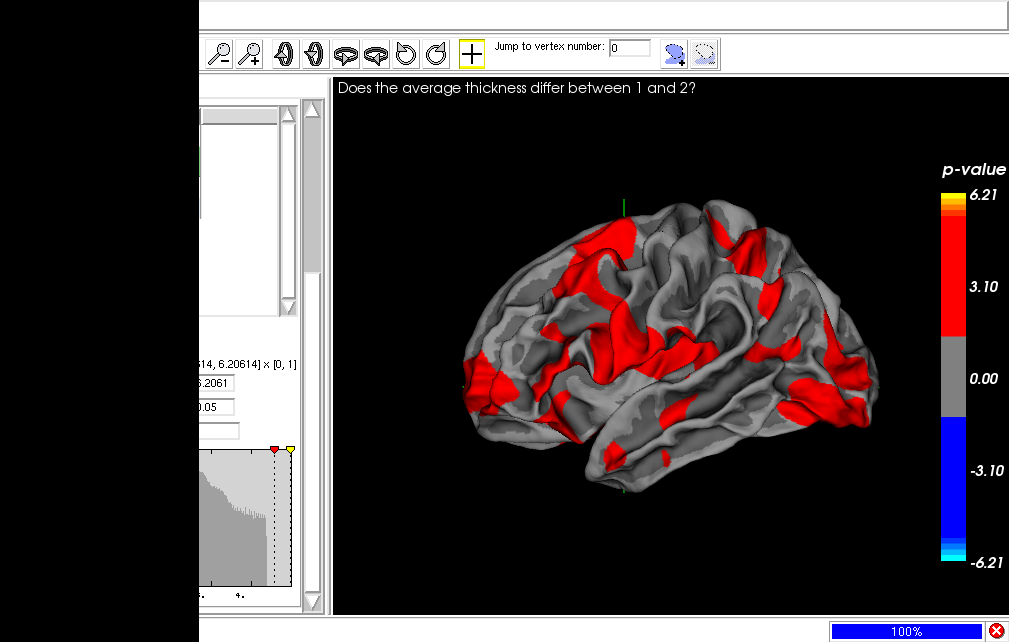
yeah, I've replaced the input with the sig.mgh for the contrast of interest, which retruns something more plausible. Thanks again, and sorry for the confusion. Ta, Alex
I noticed that you are using contrasts.sig.mgh as the input to mri_surfcluster and that the source frame is 0. contrasts.sig.mgh will have many frames. Does the 1st frame (frame 0) correspond to the image below? If not, then add --frame frameno to your cmd where frameno is the 0-based frame number that corresponds to that image.
doug
Alex Fornito wrote:
3dcopy gefunct1.nii gefunct1
Thanks for all your help guys, but I am still having trouble (!). This time I've tried a different dataset, again just a simple 2 group comaprison with no covariates.
Running this in qdec, and visualizing with a low threshold (min=1.3), I see a whole bunch of clusters (see attached). However, when I run mri_surfcluster, I only get one whole brain cluster again (see below). This time I smoothed with 15 mm in qdec, although I get the same if I smooth with 10mm. I have kept the thresholds low on purpose, because I expect that something should come out?? I did not run simulations in this instance, to cut processing time.
mri_surfcluster --in qdec/MF_lh_15mm/contrasts.sig.mgh --no-adjust --subject fsaverage/ --hemi l h --thmin 1.3 --minarea 15 --sum TestClusters
thsign = abs, id = 0 version $Id: mri_surfcluster.c,v 1.39 2007/07/31 00:34:19 greve Exp $ hemi = lh srcid = qdec/MF_lh_15mm/contrasts.sig.mgh paint srcsubjid = fsaverage/ srcsurf = white srcframe = 0 thsign = abs thmin = 1.3 thmax = -1 fdr = -1 minarea = 15 xfmfile = talairach.xfm nth = -1 sumfile = TestClusters subjectsdir = /data/kang/work/struct/alex/freesurfer/subjects_cann FixMNI = 1 ------------- XFM matrix (RAS2RAS) --------------- /data/kang/work/struct/alex/freesurfer/subjects_cann/fsaverage//mri/transforms/t alairach.xfm 1.000 0.000 0.000 0.000; 0.000 1.000 0.000 0.000; 0.000 0.000 1.000 0.000; 0.000 0.000 0.000 1.000;
Reading source surface /data/kang/work/struct/alex/freesurfer/subjects_cann/fsav erage//surf/lh.white reading group avg surface area 822 cm^2 from file Reading in average area /data/kang/work/struct/alex/freesurfer/subjects_cann/fsa verage//surf/lh.white.avg.area.mgh Done reading source surface Computing metric properties Loading source values number of voxels in search space = 163842 Done loading source values (nvtxs = 163842) overall max = 1e+10 at vertex 26 overall min = 1.75775 at vertex 126983 surface nvertices 163842 surface area 65416.985991 surface area 65416.985976 NOT Adjusting threshold for 1-tailed test Searching for Clusters ... thmin=1.300000 (1.300000), thmax=-1.000000 (-1), thsignid=0, minarea=15.000000 Found 1 clusters Max cluster size 103339.460938 INFO: fixing MNI talairach coordinates
On 05/12/2007, at 4:19 AM, Doug Greve wrote:
There's really no such thing as an opt kernel size. The best size depends on the underlying signal and can be space variant.
doug
Alex Fornito wrote:
Yes, I selected 25 mm on qdec, based on the Lerch paper suggesting this was a generally 'optimal' kernel size. The 34.309.. was the residual output to y.fsgd.
Do you recommend a smaller kernel?
On 04/12/2007, at 5:41 PM, Pratap Kunwar wrote:
I think, one reason for getting only one big cluster is because your fwhm value is very high. By the way how did you get fwhm 34.309616??, was it produced by selecting fwhm 25 (max on Qdec)on Qdec?
Did you try fwhm 10 or 15?
Thanks for your help Pratap. I've actually been trying to follow the tutorial and was running simulations initially, but when I tried to re-trace my steps I ended omitted them because I forgot they were necessary for mri_surfcluster.
Either way, the results are the same- I still get one whole surface cluster as output even after running simulations. In this case, I re- ran it copying your commands, except I used perm because I have low numbers and no covariates. I also ran 1000 permutations, to get a quick initial result for testing. My commands and output are below.
I would appreciate further help on this, as I'm not sure where I'm going wrong!
also, I noticed that after your mri_glmfit command, you added --i divided into 5000 each. Sorry, but I'm not sure what you meant by that.
---> i had split simulation (10,000 iterations)into multiple runs csd1* (5000 iterations) and csd2* (5000 iterations) since mc-z relatively takes long time comparing to permutation. More on, https://surfer.nmr.mgh.harvard.edu/fswiki/FsTutorial_2fGroupAnalysis?action=... https://surfer.nmr.mgh.harvard.edu/fswiki/FsTutorial_2fGroupAnalysis?action=highlight&value=fsgd
mri_glmfit --y qdec/MF_group_rh/y.mgh --fsgd qdec/MF_group_rh/ qdec.fsgd doss --surf fsaverage rh --fwhm 34.309616 --C qdec/ MF_group_rh/contrasts/Diff-1-2-Intercept.mat --sim perm 1000 2 stats/ newperm_rh/newperm_rh --glmdir stats/newperm_rh/
gdfReadHeader: reading qdec/MF_group_rh/qdec.fsgd INFO: demeaning continous variables Continuous Variable Means (all subjects) Class Means of each Continuous Variable 1 group1 2 group2 INFO: gd2mtx_method is doss Reading source surface /data/kang/work/struct/alex/freesurfer/ subjects_cann/fsaverage/surf/rh.white reading group avg surface area 822 cm^2 from file Reading in average area /data/kang/work/struct/alex/freesurfer/ subjects_cann/fsaverage/surf/rh.white.avg.area.mgh simbase stats/newperm_rh/newperm_rh Number of vertices 163842 Number of faces 327680 Total area 65020.765625 AvgVtxArea 0.396850 AvgVtxDist 0.717994 StdVtxDist 0.193566 reading group avg surface area 822 cm^2 from file Reading in average area /data/kang/work/struct/alex/freesurfer/ subjects_cann/fsaverage/surf/rh.white.avg.area.mgh INFO: fwhm2niters: Fixing group surface area Surface smoothing by fwhm=34.309616, niters=866.000000
$Id: mri_glmfit.c,v 1.138.2.1 2007/09/12 15:38:19 nicks Exp $ cwd /data/kang/work/struct/alex/freesurfer/subjects_cann cmdline mri_glmfit --y qdec/MF_group_rh/y.mgh --fsgd qdec/MF_group_rh/ qdec.fsgd doss --surf fsaverage rh --fwhm 34.309616 --C qdec/ MF_group_rh/contrasts/Diff-1-2-Intercept.mat --sim perm 1000 2 stats/ newperm_rh/newperm_rh --glmdir stats/newperm_rh/ sysname Linux hostname kang machine i686 user alex FixVertexAreaFlag = 1 UseMaskWithSmoothing 1 fwhm 34.309616 niters 866.000000 OneSampleGroupMean 0 y /data/kang/work/struct/alex/freesurfer/subjects_cann/qdec/ MF_group_rh/y.mgh logyflag 0 usedti 0 FSGD qdec/MF_group_rh/qdec.fsgd glmdir stats/newperm_rh/ DoFFx 0 Loading y from /data/kang/work/struct/alex/freesurfer/subjects_cann/ qdec/MF_group_rh/y.mgh Matrix condition is 1 search space = 82167.6 Smoothing input by fwhm 34.309616 Smoothing done, nsteps = 866, tsec = 1236.17 ... done DOF = 28 thresh = 2, threshadj = 2 Starting simulation sim over 1000 trials 1/1000 t=0 ------------------------------------------------ Starting fit and test 10% 20% 30% 40% 50% 60% 70% 80% 90% 100% Diff-1-2-Intercept 0 nc=3 maxcsize=1910.81 sigmax=-3.00831 Fmax=13.551 2/1000 t=0.0572833 ------------------------------------------------ Starting fit and test 10% 20% 30% 40% 50% 60% 70% 80% 90% 100% Diff-1-2-Intercept 1 nc=0 maxcsize=0 sigmax=1.36036 Fmax=4.46612 3/1000 t=0.0994333 ------------------------------------------------
... and so on... then
mri_surfcluster --src qdec/MF_group_lh/contrasts.sig.mgh --csd stats/ newperm_lh/newperm_lh-Diff-1-2-Intercept.csd --sum stats/newperm_lh/ newperm_lh --ocp stats/newperm_lh/newperm_lh.mgh
thsign = abs, id = 0 version $Id: mri_surfcluster.c,v 1.39 2007/07/31 00:34:19 greve Exp $ hemi = rh srcid = qdec/MF_group_lh/contrasts.sig.mgh paint srcsubjid = fsaverage srcsurf = white srcframe = 0 thsign = abs thmin = 2 thmax = -1 fdr = -1 minarea = 0 xfmfile = talairach.xfm nth = -1 sumfile = stats/newperm_lh/newperm_lh subjectsdir = /data/kang/work/struct/alex/freesurfer/subjects_cann FixMNI = 1 ------------- XFM matrix (RAS2RAS) --------------- /data/kang/work/struct/alex/freesurfer/subjects_cann/fsaverage/mri/ transforms/talairach.xfm 1.000 0.000 0.000 0.000; 0.000 1.000 0.000 0.000; 0.000 0.000 1.000 0.000; 0.000 0.000 0.000 1.000;
Reading source surface /data/kang/work/struct/alex/freesurfer/ subjects_cann/fsaverage/surf/rh.white reading group avg surface area 822 cm^2 from file Reading in average area /data/kang/work/struct/alex/freesurfer/ subjects_cann/fsaverage/surf/rh.white.avg.area.mgh Done reading source surface Computing metric properties Loading source values number of voxels in search space = 163842 Done loading source values (nvtxs = 163842) overall max = 43.1907 at vertex 101931 overall min = 7.66111 at vertex 28089 surface nvertices 163842 surface area 65020.838384 surface area 65020.838382 NOT Adjusting threshold for 1-tailed test Searching for Clusters ... thmin=2.000000 (2.000000), thmax=-1.000000 (-1), thsignid=0, minarea=0.000000 Found 1 clusters Max cluster size 103836.125000 INFO: fixing MNI talairach coordinates Saving cluster pval stats/newperm_lh/newperm_lh.mgh
On 04/12/2007, at 11:30 AM, Pratap Kunwar wrote:
> Alex, > > You have to do simulations using mri_glmfit before youdo > mri_surfcluster, > > [more info in this link at > https://surfer.nmr.mgh.harvard.edu/fswiki/ > FsTutorial_2fGroupAnalysis?action=highlight&value=fsgd > go down to [4.0 Using mri_glmfit to correct for multiple > comparisons: ] > > USAGE: ./mri_glmfit > > --glmdir dir : save outputs to dir > > --y inputfile **y.mgh > --fsgd FSGDF <gd2mtx> : freesurfer descriptor file **qdec.fsgd > --C contrast1.mat <--C contrast2.mat ...> > --fwhm fwhm : smooth input by fwhm ** your smoothing value from > " > fwhm.dat" > --surf subject hemi <surfname> : needed for some flags (uses > white by > default) **lh or rh > --sim nulltype nsim thresh csdbasename : simulation perm, mc- > full, mc-z > **mc-z (i used) is faster than mc-full, minimum threshold value ( > i.e. > 1.3 for 0.05), > > My command was more like this, > > mri_glmfit --y y.mgh --fsgd qdec.fsgd doss --surf fsaverage rh -- > fwhm < ?? > >> --C contrast/contrastname.mat --sim mc-z 5000 1.3 f11/csd1 -- >> glmdir f11 > > > > mri_glmfit --y y.mgh --fsgd qdec.fsgd doss --surf fsaverage rh > --fwhm > 14.504073 --C contrast/contrastname.mat --sim mc-z 5000 1.3 > f11/csd2 > --glmdir f11 > > --i divided into 5000 each > > from above mri_glmfit, i got two files starting with csd1* .csd and > csd2*.csd. > > Next one is > > mri_surfcluster, > mri_surfcluster --src contrastname/sig.mgh --csd csd1* .csd --csd > csd2* > ..csd --sum <text summary file --sum <*.sum> --ocp <*.mgh> > > the output file *.sum can be opened in text editor and *.mgh can > be seen > using tksurfer. Check the link above link for more details (i just > followed that link when i did last month). > > let me know if you get into more problems. > > pratap > >> >>> On 11/28/2007 07:43 PM, Alex Fornito wrote: >>> >>>> Hi, >>>> I have run qdec for a simple contrast comparing thickness across >>>> the >>>> cortical surface between a patient and control group. Not much >>>> survives vertex-wise FDR correction, and I would like to try >>>> cluster-based thresholding. I would like to make sure I >>>> understand the >>>> inputs to the command. Am I correct on the following? >>>> >>>> --in = the signifcance values (i.e., contrast_name.sig.mgh file) >>>> --thmin = the vertexwise threshold for determining clusters, >>>> where 2 >>>> corresponds to p=.01 >>>> --minarea = the cluster extent threshold - Am I correct in >>>> assuming >>>> this should not be smaller than the smoothing kernel? >>>> >>>> When I run the command below, I get the following output. Only >>>> one >>>> (whole hemi) cluster is identified. I'm not sure if its a >>>> problem in >>>> my command line, or with my data. Also, I seem to have the >>>> --cwsig >>>> flag wrong, but can't figure out the error (appending .w >>>> or .label to >>>> the end of the output filename does not change the error). >>>> >>>> I greatly appreciate your help. >>>> >>>> >>>> mri_surfcluster --in qdec/MF_group_lh/contrasts.sig.mgh >>>> --subject >>>> fsaverage --hemi lh --surf white --annot aparc --sign abs >>>> --thmin 2 >>>> --minarea 25 --sum stats/qdec_run/cluster/summary.txt --o >>>> stats/qdec_run/cluster/cluster_output --cwsig >>>> stats/qdec_run/cluster/cwsig --olab >>>> stats/qdec_run/cluster/MF_group_lh_thk >>>> >>>> thsign = abs, id = 0 >>>> version $Id: mri_surfcluster.c,v 1.39 2007/07/31 00:34:19 greve >>>> Exp $ >>>> hemi = lh >>>> srcid = qdec/MF_group_lh/contrasts.sig.mgh paint >>>> srcsubjid = fsaverage >>>> srcsurf = white >>>> srcframe = 0 >>>> thsign = abs >>>> thmin = 2 >>>> thmax = -1 >>>> fdr = -1 >>>> minarea = 25 >>>> xfmfile = talairach.xfm >>>> nth = -1 >>>> outid = stats/qdec_run/cluster/cluster_output paint >>>> sumfile = stats/run2/cluster/summary.txt >>>> subjectsdir = /data/kang/work/struct/alex/freesurfer/ >>>> subjects_cann >>>> FixMNI = 1 >>>> ------------- XFM matrix (RAS2RAS) --------------- >>>> /data/kang/work/struct/alex/freesurfer/subjects_cann/fsaverage/ >>>> mri/transforms/talairach.xfm >>>> 1.000 0.000 0.000 0.000; >>>> 0.000 1.000 0.000 0.000; >>>> 0.000 0.000 1.000 0.000; >>>> 0.000 0.000 0.000 1.000; >>>> ---------------------------------------------------- >>>> Reading source surface >>>> /data/kang/work/struct/alex/freesurfer/subjects_cann/fsaverage/ >>>> surf/lh.white >>>> reading group avg surface area 822 cm^2 from file >>>> Reading in average area >>>> /data/kang/work/struct/alex/freesurfer/subjects_cann/fsaverage/ >>>> surf/lh.white.avg.area.mgh >>>> Done reading source surface >>>> Reading annotation >>>> /data/kang/work/struct/alex/freesurfer/subjects_cann/fsaverage/ >>>> label/lh.aparc.annot >>>> reading colortable from annotation file... >>>> colortable with 35 entries read (originally >>>> /space/amaebi/26/users/buckner_cortical_atlas/scripts/ >>>> colortable_final.txt) >>>> Computing metric properties >>>> Loading source values >>>> number of voxels in search space = 163842 >>>> Done loading source values (nvtxs = 163842) >>>> overall max = 43.1907 at vertex 101931 >>>> overall min = 7.66111 at vertex 28089 >>>> surface nvertices 163842 >>>> surface area 65416.985991 >>>> surface area 65416.985976 >>>> NOT Adjusting threshold for 1-tailed test >>>> Searching for Clusters ... >>>> thmin=2.000000 (2.000000), thmax=-1.000000 (-1), thsignid=0, >>>> minarea=25.000000 >>>> Found 1 clusters >>>> Max cluster size 103339.460938 >>>> INFO: fixing MNI talairach coordinates >>>> Saving thresholded output to >>>> stats/qdec_run/cluster/cluster_output >>>> avg = 35.029, stdev = 4.669, min = 7.661, max = 43.191 >>>> Saving cluster pval stats/qdec_run/cluster/cwsig >>>> unknown file type for file (stats/qdec_run/cluster/cwsig) >>>> LabelWrite: saving to stats/qdec_run/cluster/ >>>> MF_group_lh_thk-0001.label >>>> >>>> >>>> >>>> Alex Fornito >>>> JN Peters Research Fellow >>>> Melbourne Neuropsychiatry Centre >>>> Department of Psychiatry >>>> The University of Melbourne >>>> >>>> Postal address: >>>> Melbourne Neuropsychiatry Centre >>>> National Neuroscience Facility >>>> Levels 2 & 3, 161 Barry St >>>> Carlton South Vic 3053 Australia >>>> >>>> Ph: +61 3 8344 1861 >>>> Fax: +61 3 9348 0469 >>>> >>>> fornitoa@unimelb.edu.au mailto:fornitoa@unimelb.edu.au >>>> >>>> >>>> >>>> >>>> ------------------------------------------------------------------- >>>> ----- >>>> >>>> _______________________________________________ >>>> Freesurfer mailing list >>>> Freesurfer@nmr.mgh.harvard.edu >>>> mailto:Freesurfer@nmr.mgh.harvard.edu >>>> https://mail.nmr.mgh.harvard.edu/mailman/listinfo/freesurfer >>> >>> >>> >> >> _______________________________________________ >> Freesurfer mailing list >> Freesurfer@nmr.mgh.harvard.edu >> mailto:Freesurfer@nmr.mgh.harvard.edu >> https://mail.nmr.mgh.harvard.edu/mailman/listinfo/freesurfer >> >> >> >
Alex Fornito JN Peters Research Fellow Melbourne Neuropsychiatry Centre Department of Psychiatry The University of Melbourne
Postal address: Melbourne Neuropsychiatry Centre National Neuroscience Facility Levels 2 & 3, 161 Barry St Carlton South Vic 3053 Australia
Ph: +61 3 8344 1861 Fax: +61 3 9348 0469
fornitoa@unimelb.edu.au mailto:fornitoa@unimelb.edu.au
Alex Fornito JN Peters Research Fellow Melbourne Neuropsychiatry Centre Department of Psychiatry The University of Melbourne
Postal address: Melbourne Neuropsychiatry Centre National Neuroscience Facility Levels 2 & 3, 161 Barry St Carlton South Vic 3053 Australia
Ph: +61 3 8344 1861 Fax: +61 3 9348 0469
fornitoa@unimelb.edu.au mailto:fornitoa@unimelb.edu.au
-- Douglas N. Greve, Ph.D. MGH-NMR Center greve@nmr.mgh.harvard.edu Phone Number: 617-724-2358 Fax: 617-726-7422
In order to help us help you, please follow the steps in: surfer.nmr.mgh.harvard.edu/fswiki/BugReporting
Alex Fornito JN Peters Research Fellow Melbourne Neuropsychiatry Centre Department of Psychiatry The University of Melbourne
Postal address: Melbourne Neuropsychiatry Centre National Neuroscience Facility Levels 2 & 3, 161 Barry St Carlton South Vic 3053 Australia
Ph: +61 3 8344 1861 Fax: +61 3 9348 0469
fornitoa@unimelb.edu.au mailto:fornitoa@unimelb.edu.au
-- Douglas N. Greve, Ph.D. MGH-NMR Center greve@nmr.mgh.harvard.edu Phone Number: 617-724-2358 Fax: 617-726-7422
In order to help us help you, please follow the steps in: surfer.nmr.mgh.harvard.edu/fswiki/BugReporting
freesurfer@nmr.mgh.harvard.edu
-
 Alex Fornito
 -
Alexander Fornito
-
 Cameron Ellis
 -
 Doug Greve
 -
 Nick Schmansky
 -
 Pratap Kunwar