
External Email - Use Caution
Hello experts,
I am interested in identifying regions of interest by comparing cortical volume (CV) between controls and patients.
After including age and sex as my covariates, I identified regions X1 and X2, which showed significantly lower CV for patients (as compared to controls).
But after I include ICV as another covariate, my results show that for none of the areas there is any significant difference in CV, i.e. my results vanish.
When I checked subjectwise ICV for each group, I found that there is almost significant difference (two-sampled t-test, p = 0.067) in ICV between two groups, but interestingly mean group ICV for patients group was larger compared than mean ICV for controls. But as I said earlier, regions X1 and X2 had significantly lower CV for patients (as compared to controls), when I didn't include ICV as covariate.
Could you please help me in interpreting these results? Is there any advice regarding inclusion of ICV as covariate? Or my results are purely because of differences in ICV between groups, and there is no real findings regarding the regions identified (X1 and X2)?
Thanks a lot !

your results could have vanished after ICV correction for one of
two reasons: the CV difference became less or the values became
noisier (or a combination). So check in your data which one of
those things happened.


On 7/23/18 8:30 PM, Martin Juneja wrote:
External Email - Use Caution
Hello experts,
I am interested in identifying regions of interest by comparing cortical volume (CV) between controls and patients.
After including age and sex as my covariates, I identified regions X1 and X2, which showed significantly lower CV for patients (as compared to controls).
But after I include ICV as another covariate, my results show that for none of the areas there is any significant difference in CV, i.e. my results vanish.
When I checked subjectwise ICV for each group, I found that there is almost significant difference (two-sampled t-test, p = 0.067) in ICV between two groups, but interestingly mean group ICV for patients group was larger compared than mean ICV for controls. But as I said earlier, regions X1 and X2 had significantly lower CV for patients (as compared to controls), when I didn't include ICV as covariate.
Could you please help me in interpreting these results? Is there any advice regarding inclusion of ICV as covariate? Or my results are purely because of differences in ICV between groups, and there is no real findings regarding the regions identified (X1 and X2)?
Thanks a lot !
Freesurfer mailing list Freesurfer@nmr.mgh.harvard.edu https://mail.nmr.mgh.harvard.edu/mailman/listinfo/freesurfer
External Email - Use Caution
Hi Dr. Greve,
Thanks for your quick reply. Could you please give me more details how can I check this whether its because of noise or its because of less CV difference? I am not sure what method/way is the best and commonly used to confirm these factors.
Thanks.
On Tue, Jul 24, 2018 at 7:06 AM, Douglas Greve dgreve@mgh.harvard.edu wrote:
your results could have vanished after ICV correction for one of
two reasons: the CV difference became less or the values became
noisier (or a combination). So check in your data which one of
those things happened.


On 7/23/18 8:30 PM, Martin Juneja wrote:
External Email - Use CautionHello experts,
I am interested in identifying regions of interest by comparing cortical volume (CV) between controls and patients.
After including age and sex as my covariates, I identified regions X1 and X2, which showed significantly lower CV for patients (as compared to controls).
But after I include ICV as another covariate, my results show that for none of the areas there is any significant difference in CV, i.e. my results vanish.
When I checked subjectwise ICV for each group, I found that there is almost significant difference (two-sampled t-test, p = 0.067) in ICV between two groups, but interestingly mean group ICV for patients group was larger compared than mean ICV for controls. But as I said earlier, regions X1 and X2 had significantly lower CV for patients (as compared to controls), when I didn't include ICV as covariate.
Could you please help me in interpreting these results? Is there any advice regarding inclusion of ICV as covariate? Or my results are purely because of differences in ICV between groups, and there is no real findings regarding the regions identified (X1 and X2)?
Thanks a lot !
Freesurfer mailing listFreesurfer@nmr.mgh.harvard.eduhttps://mail.nmr.mgh.harvard.edu/mailman/listinfo/freesurfer
Freesurfer mailing list Freesurfer@nmr.mgh.harvard.edu https://mail.nmr.mgh.harvard.edu/mailman/listinfo/freesurfer
The information in this e-mail is intended only for the person to whom it is addressed. If you believe this e-mail was sent to you in error and the e-mail contains patient information, please contact the Partners Compliance HelpLine at http://www.partners.org/complianceline . If the e-mail was sent to you in error but does not contain patient information, please contact the sender and properly dispose of the e-mail.
For noise compare the values in the rstd.mgh file, for effect size look in the gamma.mgh file
On 07/24/2018 12:27 PM, Martin Juneja wrote:
External Email - Use Caution
Hi Dr. Greve,
Thanks for your quick reply. Could you please give me more details how can I check this whether its because of noise or its because of less CV difference? I am not sure what method/way is the best and commonly used to confirm these factors.
Thanks.
On Tue, Jul 24, 2018 at 7:06 AM, Douglas Greve <dgreve@mgh.harvard.edu mailto:dgreve@mgh.harvard.edu> wrote:
your results could have vanished after ICV correction for one of two reasons: the CV difference became less or the values became noisier (or a combination). So check in your data which one of those things happened. On 7/23/18 8:30 PM, Martin Juneja wrote:External Email - Use Caution Hello experts, I am interested in identifying regions of interest by comparing cortical volume (CV) between controls and patients. After including age and sex as my covariates, I identified regions X1 and X2, which showed significantly lower CV for patients (as compared to controls). But after I include ICV as another covariate, my results show that for none of the areas there is any significant difference in CV, i.e. my results vanish. When I checked subjectwise ICV for each group, I found that there is almost significant difference (two-sampled t-test, p = 0.067) in ICV between two groups, but interestingly mean group ICV for patients group was larger compared than mean ICV for controls. But as I said earlier, regions X1 and X2 had significantly lower CV for patients (as compared to controls), when I didn't include ICV as covariate. Could you please help me in interpreting these results? Is there any advice regarding inclusion of ICV as covariate? Or my results are purely because of differences in ICV between groups, and there is no real findings regarding the regions identified (X1 and X2)? Thanks a lot ! _______________________________________________ Freesurfer mailing list Freesurfer@nmr.mgh.harvard.edu <mailto:Freesurfer@nmr.mgh.harvard.edu> https://mail.nmr.mgh.harvard.edu/mailman/listinfo/freesurfer <https://mail.nmr.mgh.harvard.edu/mailman/listinfo/freesurfer>_______________________________________________ Freesurfer mailing list Freesurfer@nmr.mgh.harvard.edu <mailto:Freesurfer@nmr.mgh.harvard.edu> https://mail.nmr.mgh.harvard.edu/mailman/listinfo/freesurfer <https://mail.nmr.mgh.harvard.edu/mailman/listinfo/freesurfer> The information in this e-mail is intended only for the person to whom it is addressed. If you believe this e-mail was sent to you in error and the e-mail contains patient information, please contact the Partners Compliance HelpLine at http://www.partners.org/complianceline <http://www.partners.org/complianceline> . If the e-mail was sent to you in error but does not contain patient information, please contact the sender and properly dispose of the e-mail.
Freesurfer mailing list Freesurfer@nmr.mgh.harvard.edu https://mail.nmr.mgh.harvard.edu/mailman/listinfo/freesurfer
External Email - Use Caution
Hi Dr. Greve,
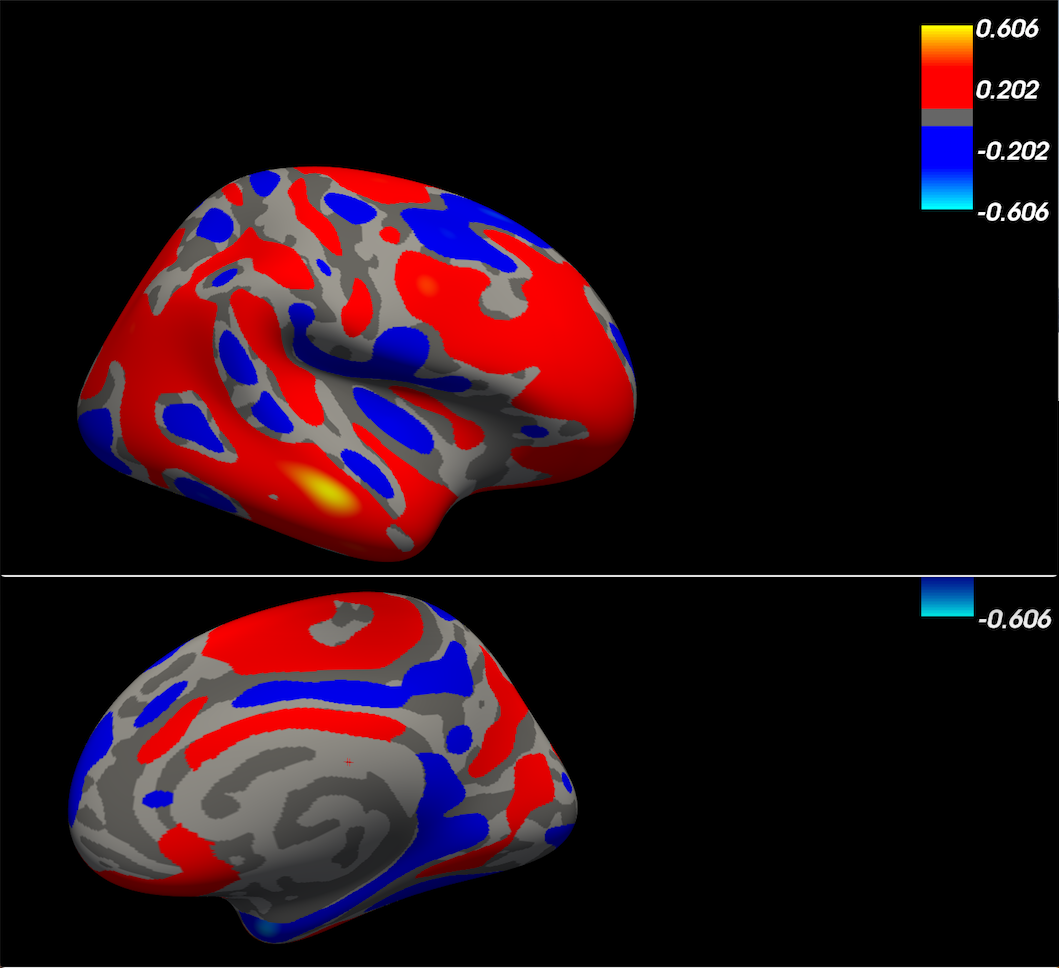
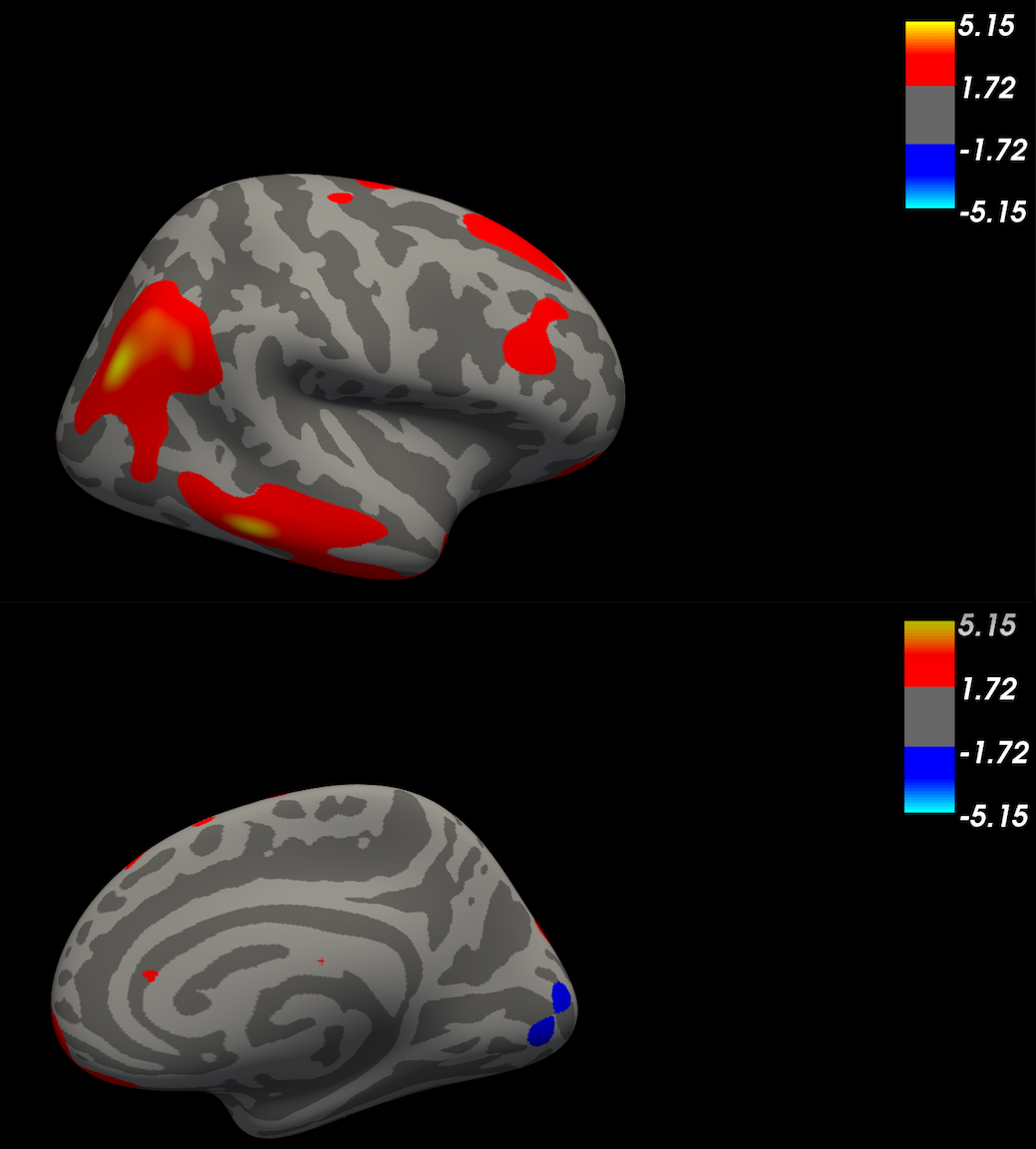
So I checked both. The rstd.mgh files are very similar in both cases (with and without ICV as covariate), but gamma.mgh files are very different for both cases. Here I am attaching screen shot for both cases: Gamma_With_ICV as covariate and Gamma_Without_ICV as covariate.
Could you please have a look at the attached screen shots and provide your thoughts/interpretation of this comparison?
Thanks.
On Tue, Jul 24, 2018 at 9:35 AM, Douglas N. Greve dgreve@mgh.harvard.edu wrote:
For noise compare the values in the rstd.mgh file, for effect size look in the gamma.mgh file
On 07/24/2018 12:27 PM, Martin Juneja wrote:
External Email - Use CautionHi Dr. Greve,
Thanks for your quick reply. Could you please give me more details how can I check this whether its because of noise or its because of less CV difference? I am not sure what method/way is the best and commonly used to confirm these factors.
Thanks.
On Tue, Jul 24, 2018 at 7:06 AM, Douglas Greve <dgreve@mgh.harvard.edu mailto:dgreve@mgh.harvard.edu> wrote:
your results could have vanished after ICV correction for one of two reasons: the CV difference became less or the values became noisier (or a combination). So check in your data which one of those things happened. On 7/23/18 8:30 PM, Martin Juneja wrote:External Email - Use Caution Hello experts, I am interested in identifying regions of interest by comparing cortical volume (CV) between controls and patients. After including age and sex as my covariates, I identified regions X1 and X2, which showed significantly lower CV for patients (as compared to controls). But after I include ICV as another covariate, my results show that for none of the areas there is any significant difference in CV, i.e. my results vanish. When I checked subjectwise ICV for each group, I found that there is almost significant difference (two-sampled t-test, p = 0.067) in ICV between two groups, but interestingly mean group ICV for patients group was larger compared than mean ICV for controls. But as I said earlier, regions X1 and X2 had significantly lower CV for patients (as compared to controls), when I didn't include ICV as covariate. Could you please help me in interpreting these results? Is there any advice regarding inclusion of ICV as covariate? Or my results are purely because of differences in ICV between groups, and there is no real findings regarding the regions identified (X1 and X2)? Thanks a lot ! _______________________________________________ Freesurfer mailing list Freesurfer@nmr.mgh.harvard.edu <mailto:Freesurfer@nmr.mgh.harvard.edu> https://mail.nmr.mgh.harvard.edu/mailman/listinfo/freesurfer <https://mail.nmr.mgh.harvard.edu/mailman/listinfo/freesurfer>_______________________________________________ Freesurfer mailing list Freesurfer@nmr.mgh.harvard.edu <mailto:Freesurfer@nmr.mgh.harvard.edu>
https://mail.nmr.mgh.harvard.edu/mailman/listinfo/freesurfer <https://mail.nmr.mgh.harvard.edu/mailman/listinfo/freesurfer> The information in this e-mail is intended only for the person to whom it is addressed. If you believe this e-mail was sent to you in error and the e-mail contains patient information, please contact the Partners Compliance HelpLine at http://www.partners.org/complianceline <http://www.partners.org/complianceline> . If the e-mail was sent to you in error but does not contain patient information, please contact the sender and properly dispose of the e-mail.
Freesurfer mailing list Freesurfer@nmr.mgh.harvard.edu https://mail.nmr.mgh.harvard.edu/mailman/listinfo/freesurfer
Freesurfer mailing list Freesurfer@nmr.mgh.harvard.edu https://mail.nmr.mgh.harvard.edu/mailman/listinfo/freesurfer
External Email - Use Caution
Just to add some more info here: The peak location of regions, X1 and X2, which I found without including ICV as covariate are very close with the peak locations I found in Gamma_Without_ICV (~5.15), whereas Gamma_With_ICV is almost all over the brain (range -0.6 to +0.6). I am not sure if this additional info adds anything to interpret gamma.mgh with and without ICV as covariate.
On Tue, Jul 24, 2018 at 10:10 AM, Martin Juneja mj70481@gmail.com wrote:
Hi Dr. Greve,
So I checked both. The rstd.mgh files are very similar in both cases (with and without ICV as covariate), but gamma.mgh files are very different for both cases. Here I am attaching screen shot for both cases: Gamma_With_ICV as covariate and Gamma_Without_ICV as covariate.
Could you please have a look at the attached screen shots and provide your thoughts/interpretation of this comparison?
Thanks.
On Tue, Jul 24, 2018 at 9:35 AM, Douglas N. Greve dgreve@mgh.harvard.edu wrote:
For noise compare the values in the rstd.mgh file, for effect size look in the gamma.mgh file
On 07/24/2018 12:27 PM, Martin Juneja wrote:
External Email - Use CautionHi Dr. Greve,
Thanks for your quick reply. Could you please give me more details how can I check this whether its because of noise or its because of less CV difference? I am not sure what method/way is the best and commonly used to confirm these factors.
Thanks.
On Tue, Jul 24, 2018 at 7:06 AM, Douglas Greve <dgreve@mgh.harvard.edu mailto:dgreve@mgh.harvard.edu> wrote:
your results could have vanished after ICV correction for one of two reasons: the CV difference became less or the values became noisier (or a combination). So check in your data which one of those things happened. On 7/23/18 8:30 PM, Martin Juneja wrote:External Email - Use Caution Hello experts, I am interested in identifying regions of interest by comparing cortical volume (CV) between controls and patients. After including age and sex as my covariates, I identified regions X1 and X2, which showed significantly lower CV for patients (as compared to controls). But after I include ICV as another covariate, my results show that for none of the areas there is any significant difference in CV, i.e. my results vanish. When I checked subjectwise ICV for each group, I found that there is almost significant difference (two-sampled t-test, p = 0.067) in ICV between two groups, but interestingly mean group ICV for patients group was larger compared than mean ICV for controls. But as I said earlier, regions X1 and X2 had significantly lower CV for patients (as compared to controls), when I didn't include ICV as covariate. Could you please help me in interpreting these results? Is there any advice regarding inclusion of ICV as covariate? Or my results are purely because of differences in ICV between groups, and there is no real findings regarding the regions identified (X1 and X2)? Thanks a lot ! _______________________________________________ Freesurfer mailing list Freesurfer@nmr.mgh.harvard.edu <mailto:Freesurfer@nmr.mgh.harvard.edu> https://mail.nmr.mgh.harvard.edu/mailman/listinfo/freesurfer <https://mail.nmr.mgh.harvard.edu/mailman/listinfo/freesurfer>_______________________________________________ Freesurfer mailing list Freesurfer@nmr.mgh.harvard.edu <mailto:Freesurfer@nmr.mgh.harvard.edu>
https://mail.nmr.mgh.harvard.edu/mailman/listinfo/freesurfer <https://mail.nmr.mgh.harvard.edu/mailman/listinfo/freesurfer> The information in this e-mail is intended only for the person to whom it is addressed. If you believe this e-mail was sent to you in error and the e-mail contains patient information, please contact the Partners Compliance HelpLine at http://www.partners.org/complianceline <http://www.partners.org/complianceline> . If the e-mail was sent to you in error but does not contain patient information, please contact the sender and properly dispose of the e-mail.
Freesurfer mailing list Freesurfer@nmr.mgh.harvard.edu https://mail.nmr.mgh.harvard.edu/mailman/listinfo/freesurfer
Freesurfer mailing list Freesurfer@nmr.mgh.harvard.edu https://mail.nmr.mgh.harvard.edu/mailman/listinfo/freesurfer
The gammas do look different, but it is hard to tell whether they are, eg, changing sign. Not sure what you want me to comment on.
On 7/24/18 2:17 PM, Martin Juneja wrote:
External Email - Use Caution
Just to add some more info here: The peak location of regions, X1 and X2, which I found without including ICV as covariate are very close with the peak locations I found in Gamma_Without_ICV (~5.15), whereas Gamma_With_ICV is almost all over the brain (range -0.6 to +0.6). I am not sure if this additional info adds anything to interpret gamma.mgh with and without ICV as covariate.
On Tue, Jul 24, 2018 at 10:10 AM, Martin Juneja <mj70481@gmail.com mailto:mj70481@gmail.com> wrote:
Hi Dr. Greve, So I checked both. The rstd.mgh files are very similar in both cases (with and without ICV as covariate), but gamma.mgh files are very different for both cases. Here I am attaching screen shot for both cases: Gamma_With_ICV as covariate and Gamma_Without_ICV as covariate. Could you please have a look at the attached screen shots and provide your thoughts/interpretation of this comparison? Thanks. On Tue, Jul 24, 2018 at 9:35 AM, Douglas N. Greve <dgreve@mgh.harvard.edu <mailto:dgreve@mgh.harvard.edu>> wrote: For noise compare the values in the rstd.mgh file, for effect size look in the gamma.mgh file On 07/24/2018 12:27 PM, Martin Juneja wrote: > > External Email - Use Caution > > Hi Dr. Greve, > > Thanks for your quick reply. Could you please give me more details how > can I check this whether its because of noise or its because of less > CV difference? > I am not sure what method/way is the best and commonly used to confirm > these factors. > > Thanks. > > On Tue, Jul 24, 2018 at 7:06 AM, Douglas Greve <dgreve@mgh.harvard.edu <mailto:dgreve@mgh.harvard.edu> > <mailto:dgreve@mgh.harvard.edu <mailto:dgreve@mgh.harvard.edu>>> wrote: > > your results could have vanished after ICV correction for one of > two reasons: the CV difference became less or the values became > noisier (or a combination). So check in your data which one of > those things happened. > > > On 7/23/18 8:30 PM, Martin Juneja wrote: >> >> External Email - Use Caution >> >> Hello experts, >> >> I am interested in identifying regions of interest by comparing >> cortical volume (CV) between controls and patients. >> >> After including age and sex as my covariates, I identified >> regions X1 and X2, which showed significantly lower CV for >> patients (as compared to controls). >> >> But after I include ICV as another covariate, my results show >> that for none of the areas there is any significant difference in >> CV, i.e. my results vanish. >> >> When I checked subjectwise ICV for each group, I found that there >> is almost significant difference (two-sampled t-test, p = 0.067) >> in ICV between two groups, but interestingly mean group ICV for >> patients group was larger compared than mean ICV for controls. >> But as I said earlier, regions X1 and X2 had significantly lower >> CV for patients (as compared to controls), when I didn't include >> ICV as covariate. >> >> Could you please help me in interpreting these results? Is there >> any advice regarding inclusion of ICV as covariate? Or my results >> are purely because of differences in ICV between groups, and >> there is no real findings regarding the regions identified (X1 >> and X2)? >> >> Thanks a lot ! >> >> >> _______________________________________________ >> Freesurfer mailing list >> Freesurfer@nmr.mgh.harvard.edu <mailto:Freesurfer@nmr.mgh.harvard.edu> >> <mailto:Freesurfer@nmr.mgh.harvard.edu <mailto:Freesurfer@nmr.mgh.harvard.edu>> >> https://mail.nmr.mgh.harvard.edu/mailman/listinfo/freesurfer <https://mail.nmr.mgh.harvard.edu/mailman/listinfo/freesurfer> >> <https://mail.nmr.mgh.harvard.edu/mailman/listinfo/freesurfer <https://mail.nmr.mgh.harvard.edu/mailman/listinfo/freesurfer>> > > > _______________________________________________ > Freesurfer mailing list > Freesurfer@nmr.mgh.harvard.edu <mailto:Freesurfer@nmr.mgh.harvard.edu> <mailto:Freesurfer@nmr.mgh.harvard.edu <mailto:Freesurfer@nmr.mgh.harvard.edu>> > https://mail.nmr.mgh.harvard.edu/mailman/listinfo/freesurfer <https://mail.nmr.mgh.harvard.edu/mailman/listinfo/freesurfer> > <https://mail.nmr.mgh.harvard.edu/mailman/listinfo/freesurfer <https://mail.nmr.mgh.harvard.edu/mailman/listinfo/freesurfer>> > > > The information in this e-mail is intended only for the person to > whom it is > addressed. If you believe this e-mail was sent to you in error and > the e-mail > contains patient information, please contact the Partners > Compliance HelpLine at > http://www.partners.org/complianceline <http://www.partners.org/complianceline> > <http://www.partners.org/complianceline <http://www.partners.org/complianceline>> . If the e-mail was sent > to you in error > but does not contain patient information, please contact the > sender and properly > dispose of the e-mail. > > > > > _______________________________________________ > Freesurfer mailing list > Freesurfer@nmr.mgh.harvard.edu <mailto:Freesurfer@nmr.mgh.harvard.edu> > https://mail.nmr.mgh.harvard.edu/mailman/listinfo/freesurfer <https://mail.nmr.mgh.harvard.edu/mailman/listinfo/freesurfer> _______________________________________________ Freesurfer mailing list Freesurfer@nmr.mgh.harvard.edu <mailto:Freesurfer@nmr.mgh.harvard.edu> https://mail.nmr.mgh.harvard.edu/mailman/listinfo/freesurfer <https://mail.nmr.mgh.harvard.edu/mailman/listinfo/freesurfer>
Freesurfer mailing list Freesurfer@nmr.mgh.harvard.edu https://mail.nmr.mgh.harvard.edu/mailman/listinfo/freesurfer
External Email - Use Caution
Dr. Greve,
I am sorry if my questions were not clear in previous email.
Basically, I do not know what to conclude from this gamma comparison i.e. with and without ICV as covariate. Clearly, adding ICV as covariate here, is reducing effect size all over the brain and without ICV effect size is higher at specific locations.
So should I go ahead with or without ICV as covariate?
Thanks.
On Wed, Jul 25, 2018 at 7:33 AM, Douglas Greve dgreve@mgh.harvard.edu wrote:
The gammas do look different, but it is hard to tell whether they are, eg, changing sign. Not sure what you want me to comment on.
On 7/24/18 2:17 PM, Martin Juneja wrote:
External Email - Use CautionJust to add some more info here: The peak location of regions, X1 and X2, which I found without including ICV as covariate are very close with the peak locations I found in Gamma_Without_ICV (~5.15), whereas Gamma_With_ICV is almost all over the brain (range -0.6 to +0.6). I am not sure if this additional info adds anything to interpret gamma.mgh with and without ICV as covariate.
On Tue, Jul 24, 2018 at 10:10 AM, Martin Juneja mj70481@gmail.com wrote:
Hi Dr. Greve,
So I checked both. The rstd.mgh files are very similar in both cases (with and without ICV as covariate), but gamma.mgh files are very different for both cases. Here I am attaching screen shot for both cases: Gamma_With_ICV as covariate and Gamma_Without_ICV as covariate.
Could you please have a look at the attached screen shots and provide your thoughts/interpretation of this comparison?
Thanks.
On Tue, Jul 24, 2018 at 9:35 AM, Douglas N. Greve <dgreve@mgh.harvard.edu
wrote:
For noise compare the values in the rstd.mgh file, for effect size look in the gamma.mgh file
On 07/24/2018 12:27 PM, Martin Juneja wrote:
External Email - Use CautionHi Dr. Greve,
Thanks for your quick reply. Could you please give me more details how can I check this whether its because of noise or its because of less CV difference? I am not sure what method/way is the best and commonly used to confirm these factors.
Thanks.
On Tue, Jul 24, 2018 at 7:06 AM, Douglas Greve <dgreve@mgh.harvard.edu mailto:dgreve@mgh.harvard.edu> wrote:
your results could have vanished after ICV correction for one of two reasons: the CV difference became less or the values became noisier (or a combination). So check in your data which one of those things happened. On 7/23/18 8:30 PM, Martin Juneja wrote:External Email - Use Caution Hello experts, I am interested in identifying regions of interest by comparing cortical volume (CV) between controls and patients. After including age and sex as my covariates, I identified regions X1 and X2, which showed significantly lower CV for patients (as compared to controls). But after I include ICV as another covariate, my results show that for none of the areas there is any significant difference in CV, i.e. my results vanish. When I checked subjectwise ICV for each group, I found that there is almost significant difference (two-sampled t-test, p = 0.067) in ICV between two groups, but interestingly mean group ICV for patients group was larger compared than mean ICV for controls. But as I said earlier, regions X1 and X2 had significantly lower CV for patients (as compared to controls), when I didn't include ICV as covariate. Could you please help me in interpreting these results? Is there any advice regarding inclusion of ICV as covariate? Or my results are purely because of differences in ICV between groups, and there is no real findings regarding the regions identified (X1 and X2)? Thanks a lot ! _______________________________________________ Freesurfer mailing list Freesurfer@nmr.mgh.harvard.edu <mailto:Freesurfer@nmr.mgh.harvard.edu> https://mail.nmr.mgh.harvard.edu/mailman/listinfo/freesurfer <https://mail.nmr.mgh.harvard.edu/mailman/listinfo/freesurfer>_______________________________________________ Freesurfer mailing list Freesurfer@nmr.mgh.harvard.edu <mailto:Freesurfer@nmr.mgh.harvard.edu>
https://mail.nmr.mgh.harvard.edu/mailman/listinfo/freesurfer <https://mail.nmr.mgh.harvard.edu/mailman/listinfo/freesurfer> The information in this e-mail is intended only for the person to whom it is addressed. If you believe this e-mail was sent to you in error and the e-mail contains patient information, please contact the Partners Compliance HelpLine at http://www.partners.org/complianceline <http://www.partners.org/complianceline> . If the e-mail was sent to you in error but does not contain patient information, please contact the sender and properly dispose of the e-mail.
Freesurfer mailing list Freesurfer@nmr.mgh.harvard.edu https://mail.nmr.mgh.harvard.edu/mailman/listinfo/freesurfer
Freesurfer mailing list Freesurfer@nmr.mgh.harvard.edu https://mail.nmr.mgh.harvard.edu/mailman/listinfo/freesurfer
Freesurfer mailing listFreesurfer@nmr.mgh.harvard.eduhttps://mail.nmr.mgh.harvard.edu/mailman/listinfo/freesurfer
Freesurfer mailing list Freesurfer@nmr.mgh.harvard.edu https://mail.nmr.mgh.harvard.edu/mailman/listinfo/freesurfer
The information in this e-mail is intended only for the person to whom it is addressed. If you believe this e-mail was sent to you in error and the e-mail contains patient information, please contact the Partners Compliance HelpLine at http://www.partners.org/complianceline . If the e-mail was sent to you in error but does not contain patient information, please contact the sender and properly dispose of the e-mail.
If you are using surface area or volume, then you need ICV
On 7/25/18 1:51 PM, Martin Juneja wrote:
External Email - Use Caution
Dr. Greve,
I am sorry if my questions were not clear in previous email.
Basically, I do not know what to conclude from this gamma comparison i.e. with and without ICV as covariate. Clearly, adding ICV as covariate here, is reducing effect size all over the brain and without ICV effect size is higher at specific locations.
So should I go ahead with or without ICV as covariate?
Thanks.
On Wed, Jul 25, 2018 at 7:33 AM, Douglas Greve <dgreve@mgh.harvard.edu mailto:dgreve@mgh.harvard.edu> wrote:
The gammas do look different, but it is hard to tell whether they are, eg, changing sign. Not sure what you want me to comment on. On 7/24/18 2:17 PM, Martin Juneja wrote:External Email - Use Caution Just to add some more info here: The peak location of regions, X1 and X2, which I found without including ICV as covariate are very close with the peak locations I found in Gamma_Without_ICV (~5.15), whereas Gamma_With_ICV is almost all over the brain (range -0.6 to +0.6). I am not sure if this additional info adds anything to interpret gamma.mgh with and without ICV as covariate. On Tue, Jul 24, 2018 at 10:10 AM, Martin Juneja <mj70481@gmail.com <mailto:mj70481@gmail.com>> wrote: Hi Dr. Greve, So I checked both. The rstd.mgh files are very similar in both cases (with and without ICV as covariate), but gamma.mgh files are very different for both cases. Here I am attaching screen shot for both cases: Gamma_With_ICV as covariate and Gamma_Without_ICV as covariate. Could you please have a look at the attached screen shots and provide your thoughts/interpretation of this comparison? Thanks. On Tue, Jul 24, 2018 at 9:35 AM, Douglas N. Greve <dgreve@mgh.harvard.edu <mailto:dgreve@mgh.harvard.edu>> wrote: For noise compare the values in the rstd.mgh file, for effect size look in the gamma.mgh file On 07/24/2018 12:27 PM, Martin Juneja wrote: > > External Email - Use Caution > > Hi Dr. Greve, > > Thanks for your quick reply. Could you please give me more details how > can I check this whether its because of noise or its because of less > CV difference? > I am not sure what method/way is the best and commonly used to confirm > these factors. > > Thanks. > > On Tue, Jul 24, 2018 at 7:06 AM, Douglas Greve <dgreve@mgh.harvard.edu <mailto:dgreve@mgh.harvard.edu> > <mailto:dgreve@mgh.harvard.edu <mailto:dgreve@mgh.harvard.edu>>> wrote: > > your results could have vanished after ICV correction for one of > two reasons: the CV difference became less or the values became > noisier (or a combination). So check in your data which one of > those things happened. > > > On 7/23/18 8:30 PM, Martin Juneja wrote: >> >> External Email - Use Caution >> >> Hello experts, >> >> I am interested in identifying regions of interest by comparing >> cortical volume (CV) between controls and patients. >> >> After including age and sex as my covariates, I identified >> regions X1 and X2, which showed significantly lower CV for >> patients (as compared to controls). >> >> But after I include ICV as another covariate, my results show >> that for none of the areas there is any significant difference in >> CV, i.e. my results vanish. >> >> When I checked subjectwise ICV for each group, I found that there >> is almost significant difference (two-sampled t-test, p = 0.067) >> in ICV between two groups, but interestingly mean group ICV for >> patients group was larger compared than mean ICV for controls. >> But as I said earlier, regions X1 and X2 had significantly lower >> CV for patients (as compared to controls), when I didn't include >> ICV as covariate. >> >> Could you please help me in interpreting these results? Is there >> any advice regarding inclusion of ICV as covariate? Or my results >> are purely because of differences in ICV between groups, and >> there is no real findings regarding the regions identified (X1 >> and X2)? >> >> Thanks a lot ! >> >> >> _______________________________________________ >> Freesurfer mailing list >> Freesurfer@nmr.mgh.harvard.edu <mailto:Freesurfer@nmr.mgh.harvard.edu> >> <mailto:Freesurfer@nmr.mgh.harvard.edu <mailto:Freesurfer@nmr.mgh.harvard.edu>> >> https://mail.nmr.mgh.harvard.edu/mailman/listinfo/freesurfer <https://mail.nmr.mgh.harvard.edu/mailman/listinfo/freesurfer> >> <https://mail.nmr.mgh.harvard.edu/mailman/listinfo/freesurfer <https://mail.nmr.mgh.harvard.edu/mailman/listinfo/freesurfer>> > > > _______________________________________________ > Freesurfer mailing list > Freesurfer@nmr.mgh.harvard.edu <mailto:Freesurfer@nmr.mgh.harvard.edu> <mailto:Freesurfer@nmr.mgh.harvard.edu <mailto:Freesurfer@nmr.mgh.harvard.edu>> > https://mail.nmr.mgh.harvard.edu/mailman/listinfo/freesurfer <https://mail.nmr.mgh.harvard.edu/mailman/listinfo/freesurfer> > <https://mail.nmr.mgh.harvard.edu/mailman/listinfo/freesurfer <https://mail.nmr.mgh.harvard.edu/mailman/listinfo/freesurfer>> > > > The information in this e-mail is intended only for the person to > whom it is > addressed. If you believe this e-mail was sent to you in error and > the e-mail > contains patient information, please contact the Partners > Compliance HelpLine at > http://www.partners.org/complianceline <http://www.partners.org/complianceline> > <http://www.partners.org/complianceline <http://www.partners.org/complianceline>> . If the e-mail was sent > to you in error > but does not contain patient information, please contact the > sender and properly > dispose of the e-mail. > > > > > _______________________________________________ > Freesurfer mailing list > Freesurfer@nmr.mgh.harvard.edu <mailto:Freesurfer@nmr.mgh.harvard.edu> > https://mail.nmr.mgh.harvard.edu/mailman/listinfo/freesurfer <https://mail.nmr.mgh.harvard.edu/mailman/listinfo/freesurfer> _______________________________________________ Freesurfer mailing list Freesurfer@nmr.mgh.harvard.edu <mailto:Freesurfer@nmr.mgh.harvard.edu> https://mail.nmr.mgh.harvard.edu/mailman/listinfo/freesurfer <https://mail.nmr.mgh.harvard.edu/mailman/listinfo/freesurfer> _______________________________________________ Freesurfer mailing list Freesurfer@nmr.mgh.harvard.edu <mailto:Freesurfer@nmr.mgh.harvard.edu> https://mail.nmr.mgh.harvard.edu/mailman/listinfo/freesurfer <https://mail.nmr.mgh.harvard.edu/mailman/listinfo/freesurfer>_______________________________________________ Freesurfer mailing list Freesurfer@nmr.mgh.harvard.edu <mailto:Freesurfer@nmr.mgh.harvard.edu> https://mail.nmr.mgh.harvard.edu/mailman/listinfo/freesurfer <https://mail.nmr.mgh.harvard.edu/mailman/listinfo/freesurfer> The information in this e-mail is intended only for the person to whom it is addressed. If you believe this e-mail was sent to you in error and the e-mail contains patient information, please contact the Partners Compliance HelpLine at http://www.partners.org/complianceline <http://www.partners.org/complianceline> . If the e-mail was sent to you in error but does not contain patient information, please contact the sender and properly dispose of the e-mail.
Freesurfer mailing list Freesurfer@nmr.mgh.harvard.edu https://mail.nmr.mgh.harvard.edu/mailman/listinfo/freesurfer
External Email - Use Caution
Dear Dr. Greve,
I am so sorry for annoying you with multiple emails. I clearly got the difference between gamma.mgh files depending on whether I use ICV or not as a covariate. Next, I checked the ratio of gamma/rstd (Cohen's d) with and without ICV as covariate. Again, its totally different with and without ICV. Here I am attaching screen shot for that: left one is after I include ICV as covariate (minimum effect size) and the right one is without ICV as covariate (maximum effect size).
I really did not understand the idea behind comparing gamma.mgh and rstd.mgh (and may be their ratio), especially, if it's always the case that for surface area and volume, we need ICV as covariate.
On Thu, Jul 26, 2018 at 10:13 AM, Douglas Greve dgreve@mgh.harvard.edu wrote:
If you are using surface area or volume, then you need ICV
On 7/25/18 1:51 PM, Martin Juneja wrote:
External Email - Use CautionDr. Greve,
I am sorry if my questions were not clear in previous email.
Basically, I do not know what to conclude from this gamma comparison i.e. with and without ICV as covariate. Clearly, adding ICV as covariate here, is reducing effect size all over the brain and without ICV effect size is higher at specific locations.
So should I go ahead with or without ICV as covariate?
Thanks.
On Wed, Jul 25, 2018 at 7:33 AM, Douglas Greve dgreve@mgh.harvard.edu wrote:
The gammas do look different, but it is hard to tell whether they are, eg, changing sign. Not sure what you want me to comment on.
On 7/24/18 2:17 PM, Martin Juneja wrote:
External Email - Use CautionJust to add some more info here: The peak location of regions, X1 and X2, which I found without including ICV as covariate are very close with the peak locations I found in Gamma_Without_ICV (~5.15), whereas Gamma_With_ICV is almost all over the brain (range -0.6 to +0.6). I am not sure if this additional info adds anything to interpret gamma.mgh with and without ICV as covariate.
On Tue, Jul 24, 2018 at 10:10 AM, Martin Juneja mj70481@gmail.com wrote:
Hi Dr. Greve,
So I checked both. The rstd.mgh files are very similar in both cases (with and without ICV as covariate), but gamma.mgh files are very different for both cases. Here I am attaching screen shot for both cases: Gamma_With_ICV as covariate and Gamma_Without_ICV as covariate.
Could you please have a look at the attached screen shots and provide your thoughts/interpretation of this comparison?
Thanks.
On Tue, Jul 24, 2018 at 9:35 AM, Douglas N. Greve < dgreve@mgh.harvard.edu> wrote:
For noise compare the values in the rstd.mgh file, for effect size look in the gamma.mgh file
On 07/24/2018 12:27 PM, Martin Juneja wrote:
External Email - Use CautionHi Dr. Greve,
Thanks for your quick reply. Could you please give me more details
how
can I check this whether its because of noise or its because of less CV difference? I am not sure what method/way is the best and commonly used to
confirm
these factors.
Thanks.
On Tue, Jul 24, 2018 at 7:06 AM, Douglas Greve <
dgreve@mgh.harvard.edu
mailto:dgreve@mgh.harvard.edu> wrote:
your results could have vanished after ICV correction for one of two reasons: the CV difference became less or the values became noisier (or a combination). So check in your data which one of those things happened. On 7/23/18 8:30 PM, Martin Juneja wrote:External Email - Use Caution Hello experts, I am interested in identifying regions of interest by comparing cortical volume (CV) between controls and patients. After including age and sex as my covariates, I identified regions X1 and X2, which showed significantly lower CV for patients (as compared to controls). But after I include ICV as another covariate, my results show that for none of the areas there is any significant difference in CV, i.e. my results vanish. When I checked subjectwise ICV for each group, I found that there is almost significant difference (two-sampled t-test, p = 0.067) in ICV between two groups, but interestingly mean group ICV for patients group was larger compared than mean ICV for controls. But as I said earlier, regions X1 and X2 had significantly lower CV for patients (as compared to controls), when I didn't include ICV as covariate. Could you please help me in interpreting these results? Is there any advice regarding inclusion of ICV as covariate? Or my results are purely because of differences in ICV between groups, and there is no real findings regarding the regions identified (X1 and X2)? Thanks a lot ! _______________________________________________ Freesurfer mailing list Freesurfer@nmr.mgh.harvard.edu <mailto:Freesurfer@nmr.mgh.harvard.edu> https://mail.nmr.mgh.harvard.edu/mailman/listinfo/freesurfer <https://mail.nmr.mgh.harvard.edu/mailman/listinfo/freesurfer>_______________________________________________ Freesurfer mailing list Freesurfer@nmr.mgh.harvard.edu <mailto:Freesurfer@nmr.mgh.harvard.edu>
https://mail.nmr.mgh.harvard.edu/mailman/listinfo/freesurfer <https://mail.nmr.mgh.harvard.edu/mailman/listinfo/freesurfer> The information in this e-mail is intended only for the person to whom it is addressed. If you believe this e-mail was sent to you in error and the e-mail contains patient information, please contact the Partners Compliance HelpLine at http://www.partners.org/complianceline <http://www.partners.org/complianceline> . If the e-mail was sent to you in error but does not contain patient information, please contact the sender and properly dispose of the e-mail.
Freesurfer mailing list Freesurfer@nmr.mgh.harvard.edu https://mail.nmr.mgh.harvard.edu/mailman/listinfo/freesurfer
Freesurfer mailing list Freesurfer@nmr.mgh.harvard.edu https://mail.nmr.mgh.harvard.edu/mailman/listinfo/freesurfer
Freesurfer mailing listFreesurfer@nmr.mgh.harvard.eduhttps://mail.nmr.mgh.harvard.edu/mailman/listinfo/freesurfer
Freesurfer mailing list Freesurfer@nmr.mgh.harvard.edu https://mail.nmr.mgh.harvard.edu/mailman/listinfo/freesurfer
The information in this e-mail is intended only for the person to whom it is addressed. If you believe this e-mail was sent to you in error and the e-mail contains patient information, please contact the Partners Compliance HelpLine at http://www.partners.org/complianceline . If the e-mail was sent to you in error but does not contain patient information, please contact the sender and properly dispose of the e-mail.
Freesurfer mailing listFreesurfer@nmr.mgh.harvard.eduhttps://mail.nmr.mgh.harvard.edu/mailman/listinfo/freesurfer
Freesurfer mailing list Freesurfer@nmr.mgh.harvard.edu https://mail.nmr.mgh.harvard.edu/mailman/listinfo/freesurfer
The information in this e-mail is intended only for the person to whom it is addressed. If you believe this e-mail was sent to you in error and the e-mail contains patient information, please contact the Partners Compliance HelpLine at http://www.partners.org/complianceline . If the e-mail was sent to you in error but does not contain patient information, please contact the sender and properly dispose of the e-mail.
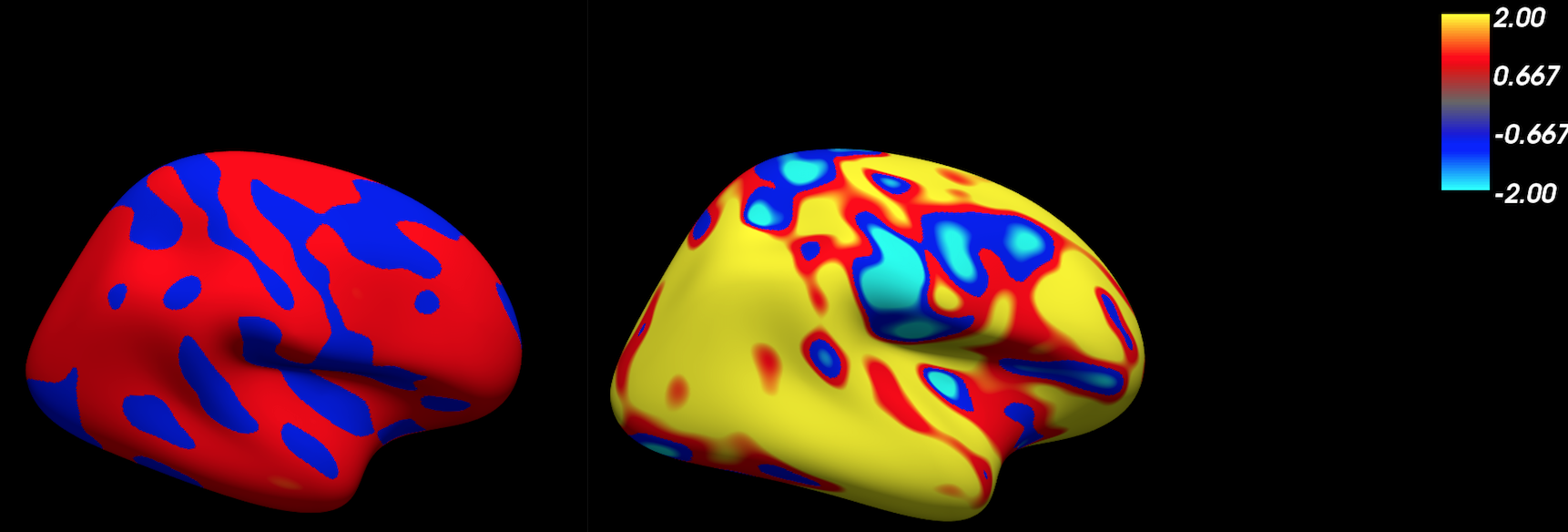
They give different results because they are supposed to. It may be that the effect you are seeing without regressing out ICV is due to ICV, and when you control for ICV the effect goes away. It could also be that the ICV causes the variance to increase. This is why I asked you to check the rstd (residual standard deviation). You said that did not change, so I would expect that the ICV must be removing your desired effect as seen the in gamma. Sorry, I don't know what else to tell you.
On 7/26/18 1:24 PM, Martin Juneja wrote:
External Email - Use Caution
Dear Dr. Greve,
I am so sorry for annoying you with multiple emails. I clearly got the difference between gamma.mgh files depending on whether I use ICV or not as a covariate. Next, I checked the ratio of gamma/rstd (Cohen's d) with and without ICV as covariate. Again, its totally different with and without ICV. Here I am attaching screen shot for that: left one is after I include ICV as covariate (minimum effect size) and the right one is without ICV as covariate (maximum effect size).
I really did not understand the idea behind comparing gamma.mgh and rstd.mgh (and may be their ratio), especially, if it's always the case that for surface area and volume, we need ICV as covariate.
On Thu, Jul 26, 2018 at 10:13 AM, Douglas Greve <dgreve@mgh.harvard.edu mailto:dgreve@mgh.harvard.edu> wrote:
If you are using surface area or volume, then you need ICV On 7/25/18 1:51 PM, Martin Juneja wrote:External Email - Use Caution Dr. Greve, I am sorry if my questions were not clear in previous email. Basically, I do not know what to conclude from this gamma comparison i.e. with and without ICV as covariate. Clearly, adding ICV as covariate here, is reducing effect size all over the brain and without ICV effect size is higher at specific locations. So should I go ahead with or without ICV as covariate? Thanks. On Wed, Jul 25, 2018 at 7:33 AM, Douglas Greve <dgreve@mgh.harvard.edu <mailto:dgreve@mgh.harvard.edu>> wrote: The gammas do look different, but it is hard to tell whether they are, eg, changing sign. Not sure what you want me to comment on. On 7/24/18 2:17 PM, Martin Juneja wrote:External Email - Use Caution Just to add some more info here: The peak location of regions, X1 and X2, which I found without including ICV as covariate are very close with the peak locations I found in Gamma_Without_ICV (~5.15), whereas Gamma_With_ICV is almost all over the brain (range -0.6 to +0.6). I am not sure if this additional info adds anything to interpret gamma.mgh with and without ICV as covariate. On Tue, Jul 24, 2018 at 10:10 AM, Martin Juneja <mj70481@gmail.com <mailto:mj70481@gmail.com>> wrote: Hi Dr. Greve, So I checked both. The rstd.mgh files are very similar in both cases (with and without ICV as covariate), but gamma.mgh files are very different for both cases. Here I am attaching screen shot for both cases: Gamma_With_ICV as covariate and Gamma_Without_ICV as covariate. Could you please have a look at the attached screen shots and provide your thoughts/interpretation of this comparison? Thanks. On Tue, Jul 24, 2018 at 9:35 AM, Douglas N. Greve <dgreve@mgh.harvard.edu <mailto:dgreve@mgh.harvard.edu>> wrote: For noise compare the values in the rstd.mgh file, for effect size look in the gamma.mgh file On 07/24/2018 12:27 PM, Martin Juneja wrote: > > External Email - Use Caution > > Hi Dr. Greve, > > Thanks for your quick reply. Could you please give me more details how > can I check this whether its because of noise or its because of less > CV difference? > I am not sure what method/way is the best and commonly used to confirm > these factors. > > Thanks. > > On Tue, Jul 24, 2018 at 7:06 AM, Douglas Greve <dgreve@mgh.harvard.edu <mailto:dgreve@mgh.harvard.edu> > <mailto:dgreve@mgh.harvard.edu <mailto:dgreve@mgh.harvard.edu>>> wrote: > > your results could have vanished after ICV correction for one of > two reasons: the CV difference became less or the values became > noisier (or a combination). So check in your data which one of > those things happened. > > > On 7/23/18 8:30 PM, Martin Juneja wrote: >> >> External Email - Use Caution >> >> Hello experts, >> >> I am interested in identifying regions of interest by comparing >> cortical volume (CV) between controls and patients. >> >> After including age and sex as my covariates, I identified >> regions X1 and X2, which showed significantly lower CV for >> patients (as compared to controls). >> >> But after I include ICV as another covariate, my results show >> that for none of the areas there is any significant difference in >> CV, i.e. my results vanish. >> >> When I checked subjectwise ICV for each group, I found that there >> is almost significant difference (two-sampled t-test, p = 0.067) >> in ICV between two groups, but interestingly mean group ICV for >> patients group was larger compared than mean ICV for controls. >> But as I said earlier, regions X1 and X2 had significantly lower >> CV for patients (as compared to controls), when I didn't include >> ICV as covariate. >> >> Could you please help me in interpreting these results? Is there >> any advice regarding inclusion of ICV as covariate? Or my results >> are purely because of differences in ICV between groups, and >> there is no real findings regarding the regions identified (X1 >> and X2)? >> >> Thanks a lot ! >> >> >> _______________________________________________ >> Freesurfer mailing list >> Freesurfer@nmr.mgh.harvard.edu <mailto:Freesurfer@nmr.mgh.harvard.edu> >> <mailto:Freesurfer@nmr.mgh.harvard.edu <mailto:Freesurfer@nmr.mgh.harvard.edu>> >> https://mail.nmr.mgh.harvard.edu/mailman/listinfo/freesurfer <https://mail.nmr.mgh.harvard.edu/mailman/listinfo/freesurfer> >> <https://mail.nmr.mgh.harvard.edu/mailman/listinfo/freesurfer <https://mail.nmr.mgh.harvard.edu/mailman/listinfo/freesurfer>> > > > _______________________________________________ > Freesurfer mailing list > Freesurfer@nmr.mgh.harvard.edu <mailto:Freesurfer@nmr.mgh.harvard.edu> <mailto:Freesurfer@nmr.mgh.harvard.edu <mailto:Freesurfer@nmr.mgh.harvard.edu>> > https://mail.nmr.mgh.harvard.edu/mailman/listinfo/freesurfer <https://mail.nmr.mgh.harvard.edu/mailman/listinfo/freesurfer> > <https://mail.nmr.mgh.harvard.edu/mailman/listinfo/freesurfer <https://mail.nmr.mgh.harvard.edu/mailman/listinfo/freesurfer>> > > > The information in this e-mail is intended only for the person to > whom it is > addressed. If you believe this e-mail was sent to you in error and > the e-mail > contains patient information, please contact the Partners > Compliance HelpLine at > http://www.partners.org/complianceline <http://www.partners.org/complianceline> > <http://www.partners.org/complianceline <http://www.partners.org/complianceline>> . If the e-mail was sent > to you in error > but does not contain patient information, please contact the > sender and properly > dispose of the e-mail. > > > > > _______________________________________________ > Freesurfer mailing list > Freesurfer@nmr.mgh.harvard.edu <mailto:Freesurfer@nmr.mgh.harvard.edu> > https://mail.nmr.mgh.harvard.edu/mailman/listinfo/freesurfer <https://mail.nmr.mgh.harvard.edu/mailman/listinfo/freesurfer> _______________________________________________ Freesurfer mailing list Freesurfer@nmr.mgh.harvard.edu <mailto:Freesurfer@nmr.mgh.harvard.edu> https://mail.nmr.mgh.harvard.edu/mailman/listinfo/freesurfer <https://mail.nmr.mgh.harvard.edu/mailman/listinfo/freesurfer> _______________________________________________ Freesurfer mailing list Freesurfer@nmr.mgh.harvard.edu <mailto:Freesurfer@nmr.mgh.harvard.edu> https://mail.nmr.mgh.harvard.edu/mailman/listinfo/freesurfer <https://mail.nmr.mgh.harvard.edu/mailman/listinfo/freesurfer>_______________________________________________ Freesurfer mailing list Freesurfer@nmr.mgh.harvard.edu <mailto:Freesurfer@nmr.mgh.harvard.edu> https://mail.nmr.mgh.harvard.edu/mailman/listinfo/freesurfer <https://mail.nmr.mgh.harvard.edu/mailman/listinfo/freesurfer> The information in this e-mail is intended only for the person to whom it is addressed. If you believe this e-mail was sent to you in error and the e-mail contains patient information, please contact the Partners Compliance HelpLine at http://www.partners.org/complianceline <http://www.partners.org/complianceline> . If the e-mail was sent to you in error but does not contain patient information, please contact the sender and properly dispose of the e-mail. _______________________________________________ Freesurfer mailing list Freesurfer@nmr.mgh.harvard.edu <mailto:Freesurfer@nmr.mgh.harvard.edu> https://mail.nmr.mgh.harvard.edu/mailman/listinfo/freesurfer <https://mail.nmr.mgh.harvard.edu/mailman/listinfo/freesurfer>_______________________________________________ Freesurfer mailing list Freesurfer@nmr.mgh.harvard.edu <mailto:Freesurfer@nmr.mgh.harvard.edu> https://mail.nmr.mgh.harvard.edu/mailman/listinfo/freesurfer <https://mail.nmr.mgh.harvard.edu/mailman/listinfo/freesurfer> The information in this e-mail is intended only for the person to whom it is addressed. If you believe this e-mail was sent to you in error and the e-mail contains patient information, please contact the Partners Compliance HelpLine at http://www.partners.org/complianceline <http://www.partners.org/complianceline> . If the e-mail was sent to you in error but does not contain patient information, please contact the sender and properly dispose of the e-mail.
Freesurfer mailing list Freesurfer@nmr.mgh.harvard.edu https://mail.nmr.mgh.harvard.edu/mailman/listinfo/freesurfer
External Email - Use Caution
Thanks a lot Dr. Greve, that really helps.
On Thu, Jul 26, 2018 at 10:45 AM, Douglas Greve dgreve@mgh.harvard.edu wrote:
They give different results because they are supposed to. It may be that the effect you are seeing without regressing out ICV is due to ICV, and when you control for ICV the effect goes away. It could also be that the ICV causes the variance to increase. This is why I asked you to check the rstd (residual standard deviation). You said that did not change, so I would expect that the ICV must be removing your desired effect as seen the in gamma. Sorry, I don't know what else to tell you.
On 7/26/18 1:24 PM, Martin Juneja wrote:
External Email - Use CautionDear Dr. Greve,
I am so sorry for annoying you with multiple emails. I clearly got the difference between gamma.mgh files depending on whether I use ICV or not as a covariate. Next, I checked the ratio of gamma/rstd (Cohen's d) with and without ICV as covariate. Again, its totally different with and without ICV. Here I am attaching screen shot for that: left one is after I include ICV as covariate (minimum effect size) and the right one is without ICV as covariate (maximum effect size).
I really did not understand the idea behind comparing gamma.mgh and rstd.mgh (and may be their ratio), especially, if it's always the case that for surface area and volume, we need ICV as covariate.
On Thu, Jul 26, 2018 at 10:13 AM, Douglas Greve dgreve@mgh.harvard.edu wrote:
If you are using surface area or volume, then you need ICV
On 7/25/18 1:51 PM, Martin Juneja wrote:
External Email - Use CautionDr. Greve,
I am sorry if my questions were not clear in previous email.
Basically, I do not know what to conclude from this gamma comparison i.e. with and without ICV as covariate. Clearly, adding ICV as covariate here, is reducing effect size all over the brain and without ICV effect size is higher at specific locations.
So should I go ahead with or without ICV as covariate?
Thanks.
On Wed, Jul 25, 2018 at 7:33 AM, Douglas Greve dgreve@mgh.harvard.edu wrote:
The gammas do look different, but it is hard to tell whether they are, eg, changing sign. Not sure what you want me to comment on.
On 7/24/18 2:17 PM, Martin Juneja wrote:
External Email - Use CautionJust to add some more info here: The peak location of regions, X1 and X2, which I found without including ICV as covariate are very close with the peak locations I found in Gamma_Without_ICV (~5.15), whereas Gamma_With_ICV is almost all over the brain (range -0.6 to +0.6). I am not sure if this additional info adds anything to interpret gamma.mgh with and without ICV as covariate.
On Tue, Jul 24, 2018 at 10:10 AM, Martin Juneja mj70481@gmail.com wrote:
Hi Dr. Greve,
So I checked both. The rstd.mgh files are very similar in both cases (with and without ICV as covariate), but gamma.mgh files are very different for both cases. Here I am attaching screen shot for both cases: Gamma_With_ICV as covariate and Gamma_Without_ICV as covariate.
Could you please have a look at the attached screen shots and provide your thoughts/interpretation of this comparison?
Thanks.
On Tue, Jul 24, 2018 at 9:35 AM, Douglas N. Greve < dgreve@mgh.harvard.edu> wrote:
For noise compare the values in the rstd.mgh file, for effect size look in the gamma.mgh file
On 07/24/2018 12:27 PM, Martin Juneja wrote:
External Email - Use CautionHi Dr. Greve,
Thanks for your quick reply. Could you please give me more details
how
can I check this whether its because of noise or its because of less CV difference? I am not sure what method/way is the best and commonly used to
confirm
these factors.
Thanks.
On Tue, Jul 24, 2018 at 7:06 AM, Douglas Greve <
dgreve@mgh.harvard.edu
mailto:dgreve@mgh.harvard.edu> wrote:
your results could have vanished after ICV correction for one of two reasons: the CV difference became less or the values became noisier (or a combination). So check in your data which one of those things happened. On 7/23/18 8:30 PM, Martin Juneja wrote:> > External Email - Use Caution > > Hello experts, > > I am interested in identifying regions of interest by comparing > cortical volume (CV) between controls and patients. > > After including age and sex as my covariates, I identified > regions X1 and X2, which showed significantly lower CV for > patients (as compared to controls). > > But after I include ICV as another covariate, my results show > that for none of the areas there is any significant difference
in
> CV, i.e. my results vanish. > > When I checked subjectwise ICV for each group, I found that
there
> is almost significant difference (two-sampled t-test, p = 0.067) > in ICV between two groups, but interestingly mean group ICV for > patients group was larger compared than mean ICV for controls. > But as I said earlier, regions X1 and X2 had significantly lower > CV for patients (as compared to controls), when I didn't include > ICV as covariate. > > Could you please help me in interpreting these results? Is there > any advice regarding inclusion of ICV as covariate? Or my
results
> are purely because of differences in ICV between groups, and > there is no real findings regarding the regions identified (X1 > and X2)? > > Thanks a lot ! > > > _______________________________________________ > Freesurfer mailing list > Freesurfer@nmr.mgh.harvard.edu > mailto:Freesurfer@nmr.mgh.harvard.edu > https://mail.nmr.mgh.harvard.edu/mailman/listinfo/freesurfer > https://mail.nmr.mgh.harvard.edu/mailman/listinfo/freesurfer
_______________________________________________
Freesurfer mailing list
Freesurfer@nmr.mgh.harvard.edu <mailto:Freesurfer@nmr.mgh.
harvard.edu>
https://mail.nmr.mgh.harvard.edu/mailman/listinfo/freesurfer
<https://mail.nmr.mgh.harvard.edu/mailman/listinfo/freesurfer>


The information in this e-mail is intended only for the person to
whom it is
addressed. If you believe this e-mail was sent to you in error
and
the e-mail
contains patient information, please contact the Partners
Compliance HelpLine at
http://www.partners.org/complianceline
<http://www.partners.org/complianceline> . If the e-mail was
sent
to you in error
but does not contain patient information, please contact the
sender and properly
dispose of the e-mail.
Freesurfer mailing list Freesurfer@nmr.mgh.harvard.edu https://mail.nmr.mgh.harvard.edu/mailman/listinfo/freesurfer
Freesurfer mailing list Freesurfer@nmr.mgh.harvard.edu https://mail.nmr.mgh.harvard.edu/mailman/listinfo/freesurfer
Freesurfer mailing listFreesurfer@nmr.mgh.harvard.eduhttps://mail.nmr.mgh.harvard.edu/mailman/listinfo/freesurfer
Freesurfer mailing list Freesurfer@nmr.mgh.harvard.edu https://mail.nmr.mgh.harvard.edu/mailman/listinfo/freesurfer
The information in this e-mail is intended only for the person to whom it is addressed. If you believe this e-mail was sent to you in error and the e-mail contains patient information, please contact the Partners Compliance HelpLine at http://www.partners.org/complianceline . If the e-mail was sent to you in error but does not contain patient information, please contact the sender and properly dispose of the e-mail.
Freesurfer mailing listFreesurfer@nmr.mgh.harvard.eduhttps://mail.nmr.mgh.harvard.edu/mailman/listinfo/freesurfer
Freesurfer mailing list Freesurfer@nmr.mgh.harvard.edu https://mail.nmr.mgh.harvard.edu/mailman/listinfo/freesurfer
The information in this e-mail is intended only for the person to whom it is addressed. If you believe this e-mail was sent to you in error and the e-mail contains patient information, please contact the Partners Compliance HelpLine at http://www.partners.org/complianceline . If the e-mail was sent to you in error but does not contain patient information, please contact the sender and properly dispose of the e-mail.
Freesurfer mailing listFreesurfer@nmr.mgh.harvard.eduhttps://mail.nmr.mgh.harvard.edu/mailman/listinfo/freesurfer
Freesurfer mailing list Freesurfer@nmr.mgh.harvard.edu https://mail.nmr.mgh.harvard.edu/mailman/listinfo/freesurfer
The information in this e-mail is intended only for the person to whom it is addressed. If you believe this e-mail was sent to you in error and the e-mail contains patient information, please contact the Partners Compliance HelpLine at http://www.partners.org/complianceline . If the e-mail was sent to you in error but does not contain patient information, please contact the sender and properly dispose of the e-mail.
freesurfer@nmr.mgh.harvard.edu
-
 Douglas Greve
 -
Douglas N. Greve
-
 Martin Juneja