
External Email - Use Caution
Hi,
I was already discussing my doubts with Douglas here https://secure-web.cisco.com/1UDGfmmgTwXKhhYWoGJSmyTRYLt6xQw2AQ1oLFEdo13Hp2h..., but for some reason my emails stopped going to the mailing list. So I'm sending what was left open.
So which file do I put as an argument to --thfile? Or I just don't put the --thfile?
And about that tool to convert the table into a map. That's what appeared in that link you sent me. [cid:8ba3ee60-644b-4fa0-9d4e-925fd659cbde] Do I run the second line to get the tool?
Thanks again, Laura Willers de Souza
Master Student in Biochemistry
Zimmer Lab - Federal University of Rio Grande do Sul
- Porto Alegre/RS - Brazil
________________________________ De: Douglas N. Greve dgreve@mgh.harvard.edu Enviado: terça-feira, 4 de janeiro de 2022 19:35 Para: Laura Willers de Souza laura.w.desouza@hotmail.com Cc: freesurfer@nmr.mgh.harvard.edu freesurfer@nmr.mgh.harvard.edu Assunto: Re: [Freesurfer] Doubts about analysis of hippocampal subfields and nuclei of the amygdala
oh, sorry, the --thfile should not be the table file. The sig.mgh has the same info as the table file, so you do not need to pass the table file.
On 1/4/2022 4:44 PM, Laura Willers de Souza wrote:
External Email - Use Caution
Sorry, let me explain better!
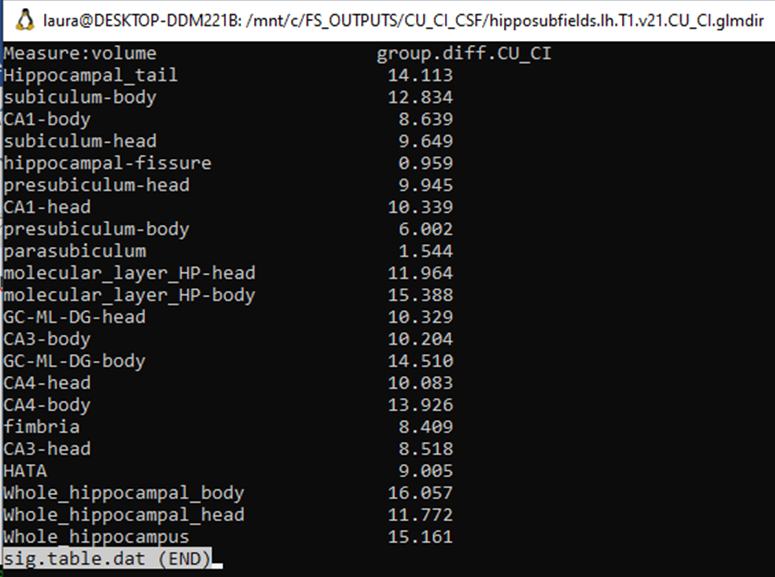
When mri_glmfit finishes it generates the sig.table.dat file which has the p values of the ROIs (first image below). Then, when mri_fdr finishes, that same sig.table.dat file no longer contains the p-values of the ROIs, but the FDR value (second image). In this way, the p-values of the ROIs are lost. What I would like is to end mri_fdr with a file with the value of fdr + the original sig.table.dat file with the p values of the ROIs. Is there a way to do this? [cid:fe76dede-c6fd-4e10-889e-35622f3282f7][cid:b0468c6b-739c-4f3c-8363-2eafb697e623] On this link you sent there is the following: [cid:227a858a-37e2-4089-898a-ab6e2a06eee8] Was it supposed to be like this?
Best, Laura Willers de Souza
Master Student in Biochemistry
Zimmer Lab - Federal University of Rio Grande do Sul
- Porto Alegre/RS - Brazil
________________________________ De: Douglas N. Greve dgreve@mgh.harvard.edumailto:dgreve@mgh.harvard.edu Enviado: terça-feira, 4 de janeiro de 2022 17:21 Para: Laura Willers de Souza laura.w.desouza@hotmail.commailto:laura.w.desouza@hotmail.com Cc: freesurfer@nmr.mgh.harvard.edumailto:freesurfer@nmr.mgh.harvard.edu freesurfer@nmr.mgh.harvard.edumailto:freesurfer@nmr.mgh.harvard.edu Assunto: Re: [Freesurfer] Doubts about analysis of hippocampal subfields and nuclei of the amygdala
On 1/4/2022 2:42 PM, Laura Willers de Souza wrote:
External Email - Use Caution
The command worked fine! But, in the end, the file that contains the thresholds for each of the ROI (first image below) ends up being replaced by the FDR value (second image below), which is not very good, because this information ends up getting lost. I don't understand what you mean. The value in the file is the threshold that you would use to divide your ROIs into significant vs nonsig groups in a way that meets the FDR criteria; in your case, it looks all but subiculum will pass. Or are you looking for an FDR-corrected p-value for each ROI? Is there any way to save the FDR value in another file and not in the same one where the p-values of the ROI are?
And is it possible to visualize the ROIs with the significance scale in freeview? I tried to overlay the sig.mgh file over the inflated surface and also the mri_fdr output.mgh file, but it didn't work. That definitely will not work. What should I do to make this work? You have to convert the table into a map. You can get a tool to do this from here https://secure-web.cisco.com/1UwuvPGUGGetf-98W3sTl8juzXEKWw2wDDMGIZUi3FygWcz...https://secure-web.cisco.com/1h610sgx8xUYJT8v3G61D8UsnoyEDEVgkpvN1qNZPm7dXLG9JQhfs8h6eIdIRnAG63g7nd9F4wZuBzcZw1A1glbTYPfVrB1WrH6MyD9_wCI4VrWEZWkggzg9qQsDbaVgZHbEVHYeqLBr6BB7ZQOmqoTVL0G6JOslps-4vd0pIIi4meXP-EtmkbGjG2U2PQ_91ESGlU8XMPyo0hh5O1Kgs-dndLljqSxgrbglXAY6HwMtOoR5bWY7kuq-767yAaxtfscbpE7F96ANSdtJxVtZIIgD8tBHiYwNAQhKrIUzxyZ3oxbn5BjTsEw0h2LVZdmQ7/https%3A%2F%2Fgate.nmr.mgh.harvard.edu%2Fsafelinks%2Fgreve%2Ftable2map username 'guest' password 'collab' I'm not totally sure it will work as a stand-alone. You might have to download the development version of FS to get it. Specify the subfields segmenation as the --seg option.
Thank you so much again, Laura Willers de Souza
Master Student in Biochemistry
Zimmer Lab - Federal University of Rio Grande do Sul
- Porto Alegre/RS - Brazil
________________________________ De: Douglas N. Greve dgreve@mgh.harvard.edumailto:dgreve@mgh.harvard.edu Enviado: terça-feira, 4 de janeiro de 2022 15:21 Para: Laura Willers de Souza laura.w.desouza@hotmail.commailto:laura.w.desouza@hotmail.com Cc: freesurfer@nmr.mgh.harvard.edumailto:freesurfer@nmr.mgh.harvard.edu freesurfer@nmr.mgh.harvard.edumailto:freesurfer@nmr.mgh.harvard.edu Assunto: Re: [Freesurfer] Doubts about analysis of hippocampal subfields and nuclei of the amygdala
that looks right; I don't think you need a 2nd --thfile (but does not hurt it).
On 1/3/2022 3:27 PM, Laura Willers de Souza wrote:
External Email - Use Caution
Dear Douglas,
Once again, thanks so much for the reply!
About the mask, I just don't put anything or put "nomask"?
With your suggestions, the command looks like this:
mri_fdr --fdr .05 --pos --thfile $SUBJECTS_DIR/hipposubfields.lh.T1.v21.CU_CI.glmdir/sig.table.dat --i $SUBJECTS_DIR/hipposubfields.lh.T1.v21.CU_CI.glmdir/group.diff.CU_CI/sig.mgh nomask hipposubfields.lh.T1.v21.CU_CI.mgh --thfile $SUBJECTS_DIR/hipposubfields.rh.T1.v21.CU_CI.glmdir/sig.table.dat --i $SUBJECTS_DIR/hipposubfields.rh.T1.v21.CU_CI.glmdir/group.diff.CU_CI/sig.mgh nomask hipposubfields.rh.T1.v21.CU_CI.mgh
Do you think this is correct?
As it was before (without the input to --thfile) it was giving the following error:
I believe that with these fixes it should work fine, right?
Thank you so much again!
Best, Laura Willers de Souza
Master Student in Biochemistry
Zimmer Lab - Federal University of Rio Grande do Sul
- Porto Alegre/RS - Brazil



freesurfer@nmr.mgh.harvard.edu
-
 Laura Willers de Souza