
External Email - Use Caution
Hi all,
I am deeply confused and terribly needed some help, and I failed to find the answer in the Freesurfer website.
I had two patient groups F and R. To analysis the correlation between active time and cortical thickness, I tried two different methods A and B (A, treating patients in different group F and R as shown in attached figure A; B, treating all patients as one group FR as shown in attached figure B), and got distinctly different results.
So, my questions:
1、Which one is actually correct for calculating the correlation between active time and thickness, and what does the other one mean?
2、Does "--cache 3 abs --cwp 0.999" means that the result is only corrected with vertex level P < 0.001, and no cluster level correction is conducted?
I am looking forward to getting your help.
Sincerely yours,
Ge Tan
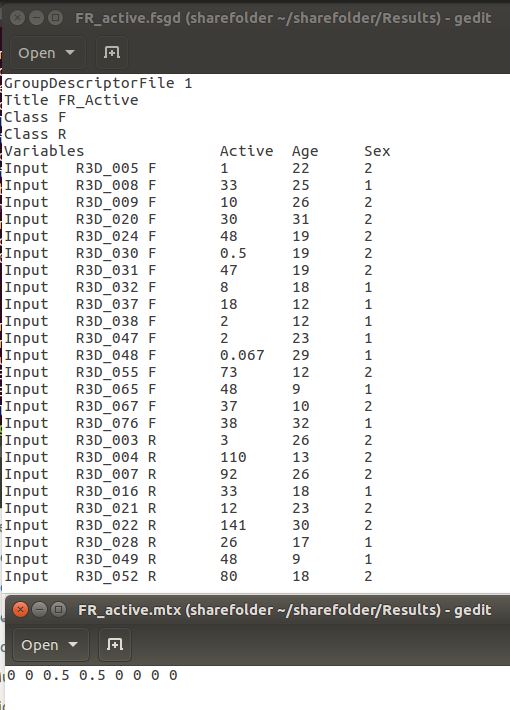
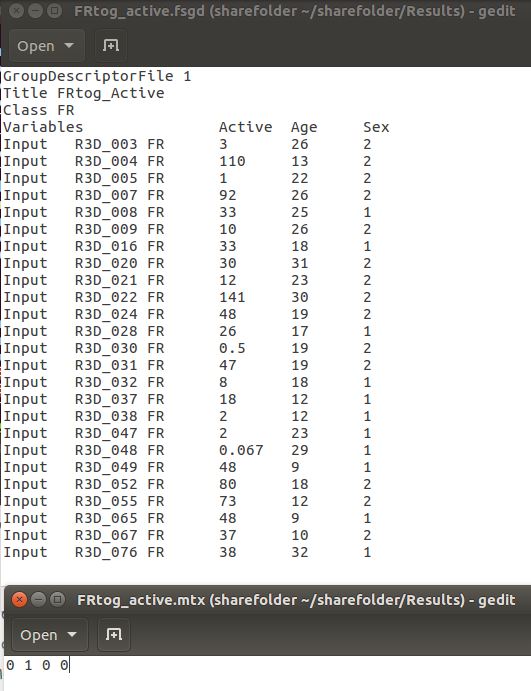

If there is no interaction between F/R and Active, then there should not be any theoretical difference between the two analyses, except that FR combined will be slightly more powerful since it has one more degree of freedom. You should first use the uncombined model to look for an interaction, and then proceed with the combined if there is no significant interaction.
There are several other things that could also come into play. First, it looks like the Rs have a much higher active score than Fs. This will create some correlation in the uncombined model and weaken the power. Second, it looks like there might be more Sex=1 in the R group; this will also weaken the uncombined model.
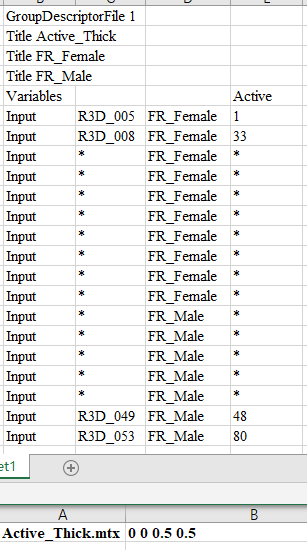
One more thing: you are not modeling sex properly. You should create four Classes (F-Male, F-Female, R-Male, and R-Female)
On 8/19/2019 8:32 AM, tange_neuro wrote:
External Email - Use Caution Hi all, I am deeply confused and terribly needed some help, and I failed to find the answer in the Freesurfer website. I had two patient groups F and R. To analysis the correlation between active time and cortical thickness, I tried two different methods A and B (A, treating patients in different group F and R as shown in attached figure A; B, treating all patients as one group FR as shown in attached figure B), and got distinctly different results. So, my questions: 1、Which one is actually correct for calculating the correlation between active time and thickness, and what does the other one mean? 2、Does "--cache 3 abs --cwp 0.999" means that the result is only corrected with vertex level P < 0.001, and no cluster level correction is conducted? I am looking forward to getting your help. Sincerely yours, Ge Tan
_______________________________________________ Freesurfer mailing list Freesurfer@nmr.mgh.harvard.edumailto:Freesurfer@nmr.mgh.harvard.edu https://mail.nmr.mgh.harvard.edu/mailman/listinfo/freesurfer
External Email - Use Caution
Dear Greve,
Many thanks for your help. I still have a few questions.
- I took your suggestions as that if there was no interaction between F/R and Active, both methods would be ok, and the results should be the same nearly; but if the interaction existed, FR combined should be the first and only choice. Is that right?
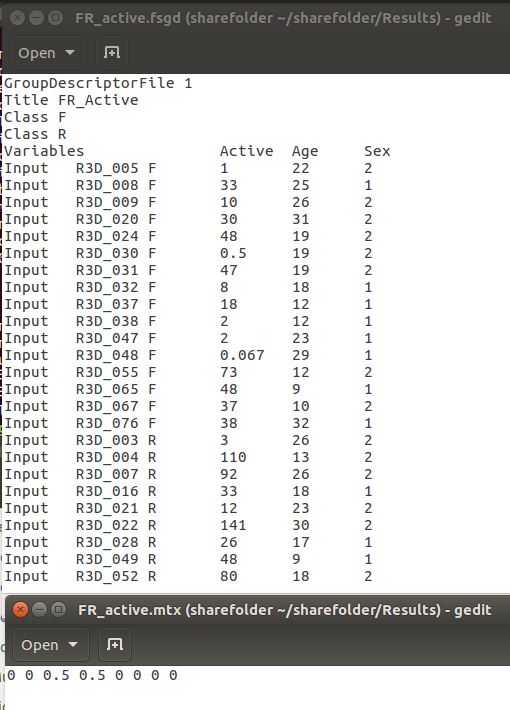
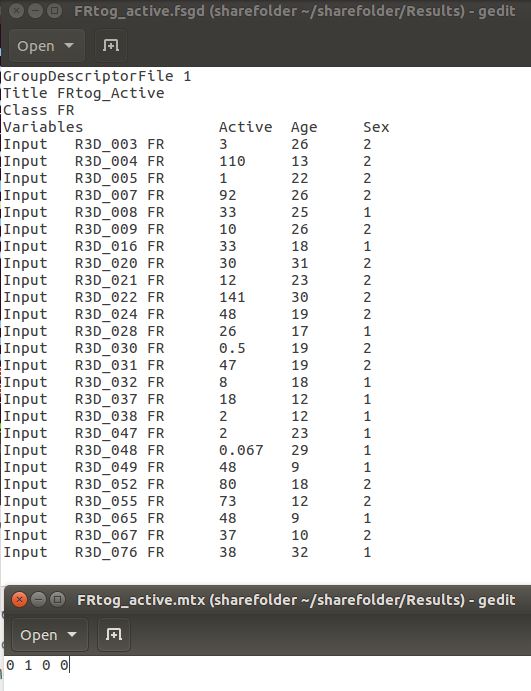
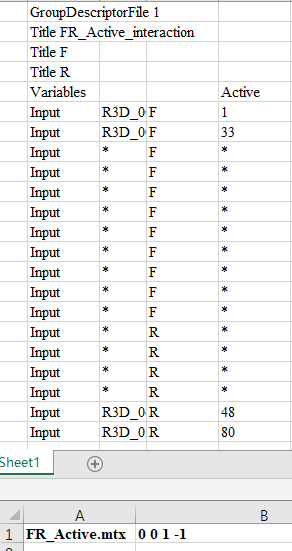
- So before assessing the correlation between thickness and Active, I should better assess the interaction between F/R and Active, for example using the DODS model [0 (group F) 0 (group R) 1 (Active of F) -1 (Active of R)] (Here, please ignoring other variables i.e. age and sex……, Figure 1). Right?
- As for sex, how could I deal with it, if I want to assess the correlation between thickness and Active using FR combined? Is the method shown in Picture 2 the only proper analysis I should take?
- Using the code "mri_glmfit-sim –glmdir < > --cache 3 abs --cwp 0.999", all survived results indicated that they could meet the criteria (correction) of vertex-level P < 0.001, and the 0.999 indicated that no cluster-level correction (i.e. 0.05) was conducted. Right?
Really very sorry for troubling you so much!
Best Regards,
Ge Tan
At 2019-08-19 21:29:34, "Greve, Douglas N.,Ph.D." DGREVE@mgh.harvard.edu wrote: If there is no interaction between F/R and Active, then there should not be any theoretical difference between the two analyses, except that FR combined will be slightly more powerful since it has one more degree of freedom. You should first use the uncombined model to look for an interaction, and then proceed with the combined if there is no significant interaction.
There are several other things that could also come into play. First, it looks like the Rs have a much higher active score than Fs. This will create some correlation in the uncombined model and weaken the power. Second, it looks like there might be more Sex=1 in the R group; this will also weaken the uncombined model.
One more thing: you are not modeling sex properly. You should create four Classes (F-Male, F-Female, R-Male, and R-Female)
On 8/19/2019 8:32 AM, tange_neuro wrote:
External Email - Use Caution
Hi all,
I am deeply confused and terribly needed some help, and I failed to find the answer in the Freesurfer website.
I had two patient groups F and R. To analysis the correlation between active time and cortical thickness, I tried two different methods A and B (A, treating patients in different group F and R as shown in attached figure A; B, treating all patients as one group FR as shown in attached figure B), and got distinctly different results.
So, my questions:
1、Which one is actually correct for calculating the correlation between active time and thickness, and what does the other one mean?
2、Does "--cache 3 abs --cwp 0.999" means that the result is only corrected with vertex level P < 0.001, and no cluster level correction is conducted?
I am looking forward to getting your help.
Sincerely yours,
Ge Tan
_______________________________________________ Freesurfer mailing list Freesurfer@nmr.mgh.harvard.eduhttps://mail.nmr.mgh.harvard.edu/mailman/listinfo/freesurfer
freesurfer@nmr.mgh.harvard.edu
-
 Greve, Douglas N.,Ph.D.
 -
 tange_neuro