
Hi Freesurfers,
I am using R to perform thickness analyses. All subjects are transformed in fsaverage space and all values are placed in a matrix with 327684 columns (163842 for each hemisphere). I put the results back in a surface file (.asc format) and then convert it to a binary Freesurfer format. I then open the files in Freesurfer to view them.
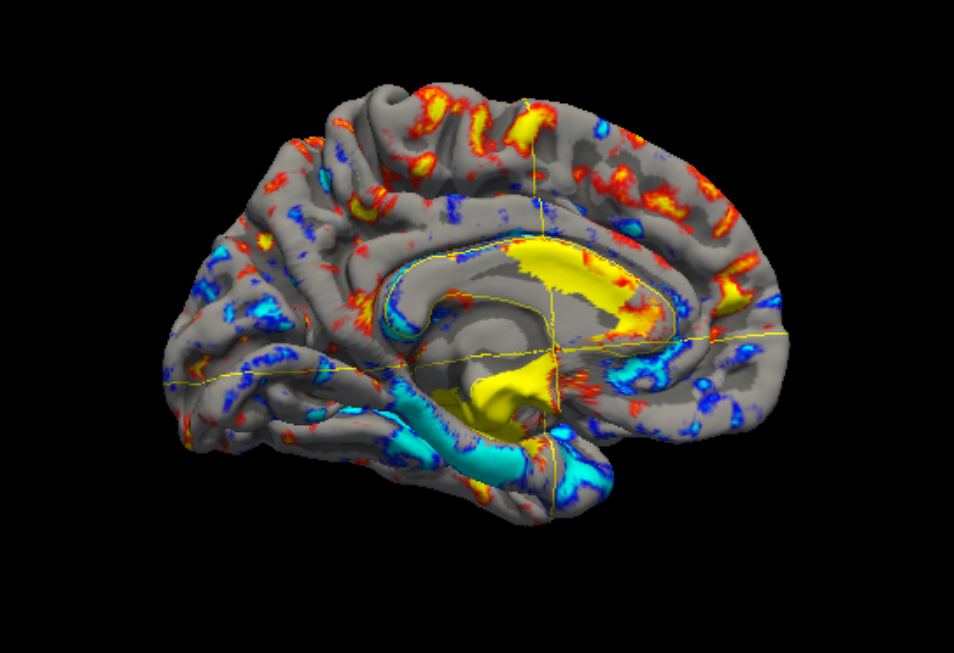
Overall the results make sense and fall in the right places. But I am concerned that some results fall into the corpus callosum, which, if I remember correctly should not have any thickness value, and therefore no results.
Here is a screenshot: [image: Inline image 1]
Can someone help my understand what might be wrong? Or, if this is normal, why I am finding thickness results where there is no thickness?
Is there a way to find label numbers for each vertex in fsaverage space (i.e. list of parcel number for each vertex). This might be useful to exclude certain vertices or compute summery statistics of the results directly in R.
Third question, is it possible to threshold the above map based on minimal cluster area (i.e., in mri_surfcluster). If yes, do I need to prepare a binary file with p-values for thresholding (0-1), or can I use mri_surfcluster with t-score maps (0-Inf)?
Thank you for your help. Dorian

Hi Dorian
that is a bit worriesome. Typically the surfaces are "frozen" at the midline and hence the thickness is 0, so there should be no difference. I guess if a single subject had an incorrect CC segmentation you would be 0 variance within one group and hence significant results or something like that. We usually mask out the midline also using the ?h.cortex.label file.
As for the parcel question, fsaverage should have .annot files in the label dir that correespond to various parcellations. YOu can read them into matlab with read_annotation.m
I'll leave the 3rd question for someone else cheers Bruce
On Wed, 8 Mar 2017, Dorian P. wrote:
Hi Freesurfers, I am using R to perform thickness analyses. All subjects are transformed in fsaverage space and all values are placed in a matrix with 327684 columns (163842 for each hemisphere). I put the results back in a surface file (.asc format) and then convert it to a binary Freesurfer format. I then open the files in Freesurfer to view them.
Overall the results make sense and fall in the right places. But I am concerned that some results fall into the corpus callosum, which, if I remember correctly should not have any thickness value, and therefore no results.
Here is a screenshot: Inline image 1
Can someone help my understand what might be wrong? Or, if this is normal, why I am finding thickness results where there is no thickness?
Is there a way to find label numbers for each vertex in fsaverage space (i.e. list of parcel number for each vertex). This might be useful to exclude certain vertices or compute summery statistics of the results directly in R.
Third question, is it possible to threshold the above map based on minimal cluster area (i.e., in mri_surfcluster). If yes, do I need to prepare a binary file with p-values for thresholding (0-1), or can I use mri_surfcluster with t-score maps (0-Inf)?
Thank you for your help. Dorian

On 03/08/2017 09:27 PM, Dorian P. wrote:
Hi Freesurfers,
I am using R to perform thickness analyses. All subjects are transformed in fsaverage space and all values are placed in a matrix with 327684 columns (163842 for each hemisphere). I put the results back in a surface file (.asc format) and then convert it to a binary Freesurfer format. I then open the files in Freesurfer to view them.
Overall the results make sense and fall in the right places. But I am concerned that some results fall into the corpus callosum, which, if I remember correctly should not have any thickness value, and therefore no results.
Here is a screenshot: Inline image 1
Can someone help my understand what might be wrong? Or, if this is normal, why I am finding thickness results where there is no thickness?
Is this 5.3? The thickness may not be 0 in the medial wall, but non-zero values are meaningless and should be masked out or ignored.
Is there a way to find label numbers for each vertex in fsaverage space (i.e. list of parcel number for each vertex). This might be useful to exclude certain vertices or compute summery statistics of the results directly in R.
You can load the annotation into matlab with read_annotation.m
Third question, is it possible to threshold the above map based on minimal cluster area (i.e., in mri_surfcluster). If yes, do I need to prepare a binary file with p-values for thresholding (0-1), or can I use mri_surfcluster with t-score maps (0-Inf)?
You can use any map you want, you just have to specify the threshold correctly. Also, you will need to have a FWHM. To get this I would run an analysis in mri_glmfit using a design similar to what you used in R (small differences probably won't affect the FWHM measure).
Thank you for your help. Dorian
Freesurfer mailing list Freesurfer@nmr.mgh.harvard.edu https://mail.nmr.mgh.harvard.edu/mailman/listinfo/freesurfer
Thank you Bruce, Douglas.
Yes, I think thicknesses were obtained with v 5.3.0. There might be errors as Bruce pointed out, I am going now through all maps to check them. This makes me think of a question. Volumetric template registrations sometimes go wrong. Does this happen also to surface registrations in FS sometimes ???
I am using other statistics, not glm, but thanks for suggesting it. Data are imported and exported in R using some R functions I built myself, nothing fancy, just using intermediate text files to get what I want and put it back for visualization.
Thank you
On Thu, Mar 9, 2017 at 11:23 AM, Douglas N Greve greve@nmr.mgh.harvard.edu wrote:
On 03/08/2017 09:27 PM, Dorian P. wrote:
Hi Freesurfers,
I am using R to perform thickness analyses. All subjects are transformed in fsaverage space and all values are placed in a matrix with 327684 columns (163842 for each hemisphere). I put the results back in a surface file (.asc format) and then convert it to a binary Freesurfer format. I then open the files in Freesurfer to view them.
Overall the results make sense and fall in the right places. But I am concerned that some results fall into the corpus callosum, which, if I remember correctly should not have any thickness value, and therefore no results.
Here is a screenshot: Inline image 1
Can someone help my understand what might be wrong? Or, if this is normal, why I am finding thickness results where there is no thickness?
Is this 5.3? The thickness may not be 0 in the medial wall, but non-zero values are meaningless and should be masked out or ignored.
Is there a way to find label numbers for each vertex in fsaverage space (i.e. list of parcel number for each vertex). This might be useful to exclude certain vertices or compute summery statistics of the results directly in R.
You can load the annotation into matlab with read_annotation.m
Third question, is it possible to threshold the above map based on minimal cluster area (i.e., in mri_surfcluster). If yes, do I need to prepare a binary file with p-values for thresholding (0-1), or can I use mri_surfcluster with t-score maps (0-Inf)?
You can use any map you want, you just have to specify the threshold correctly. Also, you will need to have a FWHM. To get this I would run an analysis in mri_glmfit using a design similar to what you used in R (small differences probably won't affect the FWHM measure).
Thank you for your help. Dorian
Freesurfer mailing list Freesurfer@nmr.mgh.harvard.edu https://mail.nmr.mgh.harvard.edu/mailman/listinfo/freesurfer
-- Douglas N. Greve, Ph.D. MGH-NMR Center greve@nmr.mgh.harvard.edu Phone Number: 617-724-2358 Fax: 617-726-7422
Bugs: surfer.nmr.mgh.harvard.edu/fswiki/BugReporting FileDrop: https://gate.nmr.mgh.harvard.edu/filedrop2 www.nmr.mgh.harvard.edu/facility/filedrop/index.html Outgoing: ftp://surfer.nmr.mgh.harvard.edu/transfer/outgoing/flat/greve/
Freesurfer mailing list Freesurfer@nmr.mgh.harvard.edu https://mail.nmr.mgh.harvard.edu/mailman/listinfo/freesurfer
The information in this e-mail is intended only for the person to whom it is addressed. If you believe this e-mail was sent to you in error and the e-mail contains patient information, please contact the Partners Compliance HelpLine at http://www.partners.org/complianceline . If the e-mail was sent to you in error but does not contain patient information, please contact the sender and properly dispose of the e-mail.
Hi Dorian
you can load the aparc.annot for each subject and use it to chek if the spherical registration worked ok. It's easy enough to write a script to load these for each subject, then write a tif file with a medial view, and zip through them all with nmovie
cheers Bruce On Thu, 9 Mar 2017, Dorian P. wrote:
Thank you Bruce, Douglas. Yes, I think thicknesses were obtained with v 5.3.0. There might be errors as Bruce pointed out, I am going now through all maps to check them. This makes me think of a question. Volumetric template registrations sometimes go wrong. Does this happen also to surface registrations in FS sometimes ???
I am using other statistics, not glm, but thanks for suggesting it. Data are imported and exported in R using some R functions I built myself, nothing fancy, just using intermediate text files to get what I want and put it back for visualization.
Thank you
On Thu, Mar 9, 2017 at 11:23 AM, Douglas N Greve greve@nmr.mgh.harvard.edu wrote:
  On 03/08/2017 09:27 PM, Dorian P. wrote:
  > Hi Freesurfers,
  >
  > I am using R to perform thickness analyses. All subjects are
  > transformed in fsaverage space and all values are placed in a
  matrix
  > with 327684 columns (163842 for each hemisphere). I put the
  results
  > back in a surface file (.asc format) and then convert it to a
  binary
  > Freesurfer format. I then open the files in Freesurfer to view
  them.
  >
  > Overall the results make sense and fall in the right places.
  But I am
  > concerned that some results fall into the corpus callosum,
  which, if I
  > remember correctly should not have any thickness value, and
  therefore
  > no results.
  >
  > Here is a screenshot:
  > Inline image 1
  >
  > Can someone help my understand what might be wrong? Or, if
  this is
  > normal, why I am finding thickness results where there is no
  thickness?
  Is this 5.3? The thickness may not be 0 in the medial wall, but
  non-zero
  values are meaningless and should be masked out or ignored.
  >
  > Is there a way to find label numbers for each vertex in
  fsaverage
  > space (i.e. list of parcel number for each vertex). This might
  be
  > useful to exclude certain vertices or compute summery
  statistics of
  > the results directly in R.
  You can load the annotation into matlab with read_annotation.m
  >
  > Third question, is it possible to threshold the above map
  based on
  > minimal cluster area (i.e., in mri_surfcluster). If yes, do I
  need to
  > prepare a binary file with p-values for thresholding (0-1), or
  can I
  > use mri_surfcluster with t-score maps (0-Inf)?
  You can use any map you want, you just have to specify the
  threshold
  correctly. Also, you will need to have a FWHM. To get this I
  would run
  an analysis in mri_glmfit using a design similar to what you
  used in R
  (small differences probably won't affect the FWHM measure).
  >
  > Thank you for your help.
  > Dorian
  >
  >
  >
  > _______________________________________________
  > Freesurfer mailing list
  > Freesurfer@nmr.mgh.harvard.edu
  > https://mail.nmr.mgh.harvard.edu/mailman/listinfo/freesurfer

  --
  Douglas N. Greve, Ph.D.
  MGH-NMR Center
  greve@nmr.mgh.harvard.edu
  Phone Number: 617-724-2358
  Fax: 617-726-7422

  Bugs: surfer.nmr.mgh.harvard.edu/fswiki/BugReporting
  FileDrop: https://gate.nmr.mgh.harvard.edu/filedrop2
  www.nmr.mgh.harvard.edu/facility/filedrop/index.html
  Outgoing:
  ftp://surfer.nmr.mgh.harvard.edu/transfer/outgoing/flat/greve/

  _______________________________________________
  Freesurfer mailing list
  Freesurfer@nmr.mgh.harvard.edu
  https://mail.nmr.mgh.harvard.edu/mailman/listinfo/freesurfer


  The information in this e-mail is intended only for the person
  to whom it is
  addressed. If you believe this e-mail was sent to you in error
  and the e-mail
  contains patient information, please contact the Partners
  Compliance HelpLine at
  http://www.partners.org/complianceline . If the e-mail was sent
  to you in error
  but does not contain patient information, please contact the
  sender and properly
  dispose of the e-mail.
Thanks. I created a video to loop through all my 170+ subjects in template space:
https://drive.google.com/open?id=0BxHeqEv37qqDeGFWVnpSVkVobkk
I see some cases that have dramatic problems. I will need to check those more carefully and probably do an inspection of each one in individual space. Beside those, do you think the variability of values going in and out of the medial wall is normal for most of the subjects? You can point at specific cases with the number of the subject on the overlay menu (left). Thickness values start at 0.001
Thanks for your help so far.
Dorian
On Thu, Mar 9, 2017 at 4:29 PM, Bruce Fischl fischl@nmr.mgh.harvard.edu wrote:
Hi Dorian
you can load the aparc.annot for each subject and use it to chek if the spherical registration worked ok. It's easy enough to write a script to load these for each subject, then write a tif file with a medial view, and zip through them all with nmovie
cheers Bruce On Thu, 9 Mar 2017, Dorian P. wrote:
Thank you Bruce, Douglas. Yes, I think thicknesses were obtained with v 5.3.0. There might be
errors
as Bruce pointed out, I am going now through all maps to check them. This makes me think of a question. Volumetric template registrations
sometimes go
wrong. Does this happen also to surface registrations in FS sometimes ???
I am using other statistics, not glm, but thanks for suggesting it. Data
are
imported and exported in R using some R functions I built myself, nothing fancy, just using intermediate text files to get what I want and put it
back
for visualization.
Thank you
On Thu, Mar 9, 2017 at 11:23 AM, Douglas N Greve <
greve@nmr.mgh.harvard.edu>
wrote:
  On 03/08/2017 09:27 PM, Dorian P. wrote:
  > Hi Freesurfers,
  >
  > I am using R to perform thickness analyses. All subjects are
  > transformed in fsaverage space and all values are placed in a
  matrix
  > with 327684 columns (163842 for each hemisphere). I put the
  results
  > back in a surface file (.asc format) and then convert it to a
  binary
  > Freesurfer format. I then open the files in Freesurfer to view
  them.
  >
  > Overall the results make sense and fall in the right places.
  But I am
  > concerned that some results fall into the corpus callosum,
  which, if I
  > remember correctly should not have any thickness value, and
  therefore
  > no results.
  >
  > Here is a screenshot:
  > Inline image 1
  >
  > Can someone help my understand what might be wrong? Or, if
  this is
  > normal, why I am finding thickness results where there is no
  thickness?
  Is this 5.3? The thickness may not be 0 in the medial wall, but
  non-zero
  values are meaningless and should be masked out or ignored.
  >
  > Is there a way to find label numbers for each vertex in
  fsaverage
  > space (i.e. list of parcel number for each vertex). This might
  be
  > useful to exclude certain vertices or compute summery
  statistics of
  > the results directly in R.
  You can load the annotation into matlab with read_annotation.m
  >
  > Third question, is it possible to threshold the above map
  based on
  > minimal cluster area (i.e., in mri_surfcluster). If yes, do I
  need to
  > prepare a binary file with p-values for thresholding (0-1), or
  can I
  > use mri_surfcluster with t-score maps (0-Inf)?
  You can use any map you want, you just have to specify the
  threshold
  correctly. Also, you will need to have a FWHM. To get this I
  would run
  an analysis in mri_glmfit using a design similar to what you
  used in R
  (small differences probably won't affect the FWHM measure).
  >
  > Thank you for your help.
  > Dorian
  >
  >
  >
  > _______________________________________________
  > Freesurfer mailing list
  > Freesurfer@nmr.mgh.harvard.edu
  > https://mail.nmr.mgh.harvard.edu/mailman/listinfo/freesurfer

  --
  Douglas N. Greve, Ph.D.
  MGH-NMR Center
  greve@nmr.mgh.harvard.edu
  Phone Number: 617-724-2358
  Fax: 617-726-7422

  Bugs: surfer.nmr.mgh.harvard.edu/fswiki/BugReporting
  FileDrop: https://gate.nmr.mgh.harvard.edu/filedrop2
  www.nmr.mgh.harvard.edu/facility/filedrop/index.html
  Outgoing:
  ftp://surfer.nmr.mgh.harvard.edu/transfer/outgoing/flat/greve/

  _______________________________________________
  Freesurfer mailing list
  Freesurfer@nmr.mgh.harvard.edu
  https://mail.nmr.mgh.harvard.edu/mailman/listinfo/freesurfer


  The information in this e-mail is intended only for the person
  to whom it is
  addressed. If you believe this e-mail was sent to you in error
  and the e-mail
  contains patient information, please contact the Partners
  Compliance HelpLine at
  http://www.partners.org/complianceline . If the e-mail was sent
  to you in error
  but does not contain patient information, please contact the
  sender and properly
  dispose of the e-mail.
Freesurfer mailing list Freesurfer@nmr.mgh.harvard.edu https://mail.nmr.mgh.harvard.edu/mailman/listinfo/freesurfer
you could create a mask that is the AND of all your subject masks I suppose
On Thu, 9 Mar 2017, Dorian P. wrote:
Thanks. I created a video to loop through all my 170+ subjects in template space: https://drive.google.com/open?id=0BxHeqEv37qqDeGFWVnpSVkVobkk
I see some cases that have dramatic problems. I will need to check those more carefully and probably do an inspection of each one in individual space. Beside those, do you think the variability of values going in and out of the medial wall is normal for most of the subjects? You can point at specific cases with the number of the subject on the overlay menu (left). Thickness values start at 0.001
Thanks for your help so far.
Dorian
On Thu, Mar 9, 2017 at 4:29 PM, Bruce Fischl fischl@nmr.mgh.harvard.edu wrote: Hi Dorian
  you can load the aparc.annot for each subject and use it to chek
  if the
  spherical registration worked ok. It's easy enough to write a
  script to
  load these for each subject, then write a tif file with a medial
  view, and
  zip through them all with nmovie

  cheers
  Bruce
  On Thu, 9 Mar 2017, Dorian P. wrote:

  > Thank you Bruce, Douglas.
  > Yes, I think thicknesses were obtained with v 5.3.0. There
  might be errors
  > as Bruce pointed out, I am going now through all maps to check
  them. This
  > makes me think of a question. Volumetric template
  registrations sometimes go
  > wrong. Does this happen also to surface registrations in FS
  sometimes ???
  >
  > I am using other statistics, not glm, but thanks for
  suggesting it. Data are
  > imported and exported in R using some R functions I built
  myself, nothing
  > fancy, just using intermediate text files to get what I want
  and put it back
  > for visualization.
  >
  > Thank you
  >
  > On Thu, Mar 9, 2017 at 11:23 AM, Douglas N Greve
  <greve@nmr.mgh.harvard.edu>
  > wrote:
  >
  >
  >       On 03/08/2017 09:27 PM, Dorian P. wrote:
  >       > Hi Freesurfers,
  >       >
  >       > I am using R to perform thickness analyses. All
  subjects are
  >       > transformed in fsaverage space and all values are
  placed in a
  >       matrix
  >       > with 327684 columns (163842 for each hemisphere). I
  put the
  >       results
  >       > back in a surface file (.asc format) and then convert
  it to a
  >       binary
  >       > Freesurfer format. I then open the files in Freesurfer
  to view
  >       them.
  >       >
  >       > Overall the results make sense and fall in the right
  places.
  >       But I am
  >       > concerned that some results fall into the corpus
  callosum,
  >       which, if I
  >       > remember correctly should not have any thickness
  value, and
  >       therefore
  >       > no results.
  >       >
  >       > Here is a screenshot:
  >       > Inline image 1
  >       >
  >       > Can someone help my understand what might be wrong?
  Or, if
  >       this is
  >       > normal, why I am finding thickness results where there
  is no
  >       thickness?
  >       Is this 5.3? The thickness may not be 0 in the medial
  wall, but
  >       non-zero
  >       values are meaningless and should be masked out or
  ignored.
  >       >
  >       > Is there a way to find label numbers for each vertex
  in
  >       fsaverage
  >       > space (i.e. list of parcel number for each vertex).
  This might
  >       be
  >       > useful to exclude certain vertices or compute summery
  >       statistics of
  >       > the results directly in R.
  >       You can load the annotation into matlab with
  read_annotation.m
  >       >
  >       > Third question, is it possible to threshold the above
  map
  >       based on
  >       > minimal cluster area (i.e., in mri_surfcluster). If
  yes, do I
  >       need to
  >       > prepare a binary file with p-values for thresholding
  (0-1), or
  >       can I
  >       > use mri_surfcluster with t-score maps (0-Inf)?
  >       You can use any map you want, you just have to specify
  the
  >       threshold
  >       correctly. Also, you will need to have a FWHM. To get
  this I
  >       would run
  >       an analysis in mri_glmfit using a design similar to what
  you
  >       used in R
  >       (small differences probably won't affect the FWHM
  measure).
  >       >
  >       > Thank you for your help.
  >       > Dorian
  >       >
  >       >
  >       >
  >       > _______________________________________________
  >       > Freesurfer mailing list
  >       > Freesurfer@nmr.mgh.harvard.edu
  >       >
  https://mail.nmr.mgh.harvard.edu/mailman/listinfo/freesurfer
  >
  >       --
  >       Douglas N. Greve, Ph.D.
  >       MGH-NMR Center
  >       greve@nmr.mgh.harvard.edu
  >       Phone Number: 617-724-2358
  >       Fax: 617-726-7422
  >
  >       Bugs: surfer.nmr.mgh.harvard.edu/fswiki/BugReporting
  >       FileDrop: https://gate.nmr.mgh.harvard.edu/filedrop2
  >       www.nmr.mgh.harvard.edu/facility/filedrop/index.html
  >       Outgoing:
  >
   ftp://surfer.nmr.mgh.harvard.edu/transfer/outgoing/flat/greve/
  >
  >       _______________________________________________
  >       Freesurfer mailing list
  >       Freesurfer@nmr.mgh.harvard.edu
  >
   https://mail.nmr.mgh.harvard.edu/mailman/listinfo/freesurfer
  >
  >
  >       The information in this e-mail is intended only for the
  person
  >       to whom it is
  >       addressed. If you believe this e-mail was sent to you in
  error
  >       and the e-mail
  >       contains patient information, please contact the
  Partners
  >       Compliance HelpLine at
  >       http://www.partners.org/complianceline . If the e-mail
  was sent
  >       to you in error
  >       but does not contain patient information, please contact
  the
  >       sender and properly
  >       dispose of the e-mail.
  >
  >
  >
  >
  _______________________________________________
  Freesurfer mailing list
  Freesurfer@nmr.mgh.harvard.edu
  https://mail.nmr.mgh.harvard.edu/mailman/listinfo/freesurfer
freesurfer@nmr.mgh.harvard.edu
-
 Bruce Fischl
 -
 Dorian P.
 -
 Douglas N Greve