
Hi Jürgen,
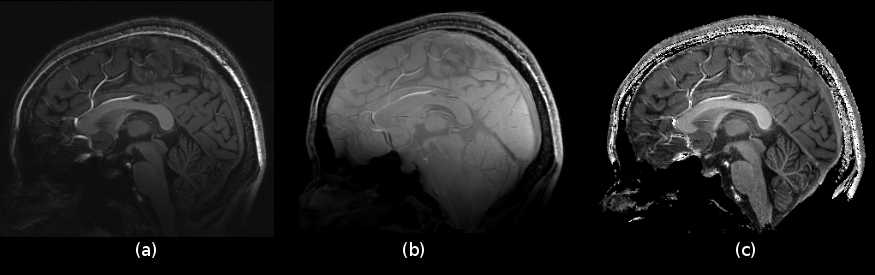
We are using a 7T from Siemens and we acquire two volumes with an MPRAGE and 3D GE sequence. Using SPM both volumes are co-registered and afterwards the MPRAGE is divided by the 3D GE. Attached is a sample *.jpg showing the results.
In our case the temporal lobes are still not very homogeneous due to some problems with the coil or gradient system (currently a new gradient is being installed, so it probably will help). Also Im further improving the volumes by running mri_nu_correct.mni on the T1.mgz created by the normalization stage (like mri_nu_correct.mni stop 0.001 distance 25 i T1.mgz o nu.mgz) and running mri_normalize again afterwards. The volume normally looks very homogeneous afterwards, even the temporal lobes.
But Im facing problems in the following stages, mainly everything based on the aseg files as I need to skip the process. I cant recall exactly during which stage, but recon-all exists with the error that the aseg.mgz needs to be conformed, so it needs to be skipped. But by skipping these stages I currently have issues during mri_fill as the cerebellum is not erased as it should be.
Also the skull stripping isnt very good in most cases. The only solution I had was using a brainmask created by Slicer or to run recon-all normally (conforming the data) and resampling the brainmask to the original resolution (using mri_vol2vol). Then masking the T1.mgz to get a fairly good looking brainmask.
Hope this helps,
Regards,
Falk
From: Jürgen Hänggi [mailto:j.haenggi@psychologie.uzh.ch] Sent: Monday, May 18, 2009 3:30 PM To: Falk Lüsebrink Subject: Re: [Freesurfer] Measuring cortical thickness with high resolution data
Hi Falk
We are also struggling with 7T images and Freesurfer. In your email (see below) you wrote that you have find a way to get ride of the inhomogeneities inherent in the 7T images. Which other sequence did you use for that? Do you also use a 7T scanner from Philips? Do you use an adiabatic pulse sequence?
Thanks in advance Best regards Jürgen
On [DATE], "Falk Lüsebrink" <[ADDRESS]> wrote:
Hi Freesurfers,
Im trying to evaluate the usefulness of high resolution scans acquired at 7T with an isometric voxel size of .6mm for the measurement of cortical thickness. The inhomogeneities are taken care of by dividing the scans with another scan of another sequence, so they are not an issue anymore.
My problem is that Freesurfer usually conforms the voxel size to 1mm which is not desirable. I tried using the cm and noaseg flags for the recon-all process to avoid the conformation and to skip the subcortical segmentation, but another problem arises while using these flags.
The error I receive is occurring after the WM Segmentation and states as follows:
#-------------------------------------------- #...@# WM Segmentation Wed Mar 18 10:14:42 CET 2009
cp wm.mgz wm.seg.mgz
mri_segment -keep brain.mgz wm.seg.mgz
preserving editing changes in output volume... doing initial intensity segmentation... using local statistics to label ambiguous voxels... computing class statistics for intensity windows... WM (106.0): 106.9 +- 5.8 [80.0 --> 125.0] GM (69.0) : 66.3 +- 11.6 [30.0 --> 96.0] setting bottom of white matter range to 77.9 setting top of gray matter range to 89.4 doing initial intensity segmentation... using local statistics to label ambiguous voxels... using local geometry to label remaining ambiguous voxels...
reclassifying voxels using Gaussian border classifier...
removing voxels with positive offset direction... smoothing T1 volume with sigma = 0.250 removing 1-dimensional structures... thickening thin strands.... 20 segments, 4813 filled 10270 bright non-wm voxels segmented. 5589 diagonally connected voxels added... white matter segmentation took 2.4 minutes writing output to wm.seg.mgz... ERROR: mri_segment-MRIcheckVolDims: volume1 height=256 != volume2 height=320.
The dimensions of the data Im trying to process is 320 x 320 x 224 and is changed to 320 x 320 x 320 while using the cm flag. It seems the mri_segment process cant handle any dimensions above 256 or Im missing another flag.
Does someone has any ideas about that issue?
Regards, Falk
_____
_______________________________________________ Freesurfer mailing list Freesurfer@nmr.mgh.harvard.edu https://mail.nmr.mgh.harvard.edu/mailman/listinfo/freesurfer
---------------------------------------------------------------------------- Juergen Haenggi Ph.D. (Dr. des.) Division Neuropsychology Institute of Psychology University of Zurich Binzmuehlestrasse 14, PO Box 25 8050 Zurich, Switzerland 0041 44 635 73 97 (phone office) 0041 76 445 86 84 (phone mobile) 0041 44 635 74 09 (fax office) BIN 4.D.04 (office room number) j.haenggi[at]psychologie.uzh.ch (email) http://www.psychologie.uzh.ch/neuropsy/ (website) http://www.juergenhaenggi.ch (private website)
This e-mail (and any attachment/s) contains confidential and/or privileged information. If you are not the intended recipient (or have received this e-mail in error) please notify the sender immediately and destroy this e-mail. Any unauthorised copying, disclosure or distribution of the material in this e-mail is strictly forbidden. ----------------------------------------------------------------------------
freesurfer@nmr.mgh.harvard.edu
-
 Falk Lüsebrink