
Hey Experts,
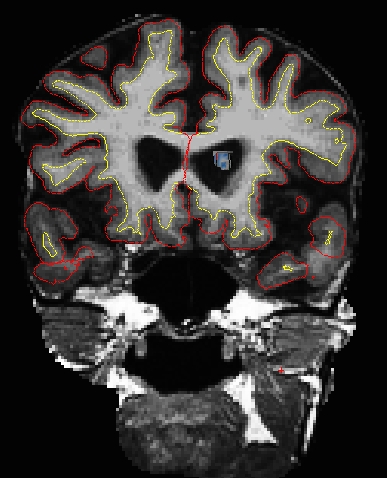
As you can see from the picture, the autorecon does not work properly (for WM/Pial surfs) with my files: Especially in the temporal lobes.
I am working with the SPGR files of a 3T GE Machine. Is there any way to optimize the autorecon results for SPGRs? (Except the lavish application of CPs.)
Best regards Thomas
On Mon, Jul 23, 2012 at 6:00 PM, freesurfer-request@nmr.mgh.harvard.eduwrote:
Send Freesurfer mailing list submissions to freesurfer@nmr.mgh.harvard.edu
To subscribe or unsubscribe via the World Wide Web, visit https://mail.nmr.mgh.harvard.edu/mailman/listinfo/freesurfer or, via email, send a message with subject or body 'help' to freesurfer-request@nmr.mgh.harvard.edu
You can reach the person managing the list at freesurfer-owner@nmr.mgh.harvard.edu
When replying, please edit your Subject line so it is more specific than "Re: Contents of Freesurfer digest..."
Today's Topics:
- Re: Questions about correction over 2 hemispheres and MCC (Reem Jan)
- More than two time-points in longitudinal base = Memory allocation error? (Liz Bowman)
- Re: Talairach registration (Mojdeh Zamyadi)
- Subcortical segmentations (Jordan Pierce)
Message: 1 Date: Sun, 22 Jul 2012 21:12:44 +0000 From: Reem Jan r.jan@auckland.ac.nz Subject: Re: [Freesurfer] Questions about correction over 2 hemispheres and MCC To: "Watson, Christopher" Christopher.Watson@childrens.harvard.edu Cc: Freesurfer Mailinglist freesurfer@nmr.mgh.harvard.edu Message-ID: < 3375B664D4A0834FB7D0C15D590A9EF11825DBC1@FMHS-MBX1.fmhs.auckland.ac.nz>
Content-Type: text/plain; charset="iso-8859-1"
Hi Bruce, J?rgen and Chris
Thank you for elaborating further. I've gone with a Bonferroni correction as I had a limited number of tests (a-priori hypothesis). But just out of interest Chris, you mentioned you found correlations between subcortical structures, do you have a reference I could look at? The tool that J?rgen suggested requires we enter a correlation coefficient, so I wondered if I could use published values or whether I'd need to calculate my own (if so, could you please recommend a way of doing that in Freesurfer or FSL?)
Many thanks in advance
Kind regards Reem
-----Original Message----- From: freesurfer-bounces@nmr.mgh.harvard.edu [mailto: freesurfer-bounces@nmr.mgh.harvard.edu] On Behalf Of J?rgen H?nggi Sent: Sunday, 22 July 2012 7:47 p.m. To: Watson, Christopher Cc: Freesurfer Mailinglist Subject: Re: [Freesurfer] Questions about correction over 2 hemispheres and MCC
Hi Chris
Yes there are such tools. Bonferroni oder Sidak test that take into account the correlated measures. Here you can find these tools
http://www.quantitativeskills.com/sisa/calculations/bonfer.htm
Cheers J?rgen
On [DATE], "Watson, Christopher" <[ADDRESS]> wrote:
What about, for example, the correlations I've seen in a cohort of
subjects.
In 158 subjects aged 10-19 (both controls and patients), the correlation between L & R thalamus is 0.91, and the correlations between L & R of caudate, putamen, pallidum, hippocampus, and amygdala
were all 0.75 or higher.
I would think that a Bonferroni correction would be incredibly conservative and, in my opinion, just plain wrong because true significant diff's would be missed. Is there any principled way of dealing with multiple tests that are correlated?
Thanks, Chris ________________________________________ From: Bruce Fischl [fischl@nmr.mgh.harvard.edu] Sent: Saturday, July 21, 2012 12:01 PM To: Watson, Christopher Cc: Douglas N Greve; freesurfer@nmr.mgh.harvard.edu Subject: Re: [Freesurfer] Questions about correction over 2 hemispheres and MCC
Hi Chris,
bonferroni will be overly conservative in that case, but we rarely really know the true covariance structure of the data, so we would rather err on the side of being conservative.
cheers Bruce On Fri, 20 Jul 2012, Watson, Christopher wrote:
Hi Doug et al,
The 2nd question is something I've wondered about. Doesn't a Bonferroni correction assume that the measures are independent? If so, I think in the case of subcortical structures, it is incorrect to use this method, as e.g. the putamen and pallidal volumes are not independent of one another. If not, and it is acceptable to use when there are dependencies between measures, how do you calculate the FWE? It wouldn't be equal to alpha/n, unless I am misunderstanding something.
Thanks, Chris ________________________________________ From: freesurfer-bounces@nmr.mgh.harvard.edu [freesurfer-bounces@nmr.mgh.harvard.edu] on behalf of Douglas N Greve [greve@nmr.mgh.harvard.edu] Sent: Friday, July 20, 2012 2:38 PM To: freesurfer@nmr.mgh.harvard.edu Subject: Re: [Freesurfer] Questions about correction over 2 hemispheres and MCC
Hi Reem, it looks like you've done everything correctly (sorry for the null result). As for your second, question, I don't think there is a way other than Bonferroni. You can try FDR, but it makes the interpretation a little messy. doug
On 07/19/2012 07:59 PM, Reem Jan wrote:
Hi Doug
I hope it?s okay that I double check I?m doing the correction over 2 hemispheres correctly and ask a question regarding correction for multiple comparisons. I will briefly describe what I have done:
I have 2 groups of subjects ? Drug addicts (n= 17) and controls (n=20).
1.I ran a surface thickness study:
?For the ?mri_glmfit? command, I used DOSS and specified a contrast of +1 -1 0 (Controls > MA)
?I ran a pre-cached simulation with the following command: mri_glmfit-sim --glmdir lh.group_age.glmdir --cache 4 pos
?This simulation should only have corrected for the left hemisphere as I understand it. My cluster summary text file showed me that a cluster survived in the insula. I interpreted this as ?controls had higher grey matter thickness in this cluster located in the insula than drug addicts?. However, this was only corrected over the left hemisphere (when I ran the same simulation in the right hemisphere, nothing survived multiple comparison correction).
?I now wanted to correct the lh results for 2 hemispheres. From the help menu of ?mri_glmfit-sim?, I understood you can do this in 2 ways, are both of these correct and give the same result?
a.mri_glmfit-sim --glmdir lh.group_age.glmdir --cache 4 pos --2 spaces --no-sim csdbase
b.mri_glmfit-sim --glmdir lh.group_age.glmdir --cache 4 pos --cwpvalthresh 0.025
?No clusters survived the Bonferroni correction over both hemispheres. So I assume I can no longer report this result?
2.I ran a subcortical volume study:
?I used SPSS to perform the statistical analysis on each of 14 subcortical structures (left and right). Is there a good way to correct for multiple comparisons, apart from Bonferroni, which would be very conservative?
Many thanks for your advice.
Kind regards
Reem
*Reem Jan***
BPharm (Hons), RegPharmNZ
PhD Student / Pharmacist
School of Pharmacy, Faculty of Medical & Health Sciences, The University of Auckland, Private Bag 92019, Auckland, New Zealand.
Ph: +64 9 373 7599 ext 81138. DDI: +64 9 923 1138
F: +64 9 367 7192
*From:*freesurfer-bounces@nmr.mgh.harvard.edu [mailto:freesurfer-bounces@nmr.mgh.harvard.edu] *On Behalf Of *Douglas Greve *Sent:* Friday, 20 July 2012 11:52 a.m. *To:* freesurfer@nmr.mgh.harvard.edu *Subject:* Re: [Freesurfer] slice-by-slice predictors
Sorry, not possible.
On 7/19/12 6:56 PM, Caspar M. Schwiedrzik wrote:
Hi! Is it possible to have slice-by-slice predictors in Freesurfer, and if so, how? Thanks, Caspar
Freesurfer mailing list Freesurfer@nmr.mgh.harvard.edu mailto:Freesurfer@nmr.mgh.harvard.edu https://mail.nmr.mgh.harvard.edu/mailman/listinfo/freesurfer
Freesurfer mailing list Freesurfer@nmr.mgh.harvard.edu https://mail.nmr.mgh.harvard.edu/mailman/listinfo/freesurfer
-- Douglas N. Greve, Ph.D. MGH-NMR Center greve@nmr.mgh.harvard.edu Phone Number: 617-724-2358 Fax: 617-726-7422
Bugs: surfer.nmr.mgh.harvard.edu/fswiki/BugReporting FileDrop: www.nmr.mgh.harvard.edu/facility/filedrop/index.html
Freesurfer mailing list Freesurfer@nmr.mgh.harvard.edu https://mail.nmr.mgh.harvard.edu/mailman/listinfo/freesurfer
The information in this e-mail is intended only for the person to whom it is addressed. If you believe this e-mail was sent to you in error and the e-mail contains patient information, please contact the Partners Compliance HelpLine at http://www.partners.org/complianceline . If the e-mail was sent to you in error but does not contain patient information, please contact the sender and properly dispose of the e-mail.
Freesurfer mailing list Freesurfer@nmr.mgh.harvard.edu https://mail.nmr.mgh.harvard.edu/mailman/listinfo/freesurfer
Freesurfer mailing list Freesurfer@nmr.mgh.harvard.edu https://mail.nmr.mgh.harvard.edu/mailman/listinfo/freesurfer
J?rgen H?nggi, Ph.D. Division Neuropsychology Institute of Psychology University of Zurich Binzmuehlestrasse 14, PO Box 25 8050 Zurich, Switzerland 0041 44 635 73 97 (phone office) 0041 76 445 86 84 (phone mobile) 0041 44 635 74 09 (fax office) BIN 4.D.04 (office room number) j.haenggi[at]psychologie.uzh.ch (email) http://www.psychologie.uzh.ch/neuropsy/ (website) http://www.juergenhaenggi.ch (private website)
This e-mail (and any attachment/s) contains confidential and/or privileged information. If you are not the intended recipient (or have received this e-mail in error) please notify the sender immediately and destroy this e-mail. Any unauthorised copying, disclosure or distribution of the material in this e-mail is strictly forbidden.
Freesurfer mailing list Freesurfer@nmr.mgh.harvard.edu https://mail.nmr.mgh.harvard.edu/mailman/listinfo/freesurfer
Message: 2 Date: Mon, 23 Jul 2012 10:21:33 +1000 From: Liz Bowman ea_bowman@hotmail.com Subject: [Freesurfer] More than two time-points in longitudinal base = Memory allocation error? To: freesurfer@nmr.mgh.harvard.edu Message-ID: SNT135-W17F702D9DC415BB91613828CDD0@phx.gbl Content-Type: text/plain; charset="iso-8859-1"
Hello, I have several patients scans taken over multiple time points (up to nine time points in some patients). I thought I might be able to use these to create a base template for longitudinal processing, however the process fails and exits with errors if I try to create a base with more than two time points from a patient. This is a sample of the error log of the most recent attempt, with three timepoints: Resolution: 1 S( 128 128 128 ) T( 128 128 128 ) Iteration(f): 1 -- diff. to prev. transform: 0.876663 Iteration(f): 2 -- diff. to prev. transform: 0.0148738 Iteration(f): 3 -- diff. to prev. transform: 0.00156813 < 0.01 :-) Resolution: 0 S( 256 256 256 ) T( 256 256 256 ) Iteration(f): 1 -- diff. to prev. transform: 0.263086 Iteration(f): 2mri_robust_template(1035) malloc: *** mmap(size=262144) failed (error code=12)*** error: can't allocate region*** set a breakpoint in malloc_error_break to debugMRIalloc(256, 256, 256): could not allocate 262144 bytes for 68th slice Cannot allocate memoryDarwin 550D-UOM88670.local 10.8.0 Darwin Kernel Version 10.8.0: Tue Jun 7 16:32:41 PDT 2011; root:xnu-1504.15.3~1/RELEASE_X86_64 x86_64 recon-all -s KSx3 exited with ERRORS at Mon Jul 23 10:15:13 EST 2012 For more details, see the log file /Applications/freesurfer/subjects/KSx3/scripts/recon-all.logTo report a problem, see http://surfer.nmr.mgh.harvard.edu/fswiki/BugReporting I would be grateful for any advice. Regards, EA Bowman

Hi Thomas,
The following message posted by Michael Harms http://www.mail-archive.com/freesurfer@nmr.mgh.harvard.edu/msg20991.html has some very useful options. I recently noticed that they help us with a very similar problem...
Also, I recall that for FS v5.0 there was a flag -nuintensitycor-3T for "optimal parameters for nu_correct for 3T scans" (as described in release notes for v5.0.)
Bruce, the -nuintensitycor-3T is still available in v5.1 right? If yes, then we could combine the options the two set of options and run recon-all with "-b 20 -n 5 and -nuintensitycor-3T" for the 3T scans? Would this be reasonable or does this combination not recommended ?
Thanks Mehul
On Tue, Jul 24, 2012 at 12:47 AM, Thomas Fink <mr.thomas.fink@googlemail.com
wrote:
Hey Experts,
As you can see from the picture, the autorecon does not work properly (for WM/Pial surfs) with my files: Especially in the temporal lobes.
I am working with the SPGR files of a 3T GE Machine. Is there any way to optimize the autorecon results for SPGRs? (Except the lavish application of CPs.)
Best regards Thomas
On Mon, Jul 23, 2012 at 6:00 PM, freesurfer-request@nmr.mgh.harvard.eduwrote:
Send Freesurfer mailing list submissions to freesurfer@nmr.mgh.harvard.edu
To subscribe or unsubscribe via the World Wide Web, visit https://mail.nmr.mgh.harvard.edu/mailman/listinfo/freesurfer or, via email, send a message with subject or body 'help' to freesurfer-request@nmr.mgh.harvard.edu
You can reach the person managing the list at freesurfer-owner@nmr.mgh.harvard.edu
When replying, please edit your Subject line so it is more specific than "Re: Contents of Freesurfer digest..."
Today's Topics:
- Re: Questions about correction over 2 hemispheres and MCC (Reem Jan)
- More than two time-points in longitudinal base = Memory allocation error? (Liz Bowman)
- Re: Talairach registration (Mojdeh Zamyadi)
- Subcortical segmentations (Jordan Pierce)
Message: 1 Date: Sun, 22 Jul 2012 21:12:44 +0000 From: Reem Jan r.jan@auckland.ac.nz Subject: Re: [Freesurfer] Questions about correction over 2 hemispheres and MCC To: "Watson, Christopher" Christopher.Watson@childrens.harvard.edu Cc: Freesurfer Mailinglist freesurfer@nmr.mgh.harvard.edu Message-ID: < 3375B664D4A0834FB7D0C15D590A9EF11825DBC1@FMHS-MBX1.fmhs.auckland.ac.nz>
Content-Type: text/plain; charset="iso-8859-1"
Hi Bruce, J?rgen and Chris
Thank you for elaborating further. I've gone with a Bonferroni correction as I had a limited number of tests (a-priori hypothesis). But just out of interest Chris, you mentioned you found correlations between subcortical structures, do you have a reference I could look at? The tool that J?rgen suggested requires we enter a correlation coefficient, so I wondered if I could use published values or whether I'd need to calculate my own (if so, could you please recommend a way of doing that in Freesurfer or FSL?)
Many thanks in advance
Kind regards Reem
-----Original Message----- From: freesurfer-bounces@nmr.mgh.harvard.edu [mailto: freesurfer-bounces@nmr.mgh.harvard.edu] On Behalf Of J?rgen H?nggi Sent: Sunday, 22 July 2012 7:47 p.m. To: Watson, Christopher Cc: Freesurfer Mailinglist Subject: Re: [Freesurfer] Questions about correction over 2 hemispheres and MCC
Hi Chris
Yes there are such tools. Bonferroni oder Sidak test that take into account the correlated measures. Here you can find these tools
http://www.quantitativeskills.com/sisa/calculations/bonfer.htm
Cheers J?rgen
On [DATE], "Watson, Christopher" <[ADDRESS]> wrote:
What about, for example, the correlations I've seen in a cohort of
subjects.
In 158 subjects aged 10-19 (both controls and patients), the correlation between L & R thalamus is 0.91, and the correlations between L & R of caudate, putamen, pallidum, hippocampus, and amygdala
were all 0.75 or higher.
I would think that a Bonferroni correction would be incredibly conservative and, in my opinion, just plain wrong because true significant diff's would be missed. Is there any principled way of dealing with multiple tests that are correlated?
Thanks, Chris ________________________________________ From: Bruce Fischl [fischl@nmr.mgh.harvard.edu] Sent: Saturday, July 21, 2012 12:01 PM To: Watson, Christopher Cc: Douglas N Greve; freesurfer@nmr.mgh.harvard.edu Subject: Re: [Freesurfer] Questions about correction over 2 hemispheres and MCC
Hi Chris,
bonferroni will be overly conservative in that case, but we rarely really know the true covariance structure of the data, so we would rather err on the side of being conservative.
cheers Bruce On Fri, 20 Jul 2012, Watson, Christopher wrote:
Hi Doug et al,
The 2nd question is something I've wondered about. Doesn't a Bonferroni correction assume that the measures are independent? If so, I think in the case of subcortical structures, it is incorrect to use this method, as e.g. the putamen and pallidal volumes are not independent of one another. If not, and it is acceptable to use when there are dependencies between measures, how do you calculate the FWE? It wouldn't be equal to alpha/n, unless I am misunderstanding something.
Thanks, Chris ________________________________________ From: freesurfer-bounces@nmr.mgh.harvard.edu [freesurfer-bounces@nmr.mgh.harvard.edu] on behalf of Douglas N Greve [greve@nmr.mgh.harvard.edu] Sent: Friday, July 20, 2012 2:38 PM To: freesurfer@nmr.mgh.harvard.edu Subject: Re: [Freesurfer] Questions about correction over 2 hemispheres and MCC
Hi Reem, it looks like you've done everything correctly (sorry for the null result). As for your second, question, I don't think there is a way other than Bonferroni. You can try FDR, but it makes the interpretation a little messy. doug
On 07/19/2012 07:59 PM, Reem Jan wrote:
Hi Doug
I hope it?s okay that I double check I?m doing the correction over 2 hemispheres correctly and ask a question regarding correction for multiple comparisons. I will briefly describe what I have done:
I have 2 groups of subjects ? Drug addicts (n= 17) and controls
(n=20).
1.I ran a surface thickness study:
?For the ?mri_glmfit? command, I used DOSS and specified a contrast of +1 -1 0 (Controls > MA)
?I ran a pre-cached simulation with the following command: mri_glmfit-sim --glmdir lh.group_age.glmdir --cache 4 pos
?This simulation should only have corrected for the left hemisphere as I understand it. My cluster summary text file showed me that a cluster survived in the insula. I interpreted this as ?controls had higher grey matter thickness in this cluster located in the insula than drug addicts?. However, this was only corrected over the left hemisphere (when I ran the same simulation in the right hemisphere, nothing survived multiple comparison correction).
?I now wanted to correct the lh results for 2 hemispheres. From the help menu of ?mri_glmfit-sim?, I understood you can do this in 2 ways, are both of these correct and give the same result?
a.mri_glmfit-sim --glmdir lh.group_age.glmdir --cache 4 pos --2 spaces --no-sim csdbase
b.mri_glmfit-sim --glmdir lh.group_age.glmdir --cache 4 pos --cwpvalthresh 0.025
?No clusters survived the Bonferroni correction over both hemispheres. So I assume I can no longer report this result?
2.I ran a subcortical volume study:
?I used SPSS to perform the statistical analysis on each of 14 subcortical structures (left and right). Is there a good way to correct for multiple comparisons, apart from Bonferroni, which would be very conservative?
Many thanks for your advice.
Kind regards
Reem
*Reem Jan***
BPharm (Hons), RegPharmNZ
PhD Student / Pharmacist
School of Pharmacy, Faculty of Medical & Health Sciences, The University of Auckland, Private Bag 92019, Auckland, New Zealand.
Ph: +64 9 373 7599 ext 81138. DDI: +64 9 923 1138
F: +64 9 367 7192
*From:*freesurfer-bounces@nmr.mgh.harvard.edu [mailto:freesurfer-bounces@nmr.mgh.harvard.edu] *On Behalf Of *Douglas Greve *Sent:* Friday, 20 July 2012 11:52 a.m. *To:* freesurfer@nmr.mgh.harvard.edu *Subject:* Re: [Freesurfer] slice-by-slice predictors
Sorry, not possible.
On 7/19/12 6:56 PM, Caspar M. Schwiedrzik wrote:
Hi! Is it possible to have slice-by-slice predictors in Freesurfer, and if so, how? Thanks, Caspar
Freesurfer mailing list Freesurfer@nmr.mgh.harvard.edu mailto:Freesurfer@nmr.mgh.harvard.edu https://mail.nmr.mgh.harvard.edu/mailman/listinfo/freesurfer
Freesurfer mailing list Freesurfer@nmr.mgh.harvard.edu https://mail.nmr.mgh.harvard.edu/mailman/listinfo/freesurfer
-- Douglas N. Greve, Ph.D. MGH-NMR Center greve@nmr.mgh.harvard.edu Phone Number: 617-724-2358 Fax: 617-726-7422
Bugs: surfer.nmr.mgh.harvard.edu/fswiki/BugReporting FileDrop: www.nmr.mgh.harvard.edu/facility/filedrop/index.html
Freesurfer mailing list Freesurfer@nmr.mgh.harvard.edu https://mail.nmr.mgh.harvard.edu/mailman/listinfo/freesurfer
The information in this e-mail is intended only for the person to whom it is addressed. If you believe this e-mail was sent to you in error and the e-mail contains patient information, please contact the Partners Compliance HelpLine at http://www.partners.org/complianceline . If the e-mail was sent to you in error but does not contain patient information, please contact the sender and properly dispose of the e-mail.
Freesurfer mailing list Freesurfer@nmr.mgh.harvard.edu https://mail.nmr.mgh.harvard.edu/mailman/listinfo/freesurfer
Freesurfer mailing list Freesurfer@nmr.mgh.harvard.edu https://mail.nmr.mgh.harvard.edu/mailman/listinfo/freesurfer
J?rgen H?nggi, Ph.D. Division Neuropsychology Institute of Psychology University of Zurich Binzmuehlestrasse 14, PO Box 25 8050 Zurich, Switzerland 0041 44 635 73 97 (phone office) 0041 76 445 86 84 (phone mobile) 0041 44 635 74 09 (fax office) BIN 4.D.04 (office room number) j.haenggi[at]psychologie.uzh.ch (email) http://www.psychologie.uzh.ch/neuropsy/ (website) http://www.juergenhaenggi.ch (private website)
This e-mail (and any attachment/s) contains confidential and/or privileged information. If you are not the intended recipient (or have received this e-mail in error) please notify the sender immediately and destroy this e-mail. Any unauthorised copying, disclosure or distribution of the material in this e-mail is strictly forbidden.
Freesurfer mailing list Freesurfer@nmr.mgh.harvard.edu https://mail.nmr.mgh.harvard.edu/mailman/listinfo/freesurfer
Message: 2 Date: Mon, 23 Jul 2012 10:21:33 +1000 From: Liz Bowman ea_bowman@hotmail.com Subject: [Freesurfer] More than two time-points in longitudinal base = Memory allocation error? To: freesurfer@nmr.mgh.harvard.edu Message-ID: SNT135-W17F702D9DC415BB91613828CDD0@phx.gbl Content-Type: text/plain; charset="iso-8859-1"
Hello, I have several patients scans taken over multiple time points (up to nine time points in some patients). I thought I might be able to use these to create a base template for longitudinal processing, however the process fails and exits with errors if I try to create a base with more than two time points from a patient. This is a sample of the error log of the most recent attempt, with three timepoints: Resolution: 1 S( 128 128 128 ) T( 128 128 128 ) Iteration(f): 1 -- diff. to prev. transform: 0.876663 Iteration(f): 2 -- diff. to prev. transform: 0.0148738 Iteration(f): 3 -- diff. to prev. transform: 0.00156813 < 0.01 :-) Resolution: 0 S( 256 256 256 ) T( 256 256 256 ) Iteration(f): 1 -- diff. to prev. transform: 0.263086 Iteration(f): 2mri_robust_template(1035) malloc: *** mmap(size=262144) failed (error code=12)*** error: can't allocate region*** set a breakpoint in malloc_error_break to debugMRIalloc(256, 256, 256): could not allocate 262144 bytes for 68th slice Cannot allocate memoryDarwin 550D-UOM88670.local 10.8.0 Darwin Kernel Version 10.8.0: Tue Jun 7 16:32:41 PDT 2011; root:xnu-1504.15.3~1/RELEASE_X86_64 x86_64 recon-all -s KSx3 exited with ERRORS at Mon Jul 23 10:15:13 EST 2012 For more details, see the log file /Applications/freesurfer/subjects/KSx3/scripts/recon-all.logTo report a problem, see http://surfer.nmr.mgh.harvard.edu/fswiki/BugReporting I would be grateful for any advice. Regards, EA Bowman

Yes, that flag still works in 5.1.
Bruce, think these parameters could be default in 5.2? It's a long extra flag (that is, I imagine, someone arcane knowledge) for what has to be the overwhelmingly modal field strength these days.
Sorry to hijack, but this would be nice!
Cheers, Michael
On Wed, Jul 25, 2012 at 10:29 PM, Mehul Sampat mehul.sampat@ieee.orgwrote:
Hi Thomas,
The following message posted by Michael Harms http://www.mail-archive.com/freesurfer@nmr.mgh.harvard.edu/msg20991.html has some very useful options. I recently noticed that they help us with a very similar problem...
Also, I recall that for FS v5.0 there was a flag -nuintensitycor-3T for "optimal parameters for nu_correct for 3T scans" (as described in release notes for v5.0.)
Bruce, the -nuintensitycor-3T is still available in v5.1 right? If yes, then we could combine the options the two set of options and run recon-all with "-b 20 -n 5 and -nuintensitycor-3T" for the 3T scans? Would this be reasonable or does this combination not recommended ?
Thanks Mehul
On Tue, Jul 24, 2012 at 12:47 AM, Thomas Fink < mr.thomas.fink@googlemail.com> wrote:
Hey Experts,
As you can see from the picture, the autorecon does not work properly (for WM/Pial surfs) with my files: Especially in the temporal lobes.
I am working with the SPGR files of a 3T GE Machine. Is there any way to optimize the autorecon results for SPGRs? (Except the lavish application of CPs.)
Best regards Thomas
On Mon, Jul 23, 2012 at 6:00 PM, freesurfer-request@nmr.mgh.harvard.eduwrote:
Send Freesurfer mailing list submissions to freesurfer@nmr.mgh.harvard.edu
To subscribe or unsubscribe via the World Wide Web, visit https://mail.nmr.mgh.harvard.edu/mailman/listinfo/freesurfer or, via email, send a message with subject or body 'help' to freesurfer-request@nmr.mgh.harvard.edu
You can reach the person managing the list at freesurfer-owner@nmr.mgh.harvard.edu
When replying, please edit your Subject line so it is more specific than "Re: Contents of Freesurfer digest..."
Today's Topics:
- Re: Questions about correction over 2 hemispheres and MCC (Reem Jan)
- More than two time-points in longitudinal base = Memory allocation error? (Liz Bowman)
- Re: Talairach registration (Mojdeh Zamyadi)
- Subcortical segmentations (Jordan Pierce)
Message: 1 Date: Sun, 22 Jul 2012 21:12:44 +0000 From: Reem Jan r.jan@auckland.ac.nz Subject: Re: [Freesurfer] Questions about correction over 2 hemispheres and MCC To: "Watson, Christopher" Christopher.Watson@childrens.harvard.edu Cc: Freesurfer Mailinglist freesurfer@nmr.mgh.harvard.edu Message-ID: < 3375B664D4A0834FB7D0C15D590A9EF11825DBC1@FMHS-MBX1.fmhs.auckland.ac.nz>
Content-Type: text/plain; charset="iso-8859-1"
Hi Bruce, J?rgen and Chris
Thank you for elaborating further. I've gone with a Bonferroni correction as I had a limited number of tests (a-priori hypothesis). But just out of interest Chris, you mentioned you found correlations between subcortical structures, do you have a reference I could look at? The tool that J?rgen suggested requires we enter a correlation coefficient, so I wondered if I could use published values or whether I'd need to calculate my own (if so, could you please recommend a way of doing that in Freesurfer or FSL?)
Many thanks in advance
Kind regards Reem
-----Original Message----- From: freesurfer-bounces@nmr.mgh.harvard.edu [mailto: freesurfer-bounces@nmr.mgh.harvard.edu] On Behalf Of J?rgen H?nggi Sent: Sunday, 22 July 2012 7:47 p.m. To: Watson, Christopher Cc: Freesurfer Mailinglist Subject: Re: [Freesurfer] Questions about correction over 2 hemispheres and MCC
Hi Chris
Yes there are such tools. Bonferroni oder Sidak test that take into account the correlated measures. Here you can find these tools
http://www.quantitativeskills.com/sisa/calculations/bonfer.htm
Cheers J?rgen
On [DATE], "Watson, Christopher" <[ADDRESS]> wrote:
What about, for example, the correlations I've seen in a cohort of
subjects.
In 158 subjects aged 10-19 (both controls and patients), the correlation between L & R thalamus is 0.91, and the correlations between L & R of caudate, putamen, pallidum, hippocampus, and amygdala
were all 0.75 or higher.
I would think that a Bonferroni correction would be incredibly conservative and, in my opinion, just plain wrong because true significant diff's would be missed. Is there any principled way of dealing with multiple tests that are correlated?
Thanks, Chris ________________________________________ From: Bruce Fischl [fischl@nmr.mgh.harvard.edu] Sent: Saturday, July 21, 2012 12:01 PM To: Watson, Christopher Cc: Douglas N Greve; freesurfer@nmr.mgh.harvard.edu Subject: Re: [Freesurfer] Questions about correction over 2 hemispheres and MCC
Hi Chris,
bonferroni will be overly conservative in that case, but we rarely really know the true covariance structure of the data, so we would rather err on the side of being conservative.
cheers Bruce On Fri, 20 Jul 2012, Watson, Christopher wrote:
Hi Doug et al,
The 2nd question is something I've wondered about. Doesn't a Bonferroni correction assume that the measures are independent? If so, I think in the case of subcortical structures, it is incorrect to use this method, as e.g. the putamen and pallidal volumes are not independent of one another. If not, and it is acceptable to use when there are dependencies between measures, how do you calculate the FWE? It wouldn't be equal to alpha/n, unless I am misunderstanding something.
Thanks, Chris ________________________________________ From: freesurfer-bounces@nmr.mgh.harvard.edu [freesurfer-bounces@nmr.mgh.harvard.edu] on behalf of Douglas N Greve [greve@nmr.mgh.harvard.edu] Sent: Friday, July 20, 2012 2:38 PM To: freesurfer@nmr.mgh.harvard.edu Subject: Re: [Freesurfer] Questions about correction over 2 hemispheres and MCC
Hi Reem, it looks like you've done everything correctly (sorry for the null result). As for your second, question, I don't think there is a way other than Bonferroni. You can try FDR, but it makes the interpretation a little messy. doug
On 07/19/2012 07:59 PM, Reem Jan wrote:
Hi Doug
I hope it?s okay that I double check I?m doing the correction over 2 hemispheres correctly and ask a question regarding correction for multiple comparisons. I will briefly describe what I have done:
I have 2 groups of subjects ? Drug addicts (n= 17) and controls
(n=20).
1.I ran a surface thickness study:
?For the ?mri_glmfit? command, I used DOSS and specified a contrast of +1 -1 0 (Controls > MA)
?I ran a pre-cached simulation with the following command: mri_glmfit-sim --glmdir lh.group_age.glmdir --cache 4 pos
?This simulation should only have corrected for the left hemisphere as I understand it. My cluster summary text file showed me that a cluster survived in the insula. I interpreted this as ?controls had higher grey matter thickness in this cluster located in the insula than drug addicts?. However, this was only corrected over the left hemisphere (when I ran the same simulation in the right hemisphere, nothing survived multiple comparison correction).
?I now wanted to correct the lh results for 2 hemispheres. From the help menu of ?mri_glmfit-sim?, I understood you can do this in 2 ways, are both of these correct and give the same result?
a.mri_glmfit-sim --glmdir lh.group_age.glmdir --cache 4 pos --2 spaces --no-sim csdbase
b.mri_glmfit-sim --glmdir lh.group_age.glmdir --cache 4 pos --cwpvalthresh 0.025
?No clusters survived the Bonferroni correction over both
hemispheres.
So I assume I can no longer report this result?
2.I ran a subcortical volume study:
?I used SPSS to perform the statistical analysis on each of 14 subcortical structures (left and right). Is there a good way to correct for multiple comparisons, apart from Bonferroni, which would be very conservative?
Many thanks for your advice.
Kind regards
Reem
*Reem Jan***
BPharm (Hons), RegPharmNZ
PhD Student / Pharmacist
School of Pharmacy, Faculty of Medical & Health Sciences, The University of Auckland, Private Bag 92019, Auckland, New Zealand.
Ph: +64 9 373 7599 ext 81138. DDI: +64 9 923 1138
F: +64 9 367 7192
*From:*freesurfer-bounces@nmr.mgh.harvard.edu [mailto:freesurfer-bounces@nmr.mgh.harvard.edu] *On Behalf Of *Douglas Greve *Sent:* Friday, 20 July 2012 11:52 a.m. *To:* freesurfer@nmr.mgh.harvard.edu *Subject:* Re: [Freesurfer] slice-by-slice predictors
Sorry, not possible.
On 7/19/12 6:56 PM, Caspar M. Schwiedrzik wrote:
Hi! Is it possible to have slice-by-slice predictors in Freesurfer, and if so, how? Thanks, Caspar
Freesurfer mailing list Freesurfer@nmr.mgh.harvard.edu mailto:Freesurfer@nmr.mgh.harvard.edu https://mail.nmr.mgh.harvard.edu/mailman/listinfo/freesurfer
Freesurfer mailing list Freesurfer@nmr.mgh.harvard.edu https://mail.nmr.mgh.harvard.edu/mailman/listinfo/freesurfer
-- Douglas N. Greve, Ph.D. MGH-NMR Center greve@nmr.mgh.harvard.edu Phone Number: 617-724-2358 Fax: 617-726-7422
Bugs: surfer.nmr.mgh.harvard.edu/fswiki/BugReporting FileDrop: www.nmr.mgh.harvard.edu/facility/filedrop/index.html
Freesurfer mailing list Freesurfer@nmr.mgh.harvard.edu https://mail.nmr.mgh.harvard.edu/mailman/listinfo/freesurfer
The information in this e-mail is intended only for the person to whom it is addressed. If you believe this e-mail was sent to you in error and the e-mail contains patient information, please contact the Partners Compliance HelpLine at http://www.partners.org/complianceline . If the e-mail was sent to you in error but does not contain patient information, please contact the sender and properly dispose of the e-mail.
Freesurfer mailing list Freesurfer@nmr.mgh.harvard.edu https://mail.nmr.mgh.harvard.edu/mailman/listinfo/freesurfer
Freesurfer mailing list Freesurfer@nmr.mgh.harvard.edu https://mail.nmr.mgh.harvard.edu/mailman/listinfo/freesurfer
J?rgen H?nggi, Ph.D. Division Neuropsychology Institute of Psychology University of Zurich Binzmuehlestrasse 14, PO Box 25 8050 Zurich, Switzerland 0041 44 635 73 97 (phone office) 0041 76 445 86 84 (phone mobile) 0041 44 635 74 09 (fax office) BIN 4.D.04 (office room number) j.haenggi[at]psychologie.uzh.ch (email) http://www.psychologie.uzh.ch/neuropsy/ (website) http://www.juergenhaenggi.ch (private website)
This e-mail (and any attachment/s) contains confidential and/or privileged information. If you are not the intended recipient (or have received this e-mail in error) please notify the sender immediately and destroy this e-mail. Any unauthorised copying, disclosure or distribution of the material in this e-mail is strictly forbidden.
Freesurfer mailing list Freesurfer@nmr.mgh.harvard.edu https://mail.nmr.mgh.harvard.edu/mailman/listinfo/freesurfer
Message: 2 Date: Mon, 23 Jul 2012 10:21:33 +1000 From: Liz Bowman ea_bowman@hotmail.com Subject: [Freesurfer] More than two time-points in longitudinal base = Memory allocation error? To: freesurfer@nmr.mgh.harvard.edu Message-ID: SNT135-W17F702D9DC415BB91613828CDD0@phx.gbl Content-Type: text/plain; charset="iso-8859-1"
Hello, I have several patients scans taken over multiple time points (up to nine time points in some patients). I thought I might be able to use these to create a base template for longitudinal processing, however the process fails and exits with errors if I try to create a base with more than two time points from a patient. This is a sample of the error log of the most recent attempt, with three timepoints: Resolution: 1 S( 128 128 128 ) T( 128 128 128 ) Iteration(f): 1 -- diff. to prev. transform: 0.876663 Iteration(f): 2 -- diff. to prev. transform: 0.0148738 Iteration(f): 3 -- diff. to prev. transform: 0.00156813 < 0.01 :-) Resolution: 0 S( 256 256 256 ) T( 256 256 256 ) Iteration(f): 1 -- diff. to prev. transform: 0.263086 Iteration(f): 2mri_robust_template(1035) malloc: *** mmap(size=262144) failed (error code=12)*** error: can't allocate region*** set a breakpoint in malloc_error_break to debugMRIalloc(256, 256, 256): could not allocate 262144 bytes for 68th slice Cannot allocate memoryDarwin 550D-UOM88670.local 10.8.0 Darwin Kernel Version 10.8.0: Tue Jun 7 16:32:41 PDT 2011; root:xnu-1504.15.3~1/RELEASE_X86_64 x86_64 recon-all -s KSx3 exited with ERRORS at Mon Jul 23 10:15:13 EST 2012 For more details, see the log file /Applications/freesurfer/subjects/KSx3/scripts/recon-all.logTo report a problem, see http://surfer.nmr.mgh.harvard.edu/fswiki/BugReporting I would be grateful for any advice. Regards, EA Bowman

Hi Michael
that's a good thought. Let me talk to Nick, and see if we should default to it and have a 1.5T flag instead
Bruce On Thu, 26 Jul 2012, Michael Waskom wrote:
Yes, that flag still works in 5.1. Bruce, think these parameters could be default in 5.2? It's a long extra flag (that is, I imagine, someone arcane knowledge) for what has to be the overwhelmingly modal field strength these days.
Sorry to hijack, but this would be nice!
Cheers, Michael
On Wed, Jul 25, 2012 at 10:29 PM, Mehul Sampat mehul.sampat@ieee.org wrote: Hi Thomas, The following message posted by Michael Harms http://www.mail-archive.com/freesurfer@nmr.mgh.harvard.edu/msg20991.html has some very useful options. I recently noticed that they help us with a very similar problem...
Also, I recall that for FS v5.0 there was a flag -nuintensitycor-3T for "optimal parameters for nu_correct for 3T scans" (as described in release notes for v5.0.)
Bruce, the -nuintensitycor-3T is still available in v5.1 right? If yes, then we could combine the options the two set of options and run recon-all with "-b 20 -n 5 and -nuintensitycor-3T" for the 3T scans? Would this be reasonable or does this combination not recommended ?
Thanks Mehul
On Tue, Jul 24, 2012 at 12:47 AM, Thomas Fink mr.thomas.fink@googlemail.com wrote: Hey Experts,
  As you can see from the picture, the autorecon does not
  work properly (for WM/Pial surfs) with my files:
  Especially in the temporal lobes.

  I am working with the SPGR files of a 3T GE Machine.
  Is there any way to optimize the autorecon results for
  SPGRs?
  (Except the lavish application of CPs.)

  Best regards
  Thomas


  On Mon, Jul 23, 2012 at 6:00 PM,
  <freesurfer-request@nmr.mgh.harvard.edu> wrote:
        Send Freesurfer mailing list submissions to
                freesurfer@nmr.mgh.harvard.edu

        To subscribe or unsubscribe via the World Wide
        Web, visit

        https://mail.nmr.mgh.harvard.edu/mailman/listinfo/freesurfer
        or, via email, send a message with subject or
        body 'help' to
                freesurfer-request@nmr.mgh.harvard.edu

        You can reach the person managing the list at
                freesurfer-owner@nmr.mgh.harvard.edu

        When replying, please edit your Subject line
        so it is more specific
        than "Re: Contents of Freesurfer digest..."


        Today's Topics:

           1. Re: Questions about correction over 2
        hemispheres and MCC
              (Reem Jan)
           2. More than two time-points in
        longitudinal base = Memory
              allocation error? (Liz Bowman)
           3. Re: Talairach registration (Mojdeh
        Zamyadi)
           4. Subcortical segmentations (Jordan
        Pierce)


        ----------------------------------------------------------------------

        Message: 1
        Date: Sun, 22 Jul 2012 21:12:44 +0000
        From: Reem Jan <r.jan@auckland.ac.nz>
        Subject: Re: [Freesurfer] Questions about
        correction over 2
                hemispheres and MCC
        To: "Watson, Christopher"
        <Christopher.Watson@childrens.harvard.edu>
        Cc: Freesurfer Mailinglist
        <freesurfer@nmr.mgh.harvard.edu>
        Message-ID:

        <3375B664D4A0834FB7D0C15D590A9EF11825DBC1@FMHS-MBX1.fmhs.auckland.ac.nz>

        Content-Type: text/plain; charset="iso-8859-1"

        Hi Bruce, J?rgen and Chris

        Thank you for elaborating further. I've gone
        with a Bonferroni correction as I had a
        limited number of tests (a-priori hypothesis).
        But just out of interest Chris, you mentioned
        you found correlations between subcortical
        structures, do you have a reference I could
        look at? The tool that J?rgen suggested
        requires we enter a correlation coefficient,
        so I wondered if I could use published values
        or whether I'd need to calculate my own (if
        so, could you please recommend a way of doing
        that in Freesurfer or FSL?)

        Many thanks in advance

        Kind regards
        Reem

        -----Original Message-----
        From: freesurfer-bounces@nmr.mgh.harvard.edu
        [mailto:freesurfer-bounces@nmr.mgh.harvard.edu]
        On Behalf Of J?rgen H?nggi
        Sent: Sunday, 22 July 2012 7:47 p.m.
        To: Watson, Christopher
        Cc: Freesurfer Mailinglist
        Subject: Re: [Freesurfer] Questions about
        correction over 2 hemispheres and MCC

        Hi Chris

        Yes there are such tools. Bonferroni oder
        Sidak test that take into account the
        correlated measures. Here you can find these
        tools

        http://www.quantitativeskills.com/sisa/calculations/bonfer.htm

        Cheers
        J?rgen


        On [DATE], "Watson, Christopher" <[ADDRESS]>
        wrote:

        > What about, for example, the correlations
        I've seen in a cohort of subjects.
        >
        > In 158 subjects aged 10-19 (both controls
        and patients), the
        > correlation between L & R thalamus is 0.91,
        and the correlations
        > between L & R of caudate, putamen, pallidum,
        hippocampus, and amygdala were all 0.75 or
        higher.
        >
        > I would think that a Bonferroni correction
        would be incredibly
        > conservative and, in my opinion, just plain
        wrong because true
        > significant diff's would be missed. Is there
        any principled way of
        > dealing with multiple tests that are
        correlated?
        >
        > Thanks,
        > Chris
        > ________________________________________
        > From: Bruce Fischl
        [fischl@nmr.mgh.harvard.edu]
        > Sent: Saturday, July 21, 2012 12:01 PM
        > To: Watson, Christopher
        > Cc: Douglas N Greve;
        freesurfer@nmr.mgh.harvard.edu
        > Subject: Re: [Freesurfer] Questions about
        correction over 2
        > hemispheres and MCC
        >
        > Hi Chris,
        >
        > bonferroni will be overly conservative in
        that case, but we rarely
        > really know the true covariance structure of
        the data, so we would
        > rather err on the side of being
        conservative.
        >
        > cheers
        > Bruce
        > On Fri, 20 Jul 2012, Watson, Christopher
        > wrote:
        >
        >> Hi Doug et al,
        >>
        >> The 2nd question is something I've wondered
        about. Doesn't a
        >> Bonferroni correction assume that the
        measures are independent?
        >> If so, I think in the case of subcortical
        structures, it is incorrect
        >> to use this method, as e.g. the putamen and
        pallidal volumes are not
        >> independent of one another.
        >> If not, and it is acceptable to use when
        there are dependencies
        >> between measures, how do you calculate the
        FWE? It wouldn't be equal
        >> to alpha/n, unless I am misunderstanding
        something.
        >>
        >> Thanks,
        >> Chris
        >> ________________________________________
        >> From:
        freesurfer-bounces@nmr.mgh.harvard.edu
        >> [freesurfer-bounces@nmr.mgh.harvard.edu] on
        behalf of Douglas N Greve
        >> [greve@nmr.mgh.harvard.edu]
        >> Sent: Friday, July 20, 2012 2:38 PM
        >> To: freesurfer@nmr.mgh.harvard.edu
        >> Subject: Re: [Freesurfer] Questions about
        correction over 2
        >> hemispheres and MCC
        >>
        >> Hi Reem, it looks like you've done
        everything correctly (sorry for
        >> the null result). As for your second,
        question, I don't think there
        >> is a way other than Bonferroni. You can try
        FDR, but it makes the
        >> interpretation a little messy.
        >> doug
        >>
        >> On 07/19/2012 07:59 PM, Reem Jan wrote:
        >>>
        >>> Hi Doug
        >>>
        >>> I hope it?s okay that I double check I?m
        doing the correction over 2
        >>> hemispheres correctly and ask a question
        regarding correction for
        >>> multiple comparisons. I will briefly
        describe what I have done:
        >>>
        >>> I have 2 groups of subjects ? Drug addicts
        (n= 17) and controls (n=20).
        >>>
        >>> 1.I ran a surface thickness study:
        >>>
        >>> ?For the ?mri_glmfit? command, I used DOSS
        and specified a contrast
        >>> of
        >>> +1 -1 0 (Controls > MA)
        >>>
        >>> ?I ran a pre-cached simulation with the
        following command:
        >>> mri_glmfit-sim --glmdir
        lh.group_age.glmdir --cache 4 pos
        >>>
        >>> ?This simulation should only have
        corrected for the left hemisphere
        >>> as I understand it. My cluster summary
        text file showed me that a
        >>> cluster survived in the insula. I
        interpreted this as ?controls had
        >>> higher grey matter thickness in this
        cluster located in the insula
        >>> than drug addicts?. However, this was only
        corrected over the left
        >>> hemisphere (when I ran the same simulation
        in the right hemisphere,
        >>> nothing survived multiple comparison
        correction).
        >>>
        >>> ?I now wanted to correct the lh results
        for 2 hemispheres. From the
        >>> help menu of ?mri_glmfit-sim?, I
        understood you can do this in 2
        >>> ways, are both of these correct and give
        the same result?
        >>>
        >>> a.mri_glmfit-sim --glmdir
        lh.group_age.glmdir --cache 4 pos --2
        >>> spaces --no-sim csdbase
        >>>
        >>> b.mri_glmfit-sim --glmdir
        lh.group_age.glmdir --cache 4 pos
        >>> --cwpvalthresh 0.025
        >>>
        >>> ?No clusters survived the Bonferroni
        correction over both hemispheres.
        >>> So I assume I can no longer report this
        result?
        >>>
        >>> 2.I ran a subcortical volume study:
        >>>
        >>> ?I used SPSS to perform the statistical
        analysis on each of 14
        >>> subcortical structures (left and right).
        Is there a good way to
        >>> correct for multiple comparisons, apart
        from Bonferroni, which would
        >>> be very conservative?
        >>>
        >>> Many thanks for your advice.
        >>>
        >>> Kind regards
        >>>
        >>> Reem
        >>>
        >>> *Reem Jan***
        >>>
        >>> BPharm (Hons), RegPharmNZ
        >>>
        >>> PhD Student / Pharmacist
        >>>
        >>> School of Pharmacy, Faculty of Medical &
        Health Sciences, The
        >>> University of Auckland, Private Bag 92019,
        Auckland, New Zealand.
        >>>
        >>> Ph: +64 9 373 7599 ext 81138. DDI: +64 9
        923 1138
        >>>
        >>> F: +64 9 367 7192
        >>>
        >>>
        *From:*freesurfer-bounces@nmr.mgh.harvard.edu
        >>>
        [mailto:freesurfer-bounces@nmr.mgh.harvard.edu]
        *On Behalf Of
        >>> *Douglas Greve
        >>> *Sent:* Friday, 20 July 2012 11:52 a.m.
        >>> *To:* freesurfer@nmr.mgh.harvard.edu
        >>> *Subject:* Re: [Freesurfer] slice-by-slice
        predictors
        >>>
        >>> Sorry, not possible.
        >>>
        >>> On 7/19/12 6:56 PM, Caspar M. Schwiedrzik
        wrote:
        >>>
        >>> Hi!
        >>> Is it possible to have slice-by-slice
        predictors in Freesurfer, and
        >>> if so, how?
        >>> Thanks,
        >>> Caspar
        >>>
        >>>
        >>>
        >>>
        >>>
        _______________________________________________
        >>> Freesurfer mailing list
        >>> Freesurfer@nmr.mgh.harvard.edu
        >>> <mailto:Freesurfer@nmr.mgh.harvard.edu>
        >>>
        https://mail.nmr.mgh.harvard.edu/mailman/listinfo/freesurfer
        >>>
        >>>
        >>>
        _______________________________________________
        >>> Freesurfer mailing list
        >>> Freesurfer@nmr.mgh.harvard.edu
        >>>
        https://mail.nmr.mgh.harvard.edu/mailman/listinfo/freesurfer
        >>
        >> --
        >> Douglas N. Greve, Ph.D.
        >> MGH-NMR Center
        >> greve@nmr.mgh.harvard.edu
        >> Phone Number: 617-724-2358
        >> Fax: 617-726-7422
        >>
        >> Bugs:
        surfer.nmr.mgh.harvard.edu/fswiki/BugReporting
        >> FileDrop:
        www.nmr.mgh.harvard.edu/facility/filedrop/index.html
        >>
        >>
        _______________________________________________
        >> Freesurfer mailing list
        >> Freesurfer@nmr.mgh.harvard.edu
        >>
        https://mail.nmr.mgh.harvard.edu/mailman/listinfo/freesurfer
        >>
        >>
        >> The information in this e-mail is intended
        only for the person to
        >> whom it is addressed. If you believe this
        e-mail was sent to you in
        >> error and the e-mail contains patient
        information, please contact the
        >> Partners Compliance HelpLine at
        >> http://www.partners.org/complianceline . If
        the e-mail was sent to
        >> you in error but does not contain patient
        information, please contact
        >> the sender and properly dispose of the
        e-mail.
        >>
        >>
        >>
        _______________________________________________
        >> Freesurfer mailing list
        >> Freesurfer@nmr.mgh.harvard.edu
        >>
        https://mail.nmr.mgh.harvard.edu/mailman/listinfo/freesurfer
        >>
        >>
        >>
        >
        >
        _______________________________________________
        > Freesurfer mailing list
        > Freesurfer@nmr.mgh.harvard.edu
        >
        https://mail.nmr.mgh.harvard.edu/mailman/listinfo/freesurfer
        -
        J?rgen H?nggi, Ph.D.
        Division Neuropsychology
        Institute of Psychology
        University of Zurich
        Binzmuehlestrasse 14, PO Box 25
        8050 Zurich, Switzerland
        0041 44 635 73 97 (phone office)
        0041 76 445 86 84 (phone mobile)
        0041 44 635 74 09 (fax office)
        BIN 4.D.04 (office room number)
        j.haenggi[at]psychologie.uzh.ch (email)
        http://www.psychologie.uzh.ch/neuropsy/
        (website) http://www.juergenhaenggi.ch
        (private website)

        This e-mail (and any attachment/s) contains
        confidential and/or privileged information. If
        you are not the intended recipient (or have
        received this e-mail in error) please notify
        the sender immediately and destroy this
        e-mail. Any unauthorised copying, disclosure
        or distribution of the material in this e-mail
        is strictly forbidden.
        -


        _______________________________________________
        Freesurfer mailing list
        Freesurfer@nmr.mgh.harvard.edu
        https://mail.nmr.mgh.harvard.edu/mailman/listinfo/freesurfer


        ------------------------------

        Message: 2
        Date: Mon, 23 Jul 2012 10:21:33 +1000
        From: Liz Bowman <ea_bowman@hotmail.com>
        Subject: [Freesurfer] More than two
        time-points in longitudinal base =
                Memory allocation error?
        To: <freesurfer@nmr.mgh.harvard.edu>
        Message-ID:
        <SNT135-W17F702D9DC415BB91613828CDD0@phx.gbl>
        Content-Type: text/plain; charset="iso-8859-1"


        Hello,
        I have several patients scans taken over
        multiple time points (up to nine time points
        in some patients).  I thought I might be able
        to use these to create a base template for
        longitudinal processing, however the process
        fails and exits with errors if I try to create
        a base with more than two time points from a
        patient.
        This is a sample of the error log of the most
        recent attempt, with three timepoints:
        Resolution: 1  S( 128 128 128 )  T( 128 128
        128 ) Iteration(f): 1     -- diff. to prev.
        transform: 0.876663 Iteration(f): 2     --
        diff. to prev. transform: 0.0148738
        Iteration(f): 3     -- diff. to prev.
        transform: 0.00156813  < 0.01  :-)
        Resolution: 0  S( 256 256 256 )  T( 256 256
        256 ) Iteration(f): 1     -- diff. to prev.
        transform: 0.263086 Iteration(f):
        2mri_robust_template(1035) malloc: ***
        mmap(size=262144) failed (error code=12)***
        error: can't allocate region*** set a
        breakpoint in malloc_error_break to
        debugMRIalloc(256, 256, 256): could not
        allocate 262144 bytes for 68th slice
        Cannot allocate memoryDarwin
        550D-UOM88670.local 10.8.0 Darwin Kernel
        Version 10.8.0: Tue Jun  7 16:32:41 PDT 2011;
        root:xnu-1504.15.3~1/RELEASE_X86_64 x86_64
        recon-all -s KSx3 exited with ERRORS at Mon
        Jul 23 10:15:13 EST 2012
        For more details, see the log file
        /Applications/freesurfer/subjects/KSx3/scripts/recon-all.logTo
        report a problem, see
        http://surfer.nmr.mgh.harvard.edu/fswiki/BugReporting
        I would be grateful for any advice.
        Regards,
        EA Bowman
Hey experts,
Thank you very much for your advice!
So I guess my best guess would be to use recon-all with -nuintensitycor-3T and add an expert option file for "-b 20" and "-n 5". These flags belong to the "mri_normalize" binary?
Best regards Thomas
On Thu, Jul 26, 2012 at 4:12 PM, Bruce Fischl fischl@nmr.mgh.harvard.eduwrote:
Hi Michael
that's a good thought. Let me talk to Nick, and see if we should default to it and have a 1.5T flag instead
Bruce
On Thu, 26 Jul 2012, Michael Waskom wrote:
Yes, that flag still works in 5.1.
Bruce, think these parameters could be default in 5.2? It's a long extra flag (that is, I imagine, someone arcane knowledge) for what has to be the overwhelmingly modal field strength these days.
Sorry to hijack, but this would be nice!
Cheers, Michael
On Wed, Jul 25, 2012 at 10:29 PM, Mehul Sampat mehul.sampat@ieee.org wrote: Hi Thomas, The following message posted by Michael Harms http://www.mail-archive.com/**freesurfer@nmr.mgh.harvard.** edu/msg20991.htmlhttp://www.mail-archive.com/freesurfer@nmr.mgh.harvard.edu/msg20991.html has some very useful options. I recently noticed that they help us with a very similar problem...
Also, I recall that for FS v5.0 there was a flag -nuintensitycor-3T for "optimal parameters for nu_correct for 3T scans" (as described in release notes for v5.0.)
Bruce, the -nuintensitycor-3T is still available in v5.1 right? If yes, then we could combine the options the two set of options and run recon-all with "-b 20 -n 5 and -nuintensitycor-3T" for the 3T scans? Would this be reasonable or does this combination not recommended ?
Thanks Mehul
On Tue, Jul 24, 2012 at 12:47 AM, Thomas Fink <mr.thomas.fink@googlemail.com**> wrote: Hey Experts,
  As you can see from the picture, the autorecon does not
  work properly (for WM/Pial surfs) with my files:
  Especially in the temporal lobes.

  I am working with the SPGR files of a 3T GE Machine.
  Is there any way to optimize the autorecon results for
  SPGRs?
  (Except the lavish application of CPs.)

  Best regards
  Thomas
Hi Mehul
it's really all empirical. You just don't want the intensity normalization to erode the gray/white boundary.
cheers Bruce On Wed, 25 Jul 2012, Mehul Sampat wrote:
Hi Thomas, The following message posted by Michael Harms http://www.mail-archive.com/freesurfer@nmr.mgh.harvard.edu/msg20991.html has some very useful options. I recently noticed that they help us with a very similar problem...
Also, I recall that for FS v5.0 there was a flag -nuintensitycor-3T for "optimal parameters for nu_correct for 3T scans" (as described in release notes for v5.0.)
Bruce, the -nuintensitycor-3T is still available in v5.1 right? If yes, then we could combine the options the two set of options and run recon-all with "-b 20 -n 5 and -nuintensitycor-3T" for the 3T scans? Would this be reasonable or does this combination not recommended ?
Thanks Mehul
On Tue, Jul 24, 2012 at 12:47 AM, Thomas Fink mr.thomas.fink@googlemail.com wrote: Hey Experts,
  As you can see from the picture, the autorecon does not work
  properly (for WM/Pial surfs) with my files:
  Especially in the temporal lobes.

  I am working with the SPGR files of a 3T GE Machine.
  Is there any way to optimize the autorecon results for SPGRs?
  (Except the lavish application of CPs.)

  Best regards
  Thomas


  On Mon, Jul 23, 2012 at 6:00 PM,
  <freesurfer-request@nmr.mgh.harvard.edu> wrote:
        Send Freesurfer mailing list submissions to
                freesurfer@nmr.mgh.harvard.edu

        To subscribe or unsubscribe via the World Wide Web,
        visit

        https://mail.nmr.mgh.harvard.edu/mailman/listinfo/freesurfer
        or, via email, send a message with subject or body
        'help' to
                freesurfer-request@nmr.mgh.harvard.edu

        You can reach the person managing the list at
                freesurfer-owner@nmr.mgh.harvard.edu

        When replying, please edit your Subject line so it
        is more specific
        than "Re: Contents of Freesurfer digest..."


        Today's Topics:

           1. Re: Questions about correction over 2
        hemispheres and MCC
              (Reem Jan)
           2. More than two time-points in longitudinal base
        = Memory
              allocation error? (Liz Bowman)
           3. Re: Talairach registration (Mojdeh Zamyadi)
           4. Subcortical segmentations (Jordan Pierce)


        ----------------------------------------------------------------------

        Message: 1
        Date: Sun, 22 Jul 2012 21:12:44 +0000
        From: Reem Jan <r.jan@auckland.ac.nz>
        Subject: Re: [Freesurfer] Questions about correction
        over 2
                hemispheres and MCC
        To: "Watson, Christopher"
        <Christopher.Watson@childrens.harvard.edu>
        Cc: Freesurfer Mailinglist
        <freesurfer@nmr.mgh.harvard.edu>
        Message-ID:

        <3375B664D4A0834FB7D0C15D590A9EF11825DBC1@FMHS-MBX1.fmhs.auckland.ac.nz>

        Content-Type: text/plain; charset="iso-8859-1"

        Hi Bruce, J?rgen and Chris

        Thank you for elaborating further. I've gone with a
        Bonferroni correction as I had a limited number of
        tests (a-priori hypothesis). But just out of
        interest Chris, you mentioned you found correlations
        between subcortical structures, do you have a
        reference I could look at? The tool that J?rgen
        suggested requires we enter a correlation
        coefficient, so I wondered if I could use published
        values or whether I'd need to calculate my own (if
        so, could you please recommend a way of doing that
        in Freesurfer or FSL?)

        Many thanks in advance

        Kind regards
        Reem

        -----Original Message-----
        From: freesurfer-bounces@nmr.mgh.harvard.edu
        [mailto:freesurfer-bounces@nmr.mgh.harvard.edu] On
        Behalf Of J?rgen H?nggi
        Sent: Sunday, 22 July 2012 7:47 p.m.
        To: Watson, Christopher
        Cc: Freesurfer Mailinglist
        Subject: Re: [Freesurfer] Questions about correction
        over 2 hemispheres and MCC

        Hi Chris

        Yes there are such tools. Bonferroni oder Sidak test
        that take into account the correlated measures. Here
        you can find these tools

        http://www.quantitativeskills.com/sisa/calculations/bonfer.htm

        Cheers
        J?rgen


        On [DATE], "Watson, Christopher" <[ADDRESS]> wrote:

        > What about, for example, the correlations I've
        seen in a cohort of subjects.
        >
        > In 158 subjects aged 10-19 (both controls and
        patients), the
        > correlation between L & R thalamus is 0.91, and
        the correlations
        > between L & R of caudate, putamen, pallidum,
        hippocampus, and amygdala were all 0.75 or higher.
        >
        > I would think that a Bonferroni correction would
        be incredibly
        > conservative and, in my opinion, just plain wrong
        because true
        > significant diff's would be missed. Is there any
        principled way of
        > dealing with multiple tests that are correlated?
        >
        > Thanks,
        > Chris
        > ________________________________________
        > From: Bruce Fischl [fischl@nmr.mgh.harvard.edu]
        > Sent: Saturday, July 21, 2012 12:01 PM
        > To: Watson, Christopher
        > Cc: Douglas N Greve;
        freesurfer@nmr.mgh.harvard.edu
        > Subject: Re: [Freesurfer] Questions about
        correction over 2
        > hemispheres and MCC
        >
        > Hi Chris,
        >
        > bonferroni will be overly conservative in that
        case, but we rarely
        > really know the true covariance structure of the
        data, so we would
        > rather err on the side of being conservative.
        >
        > cheers
        > Bruce
        > On Fri, 20 Jul 2012, Watson, Christopher
        > wrote:
        >
        >> Hi Doug et al,
        >>
        >> The 2nd question is something I've wondered
        about. Doesn't a
        >> Bonferroni correction assume that the measures
        are independent?
        >> If so, I think in the case of subcortical
        structures, it is incorrect
        >> to use this method, as e.g. the putamen and
        pallidal volumes are not
        >> independent of one another.
        >> If not, and it is acceptable to use when there
        are dependencies
        >> between measures, how do you calculate the FWE?
        It wouldn't be equal
        >> to alpha/n, unless I am misunderstanding
        something.
        >>
        >> Thanks,
        >> Chris
        >> ________________________________________
        >> From: freesurfer-bounces@nmr.mgh.harvard.edu
        >> [freesurfer-bounces@nmr.mgh.harvard.edu] on
        behalf of Douglas N Greve
        >> [greve@nmr.mgh.harvard.edu]
        >> Sent: Friday, July 20, 2012 2:38 PM
        >> To: freesurfer@nmr.mgh.harvard.edu
        >> Subject: Re: [Freesurfer] Questions about
        correction over 2
        >> hemispheres and MCC
        >>
        >> Hi Reem, it looks like you've done everything
        correctly (sorry for
        >> the null result). As for your second, question, I
        don't think there
        >> is a way other than Bonferroni. You can try FDR,
        but it makes the
        >> interpretation a little messy.
        >> doug
        >>
        >> On 07/19/2012 07:59 PM, Reem Jan wrote:
        >>>
        >>> Hi Doug
        >>>
        >>> I hope it?s okay that I double check I?m doing
        the correction over 2
        >>> hemispheres correctly and ask a question
        regarding correction for
        >>> multiple comparisons. I will briefly describe
        what I have done:
        >>>
        >>> I have 2 groups of subjects ? Drug addicts (n=
        17) and controls (n=20).
        >>>
        >>> 1.I ran a surface thickness study:
        >>>
        >>> ?For the ?mri_glmfit? command, I used DOSS and
        specified a contrast
        >>> of
        >>> +1 -1 0 (Controls > MA)
        >>>
        >>> ?I ran a pre-cached simulation with the
        following command:
        >>> mri_glmfit-sim --glmdir lh.group_age.glmdir
        --cache 4 pos
        >>>
        >>> ?This simulation should only have corrected for
        the left hemisphere
        >>> as I understand it. My cluster summary text file
        showed me that a
        >>> cluster survived in the insula. I interpreted
        this as ?controls had
        >>> higher grey matter thickness in this cluster
        located in the insula
        >>> than drug addicts?. However, this was only
        corrected over the left
        >>> hemisphere (when I ran the same simulation in
        the right hemisphere,
        >>> nothing survived multiple comparison
        correction).
        >>>
        >>> ?I now wanted to correct the lh results for 2
        hemispheres. From the
        >>> help menu of ?mri_glmfit-sim?, I understood you
        can do this in 2
        >>> ways, are both of these correct and give the
        same result?
        >>>
        >>> a.mri_glmfit-sim --glmdir lh.group_age.glmdir
        --cache 4 pos --2
        >>> spaces --no-sim csdbase
        >>>
        >>> b.mri_glmfit-sim --glmdir lh.group_age.glmdir
        --cache 4 pos
        >>> --cwpvalthresh 0.025
        >>>
        >>> ?No clusters survived the Bonferroni correction
        over both hemispheres.
        >>> So I assume I can no longer report this result?
        >>>
        >>> 2.I ran a subcortical volume study:
        >>>
        >>> ?I used SPSS to perform the statistical analysis
        on each of 14
        >>> subcortical structures (left and right). Is
        there a good way to
        >>> correct for multiple comparisons, apart from
        Bonferroni, which would
        >>> be very conservative?
        >>>
        >>> Many thanks for your advice.
        >>>
        >>> Kind regards
        >>>
        >>> Reem
        >>>
        >>> *Reem Jan***
        >>>
        >>> BPharm (Hons), RegPharmNZ
        >>>
        >>> PhD Student / Pharmacist
        >>>
        >>> School of Pharmacy, Faculty of Medical & Health
        Sciences, The
        >>> University of Auckland, Private Bag 92019,
        Auckland, New Zealand.
        >>>
        >>> Ph: +64 9 373 7599 ext 81138. DDI: +64 9 923
        1138
        >>>
        >>> F: +64 9 367 7192
        >>>
        >>> *From:*freesurfer-bounces@nmr.mgh.harvard.edu
        >>> [mailto:freesurfer-bounces@nmr.mgh.harvard.edu]
        *On Behalf Of
        >>> *Douglas Greve
        >>> *Sent:* Friday, 20 July 2012 11:52 a.m.
        >>> *To:* freesurfer@nmr.mgh.harvard.edu
        >>> *Subject:* Re: [Freesurfer] slice-by-slice
        predictors
        >>>
        >>> Sorry, not possible.
        >>>
        >>> On 7/19/12 6:56 PM, Caspar M. Schwiedrzik wrote:
        >>>
        >>> Hi!
        >>> Is it possible to have slice-by-slice predictors
        in Freesurfer, and
        >>> if so, how?
        >>> Thanks,
        >>> Caspar
        >>>
        >>>
        >>>
        >>>
        >>> _______________________________________________
        >>> Freesurfer mailing list
        >>> Freesurfer@nmr.mgh.harvard.edu
        >>> <mailto:Freesurfer@nmr.mgh.harvard.edu>
        >>>
        https://mail.nmr.mgh.harvard.edu/mailman/listinfo/freesurfer
        >>>
        >>>
        >>> _______________________________________________
        >>> Freesurfer mailing list
        >>> Freesurfer@nmr.mgh.harvard.edu
        >>>
        https://mail.nmr.mgh.harvard.edu/mailman/listinfo/freesurfer
        >>
        >> --
        >> Douglas N. Greve, Ph.D.
        >> MGH-NMR Center
        >> greve@nmr.mgh.harvard.edu
        >> Phone Number: 617-724-2358
        >> Fax: 617-726-7422
        >>
        >> Bugs:
        surfer.nmr.mgh.harvard.edu/fswiki/BugReporting
        >> FileDrop:
        www.nmr.mgh.harvard.edu/facility/filedrop/index.html
        >>
        >> _______________________________________________
        >> Freesurfer mailing list
        >> Freesurfer@nmr.mgh.harvard.edu
        >>
        https://mail.nmr.mgh.harvard.edu/mailman/listinfo/freesurfer
        >>
        >>
        >> The information in this e-mail is intended only
        for the person to
        >> whom it is addressed. If you believe this e-mail
        was sent to you in
        >> error and the e-mail contains patient
        information, please contact the
        >> Partners Compliance HelpLine at
        >> http://www.partners.org/complianceline . If the
        e-mail was sent to
        >> you in error but does not contain patient
        information, please contact
        >> the sender and properly dispose of the e-mail.
        >>
        >>
        >> _______________________________________________
        >> Freesurfer mailing list
        >> Freesurfer@nmr.mgh.harvard.edu
        >>
        https://mail.nmr.mgh.harvard.edu/mailman/listinfo/freesurfer
        >>
        >>
        >>
        >
        > _______________________________________________
        > Freesurfer mailing list
        > Freesurfer@nmr.mgh.harvard.edu
        >
        https://mail.nmr.mgh.harvard.edu/mailman/listinfo/freesurfer
        -
        J?rgen H?nggi, Ph.D.
        Division Neuropsychology
        Institute of Psychology
        University of Zurich
        Binzmuehlestrasse 14, PO Box 25
        8050 Zurich, Switzerland
        0041 44 635 73 97 (phone office)
        0041 76 445 86 84 (phone mobile)
        0041 44 635 74 09 (fax office)
        BIN 4.D.04 (office room number)
        j.haenggi[at]psychologie.uzh.ch (email)
        http://www.psychologie.uzh.ch/neuropsy/ (website)
        http://www.juergenhaenggi.ch (private website)

        This e-mail (and any attachment/s) contains
        confidential and/or privileged information. If you
        are not the intended recipient (or have received
        this e-mail in error) please notify the sender
        immediately and destroy this e-mail. Any
        unauthorised copying, disclosure or distribution of
        the material in this e-mail is strictly forbidden.
        -


        _______________________________________________
        Freesurfer mailing list
        Freesurfer@nmr.mgh.harvard.edu
        https://mail.nmr.mgh.harvard.edu/mailman/listinfo/freesurfer


        ------------------------------

        Message: 2
        Date: Mon, 23 Jul 2012 10:21:33 +1000
        From: Liz Bowman <ea_bowman@hotmail.com>
        Subject: [Freesurfer] More than two time-points in
        longitudinal base =
                Memory allocation error?
        To: <freesurfer@nmr.mgh.harvard.edu>
        Message-ID:
        <SNT135-W17F702D9DC415BB91613828CDD0@phx.gbl>
        Content-Type: text/plain; charset="iso-8859-1"


        Hello,
        I have several patients scans taken over multiple
        time points (up to nine time points in some
        patients).  I thought I might be able to use these
        to create a base template for longitudinal
        processing, however the process fails and exits with
        errors if I try to create a base with more than two
        time points from a patient.
        This is a sample of the error log of the most recent
        attempt, with three timepoints:
        Resolution: 1  S( 128 128 128 )  T( 128 128 128 )
        Iteration(f): 1     -- diff. to prev. transform:
        0.876663 Iteration(f): 2     -- diff. to prev.
        transform: 0.0148738 Iteration(f): 3     -- diff. to
        prev. transform: 0.00156813  < 0.01  :-)
        Resolution: 0  S( 256 256 256 )  T( 256 256 256 )
        Iteration(f): 1     -- diff. to prev. transform:
        0.263086 Iteration(f): 2mri_robust_template(1035)
        malloc: *** mmap(size=262144) failed (error
        code=12)*** error: can't allocate region*** set a
        breakpoint in malloc_error_break to
        debugMRIalloc(256, 256, 256): could not allocate
        262144 bytes for 68th slice
        Cannot allocate memoryDarwin 550D-UOM88670.local
        10.8.0 Darwin Kernel Version 10.8.0: Tue Jun  7
        16:32:41 PDT 2011;
        root:xnu-1504.15.3~1/RELEASE_X86_64 x86_64
        recon-all -s KSx3 exited with ERRORS at Mon Jul 23
        10:15:13 EST 2012
        For more details, see the log file
        /Applications/freesurfer/subjects/KSx3/scripts/recon-all.logTo
        report a problem, see
        http://surfer.nmr.mgh.harvard.edu/fswiki/BugReporting
        I would be grateful for any advice.
        Regards,
        EA Bowman
freesurfer@nmr.mgh.harvard.edu
-
 Bruce Fischl
 -
 Mehul Sampat
 -
 Michael Waskom
 -
 Thomas Fink