
Hi Louis,
I would appreciate if I could get your feedback on this specific subject we are experiencing problems with.
Thanks James
On Tue, Jul 15, 2014 at 8:20 PM, Bruce Fischl fischl@nmr.mgh.harvard.edu wrote:
Hi James
I did, and one of our RAs here is going to be looking into it. Louis (ccd) can give you more information
cheers Bruce
On Tue, 15 Jul 2014, james pardon wrote:
Hi Bruce,
I was wondering whether you have seen my email below?
Thanks so much
Cheers, James
On Sat, Jul 12, 2014 at 9:18 AM, james pardon james.pardon15@gmail.com wrote: Hi Bruce, I have sent the link for a problem subject via a private message. Please note since MS causes hypointense lesions in white matter I have used an algorithm that fills hypointense lesions in WM with median intensity of normal appearing WM.
Thanks James
On Fri, Jul 11, 2014 at 11:19 PM, Bruce Fischl fischl@nmr.mgh.harvard.edu wrote: Hi James
  if you upload a problem subject we will take a look (the
  whole subject dir please)
  cheers
  Bruce
  On Fri, 11 Jul 2014, james pardon wrote:

        Hi all,
        On a few subjects with a specific pathology
        (MS) I cannot easily reconstruct temporal
        lobes.
        I think this issue comes up quite regularly on
        the mailing list, and I have tried to trouble
        shoot using control points, WM edits, even
        getting back to orig/001.mgz to correct areas
        that
        may seem the culprit for breaking surface
        reconstruction. Some subjects have gone
        through 7-8
        runs of recon-all with different edits but
        still the problem persists in a few subjects
        in my
        study.

        I have also tried to use -mprage and -3T flags
        along the way to allow more liberal control
        point growing, despite an improvement in my
        results some of subjects still have very bad
        surface constructions. I have attached two
        snapshots to this email and I am happy to
        upload
        the complete subject folder if you need to
        take a look at them.

        As far as the SNR is concerned, I have
        designed my study based on recommended
        Freesurfer
        parameters a couple of years ago on 3T Siemens
        Trio with 32-channel receiver coil.

        A huge thank you for your previous helps, and
        thanks in advance for helping me with this new
        issue.

        James
Freesurfer mailing list Freesurfer@nmr.mgh.harvard.edu https://mail.nmr.mgh.harvard.edu/mailman/listinfo/freesurfer
The information in this e-mail is intended only for the person to whom it is addressed. If you believe this e-mail was sent to you in error and the e-mail contains patient information, please contact the Partners Compliance HelpLine at http://www.partners.org/complianceline . If the e-mail was sent to you in error but does not contain patient information, please contact the sender and properly dispose of the e-mail.

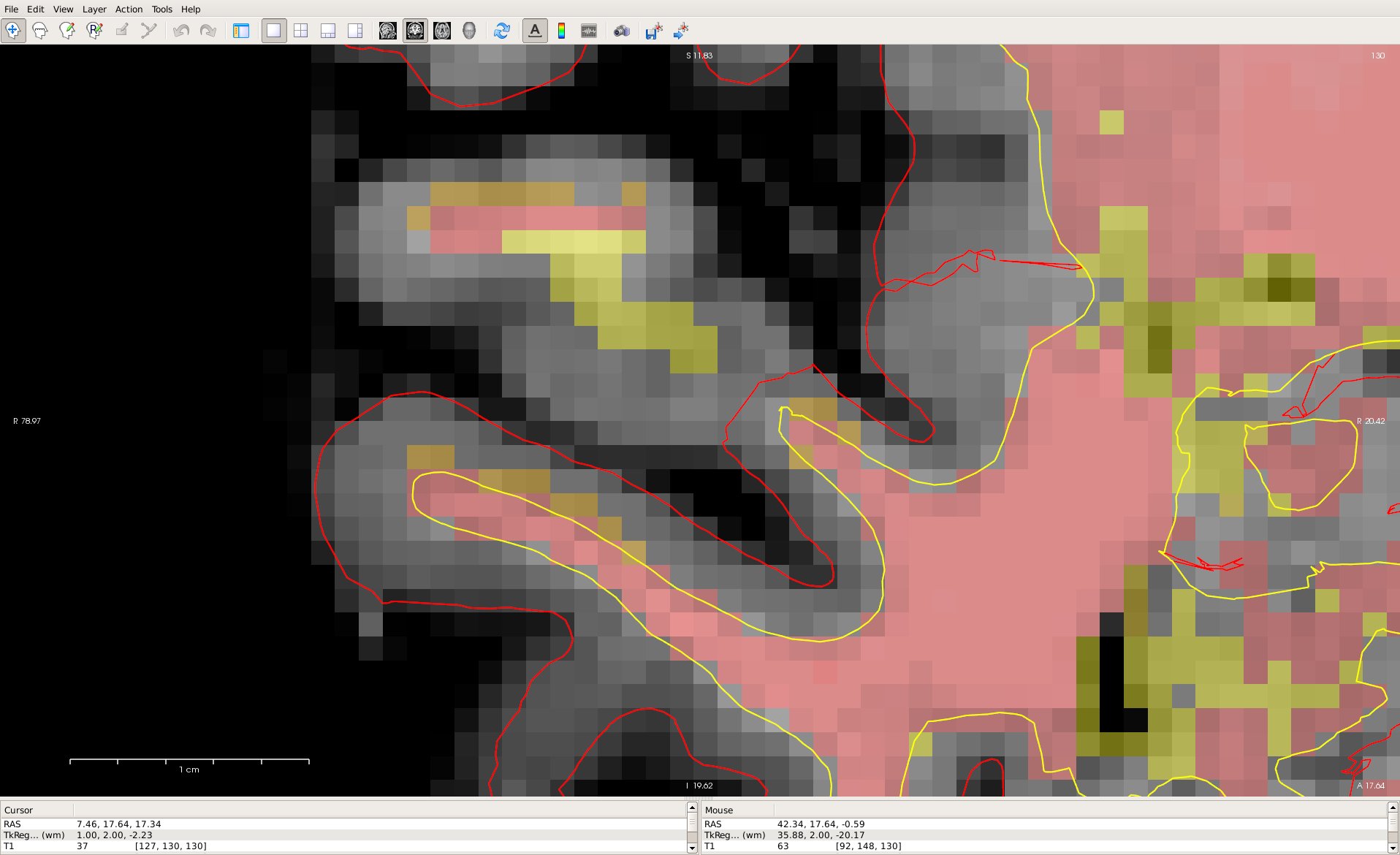
Hi James, With the wm edits in the temporal lobes, make sure that the wm painted in on the wm.mgz in the various gyri is connected to the main body of wm throughout each lobe. Even if there is a disconnection on only a couple slices, it tends to have an effect on nearby slices as well where the wm is completely connected. See snapshot attached for an example of a disconnection in the STG wm that should be filled in. -Louis
On Thu, 17 Jul 2014, james pardon wrote:
Hi Louis, I would appreciate if I could get your feedback on this specific subject we are experiencing problems with.
Thanks James
On Tue, Jul 15, 2014 at 8:20 PM, Bruce Fischl fischl@nmr.mgh.harvard.edu wrote: Hi James
  I did, and one of our RAs here is going to be looking into it. Louis (ccd)
  can give you more information

  cheers
  Bruce
  On Tue, 15 Jul 2014, james pardon wrote:

        Hi Bruce,
        I was wondering whether you have seen my email below?

        Thanks so much

        Cheers,
        James


        On Sat, Jul 12, 2014 at 9:18 AM, james pardon
        <james.pardon15@gmail.com>
        wrote:
              Hi Bruce,
        I have sent the link for a problem subject via a private
        message. Please note since MS causes hypointense lesions in
        white
        matter I have used an algorithm that fills hypointense lesions
        in WM
        with median intensity of normal appearing WM.

        Thanks
        James


        On Fri, Jul 11, 2014 at 11:19 PM, Bruce Fischl
        <fischl@nmr.mgh.harvard.edu> wrote:
              Hi James

              if you upload a problem subject we will take a look (the
              whole subject dir please)
              cheers
              Bruce
              On Fri, 11 Jul 2014, james pardon wrote:

                    Hi all,
                    On a few subjects with a specific pathology
                    (MS) I cannot easily reconstruct temporal
                    lobes.
                    I think this issue comes up quite regularly on
                    the mailing list, and I have tried to trouble
                    shoot using control points, WM edits, even
                    getting back to orig/001.mgz to correct areas
                    that
                    may seem the culprit for breaking surface
                    reconstruction. Some subjects have gone
                    through 7-8
                    runs of recon-all with different edits but
                    still the problem persists in a few subjects
                    in my
                    study.

                    I have also tried to use -mprage and -3T flags
                    along the way to allow more liberal control
                    point growing, despite an improvement in my
                    results some of subjects still have very bad
                    surface constructions. I have attached two
                    snapshots to this email and I am happy to
                    upload
                    the complete subject folder if you need to
                    take a look at them.

                    As far as the SNR is concerned, I have
                    designed my study based on recommended
                    Freesurfer
                    parameters a couple of years ago on 3T Siemens
                    Trio with 32-channel receiver coil.

                    A huge thank you for your previous helps, and
                    thanks in advance for helping me with this new
                    issue.

                    James


        _______________________________________________
        Freesurfer mailing list
        Freesurfer@nmr.mgh.harvard.edu
        https://mail.nmr.mgh.harvard.edu/mailman/listinfo/freesurfer


        The information in this e-mail is intended only for the person
        to whom it is
        addressed. If you believe this e-mail was sent to you in error
        and the e-mail
        contains patient information, please contact the Partners
        Compliance HelpLine at
        http://www.partners.org/complianceline . If the e-mail was
        sent
        to you in error
        but does not contain patient information, please contact the
        sender and properly
        dispose of the e-mail.
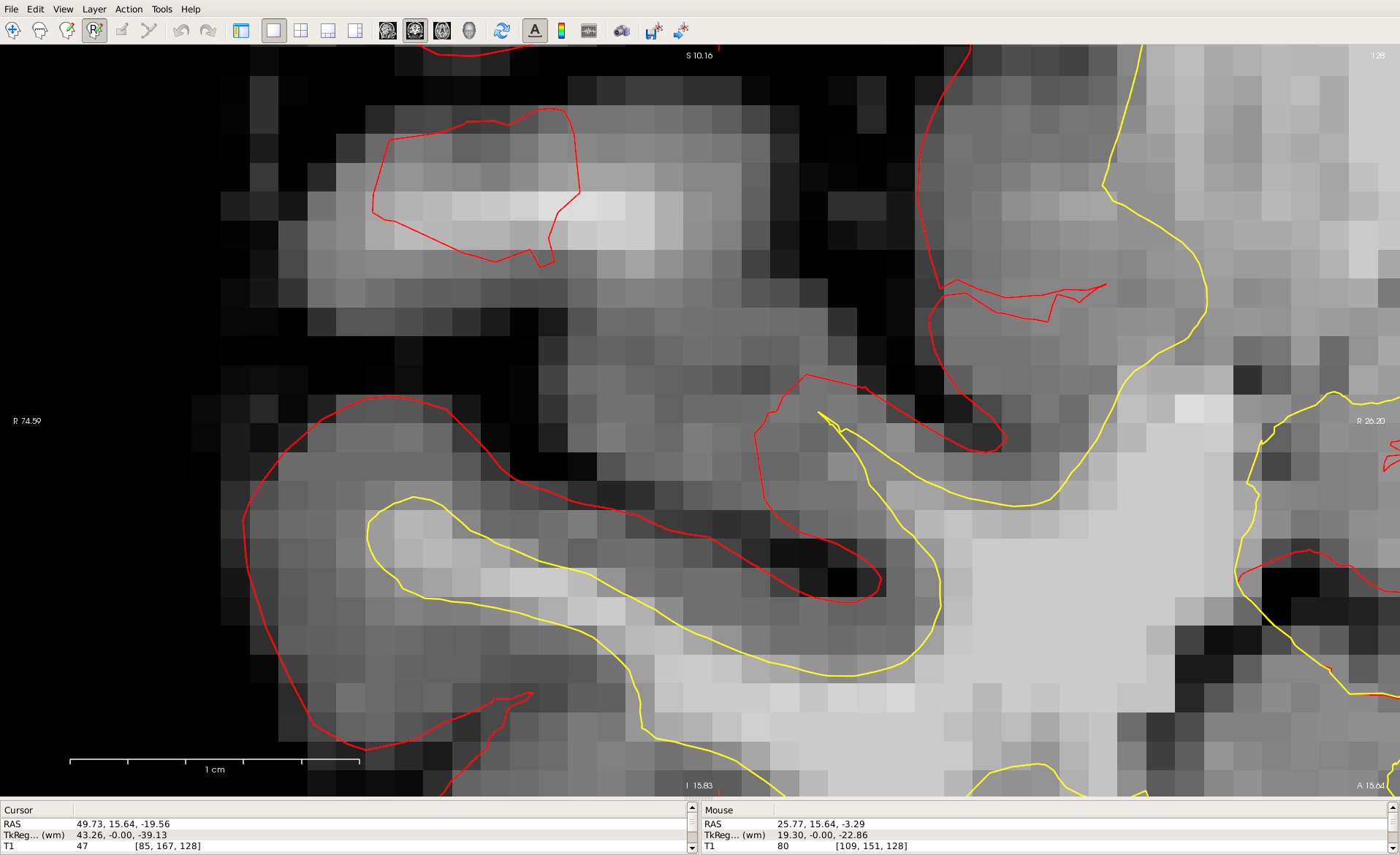
I should add though that in some sections where there is a disconnection in the wm on the wm.gz that I would want to fill in, it's tough to tell where exactly the wm is since the intensities of the voxels on the brainmask.mgz in that gap look like uniform gm. Normally you can see at least a small relative difference in intensities, gm vs. wm.
Maybe it is pathology-related? -Louis
On Thu, 17 Jul 2014, Louis Nicholas Vinke wrote:
Hi James, With the wm edits in the temporal lobes, make sure that the wm painted in on the wm.mgz in the various gyri is connected to the main body of wm throughout each lobe. Even if there is a disconnection on only a couple slices, it tends to have an effect on nearby slices as well where the wm is completely connected. See snapshot attached for an example of a disconnection in the STG wm that should be filled in. -Louis
On Thu, 17 Jul 2014, james pardon wrote:
Hi Louis, I would appreciate if I could get your feedback on this specific subject we are experiencing problems with.
Thanks James
On Tue, Jul 15, 2014 at 8:20 PM, Bruce Fischl fischl@nmr.mgh.harvard.edu wrote: Hi James
I did, and one of our RAs here is going to be looking into it. Louis(ccd) can give you more information
  cheers
  Bruce
  On Tue, 15 Jul 2014, james pardon wrote:

        Hi Bruce,
        I was wondering whether you have seen my email below?

        Thanks so much

        Cheers,
        James


        On Sat, Jul 12, 2014 at 9:18 AM, james pardon
        <james.pardon15@gmail.com>
        wrote:
              Hi Bruce,
        I have sent the link for a problem subject via a private
        message. Please note since MS causes hypointense lesions in
        white
        matter I have used an algorithm that fills hypointense lesions
        in WM
        with median intensity of normal appearing WM.

        Thanks
        James


        On Fri, Jul 11, 2014 at 11:19 PM, Bruce Fischl
        <fischl@nmr.mgh.harvard.edu> wrote:
              Hi James

              if you upload a problem subject we will take a look (the
              whole subject dir please)
              cheers
              Bruce
              On Fri, 11 Jul 2014, james pardon wrote:

                    Hi all,
                    On a few subjects with a specific pathology
                    (MS) I cannot easily reconstruct temporal
                    lobes.
                    I think this issue comes up quite regularly on
                    the mailing list, and I have tried to trouble
                    shoot using control points, WM edits, even
                    getting back to orig/001.mgz to correct areas
                    that
                    may seem the culprit for breaking surface
                    reconstruction. Some subjects have gone
                    through 7-8
                    runs of recon-all with different edits but
                    still the problem persists in a few subjects
                    in my
                    study.

                    I have also tried to use -mprage and -3T flags
                    along the way to allow more liberal control
                    point growing, despite an improvement in my
                    results some of subjects still have very bad
                    surface constructions. I have attached two
                    snapshots to this email and I am happy to
                    upload
                    the complete subject folder if you need to
                    take a look at them.

                    As far as the SNR is concerned, I have
                    designed my study based on recommended
                    Freesurfer
                    parameters a couple of years ago on 3T Siemens
                    Trio with 32-channel receiver coil.

                    A huge thank you for your previous helps, and
                    thanks in advance for helping me with this new
                    issue.

                    James


        _______________________________________________
        Freesurfer mailing list
        Freesurfer@nmr.mgh.harvard.edu
        https://mail.nmr.mgh.harvard.edu/mailman/listinfo/freesurfer


        The information in this e-mail is intended only for the person
        to whom it is
        addressed. If you believe this e-mail was sent to you in error
        and the e-mail
        contains patient information, please contact the Partners
        Compliance HelpLine at
        http://www.partners.org/complianceline . If the e-mail was
        sent
        to you in error
        but does not contain patient information, please contact the
        sender and properly
        dispose of the e-mail.
freesurfer@nmr.mgh.harvard.edu
-
 james pardon
 -
 Louis Nicholas Vinke