
Hello,
If a QDEC analysis returns a certain cluster as being significantly different between the groups (after MC correction) in terms of some measure, which part of this cluster's description should my interpretation of this result be based on: its spatial extent (how it looks when projected onto the template brain, and what your knowledge of brain anatomy makes of that) or the coordinates of its maxima (as reported in the terminal window)?
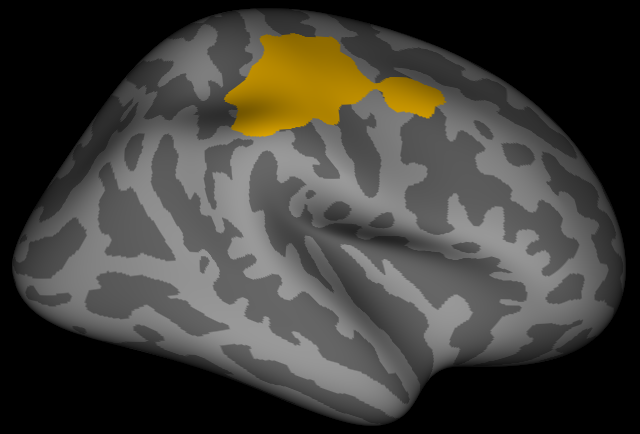
For instance, my result cluster is labeled as the postcentral gyrus, I guess because that is the parcel that overlaps most with the cluster (or perhaps because that is where the maximum point of the cluster falls?!), but looking at the cluster, it clearly extends into the parietal lobe:
So how does one go about describing this cluster and interpreting the meaning of the effect in a Discussion section? Should I focus on the postcentral gyrus label and link it to other PCG effects in the literature? Or should I instead try to find in the literature maxima coordinates that are similar to what I get here?
Any help much appreciated! --Francesco
apologies, picture was not attached previously
On 5 August 2014 23:39, Francesco Puccettone <francesco.puccettone@gmail.com
wrote:
Hello,
If a QDEC analysis returns a certain cluster as being significantly different between the groups (after MC correction) in terms of some measure, which part of this cluster's description should my interpretation of this result be based on: its spatial extent (how it looks when projected onto the template brain, and what your knowledge of brain anatomy makes of that) or the coordinates of its maxima (as reported in the terminal window)?
For instance, my result cluster is labeled as the postcentral gyrus, I guess because that is the parcel that overlaps most with the cluster (or perhaps because that is where the maximum point of the cluster falls?!), but looking at the cluster, it clearly extends into the parietal lobe:
So how does one go about describing this cluster and interpreting the meaning of the effect in a Discussion section? Should I focus on the postcentral gyrus label and link it to other PCG effects in the literature? Or should I instead try to find in the literature maxima coordinates that are similar to what I get here?
Any help much appreciated! --Francesco

?Hello all,
I was just wondering if in publications/papers it is more common to report the average FA statistics, the weighted average statistics, or the center statistics (the average of the highest probability pathway).
These are the statistics provided by Tracula.
Thanks,
Emily

Weighted average recommended, see my previous email.
On Tue, 5 Aug 2014, Emily Louise Belleau wrote:
Hello all,
I was just wondering if in publications/papers it is more common to report the average FA statistics, the weighted average statistics, or the center statistics (the average of the highest probability pathway).
These are the statistics provided by Tracula.
Thanks,
Emily

I would definitely show a picture of it, say which areas it overlaps, and spec the coordinates for the max (which is what QDEC reports). doug
On 08/05/2014 06:39 PM, Francesco Puccettone wrote:
Hello,
If a QDEC analysis returns a certain cluster as being significantly different between the groups (after MC correction) in terms of some measure, which part of this cluster's description should my interpretation of this result be based on: its spatial extent (how it looks when projected onto the template brain, and what your knowledge of brain anatomy makes of that) or the coordinates of its maxima (as reported in the terminal window)?
For instance, my result cluster is labeled as the postcentral gyrus, I guess because that is the parcel that overlaps most with the cluster (or perhaps because that is where the maximum point of the cluster falls?!), but looking at the cluster, it clearly extends into the parietal lobe:
So how does one go about describing this cluster and interpreting the meaning of the effect in a Discussion section? Should I focus on the postcentral gyrus label and link it to other PCG effects in the literature? Or should I instead try to find in the literature maxima coordinates that are similar to what I get here?
Any help much appreciated! --Francesco
Freesurfer mailing list Freesurfer@nmr.mgh.harvard.edu https://mail.nmr.mgh.harvard.edu/mailman/listinfo/freesurfer
Hello Doug, thank you very much for your answer. But how I can find which other areas the cluster overlaps, since QDEC only gives the name of the parcel that contains the max point? Is there any other (semi)automated way of obtaining the names of the other structures that the cluster contains (either in whole or parts of)? Or is it just down to one's own knowledge of brain anatomy? --Francesco
On 6 August 2014 23:12, Douglas N Greve greve@nmr.mgh.harvard.edu wrote:
I would definitely show a picture of it, say which areas it overlaps, and spec the coordinates for the max (which is what QDEC reports). doug
On 08/05/2014 06:39 PM, Francesco Puccettone wrote:
Hello,
If a QDEC analysis returns a certain cluster as being significantly different between the groups (after MC correction) in terms of some measure, which part of this cluster's description should my interpretation of this result be based on: its spatial extent (how it looks when projected onto the template brain, and what your knowledge of brain anatomy makes of that) or the coordinates of its maxima (as reported in the terminal window)?
For instance, my result cluster is labeled as the postcentral gyrus, I guess because that is the parcel that overlaps most with the cluster (or perhaps because that is where the maximum point of the cluster falls?!), but looking at the cluster, it clearly extends into the parietal lobe:
So how does one go about describing this cluster and interpreting the meaning of the effect in a Discussion section? Should I focus on the postcentral gyrus label and link it to other PCG effects in the literature? Or should I instead try to find in the literature maxima coordinates that are similar to what I get here?
Any help much appreciated! --Francesco
Freesurfer mailing list Freesurfer@nmr.mgh.harvard.edu https://mail.nmr.mgh.harvard.edu/mailman/listinfo/freesurfer
-- Douglas N. Greve, Ph.D. MGH-NMR Center greve@nmr.mgh.harvard.edu Phone Number: 617-724-2358 Fax: 617-726-7422
Bugs: surfer.nmr.mgh.harvard.edu/fswiki/BugReporting FileDrop: https://gate.nmr.mgh.harvard.edu/filedrop2 www.nmr.mgh.harvard.edu/facility/filedrop/index.html Outgoing: ftp://surfer.nmr.mgh.harvard.edu/transfer/outgoing/flat/greve/
Freesurfer mailing list Freesurfer@nmr.mgh.harvard.edu https://mail.nmr.mgh.harvard.edu/mailman/listinfo/freesurfer
The information in this e-mail is intended only for the person to whom it is addressed. If you believe this e-mail was sent to you in error and the e-mail contains patient information, please contact the Partners Compliance HelpLine at http://www.partners.org/complianceline . If the e-mail was sent to you in error but does not contain patient information, please contact the sender and properly dispose of the e-mail.
freesurfer@nmr.mgh.harvard.edu
-
 Anastasia Yendiki
 -
 Douglas N Greve
 -
 Emily Louise Belleau
 -
 Francesco Puccettone