
Hello FreeSurfer experts,
I came across a paper: http://www.sciencedirect.com/science/article/pii/S0166432815001837 where correlation maps between volume and gyrification are reported.
I am familiar with GLM in FreeSurfer i.e. correlating behavioral measures with volume and gyrification but I was wondering how to correlate structure measures with each other e.g. volume and gyrification.
I would really appreciate any help.
Thanks.

You have to use the --pvr option to mri_glmfit. Run it with --help to get more info and write back if you still have questions
On 04/26/2017 08:33 PM, Martin Juneja wrote:
Hello FreeSurfer experts,
I came across a paper: http://www.sciencedirect.com/science/article/pii/S0166432815001837 where correlation maps between volume and gyrification are reported.
I am familiar with GLM in FreeSurfer i.e. correlating behavioral measures with volume and gyrification but I was wondering how to correlate structure measures with each other e.g. volume and gyrification.
I would really appreciate any help.
Thanks.
Freesurfer mailing list Freesurfer@nmr.mgh.harvard.edu https://mail.nmr.mgh.harvard.edu/mailman/listinfo/freesurfer
Hi Dr. Greve,
I did not find --help option very helpful here and also I could not find much help from the previous FreeSurfer posts. Could you please share more details here e.g. how to set up fsgd and contrast file and how to run mri_glmfit command here (e.g. what inputs should be provided here?).
I am basically interested in correlating volume and gyrification regressing out the effect of age and gender. I already have lh.pial_lgi and lh.volume files saved in 'surf' directory of each subject.
Thanks.
On Thu, Apr 27, 2017 at 8:42 AM, Douglas N Greve greve@nmr.mgh.harvard.edu wrote:
You have to use the --pvr option to mri_glmfit. Run it with --help to get more info and write back if you still have questions
On 04/26/2017 08:33 PM, Martin Juneja wrote:
Hello FreeSurfer experts,
I came across a paper: http://www.sciencedirect.com/science/article/pii/S0166432815001837 where correlation maps between volume and gyrification are reported.
I am familiar with GLM in FreeSurfer i.e. correlating behavioral measures with volume and gyrification but I was wondering how to correlate structure measures with each other e.g. volume and
gyrification.
I would really appreciate any help.
Thanks.
Freesurfer mailing list Freesurfer@nmr.mgh.harvard.edu https://mail.nmr.mgh.harvard.edu/mailman/listinfo/freesurfer
-- Douglas N. Greve, Ph.D. MGH-NMR Center greve@nmr.mgh.harvard.edu Phone Number: 617-724-2358 Fax: 617-726-7422
Bugs: surfer.nmr.mgh.harvard.edu/fswiki/BugReporting FileDrop: https://gate.nmr.mgh.harvard.edu/filedrop2 www.nmr.mgh.harvard.edu/facility/filedrop/index.html Outgoing: ftp://surfer.nmr.mgh.harvard.edu/transfer/outgoing/flat/greve/
Freesurfer mailing list Freesurfer@nmr.mgh.harvard.edu https://mail.nmr.mgh.harvard.edu/mailman/listinfo/freesurfer
The information in this e-mail is intended only for the person to whom it is addressed. If you believe this e-mail was sent to you in error and the e-mail contains patient information, please contact the Partners Compliance HelpLine at http://www.partners.org/complianceline . If the e-mail was sent to you in error but does not contain patient information, please contact the sender and properly dispose of the e-mail.
To use the PVR, you need to create a stack of the measures that you want to use (eg, lGI). This will be the same size as the stack you want to correlate with. Eg, if you use mris_preproc to create a thickness stack, you would use the same command to create the lGI stack. Create your FSGD file as normal, but when you create your contrast file, make sure to add a column to handle the per-vertex regressor. Eg, if you have two groups, then you would create a contrast [0 0 1] to test for the effect of the PVR. When you run mri_glmfit, just add --pvr lgi.mgz
On 04/27/2017 06:13 PM, Martin Juneja wrote:
Hi Dr. Greve,
I did not find --help option very helpful here and also I could not find much help from the previous FreeSurfer posts. Could you please share more details here e.g. how to set up fsgd and contrast file and how to run mri_glmfit command here (e.g. what inputs should be provided here?).
I am basically interested in correlating volume and gyrification regressing out the effect of age and gender. I already have lh.pial_lgi and lh.volume files saved in 'surf' directory of each subject.
Thanks.
On Thu, Apr 27, 2017 at 8:42 AM, Douglas N Greve <greve@nmr.mgh.harvard.edu mailto:greve@nmr.mgh.harvard.edu> wrote:
You have to use the --pvr option to mri_glmfit. Run it with --help to
get more info and write back if you still have questions


On 04/26/2017 08:33 PM, Martin Juneja wrote:
> Hello FreeSurfer experts,
>
> I came across a paper:
>
http://www.sciencedirect.com/science/article/pii/S0166432815001837
<http://www.sciencedirect.com/science/article/pii/S0166432815001837>
> where correlation maps between volume and gyrification are reported.
>
> I am familiar with GLM in FreeSurfer i.e. correlating behavioral
> measures with volume and gyrification but I was wondering how to
> correlate structure measures with each other e.g. volume and
gyrification.
>
> I would really appreciate any help.
>
> Thanks.
>
>
> _______________________________________________
> Freesurfer mailing list
> Freesurfer@nmr.mgh.harvard.edu
<mailto:Freesurfer@nmr.mgh.harvard.edu>
> https://mail.nmr.mgh.harvard.edu/mailman/listinfo/freesurfer
<https://mail.nmr.mgh.harvard.edu/mailman/listinfo/freesurfer>

--
Douglas N. Greve, Ph.D.
MGH-NMR Center
greve@nmr.mgh.harvard.edu <mailto:greve@nmr.mgh.harvard.edu>
Phone Number: 617-724-2358 <tel:617-724-2358>
Fax: 617-726-7422 <tel:617-726-7422>

Bugs: surfer.nmr.mgh.harvard.edu/fswiki/BugReporting
<http://surfer.nmr.mgh.harvard.edu/fswiki/BugReporting>
FileDrop: https://gate.nmr.mgh.harvard.edu/filedrop2
<https://gate.nmr.mgh.harvard.edu/filedrop2>
www.nmr.mgh.harvard.edu/facility/filedrop/index.html
<http://www.nmr.mgh.harvard.edu/facility/filedrop/index.html>
Outgoing:
ftp://surfer.nmr.mgh.harvard.edu/transfer/outgoing/flat/greve/
<ftp://surfer.nmr.mgh.harvard.edu/transfer/outgoing/flat/greve/>

_______________________________________________
Freesurfer mailing list
Freesurfer@nmr.mgh.harvard.edu <mailto:Freesurfer@nmr.mgh.harvard.edu>
https://mail.nmr.mgh.harvard.edu/mailman/listinfo/freesurfer
<https://mail.nmr.mgh.harvard.edu/mailman/listinfo/freesurfer>


The information in this e-mail is intended only for the person to
whom it is
addressed. If you believe this e-mail was sent to you in error and
the e-mail
contains patient information, please contact the Partners
Compliance HelpLine at
http://www.partners.org/complianceline
<http://www.partners.org/complianceline> . If the e-mail was sent
to you in error
but does not contain patient information, please contact the
sender and properly
dispose of the e-mail.
Freesurfer mailing list Freesurfer@nmr.mgh.harvard.edu https://mail.nmr.mgh.harvard.edu/mailman/listinfo/freesurfer
Dear Dr. Greve,
I created two stacks: one with volume and the other with LGI using mris commands as following:
mris_preproc --fsgd CV_LGI.fsgd --target fsaverage --hemi lh --meas volume --out Corr_CV_LGI/lh.vol.mgh mris_preproc --fsgd CV_LGI.fsgd --target fsaverage --hemi lh --meas pial_lgi --out Corr_CV_LGI/lh.LGI.mgh
Then I smoothed the data using:
mri_surf2surf --hemi lh --s fsaverage --sval Corr_CV_LGI/lh.vol.mgh --fwhm 10 --cortex --tval Corr_CV_LGI/lh.vol.10.mgh mri_surf2surf --hemi lh --s fsaverage --sval Corr_CV_LGI/lh.LGI.mgh --fwhm 10 --cortex --tval Corr_CV_LGI/lh.LGI.10.mgh
Finally I ran glmfit command as following:
mri_glmfit --y Corr_CV_LGI/lh.vol.10.mgh --fsgd CV_LGI.fsgd dods --C Corr-VL-cor.mtx --surf fsaverage lh --cortex --glmdir Corr_CV_LGI/lh.VL.glmdir --pvr Corr_CV_LGI/lh.LGI.10.mgh
My fsgd file looks like this: GroupDescriptorFile 1 Class Male Class Female Variables Age Input X001 Male 36 Input X003 Male 29 Input X004 Male 39 etc.
and my contrast file (Corr-VL-cor.mtx) is: 0 0.5 0.5 0 1 (I am interested in regressing out the effect of age and gender).
These steps do not give me any error but somehow (i) I do not get pcc.mgh (partial correlation between volume and LGI measures) file and (ii) sig.mgh file also does not seem correct.
Could you please help me in figuring out the error or where I am doing wrong?
Thanks.
On Fri, Apr 28, 2017 at 3:19 PM, Douglas N Greve greve@nmr.mgh.harvard.edu wrote:
To use the PVR, you need to create a stack of the measures that you want to use (eg, lGI). This will be the same size as the stack you want to correlate with. Eg, if you use mris_preproc to create a thickness stack, you would use the same command to create the lGI stack. Create your FSGD file as normal, but when you create your contrast file, make sure to add a column to handle the per-vertex regressor. Eg, if you have two groups, then you would create a contrast [0 0 1] to test for the effect of the PVR. When you run mri_glmfit, just add --pvr lgi.mgz
On 04/27/2017 06:13 PM, Martin Juneja wrote:
Hi Dr. Greve,
I did not find --help option very helpful here and also I could not find much help from the previous FreeSurfer posts. Could you please share more details here e.g. how to set up fsgd and contrast file and how to run mri_glmfit command here (e.g. what inputs should be provided here?).
I am basically interested in correlating volume and gyrification regressing out the effect of age and gender. I already have lh.pial_lgi and lh.volume files saved in 'surf' directory of each
subject.
Thanks.
On Thu, Apr 27, 2017 at 8:42 AM, Douglas N Greve <greve@nmr.mgh.harvard.edu mailto:greve@nmr.mgh.harvard.edu> wrote:
You have to use the --pvr option to mri_glmfit. Run it with --help to
get more info and write back if you still have questions


On 04/26/2017 08:33 PM, Martin Juneja wrote:
> Hello FreeSurfer experts,
>
> I came across a paper:
>
http://www.sciencedirect.com/science/article/pii/S0166432815001837
<http://www.sciencedirect.com/science/article/pii/S0166432815001837>
> where correlation maps between volume and gyrification are
reported.
>
> I am familiar with GLM in FreeSurfer i.e. correlating behavioral
> measures with volume and gyrification but I was wondering how to
> correlate structure measures with each other e.g. volume and
gyrification.
>
> I would really appreciate any help.
>
> Thanks.
>
>
> _______________________________________________
> Freesurfer mailing list
> Freesurfer@nmr.mgh.harvard.edu
<mailto:Freesurfer@nmr.mgh.harvard.edu>
> https://mail.nmr.mgh.harvard.edu/mailman/listinfo/freesurfer
<https://mail.nmr.mgh.harvard.edu/mailman/listinfo/freesurfer>

--
Douglas N. Greve, Ph.D.
MGH-NMR Center
greve@nmr.mgh.harvard.edu <mailto:greve@nmr.mgh.harvard.edu>
Phone Number: 617-724-2358 <tel:617-724-2358>
Fax: 617-726-7422 <tel:617-726-7422>

Bugs: surfer.nmr.mgh.harvard.edu/fswiki/BugReporting
<http://surfer.nmr.mgh.harvard.edu/fswiki/BugReporting>
FileDrop: https://gate.nmr.mgh.harvard.edu/filedrop2
<https://gate.nmr.mgh.harvard.edu/filedrop2>
www.nmr.mgh.harvard.edu/facility/filedrop/index.html
<http://www.nmr.mgh.harvard.edu/facility/filedrop/index.html>
Outgoing:
ftp://surfer.nmr.mgh.harvard.edu/transfer/outgoing/flat/greve/
<ftp://surfer.nmr.mgh.harvard.edu/transfer/outgoing/flat/greve/>

_______________________________________________
Freesurfer mailing list
Freesurfer@nmr.mgh.harvard.edu <mailto:Freesurfer@nmr.mgh.
harvard.edu>
https://mail.nmr.mgh.harvard.edu/mailman/listinfo/freesurfer
<https://mail.nmr.mgh.harvard.edu/mailman/listinfo/freesurfer>


The information in this e-mail is intended only for the person to
whom it is
addressed. If you believe this e-mail was sent to you in error and
the e-mail
contains patient information, please contact the Partners
Compliance HelpLine at
http://www.partners.org/complianceline
<http://www.partners.org/complianceline> . If the e-mail was sent
to you in error
but does not contain patient information, please contact the
sender and properly
dispose of the e-mail.
Freesurfer mailing list Freesurfer@nmr.mgh.harvard.edu https://mail.nmr.mgh.harvard.edu/mailman/listinfo/freesurfer
-- Douglas N. Greve, Ph.D. MGH-NMR Center greve@nmr.mgh.harvard.edu Phone Number: 617-724-2358 Fax: 617-726-7422
Bugs: surfer.nmr.mgh.harvard.edu/fswiki/BugReporting FileDrop: https://gate.nmr.mgh.harvard.edu/filedrop2 www.nmr.mgh.harvard.edu/facility/filedrop/index.html Outgoing: ftp://surfer.nmr.mgh.harvard.edu/transfer/outgoing/flat/greve/
Freesurfer mailing list Freesurfer@nmr.mgh.harvard.edu https://mail.nmr.mgh.harvard.edu/mailman/listinfo/freesurfer
Hi Dr. Greve,
I am sorry for reposting this. Could you please confirm the following steps and correct me where I am wrong.
Thanks.
---------- Forwarded message ---------- From: Martin Juneja mj70481@gmail.com Date: Tue, May 9, 2017 at 12:15 PM Subject: Re: [Freesurfer] Maps showing correlations between structural measures To: Freesurfer support list freesurfer@nmr.mgh.harvard.edu
Dear Dr. Greve,
I created two stacks: one with volume and the other with LGI using mris commands as following:
mris_preproc --fsgd CV_LGI.fsgd --target fsaverage --hemi lh --meas volume --out Corr_CV_LGI/lh.vol.mgh mris_preproc --fsgd CV_LGI.fsgd --target fsaverage --hemi lh --meas pial_lgi --out Corr_CV_LGI/lh.LGI.mgh
Then I smoothed the data using:
mri_surf2surf --hemi lh --s fsaverage --sval Corr_CV_LGI/lh.vol.mgh --fwhm 10 --cortex --tval Corr_CV_LGI/lh.vol.10.mgh mri_surf2surf --hemi lh --s fsaverage --sval Corr_CV_LGI/lh.LGI.mgh --fwhm 10 --cortex --tval Corr_CV_LGI/lh.LGI.10.mgh
Finally I ran glmfit command as following:
mri_glmfit --y Corr_CV_LGI/lh.vol.10.mgh --fsgd CV_LGI.fsgd dods --C Corr-VL-cor.mtx --surf fsaverage lh --cortex --glmdir Corr_CV_LGI/lh.VL.glmdir --pvr Corr_CV_LGI/lh.LGI.10.mgh
My fsgd file looks like this: GroupDescriptorFile 1 Class Male Class Female Variables Age Input X001 Male 36 Input X003 Male 29 Input X004 Male 39 etc.
and my contrast file (Corr-VL-cor.mtx) is: 0 0.5 0.5 0 1 (I am interested in regressing out the effect of age and gender).
These steps do not give me any error but somehow (i) I do not get pcc.mgh (partial correlation between volume and LGI measures) file and (ii) sig.mgh file also does not seem correct.
Could you please help me in figuring out the error or where I am doing wrong?
Thanks.
On Fri, Apr 28, 2017 at 3:19 PM, Douglas N Greve greve@nmr.mgh.harvard.edu wrote:
To use the PVR, you need to create a stack of the measures that you want to use (eg, lGI). This will be the same size as the stack you want to correlate with. Eg, if you use mris_preproc to create a thickness stack, you would use the same command to create the lGI stack. Create your FSGD file as normal, but when you create your contrast file, make sure to add a column to handle the per-vertex regressor. Eg, if you have two groups, then you would create a contrast [0 0 1] to test for the effect of the PVR. When you run mri_glmfit, just add --pvr lgi.mgz
On 04/27/2017 06:13 PM, Martin Juneja wrote:
Hi Dr. Greve,
I did not find --help option very helpful here and also I could not find much help from the previous FreeSurfer posts. Could you please share more details here e.g. how to set up fsgd and contrast file and how to run mri_glmfit command here (e.g. what inputs should be provided here?).
I am basically interested in correlating volume and gyrification regressing out the effect of age and gender. I already have lh.pial_lgi and lh.volume files saved in 'surf' directory of each
subject.
Thanks.
On Thu, Apr 27, 2017 at 8:42 AM, Douglas N Greve <greve@nmr.mgh.harvard.edu mailto:greve@nmr.mgh.harvard.edu> wrote:
You have to use the --pvr option to mri_glmfit. Run it with --help to
get more info and write back if you still have questions


On 04/26/2017 08:33 PM, Martin Juneja wrote:
> Hello FreeSurfer experts,
>
> I came across a paper:
>
http://www.sciencedirect.com/science/article/pii/S0166432815001837
<http://www.sciencedirect.com/science/article/pii/S0166432815001837>
> where correlation maps between volume and gyrification are
reported.
>
> I am familiar with GLM in FreeSurfer i.e. correlating behavioral
> measures with volume and gyrification but I was wondering how to
> correlate structure measures with each other e.g. volume and
gyrification.
>
> I would really appreciate any help.
>
> Thanks.
>
>
> _______________________________________________
> Freesurfer mailing list
> Freesurfer@nmr.mgh.harvard.edu
<mailto:Freesurfer@nmr.mgh.harvard.edu>
> https://mail.nmr.mgh.harvard.edu/mailman/listinfo/freesurfer
<https://mail.nmr.mgh.harvard.edu/mailman/listinfo/freesurfer>

--
Douglas N. Greve, Ph.D.
MGH-NMR Center
greve@nmr.mgh.harvard.edu <mailto:greve@nmr.mgh.harvard.edu>
Phone Number: 617-724-2358 <tel:617-724-2358>
Fax: 617-726-7422 <tel:617-726-7422>

Bugs: surfer.nmr.mgh.harvard.edu/fswiki/BugReporting
<http://surfer.nmr.mgh.harvard.edu/fswiki/BugReporting>
FileDrop: https://gate.nmr.mgh.harvard.edu/filedrop2
<https://gate.nmr.mgh.harvard.edu/filedrop2>
www.nmr.mgh.harvard.edu/facility/filedrop/index.html
<http://www.nmr.mgh.harvard.edu/facility/filedrop/index.html>
Outgoing:
ftp://surfer.nmr.mgh.harvard.edu/transfer/outgoing/flat/greve/
<ftp://surfer.nmr.mgh.harvard.edu/transfer/outgoing/flat/greve/>

_______________________________________________
Freesurfer mailing list
Freesurfer@nmr.mgh.harvard.edu <mailto:Freesurfer@nmr.mgh.har
vard.edu>
https://mail.nmr.mgh.harvard.edu/mailman/listinfo/freesurfer
<https://mail.nmr.mgh.harvard.edu/mailman/listinfo/freesurfer>


The information in this e-mail is intended only for the person to
whom it is
addressed. If you believe this e-mail was sent to you in error and
the e-mail
contains patient information, please contact the Partners
Compliance HelpLine at
http://www.partners.org/complianceline
<http://www.partners.org/complianceline> . If the e-mail was sent
to you in error
but does not contain patient information, please contact the
sender and properly
dispose of the e-mail.
Freesurfer mailing list Freesurfer@nmr.mgh.harvard.edu https://mail.nmr.mgh.harvard.edu/mailman/listinfo/freesurfer
-- Douglas N. Greve, Ph.D. MGH-NMR Center greve@nmr.mgh.harvard.edu Phone Number: 617-724-2358 Fax: 617-726-7422
Bugs: surfer.nmr.mgh.harvard.edu/fswiki/BugReporting FileDrop: https://gate.nmr.mgh.harvard.edu/filedrop2 www.nmr.mgh.harvard.edu/facility/filedrop/index.html Outgoing: ftp://surfer.nmr.mgh.harvard.edu/transfer/outgoing/flat/greve/
Freesurfer mailing list Freesurfer@nmr.mgh.harvard.edu https://mail.nmr.mgh.harvard.edu/mailman/listinfo/freesurfer
mri_glmfit will not generate a pcc file with --pvr. I think I just did not get around to adding support for this. What about the sig does not look right? You can often get funny looking maps because each voxel is a different design matrix.
On 05/09/2017 03:15 PM, Martin Juneja wrote:
Dear Dr. Greve,
I created two stacks: one with volume and the other with LGI using mris commands as following:
mris_preproc --fsgd CV_LGI.fsgd --target fsaverage --hemi lh --meas volume --out Corr_CV_LGI/lh.vol.mgh mris_preproc --fsgd CV_LGI.fsgd --target fsaverage --hemi lh --meas pial_lgi --out Corr_CV_LGI/lh.LGI.mgh
Then I smoothed the data using:
mri_surf2surf --hemi lh --s fsaverage --sval Corr_CV_LGI/lh.vol.mgh --fwhm 10 --cortex --tval Corr_CV_LGI/lh.vol.10.mgh mri_surf2surf --hemi lh --s fsaverage --sval Corr_CV_LGI/lh.LGI.mgh --fwhm 10 --cortex --tval Corr_CV_LGI/lh.LGI.10.mgh
Finally I ran glmfit command as following:
mri_glmfit --y Corr_CV_LGI/lh.vol.10.mgh --fsgd CV_LGI.fsgd dods --C Corr-VL-cor.mtx --surf fsaverage lh --cortex --glmdir Corr_CV_LGI/lh.VL.glmdir --pvr Corr_CV_LGI/lh.LGI.10.mgh
My fsgd file looks like this: GroupDescriptorFile 1 Class Male Class Female Variables Age Input X001Male36 InputX003Male29 InputX004Male39 etc.
and my contrast file (Corr-VL-cor.mtx) is: 0 0.5 0.5 0 1 (I am interested in regressing out the effect of age and gender).
These steps do not give me any error but somehow (i) I do not get pcc.mgh (partial correlation between volume and LGI measures) file and (ii) sig.mgh file also does not seem correct.
Could you please help me in figuring out the error or where I am doing wrong?
Thanks.
On Fri, Apr 28, 2017 at 3:19 PM, Douglas N Greve <greve@nmr.mgh.harvard.edu mailto:greve@nmr.mgh.harvard.edu> wrote:
To use the PVR, you need to create a stack of the measures that
you want
to use (eg, lGI). This will be the same size as the stack you want to
correlate with. Eg, if you use mris_preproc to create a thickness
stack,
you would use the same command to create the lGI stack. Create
your FSGD
file as normal, but when you create your contrast file, make sure
to add
a column to handle the per-vertex regressor. Eg, if you have two
groups,
then you would create a contrast [0 0 1] to test for the effect of the
PVR. When you run mri_glmfit, just add --pvr lgi.mgz


On 04/27/2017 06:13 PM, Martin Juneja wrote:
> Hi Dr. Greve,
>
> I did not find --help option very helpful here and also I could not
> find much help from the previous FreeSurfer posts. Could you please
> share more details here e.g. how to set up fsgd and contrast
file and
> how to run mri_glmfit command here (e.g. what inputs should be
> provided here?).
>
> I am basically interested in correlating volume and gyrification
> regressing out the effect of age and gender. I already have
> lh.pial_lgi and lh.volume files saved in 'surf' directory of
each subject.
>
> Thanks.
>
> On Thu, Apr 27, 2017 at 8:42 AM, Douglas N Greve
> <greve@nmr.mgh.harvard.edu <mailto:greve@nmr.mgh.harvard.edu>
<mailto:greve@nmr.mgh.harvard.edu
<mailto:greve@nmr.mgh.harvard.edu>>> wrote:
>
>     You have to use the --pvr option to mri_glmfit. Run it with
--help to
>     get more info and write back if you still have questions
>
>
>     On 04/26/2017 08:33 PM, Martin Juneja wrote:
>     > Hello FreeSurfer experts,
>     >
>     > I came across a paper:
>     >
>
http://www.sciencedirect.com/science/article/pii/S0166432815001837
<http://www.sciencedirect.com/science/article/pii/S0166432815001837>
>
 <http://www.sciencedirect.com/science/article/pii/S0166432815001837
<http://www.sciencedirect.com/science/article/pii/S0166432815001837>>
>     > where correlation maps between volume and gyrification are
reported.
>     >
>     > I am familiar with GLM in FreeSurfer i.e. correlating
behavioral
>     > measures with volume and gyrification but I was wondering
how to
>     > correlate structure measures with each other e.g. volume and
>     gyrification.
>     >
>     > I would really appreciate any help.
>     >
>     > Thanks.
>     >
>     >
>     > _______________________________________________
>     > Freesurfer mailing list
>     > Freesurfer@nmr.mgh.harvard.edu
<mailto:Freesurfer@nmr.mgh.harvard.edu>
>     <mailto:Freesurfer@nmr.mgh.harvard.edu
<mailto:Freesurfer@nmr.mgh.harvard.edu>>
>     >
https://mail.nmr.mgh.harvard.edu/mailman/listinfo/freesurfer
<https://mail.nmr.mgh.harvard.edu/mailman/listinfo/freesurfer>
>     <https://mail.nmr.mgh.harvard.edu/mailman/listinfo/freesurfer
<https://mail.nmr.mgh.harvard.edu/mailman/listinfo/freesurfer>>
>
>     --
>     Douglas N. Greve, Ph.D.
>     MGH-NMR Center
> greve@nmr.mgh.harvard.edu <mailto:greve@nmr.mgh.harvard.edu>
<mailto:greve@nmr.mgh.harvard.edu <mailto:greve@nmr.mgh.harvard.edu>>
>     Phone Number: 617-724-2358 <tel:617-724-2358>
<tel:617-724-2358 <tel:617-724-2358>>
>     Fax: 617-726-7422 <tel:617-726-7422> <tel:617-726-7422
<tel:617-726-7422>>
>
>     Bugs: surfer.nmr.mgh.harvard.edu/fswiki/BugReporting
<http://surfer.nmr.mgh.harvard.edu/fswiki/BugReporting>
>     <http://surfer.nmr.mgh.harvard.edu/fswiki/BugReporting
<http://surfer.nmr.mgh.harvard.edu/fswiki/BugReporting>>
>     FileDrop: https://gate.nmr.mgh.harvard.edu/filedrop2
<https://gate.nmr.mgh.harvard.edu/filedrop2>
>     <https://gate.nmr.mgh.harvard.edu/filedrop2
<https://gate.nmr.mgh.harvard.edu/filedrop2>>
> www.nmr.mgh.harvard.edu/facility/filedrop/index.html
<http://www.nmr.mgh.harvard.edu/facility/filedrop/index.html>
>     <http://www.nmr.mgh.harvard.edu/facility/filedrop/index.html
<http://www.nmr.mgh.harvard.edu/facility/filedrop/index.html>>
>     Outgoing:
> ftp://surfer.nmr.mgh.harvard.edu/transfer/outgoing/flat/greve/
<ftp://surfer.nmr.mgh.harvard.edu/transfer/outgoing/flat/greve/>
>     <ftp://surfer.nmr.mgh.harvard.edu/transfer/outgoing/flat/greve/
<ftp://surfer.nmr.mgh.harvard.edu/transfer/outgoing/flat/greve/>>
>
>     _______________________________________________
>     Freesurfer mailing list
> Freesurfer@nmr.mgh.harvard.edu
<mailto:Freesurfer@nmr.mgh.harvard.edu>
<mailto:Freesurfer@nmr.mgh.harvard.edu
<mailto:Freesurfer@nmr.mgh.harvard.edu>>
> https://mail.nmr.mgh.harvard.edu/mailman/listinfo/freesurfer
<https://mail.nmr.mgh.harvard.edu/mailman/listinfo/freesurfer>
>
 <https://mail.nmr.mgh.harvard.edu/mailman/listinfo/freesurfer
<https://mail.nmr.mgh.harvard.edu/mailman/listinfo/freesurfer>>
>
>
>     The information in this e-mail is intended only for the
person to
>     whom it is
>     addressed. If you believe this e-mail was sent to you in
error and
>     the e-mail
>     contains patient information, please contact the Partners
>     Compliance HelpLine at
> http://www.partners.org/complianceline
<http://www.partners.org/complianceline>
>     <http://www.partners.org/complianceline
<http://www.partners.org/complianceline>> . If the e-mail was sent
>     to you in error
>     but does not contain patient information, please contact the
>     sender and properly
>     dispose of the e-mail.
>
>
>
>
> _______________________________________________
> Freesurfer mailing list
> Freesurfer@nmr.mgh.harvard.edu
<mailto:Freesurfer@nmr.mgh.harvard.edu>
> https://mail.nmr.mgh.harvard.edu/mailman/listinfo/freesurfer
<https://mail.nmr.mgh.harvard.edu/mailman/listinfo/freesurfer>

--
Douglas N. Greve, Ph.D.
MGH-NMR Center
greve@nmr.mgh.harvard.edu <mailto:greve@nmr.mgh.harvard.edu>
Phone Number: 617-724-2358 <tel:617-724-2358>
Fax: 617-726-7422 <tel:617-726-7422>

Bugs: surfer.nmr.mgh.harvard.edu/fswiki/BugReporting
<http://surfer.nmr.mgh.harvard.edu/fswiki/BugReporting>
FileDrop: https://gate.nmr.mgh.harvard.edu/filedrop2
<https://gate.nmr.mgh.harvard.edu/filedrop2>
www.nmr.mgh.harvard.edu/facility/filedrop/index.html
<http://www.nmr.mgh.harvard.edu/facility/filedrop/index.html>
Outgoing:
ftp://surfer.nmr.mgh.harvard.edu/transfer/outgoing/flat/greve/
<ftp://surfer.nmr.mgh.harvard.edu/transfer/outgoing/flat/greve/>

_______________________________________________
Freesurfer mailing list
Freesurfer@nmr.mgh.harvard.edu <mailto:Freesurfer@nmr.mgh.harvard.edu>
https://mail.nmr.mgh.harvard.edu/mailman/listinfo/freesurfer
<https://mail.nmr.mgh.harvard.edu/mailman/listinfo/freesurfer>
Freesurfer mailing list Freesurfer@nmr.mgh.harvard.edu https://mail.nmr.mgh.harvard.edu/mailman/listinfo/freesurfer
Hi Dr. Greve,
I doubt these results because of following:
(1). When I compare sig.mgh files created using following two commands i.e. correlation between LGI and CV versus CV and LGI: mri_glmfit --y Corr_CV_LGI/lh.LGI.10.mgh --fsgd CV_LGI.fsgd dods --C Corr-VL-cor.mtx --surf fsaverage lh --cortex --glmdir Corr_CV_LGI/lh.VL.glmdir --pvr Corr_CV_LGI/lh.CV.10.mgh and mri_glmfit --y Corr_CV_LGI/lh.vol.10.mgh --fsgd CV_LGI.fsgd dods --C Corr-VL-cor.mtx --surf fsaverage lh --cortex --glmdir Corr_CV_LGI/lh.VL.glmdir --pvr Corr_CV_LGI/lh.LGI.10.mgh
(a). I do not get identical maps. Please find attached screen shot. (b). Here, colorbar showing a value of around 30, does that reflect -log10(p)? I am not sure if thats normal?
(2). Assuming magnitude from colorbar is normal then I performed FDR correction- I am assuming its same command as following as mentioned in FS manual: mri_glmfit-sim --glmdir Corr_CV_LGI/lh.VL.glmdir --cache 1.3 pos --cwp 0.01 --2spaces
After running FDR correction, cache.th13.pos.sig.cluster.mgh and cache.th13.neg.sig.cluster.mgh, none of these are showing me any significant clusters, instead its showing a constant magnitude (same color) over whole brain?
Thanks.
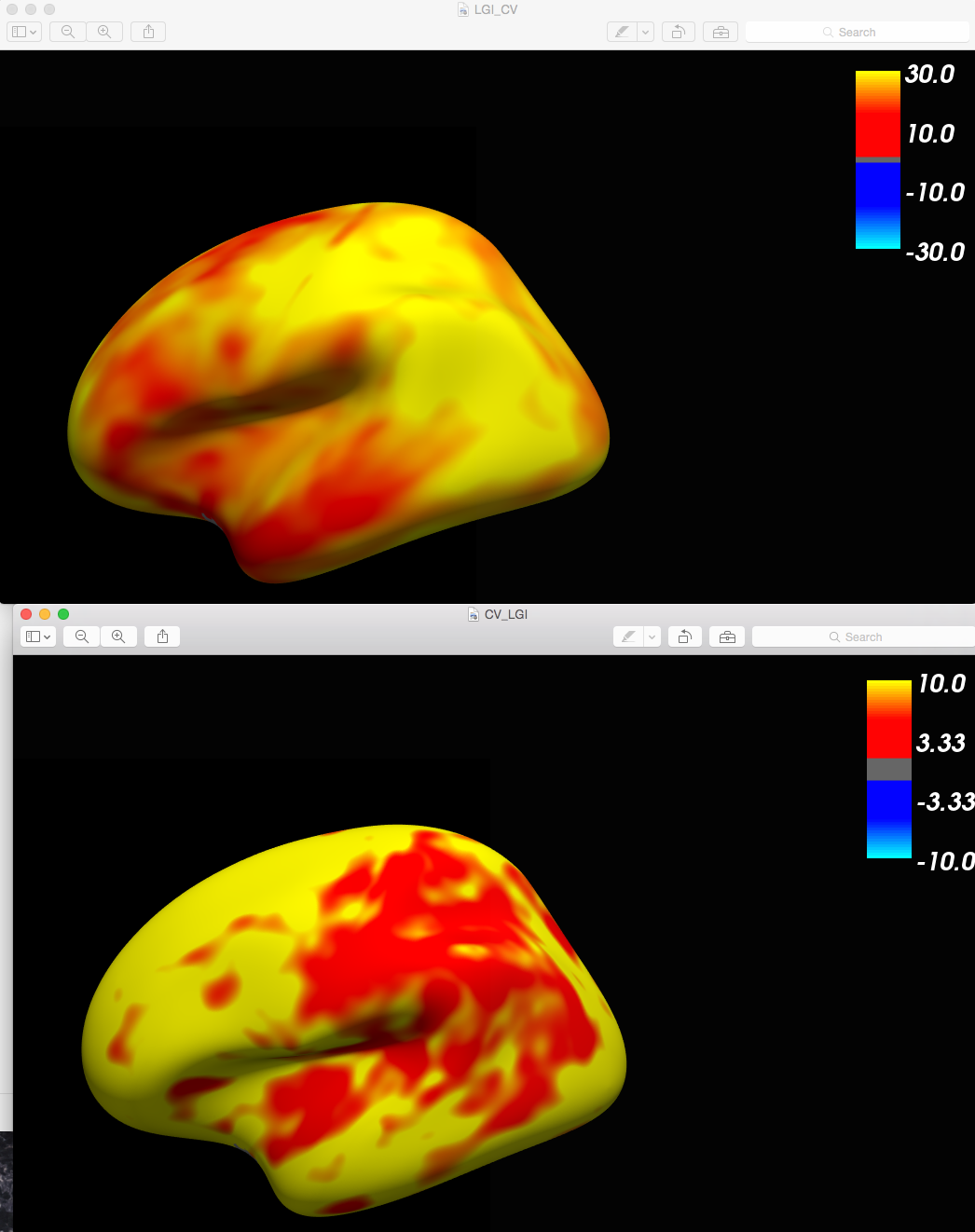
In addition to that: I am always getting positive correlations (when I load sig.mgh) every time i.e. even when I correlated thickness and gyrification. None of the voxels/areas showing negative correlation between any of the structural measures
On Thu, May 11, 2017 at 11:26 AM, Martin Juneja mj70481@gmail.com wrote:
Hi Dr. Greve,
I doubt these results because of following:
(1). When I compare sig.mgh files created using following two commands i.e. correlation between LGI and CV versus CV and LGI: mri_glmfit --y Corr_CV_LGI/lh.LGI.10.mgh --fsgd CV_LGI.fsgd dods --C Corr-VL-cor.mtx --surf fsaverage lh --cortex --glmdir Corr_CV_LGI/lh.VL.glmdir --pvr Corr_CV_LGI/lh.CV.10.mgh and mri_glmfit --y Corr_CV_LGI/lh.vol.10.mgh --fsgd CV_LGI.fsgd dods --C Corr-VL-cor.mtx --surf fsaverage lh --cortex --glmdir Corr_CV_LGI/lh.VL.glmdir --pvr Corr_CV_LGI/lh.LGI.10.mgh
(a). I do not get identical maps. Please find attached screen shot. (b). Here, colorbar showing a value of around 30, does that reflect -log10(p)? I am not sure if thats normal?
(2). Assuming magnitude from colorbar is normal then I performed FDR correction- I am assuming its same command as following as mentioned in FS manual: mri_glmfit-sim --glmdir Corr_CV_LGI/lh.VL.glmdir --cache 1.3 pos --cwp 0.01 --2spaces
After running FDR correction, cache.th13.pos.sig.cluster.mgh and cache.th13.neg.sig.cluster.mgh, none of these are showing me any significant clusters, instead its showing a constant magnitude (same color) over whole brain?
Thanks.
I think your command lines are correct. I would not expect that swapping the y and pvr to give the same results. sig=-log10(p)=30 is not totally unreasonable. I don't understand #2. Why are you running FDR and cluster correction?
On 05/11/2017 06:39 PM, Martin Juneja wrote:
In addition to that: I am always getting positive correlations (when I load sig.mgh) every time i.e. even when I correlated thickness and gyrification. None of the voxels/areas showing negative correlation between any of the structural measures
On Thu, May 11, 2017 at 11:26 AM, Martin Juneja <mj70481@gmail.com mailto:mj70481@gmail.com> wrote:
Hi Dr. Greve, I doubt these results because of following: (1). When I compare sig.mgh files created using following two commands i.e. correlation between LGI and CV versus CV and LGI: mri_glmfit --y Corr_CV_LGI/lh.LGI.10.mgh --fsgd CV_LGI.fsgd dods --C Corr-VL-cor.mtx --surf fsaverage lh --cortex --glmdir Corr_CV_LGI/lh.VL.glmdir --pvr Corr_CV_LGI/lh.CV.10.mgh and mri_glmfit --y Corr_CV_LGI/lh.vol.10.mgh --fsgd CV_LGI.fsgd dods --C Corr-VL-cor.mtx --surf fsaverage lh --cortex --glmdir Corr_CV_LGI/lh.VL.glmdir --pvr Corr_CV_LGI/lh.LGI.10.mgh (a). I do not get identical maps. Please find attached screen shot. (b). Here, colorbar showing a value of around 30, does that reflect -log10(p)? I am not sure if thats normal? (2). Assuming magnitude from colorbar is normal then I performed FDR correction- I am assuming its same command as following as mentioned in FS manual: mri_glmfit-sim --glmdir Corr_CV_LGI/lh.VL.glmdir --cache 1.3 pos --cwp 0.01 --2spaces After running FDR correction, cache.th13.pos.sig.cluster.mgh and cache.th13.neg.sig.cluster.mgh, none of these are showing me any significant clusters, instead its showing a constant magnitude (same color) over whole brain? Thanks.
Freesurfer mailing list Freesurfer@nmr.mgh.harvard.edu https://mail.nmr.mgh.harvard.edu/mailman/listinfo/freesurfer
Thanks Dr. Greve.
Regarding 2nd question, I am not sure how authors in this paper: http://www.sciencedirect.com/science/article/pii/S0166432815001837 performed FRD correction? If we do not run FDR, then is sig.mgh output already FDR corrected as shown in this paper?
Thanks for your valuable time.
On Mon, May 15, 2017 at 9:26 AM, Douglas N Greve greve@nmr.mgh.harvard.edu wrote:
I think your command lines are correct. I would not expect that swapping the y and pvr to give the same results. sig=-log10(p)=30 is not totally unreasonable. I don't understand #2. Why are you running FDR and cluster correction?
On 05/11/2017 06:39 PM, Martin Juneja wrote:
In addition to that: I am always getting positive correlations (when I load sig.mgh) every time i.e. even when I correlated thickness and gyrification. None of the voxels/areas showing negative correlation between any of the structural measures
On Thu, May 11, 2017 at 11:26 AM, Martin Juneja <mj70481@gmail.com mailto:mj70481@gmail.com> wrote:
Hi Dr. Greve, I doubt these results because of following: (1). When I compare sig.mgh files created using following two commands i.e. correlation between LGI and CV versus CV and LGI: mri_glmfit --y Corr_CV_LGI/lh.LGI.10.mgh --fsgd CV_LGI.fsgd dods --C Corr-VL-cor.mtx --surf fsaverage lh --cortex --glmdir Corr_CV_LGI/lh.VL.glmdir --pvr Corr_CV_LGI/lh.CV.10.mgh and mri_glmfit --y Corr_CV_LGI/lh.vol.10.mgh --fsgd CV_LGI.fsgd dods --C Corr-VL-cor.mtx --surf fsaverage lh --cortex --glmdir Corr_CV_LGI/lh.VL.glmdir --pvr Corr_CV_LGI/lh.LGI.10.mgh (a). I do not get identical maps. Please find attached screen shot. (b). Here, colorbar showing a value of around 30, does that reflect -log10(p)? I am not sure if thats normal? (2). Assuming magnitude from colorbar is normal then I performed FDR correction- I am assuming its same command as following as mentioned in FS manual: mri_glmfit-sim --glmdir Corr_CV_LGI/lh.VL.glmdir --cache 1.3 pos --cwp 0.01 --2spaces After running FDR correction, cache.th13.pos.sig.cluster.mgh and cache.th13.neg.sig.cluster.mgh, none of these are showing me any significant clusters, instead its showing a constant magnitude (same color) over whole brain? Thanks.
Freesurfer mailing list Freesurfer@nmr.mgh.harvard.edu https://mail.nmr.mgh.harvard.edu/mailman/listinfo/freesurfer
-- Douglas N. Greve, Ph.D. MGH-NMR Center greve@nmr.mgh.harvard.edu Phone Number: 617-724-2358 Fax: 617-726-7422
Bugs: surfer.nmr.mgh.harvard.edu/fswiki/BugReporting FileDrop: https://gate.nmr.mgh.harvard.edu/filedrop2 www.nmr.mgh.harvard.edu/facility/filedrop/index.html Outgoing: ftp://surfer.nmr.mgh.harvard.edu/transfer/outgoing/flat/greve/
Freesurfer mailing list Freesurfer@nmr.mgh.harvard.edu https://mail.nmr.mgh.harvard.edu/mailman/listinfo/freesurfer
The information in this e-mail is intended only for the person to whom it is addressed. If you believe this e-mail was sent to you in error and the e-mail contains patient information, please contact the Partners Compliance HelpLine at http://www.partners.org/complianceline . If the e-mail was sent to you in error but does not contain patient information, please contact the sender and properly dispose of the e-mail.
You can do FDR or you can co cluster correction, but you can't do both. It looks like that paper only did FDR. If you want to do FDR, you can use mri_fdr. Run with --help for more info
On 5/15/17 12:33 PM, Martin Juneja wrote:
Thanks Dr. Greve.
Regarding 2nd question, I am not sure how authors in this paper: http://www.sciencedirect.com/science/article/pii/S0166432815001837 performed FRD correction? If we do not run FDR, then is sig.mgh output already FDR corrected as shown in this paper?
Thanks for your valuable time.
On Mon, May 15, 2017 at 9:26 AM, Douglas N Greve <greve@nmr.mgh.harvard.edu mailto:greve@nmr.mgh.harvard.edu> wrote:
I think your command lines are correct. I would not expect that swapping the y and pvr to give the same results. sig=-log10(p)=30 is not totally unreasonable. I don't understand #2. Why are you running FDR and cluster correction? On 05/11/2017 06:39 PM, Martin Juneja wrote: > In addition to that: I am always getting positive correlations (when I > load sig.mgh) every time i.e. even when I correlated thickness and > gyrification. None of the voxels/areas showing negative correlation > between any of the structural measures > > On Thu, May 11, 2017 at 11:26 AM, Martin Juneja <mj70481@gmail.com <mailto:mj70481@gmail.com> > <mailto:mj70481@gmail.com <mailto:mj70481@gmail.com>>> wrote: > > Hi Dr. Greve, > > I doubt these results because of following: > > (1). When I compare sig.mgh files created using following two > commands i.e. correlation between LGI and CV versus CV and LGI: > mri_glmfit --y Corr_CV_LGI/lh.LGI.10.mgh --fsgd CV_LGI.fsgd dods > --C Corr-VL-cor.mtx --surf fsaverage lh --cortex --glmdir > Corr_CV_LGI/lh.VL.glmdir --pvr Corr_CV_LGI/lh.CV.10.mgh > and > mri_glmfit --y Corr_CV_LGI/lh.vol.10.mgh --fsgd CV_LGI.fsgd dods > --C Corr-VL-cor.mtx --surf fsaverage lh --cortex --glmdir > Corr_CV_LGI/lh.VL.glmdir --pvr Corr_CV_LGI/lh.LGI.10.mgh > > (a). I do not get identical maps. Please find attached screen shot. > (b). Here, colorbar showing a value of around 30, does that > reflect -log10(p)? I am not sure if thats normal? > > (2). Assuming magnitude from colorbar is normal then I performed > FDR correction- I am assuming its same command as following as > mentioned in FS manual: > mri_glmfit-sim --glmdir Corr_CV_LGI/lh.VL.glmdir --cache 1.3 pos > --cwp 0.01 --2spaces > > After running FDR correction, cache.th13.pos.sig.cluster.mgh and > cache.th13.neg.sig.cluster.mgh, none of these are showing me any > significant clusters, instead its showing a constant magnitude > (same color) over whole brain? > > Thanks. > > > > > > _______________________________________________ > Freesurfer mailing list > Freesurfer@nmr.mgh.harvard.edu <mailto:Freesurfer@nmr.mgh.harvard.edu> > https://mail.nmr.mgh.harvard.edu/mailman/listinfo/freesurfer <https://mail.nmr.mgh.harvard.edu/mailman/listinfo/freesurfer> -- Douglas N. Greve, Ph.D. MGH-NMR Center greve@nmr.mgh.harvard.edu <mailto:greve@nmr.mgh.harvard.edu> Phone Number: 617-724-2358 <tel:617-724-2358> Fax: 617-726-7422 <tel:617-726-7422> Bugs: surfer.nmr.mgh.harvard.edu/fswiki/BugReporting <http://surfer.nmr.mgh.harvard.edu/fswiki/BugReporting> FileDrop: https://gate.nmr.mgh.harvard.edu/filedrop2 <https://gate.nmr.mgh.harvard.edu/filedrop2> www.nmr.mgh.harvard.edu/facility/filedrop/index.html <http://www.nmr.mgh.harvard.edu/facility/filedrop/index.html> Outgoing: ftp://surfer.nmr.mgh.harvard.edu/transfer/outgoing/flat/greve/ <ftp://surfer.nmr.mgh.harvard.edu/transfer/outgoing/flat/greve/> _______________________________________________ Freesurfer mailing list Freesurfer@nmr.mgh.harvard.edu <mailto:Freesurfer@nmr.mgh.harvard.edu> https://mail.nmr.mgh.harvard.edu/mailman/listinfo/freesurfer <https://mail.nmr.mgh.harvard.edu/mailman/listinfo/freesurfer> The information in this e-mail is intended only for the person to whom it is addressed. If you believe this e-mail was sent to you in error and the e-mail contains patient information, please contact the Partners Compliance HelpLine at http://www.partners.org/complianceline <http://www.partners.org/complianceline> . If the e-mail was sent to you in error but does not contain patient information, please contact the sender and properly dispose of the e-mail.
Freesurfer mailing list Freesurfer@nmr.mgh.harvard.edu https://mail.nmr.mgh.harvard.edu/mailman/listinfo/freesurfer
freesurfer@nmr.mgh.harvard.edu
-
 Douglas Greve
 -
Douglas N Greve
-
 Martin Juneja