
External Email - Use Caution
Hi Freesurfers users,
I am looking on cortical thickness after ischemic stroke, especially stroke with cortical involvment. Freesurfer is validated in this population, Li, Q. (2015).
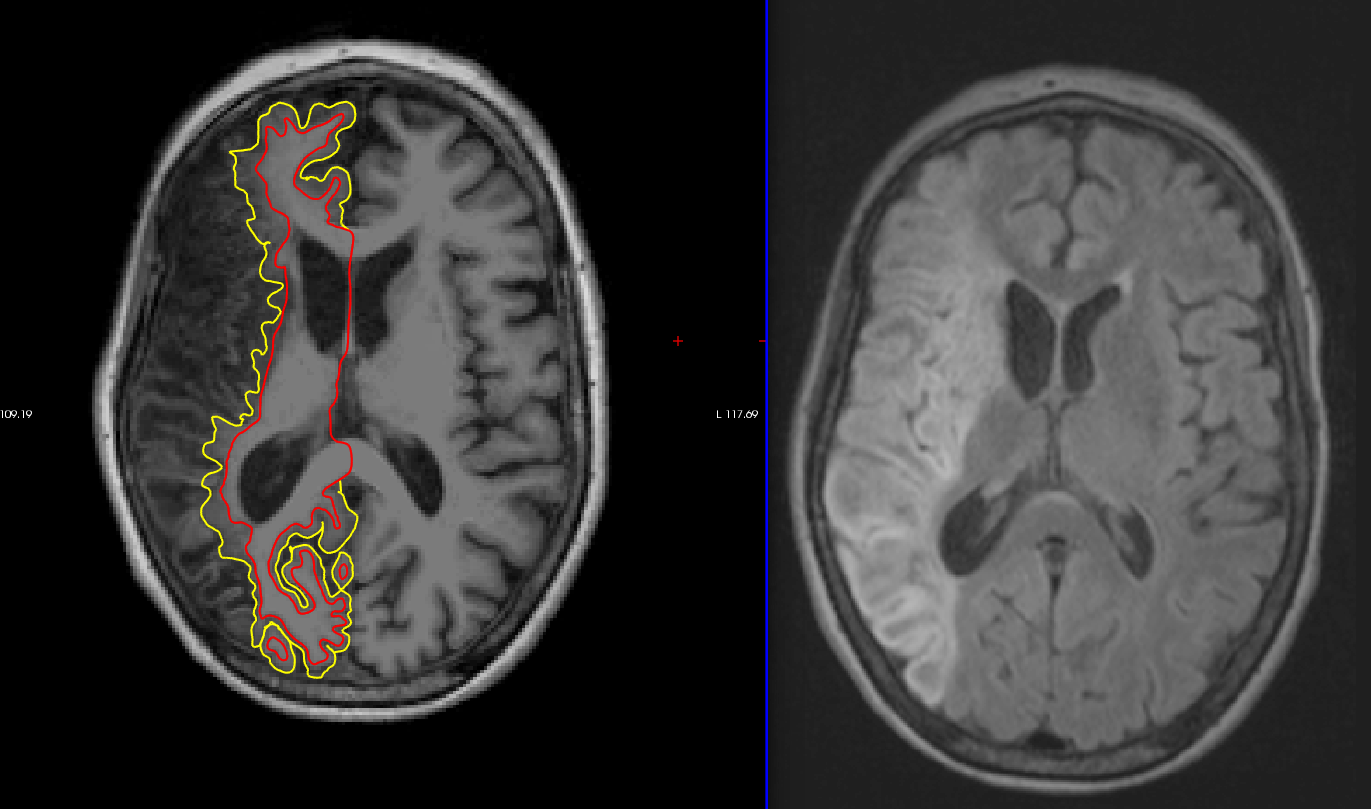
When I check the surfaces on Freeview, cortical infarcts are excluded (which is great because of the major anatomy distorsion) but the pial and white surfaces (in contact to the area excluded) are different from zero. It seems that Free-surfer still calculates the cortical thickness as an average measure of the surfaces in contact to the area excluded (which doesn't have any grey matter !). I send you a picture to illustrate my question.
I am wondering: how does Freesurfer calculate the surfaces in contact to a cortical area excluded ? If the areas are excluded does it have any consequences on the GLM with QDEC ?
Thanks a lot
Guillaume

Hi Guillaume
I certainly wouldn't trust the thickness values anywhere near the lesion. What exactly are you trying to compute?
cheers Bruce On Thu, 31 May 2018, Guillaume Bellanger wrote:
External Email - Use Caution
Hi Freesurfers users,
I am looking on cortical thickness after ischemic stroke, especially stroke with cortical involvment. Freesurfer is validated in this population, Li, Q. (2015).
When I check the surfaces on Freeview, cortical infarcts are excluded (which is great because of the major anatomy distorsion) but the pial and white surfaces (in contact to the area excluded) are different from zero. It seems that Free-surfer still calculates the cortical thickness as an average measure of the surfaces in contact to the area excluded (which doesn't have any grey matter !). I send you a picture to illustrate my question.
I am wondering: how does Freesurfer calculate the surfaces in contact to a cortical area excluded ? If the areas are excluded does it have any consequences on the GLM with QDEC ?
Thanks a lot
Guillaume
External Email - Use Caution
Hi Bruce,
Thanks for you answer.
I am trying to relate mean cortical thickness with cognitive impairment in a stroke population (cortical and sub cortical strokes). Should I exclude patients with cortical lesions/ create a mask/ look only on contro-lesional hemisphere ?
Regards
Guillaume ________________________________ From: freesurfer-bounces@nmr.mgh.harvard.edu freesurfer-bounces@nmr.mgh.harvard.edu on behalf of Bruce Fischl fischl@nmr.mgh.harvard.edu Sent: Thursday, May 31, 2018 1:09 PM To: Freesurfer support list Subject: Re: [Freesurfer] Cortical thickness and cortical stroke
Hi Guillaume
I certainly wouldn't trust the thickness values anywhere near the lesion. What exactly are you trying to compute?
cheers Bruce On Thu, 31 May 2018, Guillaume Bellanger wrote:
External Email - Use CautionHi Freesurfers users,
I am looking on cortical thickness after ischemic stroke, especially stroke with cortical involvment. Freesurfer is validated in this population, Li, Q. (2015).
When I check the surfaces on Freeview, cortical infarcts are excluded (which is great because of the major anatomy distorsion) but the pial and white surfaces (in contact to the area excluded) are different from zero. It seems that Free-surfer still calculates the cortical thickness as an average measure of the surfaces in contact to the area excluded (which doesn't have any grey matter !). I send you a picture to illustrate my question.
I am wondering: how does Freesurfer calculate the surfaces in contact to a cortical area excluded ? If the areas are excluded does it have any consequences on the GLM with QDEC ?
Thanks a lot
Guillaume
yes, I think contra-lesional might be ok On Thu, 31 May 2018, Guillaume Bellanger wrote:
External Email - Use Caution
Hi Bruce,
Thanks for you answer.
I am trying to relate mean cortical thickness with cognitive impairment in a stroke population (cortical and sub cortical strokes). Should I exclude patients with cortical lesions/ create a mask/ look only on contro-lesional hemisphere ?
Regards
Guillaume
From: freesurfer-bounces@nmr.mgh.harvard.edu freesurfer-bounces@nmr.mgh.harvard.edu on behalf of Bruce Fischl fischl@nmr.mgh.harvard.edu Sent: Thursday, May 31, 2018 1:09 PM To: Freesurfer support list Subject: Re: [Freesurfer] Cortical thickness and cortical stroke Hi Guillaume
I certainly wouldn't trust the thickness values anywhere near the lesion. What exactly are you trying to compute?
cheers Bruce On Thu, 31 May 2018, Guillaume Bellanger wrote:
External Email - Use Caution
Hi Freesurfers users,
I am looking on cortical thickness after ischemic stroke, especially stroke with cortical involvment. Freesurfer is validated in this population, Li, Q. (2015).
When I check the surfaces on Freeview, cortical infarcts are excluded (which is great because of the major anatomy distorsion) but the pial and white surfaces (in contact to the area excluded) are different from zero. It seems that Free-surfer still calculates the cortical thickness as an average measure of the surfaces in contact to the area excluded (which doesn't have any grey matter !). I send you a picture to illustrate my question.
I am wondering: how does Freesurfer calculate the surfaces in contact to a cortical area excluded ? If the areas are excluded does it have any consequences on the GLM with QDEC ?
Thanks a lot
Guillaume
freesurfer@nmr.mgh.harvard.edu
-
 Bruce Fischl
 -
 Guillaume Bellanger