
External Email - Use Caution
I’m working with MRI data from individuals with multiple sclerosis (MS). I preprocess their scans using lesion filling in FSL, based on lesion masks prepared from FLAIR images.
However, for some subjects with extensive lesions—particularly large black holes and/or juxtacortical lesions—the surface reconstruction remains inaccurate, even after applying lesion filling (and of course without it as well).
I would like to manually correct the reconstruction in these problematic areas. I’ve tried adding control points directly inside the black holes (!) and also editing the *wm.mgz* by manually adding voxels, but it seems that directly editing the surface mesh would probably be more effective and less cumbersome. Is this feasible? Are there established tools or workflows that allow manual surface mesh correction in this context?
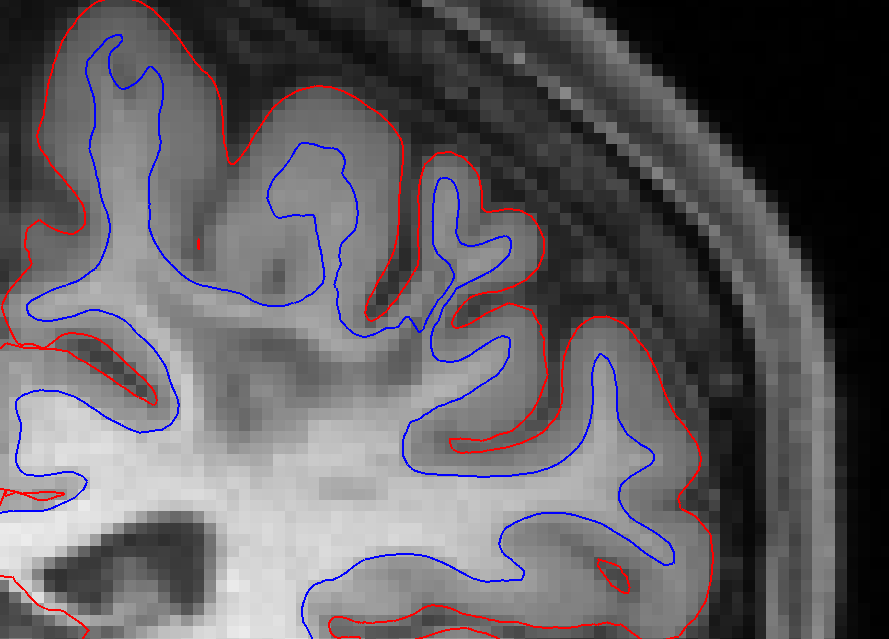
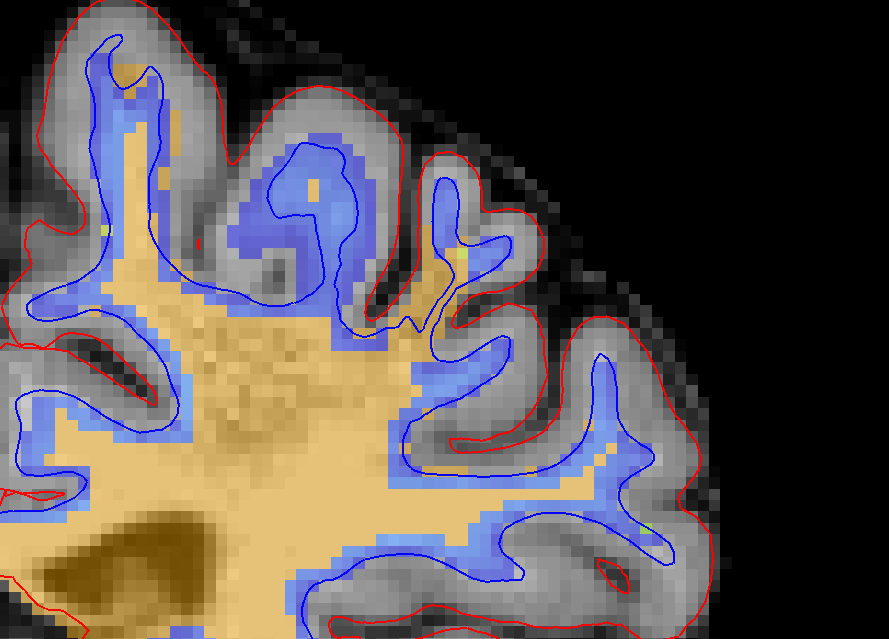
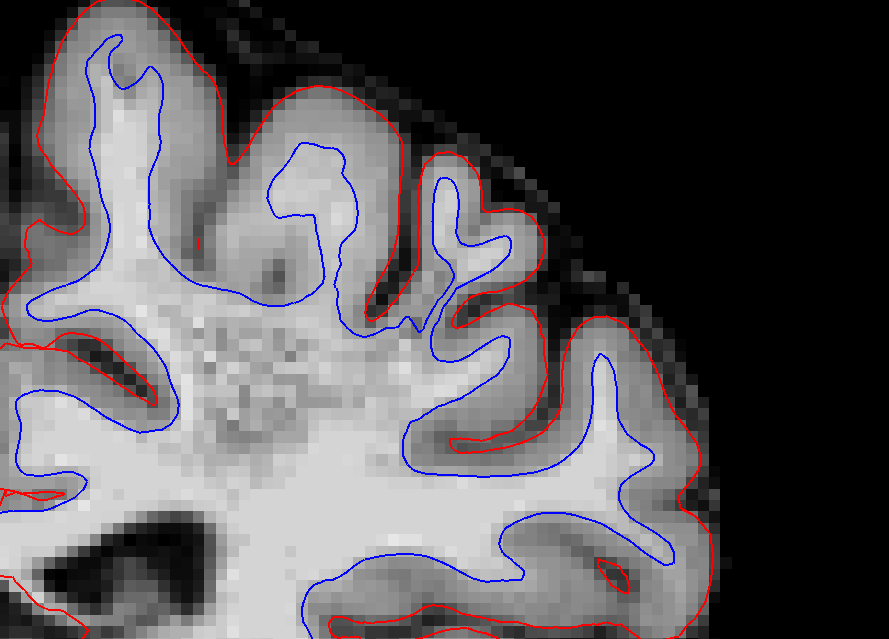
Please note that in the example provided, there is an area where, despite the correct wm.mgz mask, the surface does not follow the mask boundary.
Alternatively, I would appreciate any suggestions on other methods or pipelines that might be worth trying to improve surface reconstruction in such challenging cases.
Thank you!

you definitely dont want to add control points into the lesions! In addition to changing the wm.mgz (set the lesions to 255) you should also set the same voxels to 255 in the brainmask.finalsurfs.manedit.mgz that should fix the surface and prevent it from wandering into the the lesion
On 6/17/2025 5:33 AM, Bartosz Kossowski wrote:
External Email - Use Caution
I’m working with MRI data from individuals with multiple sclerosis (MS). I preprocess their scans using lesion filling in FSL, based on lesion masks prepared from FLAIR images.
However, for some subjects with extensive lesions—particularly large black holes and/or juxtacortical lesions—the surface reconstruction remains inaccurate, even after applying lesion filling (and of course without it as well).
I would like to manually correct the reconstruction in these problematic areas. I’ve tried adding control points directly inside the black holes (!) and also editing the *wm.mgz* by manually adding voxels, but it seems that directly editing the surface mesh would probably be more effective and less cumbersome. Is this feasible? Are there established tools or workflows that allow manual surface mesh correction in this context?
Please note that in the example provided, there is an area where, despite the correct wm.mgz mask, the surface does not follow the mask boundary.
Alternatively, I would appreciate any suggestions on other methods or pipelines that might be worth trying to improve surface reconstruction in such challenging cases.
Thank you!
Freesurfer mailing list --freesurfer@nmr.mgh.harvard.edu To unsubscribe send an email tofreesurfer-leave@nmr.mgh.harvard.edu https://mail.nmr.mgh.harvard.edu/mailman3/lists/freesurfer@nmr.mgh.harvard.e...
freesurfer@nmr.mgh.harvard.edu
-
 Bartosz Kossowski
 -
 Douglas N. Greve