
Hi,
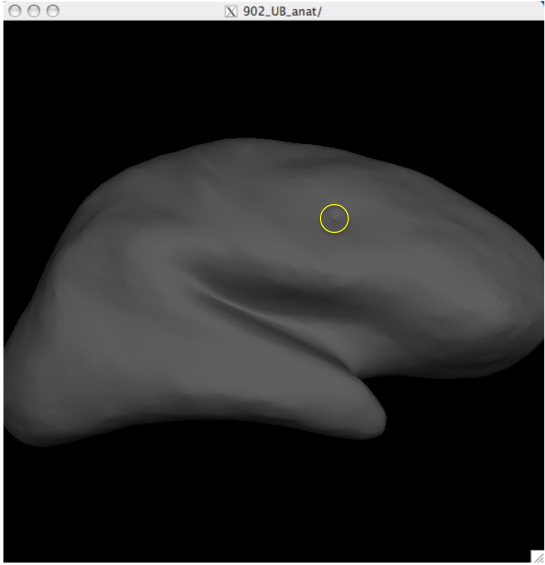
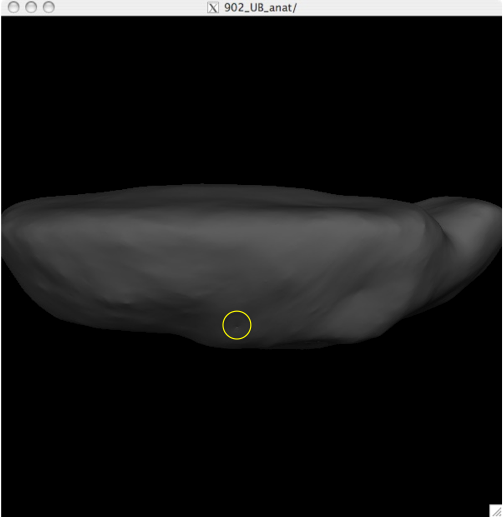
I have a couple of newbie questions on using freesurfer. I was able to reconstruct the data without too much trouble, and now am at the quality check stage. We spotted a couple of small "dimples" on the tksurfer surface (attached). Upon inspecting the uninflated views in tkmedit, however, it's not clear what is causing it. We don't see any obvious misclassification of gray or white matter, understandable I suppose given it's quite a small imperfection. How do people usually try to find the underlying problem in these cases? Also how much of an imperfection is considered "significant".
Also another issue that I found quite strange. When we find the coordinate in tksurfer, and try to input it into tkmedit, the program would show a coordinate that is somewhere near (but not all that close, between 10-20mm) to the actual inputted coordinate. Not sure why that would be, but it makes going between tksurfer and tkmedit more cumbersome.
BTW, thanks for the great software and the wiki.
Ming Hsu

Hi Ming,
don't worry about the dimples, they are irrelevant unless they are quite deep (in which case they can represent an inaccurately segmented lesion).
As for tkmedit/tksurfer, they have "save point" and "goto point" buttons that allow them to communicate. Much easier than typing in coords.
cheers, Bruce
On Fri, 16 May 2008, Ming Hsu wrote:
Hi,
I have a couple of newbie questions on using freesurfer. I was able to reconstruct the data without too much trouble, and now am at the quality check stage. We spotted a couple of small "dimples" on the tksurfer surface (attached). Upon inspecting the uninflated views in tkmedit, however, it's not clear what is causing it. We don't see any obvious misclassification of gray or white matter, understandable I suppose given it's quite a small imperfection. How do people usually try to find the underlying problem in these cases? Also how much of an imperfection is considered "significant".
Also another issue that I found quite strange. When we find the coordinate in tksurfer, and try to input it into tkmedit, the program would show a coordinate that is somewhere near (but not all that close, between 10-20mm) to the actual inputted coordinate. Not sure why that would be, but it makes going between tksurfer and tkmedit more cumbersome.
BTW, thanks for the great software and the wiki.
Ming Hsu
freesurfer@nmr.mgh.harvard.edu
-
 Bruce Fischl
 -
 Ming Hsu