
Dear Fs experts,
I am running a longitudinal dataset through the longitudinal pipeline, and noticed that for one subject, although we kept everything the same (sequence, coil etc) the two timepoints' brainmasks look different: timepoint one (in the attached snapshot, gs_tp1) looks as if it has been smoothed, compared to timepoint two (gs_tp2). I have checked some other images from this subject, and the same seems to occur for orig.mgz, but not for rawavg.mgz.
Any idea on what could be causing the difference would be greatly appreciated.
Thanks in advance, Irene
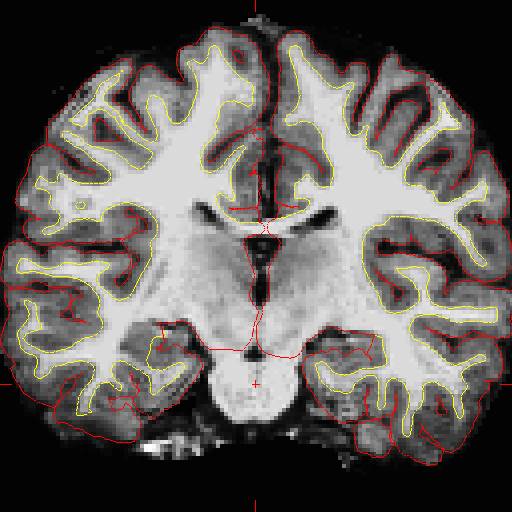
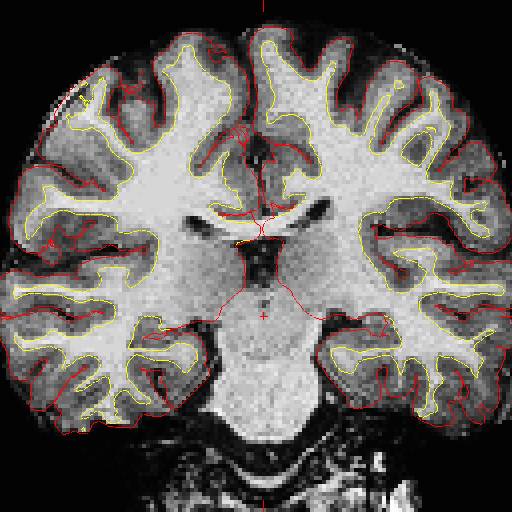

Hi Irene,
both images should be smoothed the same. You only have two time points in each subject? Which FreeSurfer version are you using? And these images are from the *.long.base directories (or are they from the independent runs)?
-Martin
On Thu, 2011-11-03 at 15:20 +0100, Irene Altarelli wrote:
Dear Fs experts,
I am running a longitudinal dataset through the longitudinal pipeline, and noticed that for one subject, although we kept everything the same (sequence, coil etc) the two timepoints' brainmasks look different: timepoint one (in the attached snapshot, gs_tp1) looks as if it has been smoothed, compared to timepoint two (gs_tp2). I have checked some other images from this subject, and the same seems to occur for orig.mgz, but not for rawavg.mgz.
Any idea on what could be causing the difference would be greatly appreciated.
Thanks in advance, Irene _______________________________________________ Freesurfer mailing list Freesurfer@nmr.mgh.harvard.edu https://mail.nmr.mgh.harvard.edu/mailman/listinfo/freesurfer
Dear Martin,
thanks for your quick reply.
I am using version 5.1. I only have two timepoints per subject and I took the snapshots from the independent runs. What bothers me is that the difference is not present in the 001.mgz images, but seems to appear later in the workflow.
Thanks again, Irene
Le jeudi 03 novembre 2011 à 10:40 -0400, Martin Reuter a écrit :
Hi Irene,
both images should be smoothed the same. You only have two time points in each subject? Which FreeSurfer version are you using? And these images are from the *.long.base directories (or are they from the independent runs)?
-Martin
On Thu, 2011-11-03 at 15:20 +0100, Irene Altarelli wrote:
Dear Fs experts,
I am running a longitudinal dataset through the longitudinal pipeline, and noticed that for one subject, although we kept everything the same (sequence, coil etc) the two timepoints' brainmasks look different: timepoint one (in the attached snapshot, gs_tp1) looks as if it has been smoothed, compared to timepoint two (gs_tp2). I have checked some other images from this subject, and the same seems to occur for orig.mgz, but not for rawavg.mgz.
Any idea on what could be causing the difference would be greatly appreciated.
Thanks in advance, Irene _______________________________________________ Freesurfer mailing list Freesurfer@nmr.mgh.harvard.edu https://mail.nmr.mgh.harvard.edu/mailman/listinfo/freesurfer
Freesurfer mailing list Freesurfer@nmr.mgh.harvard.edu https://mail.nmr.mgh.harvard.edu/mailman/listinfo/freesurfer
The information in this e-mail is intended only for the person to whom it is addressed. If you believe this e-mail was sent to you in error and the e-mail contains patient information, please contact the Partners Compliance HelpLine at http://www.partners.org/complianceline . If the e-mail was sent to you in error but does not contain patient information, please contact the sender and properly dispose of the e-mail.
Hi Irene,
since those images are not from the longitudinal runs, it really is a cross sectional question:
You have two images and the raw average look both similarly noisy, but the orig (which is the first image in the recon-all stream) is smoother for one than the other.
That means that the conform step (that interpolates the isotropic orig from the rawavg) introduces the different smoothing. Not sure why it is different. You can check (with mri_info) the voxel sizes of your rawavg and the RAS coordinates. If they are the same, smoothing should also be the same.
Best, Martin
On Thu, 2011-11-03 at 17:48 +0100, Irene Altarelli wrote:
Dear Martin,
thanks for your quick reply.
I am using version 5.1. I only have two timepoints per subject and I took the snapshots from the independent runs. What bothers me is that the difference is not present in the 001.mgz images, but seems to appear later in the workflow.
Thanks again, Irene
Le jeudi 03 novembre 2011 à 10:40 -0400, Martin Reuter a écrit :
Hi Irene,
both images should be smoothed the same. You only have two time points in each subject? Which FreeSurfer version are you using? And these images are from the *.long.base directories (or are they from the independent runs)?
-Martin
On Thu, 2011-11-03 at 15:20 +0100, Irene Altarelli wrote:
Dear Fs experts,
I am running a longitudinal dataset through the longitudinal pipeline, and noticed that for one subject, although we kept everything the same (sequence, coil etc) the two timepoints' brainmasks look different: timepoint one (in the attached snapshot, gs_tp1) looks as if it has been smoothed, compared to timepoint two (gs_tp2). I have checked some other images from this subject, and the same seems to occur for orig.mgz, but not for rawavg.mgz.
Any idea on what could be causing the difference would be greatly appreciated.
Thanks in advance, Irene _______________________________________________ Freesurfer mailing list Freesurfer@nmr.mgh.harvard.edu https://mail.nmr.mgh.harvard.edu/mailman/listinfo/freesurfer
Freesurfer mailing list Freesurfer@nmr.mgh.harvard.edu https://mail.nmr.mgh.harvard.edu/mailman/listinfo/freesurfer
The information in this e-mail is intended only for the person to whom it is addressed. If you believe this e-mail was sent to you in error and the e-mail contains patient information, please contact the Partners Compliance HelpLine at http://www.partners.org/complianceline . If the e-mail was sent to you in error but does not contain patient information, please contact the sender and properly dispose of the e-mail.
Dear Martin,
the RAS coordinates and voxel to ras transforms are indeed slightly different. Should I change this and if so, how?
Please find the output of mri_info for each of the two acquisitions at the end of this email.
Thanks again! Irene
***********************************************************************************
Volume information for gsTP1/mri/rawavg.mgz type: MGH dimensions: 256 x 256 x 176 voxel sizes: 1.0000, 1.0000, 1.0000 type: FLOAT (3) fov: 256.000 dof: 0 xstart: -128.0, xend: 128.0 ystart: -128.0, yend: 128.0 zstart: -88.0, zend: 88.0 TR: 0.00 msec, TE: 0.00 msec, TI: 0.00 msec, flip angle: 0.00 degrees nframes: 1 PhEncDir: UNKNOWN ras xform present xform info: x_r = 0.0000, y_r = -0.0436, z_r = 0.9990, c_r = -3.5493 : x_a = -1.0000, y_a = 0.0000, z_a = 0.0000, c_a = 12.8739 : x_s = 0.0000, y_s = 0.9990, z_s = 0.0436, c_s = -16.0490
talairach xfm : Orientation : PSR Primary Slice Direction: sagittal
voxel to ras transform: 0.0000 -0.0436 0.9990 -85.8823 -1.0000 0.0000 0.0000 140.8739 0.0000 0.9990 0.0436 -147.7657 0.0000 0.0000 0.0000 1.0000
voxel-to-ras determinant -1
ras to voxel transform: -0.0000 -1.0000 -0.0000 140.8739 -0.0436 0.0000 0.9990 143.8789 0.9990 -0.0000 0.0436 92.2460 0.0000 0.0000 0.0000 1.0000
***********************************************************************************
Volume information for gsTP2/mri/rawavg.mgz type: MGH dimensions: 256 x 256 x 176 voxel sizes: 1.0000, 1.0000, 1.0000 type: FLOAT (3) fov: 256.000 dof: 0 xstart: -128.0, xend: 128.0 ystart: -128.0, yend: 128.0 zstart: -88.0, zend: 88.0 TR: 0.00 msec, TE: 0.00 msec, TI: 0.00 msec, flip angle: 0.00 degrees nframes: 1 PhEncDir: UNKNOWN ras xform present xform info: x_r = 0.0000, y_r = 0.0000, z_r = 1.0000, c_r = -1.5339 : x_a = -1.0000, y_a = 0.0000, z_a = 0.0000, c_a = 11.5254 : x_s = 0.0000, y_s = 1.0000, z_s = 0.0000, c_s = -19.3390
talairach xfm : Orientation : PSR Primary Slice Direction: sagittal
voxel to ras transform: 0.0000 0.0000 1.0000 -89.5339 -1.0000 0.0000 0.0000 139.5254 0.0000 1.0000 0.0000 -147.3390 0.0000 0.0000 0.0000 1.0000
voxel-to-ras determinant -1
ras to voxel transform: -0.0000 -1.0000 -0.0000 139.5254 -0.0000 -0.0000 1.0000 147.3390 1.0000 0.0000 0.0000 89.5339 0.0000 0.0000 0.0000 1.0000
Selon Martin Reuter mreuter@nmr.mgh.harvard.edu:
Hi Irene,
since those images are not from the longitudinal runs, it really is a cross sectional question:
You have two images and the raw average look both similarly noisy, but the orig (which is the first image in the recon-all stream) is smoother for one than the other.
That means that the conform step (that interpolates the isotropic orig from the rawavg) introduces the different smoothing. Not sure why it is different. You can check (with mri_info) the voxel sizes of your rawavg and the RAS coordinates. If they are the same, smoothing should also be the same.
Best, Martin
On Thu, 2011-11-03 at 17:48 +0100, Irene Altarelli wrote:
Dear Martin,
thanks for your quick reply.
I am using version 5.1. I only have two timepoints per subject and I took the snapshots from the independent runs. What bothers me is that the difference is not present in the 001.mgz images, but seems to appear later in the workflow.
Thanks again, Irene
Le jeudi 03 novembre 2011 à 10:40 -0400, Martin Reuter a écrit :
Hi Irene,
both images should be smoothed the same. You only have two time points in each subject? Which FreeSurfer version are you using? And these images are from the *.long.base directories (or are they from the independent runs)?
-Martin
On Thu, 2011-11-03 at 15:20 +0100, Irene Altarelli wrote:
Dear Fs experts,
I am running a longitudinal dataset through the longitudinal pipeline, and noticed that for one subject, although we kept everything the same (sequence, coil etc) the two timepoints' brainmasks look different: timepoint one (in the attached snapshot, gs_tp1) looks as if it has
been
smoothed, compared to timepoint two (gs_tp2). I have checked some other images from this subject, and the same seems to occur for orig.mgz, but not for rawavg.mgz.
Any idea on what could be causing the difference would be greatly appreciated.
Thanks in advance, Irene _______________________________________________ Freesurfer mailing list Freesurfer@nmr.mgh.harvard.edu https://mail.nmr.mgh.harvard.edu/mailman/listinfo/freesurfer
Freesurfer mailing list Freesurfer@nmr.mgh.harvard.edu https://mail.nmr.mgh.harvard.edu/mailman/listinfo/freesurfer
The information in this e-mail is intended only for the person to whom it
is
addressed. If you believe this e-mail was sent to you in error and the
contains patient information, please contact the Partners Compliance
HelpLine at
http://www.partners.org/complianceline . If the e-mail was sent to you in
error
but does not contain patient information, please contact the sender and
properly
dispose of the e-mail.
Hi Irene,
the voxel sizes are isotropic 1mm (which is good). However for some reason the first image is slightly rotated while the second is perfectly aligned with the axes. Therefore the first gets interpolated while the second stays the same. That explains the different smoothing.
Now the question is why is one image different. Do you collect a single scan for each session or are you averaging several within-session scans? You should look at other subjects and try to find out if and why specific time points are slightly rotated.
By the way this is a good example how to potentially mess up a longitudinal study. If for example one of the time points is always (or more frequently) rotated because of a different protocol the study would be severely biased. So it is good that you are checking this.
Best, Martin
On Fri, 2011-11-04 at 10:28 +0100, Irene.Altarelli@ens.fr wrote:
Dear Martin,
the RAS coordinates and voxel to ras transforms are indeed slightly different. Should I change this and if so, how?
Please find the output of mri_info for each of the two acquisitions at the end of this email.
Thanks again! Irene
Volume information for gsTP1/mri/rawavg.mgz type: MGH dimensions: 256 x 256 x 176 voxel sizes: 1.0000, 1.0000, 1.0000 type: FLOAT (3) fov: 256.000 dof: 0 xstart: -128.0, xend: 128.0 ystart: -128.0, yend: 128.0 zstart: -88.0, zend: 88.0 TR: 0.00 msec, TE: 0.00 msec, TI: 0.00 msec, flip angle: 0.00 degrees nframes: 1 PhEncDir: UNKNOWN ras xform present xform info: x_r = 0.0000, y_r = -0.0436, z_r = 0.9990, c_r = -3.5493 : x_a = -1.0000, y_a = 0.0000, z_a = 0.0000, c_a = 12.8739 : x_s = 0.0000, y_s = 0.9990, z_s = 0.0436, c_s = -16.0490
talairach xfm : Orientation : PSR Primary Slice Direction: sagittal
voxel to ras transform: 0.0000 -0.0436 0.9990 -85.8823 -1.0000 0.0000 0.0000 140.8739 0.0000 0.9990 0.0436 -147.7657 0.0000 0.0000 0.0000 1.0000
voxel-to-ras determinant -1
ras to voxel transform: -0.0000 -1.0000 -0.0000 140.8739 -0.0436 0.0000 0.9990 143.8789 0.9990 -0.0000 0.0436 92.2460 0.0000 0.0000 0.0000 1.0000
Volume information for gsTP2/mri/rawavg.mgz type: MGH dimensions: 256 x 256 x 176 voxel sizes: 1.0000, 1.0000, 1.0000 type: FLOAT (3) fov: 256.000 dof: 0 xstart: -128.0, xend: 128.0 ystart: -128.0, yend: 128.0 zstart: -88.0, zend: 88.0 TR: 0.00 msec, TE: 0.00 msec, TI: 0.00 msec, flip angle: 0.00 degrees nframes: 1 PhEncDir: UNKNOWN ras xform present xform info: x_r = 0.0000, y_r = 0.0000, z_r = 1.0000, c_r = -1.5339 : x_a = -1.0000, y_a = 0.0000, z_a = 0.0000, c_a = 11.5254 : x_s = 0.0000, y_s = 1.0000, z_s = 0.0000, c_s = -19.3390
talairach xfm : Orientation : PSR Primary Slice Direction: sagittal
voxel to ras transform: 0.0000 0.0000 1.0000 -89.5339 -1.0000 0.0000 0.0000 139.5254 0.0000 1.0000 0.0000 -147.3390 0.0000 0.0000 0.0000 1.0000
voxel-to-ras determinant -1
ras to voxel transform: -0.0000 -1.0000 -0.0000 139.5254 -0.0000 -0.0000 1.0000 147.3390 1.0000 0.0000 0.0000 89.5339 0.0000 0.0000 0.0000 1.0000
Selon Martin Reuter mreuter@nmr.mgh.harvard.edu:
Hi Irene,
since those images are not from the longitudinal runs, it really is a cross sectional question:
You have two images and the raw average look both similarly noisy, but the orig (which is the first image in the recon-all stream) is smoother for one than the other.
That means that the conform step (that interpolates the isotropic orig from the rawavg) introduces the different smoothing. Not sure why it is different. You can check (with mri_info) the voxel sizes of your rawavg and the RAS coordinates. If they are the same, smoothing should also be the same.
Best, Martin
On Thu, 2011-11-03 at 17:48 +0100, Irene Altarelli wrote:
Dear Martin,
thanks for your quick reply.
I am using version 5.1. I only have two timepoints per subject and I took the snapshots from the independent runs. What bothers me is that the difference is not present in the 001.mgz images, but seems to appear later in the workflow.
Thanks again, Irene
Le jeudi 03 novembre 2011 à 10:40 -0400, Martin Reuter a écrit :
Hi Irene,
both images should be smoothed the same. You only have two time points in each subject? Which FreeSurfer version are you using? And these images are from the *.long.base directories (or are they from the independent runs)?
-Martin
On Thu, 2011-11-03 at 15:20 +0100, Irene Altarelli wrote:
Dear Fs experts,
I am running a longitudinal dataset through the longitudinal pipeline, and noticed that for one subject, although we kept everything the same (sequence, coil etc) the two timepoints' brainmasks look different: timepoint one (in the attached snapshot, gs_tp1) looks as if it has
been
smoothed, compared to timepoint two (gs_tp2). I have checked some other images from this subject, and the same seems to occur for orig.mgz, but not for rawavg.mgz.
Any idea on what could be causing the difference would be greatly appreciated.
Thanks in advance, Irene _______________________________________________ Freesurfer mailing list Freesurfer@nmr.mgh.harvard.edu https://mail.nmr.mgh.harvard.edu/mailman/listinfo/freesurfer
Freesurfer mailing list Freesurfer@nmr.mgh.harvard.edu https://mail.nmr.mgh.harvard.edu/mailman/listinfo/freesurfer
The information in this e-mail is intended only for the person to whom it
is
addressed. If you believe this e-mail was sent to you in error and the
contains patient information, please contact the Partners Compliance
HelpLine at
http://www.partners.org/complianceline . If the e-mail was sent to you in
error
but does not contain patient information, please contact the sender and
properly
dispose of the e-mail.

Hi Irene, To add to what Martin wrote, the issue is that the conform stage of mri_convert automatically interpolates "oblique acquisitions" and the user has no control to turn off this behavior. You may be interested in the following thread in which I inquired about this interpolation:
http://www.mail-archive.com/freesurfer@nmr.mgh.harvard.edu/msg18123.html
In our case, we have 1 mm isotropic data acquired aligned to the AC/PC, and we didn't want FS to interpolate/rotate this data during the creation of orig.mgz. So, we have taken to manually editing the sform/qform of the input nii file so that no rotation is coded in the sform/qform. In our case, we are accomplishing this editing using FSL tools, although I'm sure that you could accomplish the same using appropriate flags with mri_convert. As to whether such editing would break any assumptions of the longitudinal stream I don't know. (I wouldn't think so, because zeroing out a small rotation in the sform/qform is basically akin to rotating the subject's head in the magnet and then acquiring an image with its read/phase/slice axes aligned with the canonical gradient axes).
cheers, -MH
On Fri, 2011-11-04 at 11:07 -0400, Martin Reuter wrote:
Hi Irene,
the voxel sizes are isotropic 1mm (which is good). However for some reason the first image is slightly rotated while the second is perfectly aligned with the axes. Therefore the first gets interpolated while the second stays the same. That explains the different smoothing.
Now the question is why is one image different. Do you collect a single scan for each session or are you averaging several within-session scans? You should look at other subjects and try to find out if and why specific time points are slightly rotated.
By the way this is a good example how to potentially mess up a longitudinal study. If for example one of the time points is always (or more frequently) rotated because of a different protocol the study would be severely biased. So it is good that you are checking this.
Best, Martin
On Fri, 2011-11-04 at 10:28 +0100, Irene.Altarelli@ens.fr wrote:
Dear Martin,
the RAS coordinates and voxel to ras transforms are indeed slightly different. Should I change this and if so, how?
Please find the output of mri_info for each of the two acquisitions at the end of this email.
Thanks again! Irene
Volume information for gsTP1/mri/rawavg.mgz type: MGH dimensions: 256 x 256 x 176 voxel sizes: 1.0000, 1.0000, 1.0000 type: FLOAT (3) fov: 256.000 dof: 0 xstart: -128.0, xend: 128.0 ystart: -128.0, yend: 128.0 zstart: -88.0, zend: 88.0 TR: 0.00 msec, TE: 0.00 msec, TI: 0.00 msec, flip angle: 0.00 degrees nframes: 1 PhEncDir: UNKNOWN ras xform present xform info: x_r = 0.0000, y_r = -0.0436, z_r = 0.9990, c_r = -3.5493 : x_a = -1.0000, y_a = 0.0000, z_a = 0.0000, c_a = 12.8739 : x_s = 0.0000, y_s = 0.9990, z_s = 0.0436, c_s = -16.0490
talairach xfm : Orientation : PSR Primary Slice Direction: sagittal
voxel to ras transform: 0.0000 -0.0436 0.9990 -85.8823 -1.0000 0.0000 0.0000 140.8739 0.0000 0.9990 0.0436 -147.7657 0.0000 0.0000 0.0000 1.0000
voxel-to-ras determinant -1
ras to voxel transform: -0.0000 -1.0000 -0.0000 140.8739 -0.0436 0.0000 0.9990 143.8789 0.9990 -0.0000 0.0436 92.2460 0.0000 0.0000 0.0000 1.0000
Volume information for gsTP2/mri/rawavg.mgz type: MGH dimensions: 256 x 256 x 176 voxel sizes: 1.0000, 1.0000, 1.0000 type: FLOAT (3) fov: 256.000 dof: 0 xstart: -128.0, xend: 128.0 ystart: -128.0, yend: 128.0 zstart: -88.0, zend: 88.0 TR: 0.00 msec, TE: 0.00 msec, TI: 0.00 msec, flip angle: 0.00 degrees nframes: 1 PhEncDir: UNKNOWN ras xform present xform info: x_r = 0.0000, y_r = 0.0000, z_r = 1.0000, c_r = -1.5339 : x_a = -1.0000, y_a = 0.0000, z_a = 0.0000, c_a = 11.5254 : x_s = 0.0000, y_s = 1.0000, z_s = 0.0000, c_s = -19.3390
talairach xfm : Orientation : PSR Primary Slice Direction: sagittal
voxel to ras transform: 0.0000 0.0000 1.0000 -89.5339 -1.0000 0.0000 0.0000 139.5254 0.0000 1.0000 0.0000 -147.3390 0.0000 0.0000 0.0000 1.0000
voxel-to-ras determinant -1
ras to voxel transform: -0.0000 -1.0000 -0.0000 139.5254 -0.0000 -0.0000 1.0000 147.3390 1.0000 0.0000 0.0000 89.5339 0.0000 0.0000 0.0000 1.0000
Selon Martin Reuter mreuter@nmr.mgh.harvard.edu:
Hi Irene,
since those images are not from the longitudinal runs, it really is a cross sectional question:
You have two images and the raw average look both similarly noisy, but the orig (which is the first image in the recon-all stream) is smoother for one than the other.
That means that the conform step (that interpolates the isotropic orig from the rawavg) introduces the different smoothing. Not sure why it is different. You can check (with mri_info) the voxel sizes of your rawavg and the RAS coordinates. If they are the same, smoothing should also be the same.
Best, Martin
On Thu, 2011-11-03 at 17:48 +0100, Irene Altarelli wrote:
Dear Martin,
thanks for your quick reply.
I am using version 5.1. I only have two timepoints per subject and I took the snapshots from the independent runs. What bothers me is that the difference is not present in the 001.mgz images, but seems to appear later in the workflow.
Thanks again, Irene
Le jeudi 03 novembre 2011 à 10:40 -0400, Martin Reuter a écrit :
Hi Irene,
both images should be smoothed the same. You only have two time points in each subject? Which FreeSurfer version are you using? And these images are from the *.long.base directories (or are they from the independent runs)?
-Martin
On Thu, 2011-11-03 at 15:20 +0100, Irene Altarelli wrote:
Dear Fs experts,
I am running a longitudinal dataset through the longitudinal pipeline, and noticed that for one subject, although we kept everything the same (sequence, coil etc) the two timepoints' brainmasks look different: timepoint one (in the attached snapshot, gs_tp1) looks as if it has
been
smoothed, compared to timepoint two (gs_tp2). I have checked some other images from this subject, and the same seems to occur for orig.mgz, but not for rawavg.mgz.
Any idea on what could be causing the difference would be greatly appreciated.
Thanks in advance, Irene _______________________________________________ Freesurfer mailing list Freesurfer@nmr.mgh.harvard.edu https://mail.nmr.mgh.harvard.edu/mailman/listinfo/freesurfer
Freesurfer mailing list Freesurfer@nmr.mgh.harvard.edu https://mail.nmr.mgh.harvard.edu/mailman/listinfo/freesurfer
The information in this e-mail is intended only for the person to whom it
is
addressed. If you believe this e-mail was sent to you in error and the
contains patient information, please contact the Partners Compliance
HelpLine at
http://www.partners.org/complianceline . If the e-mail was sent to you in
error
but does not contain patient information, please contact the sender and
properly
dispose of the e-mail.
Freesurfer mailing list Freesurfer@nmr.mgh.harvard.edu https://mail.nmr.mgh.harvard.edu/mailman/listinfo/freesurfer
freesurfer@nmr.mgh.harvard.edu
-
 Irene Altarelli
 -
Irene.Altarelli@ens.fr
-
 Martin Reuter
 -
 Michael Harms