
Dear freesurfer folks,
My colleagues and I have been running into some troubles with our talairach registration.
These are the steps that we run: 1. cd SUBJECT_DIR: 2. recon-all -all -subjid $SUBJECT 3. cd $SUBJECT/mri 4. mri_nu_correct.mni --i orig.mgz --o orig.mgz --n 3 5. recon-all -s $SUBJECT -talairach -clean-tal -tal-check 6. cd ../../ 7. recon-all -all -subjid $SUBJECT
recon -all -version yields this: $Id: recon-all,v 1.379.2.17 2011/05/20 22:48:18 nicks Exp $
Then we have been checking our talairach registration by following these instructions: https://surfer.nmr.mgh.harvard.edu/fswiki/FsTutorial/Talairach
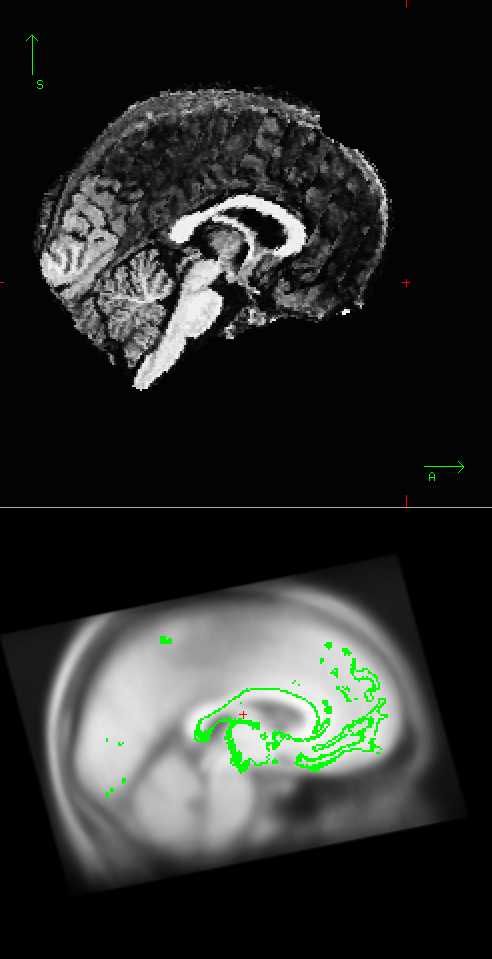
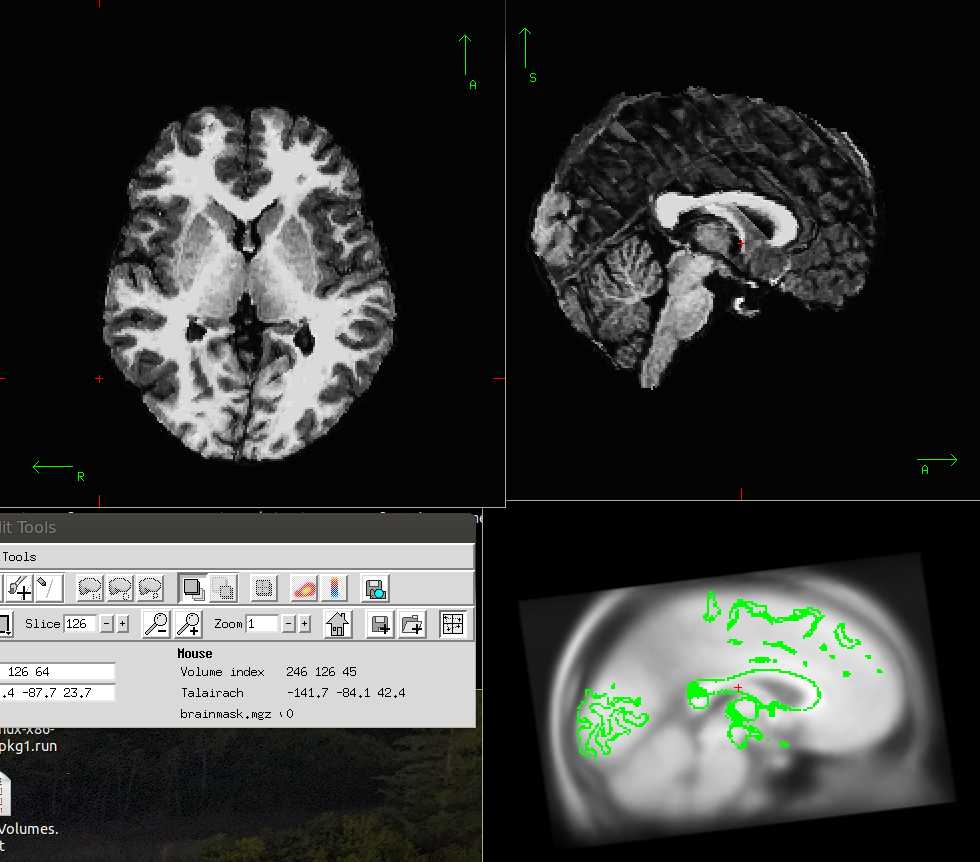
When we go to visually examine the talairach transformed volume (*file --> load transform--> load transform for main volume --> talairach.xfm*), we've found that many of the images look chunked, jagged, or striated, like pieces of a puzzle fit together poorly rather than a smooth whole brain (see attached images for examples). When we look at the talairach overlay using *tkregister2 --mgz --s subjectID --fstal --surf orig *on these same brains, they don't look particularly misaligned. We have tried doing some minor moving and stretching of the talairach volume to better fit our subject volume when it seems necessary, but when we compare the edited vs unedited talairach, the one we fixed still has the striation problem, though sometimes less so.
What might be causing this? What might be some remedies? We are also particularly concerned because we know that the alignment of the corpus callosum is important for the talairach registration progress, and the population that we work with (children with fetal alcohol exposure) has know callosal abnormalities (e.g., some deviations in shape, placement, volume), although we are seeing problems even in ones that look perfectly aligned.
Thank you very much for any advice you can offer!
Best,
Robyn Migliorini Center for Behavioral Teratology San Diego State University / University of California San Diego Joint Doctoral Program in Clinical Psychology
freesurfer@nmr.mgh.harvard.edu
-
 Robyn Migliorini