
Dear all,
I have a question regarding the output from selxavg3-sess. I noticed that within an analysis there is a X.mat that looks like a design matrix -- however is this used at any stage of the analysis? The help message in selxavg3-sess reads:
"This program will construct the design matrix for each run, fit the GLM, save regression coefficients, compute contrasts and significances of contrasts. The runs are combined together so the output is the average across runs (some would call this a "second-level" analysis)."
so this looks like that x.mat is constructed and used for each run (and not saved by default). This then looks like X.mat is not used in the analysis -- it is just there for illustrative purposes? or have I misinterpreted the help message.
If this is correct (i.e. X.mat in the output is not used) when making contrasts using mkcontrast-sess, is there a way to parametrically modulate each run? e.g. to model behavioural changes per run etc.
Cheers,
*Dr Kevin Aquino* Research fellow, Sir Peter Mansfield Magnetic Resonance Center, The University of Nottingham.
Honorary Research Fellow School of Physics, Faculty of Science, University of Sydney
*E* Kevin.aquino@nottingham.ac.uk, aquino@physics.usyd.edu.au | *W* https://kevinaquino.github.io http://www.physics.usyd.edu.au/~aquino/
----------------------------------------------
The brain is a wonderful organ. It starts working the moment you get up and does not stop until you get into the office. - Robert Frost
CRICOS 00026A This email plus any attachments to it are confidential. Any unauthorised use is strictly prohibited. If you receive this email in error, please delete it and any attachments.
Please think of our environment and only print this e-mail if necessary.

It has the design matrix plus a lot of other stuff in it. For parametric modulation, have you seen this page
https://surfer.nmr.mgh.harvard.edu/fswiki/FsFastParametricModulation
On 08/15/2017 09:52 PM, Kevin Aquino wrote:
Dear all,
I have a question regarding the output from selxavg3-sess. I noticed that within an analysis there is a X.mat that looks like a design matrix -- however is this used at any stage of the analysis? The help message in selxavg3-sess reads:
"This program will construct the design matrix for each run, fit the GLM, save regression coefficients, compute contrasts and significances of contrasts. The runs are combined together so the output is the average across runs (some would call this a "second-level" analysis)."
so this looks like that x.mat is constructed and used for each run (and not saved by default). This then looks like X.mat is not used in the analysis -- it is just there for illustrative purposes? or have I misinterpreted the help message.
If this is correct (i.e. X.mat in the output is not used) when making contrasts using mkcontrast-sess, is there a way to parametrically modulate each run? e.g. to model behavioural changes per run etc.
Cheers,
*Dr Kevin Aquino* Research fellow, Sir Peter Mansfield Magnetic Resonance Center, The University of Nottingham.
Honorary Research Fellow School of Physics, Faculty of Science, University of Sydney
*E* Kevin.aquino@nottingham.ac.uk mailto:Kevin.aquino@nottingham.ac.uk, aquino@physics.usyd.edu.au mailto:aquino@physics.usyd.edu.au | *W* *MailScanner has detected a possible fraud attempt from "www.physics.usyd.edu.au" claiming to be* https://kevinaquino.github.io http://www.physics.usyd.edu.au/%7Eaquino/
The brain is a wonderful organ. It starts working the moment you get up and does not stop until you get into the office.
Robert Frost
CRICOS 00026A This email plus any attachments to it are confidential. Any unauthorised use is strictly prohibited. If you receive this email in error, please delete it and any attachments.
Please think of our environment and only print this e-mail if necessary.
Freesurfer mailing list Freesurfer@nmr.mgh.harvard.edu https://mail.nmr.mgh.harvard.edu/mailman/listinfo/freesurfer
Thanks for that Doug,
[I was hoping i could do the parametric modulation in the contrast weights -- SPM style of doing this after the betas were fit].
Regarding the X.mat question, sorry I wasn't clear. I can see it has the nuisance regressors and constant terms, but is that x.mat used to estimate the betas?
In the beta estimation which scenario is happening?
1. concatenate all the model regressors onto one column, add the nuisance regressors and constant terms into one big matrix (X.mat) to estimate the beta values 2. create a matrix for each run separately and estimate the betas. Save regression coefficients, compute contrasts and significances of contrasts. The end (default) result is the average (i guess average of all the estimated quantities).
From the help message it looks like it is #2, and if thats the case then
X.mat looks like its a summary. I ask this because I would like to use a X that looks something like below: [image: Inline image 1],
which is essentially the scenario in #2, but the output of X.mat looks like this:
[image: Inline image 2] (the image hasn't been normalized so that is why there are blank spaces for 3 of the 6 nuisance regressors)
There are slight differences between the two (so it doesn't matter in the long run) but I just want to know which one is being used. On a quick look of selxag3-sess, the matlab files look like compiled mex files, so I can't access them.
Thanks!
*Dr Kevin Aquino* Research fellow, Sir Peter Mansfield Magnetic Resonance Center, The University of Nottingham.
Honorary Research Fellow School of Physics, Faculty of Science, University of Sydney
----------------------------------------------
The brain is a wonderful organ. It starts working the moment you get up and does not stop until you get into the office. - Robert Frost
CRICOS 00026A This email plus any attachments to it are confidential. Any unauthorised use is strictly prohibited. If you receive this email in error, please delete it and any attachments.
Please think of our environment and only print this e-mail if necessary.
On Thu, Aug 17, 2017 at 8:24 AM, Douglas N Greve greve@nmr.mgh.harvard.edu wrote:
It has the design matrix plus a lot of other stuff in it. For parametric modulation, have you seen this page
https://surfer.nmr.mgh.harvard.edu/fswiki/FsFastParametricModulation
On 08/15/2017 09:52 PM, Kevin Aquino wrote:
Dear all,
I have a question regarding the output from selxavg3-sess. I noticed that within an analysis there is a X.mat that looks like a design matrix -- however is this used at any stage of the analysis? The help message in selxavg3-sess reads:
"This program will construct the design matrix for each run, fit the GLM, save regression coefficients, compute contrasts and significances of contrasts. The runs are combined together so the output is the average across runs (some would call this a "second-level" analysis)."
so this looks like that x.mat is constructed and used for each run (and not saved by default). This then looks like X.mat is not used in the analysis -- it is just there for illustrative purposes? or have I misinterpreted the help message.
If this is correct (i.e. X.mat in the output is not used) when making contrasts using mkcontrast-sess, is there a way to parametrically modulate each run? e.g. to model behavioural changes per run etc.
Cheers,
*Dr Kevin Aquino* Research fellow, Sir Peter Mansfield Magnetic Resonance Center, The University of Nottingham.
Honorary Research Fellow School of Physics, Faculty of Science, University of Sydney
*E* Kevin.aquino@nottingham.ac.uk mailto:Kevin.aquino@nottingham.ac.uk, aquino@physics.usyd.edu.au mailto:aquino@physics.usyd.edu.au | *W* *MailScanner has detected a possible fraud attempt from "www.physics.usyd.edu.au" claiming to be* https://kevinaquino.github.io <http://www.physics.usyd.edu.au/%7Eaquino/
The brain is a wonderful organ. It starts working the moment you get up and does not stop until you get into the office.
Robert Frost
CRICOS 00026A This email plus any attachments to it are confidential. Any unauthorised use is strictly prohibited. If you receive this email in error, please delete it and any attachments.
Please think of our environment and only print this e-mail if necessary.
Freesurfer mailing list Freesurfer@nmr.mgh.harvard.edu https://mail.nmr.mgh.harvard.edu/mailman/listinfo/freesurfer
-- Douglas N. Greve, Ph.D. MGH-NMR Center greve@nmr.mgh.harvard.edu Phone Number: 617-724-2358 Fax: 617-726-7422
Bugs: surfer.nmr.mgh.harvard.edu/fswiki/BugReporting FileDrop: https://gate.nmr.mgh.harvard.edu/filedrop2 www.nmr.mgh.harvard.edu/facility/filedrop/index.html Outgoing: ftp://surfer.nmr.mgh.harvard.edu/transfer/outgoing/flat/greve/
Freesurfer mailing list Freesurfer@nmr.mgh.harvard.edu https://mail.nmr.mgh.harvard.edu/mailman/listinfo/freesurfer
The information in this e-mail is intended only for the person to whom it is addressed. If you believe this e-mail was sent to you in error and the e-mail contains patient information, please contact the Partners Compliance HelpLine at http://www.partners.org/complianceline . If the e-mail was sent to you in error but does not contain patient information, please contact the sender and properly dispose of the e-mail.
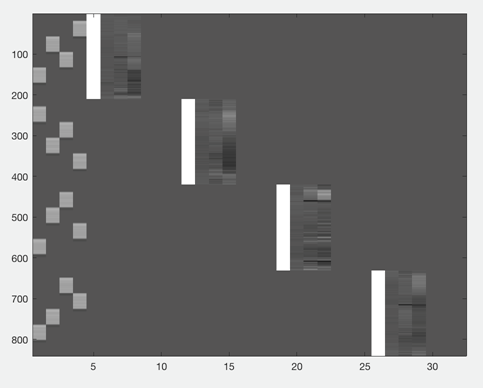
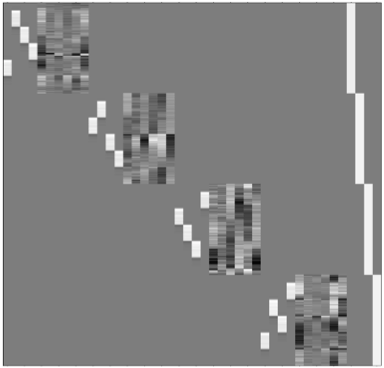
selxavg uses scenario #1, which corresponds to the 2nd image below, ie, all the task regressors are in a single column and not pulled out on a run-by-run basis. The nuisance regressors are specific to each run.
On 08/16/2017 08:24 PM, Kevin Aquino wrote:
Thanks for that Doug,
[I was hoping i could do the parametric modulation in the contrast weights -- SPM style of doing this after the betas were fit].
Regarding the X.mat question, sorry I wasn't clear. I can see it has the nuisance regressors and constant terms, but is that x.mat used to estimate the betas?
Yes
In the beta estimation which scenario is happening?
- concatenate all the model regressors onto one column, add the
nuisance regressors and constant terms into one big matrix (X.mat) to estimate the beta values 2. create a matrix for each run separately and estimate the betas. Save regression coefficients, compute contrasts and significances of contrasts. The end (default) result is the average (i guess average of all the estimated quantities).
From the help message it looks like it is #2, and if thats the case then X.mat looks like its a summary. I ask this because I would like to use a X that looks something like below: Inline image 1,
which is essentially the scenario in #2, but the output of X.mat looks like this:
Inline image 2 (the image hasn't been normalized so that is why there are blank spaces for 3 of the 6 nuisance regressors)
There are slight differences between the two (so it doesn't matter in the long run) but I just want to know which one is being used. On a quick look of selxag3-sess, the matlab files look like compiled mex files, so I can't access them.
Thanks!
*Dr Kevin Aquino* Research fellow, Sir Peter Mansfield Magnetic Resonance Center, The University of Nottingham.
Honorary Research Fellow School of Physics, Faculty of Science, University of Sydney
The brain is a wonderful organ. It starts working the moment you get up and does not stop until you get into the office.
Robert Frost
CRICOS 00026A This email plus any attachments to it are confidential. Any unauthorised use is strictly prohibited. If you receive this email in error, please delete it and any attachments.
Please think of our environment and only print this e-mail if necessary.
On Thu, Aug 17, 2017 at 8:24 AM, Douglas N Greve <greve@nmr.mgh.harvard.edu mailto:greve@nmr.mgh.harvard.edu> wrote:
It has the design matrix plus a lot of other stuff in it. For
parametric
modulation, have you seen this page

https://surfer.nmr.mgh.harvard.edu/fswiki/FsFastParametricModulation
<https://surfer.nmr.mgh.harvard.edu/fswiki/FsFastParametricModulation>

On 08/15/2017 09:52 PM, Kevin Aquino wrote:
> Dear all,
>
> I have a question regarding the output from selxavg3-sess. I noticed
> that within an analysis there  is a X.mat that looks like a design
> matrix -- however is this used at any stage of the analysis?
The help
> message in selxavg3-sess reads:
>
> "This program will construct the design matrix for each run, fit
> the GLM, save regression coefficients, compute contrasts and
> significances of contrasts. The runs are combined together so the
> output is the average across runs (some would call this a
> "second-level" analysis)."
>
> so this looks like that x.mat is constructed and used for each run
> (and not saved by default). This then looks like X.mat is not
used in
> the analysis -- it is just there for illustrative purposes? or
have I
> misinterpreted the help message.
>
>
> If this is correct (i.e. X.mat in the output is not used) when
making
> contrasts using mkcontrast-sess, is there a way to parametrically
> modulate each run? e.g. to model behavioural changes per run etc.
>
> Cheers,
>
>
> *Dr Kevin Aquino*
> Research fellow,
> Sir Peter Mansfield Magnetic Resonance Center, The University of
> Nottingham.
>
> Honorary Research Fellow
> School of Physics, Faculty of Science, University of Sydney
>
> *E* Kevin.aquino@nottingham.ac.uk
<mailto:Kevin.aquino@nottingham.ac.uk>
> <mailto:Kevin.aquino@nottingham.ac.uk
<mailto:Kevin.aquino@nottingham.ac.uk>>,
aquino@physics.usyd.edu.au <mailto:aquino@physics.usyd.edu.au>
> <mailto:aquino@physics.usyd.edu.au
<mailto:aquino@physics.usyd.edu.au>> | *W* *MailScanner has detected a
> possible fraud attempt from "www.physics.usyd.edu.au
<http://www.physics.usyd.edu.au>" claiming to be*
> https://kevinaquino.github.io
<http://www.physics.usyd.edu.au/%7Eaquino/
<http://www.physics.usyd.edu.au/%7Eaquino/>>
>
> ----------------------------------------------
>
> The brain is a wonderful organ. It starts working the moment you get
> up and does not stop until you get into the office.
> -
> Robert Frost
>
> CRICOS 00026A
> This email plus any attachments to it are confidential. Any
> unauthorised use is strictly prohibited. If you receive this
email in
> error, please delete it and any attachments.
>
> Please think of our environment and only print this e-mail if
necessary.
>
>
>
> _______________________________________________
> Freesurfer mailing list
> Freesurfer@nmr.mgh.harvard.edu
<mailto:Freesurfer@nmr.mgh.harvard.edu>
> https://mail.nmr.mgh.harvard.edu/mailman/listinfo/freesurfer
<https://mail.nmr.mgh.harvard.edu/mailman/listinfo/freesurfer>

--
Douglas N. Greve, Ph.D.
MGH-NMR Center
greve@nmr.mgh.harvard.edu <mailto:greve@nmr.mgh.harvard.edu>
Phone Number: 617-724-2358
Fax: 617-726-7422

Bugs: surfer.nmr.mgh.harvard.edu/fswiki/BugReporting
<http://surfer.nmr.mgh.harvard.edu/fswiki/BugReporting>
FileDrop: https://gate.nmr.mgh.harvard.edu/filedrop2
<https://gate.nmr.mgh.harvard.edu/filedrop2>
www.nmr.mgh.harvard.edu/facility/filedrop/index.html
<http://www.nmr.mgh.harvard.edu/facility/filedrop/index.html>
Outgoing:
ftp://surfer.nmr.mgh.harvard.edu/transfer/outgoing/flat/greve/
<ftp://surfer.nmr.mgh.harvard.edu/transfer/outgoing/flat/greve/>

_______________________________________________
Freesurfer mailing list
Freesurfer@nmr.mgh.harvard.edu <mailto:Freesurfer@nmr.mgh.harvard.edu>
https://mail.nmr.mgh.harvard.edu/mailman/listinfo/freesurfer
<https://mail.nmr.mgh.harvard.edu/mailman/listinfo/freesurfer>


The information in this e-mail is intended only for the person to
whom it is
addressed. If you believe this e-mail was sent to you in error and
the e-mail
contains patient information, please contact the Partners
Compliance HelpLine at
http://www.partners.org/complianceline
<http://www.partners.org/complianceline> . If the e-mail was sent
to you in error
but does not contain patient information, please contact the
sender and properly
dispose of the e-mail.
Freesurfer mailing list Freesurfer@nmr.mgh.harvard.edu https://mail.nmr.mgh.harvard.edu/mailman/listinfo/freesurfer
Thanks for that Doug!
Cheers,
*Dr Kevin Aquino* Research fellow, Sir Peter Mansfield Magnetic Resonance Center, The University of Nottingham.
Honorary Research Fellow School of Physics, Faculty of Science, University of Sydney
*E* Kevin.aquino@nottingham.ac.uk, aquino@physics.usyd.edu.au | *W* https://kevinaquino.github.io http://www.physics.usyd.edu.au/~aquino/
----------------------------------------------
The brain is a wonderful organ. It starts working the moment you get up and does not stop until you get into the office. - Robert Frost
CRICOS 00026A This email plus any attachments to it are confidential. Any unauthorised use is strictly prohibited. If you receive this email in error, please delete it and any attachments.
Please think of our environment and only print this e-mail if necessary.
On Fri, Aug 18, 2017 at 7:28 AM, Douglas N Greve greve@nmr.mgh.harvard.edu wrote:
selxavg uses scenario #1, which corresponds to the 2nd image below, ie, all the task regressors are in a single column and not pulled out on a run-by-run basis. The nuisance regressors are specific to each run.
On 08/16/2017 08:24 PM, Kevin Aquino wrote:
Thanks for that Doug,
[I was hoping i could do the parametric modulation in the contrast weights -- SPM style of doing this after the betas were fit].
Regarding the X.mat question, sorry I wasn't clear. I can see it has the nuisance regressors and constant terms, but is that x.mat used to estimate the betas?
Yes
In the beta estimation which scenario is happening?
- concatenate all the model regressors onto one column, add the
nuisance regressors and constant terms into one big matrix (X.mat) to estimate the beta values 2. create a matrix for each run separately and estimate the betas. Save regression coefficients, compute contrasts and significances of contrasts. The end (default) result is the average (i guess average of all the estimated quantities).
From the help message it looks like it is #2, and if thats the case then X.mat looks like its a summary. I ask this because I would like to use a X that looks something like below: Inline image 1,
which is essentially the scenario in #2, but the output of X.mat looks like this:
Inline image 2 (the image hasn't been normalized so that is why there are blank spaces for 3 of the 6 nuisance regressors)
There are slight differences between the two (so it doesn't matter in the long run) but I just want to know which one is being used. On a quick look of selxag3-sess, the matlab files look like compiled mex files, so I can't access them.
Thanks!
*Dr Kevin Aquino* Research fellow, Sir Peter Mansfield Magnetic Resonance Center, The University of Nottingham.
Honorary Research Fellow School of Physics, Faculty of Science, University of Sydney
The brain is a wonderful organ. It starts working the moment you get up and does not stop until you get into the office.
Robert Frost
CRICOS 00026A This email plus any attachments to it are confidential. Any unauthorised use is strictly prohibited. If you receive this email in error, please delete it and any attachments.
Please think of our environment and only print this e-mail if necessary.
On Thu, Aug 17, 2017 at 8:24 AM, Douglas N Greve <greve@nmr.mgh.harvard.edu mailto:greve@nmr.mgh.harvard.edu> wrote:
It has the design matrix plus a lot of other stuff in it. For
parametric
modulation, have you seen this page

https://surfer.nmr.mgh.harvard.edu/fswiki/FsFastParametricModulation
<https://surfer.nmr.mgh.harvard.edu/fswiki/
FsFastParametricModulation>
On 08/15/2017 09:52 PM, Kevin Aquino wrote:
> Dear all,
>
> I have a question regarding the output from selxavg3-sess. I
noticed
> that within an analysis there  is a X.mat that looks like a design
> matrix -- however is this used at any stage of the analysis?
The help
> message in selxavg3-sess reads:
>
> "This program will construct the design matrix for each run, fit
> the GLM, save regression coefficients, compute contrasts and
> significances of contrasts. The runs are combined together so the
> output is the average across runs (some would call this a
> "second-level" analysis)."
>
> so this looks like that x.mat is constructed and used for each run
> (and not saved by default). This then looks like X.mat is not
used in
> the analysis -- it is just there for illustrative purposes? or
have I
> misinterpreted the help message.
>
>
> If this is correct (i.e. X.mat in the output is not used) when
making
> contrasts using mkcontrast-sess, is there a way to parametrically
> modulate each run? e.g. to model behavioural changes per run etc.
>
> Cheers,
>
>
> *Dr Kevin Aquino*
> Research fellow,
> Sir Peter Mansfield Magnetic Resonance Center, The University of
> Nottingham.
>
> Honorary Research Fellow
> School of Physics, Faculty of Science, University of Sydney
>
> *E* Kevin.aquino@nottingham.ac.uk
<mailto:Kevin.aquino@nottingham.ac.uk>
> <mailto:Kevin.aquino@nottingham.ac.uk
<mailto:Kevin.aquino@nottingham.ac.uk>>,
aquino@physics.usyd.edu.au <mailto:aquino@physics.usyd.edu.au>
> <mailto:aquino@physics.usyd.edu.au
<mailto:aquino@physics.usyd.edu.au>> | *W* *MailScanner has
detected a
> possible fraud attempt from "www.physics.usyd.edu.au
<http://www.physics.usyd.edu.au>" claiming to be*
> https://kevinaquino.github.io
<http://www.physics.usyd.edu.au/%7Eaquino/
<http://www.physics.usyd.edu.au/%7Eaquino/>>
>
> ----------------------------------------------
>
> The brain is a wonderful organ. It starts working the moment you
get
> up and does not stop until you get into the office.
> -
> Robert Frost
>
> CRICOS 00026A
> This email plus any attachments to it are confidential. Any
> unauthorised use is strictly prohibited. If you receive this
email in
> error, please delete it and any attachments.
>
> Please think of our environment and only print this e-mail if
necessary.
>
>
>
> _______________________________________________
> Freesurfer mailing list
> Freesurfer@nmr.mgh.harvard.edu
<mailto:Freesurfer@nmr.mgh.harvard.edu>
> https://mail.nmr.mgh.harvard.edu/mailman/listinfo/freesurfer
<https://mail.nmr.mgh.harvard.edu/mailman/listinfo/freesurfer>

--
Douglas N. Greve, Ph.D.
MGH-NMR Center
greve@nmr.mgh.harvard.edu <mailto:greve@nmr.mgh.harvard.edu>
Phone Number: 617-724-2358
Fax: 617-726-7422

Bugs: surfer.nmr.mgh.harvard.edu/fswiki/BugReporting
<http://surfer.nmr.mgh.harvard.edu/fswiki/BugReporting>
FileDrop: https://gate.nmr.mgh.harvard.edu/filedrop2
<https://gate.nmr.mgh.harvard.edu/filedrop2>
www.nmr.mgh.harvard.edu/facility/filedrop/index.html
<http://www.nmr.mgh.harvard.edu/facility/filedrop/index.html>
Outgoing:
ftp://surfer.nmr.mgh.harvard.edu/transfer/outgoing/flat/greve/
<ftp://surfer.nmr.mgh.harvard.edu/transfer/outgoing/flat/greve/>

_______________________________________________
Freesurfer mailing list
Freesurfer@nmr.mgh.harvard.edu <mailto:Freesurfer@nmr.mgh.
harvard.edu>
https://mail.nmr.mgh.harvard.edu/mailman/listinfo/freesurfer
<https://mail.nmr.mgh.harvard.edu/mailman/listinfo/freesurfer>


The information in this e-mail is intended only for the person to
whom it is
addressed. If you believe this e-mail was sent to you in error and
the e-mail
contains patient information, please contact the Partners
Compliance HelpLine at
http://www.partners.org/complianceline
<http://www.partners.org/complianceline> . If the e-mail was sent
to you in error
but does not contain patient information, please contact the
sender and properly
dispose of the e-mail.
Freesurfer mailing list Freesurfer@nmr.mgh.harvard.edu https://mail.nmr.mgh.harvard.edu/mailman/listinfo/freesurfer
-- Douglas N. Greve, Ph.D. MGH-NMR Center greve@nmr.mgh.harvard.edu Phone Number: 617-724-2358 Fax: 617-726-7422
Bugs: surfer.nmr.mgh.harvard.edu/fswiki/BugReporting FileDrop: https://gate.nmr.mgh.harvard.edu/filedrop2 www.nmr.mgh.harvard.edu/facility/filedrop/index.html Outgoing: ftp://surfer.nmr.mgh.harvard.edu/transfer/outgoing/flat/greve/
Freesurfer mailing list Freesurfer@nmr.mgh.harvard.edu https://mail.nmr.mgh.harvard.edu/mailman/listinfo/freesurfer
freesurfer@nmr.mgh.harvard.edu
-
 Douglas N Greve
 -
 Kevin Aquino