
Is there an available list of GM regions within the list of regions in the FreeSurferColorLUT.txt?
(In particular, I am interested in a list of GM regions output in a default run of recon-all, which seems to have a maximum regionnumber of 2035. But a full list is great, too-- I'm not sure which might be already available or easier to generate.)
I had thought of using the segmentation volumes to help me differentiate ROIs. For example, I could get rid of regions that overlap with the WM volume, but I think that the segmentation might come from a slightly different bit of information than the sum of segmented regions. As shown in the attached slice image, if I underlay the WM segmentation volume (color = white), and overlay a "recon-all" parcellation+segmentation map (color = red for GM on right, yellow for GM on left, and green for non-GM) to look for overlap, I see that some of the WM seg volume overlaps with GM ROIs (overlaps are isolated pink-ish voxels and light yellow voxels; one highlighted in cross hairs). I guess this difference occurs because the segmentation volume comes from the surfaces themselves?
Anyways, this makes me think that I can't automate finding the GM, and I would rather go from LUT numbers, and hence the above question.
Thanks, pt
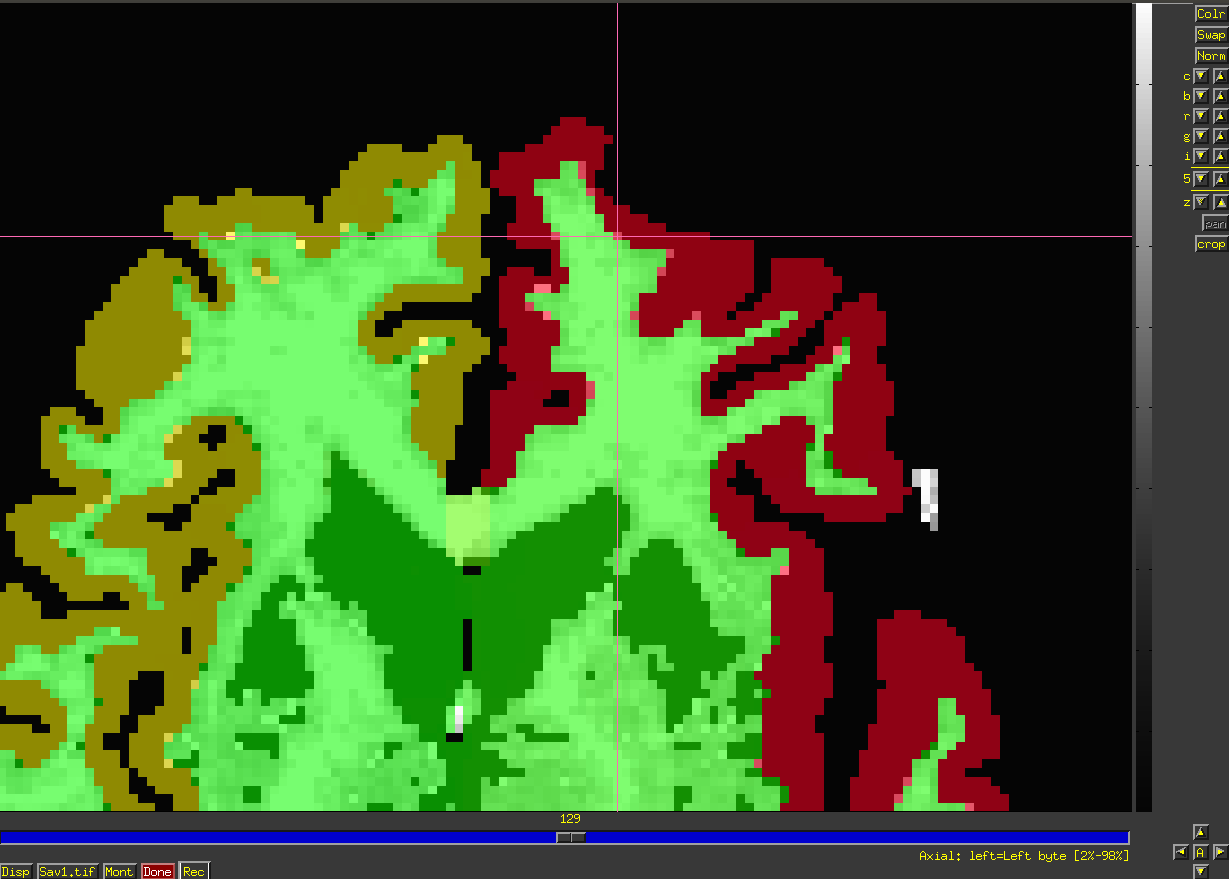

I don't know that we have a complete list in one place of just the aparc+aseg ROIs, but you can get one by running
mri_segstats --seg aparc+aseg.mgz --ctab-default --sum sum.dat
then look in the sum.dat file
On 11/03/2016 04:32 PM, P Taylor wrote:
Is there an available list of GM regions within the list of regions in the FreeSurferColorLUT.txt?
(In particular, I am interested in a list of GM regions output in a default run of recon-all, which seems to have a maximum regionnumber of 2035. But a full list is great, too-- I'm not sure which might be already available or easier to generate.)
I had thought of using the segmentation volumes to help me differentiate ROIs. For example, I could get rid of regions that overlap with the WM volume, but I think that the segmentation might come from a slightly different bit of information than the sum of segmented regions. As shown in the attached slice image, if I underlay the WM segmentation volume (color = white), and overlay a "recon-all" parcellation+segmentation map (color = red for GM on right, yellow for GM on left, and green for non-GM) to look for overlap, I see that some of the WM seg volume overlaps with GM ROIs (overlaps are isolated pink-ish voxels and light yellow voxels; one highlighted in cross hairs). I guess this difference occurs because the segmentation volume comes from the surfaces themselves?
Anyways, this makes me think that I can't automate finding the GM, and I would rather go from LUT numbers, and hence the above question.
Thanks, pt
Freesurfer mailing list Freesurfer@nmr.mgh.harvard.edu https://mail.nmr.mgh.harvard.edu/mailman/listinfo/freesurfer
Thanks, that's useful for getting the ROI volumes and a list of all that's been found for a particular data set.
I would still like to have a way to identify a listed region as gray matter or not so that I can parse the file for only GM regions that have been returned, particularly as different numbers of ROIs are typically returned in an aparc+aseg file.
I see in the aseg.stats file that there are volumetric summations for GM quantities, such as: # Measure lhCortex, lhCortexVol, Left hemisphere cortical gray matter volume, 238183.759207, mm^3 # Measure rhCortex, rhCortexVol, Right hemisphere cortical gray matter volume, 240824.502797, mm^3 # Measure Cortex, CortexVol, Total cortical gray matter volume, 479008.262004, mm^3 .... # Measure SubCortGray, SubCortGrayVol, Subcortical gray matter volume, 57815.000000, mm^3 # Measure TotalGray, TotalGrayVol, Total gray matter volume, 643956.262004, mm^3
Are these calculated by summing individual ROI volumes, so that a list of all possible GM volumes does already exist somewhere?
Thanks, pt
On Mon, Nov 7, 2016 at 3:39 PM, Douglas N Greve greve@nmr.mgh.harvard.edu wrote:
I don't know that we have a complete list in one place of just the aparc+aseg ROIs, but you can get one by running
mri_segstats --seg aparc+aseg.mgz --ctab-default --sum sum.dat
then look in the sum.dat file
On 11/03/2016 04:32 PM, P Taylor wrote:
Is there an available list of GM regions within the list of regions in the FreeSurferColorLUT.txt?
(In particular, I am interested in a list of GM regions output in a default run of recon-all, which seems to have a maximum regionnumber of 2035. But a full list is great, too-- I'm not sure which might be already available or easier to generate.)
I had thought of using the segmentation volumes to help me differentiate ROIs. For example, I could get rid of regions that overlap with the WM volume, but I think that the segmentation might come from a slightly different bit of information than the sum of segmented regions. As shown in the attached slice image, if I underlay the WM segmentation volume (color = white), and overlay a "recon-all" parcellation+segmentation map (color = red for GM on right, yellow for GM on left, and green for non-GM) to look for overlap, I see that some of the WM seg volume overlaps with GM ROIs (overlaps are isolated pink-ish voxels and light yellow voxels; one highlighted in cross hairs). I guess this difference occurs because the segmentation volume comes from the surfaces themselves?
Anyways, this makes me think that I can't automate finding the GM, and I would rather go from LUT numbers, and hence the above question.
Thanks, pt
Freesurfer mailing list Freesurfer@nmr.mgh.harvard.edu https://mail.nmr.mgh.harvard.edu/mailman/listinfo/freesurfer
-- Douglas N. Greve, Ph.D. MGH-NMR Center greve@nmr.mgh.harvard.edu Phone Number: 617-724-2358 Fax: 617-726-7422
Bugs: surfer.nmr.mgh.harvard.edu/fswiki/BugReporting FileDrop: https://gate.nmr.mgh.harvard.edu/filedrop2 www.nmr.mgh.harvard.edu/facility/filedrop/index.html Outgoing: ftp://surfer.nmr.mgh.harvard.edu/transfer/outgoing/flat/greve/
Freesurfer mailing list Freesurfer@nmr.mgh.harvard.edu https://mail.nmr.mgh.harvard.edu/mailman/listinfo/freesurfer
The information in this e-mail is intended only for the person to whom it is addressed. If you believe this e-mail was sent to you in error and the e-mail contains patient information, please contact the Partners Compliance HelpLine at http://www.partners.org/complianceline . If the e-mail was sent to you in error but does not contain patient information, please contact the sender and properly dispose of the e-mail.
We don't currently have that information (ie, tissue type) stored with the ROI. One thing you can do is to run mri_binarize with the --gm option on aparc+aseg.mgz This uses some rules to determine what is GM and creates a mask of GM. You can then feed this into mri_segstats with --mask, and it should only return ROIs that are in the GM mask.
On 11/7/16 8:10 PM, P Taylor wrote:
Thanks, that's useful for getting the ROI volumes and a list of all that's been found for a particular data set.
I would still like to have a way to identify a listed region as gray matter or not so that I can parse the file for only GM regions that have been returned, particularly as different numbers of ROIs are typically returned in an aparc+aseg file.
I see in the aseg.stats file that there are volumetric summations for GM quantities, such as: # Measure lhCortex, lhCortexVol, Left hemisphere cortical gray matter volume, 238183.759207, mm^3 # Measure rhCortex, rhCortexVol, Right hemisphere cortical gray matter volume, 240824.502797, mm^3 # Measure Cortex, CortexVol, Total cortical gray matter volume, 479008.262004, mm^3 .... # Measure SubCortGray, SubCortGrayVol, Subcortical gray matter volume, 57815.000000, mm^3 # Measure TotalGray, TotalGrayVol, Total gray matter volume, 643956.262004, mm^3
Are these calculated by summing individual ROI volumes, so that a list of all possible GM volumes does already exist somewhere?
Thanks, pt
On Mon, Nov 7, 2016 at 3:39 PM, Douglas N Greve <greve@nmr.mgh.harvard.edu mailto:greve@nmr.mgh.harvard.edu> wrote:
I don't know that we have a complete list in one place of just the
aparc+aseg ROIs, but you can get one by running

mri_segstats --seg aparc+aseg.mgz --ctab-default --sum sum.dat

then look in the sum.dat file


On 11/03/2016 04:32 PM, P Taylor wrote:
> Is there an available list of GM regions within the list of
regions in
> the FreeSurferColorLUT.txt?
>
> (In particular, I am interested in a list of GM regions output in a
> default run of recon-all, which seems to have a maximum regionnumber
> of 2035.  But a full list is great, too-- I'm not sure which
might be
> already available or easier to generate.)
>
> I had thought of using the segmentation volumes to help me
> differentiate ROIs. For example, I could get rid of regions that
> overlap with the WM volume, but I think that the segmentation might
> come from a slightly different bit of information than the sum of
> segmented regions.  As shown in the attached slice image, if I
> underlay the WM segmentation volume (color = white), and overlay a
> "recon-all" parcellation+segmentation map (color = red for GM on
> right, yellow for GM on left, and green for non-GM) to look for
> overlap, I see that some of the WM seg volume overlaps with GM ROIs
> (overlaps are isolated pink-ish voxels and light yellow voxels; one
> highlighted in cross hairs).  I guess this difference occurs because
> the segmentation volume comes from the surfaces themselves?
>
> Anyways, this makes me think that I can't automate finding the
GM, and
> I would rather go from LUT numbers, and hence the above question.
>
> Thanks,
> pt
>
>
>
> _______________________________________________
> Freesurfer mailing list
> Freesurfer@nmr.mgh.harvard.edu
<mailto:Freesurfer@nmr.mgh.harvard.edu>
> https://mail.nmr.mgh.harvard.edu/mailman/listinfo/freesurfer
<https://mail.nmr.mgh.harvard.edu/mailman/listinfo/freesurfer>

--
Douglas N. Greve, Ph.D.
MGH-NMR Center
greve@nmr.mgh.harvard.edu <mailto:greve@nmr.mgh.harvard.edu>
Phone Number: 617-724-2358 <tel:617-724-2358>
Fax: 617-726-7422 <tel:617-726-7422>

Bugs: surfer.nmr.mgh.harvard.edu/fswiki/BugReporting
<http://surfer.nmr.mgh.harvard.edu/fswiki/BugReporting>
FileDrop: https://gate.nmr.mgh.harvard.edu/filedrop2
<https://gate.nmr.mgh.harvard.edu/filedrop2>
www.nmr.mgh.harvard.edu/facility/filedrop/index.html
<http://www.nmr.mgh.harvard.edu/facility/filedrop/index.html>
Outgoing:
ftp://surfer.nmr.mgh.harvard.edu/transfer/outgoing/flat/greve/
<ftp://surfer.nmr.mgh.harvard.edu/transfer/outgoing/flat/greve/>

_______________________________________________
Freesurfer mailing list
Freesurfer@nmr.mgh.harvard.edu <mailto:Freesurfer@nmr.mgh.harvard.edu>
https://mail.nmr.mgh.harvard.edu/mailman/listinfo/freesurfer
<https://mail.nmr.mgh.harvard.edu/mailman/listinfo/freesurfer>


The information in this e-mail is intended only for the person to
whom it is
addressed. If you believe this e-mail was sent to you in error and
the e-mail
contains patient information, please contact the Partners
Compliance HelpLine at
http://www.partners.org/complianceline
<http://www.partners.org/complianceline> . If the e-mail was sent
to you in error
but does not contain patient information, please contact the
sender and properly
dispose of the e-mail.
Freesurfer mailing list Freesurfer@nmr.mgh.harvard.edu https://mail.nmr.mgh.harvard.edu/mailman/listinfo/freesurfer
Thanks, I'd like to try that. However, my mri_binarize doesn't show that option, and when I try running it, that option isn't recognized:
$ mri_binarize --gm --o map_gm.nii --i aparc+aseg.mgz ERROR: Option --gm unknown
Looking at the mri_binarize help, I see '--wm' exists, and that does, indeed, produce a WM-looking volume. I also see an option "--wm+vcsf"; would subtracting that resulting map leave only GM?
My version of FS is: ---------------------------------------------------------------------- You are running this version of FreeSurfer:
freesurfer-Linux-centos6_x86_64-stable-pub-v5.3.0 ----------------------------------------------------------------------
In the online description of mri_binarize: https://surfer.nmr.mgh.harvard.edu/fswiki/mri_binarize I see a "--subcort-gm" option that doesn't appear to work for me, but I guess that isn't full WM.
So, am I somehow behind the times? From the download page: https://surfer.nmr.mgh.harvard.edu/fswiki/DownloadAndInstall it looks like my v5.3 is the most currently available?
... and, in case it's useful, the explicit version of my mri_binarize (bottom line of the help) is: $Id: mri_binarize.c,v 1.26.2.1 2011/04/08 15:40:50 greve Exp $
Thanks, pt
On Tue, Nov 8, 2016 at 11:08 AM, Douglas Greve greve@nmr.mgh.harvard.edu wrote:
We don't currently have that information (ie, tissue type) stored
with the ROI. One thing you can do is to run mri_binarize with the
--gm option on aparc+aseg.mgz This uses some rules to determine
what is GM and creates a mask of GM. You can then feed this into
mri_segstats with --mask, and it should only return ROIs that are
in the GM mask.


On 11/7/16 8:10 PM, P Taylor wrote:
Thanks, that's useful for getting the ROI volumes and a list of all that's been found for a particular data set.
I would still like to have a way to identify a listed region as gray matter or not so that I can parse the file for only GM regions that have been returned, particularly as different numbers of ROIs are typically returned in an aparc+aseg file.
I see in the aseg.stats file that there are volumetric summations for GM quantities, such as: # Measure lhCortex, lhCortexVol, Left hemisphere cortical gray matter volume, 238183.759207, mm^3 # Measure rhCortex, rhCortexVol, Right hemisphere cortical gray matter volume, 240824.502797, mm^3 # Measure Cortex, CortexVol, Total cortical gray matter volume, 479008.262004, mm^3 .... # Measure SubCortGray, SubCortGrayVol, Subcortical gray matter volume, 57815.000000, mm^3 # Measure TotalGray, TotalGrayVol, Total gray matter volume, 643956.262004, mm^3
Are these calculated by summing individual ROI volumes, so that a list of all possible GM volumes does already exist somewhere?
Thanks, pt
On Mon, Nov 7, 2016 at 3:39 PM, Douglas N Greve <greve@nmr.mgh.harvard.edu
wrote:
I don't know that we have a complete list in one place of just the aparc+aseg ROIs, but you can get one by running
mri_segstats --seg aparc+aseg.mgz --ctab-default --sum sum.dat
then look in the sum.dat file
On 11/03/2016 04:32 PM, P Taylor wrote:
Is there an available list of GM regions within the list of regions in the FreeSurferColorLUT.txt?
(In particular, I am interested in a list of GM regions output in a default run of recon-all, which seems to have a maximum regionnumber of 2035. But a full list is great, too-- I'm not sure which might be already available or easier to generate.)
I had thought of using the segmentation volumes to help me differentiate ROIs. For example, I could get rid of regions that overlap with the WM volume, but I think that the segmentation might come from a slightly different bit of information than the sum of segmented regions. As shown in the attached slice image, if I underlay the WM segmentation volume (color = white), and overlay a "recon-all" parcellation+segmentation map (color = red for GM on right, yellow for GM on left, and green for non-GM) to look for overlap, I see that some of the WM seg volume overlaps with GM ROIs (overlaps are isolated pink-ish voxels and light yellow voxels; one highlighted in cross hairs). I guess this difference occurs because the segmentation volume comes from the surfaces themselves?
Anyways, this makes me think that I can't automate finding the GM, and I would rather go from LUT numbers, and hence the above question.
Thanks, pt
Freesurfer mailing list Freesurfer@nmr.mgh.harvard.edu https://mail.nmr.mgh.harvard.edu/mailman/listinfo/freesurfer
-- Douglas N. Greve, Ph.D. MGH-NMR Center greve@nmr.mgh.harvard.edu Phone Number: 617-724-2358 Fax: 617-726-7422
Bugs: surfer.nmr.mgh.harvard.edu/fswiki/BugReporting FileDrop: https://gate.nmr.mgh.harvard.edu/filedrop2 www.nmr.mgh.harvard.edu/facility/filedrop/index.html Outgoing: ftp://surfer.nmr.mgh.harvard.edu/transfer/outgoing/flat/greve/
Freesurfer mailing list Freesurfer@nmr.mgh.harvard.edu https://mail.nmr.mgh.harvard.edu/mailman/listinfo/freesurfer
The information in this e-mail is intended only for the person to whom it is addressed. If you believe this e-mail was sent to you in error and the e-mail contains patient information, please contact the Partners Compliance HelpLine at http://www.partners.org/complianceline . If the e-mail was sent to you in error but does not contain patient information, please contact the sender and properly dispose of the e-mail.
Freesurfer mailing listFreesurfer@nmr.mgh.harvard.eduhttps://mail.nmr.mgh.harvard.edu/mailman/listinfo/freesurfer
Freesurfer mailing list Freesurfer@nmr.mgh.harvard.edu https://mail.nmr.mgh.harvard.edu/mailman/listinfo/freesurfer
The information in this e-mail is intended only for the person to whom it is addressed. If you believe this e-mail was sent to you in error and the e-mail contains patient information, please contact the Partners Compliance HelpLine at http://www.partners.org/complianceline . If the e-mail was sent to you in error but does not contain patient information, please contact the sender and properly dispose of the e-mail.
Try this one https://gate.nmr.mgh.harvard.edu/safelinks/greve/mri_binarize
On 11/8/16 11:26 AM, P Taylor wrote:
Thanks, I'd like to try that. However, my mri_binarize doesn't show that option, and when I try running it, that option isn't recognized:
$ mri_binarize --gm --o map_gm.nii --i aparc+aseg.mgz ERROR: Option --gm unknown
Looking at the mri_binarize help, I see '--wm' exists, and that does, indeed, produce a WM-looking volume. I also see an option "--wm+vcsf"; would subtracting that resulting map leave only GM?
My version of FS is:
You are running this version of FreeSurfer:
freesurfer-Linux-centos6_x86_64-stable-pub-v5.3.0
In the online description of mri_binarize: https://surfer.nmr.mgh.harvard.edu/fswiki/mri_binarize I see a "--subcort-gm" option that doesn't appear to work for me, but I guess that isn't full WM.
So, am I somehow behind the times? From the download page: https://surfer.nmr.mgh.harvard.edu/fswiki/DownloadAndInstall it looks like my v5.3 is the most currently available?
... and, in case it's useful, the explicit version of my mri_binarize (bottom line of the help) is: $Id: mri_binarize.c,v 1.26.2.1 2011/04/08 15:40:50 greve Exp $
Thanks, pt
On Tue, Nov 8, 2016 at 11:08 AM, Douglas Greve <greve@nmr.mgh.harvard.edu mailto:greve@nmr.mgh.harvard.edu> wrote:
We don't currently have that information (ie, tissue type) stored with the ROI. One thing you can do is to run mri_binarize with the --gm option on aparc+aseg.mgz This uses some rules to determine what is GM and creates a mask of GM. You can then feed this into mri_segstats with --mask, and it should only return ROIs that are in the GM mask. On 11/7/16 8:10 PM, P Taylor wrote:Thanks, that's useful for getting the ROI volumes and a list of all that's been found for a particular data set. I would still like to have a way to identify a listed region as gray matter or not so that I can parse the file for only GM regions that have been returned, particularly as different numbers of ROIs are typically returned in an aparc+aseg file. I see in the aseg.stats file that there are volumetric summations for GM quantities, such as: # Measure lhCortex, lhCortexVol, Left hemisphere cortical gray matter volume, 238183.759207, mm^3 # Measure rhCortex, rhCortexVol, Right hemisphere cortical gray matter volume, 240824.502797, mm^3 # Measure Cortex, CortexVol, Total cortical gray matter volume, 479008.262004, mm^3 .... # Measure SubCortGray, SubCortGrayVol, Subcortical gray matter volume, 57815.000000, mm^3 # Measure TotalGray, TotalGrayVol, Total gray matter volume, 643956.262004, mm^3 Are these calculated by summing individual ROI volumes, so that a list of all possible GM volumes does already exist somewhere? Thanks, pt On Mon, Nov 7, 2016 at 3:39 PM, Douglas N Greve <greve@nmr.mgh.harvard.edu <mailto:greve@nmr.mgh.harvard.edu>> wrote: I don't know that we have a complete list in one place of just the aparc+aseg ROIs, but you can get one by running mri_segstats --seg aparc+aseg.mgz --ctab-default --sum sum.dat then look in the sum.dat file On 11/03/2016 04:32 PM, P Taylor wrote: > Is there an available list of GM regions within the list of regions in > the FreeSurferColorLUT.txt? > > (In particular, I am interested in a list of GM regions output in a > default run of recon-all, which seems to have a maximum regionnumber > of 2035. But a full list is great, too-- I'm not sure which might be > already available or easier to generate.) > > I had thought of using the segmentation volumes to help me > differentiate ROIs. For example, I could get rid of regions that > overlap with the WM volume, but I think that the segmentation might > come from a slightly different bit of information than the sum of > segmented regions. As shown in the attached slice image, if I > underlay the WM segmentation volume (color = white), and overlay a > "recon-all" parcellation+segmentation map (color = red for GM on > right, yellow for GM on left, and green for non-GM) to look for > overlap, I see that some of the WM seg volume overlaps with GM ROIs > (overlaps are isolated pink-ish voxels and light yellow voxels; one > highlighted in cross hairs). I guess this difference occurs because > the segmentation volume comes from the surfaces themselves? > > Anyways, this makes me think that I can't automate finding the GM, and > I would rather go from LUT numbers, and hence the above question. > > Thanks, > pt > > > > _______________________________________________ > Freesurfer mailing list > Freesurfer@nmr.mgh.harvard.edu <mailto:Freesurfer@nmr.mgh.harvard.edu> > https://mail.nmr.mgh.harvard.edu/mailman/listinfo/freesurfer <https://mail.nmr.mgh.harvard.edu/mailman/listinfo/freesurfer> -- Douglas N. Greve, Ph.D. MGH-NMR Center greve@nmr.mgh.harvard.edu <mailto:greve@nmr.mgh.harvard.edu> Phone Number: 617-724-2358 <tel:617-724-2358> Fax: 617-726-7422 <tel:617-726-7422> Bugs: surfer.nmr.mgh.harvard.edu/fswiki/BugReporting <http://surfer.nmr.mgh.harvard.edu/fswiki/BugReporting> FileDrop: https://gate.nmr.mgh.harvard.edu/filedrop2 <https://gate.nmr.mgh.harvard.edu/filedrop2> www.nmr.mgh.harvard.edu/facility/filedrop/index.html <http://www.nmr.mgh.harvard.edu/facility/filedrop/index.html> Outgoing: ftp://surfer.nmr.mgh.harvard.edu/transfer/outgoing/flat/greve/ <ftp://surfer.nmr.mgh.harvard.edu/transfer/outgoing/flat/greve/> _______________________________________________ Freesurfer mailing list Freesurfer@nmr.mgh.harvard.edu <mailto:Freesurfer@nmr.mgh.harvard.edu> https://mail.nmr.mgh.harvard.edu/mailman/listinfo/freesurfer <https://mail.nmr.mgh.harvard.edu/mailman/listinfo/freesurfer> The information in this e-mail is intended only for the person to whom it is addressed. If you believe this e-mail was sent to you in error and the e-mail contains patient information, please contact the Partners Compliance HelpLine at http://www.partners.org/complianceline <http://www.partners.org/complianceline> . If the e-mail was sent to you in error but does not contain patient information, please contact the sender and properly dispose of the e-mail. _______________________________________________ Freesurfer mailing list Freesurfer@nmr.mgh.harvard.edu <mailto:Freesurfer@nmr.mgh.harvard.edu> https://mail.nmr.mgh.harvard.edu/mailman/listinfo/freesurfer <https://mail.nmr.mgh.harvard.edu/mailman/listinfo/freesurfer>_______________________________________________ Freesurfer mailing list Freesurfer@nmr.mgh.harvard.edu <mailto:Freesurfer@nmr.mgh.harvard.edu> https://mail.nmr.mgh.harvard.edu/mailman/listinfo/freesurfer <https://mail.nmr.mgh.harvard.edu/mailman/listinfo/freesurfer> The information in this e-mail is intended only for the person to whom it is addressed. If you believe this e-mail was sent to you in error and the e-mail contains patient information, please contact the Partners Compliance HelpLine at http://www.partners.org/complianceline <http://www.partners.org/complianceline> . If the e-mail was sent to you in error but does not contain patient information, please contact the sender and properly dispose of the e-mail.
Freesurfer mailing list Freesurfer@nmr.mgh.harvard.edu https://mail.nmr.mgh.harvard.edu/mailman/listinfo/freesurfer
Ah, cool, that looks like it does the trick-- thanks much.
Will that version of mri_binarize be in the next release of FS?
Thanks, pt
On Tue, Nov 8, 2016 at 11:35 AM, Douglas Greve greve@nmr.mgh.harvard.edu wrote:
Try this one https://gate.nmr.mgh.harvard.edu/safelinks/greve/mri_binarize
On 11/8/16 11:26 AM, P Taylor wrote:
Thanks, I'd like to try that. However, my mri_binarize doesn't show that option, and when I try running it, that option isn't recognized:
$ mri_binarize --gm --o map_gm.nii --i aparc+aseg.mgz ERROR: Option --gm unknown
Looking at the mri_binarize help, I see '--wm' exists, and that does, indeed, produce a WM-looking volume. I also see an option "--wm+vcsf"; would subtracting that resulting map leave only GM?
My version of FS is:
You are running this version of FreeSurfer:
freesurfer-Linux-centos6_x86_64-stable-pub-v5.3.0
In the online description of mri_binarize: https://surfer.nmr.mgh.harvard.edu/fswiki/mri_binarize I see a "--subcort-gm" option that doesn't appear to work for me, but I guess that isn't full WM.
So, am I somehow behind the times? From the download page: https://surfer.nmr.mgh.harvard.edu/fswiki/DownloadAndInstall it looks like my v5.3 is the most currently available?
... and, in case it's useful, the explicit version of my mri_binarize (bottom line of the help) is: $Id: mri_binarize.c,v 1.26.2.1 2011/04/08 15:40:50 greve Exp $
Thanks, pt
On Tue, Nov 8, 2016 at 11:08 AM, Douglas Greve greve@nmr.mgh.harvard.edu wrote:
We don't currently have that information (ie, tissue type) stored with the ROI. One thing you can do is to run mri_binarize with the --gm option on aparc+aseg.mgz This uses some rules to determine what is GM and creates a mask of GM. You can then feed this into mri_segstats with --mask, and it should only return ROIs that are in the GM mask.
On 11/7/16 8:10 PM, P Taylor wrote:
Thanks, that's useful for getting the ROI volumes and a list of all that's been found for a particular data set.
I would still like to have a way to identify a listed region as gray matter or not so that I can parse the file for only GM regions that have been returned, particularly as different numbers of ROIs are typically returned in an aparc+aseg file.
I see in the aseg.stats file that there are volumetric summations for GM quantities, such as: # Measure lhCortex, lhCortexVol, Left hemisphere cortical gray matter volume, 238183.759207, mm^3 # Measure rhCortex, rhCortexVol, Right hemisphere cortical gray matter volume, 240824.502797, mm^3 # Measure Cortex, CortexVol, Total cortical gray matter volume, 479008.262004, mm^3 .... # Measure SubCortGray, SubCortGrayVol, Subcortical gray matter volume, 57815.000000, mm^3 # Measure TotalGray, TotalGrayVol, Total gray matter volume, 643956.262004, mm^3
Are these calculated by summing individual ROI volumes, so that a list of all possible GM volumes does already exist somewhere?
Thanks, pt
On Mon, Nov 7, 2016 at 3:39 PM, Douglas N Greve < greve@nmr.mgh.harvard.edu> wrote:
I don't know that we have a complete list in one place of just the aparc+aseg ROIs, but you can get one by running
mri_segstats --seg aparc+aseg.mgz --ctab-default --sum sum.dat
then look in the sum.dat file
On 11/03/2016 04:32 PM, P Taylor wrote:
Is there an available list of GM regions within the list of regions in the FreeSurferColorLUT.txt?
(In particular, I am interested in a list of GM regions output in a default run of recon-all, which seems to have a maximum regionnumber of 2035. But a full list is great, too-- I'm not sure which might be already available or easier to generate.)
I had thought of using the segmentation volumes to help me differentiate ROIs. For example, I could get rid of regions that overlap with the WM volume, but I think that the segmentation might come from a slightly different bit of information than the sum of segmented regions. As shown in the attached slice image, if I underlay the WM segmentation volume (color = white), and overlay a "recon-all" parcellation+segmentation map (color = red for GM on right, yellow for GM on left, and green for non-GM) to look for overlap, I see that some of the WM seg volume overlaps with GM ROIs (overlaps are isolated pink-ish voxels and light yellow voxels; one highlighted in cross hairs). I guess this difference occurs because the segmentation volume comes from the surfaces themselves?
Anyways, this makes me think that I can't automate finding the GM, and I would rather go from LUT numbers, and hence the above question.
Thanks, pt
Freesurfer mailing list Freesurfer@nmr.mgh.harvard.edu https://mail.nmr.mgh.harvard.edu/mailman/listinfo/freesurfer
-- Douglas N. Greve, Ph.D. MGH-NMR Center greve@nmr.mgh.harvard.edu Phone Number: 617-724-2358 Fax: 617-726-7422
Bugs: surfer.nmr.mgh.harvard.edu/fswiki/BugReporting FileDrop: https://gate.nmr.mgh.harvard.edu/filedrop2 www.nmr.mgh.harvard.edu/facility/filedrop/index.html Outgoing: ftp://surfer.nmr.mgh.harvard.edu/transfer/outgoing/flat/greve/
Freesurfer mailing list Freesurfer@nmr.mgh.harvard.edu https://mail.nmr.mgh.harvard.edu/mailman/listinfo/freesurfer
The information in this e-mail is intended only for the person to whom it is addressed. If you believe this e-mail was sent to you in error and the e-mail contains patient information, please contact the Partners Compliance HelpLine at http://www.partners.org/complianceline . If the e-mail was sent to you in error but does not contain patient information, please contact the sender and properly dispose of the e-mail.
Freesurfer mailing listFreesurfer@nmr.mgh.harvard.eduhttps://mail.nmr.mgh.harvard.edu/mailman/listinfo/freesurfer
_______________________________________________ Freesurfer mailing list Freesurfer@nmr.mgh.harvard.edu https://mail.nmr.mgh.harvard.e du/mailman/listinfo/freesurfer The information in this e-mail is intended only for the person to whom it is addressed. If you believe this e-mail was sent to you in error and the e-mail contains patient information, please contact the Partners Compliance HelpLine at http://www.partners.org/complianceline . If the e-mail was sent to you in error but does not contain patient information, please contact the sender and properly dispose of the e-mail.
Freesurfer mailing listFreesurfer@nmr.mgh.harvard.eduhttps://mail.nmr.mgh.harvard.edu/mailman/listinfo/freesurfer
Freesurfer mailing list Freesurfer@nmr.mgh.harvard.edu https://mail.nmr.mgh.harvard.edu/mailman/listinfo/freesurfer
The information in this e-mail is intended only for the person to whom it is addressed. If you believe this e-mail was sent to you in error and the e-mail contains patient information, please contact the Partners Compliance HelpLine at http://www.partners.org/complianceline . If the e-mail was sent to you in error but does not contain patient information, please contact the sender and properly dispose of the e-mail.
yes
On 11/8/16 11:51 AM, P Taylor wrote:
Ah, cool, that looks like it does the trick-- thanks much.
Will that version of mri_binarize be in the next release of FS?
Thanks, pt
On Tue, Nov 8, 2016 at 11:35 AM, Douglas Greve <greve@nmr.mgh.harvard.edu mailto:greve@nmr.mgh.harvard.edu> wrote:
Try this one https://gate.nmr.mgh.harvard.edu/safelinks/greve/mri_binarize <https://gate.nmr.mgh.harvard.edu/safelinks/greve/mri_binarize> On 11/8/16 11:26 AM, P Taylor wrote:Thanks, I'd like to try that. However, my mri_binarize doesn't show that option, and when I try running it, that option isn't recognized: $ mri_binarize --gm --o map_gm.nii --i aparc+aseg.mgz ERROR: Option --gm unknown Looking at the mri_binarize help, I see '--wm' exists, and that does, indeed, produce a WM-looking volume. I also see an option "--wm+vcsf"; would subtracting that resulting map leave only GM? My version of FS is: ---------------------------------------------------------------------- You are running this version of FreeSurfer: freesurfer-Linux-centos6_x86_64-stable-pub-v5.3.0 ---------------------------------------------------------------------- In the online description of mri_binarize: https://surfer.nmr.mgh.harvard.edu/fswiki/mri_binarize <https://surfer.nmr.mgh.harvard.edu/fswiki/mri_binarize> I see a "--subcort-gm" option that doesn't appear to work for me, but I guess that isn't full WM. So, am I somehow behind the times? From the download page: https://surfer.nmr.mgh.harvard.edu/fswiki/DownloadAndInstall <https://surfer.nmr.mgh.harvard.edu/fswiki/DownloadAndInstall> it looks like my v5.3 is the most currently available? ... and, in case it's useful, the explicit version of my mri_binarize (bottom line of the help) is: $Id: mri_binarize.c,v 1.26.2.1 2011/04/08 15:40:50 greve Exp $ Thanks, pt On Tue, Nov 8, 2016 at 11:08 AM, Douglas Greve <greve@nmr.mgh.harvard.edu <mailto:greve@nmr.mgh.harvard.edu>> wrote: We don't currently have that information (ie, tissue type) stored with the ROI. One thing you can do is to run mri_binarize with the --gm option on aparc+aseg.mgz This uses some rules to determine what is GM and creates a mask of GM. You can then feed this into mri_segstats with --mask, and it should only return ROIs that are in the GM mask. On 11/7/16 8:10 PM, P Taylor wrote:Thanks, that's useful for getting the ROI volumes and a list of all that's been found for a particular data set. I would still like to have a way to identify a listed region as gray matter or not so that I can parse the file for only GM regions that have been returned, particularly as different numbers of ROIs are typically returned in an aparc+aseg file. I see in the aseg.stats file that there are volumetric summations for GM quantities, such as: # Measure lhCortex, lhCortexVol, Left hemisphere cortical gray matter volume, 238183.759207, mm^3 # Measure rhCortex, rhCortexVol, Right hemisphere cortical gray matter volume, 240824.502797, mm^3 # Measure Cortex, CortexVol, Total cortical gray matter volume, 479008.262004, mm^3 .... # Measure SubCortGray, SubCortGrayVol, Subcortical gray matter volume, 57815.000000, mm^3 # Measure TotalGray, TotalGrayVol, Total gray matter volume, 643956.262004, mm^3 Are these calculated by summing individual ROI volumes, so that a list of all possible GM volumes does already exist somewhere? Thanks, pt On Mon, Nov 7, 2016 at 3:39 PM, Douglas N Greve <greve@nmr.mgh.harvard.edu <mailto:greve@nmr.mgh.harvard.edu>> wrote: I don't know that we have a complete list in one place of just the aparc+aseg ROIs, but you can get one by running mri_segstats --seg aparc+aseg.mgz --ctab-default --sum sum.dat then look in the sum.dat file On 11/03/2016 04:32 PM, P Taylor wrote: > Is there an available list of GM regions within the list of regions in > the FreeSurferColorLUT.txt? > > (In particular, I am interested in a list of GM regions output in a > default run of recon-all, which seems to have a maximum regionnumber > of 2035. But a full list is great, too-- I'm not sure which might be > already available or easier to generate.) > > I had thought of using the segmentation volumes to help me > differentiate ROIs. For example, I could get rid of regions that > overlap with the WM volume, but I think that the segmentation might > come from a slightly different bit of information than the sum of > segmented regions. As shown in the attached slice image, if I > underlay the WM segmentation volume (color = white), and overlay a > "recon-all" parcellation+segmentation map (color = red for GM on > right, yellow for GM on left, and green for non-GM) to look for > overlap, I see that some of the WM seg volume overlaps with GM ROIs > (overlaps are isolated pink-ish voxels and light yellow voxels; one > highlighted in cross hairs). I guess this difference occurs because > the segmentation volume comes from the surfaces themselves? > > Anyways, this makes me think that I can't automate finding the GM, and > I would rather go from LUT numbers, and hence the above question. > > Thanks, > pt > > > > _______________________________________________ > Freesurfer mailing list > Freesurfer@nmr.mgh.harvard.edu <mailto:Freesurfer@nmr.mgh.harvard.edu> > https://mail.nmr.mgh.harvard.edu/mailman/listinfo/freesurfer <https://mail.nmr.mgh.harvard.edu/mailman/listinfo/freesurfer> -- Douglas N. Greve, Ph.D. MGH-NMR Center greve@nmr.mgh.harvard.edu <mailto:greve@nmr.mgh.harvard.edu> Phone Number: 617-724-2358 <tel:617-724-2358> Fax: 617-726-7422 <tel:617-726-7422> Bugs: surfer.nmr.mgh.harvard.edu/fswiki/BugReporting <http://surfer.nmr.mgh.harvard.edu/fswiki/BugReporting> FileDrop: https://gate.nmr.mgh.harvard.edu/filedrop2 <https://gate.nmr.mgh.harvard.edu/filedrop2> www.nmr.mgh.harvard.edu/facility/filedrop/index.html <http://www.nmr.mgh.harvard.edu/facility/filedrop/index.html> Outgoing: ftp://surfer.nmr.mgh.harvard.edu/transfer/outgoing/flat/greve/ <ftp://surfer.nmr.mgh.harvard.edu/transfer/outgoing/flat/greve/> _______________________________________________ Freesurfer mailing list Freesurfer@nmr.mgh.harvard.edu <mailto:Freesurfer@nmr.mgh.harvard.edu> https://mail.nmr.mgh.harvard.edu/mailman/listinfo/freesurfer <https://mail.nmr.mgh.harvard.edu/mailman/listinfo/freesurfer> The information in this e-mail is intended only for the person to whom it is addressed. If you believe this e-mail was sent to you in error and the e-mail contains patient information, please contact the Partners Compliance HelpLine at http://www.partners.org/complianceline <http://www.partners.org/complianceline> . If the e-mail was sent to you in error but does not contain patient information, please contact the sender and properly dispose of the e-mail. _______________________________________________ Freesurfer mailing list Freesurfer@nmr.mgh.harvard.edu <mailto:Freesurfer@nmr.mgh.harvard.edu> https://mail.nmr.mgh.harvard.edu/mailman/listinfo/freesurfer <https://mail.nmr.mgh.harvard.edu/mailman/listinfo/freesurfer>_______________________________________________ Freesurfer mailing list Freesurfer@nmr.mgh.harvard.edu <mailto:Freesurfer@nmr.mgh.harvard.edu> https://mail.nmr.mgh.harvard.edu/mailman/listinfo/freesurfer <https://mail.nmr.mgh.harvard.edu/mailman/listinfo/freesurfer> The information in this e-mail is intended only for the person to whom it is addressed. If you believe this e-mail was sent to you in error and the e-mail contains patient information, please contact the Partners Compliance HelpLine at http://www.partners.org/complianceline <http://www.partners.org/complianceline> . If the e-mail was sent to you in error but does not contain patient information, please contact the sender and properly dispose of the e-mail. _______________________________________________ Freesurfer mailing list Freesurfer@nmr.mgh.harvard.edu <mailto:Freesurfer@nmr.mgh.harvard.edu> https://mail.nmr.mgh.harvard.edu/mailman/listinfo/freesurfer <https://mail.nmr.mgh.harvard.edu/mailman/listinfo/freesurfer>_______________________________________________ Freesurfer mailing list Freesurfer@nmr.mgh.harvard.edu <mailto:Freesurfer@nmr.mgh.harvard.edu> https://mail.nmr.mgh.harvard.edu/mailman/listinfo/freesurfer <https://mail.nmr.mgh.harvard.edu/mailman/listinfo/freesurfer> The information in this e-mail is intended only for the person to whom it is addressed. If you believe this e-mail was sent to you in error and the e-mail contains patient information, please contact the Partners Compliance HelpLine at http://www.partners.org/complianceline <http://www.partners.org/complianceline> . If the e-mail was sent to you in error but does not contain patient information, please contact the sender and properly dispose of the e-mail.
Freesurfer mailing list Freesurfer@nmr.mgh.harvard.edu https://mail.nmr.mgh.harvard.edu/mailman/listinfo/freesurfer
And a final question, which might be a silly one-- This GM map applies to both the aparc.a2009s+aseg.mgz and aparc+aseg.mgz files, right?
Running "mri_binarize --gm ..." on each of those files separately gave the same mask-- I believe this should be a general property?
Thanks, pt
On Tue, Nov 8, 2016 at 11:57 AM, Douglas Greve greve@nmr.mgh.harvard.edu wrote:
yes
On 11/8/16 11:51 AM, P Taylor wrote:
Ah, cool, that looks like it does the trick-- thanks much.
Will that version of mri_binarize be in the next release of FS?
Thanks, pt
On Tue, Nov 8, 2016 at 11:35 AM, Douglas Greve greve@nmr.mgh.harvard.edu wrote:
Try this one https://gate.nmr.mgh.harvard.edu/safelinks/greve/mri_binariz e
On 11/8/16 11:26 AM, P Taylor wrote:
Thanks, I'd like to try that. However, my mri_binarize doesn't show that option, and when I try running it, that option isn't recognized:
$ mri_binarize --gm --o map_gm.nii --i aparc+aseg.mgz ERROR: Option --gm unknown
Looking at the mri_binarize help, I see '--wm' exists, and that does, indeed, produce a WM-looking volume. I also see an option "--wm+vcsf"; would subtracting that resulting map leave only GM?
My version of FS is:
You are running this version of FreeSurfer:
freesurfer-Linux-centos6_x86_64-stable-pub-v5.3.0
In the online description of mri_binarize: https://surfer.nmr.mgh.harvard.edu/fswiki/mri_binarize I see a "--subcort-gm" option that doesn't appear to work for me, but I guess that isn't full WM.
So, am I somehow behind the times? From the download page: https://surfer.nmr.mgh.harvard.edu/fswiki/DownloadAndInstall it looks like my v5.3 is the most currently available?
... and, in case it's useful, the explicit version of my mri_binarize (bottom line of the help) is: $Id: mri_binarize.c,v 1.26.2.1 2011/04/08 15:40:50 greve Exp $
Thanks, pt
On Tue, Nov 8, 2016 at 11:08 AM, Douglas Greve <greve@nmr.mgh.harvard.edu
wrote:
We don't currently have that information (ie, tissue type) stored with the ROI. One thing you can do is to run mri_binarize with the --gm option on aparc+aseg.mgz This uses some rules to determine what is GM and creates a mask of GM. You can then feed this into mri_segstats with --mask, and it should only return ROIs that are in the GM mask.
On 11/7/16 8:10 PM, P Taylor wrote:
Thanks, that's useful for getting the ROI volumes and a list of all that's been found for a particular data set.
I would still like to have a way to identify a listed region as gray matter or not so that I can parse the file for only GM regions that have been returned, particularly as different numbers of ROIs are typically returned in an aparc+aseg file.
I see in the aseg.stats file that there are volumetric summations for GM quantities, such as: # Measure lhCortex, lhCortexVol, Left hemisphere cortical gray matter volume, 238183.759207, mm^3 # Measure rhCortex, rhCortexVol, Right hemisphere cortical gray matter volume, 240824.502797, mm^3 # Measure Cortex, CortexVol, Total cortical gray matter volume, 479008.262004, mm^3 .... # Measure SubCortGray, SubCortGrayVol, Subcortical gray matter volume, 57815.000000, mm^3 # Measure TotalGray, TotalGrayVol, Total gray matter volume, 643956.262004, mm^3
Are these calculated by summing individual ROI volumes, so that a list of all possible GM volumes does already exist somewhere?
Thanks, pt
On Mon, Nov 7, 2016 at 3:39 PM, Douglas N Greve < greve@nmr.mgh.harvard.edu> wrote:
I don't know that we have a complete list in one place of just the aparc+aseg ROIs, but you can get one by running
mri_segstats --seg aparc+aseg.mgz --ctab-default --sum sum.dat
then look in the sum.dat file
On 11/03/2016 04:32 PM, P Taylor wrote:
Is there an available list of GM regions within the list of regions in the FreeSurferColorLUT.txt?
(In particular, I am interested in a list of GM regions output in a default run of recon-all, which seems to have a maximum regionnumber of 2035. But a full list is great, too-- I'm not sure which might be already available or easier to generate.)
I had thought of using the segmentation volumes to help me differentiate ROIs. For example, I could get rid of regions that overlap with the WM volume, but I think that the segmentation might come from a slightly different bit of information than the sum of segmented regions. As shown in the attached slice image, if I underlay the WM segmentation volume (color = white), and overlay a "recon-all" parcellation+segmentation map (color = red for GM on right, yellow for GM on left, and green for non-GM) to look for overlap, I see that some of the WM seg volume overlaps with GM ROIs (overlaps are isolated pink-ish voxels and light yellow voxels; one highlighted in cross hairs). I guess this difference occurs because the segmentation volume comes from the surfaces themselves?
Anyways, this makes me think that I can't automate finding the GM, and I would rather go from LUT numbers, and hence the above question.
Thanks, pt
Freesurfer mailing list Freesurfer@nmr.mgh.harvard.edu https://mail.nmr.mgh.harvard.edu/mailman/listinfo/freesurfer
-- Douglas N. Greve, Ph.D. MGH-NMR Center greve@nmr.mgh.harvard.edu Phone Number: 617-724-2358 Fax: 617-726-7422
Bugs: surfer.nmr.mgh.harvard.edu/fswiki/BugReporting FileDrop: https://gate.nmr.mgh.harvard.edu/filedrop2 www.nmr.mgh.harvard.edu/facility/filedrop/index.html Outgoing: ftp://surfer.nmr.mgh.harvard.edu/transfer/outgoing/flat/grev e/
Freesurfer mailing list Freesurfer@nmr.mgh.harvard.edu https://mail.nmr.mgh.harvard.edu/mailman/listinfo/freesurfer
The information in this e-mail is intended only for the person to whom it is addressed. If you believe this e-mail was sent to you in error and the e-mail contains patient information, please contact the Partners Compliance HelpLine at http://www.partners.org/complianceline . If the e-mail was sent to you in error but does not contain patient information, please contact the sender and properly dispose of the e-mail.
Freesurfer mailing listFreesurfer@nmr.mgh.harvard.eduhttps://mail.nmr.mgh.harvard.edu/mailman/listinfo/freesurfer
_______________________________________________ Freesurfer mailing list Freesurfer@nmr.mgh.harvard.edu https://mail.nmr.mgh.harvard.e du/mailman/listinfo/freesurfer The information in this e-mail is intended only for the person to whom it is addressed. If you believe this e-mail was sent to you in error and the e-mail contains patient information, please contact the Partners Compliance HelpLine at http://www.partners.org/complianceline . If the e-mail was sent to you in error but does not contain patient information, please contact the sender and properly dispose of the e-mail.
Freesurfer mailing listFreesurfer@nmr.mgh.harvard.eduhttps://mail.nmr.mgh.harvard.edu/mailman/listinfo/freesurfer
_______________________________________________ Freesurfer mailing list Freesurfer@nmr.mgh.harvard.edu https://mail.nmr.mgh.harvard.e du/mailman/listinfo/freesurfer The information in this e-mail is intended only for the person to whom it is addressed. If you believe this e-mail was sent to you in error and the e-mail contains patient information, please contact the Partners Compliance HelpLine at http://www.partners.org/complianceline . If the e-mail was sent to you in error but does not contain patient information, please contact the sender and properly dispose of the e-mail.
Freesurfer mailing listFreesurfer@nmr.mgh.harvard.eduhttps://mail.nmr.mgh.harvard.edu/mailman/listinfo/freesurfer
Freesurfer mailing list Freesurfer@nmr.mgh.harvard.edu https://mail.nmr.mgh.harvard.edu/mailman/listinfo/freesurfer
The information in this e-mail is intended only for the person to whom it is addressed. If you believe this e-mail was sent to you in error and the e-mail contains patient information, please contact the Partners Compliance HelpLine at http://www.partners.org/complianceline . If the e-mail was sent to you in error but does not contain patient information, please contact the sender and properly dispose of the e-mail.
Yes. It just uses a rule on the numbers that it expects to be GM. At some point, I'll add both tissue type and laterality info to the ROIs, but not for version 6
On 11/8/16 12:03 PM, P Taylor wrote:
And a final question, which might be a silly one-- This GM map applies to both the aparc.a2009s+aseg.mgz and aparc+aseg.mgz files, right?
Running "mri_binarize --gm ..." on each of those files separately gave the same mask-- I believe this should be a general property?
Thanks, pt
On Tue, Nov 8, 2016 at 11:57 AM, Douglas Greve <greve@nmr.mgh.harvard.edu mailto:greve@nmr.mgh.harvard.edu> wrote:
yes On 11/8/16 11:51 AM, P Taylor wrote:Ah, cool, that looks like it does the trick-- thanks much. Will that version of mri_binarize be in the next release of FS? Thanks, pt On Tue, Nov 8, 2016 at 11:35 AM, Douglas Greve <greve@nmr.mgh.harvard.edu <mailto:greve@nmr.mgh.harvard.edu>> wrote: Try this one https://gate.nmr.mgh.harvard.edu/safelinks/greve/mri_binarize <https://gate.nmr.mgh.harvard.edu/safelinks/greve/mri_binarize> On 11/8/16 11:26 AM, P Taylor wrote:Thanks, I'd like to try that. However, my mri_binarize doesn't show that option, and when I try running it, that option isn't recognized: $ mri_binarize --gm --o map_gm.nii --i aparc+aseg.mgz ERROR: Option --gm unknown Looking at the mri_binarize help, I see '--wm' exists, and that does, indeed, produce a WM-looking volume. I also see an option "--wm+vcsf"; would subtracting that resulting map leave only GM? My version of FS is: ---------------------------------------------------------------------- You are running this version of FreeSurfer: freesurfer-Linux-centos6_x86_64-stable-pub-v5.3.0 ---------------------------------------------------------------------- In the online description of mri_binarize: https://surfer.nmr.mgh.harvard.edu/fswiki/mri_binarize <https://surfer.nmr.mgh.harvard.edu/fswiki/mri_binarize> I see a "--subcort-gm" option that doesn't appear to work for me, but I guess that isn't full WM. So, am I somehow behind the times? From the download page: https://surfer.nmr.mgh.harvard.edu/fswiki/DownloadAndInstall <https://surfer.nmr.mgh.harvard.edu/fswiki/DownloadAndInstall> it looks like my v5.3 is the most currently available? ... and, in case it's useful, the explicit version of my mri_binarize (bottom line of the help) is: $Id: mri_binarize.c,v 1.26.2.1 2011/04/08 15:40:50 greve Exp $ Thanks, pt On Tue, Nov 8, 2016 at 11:08 AM, Douglas Greve <greve@nmr.mgh.harvard.edu <mailto:greve@nmr.mgh.harvard.edu>> wrote: We don't currently have that information (ie, tissue type) stored with the ROI. One thing you can do is to run mri_binarize with the --gm option on aparc+aseg.mgz This uses some rules to determine what is GM and creates a mask of GM. You can then feed this into mri_segstats with --mask, and it should only return ROIs that are in the GM mask. On 11/7/16 8:10 PM, P Taylor wrote:Thanks, that's useful for getting the ROI volumes and a list of all that's been found for a particular data set. I would still like to have a way to identify a listed region as gray matter or not so that I can parse the file for only GM regions that have been returned, particularly as different numbers of ROIs are typically returned in an aparc+aseg file. I see in the aseg.stats file that there are volumetric summations for GM quantities, such as: # Measure lhCortex, lhCortexVol, Left hemisphere cortical gray matter volume, 238183.759207, mm^3 # Measure rhCortex, rhCortexVol, Right hemisphere cortical gray matter volume, 240824.502797, mm^3 # Measure Cortex, CortexVol, Total cortical gray matter volume, 479008.262004, mm^3 .... # Measure SubCortGray, SubCortGrayVol, Subcortical gray matter volume, 57815.000000, mm^3 # Measure TotalGray, TotalGrayVol, Total gray matter volume, 643956.262004, mm^3 Are these calculated by summing individual ROI volumes, so that a list of all possible GM volumes does already exist somewhere? Thanks, pt On Mon, Nov 7, 2016 at 3:39 PM, Douglas N Greve <greve@nmr.mgh.harvard.edu <mailto:greve@nmr.mgh.harvard.edu>> wrote: I don't know that we have a complete list in one place of just the aparc+aseg ROIs, but you can get one by running mri_segstats --seg aparc+aseg.mgz --ctab-default --sum sum.dat then look in the sum.dat file On 11/03/2016 04:32 PM, P Taylor wrote: > Is there an available list of GM regions within the list of regions in > the FreeSurferColorLUT.txt? > > (In particular, I am interested in a list of GM regions output in a > default run of recon-all, which seems to have a maximum regionnumber > of 2035. But a full list is great, too-- I'm not sure which might be > already available or easier to generate.) > > I had thought of using the segmentation volumes to help me > differentiate ROIs. For example, I could get rid of regions that > overlap with the WM volume, but I think that the segmentation might > come from a slightly different bit of information than the sum of > segmented regions. As shown in the attached slice image, if I > underlay the WM segmentation volume (color = white), and overlay a > "recon-all" parcellation+segmentation map (color = red for GM on > right, yellow for GM on left, and green for non-GM) to look for > overlap, I see that some of the WM seg volume overlaps with GM ROIs > (overlaps are isolated pink-ish voxels and light yellow voxels; one > highlighted in cross hairs). I guess this difference occurs because > the segmentation volume comes from the surfaces themselves? > > Anyways, this makes me think that I can't automate finding the GM, and > I would rather go from LUT numbers, and hence the above question. > > Thanks, > pt > > > > _______________________________________________ > Freesurfer mailing list > Freesurfer@nmr.mgh.harvard.edu <mailto:Freesurfer@nmr.mgh.harvard.edu> > https://mail.nmr.mgh.harvard.edu/mailman/listinfo/freesurfer <https://mail.nmr.mgh.harvard.edu/mailman/listinfo/freesurfer> -- Douglas N. Greve, Ph.D. MGH-NMR Center greve@nmr.mgh.harvard.edu <mailto:greve@nmr.mgh.harvard.edu> Phone Number: 617-724-2358 <tel:617-724-2358> Fax: 617-726-7422 <tel:617-726-7422> Bugs: surfer.nmr.mgh.harvard.edu/fswiki/BugReporting <http://surfer.nmr.mgh.harvard.edu/fswiki/BugReporting> FileDrop: https://gate.nmr.mgh.harvard.edu/filedrop2 <https://gate.nmr.mgh.harvard.edu/filedrop2> www.nmr.mgh.harvard.edu/facility/filedrop/index.html <http://www.nmr.mgh.harvard.edu/facility/filedrop/index.html> Outgoing: ftp://surfer.nmr.mgh.harvard.edu/transfer/outgoing/flat/greve/ <ftp://surfer.nmr.mgh.harvard.edu/transfer/outgoing/flat/greve/> _______________________________________________ Freesurfer mailing list Freesurfer@nmr.mgh.harvard.edu <mailto:Freesurfer@nmr.mgh.harvard.edu> https://mail.nmr.mgh.harvard.edu/mailman/listinfo/freesurfer <https://mail.nmr.mgh.harvard.edu/mailman/listinfo/freesurfer> The information in this e-mail is intended only for the person to whom it is addressed. If you believe this e-mail was sent to you in error and the e-mail contains patient information, please contact the Partners Compliance HelpLine at http://www.partners.org/complianceline <http://www.partners.org/complianceline> . If the e-mail was sent to you in error but does not contain patient information, please contact the sender and properly dispose of the e-mail. _______________________________________________ Freesurfer mailing list Freesurfer@nmr.mgh.harvard.edu <mailto:Freesurfer@nmr.mgh.harvard.edu> https://mail.nmr.mgh.harvard.edu/mailman/listinfo/freesurfer <https://mail.nmr.mgh.harvard.edu/mailman/listinfo/freesurfer>_______________________________________________ Freesurfer mailing list Freesurfer@nmr.mgh.harvard.edu <mailto:Freesurfer@nmr.mgh.harvard.edu> https://mail.nmr.mgh.harvard.edu/mailman/listinfo/freesurfer <https://mail.nmr.mgh.harvard.edu/mailman/listinfo/freesurfer> The information in this e-mail is intended only for the person to whom it is addressed. If you believe this e-mail was sent to you in error and the e-mail contains patient information, please contact the Partners Compliance HelpLine at http://www.partners.org/complianceline <http://www.partners.org/complianceline> . If the e-mail was sent to you in error but does not contain patient information, please contact the sender and properly dispose of the e-mail. _______________________________________________ Freesurfer mailing list Freesurfer@nmr.mgh.harvard.edu <mailto:Freesurfer@nmr.mgh.harvard.edu> https://mail.nmr.mgh.harvard.edu/mailman/listinfo/freesurfer <https://mail.nmr.mgh.harvard.edu/mailman/listinfo/freesurfer>_______________________________________________ Freesurfer mailing list Freesurfer@nmr.mgh.harvard.edu <mailto:Freesurfer@nmr.mgh.harvard.edu> https://mail.nmr.mgh.harvard.edu/mailman/listinfo/freesurfer <https://mail.nmr.mgh.harvard.edu/mailman/listinfo/freesurfer> The information in this e-mail is intended only for the person to whom it is addressed. If you believe this e-mail was sent to you in error and the e-mail contains patient information, please contact the Partners Compliance HelpLine at http://www.partners.org/complianceline <http://www.partners.org/complianceline> . If the e-mail was sent to you in error but does not contain patient information, please contact the sender and properly dispose of the e-mail. _______________________________________________ Freesurfer mailing list Freesurfer@nmr.mgh.harvard.edu <mailto:Freesurfer@nmr.mgh.harvard.edu> https://mail.nmr.mgh.harvard.edu/mailman/listinfo/freesurfer <https://mail.nmr.mgh.harvard.edu/mailman/listinfo/freesurfer>_______________________________________________ Freesurfer mailing list Freesurfer@nmr.mgh.harvard.edu <mailto:Freesurfer@nmr.mgh.harvard.edu> https://mail.nmr.mgh.harvard.edu/mailman/listinfo/freesurfer <https://mail.nmr.mgh.harvard.edu/mailman/listinfo/freesurfer> The information in this e-mail is intended only for the person to whom it is addressed. If you believe this e-mail was sent to you in error and the e-mail contains patient information, please contact the Partners Compliance HelpLine at http://www.partners.org/complianceline <http://www.partners.org/complianceline> . If the e-mail was sent to you in error but does not contain patient information, please contact the sender and properly dispose of the e-mail.
Freesurfer mailing list Freesurfer@nmr.mgh.harvard.edu https://mail.nmr.mgh.harvard.edu/mailman/listinfo/freesurfer
OK. But going back to my question that kicked this thread off, actually what I was looking for was just such a rule.
I could make a fairly solid list of GM from using this new "mri_binarize --gm ...." on several recon-all outputs. Would it be possible to have the rule (presumably a list of numbers corresponding to GM ROIs?) so I can have as secure a set of GM labels as possible?
Thanks, pt
On Tue, Nov 8, 2016 at 12:29 PM, Douglas Greve greve@nmr.mgh.harvard.edu wrote:
Yes. It just uses a rule on the numbers that it expects to be GM. At some point, I'll add both tissue type and laterality info to the ROIs, but not for version 6
On 11/8/16 12:03 PM, P Taylor wrote:
And a final question, which might be a silly one-- This GM map applies to both the aparc.a2009s+aseg.mgz and aparc+aseg.mgz files, right?
Running "mri_binarize --gm ..." on each of those files separately gave the same mask-- I believe this should be a general property?
Thanks, pt
On Tue, Nov 8, 2016 at 11:57 AM, Douglas Greve greve@nmr.mgh.harvard.edu wrote:
yes
On 11/8/16 11:51 AM, P Taylor wrote:
Ah, cool, that looks like it does the trick-- thanks much.
Will that version of mri_binarize be in the next release of FS?
Thanks, pt
On Tue, Nov 8, 2016 at 11:35 AM, Douglas Greve <greve@nmr.mgh.harvard.edu
wrote:
Try this one https://gate.nmr.mgh.harvard.e du/safelinks/greve/mri_binarize
On 11/8/16 11:26 AM, P Taylor wrote:
Thanks, I'd like to try that. However, my mri_binarize doesn't show that option, and when I try running it, that option isn't recognized:
$ mri_binarize --gm --o map_gm.nii --i aparc+aseg.mgz ERROR: Option --gm unknown
Looking at the mri_binarize help, I see '--wm' exists, and that does, indeed, produce a WM-looking volume. I also see an option "--wm+vcsf"; would subtracting that resulting map leave only GM?
My version of FS is:
You are running this version of FreeSurfer:
freesurfer-Linux-centos6_x86_64-stable-pub-v5.3.0
In the online description of mri_binarize: https://surfer.nmr.mgh.harvard.edu/fswiki/mri_binarize I see a "--subcort-gm" option that doesn't appear to work for me, but I guess that isn't full WM.
So, am I somehow behind the times? From the download page: https://surfer.nmr.mgh.harvard.edu/fswiki/DownloadAndInstall it looks like my v5.3 is the most currently available?
... and, in case it's useful, the explicit version of my mri_binarize (bottom line of the help) is: $Id: mri_binarize.c,v 1.26.2.1 2011/04/08 15:40:50 greve Exp $
Thanks, pt
On Tue, Nov 8, 2016 at 11:08 AM, Douglas Greve < greve@nmr.mgh.harvard.edu> wrote:
We don't currently have that information (ie, tissue type) stored with the ROI. One thing you can do is to run mri_binarize with the --gm option on aparc+aseg.mgz This uses some rules to determine what is GM and creates a mask of GM. You can then feed this into mri_segstats with --mask, and it should only return ROIs that are in the GM mask.
On 11/7/16 8:10 PM, P Taylor wrote:
Thanks, that's useful for getting the ROI volumes and a list of all that's been found for a particular data set.
I would still like to have a way to identify a listed region as gray matter or not so that I can parse the file for only GM regions that have been returned, particularly as different numbers of ROIs are typically returned in an aparc+aseg file.
I see in the aseg.stats file that there are volumetric summations for GM quantities, such as: # Measure lhCortex, lhCortexVol, Left hemisphere cortical gray matter volume, 238183.759207, mm^3 # Measure rhCortex, rhCortexVol, Right hemisphere cortical gray matter volume, 240824.502797, mm^3 # Measure Cortex, CortexVol, Total cortical gray matter volume, 479008.262004, mm^3 .... # Measure SubCortGray, SubCortGrayVol, Subcortical gray matter volume, 57815.000000, mm^3 # Measure TotalGray, TotalGrayVol, Total gray matter volume, 643956.262004, mm^3
Are these calculated by summing individual ROI volumes, so that a list of all possible GM volumes does already exist somewhere?
Thanks, pt
On Mon, Nov 7, 2016 at 3:39 PM, Douglas N Greve < greve@nmr.mgh.harvard.edu> wrote:
I don't know that we have a complete list in one place of just the aparc+aseg ROIs, but you can get one by running
mri_segstats --seg aparc+aseg.mgz --ctab-default --sum sum.dat
then look in the sum.dat file
On 11/03/2016 04:32 PM, P Taylor wrote:
Is there an available list of GM regions within the list of regions
in
the FreeSurferColorLUT.txt?
(In particular, I am interested in a list of GM regions output in a default run of recon-all, which seems to have a maximum regionnumber of 2035. But a full list is great, too-- I'm not sure which might be already available or easier to generate.)
I had thought of using the segmentation volumes to help me differentiate ROIs. For example, I could get rid of regions that overlap with the WM volume, but I think that the segmentation might come from a slightly different bit of information than the sum of segmented regions. As shown in the attached slice image, if I underlay the WM segmentation volume (color = white), and overlay a "recon-all" parcellation+segmentation map (color = red for GM on right, yellow for GM on left, and green for non-GM) to look for overlap, I see that some of the WM seg volume overlaps with GM ROIs (overlaps are isolated pink-ish voxels and light yellow voxels; one highlighted in cross hairs). I guess this difference occurs because the segmentation volume comes from the surfaces themselves?
Anyways, this makes me think that I can't automate finding the GM,
and
I would rather go from LUT numbers, and hence the above question.
Thanks, pt
Freesurfer mailing list Freesurfer@nmr.mgh.harvard.edu https://mail.nmr.mgh.harvard.edu/mailman/listinfo/freesurfer
-- Douglas N. Greve, Ph.D. MGH-NMR Center greve@nmr.mgh.harvard.edu Phone Number: 617-724-2358 Fax: 617-726-7422
Bugs: surfer.nmr.mgh.harvard.edu/fswiki/BugReporting FileDrop: https://gate.nmr.mgh.harvard.edu/filedrop2 www.nmr.mgh.harvard.edu/facility/filedrop/index.html Outgoing: ftp://surfer.nmr.mgh.harvard.edu/transfer/outgoing/flat/grev e/
Freesurfer mailing list Freesurfer@nmr.mgh.harvard.edu https://mail.nmr.mgh.harvard.edu/mailman/listinfo/freesurfer
The information in this e-mail is intended only for the person to whom it is addressed. If you believe this e-mail was sent to you in error and the e-mail contains patient information, please contact the Partners Compliance HelpLine at http://www.partners.org/complianceline . If the e-mail was sent to you in error but does not contain patient information, please contact the sender and properly dispose of the e-mail.
Freesurfer mailing listFreesurfer@nmr.mgh.harvard.eduhttps://mail.nmr.mgh.harvard.edu/mailman/listinfo/freesurfer
_______________________________________________ Freesurfer mailing list Freesurfer@nmr.mgh.harvard.edu https://mail.nmr.mgh.harvard.e du/mailman/listinfo/freesurfer The information in this e-mail is intended only for the person to whom it is addressed. If you believe this e-mail was sent to you in error and the e-mail contains patient information, please contact the Partners Compliance HelpLine at http://www.partners.org/complianceline . If the e-mail was sent to you in error but does not contain patient information, please contact the sender and properly dispose of the e-mail.
Freesurfer mailing listFreesurfer@nmr.mgh.harvard.eduhttps://mail.nmr.mgh.harvard.edu/mailman/listinfo/freesurfer
_______________________________________________ Freesurfer mailing list Freesurfer@nmr.mgh.harvard.edu https://mail.nmr.mgh.harvard.e du/mailman/listinfo/freesurfer The information in this e-mail is intended only for the person to whom it is addressed. If you believe this e-mail was sent to you in error and the e-mail contains patient information, please contact the Partners Compliance HelpLine at http://www.partners.org/complianceline . If the e-mail was sent to you in error but does not contain patient information, please contact the sender and properly dispose of the e-mail.
Freesurfer mailing listFreesurfer@nmr.mgh.harvard.eduhttps://mail.nmr.mgh.harvard.edu/mailman/listinfo/freesurfer
_______________________________________________ Freesurfer mailing list Freesurfer@nmr.mgh.harvard.edu https://mail.nmr.mgh.harvard.e du/mailman/listinfo/freesurfer The information in this e-mail is intended only for the person to whom it is addressed. If you believe this e-mail was sent to you in error and the e-mail contains patient information, please contact the Partners Compliance HelpLine at http://www.partners.org/complianceline . If the e-mail was sent to you in error but does not contain patient information, please contact the sender and properly dispose of the e-mail.
Freesurfer mailing listFreesurfer@nmr.mgh.harvard.eduhttps://mail.nmr.mgh.harvard.edu/mailman/listinfo/freesurfer
Freesurfer mailing list Freesurfer@nmr.mgh.harvard.edu https://mail.nmr.mgh.harvard.edu/mailman/listinfo/freesurfer
The information in this e-mail is intended only for the person to whom it is addressed. If you believe this e-mail was sent to you in error and the e-mail contains patient information, please contact the Partners Compliance HelpLine at http://www.partners.org/complianceline . If the e-mail was sent to you in error but does not contain patient information, please contact the sender and properly dispose of the e-mail.
Actually, what it does is to binarize all the labels that it thinks are not GM, and then invert the mask to give GM. for what it is worth, there are the non-GM numbers
MatchValues[nMatch++] = 2; MatchValues[nMatch++] = 41; MatchValues[nMatch++] = 77; MatchValues[nMatch++] = 251; MatchValues[nMatch++] = 252; MatchValues[nMatch++] = 253; MatchValues[nMatch++] = 254; MatchValues[nMatch++] = 255; MatchValues[nMatch++] = 7; // Cerebellar WM MatchValues[nMatch++] = 46; // Cerebellar WM MatchValues[nMatch++] = 4; // Left-Lateral-Ventricle MatchValues[nMatch++] = 5; // Left-Inf-Lat-Vent MatchValues[nMatch++] = 14; // 3rd-Ventricle MatchValues[nMatch++] = 43; // Right-Lateral-Ventricle MatchValues[nMatch++] = 44; // Right-Inf-Lat-Vent MatchValues[nMatch++] = 15; // 4th-Ventricle MatchValues[nMatch++] = 72; // 5th-Ventricle MatchValues[nMatch++] = 31; // Left-choroid-plexus MatchValues[nMatch++] = 63; // Right-choroid-plexus MatchValues[nMatch++] = 0; // Background MatchValues[nMatch++] = 24; // CSF
On 11/8/16 1:06 PM, P Taylor wrote:
OK. But going back to my question that kicked this thread off, actually what I was looking for was just such a rule.
I could make a fairly solid list of GM from using this new "mri_binarize --gm ...." on several recon-all outputs. Would it be possible to have the rule (presumably a list of numbers corresponding to GM ROIs?) so I can have as secure a set of GM labels as possible?
Thanks, pt
On Tue, Nov 8, 2016 at 12:29 PM, Douglas Greve <greve@nmr.mgh.harvard.edu mailto:greve@nmr.mgh.harvard.edu> wrote:
Yes. It just uses a rule on the numbers that it expects to be GM. At some point, I'll add both tissue type and laterality info to the ROIs, but not for version 6 On 11/8/16 12:03 PM, P Taylor wrote:And a final question, which might be a silly one-- This GM map applies to both the aparc.a2009s+aseg.mgz and aparc+aseg.mgz files, right? Running "mri_binarize --gm ..." on each of those files separately gave the same mask-- I believe this should be a general property? Thanks, pt On Tue, Nov 8, 2016 at 11:57 AM, Douglas Greve <greve@nmr.mgh.harvard.edu <mailto:greve@nmr.mgh.harvard.edu>> wrote: yes On 11/8/16 11:51 AM, P Taylor wrote:Ah, cool, that looks like it does the trick-- thanks much. Will that version of mri_binarize be in the next release of FS? Thanks, pt On Tue, Nov 8, 2016 at 11:35 AM, Douglas Greve <greve@nmr.mgh.harvard.edu <mailto:greve@nmr.mgh.harvard.edu>> wrote: Try this one https://gate.nmr.mgh.harvard.edu/safelinks/greve/mri_binarize <https://gate.nmr.mgh.harvard.edu/safelinks/greve/mri_binarize> On 11/8/16 11:26 AM, P Taylor wrote:Thanks, I'd like to try that. However, my mri_binarize doesn't show that option, and when I try running it, that option isn't recognized: $ mri_binarize --gm --o map_gm.nii --i aparc+aseg.mgz ERROR: Option --gm unknown Looking at the mri_binarize help, I see '--wm' exists, and that does, indeed, produce a WM-looking volume. I also see an option "--wm+vcsf"; would subtracting that resulting map leave only GM? My version of FS is: ---------------------------------------------------------------------- You are running this version of FreeSurfer: freesurfer-Linux-centos6_x86_64-stable-pub-v5.3.0 ---------------------------------------------------------------------- In the online description of mri_binarize: https://surfer.nmr.mgh.harvard.edu/fswiki/mri_binarize <https://surfer.nmr.mgh.harvard.edu/fswiki/mri_binarize> I see a "--subcort-gm" option that doesn't appear to work for me, but I guess that isn't full WM. So, am I somehow behind the times? From the download page: https://surfer.nmr.mgh.harvard.edu/fswiki/DownloadAndInstall <https://surfer.nmr.mgh.harvard.edu/fswiki/DownloadAndInstall> it looks like my v5.3 is the most currently available? ... and, in case it's useful, the explicit version of my mri_binarize (bottom line of the help) is: $Id: mri_binarize.c,v 1.26.2.1 2011/04/08 15:40:50 greve Exp $ Thanks, pt On Tue, Nov 8, 2016 at 11:08 AM, Douglas Greve <greve@nmr.mgh.harvard.edu <mailto:greve@nmr.mgh.harvard.edu>> wrote: We don't currently have that information (ie, tissue type) stored with the ROI. One thing you can do is to run mri_binarize with the --gm option on aparc+aseg.mgz This uses some rules to determine what is GM and creates a mask of GM. You can then feed this into mri_segstats with --mask, and it should only return ROIs that are in the GM mask. On 11/7/16 8:10 PM, P Taylor wrote:Thanks, that's useful for getting the ROI volumes and a list of all that's been found for a particular data set. I would still like to have a way to identify a listed region as gray matter or not so that I can parse the file for only GM regions that have been returned, particularly as different numbers of ROIs are typically returned in an aparc+aseg file. I see in the aseg.stats file that there are volumetric summations for GM quantities, such as: # Measure lhCortex, lhCortexVol, Left hemisphere cortical gray matter volume, 238183.759207, mm^3 # Measure rhCortex, rhCortexVol, Right hemisphere cortical gray matter volume, 240824.502797, mm^3 # Measure Cortex, CortexVol, Total cortical gray matter volume, 479008.262004, mm^3 .... # Measure SubCortGray, SubCortGrayVol, Subcortical gray matter volume, 57815.000000, mm^3 # Measure TotalGray, TotalGrayVol, Total gray matter volume, 643956.262004, mm^3 Are these calculated by summing individual ROI volumes, so that a list of all possible GM volumes does already exist somewhere? Thanks, pt On Mon, Nov 7, 2016 at 3:39 PM, Douglas N Greve <greve@nmr.mgh.harvard.edu <mailto:greve@nmr.mgh.harvard.edu>> wrote: I don't know that we have a complete list in one place of just the aparc+aseg ROIs, but you can get one by running mri_segstats --seg aparc+aseg.mgz --ctab-default --sum sum.dat then look in the sum.dat file On 11/03/2016 04:32 PM, P Taylor wrote: > Is there an available list of GM regions within the list of regions in > the FreeSurferColorLUT.txt? > > (In particular, I am interested in a list of GM regions output in a > default run of recon-all, which seems to have a maximum regionnumber > of 2035. But a full list is great, too-- I'm not sure which might be > already available or easier to generate.) > > I had thought of using the segmentation volumes to help me > differentiate ROIs. For example, I could get rid of regions that > overlap with the WM volume, but I think that the segmentation might > come from a slightly different bit of information than the sum of > segmented regions. As shown in the attached slice image, if I > underlay the WM segmentation volume (color = white), and overlay a > "recon-all" parcellation+segmentation map (color = red for GM on > right, yellow for GM on left, and green for non-GM) to look for > overlap, I see that some of the WM seg volume overlaps with GM ROIs > (overlaps are isolated pink-ish voxels and light yellow voxels; one > highlighted in cross hairs). I guess this difference occurs because > the segmentation volume comes from the surfaces themselves? > > Anyways, this makes me think that I can't automate finding the GM, and > I would rather go from LUT numbers, and hence the above question. > > Thanks, > pt > > > > _______________________________________________ > Freesurfer mailing list > Freesurfer@nmr.mgh.harvard.edu <mailto:Freesurfer@nmr.mgh.harvard.edu> > https://mail.nmr.mgh.harvard.edu/mailman/listinfo/freesurfer <https://mail.nmr.mgh.harvard.edu/mailman/listinfo/freesurfer> -- Douglas N. Greve, Ph.D. MGH-NMR Center greve@nmr.mgh.harvard.edu <mailto:greve@nmr.mgh.harvard.edu> Phone Number: 617-724-2358 <tel:617-724-2358> Fax: 617-726-7422 <tel:617-726-7422> Bugs: surfer.nmr.mgh.harvard.edu/fswiki/BugReporting <http://surfer.nmr.mgh.harvard.edu/fswiki/BugReporting> FileDrop: https://gate.nmr.mgh.harvard.edu/filedrop2 <https://gate.nmr.mgh.harvard.edu/filedrop2> www.nmr.mgh.harvard.edu/facility/filedrop/index.html <http://www.nmr.mgh.harvard.edu/facility/filedrop/index.html> Outgoing: ftp://surfer.nmr.mgh.harvard.edu/transfer/outgoing/flat/greve/ <ftp://surfer.nmr.mgh.harvard.edu/transfer/outgoing/flat/greve/> _______________________________________________ Freesurfer mailing list Freesurfer@nmr.mgh.harvard.edu <mailto:Freesurfer@nmr.mgh.harvard.edu> https://mail.nmr.mgh.harvard.edu/mailman/listinfo/freesurfer <https://mail.nmr.mgh.harvard.edu/mailman/listinfo/freesurfer> The information in this e-mail is intended only for the person to whom it is addressed. If you believe this e-mail was sent to you in error and the e-mail contains patient information, please contact the Partners Compliance HelpLine at http://www.partners.org/complianceline <http://www.partners.org/complianceline> . If the e-mail was sent to you in error but does not contain patient information, please contact the sender and properly dispose of the e-mail. _______________________________________________ Freesurfer mailing list Freesurfer@nmr.mgh.harvard.edu <mailto:Freesurfer@nmr.mgh.harvard.edu> https://mail.nmr.mgh.harvard.edu/mailman/listinfo/freesurfer <https://mail.nmr.mgh.harvard.edu/mailman/listinfo/freesurfer>_______________________________________________ Freesurfer mailing list Freesurfer@nmr.mgh.harvard.edu <mailto:Freesurfer@nmr.mgh.harvard.edu> https://mail.nmr.mgh.harvard.edu/mailman/listinfo/freesurfer <https://mail.nmr.mgh.harvard.edu/mailman/listinfo/freesurfer> The information in this e-mail is intended only for the person to whom it is addressed. If you believe this e-mail was sent to you in error and the e-mail contains patient information, please contact the Partners Compliance HelpLine at http://www.partners.org/complianceline <http://www.partners.org/complianceline> . If the e-mail was sent to you in error but does not contain patient information, please contact the sender and properly dispose of the e-mail. _______________________________________________ Freesurfer mailing list Freesurfer@nmr.mgh.harvard.edu <mailto:Freesurfer@nmr.mgh.harvard.edu> https://mail.nmr.mgh.harvard.edu/mailman/listinfo/freesurfer <https://mail.nmr.mgh.harvard.edu/mailman/listinfo/freesurfer>_______________________________________________ Freesurfer mailing list Freesurfer@nmr.mgh.harvard.edu <mailto:Freesurfer@nmr.mgh.harvard.edu> https://mail.nmr.mgh.harvard.edu/mailman/listinfo/freesurfer <https://mail.nmr.mgh.harvard.edu/mailman/listinfo/freesurfer> The information in this e-mail is intended only for the person to whom it is addressed. If you believe this e-mail was sent to you in error and the e-mail contains patient information, please contact the Partners Compliance HelpLine at http://www.partners.org/complianceline <http://www.partners.org/complianceline> . If the e-mail was sent to you in error but does not contain patient information, please contact the sender and properly dispose of the e-mail. _______________________________________________ Freesurfer mailing list Freesurfer@nmr.mgh.harvard.edu <mailto:Freesurfer@nmr.mgh.harvard.edu> https://mail.nmr.mgh.harvard.edu/mailman/listinfo/freesurfer <https://mail.nmr.mgh.harvard.edu/mailman/listinfo/freesurfer>_______________________________________________ Freesurfer mailing list Freesurfer@nmr.mgh.harvard.edu <mailto:Freesurfer@nmr.mgh.harvard.edu> https://mail.nmr.mgh.harvard.edu/mailman/listinfo/freesurfer <https://mail.nmr.mgh.harvard.edu/mailman/listinfo/freesurfer> The information in this e-mail is intended only for the person to whom it is addressed. If you believe this e-mail was sent to you in error and the e-mail contains patient information, please contact the Partners Compliance HelpLine at http://www.partners.org/complianceline <http://www.partners.org/complianceline> . If the e-mail was sent to you in error but does not contain patient information, please contact the sender and properly dispose of the e-mail. _______________________________________________ Freesurfer mailing list Freesurfer@nmr.mgh.harvard.edu <mailto:Freesurfer@nmr.mgh.harvard.edu> https://mail.nmr.mgh.harvard.edu/mailman/listinfo/freesurfer <https://mail.nmr.mgh.harvard.edu/mailman/listinfo/freesurfer>_______________________________________________ Freesurfer mailing list Freesurfer@nmr.mgh.harvard.edu <mailto:Freesurfer@nmr.mgh.harvard.edu> https://mail.nmr.mgh.harvard.edu/mailman/listinfo/freesurfer <https://mail.nmr.mgh.harvard.edu/mailman/listinfo/freesurfer> The information in this e-mail is intended only for the person to whom it is addressed. If you believe this e-mail was sent to you in error and the e-mail contains patient information, please contact the Partners Compliance HelpLine at http://www.partners.org/complianceline <http://www.partners.org/complianceline> . If the e-mail was sent to you in error but does not contain patient information, please contact the sender and properly dispose of the e-mail.
Freesurfer mailing list Freesurfer@nmr.mgh.harvard.edu https://mail.nmr.mgh.harvard.edu/mailman/listinfo/freesurfer
OK, thanks for that list of complementary ROIs.
I've always wondered what is the maximal set of regions that can be returned by the standard recon-all with no other options for aparc+aseg and aparc+aseg2009? Looking at the FreeSurferColorLUT.txt, I guess there is a batch from lines 1-231 (spanning integer range 0-255), then some groupings of regions get skipped, picking up again at ~line 415 with the comment about mri_aparc2aseg (integer range 1000-2035, the max of which seems to be the largest int in the aparc+aseg), and then is there a jump again to line 1079, starting with the comment about the --a2009s flag (integer range 11100-12175, the last of which seems to be the largest int in the aparc+aseg2009)?
Is that a correct set of regions that are returned? And out of that combined set, we can deselect any of the "MatchValues" of WM/CSF/background/etc. to be left with GM?
Thanks, pt
On Tue, Nov 8, 2016 at 1:32 PM, Douglas Greve greve@nmr.mgh.harvard.edu wrote:
Actually, what it does is to binarize all the labels that it thinks are not GM, and then invert the mask to give GM. for what it is worth, there are the non-GM numbers MatchValues[nMatch++] = 2; MatchValues[nMatch++] = 41; MatchValues[nMatch++] = 77; MatchValues[nMatch++] = 251; MatchValues[nMatch++] = 252; MatchValues[nMatch++] = 253; MatchValues[nMatch++] = 254; MatchValues[nMatch++] = 255; MatchValues[nMatch++] = 7; // Cerebellar WM MatchValues[nMatch++] = 46; // Cerebellar WM MatchValues[nMatch++] = 4; // Left-Lateral-Ventricle MatchValues[nMatch++] = 5; // Left-Inf-Lat-Vent MatchValues[nMatch++] = 14; // 3rd-Ventricle MatchValues[nMatch++] = 43; // Right-Lateral-Ventricle MatchValues[nMatch++] = 44; // Right-Inf-Lat-Vent MatchValues[nMatch++] = 15; // 4th-Ventricle MatchValues[nMatch++] = 72; // 5th-Ventricle MatchValues[nMatch++] = 31; // Left-choroid-plexus MatchValues[nMatch++] = 63; // Right-choroid-plexus MatchValues[nMatch++] = 0; // Background MatchValues[nMatch++] = 24; // CSF
On 11/8/16 1:06 PM, P Taylor wrote:
OK. But going back to my question that kicked this thread off, actually what I was looking for was just such a rule.
I could make a fairly solid list of GM from using this new "mri_binarize --gm ...." on several recon-all outputs. Would it be possible to have the rule (presumably a list of numbers corresponding to GM ROIs?) so I can have as secure a set of GM labels as possible?
Thanks, pt
On Tue, Nov 8, 2016 at 12:29 PM, Douglas Greve greve@nmr.mgh.harvard.edu wrote:
Yes. It just uses a rule on the numbers that it expects to be GM. At some point, I'll add both tissue type and laterality info to the ROIs, but not for version 6
On 11/8/16 12:03 PM, P Taylor wrote:
And a final question, which might be a silly one-- This GM map applies to both the aparc.a2009s+aseg.mgz and aparc+aseg.mgz files, right?
Running "mri_binarize --gm ..." on each of those files separately gave the same mask-- I believe this should be a general property?
Thanks, pt
On Tue, Nov 8, 2016 at 11:57 AM, Douglas Greve <greve@nmr.mgh.harvard.edu
wrote:
yes
On 11/8/16 11:51 AM, P Taylor wrote:
Ah, cool, that looks like it does the trick-- thanks much.
Will that version of mri_binarize be in the next release of FS?
Thanks, pt
On Tue, Nov 8, 2016 at 11:35 AM, Douglas Greve < greve@nmr.mgh.harvard.edu> wrote:
Try this one https://gate.nmr.mgh.harvard.e du/safelinks/greve/mri_binarize
On 11/8/16 11:26 AM, P Taylor wrote:
Thanks, I'd like to try that. However, my mri_binarize doesn't show that option, and when I try running it, that option isn't recognized:
$ mri_binarize --gm --o map_gm.nii --i aparc+aseg.mgz ERROR: Option --gm unknown
Looking at the mri_binarize help, I see '--wm' exists, and that does, indeed, produce a WM-looking volume. I also see an option "--wm+vcsf"; would subtracting that resulting map leave only GM?
My version of FS is:
You are running this version of FreeSurfer:
freesurfer-Linux-centos6_x86_64-stable-pub-v5.3.0
In the online description of mri_binarize: https://surfer.nmr.mgh.harvard.edu/fswiki/mri_binarize I see a "--subcort-gm" option that doesn't appear to work for me, but I guess that isn't full WM.
So, am I somehow behind the times? From the download page: https://surfer.nmr.mgh.harvard.edu/fswiki/DownloadAndInstall it looks like my v5.3 is the most currently available?
... and, in case it's useful, the explicit version of my mri_binarize (bottom line of the help) is: $Id: mri_binarize.c,v 1.26.2.1 2011/04/08 15:40:50 greve Exp $
Thanks, pt
On Tue, Nov 8, 2016 at 11:08 AM, Douglas Greve < greve@nmr.mgh.harvard.edu> wrote:
We don't currently have that information (ie, tissue type) stored with the ROI. One thing you can do is to run mri_binarize with the --gm option on aparc+aseg.mgz This uses some rules to determine what is GM and creates a mask of GM. You can then feed this into mri_segstats with --mask, and it should only return ROIs that are in the GM mask.
On 11/7/16 8:10 PM, P Taylor wrote:
Thanks, that's useful for getting the ROI volumes and a list of all that's been found for a particular data set.
I would still like to have a way to identify a listed region as gray matter or not so that I can parse the file for only GM regions that have been returned, particularly as different numbers of ROIs are typically returned in an aparc+aseg file.
I see in the aseg.stats file that there are volumetric summations for GM quantities, such as: # Measure lhCortex, lhCortexVol, Left hemisphere cortical gray matter volume, 238183.759207, mm^3 # Measure rhCortex, rhCortexVol, Right hemisphere cortical gray matter volume, 240824.502797, mm^3 # Measure Cortex, CortexVol, Total cortical gray matter volume, 479008.262004, mm^3 .... # Measure SubCortGray, SubCortGrayVol, Subcortical gray matter volume, 57815.000000, mm^3 # Measure TotalGray, TotalGrayVol, Total gray matter volume, 643956.262004, mm^3
Are these calculated by summing individual ROI volumes, so that a list of all possible GM volumes does already exist somewhere?
Thanks, pt
On Mon, Nov 7, 2016 at 3:39 PM, Douglas N Greve < greve@nmr.mgh.harvard.edu> wrote:
I don't know that we have a complete list in one place of just the aparc+aseg ROIs, but you can get one by running
mri_segstats --seg aparc+aseg.mgz --ctab-default --sum sum.dat
then look in the sum.dat file
On 11/03/2016 04:32 PM, P Taylor wrote: > Is there an available list of GM regions within the list of regions in > the FreeSurferColorLUT.txt? > > (In particular, I am interested in a list of GM regions output in a > default run of recon-all, which seems to have a maximum regionnumber > of 2035. But a full list is great, too-- I'm not sure which might be > already available or easier to generate.) > > I had thought of using the segmentation volumes to help me > differentiate ROIs. For example, I could get rid of regions that > overlap with the WM volume, but I think that the segmentation might > come from a slightly different bit of information than the sum of > segmented regions. As shown in the attached slice image, if I > underlay the WM segmentation volume (color = white), and overlay a > "recon-all" parcellation+segmentation map (color = red for GM on > right, yellow for GM on left, and green for non-GM) to look for > overlap, I see that some of the WM seg volume overlaps with GM ROIs > (overlaps are isolated pink-ish voxels and light yellow voxels; one > highlighted in cross hairs). I guess this difference occurs because > the segmentation volume comes from the surfaces themselves? > > Anyways, this makes me think that I can't automate finding the GM, and > I would rather go from LUT numbers, and hence the above question. > > Thanks, > pt > > > > _______________________________________________ > Freesurfer mailing list > Freesurfer@nmr.mgh.harvard.edu > https://mail.nmr.mgh.harvard.edu/mailman/listinfo/freesurfer
-- Douglas N. Greve, Ph.D. MGH-NMR Center greve@nmr.mgh.harvard.edu Phone Number: 617-724-2358 Fax: 617-726-7422
Bugs: surfer.nmr.mgh.harvard.edu/fswiki/BugReporting FileDrop: https://gate.nmr.mgh.harvard.edu/filedrop2 www.nmr.mgh.harvard.edu/facility/filedrop/index.html Outgoing: ftp://surfer.nmr.mgh.harvard.e du/transfer/outgoing/flat/greve/
Freesurfer mailing list Freesurfer@nmr.mgh.harvard.edu https://mail.nmr.mgh.harvard.edu/mailman/listinfo/freesurfer
The information in this e-mail is intended only for the person to whom it is addressed. If you believe this e-mail was sent to you in error and the e-mail contains patient information, please contact the Partners Compliance HelpLine at http://www.partners.org/complianceline . If the e-mail was sent to you in error but does not contain patient information, please contact the sender and properly dispose of the e-mail.
Freesurfer mailing listFreesurfer@nmr.mgh.harvard.eduhttps://mail.nmr.mgh.harvard.edu/mailman/listinfo/freesurfer
_______________________________________________ Freesurfer mailing list Freesurfer@nmr.mgh.harvard.edu https://mail.nmr.mgh.harvard.e du/mailman/listinfo/freesurfer The information in this e-mail is intended only for the person to whom it is addressed. If you believe this e-mail was sent to you in error and the e-mail contains patient information, please contact the Partners Compliance HelpLine at http://www.partners.org/complianceline . If the e-mail was sent to you in error but does not contain patient information, please contact the sender and properly dispose of the e-mail.
Freesurfer mailing listFreesurfer@nmr.mgh.harvard.eduhttps://mail.nmr.mgh.harvard.edu/mailman/listinfo/freesurfer
_______________________________________________ Freesurfer mailing list Freesurfer@nmr.mgh.harvard.edu https://mail.nmr.mgh.harvard.e du/mailman/listinfo/freesurfer The information in this e-mail is intended only for the person to whom it is addressed. If you believe this e-mail was sent to you in error and the e-mail contains patient information, please contact the Partners Compliance HelpLine at http://www.partners.org/complianceline . If the e-mail was sent to you in error but does not contain patient information, please contact the sender and properly dispose of the e-mail.
Freesurfer mailing listFreesurfer@nmr.mgh.harvard.eduhttps://mail.nmr.mgh.harvard.edu/mailman/listinfo/freesurfer
_______________________________________________ Freesurfer mailing list Freesurfer@nmr.mgh.harvard.edu https://mail.nmr.mgh.harvard.e du/mailman/listinfo/freesurfer The information in this e-mail is intended only for the person to whom it is addressed. If you believe this e-mail was sent to you in error and the e-mail contains patient information, please contact the Partners Compliance HelpLine at http://www.partners.org/complianceline . If the e-mail was sent to you in error but does not contain patient information, please contact the sender and properly dispose of the e-mail.
Freesurfer mailing listFreesurfer@nmr.mgh.harvard.eduhttps://mail.nmr.mgh.harvard.edu/mailman/listinfo/freesurfer
_______________________________________________ Freesurfer mailing list Freesurfer@nmr.mgh.harvard.edu https://mail.nmr.mgh.harvard.e du/mailman/listinfo/freesurfer The information in this e-mail is intended only for the person to whom it is addressed. If you believe this e-mail was sent to you in error and the e-mail contains patient information, please contact the Partners Compliance HelpLine at http://www.partners.org/complianceline . If the e-mail was sent to you in error but does not contain patient information, please contact the sender and properly dispose of the e-mail.
Freesurfer mailing listFreesurfer@nmr.mgh.harvard.eduhttps://mail.nmr.mgh.harvard.edu/mailman/listinfo/freesurfer
Freesurfer mailing list Freesurfer@nmr.mgh.harvard.edu https://mail.nmr.mgh.harvard.edu/mailman/listinfo/freesurfer
The information in this e-mail is intended only for the person to whom it is addressed. If you believe this e-mail was sent to you in error and the e-mail contains patient information, please contact the Partners Compliance HelpLine at http://www.partners.org/complianceline . If the e-mail was sent to you in error but does not contain patient information, please contact the sender and properly dispose of the e-mail.
Sorry, I'm not sure what your question is here?
On 11/8/16 5:25 PM, P Taylor wrote:
OK, thanks for that list of complementary ROIs.
I've always wondered what is the maximal set of regions that can be returned by the standard recon-all with no other options for aparc+aseg and aparc+aseg2009? Looking at the FreeSurferColorLUT.txt, I guess there is a batch from lines 1-231 (spanning integer range 0-255), then some groupings of regions get skipped, picking up again at ~line 415 with the comment about mri_aparc2aseg (integer range 1000-2035, the max of which seems to be the largest int in the aparc+aseg), and then is there a jump again to line 1079, starting with the comment about the --a2009s flag (integer range 11100-12175, the last of which seems to be the largest int in the aparc+aseg2009)?
Is that a correct set of regions that are returned? And out of that combined set, we can deselect any of the "MatchValues" of WM/CSF/background/etc. to be left with GM?
Thanks, pt
On Tue, Nov 8, 2016 at 1:32 PM, Douglas Greve <greve@nmr.mgh.harvard.edu mailto:greve@nmr.mgh.harvard.edu> wrote:
Actually, what it does is to binarize all the labels that it thinks are not GM, and then invert the mask to give GM. for what it is worth, there are the non-GM numbers MatchValues[nMatch++] = 2; MatchValues[nMatch++] = 41; MatchValues[nMatch++] = 77; MatchValues[nMatch++] = 251; MatchValues[nMatch++] = 252; MatchValues[nMatch++] = 253; MatchValues[nMatch++] = 254; MatchValues[nMatch++] = 255; MatchValues[nMatch++] = 7; // Cerebellar WM MatchValues[nMatch++] = 46; // Cerebellar WM MatchValues[nMatch++] = 4; // Left-Lateral-Ventricle MatchValues[nMatch++] = 5; // Left-Inf-Lat-Vent MatchValues[nMatch++] = 14; // 3rd-Ventricle MatchValues[nMatch++] = 43; // Right-Lateral-Ventricle MatchValues[nMatch++] = 44; // Right-Inf-Lat-Vent MatchValues[nMatch++] = 15; // 4th-Ventricle MatchValues[nMatch++] = 72; // 5th-Ventricle MatchValues[nMatch++] = 31; // Left-choroid-plexus MatchValues[nMatch++] = 63; // Right-choroid-plexus MatchValues[nMatch++] = 0; // Background MatchValues[nMatch++] = 24; // CSF On 11/8/16 1:06 PM, P Taylor wrote:OK. But going back to my question that kicked this thread off, actually what I was looking for was just such a rule. I could make a fairly solid list of GM from using this new "mri_binarize --gm ...." on several recon-all outputs. Would it be possible to have the rule (presumably a list of numbers corresponding to GM ROIs?) so I can have as secure a set of GM labels as possible? Thanks, pt On Tue, Nov 8, 2016 at 12:29 PM, Douglas Greve <greve@nmr.mgh.harvard.edu <mailto:greve@nmr.mgh.harvard.edu>> wrote: Yes. It just uses a rule on the numbers that it expects to be GM. At some point, I'll add both tissue type and laterality info to the ROIs, but not for version 6 On 11/8/16 12:03 PM, P Taylor wrote:And a final question, which might be a silly one-- This GM map applies to both the aparc.a2009s+aseg.mgz and aparc+aseg.mgz files, right? Running "mri_binarize --gm ..." on each of those files separately gave the same mask-- I believe this should be a general property? Thanks, pt On Tue, Nov 8, 2016 at 11:57 AM, Douglas Greve <greve@nmr.mgh.harvard.edu <mailto:greve@nmr.mgh.harvard.edu>> wrote: yes On 11/8/16 11:51 AM, P Taylor wrote:Ah, cool, that looks like it does the trick-- thanks much. Will that version of mri_binarize be in the next release of FS? Thanks, pt On Tue, Nov 8, 2016 at 11:35 AM, Douglas Greve <greve@nmr.mgh.harvard.edu <mailto:greve@nmr.mgh.harvard.edu>> wrote: Try this one https://gate.nmr.mgh.harvard.edu/safelinks/greve/mri_binarize <https://gate.nmr.mgh.harvard.edu/safelinks/greve/mri_binarize> On 11/8/16 11:26 AM, P Taylor wrote:Thanks, I'd like to try that. However, my mri_binarize doesn't show that option, and when I try running it, that option isn't recognized: $ mri_binarize --gm --o map_gm.nii --i aparc+aseg.mgz ERROR: Option --gm unknown Looking at the mri_binarize help, I see '--wm' exists, and that does, indeed, produce a WM-looking volume. I also see an option "--wm+vcsf"; would subtracting that resulting map leave only GM? My version of FS is: ---------------------------------------------------------------------- You are running this version of FreeSurfer: freesurfer-Linux-centos6_x86_64-stable-pub-v5.3.0 ---------------------------------------------------------------------- In the online description of mri_binarize: https://surfer.nmr.mgh.harvard.edu/fswiki/mri_binarize <https://surfer.nmr.mgh.harvard.edu/fswiki/mri_binarize> I see a "--subcort-gm" option that doesn't appear to work for me, but I guess that isn't full WM. So, am I somehow behind the times? From the download page: https://surfer.nmr.mgh.harvard.edu/fswiki/DownloadAndInstall <https://surfer.nmr.mgh.harvard.edu/fswiki/DownloadAndInstall> it looks like my v5.3 is the most currently available? ... and, in case it's useful, the explicit version of my mri_binarize (bottom line of the help) is: $Id: mri_binarize.c,v 1.26.2.1 2011/04/08 15:40:50 greve Exp $ Thanks, pt On Tue, Nov 8, 2016 at 11:08 AM, Douglas Greve <greve@nmr.mgh.harvard.edu <mailto:greve@nmr.mgh.harvard.edu>> wrote: We don't currently have that information (ie, tissue type) stored with the ROI. One thing you can do is to run mri_binarize with the --gm option on aparc+aseg.mgz This uses some rules to determine what is GM and creates a mask of GM. You can then feed this into mri_segstats with --mask, and it should only return ROIs that are in the GM mask. On 11/7/16 8:10 PM, P Taylor wrote:Thanks, that's useful for getting the ROI volumes and a list of all that's been found for a particular data set. I would still like to have a way to identify a listed region as gray matter or not so that I can parse the file for only GM regions that have been returned, particularly as different numbers of ROIs are typically returned in an aparc+aseg file. I see in the aseg.stats file that there are volumetric summations for GM quantities, such as: # Measure lhCortex, lhCortexVol, Left hemisphere cortical gray matter volume, 238183.759207, mm^3 # Measure rhCortex, rhCortexVol, Right hemisphere cortical gray matter volume, 240824.502797, mm^3 # Measure Cortex, CortexVol, Total cortical gray matter volume, 479008.262004, mm^3 .... # Measure SubCortGray, SubCortGrayVol, Subcortical gray matter volume, 57815.000000, mm^3 # Measure TotalGray, TotalGrayVol, Total gray matter volume, 643956.262004, mm^3 Are these calculated by summing individual ROI volumes, so that a list of all possible GM volumes does already exist somewhere? Thanks, pt On Mon, Nov 7, 2016 at 3:39 PM, Douglas N Greve <greve@nmr.mgh.harvard.edu <mailto:greve@nmr.mgh.harvard.edu>> wrote: I don't know that we have a complete list in one place of just the aparc+aseg ROIs, but you can get one by running mri_segstats --seg aparc+aseg.mgz --ctab-default --sum sum.dat then look in the sum.dat file On 11/03/2016 04:32 PM, P Taylor wrote: > Is there an available list of GM regions within the list of regions in > the FreeSurferColorLUT.txt? > > (In particular, I am interested in a list of GM regions output in a > default run of recon-all, which seems to have a maximum regionnumber > of 2035. But a full list is great, too-- I'm not sure which might be > already available or easier to generate.) > > I had thought of using the segmentation volumes to help me > differentiate ROIs. For example, I could get rid of regions that > overlap with the WM volume, but I think that the segmentation might > come from a slightly different bit of information than the sum of > segmented regions. As shown in the attached slice image, if I > underlay the WM segmentation volume (color = white), and overlay a > "recon-all" parcellation+segmentation map (color = red for GM on > right, yellow for GM on left, and green for non-GM) to look for > overlap, I see that some of the WM seg volume overlaps with GM ROIs > (overlaps are isolated pink-ish voxels and light yellow voxels; one > highlighted in cross hairs). I guess this difference occurs because > the segmentation volume comes from the surfaces themselves? > > Anyways, this makes me think that I can't automate finding the GM, and > I would rather go from LUT numbers, and hence the above question. > > Thanks, > pt > > > > _______________________________________________ > Freesurfer mailing list > Freesurfer@nmr.mgh.harvard.edu <mailto:Freesurfer@nmr.mgh.harvard.edu> > https://mail.nmr.mgh.harvard.edu/mailman/listinfo/freesurfer <https://mail.nmr.mgh.harvard.edu/mailman/listinfo/freesurfer> -- Douglas N. Greve, Ph.D. MGH-NMR Center greve@nmr.mgh.harvard.edu <mailto:greve@nmr.mgh.harvard.edu> Phone Number: 617-724-2358 <tel:617-724-2358> Fax: 617-726-7422 <tel:617-726-7422> Bugs: surfer.nmr.mgh.harvard.edu/fswiki/BugReporting <http://surfer.nmr.mgh.harvard.edu/fswiki/BugReporting> FileDrop: https://gate.nmr.mgh.harvard.edu/filedrop2 <https://gate.nmr.mgh.harvard.edu/filedrop2> www.nmr.mgh.harvard.edu/facility/filedrop/index.html <http://www.nmr.mgh.harvard.edu/facility/filedrop/index.html> Outgoing: ftp://surfer.nmr.mgh.harvard.edu/transfer/outgoing/flat/greve/ <ftp://surfer.nmr.mgh.harvard.edu/transfer/outgoing/flat/greve/> _______________________________________________ Freesurfer mailing list Freesurfer@nmr.mgh.harvard.edu <mailto:Freesurfer@nmr.mgh.harvard.edu> https://mail.nmr.mgh.harvard.edu/mailman/listinfo/freesurfer <https://mail.nmr.mgh.harvard.edu/mailman/listinfo/freesurfer> The information in this e-mail is intended only for the person to whom it is addressed. If you believe this e-mail was sent to you in error and the e-mail contains patient information, please contact the Partners Compliance HelpLine at http://www.partners.org/complianceline <http://www.partners.org/complianceline> . If the e-mail was sent to you in error but does not contain patient information, please contact the sender and properly dispose of the e-mail. _______________________________________________ Freesurfer mailing list Freesurfer@nmr.mgh.harvard.edu <mailto:Freesurfer@nmr.mgh.harvard.edu> https://mail.nmr.mgh.harvard.edu/mailman/listinfo/freesurfer <https://mail.nmr.mgh.harvard.edu/mailman/listinfo/freesurfer>_______________________________________________ Freesurfer mailing list Freesurfer@nmr.mgh.harvard.edu <mailto:Freesurfer@nmr.mgh.harvard.edu> https://mail.nmr.mgh.harvard.edu/mailman/listinfo/freesurfer <https://mail.nmr.mgh.harvard.edu/mailman/listinfo/freesurfer> The information in this e-mail is intended only for the person to whom it is addressed. If you believe this e-mail was sent to you in error and the e-mail contains patient information, please contact the Partners Compliance HelpLine at http://www.partners.org/complianceline <http://www.partners.org/complianceline> . If the e-mail was sent to you in error but does not contain patient information, please contact the sender and properly dispose of the e-mail. _______________________________________________ Freesurfer mailing list Freesurfer@nmr.mgh.harvard.edu <mailto:Freesurfer@nmr.mgh.harvard.edu> https://mail.nmr.mgh.harvard.edu/mailman/listinfo/freesurfer <https://mail.nmr.mgh.harvard.edu/mailman/listinfo/freesurfer>_______________________________________________ Freesurfer mailing list Freesurfer@nmr.mgh.harvard.edu <mailto:Freesurfer@nmr.mgh.harvard.edu> https://mail.nmr.mgh.harvard.edu/mailman/listinfo/freesurfer <https://mail.nmr.mgh.harvard.edu/mailman/listinfo/freesurfer> The information in this e-mail is intended only for the person to whom it is addressed. If you believe this e-mail was sent to you in error and the e-mail contains patient information, please contact the Partners Compliance HelpLine at http://www.partners.org/complianceline <http://www.partners.org/complianceline> . If the e-mail was sent to you in error but does not contain patient information, please contact the sender and properly dispose of the e-mail. _______________________________________________ Freesurfer mailing list Freesurfer@nmr.mgh.harvard.edu <mailto:Freesurfer@nmr.mgh.harvard.edu> https://mail.nmr.mgh.harvard.edu/mailman/listinfo/freesurfer <https://mail.nmr.mgh.harvard.edu/mailman/listinfo/freesurfer>_______________________________________________ Freesurfer mailing list Freesurfer@nmr.mgh.harvard.edu <mailto:Freesurfer@nmr.mgh.harvard.edu> https://mail.nmr.mgh.harvard.edu/mailman/listinfo/freesurfer <https://mail.nmr.mgh.harvard.edu/mailman/listinfo/freesurfer> The information in this e-mail is intended only for the person to whom it is addressed. If you believe this e-mail was sent to you in error and the e-mail contains patient information, please contact the Partners Compliance HelpLine at http://www.partners.org/complianceline <http://www.partners.org/complianceline> . If the e-mail was sent to you in error but does not contain patient information, please contact the sender and properly dispose of the e-mail. _______________________________________________ Freesurfer mailing list Freesurfer@nmr.mgh.harvard.edu <mailto:Freesurfer@nmr.mgh.harvard.edu> https://mail.nmr.mgh.harvard.edu/mailman/listinfo/freesurfer <https://mail.nmr.mgh.harvard.edu/mailman/listinfo/freesurfer>_______________________________________________ Freesurfer mailing list Freesurfer@nmr.mgh.harvard.edu <mailto:Freesurfer@nmr.mgh.harvard.edu> https://mail.nmr.mgh.harvard.edu/mailman/listinfo/freesurfer <https://mail.nmr.mgh.harvard.edu/mailman/listinfo/freesurfer> The information in this e-mail is intended only for the person to whom it is addressed. If you believe this e-mail was sent to you in error and the e-mail contains patient information, please contact the Partners Compliance HelpLine at http://www.partners.org/complianceline <http://www.partners.org/complianceline> . If the e-mail was sent to you in error but does not contain patient information, please contact the sender and properly dispose of the e-mail. _______________________________________________ Freesurfer mailing list Freesurfer@nmr.mgh.harvard.edu <mailto:Freesurfer@nmr.mgh.harvard.edu> https://mail.nmr.mgh.harvard.edu/mailman/listinfo/freesurfer <https://mail.nmr.mgh.harvard.edu/mailman/listinfo/freesurfer>_______________________________________________ Freesurfer mailing list Freesurfer@nmr.mgh.harvard.edu <mailto:Freesurfer@nmr.mgh.harvard.edu> https://mail.nmr.mgh.harvard.edu/mailman/listinfo/freesurfer <https://mail.nmr.mgh.harvard.edu/mailman/listinfo/freesurfer> The information in this e-mail is intended only for the person to whom it is addressed. If you believe this e-mail was sent to you in error and the e-mail contains patient information, please contact the Partners Compliance HelpLine at http://www.partners.org/complianceline <http://www.partners.org/complianceline> . If the e-mail was sent to you in error but does not contain patient information, please contact the sender and properly dispose of the e-mail.
Freesurfer mailing list Freesurfer@nmr.mgh.harvard.edu https://mail.nmr.mgh.harvard.edu/mailman/listinfo/freesurfer
The FreeSurferColorLUT.txt file has over 1,200 regions listed in it, but I assume that not all of those could be output in those default recon-all aparc+aseg* files. For example, I don't think I have ever seen a region: "3001 wm-lh-bankssts 230 155 215 0" output.
So, I assume that there exists some set S of size N<1200 regions *could* be output in standard recon-all output aparc+aseg and aparc+aseg2009 files. I am interested in having a list of regions in S.
You provided a list of region numbers for WM+CSF that can be expected in standard recon-all output aparc+aseg and aparc+aseg2009. So, those regions are part of what I am calling S, and presumably the rest of the regions in S are all GM ROIs, since I can subtract the list of WM+CSF regions from the aparc+aseg* outputs and have a GM mask (-> what "mri_binarize --gm ..." does).
I was trying to guess what portions of the FreeSurferColorLUT.txt table might form S, by looking at the groupings of regions presented in the file, as well as the list of WM+CSF regions you had provided and some recon-all output files that I had.
So, I was wondering if S is made up of the following regions: numbers [0-255] and [1000-2035] for aparc+aseg (i.e., lines 5-231 and 430-502 in the LUT), and numbers [0-255], [1000-2035] and [11100-12175] for aparc+aseg2009 (i.e., lines 5-231, 430-502 and 1089-1241 in the LUT) ?
Thanks, pt
On Wed, Nov 9, 2016 at 9:41 AM, Douglas Greve greve@nmr.mgh.harvard.edu wrote:
Sorry, I'm not sure what your question is here?
On 11/8/16 5:25 PM, P Taylor wrote:
OK, thanks for that list of complementary ROIs.
I've always wondered what is the maximal set of regions that can be returned by the standard recon-all with no other options for aparc+aseg and aparc+aseg2009? Looking at the FreeSurferColorLUT.txt, I guess there is a batch from lines 1-231 (spanning integer range 0-255), then some groupings of regions get skipped, picking up again at ~line 415 with the comment about mri_aparc2aseg (integer range 1000-2035, the max of which seems to be the largest int in the aparc+aseg), and then is there a jump again to line 1079, starting with the comment about the --a2009s flag (integer range 11100-12175, the last of which seems to be the largest int in the aparc+aseg2009)?
Is that a correct set of regions that are returned? And out of that combined set, we can deselect any of the "MatchValues" of WM/CSF/background/etc. to be left with GM?
Thanks, pt
On Tue, Nov 8, 2016 at 1:32 PM, Douglas Greve greve@nmr.mgh.harvard.edu wrote:
Actually, what it does is to binarize all the labels that it thinks are not GM, and then invert the mask to give GM. for what it is worth, there are the non-GM numbers MatchValues[nMatch++] = 2; MatchValues[nMatch++] = 41; MatchValues[nMatch++] = 77; MatchValues[nMatch++] = 251; MatchValues[nMatch++] = 252; MatchValues[nMatch++] = 253; MatchValues[nMatch++] = 254; MatchValues[nMatch++] = 255; MatchValues[nMatch++] = 7; // Cerebellar WM MatchValues[nMatch++] = 46; // Cerebellar WM MatchValues[nMatch++] = 4; // Left-Lateral-Ventricle MatchValues[nMatch++] = 5; // Left-Inf-Lat-Vent MatchValues[nMatch++] = 14; // 3rd-Ventricle MatchValues[nMatch++] = 43; // Right-Lateral-Ventricle MatchValues[nMatch++] = 44; // Right-Inf-Lat-Vent MatchValues[nMatch++] = 15; // 4th-Ventricle MatchValues[nMatch++] = 72; // 5th-Ventricle MatchValues[nMatch++] = 31; // Left-choroid-plexus MatchValues[nMatch++] = 63; // Right-choroid-plexus MatchValues[nMatch++] = 0; // Background MatchValues[nMatch++] = 24; // CSF
On 11/8/16 1:06 PM, P Taylor wrote:
OK. But going back to my question that kicked this thread off, actually what I was looking for was just such a rule.
I could make a fairly solid list of GM from using this new "mri_binarize --gm ...." on several recon-all outputs. Would it be possible to have the rule (presumably a list of numbers corresponding to GM ROIs?) so I can have as secure a set of GM labels as possible?
Thanks, pt
On Tue, Nov 8, 2016 at 12:29 PM, Douglas Greve <greve@nmr.mgh.harvard.edu
wrote:
Yes. It just uses a rule on the numbers that it expects to be GM. At some point, I'll add both tissue type and laterality info to the ROIs, but not for version 6
On 11/8/16 12:03 PM, P Taylor wrote:
And a final question, which might be a silly one-- This GM map applies to both the aparc.a2009s+aseg.mgz and aparc+aseg.mgz files, right?
Running "mri_binarize --gm ..." on each of those files separately gave the same mask-- I believe this should be a general property?
Thanks, pt
On Tue, Nov 8, 2016 at 11:57 AM, Douglas Greve < greve@nmr.mgh.harvard.edu> wrote:
yes
On 11/8/16 11:51 AM, P Taylor wrote:
Ah, cool, that looks like it does the trick-- thanks much.
Will that version of mri_binarize be in the next release of FS?
Thanks, pt
On Tue, Nov 8, 2016 at 11:35 AM, Douglas Greve < greve@nmr.mgh.harvard.edu> wrote:
Try this one https://gate.nmr.mgh.harvard.e du/safelinks/greve/mri_binarize
On 11/8/16 11:26 AM, P Taylor wrote:
Thanks, I'd like to try that. However, my mri_binarize doesn't show that option, and when I try running it, that option isn't recognized:
$ mri_binarize --gm --o map_gm.nii --i aparc+aseg.mgz ERROR: Option --gm unknown
Looking at the mri_binarize help, I see '--wm' exists, and that does, indeed, produce a WM-looking volume. I also see an option "--wm+vcsf"; would subtracting that resulting map leave only GM?
My version of FS is:
You are running this version of FreeSurfer:
freesurfer-Linux-centos6_x86_64-stable-pub-v5.3.0
In the online description of mri_binarize: https://surfer.nmr.mgh.harvard.edu/fswiki/mri_binarize I see a "--subcort-gm" option that doesn't appear to work for me, but I guess that isn't full WM.
So, am I somehow behind the times? From the download page: https://surfer.nmr.mgh.harvard.edu/fswiki/DownloadAndInstall it looks like my v5.3 is the most currently available?
... and, in case it's useful, the explicit version of my mri_binarize (bottom line of the help) is: $Id: mri_binarize.c,v 1.26.2.1 2011/04/08 15:40:50 greve Exp $
Thanks, pt
On Tue, Nov 8, 2016 at 11:08 AM, Douglas Greve < greve@nmr.mgh.harvard.edu> wrote:
We don't currently have that information (ie, tissue type) stored with the ROI. One thing you can do is to run mri_binarize with the --gm option on aparc+aseg.mgz This uses some rules to determine what is GM and creates a mask of GM. You can then feed this into mri_segstats with --mask, and it should only return ROIs that are in the GM mask.
On 11/7/16 8:10 PM, P Taylor wrote:
Thanks, that's useful for getting the ROI volumes and a list of all that's been found for a particular data set.
I would still like to have a way to identify a listed region as gray matter or not so that I can parse the file for only GM regions that have been returned, particularly as different numbers of ROIs are typically returned in an aparc+aseg file.
I see in the aseg.stats file that there are volumetric summations for GM quantities, such as: # Measure lhCortex, lhCortexVol, Left hemisphere cortical gray matter volume, 238183.759207, mm^3 # Measure rhCortex, rhCortexVol, Right hemisphere cortical gray matter volume, 240824.502797, mm^3 # Measure Cortex, CortexVol, Total cortical gray matter volume, 479008.262004, mm^3 .... # Measure SubCortGray, SubCortGrayVol, Subcortical gray matter volume, 57815.000000, mm^3 # Measure TotalGray, TotalGrayVol, Total gray matter volume, 643956.262004, mm^3
Are these calculated by summing individual ROI volumes, so that a list of all possible GM volumes does already exist somewhere?
Thanks, pt
On Mon, Nov 7, 2016 at 3:39 PM, Douglas N Greve < greve@nmr.mgh.harvard.edu> wrote:
> I don't know that we have a complete list in one place of just the > aparc+aseg ROIs, but you can get one by running > > mri_segstats --seg aparc+aseg.mgz --ctab-default --sum sum.dat > > then look in the sum.dat file > > > On 11/03/2016 04:32 PM, P Taylor wrote: > > Is there an available list of GM regions within the list of > regions in > > the FreeSurferColorLUT.txt? > > > > (In particular, I am interested in a list of GM regions output in a > > default run of recon-all, which seems to have a maximum > regionnumber > > of 2035. But a full list is great, too-- I'm not sure which might > be > > already available or easier to generate.) > > > > I had thought of using the segmentation volumes to help me > > differentiate ROIs. For example, I could get rid of regions that > > overlap with the WM volume, but I think that the segmentation might > > come from a slightly different bit of information than the sum of > > segmented regions. As shown in the attached slice image, if I > > underlay the WM segmentation volume (color = white), and overlay a > > "recon-all" parcellation+segmentation map (color = red for GM on > > right, yellow for GM on left, and green for non-GM) to look for > > overlap, I see that some of the WM seg volume overlaps with GM ROIs > > (overlaps are isolated pink-ish voxels and light yellow voxels; one > > highlighted in cross hairs). I guess this difference occurs > because > > the segmentation volume comes from the surfaces themselves? > > > > Anyways, this makes me think that I can't automate finding the GM, > and > > I would rather go from LUT numbers, and hence the above question. > > > > Thanks, > > pt > > > > > > > > _______________________________________________ > > Freesurfer mailing list > > Freesurfer@nmr.mgh.harvard.edu > > https://mail.nmr.mgh.harvard.edu/mailman/listinfo/freesurfer > > -- > Douglas N. Greve, Ph.D. > MGH-NMR Center > greve@nmr.mgh.harvard.edu > Phone Number: 617-724-2358 > Fax: 617-726-7422 > > Bugs: surfer.nmr.mgh.harvard.edu/fswiki/BugReporting > FileDrop: https://gate.nmr.mgh.harvard.edu/filedrop2 > www.nmr.mgh.harvard.edu/facility/filedrop/index.html > Outgoing: ftp://surfer.nmr.mgh.harvard.e > du/transfer/outgoing/flat/greve/ > > _______________________________________________ > Freesurfer mailing list > Freesurfer@nmr.mgh.harvard.edu > https://mail.nmr.mgh.harvard.edu/mailman/listinfo/freesurfer > > > The information in this e-mail is intended only for the person to > whom it is > addressed. If you believe this e-mail was sent to you in error and > the e-mail > contains patient information, please contact the Partners Compliance > HelpLine at > http://www.partners.org/complianceline . If the e-mail was sent to > you in error > but does not contain patient information, please contact the sender > and properly > dispose of the e-mail. > >
Freesurfer mailing listFreesurfer@nmr.mgh.harvard.eduhttps://mail.nmr.mgh.harvard.edu/mailman/listinfo/freesurfer
_______________________________________________ Freesurfer mailing list Freesurfer@nmr.mgh.harvard.edu https://mail.nmr.mgh.harvard.e du/mailman/listinfo/freesurfer The information in this e-mail is intended only for the person to whom it is addressed. If you believe this e-mail was sent to you in error and the e-mail contains patient information, please contact the Partners Compliance HelpLine at http://www.partners.org/complianceline . If the e-mail was sent to you in error but does not contain patient information, please contact the sender and properly dispose of the e-mail.
Freesurfer mailing listFreesurfer@nmr.mgh.harvard.eduhttps://mail.nmr.mgh.harvard.edu/mailman/listinfo/freesurfer
_______________________________________________ Freesurfer mailing list Freesurfer@nmr.mgh.harvard.edu https://mail.nmr.mgh.harvard.e du/mailman/listinfo/freesurfer The information in this e-mail is intended only for the person to whom it is addressed. If you believe this e-mail was sent to you in error and the e-mail contains patient information, please contact the Partners Compliance HelpLine at http://www.partners.org/complianceline . If the e-mail was sent to you in error but does not contain patient information, please contact the sender and properly dispose of the e-mail.
Freesurfer mailing listFreesurfer@nmr.mgh.harvard.eduhttps://mail.nmr.mgh.harvard.edu/mailman/listinfo/freesurfer
_______________________________________________ Freesurfer mailing list Freesurfer@nmr.mgh.harvard.edu https://mail.nmr.mgh.harvard.e du/mailman/listinfo/freesurfer The information in this e-mail is intended only for the person to whom it is addressed. If you believe this e-mail was sent to you in error and the e-mail contains patient information, please contact the Partners Compliance HelpLine at http://www.partners.org/complianceline . If the e-mail was sent to you in error but does not contain patient information, please contact the sender and properly dispose of the e-mail.
Freesurfer mailing listFreesurfer@nmr.mgh.harvard.eduhttps://mail.nmr.mgh.harvard.edu/mailman/listinfo/freesurfer
_______________________________________________ Freesurfer mailing list Freesurfer@nmr.mgh.harvard.edu https://mail.nmr.mgh.harvard.e du/mailman/listinfo/freesurfer The information in this e-mail is intended only for the person to whom it is addressed. If you believe this e-mail was sent to you in error and the e-mail contains patient information, please contact the Partners Compliance HelpLine at http://www.partners.org/complianceline . If the e-mail was sent to you in error but does not contain patient information, please contact the sender and properly dispose of the e-mail.
Freesurfer mailing listFreesurfer@nmr.mgh.harvard.eduhttps://mail.nmr.mgh.harvard.edu/mailman/listinfo/freesurfer
_______________________________________________ Freesurfer mailing list Freesurfer@nmr.mgh.harvard.edu https://mail.nmr.mgh.harvard.e du/mailman/listinfo/freesurfer The information in this e-mail is intended only for the person to whom it is addressed. If you believe this e-mail was sent to you in error and the e-mail contains patient information, please contact the Partners Compliance HelpLine at http://www.partners.org/complianceline . If the e-mail was sent to you in error but does not contain patient information, please contact the sender and properly dispose of the e-mail.
Freesurfer mailing listFreesurfer@nmr.mgh.harvard.eduhttps://mail.nmr.mgh.harvard.edu/mailman/listinfo/freesurfer
Freesurfer mailing list Freesurfer@nmr.mgh.harvard.edu https://mail.nmr.mgh.harvard.edu/mailman/listinfo/freesurfer
The information in this e-mail is intended only for the person to whom it is addressed. If you believe this e-mail was sent to you in error and the e-mail contains patient information, please contact the Partners Compliance HelpLine at http://www.partners.org/complianceline . If the e-mail was sent to you in error but does not contain patient information, please contact the sender and properly dispose of the e-mail.
That looks like a good list, but we don't keep track of all these things. To add to it, we have wmparc.mgz which is segmented WM (3000-3035, 4000-4035).
On 11/09/2016 03:00 PM, P Taylor wrote:
The FreeSurferColorLUT.txt file has over 1,200 regions listed in it, but I assume that not all of those could be output in those default recon-all aparc+aseg* files. For example, I don't think I have ever seen a region: "3001 wm-lh-bankssts 230 155 215 0" output.
So, I assume that there exists some set S of size N<1200 regions *could* be output in standard recon-all output aparc+aseg and aparc+aseg2009 files. I am interested in having a list of regions in S.
You provided a list of region numbers for WM+CSF that can be expected in standard recon-all output aparc+aseg and aparc+aseg2009. So, those regions are part of what I am calling S, and presumably the rest of the regions in S are all GM ROIs, since I can subtract the list of WM+CSF regions from the aparc+aseg* outputs and have a GM mask (-> what "mri_binarize --gm ..." does).
I was trying to guess what portions of the FreeSurferColorLUT.txt table might form S, by looking at the groupings of regions presented in the file, as well as the list of WM+CSF regions you had provided and some recon-all output files that I had.
So, I was wondering if S is made up of the following regions: numbers [0-255] and [1000-2035] for aparc+aseg (i.e., lines 5-231 and 430-502 in the LUT), and numbers [0-255], [1000-2035] and [11100-12175] for aparc+aseg2009 (i.e., lines 5-231, 430-502 and 1089-1241 in the LUT) ?
Thanks, pt
On Wed, Nov 9, 2016 at 9:41 AM, Douglas Greve <greve@nmr.mgh.harvard.edu mailto:greve@nmr.mgh.harvard.edu> wrote:
Sorry, I'm not sure what your question is here? On 11/8/16 5:25 PM, P Taylor wrote:OK, thanks for that list of complementary ROIs. I've always wondered what is the maximal set of regions that can be returned by the standard recon-all with no other options for aparc+aseg and aparc+aseg2009? Looking at the FreeSurferColorLUT.txt, I guess there is a batch from lines 1-231 (spanning integer range 0-255), then some groupings of regions get skipped, picking up again at ~line 415 with the comment about mri_aparc2aseg (integer range 1000-2035, the max of which seems to be the largest int in the aparc+aseg), and then is there a jump again to line 1079, starting with the comment about the --a2009s flag (integer range 11100-12175, the last of which seems to be the largest int in the aparc+aseg2009)? Is that a correct set of regions that are returned? And out of that combined set, we can deselect any of the "MatchValues" of WM/CSF/background/etc. to be left with GM? Thanks, pt On Tue, Nov 8, 2016 at 1:32 PM, Douglas Greve <greve@nmr.mgh.harvard.edu <mailto:greve@nmr.mgh.harvard.edu>> wrote: Actually, what it does is to binarize all the labels that it thinks are not GM, and then invert the mask to give GM. for what it is worth, there are the non-GM numbers MatchValues[nMatch++] = 2; MatchValues[nMatch++] = 41; MatchValues[nMatch++] = 77; MatchValues[nMatch++] = 251; MatchValues[nMatch++] = 252; MatchValues[nMatch++] = 253; MatchValues[nMatch++] = 254; MatchValues[nMatch++] = 255; MatchValues[nMatch++] = 7; // Cerebellar WM MatchValues[nMatch++] = 46; // Cerebellar WM MatchValues[nMatch++] = 4; // Left-Lateral-Ventricle MatchValues[nMatch++] = 5; // Left-Inf-Lat-Vent MatchValues[nMatch++] = 14; // 3rd-Ventricle MatchValues[nMatch++] = 43; // Right-Lateral-Ventricle MatchValues[nMatch++] = 44; // Right-Inf-Lat-Vent MatchValues[nMatch++] = 15; // 4th-Ventricle MatchValues[nMatch++] = 72; // 5th-Ventricle MatchValues[nMatch++] = 31; // Left-choroid-plexus MatchValues[nMatch++] = 63; // Right-choroid-plexus MatchValues[nMatch++] = 0; // Background MatchValues[nMatch++] = 24; // CSF On 11/8/16 1:06 PM, P Taylor wrote:OK. But going back to my question that kicked this thread off, actually what I was looking for was just such a rule. I could make a fairly solid list of GM from using this new "mri_binarize --gm ...." on several recon-all outputs. Would it be possible to have the rule (presumably a list of numbers corresponding to GM ROIs?) so I can have as secure a set of GM labels as possible? Thanks, pt On Tue, Nov 8, 2016 at 12:29 PM, Douglas Greve <greve@nmr.mgh.harvard.edu <mailto:greve@nmr.mgh.harvard.edu>> wrote: Yes. It just uses a rule on the numbers that it expects to be GM. At some point, I'll add both tissue type and laterality info to the ROIs, but not for version 6 On 11/8/16 12:03 PM, P Taylor wrote:And a final question, which might be a silly one-- This GM map applies to both the aparc.a2009s+aseg.mgz and aparc+aseg.mgz files, right? Running "mri_binarize --gm ..." on each of those files separately gave the same mask-- I believe this should be a general property? Thanks, pt On Tue, Nov 8, 2016 at 11:57 AM, Douglas Greve <greve@nmr.mgh.harvard.edu <mailto:greve@nmr.mgh.harvard.edu>> wrote: yes On 11/8/16 11:51 AM, P Taylor wrote:Ah, cool, that looks like it does the trick-- thanks much. Will that version of mri_binarize be in the next release of FS? Thanks, pt On Tue, Nov 8, 2016 at 11:35 AM, Douglas Greve <greve@nmr.mgh.harvard.edu <mailto:greve@nmr.mgh.harvard.edu>> wrote: Try this one https://gate.nmr.mgh.harvard.edu/safelinks/greve/mri_binarize <https://gate.nmr.mgh.harvard.edu/safelinks/greve/mri_binarize> On 11/8/16 11:26 AM, P Taylor wrote:Thanks, I'd like to try that. However, my mri_binarize doesn't show that option, and when I try running it, that option isn't recognized: $ mri_binarize --gm --o map_gm.nii --i aparc+aseg.mgz ERROR: Option --gm unknown Looking at the mri_binarize help, I see '--wm' exists, and that does, indeed, produce a WM-looking volume. I also see an option "--wm+vcsf"; would subtracting that resulting map leave only GM? My version of FS is: ---------------------------------------------------------------------- You are running this version of FreeSurfer: freesurfer-Linux-centos6_x86_64-stable-pub-v5.3.0 ---------------------------------------------------------------------- In the online description of mri_binarize: https://surfer.nmr.mgh.harvard.edu/fswiki/mri_binarize <https://surfer.nmr.mgh.harvard.edu/fswiki/mri_binarize> I see a "--subcort-gm" option that doesn't appear to work for me, but I guess that isn't full WM. So, am I somehow behind the times? From the download page: https://surfer.nmr.mgh.harvard.edu/fswiki/DownloadAndInstall <https://surfer.nmr.mgh.harvard.edu/fswiki/DownloadAndInstall> it looks like my v5.3 is the most currently available? ... and, in case it's useful, the explicit version of my mri_binarize (bottom line of the help) is: $Id: mri_binarize.c,v 1.26.2.1 2011/04/08 15:40:50 greve Exp $ Thanks, pt On Tue, Nov 8, 2016 at 11:08 AM, Douglas Greve <greve@nmr.mgh.harvard.edu <mailto:greve@nmr.mgh.harvard.edu>> wrote: We don't currently have that information (ie, tissue type) stored with the ROI. One thing you can do is to run mri_binarize with the --gm option on aparc+aseg.mgz This uses some rules to determine what is GM and creates a mask of GM. You can then feed this into mri_segstats with --mask, and it should only return ROIs that are in the GM mask. On 11/7/16 8:10 PM, P Taylor wrote:> Thanks, that's useful for getting the > ROI volumes and a list of all that's > been found for a particular data set. > > I would still like to have a way to > identify a listed region as gray matter > or not so that I can parse the file for > only GM regions that have been returned, > particularly as different numbers of > ROIs are typically returned in an > aparc+aseg file. > > I see in the aseg.stats file that there > are volumetric summations for GM > quantities, such as: > # Measure lhCortex, lhCortexVol, Left > hemisphere cortical gray matter volume, > 238183.759207, mm^3 > # Measure rhCortex, rhCortexVol, Right > hemisphere cortical gray matter volume, > 240824.502797, mm^3 > # Measure Cortex, CortexVol, Total > cortical gray matter volume, > 479008.262004, mm^3 > .... > # Measure SubCortGray, SubCortGrayVol, > Subcortical gray matter volume, > 57815.000000, mm^3 > # Measure TotalGray, TotalGrayVol, Total > gray matter volume, 643956.262004, mm^3 > > Are these calculated by summing > individual ROI volumes, so that a list > of all possible GM volumes does already > exist somewhere? > > Thanks, > pt > > > > > > On Mon, Nov 7, 2016 at 3:39 PM, Douglas > N Greve <greve@nmr.mgh.harvard.edu > mailto:greve@nmr.mgh.harvard.edu> wrote: > > I don't know that we have a complete > list in one place of just the > aparc+aseg ROIs, but you can get one > by running > > mri_segstats --seg aparc+aseg.mgz > --ctab-default --sum sum.dat > > then look in the sum.dat file > > > On 11/03/2016 04:32 PM, P Taylor wrote: > > Is there an available list of GM > regions within the list of regions in > > the FreeSurferColorLUT.txt? > > > > (In particular, I am interested in > a list of GM regions output in a > > default run of recon-all, which > seems to have a maximum regionnumber > > of 2035. But a full list is great, > too-- I'm not sure which might be > > already available or easier to > generate.) > > > > I had thought of using the > segmentation volumes to help me > > differentiate ROIs. For example, I > could get rid of regions that > > overlap with the WM volume, but I > think that the segmentation might > > come from a slightly different bit > of information than the sum of > > segmented regions. As shown in > the attached slice image, if I > > underlay the WM segmentation > volume (color = white), and overlay a > > "recon-all" > parcellation+segmentation map (color > = red for GM on > > right, yellow for GM on left, and > green for non-GM) to look for > > overlap, I see that some of the WM > seg volume overlaps with GM ROIs > > (overlaps are isolated pink-ish > voxels and light yellow voxels; one > > highlighted in cross hairs). I > guess this difference occurs because > > the segmentation volume comes from > the surfaces themselves? > > > > Anyways, this makes me think that > I can't automate finding the GM, and > > I would rather go from LUT > numbers, and hence the above question. > > > > Thanks, > > pt > > > > > > > > > _______________________________________________ > > Freesurfer mailing list > > Freesurfer@nmr.mgh.harvard.edu > mailto:Freesurfer@nmr.mgh.harvard.edu > > > https://mail.nmr.mgh.harvard.edu/mailman/listinfo/freesurfer > https://mail.nmr.mgh.harvard.edu/mailman/listinfo/freesurfer > > -- > Douglas N. Greve, Ph.D. > MGH-NMR Center > greve@nmr.mgh.harvard.edu > mailto:greve@nmr.mgh.harvard.edu > Phone Number: 617-724-2358 > tel:617-724-2358 > Fax: 617-726-7422 tel:617-726-7422 > > Bugs: > surfer.nmr.mgh.harvard.edu/fswiki/BugReporting > http://surfer.nmr.mgh.harvard.edu/fswiki/BugReporting > FileDrop: > https://gate.nmr.mgh.harvard.edu/filedrop2 > https://gate.nmr.mgh.harvard.edu/filedrop2 > www.nmr.mgh.harvard.edu/facility/filedrop/index.html > http://www.nmr.mgh.harvard.edu/facility/filedrop/index.html > Outgoing: > ftp://surfer.nmr.mgh.harvard.edu/transfer/outgoing/flat/greve/ > ftp://surfer.nmr.mgh.harvard.edu/transfer/outgoing/flat/greve/ > > _______________________________________________ > Freesurfer mailing list > Freesurfer@nmr.mgh.harvard.edu > mailto:Freesurfer@nmr.mgh.harvard.edu > https://mail.nmr.mgh.harvard.edu/mailman/listinfo/freesurfer > https://mail.nmr.mgh.harvard.edu/mailman/listinfo/freesurfer > > > The information in this e-mail is > intended only for the person to whom > it is > addressed. If you believe this > e-mail was sent to you in error and > the e-mail > contains patient information, please > contact the Partners Compliance > HelpLine at > http://www.partners.org/complianceline > http://www.partners.org/complianceline > . If the e-mail was sent to you in error > but does not contain patient > information, please contact the > sender and properly > dispose of the e-mail. > > > > > _______________________________________________ > Freesurfer mailing list > Freesurfer@nmr.mgh.harvard.edu > mailto:Freesurfer@nmr.mgh.harvard.edu > https://mail.nmr.mgh.harvard.edu/mailman/listinfo/freesurfer > https://mail.nmr.mgh.harvard.edu/mailman/listinfo/freesurfer _______________________________________________ Freesurfer mailing list Freesurfer@nmr.mgh.harvard.edu mailto:Freesurfer@nmr.mgh.harvard.edu https://mail.nmr.mgh.harvard.edu/mailman/listinfo/freesurfer https://mail.nmr.mgh.harvard.edu/mailman/listinfo/freesurfer The information in this e-mail is intended only for the person to whom it is addressed. If you believe this e-mail was sent to you in error and the e-mail contains patient information, please contact the Partners Compliance HelpLine at http://www.partners.org/complianceline http://www.partners.org/complianceline . If the e-mail was sent to you in error but does not contain patient information, please contact the sender and properly dispose of the e-mail.
_______________________________________________ Freesurfer mailing list Freesurfer@nmr.mgh.harvard.edu <mailto:Freesurfer@nmr.mgh.harvard.edu> https://mail.nmr.mgh.harvard.edu/mailman/listinfo/freesurfer <https://mail.nmr.mgh.harvard.edu/mailman/listinfo/freesurfer>_______________________________________________ Freesurfer mailing list Freesurfer@nmr.mgh.harvard.edu <mailto:Freesurfer@nmr.mgh.harvard.edu> https://mail.nmr.mgh.harvard.edu/mailman/listinfo/freesurfer <https://mail.nmr.mgh.harvard.edu/mailman/listinfo/freesurfer> The information in this e-mail is intended only for the person to whom it is addressed. If you believe this e-mail was sent to you in error and the e-mail contains patient information, please contact the Partners Compliance HelpLine at http://www.partners.org/complianceline <http://www.partners.org/complianceline> . If the e-mail was sent to you in error but does not contain patient information, please contact the sender and properly dispose of the e-mail. _______________________________________________ Freesurfer mailing list Freesurfer@nmr.mgh.harvard.edu <mailto:Freesurfer@nmr.mgh.harvard.edu> https://mail.nmr.mgh.harvard.edu/mailman/listinfo/freesurfer <https://mail.nmr.mgh.harvard.edu/mailman/listinfo/freesurfer>_______________________________________________ Freesurfer mailing list Freesurfer@nmr.mgh.harvard.edu <mailto:Freesurfer@nmr.mgh.harvard.edu> https://mail.nmr.mgh.harvard.edu/mailman/listinfo/freesurfer <https://mail.nmr.mgh.harvard.edu/mailman/listinfo/freesurfer> The information in this e-mail is intended only for the person to whom it is addressed. If you believe this e-mail was sent to you in error and the e-mail contains patient information, please contact the Partners Compliance HelpLine at http://www.partners.org/complianceline <http://www.partners.org/complianceline> . If the e-mail was sent to you in error but does not contain patient information, please contact the sender and properly dispose of the e-mail. _______________________________________________ Freesurfer mailing list Freesurfer@nmr.mgh.harvard.edu <mailto:Freesurfer@nmr.mgh.harvard.edu> https://mail.nmr.mgh.harvard.edu/mailman/listinfo/freesurfer <https://mail.nmr.mgh.harvard.edu/mailman/listinfo/freesurfer>_______________________________________________ Freesurfer mailing list Freesurfer@nmr.mgh.harvard.edu <mailto:Freesurfer@nmr.mgh.harvard.edu> https://mail.nmr.mgh.harvard.edu/mailman/listinfo/freesurfer <https://mail.nmr.mgh.harvard.edu/mailman/listinfo/freesurfer> The information in this e-mail is intended only for the person to whom it is addressed. If you believe this e-mail was sent to you in error and the e-mail contains patient information, please contact the Partners Compliance HelpLine at http://www.partners.org/complianceline <http://www.partners.org/complianceline> . If the e-mail was sent to you in error but does not contain patient information, please contact the sender and properly dispose of the e-mail. _______________________________________________ Freesurfer mailing list Freesurfer@nmr.mgh.harvard.edu <mailto:Freesurfer@nmr.mgh.harvard.edu> https://mail.nmr.mgh.harvard.edu/mailman/listinfo/freesurfer <https://mail.nmr.mgh.harvard.edu/mailman/listinfo/freesurfer>_______________________________________________ Freesurfer mailing list Freesurfer@nmr.mgh.harvard.edu <mailto:Freesurfer@nmr.mgh.harvard.edu> https://mail.nmr.mgh.harvard.edu/mailman/listinfo/freesurfer <https://mail.nmr.mgh.harvard.edu/mailman/listinfo/freesurfer> The information in this e-mail is intended only for the person to whom it is addressed. If you believe this e-mail was sent to you in error and the e-mail contains patient information, please contact the Partners Compliance HelpLine at http://www.partners.org/complianceline <http://www.partners.org/complianceline> . If the e-mail was sent to you in error but does not contain patient information, please contact the sender and properly dispose of the e-mail. _______________________________________________ Freesurfer mailing list Freesurfer@nmr.mgh.harvard.edu <mailto:Freesurfer@nmr.mgh.harvard.edu> https://mail.nmr.mgh.harvard.edu/mailman/listinfo/freesurfer <https://mail.nmr.mgh.harvard.edu/mailman/listinfo/freesurfer>_______________________________________________ Freesurfer mailing list Freesurfer@nmr.mgh.harvard.edu <mailto:Freesurfer@nmr.mgh.harvard.edu> https://mail.nmr.mgh.harvard.edu/mailman/listinfo/freesurfer <https://mail.nmr.mgh.harvard.edu/mailman/listinfo/freesurfer> The information in this e-mail is intended only for the person to whom it is addressed. If you believe this e-mail was sent to you in error and the e-mail contains patient information, please contact the Partners Compliance HelpLine at http://www.partners.org/complianceline <http://www.partners.org/complianceline> . If the e-mail was sent to you in error but does not contain patient information, please contact the sender and properly dispose of the e-mail.
Freesurfer mailing list Freesurfer@nmr.mgh.harvard.edu https://mail.nmr.mgh.harvard.edu/mailman/listinfo/freesurfer
OK, then, I think that sorts out all my questions on this issue at this time.
Thanks for the discussion and suggestions.
--pt
On Wed, Nov 9, 2016 at 3:34 PM, Douglas N Greve greve@nmr.mgh.harvard.edu wrote:
That looks like a good list, but we don't keep track of all these things. To add to it, we have wmparc.mgz which is segmented WM (3000-3035, 4000-4035).
On 11/09/2016 03:00 PM, P Taylor wrote:
The FreeSurferColorLUT.txt file has over 1,200 regions listed in it, but I assume that not all of those could be output in those default recon-all aparc+aseg* files. For example, I don't think I have ever seen a region: "3001 wm-lh-bankssts 230 155 215 0" output.
So, I assume that there exists some set S of size N<1200 regions *could* be output in standard recon-all output aparc+aseg and aparc+aseg2009 files. I am interested in having a list of regions in S.
You provided a list of region numbers for WM+CSF that can be expected in standard recon-all output aparc+aseg and aparc+aseg2009. So, those regions are part of what I am calling S, and presumably the rest of the regions in S are all GM ROIs, since I can subtract the list of WM+CSF regions from the aparc+aseg* outputs and have a GM mask (-> what "mri_binarize --gm ..." does).
I was trying to guess what portions of the FreeSurferColorLUT.txt table might form S, by looking at the groupings of regions presented in the file, as well as the list of WM+CSF regions you had provided and some recon-all output files that I had.
So, I was wondering if S is made up of the following regions: numbers [0-255] and [1000-2035] for aparc+aseg (i.e., lines 5-231 and 430-502 in the LUT), and numbers [0-255], [1000-2035] and [11100-12175] for aparc+aseg2009 (i.e., lines 5-231, 430-502 and 1089-1241 in the LUT) ?
Thanks, pt
On Wed, Nov 9, 2016 at 9:41 AM, Douglas Greve <greve@nmr.mgh.harvard.edu mailto:greve@nmr.mgh.harvard.edu> wrote:
Sorry, I'm not sure what your question is here? On 11/8/16 5:25 PM, P Taylor wrote:OK, thanks for that list of complementary ROIs. I've always wondered what is the maximal set of regions that can be returned by the standard recon-all with no other options for aparc+aseg and aparc+aseg2009? Looking at the FreeSurferColorLUT.txt, I guess there is a batch from lines 1-231 (spanning integer range 0-255), then some groupings of regions get skipped, picking up again at ~line 415 with the comment about mri_aparc2aseg (integer range 1000-2035, the max of which seems to be the largest int in the aparc+aseg), and then is there a jump again to line 1079, starting with the comment about the --a2009s flag (integer range 11100-12175, the last of which seems to be the largest int in the aparc+aseg2009)? Is that a correct set of regions that are returned? And out of that combined set, we can deselect any of the "MatchValues" of WM/CSF/background/etc. to be left with GM? Thanks, pt On Tue, Nov 8, 2016 at 1:32 PM, Douglas Greve <greve@nmr.mgh.harvard.edu <mailto:greve@nmr.mgh.harvard.edu>>wrote:
Actually, what it does is to binarize all the labels that it thinks are not GM, and then invert the mask to give GM. for what it is worth, there are the non-GM numbers MatchValues[nMatch++] = 2; MatchValues[nMatch++] = 41; MatchValues[nMatch++] = 77; MatchValues[nMatch++] = 251; MatchValues[nMatch++] = 252; MatchValues[nMatch++] = 253; MatchValues[nMatch++] = 254; MatchValues[nMatch++] = 255; MatchValues[nMatch++] = 7; // Cerebellar WM MatchValues[nMatch++] = 46; // Cerebellar WM MatchValues[nMatch++] = 4; // Left-Lateral-Ventricle MatchValues[nMatch++] = 5; // Left-Inf-Lat-Vent MatchValues[nMatch++] = 14; // 3rd-Ventricle MatchValues[nMatch++] = 43; // Right-Lateral-Ventricle MatchValues[nMatch++] = 44; // Right-Inf-Lat-Vent MatchValues[nMatch++] = 15; // 4th-Ventricle MatchValues[nMatch++] = 72; // 5th-Ventricle MatchValues[nMatch++] = 31; // Left-choroid-plexus MatchValues[nMatch++] = 63; // Right-choroid-plexus MatchValues[nMatch++] = 0; // Background MatchValues[nMatch++] = 24; // CSF On 11/8/16 1:06 PM, P Taylor wrote:OK. But going back to my question that kicked this thread off, actually what I was looking for was just such a rule. I could make a fairly solid list of GM from using this new "mri_binarize --gm ...." on several recon-all outputs. Would it be possible to have the rule (presumably a list of numbers corresponding to GM ROIs?) so I can have as secure a set of GM labels as possible? Thanks, pt On Tue, Nov 8, 2016 at 12:29 PM, Douglas Greve <greve@nmr.mgh.harvard.edu <mailto:greve@nmr.mgh.harvard.edu>> wrote: Yes. It just uses a rule on the numbers that it expects to be GM. At some point, I'll add both tissue type and laterality info to the ROIs, but not for version 6 On 11/8/16 12:03 PM, P Taylor wrote:And a final question, which might be a silly one-- This GM map applies to both the aparc.a2009s+aseg.mgz and aparc+aseg.mgz files, right? Running "mri_binarize --gm ..." on each of those files separately gave the same mask-- I believe this should be a general property? Thanks, pt On Tue, Nov 8, 2016 at 11:57 AM, Douglas Greve <greve@nmr.mgh.harvard.edu <mailto:greve@nmr.mgh.harvard.edu>> wrote: yes On 11/8/16 11:51 AM, P Taylor wrote:Ah, cool, that looks like it does the trick-- thanks much. Will that version of mri_binarize be in the next release of FS? Thanks, pt On Tue, Nov 8, 2016 at 11:35 AM, Douglas Greve <greve@nmr.mgh.harvard.edu <mailto:greve@nmr.mgh.harvard.edu>> wrote: Try this one https://gate.nmr.mgh.harvard.edu/safelinks/greve/mri_binarize
<https://gate.nmr.mgh.harvard.edu/safelinks/greve/mri_binarize>
On 11/8/16 11:26 AM, P Taylor wrote:> Thanks, I'd like to try that. However, my > mri_binarize doesn't show that option, and > when I try running it, that option isn't > recognized: > > $ mri_binarize --gm --o map_gm.nii --i > aparc+aseg.mgz > ERROR: Option --gm unknown > > Looking at the mri_binarize help, I see > '--wm' exists, and that does, indeed, produce > a WM-looking volume. I also see an option > "--wm+vcsf"; would subtracting that resulting > map leave only GM? > > My version of FS is: > ------------------------------
> You are running this version of FreeSurfer: > > freesurfer-Linux-centos6_x86_
64-stable-pub-v5.3.0
> ------------------------------
> > In the online description of mri_binarize: > https://surfer.nmr.mgh.harvard.edu/fswiki/mri_
binarize
binarize>
> I see a "--subcort-gm" option that doesn't > appear to work for me, but I guess that isn't > full WM. > > So, am I somehow behind the times? From the > download page: > https://surfer.nmr.mgh.harvard.edu/fswiki/
DownloadAndInstall
DownloadAndInstall>
> it looks like my v5.3 is the most currently > available? > > ... and, in case it's useful, the explicit > version of my mri_binarize (bottom line of > the help) is: > $Id: mri_binarize.c,v 1.26.2.1 2011/04/08 > 15:40:50 greve Exp $ > > Thanks, > pt > > > > > On Tue, Nov 8, 2016 at 11:08 AM, Douglas > Greve <greve@nmr.mgh.harvard.edu > mailto:greve@nmr.mgh.harvard.edu> wrote: > > > We don't currently have that information > (ie, tissue type) stored with the ROI. > One thing you can do is to run > mri_binarize with the --gm option on > aparc+aseg.mgz This uses some rules to > determine what is GM and creates a mask > of GM. You can then feed this into > mri_segstats with --mask, and it should > only return ROIs that are in the GM mask. > > > On 11/7/16 8:10 PM, P Taylor wrote: >> Thanks, that's useful for getting the >> ROI volumes and a list of all that's >> been found for a particular data set. >> >> I would still like to have a way to >> identify a listed region as gray matter >> or not so that I can parse the file for >> only GM regions that have been returned, >> particularly as different numbers of >> ROIs are typically returned in an >> aparc+aseg file. >> >> I see in the aseg.stats file that there >> are volumetric summations for GM >> quantities, such as: >> # Measure lhCortex, lhCortexVol, Left >> hemisphere cortical gray matter volume, >> 238183.759207, mm^3 >> # Measure rhCortex, rhCortexVol, Right >> hemisphere cortical gray matter volume, >> 240824.502797, mm^3 >> # Measure Cortex, CortexVol, Total >> cortical gray matter volume, >> 479008.262004, mm^3 >> .... >> # Measure SubCortGray, SubCortGrayVol, >> Subcortical gray matter volume, >> 57815.000000, mm^3 >> # Measure TotalGray, TotalGrayVol, Total >> gray matter volume, 643956.262004, mm^3 >> >> Are these calculated by summing >> individual ROI volumes, so that a list >> of all possible GM volumes does already >> exist somewhere? >> >> Thanks, >> pt >> >> >> >> >> >> On Mon, Nov 7, 2016 at 3:39 PM, Douglas >> N Greve <greve@nmr.mgh.harvard.edu >> mailto:greve@nmr.mgh.harvard.edu> wrote: >> >> I don't know that we have a complete >> list in one place of just the >> aparc+aseg ROIs, but you can get one >> by running >> >> mri_segstats --seg aparc+aseg.mgz >> --ctab-default --sum sum.dat >> >> then look in the sum.dat file >> >> >> On 11/03/2016 04:32 PM, P Taylor wrote: >> > Is there an available list of GM >> regions within the list of regions in >> > the FreeSurferColorLUT.txt? >> > >> > (In particular, I am interested in >> a list of GM regions output in a >> > default run of recon-all, which >> seems to have a maximum regionnumber >> > of 2035. But a full list is great, >> too-- I'm not sure which might be >> > already available or easier to >> generate.) >> > >> > I had thought of using the >> segmentation volumes to help me >> > differentiate ROIs. For example, I >> could get rid of regions that >> > overlap with the WM volume, but I >> think that the segmentation might >> > come from a slightly different bit >> of information than the sum of >> > segmented regions. As shown in >> the attached slice image, if I >> > underlay the WM segmentation >> volume (color = white), and overlay a >> > "recon-all" >> parcellation+segmentation map (color >> = red for GM on >> > right, yellow for GM on left, and >> green for non-GM) to look for >> > overlap, I see that some of the WM >> seg volume overlaps with GM ROIs >> > (overlaps are isolated pink-ish >> voxels and light yellow voxels; one >> > highlighted in cross hairs). I >> guess this difference occurs because >> > the segmentation volume comes from >> the surfaces themselves? >> > >> > Anyways, this makes me think that >> I can't automate finding the GM, and >> > I would rather go from LUT >> numbers, and hence the above question. >> > >> > Thanks, >> > pt >> > >> > >> > >> > >> ______________________________
>> > Freesurfer mailing list >> > Freesurfer@nmr.mgh.harvard.edu >> <mailto:Freesurfer@nmr.mgh.harvard.edu
>> > >> https://mail.nmr.mgh.harvard.
edu/mailman/listinfo/freesurfer
edu/mailman/listinfo/freesurfer>
>> >> -- >> Douglas N. Greve, Ph.D. >> MGH-NMR Center >> greve@nmr.mgh.harvard.edu >> mailto:greve@nmr.mgh.harvard.edu >> Phone Number: 617-724-2358 >> tel:617-724-2358 >> Fax: 617-726-7422 tel:617-726-7422 >> >> Bugs: >> surfer.nmr.mgh.harvard.edu/
fswiki/BugReporting
harvard.edu/fswiki/BugReporting>
>> FileDrop: >> https://gate.nmr.mgh.harvard.
edu/filedrop2
edu/filedrop2>
>> www.nmr.mgh.harvard.edu/
facility/filedrop/index.html
edu/facility/filedrop/index.html>
>> Outgoing: >> ftp://surfer.nmr.mgh.harvard.
edu/transfer/outgoing/flat/greve/
>> <ftp://surfer.nmr.mgh.harvard.
edu/transfer/outgoing/flat/greve/>
>> >> ______________________________
>> Freesurfer mailing list >> Freesurfer@nmr.mgh.harvard.edu >> <mailto:Freesurfer@nmr.mgh.harvard.edu
edu/mailman/listinfo/freesurfer
edu/mailman/listinfo/freesurfer>
>> >> >> The information in this e-mail is >> intended only for the person to whom >> it is >> addressed. If you believe this >> e-mail was sent to you in error and >> the e-mail >> contains patient information, please >> contact the Partners Compliance >> HelpLine at >> http://www.partners.org/complianceline >> <http://www.partners.org/
complianceline>
>> . If the e-mail was sent to you in
error
>> but does not contain patient >> information, please contact the >> sender and properly >> dispose of the e-mail. >> >> >> >> >> ______________________________
>> Freesurfer mailing list >> Freesurfer@nmr.mgh.harvard.edu >> mailto:Freesurfer@nmr.mgh.harvard.edu >> https://mail.nmr.mgh.harvard.
edu/mailman/listinfo/freesurfer
edu/mailman/listinfo/freesurfer>
> ______________________________
> Freesurfer mailing list > Freesurfer@nmr.mgh.harvard.edu > mailto:Freesurfer@nmr.mgh.harvard.edu > https://mail.nmr.mgh.harvard.
edu/mailman/listinfo/freesurfer
edu/mailman/listinfo/freesurfer>
> The information in this e-mail is > intended only for the person to whom it > is addressed. If you believe this e-mail > was sent to you in error and the e-mail > contains patient information, please > contact the Partners Compliance HelpLine > at http://www.partners.org/complianceline > http://www.partners.org/complianceline > . If the e-mail was sent to you in error > but does not contain patient information, > please contact the sender and properly > dispose of the e-mail. > > _______________________________________________ > Freesurfer mailing list > Freesurfer@nmr.mgh.harvard.edu > mailto:Freesurfer@nmr.mgh.harvard.edu > https://mail.nmr.mgh.harvard.
edu/mailman/listinfo/freesurfer
edu/mailman/listinfo/freesurfer>
_______________________________________________ Freesurfer mailing list Freesurfer@nmr.mgh.harvard.edu <mailto:Freesurfer@nmr.mgh.harvard.edu> https://mail.nmr.mgh.harvard.edu/mailman/listinfo/freesurfer
<https://mail.nmr.mgh.harvard.edu/mailman/listinfo/freesurfer>
The information in this e-mail is intended only for the person to whom it is addressed. If you believe this e-mail was sent to you in error and the e-mail contains patient information, please contact the Partners Compliance HelpLine at http://www.partners.org/complianceline <http://www.partners.org/complianceline> . If the e-mail was sent to you in error but does not contain patient information, please contact the sender and properly dispose of the e-mail. _______________________________________________ Freesurfer mailing list Freesurfer@nmr.mgh.harvard.edu <mailto:Freesurfer@nmr.mgh.harvard.edu> https://mail.nmr.mgh.harvard.edu/mailman/listinfo/freesurfer
<https://mail.nmr.mgh.harvard.edu/mailman/listinfo/freesurfer>
    _______________________________________________ Freesurfer
    mailing list Freesurfer@nmr.mgh.harvard.edu
    <mailto:Freesurfer@nmr.mgh.harvard.edu>
    https://mail.nmr.mgh.harvard.edu/mailman/listinfo/freesurfer
    <https://mail.nmr.mgh.harvard.edu/mailman/listinfo/freesurfer>
    The information in this e-mail is intended only for the
    person to whom it is addressed. If you believe this e-mail
    was sent to you in error and the e-mail contains patient
    information, please contact the Partners Compliance HelpLine
    at http://www.partners.org/complianceline
    <http://www.partners.org/complianceline> . If the e-mail was
    sent to you in error but does not contain patient
    information, please contact the sender and properly dispose
    of the e-mail.

_______________________________________________
Freesurfer mailing list
Freesurfer@nmr.mgh.harvard.edu
<mailto:Freesurfer@nmr.mgh.harvard.edu>
https://mail.nmr.mgh.harvard.edu/mailman/listinfo/freesurfer
<https://mail.nmr.mgh.harvard.edu/mailman/listinfo/freesurfer>
_______________________________________________ Freesurfer mailing list Freesurfer@nmr.mgh.harvard.edu <mailto:Freesurfer@nmr.mgh.harvard.edu> https://mail.nmr.mgh.harvard.edu/mailman/listinfo/freesurfer
<https://mail.nmr.mgh.harvard.edu/mailman/listinfo/freesurfer>
The information in this e-mail is intended only for the person to whom it is addressed. If you believe this e-mail was sent to you in error and the e-mail contains patient information, please contact the Partners Compliance HelpLine at http://www.partners.org/complianceline <http://www.partners.org/complianceline> . If the e-mail was sent to you in error but does not contain patient information, please contact the sender and properly dispose of the e-mail. _______________________________________________ Freesurfer mailing list Freesurfer@nmr.mgh.harvard.edu <mailto:Freesurfer@nmr.mgh.harvard.edu> https://mail.nmr.mgh.harvard.edu/mailman/listinfo/freesurfer <https://mail.nmr.mgh.harvard.edu/mailman/listinfo/freesurfer>_______________________________________________ Freesurfer mailing list Freesurfer@nmr.mgh.harvard.edu <mailto:Freesurfer@nmr.mgh.harvard.edu> https://mail.nmr.mgh.harvard.edu/mailman/listinfo/freesurfer <https://mail.nmr.mgh.harvard.edu/mailman/listinfo/freesurfer> The information in this e-mail is intended only for the person to whom it is addressed. If you believe this e-mail was sent to you in error and the e-mail contains patient information, please contact the Partners Compliance HelpLine at http://www.partners.org/complianceline <http://www.partners.org/complianceline> . If the e-mail was sent to you in error but does not contain patient information, please contact the sender and properly dispose of the e-mail. _______________________________________________ Freesurfer mailing list Freesurfer@nmr.mgh.harvard.edu <mailto:Freesurfer@nmr.mgh.harvard.edu> https://mail.nmr.mgh.harvard.edu/mailman/listinfo/freesurfer <https://mail.nmr.mgh.harvard.edu/mailman/listinfo/freesurfer>_______________________________________________ Freesurfer mailing list Freesurfer@nmr.mgh.harvard.edu <mailto:Freesurfer@nmr.mgh.harvard.edu> https://mail.nmr.mgh.harvard.edu/mailman/listinfo/freesurfer <https://mail.nmr.mgh.harvard.edu/mailman/listinfo/freesurfer> The information in this e-mail is intended only for the person to whom it is addressed. If you believe this e-mail was sent to you in error and the e-mail contains patient information, please contact the Partners Compliance HelpLine at http://www.partners.org/complianceline <http://www.partners.org/complianceline> . If the e-mail was sent to you in error but does not contain patient information, please contact the sender and properly dispose of the e-mail.
Freesurfer mailing list Freesurfer@nmr.mgh.harvard.edu https://mail.nmr.mgh.harvard.edu/mailman/listinfo/freesurfer
-- Douglas N. Greve, Ph.D. MGH-NMR Center greve@nmr.mgh.harvard.edu Phone Number: 617-724-2358 Fax: 617-726-7422
Bugs: surfer.nmr.mgh.harvard.edu/fswiki/BugReporting FileDrop: https://gate.nmr.mgh.harvard.edu/filedrop2 www.nmr.mgh.harvard.edu/facility/filedrop/index.html Outgoing: ftp://surfer.nmr.mgh.harvard.edu/transfer/outgoing/flat/greve/ _______________________________________________ Freesurfer mailing list Freesurfer@nmr.mgh.harvard.edu https://mail.nmr.mgh.harvard.edu/mailman/listinfo/freesurfer
freesurfer@nmr.mgh.harvard.edu
-
 Douglas Greve
 -
Douglas N Greve
-
 P Taylor