
Hi All,
I am new and a very basic question about freesurfer processing.
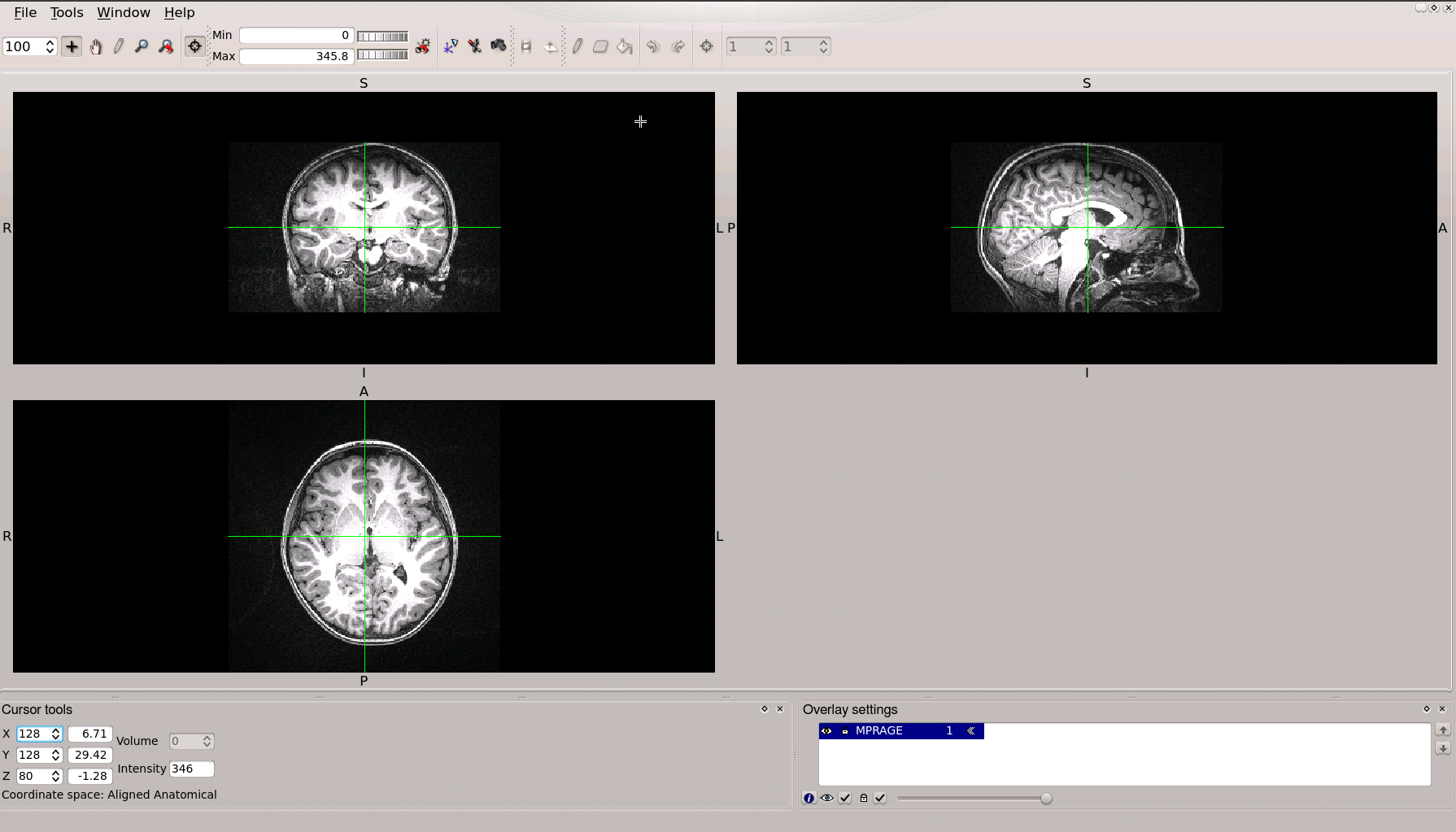
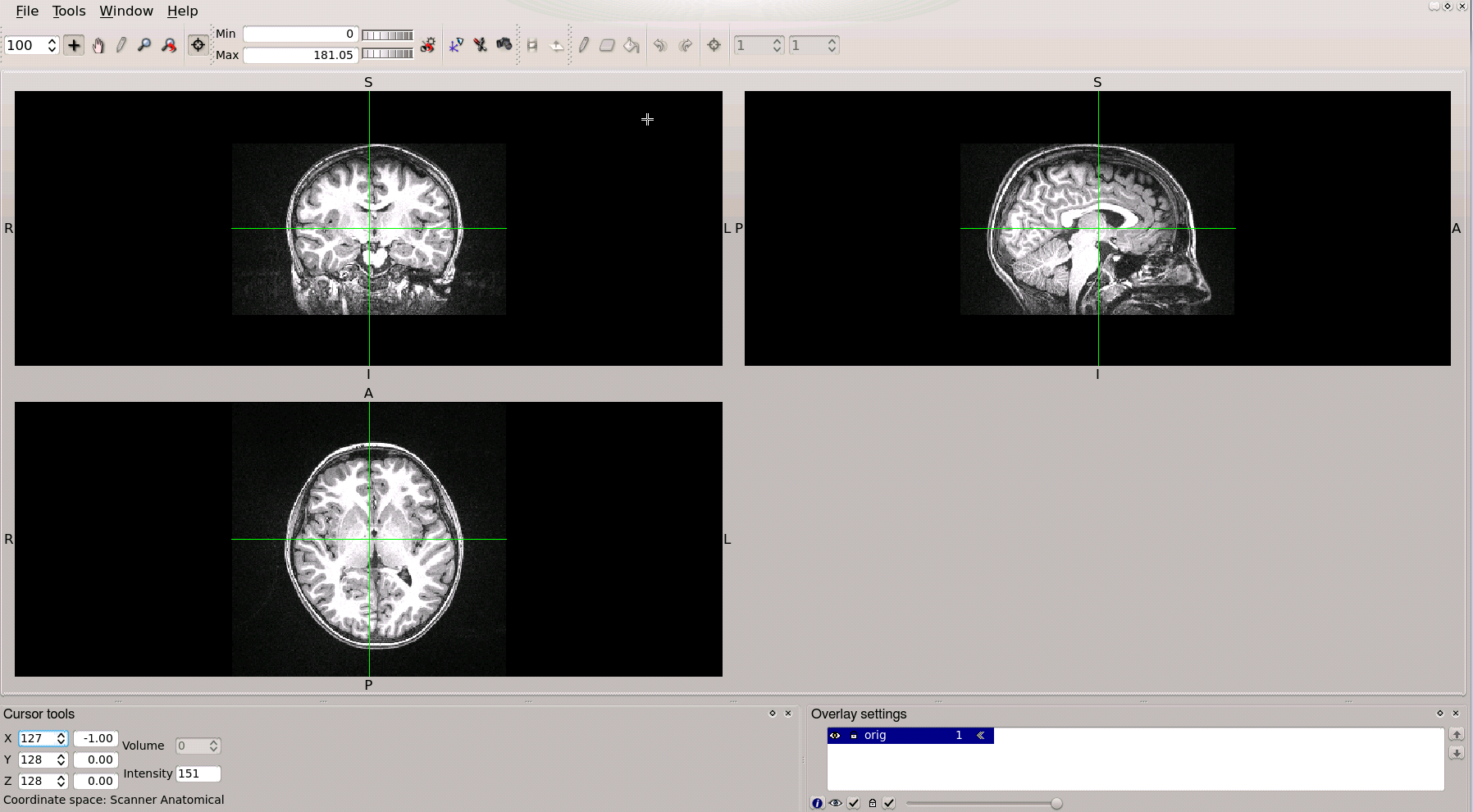
I ran recon-all on a high res-T1 image(128x128x80 matrix size), but after recon-all the folder mri contains resulted (brain.mgz and orig.mgz) T1 images has (127x128x128 matrix size).
1) how come the dimensions are changed? Is it normal? 2) how can i keep the dimensions same as the original? 3) is it possible that i will always get the higher matrix size image data?
for simplicity, i converted resulted orig.mgz to nii format and loaded it in to fslview. Please find the first image (Original) and the second image (after recon-all but orig.mgz).
Your help is greatly appreciated.
Just a correction,
The original image matrix size is (256x256x160) and the resulted image matrix size is (256x256x256).
On Mon, Apr 3, 2017 at 4:35 PM, Dhaval Shah dshah@bnac.net wrote:
Hi All,
I am new and a very basic question about freesurfer processing.
I ran recon-all on a high res-T1 image(128x128x80 matrix size), but after recon-all the folder mri contains resulted (brain.mgz and orig.mgz) T1 images has (127x128x128 matrix size).
- how come the dimensions are changed? Is it normal?
- how can i keep the dimensions same as the original?
- is it possible that i will always get the higher matrix size image
data?
for simplicity, i converted resulted orig.mgz to nii format and loaded it in to fslview. Please find the first image (Original) and the second image (after recon-all but orig.mgz).
Your help is greatly appreciated.
-- Kind regards, Dhaval Shah
MRI Research fellow,MRI Physicist,Clinical Trial Research Staff Buffalo Neuroimaging Analysis Center State University of New York at Buffalo Department of Neurology 100 High St., D-2, Buffalo, NY 14203dshah@bnac.net//http://mbl.bnac.net

Hi Dhaval
we resample all input images to 256^3 and 1mm isootropic unless we are explicitly told not to. We call this "conforming"
cheers Bruce
On Mon, 3 Apr 2017, Dhaval Shah wrote:
Just a correction,
The original image matrix size is (256x256x160) and the resulted image matrix size is (256x256x256).
On Mon, Apr 3, 2017 at 4:35 PM, Dhaval Shah dshah@bnac.net wrote: Hi All,
I am new and a very basic question about freesurfer processing.
I ran recon-all on a high res-T1 image(128x128x80 matrix size), but after recon-all the folder mri contains resulted (brain.mgz and orig.mgz) T1 images has (127x128x128 matrix size).
- how come the dimensions are changed? Is it normal?
- how can i keep the dimensions same as the original?
- is it possible that i will always get the higher matrix size image
data?
for simplicity, i converted resulted orig.mgz to nii format and loaded it in to fslview. Please find the first image (Original) and the second image (after recon-all but orig.mgz).
Your help is greatly appreciated.
-- Kind regards, Dhaval Shah
MRI Research fellow,MRI Physicist,Clinical Trial Research Staff Buffalo Neuroimaging Analysis Center State University of New York at Buffalo Department of Neurology 100 High St., D-2, Buffalo, NY 14203 dshah@bnac.net//http://mbl.bnac.net
-- Kind regards, Dhaval Shah
MRI Research fellow,MRI Physicist,Clinical Trial Research Staff Buffalo Neuroimaging Analysis Center State University of New York at Buffalo Department of Neurology 100 High St., D-2, Buffalo, NY 14203 dshah@bnac.net//http://mbl.bnac.net
Hi Bruce,
Thank you for the message. My image has isotropic voxel size 1mm3. Is there a way where i can keep the original matrix size (256x256x160) instead of re-sampling to (256x256x256)? or is there a way where i can resample the data to my original matrix size after i run recon-all?
Thank you.
On Mon, Apr 3, 2017 at 5:37 PM, Bruce Fischl fischl@nmr.mgh.harvard.edu wrote:
Hi Dhaval
we resample all input images to 256^3 and 1mm isootropic unless we are explicitly told not to. We call this "conforming"
cheers Bruce
On Mon, 3 Apr 2017, Dhaval Shah wrote:
Just a correction,
The original image matrix size is (256x256x160) and the resulted image matrix size is (256x256x256).
On Mon, Apr 3, 2017 at 4:35 PM, Dhaval Shah dshah@bnac.net wrote: Hi All,
I am new and a very basic question about freesurfer processing.
I ran recon-all on a high res-T1 image(128x128x80 matrix size), but after recon-all the folder mri contains resulted (brain.mgz and orig.mgz) T1 images has (127x128x128 matrix size).
- how come the dimensions are changed? Is it normal?
- how can i keep the dimensions same as the original?
- is it possible that i will always get the higher matrix size image
data?
for simplicity, i converted resulted orig.mgz to nii format and loaded it in to fslview. Please find the first image (Original) and the second image (after recon-all but orig.mgz).
Your help is greatly appreciated.
-- Kind regards, Dhaval Shah
MRI Research fellow,MRI Physicist,Clinical Trial Research Staff Buffalo Neuroimaging Analysis Center State University of New York at Buffalo Department of Neurology 100 High St., D-2, Buffalo, NY 14203 dshah@bnac.net//http://mbl.bnac.net
-- Kind regards, Dhaval Shah
MRI Research fellow,MRI Physicist,Clinical Trial Research Staff Buffalo Neuroimaging Analysis Center State University of New York at Buffalo Department of Neurology 100 High St., D-2, Buffalo, NY 14203 dshah@bnac.net//http://mbl.bnac.net
Freesurfer mailing list Freesurfer@nmr.mgh.harvard.edu https://mail.nmr.mgh.harvard.edu/mailman/listinfo/freesurfer
The information in this e-mail is intended only for the person to whom it is addressed. If you believe this e-mail was sent to you in error and the e-mail contains patient information, please contact the Partners Compliance HelpLine at http://www.partners.org/complianceline . If the e-mail was sent to you in error but does not contain patient information, please contact the sender and properly dispose of the e-mail.
the latter is easier than the former. You can use mri_convert with the -rl flag ("reslice like"). From the subject's mri dir you could do:
mri_convert -rt nearest -rl rawavg.mz aseg.mgz aseg.orig_space.mgz
or
mri_convert -rl rawavg.mgz norm.mg norm.orig_space.mgz
where -rt nearest tells mri_convert to use nearest neighbor interpolation instead of trilinear or cubic, which it needs to do for a label map
cheers Bruce
On Mon, 3 Apr 2017, Dhaval Shah wrote:
Hi Bruce,
Thank you for the message. My image has isotropic voxel size 1mm3. Is there a way where i can keep the original matrix size (256x256x160) instead of re-sampling to (256x256x256)? or is there a way where i can resample the data to my original matrix size after i run recon-all?
Thank you.
On Mon, Apr 3, 2017 at 5:37 PM, Bruce Fischl fischl@nmr.mgh.harvard.edu wrote: Hi Dhaval
  we resample all input images to 256^3 and 1mm isootropic unless
  we are
  explicitly told not to. We call this "conforming"

  cheers
  Bruce

  On Mon, 3 Apr 2017, Dhaval Shah wrote:

  > Just a correction,
  >
  > The original image matrix size is (256x256x160) and the
  resulted image
  > matrix size is (256x256x256).
  >
  > On Mon, Apr 3, 2017 at 4:35 PM, Dhaval Shah <dshah@bnac.net>
  wrote:
  >       Hi All,
  >
  > I am new and a very basic question about freesurfer
  processing.
  >
  > I ran recon-all on a high res-T1 image(128x128x80 matrix
  size), but
  > after recon-all the folder mri contains resulted (brain.mgz
  and
  > orig.mgz) T1 images has (127x128x128 matrix size).
  >
  > 1) how come the dimensions are changed? Is it normal?
  > 2) how can i keep the dimensions same as the original?
  > 3) is it possible that i will always get the higher matrix
  size image
  > data?
  >
  > for simplicity, i converted resulted orig.mgz to nii format
  and loaded
  > it in to fslview. Please find the first image (Original) and
  the
  > second image (after recon-all but orig.mgz).
  >
  > Your help is greatly appreciated.
  >
  > --
  > Kind regards,
  > Dhaval Shah
  >
  > MRI Research fellow,MRI Physicist,Clinical Trial Research
  Staff
  > Buffalo Neuroimaging Analysis Center
  > State University of New York at Buffalo
  > Department of Neurology
  > 100 High St., D-2, Buffalo, NY 14203
  > MailScanner has detected a possible fraud attempt from
  "dshah@bnac.net" claiming to be MailScanner has detected a
  possible fraud attempt from "dshah@bnac.net" claiming to be
  dshah@bnac.net//http://mbl.bnac.net
  >
  >
  >
  >
  > --
  > Kind regards,
  > Dhaval Shah
  >
  > MRI Research fellow,MRI Physicist,Clinical Trial Research
  Staff
  > Buffalo Neuroimaging Analysis Center
  > State University of New York at Buffalo
  > Department of Neurology
  > 100 High St., D-2, Buffalo, NY 14203
  > MailScanner has detected a possible fraud attempt from
  "dshah@bnac.net" claiming to be MailScanner has detected a
  possible fraud attempt from "dshah@bnac.net" claiming to be
  dshah@bnac.net//http://mbl.bnac.net
  >
  >
Freesurfer mailing list Freesurfer@nmr.mgh.harvard.edu https://mail.nmr.mgh.harvard.edu/mailman/listinfo/freesurfer
The information in this e-mail is intended only for the person to whom it is addressed. If you believe this e-mail was sent to you in error and the e-mail contains patient information, please contact the Partners Compliance HelpLine at http://www.partners.org/complianceline . If the e-mail was sent to you in error but does not contain patient information, please contact the sender and properly dispose of the e-mail.
-- Kind regards, Dhaval Shah
MRI Research fellow,MRI Physicist,Clinical Trial Research Staff Buffalo Neuroimaging Analysis Center State University of New York at Buffalo Department of Neurology 100 High St., D-2, Buffalo, NY 14203 dshah@bnac.net//http://mbl.bnac.net
freesurfer@nmr.mgh.harvard.edu
-
 Bruce Fischl
 -
 Dhaval Shah