
Hi all,
I've been trying to analyses both an event related and block design experiments and have noticed a couple things that are confusing me and I would appreciate any help anyone could give me.
1. In trying do the event-related analysis, I'm am a bit confused by the FIR vs Gamma analysis and the use of the time window and tprestim in the FIR analysis. I have an experiment with 6 set size conditions and 1 fixation condition. each trial is 6s long with a TR of 1.5
I have run both of these commands:
mkanalysis-sess.new -analysis supIPS_loc -TR 1.5 -paradigm supIPS.dat -designtype event-related -funcstem fmc -motioncor -runlistfile supIPSruns.txt -inorm -nskip 2 -nconditions 6 -gammafit 2.25 1.25
mkanalysis-sess.new -analysis supIPS_loc -TR 1.5 -paradigm supIPS.dat -designtype event-related -funcstem fmc -motioncor -runlistfile supIPSruns.txt -inorm -nskip 2 -nconditions 6 -tprestim 2 -timewindow 20
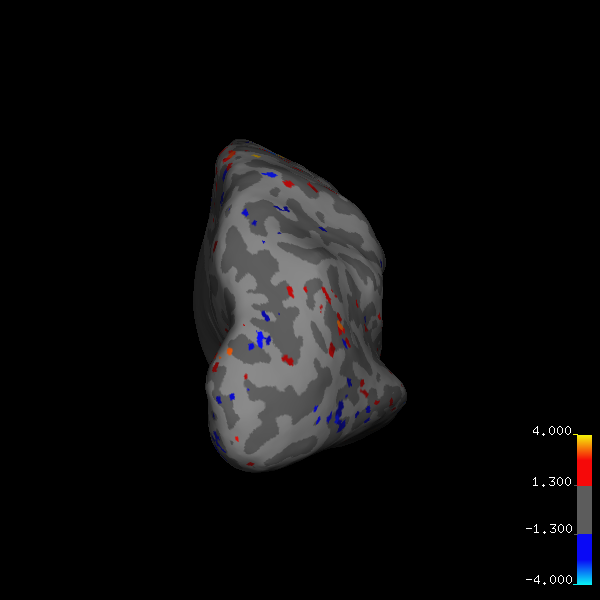
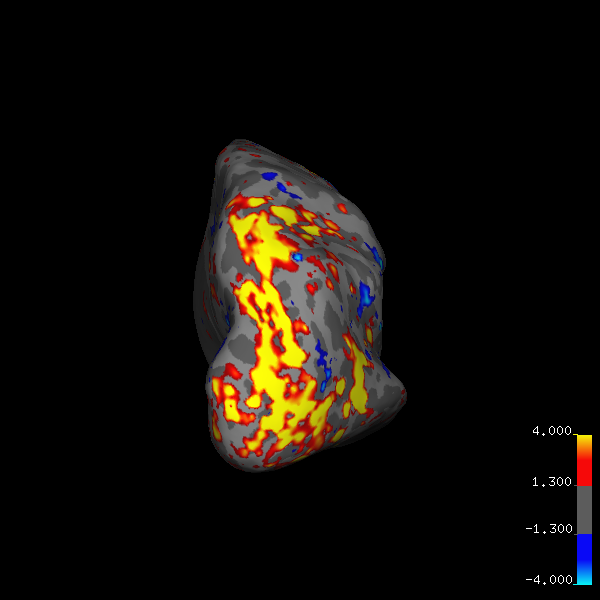
The FIR gives me a time course window, which makes me think that perhaps that is the one I want to use, but it shows very little activation. This data has been previously analyzed in Brain Voyager, so I know it's not a case of the conditions not actually causing activation, but for some reason, the FIR analysis doesn't show any. I'm not sure if this is due to a bad time window/tprestim settings, or something else. However the gamma fit analysis shows a bunch of activity where I expect to see it, but no time course window. (attached are pngs of the differences for the act_vs_fixation comparison).
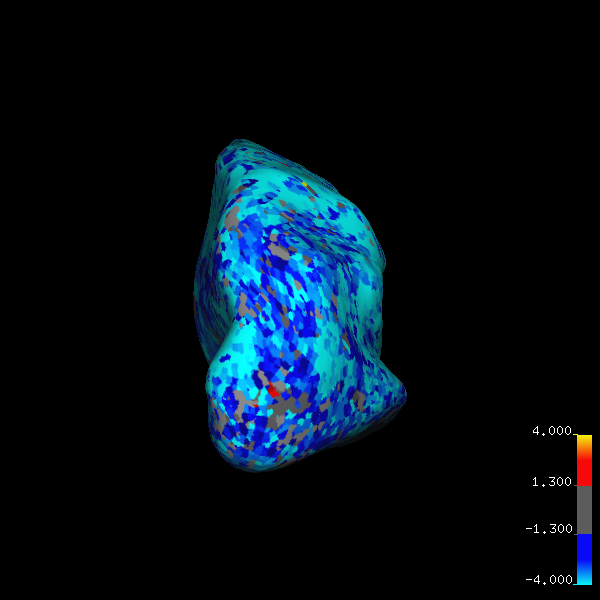
2. In addition, in both the event related (gamma) and a normal block design (different experiment) I get very different results (at least for certain comparisons) depending on whether I use selxavg-sess (with stxgrinder-sess for each contrast) or selxavg3-sess. The differences are shown in the attached pngs (act_vs_fix-gamma.png (which is the selxavg-sess and stxgrinder-sess analysis and act_vs_fix-gamma-selxavg3). In the block design, both selxavg3 and selxavg (+stxgrinder) give me very similar activation when comparing two non-null conditions (ie. shape_vs_noise) but very different (and similar to the differences in the attached pictures) activations when comparing against the null (ie shape_vs_fix or noise_vs_fix). What am I doing wrong here?
Thanks for your help!
Katie

The FIR does not assume a shape to the HRF but fits each point within the given time window. You might not be seeing activation for several reasons. FIRs are much less efficient than gamma functions. Also, by default, the FIR analysis gives you a sig map at each time point in the FIR, so you might be looking at the activation 1.5 sec *before* stimulus onset (so it would be a good thing not to see any activation!). Try advancing the time point from the overlay config window.
You can see the map from the gamma and the timecourse from the FIR with something like tksurfer-sess -analysis fir-analysis -map-analysis gamma-analysis ...
I'm not sure about the diffs with version 3. Why are you using such an old version?
doug
Katie Bettencourt wrote:
Hi all,
I've been trying to analyses both an event related and block design experiments and have noticed a couple things that are confusing me and I would appreciate any help anyone could give me.
- In trying do the event-related analysis, I'm am a bit confused by
the FIR vs Gamma analysis and the use of the time window and tprestim in the FIR analysis. I have an experiment with 6 set size conditions and 1 fixation condition. each trial is 6s long with a TR of 1.5
I have run both of these commands:
mkanalysis-sess.new -analysis supIPS_loc -TR 1.5 -paradigm supIPS.dat -designtype event-related -funcstem fmc -motioncor -runlistfile supIPSruns.txt -inorm -nskip 2 -nconditions 6 -gammafit 2.25 1.25
mkanalysis-sess.new -analysis supIPS_loc -TR 1.5 -paradigm supIPS.dat -designtype event-related -funcstem fmc -motioncor -runlistfile supIPSruns.txt -inorm -nskip 2 -nconditions 6 -tprestim 2 -timewindow 20
The FIR gives me a time course window, which makes me think that perhaps that is the one I want to use, but it shows very little activation. This data has been previously analyzed in Brain Voyager, so I know it's not a case of the conditions not actually causing activation, but for some reason, the FIR analysis doesn't show any. I'm not sure if this is due to a bad time window/tprestim settings, or something else. However the gamma fit analysis shows a bunch of activity where I expect to see it, but no time course window. (attached are pngs of the differences for the act_vs_fixation comparison).
- In addition, in both the event related (gamma) and a normal block
design (different experiment) I get very different results (at least for certain comparisons) depending on whether I use selxavg-sess (with stxgrinder-sess for each contrast) or selxavg3-sess. The differences are shown in the attached pngs (act_vs_fix-gamma.png (which is the selxavg-sess and stxgrinder-sess analysis and act_vs_fix-gamma-selxavg3). In the block design, both selxavg3 and selxavg (+stxgrinder) give me very similar activation when comparing two non-null conditions (ie. shape_vs_noise) but very different (and similar to the differences in the attached pictures) activations when comparing against the null (ie shape_vs_fix or noise_vs_fix). What am I doing wrong here?
Thanks for your help!
Katie
Freesurfer mailing list Freesurfer@nmr.mgh.harvard.edu https://mail.nmr.mgh.harvard.edu/mailman/listinfo/freesurfer
I'm not sure about the diffs with version 3. Why are you using such an old version?
I'm not sure I understand your question, why am I using the "old version" selxavg-sess or selxavg3-sess? I'm using Freesurfer 4.5, but I tried using selxavg-sess because I was confused by the results I was getting from selxavg3-sess (which is what the wiki says to use), and I was used to using selxavg-sess in my old lab, which was probably because we were using a much older version of Freesurfer. I assumed that selxavg3-sess was the newer version as it didnt' seem to need to have stxgrinder done on it to get maps out. am I wrong? It really is only when you compare against the baseline condition that you see differences in the two, but the selxavg3-sess is what is giving me the really weird whole brain more active for baseline maps.
Katie
doug
Katie Bettencourt wrote:
Hi all,
I've been trying to analyses both an event related and block design experiments and have noticed a couple things that are confusing me and I would appreciate any help anyone could give me.
- In trying do the event-related analysis, I'm am a bit confused by the
FIR vs Gamma analysis and the use of the time window and tprestim in the FIR analysis. I have an experiment with 6 set size conditions and 1 fixation condition. each trial is 6s long with a TR of 1.5
I have run both of these commands:
mkanalysis-sess.new -analysis supIPS_loc -TR 1.5 -paradigm supIPS.dat -designtype event-related -funcstem fmc -motioncor -runlistfile supIPSruns.txt -inorm -nskip 2 -nconditions 6 -gammafit 2.25 1.25
mkanalysis-sess.new -analysis supIPS_loc -TR 1.5 -paradigm supIPS.dat -designtype event-related -funcstem fmc -motioncor -runlistfile supIPSruns.txt -inorm -nskip 2 -nconditions 6 -tprestim 2 -timewindow 20
The FIR gives me a time course window, which makes me think that perhaps that is the one I want to use, but it shows very little activation. This data has been previously analyzed in Brain Voyager, so I know it's not a case of the conditions not actually causing activation, but for some reason, the FIR analysis doesn't show any. I'm not sure if this is due to a bad time window/tprestim settings, or something else. However the gamma fit analysis shows a bunch of activity where I expect to see it, but no time course window. (attached are pngs of the differences for the act_vs_fixation comparison).
- In addition, in both the event related (gamma) and a normal block
design (different experiment) I get very different results (at least for certain comparisons) depending on whether I use selxavg-sess (with stxgrinder-sess for each contrast) or selxavg3-sess. The differences are shown in the attached pngs (act_vs_fix-gamma.png (which is the selxavg-sess and stxgrinder-sess analysis and act_vs_fix-gamma-selxavg3). In the block design, both selxavg3 and selxavg (+stxgrinder) give me very similar activation when comparing two non-null conditions (ie. shape_vs_noise) but very different (and similar to the differences in the attached pictures) activations when comparing against the null (ie shape_vs_fix or noise_vs_fix). What am I doing wrong here?
Thanks for your help!
Katie
Freesurfer mailing list Freesurfer@nmr.mgh.harvard.edu https://mail.nmr.mgh.harvard.edu/mailman/listinfo/freesurfer
-- Douglas N. Greve, Ph.D. MGH-NMR Center greve@nmr.mgh.harvard.edu Phone Number: 617-724-2358 Fax: 617-726-7422
Bugs: surfer.nmr.mgh.harvard.edu/fswiki/BugReporting FileDrop: www.nmr.mgh.harvard.edu/facility/filedrop/index.html
The information in this e-mail is intended only for the person to whom it is addressed. If you believe this e-mail was sent to you in error and the e-mail contains patient information, please contact the Partners Compliance HelpLine at http://www.partners.org/complianceline . If the e-mail was sent to you in error but does not contain patient information, please contact the sender and properly dispose of the e-mail.
In fact, I had to use selxavg-sess and not selxavg3-sess to do the FIR analysis because fast-selxavg3-sess failed during the FIR analysis (I dont' have the error on me right now, but I can send it in tomorrow if it's important).
Katie
On Thu, Nov 4, 2010 at 12:29 PM, Katie Bettencourt kcrum@bu.edu wrote:
I'm not sure about the diffs with version 3. Why are you using such an old version?
I'm not sure I understand your question, why am I using the "old version" selxavg-sess or selxavg3-sess? I'm using Freesurfer 4.5, but I tried using selxavg-sess because I was confused by the results I was getting from selxavg3-sess (which is what the wiki says to use), and I was used to using selxavg-sess in my old lab, which was probably because we were using a much older version of Freesurfer. I assumed that selxavg3-sess was the newer version as it didnt' seem to need to have stxgrinder done on it to get maps out. am I wrong? It really is only when you compare against the baseline condition that you see differences in the two, but the selxavg3-sess is what is giving me the really weird whole brain more active for baseline maps.
Katie
doug
Katie Bettencourt wrote:
Hi all,
I've been trying to analyses both an event related and block design experiments and have noticed a couple things that are confusing me and I would appreciate any help anyone could give me.
- In trying do the event-related analysis, I'm am a bit confused by the
FIR vs Gamma analysis and the use of the time window and tprestim in the FIR analysis. I have an experiment with 6 set size conditions and 1 fixation condition. each trial is 6s long with a TR of 1.5
I have run both of these commands:
mkanalysis-sess.new -analysis supIPS_loc -TR 1.5 -paradigm supIPS.dat -designtype event-related -funcstem fmc -motioncor -runlistfile supIPSruns.txt -inorm -nskip 2 -nconditions 6 -gammafit 2.25 1.25
mkanalysis-sess.new -analysis supIPS_loc -TR 1.5 -paradigm supIPS.dat -designtype event-related -funcstem fmc -motioncor -runlistfile supIPSruns.txt -inorm -nskip 2 -nconditions 6 -tprestim 2 -timewindow 20
The FIR gives me a time course window, which makes me think that perhaps that is the one I want to use, but it shows very little activation. This data has been previously analyzed in Brain Voyager, so I know it's not a case of the conditions not actually causing activation, but for some reason, the FIR analysis doesn't show any. I'm not sure if this is due to a bad time window/tprestim settings, or something else. However the gamma fit analysis shows a bunch of activity where I expect to see it, but no time course window. (attached are pngs of the differences for the act_vs_fixation comparison).
- In addition, in both the event related (gamma) and a normal block
design (different experiment) I get very different results (at least for certain comparisons) depending on whether I use selxavg-sess (with stxgrinder-sess for each contrast) or selxavg3-sess. The differences are shown in the attached pngs (act_vs_fix-gamma.png (which is the selxavg-sess and stxgrinder-sess analysis and act_vs_fix-gamma-selxavg3). In the block design, both selxavg3 and selxavg (+stxgrinder) give me very similar activation when comparing two non-null conditions (ie. shape_vs_noise) but very different (and similar to the differences in the attached pictures) activations when comparing against the null (ie shape_vs_fix or noise_vs_fix). What am I doing wrong here?
Thanks for your help!
Katie
Freesurfer mailing list Freesurfer@nmr.mgh.harvard.edu https://mail.nmr.mgh.harvard.edu/mailman/listinfo/freesurfer
-- Douglas N. Greve, Ph.D. MGH-NMR Center greve@nmr.mgh.harvard.edu Phone Number: 617-724-2358 Fax: 617-726-7422
Bugs: surfer.nmr.mgh.harvard.edu/fswiki/BugReporting FileDrop: www.nmr.mgh.harvard.edu/facility/filedrop/index.html
The information in this e-mail is intended only for the person to whom it is addressed. If you believe this e-mail was sent to you in error and the e-mail contains patient information, please contact the Partners Compliance HelpLine at http://www.partners.org/complianceline . If the e-mail was sent to you in error but does not contain patient information, please contact the sender and properly dispose of the e-mail.
Ok, so looking at the FIR analysis, when I advance it to time point 5, I see my activation (yay!) but does this mean my timewindow, etc is set up wrong, or is this just something you have to do when you do a FIR analysis?
Katie
On Wed, Nov 3, 2010 at 7:05 PM, Douglas N Greve greve@nmr.mgh.harvard.eduwrote:
The FIR does not assume a shape to the HRF but fits each point within the given time window. You might not be seeing activation for several reasons. FIRs are much less efficient than gamma functions. Also, by default, the FIR analysis gives you a sig map at each time point in the FIR, so you might be looking at the activation 1.5 sec *before* stimulus onset (so it would be a good thing not to see any activation!). Try advancing the time point from the overlay config window.
You can see the map from the gamma and the timecourse from the FIR with something like tksurfer-sess -analysis fir-analysis -map-analysis gamma-analysis ...
I'm not sure about the diffs with version 3. Why are you using such an old version?
doug
Katie Bettencourt wrote:
Hi all,
I've been trying to analyses both an event related and block design experiments and have noticed a couple things that are confusing me and I would appreciate any help anyone could give me.
- In trying do the event-related analysis, I'm am a bit confused by the
FIR vs Gamma analysis and the use of the time window and tprestim in the FIR analysis. I have an experiment with 6 set size conditions and 1 fixation condition. each trial is 6s long with a TR of 1.5
I have run both of these commands:
mkanalysis-sess.new -analysis supIPS_loc -TR 1.5 -paradigm supIPS.dat -designtype event-related -funcstem fmc -motioncor -runlistfile supIPSruns.txt -inorm -nskip 2 -nconditions 6 -gammafit 2.25 1.25
mkanalysis-sess.new -analysis supIPS_loc -TR 1.5 -paradigm supIPS.dat -designtype event-related -funcstem fmc -motioncor -runlistfile supIPSruns.txt -inorm -nskip 2 -nconditions 6 -tprestim 2 -timewindow 20
The FIR gives me a time course window, which makes me think that perhaps that is the one I want to use, but it shows very little activation. This data has been previously analyzed in Brain Voyager, so I know it's not a case of the conditions not actually causing activation, but for some reason, the FIR analysis doesn't show any. I'm not sure if this is due to a bad time window/tprestim settings, or something else. However the gamma fit analysis shows a bunch of activity where I expect to see it, but no time course window. (attached are pngs of the differences for the act_vs_fixation comparison).
- In addition, in both the event related (gamma) and a normal block
design (different experiment) I get very different results (at least for certain comparisons) depending on whether I use selxavg-sess (with stxgrinder-sess for each contrast) or selxavg3-sess. The differences are shown in the attached pngs (act_vs_fix-gamma.png (which is the selxavg-sess and stxgrinder-sess analysis and act_vs_fix-gamma-selxavg3). In the block design, both selxavg3 and selxavg (+stxgrinder) give me very similar activation when comparing two non-null conditions (ie. shape_vs_noise) but very different (and similar to the differences in the attached pictures) activations when comparing against the null (ie shape_vs_fix or noise_vs_fix). What am I doing wrong here?
Thanks for your help!
Katie
Freesurfer mailing list Freesurfer@nmr.mgh.harvard.edu https://mail.nmr.mgh.harvard.edu/mailman/listinfo/freesurfer
-- Douglas N. Greve, Ph.D. MGH-NMR Center greve@nmr.mgh.harvard.edu Phone Number: 617-724-2358 Fax: 617-726-7422
Bugs: surfer.nmr.mgh.harvard.edu/fswiki/BugReporting FileDrop: www.nmr.mgh.harvard.edu/facility/filedrop/index.html
The information in this e-mail is intended only for the person to whom it is addressed. If you believe this e-mail was sent to you in error and the e-mail contains patient information, please contact the Partners Compliance HelpLine at http://www.partners.org/complianceline . If the e-mail was sent to you in error but does not contain patient information, please contact the sender and properly dispose of the e-mail.
It sounds like it is set up correctly. If you want a single map of the activation, you'll have to set up a proper contrast to do it. In mkcontrast-sess you can simply use -sumdelays; this will create a map based on the summation of the delays in the FIR. You can also choose a time point in the FIR with -sumdelays -setwdelays. It will prompt you for a list of N numbers (N being the number of points in the FIR window). You can give is something like 0 0 0 0 1 0 0 0 0 0 0 to extract time point 5. I usually recommend -sumdelays.
doug
Katie Bettencourt wrote:
Ok, so looking at the FIR analysis, when I advance it to time point 5, I see my activation (yay!) but does this mean my timewindow, etc is set up wrong, or is this just something you have to do when you do a FIR analysis?
Katie
On Wed, Nov 3, 2010 at 7:05 PM, Douglas N Greve <greve@nmr.mgh.harvard.edu mailto:greve@nmr.mgh.harvard.edu> wrote:
The FIR does not assume a shape to the HRF but fits each point
within the given time window. You might not be seeing activation
for several reasons. FIRs are much less efficient than gamma
functions. Also, by default, the FIR analysis gives you a sig map
at each time point in the FIR, so you might be looking at the
activation 1.5 sec *before* stimulus onset (so it would be a good
thing not to see any activation!). Try advancing the time point
from the overlay config window.

You can see the map from the gamma and the timecourse from the FIR
with something like
tksurfer-sess -analysis fir-analysis -map-analysis gamma-analysis ...

I'm not sure about the diffs with version 3. Why are you using
such an old version?

doug


Katie Bettencourt wrote:

    Hi all,

    I've been trying to analyses both an event related and block
    design experiments and have noticed a couple things that are
    confusing me and I would appreciate any help anyone could give me.

    1.  In trying do the event-related analysis, I'm am a bit
    confused by the FIR vs Gamma analysis and the use of the time
    window and tprestim in the FIR analysis.  I have an experiment
    with 6 set size conditions and 1 fixation condition.  each
    trial is 6s long with a TR of 1.5

    I have run both of these commands:

     mkanalysis-sess.new -analysis supIPS_loc -TR 1.5 -paradigm
    supIPS.dat -designtype event-related -funcstem fmc -motioncor
    -runlistfile supIPSruns.txt -inorm -nskip 2 -nconditions 6
    -gammafit 2.25 1.25

    mkanalysis-sess.new -analysis supIPS_loc -TR 1.5 -paradigm
    supIPS.dat -designtype event-related -funcstem fmc -motioncor
    -runlistfile supIPSruns.txt -inorm -nskip 2 -nconditions 6
    -tprestim 2 -timewindow 20


    The FIR gives me a time course window, which makes me think
    that perhaps that is the one I want to use, but it shows very
    little activation.  This data has been previously analyzed in
    Brain Voyager, so I know it's not a case of the conditions not
    actually causing activation, but for some reason, the FIR
    analysis doesn't show any.  I'm not sure if this is due to a
    bad time window/tprestim settings, or something else.  However
    the gamma fit analysis shows a bunch of activity where I
    expect to see it, but no time course window.  (attached are
    pngs of the differences for the act_vs_fixation comparison).

    2.  In addition, in both the event related (gamma) and a
    normal block design (different experiment) I get very
    different results (at least for certain comparisons) depending
    on whether I use selxavg-sess (with stxgrinder-sess for each
    contrast) or selxavg3-sess.  The differences are shown in the
    attached pngs (act_vs_fix-gamma.png (which is the selxavg-sess
    and stxgrinder-sess analysis and act_vs_fix-gamma-selxavg3).
     In the block design, both selxavg3 and selxavg (+stxgrinder)
    give me very similar activation when comparing two non-null
    conditions (ie. shape_vs_noise) but very different (and
    similar to the differences in the attached pictures)
    activations when comparing against the null (ie shape_vs_fix
    or noise_vs_fix).  What am I doing wrong here?

    Thanks for your help!

    Katie

    ------------------------------------------------------------------------


    ------------------------------------------------------------------------


    ------------------------------------------------------------------------

    ------------------------------------------------------------------------

    _______________________________________________
    Freesurfer mailing list
    Freesurfer@nmr.mgh.harvard.edu
    <mailto:Freesurfer@nmr.mgh.harvard.edu>
    https://mail.nmr.mgh.harvard.edu/mailman/listinfo/freesurfer


--
Douglas N. Greve, Ph.D.
MGH-NMR Center
greve@nmr.mgh.harvard.edu <mailto:greve@nmr.mgh.harvard.edu>
Phone Number: 617-724-2358 Fax: 617-726-7422

Bugs: surfer.nmr.mgh.harvard.edu/fswiki/BugReporting
<http://surfer.nmr.mgh.harvard.edu/fswiki/BugReporting>
FileDrop: www.nmr.mgh.harvard.edu/facility/filedrop/index.html
<http://www.nmr.mgh.harvard.edu/facility/filedrop/index.html>


The information in this e-mail is intended only for the person to
whom it is
addressed. If you believe this e-mail was sent to you in error and
the e-mail
contains patient information, please contact the Partners
Compliance HelpLine at
http://www.partners.org/complianceline . If the e-mail was sent to
you in error
but does not contain patient information, please contact the
sender and properly
dispose of the e-mail.
freesurfer@nmr.mgh.harvard.edu
-
 Douglas N Greve
 -
 Katie Bettencourt