
Dear Freesurfer-Expert,
We are currently trying to develop a 3D-Model from MRI data using combined files from Freesurfer and FSL. For this purpose we run recon-all on our subject and furthermore get some ROIs from FSL-based scripts. When visualizing the Freesurfer surfaces together with the FSL ROIs in any 3D modelling software (like e.g. Meshlab or 3D Slicer), there seems to be a space mismatch meaning: the FSL-based ROIs lie more inferior relative to the Freesurfer surfaces than they should (a shift in any other direction might be there but is at least not visible by eye; see attached screenshot). If we further add a single 2D slice of the original T1.mgz file to the 3D model, it seems to be consistent with the spatial position of the FSL ROIs, while the Freesurfer surfaces are clearly shifted (at least in z-direction; see attached screenshot). However opening the surfaces and the T1.mgz in freeview instead of 3D-Slicer, the spatial position fits.
Do you have any idea of why this is the case or even more important, how to bring both structures in the same "space"? As we need to continue modelling in 3D-Slicer, we are looking for a way to correct the spatial shift independent of freeview. We are very thankful for any input on this matter!
Best regards, Bastian David
Bastian David, M.Sc. Ph.D. candidate .............................................................. Department of Epileptology University of Bonn .............................................................. Sigmund-Freud-Str. 25 53127 Bonn .............................................................. bastian.david@ukb.uni-bonn.de www.epileptologie-bonn.de
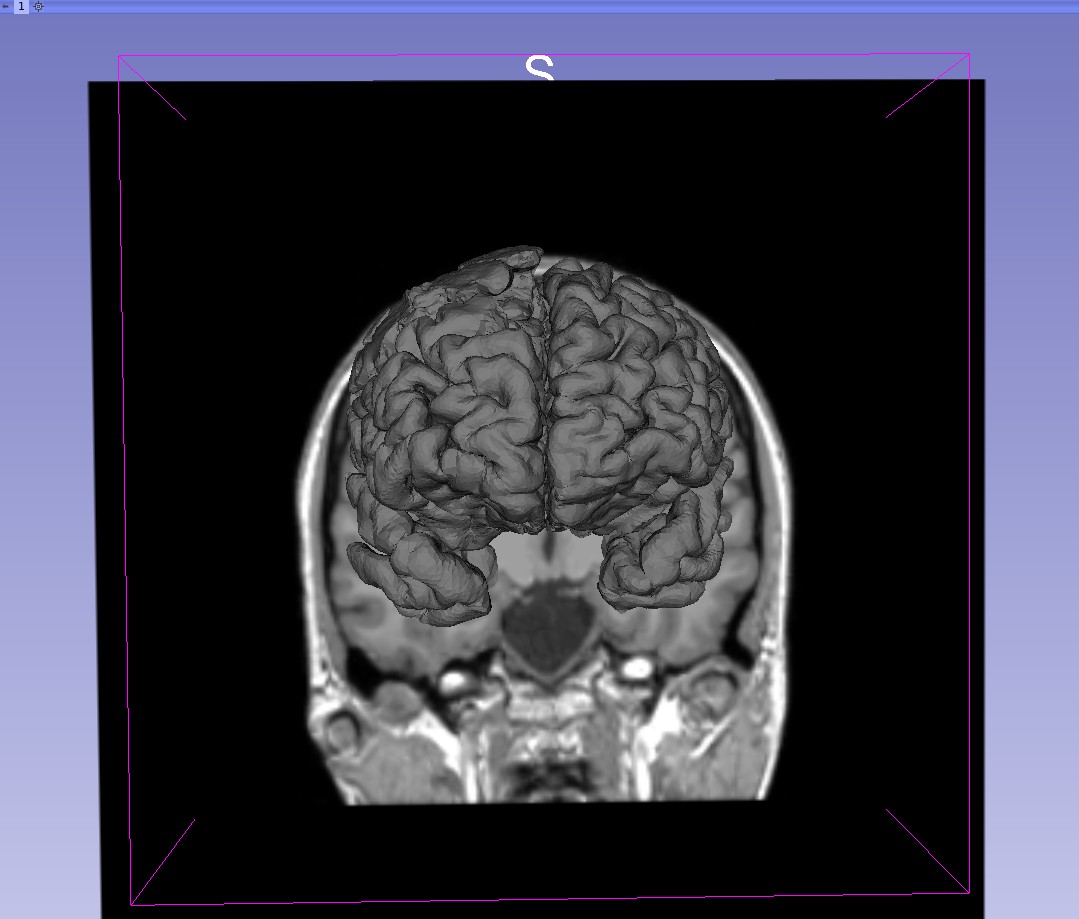
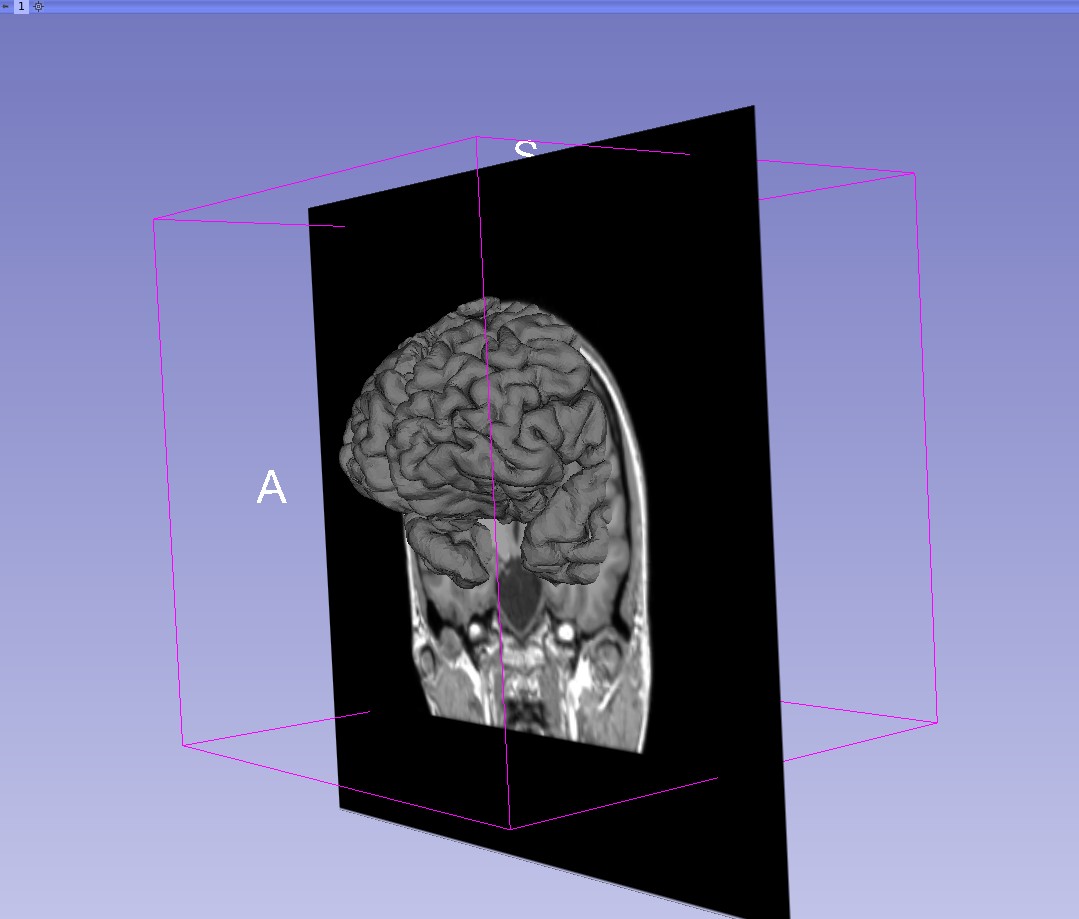
Dear Freesurfer-Expert,
I'm very sorry for reposting this issue again, but we are really in the need of help as we ourselves do not find any solution to this problem. We would be very grateful for any hint related to this.
We are currently trying to develop a 3D-Model from MRI data using combined files from Freesurfer and FSL. For this purpose we run recon-all on our subject and furthermore get some ROIs from FSL-based scripts. When visualizing the Freesurfer surfaces together with the FSL ROIs in any 3D modelling software (like e.g. Meshlab or 3D Slicer), there seems to be a space mismatch meaning: the FSL-based ROIs lie more inferior relative to the Freesurfer surfaces than they should (a shift in any other direction might be there but is at least not visible by eye; see attached screenshot). If we further add a single 2D slice of the original T1.mgz file to the 3D model, it seems to be consistent with the spatial position of the FSL ROIs, while the Freesurfer surfaces are clearly shifted (at least in z-direction; see attached screenshot). However opening the surfaces and the T1.mgz in freeview instead of 3D-Slicer, the spatial position fits.
Do you have any idea of why this is the case or even more important, how to bring both structures in the same "space"? As we need to continue modelling in 3D-Slicer, we are looking for a way to correct the spatial shift independent of freeview. We are very thankful for any input on this matter!
Best regards, Bastian David
Bastian David, M.Sc. Ph.D. candidate .............................................................. Department of Epileptology University of Bonn .............................................................. Sigmund-Freud-Str. 25 53127 Bonn .............................................................. bastian.david@ukb.uni-bonn.de www.epileptologie-bonn.de
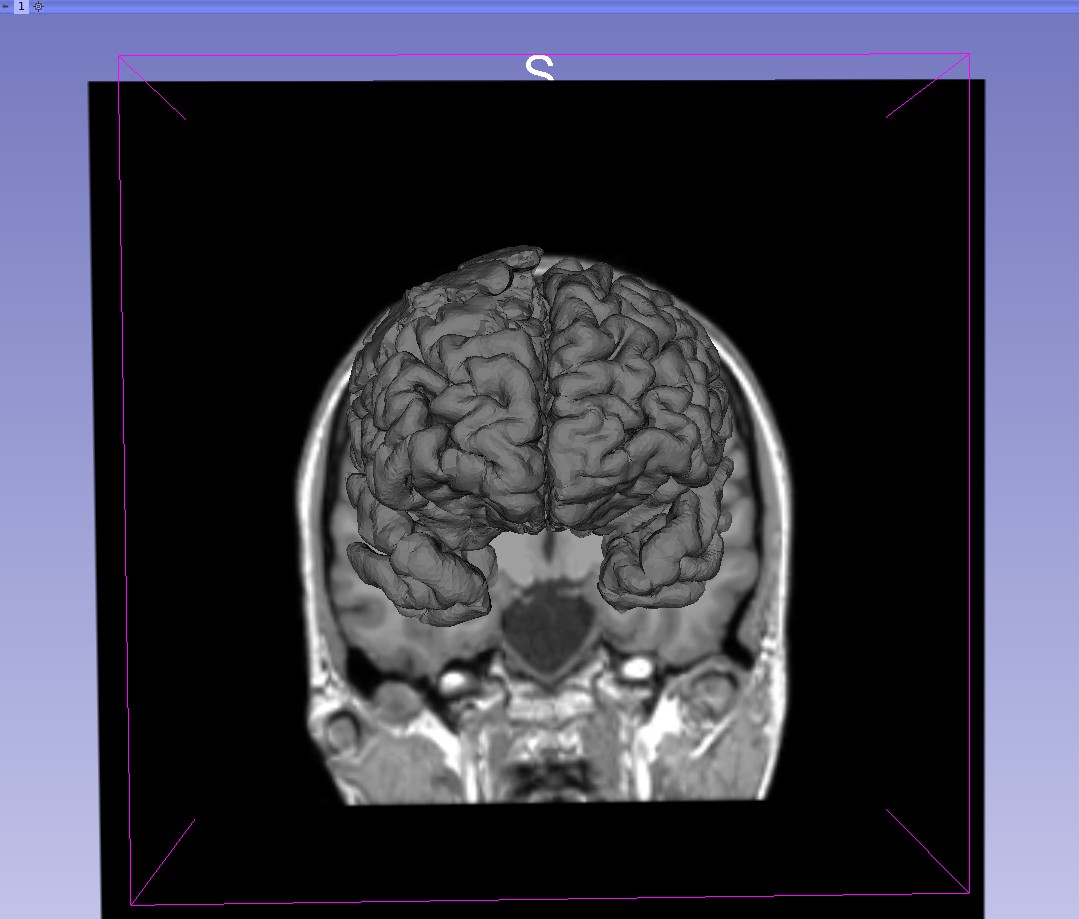
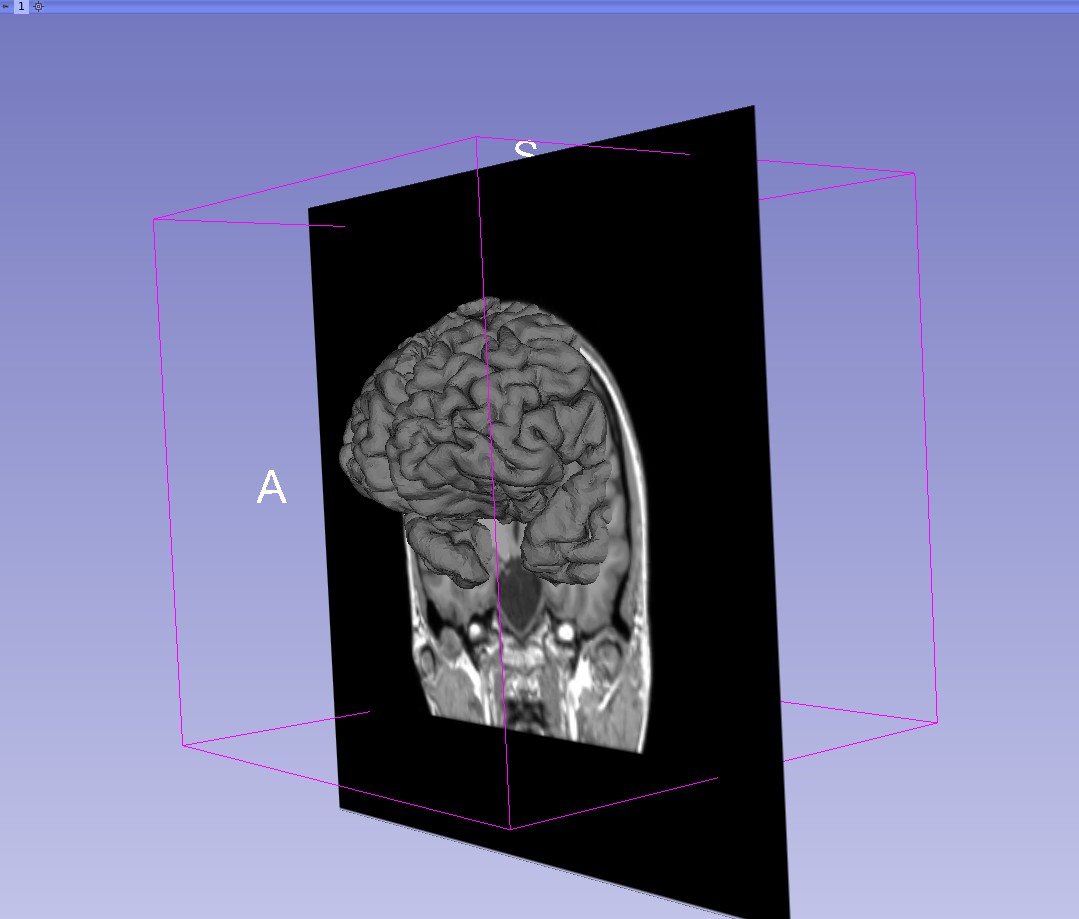

Hi Bastian
Hmm, if everything looks right when you view things inside FreeSurfer then it is goiong to be hard for us to help you as the issue sounds like it is a 3D slicer one. Have you contacted them? You can use mri_info to look at the headers and the ras2vox matrices. Typically this is a problem of where the center of the coordinate system is (frequently called c_ras - the RAS coordinates of the center of the volume).
cheers Bruce
On Mon, 24 Oct 2016, Conrad Christoffer Prillwitz wrote:
Dear Freesurfer-Expert,
I'm very sorry for reposting this issue again, but we are really in the need of help as we ourselves do not find any solution to this problem. We would be very grateful for any hint related to this.
We are currently trying to develop a 3D-Model from MRI data using combined files from Freesurfer and FSL. For this purpose we run recon-all on our subject and furthermore get some ROIs from FSL-based scripts. When visualizing the Freesurfer surfaces together with the FSL ROIs in any 3D modelling software (like e.g. Meshlab or 3D Slicer), there seems to be a space mismatch meaning: the FSL-based ROIs lie more inferior relative to the Freesurfer surfaces than they should (a shift in any other direction might be there but is at least not visible by eye; see attached screenshot). If we further add a single 2D slice of the original T1.mgz file to the 3D model, it seems to be consistent with the spatial position of the FSL ROIs, while the Freesurfer surfaces are clearly shifted (at least in z-direction; see attached screenshot). However opening the surfaces and the T1.mgz in freeview instead of 3D-Slicer, the spatial position fits.
Do you have any idea of why this is the case or even more important, how to bring both structures in the same "space"? As we need to continue modelling in 3D-Slicer, we are looking for a way to correct the spatial shift independent of freeview. We are very thankful for any input on this matter!
Best regards, Bastian David
Bastian David, M.Sc. Ph.D. candidate .............................................................. Department of Epileptology University of Bonn .............................................................. Sigmund-Freud-Str. 25 53127 Bonn .............................................................. bastian.david@ukb.uni-bonn.de www.epileptologie-bonn.de

Hi Bastian, these are very tricky questions about coordinate systems, made more difficult by having three different software packages. Have you looked at this page yet?
http://surfer.nmr.mgh.harvard.edu/fswiki/CoordinateSystems
Particularly this power point http://surfer.nmr.mgh.harvard.edu/fswiki/CoordinateSystems?action=AttachFile...
The surfaces are in their own coordinates (ie, not scanner coordinates). So anything that reads and displays them needs to know and properly interpret the coordinates. I would have thought that slicer did this. You might want to contact the slicer developers about it.
doug
On 10/20/2016 11:08 AM, Conrad Christoffer Prillwitz wrote:
Dear Freesurfer-Expert,
We are currently trying to develop a 3D-Model from MRI data using combined files from Freesurfer and FSL. For this purpose we run recon-all on our subject and furthermore get some ROIs from FSL-based scripts. When visualizing the Freesurfer surfaces together with the FSL ROIs in any 3D modelling software (like e.g. Meshlab or 3D Slicer), there seems to be a space mismatch meaning: the FSL-based ROIs lie more inferior relative to the Freesurfer surfaces than they should (a shift in any other direction might be there but is at least not visible by eye; see attached screenshot). If we further add a single 2D slice of the original T1.mgz file to the 3D model, it seems to be consistent with the spatial position of the FSL ROIs, while the Freesurfer surfaces are clearly shifted (at least in z-direction; see attached screenshot). However opening the surfaces and the T1.mgz in freeview instead of 3D-Slicer, the spatial position fits.
Do you have any idea of why this is the case or even more important, how to bring both structures in the same "space"? As we need to continue modelling in 3D-Slicer, we are looking for a way to correct the spatial shift independent of freeview. We are very thankful for any input on this matter!
Best regards, Bastian David
Bastian David, M.Sc. Ph.D. candidate .............................................................. Department of Epileptology University of Bonn .............................................................. Sigmund-Freud-Str. 25 53127 Bonn .............................................................. bastian.david@ukb.uni-bonn.de www.epileptologie-bonn.de
Freesurfer mailing list Freesurfer@nmr.mgh.harvard.edu https://mail.nmr.mgh.harvard.edu/mailman/listinfo/freesurfer
freesurfer@nmr.mgh.harvard.edu
-
 Bruce Fischl
 -
 Conrad Christoffer Prillwitz
 -
 Douglas N Greve