
External Email - Use Caution
Dear Freesurfer team,
I run statistical analysis with the files in the average subject of a dataset (created with 5th order icosahedron tesselation).
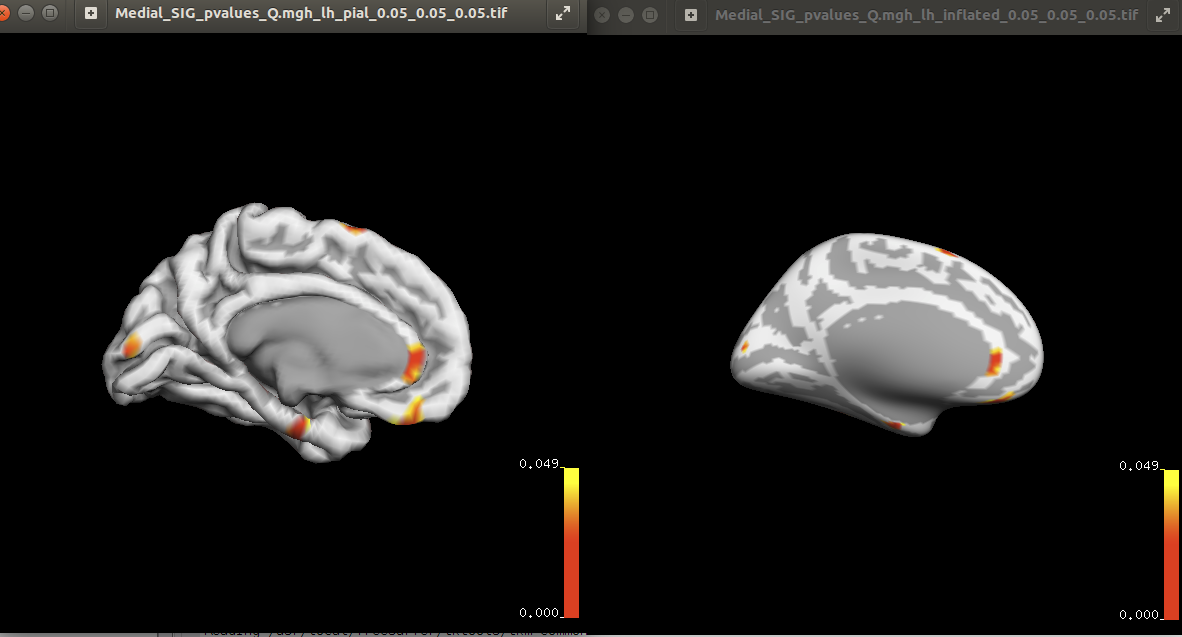
In order to visualize the results, I open the inflated-surface and the pial-surface with tksurfer and I realize that inflated-surface of the average subject is smaller than the pial-surface. Is it normal? In the fsaverage5 subject these surfaces have a very similar size.
Even, when I load the results as an overlay in the inflated-surface, the results are shown smaller (more than the proportional size) than if I load the results in the pial surface (see attached image).
What can I do to generate an inflated figure with the results in the same size than in the pial surface?
Thank you in advance. Best regards, Marina.

Hi Marina
how did you create your average inflated surface? mris_inflate typically normalizes the scale of the inflated surface to have the same total surface area as the input surface (so for the less-folded inflated surface it has to become bigger). I guess you could try running it directly in your average subject surf dir to recreate the surface. Something like:
mris_inflate -n 5 lh.smoothwm lh.inflated.new
and see how that looks cheers Bruce On Fri, 17 Jan 2020, Marina Fernández wrote:
External Email - Use Caution
Dear Freesurfer team, I run statistical analysis with the files in the average subject of a dataset (created with 5th order icosahedron tesselation).
In order to visualize the results, I open the inflated-surface and the pial-surface with tksurfer and I realize that inflated-surface of the average subject is smaller than the pial-surface. Is it normal? In the fsaverage5 subject these surfaces have a very similar size.
Even, when I load the results as an overlay in the inflated-surface, the results are shown smaller (more than the proportional size) than if I load the results in the pial surface (see attached image).
What can I do to generate an inflated figure with the results in the same size than in the pial surface?
Thank you in advance. Best regards, Marina.
freesurfer@nmr.mgh.harvard.edu
-
 Bruce Fischl
 -
 Marina Fernández