
External Email - Use Caution
Hi all,
I have a question regarding checking the output of mri_vol2surf. I am converting a manually segmented volume ROI into a surface label in order to gain information such as cortical thickness. What is the best practice for quality control and checking the surface rendering of the ROI? Are there any protocols or suggestions? As slight changes in projfrac change the output by a large degree, it's difficult to assess what is the closest to the original volume ROI. The suggestions also vary (others say projfrac 0.5, others to use projfrac-max or projdist). The main output statistic I'm interested in cortical thickness of the region (if this influences the options).
How do you choose and establish what is the best option?
Thanks Marianna

If I understand you correctly, you have an ROI defined in the volume and you want to transfer it to the surface. Is that right? First you should look at the ROI in the volume along with the surfaces and make sure that they pass through the ROI. I would generally use the projfrac-max option for something like this. After you get a surface overlay, you can map it back to the volume (mri_surf2vol) and see if it looks right relative to the full volume ROI.
On 5/21/2021 6:41 AM, M Pope wrote:
External Email - Use Caution
External Email - Use Caution
Hi all,
I have a question regarding checking the output of mri_vol2surf. I am converting a manually segmented volume ROI into a surface label in order to gain information such as cortical thickness. What is the best practice for quality control and checking the surface rendering of the ROI? Are there any protocols or suggestions? As slight changes in projfrac change the output by a large degree, it's difficult to assess what is the closest to the original volume ROI. The suggestions also vary (others say projfrac 0.5, others to use projfrac-max or projdist). The main output statistic I'm interested in cortical thickness of the region (if this influences the options).
How do you choose and establish what is the best option?
Thanks Marianna
Freesurfer mailing list Freesurfer@nmr.mgh.harvard.edu https://secure-web.cisco.com/1crndCNiNtoGVMPUhoNnIxDSbZaX5xv97bIlJ1N0pCUII7E...
External Email - Use Caution
Hi,
Thanks for this. Using mri_surf2vol as a QC hadn't occured to me and is a nice solution. I feel again using --fillribbon is the best way to project the surface to the volume for my case?
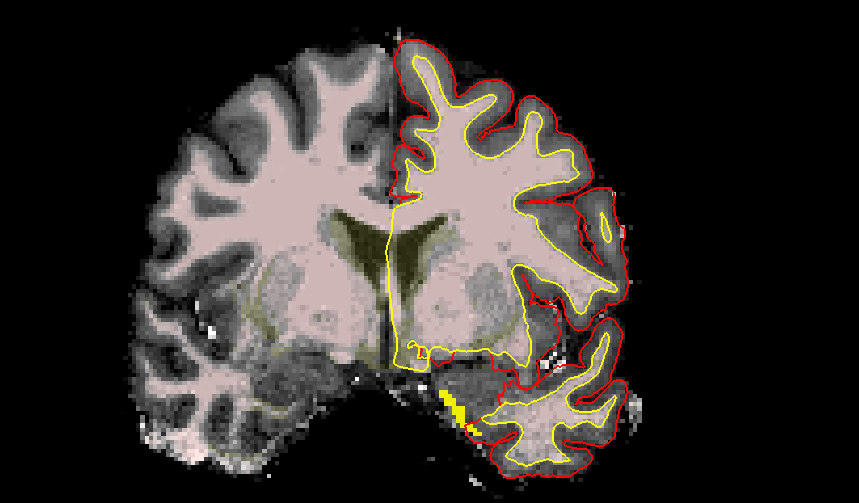
There is one other issue I had seen, but didn't know if it would affect my procedure. As I am examining the entorhinal cortex, it seems like part of my mask expands past the surfaces created by recon-all. I attach a screenshot of what I mean (the entorhinal mask is in yellow). When I then run mri_surf2vol, the output I get covers very well the part of my original mask that IS within the pial surfaces, but doesn't extend to include the rest of the mask. So it seems this is affecting the process.
Do you have any suggestions as to how I can solve this issue? Would it be worth trying to reconstruct the surfaces- although they are in line with the bert subject template of freesurfer.
Thanks, Marianna ________________________________ From: freesurfer-bounces@nmr.mgh.harvard.edu freesurfer-bounces@nmr.mgh.harvard.edu on behalf of Douglas N. Greve dgreve@mgh.harvard.edu Sent: 27 May 2021 9:39 PM To: freesurfer@nmr.mgh.harvard.edu freesurfer@nmr.mgh.harvard.edu Subject: Re: [Freesurfer] Choosing projfrac/projdist and checking mri_vol2surf output
If I understand you correctly, you have an ROI defined in the volume and you want to transfer it to the surface. Is that right? First you should look at the ROI in the volume along with the surfaces and make sure that they pass through the ROI. I would generally use the projfrac-max option for something like this. After you get a surface overlay, you can map it back to the volume (mri_surf2vol) and see if it looks right relative to the full volume ROI.
On 5/21/2021 6:41 AM, M Pope wrote:
External Email - Use Caution
External Email - Use Caution
Hi all,
I have a question regarding checking the output of mri_vol2surf. I am converting a manually segmented volume ROI into a surface label in order to gain information such as cortical thickness. What is the best practice for quality control and checking the surface rendering of the ROI? Are there any protocols or suggestions? As slight changes in projfrac change the output by a large degree, it's difficult to assess what is the closest to the original volume ROI. The suggestions also vary (others say projfrac 0.5, others to use projfrac-max or projdist). The main output statistic I'm interested in cortical thickness of the region (if this influences the options).
How do you choose and establish what is the best option?
Thanks Marianna
_______________________________________________ Freesurfer mailing list Freesurfer@nmr.mgh.harvard.edumailto:Freesurfer@nmr.mgh.harvard.edu https://secure-web.cisco.com/1crndCNiNtoGVMPUhoNnIxDSbZaX5xv97bIlJ1N0pCUII7E...
On 5/28/2021 9:25 AM, M Pope wrote:
External Email - Use Caution
External Email - Use Caution
Hi,
Thanks for this. Using mri_surf2vol as a QC hadn't occured to me and is a nice solution. I feel again using --fillribbon is the best way to project the surface to the volume for my case?
Probably does not matter since this is just QC.
There is one other issue I had seen, but didn't know if it would affect my procedure. As I am examining the entorhinal cortex, it seems like part of my mask expands past the surfaces created by recon-all. I attach a screenshot of what I mean (the entorhinal mask is in yellow). When I then run mri_surf2vol, the output I get covers very well the part of my original mask that IS within the pial surfaces, but doesn't extend to include the rest of the mask. So it seems this is affecting the process.
Often the surface is inaccurate in that part of EC because there is no gray/white contrast. You can edit the wm.mgz to add WM voxels there.
Do you have any suggestions as to how I can solve this issue? Would it be worth trying to reconstruct the surfaces- although they are in line with the bert subject template of freesurfer.
Thanks, Marianna
*From:* freesurfer-bounces@nmr.mgh.harvard.edu freesurfer-bounces@nmr.mgh.harvard.edu on behalf of Douglas N. Greve dgreve@mgh.harvard.edu *Sent:* 27 May 2021 9:39 PM *To:* freesurfer@nmr.mgh.harvard.edu freesurfer@nmr.mgh.harvard.edu *Subject:* Re: [Freesurfer] Choosing projfrac/projdist and checking mri_vol2surf output If I understand you correctly, you have an ROI defined in the volume and you want to transfer it to the surface. Is that right? First you should look at the ROI in the volume along with the surfaces and make sure that they pass through the ROI. I would generally use the projfrac-max option for something like this. After you get a surface overlay, you can map it back to the volume (mri_surf2vol) and see if it looks right relative to the full volume ROI.
On 5/21/2021 6:41 AM, M Pope wrote:
External Email - Use Caution
External Email - Use Caution
Hi all,
I have a question regarding checking the output of mri_vol2surf. I am converting a manually segmented volume ROI into a surface label in order to gain information such as cortical thickness. What is the best practice for quality control and checking the surface rendering of the ROI? Are there any protocols or suggestions? As slight changes in projfrac change the output by a large degree, it's difficult to assess what is the closest to the original volume ROI. The suggestions also vary (others say projfrac 0.5, others to use projfrac-max or projdist). The main output statistic I'm interested in cortical thickness of the region (if this influences the options).
How do you choose and establish what is the best option?
Thanks Marianna
Freesurfer mailing list Freesurfer@nmr.mgh.harvard.edu mailto:Freesurfer@nmr.mgh.harvard.edu https://secure-web.cisco.com/1crndCNiNtoGVMPUhoNnIxDSbZaX5xv97bIlJ1N0pCUII7E... https://secure-web.cisco.com/1crndCNiNtoGVMPUhoNnIxDSbZaX5xv97bIlJ1N0pCUII7EcUVI4slR0gbGN3F62lLnTmj7wr-dJaeO9AKmBNBMeRzatolyfg2XS1XoFHeDuVU1n5eI0HQGrT2PoZZ_VYiryY1YhhJbsD-EUTUlMW_2tw6yWS3nTlcCuYS6XJUtsKSnQimsZ_ul5RXOMaKs2vYbC7LZ7Y20VR6b01z1Akn0G73LdPu-zgYWeS1aWy8RoC9O8ATX7WyQMimsPJ-iBV5-5ynzL01HECR1yfmCIn5Q/https%3A%2F%2Fmail.nmr.mgh.harvard.edu%2Fmailman%2Flistinfo%2Ffreesurfer
Freesurfer mailing list Freesurfer@nmr.mgh.harvard.edu https://secure-web.cisco.com/1F8p448890AiMz2gjAtcXle9Q065AgONKG4pWEFQ4nsRvkD...
freesurfer@nmr.mgh.harvard.edu
-
 Douglas N. Greve
 -
 M Pope