
External Email - Use Caution
Dear TRACULA experts,
I’m hoping someone can provide some insight about why I’m having a little trouble with tract reconstruction using the longitudinal TRACULA pipeline.
As background, the analysis contains 75 middle-aged, cognitively-unimpaired subjects with two time points of imaging (T1 and multi-shell DWI) separated by approximately 2 years. The T1 images have been sent through the longitudinal Freesurfer (6.0) pipeline successfully. The multi-shell data is 2x2x2mm and has 3 b-values (6 b=0, 9 x b=500, 18 x b=800, 36 x b=2000). Prior to use in TRACULA, each DWI volume is noise and Gibbs ringing corrected in MRTrix3, then motion and eddy current corrected using ‘eddy’ in FSL.
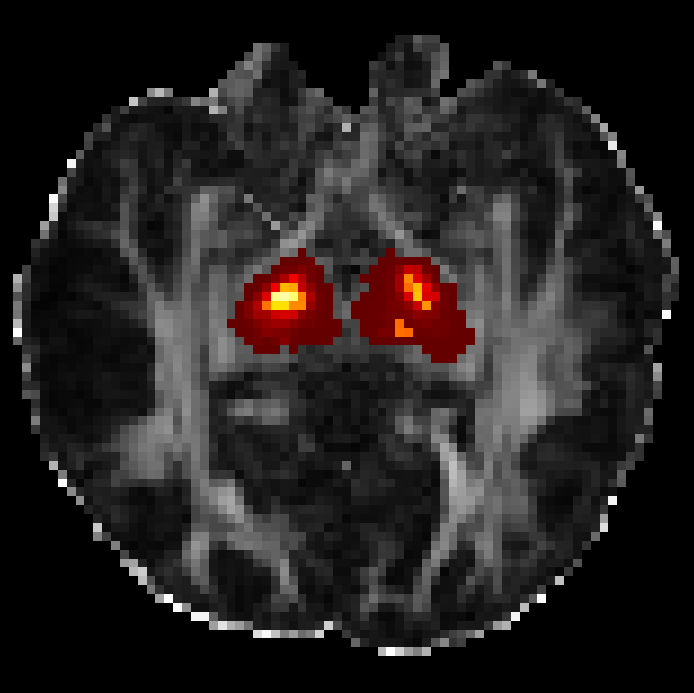
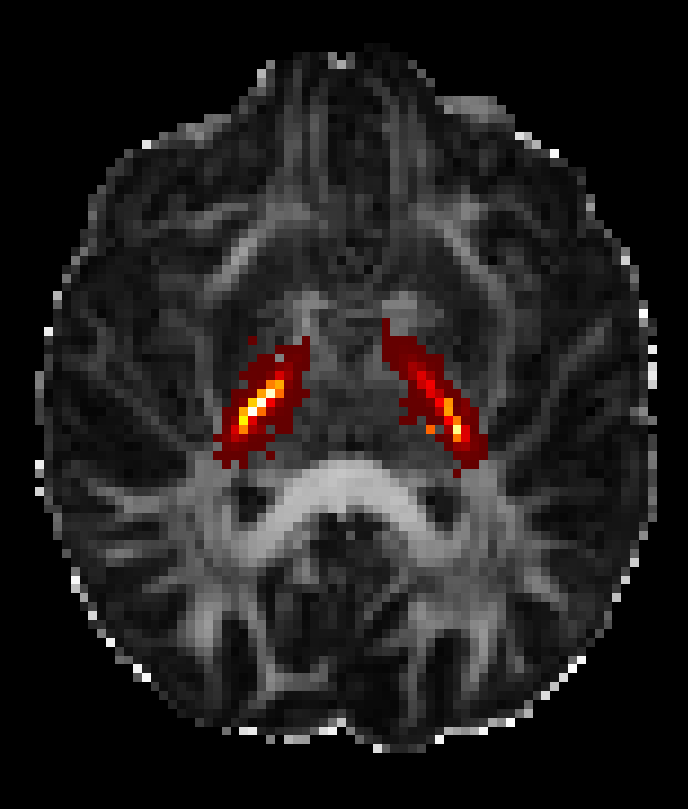
I then run the longitudinal TRACULA pipeline according to the instructions online, and everything completes, but some of the tract posterior distributions look a little funny. I’m attaching some images of the CST where the right side is good but the left side is weird. In case those don’t make it through, here’s a description: While some tract posterior distributions look like good, smooth distributions, some of the tract distributions have a distinct high-value single-voxel running through them. My understanding is that if a tract just has this single line, it means there was an issue with the path initialization (this also occurs in my dataset occasionally), but what about if a tract has both a semi-decent looking distribution, but also has this single-voxel high probability tract?
Is there a step or an output that I could check to help understand why this is occurring? I’ve checked the DWI to T1 bbregister outputs, and those look honestly pretty good (considering this DWI data is non EPI-distortion corrected using field maps or topup).
For the longitudinal TRACULA pipeline, what’s the best way to check if the control points calculated from trac-all -prior are good? In cross-sectional TRACULA, the control point coordinates are output in diffusion space (which seems easy to check), but in the longitudinal they’re only in MNI or anatorig (which I assume means base template?).
Any ideas? Thanks in advance!
Nick



Hi Nick - This likely means that it got stuck at the initial path for a while, but eventually got unstuck and explored the space successfully. If you don't like this look, you can try setting the nburnin parameter in the config file, to something higher than the default 200. This sets the number of perturbations of the path that occur in the very beginning, and are then discarded.
Hope this helps, a.y
On Jan 4, 2019 5:01 PM, Nick Vogt nvogt@wisc.edu wrote:
External Email - Use Caution
Dear TRACULA experts,
I’m hoping someone can provide some insight about why I’m having a little trouble with tract reconstruction using the longitudinal TRACULA pipeline.
As background, the analysis contains 75 middle-aged, cognitively-unimpaired subjects with two time points of imaging (T1 and multi-shell DWI) separated by approximately 2 years. The T1 images have been sent through the longitudinal Freesurfer (6.0) pipeline successfully. The multi-shell data is 2x2x2mm and has 3 b-values (6 b=0, 9 x b=500, 18 x b=800, 36 x b=2000). Prior to use in TRACULA, each DWI volume is noise and Gibbs ringing corrected in MRTrix3, then motion and eddy current corrected using ‘eddy’ in FSL.
I then run the longitudinal TRACULA pipeline according to the instructions online, and everything completes, but some of the tract posterior distributions look a little funny. I’m attaching some images of the CST where the right side is good but the left side is weird. In case those don’t make it through, here’s a description: While some tract posterior distributions look like good, smooth distributions, some of the tract distributions have a distinct high-value single-voxel running through them. My understanding is that if a tract just has this single line, it means there was an issue with the path initialization (this also occurs in my dataset occasionally), but what about if a tract has both a semi-decent looking distribution, but also has this single-voxel high probability tract?
Is there a step or an output that I could check to help understand why this is occurring? I’ve checked the DWI to T1 bbregister outputs, and those look honestly pretty good (considering this DWI data is non EPI-distortion corrected using field maps or topup).
For the longitudinal TRACULA pipeline, what’s the best way to check if the control points calculated from trac-all -prior are good? In cross-sectional TRACULA, the control point coordinates are output in diffusion space (which seems easy to check), but in the longitudinal they’re only in MNI or anatorig (which I assume means base template?).
Any ideas? Thanks in advance!
Nick
External Email - Use Caution
Thank you Anastasia!
I’ll try upping the nburnin to 2000, and then I’ve also had some success increasing the nsample to 18000 (which presumably gives it more opportunities to get unstuck and explore?).
For the longitudinal pipeline, what’s the best way to check that the control points are good prior to running trac-all -path? If I overlay everything in MNI space and the initial spline with the control points looks like it’s in white matter, that should mean that in diffusion space it’s also going to be good as well, correct? Is this even a necessary step or should I just try pushing through to reconstruct the paths and just check the final posterior distribution output?
Thank you so much for the help!
Nick On Jan 4, 2019, 4:12 PM -0600, Yendiki, Anastasia AYENDIKI@mgh.harvard.edu, wrote: Hi Nick - This likely means that it got stuck at the initial path for a while, but eventually got unstuck and explored the space successfully. If you don't like this look, you can try setting the nburnin parameter in the config file, to something higher than the default 200. This sets the number of perturbations of the path that occur in the very beginning, and are then discarded.
Hope this helps, a.y
On Jan 4, 2019 5:01 PM, Nick Vogt nvogt@wisc.edu wrote:
External Email - Use Caution
Dear TRACULA experts,
I’m hoping someone can provide some insight about why I’m having a little trouble with tract reconstruction using the longitudinal TRACULA pipeline.
As background, the analysis contains 75 middle-aged, cognitively-unimpaired subjects with two time points of imaging (T1 and multi-shell DWI) separated by approximately 2 years. The T1 images have been sent through the longitudinal Freesurfer (6.0) pipeline successfully. The multi-shell data is 2x2x2mm and has 3 b-values (6 b=0, 9 x b=500, 18 x b=800, 36 x b=2000). Prior to use in TRACULA, each DWI volume is noise and Gibbs ringing corrected in MRTrix3, then motion and eddy current corrected using ‘eddy’ in FSL.
I then run the longitudinal TRACULA pipeline according to the instructions online, and everything completes, but some of the tract posterior distributions look a little funny. I’m attaching some images of the CST where the right side is good but the left side is weird. In case those don’t make it through, here’s a description: While some tract posterior distributions look like good, smooth distributions, some of the tract distributions have a distinct high-value single-voxel running through them. My understanding is that if a tract just has this single line, it means there was an issue with the path initialization (this also occurs in my dataset occasionally), but what about if a tract has both a semi-decent looking distribution, but also has this single-voxel high probability tract?
Is there a step or an output that I could check to help understand why this is occurring? I’ve checked the DWI to T1 bbregister outputs, and those look honestly pretty good (considering this DWI data is non EPI-distortion corrected using field maps or topup).
For the longitudinal TRACULA pipeline, what’s the best way to check if the control points calculated from trac-all -prior are good? In cross-sectional TRACULA, the control point coordinates are output in diffusion space (which seems easy to check), but in the longitudinal they’re only in MNI or anatorig (which I assume means base template?).
Any ideas? Thanks in advance!
Nick
Hi Nick - Increasing the nsample is another way to do it, but somewhat different. This way those "stuck" initial samples are still saved in the distribution, they are just less obvious because there are mixed in with many more of the "unstuck" ones.
In longitudinal TRACULA, the paths are initialized and perturbed in the within-subject base template space. You can display the FA maps of individual time points in that space using the transformation from dmri/xfms/anatorig2diff... This way you can troubleshoot where the issues with the initial path may be.
Hope this helps,
a.y
________________________________ From: freesurfer-bounces@nmr.mgh.harvard.edu freesurfer-bounces@nmr.mgh.harvard.edu on behalf of Nick Vogt nvogt@wisc.edu Sent: Friday, January 4, 2019 6:21:30 PM To: Freesurfer support list Subject: Re: [Freesurfer] Tracula longitudinal tract reconstruction problems
External Email - Use Caution
Thank you Anastasia!
I’ll try upping the nburnin to 2000, and then I’ve also had some success increasing the nsample to 18000 (which presumably gives it more opportunities to get unstuck and explore?).
For the longitudinal pipeline, what’s the best way to check that the control points are good prior to running trac-all -path? If I overlay everything in MNI space and the initial spline with the control points looks like it’s in white matter, that should mean that in diffusion space it’s also going to be good as well, correct? Is this even a necessary step or should I just try pushing through to reconstruct the paths and just check the final posterior distribution output?
Thank you so much for the help!
Nick On Jan 4, 2019, 4:12 PM -0600, Yendiki, Anastasia AYENDIKI@mgh.harvard.edu, wrote: Hi Nick - This likely means that it got stuck at the initial path for a while, but eventually got unstuck and explored the space successfully. If you don't like this look, you can try setting the nburnin parameter in the config file, to something higher than the default 200. This sets the number of perturbations of the path that occur in the very beginning, and are then discarded.
Hope this helps, a.y
On Jan 4, 2019 5:01 PM, Nick Vogt nvogt@wisc.edu wrote:
External Email - Use Caution
Dear TRACULA experts,
I’m hoping someone can provide some insight about why I’m having a little trouble with tract reconstruction using the longitudinal TRACULA pipeline.
As background, the analysis contains 75 middle-aged, cognitively-unimpaired subjects with two time points of imaging (T1 and multi-shell DWI) separated by approximately 2 years. The T1 images have been sent through the longitudinal Freesurfer (6.0) pipeline successfully. The multi-shell data is 2x2x2mm and has 3 b-values (6 b=0, 9 x b=500, 18 x b=800, 36 x b=2000). Prior to use in TRACULA, each DWI volume is noise and Gibbs ringing corrected in MRTrix3, then motion and eddy current corrected using ‘eddy’ in FSL.
I then run the longitudinal TRACULA pipeline according to the instructions online, and everything completes, but some of the tract posterior distributions look a little funny. I’m attaching some images of the CST where the right side is good but the left side is weird. In case those don’t make it through, here’s a description: While some tract posterior distributions look like good, smooth distributions, some of the tract distributions have a distinct high-value single-voxel running through them. My understanding is that if a tract just has this single line, it means there was an issue with the path initialization (this also occurs in my dataset occasionally), but what about if a tract has both a semi-decent looking distribution, but also has this single-voxel high probability tract?
Is there a step or an output that I could check to help understand why this is occurring? I’ve checked the DWI to T1 bbregister outputs, and those look honestly pretty good (considering this DWI data is non EPI-distortion corrected using field maps or topup).
For the longitudinal TRACULA pipeline, what’s the best way to check if the control points calculated from trac-all -prior are good? In cross-sectional TRACULA, the control point coordinates are output in diffusion space (which seems easy to check), but in the longitudinal they’re only in MNI or anatorig (which I assume means base template?).
Any ideas? Thanks in advance!
Nick
freesurfer@nmr.mgh.harvard.edu
-
 Nick Vogt
 -
 Yendiki, Anastasia