
Great - and this would be true for all models?
For example, in the attached graph, I'm looking at a region representing increased cortical thickness for one group compared to the other (orange blob, Q: "Does the average thickness differ between HC and SAD?" nuisance factor: mean thickness). From this plot it appears that SAD > HC, but based on your answer to the previous question I would think this region should represent HC > SAD. Can you please explain this?
Thank you!
On Wed, Oct 30, 2013 at 7:33 AM, Douglas N Greve greve@nmr.mgh.harvard.eduwrote:
In your case you have HC listed first, so red/yellow means HC>SAD, blue means SAD>HC doug
On 10/29/2013 11:03 PM, Ashley Shurick wrote:
Hi Doug,
Apologies, but I have a rather easy follow-up question that I can't figure out:
How do you interpret the effect in each significant region? A previous post suggests using ctrl + left mouse click on a blob and examining the plot of the data. However, for the model I am looking at ("Does the thickness-ERQ correlation differ between HC and SAD?") I still can't determine if cortical thinning represents HC<SAD or SAD<HC. I'm attaching a representative plot here.
Thank you,
Ashley
On Tue, Oct 29, 2013 at 10:25 AM, Ashley Shurick < ashley.shurick@gmail.com <mailto:ashley.shurick@gmail.**comashley.shurick@gmail.com>> wrote:
Thank you!


On Tue, Oct 29, 2013 at 10:19 AM, Douglas N Greve
<greve@nmr.mgh.harvard.edu <mailto:greve@nmr.mgh.harvard.**edu<greve@nmr.mgh.harvard.edu>>>
wrote:
On 10/29/2013 01:10 PM, Ashley Shurick wrote: > Hi all, > > I'm running analyses in Qdec and want to verify a few things: > > 1. When comparing two groups (HC vs patients) I am including mean > cortical thickness as a covariate, using the following equation: > > > bh.thickness = (lh.thickness*lh.surfarea + rh.thickness*rh.surfarea) / > (lh.surfarea + rh.surfarea) > > > Is this the best way to calculate global mean thickness? Yes > > > 2. I want to regress out any effects of age, therefore I need to > demean the ages for my groups as a whole, and not perform this > calculation on each group separately, correct? Yes, in which case the test of the difference between groups will be done at an age equal to the mean of the ages. > > 3. I'm including questionnaires as a covariate of interest - do I need > to demean these values as well? When you do a test on a continuous covariate, that test will be unaffected by demeaning of the covariate. Demeaning will affect the difference between groups if you use a separate covariate for each group. If you have a single covariate across groups, demeaning will have no effect. doug > > > Thank you in advance for your help! > > > Ashley > > > -- > Ashley A. Shurick > Ph.D. Candidate > Department of Psychology > Stanford University > > > ______________________________**_________________ > Freesurfer mailing list > Freesurfer@nmr.mgh.harvard.edu <mailto:Freesurfer@nmr.mgh.**harvard.edu<Freesurfer@nmr.mgh.harvard.edu>> https://mail.nmr.mgh.harvard.**edu/mailman/listinfo/**freesurfer https://mail.nmr.mgh.harvard.edu/mailman/listinfo/freesurfer
-- Douglas N. Greve, Ph.D. MGH-NMR Center greve@nmr.mgh.harvard.edu <mailto:greve@nmr.mgh.harvard.**edu<greve@nmr.mgh.harvard.edu>Phone Number: 617-724-2358 <tel:617-724-2358> Fax: 617-726-7422 <tel:617-726-7422> Bugs: surfer.nmr.mgh.harvard.edu/**fswiki/BugReporting<http://surfer.nmr.mgh.harvard.edu/fswiki/BugReporting> <http://surfer.nmr.mgh.**harvard.edu/fswiki/**BugReporting<http://surfer.nmr.mgh.harvard.edu/fswiki/BugReporting>FileDrop: https://gate.nmr.mgh.harvard.**edu/filedrop2<https://gate.nmr.mgh.harvard.edu/filedrop2> www.nmr.mgh.harvard.edu/**facility/filedrop/index.html<http://www.nmr.mgh.harvard.edu/facility/filedrop/index.html> <http://www.nmr.mgh.harvard.**edu/facility/filedrop/index.**html<http://www.nmr.mgh.harvard.edu/facility/filedrop/index.html>Outgoing: ftp://surfer.nmr.mgh.harvard.**edu/transfer/outgoing/flat/**greve/ ftp://surfer.nmr.mgh.harvard.edu/transfer/outgoing/flat/greve/
______________________________**_________________ Freesurfer mailing list Freesurfer@nmr.mgh.harvard.edu <mailto:Freesurfer@nmr.mgh.**harvard.edu<Freesurfer@nmr.mgh.harvard.edu>https://mail.nmr.mgh.harvard.**edu/mailman/listinfo/**freesurfer<https://mail.nmr.mgh.harvard.edu/mailman/listinfo/freesurfer> The information in this e-mail is intended only for the person to whom it is addressed. If you believe this e-mail was sent to you in error and the e-mail contains patient information, please contact the Partners Compliance HelpLine at http://www.partners.org/**complianceline<http://www.partners.org/complianceline>. If the e-mail was sent to you in error but does not contain patient information, please contact the sender and properly dispose of the e-mail.-- Douglas N. Greve, Ph.D. MGH-NMR Center greve@nmr.mgh.harvard.edu Phone Number: 617-724-2358 Fax: 617-726-7422
Bugs: surfer.nmr.mgh.harvard.edu/**fswiki/BugReportinghttp://surfer.nmr.mgh.harvard.edu/fswiki/BugReporting FileDrop: https://gate.nmr.mgh.harvard.**edu/filedrop2https://gate.nmr.mgh.harvard.edu/filedrop2 www.nmr.mgh.harvard.edu/**facility/filedrop/index.htmlhttp://www.nmr.mgh.harvard.edu/facility/filedrop/index.html Outgoing: ftp://surfer.nmr.mgh.harvard.**edu/transfer/outgoing/flat/** greve/ ftp://surfer.nmr.mgh.harvard.edu/transfer/outgoing/flat/greve/
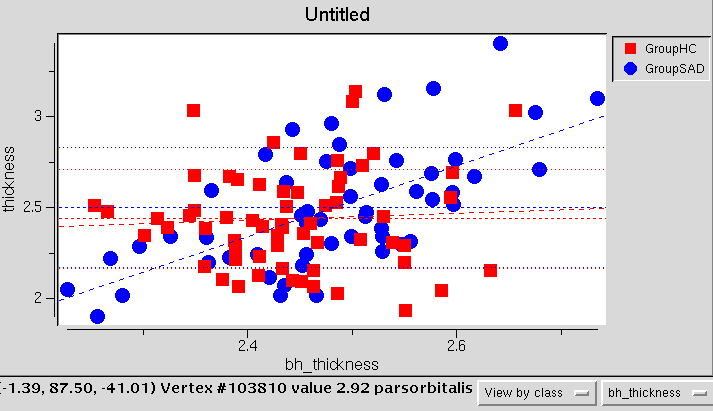

Yes, true for all models. I'm not sure what I'm looking at in this scatter plot. The scatter plot does not have the nuisance effects removed, so it might be that when you remove the nuisance effect, then HC>SAD doug
On 10/30/2013 01:32 PM, Ashley Shurick wrote:
Great - and this would be true for all models?
For example, in the attached graph, I'm looking at a region representing increased cortical thickness for one group compared to the other (orange blob, Q: "Does the average thickness differ between HC and SAD?" nuisance factor: mean thickness). From this plot it appears that SAD > HC, but based on your answer to the previous question I would think this region should represent HC > SAD. Can you please explain this?
Thank you!
On Wed, Oct 30, 2013 at 7:33 AM, Douglas N Greve <greve@nmr.mgh.harvard.edu mailto:greve@nmr.mgh.harvard.edu> wrote:
In your case you have HC listed first, so red/yellow means HC>SAD,
blue means SAD>HC
doug


On 10/29/2013 11:03 PM, Ashley Shurick wrote:

    Hi Doug,

    Apologies, but I have a rather easy follow-up question that I
    can't figure out:

    How do you interpret the effect in each significant region? A
    previous post suggests using ctrl + left mouse click on a blob
    and examining the plot of the data. However, for the model I
    am looking at ("Does the thickness-ERQ correlation differ
    between HC and SAD?") I still can't determine if cortical
    thinning represents HC<SAD or SAD<HC. I'm attaching a
    representative plot here.

    Thank you,

    Ashley


    On Tue, Oct 29, 2013 at 10:25 AM, Ashley Shurick
    <ashley.shurick@gmail.com <mailto:ashley.shurick@gmail.com>
    <mailto:ashley.shurick@gmail.com
    <mailto:ashley.shurick@gmail.com>>> wrote:

        Thank you!


        On Tue, Oct 29, 2013 at 10:19 AM, Douglas N Greve
        <greve@nmr.mgh.harvard.edu
    <mailto:greve@nmr.mgh.harvard.edu>
    <mailto:greve@nmr.mgh.harvard.edu
    <mailto:greve@nmr.mgh.harvard.edu>>> wrote:


            On 10/29/2013 01:10 PM, Ashley Shurick wrote:
            > Hi all,
            >
            > I'm running analyses in Qdec and want to verify a
    few things:
            >
            > 1. When comparing two groups (HC vs patients) I am
    including
            mean
            > cortical thickness as a covariate, using the
    following equation:
            >
            >
            > bh.thickness = (lh.thickness*lh.surfarea +
            rh.thickness*rh.surfarea) /
            > (lh.surfarea + rh.surfarea)
            >
            >
            > Is this the best way to calculate global mean thickness?
            Yes
            >
            >
            > 2. I want to regress out any effects of age,
    therefore I need to
            > demean the ages for my groups as a whole, and not
    perform this
            > calculation on each group separately, correct?
            Yes, in which case the test of the difference between
    groups
            will be
            done at an age equal to the mean of the ages.
            >
            > 3. I'm including questionnaires as a covariate of
    interest -
            do I need
            > to demean these values as well?
            When you do a test on a continuous covariate, that
    test will be
            unaffected by demeaning of the covariate. Demeaning will
            affect the
            difference between groups if you use a separate
    covariate for each
            group. If you have a single covariate across groups,
    demeaning
            will have
            no effect.

            doug
            >
            >
            > Thank you in advance for your help!
            >
            >
            > Ashley
            >
            >
            > --
            > Ashley A. Shurick
            > Ph.D. Candidate
            > Department of Psychology
            > Stanford University
            >
            >
            > _______________________________________________
            > Freesurfer mailing list
            > Freesurfer@nmr.mgh.harvard.edu
    <mailto:Freesurfer@nmr.mgh.harvard.edu>
            <mailto:Freesurfer@nmr.mgh.harvard.edu
    <mailto:Freesurfer@nmr.mgh.harvard.edu>>

            >
    https://mail.nmr.mgh.harvard.edu/mailman/listinfo/freesurfer

            --
            Douglas N. Greve, Ph.D.
            MGH-NMR Center
    greve@nmr.mgh.harvard.edu <mailto:greve@nmr.mgh.harvard.edu>
    <mailto:greve@nmr.mgh.harvard.edu
    <mailto:greve@nmr.mgh.harvard.edu>>
            Phone Number: 617-724-2358 <tel:617-724-2358>
    <tel:617-724-2358 <tel:617-724-2358>>
            Fax: 617-726-7422 <tel:617-726-7422> <tel:617-726-7422
    <tel:617-726-7422>>

            Bugs: surfer.nmr.mgh.harvard.edu/fswiki/BugReporting
    <http://surfer.nmr.mgh.harvard.edu/fswiki/BugReporting>
            <http://surfer.nmr.mgh.harvard.edu/fswiki/BugReporting>
            FileDrop: https://gate.nmr.mgh.harvard.edu/filedrop2
    www.nmr.mgh.harvard.edu/facility/filedrop/index.html
    <http://www.nmr.mgh.harvard.edu/facility/filedrop/index.html>

    <http://www.nmr.mgh.harvard.edu/facility/filedrop/index.html>

            Outgoing:
    ftp://surfer.nmr.mgh.harvard.edu/transfer/outgoing/flat/greve/

            _______________________________________________
            Freesurfer mailing list
    Freesurfer@nmr.mgh.harvard.edu
    <mailto:Freesurfer@nmr.mgh.harvard.edu>
            <mailto:Freesurfer@nmr.mgh.harvard.edu
    <mailto:Freesurfer@nmr.mgh.harvard.edu>>

    https://mail.nmr.mgh.harvard.edu/mailman/listinfo/freesurfer


            The information in this e-mail is intended only for
    the person
            to whom it is
            addressed. If you believe this e-mail was sent to you
    in error
            and the e-mail
            contains patient information, please contact the Partners
            Compliance HelpLine at
    http://www.partners.org/complianceline . If the e-mail was
            sent to you in error
            but does not contain patient information, please
    contact the
            sender and properly
            dispose of the e-mail.


--
Douglas N. Greve, Ph.D.
MGH-NMR Center
greve@nmr.mgh.harvard.edu <mailto:greve@nmr.mgh.harvard.edu>
Phone Number: 617-724-2358 <tel:617-724-2358>
Fax: 617-726-7422 <tel:617-726-7422>

Bugs: surfer.nmr.mgh.harvard.edu/fswiki/BugReporting
<http://surfer.nmr.mgh.harvard.edu/fswiki/BugReporting>
FileDrop: https://gate.nmr.mgh.harvard.edu/filedrop2
www.nmr.mgh.harvard.edu/facility/filedrop/index.html
<http://www.nmr.mgh.harvard.edu/facility/filedrop/index.html>
Outgoing:
ftp://surfer.nmr.mgh.harvard.edu/transfer/outgoing/flat/greve/
Freesurfer mailing list Freesurfer@nmr.mgh.harvard.edu https://mail.nmr.mgh.harvard.edu/mailman/listinfo/freesurfer
freesurfer@nmr.mgh.harvard.edu
-
 Ashley Shurick
 -
 Douglas N Greve