
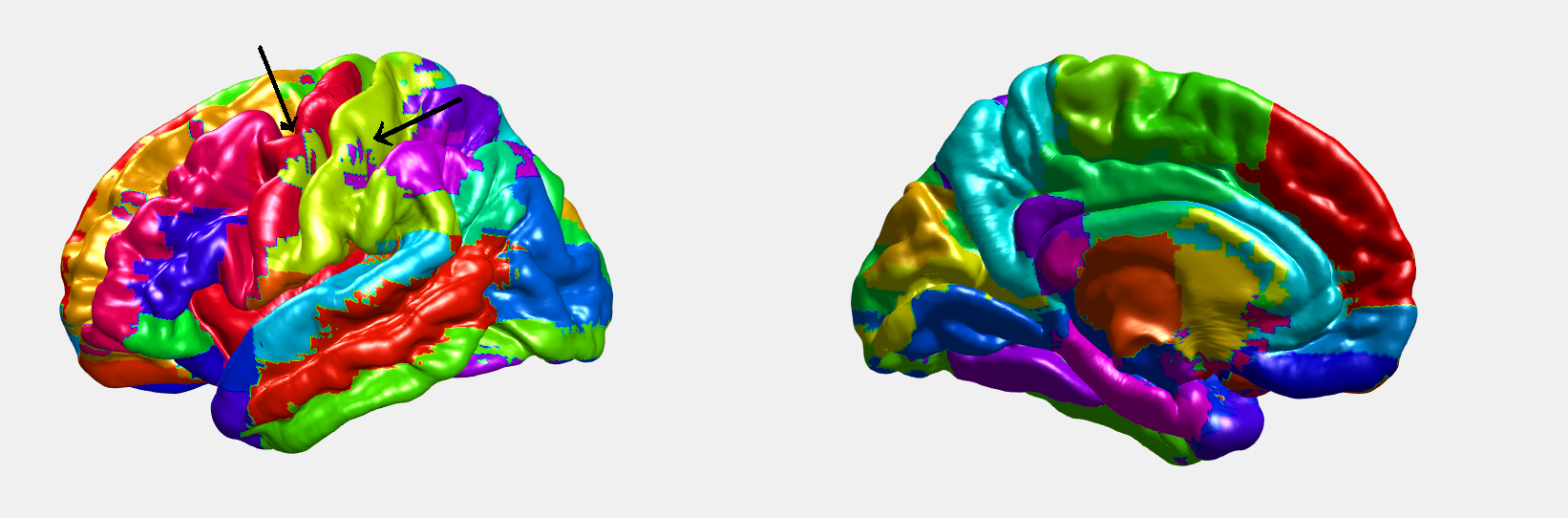
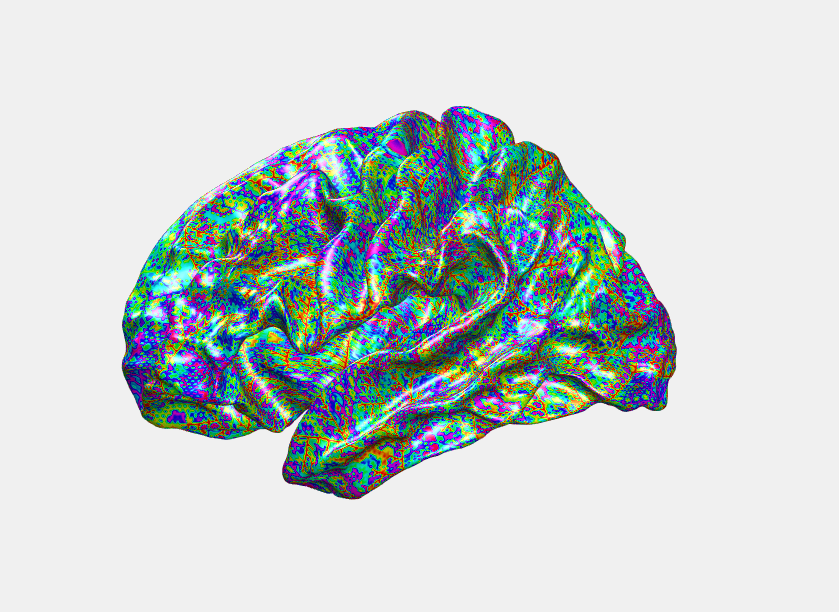
Hi, We are trying to project the AAL labels from volume to surface in order to be able to include the AAL atlas to our surface-based experiments. What we have done so far is that we projected the volume labels to the fsaverage white surface using mri_vol2surf function in the following setting: mri_vol2surf --mov ROI_MNI_V5.nii --mni152reg --hemi lh --surf white --o $OUT_FOLDER/lh.fsaverage.white.ROI_MNI_V5.asc.w --out_type paint --trgsubject fsaverage where ROI_MNI_V5.nii corresponds to the ALL atlas in MNI space. After converting the output asc.w file first to a FreeSurfer-compatible format, and then to gifti, we realized that the result was garbage (Please see Fig. 1). Following a suggestion from a member of our research group, we applied dilation to the input atlas (ROI_MNI_V5.nii) and re-ran the function with the same setting as above. This way, the final cortical parcellation was not perfect but still seemed to be usable (Please see Fig. 2). The problem here is that, as you may have also noticed, some of the cortical parcellation boundaries do not follow the folding patterns across the surface. Besides, some parcels just do not seem to be right (see the arrows in the motor area). Having said that, I have the following questions:1- Why is not possible to properly project the labels onto the surface without first dilating the input atlas?2- If dilation is not a big issue, how would the experts in the mailing list interpret the distortions, especially in the motor area? Is it kind of a side effect we should expect after such process between volume and surface?
From the archive I can see that similar questions have been posted a few years back (https://www.mail-archive.com/freesurfer@nmr.mgh.harvard.edu/msg27586.html, https://www.mail-archive.com/freesurfer%40nmr.mgh.harvard.edu/msg23761.html). Although these messages are highly useful, apparently there is still not a standard solution to this problem. Please accept my sincere apologies if this is still considered as re-posting.
Any feedback is greatly appreciated. Thanks for your attention. Kind regards,Salim
freesurfer@nmr.mgh.harvard.edu
-
 Salim Arslan