
Dear Freesurfer experts,
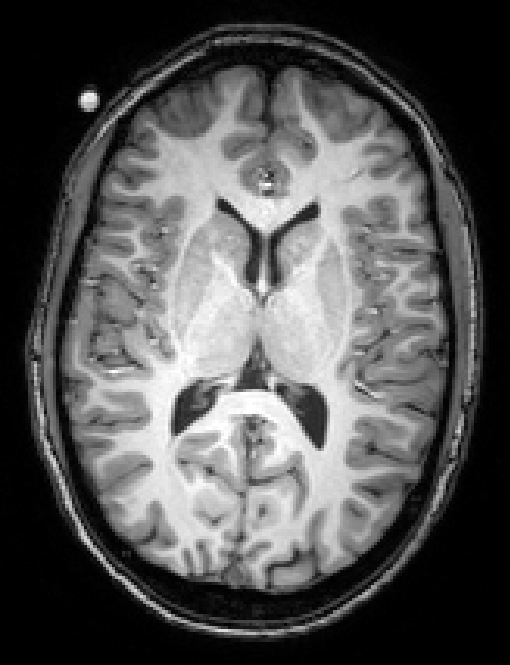
We are planning to start a new MRI study which will include T1 scans. As we are in a testing phase now, I was wondering whether you could comment on the attached screenshots. Clearly, "scan1" has a better white matter/grey matter contrast than "scan2". Do you think going for "scan1" would be the sensible thing to do when we later wish to use Freesurfer with these scans? Or perhaps is neither of the examples I attached good enough?
By the way, these scans were acquired on a Philips 3T scanner, both taking around 10 minutes.
It you need any more information, please let me know. Many thanks in advance for your advice.
Jelmer Kok ________________________________ De inhoud van dit bericht is vertrouwelijk en alleen bestemd voor de geadresseerde(n). Anderen dan de geadresseerde(n) mogen geen gebruik maken van dit bericht, het niet openbaar maken of op enige wijze verspreiden of vermenigvuldigen. Het UMCG kan niet aansprakelijk gesteld worden voor een incomplete aankomst of vertraging van dit verzonden bericht.
The contents of this message are confidential and only intended for the eyes of the addressee(s). Others than the addressee(s) are not allowed to use this message, to make it public or to distribute or multiply this message in any way. The UMCG cannot be held responsible for incomplete reception or delay of this transferred message.



Hi Jelmer
if you give us the specific acquisition details we can help more (receive coil, acceleration, voxel size, sequence type, TR/TE/TI/flip angle/bandwidth, etc....). We also have recommended morphometry sequences on our website.
10 min is a pretty long structural scan for a modern MRI scanner.
cheers Bruce
On Tue, 1 Apr 2014, Kok, JG (neuro) wrote:
Dear Freesurfer experts, We are planning to start a new MRI study which will include T1 scans. As we are in a testing phase now, I was wondering whether you could comment on the attached screenshots. Clearly, "scan1" has a better white matter/grey matter contrast than "scan2". Do you think going for "scan1" would be the sensible thing to do when we later wish to use Freesurfer with these scans? Or perhaps is neither of the examples I attached good enough?
By the way, these scans were acquired on a Philips 3T scanner, both taking around 10 minutes.
It you need any more information, please let me know. Many thanks in advance for your advice.
Jelmer Kok
De inhoud van dit bericht is vertrouwelijk en alleen bestemd voor de geadresseerde(n). Anderen dan de geadresseerde(n) mogen geen gebruik maken van dit bericht, het niet openbaar maken of op enige wijze verspreiden of vermenigvuldigen. Het UMCG kan niet aansprakelijk gesteld worden voor een incomplete aankomst of vertraging van dit verzonden bericht.
The contents of this message are confidential and only intended for the eyes of the addressee(s). Others than the addressee(s) are not allowed to use this message, to make it public or to distribute or multiply this message in any way. The UMCG cannot be held responsible for incomplete reception or delay of this transferred message.
Hi Bruce,
Thanks for your fast reply.
Hereby I attach the parameter files of both scans (although I suspect looking at the parameters of "scan1" may be sufficient). Checking it with the information on Philips at "http://www.nmr.mgh.harvard.edu/~andre/FreeSurfer_recommended_morphometry_pro...":
" Sequence: T1W_3D_TFE_SENSE Acquisition time: 5:13 Voxel size: 1.0 x 1.0 x 1.0 mm3 Geometry: FoV 256 mm (256 x 256 matrix), 176 sagittal slices, slice thickness 1 mm, (3D encoding) Timing: TR shortest (7600 ms), TI 1100 ms, TE shortest (3.5 ms), bandwidth 191.5 Hz/px RF: flip angle 7° Acceleration: 2x SENSE "
suggests that parameters in "scan1_parameter_file.txt" are already pretty similar to those I guess. (Is it the SENSE that is missing in our protocol that is the most important difference?)
Thanks,
Jelmer
________________________________________ Van: freesurfer-bounces@nmr.mgh.harvard.edu [freesurfer-bounces@nmr.mgh.harvard.edu] namens Bruce Fischl [fischl@nmr.mgh.harvard.edu] Verzonden: dinsdag 1 april 2014 14:09 Aan: Freesurfer support list Onderwerp: Re: [Freesurfer] quality T1 scans for new study
Hi Jelmer
if you give us the specific acquisition details we can help more (receive coil, acceleration, voxel size, sequence type, TR/TE/TI/flip angle/bandwidth, etc....). We also have recommended morphometry sequences on our website.
10 min is a pretty long structural scan for a modern MRI scanner.
cheers Bruce
On Tue, 1 Apr 2014, Kok, JG (neuro) wrote:
Dear Freesurfer experts, We are planning to start a new MRI study which will include T1 scans. As we are in a testing phase now, I was wondering whether you could comment on the attached screenshots. Clearly, "scan1" has a better white matter/grey matter contrast than "scan2". Do you think going for "scan1" would be the sensible thing to do when we later wish to use Freesurfer with these scans? Or perhaps is neither of the examples I attached good enough?
By the way, these scans were acquired on a Philips 3T scanner, both taking around 10 minutes.
It you need any more information, please let me know. Many thanks in advance for your advice.
Jelmer Kok
De inhoud van dit bericht is vertrouwelijk en alleen bestemd voor de geadresseerde(n). Anderen dan de geadresseerde(n) mogen geen gebruik maken van dit bericht, het niet openbaar maken of op enige wijze verspreiden of vermenigvuldigen. Het UMCG kan niet aansprakelijk gesteld worden voor een incomplete aankomst of vertraging van dit verzonden bericht.
The contents of this message are confidential and only intended for the eyes of the addressee(s). Others than the addressee(s) are not allowed to use this message, to make it public or to distribute or multiply this message in any way. The UMCG cannot be held responsible for incomplete reception or delay of this transferred message.
_______________________________________________ Freesurfer mailing list Freesurfer@nmr.mgh.harvard.edu https://mail.nmr.mgh.harvard.edu/mailman/listinfo/freesurfer
The information in this e-mail is intended only for the person to whom it is addressed. If you believe this e-mail was sent to you in error and the e-mail contains patient information, please contact the Partners Compliance HelpLine at http://www.partners.org/complianceline . If the e-mail was sent to you in error but does not contain patient information, please contact the sender and properly dispose of the e-mail.
________________________________ De inhoud van dit bericht is vertrouwelijk en alleen bestemd voor de geadresseerde(n). Anderen dan de geadresseerde(n) mogen geen gebruik maken van dit bericht, het niet openbaar maken of op enige wijze verspreiden of vermenigvuldigen. Het UMCG kan niet aansprakelijk gesteld worden voor een incomplete aankomst of vertraging van dit verzonden bericht.
The contents of this message are confidential and only intended for the eyes of the addressee(s). Others than the addressee(s) are not allowed to use this message, to make it public or to distribute or multiply this message in any way. The UMCG cannot be held responsible for incomplete reception or delay of this transferred message.
looks pretty reasonable. Andre: any comments/suggestions?
On Tue, 1 Apr 2014, Kok, JG (neuro) wrote:
Hi Bruce,
Thanks for your fast reply.
Hereby I attach the parameter files of both scans (although I suspect looking at the parameters of "scan1" may be sufficient). Checking it with the information on Philips at "http://www.nmr.mgh.harvard.edu/~andre/FreeSurfer_recommended_morphometry_pro...":
" Sequence: T1W_3D_TFE_SENSE Acquisition time: 5:13 Voxel size: 1.0 x 1.0 x 1.0 mm3 Geometry: FoV 256 mm (256 x 256 matrix), 176 sagittal slices, slice thickness 1 mm, (3D encoding) Timing: TR shortest (7600 ms), TI 1100 ms, TE shortest (3.5 ms), bandwidth 191.5 Hz/px RF: flip angle 7° Acceleration: 2x SENSE "
suggests that parameters in "scan1_parameter_file.txt" are already pretty similar to those I guess. (Is it the SENSE that is missing in our protocol that is the most important difference?)
Thanks,
Jelmer
Van: freesurfer-bounces@nmr.mgh.harvard.edu [freesurfer-bounces@nmr.mgh.harvard.edu] namens Bruce Fischl [fischl@nmr.mgh.harvard.edu] Verzonden: dinsdag 1 april 2014 14:09 Aan: Freesurfer support list Onderwerp: Re: [Freesurfer] quality T1 scans for new study
Hi Jelmer
if you give us the specific acquisition details we can help more (receive coil, acceleration, voxel size, sequence type, TR/TE/TI/flip angle/bandwidth, etc....). We also have recommended morphometry sequences on our website.
10 min is a pretty long structural scan for a modern MRI scanner.
cheers Bruce
On Tue, 1 Apr 2014, Kok, JG (neuro) wrote:
Dear Freesurfer experts, We are planning to start a new MRI study which will include T1 scans. As we are in a testing phase now, I was wondering whether you could comment on the attached screenshots. Clearly, "scan1" has a better white matter/grey matter contrast than "scan2". Do you think going for "scan1" would be the sensible thing to do when we later wish to use Freesurfer with these scans? Or perhaps is neither of the examples I attached good enough?
By the way, these scans were acquired on a Philips 3T scanner, both taking around 10 minutes.
It you need any more information, please let me know. Many thanks in advance for your advice.
Jelmer Kok
De inhoud van dit bericht is vertrouwelijk en alleen bestemd voor de geadresseerde(n). Anderen dan de geadresseerde(n) mogen geen gebruik maken van dit bericht, het niet openbaar maken of op enige wijze verspreiden of vermenigvuldigen. Het UMCG kan niet aansprakelijk gesteld worden voor een incomplete aankomst of vertraging van dit verzonden bericht.
The contents of this message are confidential and only intended for the eyes of the addressee(s). Others than the addressee(s) are not allowed to use this message, to make it public or to distribute or multiply this message in any way. The UMCG cannot be held responsible for incomplete reception or delay of this transferred message.
Freesurfer mailing list Freesurfer@nmr.mgh.harvard.edu https://mail.nmr.mgh.harvard.edu/mailman/listinfo/freesurfer
The information in this e-mail is intended only for the person to whom it is addressed. If you believe this e-mail was sent to you in error and the e-mail contains patient information, please contact the Partners Compliance HelpLine at http://www.partners.org/complianceline . If the e-mail was sent to you in error but does not contain patient information, please contact the sender and properly dispose of the e-mail.
De inhoud van dit bericht is vertrouwelijk en alleen bestemd voor de geadresseerde(n). Anderen dan de geadresseerde(n) mogen geen gebruik maken van dit bericht, het niet openbaar maken of op enige wijze verspreiden of vermenigvuldigen. Het UMCG kan niet aansprakelijk gesteld worden voor een incomplete aankomst of vertraging van dit verzonden bericht.
The contents of this message are confidential and only intended for the eyes of the addressee(s). Others than the addressee(s) are not allowed to use this message, to make it public or to distribute or multiply this message in any way. The UMCG cannot be held responsible for incomplete reception or delay of this transferred message.
freesurfer@nmr.mgh.harvard.edu
-
 Bruce Fischl
 -
 Kok, JG (neuro)