
Dear FreeSurfer Experts,
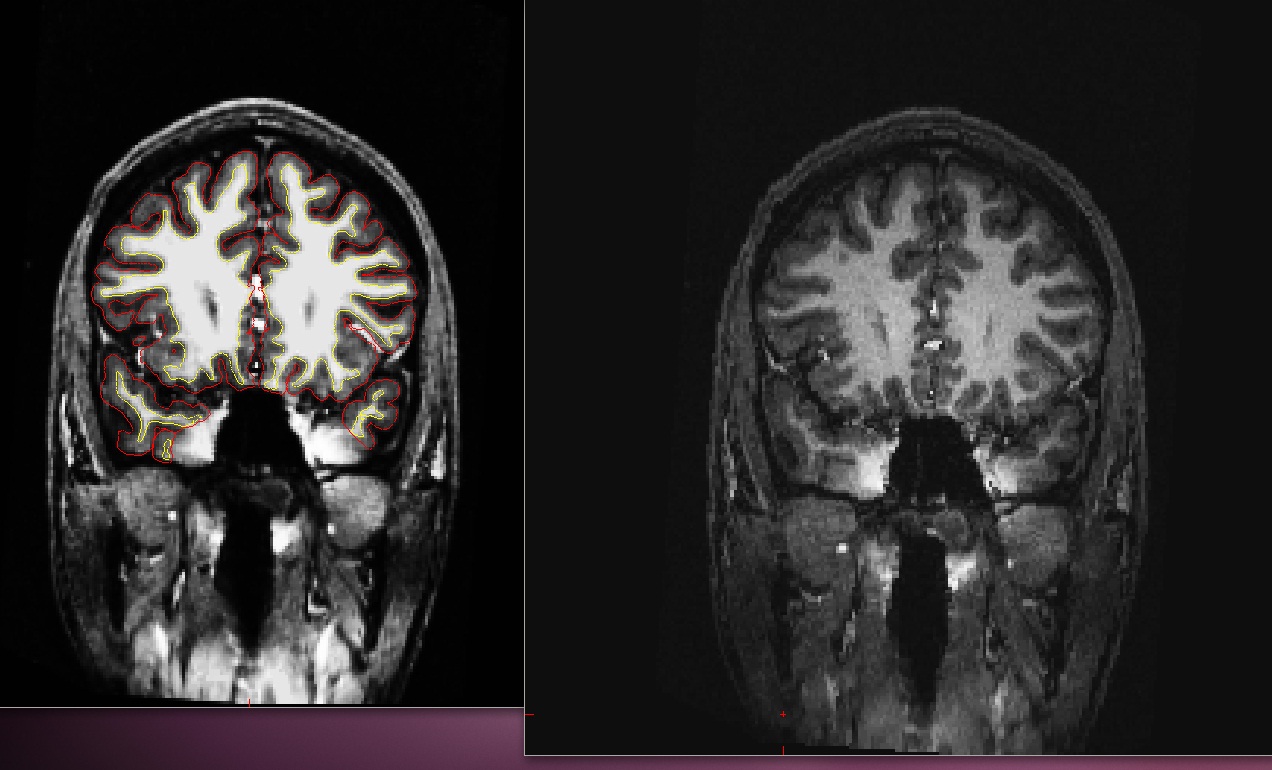
I'm currently working with a data set that seems to have a systematic problem with intensity. I attached an image of a brain with this problem for your reference. As you can see, the unprocessed MRI file has an intensity problem in the temporal lobe, almost like a flashlight is lighting it up. When FreeSurfer processes this part of the brain it fails to detect it. My question is a) is this data still usable? We aren't actually looking for any effects in this area of the brain, but are worried that it is a bigger symptom of problematic data and b) if this data is still usable, is there anything we can do to work around it?
Thanks, Matthew Russell

Dear freesurfer users,
I am a beginner in freesurfer. I have run the recon-all command for all my images, but in some of them the program aborted before completing (and even if I try to re-run recon-all). After that, inspecting the segmentation with tkmedit and tksurfer, many images have small defects (like including pieces of dura within pial surface or excluding some white matter voxels from the white matter surface). I would like to ask:
1) What should I do to run recon-all approprietly? I have run with nifti images (.nii) - is that correct? 2) Should I correct all small defects observed in tkmedit and tksurfer for all images before running qdec?
Thanks a lot
Alfredo Damasceno

Hi Alfredo It depends on why it aborted. Can you send us the error message you get? Cheers Bruce
On Mar 4, 2011, at 8:25 AM, Alfredo Damasceno alfredodamasceno@hotmail.com wrote:
Dear freesurfer users,
I am a beginner in freesurfer. I have run the recon-all command for all my images, but in some of them the program aborted before completing (and even if I try to re-run recon-all). After that, inspecting the segmentation with tkmedit and tksurfer, many images have small defects (like including pieces of dura within pial surface or excluding some white matter voxels from the white matter surface). I would like to ask:
- What should I do to run recon-all approprietly? I have run with nifti images (.nii) - is that correct?
- Should I correct all small defects observed in tkmedit and tksurfer for all images before running qdec?
Thanks a lot
Alfredo Damasceno _______________________________________________ Freesurfer mailing list Freesurfer@nmr.mgh.harvard.edu https://mail.nmr.mgh.harvard.edu/mailman/listinfo/freesurfer
Hi matt Does the parcellation look correct? If so you might be ok if you stay away from the affected regions. It's hard to tell from one slice. Cheers Bruce
On Mar 3, 2011, at 9:47 PM, Matt Russell russ0150@umn.edu wrote:
Dear FreeSurfer Experts,
I'm currently working with a data set that seems to have a systematic problem with intensity. I attached an image of a brain with this problem for your reference. As you can see, the unprocessed MRI file has an intensity problem in the temporal lobe, almost like a flashlight is lighting it up. When FreeSurfer processes this part of the brain it fails to detect it. My question is a) is this data still usable? We aren't actually looking for any effects in this area of the brain, but are worried that it is a bigger symptom of problematic data and b) if this data is still usable, is there anything we can do to work around it?
Thanks, Matthew Russell
<IntensityIssueMattRussell.jpg> _______________________________________________ Freesurfer mailing list Freesurfer@nmr.mgh.harvard.edu https://mail.nmr.mgh.harvard.edu/mailman/listinfo/freesurfer
Thanks Bruce,
The parcellation looks good in general, except that this part of the temporal lobe is consistently missed due to that anomaly.
Best, Matt
On Fri, Mar 4, 2011 at 7:52 AM, Bruce Fischl fischl@nmr.mgh.harvard.eduwrote:
Hi matt Does the parcellation look correct? If so you might be ok if you stay away from the affected regions. It's hard to tell from one slice. Cheers Bruce
On Mar 3, 2011, at 9:47 PM, Matt Russell russ0150@umn.edu wrote:
Dear FreeSurfer Experts,
I'm currently working with a data set that seems to have a systematic
problem with intensity. I attached an image of a brain with this problem for your reference. As you can see, the unprocessed MRI file has an intensity problem in the temporal lobe, almost like a flashlight is lighting it up. When FreeSurfer processes this part of the brain it fails to detect it. My question is a) is this data still usable? We aren't actually looking for any effects in this area of the brain, but are worried that it is a bigger symptom of problematic data and b) if this data is still usable, is there anything we can do to work around it?
Thanks, Matthew Russell
<IntensityIssueMattRussell.jpg> _______________________________________________ Freesurfer mailing list Freesurfer@nmr.mgh.harvard.edu https://mail.nmr.mgh.harvard.edu/mailman/listinfo/freesurfer
then maybe you are ok On Tue, 8 Mar 2011, Matt Russell wrote:
Thanks Bruce,
The parcellation looks good in general, except that this part of the temporal lobe is consistently missed due to that anomaly.
Best, Matt
On Fri, Mar 4, 2011 at 7:52 AM, Bruce Fischl fischl@nmr.mgh.harvard.eduwrote:
Hi matt Does the parcellation look correct? If so you might be ok if you stay away from the affected regions. It's hard to tell from one slice. Cheers Bruce
On Mar 3, 2011, at 9:47 PM, Matt Russell russ0150@umn.edu wrote:
Dear FreeSurfer Experts,
I'm currently working with a data set that seems to have a systematic
problem with intensity. I attached an image of a brain with this problem for your reference. As you can see, the unprocessed MRI file has an intensity problem in the temporal lobe, almost like a flashlight is lighting it up. When FreeSurfer processes this part of the brain it fails to detect it. My question is a) is this data still usable? We aren't actually looking for any effects in this area of the brain, but are worried that it is a bigger symptom of problematic data and b) if this data is still usable, is there anything we can do to work around it?
Thanks, Matthew Russell
<IntensityIssueMattRussell.jpg> _______________________________________________ Freesurfer mailing list Freesurfer@nmr.mgh.harvard.edu https://mail.nmr.mgh.harvard.edu/mailman/listinfo/freesurfer
freesurfer@nmr.mgh.harvard.edu
-
 Alfredo Damasceno
 -
 Bruce Fischl
 -
 Matt Russell