
Hello Freesurfer experts,
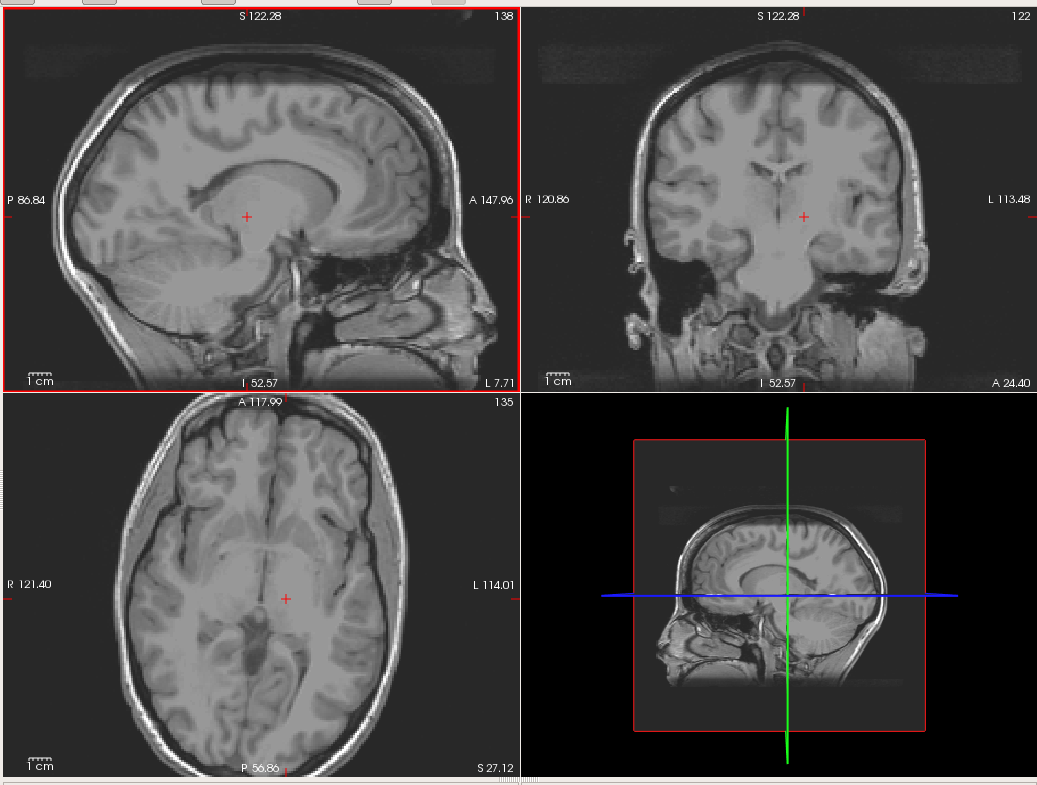
I have a dataset in which there is an artifact affecting many subjects. The problem is a greatly reduced signal at the top of the head. The images come from a GE scanner and it appears to have been caused by a configuration issue in the protocol. Sometimes this artifact impacts the cortical grey matter, as in the attached screenshot (showing T1.mgz after this subject was run through recon-all). In these cases the aseg.mgz is invalid in these superior areas, as the mask does not extend into the signal dropout area.
I'm wondering if anyone has an idea for correcting this issue, perhaps by adjusting parameters associated with Freesurfer's non-uniformity correction steps.
Thanks much for any suggestions, Andrew Davis
[image: Inline image 1]

Hi Andrew
wow, that's pretty strange. The only thing I can think of that might recover this is to put pairs of control points in the white matter, one on either side of the boundary of your artifact. Or maybe it always affects the same slices and you can scale them up? I guess it depends on how variable it is
cheers Bruce
On Tue, 7 Mar 2017, Andrew D. Davis wrote:
Hello Freesurfer experts,
I have a dataset in which there is an artifact affecting many subjects. The problem is a greatly reduced signal at the top of the head. The images come from a GE scanner and it appears to have been caused by a configuration issue in the protocol. Sometimes this artifact impacts the cortical grey matter, as in the attached screenshot (showing T1.mgz after this subject was run through recon-all). In these cases the aseg.mgz is invalid in these superior areas, as the mask does not extend into the signal dropout area.
I'm wondering if anyone has an idea for correcting this issue, perhaps by adjusting parameters associated with Freesurfer's non-uniformity correction steps.
Thanks much for any suggestions, Andrew Davis
Inline image 1
Hi Bruce and all,
Thanks for the suggestion on scaling -- it would be nice if it were consistent, but it varies quite a lot from scan to scan. At the most, about 30 of the top slices are affected, but often the number of affected slices is fewer, and sometimes the spatial extent of the artifact is small enough that the signal intensity of the cortex is unaffected.
Another note that might be of interest is that skull stripping seems to succeed even in severe cases of the artifact. I'm not sure if that could be leveraged to solve the problem.
Best, Andrew
On Tue, Mar 7, 2017 at 3:50 PM, Bruce Fischl fischl@nmr.mgh.harvard.edu wrote:
Hi Andrew
wow, that's pretty strange. The only thing I can think of that might recover this is to put pairs of control points in the white matter, one on either side of the boundary of your artifact. Or maybe it always affects the same slices and you can scale them up? I guess it depends on how variable it is
cheers Bruce
On Tue, 7 Mar 2017, Andrew D. Davis wrote:
Hello Freesurfer experts,
I have a dataset in which there is an artifact affecting many subjects. The problem is a greatly reduced signal at the top of the head. The images come from a GE scanner and it appears to have been caused by a configuration issue in the protocol. Sometimes this artifact impacts the cortical grey matter, as in the attached screenshot (showing T1.mgz after this subject was run through recon-all). In these cases the aseg.mgz is invalid in these superior areas, as the mask does not extend into the signal dropout area.
I'm wondering if anyone has an idea for correcting this issue, perhaps by adjusting parameters associated with Freesurfer's non-uniformity correction steps.
Thanks much for any suggestions, Andrew Davis
Inline image 1
Freesurfer mailing list Freesurfer@nmr.mgh.harvard.edu https://mail.nmr.mgh.harvard.edu/mailman/listinfo/freesurfer
The information in this e-mail is intended only for the person to whom it is addressed. If you believe this e-mail was sent to you in error and the e-mail contains patient information, please contact the Partners Compliance HelpLine at http://www.partners.org/complianceline . If the e-mail was sent to you in error but does not contain patient information, please contact the sender and properly dispose of the e-mail.
freesurfer@nmr.mgh.harvard.edu
-
 Andrew D. Davis
 -
 Bruce Fischl