
Hi Anastasia and list,
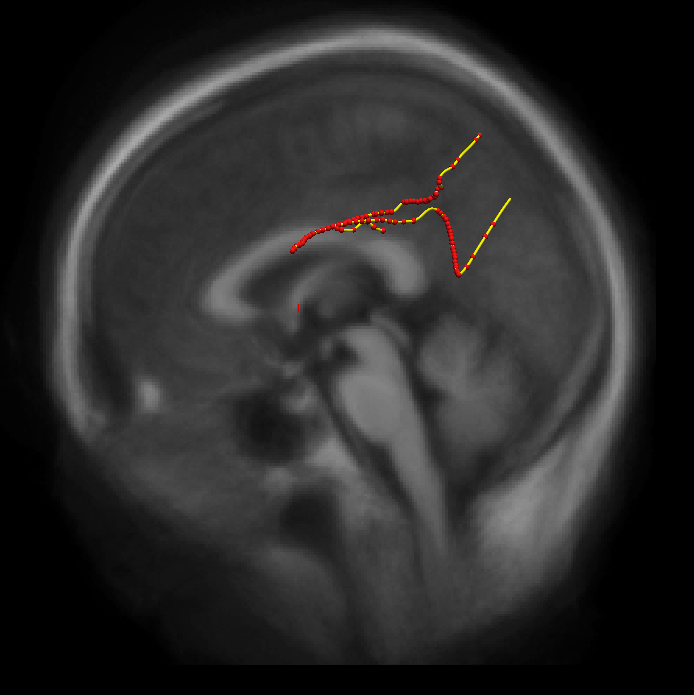
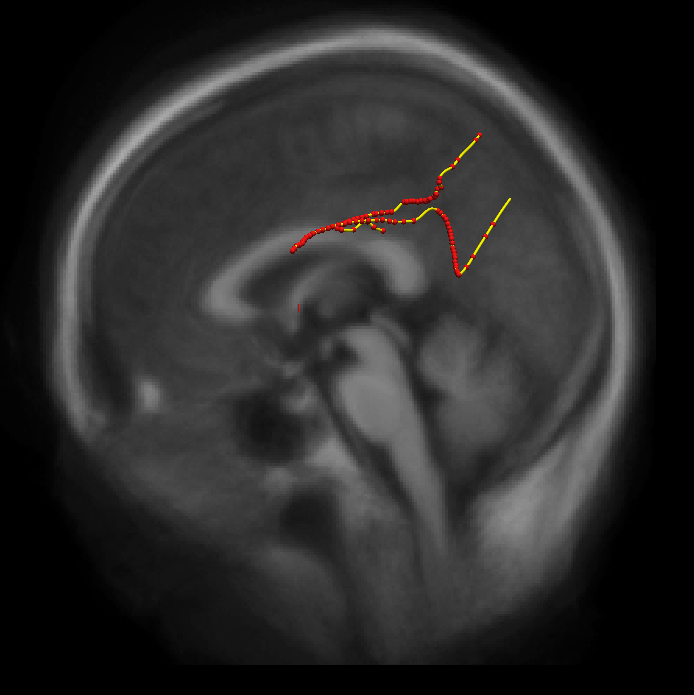
sorry, I just now got around to testing out the new build of dmri_paths you sent me. Sadly, the results look about the same:
Here the path stats file for the left SLFt:
What could be the problem?! I think I did what you suggested:
- install the new version of dmri_paths (https://www.dropbox.com/s/g6i7rcnbegwj5pm/dmri_paths?dl=0) and make it executable - rerun trac-all -path for the subjects with only one time point - rerun trac-all -stat for all subjects
Also: Is that problem only a visualization problem, or does it also mean that the values I get for a participant at a specific part of a tract are not aligned and I cannot analyze the data in that way?
Thanks for your help!!
Best,
Janosch
On 20 Aug 2015, at 21:35, Anastasia Yendiki ayendiki@nmr.mgh.harvard.edu wrote:
Hi Janosch - Indeed, someone has to be first. I'll send you a fresh build of dmri_paths tomorrow. You'll have to replace your copy of $FREESURFER_HOME/bin/dmri_paths with it and then rerun "trac-all -path" only for the subjects that have 1 time point. Then rerun "trac-all -stat" with all subjects together. And then tell us what other problem you find :)
Best, a.y
On Thu, 20 Aug 2015, Janosch Linkersdörfer wrote:
Hey Anastasia,
Am 19.08.2015 um 14:03 schrieb Anastasia Yendiki ayendiki@nmr.mgh.harvard.edu:
Hi Janosch - There is a bug in how the output paths are saved when longitudinal TRACULA is run with one time point only. I'm working on a fix.
OK, then I'm relieved that it isn't an error on my side. Thank you very much for looking into it!
In the meantime, you can try your analysis with the subjects that have multiple time points and you won't be affected by this problem. I can see that the subjects with a single time point are about 1/3 of your sample, and so you may not want to drop them completely.
Yeah, it's children's data, so I'm happy about every measurement we got. I'll be waiting for the fixed script to be able to include all subjects in the analysis...
Thank you for trying things that nobody else has tried and finding these bugs!
Somebody has to be the first, eh? :)
Thank you very much,
Janosch
More soon, a.y
On Mon, 17 Aug 2015, Janosch Linkersdörfer wrote:
Hey Anastasia,
thanks for looking into this.
Am 17.08.2015 um 20:33 schrieb Anastasia Yendiki ayendiki@nmr.mgh.harvard.edu:
Hi Janosch - Looking at the stats files of your subjects, just by a quick count of the number of lines, I see that there are some subjects that have only 1 time point and some that have multiple time points, and that the pathstats.byvoxel.txt files have different lengths between those two types of subjects.
I suspect that the strange average path that you get has to do with how this mixing of subjects was done. Did you run the subjects with a single time point through the longitudinal stream as well?
Yes, I ran the longitudinal stream for all subjects, also for the ones with only one time point.
Thanks,
Janosch
Best, a.y
On Sun, 9 Aug 2015, Janosch Linkersdörfer wrote:
Hi Anastasia,
yes, I am. But it looks similar in the distributed version :(
Thanks,
Janosch
> Am 08.08.2015 um 00:48 schrieb Anastasia Yendiki ayendiki@nmr.mgh.harvard.edu: > > > Hi Janosch - Are you by any chance using the dev version of freeview? > > a.y > > On Fri, 7 Aug 2015, Janosch Linkersdörfer wrote: > >> Hi Anastasia and list, >> >> I'm trying to do analyses along the tract with the path_stats_byvoxel files. >> >> When I am visualizing the points using the waypoint functionality of Freeview, it looks a little strange, i.e., the points are not equally spaces on the tract, but clumped together at some parts and spread out on others, see: >> >> >> >> this looks different to your slides: >> >> >> >> Also, the most posterior points seem to be strangely located (in the other hemisphere). What could be the reason for this strange behavior? >> >> Thanks, >> >> Janosch > > > The information in this e-mail is intended only for the person to whom it is > addressed. If you believe this e-mail was sent to you in error and the e-mail > contains patient information, please contact the Partners Compliance HelpLine at > http://www.partners.org/complianceline . If the e-mail was sent to you in error > but does not contain patient information, please contact the sender and properly > dispose of the e-mail.

Dear all I'm running the new pipleline for hippocampal subfields segmentation with FreeSurfer v6.0 on a T13D image. As results i can extract values for the Whole hippocampus and the following subfields: Hippocampal_tail, subiculum, CA1, hippocampal-fissure, presubiculum, parasubiculum, molecular_layer_HP, GC-ML-DG, CA3, CA4, fimbria, HATA but not for Alveus as reported in the paper of Iglesias, JE. et al. 2015. Was my computation wrong?
Best, Daniele
2015-11-03 9:37 GMT+01:00 Janosch Linkersdörfer linkersdoerfer@gmail.com:
Hi Anastasia and list,
sorry, I just now got around to testing out the new build of dmri_paths you sent me. Sadly, the results look about the same:
Here the path stats file for the left SLFt:
What could be the problem?! I think I did what you suggested:
- install the new version of dmri_paths (
https://www.dropbox.com/s/g6i7rcnbegwj5pm/dmri_paths?dl=0) and make it executable
- rerun trac-all -path for the subjects with only one time point
- rerun trac-all -stat for all subjects
Also: Is that problem only a visualization problem, or does it also mean that the values I get for a participant at a specific part of a tract are not aligned and I cannot analyze the data in that way?
Thanks for your help!!
Best,
Janosch
On 20 Aug 2015, at 21:35, Anastasia Yendiki <
ayendiki@nmr.mgh.harvard.edu> wrote:
Hi Janosch - Indeed, someone has to be first. I'll send you a fresh
build of dmri_paths tomorrow. You'll have to replace your copy of $FREESURFER_HOME/bin/dmri_paths with it and then rerun "trac-all -path" only for the subjects that have 1 time point. Then rerun "trac-all -stat" with all subjects together. And then tell us what other problem you find :)
Best, a.y
On Thu, 20 Aug 2015, Janosch Linkersdörfer wrote:
Hey Anastasia,
Am 19.08.2015 um 14:03 schrieb Anastasia Yendiki <
ayendiki@nmr.mgh.harvard.edu>:
Hi Janosch - There is a bug in how the output paths are saved when
longitudinal TRACULA is run with one time point only. I'm working on a fix.
OK, then I'm relieved that it isn't an error on my side. Thank you very
much for looking into it!
In the meantime, you can try your analysis with the subjects that have
multiple time points and you won't be affected by this problem. I can see that the subjects with a single time point are about 1/3 of your sample, and so you may not want to drop them completely.
Yeah, it's children's data, so I'm happy about every measurement we
got. I'll be waiting for the fixed script to be able to include all subjects in the analysis...
Thank you for trying things that nobody else has tried and finding
these bugs!
Somebody has to be the first, eh? :)
Thank you very much,
Janosch
More soon, a.y
On Mon, 17 Aug 2015, Janosch Linkersdörfer wrote:
Hey Anastasia,
thanks for looking into this.
Am 17.08.2015 um 20:33 schrieb Anastasia Yendiki <
ayendiki@nmr.mgh.harvard.edu>:
Hi Janosch - Looking at the stats files of your subjects, just by a
quick count of the number of lines, I see that there are some subjects that have only 1 time point and some that have multiple time points, and that the pathstats.byvoxel.txt files have different lengths between those two types of subjects.
I suspect that the strange average path that you get has to do with
how this mixing of subjects was done. Did you run the subjects with a single time point through the longitudinal stream as well?
Yes, I ran the longitudinal stream for all subjects, also for the
ones with only one time point.
Thanks,
Janosch
Best, a.y
On Sun, 9 Aug 2015, Janosch Linkersdörfer wrote:
> Hi Anastasia, > > yes, I am. But it looks similar in the distributed version :( > > Thanks, > > Janosch > >> Am 08.08.2015 um 00:48 schrieb Anastasia Yendiki <
ayendiki@nmr.mgh.harvard.edu>:
>> >> >> Hi Janosch - Are you by any chance using the dev version of
freeview?
>> >> a.y >> >> On Fri, 7 Aug 2015, Janosch Linkersdörfer wrote: >> >>> Hi Anastasia and list, >>> >>> I'm trying to do analyses along the tract with the
path_stats_byvoxel files.
>>> >>> When I am visualizing the points using the waypoint functionality
of Freeview, it looks a little strange, i.e., the points are not equally spaces on the tract, but clumped together at some parts and spread out on others, see:
>>> >>> >>> >>> this looks different to your slides: >>> >>> >>> >>> Also, the most posterior points seem to be strangely located (in
the other hemisphere). What could be the reason for this strange behavior?
>>> >>> Thanks, >>> >>> Janosch >> >> >> The information in this e-mail is intended only for the person to
whom it is
>> addressed. If you believe this e-mail was sent to you in error and
the e-mail
>> contains patient information, please contact the Partners
Compliance HelpLine at
>> http://www.partners.org/complianceline . If the e-mail was sent
to you in error
>> but does not contain patient information, please contact the
sender and properly
>> dispose of the e-mail. > > >
Freesurfer mailing list Freesurfer@nmr.mgh.harvard.edu https://mail.nmr.mgh.harvard.edu/mailman/listinfo/freesurfer
The information in this e-mail is intended only for the person to whom it is addressed. If you believe this e-mail was sent to you in error and the e-mail contains patient information, please contact the Partners Compliance HelpLine at http://www.partners.org/complianceline . If the e-mail was sent to you in error but does not contain patient information, please contact the sender and properly dispose of the e-mail.
Begin forwarded message:
From: Janosch Linkersdörfer linkersdoerfer@gmail.com Subject: Re: visualizing paths stats by voxel Date: 3 Nov 2015 09:37:48 CET To: Anastasia Yendiki ayendiki@nmr.mgh.harvard.edu Cc: freesurfer@nmr.mgh.harvard.edu
Hi Anastasia and list,
sorry, I just now got around to testing out the new build of dmri_paths you sent me. Sadly, the results look about the same:
Here the path stats file for the left SLFt:
What could be the problem?! I think I did what you suggested:
- install the new version of dmri_paths (https://www.dropbox.com/s/g6i7rcnbegwj5pm/dmri_paths?dl=0) and make it executable
- rerun trac-all -path for the subjects with only one time point
- rerun trac-all -stat for all subjects
Also: Is that problem only a visualization problem, or does it also mean that the values I get for a participant at a specific part of a tract are not aligned and I cannot analyze the data in that way?
Thanks for your help!!
Best,
Janosch
On 20 Aug 2015, at 21:35, Anastasia Yendiki ayendiki@nmr.mgh.harvard.edu wrote:
Hi Janosch - Indeed, someone has to be first. I'll send you a fresh build of dmri_paths tomorrow. You'll have to replace your copy of $FREESURFER_HOME/bin/dmri_paths with it and then rerun "trac-all -path" only for the subjects that have 1 time point. Then rerun "trac-all -stat" with all subjects together. And then tell us what other problem you find :)
Best, a.y
On Thu, 20 Aug 2015, Janosch Linkersdörfer wrote:
Hey Anastasia,
Am 19.08.2015 um 14:03 schrieb Anastasia Yendiki ayendiki@nmr.mgh.harvard.edu:
Hi Janosch - There is a bug in how the output paths are saved when longitudinal TRACULA is run with one time point only. I'm working on a fix.
OK, then I'm relieved that it isn't an error on my side. Thank you very much for looking into it!
In the meantime, you can try your analysis with the subjects that have multiple time points and you won't be affected by this problem. I can see that the subjects with a single time point are about 1/3 of your sample, and so you may not want to drop them completely.
Yeah, it's children's data, so I'm happy about every measurement we got. I'll be waiting for the fixed script to be able to include all subjects in the analysis...
Thank you for trying things that nobody else has tried and finding these bugs!
Somebody has to be the first, eh? :)
Thank you very much,
Janosch
More soon, a.y
On Mon, 17 Aug 2015, Janosch Linkersdörfer wrote:
Hey Anastasia,
thanks for looking into this.
Am 17.08.2015 um 20:33 schrieb Anastasia Yendiki ayendiki@nmr.mgh.harvard.edu:
Hi Janosch - Looking at the stats files of your subjects, just by a quick count of the number of lines, I see that there are some subjects that have only 1 time point and some that have multiple time points, and that the pathstats.byvoxel.txt files have different lengths between those two types of subjects.
I suspect that the strange average path that you get has to do with how this mixing of subjects was done. Did you run the subjects with a single time point through the longitudinal stream as well?
Yes, I ran the longitudinal stream for all subjects, also for the ones with only one time point.
Thanks,
Janosch
Best, a.y
On Sun, 9 Aug 2015, Janosch Linkersdörfer wrote:
> Hi Anastasia, > > yes, I am. But it looks similar in the distributed version :( > > Thanks, > > Janosch > >> Am 08.08.2015 um 00:48 schrieb Anastasia Yendiki ayendiki@nmr.mgh.harvard.edu: >> >> >> Hi Janosch - Are you by any chance using the dev version of freeview? >> >> a.y >> >> On Fri, 7 Aug 2015, Janosch Linkersdörfer wrote: >> >>> Hi Anastasia and list, >>> >>> I'm trying to do analyses along the tract with the path_stats_byvoxel files. >>> >>> When I am visualizing the points using the waypoint functionality of Freeview, it looks a little strange, i.e., the points are not equally spaces on the tract, but clumped together at some parts and spread out on others, see: >>> >>> >>> >>> this looks different to your slides: >>> >>> >>> >>> Also, the most posterior points seem to be strangely located (in the other hemisphere). What could be the reason for this strange behavior? >>> >>> Thanks, >>> >>> Janosch >> >> >> The information in this e-mail is intended only for the person to whom it is >> addressed. If you believe this e-mail was sent to you in error and the e-mail >> contains patient information, please contact the Partners Compliance HelpLine at >> http://www.partners.org/complianceline . If the e-mail was sent to you in error >> but does not contain patient information, please contact the sender and properly >> dispose of the e-mail. > > >
freesurfer@nmr.mgh.harvard.edu
-
 Daniele Orlandi
 -
 Janosch Linkersdörfer