
External Email - Use Caution
Dear experts, I'm performing a study on visual pathways, in which each participant undergoes to 2 different conditions. One in normal sight (NG, i.e.: No Goggles) and second in narrowed sight using special goggles (YG, i.e.: Yes Goggles). I'd like to compare the results between these two conditions (basically, subject A, B, C in cond1 versus subject A, B, C in cond2).
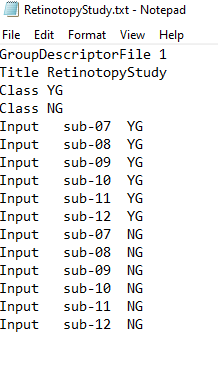
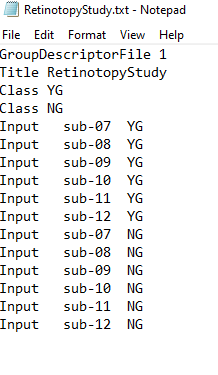
I created the FSGD file (attached as "RetinotopyStudy" file) and the contrast matrices, organised as:
1 -1 , named "YG-NG.mtx"
-1 1, named "NG-YG.mtx"
In this FSGD sample file, I reported only subjects from 7 to 12. My folders are organised as follows:
main >> recon_output >> sub-yy (X folders for X subjects)
                                >> Contrasts (with contrast files)
                                >> FSGD (with FSGD files)
                                >> fsaverage (subjects template
created during recon-all -qcache) >> pRF_function >> analNG (inside, there are the functionals for each subject in NG condition) >> analYG (inside, there are the functionals for each subject in YG condition)
Once I used the pipeline for the retinotopy analysis http://freesurfer.net/fswiki/FsFastIndividualRetinotopyAnalysisand I have results for each participant, and now I'd like to make 2nd lev analysis. So the idea would be, as you probably already got it, condition Yes Goggles versus condition No Goggles. I use the command:
mris_preproc --fsgd RetinotopyStudy --target fsaverage --hemi ?h --out
outputname.mgh
But I'm not sure it would calculate in the right way. The question is: how would I organise the FSGD file or folders in such a way that FREESURFER would know that it has to compare results from the same subjects but from two different folders (analNG vs analYG)?
Hoping that's clear, I really look forward to hear from you soon. Thank you for your time, Marco

What quantity from the retinotopy analysis do you want to compare across subjects? Eg, the phase? Can you send your mkanalysis-sess command?
On 2/28/2020 8:17 AM, Marco Ninghetto wrote:
External Email - Use Caution
Dear experts, I'm performing a study on visual pathways, in which each participant undergoes to 2 different conditions. One in normal sight (NG, i.e.: No Goggles) and second in narrowed sight using special goggles (YG, i.e.: Yes Goggles). I'd like to compare the results between these two conditions (basically, subject A, B, C in cond1 versus subject A, B, C in cond2).
I created the FSGD file (attached as "RetinotopyStudy" file) and the contrast matrices, organised as:
    1 -1 , named "YG-NG.mtx"
    -1 1,  named "NG-YG.mtx"
In this FSGD sample file, I reported only subjects from 7 to 12. My folders are organised as follows:
    main >> recon_output  >> sub-yy (X folders for X subjects)
                                        >> Contrasts (with
    contrast files)
                                        >> FSGD (with FSGD files)
                                        >> fsaverage (subjects
    template created during recon-all -qcache)
            >> pRF_function >> analNG (inside, there are the
    functionals for each subject in NG condition)
                                        >> analYG (inside, there
    are the functionals for each subject in YG condition)
Once I used the pipeline for the retinotopy analysis http://freesurfer.net/fswiki/FsFastIndividualRetinotopyAnalysisand I have results for each participant, and now I'd like to make 2nd lev analysis. So the idea would be, as you probably already got it, condition Yes Goggles versus condition No Goggles. I use the command:
    mris_preproc --fsgd RetinotopyStudy --target fsaverage --hemi
    ?h --out outputname.mgh
But I'm not sure it would calculate in the right way. The question is: how would I organise the FSGD file or folders in such a way that FREESURFER would know that it has to compare results from the same subjects but from two different folders (analNG vs analYG)?
Hoping that's clear, I really look forward to hear from you soon. Thank you for your time, Marco
--
Marco Ninghetto, PhD candidate Laboratory of Neuroplasticity Nencki Institute of Experimental Biology Polish Academy of Sciences 3 Pasteur Street, 02-093 Warsaw, Poland
Freesurfer mailing list Freesurfer@nmr.mgh.harvard.edu https://mail.nmr.mgh.harvard.edu/mailman/listinfo/freesurfer
External Email - Use Caution
Thanks for your support. Here my "mkanalysis-sess" command:
mkanalysis-sess -a rtopy.self.?h.ng -surface self ?h -paradigm rtopy.par
-retinotopy 41 -TR 2.5 -fsd bold -fwhm 5 -per-run
I run this command for both no goggles condition (rtopy.self.?h.ng) and for yes goggles (rtopy.self.?h.yg). The functional data were acquired using rotating wedge 45deg counter-clockwise and expanding ring (out) stimuli. One cycle lasted 41sec, each stimulus had 6 cycles.
On Fri, 28 Feb 2020, 22:24 Douglas N. Greve, dgreve@mgh.harvard.edu wrote:
What quantity from the retinotopy analysis do you want to compare across subjects? Eg, the phase? Can you send your mkanalysis-sess command?
On 2/28/2020 8:17 AM, Marco Ninghetto wrote:
External Email - Use CautionDear experts, I'm performing a study on visual pathways, in which each participant undergoes to 2 different conditions. One in normal sight (NG, i.e.: No Goggles) and second in narrowed sight using special goggles (YG, i.e.: Yes Goggles). I'd like to compare the results between these two conditions (basically, subject A, B, C in cond1 versus subject A, B, C in cond2).
I created the FSGD file (attached as "RetinotopyStudy" file) and the contrast matrices, organised as:
1 -1 , named "YG-NG.mtx"
-1 1, named "NG-YG.mtx"
In this FSGD sample file, I reported only subjects from 7 to 12. My folders are organised as follows:
main >> recon_output >> sub-yy (X folders for X subjects)
                                >> Contrasts (with contrast files)
                                >> FSGD (with FSGD files)
                                >> fsaverage (subjects template
created during recon-all -qcache) >> pRF_function >> analNG (inside, there are the functionals for each subject in NG condition) >> analYG (inside, there are the functionals for each subject in YG condition)
Once I used the pipeline for the retinotopy analysis http://freesurfer.net/fswiki/FsFastIndividualRetinotopyAnalysisand I have results for each participant, and now I'd like to make 2nd lev analysis. So the idea would be, as you probably already got it, condition Yes Goggles versus condition No Goggles. I use the command:
mris_preproc --fsgd RetinotopyStudy --target fsaverage --hemi ?h --out
outputname.mgh
But I'm not sure it would calculate in the right way. The question is: how would I organise the FSGD file or folders in such a way that FREESURFER would know that it has to compare results from the same subjects but from two different folders (analNG vs analYG)?
Hoping that's clear, I really look forward to hear from you soon. Thank you for your time, Marco
--
Marco Ninghetto, PhD candidate Laboratory of Neuroplasticity Nencki Institute of Experimental Biology Polish Academy of Sciences 3 Pasteur Street, 02-093 Warsaw, Poland
Freesurfer mailing listFreesurfer@nmr.mgh.harvard.eduhttps://mail.nmr.mgh.harvard.edu/mailman/listinfo/freesurfer
Freesurfer mailing list Freesurfer@nmr.mgh.harvard.edu https://mail.nmr.mgh.harvard.edu/mailman/listinfo/freesurfer
External Email - Use Caution
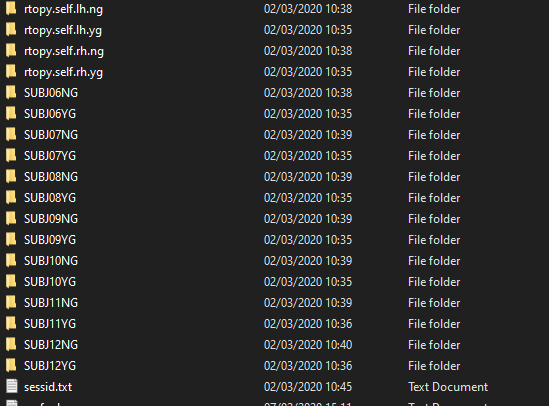
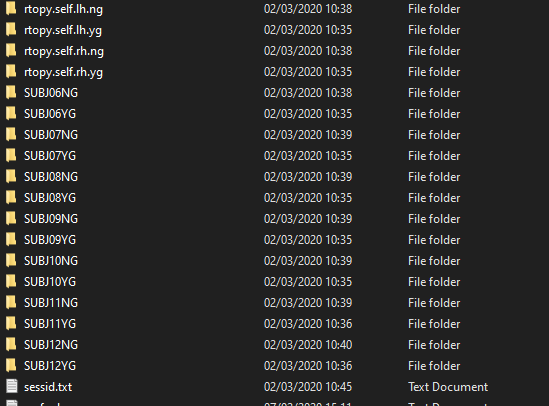
Since that each subject undergoes to both conditions and functional images are in 2 different folders, I modify my folder structure and put functional folders together. It means that now I have a main functional folder (pRFs_functionals) in which I have all subjects two times named differently (eg: SUBJ06YG and SUBJ06NG, where YG means with goggles condition and NG means without goggles condition). Something like below: [image: image.png] All the subjects have one structural image in a folder named "fs_output". Now that all functionals are together, my question is how to create the FSGD file. At this moment FSGD looks like this: [image: image.png] Each subject has his own structural data saved in a folder called "sub-xx", inside the main folder from "recon-all". So, my doubt is how to name subjects inside the FSGD in such a way that FREESURFER would know it has to compare the same subject two times in two different conditions. Command is:
mris_preproc --fsgd RetinotopyStudy --target fsaverage --hemi ?h --out
?h.out.retinotopy
Thank you for your effort in solving this matter, Marco
On Fri, 28 Feb 2020 at 23:17, Marco Ninghetto m.ninghetto@nencki.edu.pl wrote:
Thanks for your support. Here my "mkanalysis-sess" command:
mkanalysis-sess -a rtopy.self.?h.ng -surface self ?h -paradigm rtopy.par
-retinotopy 41 -TR 2.5 -fsd bold -fwhm 5 -per-run
I run this command for both no goggles condition (rtopy.self.?h.ng) and for yes goggles (rtopy.self.?h.yg). The functional data were acquired using rotating wedge 45deg counter-clockwise and expanding ring (out) stimuli. One cycle lasted 41sec, each stimulus had 6 cycles.
On Fri, 28 Feb 2020, 22:24 Douglas N. Greve, dgreve@mgh.harvard.edu wrote:
What quantity from the retinotopy analysis do you want to compare across subjects? Eg, the phase? Can you send your mkanalysis-sess command?
On 2/28/2020 8:17 AM, Marco Ninghetto wrote:
External Email - Use CautionDear experts, I'm performing a study on visual pathways, in which each participant undergoes to 2 different conditions. One in normal sight (NG, i.e.: No Goggles) and second in narrowed sight using special goggles (YG, i.e.: Yes Goggles). I'd like to compare the results between these two conditions (basically, subject A, B, C in cond1 versus subject A, B, C in cond2).
I created the FSGD file (attached as "RetinotopyStudy" file) and the contrast matrices, organised as:
1 -1 , named "YG-NG.mtx"
-1 1, named "NG-YG.mtx"
In this FSGD sample file, I reported only subjects from 7 to 12. My folders are organised as follows:
main >> recon_output >> sub-yy (X folders for X subjects)
                                >> Contrasts (with contrast files)
                                >> FSGD (with FSGD files)
                                >> fsaverage (subjects template
created during recon-all -qcache) >> pRF_function >> analNG (inside, there are the functionals for each subject in NG condition) >> analYG (inside, there are the functionals for each subject in YG condition)
Once I used the pipeline for the retinotopy analysis http://freesurfer.net/fswiki/FsFastIndividualRetinotopyAnalysisand I have results for each participant, and now I'd like to make 2nd lev analysis. So the idea would be, as you probably already got it, condition Yes Goggles versus condition No Goggles. I use the command:
mris_preproc --fsgd RetinotopyStudy --target fsaverage --hemi ?h --out
outputname.mgh
But I'm not sure it would calculate in the right way. The question is: how would I organise the FSGD file or folders in such a way that FREESURFER would know that it has to compare results from the same subjects but from two different folders (analNG vs analYG)?
Hoping that's clear, I really look forward to hear from you soon. Thank you for your time, Marco
--
Marco Ninghetto, PhD candidate Laboratory of Neuroplasticity Nencki Institute of Experimental Biology Polish Academy of Sciences 3 Pasteur Street, 02-093 Warsaw, Poland
Freesurfer mailing listFreesurfer@nmr.mgh.harvard.eduhttps://mail.nmr.mgh.harvard.edu/mailman/listinfo/freesurfer
Freesurfer mailing list Freesurfer@nmr.mgh.harvard.edu https://mail.nmr.mgh.harvard.edu/mailman/listinfo/freesurfer
What quantity do you want to compare across subjects/goggle condition? Sorry for the delay, I have not worked much with the retinotopy code in a while and don't have it at my fingertips
On 3/2/2020 9:08 AM, Marco Ninghetto wrote:
External Email - Use Caution
Since that each subject undergoes to both conditions and functional images are in 2 different folders, I modify my folder structure and put functional folders together. It means that now I have a main functional folder (pRFs_functionals) in which I have all subjects two times named differently (eg: SUBJ06YG and SUBJ06NG, where YG means with goggles condition and NG means without goggles condition). Something like below: image.png All the subjects have one structural image in a folder named "fs_output". Now that all functionals are together, my question is how to create the FSGD file. At this moment FSGD looks like this: image.png Each subject has his own structural data saved in a folder called "sub-xx", inside the main folder from "recon-all". So, my doubt is how to name subjects inside the FSGD in such a way that FREESURFER would know it has to compare the same subject two times in two different conditions. Command is:
    mris_preproc --fsgd RetinotopyStudy --target fsaverage --hemi
    ?h --out ?h.out.retinotopy
Thank you for your effort in solving this matter, Marco
On Fri, 28 Feb 2020 at 23:17, Marco Ninghetto <m.ninghetto@nencki.edu.pl mailto:m.ninghetto@nencki.edu.pl> wrote:
Thanks for your support. Here my "mkanalysis-sess" command: mkanalysis-sess -a rtopy.self.?h.ng -surface self ?h -paradigm rtopy.par -retinotopy 41 -TR 2.5 -fsd bold -fwhm 5 -per-run I run this command for both no goggles condition (rtopy.self.?h.ng) and for yes goggles (rtopy.self.?h.yg). The functional data were acquired using rotating wedge 45deg counter-clockwise and expanding ring (out) stimuli. One cycle lasted 41sec, each stimulus had 6 cycles. On Fri, 28 Feb 2020, 22:24 Douglas N. Greve, <dgreve@mgh.harvard.edu <mailto:dgreve@mgh.harvard.edu>> wrote: What quantity from the retinotopy analysis do you want to compare across subjects? Eg, the phase? Can you send your mkanalysis-sess command? On 2/28/2020 8:17 AM, Marco Ninghetto wrote:External Email - Use Caution Dear experts, I'm performing a study on visual pathways, in which each participant undergoes to 2 different conditions. One in normal sight (NG, i.e.: No Goggles) and second in narrowed sight using special goggles (YG, i.e.: Yes Goggles). I'd like to compare the results between these two conditions (basically, subject A, B, C in cond1 versus subject A, B, C in cond2). I created the FSGD file (attached as "RetinotopyStudy" file) and the contrast matrices, organised as: 1 -1 , named "YG-NG.mtx" -1 1, named "NG-YG.mtx" In this FSGD sample file, I reported only subjects from 7 to 12. My folders are organised as follows: main >> recon_output >> sub-yy (X folders for X subjects) >> Contrasts (with contrast files) >> FSGD (with FSGD files) >> fsaverage (subjects template created during recon-all -qcache) >> pRF_function >> analNG (inside, there are the functionals for each subject in NG condition) >> analYG (inside, there are the functionals for each subject in YG condition) Once I used the pipeline for the retinotopy analysis <http://freesurfer.net/fswiki/FsFastIndividualRetinotopyAnalysis>and I have results for each participant, and now I'd like to make 2nd lev analysis. So the idea would be, as you probably already got it, condition Yes Goggles versus condition No Goggles. I use the command: mris_preproc --fsgd RetinotopyStudy --target fsaverage --hemi ?h --out outputname.mgh But I'm not sure it would calculate in the right way. The question is: how would I organise the FSGD file or folders in such a way that FREESURFER would know that it has to compare results from the same subjects but from two different folders (analNG vs analYG)? Hoping that's clear, I really look forward to hear from you soon. Thank you for your time, Marco -- --------------------------------------------------- Marco Ninghetto, PhD candidate Laboratory of Neuroplasticity Nencki Institute of Experimental Biology Polish Academy of Sciences 3 Pasteur Street, 02-093 Warsaw, Poland _______________________________________________ Freesurfer mailing list Freesurfer@nmr.mgh.harvard.edu <mailto:Freesurfer@nmr.mgh.harvard.edu> https://mail.nmr.mgh.harvard.edu/mailman/listinfo/freesurfer_______________________________________________ Freesurfer mailing list Freesurfer@nmr.mgh.harvard.edu <mailto:Freesurfer@nmr.mgh.harvard.edu> https://mail.nmr.mgh.harvard.edu/mailman/listinfo/freesurfer--
Marco Ninghetto, PhD candidate Laboratory of Neuroplasticity Nencki Institute of Experimental Biology Polish Academy of Sciences 3 Pasteur Street, 02-093 Warsaw, Poland
Freesurfer mailing list Freesurfer@nmr.mgh.harvard.edu https://mail.nmr.mgh.harvard.edu/mailman/listinfo/freesurfer
freesurfer@nmr.mgh.harvard.edu
-
 Douglas N. Greve
 -
 Marco Ninghetto