
External Email - Use Caution
Dear sir/madam,
Being interested in improving the pial surface construction in our datasets (acquired at 3 Tesla), I have been considering the addition of the T2-weighted image from our studies' protocol to our recon-all run. However, looking at its acquisition parameters, I'm sure as to whether making use of this T2-weighted image would benefit pial surface construction. First, some parameters:
T1-weighted image: 3D sagittal spoiled-gradient FFE TR/TE: 10.02/4.6 FA: 8 Slices: 200 .75x.75x.8 mm³
T2-weighted image: Dual Echo - TSE clinical scan transversal T2-weighted TR/TE: 600/80 FA: 90 17 slices of 5 mm slicegap: 1.2 mm
And our initial recon-all run, without the T2-weighted image: recon-all -all -i sub -subjid subid -3T -hires -expert expert.opts The recon-all run I had in mind with the T2-weighted image added: recon-all -all -i sub -subjid subid -3T -hires -expert expert.opts -T2/path/to/T2 -T2pial expert.opts content: mris_inflate -n 50
Now, my question is, would a T2-weighted image acquired at the abovementioned parameters actually do the pial surface construction any good when included to a recon-all -hires run on submillimeter T1-weighted images like ours? Or, would it perhaps worsen pial surface construction, even (owing to, for example, the low resolution of the T2-weighted image)?
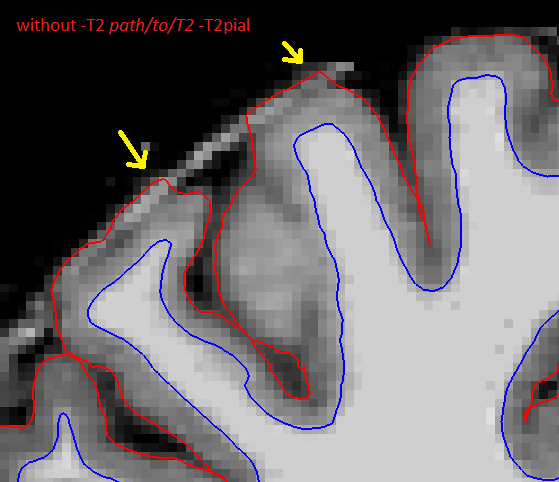
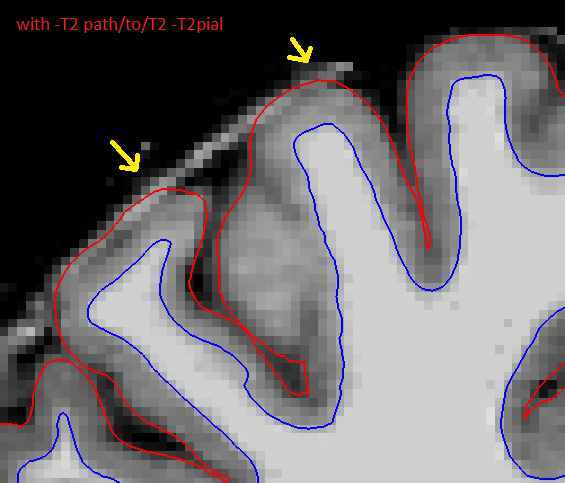
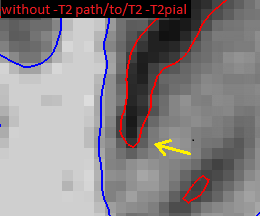
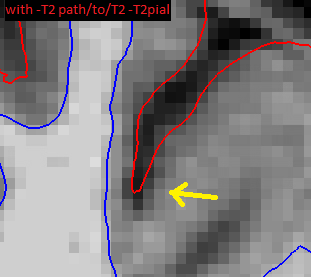
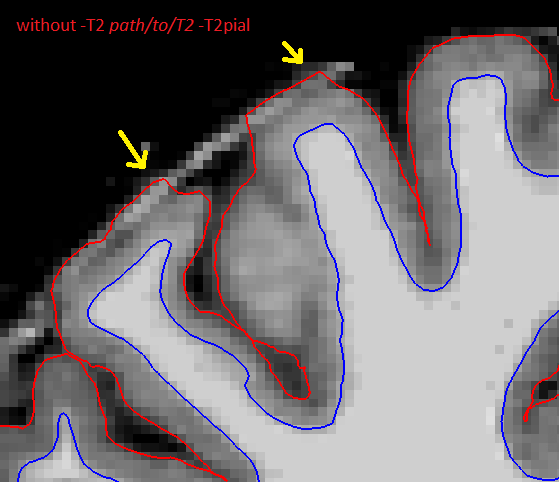
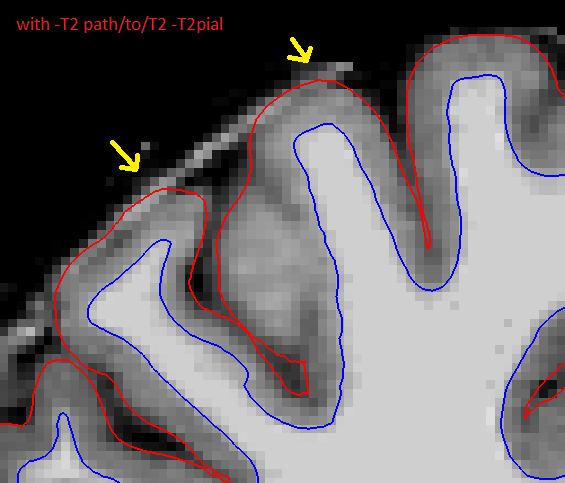
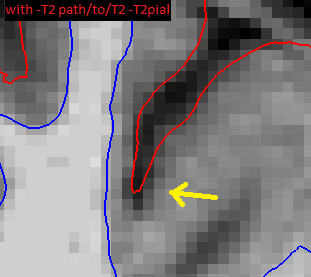
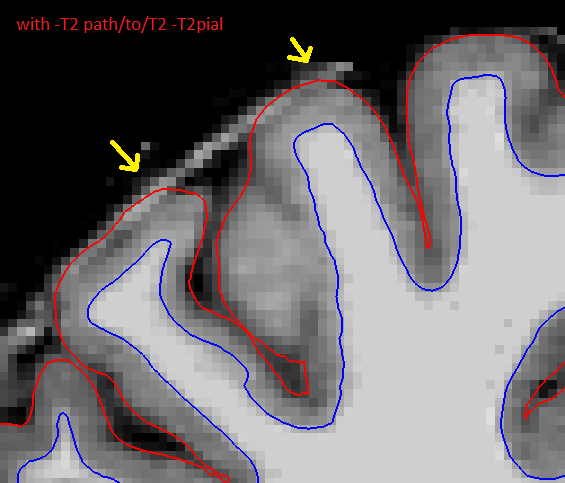
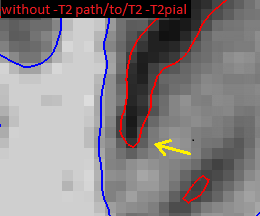
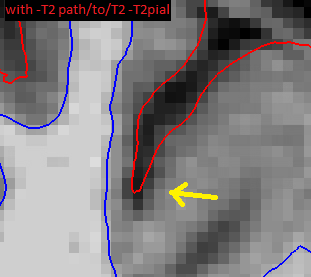
I have tested this on one of our subjects, which had a lot of dura included to the pial surface in the recon-all run without the addition of the T2-weighted image. After running recon-all on this subject again, this time with the T2-weighted image included and -T2pial turned on, (slightly) less dura was included to the pial surface (i.e., improvement; top two images for comparison example), but now it also seemed to exclude some parts of the cortex on other spots (bottom two images for comparison example), as well.
[cid:196242f0-e97c-43e8-b940-8843db62ab07] [cid:737f0df8-9a94-4b61-ac9f-a403d5389acf] dura inclusion comparison left: without -T2 and -T2pial right: with -T2 and -T2pial
and:
[cid:afefd874-e994-4b34-87fd-cef34040bdce] [cid:d7047b7f-d15f-424d-8f5e-1c9602a3f298] pial surface quality comparison in sulcus left: without -T2 and -T2pial right: with -T2 and -T2pial
I would greatly appreciate FreeSurfer experts' advice on this. Thank you very much for your time!
Kind regards, Simon Poortman (Erasmus MC, Rotterdam)
External Email - Use Caution
Correction to previous e-mail: However, looking at its acquisition parameters, I'm not sure as to whether making use of this T2-weighted image would benefit pial surface construction. Apologies.
Have a good weekend!
Kind regards, Simon Poortman (Erasmus MC, Rotterdam) ________________________________ From: freesurfer-bounces@nmr.mgh.harvard.edu freesurfer-bounces@nmr.mgh.harvard.edu on behalf of S.R. Poortman s.poortman@erasmusmc.nl Sent: Friday, February 5, 2021 2:24 PM To: freesurfer@nmr.mgh.harvard.edu freesurfer@nmr.mgh.harvard.edu Subject: [Freesurfer] Regarding recon-all's -T2pial option
External Email - Use Caution
Dear sir/madam,
Being interested in improving the pial surface construction in our datasets (acquired at 3 Tesla), I have been considering the addition of the T2-weighted image from our studies' protocol to our recon-all run. However, looking at its acquisition parameters, I'm sure as to whether making use of this T2-weighted image would benefit pial surface construction. First, some parameters:
T1-weighted image: 3D sagittal spoiled-gradient FFE TR/TE: 10.02/4.6 FA: 8 Slices: 200 .75x.75x.8 mm³
T2-weighted image: Dual Echo - TSE clinical scan transversal T2-weighted TR/TE: 600/80 FA: 90 17 slices of 5 mm slicegap: 1.2 mm
And our initial recon-all run, without the T2-weighted image: recon-all -all -i sub -subjid subid -3T -hires -expert expert.opts The recon-all run I had in mind with the T2-weighted image added: recon-all -all -i sub -subjid subid -3T -hires -expert expert.opts -T2/path/to/T2 -T2pial expert.opts content: mris_inflate -n 50
Now, my question is, would a T2-weighted image acquired at the abovementioned parameters actually do the pial surface construction any good when included to a recon-all -hires run on submillimeter T1-weighted images like ours? Or, would it perhaps worsen pial surface construction, even (owing to, for example, the low resolution of the T2-weighted image)?
I have tested this on one of our subjects, which had a lot of dura included to the pial surface in the recon-all run without the addition of the T2-weighted image. After running recon-all on this subject again, this time with the T2-weighted image included and -T2pial turned on, (slightly) less dura was included to the pial surface (i.e., improvement; top two images for comparison example), but now it also seemed to exclude some parts of the cortex on other spots (bottom two images for comparison example), as well.
[cid:196242f0-e97c-43e8-b940-8843db62ab07] [cid:737f0df8-9a94-4b61-ac9f-a403d5389acf] dura inclusion comparison left: without -T2 and -T2pial right: with -T2 and -T2pial
and:
[cid:afefd874-e994-4b34-87fd-cef34040bdce] [cid:d7047b7f-d15f-424d-8f5e-1c9602a3f298] pial surface quality comparison in sulcus left: without -T2 and -T2pial right: with -T2 and -T2pial
I would greatly appreciate FreeSurfer experts' advice on this. Thank you very much for your time!
Kind regards, Simon Poortman (Erasmus MC, Rotterdam)


I think those examples of dura would certainly improve with T2. Sorry, I'm not entirely sure what your question is.
On 2/5/2021 8:31 AM, S.R. Poortman wrote:
External Email - Use Caution
Correction to previous e-mail:
However, looking at its acquisition parameters, I'm *_not_* sure
as to whether making use of this T2-weighted image would benefit
pial surface construction.
Apologies.
Have a good weekend!
Kind regards, Simon Poortman (Erasmus MC, Rotterdam)
*From:* freesurfer-bounces@nmr.mgh.harvard.edu freesurfer-bounces@nmr.mgh.harvard.edu on behalf of S.R. Poortman s.poortman@erasmusmc.nl *Sent:* Friday, February 5, 2021 2:24 PM *To:* freesurfer@nmr.mgh.harvard.edu freesurfer@nmr.mgh.harvard.edu *Subject:* [Freesurfer] Regarding recon-all's -T2pial option
External Email - Use Caution
Dear sir/madam,
Being interested in improving the pial surface construction in our datasets (acquired at 3 Tesla), I have been considering the addition of the T2-weighted image from our studies' protocol to our recon-all run. However, looking at its acquisition parameters, I'm sure as to whether making use of this T2-weighted image would benefit pial surface construction. First, some parameters:
*T1-weighted image:* 3D sagittal spoiled-gradient FFE TR/TE: 10.02/4.6 FA: 8 Slices: 200 .75x.75x.8 mm³
*T2-weighted image:* Dual Echo - TSE clinical scan transversal T2-weighted TR/TE: 600/80 FA: 90 17 slices of 5 mm slicegap: 1.2 mm
And our initial recon-all run, without the T2-weighted image:
recon-all -all -i /sub/ -subjid /subid/ -3T -hires -expert
/expert.opts/
The recon-all run I had in mind with the T2-weighted image added:
recon-all -all -i /sub/ -subjid /subid/ -3T -hires -expert
/expert.opts -T2//path/to/T2 /-T2pial/
expert.opts content:
mris_inflate -n 50Now, my question is, would a T2-weighted image acquired at the abovementioned parameters actually do the pial surface construction any good when included to a /recon-all -hires/ run on submillimeter T1-weighted images like ours? Or, would it perhaps worsen pial surface construction, even (owing to, for example, the low resolution of the T2-weighted image)?
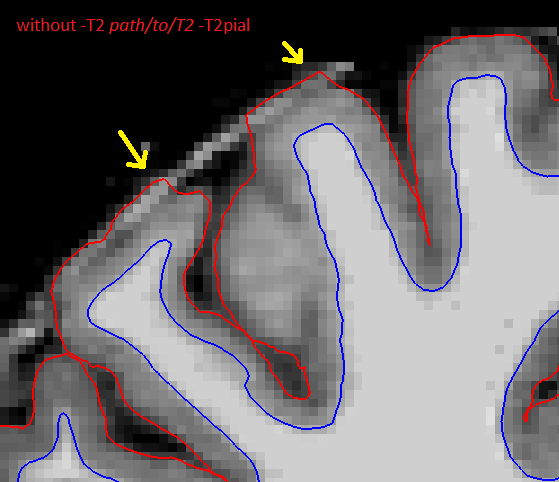
I have tested this on one of our subjects, which had a lot of dura included to the pial surface in the recon-all run without the addition of the T2-weighted image. After running recon-all on this subject again, this time with the T2-weighted image included and -T2pial turned on, (slightly) less dura was included to the pial surface (i.e., improvement; top two images for comparison example), but now it also seemed to exclude some parts of the cortex on other spots (bottom two images for comparison example), as well.
dura inclusion comparison left: without -T2 and -T2pial right: with -T2 and -T2pial
and:
pial surface quality comparison in sulcus left: without -T2 and -T2pial right: with -T2 and -T2pial
I would greatly appreciate FreeSurfer experts' advice on this. Thank you very much for your time!
Kind regards, Simon Poortman (Erasmus MC, Rotterdam)
Freesurfer mailing list Freesurfer@nmr.mgh.harvard.edu https://mail.nmr.mgh.harvard.edu/mailman/listinfo/freesurfer
freesurfer@nmr.mgh.harvard.edu
-
 Douglas N. Greve
 -
 S.R. Poortman