
Hello FreeSurfer Team,
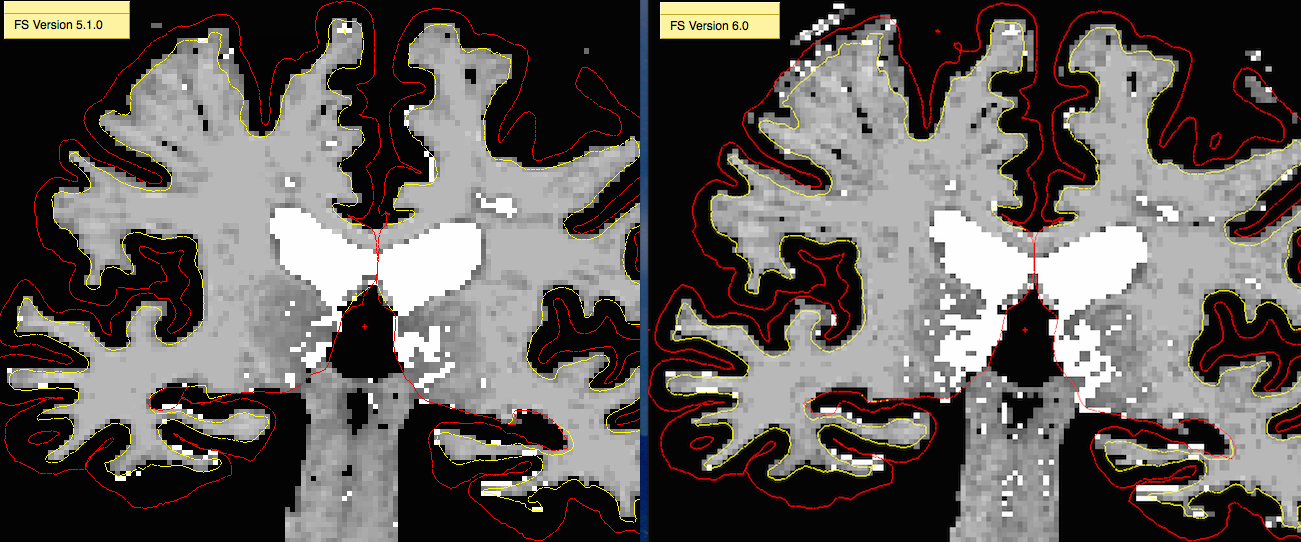
For a longitudinal study, we processed the cross-sectional scans through FS v5.1 and ran the longitudinal stream in FS v6.0. The voxel intensities in wm.mgz of the long timepoints are variable and are much lower (not in the range of 110).
I have attached the image of a longitudinal timepoint created in v6.0 and compared it to the one created in v5.1 (The cross brain recons for both of them were done in v5.1). The white and pial surfaces look similar across versions but the long created in v6.0 does not have a uniform intensity compared to the one created in v5.1. Should this matter as long as the surfaces look fine?
I tried to use expert options with ‘mri_normalize –gentle’ while creating the long in v6.0 but it did not help. Any suggestions to achieve a better intensity normalization?
Thank you, Jaiashre.

HI Jaiashre
is there a reason to mix versions? We always advise against this
cheers Bruce On Fri, 10 Mar 2017, Jaiashre Sridhar wrote:
Hello FreeSurfer Team,
For a longitudinal study, we processed the cross-sectional scans through FS v5.1 and ran the longitudinal stream in FS v6.0. The voxel intensities in wm.mgz of the long timepoints are variable and are much lower (not in the range of 110).
I have attached the image of a longitudinal timepoint created in v6.0 and compared it to the one created in v5.1 (The cross brain recons for both of them were done in v5.1). The white and pial surfaces look similar across versions but the long created in v6.0 does not have a uniform intensity compared to the one created in v5.1. Should this matter as long as the surfaces look fine?
I tried to use expert options with ‘mri_normalize –gentle’ while creating the long in v6.0 but it did not help. Any suggestions to achieve a better intensity normalization?
Thank you,
Jaiashre.
freesurfer@nmr.mgh.harvard.edu
-
 Bruce Fischl
 -
 Jaiashre Sridhar