
Hi all,
I ran an analysis on data after dividing each voxel mean across the run, and then multiplying by 100. (My intuition was that the percent signal change should be more consistent across varying SNR that the non-normalized betas).
I had naively expected ces.nii and cespct.nii to be equivalent in this case, but in fact, cespct.nii is steeply larger and only imperfectly correlated with ces.nii. What am I missing?
stephen
*stephen v. shepherd phd* The Rockefeller University / 1230 York Avenue / New York NY 10065-6307 USA // 212.327.7699

Rescaling by the voxel mean will mess up the intensity normalization. Try making your analysis (mkanalysis-sess) with -no-inorm and see if the results are more consistent. They will not be exact because the raw mean time course is not used to create the cespct. Rather it is the regression coefficient of the mean offset regressor. They should be pretty close though.
On 6/7/16 12:22 AM, S.V.Shepherd [work] wrote:
Hi all,
I ran an analysis on data after dividing each voxel mean across the run, and then multiplying by 100. (My intuition was that the percent signal change should be more consistent across varying SNR that the non-normalized betas).
I had naively expected ces.nii and cespct.nii to be equivalent in this case, but in fact, cespct.nii is steeply larger and only imperfectly correlated with ces.nii. What am I missing?
stephen
_stephen v. shepherd phd_ The Rockefeller University / 1230 York Avenue / New York NY 10065-6307 USA // 212.327.7699
Freesurfer mailing list Freesurfer@nmr.mgh.harvard.edu https://mail.nmr.mgh.harvard.edu/mailman/listinfo/freesurfer
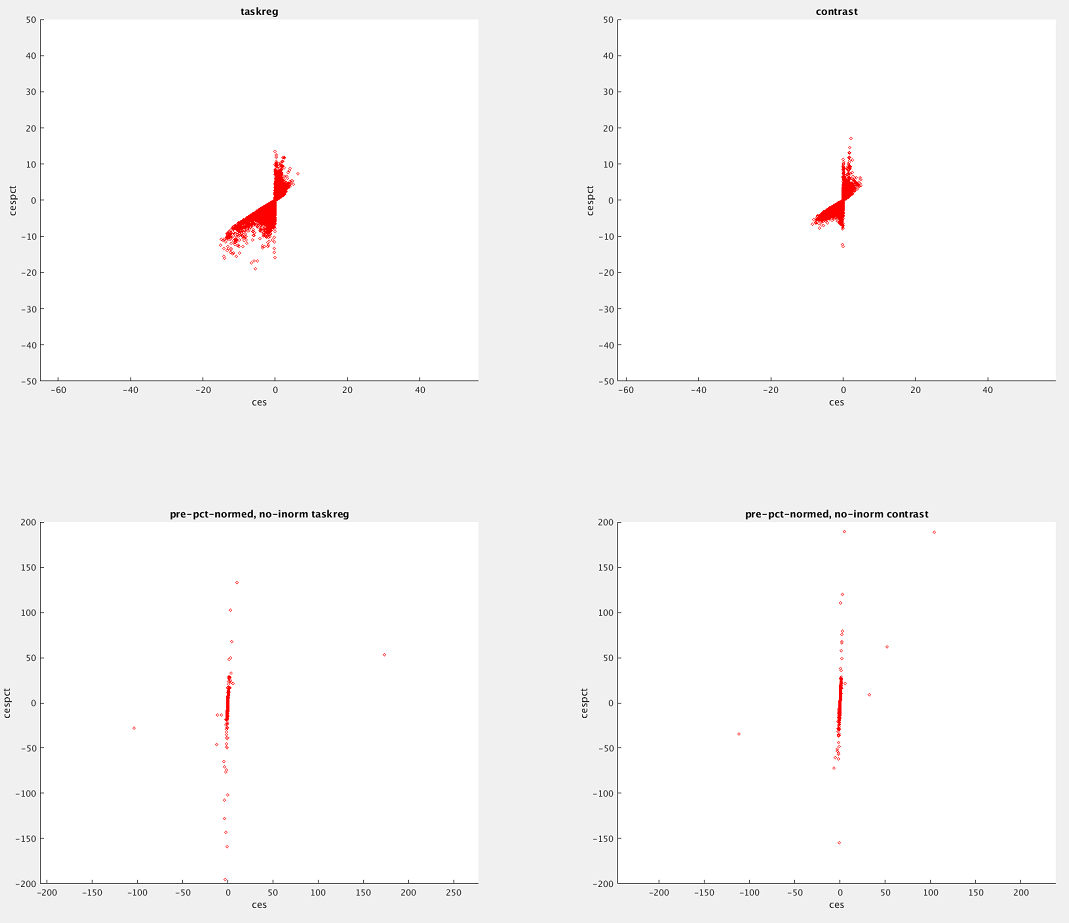
The built-in Intensity normalization is a constant multiplied to each run's data based on the per-run mean, right? It thus normalizes global intensity variation across subjects, but not regional, right? Whereas my approach would normalize regional variation in signal strength (good), at the risk of emphasizing low-signal/low-CNR sessions versus high-signal/high-CNR days (bad).
However, even after repeating the analysis with -no-inorm, I still see discrepancies between measures. There appears to be some voxel-by-voxel variation around a typical scaling factor for cespct vs ces. At top is ces ver cespct for my regular analysis, below is the same with pre-normalization to voxerwise percentile and with no-inorm.
[image: Inline image 2]
*stephen v. shepherd phd* The Rockefeller University / 1230 York Avenue / New York NY 10065-6307 USA // 212.327.7699
On Tue, Jun 7, 2016 at 10:46 AM, Douglas Greve greve@nmr.mgh.harvard.edu wrote:
Rescaling by the voxel mean will mess up the intensity normalization. Try making your analysis (mkanalysis-sess) with -no-inorm and see if the results are more consistent. They will not be exact because the raw mean time course is not used to create the cespct. Rather it is the regression coefficient of the mean offset regressor. They should be pretty close though.
On 6/7/16 12:22 AM, S.V.Shepherd [work] wrote:
Hi all,
I ran an analysis on data after dividing each voxel mean across the run, and then multiplying by 100. (My intuition was that the percent signal change should be more consistent across varying SNR that the non-normalized betas).
I had naively expected ces.nii and cespct.nii to be equivalent in this case, but in fact, cespct.nii is steeply larger and only imperfectly correlated with ces.nii. What am I missing?
stephen
*stephen v. shepherd phd* The Rockefeller University / 1230 York Avenue / New York NY 10065-6307 USA // 212.327.7699
Freesurfer mailing listFreesurfer@nmr.mgh.harvard.eduhttps://mail.nmr.mgh.harvard.edu/mailman/listinfo/freesurfer
Freesurfer mailing list Freesurfer@nmr.mgh.harvard.edu https://mail.nmr.mgh.harvard.edu/mailman/listinfo/freesurfer
The information in this e-mail is intended only for the person to whom it is addressed. If you believe this e-mail was sent to you in error and the e-mail contains patient information, please contact the Partners Compliance HelpLine at http://www.partners.org/complianceline . If the e-mail was sent to you in error but does not contain patient information, please contact the sender and properly dispose of the e-mail.
freesurfer@nmr.mgh.harvard.edu
-
 Douglas Greve
 -
 S.V.Shepherd [work]