External Email - Use Caution
Dear list members,
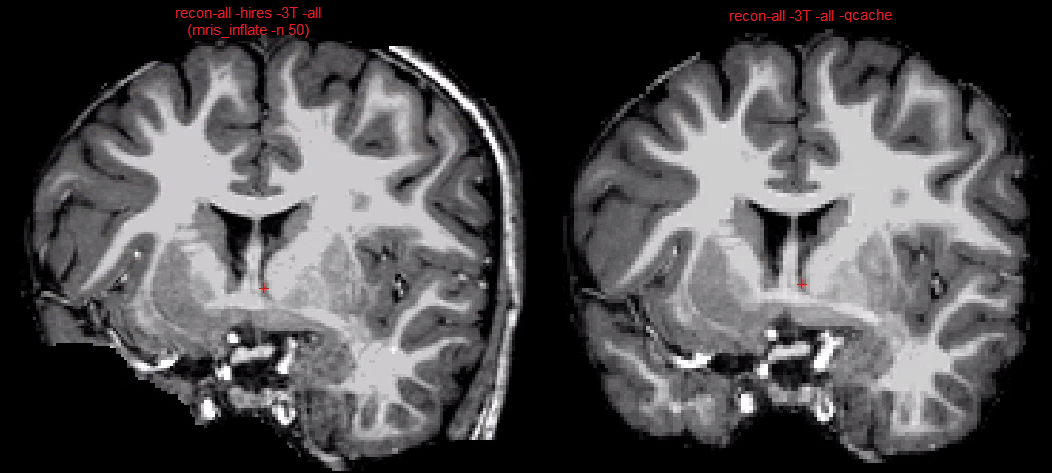
As a PhD student working on longitudinal child and adolescent T1-weighted data (.75x.75x.8 mm3) acquired at 3T (age range: 8 - 18 at baseline; 11 - 24 at follow-up), with the aim of doing cortical laminar analyses eventually, I am interested in getting the most of our lab's submillimeter resolution data. Therefore, in addition to a default recon-all run (with the -3T option enabled), I ran a separate recon-all with both the -3T and the -hires option enabled (with mris_inflate -n 50 added to the expert file), resulting in the following two runs: recon-all -all -i ${subj} -subjid ${SUB_ID} -3T and recon-all -all -i ${subj} -subjid ${SUB_ID} -3T -hires -expert $EXPERT_FILE Now, the surfaces (i.e., lh.pial, lh.white, rh.pial, rh.white) seem to be calculated more accurately for most brain regions, indeed, which looks very promising. However, the brainmask.mgz turns out to be of poor quality for a number of our subjects, cutting away a substantial portion of the brain. See the image below for an example of the same subject, on which both runs have been performed. The same slices are shown for each run. As can be seen in the image, a part of the the temporal region of the brain has been excluded in the brainmask.mgz of the -hires run (left in the image).
[cid:b4d26f40-11bb-4d8f-888c-ab4da9fea062]
Is there anything I can do, such as adjusting certain parameters, to prevent this from occurring? It would be a shame if I couldn't make use of the -hires option due to this, as it does seem to be a promising option in all other aspects.
Thank you for considering my question. I look forward to hearing from you.
Good holidays to you!
Kind regards, Simon Poortman (Erasmus MC, Rotterdam, the Netherlands)