Thanks a million for all of the answers about cor2label+ in the other post - very helpful.
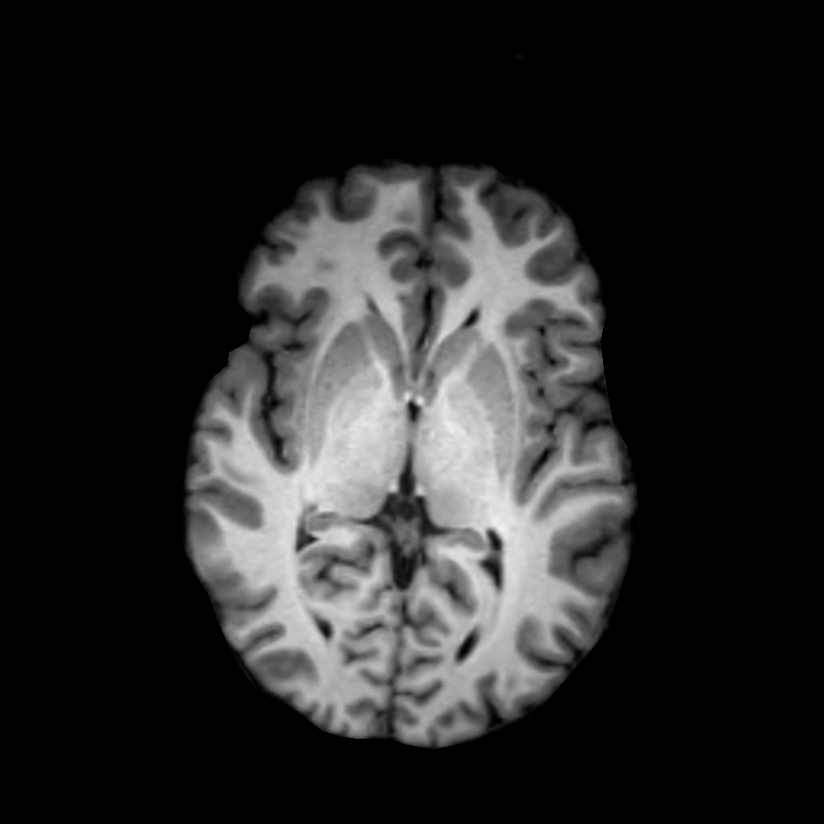
I produced the figure using a csh script which reads in the vectors and creates a display list which xfig understands. The display list is in the attached xfig file which needs to be gunzip'd before displaying it with: xfig 126_free_p5.fig The attached gif is the background cut in the figure. I got it by using ImageJ to read in the DICOM images and create the axial slices 1 mm apart. The registration of those images is slightly off. I generated the vectors by applying the transform extracted from aseg.mgz with mri_info --tkr2scanner to the vectors in rh.cortex.label and rh.V2.label . I used one of my fortran routines to do the matrix x vector multiplication.
Regards, Don Don Krieger, Ph.D. Department of Neurological Surgery University of Pittsburgh (412)648-9654 Office (412)521-4431 Cell/Text
-----Original Message----- From: freesurfer-bounces@nmr.mgh.harvard.edu [mailto:freesurfer- bounces@nmr.mgh.harvard.edu] On Behalf Of Douglas N Greve Sent: Wednesday, August 06, 2014 6:32 PM To: freesurfer@nmr.mgh.harvard.edu Subject: Re: [Freesurfer] FW: YANQ follow-up
How did you create that image? You can use mri_cor2label to extract the labels from aparc+aseg (it will take values > 255) doug
On 08/04/2014 01:16 PM, Krieger, Donald N. wrote:
Thanks Doug,
Got it.
I've attached a sample image on which I've drawn transformed vectors
from:
1.rh.cortex.label (red)
2.rh.V2.label_orig (blue)
3.rh.V2.label_white (yellow)
4.rh.V2.label_pial (aqua)
I used mri_annotation2label to extract vectors from the aparc and BA annotation files.
I used mri_info to extract the tkr2scanner transform from aparc+aseg.mgz .
You can see that the cut through the mri volume on which the dots are drawn is slightly off.
It would be helpful to hear if you think there is something else I should check.
The registration of dots with the white/gray matter boundary is comparable for axial slices 2 cm apart top to bottom.
For each label, I now need to extract vectors which fill the specified volume, gray or white.
It looks like this information is present in mri/filled.mgz but I have not found a way which I understand to extract vectors from a .mgz volume.
mri_cor2label appears to work but it uses -id labelid which I haven't been able to puzzle out.
The documentation states that labelid ranges from 0-255 so it's not the same as that present in FreeSurferColorLUT.txt .
Can you please explain this or put me out of my misery by telling me mri_cor2label is not the tool to use.
Finally, when I load aparc+aseg.mgz in freeview, subcortical structures are clearly segmented including the cerebellum, basal ganglia, etc.
How do I extract these vectors into .label files?
There is no aseg.annot in the label directory and none of the .annot files yield .label files for these structures.
Do I need to run something else which is not included by default in recon-all to generate this file or is there some other route to get there?
Regards,
Don
Don Krieger, Ph.D.
Department of Neurological Surgery
University of Pittsburgh
(412)648-9654 Office
(412)521-4431 Cell/Text
-----Original Message-----
From: freesurfer-bounces@nmr.mgh.harvard.edu [mailto:freesurfer-
bounces@nmr.mgh.harvard.edu] On Behalf Of Douglas N Greve
Sent: Friday, August 01, 2014 4:05 PM
To: freesurfer@nmr.mgh.harvard.edu
Subject: Re: [Freesurfer] FW: YANQ follow-up
Hi Don, try looking at this page for more info on our coordinate systems
On 08/01/2014 10:47 AM, Bruce Fischl wrote:
Hi Don
the -rt nearest switch is for mri_convert. I'll leave the rest of the
questions for Doug :) Bruce On Fri, 1 Aug 2014, Krieger, Donald N.
wrote:
Thanks for posting back so quickly, Bruce, and for the direction.
Just to clarify, here is the command which I am using so you can see
the types of files on which I am operating.
The working directory is ${FREESURFER_HOME}/subjects/bert .
I'm putting each switch on a separate line:
mri_label2label
--s Sub125
--srclabel label/rh.cortex.label
--trglabel testLabels/rh.cortext.label
--xfm mri/transforms/talairach.xfm
--xfm-invert
--regmethod volume
I plotted the output vectors for a single 1 mm slice using my tools.
This is shown in the left panel of the attached jpg.
The right panel shows the same vectors translated by hand to "fit."
The size and shape are close so this appears to be in the right
direction.
I would like to find the freesurfer coords --> MRI coords transform
and try it in place of talairach.xfm .
I assume that the inverse of talairach.xfm is not the correct
transform to get from freesurfer --> MRI coordinates.
Is there a way to extract the correct transform? It must have existed
early in the "recon-all" run and must also be accessible to
mri_convert -rl ...
I tried --nt as you suggested but my version of mri_label2label
(stable5)
does not recognize it.
I tried --regmethod surface --hemi rh and found that it gives
identical
results whether using --xfm-invert or not !
Regards,
Don
Don Krieger, Ph.D.
Department of Neurological Surgery
University of Pittsburgh
(412)648-9654 Office
(412)521-4431 Cell/Text
-----Original Message-----
From: freesurfer-bounces@nmr.mgh.harvard.edu
mailto:freesurfer-bounces@nmr.mgh.harvard.edu [mailto:freesurfer-
bounces@nmr.mgh.harvard.edu
mailto:bounces@nmr.mgh.harvard.edu] On Behalf Of Bruce Fischl
Sent: Friday, August 01, 2014 9:29 AM
To: Freesurfer support list
Subject: Re: [Freesurfer] FW: YANQ follow-up
Hi Don
try mri_label2label. Also, the if you are transforming label
volumes
you need to use nearest neighbor interpolation, so include the -rt
nearest
switch.
cheers
Bruce
On Fri, 1 Aug 2014, Krieger, Donald N. wrote:
>
> Hi All,
>
>
>
> I am still in need of finding the tool sequence to generate
an ASCII
> file containing (1) voxel RAS coordinates (2) for a specific
label
> (3) using the original MRI coordinates rather than freesurfer
coordinates.
>
>
>
> mri_convert -rl rawavg.mgz <input vol> <output vol>
>
> does generate a new output volume containing the "labelled"
voxels
> contained in <input vol> . I can tell because this volume
shows up
> more or less correctly in freeview although the color mapping
> appears to have changed or perhaps freeview is doing some kind
of
"fill"
> operation differently depending on the loaded volume. I assume
> these are in the coordinates for rawavg.mgz but cannot tell for
sure.
>
>
>
> I need to generate a list of these voxel coordinates from <output
> vol> to check and for my work.
>
> (1) Do I need to generate a new annotation file from <output vol>
> and then use mri_annotation2label to get there? I have not been
> able to find the tool sequence which generates the .annot files.
>
> (2) An alternative appears to be mri_label2label with -xfm
> xfmfile and possibly including --xfm-invert . I did get this
> command to complete successfully using
mri/transforms/talaraich.xfm
> but I presume this is not the correct transform.
>
>
>
> Thanks and best regards,
>
>
>
> Don
>
>
>
> Don Krieger, Ph.D.
>
> Department of Neurological Surgery
>
> University of Pittsburgh
>
> (412)648-9654 Office
>
> (412)521-4431 Cell/Text
>
>
>
> From: Krieger, Donald N.
> Sent: Thursday, July 31, 2014 9:36 AM
> To: freesurfer@nmr.mgh.harvard.edu
mailto:freesurfer@nmr.mgh.harvard.edu
> Subject: YANQ follow-up
>
>
>
> Thanks again for the pointer, Bruce.
>
>
>
> You wrote:
>
> . mri_convert -rl rawavg.mgz <input vol> <output vol>
>
> which does produce an output volume from which I now need to
extract
> RAS voxel coordinates.
>
> A pointer to a keyboard command would be most welcome.
>
>
>
> Of interest is the difference between the color mappings for the
> input and output volumes in freeview.
>
> When using the lookup table in freeview they are quite different
> whereas in grayscale they are almost identical.
>
> I wonder if this is contributing to my difficulty in finding
a tool
> to extract the voxel coordinates.
>
>
>
> Thanks again.
>
>
>
> Regards,
>
>
>
> Don
>
>
>
> Don Krieger, Ph.D.
>
> Department of Neurological Surgery
>
> University of Pittsburgh
>
> (412)648-9654 Office
>
> (412)521-4431 Cell/Text
>
>
>
>
>
Freesurfer mailing list
Freesurfer@nmr.mgh.harvard.edu
mailto:Freesurfer@nmr.mgh.harvard.edu
https://mail.nmr.mgh.harvard.edu/mailman/listinfo/freesurfer
--
Douglas N. Greve, Ph.D.
MGH-NMR Center
greve@nmr.mgh.harvard.edu mailto:greve@nmr.mgh.harvard.edu
Phone Number: 617-724-2358
Fax: 617-726-7422
Bugs: surfer.nmr.mgh.harvard.edu/fswiki/BugReporting
www.nmr.mgh.harvard.edu/facility/filedrop/index.html
http://www.nmr.mgh.harvard.edu/facility/filedrop/index.html
Outgoing:
ftp://surfer.nmr.mgh.harvard.edu/transfer/outgoing/flat/greve/
Freesurfer mailing list
Freesurfer@nmr.mgh.harvard.edu
mailto:Freesurfer@nmr.mgh.harvard.edu
https://mail.nmr.mgh.harvard.edu/mailman/listinfo/freesurfer
The information in this e-mail is intended only for the person to
whom it is
addressed. If you believe this e-mail was sent to you in error and
the e-mail
contains patient information, please contact the Partners Compliance
HelpLine at
http://www.partners.org/complianceline . If the e-mail was sent to
you in
error
but does not contain patient information, please contact the sender and
properly
dispose of the e-mail.
Freesurfer mailing list Freesurfer@nmr.mgh.harvard.edu https://mail.nmr.mgh.harvard.edu/mailman/listinfo/freesurfer
-- Douglas N. Greve, Ph.D. MGH-NMR Center greve@nmr.mgh.harvard.edu Phone Number: 617-724-2358 Fax: 617-726-7422
Bugs: surfer.nmr.mgh.harvard.edu/fswiki/BugReporting FileDrop: https://gate.nmr.mgh.harvard.edu/filedrop2 www.nmr.mgh.harvard.edu/facility/filedrop/index.html Outgoing: ftp://surfer.nmr.mgh.harvard.edu/transfer/outgoing/flat/greve/
Freesurfer mailing list Freesurfer@nmr.mgh.harvard.edu https://mail.nmr.mgh.harvard.edu/mailman/listinfo/freesurfer