Dear Bruce,
thanks a lot for your answer. I am still a bit confused. I followed your suggestion to use msris_curvature to compute the curvature on the white surface (unsmoothed) instead of on smoothwm:
mris_curvature -w -a 10 $subj/surf/lh.white mris_preproc -s $subj --target fsaverage --hemi lh --meas white.H --out ./measures/lh.white.H.mgh mri_surf2surf --hemi lh --s fsaverage --sval ./measures/lh.white.H.mgh --tval ./measures/lh.white.H_sm10.mgh --fwhm-trg 10 --cortex --noreshape (mri_surf2surf smoothing was applied also to other curvatures)
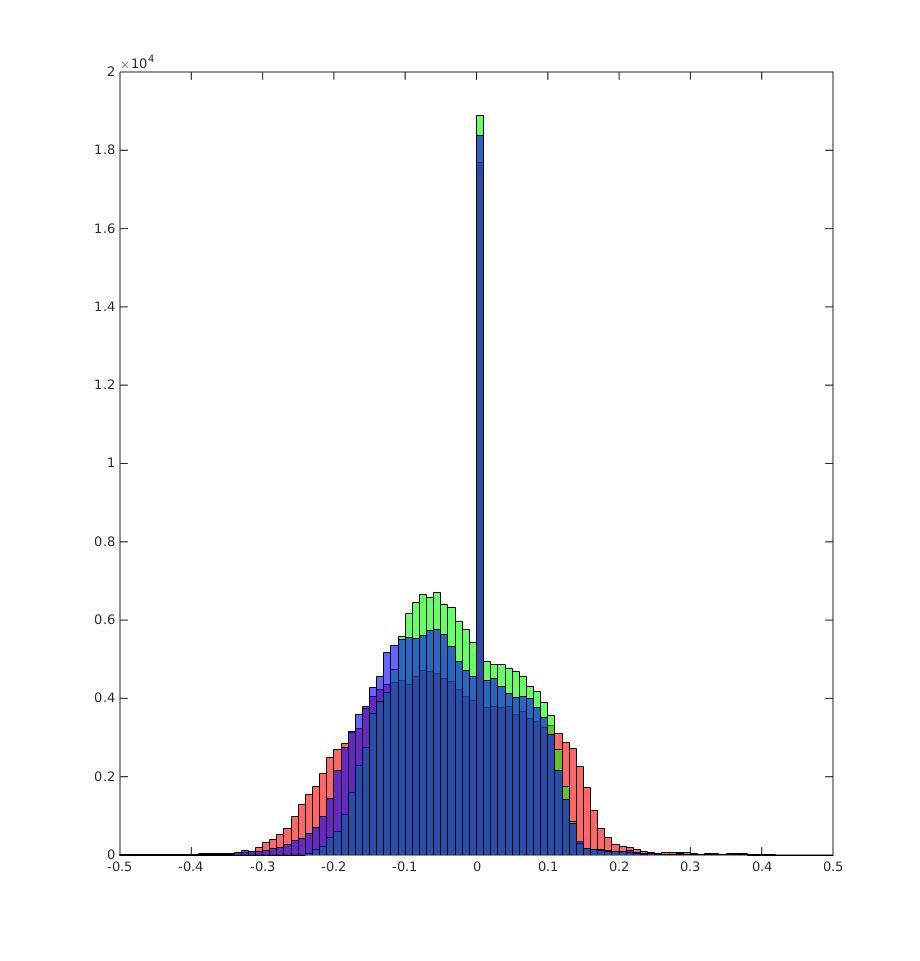
If I understood right, mris_curvature uses a hessian method to compute the curvature, while mris_curvature_stats uses the Gauss-Bonnet theorem (I extracted this information from your email to this mailing list from: Fri, 26 Feb 2010 05:54:32 -0800). In an email from Wed, 30 Mar 2011 12:40:58 -0700, Rudolph says that gauss-bonnet procedure is more robust against noise. Does this also hold for the mean/extrinsic curvature? I ask because in the Gauss-Bonnet theorem only the gaussian curvature is mentioned. For the extrinsic/mean curvature (see attachment) I obtain that actually the smoothwm.H.crv seems to be the noisiest quantity (red in the histogram), followed by the classical method applied on the unsmoothed white matter surface (blu) and by the classical method applied on the smoothed wm surface (green, corresponds to the ?h.curv files produced by recon-all). This observation also holds when comparing the curvature in ?h.curv.pial and ?h.pial.H.crv (histogram sent in my previous email). In that case, on many vertices the mean curvature computed with the gauss-Bonnet method was ~1/mm which makes me think to unrealistically small 'hollows' on the pial surface.
Finally, to compare curvature vertexwise between a group of patients and controls, which should be the right numerical quantity to look at: 1- curv.pial (classic method on smoothed pial surface - from recon-all) 2- pial.H (classic method on smoothed pial surface - from mris_curvature) 3- pial.H.crv (gauss-bonnet method on the pial surface - from mris_curvature_stats)?
Thank you very much for any help,
Fabio
Dr. Fabio Bernardoni wiss. Mitarbeiter Psychosoziale Medizin und Entwicklungsneurowissenschaften Tel. +49 (0)351 458-5245 Fax +49 (0)351 458-7206 URL http://www.uniklinikum-dresden.de/psm; www.transdenlab.de Universitätsklinikum Carl Gustav Carus & Medizinische Fakultät an der Technischen Universität Dresden Anstalt des öffentlichen Rechts des Freistaates Sachsen Fetscherstraße 74, 01307 Dresden http://www.uniklinikum-dresden.de Vorstand: Prof. Dr. med. D. M. Albrecht (Sprecher), Wilfried E. B. Winzer Vorsitzender des Aufsichtsrates: Prof. Dr. med. Peter C. Scriba USt.-IDNr.: DE 140 135 217, St.-Nr.: 203 145 03113