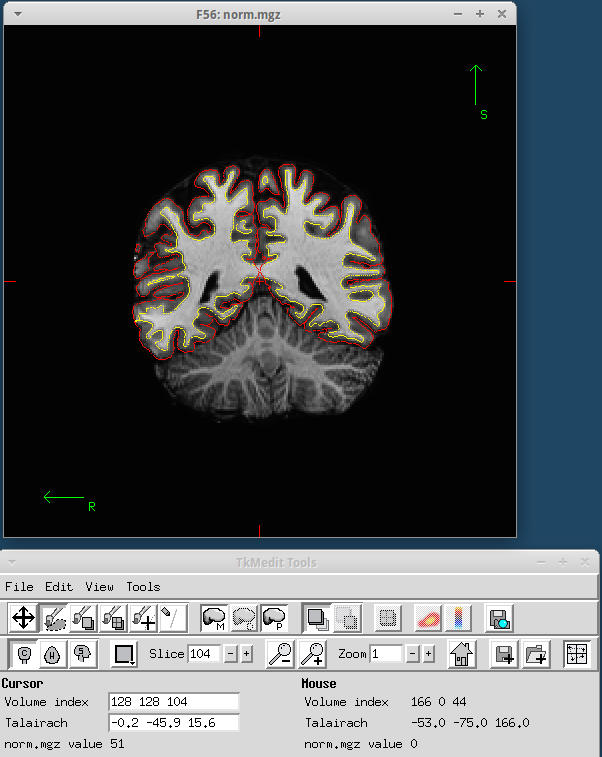
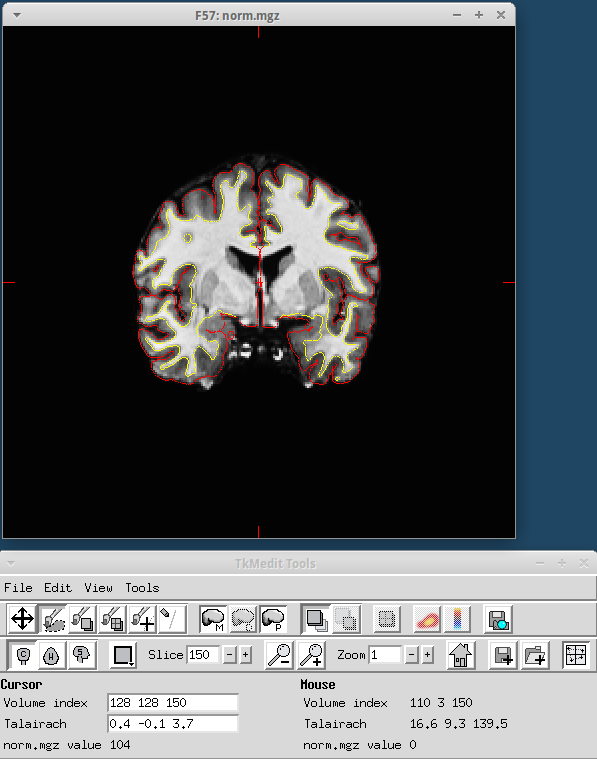
Many thanks Martin and Nick! The rendering option was already checked, but the freeview inspection commands were still very very slow, so I used commands of the following form, which as far as I understand should be equivalent: *tkmedit subjID norm.mgz -surfs* For several subjects (maybe 20 out of the total of 72), I noticed that the surfaces don\t seem to quite follow the GM/WM demarcation line as expected - for instance, by having portions of white surface (yellow line, see attached screenshots) surrounded by pial surface (red line), or by having very large cortical thickness in some parts of the brain. Is it possible that these apparent artefacts make sense "in context" (by looking at the adjacent slides), or is it the case that I need to go back and do white surface correction, and then redo all 3 steps of the longitudinal process?
Thanks again for your help! Tudor
On 29 May 2014 17:39, Nick Schmansky nicks@nmr.mgh.harvard.edu wrote:
Tudor,
in your virtual machine, make sure the 3D rendering option, or 'use hardware rendering' (or something like that) is enabled. this would be on the Windows VM config side of things. otherwise it will do software rendering which is painfully slow.
Nick
Hi Tudor,
I don't think there is a way to speed things up. Let me know if you find a case where the template is blurry or has ghosts. It should not happen, but if it does it indicates a bad registratration, you'd have to run the mri_robust_template command with different parameters manually then.
Best, Martin
On 05/27/2014 06:13 PM, Tudor Popescu wrote:
Hi Martin, Wasn't sure whether you'd seen my reply below, look forward to hear back your thoughts, thanks! Tudor
On 25 May 2014 21:40, "Tudor Popescu" <tudor3@gmail.com mailto:tudor3@gmail.com> wrote:
Thanks very much Martin and Bruce. I guess I'd misread the Wiki (my own fault, not the text's), and am glad to hear that the longitudinal pipeline is in fact perfectly suitable for my needs here. Having run the first 2 steps (cross and base), I'm a bit unclear how the output so far has to be manually inspected. It says in the tutorial <http://freesurfer.net/fswiki/FsTutorial/LongitudinalTutorial> that you should load each subject's base volume + surfs in freeview and then "move back and forth a few slices". However, even just loading each base in this manner takes ~1 min on my PC (CoreDuo, 4GB, Ubuntu Virtualbox in Windows 7), and then moving with PgUp/PgDn between all coronal slices (starting from the default slice=128, going all the way posterior and then all the way anterior) is excruciatingly slow. All of this would have to be repeated for all my 72 subjects - is there any way to optimise this manual inspection? Also, if the surfs turn out to not follow the volume correctly, presumably the thing to do is white surface correction + re-running recon. But what should one do if, due to an erroneous averaging between timepoints, you see blurs/ghosts in your base template? Many thanks! Tudor On 9 May 2014 21:33, Martin Reuter <mreuter@nmr.mgh.harvard.edu <mailto:mreuter@nmr.mgh.harvard.edu>> wrote: Hi Tudor, the longitudinal pipeline in FS is actually one of the best on the planet as far as I know :-). If there is any contradictory information on the wiki, can you point me to that so I can see what causes the misconception. Really: compared to independent processing, it significantly increases sensitivity. Also we have designed it to be unbiased with respect to a single time point or directionality. It is quite mature by now. You should definitely use the longitudinal pipeline for the analysis of your data. Now to your questions 1. QDEC: I am not too familiar with qdec. You can definitely try the 2-stage approach described on the wiki. There you first compute a measure of change (e.g. hippocampal volume change during your week) and then compare that measure across groups similar to a cross sectional volume/thickness analysis. You can also use our tools to run a linear mixed effects model if you want to do that (it is more involved and requires you to use matlab tools). In your case, you probably have 2 time points for all subjects and the time distance is probably the same for all subjects, so the 2-stage approach should be fine. 2. The image processing is done via the longitudinal pipeline (three steps: cross, base, long), to prepare the data look at the description of the 2-stage model http://freesurfer.net/fswiki/LongitudinalTwoStageModel and also the longitudinal tutorial http://freesurfer.net/fswiki/FsTutorial/LongitudinalTutorial 3. At the recon all level in FS you get (after the 3 steps) measurement for all time points. So you would compare those results across time in the stats. Hope that helps, Martin On 05/08/2014 08:14 AM, Tudor Popescu wrote:Sorry for the repeat, wasn't sure whether this was received the first time. Tudor On 6 May 2014 19:55, Tudor Popescu <tudor3@gmail.com <mailto:tudor3@gmail.com>> wrote: Dear FS list, I have structural data from a learning study (pre&post-training scans, with 3 groups). Although the training was only one week, I'm guessing from an analysis point of view, this still qualifies as longitudinal. I want to check for * the main within-subjects effect of time point(pre&post) * the main between-subjects effect of group (treatment A, treatment B, control), * the time x group interaction
I intend to look at thickness, surface area, volume, andlGI.
        I read on the wiki
        <
http://surfer.nmr.mgh.harvard.edu/fswiki/LongitudinalProcessing%3E
        that FS is currently not optimal for longitudinal
        analyses. I intend my FreeSurfer analysis to supplement a
        VBM analysis done in FSL. In case it is in fact a good
        idea to do this, my questions (not covered in the
        'longitudinal' wiki page) are:

        1) Can QDEC be used for such an analysis, and if so, what
        would be different as compared to a cross-sectional (no
        temporal/within factor) study?

        2) Also, is the pre-processing stage any different?

        3) In FSL, for longitudinal designs you do stats on
        images obtained as the difference between consecutive
        time points. Does this have to be done in FreeSurfer as
        well, and if so, is it done at the recon-all level or
        only at the stats (QDEC) level?

        Thanks!

        Tudor


    _______________________________________________
    Freesurfer mailing list
    Freesurfer@nmr.mgh.harvard.edu
mailto:Freesurfer@nmr.mgh.harvard.edu https://mail.nmr.mgh.harvard.edu/mailman/listinfo/freesurfer
    --
    Martin Reuter, Ph.D.

    Instructor in Neurology
       Harvard Medical School
    Assistant in Neuroscience
       Dept. of Radiology, Massachusetts General Hospital
       Dept. of Neurology, Massachusetts General Hospital
    Research Affiliate
       Computer Science and Artificial Intelligence Lab,
       Dept. of Electrical Engineering and Computer Science,
       Massachusetts Institute of Technology

    A.A.Martinos Center for Biomedical Imaging
    149 Thirteenth Street, Suite 2301
    Charlestown, MA 02129

    Phone:+1-617-724-5652  <tel:%2B1-617-724-5652>
    Email:
        mreuter@nmr.mgh.harvard.edu
mailto:mreuter@nmr.mgh.harvard.edu reuter@mit.edu mailto:reuter@mit.edu Web :http://reuter.mit.edu
    _______________________________________________
    Freesurfer mailing list
    Freesurfer@nmr.mgh.harvard.edu
    <mailto:Freesurfer@nmr.mgh.harvard.edu>
    https://mail.nmr.mgh.harvard.edu/mailman/listinfo/freesurfer


    The information in this e-mail is intended only for the person
    to whom it is
    addressed. If you believe this e-mail was sent to you in error
    and the e-mail
    contains patient information, please contact the Partners
    Compliance HelpLine at
    http://www.partners.org/complianceline . If the e-mail was
    sent to you in error
    but does not contain patient information, please contact the
    sender and properly
    dispose of the e-mail.
Freesurfer mailing list Freesurfer@nmr.mgh.harvard.edu https://mail.nmr.mgh.harvard.edu/mailman/listinfo/freesurfer
-- Martin Reuter, Ph.D.
Instructor in Neurology Harvard Medical School Assistant in Neuroscience Dept. of Radiology, Massachusetts General Hospital Dept. of Neurology, Massachusetts General Hospital Research Affiliate Computer Science and Artificial Intelligence Lab, Dept. of Electrical Engineering and Computer Science, Massachusetts Institute of Technology
A.A.Martinos Center for Biomedical Imaging 149 Thirteenth Street, Suite 2301 Charlestown, MA 02129
Phone: +1-617-724-5652 Email: mreuter@nmr.mgh.harvard.edu reuter@mit.edu Web : http://reuter.mit.edu
Freesurfer mailing list Freesurfer@nmr.mgh.harvard.edu https://mail.nmr.mgh.harvard.edu/mailman/listinfo/freesurfer
Freesurfer mailing list Freesurfer@nmr.mgh.harvard.edu https://mail.nmr.mgh.harvard.edu/mailman/listinfo/freesurfer