Dear Doug and freesurfers,
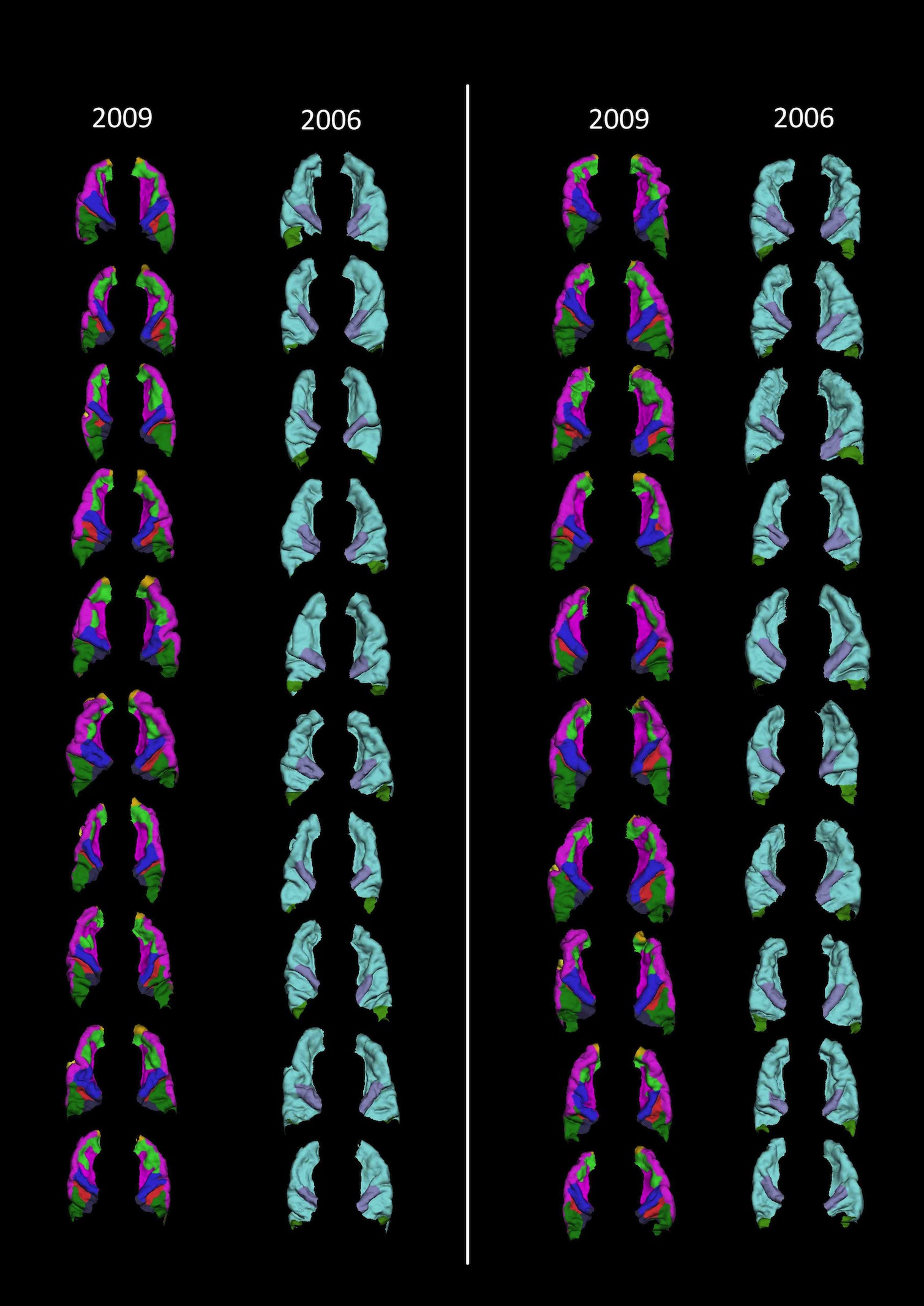
Referring to the topic we already talked about above, I am still wondering wether the pial view of the Heschl's gyrus (transverse temporal gyrus) of an individual subject (not averaged) is displayed correctly, for the calculated surface in mm^2 from the aseg-file is for atlas I (Desikan 2006) always larger than for atlas II (Destrieux 2010) - but as the attachment shows (individual Heschl's Gyrus of 20 subjects) atlas II consistently looks considerably larger. What am I doing wrong? Or can the pial surface not conclusively be interpreted refering to the calculated aseg results?
Thanks in advance,
2013/4/2 Douglas N Greve greve@nmr.mgh.harvard.edu
Yea, the appearance of the average subject pial surface can be very different depending up on the input subjects. The xyz for a pial vertex are just the average mni305 xyz for that vertex averaged over the input subjects. Since it is dependent on a 12DOF transform, it will not accurately represent any surface. The overlays (thicknesses, etc) are registered using the surface-based high DOF registration, so their averages mean something. But the pial surface should only be used for display. doug
On 04/02/2013 01:07 PM, Bruce Fischl wrote:
the average subject is constructed by specifically trying to normalize out differences in folding so I wouldn't try to infer anything from it cheers Bruce
On Tue, 2 Apr 2013, Klein, Holger wrote:
Hi Bruce, Thanks for the quick reply. I took the individual surface values from every subject's aseg-file and calculated the mean. Visualization was made in tksurfer with the average subject.
Thus, I am still wondering about this discrepancy.
Any other hints?
Thanks, H
2013/4/2 Bruce Fischl fischl@nmr.mgh.harvard.edu Hi Holger
how did you calculate the surface area? And how are youvisualizing it? I wouldn't use the surface area of the average subject for anything other than visualization as the coordinate system is not linear. You need to compute the surface area in the individual subject coordinates or take the jacobians into account.
  cheers
  Bruce


  On Tue, 2 Apr 2013, Klein, Holger wrote:

  Dear Freesurfers,
  I averaged 42 subjects with make_average_subject focusing on
Heschl's Gyrus and finally got the image attached (for both atlases (Desikan = Atlas I, Destrieux = Atlas II).
Gray matter surface calculations for Heschl's gyrus showed thefollowing mean values (in mm^2): Atlas I lh = 439 (SD 60), rh = 323 (SD 46) Atlas II lh = 340 (SD 70), rh = 253 (SD 47)
Heschl's gyrus depicted in the attached image looksconsiderably larger for Atlas II, but the surface analysis gives me smaller values for mean surface calculation (Atlas II < Atlas I)
  How can that be explained?

  Thanks in advance
[cleardot.gif]
Holger
Freesurfer mailing list Freesurfer@nmr.mgh.harvard.edu https://mail.nmr.mgh.harvard.edu/mailman/listinfo/freesurfer
The information in this e-mail is intended only for the person to whom it is addressed. If you believe this e-mail was sent to you in error and the e-mail contains patient information, please contact the Partners Compliance HelpLine at http://www.partners.org/complianceline . If the e-mail was sent to you in error but does not contain patient information, please contact the sender and properly dispose of the e-mail.
Freesurfer mailing list Freesurfer@nmr.mgh.harvard.edu https://mail.nmr.mgh.harvard.edu/mailman/listinfo/freesurfer
-- Douglas N. Greve, Ph.D. MGH-NMR Center greve@nmr.mgh.harvard.edu Phone Number: 617-724-2358 Fax: 617-726-7422
Bugs: surfer.nmr.mgh.harvard.edu/fswiki/BugReporting FileDrop: www.nmr.mgh.harvard.edu/facility/filedrop/index.html Outgoing: ftp://surfer.nmr.mgh.harvard.edu/transfer/outgoing/flat/greve/
Freesurfer mailing list Freesurfer@nmr.mgh.harvard.edu https://mail.nmr.mgh.harvard.edu/mailman/listinfo/freesurfer