
Hi,
Has anyone encountered this before? I have a few volumes for which mri_watershed output volumes are fine apart from some non-zero voxels near the edges (which are not connected to the brain). The volumes are in transverse format and the most noticeable effect is some inferior slices (neck, lower jaw) which are not being masked out, though there are also some voxels close to the coronal edges. For both sets of edges there is a one or two voxel thick layer parallel to either the coronal or transverse plane.
This is with Freesurfer 4.0.2, T1 images in Analyze format.
Thanks for your time, Ian Malone

Hi Ian,
mri_watershed minimizes a risk functional in which we weigh the cost of leaving non-brain voxels to be much less than stripping true brain ones, so it does sometimes leave stuff around. Is this causing any problems?
Bruce On Wed, 30 Jul 2008, Ian Malone wrote:
Hi,
Has anyone encountered this before? I have a few volumes for which mri_watershed output volumes are fine apart from some non-zero voxels near the edges (which are not connected to the brain). The volumes are in transverse format and the most noticeable effect is some inferior slices (neck, lower jaw) which are not being masked out, though there are also some voxels close to the coronal edges. For both sets of edges there is a one or two voxel thick layer parallel to either the coronal or transverse plane.
This is with Freesurfer 4.0.2, T1 images in Analyze format.
Thanks for your time, Ian Malone _______________________________________________ Freesurfer mailing list Freesurfer@nmr.mgh.harvard.edu https://mail.nmr.mgh.harvard.edu/mailman/listinfo/freesurfer
It's not terrible; it can be worked around. But it does feel more like a bug than a feature, as these voxels are un-connected with any in the brain. It looks a bit like the edge of a bounding box.
Thanks, Ian
Bruce Fischl wrote:
Hi Ian,
mri_watershed minimizes a risk functional in which we weigh the cost of leaving non-brain voxels to be much less than stripping true brain ones, so it does sometimes leave stuff around. Is this causing any problems?
Bruce On Wed, 30 Jul 2008, Ian Malone wrote:
Hi,
Has anyone encountered this before? I have a few volumes for which mri_watershed output volumes are fine apart from some non-zero voxels near the edges (which are not connected to the brain). The volumes are in transverse format and the most noticeable effect is some inferior slices (neck, lower jaw) which are not being masked out, though there are also some voxels close to the coronal edges. For both sets of edges there is a one or two voxel thick layer parallel to either the coronal or transverse plane.
This is with Freesurfer 4.0.2, T1 images in Analyze format.
Thanks for your time, Ian Malone _______________________________________________ Freesurfer mailing list Freesurfer@nmr.mgh.harvard.edu https://mail.nmr.mgh.harvard.edu/mailman/listinfo/freesurfer
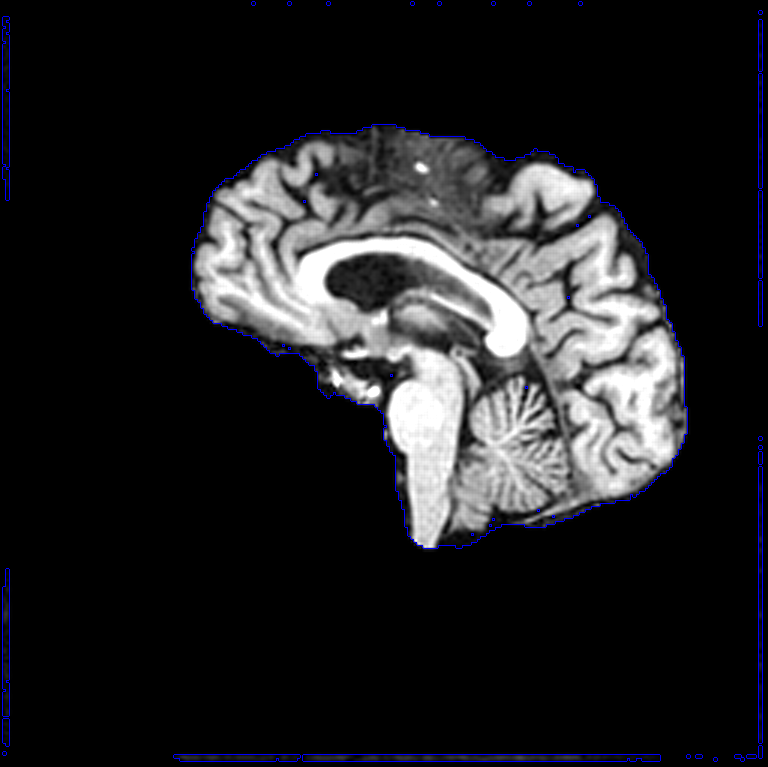
To illustrate the issue, this is a slice from one of the problematic volumes. The blue outlines surround non-zero voxels, the regions around the edges carry on parallel to those planes.
Ian
Ian Malone wrote:
It's not terrible; it can be worked around. But it does feel more like a bug than a feature, as these voxels are un-connected with any in the brain. It looks a bit like the edge of a bounding box.
Thanks, Ian
Bruce Fischl wrote:
Hi Ian,
mri_watershed minimizes a risk functional in which we weigh the cost of leaving non-brain voxels to be much less than stripping true brain ones, so it does sometimes leave stuff around. Is this causing any problems?
Bruce On Wed, 30 Jul 2008, Ian Malone wrote:
Hi,
Has anyone encountered this before? I have a few volumes for which mri_watershed output volumes are fine apart from some non-zero voxels near the edges (which are not connected to the brain). The volumes are in transverse format and the most noticeable effect is some inferior slices (neck, lower jaw) which are not being masked out, though there are also some voxels close to the coronal edges. For both sets of edges there is a one or two voxel thick layer parallel to either the coronal or transverse plane.
This is with Freesurfer 4.0.2, T1 images in Analyze format.
Thanks for your time, Ian Malone _______________________________________________ Freesurfer mailing list Freesurfer@nmr.mgh.harvard.edu https://mail.nmr.mgh.harvard.edu/mailman/listinfo/freesurfer
Hi Ian,
does this mess up the ?h.white or ?h.pial surfaces? Or the aseg.mgz? If not, I wouldn't worry about it.
cheers, Bruce On Tue, 5 Aug 2008, Ian Malone wrote:
To illustrate the issue, this is a slice from one of the problematic volumes. The blue outlines surround non-zero voxels, the regions around the edges carry on parallel to those planes.
Ian
Ian Malone wrote:
It's not terrible; it can be worked around. But it does feel more like a bug than a feature, as these voxels are un-connected with any in the brain. It looks a bit like the edge of a bounding box.
Thanks, Ian
Bruce Fischl wrote:
Hi Ian,
mri_watershed minimizes a risk functional in which we weigh the cost of leaving non-brain voxels to be much less than stripping true brain ones, so it does sometimes leave stuff around. Is this causing any problems?
Bruce On Wed, 30 Jul 2008, Ian Malone wrote:
Hi,
Has anyone encountered this before? I have a few volumes for which mri_watershed output volumes are fine apart from some non-zero voxels near the edges (which are not connected to the brain). The volumes are in transverse format and the most noticeable effect is some inferior slices (neck, lower jaw) which are not being masked out, though there are also some voxels close to the coronal edges. For both sets of edges there is a one or two voxel thick layer parallel to either the coronal or transverse plane.
This is with Freesurfer 4.0.2, T1 images in Analyze format.
Thanks for your time, Ian Malone _______________________________________________ Freesurfer mailing list Freesurfer@nmr.mgh.harvard.edu https://mail.nmr.mgh.harvard.edu/mailman/listinfo/freesurfer
freesurfer@nmr.mgh.harvard.edu
-
 Bruce Fischl
 -
 Ian Malone