
Hello surfers,
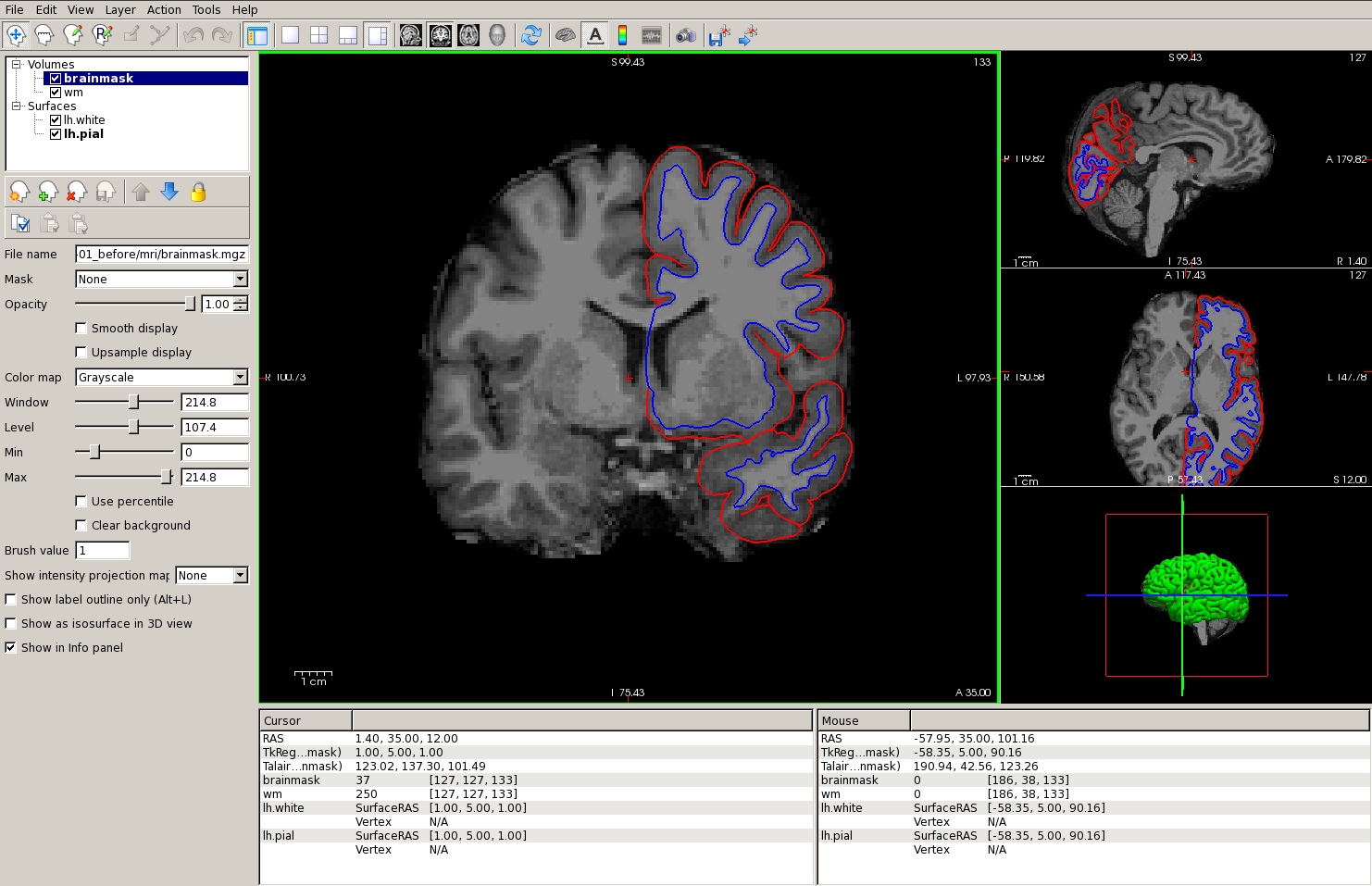
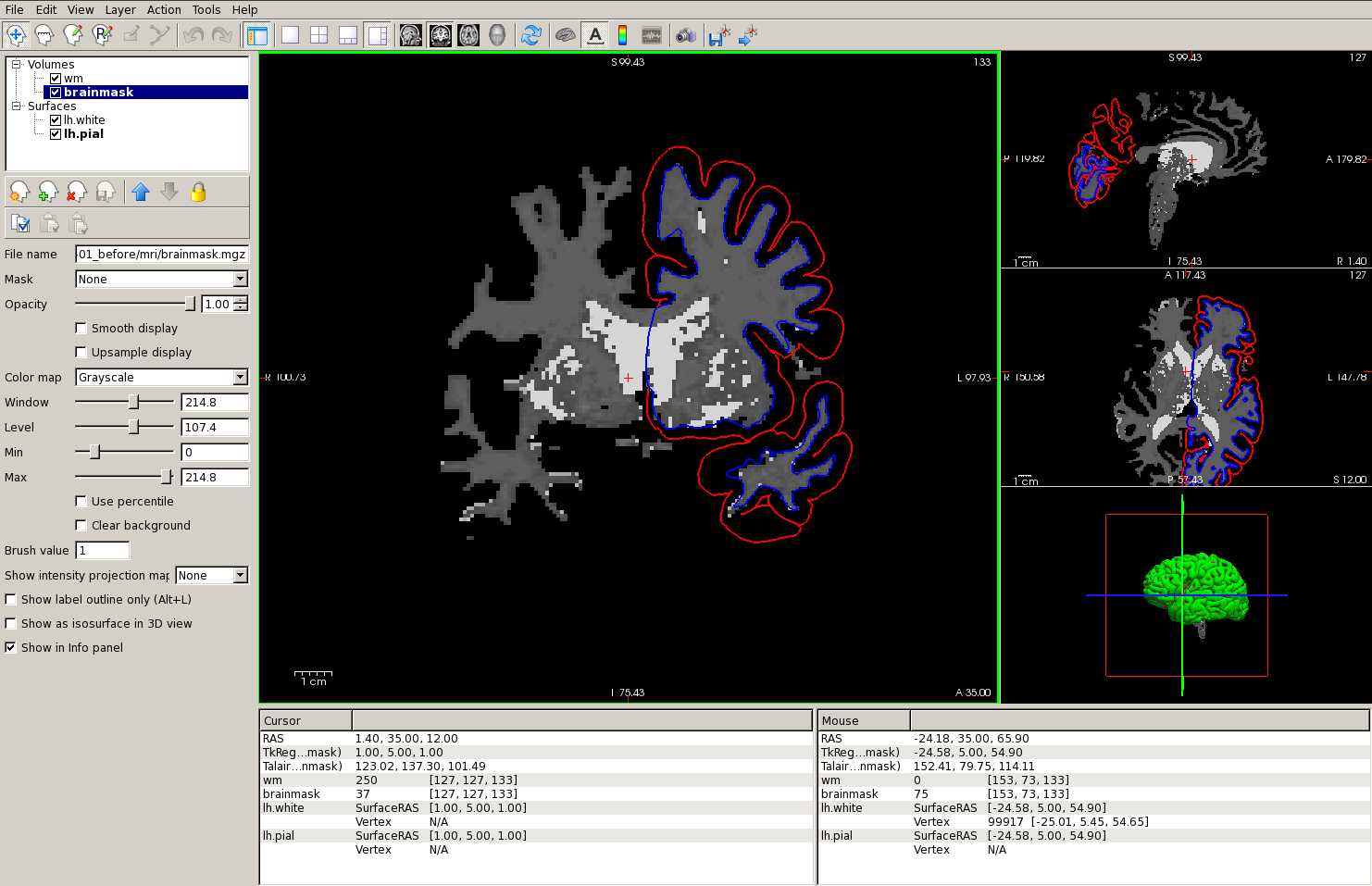
I'm attempting to extend white and pial surfaces to encompass an unrecognized gyrus. The wm.mgz seems include the WM tissue, but the white surface does not extend to the WM boundary. I thought this might be related to an intensity normalization error and tried using control points, but that did not make a big difference in the resulting surfaces. I've attached pictures to better illustrate the problem. Thanks in advance for your help!
Best regards, Jake

Hi Jake
usually that means that there is a topology defect that is being incorrectly fixed. If you upload the subject and point us at the voxel coords we will take a look
cheers Bruce
On Wed, 26 Jul 2017, Jake Rieke wrote:
Hello surfers,
I'm attempting to extend white and pial surfaces to encompass an unrecognized gyrus. The wm.mgz seems include the WM tissue, but the white surface does not extend to the WM boundary. I thought this might be related to an intensity normalization error and tried using control points, but that did not make a big difference in the resulting surfaces. I've attached pictures to better illustrate the problem. Thanks in advance for your help!
Best regards, Jake
Hi Bruce,
Thanks for the response. I just uploaded the subject using the ftp file exchange. The issue is visible in the region close to voxel coordinate [172, 123 ,134]. the missing gyrus is capped between coronal slice 141 to 118. I forgot to mention in my first message that we used a T2 to improve pial surface after initial running with just the T1.
Thanks again Jake
Biomedical Engineer, Brain Rehabilitation Research Center Malcolm Randall VA Medical Center, 1601 SW Archer Road, Gainesville, FL 32608 Phone: 1-352-376-1611 ext. 5249, E-mail: jakerieke@gmail.com
On Wed, Jul 26, 2017 at 8:16 PM, Bruce Fischl fischl@nmr.mgh.harvard.edu wrote:
Hi Jake
usually that means that there is a topology defect that is being incorrectly fixed. If you upload the subject and point us at the voxel coords we will take a look
cheers Bruce
On Wed, 26 Jul 2017, Jake Rieke wrote:
Hello surfers,
I'm attempting to extend white and pial surfaces to encompass an unrecognized gyrus. The wm.mgz seems include the WM tissue, but the white surface does not extend to the WM boundary. I thought this might be
related
to an intensity normalization error and tried using control points, but
that
did not make a big difference in the resulting surfaces. I've attached pictures to better illustrate the problem. Thanks in advance for your
help!
Best regards, Jake
Freesurfer mailing list Freesurfer@nmr.mgh.harvard.edu https://mail.nmr.mgh.harvard.edu/mailman/listinfo/freesurfer
The information in this e-mail is intended only for the person to whom it is addressed. If you believe this e-mail was sent to you in error and the e-mail contains patient information, please contact the Partners Compliance HelpLine at http://www.partners.org/complianceline . If the e-mail was sent to you in error but does not contain patient information, please contact the sender and properly dispose of the e-mail.
Hi Jake
there are voxels like 173, 112, 122 that are incorrectly segmented as wm (that is, they have a value >=5 in the wm.mgz) that connect two adjenct gyri. You can either change the intensity thresholds in mri_segment, or manually erase some of them. The best way to see this is to look at the surface prior to topology correction, and color it with defect numbers so you can see where the defects are. Something like:
cd $SUBJECTS_DIR/<subject id>/mri freeview -v brain.mgz wm.mgz:colormap=heat:heatscale=1,100 \ -f ../surf/lh.orig.nofix:overlay=../surf/lh.defect_labels:overlay_threshold=1,255:edgecolor=overlay \ -slice 172 123 134
if you page through a few axial slices you will see that the wm.mgz is connected to the body of the wm in slice 109, disconnecs in 110, then reconnects to a different part in 115, which should never happen
cheers Bruce On Thu, 27 Jul 2017, Jake Rieke wrote:
Hi Bruce,
Thanks for the response. I just uploaded the subject using the ftp file exchange. The issue is visible in the region close to voxel coordinate [172, 123 ,134]. the missing gyrus is capped between coronal slice 141 to 118. I forgot to mention in my first message that we used a T2 to improve pial surface after initial running with just the T1.
Thanks again Jake
Biomedical Engineer, Brain Rehabilitation Research CenterMalcolm Randall VA Medical Center, 1601 SW Archer Road, Gainesville, FL 32608 Phone: 1-352-376-1611 ext. 5249, E-mail: jakerieke@gmail.com
On Wed, Jul 26, 2017 at 8:16 PM, Bruce Fischl fischl@nmr.mgh.harvard.edu wrote: Hi Jake
  usually that means that there is a topology defect that is being
  incorrectly fixed. If you upload the subject and point us at the
  voxel
  coords we will take a look

  cheers
  Bruce

  On Wed, 26 Jul 2017, Jake Rieke wrote:

  > Hello surfers,
  >
  > I'm attempting to extend white and pial surfaces to encompass
  an
  > unrecognized gyrus. The wm.mgz seems include the WM tissue,
  but the white
  > surface does not extend to the WM boundary. I thought this
  might be related
  > to an intensity normalization error and tried using control
  points, but that
  > did not make a big difference in the resulting surfaces. I've
  attached
  > pictures to better illustrate the problem. Thanks in advance
  for your help!
  >
  > Best regards,
  > Jake
  >
  >
  >
Freesurfer mailing list Freesurfer@nmr.mgh.harvard.edu https://mail.nmr.mgh.harvard.edu/mailman/listinfo/freesurfer
The information in this e-mail is intended only for the person to whom it is addressed. If you believe this e-mail was sent to you in error and the e-mail contains patient information, please contact the Partners Compliance HelpLine at http://www.partners.org/complianceline . If the e-mail was sent to you in error but does not contain patient information, please contact the sender and properly dispose of the e-mail.
Thanks, Bruce and Douglas! Looking at the surface prior to the topology correction step has been very helpful. I can see the region you pointed out - where the wm.mgz connects to the body of the wm, disconnects, and then reconnects at a different spot. I'm having some trouble implementing the manual edits to the wm.mgz. Part of the problem is that I'm still training my eye to differentiate GM and WM (especially in cases with thin tracts or partial voluming), but this gives me a great place to start.
I'm wondering, in general, is the idea to erase or add voxels in the wm.mgz where the defects are located? In other words, defects can be interpreted as areas of misclassified as WM? In this case, it seems that I need to focus on deleting voxels in the wm.mgz that are incorrectly segmented.
Thanks, Jake
Biomedical Engineer, Brain Rehabilitation Research Center Malcolm Randall VA Medical Center, 1601 SW Archer Road, Gainesville, FL 32608 Phone: 1-352-376-1611 ext. 5249, E-mail: jakerieke@gmail.com
On Thu, Jul 27, 2017 at 1:09 PM, Bruce Fischl fischl@nmr.mgh.harvard.edu wrote:
Hi Jake
there are voxels like 173, 112, 122 that are incorrectly segmented as wm (that is, they have a value >=5 in the wm.mgz) that connect two adjenct gyri. You can either change the intensity thresholds in mri_segment, or manually erase some of them. The best way to see this is to look at the surface prior to topology correction, and color it with defect numbers so you can see where the defects are. Something like:
cd $SUBJECTS_DIR/<subject id>/mri freeview -v brain.mgz wm.mgz:colormap=heat:heatscale=1,100 \ -f ../surf/lh.orig.nofix:overlay=../surf/lh.defect_labels:overl ay_threshold=1,255:edgecolor=overlay \ -slice 172 123 134
if you page through a few axial slices you will see that the wm.mgz is connected to the body of the wm in slice 109, disconnecs in 110, then reconnects to a different part in 115, which should never happen
cheers Bruce On Thu, 27 Jul 2017, Jake Rieke wrote:
Hi Bruce,
Thanks for the response. I just uploaded the subject using the ftp file exchange. The issue is visible in the region close to voxel coordinate [172, 123 ,134]. the missing gyrus is capped between coronal slice 141 to 118. I forgot to mention in my first message that we used a T2 to improve pial surface after initial running with just the T1.
Thanks again Jake
Biomedical Engineer, Brain Rehabilitation Research CenterMalcolm Randall VA
Medical Center, 1601 SW Archer Road, Gainesville, FL 32608 Phone: 1-352-376-1611 ext. 5249, E-mail: jakerieke@gmail.com
On Wed, Jul 26, 2017 at 8:16 PM, Bruce Fischl <fischl@nmr.mgh.harvard.edu
wrote: Hi Jake
  usually that means that there is a topology defect that is being
  incorrectly fixed. If you upload the subject and point us at the
  voxel
  coords we will take a look

  cheers
  Bruce

  On Wed, 26 Jul 2017, Jake Rieke wrote:

  > Hello surfers,
  >
  > I'm attempting to extend white and pial surfaces to encompass
  an
  > unrecognized gyrus. The wm.mgz seems include the WM tissue,
  but the white
  > surface does not extend to the WM boundary. I thought this
  might be related
  > to an intensity normalization error and tried using control
  points, but that
  > did not make a big difference in the resulting surfaces. I've
  attached
  > pictures to better illustrate the problem. Thanks in advance
  for your help!
  >
  > Best regards,
  > Jake
  >
  >
  >
Freesurfer mailing list Freesurfer@nmr.mgh.harvard.edu https://mail.nmr.mgh.harvard.edu/mailman/listinfo/freesurfer
The information in this e-mail is intended only for the person to whom it is addressed. If you believe this e-mail was sent to you in error and the e-mail contains patient information, please contact the Partners Compliance HelpLine at http://www.partners.org/complianceline . If the e-mail was sent to you in error but does not contain patient information, please contact the sender and properly dispose of the e-mail.
Freesurfer mailing list Freesurfer@nmr.mgh.harvard.edu https://mail.nmr.mgh.harvard.edu/mailman/listinfo/freesurfer
The information in this e-mail is intended only for the person to whom it is addressed. If you believe this e-mail was sent to you in error and the e-mail contains patient information, please contact the Partners Compliance HelpLine at http://www.partners.org/complianceline . If the e-mail was sent to you in error but does not contain patient information, please contact the sender and properly dispose of the e-mail.
it depends. In this case you want to erase as it creates an incorrect connection. In others you want to add if there is an incorrect break On Fri, 28 Jul 2017, Jake Rieke wrote:
Thanks, Bruce and Douglas! Looking at the surface prior to the topology correction step has been very helpful. I can see the region you pointed out
- where the wm.mgz connects to the body of the wm, disconnects, and then
reconnects at a different spot. I'm having some trouble implementing the manual edits to the wm.mgz. Part of the problem is that I'm still training my eye to differentiate GM and WM (especially in cases with thin tracts or partial voluming), but this gives me a great place to start.
I'm wondering, in general, is the idea to erase or add voxels in the wm.mgz where the defects are located? In other words, defects can be interpreted as areas of misclassified as WM? In this case, it seems that I need to focus on deleting voxels in the wm.mgz that are incorrectly segmented.
Thanks, Jake
Biomedical Engineer, Brain Rehabilitation Research CenterMalcolm Randall VA Medical Center, 1601 SW Archer Road, Gainesville, FL 32608 Phone: 1-352-376-1611 ext. 5249, E-mail: jakerieke@gmail.com
On Thu, Jul 27, 2017 at 1:09 PM, Bruce Fischl fischl@nmr.mgh.harvard.edu wrote: Hi Jake
  there are voxels like 173, 112, 122 that are incorrectly
  segmented as wm (that is, they have a value >=5 in the wm.mgz)
  that connect two adjenct gyri. You can either change the
  intensity thresholds in mri_segment, or manually erase some of
  them. The best way to see this is to look at the surface prior
  to topology correction, and color it with defect numbers so you
  can see where the defects are. Something like:

  cd $SUBJECTS_DIR/<subject id>/mri
  freeview -v brain.mgz wm.mgz:colormap=heat:heatscale=1,100 \
          -f../surf/lh.orig.nofix:overlay=../surf/lh.defect_labels:overlay_threshold=1,
  255:edgecolor=overlay \
          -slice 172 123 134


  if you page through a few axial slices you will see that the
  wm.mgz is connected to the body of the wm in slice 109,
  disconnecs in 110, then reconnects to a different part in 115,
  which should never happen

  cheers
  Bruce
   On Thu, 27 Jul 2017, Jake Rieke wrote:

        Hi Bruce,

        Thanks for the response. I just uploaded the subject
        using the ftp file
        exchange. The issue is visible in the region close
        to voxel coordinate [172,
        123 ,134]. the missing gyrus is capped between
        coronal slice 141 to 118. I
        forgot to mention in my first message that we used a
        T2 to improve pial
        surface after initial running with just the T1.

        Thanks again
        Jake

        Biomedical Engineer, Brain Rehabilitation Research
        CenterMalcolm Randall VA
        Medical Center, 1601 SW Archer Road, Gainesville, FL
        32608
        Phone: 1-352-376-1611 ext. 5249, E-mail:
        jakerieke@gmail.com

        On Wed, Jul 26, 2017 at 8:16 PM, Bruce Fischl
        <fischl@nmr.mgh.harvard.edu>
        wrote:
              Hi Jake

              usually that means that there is a topology
        defect that is being
              incorrectly fixed. If you upload the subject
        and point us at the
              voxel
              coords we will take a look

              cheers
              Bruce

              On Wed, 26 Jul 2017, Jake Rieke wrote:

              > Hello surfers,
              >
              > I'm attempting to extend white and pial
        surfaces to encompass
              an
              > unrecognized gyrus. The wm.mgz seems include
        the WM tissue,
              but the white
              > surface does not extend to the WM boundary.
        I thought this
              might be related
              > to an intensity normalization error and
        tried using control
              points, but that
              > did not make a big difference in the
        resulting surfaces. I've
              attached
              > pictures to better illustrate the problem.
        Thanks in advance
              for your help!
              >
              > Best regards,
              > Jake
              >
              >
              >
        _______________________________________________
        Freesurfer mailing list
        Freesurfer@nmr.mgh.harvard.edu
        https://mail.nmr.mgh.harvard.edu/mailman/listinfo/freesurfer


        The information in this e-mail is intended only for
        the person to whom
        it is
        addressed. If you believe this e-mail was sent to
        you in error and the
        e-mail
        contains patient information, please contact the
        Partners Compliance
        HelpLine at
        http://www.partners.org/complianceline . If the
        e-mail was sent to you
        in error
        but does not contain patient information, please
        contact the sender
        and properly
        dispose of the e-mail.
Freesurfer mailing list Freesurfer@nmr.mgh.harvard.edu https://mail.nmr.mgh.harvard.edu/mailman/listinfo/freesurfer
The information in this e-mail is intended only for the person to whom it is addressed. If you believe this e-mail was sent to you in error and the e-mail contains patient information, please contact the Partners Compliance HelpLine at http://www.partners.org/complianceline . If the e-mail was sent to you in error but does not contain patient information, please contact the sender and properly dispose of the e-mail.
Okay, understood. Thanks again for your help.
Best regards, Jake
On Fri, Jul 28, 2017 at 11:20 AM, Bruce Fischl fischl@nmr.mgh.harvard.edu wrote:
it depends. In this case you want to erase as it creates an incorrect connection. In others you want to add if there is an incorrect break On Fri, 28 Jul 2017, Jake Rieke wrote:
Thanks, Bruce and Douglas! Looking at the surface prior to the topology
correction step has been very helpful. I can see the region you pointed out
- where the wm.mgz connects to the body of the wm, disconnects, and then
reconnects at a different spot. I'm having some trouble implementing the manual edits to the wm.mgz. Part of the problem is that I'm still training my eye to differentiate GM and WM (especially in cases with thin tracts or partial voluming), but this gives me a great place to start.
I'm wondering, in general, is the idea to erase or add voxels in the wm.mgz where the defects are located? In other words, defects can be interpreted as areas of misclassified as WM? In this case, it seems that I need to focus on deleting voxels in the wm.mgz that are incorrectly segmented.
Thanks, Jake
Biomedical Engineer, Brain Rehabilitation Research CenterMalcolm Randall VA Medical Center, 1601 SW Archer Road, Gainesville, FL 32608 Phone: 1-352-376-1611 ext. 5249, E-mail: jakerieke@gmail.com
On Thu, Jul 27, 2017 at 1:09 PM, Bruce Fischl <fischl@nmr.mgh.harvard.edu
wrote: Hi Jake
  there are voxels like 173, 112, 122 that are incorrectly
  segmented as wm (that is, they have a value >=5 in the wm.mgz)
  that connect two adjenct gyri. You can either change the
  intensity thresholds in mri_segment, or manually erase some of
  them. The best way to see this is to look at the surface prior
  to topology correction, and color it with defect numbers so you
  can see where the defects are. Something like:

  cd $SUBJECTS_DIR/<subject id>/mri
  freeview -v brain.mgz wm.mgz:colormap=heat:heatscale=1,100 \
          -f../surf/lh.orig.nofix:overlay=../surf/lh.defect_labels:
overlay_threshold=1, 255:edgecolor=overlay \ -slice 172 123 134
  if you page through a few axial slices you will see that the
  wm.mgz is connected to the body of the wm in slice 109,
  disconnecs in 110, then reconnects to a different part in 115,
  which should never happen

  cheers
  Bruce
   On Thu, 27 Jul 2017, Jake Rieke wrote:

        Hi Bruce,

        Thanks for the response. I just uploaded the subject
        using the ftp file
        exchange. The issue is visible in the region close
        to voxel coordinate [172,
        123 ,134]. the missing gyrus is capped between
        coronal slice 141 to 118. I
        forgot to mention in my first message that we used a
        T2 to improve pial
        surface after initial running with just the T1.

        Thanks again
        Jake

        Biomedical Engineer, Brain Rehabilitation Research
        CenterMalcolm Randall VA
        Medical Center, 1601 SW Archer Road, Gainesville, FL
        32608
        Phone: 1-352-376-1611 ext. 5249, E-mail:
        jakerieke@gmail.com

        On Wed, Jul 26, 2017 at 8:16 PM, Bruce Fischl
        <fischl@nmr.mgh.harvard.edu>
        wrote:
              Hi Jake

              usually that means that there is a topology
        defect that is being
              incorrectly fixed. If you upload the subject
        and point us at the
              voxel
              coords we will take a look

              cheers
              Bruce

              On Wed, 26 Jul 2017, Jake Rieke wrote:

              > Hello surfers,
              >
              > I'm attempting to extend white and pial
        surfaces to encompass
              an
              > unrecognized gyrus. The wm.mgz seems include
        the WM tissue,
              but the white
              > surface does not extend to the WM boundary.
        I thought this
              might be related
              > to an intensity normalization error and
        tried using control
              points, but that
              > did not make a big difference in the
        resulting surfaces. I've
              attached
              > pictures to better illustrate the problem.
        Thanks in advance
              for your help!
              >
              > Best regards,
              > Jake
              >
              >
              >
        _______________________________________________
        Freesurfer mailing list
        Freesurfer@nmr.mgh.harvard.edu
        https://mail.nmr.mgh.harvard.edu/mailman/listinfo/freesurfer


        The information in this e-mail is intended only for
        the person to whom
        it is
        addressed. If you believe this e-mail was sent to
        you in error and the
        e-mail
        contains patient information, please contact the
        Partners Compliance
        HelpLine at
        http://www.partners.org/complianceline . If the
        e-mail was sent to you
        in error
        but does not contain patient information, please
        contact the sender
        and properly
        dispose of the e-mail.
Freesurfer mailing list Freesurfer@nmr.mgh.harvard.edu https://mail.nmr.mgh.harvard.edu/mailman/listinfo/freesurfer
The information in this e-mail is intended only for the person to whom it is addressed. If you believe this e-mail was sent to you in error and the e-mail contains patient information, please contact the Partners Compliance HelpLine at http://www.partners.org/complianceline . If the e-mail was sent to you in error but does not contain patient information, please contact the sender and properly dispose of the e-mail.
Freesurfer mailing list Freesurfer@nmr.mgh.harvard.edu https://mail.nmr.mgh.harvard.edu/mailman/listinfo/freesurfer
The information in this e-mail is intended only for the person to whom it is addressed. If you believe this e-mail was sent to you in error and the e-mail contains patient information, please contact the Partners Compliance HelpLine at http://www.partners.org/complianceline . If the e-mail was sent to you in error but does not contain patient information, please contact the sender and properly dispose of the e-mail.

you can also run defect-seg, then look at the help to get an idea of how to load the defect segmentation and see whether the defect is causing the problem
On 07/26/2017 08:16 PM, Bruce Fischl wrote:
Hi Jake
usually that means that there is a topology defect that is being incorrectly fixed. If you upload the subject and point us at the voxel coords we will take a look
cheers Bruce
On Wed, 26 Jul 2017, Jake Rieke wrote:
Hello surfers,
I'm attempting to extend white and pial surfaces to encompass an unrecognized gyrus. The wm.mgz seems include the WM tissue, but the white surface does not extend to the WM boundary. I thought this might be related to an intensity normalization error and tried using control points, but that did not make a big difference in the resulting surfaces. I've attached pictures to better illustrate the problem. Thanks in advance for your help!
Best regards, Jake
Freesurfer mailing list Freesurfer@nmr.mgh.harvard.edu https://mail.nmr.mgh.harvard.edu/mailman/listinfo/freesurfer
freesurfer@nmr.mgh.harvard.edu
-
 Bruce Fischl
 -
 Douglas N Greve
 -
 Jake Rieke