
Hi,
I am currently analyzing some retinotopy data. For the polar angle stimulus we had both clockwise and counterclockwise stimuli. Both of them started at the top of the screen (12 o'clock), each run includes 4 full cycles and ends with the last wedge slightly before/after 12o'clock.
We have created seperate paradigm files (direction pos / direction neg) for the clockwise and counterclockwise runs and followed the steps as indicated by the "FsFastIndividualRetinotopyAnalysis". However, when we run the Freesurfer retinotopy analysis on the whole data set, the polar angle is very noisy. When we run the same analysis separately for the clockwise and counterclockwise runs separately, the results look much better. Could anyone tell me what I am doing wrong?
Thanks!
Thomas

what is it that is noisy? The angle map or the p-value map? Can you send pics? doug
On 08/06/2012 12:41 PM, Thomas Janssens wrote:
Hi,
I am currently analyzing some retinotopy data. For the polar angle stimulus we had both clockwise and counterclockwise stimuli. Both of them started at the top of the screen (12 o'clock), each run includes 4 full cycles and ends with the last wedge slightly before/after 12o'clock.
We have created seperate paradigm files (direction pos / direction neg) for the clockwise and counterclockwise runs and followed the steps as indicated by the "FsFastIndividualRetinotopyAnalysis". However, when we run the Freesurfer retinotopy analysis on the whole data set, the polar angle is very noisy. When we run the same analysis separately for the clockwise and counterclockwise runs separately, the results look much better. Could anyone tell me what I am doing wrong?
Thanks!
Thomas
Freesurfer mailing list Freesurfer@nmr.mgh.harvard.edu https://mail.nmr.mgh.harvard.edu/mailman/listinfo/freesurfer
Hi Doug,
the p-values are all much lower when I combine both the counterclockwise and clockwise stimuli and the angle maps look completely different. I have noticed that for the eccentricity data I have the same problem (contracting and expanding rings).
Below you can find the images (it is macaque MION fMRI data).
Thanks,
Thomas
On 06 Aug 2012, at 19:43, Douglas N Greve wrote:
what is it that is noisy? The angle map or the p-value map? Can you send pics? doug
On 08/06/2012 12:41 PM, Thomas Janssens wrote:
Hi,
I am currently analyzing some retinotopy data. For the polar angle stimulus we had both clockwise and counterclockwise stimuli. Both of them started at the top of the screen (12 o'clock), each run includes 4 full cycles and ends with the last wedge slightly before/after 12o'clock.
We have created seperate paradigm files (direction pos / direction neg) for the clockwise and counterclockwise runs and followed the steps as indicated by the "FsFastIndividualRetinotopyAnalysis". However, when we run the Freesurfer retinotopy analysis on the whole data set, the polar angle is very noisy. When we run the same analysis separately for the clockwise and counterclockwise runs separately, the results look much better. Could anyone tell me what I am doing wrong?
Thanks!
Thomas
Freesurfer mailing list Freesurfer@nmr.mgh.harvard.edu https://mail.nmr.mgh.harvard.edu/mailman/listinfo/freesurfer
-- Douglas N. Greve, Ph.D. MGH-NMR Center greve@nmr.mgh.harvard.edu Phone Number: 617-724-2358 Fax: 617-726-7422
Bugs: surfer.nmr.mgh.harvard.edu/fswiki/BugReporting FileDrop: www.nmr.mgh.harvard.edu/facility/filedrop/index.html
Freesurfer mailing list Freesurfer@nmr.mgh.harvard.edu https://mail.nmr.mgh.harvard.edu/mailman/listinfo/freesurfer
Thomas Janssens, PhD student FWO Laboratorium voor Neuro- en Psychofysiologie K.U.Leuven Medical School Herestraat 49, B-3000 Leuven (Belgium) phone +32 16 33 00 35 cell phone +32 494 115 509 thomasj@nmr.mgh.harvard.edu thomas.janssens@med.kuleuven.be
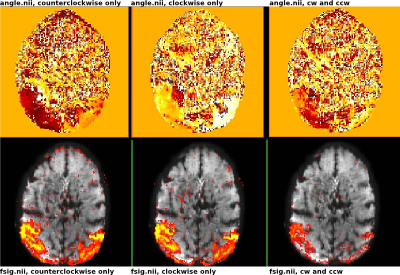
I see what you mean. Is it possible that they are the same direction? When you look at the angle values when running them individually, are they the same or opposite sign? Are you sure that the par file lists one as positive and one as negative? doug
On 08/06/2012 02:56 PM, Thomas Janssens wrote:
Hi Doug,
the p-values are all much lower when I combine both the counterclockwise and clockwise stimuli and the angle maps look completely different. I have noticed that for the eccentricity data I have the same problem (contracting and expanding rings).
Below you can find the images (it is macaque MION fMRI data).
Thanks,
Thomas
On 06 Aug 2012, at 19:43, Douglas N Greve wrote:
what is it that is noisy? The angle map or the p-value map? Can you send pics? doug
On 08/06/2012 12:41 PM, Thomas Janssens wrote:
Hi,
I am currently analyzing some retinotopy data. For the polar angle stimulus we had both clockwise and counterclockwise stimuli. Both of them started at the top of the screen (12 o'clock), each run includes 4 full cycles and ends with the last wedge slightly before/after 12o'clock.
We have created seperate paradigm files (direction pos / direction neg) for the clockwise and counterclockwise runs and followed the steps as indicated by the "FsFastIndividualRetinotopyAnalysis". However, when we run the Freesurfer retinotopy analysis on the whole data set, the polar angle is very noisy. When we run the same analysis separately for the clockwise and counterclockwise runs separately, the results look much better. Could anyone tell me what I am doing wrong?
Thanks!
Thomas
Freesurfer mailing list Freesurfer@nmr.mgh.harvard.edu mailto:Freesurfer@nmr.mgh.harvard.edu https://mail.nmr.mgh.harvard.edu/mailman/listinfo/freesurfer
-- Douglas N. Greve, Ph.D. MGH-NMR Center greve@nmr.mgh.harvard.edu mailto:greve@nmr.mgh.harvard.edu Phone Number: 617-724-2358 Fax: 617-726-7422
Bugs: surfer.nmr.mgh.harvard.edu/fswiki/BugReporting FileDrop: www.nmr.mgh.harvard.edu/facility/filedrop/index.html
Freesurfer mailing list Freesurfer@nmr.mgh.harvard.edu https://mail.nmr.mgh.harvard.edu/mailman/listinfo/freesurfer
Thomas Janssens, PhD student FWO Laboratorium voor Neuro- en Psychofysiologie K.U.Leuven Medical School Herestraat 49, B-3000 Leuven (Belgium) phone +32 16 33 00 35 cell phone +32 494 115 509 thomasj@nmr.mgh.harvard.edu mailto:thomasj@nmr.mgh.harvard.edu thomas.janssens@med.kuleuven.be mailto:thomas.janssens@med.kuleuven.be
I am 100% sure that the stimuli themselves are correct (clockwise and counterclockwise/ expanding and contracting).
When I look at the individual angle values I noticed that the difference between the cw and ccw is on average equal to half a cycle (so pi). When I plot the results (using the real.nii and imag.nii files) on a surface in tksurfer, I noticed that a phase offset of 0.43-0.5 seems to lead to a perfect match between the individually run ccw and cw.
I have also tried to run the ccw runs with the pos direction in the par file. It is impossible to match the angle in everywhere in this image to the cw dataset by using an offset.
Taking all this into account I would say that the pos and neg are correctly defined in my analysis setup. Could it be that freesurfer does not assume the cw and ccw to start both at 12 o'clock, but rather one at 12o'clock and one at 6 o'clock? Or do you have any idea what else is wrong?
Thanks, Thomas
On 06 Aug 2012, at 22:02, Douglas N Greve wrote:
I see what you mean. Is it possible that they are the same direction? When you look at the angle values when running them individually, are they the same or opposite sign? Are you sure that the par file lists one as positive and one as negative? doug
On 08/06/2012 02:56 PM, Thomas Janssens wrote:
Hi Doug,
the p-values are all much lower when I combine both the counterclockwise and clockwise stimuli and the angle maps look completely different. I have noticed that for the eccentricity data I have the same problem (contracting and expanding rings).
Below you can find the images (it is macaque MION fMRI data).
Thanks,
Thomas
On 06 Aug 2012, at 19:43, Douglas N Greve wrote:
what is it that is noisy? The angle map or the p-value map? Can you send pics? doug
On 08/06/2012 12:41 PM, Thomas Janssens wrote:
Hi,
I am currently analyzing some retinotopy data. For the polar angle stimulus we had both clockwise and counterclockwise stimuli. Both of them started at the top of the screen (12 o'clock), each run includes 4 full cycles and ends with the last wedge slightly before/after 12o'clock.
We have created seperate paradigm files (direction pos / direction neg) for the clockwise and counterclockwise runs and followed the steps as indicated by the "FsFastIndividualRetinotopyAnalysis". However, when we run the Freesurfer retinotopy analysis on the whole data set, the polar angle is very noisy. When we run the same analysis separately for the clockwise and counterclockwise runs separately, the results look much better. Could anyone tell me what I am doing wrong?
Thanks!
Thomas
Freesurfer mailing list Freesurfer@nmr.mgh.harvard.edu mailto:Freesurfer@nmr.mgh.harvard.edu https://mail.nmr.mgh.harvard.edu/mailman/listinfo/freesurfer
-- Douglas N. Greve, Ph.D. MGH-NMR Center greve@nmr.mgh.harvard.edu mailto:greve@nmr.mgh.harvard.edu Phone Number: 617-724-2358 Fax: 617-726-7422
Bugs: surfer.nmr.mgh.harvard.edu/fswiki/BugReporting FileDrop: www.nmr.mgh.harvard.edu/facility/filedrop/index.html
Freesurfer mailing list Freesurfer@nmr.mgh.harvard.edu https://mail.nmr.mgh.harvard.edu/mailman/listinfo/freesurfer
Thomas Janssens, PhD student FWO Laboratorium voor Neuro- en Psychofysiologie K.U.Leuven Medical School Herestraat 49, B-3000 Leuven (Belgium) phone +32 16 33 00 35 cell phone +32 494 115 509 thomasj@nmr.mgh.harvard.edu mailto:thomasj@nmr.mgh.harvard.edu thomas.janssens@med.kuleuven.be mailto:thomas.janssens@med.kuleuven.be
-- Douglas N. Greve, Ph.D. MGH-NMR Center greve@nmr.mgh.harvard.edu Phone Number: 617-724-2358 Fax: 617-726-7422
Bugs: surfer.nmr.mgh.harvard.edu/fswiki/BugReporting FileDrop: www.nmr.mgh.harvard.edu/facility/filedrop/index.html
Thomas Janssens, PhD student FWO Laboratorium voor Neuro- en Psychofysiologie K.U.Leuven Medical School Herestraat 49, B-3000 Leuven (Belgium) phone +32 16 33 00 35 cell phone +32 494 115 509 thomasj@nmr.mgh.harvard.edu thomas.janssens@med.kuleuven.be
Hi Doug,
It seems that, our stimulus presentation is inconsistent with the way freesurfer processes the retinotopy clockwise and counter clockwise data.
After going through the freesurfer code I found the following. The freesurfer code assumes that the wedge starts horizontally for both clockwise and counterclockwise runs. In the glm analysis, the difference between the two types of runs (specified in the paradigm file by "neg" or "pos") is programmed in the function $FREESURFER_HOME/fsfast/toolbox/flac_desmat.m as follows:
for "pos" runs the real part equals cos(phz) and the imaginary part equals sin(phz)
for "neg" runs the real part stays cos(phz) and the imaginary part equals -sin(phz).
This is correct if the wedge starts in the horizontal positionm, but not if the wedge starts vertically. In that case the code above will lead to a phase shift of half a cycle for the "neg" runs compared to the "pos" runs.
However, this problem is solved by changing the code for the "neg" runs to: the real part equals -cos(phz) and the imaginary part equals sin(phz).
This small change fixed the problems for our data.
Thomas
On 08 Aug 2012, at 16:27, Thomas Janssens wrote:
I am 100% sure that the stimuli themselves are correct (clockwise and counterclockwise/ expanding and contracting).
When I look at the individual angle values I noticed that the difference between the cw and ccw is on average equal to half a cycle (so pi). When I plot the results (using the real.nii and imag.nii files) on a surface in tksurfer, I noticed that a phase offset of 0.43-0.5 seems to lead to a perfect match between the individually run ccw and cw.
I have also tried to run the ccw runs with the pos direction in the par file. It is impossible to match the angle in everywhere in this image to the cw dataset by using an offset.
Taking all this into account I would say that the pos and neg are correctly defined in my analysis setup. Could it be that freesurfer does not assume the cw and ccw to start both at 12 o'clock, but rather one at 12o'clock and one at 6 o'clock? Or do you have any idea what else is wrong?
Thanks, Thomas
On 06 Aug 2012, at 22:02, Douglas N Greve wrote:
I see what you mean. Is it possible that they are the same direction? When you look at the angle values when running them individually, are they the same or opposite sign? Are you sure that the par file lists one as positive and one as negative? doug
On 08/06/2012 02:56 PM, Thomas Janssens wrote:
Hi Doug,
the p-values are all much lower when I combine both the counterclockwise and clockwise stimuli and the angle maps look completely different. I have noticed that for the eccentricity data I have the same problem (contracting and expanding rings).
Below you can find the images (it is macaque MION fMRI data).
Thanks,
Thomas
On 06 Aug 2012, at 19:43, Douglas N Greve wrote:
what is it that is noisy? The angle map or the p-value map? Can you send pics? doug
On 08/06/2012 12:41 PM, Thomas Janssens wrote:
Hi,
I am currently analyzing some retinotopy data. For the polar angle stimulus we had both clockwise and counterclockwise stimuli. Both of them started at the top of the screen (12 o'clock), each run includes 4 full cycles and ends with the last wedge slightly before/after 12o'clock.
We have created seperate paradigm files (direction pos / direction neg) for the clockwise and counterclockwise runs and followed the steps as indicated by the "FsFastIndividualRetinotopyAnalysis". However, when we run the Freesurfer retinotopy analysis on the whole data set, the polar angle is very noisy. When we run the same analysis separately for the clockwise and counterclockwise runs separately, the results look much better. Could anyone tell me what I am doing wrong?
Thanks!
Thomas
Freesurfer mailing list Freesurfer@nmr.mgh.harvard.edu mailto:Freesurfer@nmr.mgh.harvard.edu https://mail.nmr.mgh.harvard.edu/mailman/listinfo/freesurfer
-- Douglas N. Greve, Ph.D. MGH-NMR Center greve@nmr.mgh.harvard.edu mailto:greve@nmr.mgh.harvard.edu Phone Number: 617-724-2358 Fax: 617-726-7422
Bugs: surfer.nmr.mgh.harvard.edu/fswiki/BugReporting FileDrop: www.nmr.mgh.harvard.edu/facility/filedrop/index.html
Freesurfer mailing list Freesurfer@nmr.mgh.harvard.edu https://mail.nmr.mgh.harvard.edu/mailman/listinfo/freesurfer
Thomas Janssens, PhD student FWO Laboratorium voor Neuro- en Psychofysiologie K.U.Leuven Medical School Herestraat 49, B-3000 Leuven (Belgium) phone +32 16 33 00 35 cell phone +32 494 115 509 thomasj@nmr.mgh.harvard.edu mailto:thomasj@nmr.mgh.harvard.edu thomas.janssens@med.kuleuven.be mailto:thomas.janssens@med.kuleuven.be
-- Douglas N. Greve, Ph.D. MGH-NMR Center greve@nmr.mgh.harvard.edu Phone Number: 617-724-2358 Fax: 617-726-7422
Bugs: surfer.nmr.mgh.harvard.edu/fswiki/BugReporting FileDrop: www.nmr.mgh.harvard.edu/facility/filedrop/index.html
Thomas Janssens, PhD student FWO Laboratorium voor Neuro- en Psychofysiologie K.U.Leuven Medical School Herestraat 49, B-3000 Leuven (Belgium) phone +32 16 33 00 35 cell phone +32 494 115 509 thomasj@nmr.mgh.harvard.edu thomas.janssens@med.kuleuven.be
Freesurfer mailing list Freesurfer@nmr.mgh.harvard.edu https://mail.nmr.mgh.harvard.edu/mailman/listinfo/freesurfer
Thomas Janssens, PhD student FWO Laboratorium voor Neuro- en Psychofysiologie K.U.Leuven Medical School Herestraat 49, B-3000 Leuven (Belgium) phone +32 16 33 00 35 cell phone +32 494 115 509 thomasj@nmr.mgh.harvard.edu thomas.janssens@med.kuleuven.be
wow, that's good to know. Sounds like I need to add another hook so that people can set that parameter. doug
On 08/13/2012 08:24 AM, Thomas Janssens wrote:
Hi Doug,
It seems that, our stimulus presentation is inconsistent with the way freesurfer processes the retinotopy clockwise and counter clockwise data.
After going through the freesurfer code I found the following. The freesurfer code assumes that the wedge starts horizontally for both clockwise and counterclockwise runs. In the glm analysis, the difference between the two types of runs (specified in the paradigm file by "neg" or "pos") is programmed in the function $FREESURFER_HOME/fsfast/toolbox/flac_desmat.m as follows:
for "pos" runs the real part equals cos(phz) and the imaginary part equals sin(phz)
for "neg" runs the real part stays cos(phz) and the imaginary part equals -sin(phz).
This is correct if the wedge starts in the horizontal positionm, but not if the wedge starts vertically. In that case the code above will lead to a phase shift of half a cycle for the "neg" runs compared to the "pos" runs.
However, this problem is solved by changing the code for the "neg" runs to: the real part equals -cos(phz) and the imaginary part equals sin(phz).
This small change fixed the problems for our data.
Thomas
On 08 Aug 2012, at 16:27, Thomas Janssens wrote:
I am 100% sure that the stimuli themselves are correct (clockwise and counterclockwise/ expanding and contracting).
When I look at the individual angle values I noticed that the difference between the cw and ccw is on average equal to half a cycle (so pi). When I plot the results (using the real.nii and imag.nii files) on a surface in tksurfer, I noticed that a phase offset of 0.43-0.5 seems to lead to a perfect match between the individually run ccw and cw.
I have also tried to run the ccw runs with the pos direction in the par file. It is impossible to match the angle in everywhere in this image to the cw dataset by using an offset.
Taking all this into account I would say that the pos and neg are correctly defined in my analysis setup. Could it be that freesurfer does not assume the cw and ccw to start both at 12 o'clock, but rather one at 12o'clock and one at 6 o'clock? Or do you have any idea what else is wrong?
Thanks, Thomas
On 06 Aug 2012, at 22:02, Douglas N Greve wrote:
I see what you mean. Is it possible that they are the same direction? When you look at the angle values when running them individually, are they the same or opposite sign? Are you sure that the par file lists one as positive and one as negative? doug
On 08/06/2012 02:56 PM, Thomas Janssens wrote:
Hi Doug,
the p-values are all much lower when I combine both the counterclockwise and clockwise stimuli and the angle maps look completely different. I have noticed that for the eccentricity data I have the same problem (contracting and expanding rings).
Below you can find the images (it is macaque MION fMRI data).
Thanks,
Thomas
On 06 Aug 2012, at 19:43, Douglas N Greve wrote:
what is it that is noisy? The angle map or the p-value map? Can you send pics? doug
On 08/06/2012 12:41 PM, Thomas Janssens wrote:
Hi,
I am currently analyzing some retinotopy data. For the polar angle stimulus we had both clockwise and counterclockwise stimuli. Both of them started at the top of the screen (12 o'clock), each run includes 4 full cycles and ends with the last wedge slightly before/after 12o'clock.
We have created seperate paradigm files (direction pos / direction neg) for the clockwise and counterclockwise runs and followed the steps as indicated by the "FsFastIndividualRetinotopyAnalysis". However, when we run the Freesurfer retinotopy analysis on the whole data set, the polar angle is very noisy. When we run the same analysis separately for the clockwise and counterclockwise runs separately, the results look much better. Could anyone tell me what I am doing wrong?
Thanks!
Thomas
Freesurfer mailing list Freesurfer@nmr.mgh.harvard.edu mailto:Freesurfer@nmr.mgh.harvard.edu mailto:Freesurfer@nmr.mgh.harvard.edu https://mail.nmr.mgh.harvard.edu/mailman/listinfo/freesurfer
-- Douglas N. Greve, Ph.D. MGH-NMR Center greve@nmr.mgh.harvard.edu mailto:greve@nmr.mgh.harvard.edu mailto:greve@nmr.mgh.harvard.edu Phone Number: 617-724-2358 Fax: 617-726-7422
Bugs: surfer.nmr.mgh.harvard.edu/fswiki/BugReporting FileDrop: www.nmr.mgh.harvard.edu/facility/filedrop/index.html http://www.nmr.mgh.harvard.edu/facility/filedrop/index.html
Freesurfer mailing list Freesurfer@nmr.mgh.harvard.edu mailto:Freesurfer@nmr.mgh.harvard.edu https://mail.nmr.mgh.harvard.edu/mailman/listinfo/freesurfer
Thomas Janssens, PhD student FWO Laboratorium voor Neuro- en Psychofysiologie K.U.Leuven Medical School Herestraat 49, B-3000 Leuven (Belgium) phone +32 16 33 00 35 cell phone +32 494 115 509 thomasj@nmr.mgh.harvard.edu mailto:thomasj@nmr.mgh.harvard.edu mailto:thomasj@nmr.mgh.harvard.edu thomas.janssens@med.kuleuven.be mailto:thomas.janssens@med.kuleuven.be mailto:thomas.janssens@med.kuleuven.be
-- Douglas N. Greve, Ph.D. MGH-NMR Center greve@nmr.mgh.harvard.edu mailto:greve@nmr.mgh.harvard.edu Phone Number: 617-724-2358 Fax: 617-726-7422
Bugs: surfer.nmr.mgh.harvard.edu/fswiki/BugReporting FileDrop: www.nmr.mgh.harvard.edu/facility/filedrop/index.html http://www.nmr.mgh.harvard.edu/facility/filedrop/index.html
Thomas Janssens, PhD student FWO Laboratorium voor Neuro- en Psychofysiologie K.U.Leuven Medical School Herestraat 49, B-3000 Leuven (Belgium) phone +32 16 33 00 35 cell phone +32 494 115 509 thomasj@nmr.mgh.harvard.edu mailto:thomasj@nmr.mgh.harvard.edu thomas.janssens@med.kuleuven.be mailto:thomas.janssens@med.kuleuven.be
Freesurfer mailing list Freesurfer@nmr.mgh.harvard.edu mailto:Freesurfer@nmr.mgh.harvard.edu https://mail.nmr.mgh.harvard.edu/mailman/listinfo/freesurfer
Thomas Janssens, PhD student FWO Laboratorium voor Neuro- en Psychofysiologie K.U.Leuven Medical School Herestraat 49, B-3000 Leuven (Belgium) phone +32 16 33 00 35 cell phone +32 494 115 509 thomasj@nmr.mgh.harvard.edu mailto:thomasj@nmr.mgh.harvard.edu thomas.janssens@med.kuleuven.be mailto:thomas.janssens@med.kuleuven.be
freesurfer@nmr.mgh.harvard.edu
-
 Douglas N Greve
 -
 Thomas Janssens