
Hi all,
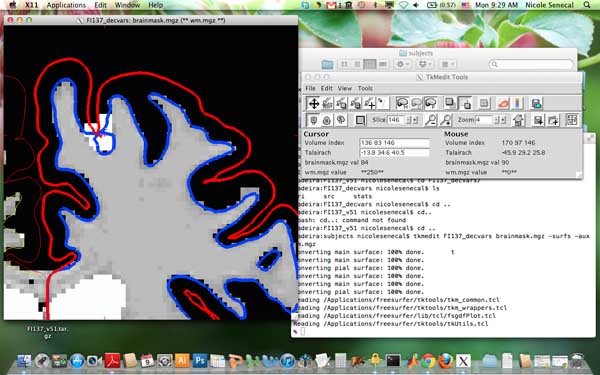
I've been having two variants of problems with wm.mgz, using version5.1. One can be seen in the attached screenshot FI137 - areas that are not white matter are designated as "white matter hypointensities" on wm.mgz, and create problems with both surfaces. This has happened in a number of our subjects, in multiple locations throughout each brain. Is this something we just need to delete manually on each subject, or is there a more efficient way to deal with this?
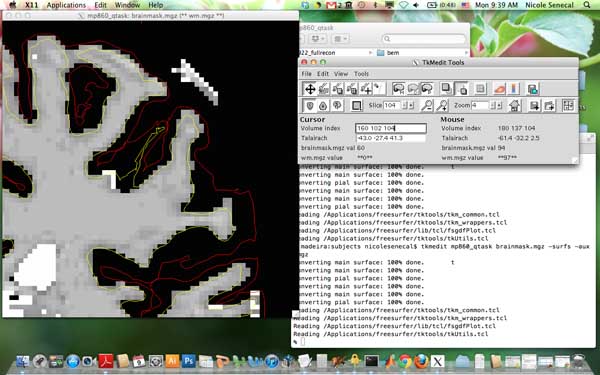
The second is seen in the screenshots of MP860 wm. An area that is not white matter, and is not designated as white matter on wm.mgz, is still created as a white matter surface. This hasn't happened as often as the above, but we don't know how to get rid of an inaccurate wm surface if it's not on wm.mgz.
Thanks for your help, Nicole

Hi Nicole
  what version are you running? It's hard to diagnose from just
  the images. In general, if the surface doesn't follow the wm.mgz
  it means there was a topological defect that was corrected in
  that region. You can find it and fix it be editing the wm. If
  you can't find it, upload it and send us the coords you are
  looking at and we'll find it and show you.

  cheers
  Bruce


  On Mon, 9 Jul 2012, Nicole Senecal wrote:

        Hi all,
        I've been having two variants of problems with
        wm.mgz, using version5.1. One
        can be seen in the attached screenshot FI137 - areas
        that are not white
        matter are designated as "white matter
        hypointensities" on wm.mgz, and
        create problems with both surfaces. This has
        happened in a number of our
        subjects, in multiple locations throughout each
        brain. Is this something we
        just need to delete manually on each subject, or is
        there a more efficient
        way to deal with this?

        The second is seen in the screenshots of MP860 wm.
        An area that is not white
        matter, and is not designated as white matter on
        wm.mgz, is still created as
        a white matter surface. This hasn't happened as
        often as the above, but we
        don't know how to get rid of an inaccurate wm
        surface if it's not on wm.mgz.

        Thanks for your help,
        Nicole


        --
        Nicole Senecal
        Neuroscience Graduate Group
        Kable Lab
        3720 Walnut St., Room C37
        Philadelphia, PA  19104
        Lab phone:  215-746-4371
Hi Bruce,
It's version 5.1. Thanks for the suggestion about the second problem (surface not following wm). For the white matter hypointensity problem (surface follows wm volume, but wm is incorrect; this occurs in several places on multiple subjects), will we just have to delete this manually from wm.mgz in every case? I can upload a recon with the problem if this would help.
thanks, Nicole
On Mon, Jul 9, 2012 at 1:39 PM, Bruce Fischl fischl@nmr.mgh.harvard.eduwrote:
Hi Nicole
what version are you running? It's hard to diagnose from just the images. In general, if the surface doesn't follow the wm.mgz it means there was a topological defect that was corrected in that region. You can find it and fix it be editing the wm. If you can't find it, upload it and send us the coords you are looking at and we'll find it and show you.
cheers Bruce
On Mon, 9 Jul 2012, Nicole Senecal wrote:
Hi all,
I've been having two variants of problems with wm.mgz, using version5.1. One can be seen in the attached screenshot FI137 - areas that are not white matter are designated as "white matter hypointensities" on wm.mgz, and create problems with both surfaces. This has happened in a number of our subjects, in multiple locations throughout each brain. Is this something we just need to delete manually on each subject, or is there a more efficient way to deal with this?
The second is seen in the screenshots of MP860 wm. An area that is not white matter, and is not designated as white matter on wm.mgz, is still created as a white matter surface. This hasn't happened as often as the above, but we don't know how to get rid of an inaccurate wm surface if it's not on wm.mgz.
Thanks for your help, Nicole
-- Nicole Senecal Neuroscience Graduate Group Kable Lab 3720 Walnut St., Room C37 Philadelphia, PA 19104 Lab phone: 215-746-4371
The information in this e-mail is intended only for the person to whom it is addressed. If you believe this e-mail was sent to you in error and the e-mail contains patient information, please contact the Partners Compliance HelpLine at http://www.partners.org/**compliancelinehttp://www.partners.org/complianceline. If the e-mail was sent to you in error but does not contain patient information, please contact the sender and properly dispose of the e-mail.
Hi Nicole
I saw this before and couldn't replicate it. Sure, upload an example and I'll take a look. Hopefully it is something that is resolved in 5.2.
Bruce
On Mon, 9 Jul 2012, Nicole Senecal wrote:
Hi Bruce, It's version 5.1. Thanks for the suggestion about the second problem (surface not following wm). For the white matter hypointensity problem (surface follows wm volume, but wm is incorrect; this occurs in several places on multiple subjects), will we just have to delete this manually from wm.mgz in every case? I can upload a recon with the problem if this would help.
thanks, Nicole
On Mon, Jul 9, 2012 at 1:39 PM, Bruce Fischl fischl@nmr.mgh.harvard.edu wrote: Hi Nicole
what version are you running? It's hard to diagnose from just the images. In general, if the surface doesn't follow the wm.mgz it means there was a topological defect that was corrected in that region. You can find it and fix it be editing the wm. If you can't find it, upload it and send us the coords you are looking at and we'll find it and show you. cheers Bruce On Mon, 9 Jul 2012, Nicole Senecal wrote: Hi all, I've been having two variants of problems with wm.mgz, using version5.1. One can be seen in the attached screenshot FI137 - areas that are not white matter are designated as "white matter hypointensities" on wm.mgz, and create problems with both surfaces. This has happened in a number of our subjects, in multiple locations throughout each brain. Is this something we just need to delete manually on each subject, or is there a more efficient way to deal with this? The second is seen in the screenshots of MP860 wm. An area that is not white matter, and is not designated as white matter on wm.mgz, is still created as a white matter surface. This hasn't happened as often as the above, but we don't know how to get rid of an inaccurate wm surface if it's not on wm.mgz. Thanks for your help, Nicole -- Nicole Senecal Neuroscience Graduate Group Kable Lab 3720 Walnut St., Room C37 Philadelphia, PA 19104 Lab phone: 215-746-4371The information in this e-mail is intended only for the person to whom it is addressed. If you believe this e-mail was sent to you in error and the e-mail contains patient information, please contact the Partners Compliance HelpLine at http://www.partners.org/complianceline . If the e-mail was sent to you in error but does not contain patient information, please contact the sender and properly dispose of the e-mail.
-- Nicole Senecal Neuroscience Graduate Group Kable Lab 3720 Walnut St., Room C37 Philadelphia, PA 19104 Lab phone: 215-746-4371
freesurfer@nmr.mgh.harvard.edu
-
 Bruce Fischl
 -
 Nicole Senecal