
Hello FreeSurfers,
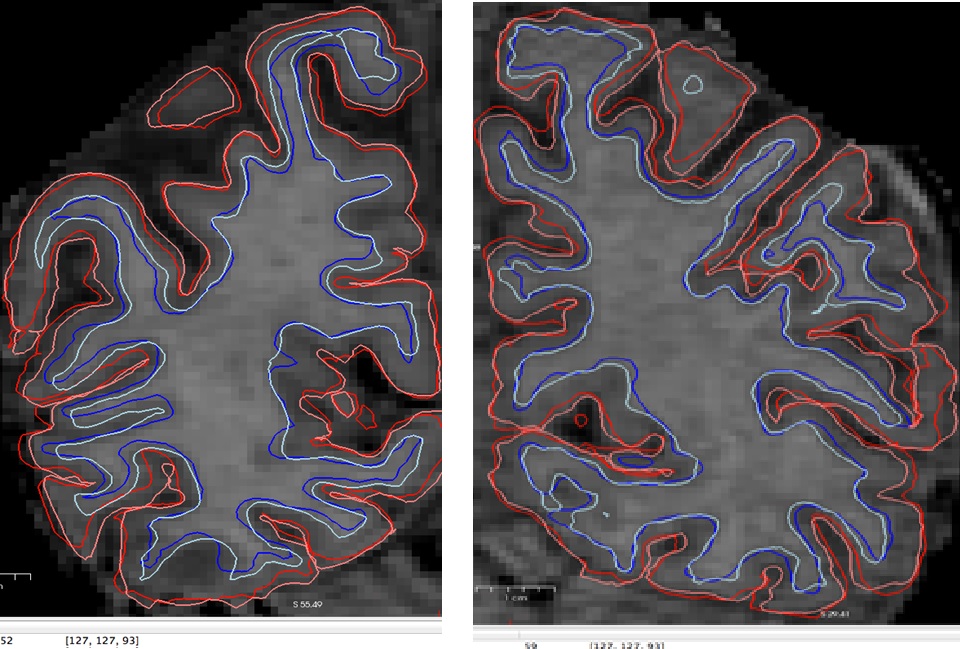
My lab has been using the longitudinal processing stream for our data set and seem to be getting some potentially troublesome results. The attached images present a snap shot of the issues we are encountering.
As you can see in the left image, there seems to be some kind of shifting going on. However, when you view each individual T1 with their corresponding boundary maps they look spot on. My question is whether or not this will have any major implication when we are trying to do a longitudinal analysis of cortical thickness?
The more troublesome issue which is shown on the right is an overall "messiness" that seems to occur in some scans. When looking back at the template and the original FreeSurfer images there doesn't appear to be any issue. It's only when the longitudinal image is constructed that there seems to be some exaggerated blur as well as some over inclusions of dura (this isn't shown in the image but has happened in a handful of our subjects).
Has anyone else experienced these kinds of issues? Only a quarter of our subjects that look as good "quality wise" as the examples posted on your wiki.
Thanks,
Seth Hutton ********************************************************** Electronic Mail is not secure, may not be read every day, and should not be used for urgent or sensitive issues

Hi Seth,
I assume the image you send shows the surfaces of the two time point taken from the *.long.baseid directories (and not from the cross sectionally processed directories)? There are many reasons why surfaces are different across time points. Some include - motion artifacts in one time point, not (or less) in the other, or other acquisition problems and non-linearities - real atrophy - misalignment in the base step (this is pretty rare, but you can check the registration by switching/blending between the time points after registration, from the .long. directories). If there is a visible global shift or rotation, it may make sense to play around with the robust_template command in the base to see if a better alignment is possible, or if there are non-linearities causing the problems.
You say that when looking at individual images with surfaces, they look spot on. That means that surfaces are created correctly, but for some reason your images are different.
Images in the longitudinal stream should not be much more blurry as in the cross stream. They do get interpolated to the base space, but this is done in a single step together with the conforming. So in most cases, there is no additional interpolation (unless images are already conformed before, then there is a second interpolation step that could introduce some blurring - although I think I use cubic interpolation for that, so it should be minimal). Take a look at the surfaces in the base (subject template) they need to be accurate there. If they include dura, edit the base.
Best, Martin
On 02/16/2016 09:29 AM, Hutton, Seth wrote:
Hello FreeSurfers,
My lab has been using the longitudinal processing stream for ourdata set and seem to be getting some potentially troublesome results. The attached images present a snap shot of the issues we are encountering.
As you can see in the left image, there seems to be some kind of shifting going on. However, when you view each individual T1 with their corresponding boundary maps they look spot on. My question is whether or not this will have any major implication when we are trying to do a longitudinal analysis of cortical thickness?
The more troublesome issue which is shown on the right is an overall "messiness" that seems to occur in some scans. When looking back at the template and the original FreeSurfer images there doesn't appear to be any issue. It's only when the longitudinal image is constructed that there seems to be some exaggerated blur as well as some over inclusions of dura (this isn't shown in the image but has happened in a handful of our subjects).
Has anyone else experienced these kinds of issues? Only a quarter of our subjects that look as good "quality wise" as the examples posted on your wiki.
Thanks,
Seth Hutton
Electronic Mail is not secure, may not be read every day, and should not be used for urgent or sensitive issues
Freesurfer mailing list Freesurfer@nmr.mgh.harvard.edu https://mail.nmr.mgh.harvard.edu/mailman/listinfo/freesurfer
freesurfer@nmr.mgh.harvard.edu
-
 Hutton, Seth
 -
 Martin Reuter