
Hello Freesurfer community,
I am looking for a way to automatically generate a surface label file of a specific dimension (e.g. a circle with a specific diameter, or a square), given a specific vertex and some measure of the desired size.
I have considered to do so by starting with a label file consisting of a single vertex, and then expanding this label with the mri_label2label tool, using the --dilate option. I wanted to know though if anyone has any better suggestions.
Thank you, Martha

Hi Martha,
A brute force but simple way to do this is to use the list of labels contained in subjects/nnn/label/lh.cortex and rh.cortex. Given a vertex x,y,z, go through the file and select the lines for which the distance to x,y,z <= 2 mm. This will give you a bunch of labels for points within a circle with 2 mm radius about x,y,z. And all of them will be on the “white” surface. If your vertex is on a different surface, e.g. pia, or you want a different geometry, e.g. square, there’s likely a simple variant which will work.
In my experience mri_label2label –dilate takes a lot of time and I’m not sure you can restrict it to give you points on the surface that you want. I think it gives you a new surface which is displaced by a fixed distance from the one where you start.
I hope this is helpful.
Best - Don
From: freesurfer-bounces@nmr.mgh.harvard.edu [mailto:freesurfer-bounces@nmr.mgh.harvard.edu] On Behalf Of Martha Shiell Sent: Saturday, February 13, 2016 12:59 PM To: freesurfer@nmr.mgh.harvard.edu Subject: [Freesurfer] Freesurfer tool to automatically generate label surrounding a given vertex?
Hello Freesurfer community,
I am looking for a way to automatically generate a surface label file of a specific dimension (e.g. a circle with a specific diameter, or a square), given a specific vertex and some measure of the desired size.
I have considered to do so by starting with a label file consisting of a single vertex, and then expanding this label with the mri_label2label tool, using the --dilate option. I wanted to know though if anyone has any better suggestions.
Thank you, Martha
-- Martha M. Shiell, PhD

Hi Don
I think label2label --dilate does a morphological dilation on the surface, not a new surface. It is also independent of distance - it just uses topology - so your approach will be better if you truly want a circle (although of course if the surface is highly curved then the metric won't be quite right)
cheers Bruce On Sat, 13 Feb 2016, Krieger, Donald N. wrote:
Hi Martha,
A brute force but simple way to do this is to use the list of labels contained in subjects/nnn/label/lh.cortex and rh.cortex.
Given a vertex x,y,z, go through the file and select the lines for which the distance to x,y,z <= 2 mm. This will give you a bunch of labels for points within a circle with 2 mm radius about x,y,z. And all of them will be on the “white” surface. If your vertex is on a different surface, e.g. pia, or you want a different geometry, e.g. square, there’s likely a simple variant which will work.
In my experience mri_label2label –dilate takes a lot of time and I’m not sure you can restrict it to give you points on the surface that you want. I think it gives you a new surface which is displaced by a fixed distance from the one where you start.
I hope this is helpful.
Best - Don
From: freesurfer-bounces@nmr.mgh.harvard.edu [mailto:freesurfer-bounces@nmr.mgh.harvard.edu] On Behalf Of Martha Shiell Sent: Saturday, February 13, 2016 12:59 PM To: freesurfer@nmr.mgh.harvard.edu Subject: [Freesurfer] Freesurfer tool to automatically generate label surrounding a given vertex?
Hello Freesurfer community,
I am looking for a way to automatically generate a surface label file of a specific dimension (e.g. a circle with a specific diameter, or a square), given a specific vertex and some measure of the desired size.
I have considered to do so by starting with a label file consisting of a single vertex, and then expanding this label with the mri_label2label tool, using the --dilate option. I wanted to know though if anyone has any better suggestions.
Thank you,
Martha
--
Martha M. Shiell, PhD
Thanks for posting back about this, Bruce. I am thinking about a different function which probably is not called --dilate. One specifies a surface, e.g. white, and gets back a new surface displaced by the distance you specify whose tangent is parallel to the tangent of the starting surface at the nearest point.
-----Original Message----- From: freesurfer-bounces@nmr.mgh.harvard.edu [mailto:freesurfer- bounces@nmr.mgh.harvard.edu] On Behalf Of Bruce Fischl Sent: Saturday, February 13, 2016 1:44 PM To: Freesurfer support list Subject: Re: [Freesurfer] Freesurfer tool to automatically generate label surrounding a given vertex?
Hi Don
I think label2label --dilate does a morphological dilation on the surface, not a new surface. It is also independent of distance - it just uses topology - so your approach will be better if you truly want a circle (although of course if the surface is highly curved then the metric won't be quite right)
cheers Bruce On Sat, 13 Feb 2016, Krieger, Donald N. wrote:
Hi Martha,
A brute force but simple way to do this is to use the list of labels contained in subjects/nnn/label/lh.cortex and rh.cortex.
Given a vertex x,y,z, go through the file and select the lines for which the distance to x,y,z <= 2 mm. This will give you a bunch of labels for points within a circle with 2 mm radius about x,y,z. And all of them will be on the “white” surface. If your vertex is on a different surface, e.g. pia, or you want a different geometry, e.g. square, there’s likely a simple variant which will work.
In my experience mri_label2label –dilate takes a lot of time and I’m not sure you can restrict it to give you points on the surface that you want. I think it gives you a new surface which is displaced by a fixed distance from the one where you start.
I hope this is helpful.
Best - Don
From: freesurfer-bounces@nmr.mgh.harvard.edu [mailto:freesurfer-bounces@nmr.mgh.harvard.edu] On Behalf Of Martha Shiell Sent: Saturday, February 13, 2016 12:59 PM To: freesurfer@nmr.mgh.harvard.edu Subject: [Freesurfer] Freesurfer tool to automatically generate label surrounding a given vertex?
Hello Freesurfer community,
I am looking for a way to automatically generate a surface label file of a specific dimension (e.g. a circle with a specific diameter, or a square), given a specific vertex and some measure of the desired size.
I have considered to do so by starting with a label file consisting of a single vertex, and then expanding this label with the mri_label2label tool, using the --dilate option. I wanted to know though if anyone has any better suggestions.
Thank you,
Martha
--
Martha M. Shiell, PhD
mris_expand probably On Sat, 13 Feb 2016, Krieger, Donald N. wrote:
Thanks for posting back about this, Bruce. I am thinking about a different function which probably is not called --dilate. One specifies a surface, e.g. white, and gets back a new surface displaced by the distance you specify whose tangent is parallel to the tangent of the starting surface at the nearest point.
-----Original Message----- From: freesurfer-bounces@nmr.mgh.harvard.edu [mailto:freesurfer- bounces@nmr.mgh.harvard.edu] On Behalf Of Bruce Fischl Sent: Saturday, February 13, 2016 1:44 PM To: Freesurfer support list Subject: Re: [Freesurfer] Freesurfer tool to automatically generate label surrounding a given vertex?
Hi Don
I think label2label --dilate does a morphological dilation on the surface, not a new surface. It is also independent of distance - it just uses topology - so your approach will be better if you truly want a circle (although of course if the surface is highly curved then the metric won't be quite right)
cheers Bruce On Sat, 13 Feb 2016, Krieger, Donald N. wrote:
Hi Martha,
A brute force but simple way to do this is to use the list of labels contained in subjects/nnn/label/lh.cortex and rh.cortex.
Given a vertex x,y,z, go through the file and select the lines for which the distance to x,y,z <= 2 mm. This will give you a bunch of labels for points within a circle with 2 mm radius about x,y,z. And all of them will be on the “white” surface. If your vertex is on a different surface, e.g. pia, or you want a different geometry, e.g. square, there’s likely a simple variant which will work.
In my experience mri_label2label –dilate takes a lot of time and I’m not sure you can restrict it to give you points on the surface that you want. I think it gives you a new surface which is displaced by a fixed distance from the one where you start.
I hope this is helpful.
Best - Don
From: freesurfer-bounces@nmr.mgh.harvard.edu [mailto:freesurfer-bounces@nmr.mgh.harvard.edu] On Behalf Of Martha Shiell Sent: Saturday, February 13, 2016 12:59 PM To: freesurfer@nmr.mgh.harvard.edu Subject: [Freesurfer] Freesurfer tool to automatically generate label surrounding a given vertex?
Hello Freesurfer community,
I am looking for a way to automatically generate a surface label file of a specific dimension (e.g. a circle with a specific diameter, or a square), given a specific vertex and some measure of the desired size.
I have considered to do so by starting with a label file consisting of a single vertex, and then expanding this label with the mri_label2label tool, using the --dilate option. I wanted to know though if anyone has any better suggestions.
Thank you,
Martha
--
Martha M. Shiell, PhD
Freesurfer mailing list Freesurfer@nmr.mgh.harvard.edu https://mail.nmr.mgh.harvard.edu/mailman/listinfo/freesurfer
Yes, thanks ... from my notes: This command contracts the selected surface vectors 3.0 mm and places the resultant new surface file in surf/lh.white-3: mris_expand lh.white -3.0 lh.white-3
Best regards, Don
-----Original Message----- From: freesurfer-bounces@nmr.mgh.harvard.edu [mailto:freesurfer- bounces@nmr.mgh.harvard.edu] On Behalf Of Bruce Fischl Sent: Saturday, February 13, 2016 2:37 PM To: Freesurfer support list Subject: Re: [Freesurfer] Freesurfer tool to automatically generate label surrounding a given vertex?
mris_expand probably On Sat, 13 Feb 2016, Krieger, Donald N. wrote:
Thanks for posting back about this, Bruce. I am thinking about a different function which probably is not called --dilate. One specifies a surface, e.g. white, and gets back a new surface displaced by
the distance you specify whose tangent is parallel to the tangent of the starting surface at the nearest point.
-----Original Message----- From: freesurfer-bounces@nmr.mgh.harvard.edu [mailto:freesurfer- bounces@nmr.mgh.harvard.edu] On Behalf Of Bruce Fischl Sent: Saturday, February 13, 2016 1:44 PM To: Freesurfer support list Subject: Re: [Freesurfer] Freesurfer tool to automatically generate label surrounding a given vertex?
Hi Don
I think label2label --dilate does a morphological dilation on the surface, not a new surface. It is also independent of distance - it just uses topology - so your approach will be better if you truly want a circle (although of course if the surface is highly curved then the metric won't be quite right)
cheers Bruce On Sat, 13 Feb 2016, Krieger, Donald N. wrote:
Hi Martha,
A brute force but simple way to do this is to use the list of labels contained in subjects/nnn/label/lh.cortex and rh.cortex.
Given a vertex x,y,z, go through the file and select the lines for which the distance to x,y,z <= 2 mm. This will give you a bunch of labels for points within a circle with 2 mm radius about x,y,z. And all of them will be on the “white” surface. If your vertex is on a different surface, e.g. pia, or you want a different geometry, e.g. square, there’s likely a simple variant which will work.
In my experience mri_label2label –dilate takes a lot of time and I’m not sure you can restrict it to give you points on the surface that you want. I think it gives you a new surface which is displaced by a fixed distance from the one where you start.
I hope this is helpful.
Best - Don
From: freesurfer-bounces@nmr.mgh.harvard.edu [mailto:freesurfer-bounces@nmr.mgh.harvard.edu] On Behalf Of Martha Shiell Sent: Saturday, February 13, 2016 12:59 PM To: freesurfer@nmr.mgh.harvard.edu Subject: [Freesurfer] Freesurfer tool to automatically generate label surrounding a given vertex?
Hello Freesurfer community,
I am looking for a way to automatically generate a surface label file of a specific dimension (e.g. a circle with a specific diameter, or a square), given a specific vertex and some measure of the
desired size.
I have considered to do so by starting with a label file consisting of a single vertex, and then expanding this label with the mri_label2label tool, using the --dilate option. I wanted to know though if anyone has any better suggestions.
Thank you,
Martha
--
Martha M. Shiell, PhD
Freesurfer mailing list Freesurfer@nmr.mgh.harvard.edu https://mail.nmr.mgh.harvard.edu/mailman/listinfo/freesurfer

Dear Freesurfer experts, I have a question about eTIV (FS 5.3) which I use as a covariate where appropriate. Is it in some way influenced by the presence of brain atrophy? I have a new sample of subjects in a longitudinal study: at time 1 they have some atrophy (due to low body weight) that improves in time 2 (4 months). I observed that eTIV-time1 is slightly correlated with weight (r=0.3) whereas no correlation is present at time 2. The correlation between eTIV-time1 and eTIV-time2 is somewhat lower than expected (r=0.53) and is lower than correlation between SegBrain_Vol_1 and SegBrain_Vol_2 (0.65).
Do you suggest in these cases to perform manual segmentation to obtain TIV? or is there any other method (in freesurfer) to obtain an estimate of TIV not influenced by brain atrophy? What about using BrainMask_to_TIV?
Thank you for any suggestion
Angela
Hi all, I would be very grateful of any advice for the problem below with e-TIV.
I have another problem with the longitudinal streaming (it is the first time I use it). I am running the .base and .long procedure in subjects with only one measure to include them in a mixed liner model analysis (as suggested in the wiki). I run the following commands:
recon-all -base template100 -tp subj025 -all
recon-all -long subj025 template100 -all
However at the second command line an error occur (attached is the log):
BEGIN failed--compilation aborted at /Applications/freesurfer/mni/bin/nu_correct line 37. ERROR: nu_correct Darwin iMac-di-Angela.local 11.4.2 Darwin Kernel Version 11.4.2: Thu Aug 23 16:25:48 PDT 2012; root:xnu-1699.32.7~1/RELEASE_X86_64 x86_64
recon-all -s subj025.long.template100 exited with ERRORS
Which is my mistake? I looked for a solution in the mailing list, but I did not find an answer. Thank you for any help!
Angela
Dear Freesurfer experts, I have a question about eTIV (FS 5.3) which I use as a covariate where appropriate. Is it in some way influenced by the presence of brain atrophy? I have a new sample of subjects in a longitudinal study: at time 1 they have some atrophy (due to low body weight) that improves in time 2 (4 months). I observed that eTIV-time1 is slightly correlated with weight (r=0.3) whereas no correlation is present at time 2. The correlation between eTIV-time1 and eTIV-time2 is somewhat lower than expected (r=0.53) and is lower than correlation between SegBrain_Vol_1 and SegBrain_Vol_2 (0.65).
Do you suggest in these cases to perform manual segmentation to obtain TIV? or is there any other method (in freesurfer) to obtain an estimate of TIV not influenced by brain atrophy? What about using BrainMask_to_TIV?
Thank you for any suggestion
Angela
Freesurfer mailing list Freesurfer@nmr.mgh.harvard.edu https://mail.nmr.mgh.harvard.edu/mailman/listinfo/freesurfer
The information in this e-mail is intended only for the person to whom it is addressed. If you believe this e-mail was sent to you in error and the e-mail contains patient information, please contact the Partners Compliance HelpLine at http://www.partners.org/complianceline . If the e-mail was sent to you in error but does not contain patient information, please contact the sender and properly dispose of the e-mail.

Hi Angela,
this does not seem to be related to longitudinal processing, your commands are OK. For some reason the nu_correct crashes (I changed the subject line). I don't know what causes that, maybe someone else has an idea. You have enough disk space?
I copy the part from the log here:
Iteration 1 Thu Feb 18 14:07:56 CET 2016 nu_correct -clobber ./tmp.mri_nu_correct.mni.56783/nu0.mnc ./tmp.mri_nu_correct.mni.56783/nu1.mnc -tmpdir ./tmp.mri_nu_correct.mni.56783/0/ Can't locate MNI/Startup.pm in @INC (@INC contains: /Applications/freesurfer/mni /Library/Perl/5.12/darwin-thread-multi-2level /Library/Perl/5.12 /Network/Library/Perl/5.12/darwin-thread-multi-2level /Network/Library/Perl/5.12 /Library/Perl/Updates/5.12.3 /System/Library/Perl/5.12/darwin-thread-multi-2level /System/Library/Perl/5.12 /System/Library/Perl/Extras/5.12/darwin-thread-multi-2level /System/Library/Perl/Extras/5.12 .) at /Applications/freesurfer/mni/bin/nu_correct line 37. BEGIN failed--compilation aborted at /Applications/freesurfer/mni/bin/nu_correct line 37. ERROR: nu_correct Darwin iMac-di-Angela.local 11.4.2 Darwin Kernel Version 11.4.2: Thu Aug 23 16:25:48 PDT 2012; root:xnu-1699.32.7~1/RELEASE_X86_64 x86_64 recon-all -s subj025.long.template100 exited with ERRORS at Thu Feb 18 14:07:56 CET 2016
Best, Martin
On 02/18/2016 08:11 AM, angela.favaro@unipd.it wrote:
Hi all, I would be very grateful of any advice for the problem below with e-TIV.
I have another problem with the longitudinal streaming (it is the first time I use it). I am running the .base and .long procedure in subjects with only one measure to include them in a mixed liner model analysis (as suggested in the wiki). I run the following commands:
recon-all -base template100 -tp subj025 -all
recon-all -long subj025 template100 -all
However at the second command line an error occur (attached is the log):
BEGIN failed--compilation aborted at /Applications/freesurfer/mni/bin/nu_correct line 37. ERROR: nu_correct Darwin iMac-di-Angela.local 11.4.2 Darwin Kernel Version 11.4.2: Thu Aug 23 16:25:48 PDT 2012; root:xnu-1699.32.7~1/RELEASE_X86_64 x86_64
recon-all -s subj025.long.template100 exited with ERRORS
Which is my mistake? I looked for a solution in the mailing list, but I did not find an answer. Thank you for any help!
Angela
Dear Freesurfer experts, I have a question about eTIV (FS 5.3) which I use as a covariate where appropriate. Is it in some way influenced by the presence of brain atrophy? I have a new sample of subjects in a longitudinal study: at time 1 they have some atrophy (due to low body weight) that improves in time 2 (4 months). I observed that eTIV-time1 is slightly correlated with weight (r=0.3) whereas no correlation is present at time 2. The correlation between eTIV-time1 and eTIV-time2 is somewhat lower than expected (r=0.53) and is lower than correlation between SegBrain_Vol_1 and SegBrain_Vol_2 (0.65).
Do you suggest in these cases to perform manual segmentation to obtain TIV? or is there any other method (in freesurfer) to obtain an estimate of TIV not influenced by brain atrophy? What about using BrainMask_to_TIV?
Thank you for any suggestion
Angela
Freesurfer mailing list Freesurfer@nmr.mgh.harvard.edu https://mail.nmr.mgh.harvard.edu/mailman/listinfo/freesurfer
The information in this e-mail is intended only for the person to whom it is addressed. If you believe this e-mail was sent to you in error and the e-mail contains patient information, please contact the Partners Compliance HelpLine at http://www.partners.org/complianceline . If the e-mail was sent to you in error but does not contain patient information, please contact the sender and properly dispose of the e-mail.
Freesurfer mailing list Freesurfer@nmr.mgh.harvard.edu https://mail.nmr.mgh.harvard.edu/mailman/listinfo/freesurfer
Hi Angel
the time1/time2 correlation of eTIV is pretty worrisome. Are you sure that there aren't outliers/failures in that set?
Bruce
On Sun, 14 Feb 2016, angela.favaro@unipd.it wrote:
Dear Freesurfer experts, I have a question about eTIV (FS 5.3) which I use as a covariate where appropriate. Is it in some way influenced by the presence of brain atrophy? I have a new sample of subjects in a longitudinal study: at time 1 they have some atrophy (due to low body weight) that improves in time 2 (4 months). I observed that eTIV-time1 is slightly correlated with weight (r=0.3) whereas no correlation is present at time 2. The correlation between eTIV-time1 and eTIV-time2 is somewhat lower than expected (r=0.53) and is lower than correlation between SegBrain_Vol_1 and SegBrain_Vol_2 (0.65).
Do you suggest in these cases to perform manual segmentation to obtain TIV? or is there any other method (in freesurfer) to obtain an estimate of TIV not influenced by brain atrophy? What about using BrainMask_to_TIV?
Thank you for any suggestion
Angela
Freesurfer mailing list Freesurfer@nmr.mgh.harvard.edu https://mail.nmr.mgh.harvard.edu/mailman/listinfo/freesurfer
Hi Bruce, please find attached the graph of the correlation between the two time point. I did not find outliers or failures. However the discrepancy between TIVs is particularly high in few cases. Obviously these data are those before running longitudinal streaming This is a sample of adolescents with low body weight (anorexia nervosa). In my previous study (on young adults with low weight) I found no correlation between TIV and body weight and high correlations between fs estimated TIV and manually segmented TIV (r=0.94 in the whole sample and r=0.93 in the underweight sample (n=38)). Do you think that the young age can be a factor? or patients who are more acutely underweight? Thank you for any suggestion
Angela
Bruce Fischl fischl@nmr.mgh.harvard.edu ha scritto:
Hi Angel
the time1/time2 correlation of eTIV is pretty worrisome. Are you sure that there aren't outliers/failures in that set?
Bruce
On Sun, 14 Feb 2016, angela.favaro@unipd.it wrote:
Dear Freesurfer experts, I have a question about eTIV (FS 5.3) which I use as a covariate where appropriate. Is it in some way influenced by the presence of brain atrophy? I have a new sample of subjects in a longitudinal study: at time 1 they have some atrophy (due to low body weight) that improves in time 2 (4 months). I observed that eTIV-time1 is slightly correlated with weight (r=0.3) whereas no correlation is present at time 2. The correlation between eTIV-time1 and eTIV-time2 is somewhat lower than expected (r=0.53) and is lower than correlation between SegBrain_Vol_1 and SegBrain_Vol_2 (0.65).
Do you suggest in these cases to perform manual segmentation to obtain TIV? or is there any other method (in freesurfer) to obtain an estimate of TIV not influenced by brain atrophy? What about using BrainMask_to_TIV?
Thank you for any suggestion
Angela
Freesurfer mailing list Freesurfer@nmr.mgh.harvard.edu https://mail.nmr.mgh.harvard.edu/mailman/listinfo/freesurfer
Freesurfer mailing list Freesurfer@nmr.mgh.harvard.edu https://mail.nmr.mgh.harvard.edu/mailman/listinfo/freesurfer
The information in this e-mail is intended only for the person to whom it is addressed. If you believe this e-mail was sent to you in error and the e-mail contains patient information, please contact the Partners Compliance HelpLine at http://www.partners.org/complianceline . If the e-mail was sent to you in error but does not contain patient information, please contact the sender and properly dispose of the e-mail.
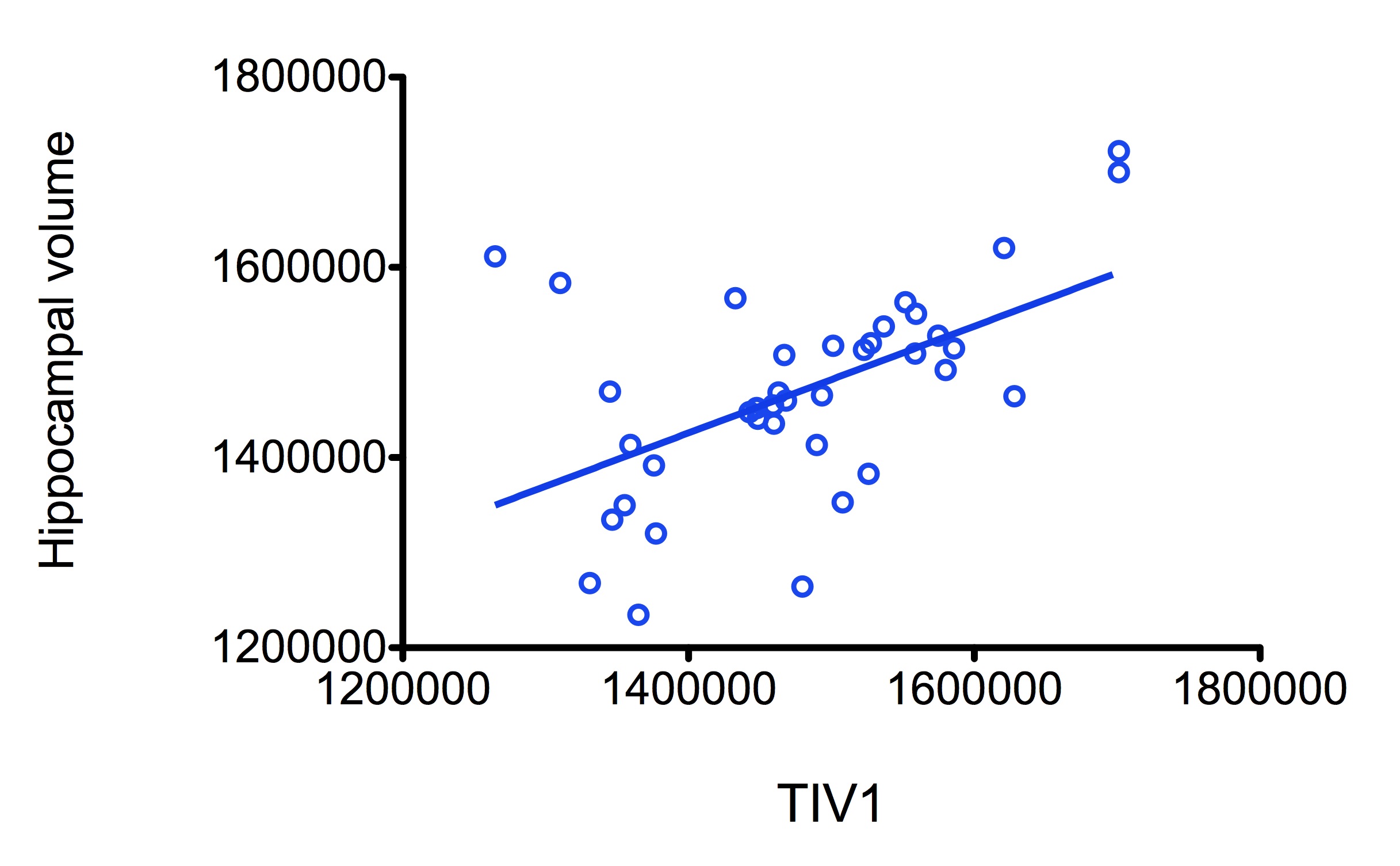
there is a mistake in the graph, hippocampal volume is TIV2 I apologize for that!
Angela Favaro angela.favaro@unipd.it ha scritto:
Hi Bruce, please find attached the graph of the correlation between the two time point. I did not find outliers or failures. However the discrepancy between TIVs is particularly high in few cases. Obviously these data are those before running longitudinal streaming This is a sample of adolescents with low body weight (anorexia nervosa). In my previous study (on young adults with low weight) I found no correlation between TIV and body weight and high correlations between fs estimated TIV and manually segmented TIV (r=0.94 in the whole sample and r=0.93 in the underweight sample (n=38)). Do you think that the young age can be a factor? or patients who are more acutely underweight? Thank you for any suggestion
Angela
Bruce Fischl fischl@nmr.mgh.harvard.edu ha scritto:
Hi Angel
the time1/time2 correlation of eTIV is pretty worrisome. Are you sure that there aren't outliers/failures in that set?
Bruce
On Sun, 14 Feb 2016, angela.favaro@unipd.it wrote:
Dear Freesurfer experts, I have a question about eTIV (FS 5.3) which I use as a covariate where appropriate. Is it in some way influenced by the presence of brain atrophy? I have a new sample of subjects in a longitudinal study: at time 1 they have some atrophy (due to low body weight) that improves in time 2 (4 months). I observed that eTIV-time1 is slightly correlated with weight (r=0.3) whereas no correlation is present at time 2. The correlation between eTIV-time1 and eTIV-time2 is somewhat lower than expected (r=0.53) and is lower than correlation between SegBrain_Vol_1 and SegBrain_Vol_2 (0.65).
Do you suggest in these cases to perform manual segmentation to obtain TIV? or is there any other method (in freesurfer) to obtain an estimate of TIV not influenced by brain atrophy? What about using BrainMask_to_TIV?
Thank you for any suggestion
Angela
Freesurfer mailing list Freesurfer@nmr.mgh.harvard.edu https://mail.nmr.mgh.harvard.edu/mailman/listinfo/freesurfer
Freesurfer mailing list Freesurfer@nmr.mgh.harvard.edu https://mail.nmr.mgh.harvard.edu/mailman/listinfo/freesurfer
The information in this e-mail is intended only for the person to whom it is addressed. If you believe this e-mail was sent to you in error and the e-mail contains patient information, please contact the Partners Compliance HelpLine at http://www.partners.org/complianceline . If the e-mail was sent to you in error but does not contain patient information, please contact the sender and properly dispose of the e-mail.

Hi, Why not use a measurement of brain size rather than “eTIV”?
cheers, -MH
-- Michael Harms, Ph.D.
----------------------------------------------------------- Conte Center for the Neuroscience of Mental Disorders Washington University School of Medicine Department of Psychiatry, Box 8134 660 South Euclid Ave.Tel: 314-747-6173 St. Louis, MO 63110Email: mharms@wustl.edu
On 2/21/16, 6:06 AM, "freesurfer-bounces@nmr.mgh.harvard.edu on behalf of Angela Favaro" <freesurfer-bounces@nmr.mgh.harvard.edu on behalf of angela.favaro@unipd.it> wrote:
there is a mistake in the graph, hippocampal volume is TIV2 I apologize for that!
Angela Favaro angela.favaro@unipd.it ha scritto:
Hi Bruce, please find attached the graph of the correlation between the two time point. I did not find outliers or failures. However the discrepancy between TIVs is particularly high in few cases. Obviously these data are those before running longitudinal streaming This is a sample of adolescents with low body weight (anorexia nervosa). In my previous study (on young adults with low weight) I found no correlation between TIV and body weight and high correlations between fs estimated TIV and manually segmented TIV (r=0.94 in the whole sample and r=0.93 in the underweight sample (n=38)). Do you think that the young age can be a factor? or patients who are more acutely underweight? Thank you for any suggestion
Angela
Bruce Fischl fischl@nmr.mgh.harvard.edu ha scritto:
Hi Angel
the time1/time2 correlation of eTIV is pretty worrisome. Are you sure that there aren't outliers/failures in that set?
Bruce
On Sun, 14 Feb 2016, angela.favaro@unipd.it wrote:
Dear Freesurfer experts, I have a question about eTIV (FS 5.3) which I use as a covariate where appropriate. Is it in some way influenced by the presence of brain atrophy? I have a new sample of subjects in a longitudinal study: at time 1 they have some atrophy (due to low body weight) that improves in time 2 (4 months). I observed that eTIV-time1 is slightly correlated with weight (r=0.3) whereas no correlation is present at time 2. The correlation between eTIV-time1 and eTIV-time2 is somewhat lower than expected (r=0.53) and is lower than correlation between SegBrain_Vol_1 and SegBrain_Vol_2 (0.65).
Do you suggest in these cases to perform manual segmentation to obtain TIV? or is there any other method (in freesurfer) to obtain an estimate of TIV not influenced by brain atrophy? What about using BrainMask_to_TIV?
Thank you for any suggestion
Angela
Freesurfer mailing list Freesurfer@nmr.mgh.harvard.edu https://mail.nmr.mgh.harvard.edu/mailman/listinfo/freesurfer
Freesurfer mailing list Freesurfer@nmr.mgh.harvard.edu https://mail.nmr.mgh.harvard.edu/mailman/listinfo/freesurfer
The information in this e-mail is intended only for the person to whom it is addressed. If you believe this e-mail was sent to you in error and the e-mail contains patient information, please contact the Partners Compliance HelpLine at http://www.partners.org/complianceline . If the e-mail was sent to you in error but does not contain patient information, please contact the sender and properly dispose of the e-mail.
_______________________________________________ Freesurfer mailing list Freesurfer@nmr.mgh.harvard.edu https://mail.nmr.mgh.harvard.edu/mailman/listinfo/freesurfer
________________________________ The materials in this message are private and may contain Protected Healthcare Information or other information of a sensitive nature. If you are not the intended recipient, be advised that any unauthorized use, disclosure, copying or the taking of any action in reliance on the contents of this information is strictly prohibited. If you have received this email in error, please immediately notify the sender via telephone or return mail.
Hi, thank you I think this would test something different: 'how much a brain area is atrophic controlling for the average brain atrophy' and not 'how much a brain area is atrophic controlling for the individual differences in head size'. Doesn't it?
Angela
"Harms, Michael" mharms@wustl.edu ha scritto:
Hi, Why not use a measurement of brain size rather than “eTIV”?
cheers, -MH
-- Michael Harms, Ph.D.
Conte Center for the Neuroscience of Mental Disorders Washington University School of Medicine Department of Psychiatry, Box 8134 660 South Euclid Ave.Tel: 314-747-6173 St. Louis, MO 63110Email: mharms@wustl.edu
On 2/21/16, 6:06 AM, "freesurfer-bounces@nmr.mgh.harvard.edu on behalf of Angela Favaro" <freesurfer-bounces@nmr.mgh.harvard.edu on behalf of angela.favaro@unipd.it> wrote:
there is a mistake in the graph, hippocampal volume is TIV2 I apologize for that!
Angela Favaro angela.favaro@unipd.it ha scritto:
Hi Bruce, please find attached the graph of the correlation between the two time point. I did not find outliers or failures. However the discrepancy between TIVs is particularly high in few cases. Obviously these data are those before running longitudinal streaming This is a sample of adolescents with low body weight (anorexia nervosa). In my previous study (on young adults with low weight) I found no correlation between TIV and body weight and high correlations between fs estimated TIV and manually segmented TIV (r=0.94 in the whole sample and r=0.93 in the underweight sample (n=38)). Do you think that the young age can be a factor? or patients who are more acutely underweight? Thank you for any suggestion
Angela
Bruce Fischl fischl@nmr.mgh.harvard.edu ha scritto:
Hi Angel
the time1/time2 correlation of eTIV is pretty worrisome. Are you sure that there aren't outliers/failures in that set?
Bruce
On Sun, 14 Feb 2016, angela.favaro@unipd.it wrote:
Dear Freesurfer experts, I have a question about eTIV (FS 5.3) which I use as a covariate where appropriate. Is it in some way influenced by the presence of brain atrophy? I have a new sample of subjects in a longitudinal study: at time 1 they have some atrophy (due to low body weight) that improves in time 2 (4 months). I observed that eTIV-time1 is slightly correlated with weight (r=0.3) whereas no correlation is present at time 2. The correlation between eTIV-time1 and eTIV-time2 is somewhat lower than expected (r=0.53) and is lower than correlation between SegBrain_Vol_1 and SegBrain_Vol_2 (0.65).
Do you suggest in these cases to perform manual segmentation to obtain TIV? or is there any other method (in freesurfer) to obtain an estimate of TIV not influenced by brain atrophy? What about using BrainMask_to_TIV?
Thank you for any suggestion
Angela
Freesurfer mailing list Freesurfer@nmr.mgh.harvard.edu https://mail.nmr.mgh.harvard.edu/mailman/listinfo/freesurfer
Freesurfer mailing list Freesurfer@nmr.mgh.harvard.edu https://mail.nmr.mgh.harvard.edu/mailman/listinfo/freesurfer
The information in this e-mail is intended only for the person to whom it is addressed. If you believe this e-mail was sent to you in error and the e-mail contains patient information, please contact the Partners Compliance HelpLine at http://www.partners.org/complianceline . If the e-mail was sent to you in error but does not contain patient information, please contact the sender and properly dispose of the e-mail.
Freesurfer mailing list Freesurfer@nmr.mgh.harvard.edu https://mail.nmr.mgh.harvard.edu/mailman/listinfo/freesurfer
The materials in this message are private and may contain Protected Healthcare Information or other information of a sensitive nature. If you are not the intended recipient, be advised that any unauthorized use, disclosure, copying or the taking of any action in reliance on the contents of this information is strictly prohibited. If you have received this email in error, please immediately notify the sender via telephone or return mail.
Freesurfer mailing list Freesurfer@nmr.mgh.harvard.edu https://mail.nmr.mgh.harvard.edu/mailman/listinfo/freesurfer
yes, it's a somewhat different and more conservative test. I guess you could check the talairach transforms of some of your subjects with eTIVs that don't make sense (or change the most over time) to try to see why this is happening. Or take Mike's suggestion and test a different (but probably still interesting) hypothesis
On Sun, 21 Feb 2016, Angela Favaro wrote:
Hi, thank you I think this would test something different: 'how much a brain area is atrophic controlling for the average brain atrophy' and not 'how much a brain area is atrophic controlling for the individual differences in head size'. Doesn't it?
Angela
"Harms, Michael" mharms@wustl.edu ha scritto:
Hi, Why not use a measurement of brain size rather than “eTIV”?
cheers, -MH
-- Michael Harms, Ph.D.
Conte Center for the Neuroscience of Mental Disorders Washington University School of Medicine Department of Psychiatry, Box 8134 660 South Euclid Ave.Tel: 314-747-6173 St. Louis, MO 63110Email: mharms@wustl.edu
On 2/21/16, 6:06 AM, "freesurfer-bounces@nmr.mgh.harvard.edu on behalf of Angela Favaro" <freesurfer-bounces@nmr.mgh.harvard.edu on behalf of angela.favaro@unipd.it> wrote:
there is a mistake in the graph, hippocampal volume is TIV2 I apologize for that!
Angela Favaro angela.favaro@unipd.it ha scritto:
Hi Bruce, please find attached the graph of the correlation between the two time point. I did not find outliers or failures. However the discrepancy between TIVs is particularly high in few cases. Obviously these data are those before running longitudinal streaming This is a sample of adolescents with low body weight (anorexia nervosa). In my previous study (on young adults with low weight) I found no correlation between TIV and body weight and high correlations between fs estimated TIV and manually segmented TIV (r=0.94 in the whole sample and r=0.93 in the underweight sample (n=38)). Do you think that the young age can be a factor? or patients who are more acutely underweight? Thank you for any suggestion
Angela
Bruce Fischl fischl@nmr.mgh.harvard.edu ha scritto:
Hi Angel
the time1/time2 correlation of eTIV is pretty worrisome. Are you sure that there aren't outliers/failures in that set?
Bruce
On Sun, 14 Feb 2016, angela.favaro@unipd.it wrote:
Dear Freesurfer experts, I have a question about eTIV (FS 5.3) which I use as a covariate where appropriate. Is it in some way influenced by the presence of brain atrophy? I have a new sample of subjects in a longitudinal study: at time 1 they have some atrophy (due to low body weight) that improves in time 2 (4 months). I observed that eTIV-time1 is slightly correlated with weight (r=0.3) whereas no correlation is present at time 2. The correlation between eTIV-time1 and eTIV-time2 is somewhat lower than expected (r=0.53) and is lower than correlation between SegBrain_Vol_1 and SegBrain_Vol_2 (0.65).
Do you suggest in these cases to perform manual segmentation to obtain TIV? or is there any other method (in freesurfer) to obtain an estimate of TIV not influenced by brain atrophy? What about using BrainMask_to_TIV?
Thank you for any suggestion
Angela
Freesurfer mailing list Freesurfer@nmr.mgh.harvard.edu https://mail.nmr.mgh.harvard.edu/mailman/listinfo/freesurfer
Freesurfer mailing list Freesurfer@nmr.mgh.harvard.edu https://mail.nmr.mgh.harvard.edu/mailman/listinfo/freesurfer
The information in this e-mail is intended only for the person to whom it is addressed. If you believe this e-mail was sent to you in error and the e-mail contains patient information, please contact the Partners Compliance HelpLine at http://www.partners.org/complianceline . If the e-mail was sent to you in error but does not contain patient information, please contact the sender and properly dispose of the e-mail.
Freesurfer mailing list Freesurfer@nmr.mgh.harvard.edu https://mail.nmr.mgh.harvard.edu/mailman/listinfo/freesurfer
The materials in this message are private and may contain Protected Healthcare Information or other information of a sensitive nature. If you are not the intended recipient, be advised that any unauthorized use, disclosure, copying or the taking of any action in reliance on the contents of this information is strictly prohibited. If you have received this email in error, please immediately notify the sender via telephone or return mail.
Freesurfer mailing list Freesurfer@nmr.mgh.harvard.edu https://mail.nmr.mgh.harvard.edu/mailman/listinfo/freesurfer
Freesurfer mailing list Freesurfer@nmr.mgh.harvard.edu https://mail.nmr.mgh.harvard.edu/mailman/listinfo/freesurfer

Another way to do this is to use mri_volsynth to create a surface overlay with a single vertex 1 and everything else 0, then use mri_surf2surf to smooth the overlay to create a disk on the surface, then use mri_binarize, then use mri_vol2label to create a surface label. for mri_volsynth, use --pdf delta --pdf-crsf vertexno 0 0 0 --dim nvertices 1 1 1 for mri_vol2label use the --surf option you can run both with --help to get more info
On 02/13/2016 02:41 PM, Krieger, Donald N. wrote:
Yes, thanks ... from my notes: This command contracts the selected surface vectors 3.0 mm and places the resultant new surface file in surf/lh.white-3: mris_expand lh.white -3.0 lh.white-3
Best regards,
Don
-----Original Message----- From: freesurfer-bounces@nmr.mgh.harvard.edu [mailto:freesurfer- bounces@nmr.mgh.harvard.edu] On Behalf Of Bruce Fischl Sent: Saturday, February 13, 2016 2:37 PM To: Freesurfer support list Subject: Re: [Freesurfer] Freesurfer tool to automatically generate label surrounding a given vertex?
mris_expand probably On Sat, 13 Feb 2016, Krieger, Donald N. wrote:
Thanks for posting back about this, Bruce. I am thinking about a different function which probably is not called --dilate. One specifies a surface, e.g. white, and gets back a new surface displaced by
the distance you specify whose tangent is parallel to the tangent of the starting surface at the nearest point.
-----Original Message----- From: freesurfer-bounces@nmr.mgh.harvard.edu [mailto:freesurfer- bounces@nmr.mgh.harvard.edu] On Behalf Of Bruce Fischl Sent: Saturday, February 13, 2016 1:44 PM To: Freesurfer support list Subject: Re: [Freesurfer] Freesurfer tool to automatically generate label surrounding a given vertex?
Hi Don
I think label2label --dilate does a morphological dilation on the surface, not a new surface. It is also independent of distance - it just uses topology - so your approach will be better if you truly want a circle (although of course if the surface is highly curved then the metric won't be quite right)
cheers Bruce On Sat, 13 Feb 2016, Krieger, Donald N. wrote:
Hi Martha,
A brute force but simple way to do this is to use the list of labels contained in subjects/nnn/label/lh.cortex and rh.cortex.
Given a vertex x,y,z, go through the file and select the lines for which the distance to x,y,z <= 2 mm. This will give you a bunch of labels for points within a circle with 2 mm radius about x,y,z. And all of them will be on the “white” surface. If your vertex is on a different surface, e.g. pia, or you want a different geometry, e.g. square, there’s likely a simple variant which will work.
In my experience mri_label2label –dilate takes a lot of time and I’m not sure you can restrict it to give you points on the surface that you want. I think it gives you a new surface which is displaced by a fixed distance from the one where you start.
I hope this is helpful.
Best - Don
From: freesurfer-bounces@nmr.mgh.harvard.edu [mailto:freesurfer-bounces@nmr.mgh.harvard.edu] On Behalf Of Martha Shiell Sent: Saturday, February 13, 2016 12:59 PM To: freesurfer@nmr.mgh.harvard.edu Subject: [Freesurfer] Freesurfer tool to automatically generate label surrounding a given vertex?
Hello Freesurfer community,
I am looking for a way to automatically generate a surface label file of a specific dimension (e.g. a circle with a specific diameter, or a square), given a specific vertex and some measure of the
desired size.
I have considered to do so by starting with a label file consisting of a single vertex, and then expanding this label with the mri_label2label tool, using the --dilate option. I wanted to know though if anyone has any better suggestions.
Thank you,
Martha
--
Martha M. Shiell, PhD
Freesurfer mailing list Freesurfer@nmr.mgh.harvard.edu https://mail.nmr.mgh.harvard.edu/mailman/listinfo/freesurfer
Freesurfer mailing list Freesurfer@nmr.mgh.harvard.edu https://mail.nmr.mgh.harvard.edu/mailman/listinfo/freesurfer
freesurfer@nmr.mgh.harvard.edu
-
 Angela Favaro
 -
angela.favaro@unipd.it
-
 Bruce Fischl
 -
 Douglas N Greve
 -
 Harms, Michael
 -
 Krieger, Donald N.
 -
 Martha Shiell
 -
 Martin Reuter