
External Email - Use Caution
Dear experts, I am running an fMRI experiment in which I have four conditions: two main conditions (condition A and condition B) and two respective control conditions (condition Acontrol and condition Bcontrol). I would like to create a map showing significantly greater activity for condition A relative to condition B, after subtracting out the activity for the respective control conditions. In other words, I would like to perform the following contrast: (condition A - condition A control) - (condition B - condition B control) Then I would like to have a map that shows the reverse contrast too:(condition B - condition B control) - (condition A - condition A control).
How do I do that?To obtain the first map: (condition A - condition A control) - (condition B - condition B control) I have tried with the mergecontrasts-sess function with the -conjunction flag and the OR option as detailed below: mergecontrasts-sess -mergedcontrast conjres -conjunction or -analysis analysisname -map sig -space sph -isxavg fixed -contrast Contrast1 2 pos 0 -contrast Contrast 2 pos 0 -s sessionsfMRI/Sub01/bold -hemi lh
where Contrast1= (condition A - condition A control) and Contrast2= (condition B - condition B control) however the map I get is exactly the same as (condition A - condition A control), as if subtracting out Contrast 2 had no impact on the map.
Thanks,
Paula

You would just run mkcontrast-sess, eg, if your four conditions are ordered condA, condAcontrol, condB, condBcont, then mkcontrast-sess -analysis analysis -contrast contrastname -a 1 -c 2 -c 3 -a 4 If you want it reversed, then just reverse the a's and c's
On 10/23/2020 4:39 AM, Paula Maldonado wrote:
External Email - Use CautionDear experts, I am running an fMRI experiment in which I have four conditions: two main conditions (condition A and condition B) and two respective control conditions (condition Acontrol and condition Bcontrol). I would like to create a map showing significantly greater activity for condition A relative to condition B, after subtracting out the activity for the respective control conditions. In other words, I would like to perform the following contrast: (condition A - condition A control) - (condition B - condition B control) Then I would like to have a map that shows the reverse contrast too:(condition B - condition B control) - (condition A - condition A control).
How do I do that?To obtain the first map: (condition A - condition A control) - (condition B - condition B control) I have tried with the mergecontrasts-sess function with the -conjunction flag and the OR option as detailed below: mergecontrasts-sess -mergedcontrast conjres -conjunction or -analysis analysisname -map sig -space sph -isxavg fixed -contrast Contrast1 2 pos 0 -contrast Contrast 2 pos 0 -s sessionsfMRI/Sub01/bold -hemi lh
where Contrast1= (condition A - condition A control) and Contrast2= (condition B - condition B control) however the map I get is exactly the same as (condition A - condition A control), as if subtracting out Contrast 2 had no impact on the map.
Thanks,
Paula
Freesurfer mailing list Freesurfer@nmr.mgh.harvard.edu https://mail.nmr.mgh.harvard.edu/mailman/listinfo/freesurfer
External Email - Use Caution
Thanks for your reply, that worked. Can you please tell me where I can find a summary table of the activated regions resulting from the conjunction analysis?
Best regards,
Paula
Il giorno 27 ott 2020, alle ore 22:50, Douglas N. Greve dgreve@mgh.harvard.edu ha scritto:
You would just run mkcontrast-sess, eg, if your four conditions are ordered condA, condAcontrol, condB, condBcont, then mkcontrast-sess -analysis analysis -contrast contrastname -a 1 -c 2 -c 3 -a 4 If you want it reversed, then just reverse the a's and c's
On 10/23/2020 4:39 AM, Paula Maldonado wrote:
External Email - Use CautionDear experts, I am running an fMRI experiment in which I have four conditions: two main conditions (condition A and condition B) and two respective control conditions (condition Acontrol and condition Bcontrol). I would like to create a map showing significantly greater activity for condition A relative to condition B, after subtracting out the activity for the respective control conditions. In other words, I would like to perform the following contrast: (condition A - condition A control) - (condition B - condition B control) Then I would like to have a map that shows the reverse contrast too:(condition B - condition B control) - (condition A - condition A control).
How do I do that?To obtain the first map: (condition A - condition A control) - (condition B - condition B control) I have tried with the mergecontrasts-sess function with the -conjunction flag and the OR option as detailed below: mergecontrasts-sess -mergedcontrast conjres -conjunction or -analysis analysisname -map sig -space sph -isxavg fixed -contrast Contrast1 2 pos 0 -contrast Contrast 2 pos 0 -s sessionsfMRI/Sub01/bold -hemi lh
where Contrast1= (condition A - condition A control) and Contrast2= (condition B - condition B control) however the map I get is exactly the same as (condition A - condition A control), as if subtracting out Contrast 2 had no impact on the map.
Thanks,
Paula
Freesurfer mailing list Freesurfer@nmr.mgh.harvard.edu https://secure-web.cisco.com/1PFjXV9QuzlqX9EM-0nPOfUdZYLQSATBLC8FqlNjXq7jjSA...
Freesurfer mailing list Freesurfer@nmr.mgh.harvard.edu https://secure-web.cisco.com/1PFjXV9QuzlqX9EM-0nPOfUdZYLQSATBLC8FqlNjXq7jjSA...
There is not a summary table, it is just a map. Do you want a cluster table?
On 11/10/2020 11:26 AM, Paula Maldonado wrote:
External Email - Use Caution
Thanks for your reply, that worked. Can you please tell me where I can find a summary table of the activated regions resulting from the conjunction analysis?
Best regards,
Paula
Il giorno 27 ott 2020, alle ore 22:50, Douglas N. Greve <dgreve@mgh.harvard.edu mailto:dgreve@mgh.harvard.edu> ha scritto:
You would just run mkcontrast-sess, eg, if your four conditions are ordered condA, condAcontrol, condB, condBcont, then mkcontrast-sess -analysis analysis -contrast contrastname -a 1 -c 2 -c 3 -a 4 If you want it reversed, then just reverse the a's and c's
On 10/23/2020 4:39 AM, Paula Maldonado wrote:
External Email - Use Caution
Dear experts, I am running an fMRI experiment in which I have four conditions: two main conditions (condition A and condition B) and two respective control conditions (condition Acontrol and condition Bcontrol). I would like to create a map showing significantly greater activity for condition A relative to condition B, after subtracting out the activity for the respective control conditions. In other words, I would like to perform the following contrast: (condition A - condition A control) - (condition B - condition B control) Then I would like to have a map that shows the reverse contrast too:(condition B - condition B control) - (condition A - condition A control).
How do I do that?To obtain the first map: (condition A - condition A control) - (condition B - condition B control) I have tried with the mergecontrasts-sess function with the -conjunction flag and the OR option as detailed below: mergecontrasts-sess -mergedcontrast conjres -conjunction or -analysis analysisname -map sig -space sph -isxavg fixed -contrast Contrast1 2 pos 0 -contrast Contrast 2 pos 0 -s sessionsfMRI/Sub01/bold -hemi lh
where Contrast1= (condition A - condition A control) and Contrast2= (condition B - condition B control) however the map I get is exactly the same as (condition A - condition A control), as if subtracting out Contrast 2 had no impact on the map.
Thanks,
Paula
Freesurfer mailing list Freesurfer@nmr.mgh.harvard.edu mailto:Freesurfer@nmr.mgh.harvard.edu https://mail.nmr.mgh.harvard.edu/mailman/listinfo/freesurfer
Freesurfer mailing list Freesurfer@nmr.mgh.harvard.edu mailto:Freesurfer@nmr.mgh.harvard.edu https://mail.nmr.mgh.harvard.edu/mailman/listinfo/freesurfer
Freesurfer mailing list Freesurfer@nmr.mgh.harvard.edu https://mail.nmr.mgh.harvard.edu/mailman/listinfo/freesurfer
External Email - Use Caution
Yes, please,
Best regards,
Paula
Il giorno 11 nov 2020, alle ore 17:32, Douglas N. Greve dgreve@mgh.harvard.edu ha scritto:
There is not a summary table, it is just a map. Do you want a cluster table?
On 11/10/2020 11:26 AM, Paula Maldonado wrote:
External Email - Use CautionThanks for your reply, that worked. Can you please tell me where I can find a summary table of the activated regions resulting from the conjunction analysis?
Best regards,
Paula
Il giorno 27 ott 2020, alle ore 22:50, Douglas N. Greve <dgreve@mgh.harvard.edu mailto:dgreve@mgh.harvard.edu> ha scritto:
You would just run mkcontrast-sess, eg, if your four conditions are ordered condA, condAcontrol, condB, condBcont, then mkcontrast-sess -analysis analysis -contrast contrastname -a 1 -c 2 -c 3 -a 4 If you want it reversed, then just reverse the a's and c's
On 10/23/2020 4:39 AM, Paula Maldonado wrote:
External Email - Use CautionDear experts, I am running an fMRI experiment in which I have four conditions: two main conditions (condition A and condition B) and two respective control conditions (condition Acontrol and condition Bcontrol). I would like to create a map showing significantly greater activity for condition A relative to condition B, after subtracting out the activity for the respective control conditions. In other words, I would like to perform the following contrast: (condition A - condition A control) - (condition B - condition B control) Then I would like to have a map that shows the reverse contrast too:(condition B - condition B control) - (condition A - condition A control).
How do I do that?To obtain the first map: (condition A - condition A control) - (condition B - condition B control) I have tried with the mergecontrasts-sess function with the -conjunction flag and the OR option as detailed below: mergecontrasts-sess -mergedcontrast conjres -conjunction or -analysis analysisname -map sig -space sph -isxavg fixed -contrast Contrast1 2 pos 0 -contrast Contrast 2 pos 0 -s sessionsfMRI/Sub01/bold -hemi lh
where Contrast1= (condition A - condition A control) and Contrast2= (condition B - condition B control) however the map I get is exactly the same as (condition A - condition A control), as if subtracting out Contrast 2 had no impact on the map.
Thanks,
Paula
Freesurfer mailing list Freesurfer@nmr.mgh.harvard.edu mailto:Freesurfer@nmr.mgh.harvard.edu https://secure-web.cisco.com/1Z2tGDyQNcpsepFLH1RpzlNDQxc_6IY6IIhtT02Fixl08uK... https://secure-web.cisco.com/1Z2tGDyQNcpsepFLH1RpzlNDQxc_6IY6IIhtT02Fixl08uKeAj23rFY8-89HPPtInUYDnYy-rra956-G_gKTe2vgUEUcozRaB5NEcYattZo5uJygrWTgwZ7Ll5oz2Fj1NfitZig2r6W59F8YCgtxgsT3cMJybWH_v4UF-BKr4mwQktK4mQc_CMjSfCvVHiue3knd4ddLTqkfgYdduLYUaz_bUOkNnglGmTm93JmdWpTfvAztsE_SWpGwKhohR0NT87t1wPOyYFF7yqMc_dc_9oA/https%3A%2F%2Fmail.nmr.mgh.harvard.edu%2Fmailman%2Flistinfo%2Ffreesurfer
Freesurfer mailing list Freesurfer@nmr.mgh.harvard.edu mailto:Freesurfer@nmr.mgh.harvard.edu https://secure-web.cisco.com/1Z2tGDyQNcpsepFLH1RpzlNDQxc_6IY6IIhtT02Fixl08uK... https://secure-web.cisco.com/1Z2tGDyQNcpsepFLH1RpzlNDQxc_6IY6IIhtT02Fixl08uKeAj23rFY8-89HPPtInUYDnYy-rra956-G_gKTe2vgUEUcozRaB5NEcYattZo5uJygrWTgwZ7Ll5oz2Fj1NfitZig2r6W59F8YCgtxgsT3cMJybWH_v4UF-BKr4mwQktK4mQc_CMjSfCvVHiue3knd4ddLTqkfgYdduLYUaz_bUOkNnglGmTm93JmdWpTfvAztsE_SWpGwKhohR0NT87t1wPOyYFF7yqMc_dc_9oA/https%3A%2F%2Fmail.nmr.mgh.harvard.edu%2Fmailman%2Flistinfo%2Ffreesurfer
Freesurfer mailing list Freesurfer@nmr.mgh.harvard.edu mailto:Freesurfer@nmr.mgh.harvard.edu https://secure-web.cisco.com/1Z2tGDyQNcpsepFLH1RpzlNDQxc_6IY6IIhtT02Fixl08uK... https://secure-web.cisco.com/1Z2tGDyQNcpsepFLH1RpzlNDQxc_6IY6IIhtT02Fixl08uKeAj23rFY8-89HPPtInUYDnYy-rra956-G_gKTe2vgUEUcozRaB5NEcYattZo5uJygrWTgwZ7Ll5oz2Fj1NfitZig2r6W59F8YCgtxgsT3cMJybWH_v4UF-BKr4mwQktK4mQc_CMjSfCvVHiue3knd4ddLTqkfgYdduLYUaz_bUOkNnglGmTm93JmdWpTfvAztsE_SWpGwKhohR0NT87t1wPOyYFF7yqMc_dc_9oA/https%3A%2F%2Fmail.nmr.mgh.harvard.edu%2Fmailman%2Flistinfo%2Ffreesurfer
Freesurfer mailing list Freesurfer@nmr.mgh.harvard.edu https://secure-web.cisco.com/1Z2tGDyQNcpsepFLH1RpzlNDQxc_6IY6IIhtT02Fixl08uK...
External Email - Use Caution
Dear Douglas,
Could you please tell me where can I find the cluster table?
Thank you, Best regards,
Paula
Il giorno 11 nov 2020, alle ore 17:32, Douglas N. Greve dgreve@mgh.harvard.edu ha scritto:
There is not a summary table, it is just a map. Do you want a cluster table?
On 11/10/2020 11:26 AM, Paula Maldonado wrote:
External Email - Use CautionThanks for your reply, that worked. Can you please tell me where I can find a summary table of the activated regions resulting from the conjunction analysis?
Best regards,
Paula
Il giorno 27 ott 2020, alle ore 22:50, Douglas N. Greve <dgreve@mgh.harvard.edu mailto:dgreve@mgh.harvard.edu> ha scritto:
You would just run mkcontrast-sess, eg, if your four conditions are ordered condA, condAcontrol, condB, condBcont, then mkcontrast-sess -analysis analysis -contrast contrastname -a 1 -c 2 -c 3 -a 4 If you want it reversed, then just reverse the a's and c's
On 10/23/2020 4:39 AM, Paula Maldonado wrote:
External Email - Use CautionDear experts, I am running an fMRI experiment in which I have four conditions: two main conditions (condition A and condition B) and two respective control conditions (condition Acontrol and condition Bcontrol). I would like to create a map showing significantly greater activity for condition A relative to condition B, after subtracting out the activity for the respective control conditions. In other words, I would like to perform the following contrast: (condition A - condition A control) - (condition B - condition B control) Then I would like to have a map that shows the reverse contrast too:(condition B - condition B control) - (condition A - condition A control).
How do I do that?To obtain the first map: (condition A - condition A control) - (condition B - condition B control) I have tried with the mergecontrasts-sess function with the -conjunction flag and the OR option as detailed below: mergecontrasts-sess -mergedcontrast conjres -conjunction or -analysis analysisname -map sig -space sph -isxavg fixed -contrast Contrast1 2 pos 0 -contrast Contrast 2 pos 0 -s sessionsfMRI/Sub01/bold -hemi lh
where Contrast1= (condition A - condition A control) and Contrast2= (condition B - condition B control) however the map I get is exactly the same as (condition A - condition A control), as if subtracting out Contrast 2 had no impact on the map.
Thanks,
Paula
Freesurfer mailing list Freesurfer@nmr.mgh.harvard.edu mailto:Freesurfer@nmr.mgh.harvard.edu https://secure-web.cisco.com/1MSoNZugOE7aA1gOT7VibT4hmgT8729NyDyuSI5M_XIIJSH... https://secure-web.cisco.com/1MSoNZugOE7aA1gOT7VibT4hmgT8729NyDyuSI5M_XIIJSHN9Oa6mpnmC2hkuFPGXkj7yukLmsGUfZBLZlQdYsY2AxtcrFwTAUaJit7RnSO-H3GPvE9U-FUvEA1D-EbOKM7OhgHOgL7846L6UgEhe81mVpJtl2L3sDGDBm7MSG4ChljHVJ517sv6mBgstQqHkHndzlu186P6Y6HoLybv0FzehRXKGA7DUFTgNZ2LwQfBNW5QeulsSuRIGiB3wlK4H99pjN1XyQPXgV5XCwCSaKg/https%3A%2F%2Fmail.nmr.mgh.harvard.edu%2Fmailman%2Flistinfo%2Ffreesurfer
Freesurfer mailing list Freesurfer@nmr.mgh.harvard.edu mailto:Freesurfer@nmr.mgh.harvard.edu https://secure-web.cisco.com/1MSoNZugOE7aA1gOT7VibT4hmgT8729NyDyuSI5M_XIIJSH... https://secure-web.cisco.com/1MSoNZugOE7aA1gOT7VibT4hmgT8729NyDyuSI5M_XIIJSHN9Oa6mpnmC2hkuFPGXkj7yukLmsGUfZBLZlQdYsY2AxtcrFwTAUaJit7RnSO-H3GPvE9U-FUvEA1D-EbOKM7OhgHOgL7846L6UgEhe81mVpJtl2L3sDGDBm7MSG4ChljHVJ517sv6mBgstQqHkHndzlu186P6Y6HoLybv0FzehRXKGA7DUFTgNZ2LwQfBNW5QeulsSuRIGiB3wlK4H99pjN1XyQPXgV5XCwCSaKg/https%3A%2F%2Fmail.nmr.mgh.harvard.edu%2Fmailman%2Flistinfo%2Ffreesurfer
Freesurfer mailing list Freesurfer@nmr.mgh.harvard.edu mailto:Freesurfer@nmr.mgh.harvard.edu https://secure-web.cisco.com/1MSoNZugOE7aA1gOT7VibT4hmgT8729NyDyuSI5M_XIIJSH... https://secure-web.cisco.com/1MSoNZugOE7aA1gOT7VibT4hmgT8729NyDyuSI5M_XIIJSHN9Oa6mpnmC2hkuFPGXkj7yukLmsGUfZBLZlQdYsY2AxtcrFwTAUaJit7RnSO-H3GPvE9U-FUvEA1D-EbOKM7OhgHOgL7846L6UgEhe81mVpJtl2L3sDGDBm7MSG4ChljHVJ517sv6mBgstQqHkHndzlu186P6Y6HoLybv0FzehRXKGA7DUFTgNZ2LwQfBNW5QeulsSuRIGiB3wlK4H99pjN1XyQPXgV5XCwCSaKg/https%3A%2F%2Fmail.nmr.mgh.harvard.edu%2Fmailman%2Flistinfo%2Ffreesurfer
Freesurfer mailing list Freesurfer@nmr.mgh.harvard.edu https://secure-web.cisco.com/1MSoNZugOE7aA1gOT7VibT4hmgT8729NyDyuSI5M_XIIJSH...
If you want a cluster table, then you will have to run mri_surfcluster on the output of the conjunction. Run it with --help and write back if you need more info
On 11/21/2020 10:03 AM, Paula Maldonado wrote:
External Email - Use Caution
Dear Douglas,
Could you please tell me where can I find the cluster table?
Thank you, Best regards,
Paula
Il giorno 11 nov 2020, alle ore 17:32, Douglas N. Greve <dgreve@mgh.harvard.edumailto:dgreve@mgh.harvard.edu> ha scritto:
There is not a summary table, it is just a map. Do you want a cluster table?
On 11/10/2020 11:26 AM, Paula Maldonado wrote:
External Email - Use Caution
Thanks for your reply, that worked. Can you please tell me where I can find a summary table of the activated regions resulting from the conjunction analysis?
Best regards,
Paula
Il giorno 27 ott 2020, alle ore 22:50, Douglas N. Greve <dgreve@mgh.harvard.edumailto:dgreve@mgh.harvard.edu> ha scritto:
You would just run mkcontrast-sess, eg, if your four conditions are ordered condA, condAcontrol, condB, condBcont, then mkcontrast-sess -analysis analysis -contrast contrastname -a 1 -c 2 -c 3 -a 4 If you want it reversed, then just reverse the a's and c's
On 10/23/2020 4:39 AM, Paula Maldonado wrote: External Email - Use Caution
Dear experts, I am running an fMRI experiment in which I have four conditions: two main conditions (condition A and condition B) and two respective control conditions (condition Acontrol and condition Bcontrol). I would like to create a map showing significantly greater activity for condition A relative to condition B, after subtracting out the activity for the respective control conditions. In other words, I would like to perform the following contrast: (condition A - condition A control) - (condition B - condition B control) Then I would like to have a map that shows the reverse contrast too:(condition B - condition B control) - (condition A - condition A control).
How do I do that?To obtain the first map: (condition A - condition A control) - (condition B - condition B control) I have tried with the mergecontrasts-sess function with the -conjunction flag and the OR option as detailed below: mergecontrasts-sess -mergedcontrast conjres -conjunction or -analysis analysisname -map sig -space sph -isxavg fixed -contrast Contrast1 2 pos 0 -contrast Contrast 2 pos 0 -s sessionsfMRI/Sub01/bold -hemi lh
where Contrast1= (condition A - condition A control) and Contrast2= (condition B - condition B control) however the map I get is exactly the same as (condition A - condition A control), as if subtracting out Contrast 2 had no impact on the map.
Thanks,
Paula
_______________________________________________ Freesurfer mailing list Freesurfer@nmr.mgh.harvard.edumailto:Freesurfer@nmr.mgh.harvard.edu MailScanner has detected a possible fraud attempt from "secure-web.cisco.com" claiming to be https://mail.nmr.mgh.harvard.edu/mailman/listinfo/freesurferhttps://secure-web.cisco.com/1MSoNZugOE7aA1gOT7VibT4hmgT8729NyDyuSI5M_XIIJSHN9Oa6mpnmC2hkuFPGXkj7yukLmsGUfZBLZlQdYsY2AxtcrFwTAUaJit7RnSO-H3GPvE9U-FUvEA1D-EbOKM7OhgHOgL7846L6UgEhe81mVpJtl2L3sDGDBm7MSG4ChljHVJ517sv6mBgstQqHkHndzlu186P6Y6HoLybv0FzehRXKGA7DUFTgNZ2LwQfBNW5QeulsSuRIGiB3wlK4H99pjN1XyQPXgV5XCwCSaKg/https%3A%2F%2Fmail.nmr.mgh.harvard.edu%2Fmailman%2Flistinfo%2Ffreesurfer
_______________________________________________ Freesurfer mailing list Freesurfer@nmr.mgh.harvard.edumailto:Freesurfer@nmr.mgh.harvard.edu MailScanner has detected a possible fraud attempt from "secure-web.cisco.com" claiming to be https://mail.nmr.mgh.harvard.edu/mailman/listinfo/freesurferhttps://secure-web.cisco.com/1MSoNZugOE7aA1gOT7VibT4hmgT8729NyDyuSI5M_XIIJSHN9Oa6mpnmC2hkuFPGXkj7yukLmsGUfZBLZlQdYsY2AxtcrFwTAUaJit7RnSO-H3GPvE9U-FUvEA1D-EbOKM7OhgHOgL7846L6UgEhe81mVpJtl2L3sDGDBm7MSG4ChljHVJ517sv6mBgstQqHkHndzlu186P6Y6HoLybv0FzehRXKGA7DUFTgNZ2LwQfBNW5QeulsSuRIGiB3wlK4H99pjN1XyQPXgV5XCwCSaKg/https%3A%2F%2Fmail.nmr.mgh.harvard.edu%2Fmailman%2Flistinfo%2Ffreesurfer
_______________________________________________ Freesurfer mailing list Freesurfer@nmr.mgh.harvard.edumailto:Freesurfer@nmr.mgh.harvard.edu MailScanner has detected a possible fraud attempt from "secure-web.cisco.com" claiming to be https://mail.nmr.mgh.harvard.edu/mailman/listinfo/freesurferhttps://secure-web.cisco.com/1MSoNZugOE7aA1gOT7VibT4hmgT8729NyDyuSI5M_XIIJSHN9Oa6mpnmC2hkuFPGXkj7yukLmsGUfZBLZlQdYsY2AxtcrFwTAUaJit7RnSO-H3GPvE9U-FUvEA1D-EbOKM7OhgHOgL7846L6UgEhe81mVpJtl2L3sDGDBm7MSG4ChljHVJ517sv6mBgstQqHkHndzlu186P6Y6HoLybv0FzehRXKGA7DUFTgNZ2LwQfBNW5QeulsSuRIGiB3wlK4H99pjN1XyQPXgV5XCwCSaKg/https%3A%2F%2Fmail.nmr.mgh.harvard.edu%2Fmailman%2Flistinfo%2Ffreesurfer
_______________________________________________ Freesurfer mailing list Freesurfer@nmr.mgh.harvard.edumailto:Freesurfer@nmr.mgh.harvard.edu https://mail.nmr.mgh.harvard.edu/mailman/listinfo/freesurfer
_______________________________________________ Freesurfer mailing list Freesurfer@nmr.mgh.harvard.edumailto:Freesurfer@nmr.mgh.harvard.edu https://mail.nmr.mgh.harvard.edu/mailman/listinfo/freesurfer
External Email - Use Caution
Thanks for your reply, However I have now a doubt regarding one aspect that I had not noticed before.
What I wanted to do is to perform the contrast (condA>condAcontrol)>(condB>condBcontrol) with the order of my condition being condA, condAcontrol, condB, condBcontrol
You said that to do so I should use -a 1 -c 2 -c 3 -a 4, but I don’t understand why condition 3 is -c and condition 4 is -a. To my understanding a is assigning a positive weight to my predictors, while c is assigning a negative one. So if I run -a 1 -c 2 -c 3 -a 4, am I not testing the contrast (condA>condAcontrol)>(condBcontrol>condB) ?
In addition, if now I want to obtain: (condA>condB)>(condAcontrol>condBcontrol) should I run mkcontrast-sess -analysis analysis -contrast contrastname -a 1 -c 3 -c 2 -a 4, or -a 1 -c 3 -a 2 -c 4?
Thanks,
Paula
Il giorno 27 ott 2020, alle ore 22:50, Douglas N. Greve dgreve@mgh.harvard.edu ha scritto:
You would just run mkcontrast-sess, eg, if your four conditions are ordered condA, condAcontrol, condB, condBcont, then mkcontrast-sess -analysis analysis -contrast contrastname -a 1 -c 2 -c 3 -a 4 If you want it reversed, then just reverse the a's and c's
On 10/23/2020 4:39 AM, Paula Maldonado wrote:
External Email - Use CautionDear experts, I am running an fMRI experiment in which I have four conditions: two main conditions (condition A and condition B) and two respective control conditions (condition Acontrol and condition Bcontrol). I would like to create a map showing significantly greater activity for condition A relative to condition B, after subtracting out the activity for the respective control conditions. In other words, I would like to perform the following contrast: (condition A - condition A control) - (condition B - condition B control) Then I would like to have a map that shows the reverse contrast too:(condition B - condition B control) - (condition A - condition A control).
How do I do that?To obtain the first map: (condition A - condition A control) - (condition B - condition B control) I have tried with the mergecontrasts-sess function with the -conjunction flag and the OR option as detailed below: mergecontrasts-sess -mergedcontrast conjres -conjunction or -analysis analysisname -map sig -space sph -isxavg fixed -contrast Contrast1 2 pos 0 -contrast Contrast 2 pos 0 -s sessionsfMRI/Sub01/bold -hemi lh
where Contrast1= (condition A - condition A control) and Contrast2= (condition B - condition B control) however the map I get is exactly the same as (condition A - condition A control), as if subtracting out Contrast 2 had no impact on the map.
Thanks,
Paula
Freesurfer mailing list Freesurfer@nmr.mgh.harvard.edu https://secure-web.cisco.com/17Vis7CsewfzKVGLwUV1wLKkghjPfiDm9VeIZ6t9CHXifdc...
Freesurfer mailing list Freesurfer@nmr.mgh.harvard.edu https://secure-web.cisco.com/17Vis7CsewfzKVGLwUV1wLKkghjPfiDm9VeIZ6t9CHXifdc...
They way you have specified your contrast is a conjunction of individual contrasts, ie, cA>cAc AND cB>cBc. If that what you want? Originally, you were just asking about the interaction
On 1/26/2021 5:17 AM, Paula Maldonado wrote:
External Email - Use CautionThanks for your reply, However I have now a doubt regarding one aspect that I had not noticed before.
What I wanted to do is to perform the contrast (condA>condAcontrol)>(condB>condBcontrol) with the order of my condition being condA, condAcontrol, condB, condBcontrol
You said that to do so I should use -a 1 -c 2 -c 3 -a 4, but I don’t understand why condition 3 is -c and condition 4 is -a. To my understanding a is assigning a positive weight to my predictors, while c is assigning a negative one. So if I run -a 1 -c 2 -c 3 -a 4, am I not testing the contrast (condA>condAcontrol)>(condBcontrol>condB) ?
In addition, if now I want to obtain: (condA>condB)>(condAcontrol>condBcontrol) should I run mkcontrast-sess -analysis analysis -contrast contrastname -a 1 -c 3 -c 2 -a 4, or -a 1 -c 3 -a 2 -c 4?
Thanks,
Paula
Il giorno 27 ott 2020, alle ore 22:50, Douglas N. Greve dgreve@mgh.harvard.edu ha scritto:
You would just run mkcontrast-sess, eg, if your four conditions are ordered condA, condAcontrol, condB, condBcont, then mkcontrast-sess -analysis analysis -contrast contrastname -a 1 -c 2 -c 3 -a 4 If you want it reversed, then just reverse the a's and c's
On 10/23/2020 4:39 AM, Paula Maldonado wrote:
External Email - Use CautionDear experts, I am running an fMRI experiment in which I have four conditions: two main conditions (condition A and condition B) and two respective control conditions (condition Acontrol and condition Bcontrol). I would like to create a map showing significantly greater activity for condition A relative to condition B, after subtracting out the activity for the respective control conditions. In other words, I would like to perform the following contrast: (condition A - condition A control) - (condition B - condition B control) Then I would like to have a map that shows the reverse contrast too:(condition B - condition B control) - (condition A - condition A control).
How do I do that?To obtain the first map: (condition A - condition A control) - (condition B - condition B control) I have tried with the mergecontrasts-sess function with the -conjunction flag and the OR option as detailed below: mergecontrasts-sess -mergedcontrast conjres -conjunction or -analysis analysisname -map sig -space sph -isxavg fixed -contrast Contrast1 2 pos 0 -contrast Contrast 2 pos 0 -s sessionsfMRI/Sub01/bold -hemi lh
where Contrast1= (condition A - condition A control) and Contrast2= (condition B - condition B control) however the map I get is exactly the same as (condition A - condition A control), as if subtracting out Contrast 2 had no impact on the map.
Thanks,
Paula
Freesurfer mailing list Freesurfer@nmr.mgh.harvard.edu https://secure-web.cisco.com/17Vis7CsewfzKVGLwUV1wLKkghjPfiDm9VeIZ6t9CHXifdc...
Freesurfer mailing list Freesurfer@nmr.mgh.harvard.edu https://secure-web.cisco.com/17Vis7CsewfzKVGLwUV1wLKkghjPfiDm9VeIZ6t9CHXifdc...
Freesurfer mailing list Freesurfer@nmr.mgh.harvard.edu https://mail.nmr.mgh.harvard.edu/mailman/listinfo/freesurfer
External Email - Use Caution
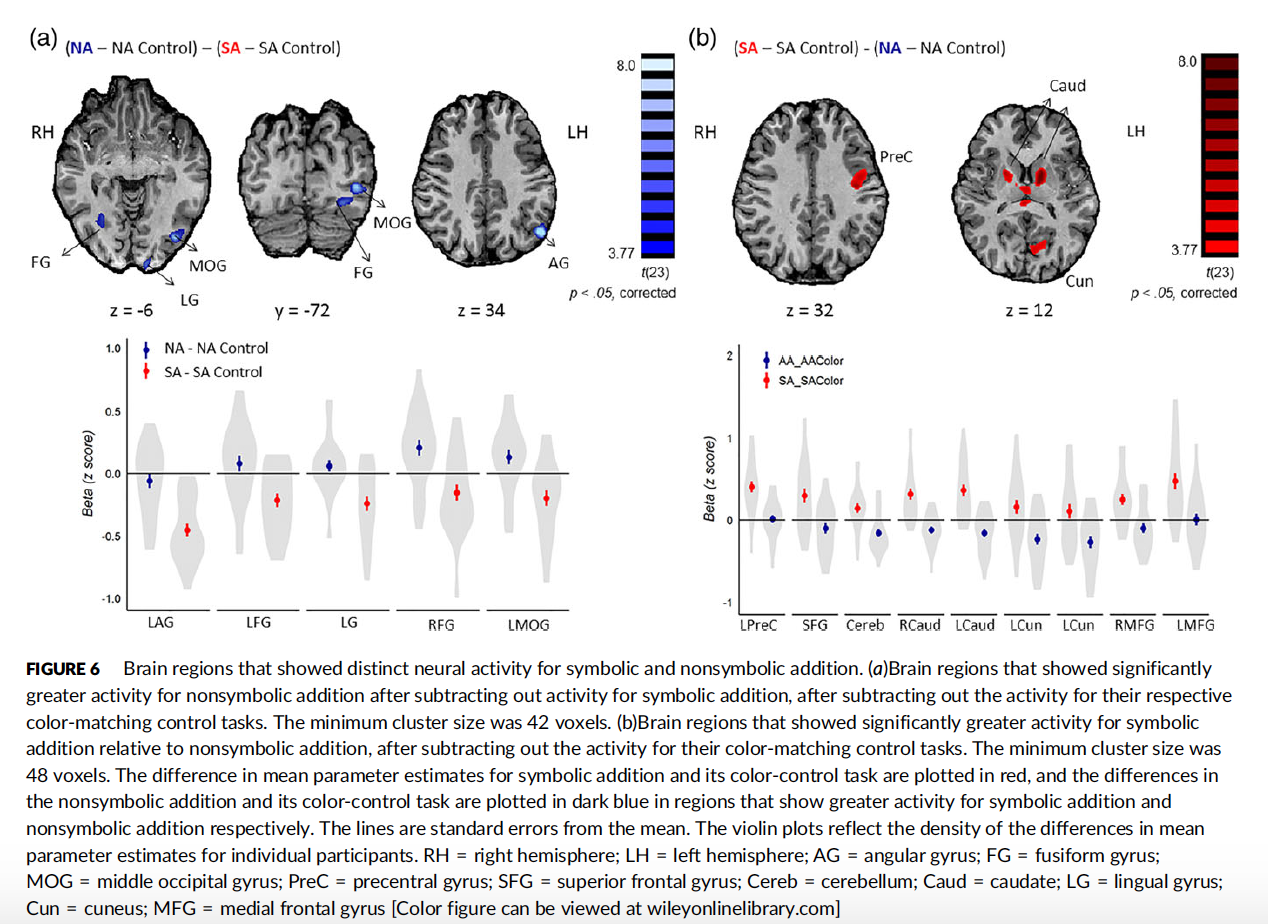
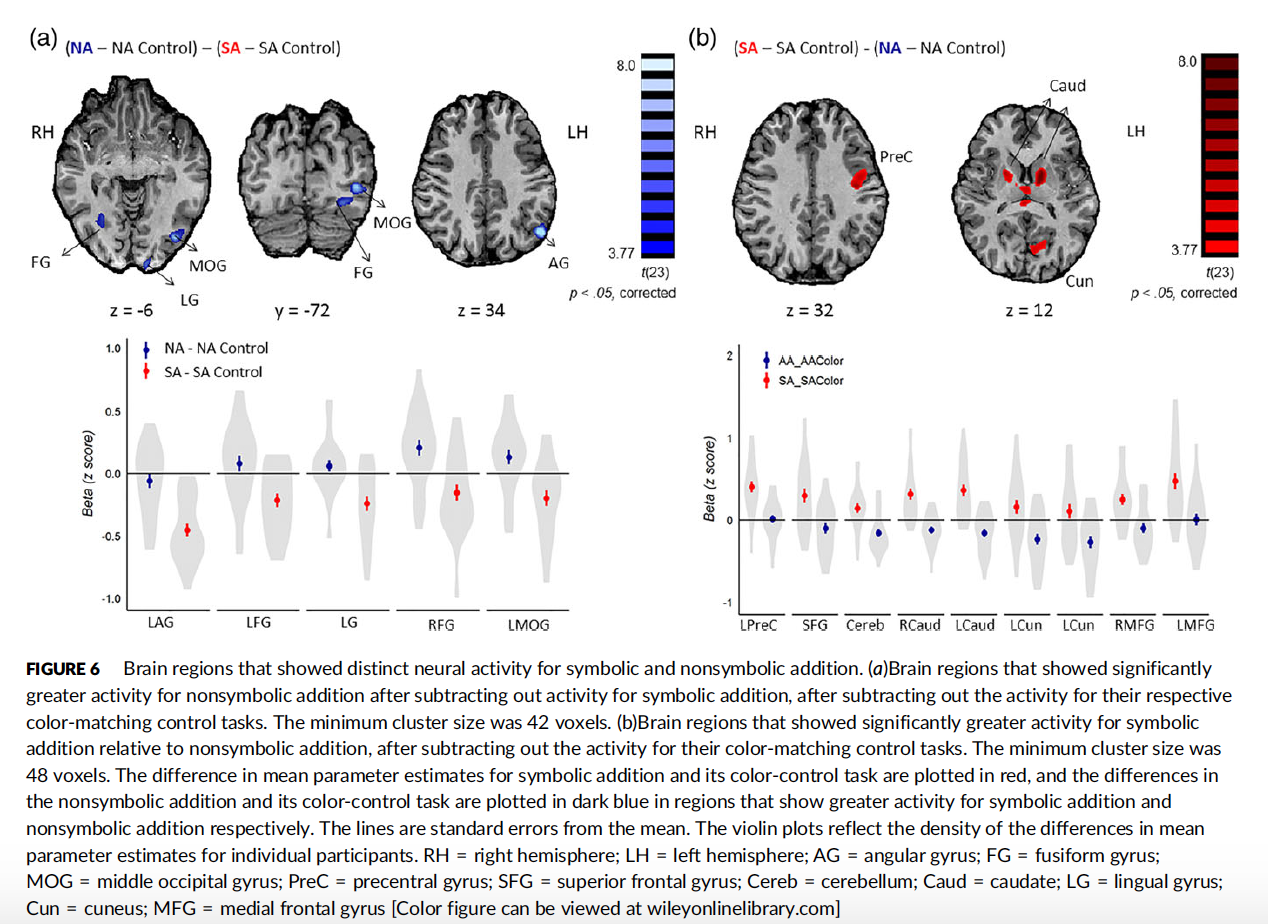
I want to find which regions are specifically activated for condA after subtracting out the activity for condB, after subtracting out the activity for their respective control tasks (condAControl and condBcontrol).
(condA-condAcontrol)>(condB-condBcontrol)
I’d like to do the analysis showed in figure 6 in: Bugden S, Woldorff MG, Brannon EM. Shared and distinct neural circuitry for nonsymbolic and symbolic double-digit addition. Hum Brain Mapp. 2019;40:1328–1343. https://secure-web.cisco.com/16EgUgo-O6ZgU2AnR7aI9rJDim8n78Dicw7nBRrgmyXoWok... https://secure-web.cisco.com/16EgUgo-O6ZgU2AnR7aI9rJDim8n78Dicw7nBRrgmyXoWokJw0p5qP-oWEI8fM48K9iLV-KUhzq2NlFmy_Pyu0MlW8_38Ukm8GE_u1N46VKCziDLHw4yV9Q8KFrZ5X4M_gRbVePSHe_Kbc9xJGW_LzmdDmO94_yoNiuzFeGr9kERDDUS__aN6owP4rjN-BTeiZ4jlTKrsZ7gT2t0hIMK20nk7lk4BI5ouKt_27d4uI8tc7hgxDoBW45sIcjSAgLB7usKrD72ih0RHk1iR8bXZjg/https%3A%2F%2Fdoi.org%2F10.1002%2Fhbm.24452
Thanks,
Paula
Il giorno 26 gen 2021, alle ore 16:18, Douglas N. Greve dgreve@mgh.harvard.edu ha scritto:
They way you have specified your contrast is a conjunction of individual contrasts, ie, cA>cAc AND cB>cBc. If that what you want? Originally, you were just asking about the interaction
On 1/26/2021 5:17 AM, Paula Maldonado wrote:
External Email - Use CautionThanks for your reply, However I have now a doubt regarding one aspect that I had not noticed before.
What I wanted to do is to perform the contrast (condA>condAcontrol)>(condB>condBcontrol) with the order of my condition being condA, condAcontrol, condB, condBcontrol
You said that to do so I should use -a 1 -c 2 -c 3 -a 4, but I don’t understand why condition 3 is -c and condition 4 is -a. To my understanding a is assigning a positive weight to my predictors, while c is assigning a negative one. So if I run -a 1 -c 2 -c 3 -a 4, am I not testing the contrast (condA>condAcontrol)>(condBcontrol>condB) ?
In addition, if now I want to obtain: (condA>condB)>(condAcontrol>condBcontrol) should I run mkcontrast-sess -analysis analysis -contrast contrastname -a 1 -c 3 -c 2 -a 4, or -a 1 -c 3 -a 2 -c 4?
Thanks,
Paula
Il giorno 27 ott 2020, alle ore 22:50, Douglas N. Greve dgreve@mgh.harvard.edu ha scritto:
You would just run mkcontrast-sess, eg, if your four conditions are ordered condA, condAcontrol, condB, condBcont, then mkcontrast-sess -analysis analysis -contrast contrastname -a 1 -c 2 -c 3 -a 4 If you want it reversed, then just reverse the a's and c's
On 10/23/2020 4:39 AM, Paula Maldonado wrote:
External Email - Use CautionDear experts, I am running an fMRI experiment in which I have four conditions: two main conditions (condition A and condition B) and two respective control conditions (condition Acontrol and condition Bcontrol). I would like to create a map showing significantly greater activity for condition A relative to condition B, after subtracting out the activity for the respective control conditions. In other words, I would like to perform the following contrast: (condition A - condition A control) - (condition B - condition B control) Then I would like to have a map that shows the reverse contrast too:(condition B - condition B control) - (condition A - condition A control).
How do I do that?To obtain the first map: (condition A - condition A control) - (condition B - condition B control) I have tried with the mergecontrasts-sess function with the -conjunction flag and the OR option as detailed below: mergecontrasts-sess -mergedcontrast conjres -conjunction or -analysis analysisname -map sig -space sph -isxavg fixed -contrast Contrast1 2 pos 0 -contrast Contrast 2 pos 0 -s sessionsfMRI/Sub01/bold -hemi lh
where Contrast1= (condition A - condition A control) and Contrast2= (condition B - condition B control) however the map I get is exactly the same as (condition A - condition A control), as if subtracting out Contrast 2 had no impact on the map.
Thanks,
Paula
Freesurfer mailing list Freesurfer@nmr.mgh.harvard.edu https://secure-web.cisco.com/17Vis7CsewfzKVGLwUV1wLKkghjPfiDm9VeIZ6t9CHXifdc... https://secure-web.cisco.com/17Vis7CsewfzKVGLwUV1wLKkghjPfiDm9VeIZ6t9CHXifdcWEg0Z6PdDLO-bFcp-Ie-E_CNaHQm97ldOW3j0GgaivIZZogL1rmUpS07_zswoVI7F_x8z4aL9RkBExxoEMbJjuSwOQiY-xoGtoLQF6kQVRq4Z8YJ64IlUuxvRM0j1FALZF5_BxMy_IxGa0P5vezrjvpHsK9T76iLBmck0BFNQKuOxWjhK1p-dQGxmCPkdVOP_18BUraanTnU6tG93o_F4dSSNY678vxXeomHj0sQ/https%3A%2F%2Fmail.nmr.mgh.harvard.edu%2Fmailman%2Flistinfo%2Ffreesurfer
Freesurfer mailing list Freesurfer@nmr.mgh.harvard.edu mailto:Freesurfer@nmr.mgh.harvard.edu https://secure-web.cisco.com/17Vis7CsewfzKVGLwUV1wLKkghjPfiDm9VeIZ6t9CHXifdc... https://secure-web.cisco.com/17Vis7CsewfzKVGLwUV1wLKkghjPfiDm9VeIZ6t9CHXifdcWEg0Z6PdDLO-bFcp-Ie-E_CNaHQm97ldOW3j0GgaivIZZogL1rmUpS07_zswoVI7F_x8z4aL9RkBExxoEMbJjuSwOQiY-xoGtoLQF6kQVRq4Z8YJ64IlUuxvRM0j1FALZF5_BxMy_IxGa0P5vezrjvpHsK9T76iLBmck0BFNQKuOxWjhK1p-dQGxmCPkdVOP_18BUraanTnU6tG93o_F4dSSNY678vxXeomHj0sQ/https%3A%2F%2Fmail.nmr.mgh.harvard.edu%2Fmailman%2Flistinfo%2Ffreesurfer
Freesurfer mailing list Freesurfer@nmr.mgh.harvard.edu mailto:Freesurfer@nmr.mgh.harvard.edu https://secure-web.cisco.com/1XrRIUlvw4Pr46NO5vnPwMtv4r7mj1s3L_KVAoOhM7acn7x... https://secure-web.cisco.com/1XrRIUlvw4Pr46NO5vnPwMtv4r7mj1s3L_KVAoOhM7acn7x8noXiMi1waq97_Cv4KAGKdkzYTOlwdSqS0u6wcMT6AiNpT3JjZmJi4PoPk0s0ykVN60Mnw0F4Fuungb3BwnGiYNAe2nYd2e5LuUh094EW3_RjJJzoSH1iQ7UeL6RxiZ_aAUfACSki99azVVqIU82n5I004Ja3qvpiW19CWRpDPbUuWyS9_E7RHP1iVqObDLj17NvT70EdlnQHMhRfVwVGi374zjXLoec3vz8nKIA/https%3A%2F%2Fmail.nmr.mgh.harvard.edu%2Fmailman%2Flistinfo%2Ffreesurfer
Freesurfer mailing list Freesurfer@nmr.mgh.harvard.edu mailto:Freesurfer@nmr.mgh.harvard.edu https://secure-web.cisco.com/1XrRIUlvw4Pr46NO5vnPwMtv4r7mj1s3L_KVAoOhM7acn7x... https://secure-web.cisco.com/1XrRIUlvw4Pr46NO5vnPwMtv4r7mj1s3L_KVAoOhM7acn7x8noXiMi1waq97_Cv4KAGKdkzYTOlwdSqS0u6wcMT6AiNpT3JjZmJi4PoPk0s0ykVN60Mnw0F4Fuungb3BwnGiYNAe2nYd2e5LuUh094EW3_RjJJzoSH1iQ7UeL6RxiZ_aAUfACSki99azVVqIU82n5I004Ja3qvpiW19CWRpDPbUuWyS9_E7RHP1iVqObDLj17NvT70EdlnQHMhRfVwVGi374zjXLoec3vz8nKIA/https%3A%2F%2Fmail.nmr.mgh.harvard.edu%2Fmailman%2Flistinfo%2Ffreesurfer
(condA-condAcontrol)>(condB-condBcontrol) is actually just a simple contrast where you are looking for (condA-condAcontrol)-(condB-condBcontrol)>0, which works out to (condA-condAcontrol-condB+condBcontrol) which works out to the -a 1 -c 2 -c 3 -a 4 contrast we first discussed
On 1/26/2021 11:46 AM, Paula Maldonado wrote:
External Email - Use Caution
I want to find which regions are specifically activated for condA after subtracting out the activity for condB, after subtracting out the activity for their respective control tasks (condAControl and condBcontrol).
(condA-condAcontrol)>(condB-condBcontrol)
I’d like to do the analysis showed in figure 6 in: Bugden S, Woldorff MG, Brannon EM. Shared and distinct neural circuitry for nonsymbolic and symbolic double-digit addition. Hum Brain Mapp. 2019;40:1328–1343. *MailScanner has detected a possible fraud attempt from "secure-web.cisco.com" claiming to be* https://doi.org/10.1002/hbm.24452 https://secure-web.cisco.com/16EgUgo-O6ZgU2AnR7aI9rJDim8n78Dicw7nBRrgmyXoWokJw0p5qP-oWEI8fM48K9iLV-KUhzq2NlFmy_Pyu0MlW8_38Ukm8GE_u1N46VKCziDLHw4yV9Q8KFrZ5X4M_gRbVePSHe_Kbc9xJGW_LzmdDmO94_yoNiuzFeGr9kERDDUS__aN6owP4rjN-BTeiZ4jlTKrsZ7gT2t0hIMK20nk7lk4BI5ouKt_27d4uI8tc7hgxDoBW45sIcjSAgLB7usKrD72ih0RHk1iR8bXZjg/https%3A%2F%2Fdoi.org%2F10.1002%2Fhbm.24452
Thanks,
Paula
Il giorno 26 gen 2021, alle ore 16:18, Douglas N. Greve <dgreve@mgh.harvard.edu mailto:dgreve@mgh.harvard.edu> ha scritto:
They way you have specified your contrast is a conjunction of individual contrasts, ie, cA>cAc AND cB>cBc. If that what you want? Originally, you were just asking about the interaction
On 1/26/2021 5:17 AM, Paula Maldonado wrote:
External Email - Use Caution
Thanks for your reply, However I have now a doubt regarding one aspect that I had not noticed before.
What I wanted to do is to perform the contrast (condA>condAcontrol)>(condB>condBcontrol) with the order of my condition being condA, condAcontrol, condB, condBcontrol
You said that to do so I should use -a 1 -c 2 -c 3 -a 4, but I don’t understand why condition 3 is -c and condition 4 is -a. To my understanding a is assigning a positive weight to my predictors, while c is assigning a negative one. So if I run -a 1 -c 2 -c 3 -a 4, am I not testing the contrast (condA>condAcontrol)>(condBcontrol>condB) ?
In addition, if now I want to obtain: (condA>condB)>(condAcontrol>condBcontrol) should I run mkcontrast-sess -analysis analysis -contrast contrastname -a 1 -c 3 -c 2 -a 4, or -a 1 -c 3 -a 2 -c 4?
Thanks,
Paula
Il giorno 27 ott 2020, alle ore 22:50, Douglas N. Greve <dgreve@mgh.harvard.edu mailto:dgreve@mgh.harvard.edu> ha scritto:
You would just run mkcontrast-sess, eg, if your four conditions are ordered condA, condAcontrol, condB, condBcont, then mkcontrast-sess -analysis analysis -contrast contrastname -a 1 -c 2 -c 3 -a 4 If you want it reversed, then just reverse the a's and c's
On 10/23/2020 4:39 AM, Paula Maldonado wrote:
External Email - Use Caution
Dear experts, I am running an fMRI experiment in which I have four conditions: two main conditions (condition A and condition B) and two respective control conditions (condition Acontrol and condition Bcontrol). I would like to create a map showing significantly greater activity for condition A relative to condition B, after subtracting out the activity for the respective control conditions. In other words, I would like to perform the following contrast: (condition A - condition A control) - (condition B - condition B control) Then I would like to have a map that shows the reverse contrast too:(condition B - condition B control) - (condition A - condition A control).
How do I do that?To obtain the first map: (condition A - condition A control) - (condition B - condition B control) I have tried with the mergecontrasts-sess function with the -conjunction flag and the OR option as detailed below: mergecontrasts-sess -mergedcontrast conjres -conjunction or -analysis analysisname -map sig -space sph -isxavg fixed -contrast Contrast1 2 pos 0 -contrast Contrast 2 pos 0 -s sessionsfMRI/Sub01/bold -hemi lh
where Contrast1= (condition A - condition A control) and Contrast2= (condition B - condition B control) however the map I get is exactly the same as (condition A - condition A control), as if subtracting out Contrast 2 had no impact on the map.
Thanks,
Paula
Freesurfer mailing list Freesurfer@nmr.mgh.harvard.edu mailto:Freesurfer@nmr.mgh.harvard.edu https://secure-web.cisco.com/17Vis7CsewfzKVGLwUV1wLKkghjPfiDm9VeIZ6t9CHXifdc... https://secure-web.cisco.com/17Vis7CsewfzKVGLwUV1wLKkghjPfiDm9VeIZ6t9CHXifdcWEg0Z6PdDLO-bFcp-Ie-E_CNaHQm97ldOW3j0GgaivIZZogL1rmUpS07_zswoVI7F_x8z4aL9RkBExxoEMbJjuSwOQiY-xoGtoLQF6kQVRq4Z8YJ64IlUuxvRM0j1FALZF5_BxMy_IxGa0P5vezrjvpHsK9T76iLBmck0BFNQKuOxWjhK1p-dQGxmCPkdVOP_18BUraanTnU6tG93o_F4dSSNY678vxXeomHj0sQ/https%3A%2F%2Fmail.nmr.mgh.harvard.edu%2Fmailman%2Flistinfo%2Ffreesurfer
Freesurfer mailing list Freesurfer@nmr.mgh.harvard.edu mailto:Freesurfer@nmr.mgh.harvard.edu https://secure-web.cisco.com/17Vis7CsewfzKVGLwUV1wLKkghjPfiDm9VeIZ6t9CHXifdc... https://secure-web.cisco.com/17Vis7CsewfzKVGLwUV1wLKkghjPfiDm9VeIZ6t9CHXifdcWEg0Z6PdDLO-bFcp-Ie-E_CNaHQm97ldOW3j0GgaivIZZogL1rmUpS07_zswoVI7F_x8z4aL9RkBExxoEMbJjuSwOQiY-xoGtoLQF6kQVRq4Z8YJ64IlUuxvRM0j1FALZF5_BxMy_IxGa0P5vezrjvpHsK9T76iLBmck0BFNQKuOxWjhK1p-dQGxmCPkdVOP_18BUraanTnU6tG93o_F4dSSNY678vxXeomHj0sQ/https%3A%2F%2Fmail.nmr.mgh.harvard.edu%2Fmailman%2Flistinfo%2Ffreesurfer
Freesurfer mailing list Freesurfer@nmr.mgh.harvard.edu mailto:Freesurfer@nmr.mgh.harvard.edu *MailScanner has detected a possible fraud attempt from "secure-web.cisco.com" claiming to be* https://mail.nmr.mgh.harvard.edu/mailman/listinfo/freesurfer https://secure-web.cisco.com/1XrRIUlvw4Pr46NO5vnPwMtv4r7mj1s3L_KVAoOhM7acn7x8noXiMi1waq97_Cv4KAGKdkzYTOlwdSqS0u6wcMT6AiNpT3JjZmJi4PoPk0s0ykVN60Mnw0F4Fuungb3BwnGiYNAe2nYd2e5LuUh094EW3_RjJJzoSH1iQ7UeL6RxiZ_aAUfACSki99azVVqIU82n5I004Ja3qvpiW19CWRpDPbUuWyS9_E7RHP1iVqObDLj17NvT70EdlnQHMhRfVwVGi374zjXLoec3vz8nKIA/https%3A%2F%2Fmail.nmr.mgh.harvard.edu%2Fmailman%2Flistinfo%2Ffreesurfer
Freesurfer mailing list Freesurfer@nmr.mgh.harvard.edu mailto:Freesurfer@nmr.mgh.harvard.edu *MailScanner has detected a possible fraud attempt from "secure-web.cisco.com" claiming to be* https://mail.nmr.mgh.harvard.edu/mailman/listinfo/freesurfer https://secure-web.cisco.com/1XrRIUlvw4Pr46NO5vnPwMtv4r7mj1s3L_KVAoOhM7acn7x8noXiMi1waq97_Cv4KAGKdkzYTOlwdSqS0u6wcMT6AiNpT3JjZmJi4PoPk0s0ykVN60Mnw0F4Fuungb3BwnGiYNAe2nYd2e5LuUh094EW3_RjJJzoSH1iQ7UeL6RxiZ_aAUfACSki99azVVqIU82n5I004Ja3qvpiW19CWRpDPbUuWyS9_E7RHP1iVqObDLj17NvT70EdlnQHMhRfVwVGi374zjXLoec3vz8nKIA/https%3A%2F%2Fmail.nmr.mgh.harvard.edu%2Fmailman%2Flistinfo%2Ffreesurfer
Freesurfer mailing list Freesurfer@nmr.mgh.harvard.edu https://mail.nmr.mgh.harvard.edu/mailman/listinfo/freesurfer
freesurfer@nmr.mgh.harvard.edu
-
 Douglas N. Greve
 -
Greve, Douglas N.,Ph.D.
-
 Paula Maldonado