
External Email - Use Caution
Hi,
Just like volume, I have "Folding Index" measures saved in lh/rh.aparc.stats files for each subject.
If I am using mris_preproc *--meas volume* --out CV/lh.CV.mgh command to concat cortical volume files from all subjects, then how can I use this command for "folding index" output file?
Any help will be really appreciated.

something like --meas white.K or white.H
On 12/19/2018 04:23 PM, Martin Juneja wrote:
External Email - Use Caution
Hi,
Just like volume, I have "Folding Index" measures saved in lh/rh.aparc.stats files for each subject.
If I am using mris_preproc *--meas volume* --out CV/lh.CV.mgh command to concat cortical volume files from all subjects, then how can I use this command for "folding index" output file?
Any help will be really appreciated.
Freesurfer mailing list Freesurfer@nmr.mgh.harvard.edu https://mail.nmr.mgh.harvard.edu/mailman/listinfo/freesurfer
External Email - Use Caution
Thanks Dr. Greve. That works, but both white.K and white.H are giving me very different output values.
For example, for first few subjects I get: -0.00237 -0.00450 -0.00204 0.00113 -0.00228 -0.00958 -0.00314 0.00180 -0.00452 if I use white.K -0.05809 -0.05799 -0.06457 -0.07254 -0.07208 -0.05023 -0.06044 -0.09338 -0.09178 if I use white.H
Can you please tell me the difference between white.K and white.H conceptually and mathematically?
On Wed, Dec 19, 2018 at 2:27 PM Greve, Douglas N.,Ph.D. < DGREVE@mgh.harvard.edu> wrote:
something like --meas white.K or white.H
On 12/19/2018 04:23 PM, Martin Juneja wrote:
External Email - Use CautionHi,
Just like volume, I have "Folding Index" measures saved in lh/rh.aparc.stats files for each subject.
If I am using mris_preproc *--meas volume* --out CV/lh.CV.mgh command to concat cortical volume files from all subjects, then how can I use this command for "folding index" output file?
Any help will be really appreciated.
Freesurfer mailing list Freesurfer@nmr.mgh.harvard.edu https://mail.nmr.mgh.harvard.edu/mailman/listinfo/freesurfer
Freesurfer mailing list Freesurfer@nmr.mgh.harvard.edu https://mail.nmr.mgh.harvard.edu/mailman/listinfo/freesurfer
I'll leave that up to Bruce and Rudolph
On 12/19/2018 05:37 PM, Martin Juneja wrote:
External Email - Use Caution
Thanks Dr. Greve. That works, but both white.K and white.H are giving me very different output values.
For example, for first few subjects I get: -0.00237 -0.00450 -0.00204 0.00113 -0.00228 -0.00958 -0.00314 0.00180 -0.00452 if I use white.K -0.05809 -0.05799 -0.06457 -0.07254 -0.07208 -0.05023 -0.06044 -0.09338 -0.09178 if I use white.H
Can you please tell me the difference between white.K and white.H conceptually and mathematically?
On Wed, Dec 19, 2018 at 2:27 PM Greve, Douglas N.,Ph.D. <DGREVE@mgh.harvard.edu mailto:DGREVE@mgh.harvard.edu> wrote:
something like --meas white.K or white.H


On 12/19/2018 04:23 PM, Martin Juneja wrote:
>
>         External Email - Use Caution
>
> Hi,
>
> Just like volume, I have "Folding Index" measures saved in
> lh/rh.aparc.stats files for each subject.
>
> If I am using mris_preproc *--meas volume* --out CV/lh.CV.mgh
command
> to concat cortical volume files from all subjects, then how can
I use
> this command for "folding index" output file?
>
> Any help will be really appreciated.
>
>
> _______________________________________________
> Freesurfer mailing list
> Freesurfer@nmr.mgh.harvard.edu
<mailto:Freesurfer@nmr.mgh.harvard.edu>
> https://mail.nmr.mgh.harvard.edu/mailman/listinfo/freesurfer


_______________________________________________
Freesurfer mailing list
Freesurfer@nmr.mgh.harvard.edu <mailto:Freesurfer@nmr.mgh.harvard.edu>
https://mail.nmr.mgh.harvard.edu/mailman/listinfo/freesurfer
Freesurfer mailing list Freesurfer@nmr.mgh.harvard.edu https://mail.nmr.mgh.harvard.edu/mailman/listinfo/freesurfer

External Email - Use Caution
K and H are the Gaussian Curvature and the Mean Curvature. Both can be computed based on the 2 principal curvatures k1 and k2 of a surface.
K and H are not identical to the folding index, though they are related to it via k1 and k2. k1 and k2 are also known as k_max and k_min, which you may know from the definition of the folding index.
Tim
On December 19, 2018 at 11:42 PM "Greve, Douglas N.,Ph.D." DGREVE@mgh.harvard.edu wrote:
I'll leave that up to Bruce and Rudolph
On 12/19/2018 05:37 PM, Martin Juneja wrote:
External Email - Use Caution
Thanks Dr. Greve. That works, but both white.K and white.H are giving me very different output values.
For example, for first few subjects I get: -0.00237 -0.00450 -0.00204 0.00113 -0.00228 -0.00958 -0.00314 0.00180 -0.00452 if I use white.K -0.05809 -0.05799 -0.06457 -0.07254 -0.07208 -0.05023 -0.06044 -0.09338 -0.09178 if I use white.H
Can you please tell me the difference between white.K and white.H conceptually and mathematically?
On Wed, Dec 19, 2018 at 2:27 PM Greve, Douglas N.,Ph.D. <DGREVE@mgh.harvard.edu mailto:DGREVE@mgh.harvard.edu> wrote:
something like --meas white.K or white.H


On 12/19/2018 04:23 PM, Martin Juneja wrote:
>
>         External Email - Use Caution
>
> Hi,
>
> Just like volume, I have "Folding Index" measures saved in
> lh/rh.aparc.stats files for each subject.
>
> If I am using mris_preproc *--meas volume* --out CV/lh.CV.mgh
command
> to concat cortical volume files from all subjects, then how can
I use
> this command for "folding index" output file?
>
> Any help will be really appreciated.
>
>
> _______________________________________________
> Freesurfer mailing list
> Freesurfer@nmr.mgh.harvard.edu
<mailto:Freesurfer@nmr.mgh.harvard.edu>
> https://mail.nmr.mgh.harvard.edu/mailman/listinfo/freesurfer


_______________________________________________
Freesurfer mailing list
Freesurfer@nmr.mgh.harvard.edu <mailto:Freesurfer@nmr.mgh.harvard.edu>
https://mail.nmr.mgh.harvard.edu/mailman/listinfo/freesurfer
Freesurfer mailing list Freesurfer@nmr.mgh.harvard.edu https://mail.nmr.mgh.harvard.edu/mailman/listinfo/freesurfer
Freesurfer mailing list Freesurfer@nmr.mgh.harvard.edu https://mail.nmr.mgh.harvard.edu/mailman/listinfo/freesurfer
-- Dr. Tim Schäfer Postdoc Computational Neuroimaging Department of Child and Adolescent Psychiatry, Psychosomatics and Psychotherapy University Hospital Frankfurt, Goethe University Frankfurt am Main, Germany

a 2D manifold has two principal curvatures, usually called k1 and k2, which are the curvature in the direction of maximum curvature and minimum curvature (they are also the eigenvalues and eigenvectors of the Hessian of the surface if it is expressed as a function over the tangent bundle). The Gaussian (K) and mean (H) curvatures are then:
K = k1*k2 H = (k1+k2)/2
cheers Bruce
On Wed, 19 Dec 2018, Greve, Douglas N.,Ph.D. wrote:
I'll leave that up to Bruce and Rudolph
On 12/19/2018 05:37 PM, Martin Juneja wrote:
External Email - Use Caution
Thanks Dr. Greve. That works, but both white.K and white.H are giving me very different output values.
For example, for first few subjects I get: -0.00237 -0.00450 -0.00204 0.00113 -0.00228 -0.00958 -0.00314 0.00180 -0.00452 if I use white.K -0.05809 -0.05799 -0.06457 -0.07254 -0.07208 -0.05023 -0.06044 -0.09338 -0.09178 if I use white.H
Can you please tell me the difference between white.K and white.H conceptually and mathematically?
On Wed, Dec 19, 2018 at 2:27 PM Greve, Douglas N.,Ph.D. <DGREVE@mgh.harvard.edu mailto:DGREVE@mgh.harvard.edu> wrote:
something like --meas white.K or white.H On 12/19/2018 04:23 PM, Martin Juneja wrote:External Email - Use Caution
Hi,
Just like volume, I have "Folding Index" measures saved in lh/rh.aparc.stats files for each subject.
If I am using mris_preproc *--meas volume* --out CV/lh.CV.mgh
commandto concat cortical volume files from all subjects, then how can
I usethis command for "folding index" output file?
Any help will be really appreciated.
Freesurfer mailing list Freesurfer@nmr.mgh.harvard.edu
<mailto:Freesurfer@nmr.mgh.harvard.edu>https://mail.nmr.mgh.harvard.edu/mailman/listinfo/freesurfer
_______________________________________________
Freesurfer mailing list
Freesurfer@nmr.mgh.harvard.edu <mailto:Freesurfer@nmr.mgh.harvard.edu>
https://mail.nmr.mgh.harvard.edu/mailman/listinfo/freesurfer
Freesurfer mailing list Freesurfer@nmr.mgh.harvard.edu https://mail.nmr.mgh.harvard.edu/mailman/listinfo/freesurfer
Freesurfer mailing list Freesurfer@nmr.mgh.harvard.edu https://mail.nmr.mgh.harvard.edu/mailman/listinfo/freesurfer
External Email - Use Caution
Thank you so much every one for helping me in this regard. I have some follow up questions:
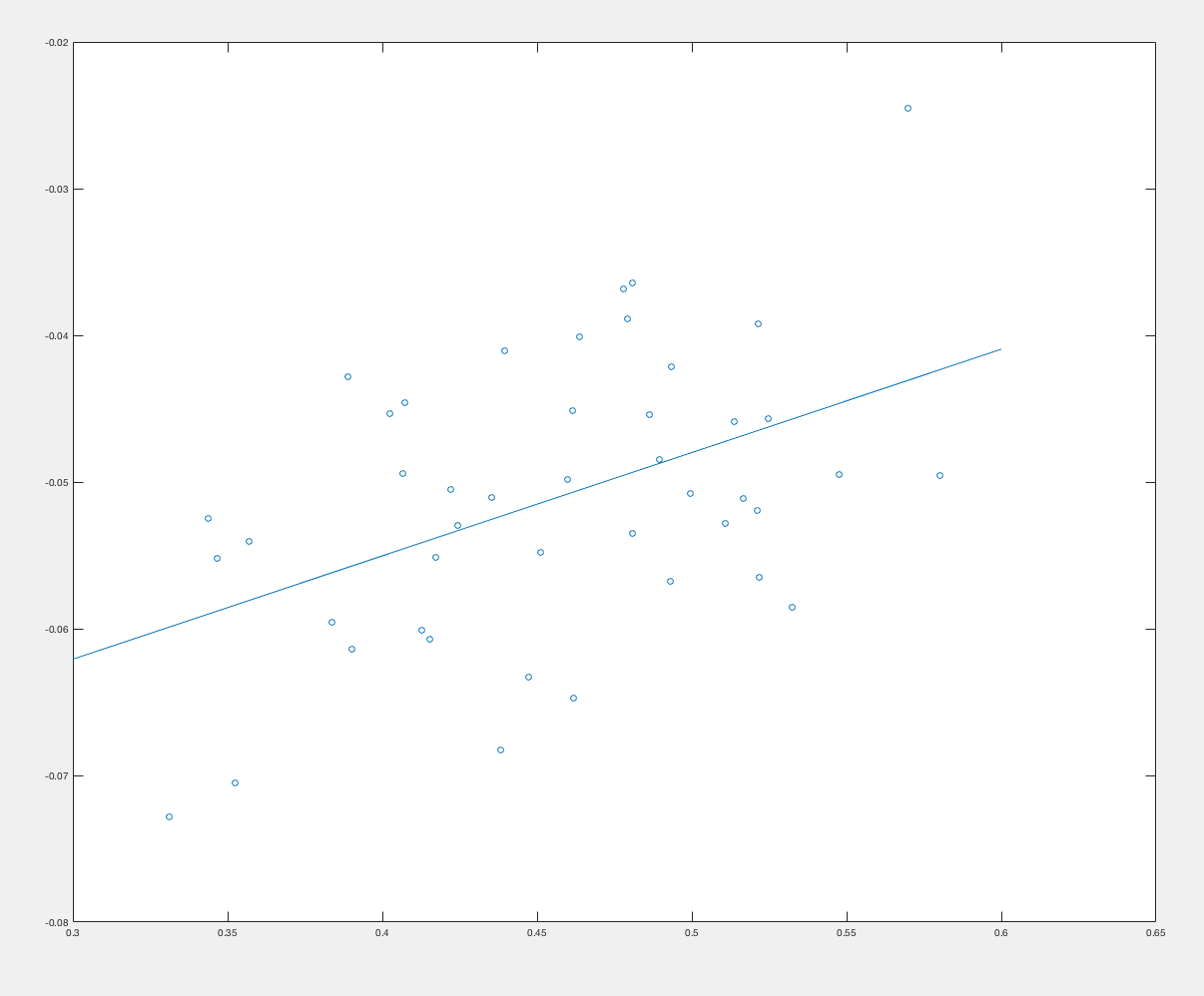
I am interested in associating mean curvature (H) with some behavioral measure. After extracting subject-wise mean curvature estimates, I found a significant positive association between mean curvature and those behavioral measures. My questions are:
(1). Why did Dr. Greve suggested to use white surface for estimating mean curvature, and not pial? What's the exact differences in both - is the only difference is that one is used for mean curvature from white matter (white surface) and the other from gray matter? I am not sure why one is recommended over the other? (2). If I want to use my own spherical ROIs for mean curvature estimation, how much radius is enough to draw spheres around peak coordinates? (3). Using white surface as recommended as Dr. Greve, I get (-) values for all the subjects, please see attached plot. Here mean curvature values are plotted along Y-axis. So here more negative values (.e.g ~ -0.07) represent sharper folds or less negative values (e.g. ~ -0.04) represent sharper folds? If I take absolute values of mean curvature, this association shown in attached plot changes from positive to negative. Can you please help me in interpreting the differences in more negative and less negative values here?
Any additional information about this measure will also be very useful, as I am using this parameter for the first time.
Thanks a lot.
On Wed, Dec 19, 2018 at 4:24 PM Bruce Fischl fischl@nmr.mgh.harvard.edu wrote:
a 2D manifold has two principal curvatures, usually called k1 and k2, which are the curvature in the direction of maximum curvature and minimum curvature (they are also the eigenvalues and eigenvectors of the Hessian of the surface if it is expressed as a function over the tangent bundle). The Gaussian (K) and mean (H) curvatures are then:
K = k1*k2 H = (k1+k2)/2
cheers Bruce
On Wed, 19 Dec 2018, Greve, Douglas N.,Ph.D. wrote:
I'll leave that up to Bruce and Rudolph
On 12/19/2018 05:37 PM, Martin Juneja wrote:
External Email - Use CautionThanks Dr. Greve. That works, but both white.K and white.H are giving me very different output values.
For example, for first few subjects I get: -0.00237 -0.00450 -0.00204 0.00113 -0.00228 -0.00958 -0.00314 0.00180 -0.00452 if I use white.K -0.05809 -0.05799 -0.06457 -0.07254 -0.07208 -0.05023 -0.06044 -0.09338 -0.09178 if I use white.H
Can you please tell me the difference between white.K and white.H conceptually and mathematically?
On Wed, Dec 19, 2018 at 2:27 PM Greve, Douglas N.,Ph.D. <DGREVE@mgh.harvard.edu mailto:DGREVE@mgh.harvard.edu> wrote:
something like --meas white.K or white.H On 12/19/2018 04:23 PM, Martin Juneja wrote:External Email - Use CautionHi,
Just like volume, I have "Folding Index" measures saved in lh/rh.aparc.stats files for each subject.
If I am using mris_preproc *--meas volume* --out CV/lh.CV.mgh
commandto concat cortical volume files from all subjects, then how can
I usethis command for "folding index" output file?
Any help will be really appreciated.
Freesurfer mailing list Freesurfer@nmr.mgh.harvard.edu
<mailto:Freesurfer@nmr.mgh.harvard.edu>https://mail.nmr.mgh.harvard.edu/mailman/listinfo/freesurfer
_______________________________________________
Freesurfer mailing list
Freesurfer@nmr.mgh.harvard.edu <mailto:
Freesurfer@nmr.mgh.harvard.edu>
https://mail.nmr.mgh.harvard.edu/mailman/listinfo/freesurfer
Freesurfer mailing list Freesurfer@nmr.mgh.harvard.edu https://mail.nmr.mgh.harvard.edu/mailman/listinfo/freesurfer
Freesurfer mailing list Freesurfer@nmr.mgh.harvard.edu https://mail.nmr.mgh.harvard.edu/mailman/listinfo/freesurfer
Freesurfer mailing list Freesurfer@nmr.mgh.harvard.edu https://mail.nmr.mgh.harvard.edu/mailman/listinfo/freesurfer
Hi Martin
you can use whichever surface you want - they are just different biological questions. The files we write out by default relate to the white surface, but you can certainly generate the equivalent for the pial using mris_curvature.
In general the curvature is 1/r, where r is the radius of an inscribed circle that is tangent to the surface in that direction. So bigger curvature implies smaller r (and sharper folds).
As for you question (2), I think that is a biological one and depends on the effect you are looking for (unless I am misunderstanding)
cheers Bruce
On Thu, 20 Dec 2018, Martin Juneja wrote:
External Email - Use Caution
Thank you so much every one for helping me in this regard. I have some follow up questions: I am interested in associating mean curvature (H) with some behavioral measure. After extracting subject-wise mean curvature estimates, I found a significant positive association between mean curvature and those behavioral measures. My questions are:
(1). Why did Dr. Greve suggested to use white surface for estimating mean curvature, and not pial? What's the exact differences in both - is the only difference is that one is used for mean curvature from white matter (white surface) and the other from gray matter? I am not sure why one is recommended over the other? (2). If I want to use my own spherical ROIs for mean curvature estimation, how much radius is enough to draw spheres around peak coordinates? (3). Using white surface as recommended as Dr. Greve, I get (-) values for all the subjects, please see attached plot. Here mean curvature values are plotted along Y-axis. So here more negative values (.e.g ~ -0.07) represent sharper folds or less negative values (e.g. ~ -0.04) represent sharper folds? If I take absolute values of mean curvature, this association shown in attached plot changes from positive to negative. Can you please help me in interpreting the differences in more negative and less negative values here?
Any additional information about this measure will also be very useful, as I am using this parameter for the first time.
Thanks a lot.
On Wed, Dec 19, 2018 at 4:24 PM Bruce Fischl fischl@nmr.mgh.harvard.edu wrote: a 2D manifold has two principal curvatures, usually called k1 and k2, which are the curvature in the direction of maximum curvature and minimum curvature (they are also the eigenvalues and eigenvectors of the Hessian of the surface if it is expressed as a function over the tangent bundle). The Gaussian (K) and mean (H) curvatures are then:
  K = k1*k2
  H = (k1+k2)/2

  cheers
  Bruce


  On Wed, 19 Dec 2018, Greve, Douglas N.,Ph.D. wrote:

  > I'll leave that up to Bruce and Rudolph
  >
  > On 12/19/2018 05:37 PM, Martin Juneja wrote:
  >>
  >>         External Email - Use Caution
  >>
  >> Thanks Dr. Greve. That works, but both white.K and white.H are giving
  >> me very different output values.
  >>
  >> For example, for first few subjects I get:
  >> -0.00237    -0.00450    -0.00204     0.00113 -0.00228    -0.00958
  >> -0.00314     0.00180    -0.00452 if I use white.K
  >> -0.05809   -0.05799    -0.06457    -0.07254 -0.07208    -0.05023
  >> -0.06044    -0.09338    -0.09178 if I use white.H
  >>
  >> Can you please tell me the difference between white.K and white.H
  >> conceptually and mathematically?
  >>
  >> On Wed, Dec 19, 2018 at 2:27 PM Greve, Douglas N.,Ph.D.
  >> <DGREVE@mgh.harvard.edu <mailto:DGREVE@mgh.harvard.edu>> wrote:
  >>
  >>     something like --meas white.K or white.H
  >>
  >>
  >>     On 12/19/2018 04:23 PM, Martin Juneja wrote:
  >>    >
  >>    >         External Email - Use Caution
  >>    >
  >>    > Hi,
  >>    >
  >>    > Just like volume, I have "Folding Index" measures saved in
  >>    > lh/rh.aparc.stats files for each subject.
  >>    >
  >>    > If I am using mris_preproc *--meas volume* --out CV/lh.CV.mgh
  >>     command
  >>    > to concat cortical volume files from all subjects, then how can
  >>     I use
  >>    > this command for "folding index" output file?
  >>    >
  >>    > Any help will be really appreciated.
  >>    >
  >>    >
  >>    > _______________________________________________
  >>    > Freesurfer mailing list
  >>    > Freesurfer@nmr.mgh.harvard.edu
  >>     <mailto:Freesurfer@nmr.mgh.harvard.edu>
  >>    > https://mail.nmr.mgh.harvard.edu/mailman/listinfo/freesurfer
  >>
  >>
  >>     _______________________________________________
  >>     Freesurfer mailing list
  >>     Freesurfer@nmr.mgh.harvard.edu <mailto:Freesurfer@nmr.mgh.harvard.edu>
  >>     https://mail.nmr.mgh.harvard.edu/mailman/listinfo/freesurfer
  >>
  >>
  >>
  >> _______________________________________________
  >> Freesurfer mailing list
  >> Freesurfer@nmr.mgh.harvard.edu
  >> https://mail.nmr.mgh.harvard.edu/mailman/listinfo/freesurfer
  >
  >
  > _______________________________________________
  > Freesurfer mailing list
  > Freesurfer@nmr.mgh.harvard.edu
  > https://mail.nmr.mgh.harvard.edu/mailman/listinfo/freesurfer
  >
  >
  >_______________________________________________
  Freesurfer mailing list
  Freesurfer@nmr.mgh.harvard.edu
  https://mail.nmr.mgh.harvard.edu/mailman/listinfo/freesurfer
External Email - Use Caution
Thank you so much Dr. Fischl, that information is very helpful.
On Thu, Dec 20, 2018 at 12:18 PM Bruce Fischl fischl@nmr.mgh.harvard.edu wrote:
Hi Martin
you can use whichever surface you want - they are just different biological questions. The files we write out by default relate to the white surface, but you can certainly generate the equivalent for the pial using mris_curvature.
In general the curvature is 1/r, where r is the radius of an inscribed circle that is tangent to the surface in that direction. So bigger curvature implies smaller r (and sharper folds).
As for you question (2), I think that is a biological one and depends on the effect you are looking for (unless I am misunderstanding)
cheers Bruce
On Thu, 20 Dec 2018, Martin Juneja wrote:
External Email - Use CautionThank you so much every one for helping me in this regard. I have some
follow up questions:
I am interested in associating mean curvature (H) with some behavioral
measure. After extracting
subject-wise mean curvature estimates, I found a significant positive
association between mean
curvature and those behavioral measures. My questions are:
(1). Why did Dr. Greve suggested to use white surface for estimating
mean curvature, and not pial?
What's the exact differences in both - is the only difference is that
one is used for mean curvature
from white matter (white surface) and the other from gray matter? I am
not sure why one is
recommended over the other? (2). If I want to use my own spherical ROIs for mean curvature
estimation, how much radius is enough
to draw spheres around peak coordinates? (3). Using white surface as recommended as Dr. Greve, I get (-) values
for all the subjects, please
see attached plot. Here mean curvature values are plotted along Y-axis.
So here more negative values
(.e.g ~ -0.07) represent sharper folds or less negative values (e.g. ~
-0.04) represent sharper
folds? If I take absolute values of mean curvature, this association
shown in attached plot changes
from positive to negative. Can you please help me in interpreting the
differences in more negative
and less negative values here?
Any additional information about this measure will also be very useful,
as I am using this parameter
for the first time.
Thanks a lot.
On Wed, Dec 19, 2018 at 4:24 PM Bruce Fischl fischl@nmr.mgh.harvard.edu
wrote:
a 2D manifold has two principal curvatures, usually called k1 andk2,
which are the curvature in the direction of maximum curvature andminimum
curvature (they are also the eigenvalues and eigenvectors of theHessian of
the surface if it is expressed as a function over the tangentbundle). The
  Gaussian (K) and mean (H) curvatures are then:

  K = k1*k2
  H = (k1+k2)/2

  cheers
  Bruce


  On Wed, 19 Dec 2018, Greve, Douglas N.,Ph.D. wrote:

  > I'll leave that up to Bruce and Rudolph
  >
  > On 12/19/2018 05:37 PM, Martin Juneja wrote:
  >>
  >>         External Email - Use Caution
  >>
  >> Thanks Dr. Greve. That works, but both white.K and white.H are
giving
  >> me very different output values.
  >>
  >> For example, for first few subjects I get:
  >> -0.00237    -0.00450    -0.00204     0.00113 -0.00228
-0.00958
  >> -0.00314     0.00180    -0.00452 if I use white.K
  >> -0.05809   -0.05799    -0.06457    -0.07254 -0.07208
-0.05023
  >> -0.06044    -0.09338    -0.09178 if I use white.H
  >>
  >> Can you please tell me the difference between white.K and
white.H
  >> conceptually and mathematically?
  >>
  >> On Wed, Dec 19, 2018 at 2:27 PM Greve, Douglas N.,Ph.D.
  >> <DGREVE@mgh.harvard.edu <mailto:DGREVE@mgh.harvard.edu>> wrote:
  >>
  >>     something like --meas white.K or white.H
  >>
  >>
  >>     On 12/19/2018 04:23 PM, Martin Juneja wrote:
  >>    >
  >>    >         External Email - Use Caution
  >>    >
  >>    > Hi,
  >>    >
  >>    > Just like volume, I have "Folding Index" measures saved in
  >>    > lh/rh.aparc.stats files for each subject.
  >>    >
  >>    > If I am using mris_preproc *--meas volume* --out
CV/lh.CV.mgh
  >>     command
  >>    > to concat cortical volume files from all subjects, then
how can
  >>     I use
  >>    > this command for "folding index" output file?
  >>    >
  >>    > Any help will be really appreciated.
  >>    >
  >>    >
  >>    > _______________________________________________
  >>    > Freesurfer mailing list
  >>    > Freesurfer@nmr.mgh.harvard.edu
  >>     <mailto:Freesurfer@nmr.mgh.harvard.edu>
  >>    >
https://mail.nmr.mgh.harvard.edu/mailman/listinfo/freesurfer
  >>
  >>
  >>     _______________________________________________
  >>     Freesurfer mailing list
  >>     Freesurfer@nmr.mgh.harvard.edu <mailto:
Freesurfer@nmr.mgh.harvard.edu>
>>https://mail.nmr.mgh.harvard.edu/mailman/listinfo/freesurfer
  >>
  >>
  >>
  >> _______________________________________________
  >> Freesurfer mailing list
  >> Freesurfer@nmr.mgh.harvard.edu
  >> https://mail.nmr.mgh.harvard.edu/mailman/listinfo/freesurfer
  >
  >
  > _______________________________________________
  > Freesurfer mailing list
  > Freesurfer@nmr.mgh.harvard.edu
  > https://mail.nmr.mgh.harvard.edu/mailman/listinfo/freesurfer
  >
  >
  >_______________________________________________
  Freesurfer mailing list
  Freesurfer@nmr.mgh.harvard.edu
  https://mail.nmr.mgh.harvard.edu/mailman/listinfo/freesurfer
Freesurfer mailing list Freesurfer@nmr.mgh.harvard.edu https://mail.nmr.mgh.harvard.edu/mailman/listinfo/freesurfer
freesurfer@nmr.mgh.harvard.edu
-
 Bruce Fischl
 -
 Greve, Douglas N.,Ph.D.
 -
 Martin Juneja
 -
 ts+ml@rcmd.org