
Hi team,
I am having problem with almost all the subjects in which wm/pial surfaces are not estimated correctly. These subjects are suffering from Corticobasal degeneration or progressive supranuclear palsy. I tried running sample of these subjects with multiple T1s as input (as we had them) and with additional parameters: -FLAIR, -FLAIRpial, -norm2-b 20, -norm2-n 5, -3T, and -bigventricles.
These are either mprage or spgr sequences with 1x1x1 resolution.
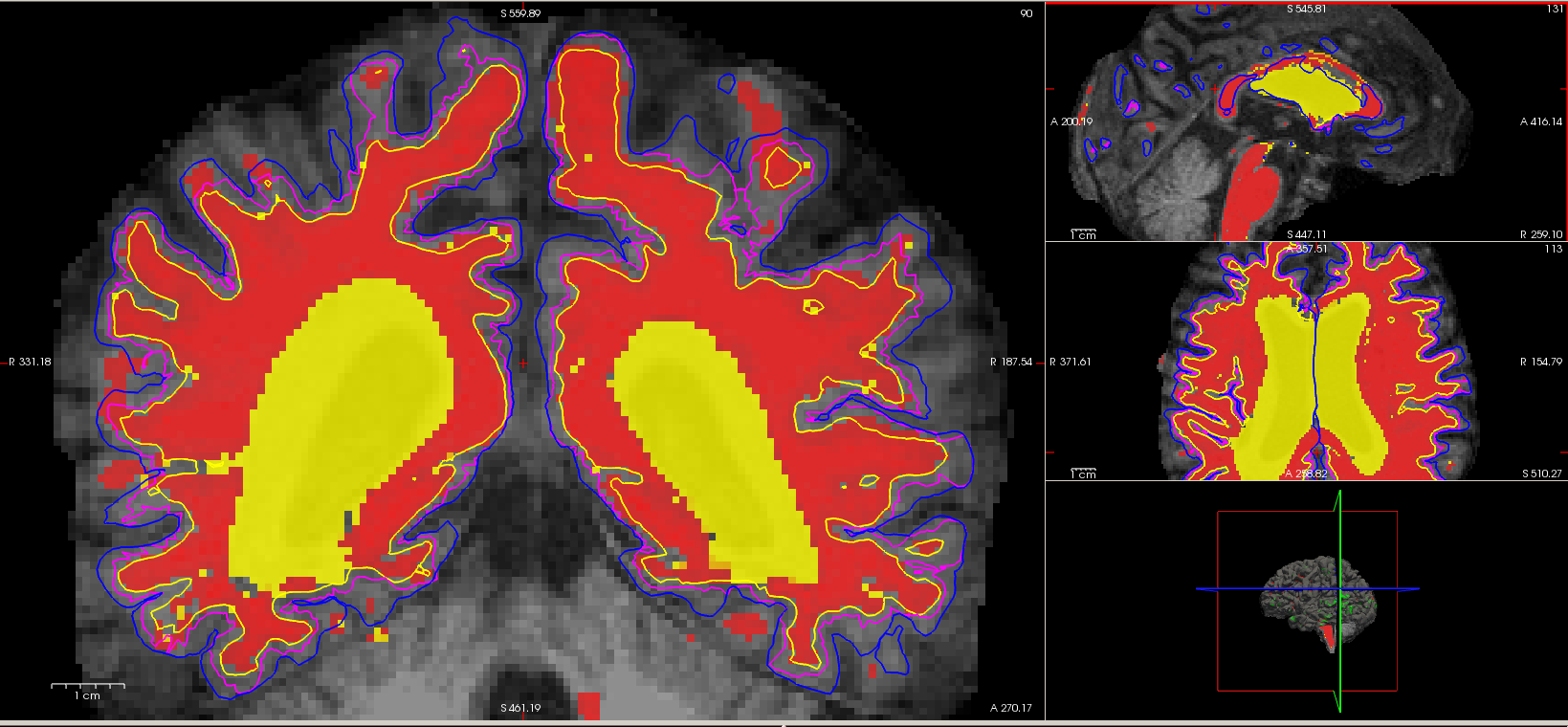
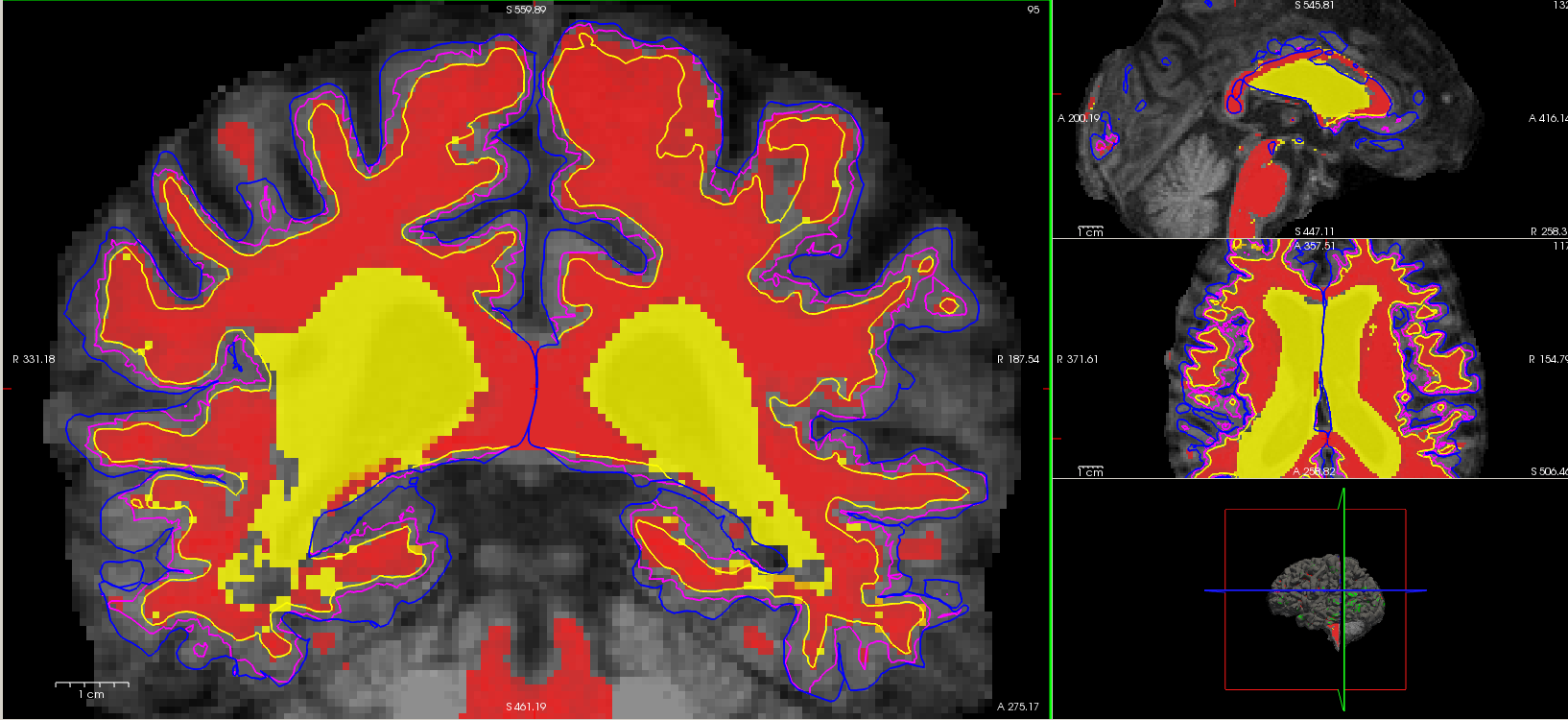
Flair input did not help instead made pial surfaces worst and convoluted (blue) as opposed to *.woFLAIR.pial surfaces (magenta), and even with addition of other flags it did not further improve estimation of wm/pial surfaces as seen in attached screenshots. The only option being adding control points. But these are about 200+ subjects, and I am not sure if to trust the manual edits on such a big scale.
Can anyone please suggest any other tweaks I could try?
[cid:01f72aae-1e98-4f12-bcf1-d2e3639dc992]
[cid:d1acff28-76d5-4cbf-aa2b-8fb55a07abfe]
Thanks, Sneha

Hi Sneha
it's tough to tell what's going on and certainly those results are way worse than what we typically find. From the little bit of data it looks like the motion corruption is pretty bad. Is that the case?
If you upload a representative subject we will take a look
cheers Bruce
On Thu, 17 Nov 2016, Sneha Pandya wrote:
Hi team,
I am having problem with almost all the subjects in which wm/pial surfaces are not estimated correctly. These subjects are suffering from Corticobasal degeneration or progressive supranuclear palsy. I tried running sample of these subjects with multiple T1s as input (as we had them) and with additional parameters: -FLAIR, -FLAIRpial, -norm2-b 20, -norm2-n 5, -3T, and -bigventricles.
These are either mprage or spgr sequences with 1x1x1 resolution.
Flair input did not help instead made pial surfaces worst and convoluted (blue) as opposed to *.woFLAIR.pial surfaces (magenta), and even with addition of other flags it did not further improve estimation of wm/pial surfaces as seen in attached screenshots. The only option being adding control points. But these are about 200+ subjects, and I am not sure if to trust the manual edits on such a big scale.
Can anyone please suggest any other tweaks I could try?
[IMAGE]
[IMAGE]
Thanks, Sneha
Thank you Bruce, it does like motion corruption but does not look that bad on source images. I have uploaded representative subject as 1_S_5001.tar.gz.
Please let me know if you would require any other files.
Thanks,
Sneha
________________________________ From: freesurfer-bounces@nmr.mgh.harvard.edu freesurfer-bounces@nmr.mgh.harvard.edu on behalf of Bruce Fischl fischl@nmr.mgh.harvard.edu Sent: Thursday, November 17, 2016 4:21:53 PM To: Freesurfer support list Subject: Re: [Freesurfer] Problem with wm/pial surfaces
Hi Sneha
it's tough to tell what's going on and certainly those results are way worse than what we typically find. From the little bit of data it looks like the motion corruption is pretty bad. Is that the case?
If you upload a representative subject we will take a look
cheers Bruce
On Thu, 17 Nov 2016, Sneha Pandya wrote:
Hi team,
I am having problem with almost all the subjects in which wm/pial surfaces are not estimated correctly. These subjects are suffering from Corticobasal degeneration or progressive supranuclear palsy. I tried running sample of these subjects with multiple T1s as input (as we had them) and with additional parameters: -FLAIR, -FLAIRpial, -norm2-b 20, -norm2-n 5, -3T, and -bigventricles.
These are either mprage or spgr sequences with 1x1x1 resolution.
Flair input did not help instead made pial surfaces worst and convoluted (blue) as opposed to *.woFLAIR.pial surfaces (magenta), and even with addition of other flags it did not further improve estimation of wm/pial surfaces as seen in attached screenshots. The only option being adding control points. But these are about 200+ subjects, and I am not sure if to trust the manual edits on such a big scale.
Can anyone please suggest any other tweaks I could try?
[IMAGE]
[IMAGE]
Thanks, Sneha
_______________________________________________ Freesurfer mailing list Freesurfer@nmr.mgh.harvard.edu https://urldefense.proofpoint.com/v2/url?u=https-3A__mail.nmr.mgh.harvard.ed...
The information in this e-mail is intended only for the person to whom it is addressed. If you believe this e-mail was sent to you in error and the e-mail contains patient information, please contact the Partners Compliance HelpLine at https://urldefense.proofpoint.com/v2/url?u=http-3A__www.partners.org_complia... . If the e-mail was sent to you in error but does not contain patient information, please contact the sender and properly dispose of the e-mail.
freesurfer@nmr.mgh.harvard.edu
-
 Bruce Fischl
 -
 Sneha Pandya