
Hi Guys, I read in the sidenote here (https://surfer.nmr.mgh.harvard.edu/fswiki/SurfaceRegAndTemplates) that inter-subject surface base registration using mris_register and -1 flag performs a sort of rigid registration. So I tried it between two of my subjects with the command below
mris_register -1 -curv P00001639/FreeSurferClean/surf/lh.sphere P00001639/FreeSurferClean/surf/lh.sphere lh.sphere3.reg
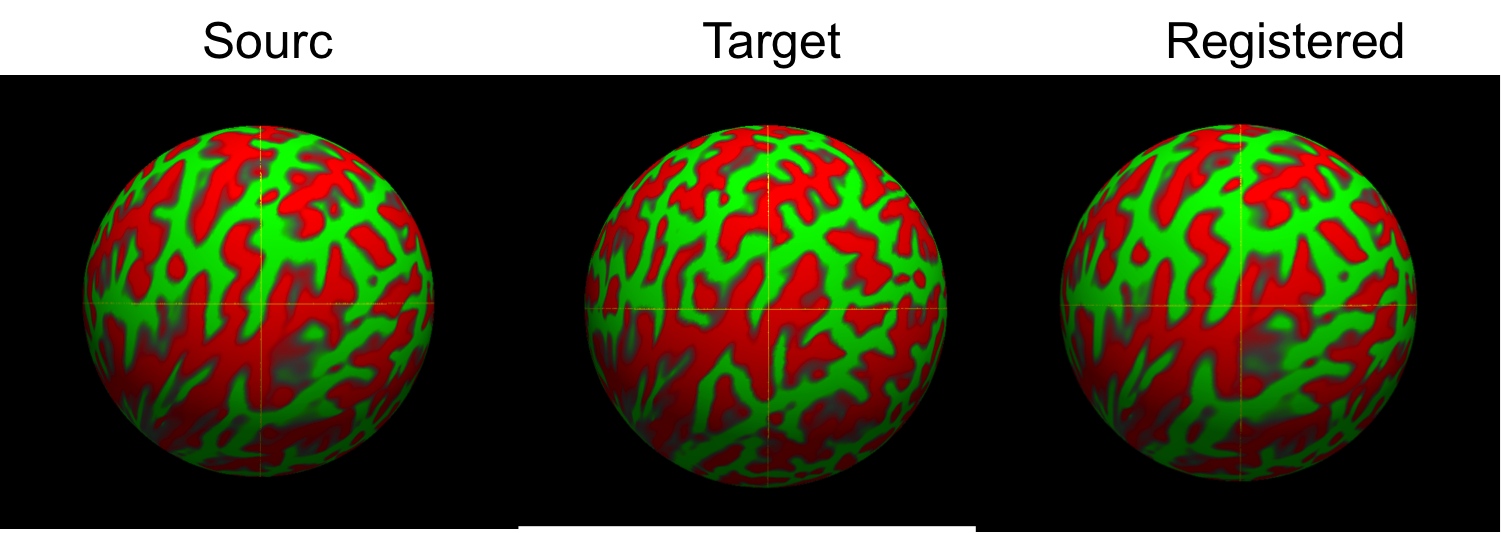
and got the results (see the attachment). It is clear that the registration output is just a shifted version of the source. Having this confirmed I want to know if there is any way to force the mris_register to perform a complete non-linear surface based registration for inter-subjects registration the same way it does for template.
I have to mention that I visualize the lh.sphere3.reg using freeview and loaded the sane lh.curv on that surface. I hope I’m not doing anything stupid.
[cid:AEB13CCB-455D-4591-B278-FEF31F6C0B4B@cpmc.columbia.edu]
Best -- Ray Razlighi, Ph.D. Assistant Professor Quantitative Neuroimaging Laboratory Division of Cognitive Neuroscience Department of Neurology Columbia University
Alt: razlighi@gmail.commailto:razlighi@gmail.com Office Phone: 212-342-1352 Office Fax: 212-342-1838 Website: http://www.columbia.edu/cu/qnl/

Hi Ray
the -1 means that the target is a single surface and not an atlas, but the registration is still nonlinear. The variances will all be 1 so you may have to play with the weights in the energy functional. We don't do this very much and it probably defaults to quite rigid. Try reducing the weight on the metric preservation term (e.g. -dist .25) if you want it to be more nonlinear
cheers Bruce
On Tue, 3 Nov 2015, Razlighi, Qolamreza R. wrote:
Hi Guys, I read in the sidenote here (https://surfer.nmr.mgh.harvard.edu/fswiki/SurfaceRegAndTemplates) that inter-subject surface base registration using mris_register and -1 flag performs a sort of rigid registration. So I tried it between two of my subjects with the command below
mris_register -1 -curv P00001639/FreeSurferClean/surf/lh.sphere P00001639/FreeSurferClean/surf/lh.sphere lh.sphere3.reg
and got the results (see the attachment). It is clear that the registration output is just a shifted version of the source. Having this confirmed I want to know if there is any way to force the mris_register to perform a complete non-linear surface based registration for inter-subjects registration the same way it does for template.
I have to mention that I visualize the lh.sphere3.reg using freeview and loaded the sane lh.curv on that surface. I hope I’m not doing anything stupid.
[IMAGE]
Best -- Ray Razlighi, Ph.D. Assistant Professor Quantitative Neuroimaging Laboratory Division of Cognitive Neuroscience Department of Neurology Columbia University
Alt: razlighi@gmail.com Office Phone: 212-342-1352 Office Fax: 212-342-1838 Website: http://www.columbia.edu/cu/qnl/
Dear Bruce,
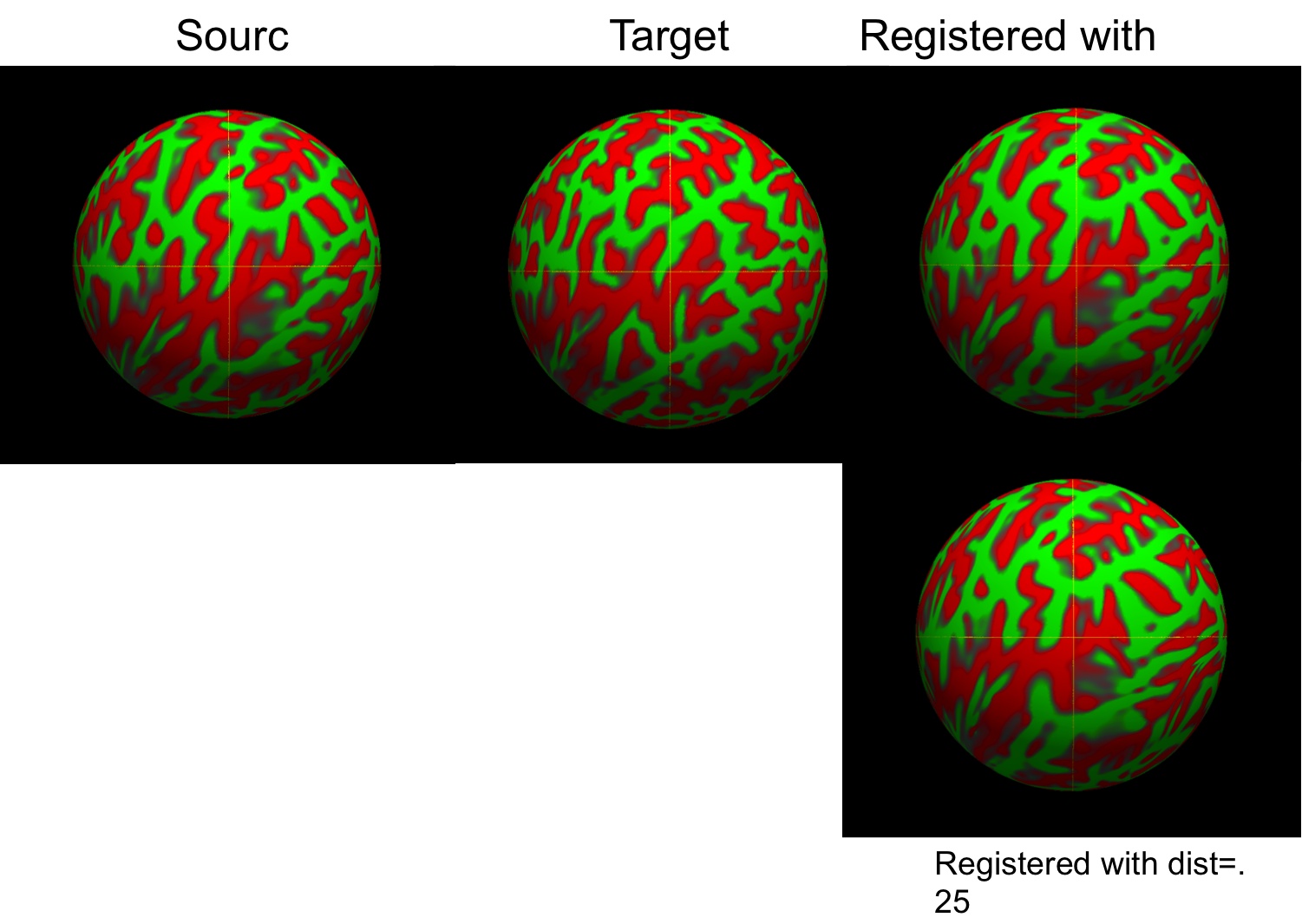
I did run it again with option (-dist 0.25); however the result did not change much (See the attachment). These results do not seem right to me and I think I’m running the command correctly (see the first email). However, I’m not sure I’m visualizing the curvature maps correctly. I assume the lh.sphere.reg has the same vertices and facets as lh.sphere but slightly displaced in space to match the curvature and sulci map of the source surface to target surface. Therefore, I visualize the lh.sphere.reg by pulling the same lh.curv file from the source image. If this is wrong, please let me know how can I correctly visualize the lh.sphere.reg, otherwise I have no idea why this surface based registration produce such inaccurate results. Any comments or suggestion is greatly appreciated.
Best [cid:E8245B5C-DB64-4625-922A-B86311C7805B@cpmc.columbia.edu] -- Ray Razlighi, Ph.D. Assistant Professor Quantitative Neuroimaging Laboratory Division of Cognitive Neuroscience Department of Neurology Columbia University
Alt: razlighi@gmail.commailto:razlighi@gmail.com Office Phone: 212-342-1352 Office Fax: 212-342-1838 Website: http://www.columbia.edu/cu/qnl/
On Nov 3, 2015, at 3:47 PM, Bruce Fischl <fischl@nmr.mgh.harvard.edumailto:fischl@nmr.mgh.harvard.edu> wrote:
Hi Ray
the -1 means that the target is a single surface and not an atlas, but the registration is still nonlinear. The variances will all be 1 so you may have to play with the weights in the energy functional. We don't do this very much and it probably defaults to quite rigid. Try reducing the weight on the metric preservation term (e.g. -dist .25) if you want it to be more nonlinear
cheers Bruce
On Tue, 3 Nov 2015, Razlighi, Qolamreza R. wrote:
Hi Guys, I read in the sidenote here (https://surfer.nmr.mgh.harvard.edu/fswiki/SurfaceRegAndTemplates) that inter-subject surface base registration using mris_register and -1 flag performs a sort of rigid registration. So I tried it between two of my subjects with the command below mris_register -1 -curv P00001639/FreeSurferClean/surf/lh.sphere P00001639/FreeSurferClean/surf/lh.sphere lh.sphere3.reg and got the results (see the attachment). It is clear that the registration output is just a shifted version of the source. Having this confirmed I want to know if there is any way to force the mris_register to perform a complete non-linear surface based registration for inter-subjects registration the same way it does for template. I have to mention that I visualize the lh.sphere3.reg using freeview and loaded the sane lh.curv on that surface. I hope I’m not doing anything stupid.
[IMAGE] Best -- Ray Razlighi, Ph.D. Assistant Professor Quantitative Neuroimaging Laboratory Division of Cognitive Neuroscience Department of Neurology Columbia University Alt: razlighi@gmail.commailto:razlighi@gmail.com Office Phone: 212-342-1352 Office Fax: 212-342-1838 Website: http://www.columbia.edu/cu/qnl/ _______________________________________________ Freesurfer mailing list Freesurfer@nmr.mgh.harvard.edumailto:Freesurfer@nmr.mgh.harvard.edu https://mail.nmr.mgh.harvard.edu/mailman/listinfo/freesurfer
The information in this e-mail is intended only for the person to whom it is addressed. If you believe this e-mail was sent to you in error and the e-mail contains patient information, please contact the Partners Compliance HelpLine at http://www.partners.org/complianceline . If the e-mail was sent to you in error but does not contain patient information, please contact the sender and properly dispose of the e-mail.
Hi Ray
that sounds right. The way I visualize these is using nmovie (which I think we include in our distribution) and flipping back and forth between the different images showing the different surfaces/curv maps.
Which inaccuracy are you referring to?
cheers Bruce
On Wed, 4 Nov 2015, Razlighi, Qolamreza R. wrote:
Dear Bruce, I did run it again with option (-dist 0.25); however the result did not change much (See the attachment). These results do not seem right to me and I think I’m running the command correctly (see the first email). However, I’m not sure I’m visualizing the curvature maps correctly. I assume the lh.sphere.reg has the same vertices and facets as lh.sphere but slightly displaced in space to match the curvature and sulci map of the source surface to target surface. Therefore, I visualize the lh.sphere.reg by pulling the same lh.curv file from the source image. If this is wrong, please let me know how can I correctly visualize the lh.sphere.reg, otherwise I have no idea why this surface based registration produce such inaccurate results. Any comments or suggestion is greatly appreciated.
Best [IMAGE] -- Ray Razlighi, Ph.D. Assistant Professor Quantitative Neuroimaging Laboratory Division of Cognitive Neuroscience Department of Neurology Columbia University
Alt: razlighi@gmail.com Office Phone: 212-342-1352 Office Fax: 212-342-1838 Website: http://www.columbia.edu/cu/qnl/
On Nov 3, 2015, at 3:47 PM, Bruce Fischl fischl@nmr.mgh.harvard.edu wrote:
  Hi Ray

  the -1 means that the target is a single surface and not an
  atlas, but the registration is still nonlinear. The variances
  will all be 1 so you may have to play with the weights in the
  energy functional. We don't do this very much and it probably
  defaults to quite rigid. Try reducing the weight on the metric
  preservation term (e.g. -dist .25) if you want it to be more
  nonlinear

  cheers
  Bruce

  On Tue, 3 Nov 2015, Razlighi, Qolamreza R. wrote:

        Hi Guys,
        I read in the sidenote here
        (https://surfer.nmr.mgh.harvard.edu/fswiki/SurfaceRegAndTemplates)
        that
        inter-subject surface base registration using
        mris_register and -1 flag
        performs a sort of rigid registration. So I tried it
        between two of my
        subjects with the command below
        mris_register -1 -curv
        P00001639/FreeSurferClean/surf/lh.sphere
        P00001639/FreeSurferClean/surf/lh.sphere
        lh.sphere3.reg
        and got the results (see the attachment). It is
        clear that the registration
        output is just a shifted version of the source.
        Having this confirmed I want
        to know if there is any way to force the
        mris_register to perform a complete
        non-linear surface based registration for
        inter-subjects registration the
        same way it does for template.
        I have to mention that I visualize the
        lh.sphere3.reg using freeview and
        loaded the sane lh.curv on that surface. I hope I’m
        not doing anything
        stupid.

        [IMAGE]
        Best
        --
        Ray Razlighi, Ph.D.
        Assistant Professor
        Quantitative Neuroimaging Laboratory
        Division of Cognitive Neuroscience
        Department of Neurology
        Columbia University
        Alt: razlighi@gmail.com
        Office Phone: 212-342-1352
        Office Fax: 212-342-1838
        Website: http://www.columbia.edu/cu/qnl/

  _______________________________________________
  Freesurfer mailing list
  Freesurfer@nmr.mgh.harvard.edu
  https://mail.nmr.mgh.harvard.edu/mailman/listinfo/freesurfer


  The information in this e-mail is intended only for the person
  to whom it is
  addressed. If you believe this e-mail was sent to you in error
  and the e-mail
  contains patient information, please contact the Partners
  Compliance HelpLine at
  http://www.partners.org/complianceline . If the e-mail was sent
  to you in error
  but does not contain patient information, please contact the
  sender and properly
  dispose of the e-mail.
Hi Bruce, Thanks for reply. I thought after registering, the source surface's curvature map should be very similar to the target one. I don't see that here. The registered surface has pretty much the same curvature map only slightly shifted. Am I missing something here?
Best
On Nov 4, 2015, at 5:56 PM, Bruce Fischl fischl@nmr.mgh.harvard.edu wrote:
Hi Ray
that sounds right. The way I visualize these is using nmovie (which I think we include in our distribution) and flipping back and forth between the different images showing the different surfaces/curv maps.
Which inaccuracy are you referring to?
cheers Bruce
On Wed, 4 Nov 2015, Razlighi, Qolamreza R. wrote:
Dear Bruce, I did run it again with option (-dist 0.25); however the result did not change much (See the attachment). These results do not seem right to me and I think I’m running the command correctly (see the first email). However, I’m not sure I’m visualizing the curvature maps correctly. I assume the lh.sphere.reg has the same vertices and facets as lh.sphere but slightly displaced in space to match the curvature and sulci map of the source surface to target surface. Therefore, I visualize the lh.sphere.reg by pulling the same lh.curv file from the source image. If this is wrong, please let me know how can I correctly visualize the lh.sphere.reg, otherwise I have no idea why this surface based registration produce such inaccurate results. Any comments or suggestion is greatly appreciated. Best [IMAGE] -- Ray Razlighi, Ph.D. Assistant Professor Quantitative Neuroimaging Laboratory Division of Cognitive Neuroscience Department of Neurology Columbia University Alt: razlighi@gmail.com Office Phone: 212-342-1352 Office Fax: 212-342-1838 Website: http://www.columbia.edu/cu/qnl/ On Nov 3, 2015, at 3:47 PM, Bruce Fischl fischl@nmr.mgh.harvard.edu wrote:
 Hi Ray

 the -1 means that the target is a single surface and not an
 atlas, but the registration is still nonlinear. The variances
 will all be 1 so you may have to play with the weights in the
 energy functional. We don't do this very much and it probably
 defaults to quite rigid. Try reducing the weight on the metric
 preservation term (e.g. -dist .25) if you want it to be more
 nonlinear

 cheers
 Bruce

 On Tue, 3 Nov 2015, Razlighi, Qolamreza R. wrote:

       Hi Guys,
       I read in the sidenote here
       (https://surfer.nmr.mgh.harvard.edu/fswiki/SurfaceRegAndTemplates)
       that
       inter-subject surface base registration using
       mris_register and -1 flag
       performs a sort of rigid registration. So I tried it
       between two of my
       subjects with the command below
       mris_register -1 -curv
       P00001639/FreeSurferClean/surf/lh.sphere
       P00001639/FreeSurferClean/surf/lh.sphere
       lh.sphere3.reg
       and got the results (see the attachment). It is
       clear that the registration
       output is just a shifted version of the source.
       Having this confirmed I want
       to know if there is any way to force the
       mris_register to perform a complete
       non-linear surface based registration for
       inter-subjects registration the
       same way it does for template.
       I have to mention that I visualize the
       lh.sphere3.reg using freeview and
       loaded the sane lh.curv on that surface. I hope I’m
       not doing anything
       stupid.

       [IMAGE]
       Best
       --
       Ray Razlighi, Ph.D.
       Assistant Professor
       Quantitative Neuroimaging Laboratory
       Division of Cognitive Neuroscience
       Department of Neurology
       Columbia University
       Alt: razlighi@gmail.com
       Office Phone: 212-342-1352
       Office Fax: 212-342-1838
       Website: http://www.columbia.edu/cu/qnl/

 _______________________________________________
 Freesurfer mailing list
 Freesurfer@nmr.mgh.harvard.edu
 https://mail.nmr.mgh.harvard.edu/mailman/listinfo/freesurfer

 The information in this e-mail is intended only for the person
 to whom it is
 addressed. If you believe this e-mail was sent to you in error
 and the e-mail
 contains patient information, please contact the Partners
 Compliance HelpLine at
 http://www.partners.org/complianceline . If the e-mail was sent
 to you in error
 but does not contain patient information, please contact the
 sender and properly
 dispose of the e-mail.
Freesurfer mailing list Freesurfer@nmr.mgh.harvard.edu https://mail.nmr.mgh.harvard.edu/mailman/listinfo/freesurfer
The information in this e-mail is intended only for the person to whom it is addressed. If you believe this e-mail was sent to you in error and the e-mail contains patient information, please contact the Partners Compliance HelpLine at http://www.partners.org/complianceline . If the e-mail was sent to you in error but does not contain patient information, please contact the sender and properly dispose of the e-mail.
Hi Ray
what version of FS are you using? Can you send me the output of the command? The distance term will prevent the curvatures from deforming too much. You can set it much smaller and see what happens if you want. There may also be an area constraint. Trying using -parea 0 also (or something small)
cheers Bruce
On Wed, 4 Nov 2015, Razlighi, Qolamreza R. wrote:
Hi Bruce, Thanks for reply. I thought after registering, the source surface's curvature map should be very similar to the target one. I don't see that here. The registered surface has pretty much the same curvature map only slightly shifted. Am I missing something here?
Best
On Nov 4, 2015, at 5:56 PM, Bruce Fischl fischl@nmr.mgh.harvard.edu wrote:
Hi Ray
that sounds right. The way I visualize these is using nmovie (which I think we include in our distribution) and flipping back and forth between the different images showing the different surfaces/curv maps.
Which inaccuracy are you referring to?
cheers Bruce
On Wed, 4 Nov 2015, Razlighi, Qolamreza R. wrote:
Dear Bruce, I did run it again with option (-dist 0.25); however the result did not change much (See the attachment). These results do not seem right to me and I think I’m running the command correctly (see the first email). However, I’m not sure I’m visualizing the curvature maps correctly. I assume the lh.sphere.reg has the same vertices and facets as lh.sphere but slightly displaced in space to match the curvature and sulci map of the source surface to target surface. Therefore, I visualize the lh.sphere.reg by pulling the same lh.curv file from the source image. If this is wrong, please let me know how can I correctly visualize the lh.sphere.reg, otherwise I have no idea why this surface based registration produce such inaccurate results. Any comments or suggestion is greatly appreciated. Best [IMAGE] -- Ray Razlighi, Ph.D. Assistant Professor Quantitative Neuroimaging Laboratory Division of Cognitive Neuroscience Department of Neurology Columbia University Alt: razlighi@gmail.com Office Phone: 212-342-1352 Office Fax: 212-342-1838 Website: http://www.columbia.edu/cu/qnl/ On Nov 3, 2015, at 3:47 PM, Bruce Fischl fischl@nmr.mgh.harvard.edu wrote:
 Hi Ray

 the -1 means that the target is a single surface and not an
 atlas, but the registration is still nonlinear. The variances
 will all be 1 so you may have to play with the weights in the
 energy functional. We don't do this very much and it probably
 defaults to quite rigid. Try reducing the weight on the metric
 preservation term (e.g. -dist .25) if you want it to be more
 nonlinear

 cheers
 Bruce

 On Tue, 3 Nov 2015, Razlighi, Qolamreza R. wrote:

       Hi Guys,
       I read in the sidenote here
       (https://surfer.nmr.mgh.harvard.edu/fswiki/SurfaceRegAndTemplates)
       that
       inter-subject surface base registration using
       mris_register and -1 flag
       performs a sort of rigid registration. So I tried it
       between two of my
       subjects with the command below
       mris_register -1 -curv
       P00001639/FreeSurferClean/surf/lh.sphere
       P00001639/FreeSurferClean/surf/lh.sphere
       lh.sphere3.reg
       and got the results (see the attachment). It is
       clear that the registration
       output is just a shifted version of the source.
       Having this confirmed I want
       to know if there is any way to force the
       mris_register to perform a complete
       non-linear surface based registration for
       inter-subjects registration the
       same way it does for template.
       I have to mention that I visualize the
       lh.sphere3.reg using freeview and
       loaded the sane lh.curv on that surface. I hope I’m
       not doing anything
       stupid.

       [IMAGE]
       Best
       --
       Ray Razlighi, Ph.D.
       Assistant Professor
       Quantitative Neuroimaging Laboratory
       Division of Cognitive Neuroscience
       Department of Neurology
       Columbia University
       Alt: razlighi@gmail.com
       Office Phone: 212-342-1352
       Office Fax: 212-342-1838
       Website: http://www.columbia.edu/cu/qnl/

 _______________________________________________
 Freesurfer mailing list
 Freesurfer@nmr.mgh.harvard.edu
 https://mail.nmr.mgh.harvard.edu/mailman/listinfo/freesurfer

 The information in this e-mail is intended only for the person
 to whom it is
 addressed. If you believe this e-mail was sent to you in error
 and the e-mail
 contains patient information, please contact the Partners
 Compliance HelpLine at
 http://www.partners.org/complianceline . If the e-mail was sent
 to you in error
 but does not contain patient information, please contact the
 sender and properly
 dispose of the e-mail.
Freesurfer mailing list Freesurfer@nmr.mgh.harvard.edu https://mail.nmr.mgh.harvard.edu/mailman/listinfo/freesurfer
The information in this e-mail is intended only for the person to whom it is addressed. If you believe this e-mail was sent to you in error and the e-mail contains patient information, please contact the Partners Compliance HelpLine at http://www.partners.org/complianceline . If the e-mail was sent to you in error but does not contain patient information, please contact the sender and properly dispose of the e-mail.
Freesurfer mailing list Freesurfer@nmr.mgh.harvard.edu https://mail.nmr.mgh.harvard.edu/mailman/listinfo/freesurfer
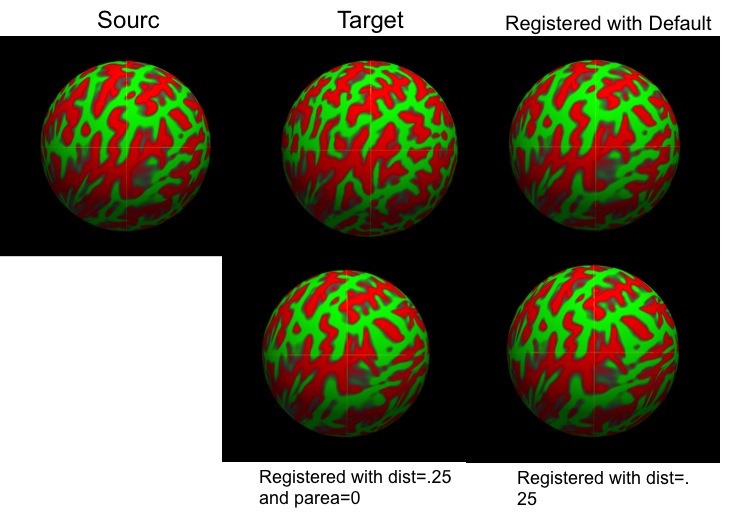
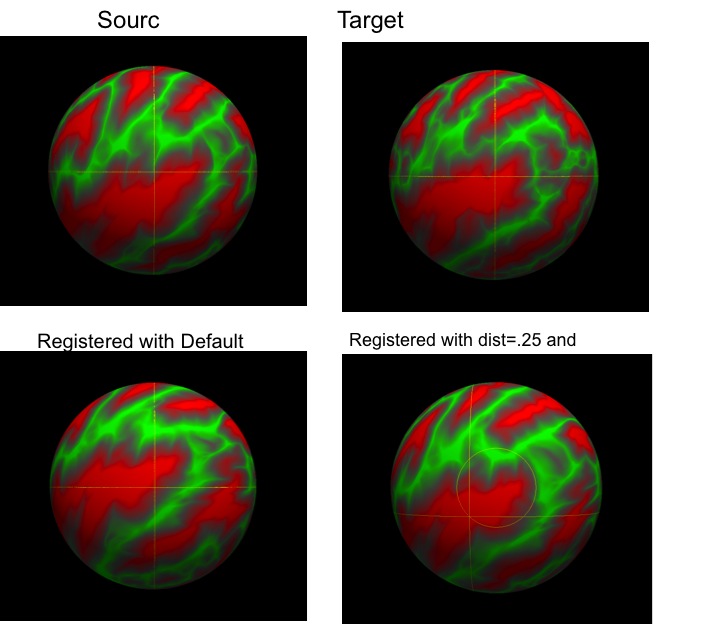
Dear Bruce, Thank again for your kind help. I’m running version 5.1.0. Below is the output of the command. I also ran it with parea=0 but almost no change in the result (see the attachment-1) I also plot the sluci map for comparison (see the attachment-2) but still not satisfactory.[cid:8FA10C76-5448-4E9D-A3F4-C29354ADF5D9@cpmc.columbia.edu][cid:9DD54DBE-FC6F-433B-A2F7-54D77C2DCF0B@cpmc.columbia.edu]
Best
~/Data/P00001613/FreeSurferClean/surf> mris_register -1 -curv -dist .25 lh.sphere ../../../P00001639/FreeSurferClean/surf/lh.sphere lh.sphere_dis25.reg treating target as a single subject's surface... using smoothwm curvature for final alignment l_dist = 0.250 $Id: mris_register.c,v 1.59 2011/03/02 00:04:33 nicks Exp $ $Id: mrisurf.c,v 1.693.2.7 2013/05/12 22:28:01 nicks Exp $ reading surface from lh.sphere... reading spherical surface ../../../P00001639/FreeSurferClean/surf/lh.sphere... curvature mean = -0.000, std = 1.000 computing parameterization for surface ../../../P00001639/FreeSurferClean/surf/lh.inflated.H... curvature mean = 0.000, std = 0.566 computing parameterization for surface ../../../P00001639/FreeSurferClean/surf/lh.sulc... curvature mean = -0.030, std = 0.282 computing parameterization for surface ../../../P00001639/FreeSurferClean/surf/lh.smoothwm... MRISregister() ------- max_passes = 4 min_degrees = 0.500000 max_degrees = 64.000000 nangles = 8 tol=5.0e-01, sigma=0.0, host=unkno, nav=1024, nbrs=1, l_extern=10000.000, l_parea=0.100, l_nlarea=1.000, l_corr=1.000, l_dist=0.250 using quadratic fit line minimization complete_dist_mat 0 rms 0 smooth_averages 0 remove_neg 0 ico_order 0 which_surface 0 target_radius 0.000000 nfields 0 scale 0.000000 desired_rms_height -1.000000 momentum 0.950000 nbhd_size -10 max_nbrs 10 niterations 25 nsurfaces 0 SURFACES 3 flags 16 (10) use curv 16 no sulc 0 no rigid align 0 mris->nsize 1 mris->hemisphere 0 randomSeed 0
-------------------- tol=5.0e-01, sigma=0.0, host=unkno, nav=1024, nbrs=1, l_extern=10000.000, l_parea=0.100, l_nlarea=1.000, l_corr=1.000, l_dist=0.250 using quadratic fit line minimization 1 Reading lh.sulc curvature mean = 0.000, std = 0.583 curvature mean = 0.044, std = 0.847 curvature mean = 0.022, std = 0.852 Starting MRISrigidBodyAlignGlobal() d=32.00 min @ (8.00, 0.00, 0.00) sse = 90765.7, tmin=0.9987 d=16.00 min @ (-4.00, -4.00, 0.00) sse = 87371.6, tmin=1.5086 d=8.00 min @ (-2.00, 0.00, 0.00) sse = 86754.0, tmin=2.0493 d=4.00 min @ (1.00, 1.00, 0.00) sse = 86449.9, tmin=2.5976 d=2.00 min @ (0.00, -0.50, 0.50) sse = 86436.5, tmin=3.1563 d=1.00 min @ (0.00, 0.25, -0.25) sse = 86423.4, tmin=3.6949 MRISrigidBodyAlignGlobal() done 4.24 min
curvature mean = 0.036, std = 0.923 curvature mean = 0.010, std = 0.931 curvature mean = 0.036, std = 0.951 curvature mean = 0.004, std = 0.967 curvature mean = 0.036, std = 0.962 curvature mean = 0.001, std = 0.984 2 Reading smoothwm curvature mean = -0.027, std = 0.269 tol=1.0e+00, sigma=0.5, host=unkno, nav=1024, nbrs=1, l_extern=10000.000, l_parea=0.100, l_nlarea=1.000, l_corr=0.050, l_spring=0.500, l_dist=0.250 using quadratic fit line minimization curvature mean = 0.090, std = 0.337 curvature mean = 0.059, std = 0.386 curvature mean = 0.091, std = 0.507 curvature mean = 0.020, std = 0.580 curvature mean = 0.091, std = 0.618 curvature mean = 0.011, std = 0.723 curvature mean = 0.093, std = 0.681 curvature mean = 0.004, std = 0.828 MRISregister() return, current seed 0 expanding nbhd size to 1 writing registered surface to lh.sphere_dis25.reg...
-- Ray Razlighi, Ph.D. Assistant Professor Quantitative Neuroimaging Laboratory Division of Cognitive Neuroscience Department of Neurology Columbia University
Alt: razlighi@gmail.commailto:razlighi@gmail.com Office Phone: 212-342-1352 Office Fax: 212-342-1838 Website: http://www.columbia.edu/cu/qnl/
On Nov 4, 2015, at 7:30 PM, Bruce Fischl <fischl@nmr.mgh.harvard.edumailto:fischl@nmr.mgh.harvard.edu> wrote:
Hi Ray
what version of FS are you using? Can you send me the output of the command? The distance term will prevent the curvatures from deforming too much. You can set it much smaller and see what happens if you want. There may also be an area constraint. Trying using -parea 0 also (or something small)
cheers Bruce
On Wed, 4 Nov 2015, Razlighi, Qolamreza R. wrote:
Hi Bruce, Thanks for reply. I thought after registering, the source surface's curvature map should be very similar to the target one. I don't see that here. The registered surface has pretty much the same curvature map only slightly shifted. Am I missing something here?
Best
On Nov 4, 2015, at 5:56 PM, Bruce Fischl <fischl@nmr.mgh.harvard.edumailto:fischl@nmr.mgh.harvard.edu> wrote:
Hi Ray
that sounds right. The way I visualize these is using nmovie (which I think we include in our distribution) and flipping back and forth between the different images showing the different surfaces/curv maps.
Which inaccuracy are you referring to?
cheers Bruce
On Wed, 4 Nov 2015, Razlighi, Qolamreza R. wrote:
Dear Bruce, I did run it again with option (-dist 0.25); however the result did not change much (See the attachment). These results do not seem right to me and I think I’m running the command correctly (see the first email). However, I’m not sure I’m visualizing the curvature maps correctly. I assume the lh.sphere.reg has the same vertices and facets as lh.sphere but slightly displaced in space to match the curvature and sulci map of the source surface to target surface. Therefore, I visualize the lh.sphere.reg by pulling the same lh.curv file from the source image. If this is wrong, please let me know how can I correctly visualize the lh.sphere.reg, otherwise I have no idea why this surface based registration produce such inaccurate results. Any comments or suggestion is greatly appreciated. Best [IMAGE] -- Ray Razlighi, Ph.D. Assistant Professor Quantitative Neuroimaging Laboratory Division of Cognitive Neuroscience Department of Neurology Columbia University Alt: razlighi@gmail.commailto:razlighi@gmail.com Office Phone: 212-342-1352 Office Fax: 212-342-1838 Website: http://www.columbia.edu/cu/qnl/ On Nov 3, 2015, at 3:47 PM, Bruce Fischl <fischl@nmr.mgh.harvard.edumailto:fischl@nmr.mgh.harvard.edu> wrote:
Hi Ray
the -1 means that the target is a single surface and not an atlas, but the registration is still nonlinear. The variances will all be 1 so you may have to play with the weights in the energy functional. We don't do this very much and it probably defaults to quite rigid. Try reducing the weight on the metric preservation term (e.g. -dist .25) if you want it to be more nonlinear
cheers Bruce
On Tue, 3 Nov 2015, Razlighi, Qolamreza R. wrote:
Hi Guys, I read in the sidenote here (https://surfer.nmr.mgh.harvard.edu/fswiki/SurfaceRegAndTemplates) that inter-subject surface base registration using mris_register and -1 flag performs a sort of rigid registration. So I tried it between two of my subjects with the command below mris_register -1 -curv P00001639/FreeSurferClean/surf/lh.sphere P00001639/FreeSurferClean/surf/lh.sphere lh.sphere3.reg and got the results (see the attachment). It is clear that the registration output is just a shifted version of the source. Having this confirmed I want to know if there is any way to force the mris_register to perform a complete non-linear surface based registration for inter-subjects registration the same way it does for template. I have to mention that I visualize the lh.sphere3.reg using freeview and loaded the sane lh.curv on that surface. I hope I’m not doing anything stupid.
[IMAGE] Best -- Ray Razlighi, Ph.D. Assistant Professor Quantitative Neuroimaging Laboratory Division of Cognitive Neuroscience Department of Neurology Columbia University Alt: razlighi@gmail.commailto:razlighi@gmail.com Office Phone: 212-342-1352 Office Fax: 212-342-1838 Website: http://www.columbia.edu/cu/qnl/
_______________________________________________ Freesurfer mailing list Freesurfer@nmr.mgh.harvard.edumailto:Freesurfer@nmr.mgh.harvard.edu https://mail.nmr.mgh.harvard.edu/mailman/listinfo/freesurfer
The information in this e-mail is intended only for the person to whom it is addressed. If you believe this e-mail was sent to you in error and the e-mail contains patient information, please contact the Partners Compliance HelpLine at http://www.partners.org/complianceline . If the e-mail was sent to you in error but does not contain patient information, please contact the sender and properly dispose of the e-mail. _______________________________________________ Freesurfer mailing list Freesurfer@nmr.mgh.harvard.edumailto:Freesurfer@nmr.mgh.harvard.edu https://mail.nmr.mgh.harvard.edu/mailman/listinfo/freesurfer
The information in this e-mail is intended only for the person to whom it is addressed. If you believe this e-mail was sent to you in error and the e-mail contains patient information, please contact the Partners Compliance HelpLine at http://www.partners.org/complianceline . If the e-mail was sent to you in error but does not contain patient information, please contact the sender and properly dispose of the e-mail.
_______________________________________________ Freesurfer mailing list Freesurfer@nmr.mgh.harvard.edumailto:Freesurfer@nmr.mgh.harvard.edu https://mail.nmr.mgh.harvard.edu/mailman/listinfo/freesurfer
_______________________________________________ Freesurfer mailing list Freesurfer@nmr.mgh.harvard.edumailto:Freesurfer@nmr.mgh.harvard.edu https://mail.nmr.mgh.harvard.edu/mailman/listinfo/freesurfer
The information in this e-mail is intended only for the person to whom it is addressed. If you believe this e-mail was sent to you in error and the e-mail contains patient information, please contact the Partners Compliance HelpLine at http://www.partners.org/complianceline . If the e-mail was sent to you in error but does not contain patient information, please contact the sender and properly dispose of the e-mail.
Hi Ray
try doing:
setenv DIAG 0x04040
then run it again and send me the output
Bruce
On Fri, 6 Nov 2015, Razlighi, Qolamreza R. wrote:
Dear Bruce, Thank again for your kind help. I’m running version 5.1.0. Below is the output of the command. I also ran it with parea=0 but almost no change in the result (see the attachment-1) I also plot the sluci map for comparison (see the attachment-2) but still not satisfactory.[IMAGE][IMAGE]
Best
~/Data/P00001613/FreeSurferClean/surf> mris_register -1 -curv -dist .25 lh.sphere ../../../P00001639/FreeSurferClean/surf/lh.sphere lh.sphere_dis25.reg treating target as a single subject's surface... using smoothwm curvature for final alignment l_dist = 0.250 $Id: mris_register.c,v 1.59 2011/03/02 00:04:33 nicks Exp $ $Id: mrisurf.c,v 1.693.2.7 2013/05/12 22:28:01 nicks Exp $ reading surface from lh.sphere... reading spherical surface ../../../P00001639/FreeSurferClean/surf/lh.sphere... curvature mean = -0.000, std = 1.000 computing parameterization for surface ../../../P00001639/FreeSurferClean/surf/lh.inflated.H... curvature mean = 0.000, std = 0.566 computing parameterization for surface ../../../P00001639/FreeSurferClean/surf/lh.sulc... curvature mean = -0.030, std = 0.282 computing parameterization for surface ../../../P00001639/FreeSurferClean/surf/lh.smoothwm... MRISregister() ------- max_passes = 4 min_degrees = 0.500000 max_degrees = 64.000000 nangles = 8 tol=5.0e-01, sigma=0.0, host=unkno, nav=1024, nbrs=1, l_extern=10000.000, l_parea=0.100, l_nlarea=1.000, l_corr=1.000, l_dist=0.250 using quadratic fit line minimization complete_dist_mat 0 rms 0 smooth_averages 0 remove_neg 0 ico_order 0 which_surface 0 target_radius 0.000000 nfields 0 scale 0.000000 desired_rms_height -1.000000 momentum 0.950000 nbhd_size -10 max_nbrs 10 niterations 25 nsurfaces 0 SURFACES 3 flags 16 (10) use curv 16 no sulc 0 no rigid align 0 mris->nsize 1 mris->hemisphere 0 randomSeed 0
tol=5.0e-01, sigma=0.0, host=unkno, nav=1024, nbrs=1, l_extern=10000.000, l_parea=0.100, l_nlarea=1.000, l_corr=1.000, l_dist=0.250 using quadratic fit line minimization 1 Reading lh.sulc curvature mean = 0.000, std = 0.583 curvature mean = 0.044, std = 0.847 curvature mean = 0.022, std = 0.852 Starting MRISrigidBodyAlignGlobal() d=32.00 min @ (8.00, 0.00, 0.00) sse = 90765.7, tmin=0.9987 d=16.00 min @ (-4.00, -4.00, 0.00) sse = 87371.6, tmin=1.5086 d=8.00 min @ (-2.00, 0.00, 0.00) sse = 86754.0, tmin=2.0493 d=4.00 min @ (1.00, 1.00, 0.00) sse = 86449.9, tmin=2.5976 d=2.00 min @ (0.00, -0.50, 0.50) sse = 86436.5, tmin=3.1563 d=1.00 min @ (0.00, 0.25, -0.25) sse = 86423.4, tmin=3.6949 MRISrigidBodyAlignGlobal() done 4.24 min
curvature mean = 0.036, std = 0.923 curvature mean = 0.010, std = 0.931 curvature mean = 0.036, std = 0.951 curvature mean = 0.004, std = 0.967 curvature mean = 0.036, std = 0.962 curvature mean = 0.001, std = 0.984 2 Reading smoothwm curvature mean = -0.027, std = 0.269 tol=1.0e+00, sigma=0.5, host=unkno, nav=1024, nbrs=1, l_extern=10000.000, l_parea=0.100, l_nlarea=1.000, l_corr=0.050, l_spring=0.500, l_dist=0.250 using quadratic fit line minimization curvature mean = 0.090, std = 0.337 curvature mean = 0.059, std = 0.386 curvature mean = 0.091, std = 0.507 curvature mean = 0.020, std = 0.580 curvature mean = 0.091, std = 0.618 curvature mean = 0.011, std = 0.723 curvature mean = 0.093, std = 0.681 curvature mean = 0.004, std = 0.828 MRISregister() return, current seed 0 expanding nbhd size to 1 writing registered surface to lh.sphere_dis25.reg...
-- Ray Razlighi, Ph.D. Assistant Professor Quantitative Neuroimaging Laboratory Division of Cognitive Neuroscience Department of Neurology Columbia University
Alt: razlighi@gmail.com Office Phone: 212-342-1352 Office Fax: 212-342-1838 Website: http://www.columbia.edu/cu/qnl/
On Nov 4, 2015, at 7:30 PM, Bruce Fischl fischl@nmr.mgh.harvard.edu wrote:
Hi Ray what version of FS are you using? Can you send me the output of the command? The distance term will prevent the curvatures from deforming too much. You can set it much smaller and see what happens if you want. There may also be an area constraint. Trying using -parea 0 also (or something small) cheers Bruce On Wed, 4 Nov 2015, Razlighi, Qolamreza R. wrote: Hi Bruce, Thanks for reply. I thought after registering, the source surface's curvature map should be very similar to the target one. I don't see that here. The registered surface has pretty much the same curvature map only slightly shifted. Am I missing something here? Best On Nov 4, 2015, at 5:56 PM, Bruce Fischl <fischl@nmr.mgh.harvard.edu> wrote: Hi Ray that sounds right. The way I visualize these is using nmovie (which I think we include in our distribution) and flipping back and forth between the different images showing the different surfaces/curv maps. Which inaccuracy are you referring to? cheers Bruce On Wed, 4 Nov 2015, Razlighi, Qolamreza R. wrote: Dear Bruce, I did run it again with option (-dist 0.25); however the result did not change much (See the attachment). These results do not seem right to me and I think I’m running the command correctly (see the first email). However, I’m not sure I’m visualizing the curvature maps correctly. I assume the lh.sphere.reg has the same vertices and facets as lh.sphere but slightly displaced in space to match the curvature and sulci map of the source surface to target surface. Therefore, I visualize the lh.sphere.reg by pulling the same lh.curv file from the source image. If this is wrong, please let me know how can I correctly visualize the lh.sphere.reg, otherwise I have no idea why this surface based registration produce such inaccurate results. Any comments or suggestion is greatly appreciated. Best [IMAGE] -- Ray Razlighi, Ph.D. Assistant Professor Quantitative Neuroimaging Laboratory Division of Cognitive Neuroscience Department of Neurology Columbia University Alt: razlighi@gmail.com Office Phone: 212-342-1352 Office Fax: 212-342-1838 Website: http://www.columbia.edu/cu/qnl/ On Nov 3, 2015, at 3:47 PM, Bruce Fischl <fischl@nmr.mgh.harvard.edu> wrote: Hi Ray the -1 means that the target is a single surface and not an atlas, but the registration is still nonlinear. The variances will all be 1 so you may have to play with the weights in the energy functional. We don't do this very much and it probably defaults to quite rigid. Try reducing the weight on the metric preservation term (e.g. -dist .25) if you want it to be more nonlinear cheers Bruce On Tue, 3 Nov 2015, Razlighi, Qolamreza R. wrote: Hi Guys, I read in the sidenote here(https://surfer.nmr.mgh.harvard.edu/fswiki/SurfaceRegAndTemplates ) that inter-subject surface base registration using mris_register and -1 flag performs a sort of rigid registration. So I tried it between two of my subjects with the command below mris_register -1 -curv P00001639/FreeSurferClean/surf/lh.sphere P00001639/FreeSurferClean/surf/lh.sphere lh.sphere3.reg and got the results (see the attachment). It is clear that the registration output is just a shifted version of the source. Having this confirmed I want to know if there is any way to force the mris_register to perform a complete non-linear surface based registration for inter-subjects registration the same way it does for template. I have to mention that I visualize the lh.sphere3.reg using freeview and loaded the sane lh.curv on that surface. I hope I’m not doing anything stupid.
                              [IMAGE]
                              Best
                              --
                              Ray Razlighi,
                    Ph.D.
                              Assistant
                    Professor
                              Quantitative
                    Neuroimaging Laboratory
                              Division of
                    Cognitive Neuroscience
                              Department of
                    Neurology
                              Columbia
                    University
                              Alt:
                    razlighi@gmail.com
                              Office Phone:
                    212-342-1352
                              Office Fax:
                    212-342-1838
                              Website:
                    http://www.columbia.edu/cu/qnl/

                        _______________________________________________
                        Freesurfer mailing list
                        Freesurfer@nmr.mgh.harvard.edu
                        https://mail.nmr.mgh.harvard.edu/mailman/listinfo/freesurfer

                        The information in this
                    e-mail is intended only for
                    the person
                        to whom it is
                        addressed. If you
                    believe this e-mail was sent
                    to you in error
                        and the e-mail
                        contains patient
                    information, please contact
                    the Partners
                        Compliance HelpLine at
                        http://www.partners.org/complianceline
                    . If the e-mail was sent
                        to you in error
                        but does not contain
                    patient information, please
                    contact the
                        sender and properly
                        dispose of the e-mail.

              _______________________________________________
              Freesurfer mailing list
              Freesurfer@nmr.mgh.harvard.edu
              https://mail.nmr.mgh.harvard.edu/mailman/listinfo/freesurfer


              The information in this e-mail is
              intended only for the person to whom it
              is
              addressed. If you believe this e-mail
              was sent to you in error and the e-mail
              contains patient information, please
              contact the Partners Compliance HelpLine
              at
              http://www.partners.org/complianceline .
              If the e-mail was sent to you in error
              but does not contain patient
              information, please contact the sender
              and properly
              dispose of the e-mail.


        _______________________________________________
        Freesurfer mailing list
        Freesurfer@nmr.mgh.harvard.edu
        https://mail.nmr.mgh.harvard.edu/mailman/listinfo/freesurfer


  _______________________________________________
  Freesurfer mailing list
  Freesurfer@nmr.mgh.harvard.edu
  https://mail.nmr.mgh.harvard.edu/mailman/listinfo/freesurfer


  The information in this e-mail is intended only for the person
  to whom it is
  addressed. If you believe this e-mail was sent to you in error
  and the e-mail
  contains patient information, please contact the Partners
  Compliance HelpLine at
  http://www.partners.org/complianceline . If the e-mail was sent
  to you in error
  but does not contain patient information, please contact the
  sender and properly
  dispose of the e-mail.
Dear Bruce, I did set the DIAG and ran it again with no luck. Below is the output and attached please find the result.
Best[cid:2C6B1DDA-86A5-49DD-BC4B-F518E975775B@cpmc.columbia.edu]
ray@athens-b8-e8-56-47-e6-54:~> tcsh [athens-b8-e8-56-47-e6-54:~] ray% [athens-b8-e8-56-47-e6-54:~] ray% setenv DIAG 0x04040 [athens-b8-e8-56-47-e6-54:~] ray% [athens-b8-e8-56-47-e6-54:~/Data/P00001613/FreeSurferClean] ray% cd surf/ [athens-b8-e8-56-47-e6-54:P00001613/FreeSurferClean/surf] ray% [athens-b8-e8-56-47-e6-54:P00001613/FreeSurferClean/surf] ray% mris_register -1 -parea 0 -curv -dist .25 lh.sphere ../../../P00001639/FreeSurferClean/surf/lh.sphere lh.sphere_dis25_parea0.reg treating target as a single subject's surface... using l_parea = 0.000 using smoothwm curvature for final alignment l_dist = 0.250 $Id: mris_register.c,v 1.59 2011/03/02 00:04:33 nicks Exp $ $Id: mrisurf.c,v 1.693.2.7 2013/05/12 22:28:01 nicks Exp $ reading surface from lh.sphere... reading spherical surface ../../../P00001639/FreeSurferClean/surf/lh.sphere... curvature mean = -0.000, std = 1.000 computing parameterization for surface ../../../P00001639/FreeSurferClean/surf/lh.inflated.H... curvature mean = 0.000, std = 0.566 computing parameterization for surface ../../../P00001639/FreeSurferClean/surf/lh.sulc... curvature mean = -0.030, std = 0.282 computing parameterization for surface ../../../P00001639/FreeSurferClean/surf/lh.smoothwm... MRISregister() ------- max_passes = 4 min_degrees = 0.500000 max_degrees = 64.000000 nangles = 8 tol=5.0e-01, sigma=0.0, host=athen, nav=1024, nbrs=1, l_extern=10000.000, l_nlarea=1.000, l_corr=1.000, l_dist=0.250 using quadratic fit line minimization complete_dist_mat 0 rms 0 smooth_averages 0 remove_neg 0 ico_order 0 which_surface 0 target_radius 0.000000 nfields 0 scale 0.000000 desired_rms_height -1.000000 momentum 0.950000 nbhd_size -10 max_nbrs 10 niterations 25 nsurfaces 0 SURFACES 3 flags 16 (10) use curv 16 no sulc 0 no rigid align 0 mris->nsize 1 mris->hemisphere 0 randomSeed 0
-------------------- tol=5.0e-01, sigma=0.0, host=athen, nav=1024, nbrs=1, l_extern=10000.000, l_nlarea=1.000, l_corr=1.000, l_dist=0.250 using quadratic fit line minimization 1 Reading lh.sulc curvature mean = 0.000, std = 0.583 reading precomputed curvature from lh.sulc
blurring surfaces with sigma=4.00... done. curvature mean = 0.044, std = 0.847 curvature mean = 0.022, std = 0.852 finding optimal rigid alignment Starting MRISrigidBodyAlignGlobal() 000: dt: 0.000, sse: 135379.3 (0.279, 21.6, 0.412, 0.853), neg: 0 (%0.00:%0.00), avgs: 1024 scanning 64.00 degree nbhd, min sse = 95165.92 (+64.00, +64.00, -64.00), min @ (0.00, 0.00, 0.00) = 95165.9 scanning 32.00 degree nbhd, min sse = 95165.92 (+32.00, +32.00, -32.00), min @ (8.00, 0.00, 0.00) = 90765.7 d=32.00 min @ (8.00, 0.00, 0.00) sse = 90765.7, tmin=1.1635 min sse = 90765.70 at (8.00, 0.00, 0.00) 001: dt: 0.000, sse: 130979.1 (0.279, 21.6, 0.412, 0.833), neg: 0 (%0.00:%0.00), avgs: 1024 scanning 16.00 degree nbhd, min sse = 90765.70 (+16.00, +16.00, -16.00), min @ (-4.00, -4.00, 0.00) = 87371.6 d=16.00 min @ (-4.00, -4.00, 0.00) sse = 87371.6, tmin=1.7380 min sse = 87371.58 at (-4.00, -4.00, 0.00) 002: dt: 0.000, sse: 127584.9 (0.279, 21.6, 0.412, 0.817), neg: 0 (%0.00:%0.00), avgs: 1024 scanning 8.00 degree nbhd, min sse = 87371.58 (+8.00, +8.00, -8.00), min @ (-2.00, 0.00, 0.00) = 86754.0 d=8.00 min @ (-2.00, 0.00, 0.00) sse = 86754.0, tmin=2.3264 min sse = 86754.03 at (-2.00, 0.00, 0.00) 003: dt: 0.000, sse: 126967.4 (0.279, 21.6, 0.412, 0.814), neg: 0 (%0.00:%0.00), avgs: 1024 scanning 4.00 degree nbhd, min sse = 86754.03 (+4.00, +4.00, -4.00), min @ (1.00, 1.00, 0.00) = 86449.9 d=4.00 min @ (1.00, 1.00, 0.00) sse = 86449.9, tmin=2.9298 min sse = 86449.91 at (1.00, 1.00, 0.00) 004: dt: 0.000, sse: 126663.3 (0.279, 21.6, 0.412, 0.813), neg: 0 (%0.00:%0.00), avgs: 1024 scanning 2.00 degree nbhd, min sse = 86449.91 (+2.00, +2.00, -2.00), min @ (0.00, -0.50, 0.50) = 86436.5 d=2.00 min @ (0.00, -0.50, 0.50) sse = 86436.5, tmin=3.5333 min sse = 86436.46 at (0.00, -0.50, 0.50) 005: dt: 0.000, sse: 126649.8 (0.279, 21.6, 0.412, 0.813), neg: 0 (%0.00:%0.00), avgs: 1024 scanning 1.00 degree nbhd, min sse = 86436.45 (+1.00, +1.00, -1.00), min @ (0.00, 0.25, -0.25) = 86423.4 d=1.00 min @ (0.00, 0.25, -0.25) sse = 86423.4, tmin=4.1242 min sse = 86423.41 at (0.00, 0.25, -0.25) 006: dt: 0.000, sse: 126636.8 (0.279, 21.6, 0.412, 0.813), neg: 0 (%0.00:%0.00), avgs: 1024 scanning 0.50 degree nbhd, min sse = 86423.41 (+0.50, +0.50, -0.50), min @ (0.00, 0.00, 0.00) = 86423.4 MRISrigidBodyAlignGlobal() done 4.71 min tol=5.0e-01, sigma=4.0, host=athen, nav=1024, nbrs=1, l_extern=10000.000, l_nlarea=1.000, l_corr=1.000, l_dist=0.250 using quadratic fit line minimization nlarea/corr = 1.000 integrating with navgs=1024 and tol=5.002e-01 007: dt: 241.975, sse: 109215.9 (0.308, 23.5, 0.429, 0.709), neg: 48 (%0.00:%0.01), avgs: 1024 008: dt: 117.533, sse: 99575.6 (0.298, 23.7, 0.432, 0.651), neg: 50 (%0.00:%0.01), avgs: 1024 009: dt: 136.508, sse: 95352.8 (0.305, 24.1, 0.436, 0.620), neg: 101 (%0.00:%0.02), avgs: 1024 010: dt: 105.985, sse: 92867.4 (0.303, 24.8, 0.442, 0.597), neg: 176 (%0.01:%0.03), avgs: 1024 011: dt: 149.343, sse: 90631.3 (0.311, 25.4, 0.448, 0.573), neg: 334 (%0.01:%0.06), avgs: 1024 012: dt: 85.796, sse: 89225.0 (0.312, 25.9, 0.453, 0.557), neg: 439 (%0.02:%0.08), avgs: 1024 013: dt: 177.745, sse: 87895.2 (0.321, 26.7, 0.460, 0.536), neg: 690 (%0.04:%0.13), avgs: 1024 014: dt: 66.370, sse: 87281.5 (0.322, 27.0, 0.463, 0.527), neg: 782 (%0.05:%0.14), avgs: 1024 015: dt: 236.440, sse: 86602.8 (0.331, 27.8, 0.472, 0.508), neg: 1155 (%0.08:%0.22), avgs: 1024 016: dt: 69.671, sse: 86419.9 (0.332, 28.0, 0.474, 0.502), neg: 1213 (%0.09:%0.23), avgs: 1024 integrating with navgs=256 and tol=2.505e-01 017: dt: 122.246, sse: 82435.7 (0.347, 29.5, 0.492, 0.436), neg: 2026 (%0.16:%0.43), avgs: 256 018: dt: 69.015, sse: 81795.8 (0.350, 29.8, 0.499, 0.417), neg: 1971 (%0.12:%0.42), avgs: 256 019: dt: 36.896, sse: 81619.9 (0.353, 30.1, 0.502, 0.407), neg: 2059 (%0.12:%0.44), avgs: 256 integrating with navgs=64 and tol=1.260e-01 020: dt: 33.532, sse: 80387.5 (0.362, 30.7, 0.513, 0.370), neg: 2300 (%0.10:%0.49), avgs: 64 021: dt: 9.860, sse: 80325.9 (0.364, 30.9, 0.516, 0.362), neg: 2391 (%0.10:%0.51), avgs: 64 integrating with navgs=16 and tol=6.442e-02 022: dt: 6.761, sse: 80080.1 (0.368, 30.9, 0.520, 0.348), neg: 1935 (%0.07:%0.41), avgs: 16 023: dt: 0.929, sse: 80074.6 (0.368, 31.0, 0.521, 0.347), neg: 1928 (%0.06:%0.40), avgs: 16 integrating with navgs=4 and tol=3.494e-02 024: dt: 1.444, sse: 80034.9 (0.370, 31.0, 0.522, 0.343), neg: 1734 (%0.06:%0.35), avgs: 4 025: dt: 0.556, sse: 80028.6 (0.370, 31.0, 0.523, 0.341), neg: 1762 (%0.05:%0.36), avgs: 4 integrating with navgs=1 and tol=2.210e-02 026: dt: 0.066, sse: 80027.9 (0.370, 31.0, 0.523, 0.341), neg: 1753 (%0.05:%0.36), avgs: 1 integrating with navgs=0 and tol=1.562e-02 027: dt: 0.050, sse: 80016.6 (0.370, 31.0, 0.523, 0.341), neg: 1716 (%0.05:%0.33), avgs: 0
blurring surfaces with sigma=2.00... done. curvature mean = 0.035, std = 0.927 curvature mean = 0.011, std = 0.928 tol=5.0e-01, sigma=2.0, host=athen, nav=1024, nbrs=1, l_extern=10000.000, l_nlarea=1.000, l_corr=1.000, l_dist=0.250 using quadratic fit line minimization nlarea/corr = 1.000 integrating with navgs=1024 and tol=5.002e-01 028: dt: 137.600, sse: 83361.7 (0.371, 31.1, 0.524, 0.373), neg: 1570 (%0.04:%0.30), avgs: 1024 integrating with navgs=256 and tol=2.505e-01 029: dt: 16.658, sse: 83344.4 (0.372, 31.1, 0.526, 0.370), neg: 1484 (%0.03:%0.28), avgs: 256 integrating with navgs=64 and tol=1.260e-01 030: dt: 10.485, sse: 83245.6 (0.375, 31.4, 0.530, 0.359), neg: 1316 (%0.03:%0.23), avgs: 64 integrating with navgs=16 and tol=6.442e-02 031: dt: 4.712, sse: 83112.1 (0.379, 31.6, 0.534, 0.346), neg: 1194 (%0.02:%0.19), avgs: 16 032: dt: 0.845, sse: 83109.5 (0.380, 31.6, 0.535, 0.344), neg: 1176 (%0.02:%0.19), avgs: 16 integrating with navgs=4 and tol=3.494e-02 033: dt: 0.700, sse: 83081.6 (0.381, 31.6, 0.536, 0.340), neg: 1147 (%0.02:%0.18), avgs: 4 integrating with navgs=1 and tol=2.210e-02 034: dt: 0.517, sse: 83064.4 (0.382, 31.7, 0.536, 0.338), neg: 1204 (%0.02:%0.19), avgs: 1 integrating with navgs=0 and tol=1.562e-02 035: dt: 0.041, sse: 83050.5 (0.382, 31.7, 0.537, 0.337), neg: 1173 (%0.02:%0.18), avgs: 0 036: dt: 0.042, sse: 83039.7 (0.382, 31.7, 0.537, 0.337), neg: 1171 (%0.02:%0.18), avgs: 0
blurring surfaces with sigma=1.00... done. curvature mean = 0.033, std = 0.955 curvature mean = 0.005, std = 0.964 tol=5.0e-01, sigma=1.0, host=athen, nav=1024, nbrs=1, l_extern=10000.000, l_nlarea=1.000, l_corr=1.000, l_dist=0.250 using quadratic fit line minimization nlarea/corr = 1.000 integrating with navgs=1024 and tol=5.002e-01 037: dt: 115.451, sse: 87076.6 (0.383, 31.7, 0.537, 0.378), neg: 1086 (%0.02:%0.16), avgs: 1024 integrating with navgs=256 and tol=2.505e-01 038: dt: 0.037, sse: 87076.2 (0.383, 31.7, 0.537, 0.378), neg: 1087 (%0.02:%0.16), avgs: 256 integrating with navgs=64 and tol=1.260e-01 039: dt: 6.000, sse: 87067.2 (0.385, 31.9, 0.540, 0.372), neg: 1155 (%0.02:%0.17), avgs: 64 integrating with navgs=16 and tol=6.442e-02 040: dt: 0.771, sse: 87047.6 (0.385, 32.0, 0.540, 0.370), neg: 1166 (%0.02:%0.17), avgs: 16 integrating with navgs=4 and tol=3.494e-02 041: dt: 0.926, sse: 86979.7 (0.387, 32.1, 0.542, 0.365), neg: 1169 (%0.02:%0.17), avgs: 4 042: dt: 0.550, sse: 86964.0 (0.388, 32.2, 0.543, 0.362), neg: 1182 (%0.02:%0.17), avgs: 4 integrating with navgs=1 and tol=2.210e-02 043: dt: 0.255, sse: 86957.1 (0.389, 32.2, 0.544, 0.360), neg: 1203 (%0.02:%0.18), avgs: 1 integrating with navgs=0 and tol=1.562e-02 044: dt: 0.035, sse: 86943.6 (0.389, 32.2, 0.544, 0.359), neg: 1219 (%0.02:%0.17), avgs: 0
blurring surfaces with sigma=0.50... done. curvature mean = 0.033, std = 0.965 curvature mean = 0.001, std = 0.983 tol=5.0e-01, sigma=0.5, host=athen, nav=1024, nbrs=1, l_extern=10000.000, l_nlarea=1.000, l_corr=1.000, l_dist=0.250 using quadratic fit line minimization nlarea/corr = 1.000 integrating with navgs=1024 and tol=5.002e-01 045: dt: 39.869, sse: 89122.8 (0.389, 32.2, 0.544, 0.381), neg: 1239 (%0.02:%0.18), avgs: 1024 integrating with navgs=256 and tol=2.505e-01 046: dt: 0.040, sse: 89122.7 (0.389, 32.2, 0.544, 0.381), neg: 1239 (%0.02:%0.18), avgs: 256 integrating with navgs=64 and tol=1.260e-01 047: dt: 0.015, sse: 89122.7 (0.389, 32.2, 0.544, 0.381), neg: 1239 (%0.02:%0.18), avgs: 64 integrating with navgs=16 and tol=6.442e-02 048: dt: 0.763, sse: 89114.0 (0.390, 32.3, 0.545, 0.379), neg: 1259 (%0.02:%0.18), avgs: 16 integrating with navgs=4 and tol=3.494e-02 049: dt: 0.531, sse: 89093.1 (0.391, 32.4, 0.546, 0.376), neg: 1286 (%0.02:%0.18), avgs: 4 integrating with navgs=1 and tol=2.210e-02 050: dt: 0.280, sse: 89084.5 (0.392, 32.4, 0.547, 0.374), neg: 1315 (%0.02:%0.19), avgs: 1 integrating with navgs=0 and tol=1.562e-02 051: dt: 0.128, sse: 89052.0 (0.393, 32.5, 0.547, 0.372), neg: 1300 (%0.04:%0.18), avgs: 0 052: dt: 0.032, sse: 89024.1 (0.392, 32.5, 0.547, 0.372), neg: 1329 (%0.02:%0.18), avgs: 0 053: dt: 0.033, sse: 89014.9 (0.393, 32.5, 0.547, 0.371), neg: 1377 (%0.02:%0.19), avgs: 0 2 Reading smoothwm curvature mean = -0.027, std = 0.269 calculating curvature of smoothwm surface tol=1.0e+00, sigma=0.5, host=athen, nav=1024, nbrs=1, l_extern=10000.000, l_nlarea=1.000, l_corr=0.050, l_spring=0.500, l_dist=0.250 using quadratic fit line minimization
blurring surfaces with sigma=4.00... done. curvature mean = 0.089, std = 0.338 curvature mean = 0.065, std = 0.378 tol=1.0e+00, sigma=4.0, host=athen, nav=1024, nbrs=1, l_extern=10000.000, l_nlarea=1.000, l_corr=0.050, l_spring=0.500, l_dist=0.250 using quadratic fit line minimization nlarea/corr = 20.000 integrating with navgs=1024 and tol=1.000e+00 054: dt: 3.299, sse: 745272.2 (0.384, 31.8, 0.538, 0.745), neg: 1168 (%0.04:%0.21), avgs: 1024 055: dt: 2.605, sse: 738110.4 (0.379, 31.4, 0.532, 0.748), neg: 740 (%0.01:%0.11), avgs: 1024 integrating with navgs=256 and tol=5.010e-01 056: dt: 2.945, sse: 732954.1 (0.377, 31.2, 0.529, 0.751), neg: 774 (%0.02:%0.13), avgs: 256 057: dt: 2.657, sse: 728543.9 (0.374, 30.9, 0.526, 0.753), neg: 511 (%0.01:%0.08), avgs: 256 058: dt: 2.797, sse: 724908.4 (0.373, 30.8, 0.523, 0.756), neg: 551 (%0.01:%0.09), avgs: 256 059: dt: 2.740, sse: 721596.7 (0.371, 30.6, 0.521, 0.758), neg: 404 (%0.00:%0.06), avgs: 256 integrating with navgs=64 and tol=2.519e-01 060: dt: 0.737, sse: 720241.4 (0.370, 30.4, 0.520, 0.758), neg: 307 (%0.00:%0.05), avgs: 64 integrating with navgs=16 and tol=1.288e-01 061: dt: 6.542, sse: 716147.8 (0.370, 30.3, 0.518, 0.758), neg: 559 (%0.01:%0.07), avgs: 16 062: dt: 1.625, sse: 712606.1 (0.367, 29.9, 0.514, 0.757), neg: 151 (%0.00:%0.02), avgs: 16 063: dt: 11.631, sse: 707697.2 (0.368, 29.9, 0.513, 0.757), neg: 580 (%0.02:%0.06), avgs: 16 064: dt: 1.462, sse: 703515.8 (0.365, 29.3, 0.508, 0.756), neg: 88 (%0.00:%0.01), avgs: 16 065: dt: 29.856, sse: 694749.9 (0.368, 29.3, 0.505, 0.756), neg: 702 (%0.03:%0.07), avgs: 16 066: dt: 1.308, sse: 688816.4 (0.363, 28.4, 0.499, 0.756), neg: 56 (%0.00:%0.01), avgs: 16 067: dt: 25.204, sse: 684304.4 (0.364, 28.4, 0.496, 0.756), neg: 526 (%0.02:%0.06), avgs: 16 068: dt: 1.261, sse: 680584.3 (0.361, 27.8, 0.492, 0.756), neg: 60 (%0.00:%0.01), avgs: 16 069: dt: 10.120, sse: 679053.8 (0.362, 27.8, 0.492, 0.756), neg: 168 (%0.00:%0.01), avgs: 16 070: dt: 1.667, sse: 677616.7 (0.361, 27.6, 0.490, 0.756), neg: 51 (%0.00:%0.00), avgs: 16 071: dt: 6.724, sse: 676628.9 (0.361, 27.6, 0.490, 0.756), neg: 124 (%0.00:%0.01), avgs: 16 072: dt: 1.678, sse: 675656.8 (0.360, 27.5, 0.489, 0.756), neg: 52 (%0.00:%0.01), avgs: 16 073: dt: 8.216, sse: 674570.9 (0.361, 27.5, 0.488, 0.757), neg: 133 (%0.00:%0.01), avgs: 16 074: dt: 1.694, sse: 673512.5 (0.360, 27.3, 0.487, 0.757), neg: 53 (%0.00:%0.01), avgs: 16 075: dt: 1.764, sse: 673109.5 (0.360, 27.3, 0.487, 0.757), neg: 50 (%0.00:%0.00), avgs: 16 integrating with navgs=4 and tol=6.988e-02 076: dt: 22.423, sse: 670854.9 (0.362, 27.2, 0.485, 0.742), neg: 200 (%0.00:%0.02), avgs: 4 077: dt: 1.661, sse: 669613.8 (0.361, 27.0, 0.484, 0.743), neg: 95 (%0.00:%0.01), avgs: 4 078: dt: 4.100, sse: 668786.9 (0.361, 27.0, 0.483, 0.744), neg: 92 (%0.00:%0.01), avgs: 4 079: dt: 3.000, sse: 668304.8 (0.361, 27.0, 0.483, 0.744), neg: 102 (%0.00:%0.01), avgs: 4 080: dt: 1.848, sse: 667791.1 (0.361, 26.9, 0.482, 0.744), neg: 77 (%0.00:%0.01), avgs: 4 081: dt: 5.400, sse: 667120.4 (0.361, 26.9, 0.482, 0.745), neg: 105 (%0.00:%0.01), avgs: 4 082: dt: 1.967, sse: 666614.0 (0.361, 26.8, 0.481, 0.745), neg: 73 (%0.00:%0.01), avgs: 4 083: dt: 4.462, sse: 666103.5 (0.361, 26.8, 0.481, 0.745), neg: 103 (%0.00:%0.01), avgs: 4 084: dt: 2.154, sse: 665621.2 (0.361, 26.8, 0.481, 0.745), neg: 76 (%0.00:%0.01), avgs: 4 085: dt: 2.615, sse: 665218.2 (0.361, 26.7, 0.480, 0.745), neg: 74 (%0.00:%0.01), avgs: 4 integrating with navgs=1 and tol=4.419e-02 086: dt: 2.667, sse: 664951.9 (0.361, 26.7, 0.480, 0.744), neg: 76 (%0.00:%0.01), avgs: 1 integrating with navgs=0 and tol=3.125e-02 087: dt: 0.506, sse: 664875.2 (0.361, 26.7, 0.480, 0.743), neg: 76 (%0.00:%0.01), avgs: 0
blurring surfaces with sigma=2.00... done. curvature mean = 0.090, std = 0.502 curvature mean = 0.020, std = 0.575 tol=1.0e+00, sigma=2.0, host=athen, nav=1024, nbrs=1, l_extern=10000.000, l_nlarea=1.000, l_corr=0.050, l_spring=0.500, l_dist=0.250 using quadratic fit line minimization nlarea/corr = 20.000 integrating with navgs=1024 and tol=1.000e+00 088: dt: 6.568, sse: 665480.4 (0.359, 26.7, 0.479, 0.937), neg: 270 (%0.02:%0.04), avgs: 1024 integrating with navgs=256 and tol=5.010e-01 089: dt: 1.744, sse: 664408.7 (0.359, 26.6, 0.478, 0.938), neg: 58 (%0.00:%0.01), avgs: 256 integrating with navgs=64 and tol=2.519e-01 090: dt: 6.774, sse: 663527.8 (0.360, 26.6, 0.478, 0.941), neg: 186 (%0.01:%0.03), avgs: 64 integrating with navgs=16 and tol=1.288e-01 091: dt: 1.450, sse: 662806.6 (0.359, 26.5, 0.477, 0.939), neg: 45 (%0.00:%0.00), avgs: 16 integrating with navgs=4 and tol=6.988e-02 092: dt: 6.720, sse: 662316.9 (0.359, 26.4, 0.477, 0.920), neg: 63 (%0.00:%0.01), avgs: 4 093: dt: 4.200, sse: 662053.0 (0.360, 26.5, 0.477, 0.913), neg: 85 (%0.00:%0.01), avgs: 4 integrating with navgs=1 and tol=4.419e-02 094: dt: 0.903, sse: 661962.4 (0.360, 26.5, 0.477, 0.910), neg: 79 (%0.00:%0.01), avgs: 1 integrating with navgs=0 and tol=3.125e-02 095: dt: 0.110, sse: 661952.2 (0.360, 26.5, 0.477, 0.909), neg: 73 (%0.00:%0.01), avgs: 0
blurring surfaces with sigma=1.00... done. curvature mean = 0.091, std = 0.611 curvature mean = 0.012, std = 0.719 tol=1.0e+00, sigma=1.0, host=athen, nav=1024, nbrs=1, l_extern=10000.000, l_nlarea=1.000, l_corr=0.050, l_spring=0.500, l_dist=0.250 using quadratic fit line minimization nlarea/corr = 20.000 integrating with navgs=1024 and tol=1.000e+00 096: dt: 8.627, sse: 661315.6 (0.359, 26.4, 0.476, 1.011), neg: 227 (%0.02:%0.04), avgs: 1024 integrating with navgs=256 and tol=5.010e-01 097: dt: 1.786, sse: 660256.5 (0.358, 26.3, 0.475, 1.012), neg: 66 (%0.00:%0.01), avgs: 256 integrating with navgs=64 and tol=2.519e-01 098: dt: 5.077, sse: 659704.2 (0.359, 26.3, 0.474, 1.011), neg: 149 (%0.01:%0.02), avgs: 64 integrating with navgs=16 and tol=1.288e-01 099: dt: 1.431, sse: 659144.8 (0.358, 26.2, 0.474, 1.009), neg: 44 (%0.00:%0.00), avgs: 16 integrating with navgs=4 and tol=6.988e-02 100: dt: 2.714, sse: 658944.9 (0.358, 26.2, 0.474, 0.996), neg: 47 (%0.00:%0.00), avgs: 4 integrating with navgs=1 and tol=4.419e-02 101: dt: 0.075, sse: 658940.8 (0.358, 26.2, 0.474, 0.995), neg: 47 (%0.00:%0.00), avgs: 1 integrating with navgs=0 and tol=3.125e-02 102: dt: 0.054, sse: 658935.4 (0.358, 26.2, 0.474, 0.994), neg: 47 (%0.00:%0.00), avgs: 0
blurring surfaces with sigma=0.50... done. curvature mean = 0.092, std = 0.682 curvature mean = 0.004, std = 0.828 tol=1.0e+00, sigma=0.5, host=athen, nav=1024, nbrs=1, l_extern=10000.000, l_nlarea=1.000, l_corr=0.050, l_spring=0.500, l_dist=0.250 using quadratic fit line minimization nlarea/corr = 20.000 integrating with navgs=1024 and tol=1.000e+00 103: dt: 27.636, sse: 656331.2 (0.358, 26.1, 0.472, 1.092), neg: 165 (%0.01:%0.03), avgs: 1024 integrating with navgs=256 and tol=5.010e-01 104: dt: 2.000, sse: 654661.2 (0.357, 25.9, 0.470, 1.083), neg: 82 (%0.00:%0.01), avgs: 256 integrating with navgs=64 and tol=2.519e-01 105: dt: 3.105, sse: 653928.0 (0.357, 25.8, 0.469, 1.076), neg: 67 (%0.00:%0.01), avgs: 64 integrating with navgs=16 and tol=1.288e-01 106: dt: 2.292, sse: 653418.9 (0.357, 25.8, 0.469, 1.066), neg: 53 (%0.00:%0.01), avgs: 16 integrating with navgs=4 and tol=6.988e-02 107: dt: 1.047, sse: 653125.0 (0.357, 25.8, 0.469, 1.057), neg: 35 (%0.00:%0.00), avgs: 4 integrating with navgs=1 and tol=4.419e-02 108: dt: 0.724, sse: 653027.9 (0.357, 25.8, 0.469, 1.047), neg: 36 (%0.00:%0.00), avgs: 1 integrating with navgs=0 and tol=3.125e-02 109: dt: 0.064, sse: 653009.2 (0.357, 25.8, 0.469, 1.044), neg: 34 (%0.00:%0.00), avgs: 0
Removing remaining folds... tol=1.0e-01, sigma=0.5, host=athen, nav=64, nbrs=1, l_extern=10000.000, l_nlarea=100.000, l_corr=0.001, l_spring=0.005, l_dist=0.002 using quadratic fit line minimization nlarea/corr = 199999.984 integrating with navgs=64 and tol=2.519e-02 110: dt: 5.514, sse: 187681.1 (0.355, 25.8, 0.466, 1.062), neg: 85 (%0.00:%0.01), avgs: 64 111: dt: 1.735, sse: 184602.0 (0.355, 25.7, 0.466, 1.064), neg: 16 (%0.00:%0.00), avgs: 64 112: dt: 2.802, sse: 182518.2 (0.354, 25.7, 0.466, 1.068), neg: 16 (%0.00:%0.00), avgs: 64 113: dt: 3.973, sse: 180638.1 (0.355, 25.8, 0.466, 1.072), neg: 16 (%0.00:%0.00), avgs: 64 114: dt: 2.388, sse: 179649.5 (0.355, 25.8, 0.467, 1.075), neg: 20 (%0.00:%0.00), avgs: 64 115: dt: 3.088, sse: 178962.5 (0.355, 25.9, 0.467, 1.079), neg: 28 (%0.00:%0.00), avgs: 64 116: dt: 2.775, sse: 178633.9 (0.356, 26.0, 0.468, 1.082), neg: 36 (%0.00:%0.00), avgs: 64 117: dt: 0.831, sse: 178379.4 (0.356, 26.0, 0.468, 1.083), neg: 37 (%0.00:%0.00), avgs: 64 118: dt: 2.731, sse: 178093.2 (0.356, 26.1, 0.469, 1.087), neg: 52 (%0.00:%0.00), avgs: 64 119: dt: 0.606, sse: 177994.0 (0.356, 26.1, 0.469, 1.088), neg: 46 (%0.00:%0.00), avgs: 64 120: dt: 0.250, sse: 177987.2 (0.356, 26.1, 0.469, 1.088), neg: 48 (%0.00:%0.00), avgs: 64 integrating with navgs=16 and tol=1.288e-02 121: dt: 0.230, sse: 177851.4 (0.357, 26.1, 0.470, 1.089), neg: 46 (%0.00:%0.00), avgs: 16 122: dt: 0.031, sse: 177844.3 (0.357, 26.1, 0.470, 1.089), neg: 45 (%0.00:%0.00), avgs: 16 integrating with navgs=4 and tol=6.988e-03 123: dt: 0.013, sse: 177801.5 (0.357, 26.1, 0.470, 1.089), neg: 38 (%0.00:%0.00), avgs: 4 124: dt: 0.014, sse: 177784.2 (0.357, 26.1, 0.470, 1.089), neg: 32 (%0.00:%0.00), avgs: 4 125: dt: 0.014, sse: 177779.8 (0.357, 26.1, 0.470, 1.089), neg: 31 (%0.00:%0.00), avgs: 4 integrating with navgs=1 and tol=4.419e-03 126: dt: 0.000, sse: 177779.8 (0.357, 26.1, 0.470, 1.089), neg: 31 (%0.00:%0.00), avgs: 1 integrating with navgs=0 and tol=3.125e-03 127: dt: 0.000, sse: 177746.4 (0.357, 26.1, 0.470, 1.089), neg: 30 (%0.00:%0.00), avgs: 0 128: dt: 0.000, sse: 177734.2 (0.357, 26.1, 0.470, 1.089), neg: 28 (%0.00:%0.00), avgs: 0 129: dt: 0.000, sse: 177734.2 (0.357, 26.1, 0.470, 1.089), neg: 28 (%0.00:%0.00), avgs: 0 registration took 0.25 hours MRISregister() return, current seed 0 expanding nbhd size to 1 writing registered surface to lh.sphere_dis25_parea0.reg... registration took 0.25 hours [athens-b8-e8-56-47-e6-54:P00001613/FreeSurferClean/surf] ray%
-- Ray Razlighi, Ph.D. Assistant Professor Quantitative Neuroimaging Laboratory Division of Cognitive Neuroscience Department of Neurology Columbia University
Alt: razlighi@gmail.commailto:razlighi@gmail.com Office Phone: 212-342-1352 Office Fax: 212-342-1838 Website: http://www.columbia.edu/cu/qnl/
On Nov 6, 2015, at 2:16 PM, Bruce Fischl <fischl@nmr.mgh.harvard.edumailto:fischl@nmr.mgh.harvard.edu> wrote:
Hi Ray
try doing:
setenv DIAG 0x04040
then run it again and send me the output
Bruce
On Fri, 6 Nov 2015, Razlighi, Qolamreza R. wrote:
Dear Bruce, Thank again for your kind help. I’m running version 5.1.0. Below is the output of the command. I also ran it with parea=0 but almost no change in the result (see the attachment-1) I also plot the sluci map for comparison (see the attachment-2) but still not satisfactory.[IMAGE][IMAGE] Best ~/Data/P00001613/FreeSurferClean/surf> mris_register -1 -curv -dist .25 lh.sphere ../../../P00001639/FreeSurferClean/surf/lh.sphere lh.sphere_dis25.reg treating target as a single subject's surface... using smoothwm curvature for final alignment l_dist = 0.250 $Id: mris_register.c,v 1.59 2011/03/02 00:04:33 nicks Exp $ $Id: mrisurf.c,v 1.693.2.7 2013/05/12 22:28:01 nicks Exp $ reading surface from lh.sphere... reading spherical surface ../../../P00001639/FreeSurferClean/surf/lh.sphere... curvature mean = -0.000, std = 1.000 computing parameterization for surface ../../../P00001639/FreeSurferClean/surf/lh.inflated.H... curvature mean = 0.000, std = 0.566 computing parameterization for surface ../../../P00001639/FreeSurferClean/surf/lh.sulc... curvature mean = -0.030, std = 0.282 computing parameterization for surface ../../../P00001639/FreeSurferClean/surf/lh.smoothwm... MRISregister() ------- max_passes = 4 min_degrees = 0.500000 max_degrees = 64.000000 nangles = 8 tol=5.0e-01, sigma=0.0, host=unkno, nav=1024, nbrs=1, l_extern=10000.000, l_parea=0.100, l_nlarea=1.000, l_corr=1.000, l_dist=0.250 using quadratic fit line minimization complete_dist_mat 0 rms 0 smooth_averages 0 remove_neg 0 ico_order 0 which_surface 0 target_radius 0.000000 nfields 0 scale 0.000000 desired_rms_height -1.000000 momentum 0.950000 nbhd_size -10 max_nbrs 10 niterations 25 nsurfaces 0 SURFACES 3 flags 16 (10) use curv 16 no sulc 0 no rigid align 0 mris->nsize 1 mris->hemisphere 0 randomSeed 0 -------------------- tol=5.0e-01, sigma=0.0, host=unkno, nav=1024, nbrs=1, l_extern=10000.000, l_parea=0.100, l_nlarea=1.000, l_corr=1.000, l_dist=0.250 using quadratic fit line minimization 1 Reading lh.sulc curvature mean = 0.000, std = 0.583 curvature mean = 0.044, std = 0.847 curvature mean = 0.022, std = 0.852 Starting MRISrigidBodyAlignGlobal() d=32.00 min @ (8.00, 0.00, 0.00) sse = 90765.7, tmin=0.9987 d=16.00 min @ (-4.00, -4.00, 0.00) sse = 87371.6, tmin=1.5086 d=8.00 min @ (-2.00, 0.00, 0.00) sse = 86754.0, tmin=2.0493 d=4.00 min @ (1.00, 1.00, 0.00) sse = 86449.9, tmin=2.5976 d=2.00 min @ (0.00, -0.50, 0.50) sse = 86436.5, tmin=3.1563 d=1.00 min @ (0.00, 0.25, -0.25) sse = 86423.4, tmin=3.6949 MRISrigidBodyAlignGlobal() done 4.24 min curvature mean = 0.036, std = 0.923 curvature mean = 0.010, std = 0.931 curvature mean = 0.036, std = 0.951 curvature mean = 0.004, std = 0.967 curvature mean = 0.036, std = 0.962 curvature mean = 0.001, std = 0.984 2 Reading smoothwm curvature mean = -0.027, std = 0.269 tol=1.0e+00, sigma=0.5, host=unkno, nav=1024, nbrs=1, l_extern=10000.000, l_parea=0.100, l_nlarea=1.000, l_corr=0.050, l_spring=0.500, l_dist=0.250 using quadratic fit line minimization curvature mean = 0.090, std = 0.337 curvature mean = 0.059, std = 0.386 curvature mean = 0.091, std = 0.507 curvature mean = 0.020, std = 0.580 curvature mean = 0.091, std = 0.618 curvature mean = 0.011, std = 0.723 curvature mean = 0.093, std = 0.681 curvature mean = 0.004, std = 0.828 MRISregister() return, current seed 0 expanding nbhd size to 1 writing registered surface to lh.sphere_dis25.reg... -- Ray Razlighi, Ph.D. Assistant Professor Quantitative Neuroimaging Laboratory Division of Cognitive Neuroscience Department of Neurology Columbia University Alt: razlighi@gmail.commailto:razlighi@gmail.com Office Phone: 212-342-1352 Office Fax: 212-342-1838 Website: http://www.columbia.edu/cu/qnl/ On Nov 4, 2015, at 7:30 PM, Bruce Fischl <fischl@nmr.mgh.harvard.edumailto:fischl@nmr.mgh.harvard.edu> wrote:
Hi Ray
what version of FS are you using? Can you send me the output of the command? The distance term will prevent the curvatures from deforming too much. You can set it much smaller and see what happens if you want. There may also be an area constraint. Trying using -parea 0 also (or something small)
cheers Bruce
On Wed, 4 Nov 2015, Razlighi, Qolamreza R. wrote:
Hi Bruce, Thanks for reply. I thought after registering, the source surface's curvature map should be very similar to the target one. I don't see that here. The registered surface has pretty much the same curvature map only slightly shifted. Am I missing something here?
Best
On Nov 4, 2015, at 5:56 PM, Bruce Fischl <fischl@nmr.mgh.harvard.edumailto:fischl@nmr.mgh.harvard.edu> wrote:
Hi Ray
that sounds right. The way I visualize these is using nmovie (which I think we include in our distribution) and flipping back and forth between the different images showing the different surfaces/curv maps.
Which inaccuracy are you referring to?
cheers Bruce
On Wed, 4 Nov 2015, Razlighi, Qolamreza R. wrote:
Dear Bruce, I did run it again with option (-dist 0.25); however the result did not change much (See the attachment). These results do not seem right to me and I think I’m running the command correctly (see the first email). However, I’m not sure I’m visualizing the curvature maps correctly. I assume the lh.sphere.reg has the same vertices and facets as lh.sphere but slightly displaced in space to match the curvature and sulci map of the source surface to target surface. Therefore, I visualize the lh.sphere.reg by pulling the same lh.curv file from the source image. If this is wrong, please let me know how can I correctly visualize the lh.sphere.reg, otherwise I have no idea why this surface based registration produce such inaccurate results. Any comments or suggestion is greatly appreciated. Best [IMAGE] -- Ray Razlighi, Ph.D. Assistant Professor Quantitative Neuroimaging Laboratory Division of Cognitive Neuroscience Department of Neurology Columbia University Alt: razlighi@gmail.commailto:razlighi@gmail.com Office Phone: 212-342-1352 Office Fax: 212-342-1838 Website: http://www.columbia.edu/cu/qnl/ On Nov 3, 2015, at 3:47 PM, Bruce Fischl <fischl@nmr.mgh.harvard.edumailto:fischl@nmr.mgh.harvard.edu> wrote:
Hi Ray
the -1 means that the target is a single surface and not an atlas, but the registration is still nonlinear. The variances will all be 1 so you may have to play with the weights in the energy functional. We don't do this very much and it probably defaults to quite rigid. Try reducing the weight on the metric preservation term (e.g. -dist .25) if you want it to be more nonlinear
cheers Bruce
On Tue, 3 Nov 2015, Razlighi, Qolamreza R. wrote:
Hi Guys, I read in the sidenote here (https://surfer.nmr.mgh.harvard.edu/fswiki/SurfaceRegAndTemplates ) that inter-subject surface base registration using mris_register and -1 flag performs a sort of rigid registration. So I tried it between two of my subjects with the command below mris_register -1 -curv P00001639/FreeSurferClean/surf/lh.sphere P00001639/FreeSurferClean/surf/lh.sphere lh.sphere3.reg and got the results (see the attachment). It is clear that the registration output is just a shifted version of the source. Having this confirmed I want to know if there is any way to force the mris_register to perform a complete non-linear surface based registration for inter-subjects registration the same way it does for template. I have to mention that I visualize the lh.sphere3.reg using freeview and loaded the sane lh.curv on that surface. I hope I’m not doing anything stupid.
[IMAGE] Best -- Ray Razlighi, Ph.D. Assistant Professor Quantitative Neuroimaging Laboratory Division of Cognitive Neuroscience Department of Neurology Columbia University Alt: razlighi@gmail.commailto:razlighi@gmail.com Office Phone: 212-342-1352 Office Fax: 212-342-1838 Website: http://www.columbia.edu/cu/qnl/
_______________________________________________ Freesurfer mailing list Freesurfer@nmr.mgh.harvard.edumailto:Freesurfer@nmr.mgh.harvard.edu https://mail.nmr.mgh.harvard.edu/mailman/listinfo/freesurfer
The information in this e-mail is intended only for the person to whom it is addressed. If you believe this e-mail was sent to you in error and the e-mail contains patient information, please contact the Partners Compliance HelpLine at http://www.partners.org/complianceline . If the e-mail was sent to you in error but does not contain patient information, please contact the sender and properly dispose of the e-mail.
_______________________________________________ Freesurfer mailing list Freesurfer@nmr.mgh.harvard.edumailto:Freesurfer@nmr.mgh.harvard.edu https://mail.nmr.mgh.harvard.edu/mailman/listinfo/freesurfer
The information in this e-mail is intended only for the person to whom it is addressed. If you believe this e-mail was sent to you in error and the e-mail contains patient information, please contact the Partners Compliance HelpLine at http://www.partners.org/complianceline . If the e-mail was sent to you in error but does not contain patient information, please contact the sender and properly dispose of the e-mail.
_______________________________________________ Freesurfer mailing list Freesurfer@nmr.mgh.harvard.edumailto:Freesurfer@nmr.mgh.harvard.edu https://mail.nmr.mgh.harvard.edu/mailman/listinfo/freesurfer
_______________________________________________ Freesurfer mailing list Freesurfer@nmr.mgh.harvard.edumailto:Freesurfer@nmr.mgh.harvard.edu https://mail.nmr.mgh.harvard.edu/mailman/listinfo/freesurfer
The information in this e-mail is intended only for the person to whom it is addressed. If you believe this e-mail was sent to you in error and the e-mail contains patient information, please contact the Partners Compliance HelpLine at http://www.partners.org/complianceline . If the e-mail was sent to you in error but does not contain patient information, please contact the sender and properly dispose of the e-mail. _______________________________________________ Freesurfer mailing list Freesurfer@nmr.mgh.harvard.edumailto:Freesurfer@nmr.mgh.harvard.edu https://mail.nmr.mgh.harvard.edu/mailman/listinfo/freesurfer
The information in this e-mail is intended only for the person to whom it is addressed. If you believe this e-mail was sent to you in error and the e-mail contains patient information, please contact the Partners Compliance HelpLine at http://www.partners.org/complianceline . If the e-mail was sent to you in error but does not contain patient information, please contact the sender and properly dispose of the e-mail.
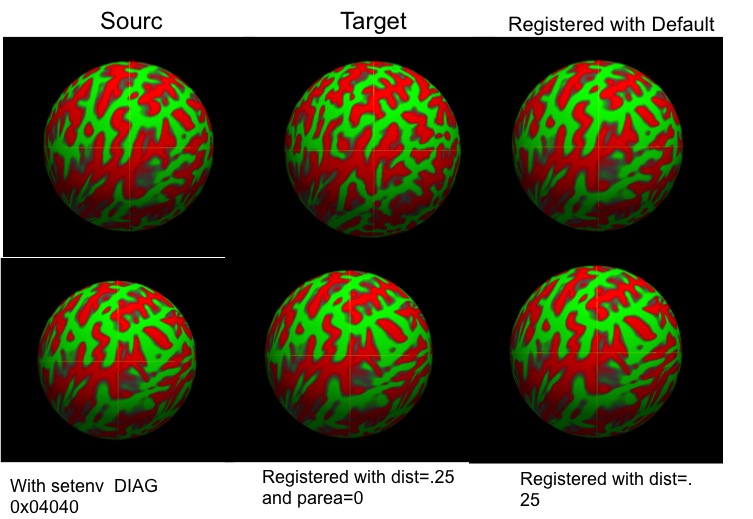
did you try setting dist to .01 or something very small? Note that we don't register individual surfaces to each other for a reason - the inverse variance weighting in the warp functional is critical to it being stable and accurate
cheers Bruce
On Fri, 6 Nov 2015, Razlighi, Qolamreza R. wrote:
Dear Bruce, I did set the DIAG and ran it again with no luck. Below is the output and attached please find the result.
Best[IMAGE]
ray@athens-b8-e8-56-47-e6-54:~> tcsh [athens-b8-e8-56-47-e6-54:~] ray% [athens-b8-e8-56-47-e6-54:~] ray% setenv DIAG 0x04040 [athens-b8-e8-56-47-e6-54:~] ray% [athens-b8-e8-56-47-e6-54:~/Data/P00001613/FreeSurferClean] ray% cd surf/ [athens-b8-e8-56-47-e6-54:P00001613/FreeSurferClean/surf] ray% [athens-b8-e8-56-47-e6-54:P00001613/FreeSurferClean/surf] ray% mris_register -1 -parea 0 -curv -dist .25 lh.sphere ../../../P00001639/FreeSurferClean/surf/lh.sphere lh.sphere_dis25_parea0.reg treating target as a single subject's surface... using l_parea = 0.000 using smoothwm curvature for final alignment l_dist = 0.250 $Id: mris_register.c,v 1.59 2011/03/02 00:04:33 nicks Exp $ $Id: mrisurf.c,v 1.693.2.7 2013/05/12 22:28:01 nicks Exp $ reading surface from lh.sphere... reading spherical surface ../../../P00001639/FreeSurferClean/surf/lh.sphere... curvature mean = -0.000, std = 1.000 computing parameterization for surface ../../../P00001639/FreeSurferClean/surf/lh.inflated.H... curvature mean = 0.000, std = 0.566 computing parameterization for surface ../../../P00001639/FreeSurferClean/surf/lh.sulc... curvature mean = -0.030, std = 0.282 computing parameterization for surface ../../../P00001639/FreeSurferClean/surf/lh.smoothwm... MRISregister() ------- max_passes = 4 min_degrees = 0.500000 max_degrees = 64.000000 nangles = 8 tol=5.0e-01, sigma=0.0, host=athen, nav=1024, nbrs=1, l_extern=10000.000, l_nlarea=1.000, l_corr=1.000, l_dist=0.250 using quadratic fit line minimization complete_dist_mat 0 rms 0 smooth_averages 0 remove_neg 0 ico_order 0 which_surface 0 target_radius 0.000000 nfields 0 scale 0.000000 desired_rms_height -1.000000 momentum 0.950000 nbhd_size -10 max_nbrs 10 niterations 25 nsurfaces 0 SURFACES 3 flags 16 (10) use curv 16 no sulc 0 no rigid align 0 mris->nsize 1 mris->hemisphere 0 randomSeed 0
tol=5.0e-01, sigma=0.0, host=athen, nav=1024, nbrs=1, l_extern=10000.000, l_nlarea=1.000, l_corr=1.000, l_dist=0.250 using quadratic fit line minimization 1 Reading lh.sulc curvature mean = 0.000, std = 0.583 reading precomputed curvature from lh.sulc
blurring surfaces with sigma=4.00... done. curvature mean = 0.044, std = 0.847 curvature mean = 0.022, std = 0.852 finding optimal rigid alignment Starting MRISrigidBodyAlignGlobal() 000: dt: 0.000, sse: 135379.3 (0.279, 21.6, 0.412, 0.853), neg: 0 (%0.00:%0.00), avgs: 1024 scanning 64.00 degree nbhd, min sse = 95165.92 (+64.00, +64.00, -64.00), min @ (0.00, 0.00, 0.00) = 95165.9 scanning 32.00 degree nbhd, min sse = 95165.92 (+32.00, +32.00, -32.00), min @ (8.00, 0.00, 0.00) = 90765.7 d=32.00 min @ (8.00, 0.00, 0.00) sse = 90765.7, tmin=1.1635 min sse = 90765.70 at (8.00, 0.00, 0.00) 001: dt: 0.000, sse: 130979.1 (0.279, 21.6, 0.412, 0.833), neg: 0 (%0.00:%0.00), avgs: 1024 scanning 16.00 degree nbhd, min sse = 90765.70 (+16.00, +16.00, -16.00), min @ (-4.00, -4.00, 0.00) = 87371.6 d=16.00 min @ (-4.00, -4.00, 0.00) sse = 87371.6, tmin=1.7380 min sse = 87371.58 at (-4.00, -4.00, 0.00) 002: dt: 0.000, sse: 127584.9 (0.279, 21.6, 0.412, 0.817), neg: 0 (%0.00:%0.00), avgs: 1024 scanning 8.00 degree nbhd, min sse = 87371.58 (+8.00, +8.00, -8.00), min @ (-2.00, 0.00, 0.00) = 86754.0 d=8.00 min @ (-2.00, 0.00, 0.00) sse = 86754.0, tmin=2.3264 min sse = 86754.03 at (-2.00, 0.00, 0.00) 003: dt: 0.000, sse: 126967.4 (0.279, 21.6, 0.412, 0.814), neg: 0 (%0.00:%0.00), avgs: 1024 scanning 4.00 degree nbhd, min sse = 86754.03 (+4.00, +4.00, -4.00), min @ (1.00, 1.00, 0.00) = 86449.9 d=4.00 min @ (1.00, 1.00, 0.00) sse = 86449.9, tmin=2.9298 min sse = 86449.91 at (1.00, 1.00, 0.00) 004: dt: 0.000, sse: 126663.3 (0.279, 21.6, 0.412, 0.813), neg: 0 (%0.00:%0.00), avgs: 1024 scanning 2.00 degree nbhd, min sse = 86449.91 (+2.00, +2.00, -2.00), min @ (0.00, -0.50, 0.50) = 86436.5 d=2.00 min @ (0.00, -0.50, 0.50) sse = 86436.5, tmin=3.5333 min sse = 86436.46 at (0.00, -0.50, 0.50) 005: dt: 0.000, sse: 126649.8 (0.279, 21.6, 0.412, 0.813), neg: 0 (%0.00:%0.00), avgs: 1024 scanning 1.00 degree nbhd, min sse = 86436.45 (+1.00, +1.00, -1.00), min @ (0.00, 0.25, -0.25) = 86423.4 d=1.00 min @ (0.00, 0.25, -0.25) sse = 86423.4, tmin=4.1242 min sse = 86423.41 at (0.00, 0.25, -0.25) 006: dt: 0.000, sse: 126636.8 (0.279, 21.6, 0.412, 0.813), neg: 0 (%0.00:%0.00), avgs: 1024 scanning 0.50 degree nbhd, min sse = 86423.41 (+0.50, +0.50, -0.50), min @ (0.00, 0.00, 0.00) = 86423.4 MRISrigidBodyAlignGlobal() done 4.71 min tol=5.0e-01, sigma=4.0, host=athen, nav=1024, nbrs=1, l_extern=10000.000, l_nlarea=1.000, l_corr=1.000, l_dist=0.250 using quadratic fit line minimization nlarea/corr = 1.000 integrating with navgs=1024 and tol=5.002e-01 007: dt: 241.975, sse: 109215.9 (0.308, 23.5, 0.429, 0.709), neg: 48 (%0.00:%0.01), avgs: 1024 008: dt: 117.533, sse: 99575.6 (0.298, 23.7, 0.432, 0.651), neg: 50 (%0.00:%0.01), avgs: 1024 009: dt: 136.508, sse: 95352.8 (0.305, 24.1, 0.436, 0.620), neg: 101 (%0.00:%0.02), avgs: 1024 010: dt: 105.985, sse: 92867.4 (0.303, 24.8, 0.442, 0.597), neg: 176 (%0.01:%0.03), avgs: 1024 011: dt: 149.343, sse: 90631.3 (0.311, 25.4, 0.448, 0.573), neg: 334 (%0.01:%0.06), avgs: 1024 012: dt: 85.796, sse: 89225.0 (0.312, 25.9, 0.453, 0.557), neg: 439 (%0.02:%0.08), avgs: 1024 013: dt: 177.745, sse: 87895.2 (0.321, 26.7, 0.460, 0.536), neg: 690 (%0.04:%0.13), avgs: 1024 014: dt: 66.370, sse: 87281.5 (0.322, 27.0, 0.463, 0.527), neg: 782 (%0.05:%0.14), avgs: 1024 015: dt: 236.440, sse: 86602.8 (0.331, 27.8, 0.472, 0.508), neg: 1155 (%0.08:%0.22), avgs: 1024 016: dt: 69.671, sse: 86419.9 (0.332, 28.0, 0.474, 0.502), neg: 1213 (%0.09:%0.23), avgs: 1024 integrating with navgs=256 and tol=2.505e-01 017: dt: 122.246, sse: 82435.7 (0.347, 29.5, 0.492, 0.436), neg: 2026 (%0.16:%0.43), avgs: 256 018: dt: 69.015, sse: 81795.8 (0.350, 29.8, 0.499, 0.417), neg: 1971 (%0.12:%0.42), avgs: 256 019: dt: 36.896, sse: 81619.9 (0.353, 30.1, 0.502, 0.407), neg: 2059 (%0.12:%0.44), avgs: 256 integrating with navgs=64 and tol=1.260e-01 020: dt: 33.532, sse: 80387.5 (0.362, 30.7, 0.513, 0.370), neg: 2300 (%0.10:%0.49), avgs: 64 021: dt: 9.860, sse: 80325.9 (0.364, 30.9, 0.516, 0.362), neg: 2391 (%0.10:%0.51), avgs: 64 integrating with navgs=16 and tol=6.442e-02 022: dt: 6.761, sse: 80080.1 (0.368, 30.9, 0.520, 0.348), neg: 1935 (%0.07:%0.41), avgs: 16 023: dt: 0.929, sse: 80074.6 (0.368, 31.0, 0.521, 0.347), neg: 1928 (%0.06:%0.40), avgs: 16 integrating with navgs=4 and tol=3.494e-02 024: dt: 1.444, sse: 80034.9 (0.370, 31.0, 0.522, 0.343), neg: 1734 (%0.06:%0.35), avgs: 4 025: dt: 0.556, sse: 80028.6 (0.370, 31.0, 0.523, 0.341), neg: 1762 (%0.05:%0.36), avgs: 4 integrating with navgs=1 and tol=2.210e-02 026: dt: 0.066, sse: 80027.9 (0.370, 31.0, 0.523, 0.341), neg: 1753 (%0.05:%0.36), avgs: 1 integrating with navgs=0 and tol=1.562e-02 027: dt: 0.050, sse: 80016.6 (0.370, 31.0, 0.523, 0.341), neg: 1716 (%0.05:%0.33), avgs: 0
blurring surfaces with sigma=2.00... done. curvature mean = 0.035, std = 0.927 curvature mean = 0.011, std = 0.928 tol=5.0e-01, sigma=2.0, host=athen, nav=1024, nbrs=1, l_extern=10000.000, l_nlarea=1.000, l_corr=1.000, l_dist=0.250 using quadratic fit line minimization nlarea/corr = 1.000 integrating with navgs=1024 and tol=5.002e-01 028: dt: 137.600, sse: 83361.7 (0.371, 31.1, 0.524, 0.373), neg: 1570 (%0.04:%0.30), avgs: 1024 integrating with navgs=256 and tol=2.505e-01 029: dt: 16.658, sse: 83344.4 (0.372, 31.1, 0.526, 0.370), neg: 1484 (%0.03:%0.28), avgs: 256 integrating with navgs=64 and tol=1.260e-01 030: dt: 10.485, sse: 83245.6 (0.375, 31.4, 0.530, 0.359), neg: 1316 (%0.03:%0.23), avgs: 64 integrating with navgs=16 and tol=6.442e-02 031: dt: 4.712, sse: 83112.1 (0.379, 31.6, 0.534, 0.346), neg: 1194 (%0.02:%0.19), avgs: 16 032: dt: 0.845, sse: 83109.5 (0.380, 31.6, 0.535, 0.344), neg: 1176 (%0.02:%0.19), avgs: 16 integrating with navgs=4 and tol=3.494e-02 033: dt: 0.700, sse: 83081.6 (0.381, 31.6, 0.536, 0.340), neg: 1147 (%0.02:%0.18), avgs: 4 integrating with navgs=1 and tol=2.210e-02 034: dt: 0.517, sse: 83064.4 (0.382, 31.7, 0.536, 0.338), neg: 1204 (%0.02:%0.19), avgs: 1 integrating with navgs=0 and tol=1.562e-02 035: dt: 0.041, sse: 83050.5 (0.382, 31.7, 0.537, 0.337), neg: 1173 (%0.02:%0.18), avgs: 0 036: dt: 0.042, sse: 83039.7 (0.382, 31.7, 0.537, 0.337), neg: 1171 (%0.02:%0.18), avgs: 0
blurring surfaces with sigma=1.00... done. curvature mean = 0.033, std = 0.955 curvature mean = 0.005, std = 0.964 tol=5.0e-01, sigma=1.0, host=athen, nav=1024, nbrs=1, l_extern=10000.000, l_nlarea=1.000, l_corr=1.000, l_dist=0.250 using quadratic fit line minimization nlarea/corr = 1.000 integrating with navgs=1024 and tol=5.002e-01 037: dt: 115.451, sse: 87076.6 (0.383, 31.7, 0.537, 0.378), neg: 1086 (%0.02:%0.16), avgs: 1024 integrating with navgs=256 and tol=2.505e-01 038: dt: 0.037, sse: 87076.2 (0.383, 31.7, 0.537, 0.378), neg: 1087 (%0.02:%0.16), avgs: 256 integrating with navgs=64 and tol=1.260e-01 039: dt: 6.000, sse: 87067.2 (0.385, 31.9, 0.540, 0.372), neg: 1155 (%0.02:%0.17), avgs: 64 integrating with navgs=16 and tol=6.442e-02 040: dt: 0.771, sse: 87047.6 (0.385, 32.0, 0.540, 0.370), neg: 1166 (%0.02:%0.17), avgs: 16 integrating with navgs=4 and tol=3.494e-02 041: dt: 0.926, sse: 86979.7 (0.387, 32.1, 0.542, 0.365), neg: 1169 (%0.02:%0.17), avgs: 4 042: dt: 0.550, sse: 86964.0 (0.388, 32.2, 0.543, 0.362), neg: 1182 (%0.02:%0.17), avgs: 4 integrating with navgs=1 and tol=2.210e-02 043: dt: 0.255, sse: 86957.1 (0.389, 32.2, 0.544, 0.360), neg: 1203 (%0.02:%0.18), avgs: 1 integrating with navgs=0 and tol=1.562e-02 044: dt: 0.035, sse: 86943.6 (0.389, 32.2, 0.544, 0.359), neg: 1219 (%0.02:%0.17), avgs: 0
blurring surfaces with sigma=0.50... done. curvature mean = 0.033, std = 0.965 curvature mean = 0.001, std = 0.983 tol=5.0e-01, sigma=0.5, host=athen, nav=1024, nbrs=1, l_extern=10000.000, l_nlarea=1.000, l_corr=1.000, l_dist=0.250 using quadratic fit line minimization nlarea/corr = 1.000 integrating with navgs=1024 and tol=5.002e-01 045: dt: 39.869, sse: 89122.8 (0.389, 32.2, 0.544, 0.381), neg: 1239 (%0.02:%0.18), avgs: 1024 integrating with navgs=256 and tol=2.505e-01 046: dt: 0.040, sse: 89122.7 (0.389, 32.2, 0.544, 0.381), neg: 1239 (%0.02:%0.18), avgs: 256 integrating with navgs=64 and tol=1.260e-01 047: dt: 0.015, sse: 89122.7 (0.389, 32.2, 0.544, 0.381), neg: 1239 (%0.02:%0.18), avgs: 64 integrating with navgs=16 and tol=6.442e-02 048: dt: 0.763, sse: 89114.0 (0.390, 32.3, 0.545, 0.379), neg: 1259 (%0.02:%0.18), avgs: 16 integrating with navgs=4 and tol=3.494e-02 049: dt: 0.531, sse: 89093.1 (0.391, 32.4, 0.546, 0.376), neg: 1286 (%0.02:%0.18), avgs: 4 integrating with navgs=1 and tol=2.210e-02 050: dt: 0.280, sse: 89084.5 (0.392, 32.4, 0.547, 0.374), neg: 1315 (%0.02:%0.19), avgs: 1 integrating with navgs=0 and tol=1.562e-02 051: dt: 0.128, sse: 89052.0 (0.393, 32.5, 0.547, 0.372), neg: 1300 (%0.04:%0.18), avgs: 0 052: dt: 0.032, sse: 89024.1 (0.392, 32.5, 0.547, 0.372), neg: 1329 (%0.02:%0.18), avgs: 0 053: dt: 0.033, sse: 89014.9 (0.393, 32.5, 0.547, 0.371), neg: 1377 (%0.02:%0.19), avgs: 0 2 Reading smoothwm curvature mean = -0.027, std = 0.269 calculating curvature of smoothwm surface tol=1.0e+00, sigma=0.5, host=athen, nav=1024, nbrs=1, l_extern=10000.000, l_nlarea=1.000, l_corr=0.050, l_spring=0.500, l_dist=0.250 using quadratic fit line minimization
blurring surfaces with sigma=4.00... done. curvature mean = 0.089, std = 0.338 curvature mean = 0.065, std = 0.378 tol=1.0e+00, sigma=4.0, host=athen, nav=1024, nbrs=1, l_extern=10000.000, l_nlarea=1.000, l_corr=0.050, l_spring=0.500, l_dist=0.250 using quadratic fit line minimization nlarea/corr = 20.000 integrating with navgs=1024 and tol=1.000e+00 054: dt: 3.299, sse: 745272.2 (0.384, 31.8, 0.538, 0.745), neg: 1168 (%0.04:%0.21), avgs: 1024 055: dt: 2.605, sse: 738110.4 (0.379, 31.4, 0.532, 0.748), neg: 740 (%0.01:%0.11), avgs: 1024 integrating with navgs=256 and tol=5.010e-01 056: dt: 2.945, sse: 732954.1 (0.377, 31.2, 0.529, 0.751), neg: 774 (%0.02:%0.13), avgs: 256 057: dt: 2.657, sse: 728543.9 (0.374, 30.9, 0.526, 0.753), neg: 511 (%0.01:%0.08), avgs: 256 058: dt: 2.797, sse: 724908.4 (0.373, 30.8, 0.523, 0.756), neg: 551 (%0.01:%0.09), avgs: 256 059: dt: 2.740, sse: 721596.7 (0.371, 30.6, 0.521, 0.758), neg: 404 (%0.00:%0.06), avgs: 256 integrating with navgs=64 and tol=2.519e-01 060: dt: 0.737, sse: 720241.4 (0.370, 30.4, 0.520, 0.758), neg: 307 (%0.00:%0.05), avgs: 64 integrating with navgs=16 and tol=1.288e-01 061: dt: 6.542, sse: 716147.8 (0.370, 30.3, 0.518, 0.758), neg: 559 (%0.01:%0.07), avgs: 16 062: dt: 1.625, sse: 712606.1 (0.367, 29.9, 0.514, 0.757), neg: 151 (%0.00:%0.02), avgs: 16 063: dt: 11.631, sse: 707697.2 (0.368, 29.9, 0.513, 0.757), neg: 580 (%0.02:%0.06), avgs: 16 064: dt: 1.462, sse: 703515.8 (0.365, 29.3, 0.508, 0.756), neg: 88 (%0.00:%0.01), avgs: 16 065: dt: 29.856, sse: 694749.9 (0.368, 29.3, 0.505, 0.756), neg: 702 (%0.03:%0.07), avgs: 16 066: dt: 1.308, sse: 688816.4 (0.363, 28.4, 0.499, 0.756), neg: 56 (%0.00:%0.01), avgs: 16 067: dt: 25.204, sse: 684304.4 (0.364, 28.4, 0.496, 0.756), neg: 526 (%0.02:%0.06), avgs: 16 068: dt: 1.261, sse: 680584.3 (0.361, 27.8, 0.492, 0.756), neg: 60 (%0.00:%0.01), avgs: 16 069: dt: 10.120, sse: 679053.8 (0.362, 27.8, 0.492, 0.756), neg: 168 (%0.00:%0.01), avgs: 16 070: dt: 1.667, sse: 677616.7 (0.361, 27.6, 0.490, 0.756), neg: 51 (%0.00:%0.00), avgs: 16 071: dt: 6.724, sse: 676628.9 (0.361, 27.6, 0.490, 0.756), neg: 124 (%0.00:%0.01), avgs: 16 072: dt: 1.678, sse: 675656.8 (0.360, 27.5, 0.489, 0.756), neg: 52 (%0.00:%0.01), avgs: 16 073: dt: 8.216, sse: 674570.9 (0.361, 27.5, 0.488, 0.757), neg: 133 (%0.00:%0.01), avgs: 16 074: dt: 1.694, sse: 673512.5 (0.360, 27.3, 0.487, 0.757), neg: 53 (%0.00:%0.01), avgs: 16 075: dt: 1.764, sse: 673109.5 (0.360, 27.3, 0.487, 0.757), neg: 50 (%0.00:%0.00), avgs: 16 integrating with navgs=4 and tol=6.988e-02 076: dt: 22.423, sse: 670854.9 (0.362, 27.2, 0.485, 0.742), neg: 200 (%0.00:%0.02), avgs: 4 077: dt: 1.661, sse: 669613.8 (0.361, 27.0, 0.484, 0.743), neg: 95 (%0.00:%0.01), avgs: 4 078: dt: 4.100, sse: 668786.9 (0.361, 27.0, 0.483, 0.744), neg: 92 (%0.00:%0.01), avgs: 4 079: dt: 3.000, sse: 668304.8 (0.361, 27.0, 0.483, 0.744), neg: 102 (%0.00:%0.01), avgs: 4 080: dt: 1.848, sse: 667791.1 (0.361, 26.9, 0.482, 0.744), neg: 77 (%0.00:%0.01), avgs: 4 081: dt: 5.400, sse: 667120.4 (0.361, 26.9, 0.482, 0.745), neg: 105 (%0.00:%0.01), avgs: 4 082: dt: 1.967, sse: 666614.0 (0.361, 26.8, 0.481, 0.745), neg: 73 (%0.00:%0.01), avgs: 4 083: dt: 4.462, sse: 666103.5 (0.361, 26.8, 0.481, 0.745), neg: 103 (%0.00:%0.01), avgs: 4 084: dt: 2.154, sse: 665621.2 (0.361, 26.8, 0.481, 0.745), neg: 76 (%0.00:%0.01), avgs: 4 085: dt: 2.615, sse: 665218.2 (0.361, 26.7, 0.480, 0.745), neg: 74 (%0.00:%0.01), avgs: 4 integrating with navgs=1 and tol=4.419e-02 086: dt: 2.667, sse: 664951.9 (0.361, 26.7, 0.480, 0.744), neg: 76 (%0.00:%0.01), avgs: 1 integrating with navgs=0 and tol=3.125e-02 087: dt: 0.506, sse: 664875.2 (0.361, 26.7, 0.480, 0.743), neg: 76 (%0.00:%0.01), avgs: 0
blurring surfaces with sigma=2.00... done. curvature mean = 0.090, std = 0.502 curvature mean = 0.020, std = 0.575 tol=1.0e+00, sigma=2.0, host=athen, nav=1024, nbrs=1, l_extern=10000.000, l_nlarea=1.000, l_corr=0.050, l_spring=0.500, l_dist=0.250 using quadratic fit line minimization nlarea/corr = 20.000 integrating with navgs=1024 and tol=1.000e+00 088: dt: 6.568, sse: 665480.4 (0.359, 26.7, 0.479, 0.937), neg: 270 (%0.02:%0.04), avgs: 1024 integrating with navgs=256 and tol=5.010e-01 089: dt: 1.744, sse: 664408.7 (0.359, 26.6, 0.478, 0.938), neg: 58 (%0.00:%0.01), avgs: 256 integrating with navgs=64 and tol=2.519e-01 090: dt: 6.774, sse: 663527.8 (0.360, 26.6, 0.478, 0.941), neg: 186 (%0.01:%0.03), avgs: 64 integrating with navgs=16 and tol=1.288e-01 091: dt: 1.450, sse: 662806.6 (0.359, 26.5, 0.477, 0.939), neg: 45 (%0.00:%0.00), avgs: 16 integrating with navgs=4 and tol=6.988e-02 092: dt: 6.720, sse: 662316.9 (0.359, 26.4, 0.477, 0.920), neg: 63 (%0.00:%0.01), avgs: 4 093: dt: 4.200, sse: 662053.0 (0.360, 26.5, 0.477, 0.913), neg: 85 (%0.00:%0.01), avgs: 4 integrating with navgs=1 and tol=4.419e-02 094: dt: 0.903, sse: 661962.4 (0.360, 26.5, 0.477, 0.910), neg: 79 (%0.00:%0.01), avgs: 1 integrating with navgs=0 and tol=3.125e-02 095: dt: 0.110, sse: 661952.2 (0.360, 26.5, 0.477, 0.909), neg: 73 (%0.00:%0.01), avgs: 0
blurring surfaces with sigma=1.00... done. curvature mean = 0.091, std = 0.611 curvature mean = 0.012, std = 0.719 tol=1.0e+00, sigma=1.0, host=athen, nav=1024, nbrs=1, l_extern=10000.000, l_nlarea=1.000, l_corr=0.050, l_spring=0.500, l_dist=0.250 using quadratic fit line minimization nlarea/corr = 20.000 integrating with navgs=1024 and tol=1.000e+00 096: dt: 8.627, sse: 661315.6 (0.359, 26.4, 0.476, 1.011), neg: 227 (%0.02:%0.04), avgs: 1024 integrating with navgs=256 and tol=5.010e-01 097: dt: 1.786, sse: 660256.5 (0.358, 26.3, 0.475, 1.012), neg: 66 (%0.00:%0.01), avgs: 256 integrating with navgs=64 and tol=2.519e-01 098: dt: 5.077, sse: 659704.2 (0.359, 26.3, 0.474, 1.011), neg: 149 (%0.01:%0.02), avgs: 64 integrating with navgs=16 and tol=1.288e-01 099: dt: 1.431, sse: 659144.8 (0.358, 26.2, 0.474, 1.009), neg: 44 (%0.00:%0.00), avgs: 16 integrating with navgs=4 and tol=6.988e-02 100: dt: 2.714, sse: 658944.9 (0.358, 26.2, 0.474, 0.996), neg: 47 (%0.00:%0.00), avgs: 4 integrating with navgs=1 and tol=4.419e-02 101: dt: 0.075, sse: 658940.8 (0.358, 26.2, 0.474, 0.995), neg: 47 (%0.00:%0.00), avgs: 1 integrating with navgs=0 and tol=3.125e-02 102: dt: 0.054, sse: 658935.4 (0.358, 26.2, 0.474, 0.994), neg: 47 (%0.00:%0.00), avgs: 0
blurring surfaces with sigma=0.50... done. curvature mean = 0.092, std = 0.682 curvature mean = 0.004, std = 0.828 tol=1.0e+00, sigma=0.5, host=athen, nav=1024, nbrs=1, l_extern=10000.000, l_nlarea=1.000, l_corr=0.050, l_spring=0.500, l_dist=0.250 using quadratic fit line minimization nlarea/corr = 20.000 integrating with navgs=1024 and tol=1.000e+00 103: dt: 27.636, sse: 656331.2 (0.358, 26.1, 0.472, 1.092), neg: 165 (%0.01:%0.03), avgs: 1024 integrating with navgs=256 and tol=5.010e-01 104: dt: 2.000, sse: 654661.2 (0.357, 25.9, 0.470, 1.083), neg: 82 (%0.00:%0.01), avgs: 256 integrating with navgs=64 and tol=2.519e-01 105: dt: 3.105, sse: 653928.0 (0.357, 25.8, 0.469, 1.076), neg: 67 (%0.00:%0.01), avgs: 64 integrating with navgs=16 and tol=1.288e-01 106: dt: 2.292, sse: 653418.9 (0.357, 25.8, 0.469, 1.066), neg: 53 (%0.00:%0.01), avgs: 16 integrating with navgs=4 and tol=6.988e-02 107: dt: 1.047, sse: 653125.0 (0.357, 25.8, 0.469, 1.057), neg: 35 (%0.00:%0.00), avgs: 4 integrating with navgs=1 and tol=4.419e-02 108: dt: 0.724, sse: 653027.9 (0.357, 25.8, 0.469, 1.047), neg: 36 (%0.00:%0.00), avgs: 1 integrating with navgs=0 and tol=3.125e-02 109: dt: 0.064, sse: 653009.2 (0.357, 25.8, 0.469, 1.044), neg: 34 (%0.00:%0.00), avgs: 0
Removing remaining folds... tol=1.0e-01, sigma=0.5, host=athen, nav=64, nbrs=1, l_extern=10000.000, l_nlarea=100.000, l_corr=0.001, l_spring=0.005, l_dist=0.002 using quadratic fit line minimization nlarea/corr = 199999.984 integrating with navgs=64 and tol=2.519e-02 110: dt: 5.514, sse: 187681.1 (0.355, 25.8, 0.466, 1.062), neg: 85 (%0.00:%0.01), avgs: 64 111: dt: 1.735, sse: 184602.0 (0.355, 25.7, 0.466, 1.064), neg: 16 (%0.00:%0.00), avgs: 64 112: dt: 2.802, sse: 182518.2 (0.354, 25.7, 0.466, 1.068), neg: 16 (%0.00:%0.00), avgs: 64 113: dt: 3.973, sse: 180638.1 (0.355, 25.8, 0.466, 1.072), neg: 16 (%0.00:%0.00), avgs: 64 114: dt: 2.388, sse: 179649.5 (0.355, 25.8, 0.467, 1.075), neg: 20 (%0.00:%0.00), avgs: 64 115: dt: 3.088, sse: 178962.5 (0.355, 25.9, 0.467, 1.079), neg: 28 (%0.00:%0.00), avgs: 64 116: dt: 2.775, sse: 178633.9 (0.356, 26.0, 0.468, 1.082), neg: 36 (%0.00:%0.00), avgs: 64 117: dt: 0.831, sse: 178379.4 (0.356, 26.0, 0.468, 1.083), neg: 37 (%0.00:%0.00), avgs: 64 118: dt: 2.731, sse: 178093.2 (0.356, 26.1, 0.469, 1.087), neg: 52 (%0.00:%0.00), avgs: 64 119: dt: 0.606, sse: 177994.0 (0.356, 26.1, 0.469, 1.088), neg: 46 (%0.00:%0.00), avgs: 64 120: dt: 0.250, sse: 177987.2 (0.356, 26.1, 0.469, 1.088), neg: 48 (%0.00:%0.00), avgs: 64 integrating with navgs=16 and tol=1.288e-02 121: dt: 0.230, sse: 177851.4 (0.357, 26.1, 0.470, 1.089), neg: 46 (%0.00:%0.00), avgs: 16 122: dt: 0.031, sse: 177844.3 (0.357, 26.1, 0.470, 1.089), neg: 45 (%0.00:%0.00), avgs: 16 integrating with navgs=4 and tol=6.988e-03 123: dt: 0.013, sse: 177801.5 (0.357, 26.1, 0.470, 1.089), neg: 38 (%0.00:%0.00), avgs: 4 124: dt: 0.014, sse: 177784.2 (0.357, 26.1, 0.470, 1.089), neg: 32 (%0.00:%0.00), avgs: 4 125: dt: 0.014, sse: 177779.8 (0.357, 26.1, 0.470, 1.089), neg: 31 (%0.00:%0.00), avgs: 4 integrating with navgs=1 and tol=4.419e-03 126: dt: 0.000, sse: 177779.8 (0.357, 26.1, 0.470, 1.089), neg: 31 (%0.00:%0.00), avgs: 1 integrating with navgs=0 and tol=3.125e-03 127: dt: 0.000, sse: 177746.4 (0.357, 26.1, 0.470, 1.089), neg: 30 (%0.00:%0.00), avgs: 0 128: dt: 0.000, sse: 177734.2 (0.357, 26.1, 0.470, 1.089), neg: 28 (%0.00:%0.00), avgs: 0 129: dt: 0.000, sse: 177734.2 (0.357, 26.1, 0.470, 1.089), neg: 28 (%0.00:%0.00), avgs: 0 registration took 0.25 hours MRISregister() return, current seed 0 expanding nbhd size to 1 writing registered surface to lh.sphere_dis25_parea0.reg... registration took 0.25 hours [athens-b8-e8-56-47-e6-54:P00001613/FreeSurferClean/surf] ray%
-- Ray Razlighi, Ph.D. Assistant Professor Quantitative Neuroimaging Laboratory Division of Cognitive Neuroscience Department of Neurology Columbia University
Alt: razlighi@gmail.com Office Phone: 212-342-1352 Office Fax: 212-342-1838 Website: http://www.columbia.edu/cu/qnl/
On Nov 6, 2015, at 2:16 PM, Bruce Fischl fischl@nmr.mgh.harvard.edu wrote:
Hi Ray try doing: setenv DIAG 0x04040 then run it again and send me the output Bruce On Fri, 6 Nov 2015, Razlighi, Qolamreza R. wrote: Dear Bruce, Thank again for your kind help. I’m running version 5.1.0. Below is the output of the command. I also ran it with parea=0 but almost no change in the result (see the attachment-1) I also plot the sluci map for comparison (see the attachment-2) but still not satisfactory.[IMAGE][IMAGE] Best ~/Data/P00001613/FreeSurferClean/surf\> mris_register -1 -curv -dist .25 lh.sphere ../../../P00001639/FreeSurferClean/surf/lh.sphere lh.sphere_dis25.reg treating target as a single subject's surface... using smoothwm curvature for final alignment l_dist = 0.250 $Id: mris_register.c,v 1.59 2011/03/02 00:04:33 nicks Exp $ $Id: mrisurf.c,v 1.693.2.7 2013/05/12 22:28:01 nicks Exp $ reading surface from lh.sphere... reading spherical surface ../../../P00001639/FreeSurferClean/surf/lh.sphere... curvature mean = -0.000, std = 1.000 computing parameterization for surface ../../../P00001639/FreeSurferClean/surf/lh.inflated.H... curvature mean = 0.000, std = 0.566 computing parameterization for surface ../../../P00001639/FreeSurferClean/surf/lh.sulc... curvature mean = -0.030, std = 0.282 computing parameterization for surface ../../../P00001639/FreeSurferClean/surf/lh.smoothwm... MRISregister() ------- max_passes = 4 min_degrees = 0.500000 max_degrees = 64.000000 nangles = 8 tol=5.0e-01, sigma=0.0, host=unkno, nav=1024, nbrs=1, l_extern=10000.000, l_parea=0.100, l_nlarea=1.000, l_corr=1.000, l_dist=0.250 using quadratic fit line minimization complete_dist_mat 0 rms 0 smooth_averages 0 remove_neg 0 ico_order 0 which_surface 0 target_radius 0.000000 nfields 0 scale 0.000000 desired_rms_height -1.000000 momentum 0.950000 nbhd_size -10 max_nbrs 10 niterations 25 nsurfaces 0 SURFACES 3 flags 16 (10) use curv 16 no sulc 0 no rigid align 0 mris->nsize 1 mris->hemisphere 0 randomSeed 0 -------------------- tol=5.0e-01, sigma=0.0, host=unkno, nav=1024, nbrs=1, l_extern=10000.000, l_parea=0.100, l_nlarea=1.000, l_corr=1.000, l_dist=0.250 using quadratic fit line minimization 1 Reading lh.sulc curvature mean = 0.000, std = 0.583 curvature mean = 0.044, std = 0.847 curvature mean = 0.022, std = 0.852 Starting MRISrigidBodyAlignGlobal() d=32.00 min @ (8.00, 0.00, 0.00) sse = 90765.7, tmin=0.9987 d=16.00 min @ (-4.00, -4.00, 0.00) sse = 87371.6, tmin=1.5086 d=8.00 min @ (-2.00, 0.00, 0.00) sse = 86754.0, tmin=2.0493 d=4.00 min @ (1.00, 1.00, 0.00) sse = 86449.9, tmin=2.5976 d=2.00 min @ (0.00, -0.50, 0.50) sse = 86436.5, tmin=3.1563 d=1.00 min @ (0.00, 0.25, -0.25) sse = 86423.4, tmin=3.6949 MRISrigidBodyAlignGlobal() done 4.24 min curvature mean = 0.036, std = 0.923 curvature mean = 0.010, std = 0.931 curvature mean = 0.036, std = 0.951 curvature mean = 0.004, std = 0.967 curvature mean = 0.036, std = 0.962 curvature mean = 0.001, std = 0.984 2 Reading smoothwm curvature mean = -0.027, std = 0.269 tol=1.0e+00, sigma=0.5, host=unkno, nav=1024, nbrs=1, l_extern=10000.000, l_parea=0.100, l_nlarea=1.000, l_corr=0.050, l_spring=0.500, l_dist=0.250 using quadratic fit line minimization curvature mean = 0.090, std = 0.337 curvature mean = 0.059, std = 0.386 curvature mean = 0.091, std = 0.507 curvature mean = 0.020, std = 0.580 curvature mean = 0.091, std = 0.618 curvature mean = 0.011, std = 0.723 curvature mean = 0.093, std = 0.681 curvature mean = 0.004, std = 0.828 MRISregister() return, current seed 0 expanding nbhd size to 1 writing registered surface to lh.sphere_dis25.reg... -- Ray Razlighi, Ph.D. Assistant Professor Quantitative Neuroimaging Laboratory Division of Cognitive Neuroscience Department of Neurology Columbia University Alt: razlighi@gmail.com Office Phone: 212-342-1352 Office Fax: 212-342-1838 Website: http://www.columbia.edu/cu/qnl/ On Nov 4, 2015, at 7:30 PM, Bruce Fischl <fischl@nmr.mgh.harvard.edu> wrote: Hi Ray what version of FS are you using? Can you send me the output of the command? The distance term will prevent the curvatures from deforming too much. You can set it much smaller and see what happens if you want. There may also be an area constraint. Trying using -parea 0 also (or something small) cheers Bruce On Wed, 4 Nov 2015, Razlighi, Qolamreza R. wrote: Hi Bruce, Thanks for reply. I thought after registering, the source surface's curvature map should be very similar to the target one. I don't see that here. The registered surface has pretty much the same curvature map only slightly shifted. Am I missing something here? Best On Nov 4, 2015, at 5:56 PM, Bruce Fischl <fischl@nmr.mgh.harvard.edu> wrote: Hi Ray that sounds right. The way I visualize these is using nmovie (which I think we include in our distribution) and flipping back and forth between the different images showing the different surfaces/curv maps. Which inaccuracy are you referring to? cheers Bruce On Wed, 4 Nov 2015, Razlighi, Qolamreza R. wrote: Dear Bruce, I did run it again with option (-dist 0.25); however the result did not change much (See the attachment). These results do not seem right to me and I think I’m running the command correctly (see the first email). However, I’m not sure I’m visualizing the curvature maps correctly. I assume the lh.sphere.reg has the same vertices and facets as lh.sphere but slightly displaced in space to match the curvature and sulci map of the source surface to target surface. Therefore, I visualize the lh.sphere.reg by pulling the same lh.curv file from the source image. If this is wrong, please let me know how can I correctly visualize the lh.sphere.reg, otherwise I have no idea why this surface based registration produce such inaccurate results. Any comments or suggestion is greatly appreciated. Best [IMAGE] -- Ray Razlighi, Ph.D. Assistant Professor Quantitative Neuroimaging Laboratory Division of Cognitive Neuroscience Department of Neurology Columbia University Alt: razlighi@gmail.com Office Phone: 212-342-1352 Office Fax: 212-342-1838 Website: http://www.columbia.edu/cu/qnl/ On Nov 3, 2015, at 3:47 PM, Bruce Fischl <fischl@nmr.mgh.harvard.edu> wrote: Hi Ray the -1 means that the target is a single surface and not an atlas, but the registration is still nonlinear. The variances will all be 1 so you may have to play with the weights in the energy functional. We don't do this very much and it probably defaults to quite rigid. Try reducing the weight on the metric preservation term (e.g. -dist .25) if you want it to be more nonlinear cheers Bruce On Tue, 3 Nov 2015, Razlighi, Qolamreza R. wrote: Hi Guys, I read in the sidenote here(https://surfer.nmr.mgh.harvard.edu/fswiki/SurfaceRegAndTemplates
                               )
                                         that
                                         inter-subject
                               surface base registration
                               using
                                         mris_register and
                               -1 flag
                                         performs a sort of
                               rigid registration. So I
                               tried it
                                         between two of my
                                         subjects with the
                               command below
                                         mris_register -1
                               -curv
                                         P00001639/FreeSurferClean/surf/lh.sphere
                                         P00001639/FreeSurferClean/surf/lh.sphere
                                         lh.sphere3.reg
                                         and got the
                               results (see the
                               attachment). It is
                                         clear that the
                               registration
                                         output is just a
                               shifted version of the
                               source.
                                         Having this
                               confirmed I want
                                         to know if there
                               is any way to force the
                                         mris_register to
                               perform a complete
                                         non-linear surface
                               based registration for
                                         inter-subjects
                               registration the
                                         same way it does
                               for template.
                                         I have to mention
                               that I visualize the
                                         lh.sphere3.reg
                               using freeview and
                                         loaded the sane
                               lh.curv on that surface. I
                               hope I’m
                                         not doing anything
                                         stupid.

                                         [IMAGE]
                                         Best
                                         --
                                         Ray Razlighi,
                               Ph.D.
                                         Assistant
                               Professor
                                         Quantitative
                               Neuroimaging Laboratory
                                         Division of
                               Cognitive Neuroscience
                                         Department of
                               Neurology
                                         Columbia
                               University
                                         Alt:
                               razlighi@gmail.com
                                         Office Phone:
                               212-342-1352
                                         Office Fax:
                               212-342-1838
                                         Website:
                               http://www.columbia.edu/cu/qnl/

                                   _______________________________________________
                                   Freesurfer mailing list
                                   Freesurfer@nmr.mgh.harvard.edu
https://mail.nmr.mgh.harvard.edu/mailman/listinf o/freesurfer
                                   The information in this
                               e-mail is intended only for
                               the person
                                   to whom it is
                                   addressed. If you
                               believe this e-mail was sent
                               to you in error
                                   and the e-mail
                                   contains patient
                               information, please contact
                               the Partners
                                   Compliance HelpLine at
                                   http://www.partners.org/complianceline
                               . If the e-mail was sent
                                   to you in error
                                   but does not contain
                               patient information, please
                               contact the
                                   sender and properly
                                   dispose of the e-mail.

                         _______________________________________________
                         Freesurfer mailing list
                         Freesurfer@nmr.mgh.harvard.edu
https://mail.nmr.mgh.harvard.edu/mailman/listinfo/freesurf er
                         The information in this e-mail is
                         intended only for the person to
        whom it
                         is
                         addressed. If you believe this
        e-mail
                         was sent to you in error and the
        e-mail
                         contains patient information,
        please
                         contact the Partners Compliance
        HelpLine
                         at
                         http://www.partners.org/complianceline
        .
                         If the e-mail was sent to you in
        error
                         but does not contain patient
                         information, please contact the
        sender
                         and properly
                         dispose of the e-mail.

                   _______________________________________________
                   Freesurfer mailing list
                   Freesurfer@nmr.mgh.harvard.edu
                   https://mail.nmr.mgh.harvard.edu/mailman/listinfo/freesurfer

             _______________________________________________
             Freesurfer mailing list
             Freesurfer@nmr.mgh.harvard.edu
             https://mail.nmr.mgh.harvard.edu/mailman/listinfo/freesurfer

             The information in this e-mail is intended only
        for the person
             to whom it is
             addressed. If you believe this e-mail was sent
        to you in error
             and the e-mail
             contains patient information, please contact
        the Partners
             Compliance HelpLine at
             http://www.partners.org/complianceline . If the
        e-mail was sent
             to you in error
             but does not contain patient information,
        please contact the
             sender and properly
             dispose of the e-mail.

  _______________________________________________
  Freesurfer mailing list
  Freesurfer@nmr.mgh.harvard.edu
  https://mail.nmr.mgh.harvard.edu/mailman/listinfo/freesurfer


  The information in this e-mail is intended only for the person
  to whom it is
  addressed. If you believe this e-mail was sent to you in error
  and the e-mail
  contains patient information, please contact the Partners
  Compliance HelpLine at
  http://www.partners.org/complianceline . If the e-mail was sent
  to you in error
  but does not contain patient information, please contact the
  sender and properly
  dispose of the e-mail.
Dear Bruce, The one I sent you were with diet .25. I reran it with .01 and now I can see minor non-linear shift ( see the attachment). I know that this registration is set up for the template one and I’m just trying to fins out the base parameter set for the subject to subject surface base registration. Since this is working perfectly for template base I assume by setting the right parameters I can get to something similar. The problem is that the curvature maps after registrations are so different that makes me believe that I’m still doing something wrong. I’m more than happy to try any other suggestion to fix this.
Best[cid:262429E6-1360-4819-B834-884EF40F404E@cpmc.columbia.edu]
-- Ray Razlighi, Ph.D. Assistant Professor Quantitative Neuroimaging Laboratory Division of Cognitive Neuroscience Department of Neurology Columbia University
Alt: razlighi@gmail.commailto:razlighi@gmail.com Office Phone: 212-342-1352 Office Fax: 212-342-1838 Website: http://www.columbia.edu/cu/qnl/
On Nov 6, 2015, at 3:23 PM, Bruce Fischl <fischl@nmr.mgh.harvard.edumailto:fischl@nmr.mgh.harvard.edu> wrote:
did you try setting dist to .01 or something very small? Note that we don't register individual surfaces to each other for a reason - the inverse variance weighting in the warp functional is critical to it being stable and accurate
cheers Bruce
On Fri, 6 Nov 2015, Razlighi, Qolamreza R. wrote:
Dear Bruce, I did set the DIAG and ran it again with no luck. Below is the output and attached please find the result. Best[IMAGE] ray@athens-b8-e8-56-47-e6-54:~> tcsh [athens-b8-e8-56-47-e6-54:~] ray% [athens-b8-e8-56-47-e6-54:~] ray% setenv DIAG 0x04040 [athens-b8-e8-56-47-e6-54:~] ray% [athens-b8-e8-56-47-e6-54:~/Data/P00001613/FreeSurferClean] ray% cd surf/ [athens-b8-e8-56-47-e6-54:P00001613/FreeSurferClean/surf] ray% [athens-b8-e8-56-47-e6-54:P00001613/FreeSurferClean/surf] ray% mris_register -1 -parea 0 -curv -dist .25 lh.sphere ../../../P00001639/FreeSurferClean/surf/lh.sphere lh.sphere_dis25_parea0.reg treating target as a single subject's surface... using l_parea = 0.000 using smoothwm curvature for final alignment l_dist = 0.250 $Id: mris_register.c,v 1.59 2011/03/02 00:04:33 nicks Exp $ $Id: mrisurf.c,v 1.693.2.7 2013/05/12 22:28:01 nicks Exp $ reading surface from lh.sphere... reading spherical surface ../../../P00001639/FreeSurferClean/surf/lh.sphere... curvature mean = -0.000, std = 1.000 computing parameterization for surface ../../../P00001639/FreeSurferClean/surf/lh.inflated.H... curvature mean = 0.000, std = 0.566 computing parameterization for surface ../../../P00001639/FreeSurferClean/surf/lh.sulc... curvature mean = -0.030, std = 0.282 computing parameterization for surface ../../../P00001639/FreeSurferClean/surf/lh.smoothwm... MRISregister() ------- max_passes = 4 min_degrees = 0.500000 max_degrees = 64.000000 nangles = 8 tol=5.0e-01, sigma=0.0, host=athen, nav=1024, nbrs=1, l_extern=10000.000, l_nlarea=1.000, l_corr=1.000, l_dist=0.250 using quadratic fit line minimization complete_dist_mat 0 rms 0 smooth_averages 0 remove_neg 0 ico_order 0 which_surface 0 target_radius 0.000000 nfields 0 scale 0.000000 desired_rms_height -1.000000 momentum 0.950000 nbhd_size -10 max_nbrs 10 niterations 25 nsurfaces 0 SURFACES 3 flags 16 (10) use curv 16 no sulc 0 no rigid align 0 mris->nsize 1 mris->hemisphere 0 randomSeed 0 -------------------- tol=5.0e-01, sigma=0.0, host=athen, nav=1024, nbrs=1, l_extern=10000.000, l_nlarea=1.000, l_corr=1.000, l_dist=0.250 using quadratic fit line minimization 1 Reading lh.sulc curvature mean = 0.000, std = 0.583 reading precomputed curvature from lh.sulc blurring surfaces with sigma=4.00... done. curvature mean = 0.044, std = 0.847 curvature mean = 0.022, std = 0.852 finding optimal rigid alignment Starting MRISrigidBodyAlignGlobal() 000: dt: 0.000, sse: 135379.3 (0.279, 21.6, 0.412, 0.853), neg: 0 (%0.00:%0.00), avgs: 1024 scanning 64.00 degree nbhd, min sse = 95165.92 (+64.00, +64.00, -64.00), min @ (0.00, 0.00, 0.00) = 95165.9 scanning 32.00 degree nbhd, min sse = 95165.92 (+32.00, +32.00, -32.00), min @ (8.00, 0.00, 0.00) = 90765.7 d=32.00 min @ (8.00, 0.00, 0.00) sse = 90765.7, tmin=1.1635 min sse = 90765.70 at (8.00, 0.00, 0.00) 001: dt: 0.000, sse: 130979.1 (0.279, 21.6, 0.412, 0.833), neg: 0 (%0.00:%0.00), avgs: 1024 scanning 16.00 degree nbhd, min sse = 90765.70 (+16.00, +16.00, -16.00), min @ (-4.00, -4.00, 0.00) = 87371.6 d=16.00 min @ (-4.00, -4.00, 0.00) sse = 87371.6, tmin=1.7380 min sse = 87371.58 at (-4.00, -4.00, 0.00) 002: dt: 0.000, sse: 127584.9 (0.279, 21.6, 0.412, 0.817), neg: 0 (%0.00:%0.00), avgs: 1024 scanning 8.00 degree nbhd, min sse = 87371.58 (+8.00, +8.00, -8.00), min @ (-2.00, 0.00, 0.00) = 86754.0 d=8.00 min @ (-2.00, 0.00, 0.00) sse = 86754.0, tmin=2.3264 min sse = 86754.03 at (-2.00, 0.00, 0.00) 003: dt: 0.000, sse: 126967.4 (0.279, 21.6, 0.412, 0.814), neg: 0 (%0.00:%0.00), avgs: 1024 scanning 4.00 degree nbhd, min sse = 86754.03 (+4.00, +4.00, -4.00), min @ (1.00, 1.00, 0.00) = 86449.9 d=4.00 min @ (1.00, 1.00, 0.00) sse = 86449.9, tmin=2.9298 min sse = 86449.91 at (1.00, 1.00, 0.00) 004: dt: 0.000, sse: 126663.3 (0.279, 21.6, 0.412, 0.813), neg: 0 (%0.00:%0.00), avgs: 1024 scanning 2.00 degree nbhd, min sse = 86449.91 (+2.00, +2.00, -2.00), min @ (0.00, -0.50, 0.50) = 86436.5 d=2.00 min @ (0.00, -0.50, 0.50) sse = 86436.5, tmin=3.5333 min sse = 86436.46 at (0.00, -0.50, 0.50) 005: dt: 0.000, sse: 126649.8 (0.279, 21.6, 0.412, 0.813), neg: 0 (%0.00:%0.00), avgs: 1024 scanning 1.00 degree nbhd, min sse = 86436.45 (+1.00, +1.00, -1.00), min @ (0.00, 0.25, -0.25) = 86423.4 d=1.00 min @ (0.00, 0.25, -0.25) sse = 86423.4, tmin=4.1242 min sse = 86423.41 at (0.00, 0.25, -0.25) 006: dt: 0.000, sse: 126636.8 (0.279, 21.6, 0.412, 0.813), neg: 0 (%0.00:%0.00), avgs: 1024 scanning 0.50 degree nbhd, min sse = 86423.41 (+0.50, +0.50, -0.50), min @ (0.00, 0.00, 0.00) = 86423.4 MRISrigidBodyAlignGlobal() done 4.71 min tol=5.0e-01, sigma=4.0, host=athen, nav=1024, nbrs=1, l_extern=10000.000, l_nlarea=1.000, l_corr=1.000, l_dist=0.250 using quadratic fit line minimization nlarea/corr = 1.000 integrating with navgs=1024 and tol=5.002e-01 007: dt: 241.975, sse: 109215.9 (0.308, 23.5, 0.429, 0.709), neg: 48 (%0.00:%0.01), avgs: 1024 008: dt: 117.533, sse: 99575.6 (0.298, 23.7, 0.432, 0.651), neg: 50 (%0.00:%0.01), avgs: 1024 009: dt: 136.508, sse: 95352.8 (0.305, 24.1, 0.436, 0.620), neg: 101 (%0.00:%0.02), avgs: 1024 010: dt: 105.985, sse: 92867.4 (0.303, 24.8, 0.442, 0.597), neg: 176 (%0.01:%0.03), avgs: 1024 011: dt: 149.343, sse: 90631.3 (0.311, 25.4, 0.448, 0.573), neg: 334 (%0.01:%0.06), avgs: 1024 012: dt: 85.796, sse: 89225.0 (0.312, 25.9, 0.453, 0.557), neg: 439 (%0.02:%0.08), avgs: 1024 013: dt: 177.745, sse: 87895.2 (0.321, 26.7, 0.460, 0.536), neg: 690 (%0.04:%0.13), avgs: 1024 014: dt: 66.370, sse: 87281.5 (0.322, 27.0, 0.463, 0.527), neg: 782 (%0.05:%0.14), avgs: 1024 015: dt: 236.440, sse: 86602.8 (0.331, 27.8, 0.472, 0.508), neg: 1155 (%0.08:%0.22), avgs: 1024 016: dt: 69.671, sse: 86419.9 (0.332, 28.0, 0.474, 0.502), neg: 1213 (%0.09:%0.23), avgs: 1024 integrating with navgs=256 and tol=2.505e-01 017: dt: 122.246, sse: 82435.7 (0.347, 29.5, 0.492, 0.436), neg: 2026 (%0.16:%0.43), avgs: 256 018: dt: 69.015, sse: 81795.8 (0.350, 29.8, 0.499, 0.417), neg: 1971 (%0.12:%0.42), avgs: 256 019: dt: 36.896, sse: 81619.9 (0.353, 30.1, 0.502, 0.407), neg: 2059 (%0.12:%0.44), avgs: 256 integrating with navgs=64 and tol=1.260e-01 020: dt: 33.532, sse: 80387.5 (0.362, 30.7, 0.513, 0.370), neg: 2300 (%0.10:%0.49), avgs: 64 021: dt: 9.860, sse: 80325.9 (0.364, 30.9, 0.516, 0.362), neg: 2391 (%0.10:%0.51), avgs: 64 integrating with navgs=16 and tol=6.442e-02 022: dt: 6.761, sse: 80080.1 (0.368, 30.9, 0.520, 0.348), neg: 1935 (%0.07:%0.41), avgs: 16 023: dt: 0.929, sse: 80074.6 (0.368, 31.0, 0.521, 0.347), neg: 1928 (%0.06:%0.40), avgs: 16 integrating with navgs=4 and tol=3.494e-02 024: dt: 1.444, sse: 80034.9 (0.370, 31.0, 0.522, 0.343), neg: 1734 (%0.06:%0.35), avgs: 4 025: dt: 0.556, sse: 80028.6 (0.370, 31.0, 0.523, 0.341), neg: 1762 (%0.05:%0.36), avgs: 4 integrating with navgs=1 and tol=2.210e-02 026: dt: 0.066, sse: 80027.9 (0.370, 31.0, 0.523, 0.341), neg: 1753 (%0.05:%0.36), avgs: 1 integrating with navgs=0 and tol=1.562e-02 027: dt: 0.050, sse: 80016.6 (0.370, 31.0, 0.523, 0.341), neg: 1716 (%0.05:%0.33), avgs: 0 blurring surfaces with sigma=2.00... done. curvature mean = 0.035, std = 0.927 curvature mean = 0.011, std = 0.928 tol=5.0e-01, sigma=2.0, host=athen, nav=1024, nbrs=1, l_extern=10000.000, l_nlarea=1.000, l_corr=1.000, l_dist=0.250 using quadratic fit line minimization nlarea/corr = 1.000 integrating with navgs=1024 and tol=5.002e-01 028: dt: 137.600, sse: 83361.7 (0.371, 31.1, 0.524, 0.373), neg: 1570 (%0.04:%0.30), avgs: 1024 integrating with navgs=256 and tol=2.505e-01 029: dt: 16.658, sse: 83344.4 (0.372, 31.1, 0.526, 0.370), neg: 1484 (%0.03:%0.28), avgs: 256 integrating with navgs=64 and tol=1.260e-01 030: dt: 10.485, sse: 83245.6 (0.375, 31.4, 0.530, 0.359), neg: 1316 (%0.03:%0.23), avgs: 64 integrating with navgs=16 and tol=6.442e-02 031: dt: 4.712, sse: 83112.1 (0.379, 31.6, 0.534, 0.346), neg: 1194 (%0.02:%0.19), avgs: 16 032: dt: 0.845, sse: 83109.5 (0.380, 31.6, 0.535, 0.344), neg: 1176 (%0.02:%0.19), avgs: 16 integrating with navgs=4 and tol=3.494e-02 033: dt: 0.700, sse: 83081.6 (0.381, 31.6, 0.536, 0.340), neg: 1147 (%0.02:%0.18), avgs: 4 integrating with navgs=1 and tol=2.210e-02 034: dt: 0.517, sse: 83064.4 (0.382, 31.7, 0.536, 0.338), neg: 1204 (%0.02:%0.19), avgs: 1 integrating with navgs=0 and tol=1.562e-02 035: dt: 0.041, sse: 83050.5 (0.382, 31.7, 0.537, 0.337), neg: 1173 (%0.02:%0.18), avgs: 0 036: dt: 0.042, sse: 83039.7 (0.382, 31.7, 0.537, 0.337), neg: 1171 (%0.02:%0.18), avgs: 0 blurring surfaces with sigma=1.00... done. curvature mean = 0.033, std = 0.955 curvature mean = 0.005, std = 0.964 tol=5.0e-01, sigma=1.0, host=athen, nav=1024, nbrs=1, l_extern=10000.000, l_nlarea=1.000, l_corr=1.000, l_dist=0.250 using quadratic fit line minimization nlarea/corr = 1.000 integrating with navgs=1024 and tol=5.002e-01 037: dt: 115.451, sse: 87076.6 (0.383, 31.7, 0.537, 0.378), neg: 1086 (%0.02:%0.16), avgs: 1024 integrating with navgs=256 and tol=2.505e-01 038: dt: 0.037, sse: 87076.2 (0.383, 31.7, 0.537, 0.378), neg: 1087 (%0.02:%0.16), avgs: 256 integrating with navgs=64 and tol=1.260e-01 039: dt: 6.000, sse: 87067.2 (0.385, 31.9, 0.540, 0.372), neg: 1155 (%0.02:%0.17), avgs: 64 integrating with navgs=16 and tol=6.442e-02 040: dt: 0.771, sse: 87047.6 (0.385, 32.0, 0.540, 0.370), neg: 1166 (%0.02:%0.17), avgs: 16 integrating with navgs=4 and tol=3.494e-02 041: dt: 0.926, sse: 86979.7 (0.387, 32.1, 0.542, 0.365), neg: 1169 (%0.02:%0.17), avgs: 4 042: dt: 0.550, sse: 86964.0 (0.388, 32.2, 0.543, 0.362), neg: 1182 (%0.02:%0.17), avgs: 4 integrating with navgs=1 and tol=2.210e-02 043: dt: 0.255, sse: 86957.1 (0.389, 32.2, 0.544, 0.360), neg: 1203 (%0.02:%0.18), avgs: 1 integrating with navgs=0 and tol=1.562e-02 044: dt: 0.035, sse: 86943.6 (0.389, 32.2, 0.544, 0.359), neg: 1219 (%0.02:%0.17), avgs: 0 blurring surfaces with sigma=0.50... done. curvature mean = 0.033, std = 0.965 curvature mean = 0.001, std = 0.983 tol=5.0e-01, sigma=0.5, host=athen, nav=1024, nbrs=1, l_extern=10000.000, l_nlarea=1.000, l_corr=1.000, l_dist=0.250 using quadratic fit line minimization nlarea/corr = 1.000 integrating with navgs=1024 and tol=5.002e-01 045: dt: 39.869, sse: 89122.8 (0.389, 32.2, 0.544, 0.381), neg: 1239 (%0.02:%0.18), avgs: 1024 integrating with navgs=256 and tol=2.505e-01 046: dt: 0.040, sse: 89122.7 (0.389, 32.2, 0.544, 0.381), neg: 1239 (%0.02:%0.18), avgs: 256 integrating with navgs=64 and tol=1.260e-01 047: dt: 0.015, sse: 89122.7 (0.389, 32.2, 0.544, 0.381), neg: 1239 (%0.02:%0.18), avgs: 64 integrating with navgs=16 and tol=6.442e-02 048: dt: 0.763, sse: 89114.0 (0.390, 32.3, 0.545, 0.379), neg: 1259 (%0.02:%0.18), avgs: 16 integrating with navgs=4 and tol=3.494e-02 049: dt: 0.531, sse: 89093.1 (0.391, 32.4, 0.546, 0.376), neg: 1286 (%0.02:%0.18), avgs: 4 integrating with navgs=1 and tol=2.210e-02 050: dt: 0.280, sse: 89084.5 (0.392, 32.4, 0.547, 0.374), neg: 1315 (%0.02:%0.19), avgs: 1 integrating with navgs=0 and tol=1.562e-02 051: dt: 0.128, sse: 89052.0 (0.393, 32.5, 0.547, 0.372), neg: 1300 (%0.04:%0.18), avgs: 0 052: dt: 0.032, sse: 89024.1 (0.392, 32.5, 0.547, 0.372), neg: 1329 (%0.02:%0.18), avgs: 0 053: dt: 0.033, sse: 89014.9 (0.393, 32.5, 0.547, 0.371), neg: 1377 (%0.02:%0.19), avgs: 0 2 Reading smoothwm curvature mean = -0.027, std = 0.269 calculating curvature of smoothwm surface tol=1.0e+00, sigma=0.5, host=athen, nav=1024, nbrs=1, l_extern=10000.000, l_nlarea=1.000, l_corr=0.050, l_spring=0.500, l_dist=0.250 using quadratic fit line minimization blurring surfaces with sigma=4.00... done. curvature mean = 0.089, std = 0.338 curvature mean = 0.065, std = 0.378 tol=1.0e+00, sigma=4.0, host=athen, nav=1024, nbrs=1, l_extern=10000.000, l_nlarea=1.000, l_corr=0.050, l_spring=0.500, l_dist=0.250 using quadratic fit line minimization nlarea/corr = 20.000 integrating with navgs=1024 and tol=1.000e+00 054: dt: 3.299, sse: 745272.2 (0.384, 31.8, 0.538, 0.745), neg: 1168 (%0.04:%0.21), avgs: 1024 055: dt: 2.605, sse: 738110.4 (0.379, 31.4, 0.532, 0.748), neg: 740 (%0.01:%0.11), avgs: 1024 integrating with navgs=256 and tol=5.010e-01 056: dt: 2.945, sse: 732954.1 (0.377, 31.2, 0.529, 0.751), neg: 774 (%0.02:%0.13), avgs: 256 057: dt: 2.657, sse: 728543.9 (0.374, 30.9, 0.526, 0.753), neg: 511 (%0.01:%0.08), avgs: 256 058: dt: 2.797, sse: 724908.4 (0.373, 30.8, 0.523, 0.756), neg: 551 (%0.01:%0.09), avgs: 256 059: dt: 2.740, sse: 721596.7 (0.371, 30.6, 0.521, 0.758), neg: 404 (%0.00:%0.06), avgs: 256 integrating with navgs=64 and tol=2.519e-01 060: dt: 0.737, sse: 720241.4 (0.370, 30.4, 0.520, 0.758), neg: 307 (%0.00:%0.05), avgs: 64 integrating with navgs=16 and tol=1.288e-01 061: dt: 6.542, sse: 716147.8 (0.370, 30.3, 0.518, 0.758), neg: 559 (%0.01:%0.07), avgs: 16 062: dt: 1.625, sse: 712606.1 (0.367, 29.9, 0.514, 0.757), neg: 151 (%0.00:%0.02), avgs: 16 063: dt: 11.631, sse: 707697.2 (0.368, 29.9, 0.513, 0.757), neg: 580 (%0.02:%0.06), avgs: 16 064: dt: 1.462, sse: 703515.8 (0.365, 29.3, 0.508, 0.756), neg: 88 (%0.00:%0.01), avgs: 16 065: dt: 29.856, sse: 694749.9 (0.368, 29.3, 0.505, 0.756), neg: 702 (%0.03:%0.07), avgs: 16 066: dt: 1.308, sse: 688816.4 (0.363, 28.4, 0.499, 0.756), neg: 56 (%0.00:%0.01), avgs: 16 067: dt: 25.204, sse: 684304.4 (0.364, 28.4, 0.496, 0.756), neg: 526 (%0.02:%0.06), avgs: 16 068: dt: 1.261, sse: 680584.3 (0.361, 27.8, 0.492, 0.756), neg: 60 (%0.00:%0.01), avgs: 16 069: dt: 10.120, sse: 679053.8 (0.362, 27.8, 0.492, 0.756), neg: 168 (%0.00:%0.01), avgs: 16 070: dt: 1.667, sse: 677616.7 (0.361, 27.6, 0.490, 0.756), neg: 51 (%0.00:%0.00), avgs: 16 071: dt: 6.724, sse: 676628.9 (0.361, 27.6, 0.490, 0.756), neg: 124 (%0.00:%0.01), avgs: 16 072: dt: 1.678, sse: 675656.8 (0.360, 27.5, 0.489, 0.756), neg: 52 (%0.00:%0.01), avgs: 16 073: dt: 8.216, sse: 674570.9 (0.361, 27.5, 0.488, 0.757), neg: 133 (%0.00:%0.01), avgs: 16 074: dt: 1.694, sse: 673512.5 (0.360, 27.3, 0.487, 0.757), neg: 53 (%0.00:%0.01), avgs: 16 075: dt: 1.764, sse: 673109.5 (0.360, 27.3, 0.487, 0.757), neg: 50 (%0.00:%0.00), avgs: 16 integrating with navgs=4 and tol=6.988e-02 076: dt: 22.423, sse: 670854.9 (0.362, 27.2, 0.485, 0.742), neg: 200 (%0.00:%0.02), avgs: 4 077: dt: 1.661, sse: 669613.8 (0.361, 27.0, 0.484, 0.743), neg: 95 (%0.00:%0.01), avgs: 4 078: dt: 4.100, sse: 668786.9 (0.361, 27.0, 0.483, 0.744), neg: 92 (%0.00:%0.01), avgs: 4 079: dt: 3.000, sse: 668304.8 (0.361, 27.0, 0.483, 0.744), neg: 102 (%0.00:%0.01), avgs: 4 080: dt: 1.848, sse: 667791.1 (0.361, 26.9, 0.482, 0.744), neg: 77 (%0.00:%0.01), avgs: 4 081: dt: 5.400, sse: 667120.4 (0.361, 26.9, 0.482, 0.745), neg: 105 (%0.00:%0.01), avgs: 4 082: dt: 1.967, sse: 666614.0 (0.361, 26.8, 0.481, 0.745), neg: 73 (%0.00:%0.01), avgs: 4 083: dt: 4.462, sse: 666103.5 (0.361, 26.8, 0.481, 0.745), neg: 103 (%0.00:%0.01), avgs: 4 084: dt: 2.154, sse: 665621.2 (0.361, 26.8, 0.481, 0.745), neg: 76 (%0.00:%0.01), avgs: 4 085: dt: 2.615, sse: 665218.2 (0.361, 26.7, 0.480, 0.745), neg: 74 (%0.00:%0.01), avgs: 4 integrating with navgs=1 and tol=4.419e-02 086: dt: 2.667, sse: 664951.9 (0.361, 26.7, 0.480, 0.744), neg: 76 (%0.00:%0.01), avgs: 1 integrating with navgs=0 and tol=3.125e-02 087: dt: 0.506, sse: 664875.2 (0.361, 26.7, 0.480, 0.743), neg: 76 (%0.00:%0.01), avgs: 0 blurring surfaces with sigma=2.00... done. curvature mean = 0.090, std = 0.502 curvature mean = 0.020, std = 0.575 tol=1.0e+00, sigma=2.0, host=athen, nav=1024, nbrs=1, l_extern=10000.000, l_nlarea=1.000, l_corr=0.050, l_spring=0.500, l_dist=0.250 using quadratic fit line minimization nlarea/corr = 20.000 integrating with navgs=1024 and tol=1.000e+00 088: dt: 6.568, sse: 665480.4 (0.359, 26.7, 0.479, 0.937), neg: 270 (%0.02:%0.04), avgs: 1024 integrating with navgs=256 and tol=5.010e-01 089: dt: 1.744, sse: 664408.7 (0.359, 26.6, 0.478, 0.938), neg: 58 (%0.00:%0.01), avgs: 256 integrating with navgs=64 and tol=2.519e-01 090: dt: 6.774, sse: 663527.8 (0.360, 26.6, 0.478, 0.941), neg: 186 (%0.01:%0.03), avgs: 64 integrating with navgs=16 and tol=1.288e-01 091: dt: 1.450, sse: 662806.6 (0.359, 26.5, 0.477, 0.939), neg: 45 (%0.00:%0.00), avgs: 16 integrating with navgs=4 and tol=6.988e-02 092: dt: 6.720, sse: 662316.9 (0.359, 26.4, 0.477, 0.920), neg: 63 (%0.00:%0.01), avgs: 4 093: dt: 4.200, sse: 662053.0 (0.360, 26.5, 0.477, 0.913), neg: 85 (%0.00:%0.01), avgs: 4 integrating with navgs=1 and tol=4.419e-02 094: dt: 0.903, sse: 661962.4 (0.360, 26.5, 0.477, 0.910), neg: 79 (%0.00:%0.01), avgs: 1 integrating with navgs=0 and tol=3.125e-02 095: dt: 0.110, sse: 661952.2 (0.360, 26.5, 0.477, 0.909), neg: 73 (%0.00:%0.01), avgs: 0 blurring surfaces with sigma=1.00... done. curvature mean = 0.091, std = 0.611 curvature mean = 0.012, std = 0.719 tol=1.0e+00, sigma=1.0, host=athen, nav=1024, nbrs=1, l_extern=10000.000, l_nlarea=1.000, l_corr=0.050, l_spring=0.500, l_dist=0.250 using quadratic fit line minimization nlarea/corr = 20.000 integrating with navgs=1024 and tol=1.000e+00 096: dt: 8.627, sse: 661315.6 (0.359, 26.4, 0.476, 1.011), neg: 227 (%0.02:%0.04), avgs: 1024 integrating with navgs=256 and tol=5.010e-01 097: dt: 1.786, sse: 660256.5 (0.358, 26.3, 0.475, 1.012), neg: 66 (%0.00:%0.01), avgs: 256 integrating with navgs=64 and tol=2.519e-01 098: dt: 5.077, sse: 659704.2 (0.359, 26.3, 0.474, 1.011), neg: 149 (%0.01:%0.02), avgs: 64 integrating with navgs=16 and tol=1.288e-01 099: dt: 1.431, sse: 659144.8 (0.358, 26.2, 0.474, 1.009), neg: 44 (%0.00:%0.00), avgs: 16 integrating with navgs=4 and tol=6.988e-02 100: dt: 2.714, sse: 658944.9 (0.358, 26.2, 0.474, 0.996), neg: 47 (%0.00:%0.00), avgs: 4 integrating with navgs=1 and tol=4.419e-02 101: dt: 0.075, sse: 658940.8 (0.358, 26.2, 0.474, 0.995), neg: 47 (%0.00:%0.00), avgs: 1 integrating with navgs=0 and tol=3.125e-02 102: dt: 0.054, sse: 658935.4 (0.358, 26.2, 0.474, 0.994), neg: 47 (%0.00:%0.00), avgs: 0 blurring surfaces with sigma=0.50... done. curvature mean = 0.092, std = 0.682 curvature mean = 0.004, std = 0.828 tol=1.0e+00, sigma=0.5, host=athen, nav=1024, nbrs=1, l_extern=10000.000, l_nlarea=1.000, l_corr=0.050, l_spring=0.500, l_dist=0.250 using quadratic fit line minimization nlarea/corr = 20.000 integrating with navgs=1024 and tol=1.000e+00 103: dt: 27.636, sse: 656331.2 (0.358, 26.1, 0.472, 1.092), neg: 165 (%0.01:%0.03), avgs: 1024 integrating with navgs=256 and tol=5.010e-01 104: dt: 2.000, sse: 654661.2 (0.357, 25.9, 0.470, 1.083), neg: 82 (%0.00:%0.01), avgs: 256 integrating with navgs=64 and tol=2.519e-01 105: dt: 3.105, sse: 653928.0 (0.357, 25.8, 0.469, 1.076), neg: 67 (%0.00:%0.01), avgs: 64 integrating with navgs=16 and tol=1.288e-01 106: dt: 2.292, sse: 653418.9 (0.357, 25.8, 0.469, 1.066), neg: 53 (%0.00:%0.01), avgs: 16 integrating with navgs=4 and tol=6.988e-02 107: dt: 1.047, sse: 653125.0 (0.357, 25.8, 0.469, 1.057), neg: 35 (%0.00:%0.00), avgs: 4 integrating with navgs=1 and tol=4.419e-02 108: dt: 0.724, sse: 653027.9 (0.357, 25.8, 0.469, 1.047), neg: 36 (%0.00:%0.00), avgs: 1 integrating with navgs=0 and tol=3.125e-02 109: dt: 0.064, sse: 653009.2 (0.357, 25.8, 0.469, 1.044), neg: 34 (%0.00:%0.00), avgs: 0 Removing remaining folds... tol=1.0e-01, sigma=0.5, host=athen, nav=64, nbrs=1, l_extern=10000.000, l_nlarea=100.000, l_corr=0.001, l_spring=0.005, l_dist=0.002 using quadratic fit line minimization nlarea/corr = 199999.984 integrating with navgs=64 and tol=2.519e-02 110: dt: 5.514, sse: 187681.1 (0.355, 25.8, 0.466, 1.062), neg: 85 (%0.00:%0.01), avgs: 64 111: dt: 1.735, sse: 184602.0 (0.355, 25.7, 0.466, 1.064), neg: 16 (%0.00:%0.00), avgs: 64 112: dt: 2.802, sse: 182518.2 (0.354, 25.7, 0.466, 1.068), neg: 16 (%0.00:%0.00), avgs: 64 113: dt: 3.973, sse: 180638.1 (0.355, 25.8, 0.466, 1.072), neg: 16 (%0.00:%0.00), avgs: 64 114: dt: 2.388, sse: 179649.5 (0.355, 25.8, 0.467, 1.075), neg: 20 (%0.00:%0.00), avgs: 64 115: dt: 3.088, sse: 178962.5 (0.355, 25.9, 0.467, 1.079), neg: 28 (%0.00:%0.00), avgs: 64 116: dt: 2.775, sse: 178633.9 (0.356, 26.0, 0.468, 1.082), neg: 36 (%0.00:%0.00), avgs: 64 117: dt: 0.831, sse: 178379.4 (0.356, 26.0, 0.468, 1.083), neg: 37 (%0.00:%0.00), avgs: 64 118: dt: 2.731, sse: 178093.2 (0.356, 26.1, 0.469, 1.087), neg: 52 (%0.00:%0.00), avgs: 64 119: dt: 0.606, sse: 177994.0 (0.356, 26.1, 0.469, 1.088), neg: 46 (%0.00:%0.00), avgs: 64 120: dt: 0.250, sse: 177987.2 (0.356, 26.1, 0.469, 1.088), neg: 48 (%0.00:%0.00), avgs: 64 integrating with navgs=16 and tol=1.288e-02 121: dt: 0.230, sse: 177851.4 (0.357, 26.1, 0.470, 1.089), neg: 46 (%0.00:%0.00), avgs: 16 122: dt: 0.031, sse: 177844.3 (0.357, 26.1, 0.470, 1.089), neg: 45 (%0.00:%0.00), avgs: 16 integrating with navgs=4 and tol=6.988e-03 123: dt: 0.013, sse: 177801.5 (0.357, 26.1, 0.470, 1.089), neg: 38 (%0.00:%0.00), avgs: 4 124: dt: 0.014, sse: 177784.2 (0.357, 26.1, 0.470, 1.089), neg: 32 (%0.00:%0.00), avgs: 4 125: dt: 0.014, sse: 177779.8 (0.357, 26.1, 0.470, 1.089), neg: 31 (%0.00:%0.00), avgs: 4 integrating with navgs=1 and tol=4.419e-03 126: dt: 0.000, sse: 177779.8 (0.357, 26.1, 0.470, 1.089), neg: 31 (%0.00:%0.00), avgs: 1 integrating with navgs=0 and tol=3.125e-03 127: dt: 0.000, sse: 177746.4 (0.357, 26.1, 0.470, 1.089), neg: 30 (%0.00:%0.00), avgs: 0 128: dt: 0.000, sse: 177734.2 (0.357, 26.1, 0.470, 1.089), neg: 28 (%0.00:%0.00), avgs: 0 129: dt: 0.000, sse: 177734.2 (0.357, 26.1, 0.470, 1.089), neg: 28 (%0.00:%0.00), avgs: 0 registration took 0.25 hours MRISregister() return, current seed 0 expanding nbhd size to 1 writing registered surface to lh.sphere_dis25_parea0.reg... registration took 0.25 hours [athens-b8-e8-56-47-e6-54:P00001613/FreeSurferClean/surf] ray%
-- Ray Razlighi, Ph.D. Assistant Professor Quantitative Neuroimaging Laboratory Division of Cognitive Neuroscience Department of Neurology Columbia University Alt: razlighi@gmail.commailto:razlighi@gmail.com Office Phone: 212-342-1352 Office Fax: 212-342-1838 Website: http://www.columbia.edu/cu/qnl/ On Nov 6, 2015, at 2:16 PM, Bruce Fischl <fischl@nmr.mgh.harvard.edumailto:fischl@nmr.mgh.harvard.edu> wrote:
Hi Ray
try doing:
setenv DIAG 0x04040
then run it again and send me the output
Bruce
On Fri, 6 Nov 2015, Razlighi, Qolamreza R. wrote:
Dear Bruce, Thank again for your kind help. I’m running version 5.1.0. Below is the output of the command. I also ran it with parea=0 but almost no change in the result (see the attachment-1) I also plot the sluci map for comparison (see the attachment-2) but still not satisfactory.[IMAGE][IMAGE] Best ~/Data/P00001613/FreeSurferClean/surf> mris_register -1 -curv -dist .25 lh.sphere ../../../P00001639/FreeSurferClean/surf/lh.sphere lh.sphere_dis25.reg treating target as a single subject's surface... using smoothwm curvature for final alignment l_dist = 0.250 $Id: mris_register.c,v 1.59 2011/03/02 00:04:33 nicks Exp $ $Id: mrisurf.c,v 1.693.2.7 2013/05/12 22:28:01 nicks Exp $ reading surface from lh.sphere... reading spherical surface ../../../P00001639/FreeSurferClean/surf/lh.sphere... curvature mean = -0.000, std = 1.000 computing parameterization for surface ../../../P00001639/FreeSurferClean/surf/lh.inflated.H... curvature mean = 0.000, std = 0.566 computing parameterization for surface ../../../P00001639/FreeSurferClean/surf/lh.sulc... curvature mean = -0.030, std = 0.282 computing parameterization for surface ../../../P00001639/FreeSurferClean/surf/lh.smoothwm... MRISregister() ------- max_passes = 4 min_degrees = 0.500000 max_degrees = 64.000000 nangles = 8 tol=5.0e-01, sigma=0.0, host=unkno, nav=1024, nbrs=1, l_extern=10000.000, l_parea=0.100, l_nlarea=1.000, l_corr=1.000, l_dist=0.250 using quadratic fit line minimization complete_dist_mat 0 rms 0 smooth_averages 0 remove_neg 0 ico_order 0 which_surface 0 target_radius 0.000000 nfields 0 scale 0.000000 desired_rms_height -1.000000 momentum 0.950000 nbhd_size -10 max_nbrs 10 niterations 25 nsurfaces 0 SURFACES 3 flags 16 (10) use curv 16 no sulc 0 no rigid align 0 mris->nsize 1 mris->hemisphere 0 randomSeed 0 -------------------- tol=5.0e-01, sigma=0.0, host=unkno, nav=1024, nbrs=1, l_extern=10000.000, l_parea=0.100, l_nlarea=1.000, l_corr=1.000, l_dist=0.250 using quadratic fit line minimization 1 Reading lh.sulc curvature mean = 0.000, std = 0.583 curvature mean = 0.044, std = 0.847 curvature mean = 0.022, std = 0.852 Starting MRISrigidBodyAlignGlobal() d=32.00 min @ (8.00, 0.00, 0.00) sse = 90765.7, tmin=0.9987 d=16.00 min @ (-4.00, -4.00, 0.00) sse = 87371.6, tmin=1.5086 d=8.00 min @ (-2.00, 0.00, 0.00) sse = 86754.0, tmin=2.0493 d=4.00 min @ (1.00, 1.00, 0.00) sse = 86449.9, tmin=2.5976 d=2.00 min @ (0.00, -0.50, 0.50) sse = 86436.5, tmin=3.1563 d=1.00 min @ (0.00, 0.25, -0.25) sse = 86423.4, tmin=3.6949 MRISrigidBodyAlignGlobal() done 4.24 min curvature mean = 0.036, std = 0.923 curvature mean = 0.010, std = 0.931 curvature mean = 0.036, std = 0.951 curvature mean = 0.004, std = 0.967 curvature mean = 0.036, std = 0.962 curvature mean = 0.001, std = 0.984 2 Reading smoothwm curvature mean = -0.027, std = 0.269 tol=1.0e+00, sigma=0.5, host=unkno, nav=1024, nbrs=1, l_extern=10000.000, l_parea=0.100, l_nlarea=1.000, l_corr=0.050, l_spring=0.500, l_dist=0.250 using quadratic fit line minimization curvature mean = 0.090, std = 0.337 curvature mean = 0.059, std = 0.386 curvature mean = 0.091, std = 0.507 curvature mean = 0.020, std = 0.580 curvature mean = 0.091, std = 0.618 curvature mean = 0.011, std = 0.723 curvature mean = 0.093, std = 0.681 curvature mean = 0.004, std = 0.828 MRISregister() return, current seed 0 expanding nbhd size to 1 writing registered surface to lh.sphere_dis25.reg... -- Ray Razlighi, Ph.D. Assistant Professor Quantitative Neuroimaging Laboratory Division of Cognitive Neuroscience Department of Neurology Columbia University Alt: razlighi@gmail.commailto:razlighi@gmail.com Office Phone: 212-342-1352 Office Fax: 212-342-1838 Website: http://www.columbia.edu/cu/qnl/ On Nov 4, 2015, at 7:30 PM, Bruce Fischl <fischl@nmr.mgh.harvard.edumailto:fischl@nmr.mgh.harvard.edu> wrote:
Hi Ray
what version of FS are you using? Can you send me the output of the command? The distance term will prevent the curvatures from deforming too much. You can set it much smaller and see what happens if you want. There may also be an area constraint. Trying using -parea 0 also (or something small)
cheers Bruce
On Wed, 4 Nov 2015, Razlighi, Qolamreza R. wrote:
Hi Bruce, Thanks for reply. I thought after registering, the source surface's curvature map should be very similar to the target one. I don't see that here. The registered surface has pretty much the same curvature map only slightly shifted. Am I missing something here?
Best
On Nov 4, 2015, at 5:56 PM, Bruce Fischl <fischl@nmr.mgh.harvard.edumailto:fischl@nmr.mgh.harvard.edu> wrote:
Hi Ray
that sounds right. The way I visualize these is using nmovie (which I think we include in our distribution) and flipping back and forth between the different images showing the different surfaces/curv maps.
Which inaccuracy are you referring to?
cheers Bruce
On Wed, 4 Nov 2015, Razlighi, Qolamreza R. wrote:
Dear Bruce, I did run it again with option (-dist 0.25); however the result did not change much (See the attachment). These results do not seem right to me and I think I’m running the command correctly (see the first email). However, I’m not sure I’m visualizing the curvature maps correctly. I assume the lh.sphere.reg has the same vertices and facets as lh.sphere but slightly displaced in space to match the curvature and sulci map of the source surface to target surface. Therefore, I visualize the lh.sphere.reg by pulling the same lh.curv file from the source image. If this is wrong, please let me know how can I correctly visualize the lh.sphere.reg, otherwise I have no idea why this surface based registration produce such inaccurate results. Any comments or suggestion is greatly appreciated. Best [IMAGE] -- Ray Razlighi, Ph.D. Assistant Professor Quantitative Neuroimaging Laboratory Division of Cognitive Neuroscience Department of Neurology Columbia University Alt: razlighi@gmail.commailto:razlighi@gmail.com Office Phone: 212-342-1352 Office Fax: 212-342-1838 Website: http://www.columbia.edu/cu/qnl/ On Nov 3, 2015, at 3:47 PM, Bruce Fischl <fischl@nmr.mgh.harvard.edumailto:fischl@nmr.mgh.harvard.edu> wrote:
Hi Ray
the -1 means that the target is a single surface and not an atlas, but the registration is still nonlinear. The variances will all be 1 so you may have to play with the weights in the energy functional. We don't do this very much and it probably defaults to quite rigid. Try reducing the weight on the metric preservation term (e.g. -dist .25) if you want it to be more nonlinear
cheers Bruce
On Tue, 3 Nov 2015, Razlighi, Qolamreza R. wrote:
Hi Guys, I read in the sidenote here (https://surfer.nmr.mgh.harvard.edu/fswiki/SurfaceRegAndTemplates
) that inter-subject surface base registration using mris_register and -1 flag performs a sort of rigid registration. So I tried it between two of my subjects with the command below mris_register -1 -curv P00001639/FreeSurferClean/surf/lh.sphere P00001639/FreeSurferClean/surf/lh.sphere lh.sphere3.reg and got the results (see the attachment). It is clear that the registration output is just a shifted version of the source. Having this confirmed I want to know if there is any way to force the mris_register to perform a complete non-linear surface based registration for inter-subjects registration the same way it does for template. I have to mention that I visualize the lh.sphere3.reg using freeview and loaded the sane lh.curv on that surface. I hope I’m not doing anything stupid.
[IMAGE] Best -- Ray Razlighi, Ph.D. Assistant Professor Quantitative Neuroimaging Laboratory Division of Cognitive Neuroscience Department of Neurology Columbia University Alt: razlighi@gmail.commailto:razlighi@gmail.com Office Phone: 212-342-1352 Office Fax: 212-342-1838 Website: http://www.columbia.edu/cu/qnl/
_______________________________________________ Freesurfer mailing list Freesurfer@nmr.mgh.harvard.edumailto:Freesurfer@nmr.mgh.harvard.edu https://mail.nmr.mgh.harvard.edu/mailman/listinf o/freesurfer
The information in this e-mail is intended only for the person to whom it is addressed. If you believe this e-mail was sent to you in error and the e-mail contains patient information, please contact the Partners Compliance HelpLine at http://www.partners.org/complianceline . If the e-mail was sent to you in error but does not contain patient information, please contact the sender and properly dispose of the e-mail.
_______________________________________________ Freesurfer mailing list Freesurfer@nmr.mgh.harvard.edumailto:Freesurfer@nmr.mgh.harvard.edu https://mail.nmr.mgh.harvard.edu/mailman/listinfo/freesurf er
The information in this e-mail is intended only for the person to whom it is addressed. If you believe this e-mail was sent to you in error and the e-mail contains patient information, please contact the Partners Compliance HelpLine at http://www.partners.org/complianceline . If the e-mail was sent to you in error but does not contain patient information, please contact the sender and properly dispose of the e-mail.
_______________________________________________ Freesurfer mailing list Freesurfer@nmr.mgh.harvard.edumailto:Freesurfer@nmr.mgh.harvard.edu https://mail.nmr.mgh.harvard.edu/mailman/listinfo/freesurfer
_______________________________________________ Freesurfer mailing list Freesurfer@nmr.mgh.harvard.edumailto:Freesurfer@nmr.mgh.harvard.edu https://mail.nmr.mgh.harvard.edu/mailman/listinfo/freesurfer
The information in this e-mail is intended only for the person to whom it is addressed. If you believe this e-mail was sent to you in error and the e-mail contains patient information, please contact the Partners Compliance HelpLine at http://www.partners.org/complianceline . If the e-mail was sent to you in error but does not contain patient information, please contact the sender and properly dispose of the e-mail.
_______________________________________________ Freesurfer mailing list Freesurfer@nmr.mgh.harvard.edumailto:Freesurfer@nmr.mgh.harvard.edu https://mail.nmr.mgh.harvard.edu/mailman/listinfo/freesurfer
The information in this e-mail is intended only for the person to whom it is addressed. If you believe this e-mail was sent to you in error and the e-mail contains patient information, please contact the Partners Compliance HelpLine at http://www.partners.org/complianceline . If the e-mail was sent to you in error but does not contain patient information, please contact the sender and properly dispose of the e-mail. _______________________________________________ Freesurfer mailing list Freesurfer@nmr.mgh.harvard.edumailto:Freesurfer@nmr.mgh.harvard.edu https://mail.nmr.mgh.harvard.edu/mailman/listinfo/freesurfer
The information in this e-mail is intended only for the person to whom it is addressed. If you believe this e-mail was sent to you in error and the e-mail contains patient information, please contact the Partners Compliance HelpLine at http://www.partners.org/complianceline . If the e-mail was sent to you in error but does not contain patient information, please contact the sender and properly dispose of the e-mail.

freesurfer@nmr.mgh.harvard.edu
-
 Bruce Fischl
 -
 Razlighi, Qolamreza R.